An 8th Grade Science Diagnostic and Review System



About This Product
Start the year with a clear picture of student readiness using this 8th grade beginning of year science assessment and targeted skills system. With a 50-question diagnostic worth 114 points, scoring and analysis tools, instructional grouping support, 11 targeted follow-up practice pages, scientific reading passages, CER tasks, and complete explained answer keys, this resource helps teachers move from assessment results to focused instruction.
Designed as a complete Assess → Analyze → Group → Review → Reteach system, this Grade 8 science resource emphasizes the reasoning demands students need as they prepare for high school science. Students analyze multi-step problems, real-world scenarios, data tables, experimental setups, scientific models, graphs, reading passages, and Claim-Evidence-Reasoning tasks across Life Science, Physical Science, Earth & Space Science, and Scientific Practices & Reading.
What’s Included
This 8th grade science assessment and review system includes:
✅ 50-question beginning-of-year science diagnostic
✅ 114 total assessment points
✅ Life Science questions
✅ Physical Science questions
✅ Earth & Space Science questions
✅ Scientific Practices & Reading questions
✅ Multiple-choice questions
✅ Short-answer questions
✅ Diagram and model interpretation
✅ Data tables
✅ Graph reading
✅ Multi-step reasoning tasks
✅ Scientific scenarios
✅ Vocabulary-in-context questions
✅ Claim-Evidence-Reasoning (CER) tasks
✅ 2 short scientific reading passages
✅ Evidence-based reading questions
✅ Pedigree interpretation
✅ Natural selection and adaptation analysis
✅ Finch selection data
✅ Cladogram interpretation
✅ Predator-prey data
✅ Periodic table patterns
✅ Chemical equation reasoning
✅ Conservation of mass data
✅ Velocity-time graph analysis
✅ Wave anatomy
✅ Transverse and longitudinal wave comparison
✅ Electromagnetic spectrum interpretation
✅ Seafloor-spreading model
✅ Spreading-rate calculation
✅ Star life-cycle model
✅ Atmospheric CO₂ graph analysis
✅ Experimental design and reliability
✅ Mean and outlier analysis
✅ Two-series graph interpretation
✅ Answer recording sheet
✅ Quick-reference answer key
✅ Skill-by-skill scoring chart
✅ Strand analysis tool
✅ Secure, Developing, and Needs Support performance bands
✅ Individual Student Performance Profile
✅ Whole-class data tracker
✅ Suggested instructional groups
✅ 11 targeted follow-up science practice pages
✅ “Key Concept” refresher on every follow-up page
✅ “Extension” task for students who are Secure
✅ All-new follow-up practice with no repeated assessment questions
✅ Reading-for-evidence follow-up practice
✅ CER writing follow-up practice
✅ Complete answer keys
✅ Suggested short-answer responses
✅ Suggested reading-response answers
✅ Completed visual and diagram answers
✅ Sample CER responses
✅ Short “why” explanation for every assessment item
✅ Partial-credit guidance
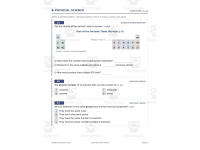
Part 1 contains 50 rigorous mixed-format questions worth 114 total points. The Teacher Guide recommends two 45-minute sessions and explains that the diagnostic emphasizes multi-step reasoning, evidence-based conclusions, data tables, experimental setups, model interpretation, and reading scientific text for evidence.
Part 2 turns student responses into actionable data with an answer recording sheet, quick-reference key, skill-by-skill scoring chart, strand analysis, performance bands, individual student profiles, a whole-class data tracker, and suggested instructional groups.
Part 3 includes 11 ready-to-assign targeted follow-up pages with all-new practice. Every page includes a concise Key Concept refresher and an Extension task, and the set includes dedicated pages for Reading Science for Evidence and CER Writing.
Part 4 provides correct answers for all 50 questions, explanations of why answers are correct, suggested responses for short-answer and reading tasks, completed diagrams, sample CER responses, and partial-credit guidance.
How It Works in the Classroom
Use this 8th grade beginning of year science assessment during the first weeks of school to identify what students retained from prior science learning, how well they reason through multi-step problems, and where instruction should begin.
The resource follows a practical five-step system:
🔎 Assess — Students complete the 50-item mixed-format science diagnostic
📊 Analyze — Score by skill and strand to identify patterns and gaps
👥 Group — Form targeted instructional groups based on shared needs
📝 Review — Assign focused follow-up practice by strand or skill
🎯 Reteach — Use complete explanations, worked visuals, and model CER responses to support next steps
The Assess → Reteach System chart on page 2 of Part 1 directly connects each stage to the matching component of the four-part resource. The same page summarizes the 50 questions, 114 points, broad format range, four reporting areas, two scientific reading passages, and suggested administration time.
Use this resource for:
⭐ Beginning-of-year science assessment
⭐ 8th grade science diagnostic
⭐ Middle school science pre-assessment
⭐ Back-to-school science review
⭐ High school science readiness
⭐ Science readiness check
⭐ Formative assessment
⭐ Small-group planning
⭐ Science intervention
⭐ Targeted reteaching
⭐ Data-driven instruction
⭐ Skill-based grouping
⭐ Independent follow-up practice
⭐ Science stations
⭐ CER practice
⭐ Reading in science
⭐ Text-evidence practice
⭐ Graph and data interpretation
⭐ Multi-step science reasoning
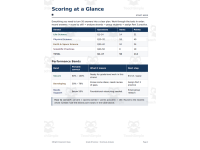
The Scoring at a Glance chart on page 2 of Part 2 breaks the assessment into four strand totals: Life Science /31, Physical Science /40, Earth & Space Science /24, and Scientific Practices /19, for 114 total points. It also defines three performance bands: Secure (80%–100%), Developing (50%–79%), and Needs Support (below 50%).
The Student Performance Profile on page 15 of Part 2 gives teachers a one-page strand snapshot with space for strengths, focus areas, assigned Part 3 practice pages, and group placement. The Class Data Tracker on page 16 provides a whole-class view so teachers can scan columns for class-wide gaps and rows for individual grouping needs.
Standards & Learning Goals
This eighth grade science diagnostic assessment reviews foundational science concepts and advanced scientific reasoning across four major areas:
🌱 Life Science — levels of biological organization, homeostasis, interacting body systems, pedigrees, mutations, natural selection, evolution, adaptations, selection pressure, inheritance, cladograms, common ancestry, predator-prey relationships, biodiversity, ecosystem resilience, and evolution CER reasoning
⚛️ Physical Science — periodic table patterns, atomic number, protons, groups and periods, valence electrons, periodic trends, balancing chemical equations, conservation of mass, open and closed systems, exothermic and endothermic reactions, velocity-time graphs, Newton’s second law, kinetic energy, potential and kinetic energy transformations, wave anatomy, transverse and longitudinal waves, wavelength and frequency, electromagnetic spectrum, and wave-energy transfer
🌎 Earth & Space Science — seafloor spreading, magnetic stripes, evidence for plate tectonics, mantle convection, spreading-rate calculations, star life cycles, gravity and orbits, light-years, tides, atmospheric CO₂ trends, and Earth-and-space CER reasoning
🔬 Scientific Practices & Reading — reliable experimental design, repeated trials, control groups, identifying experimental flaws, graph analysis, comparing data series, calculating means, identifying outliers, reading scientific texts for evidence, connecting evidence to science concepts, drawing evidence-based conclusions, and reading-based CER
Students demonstrate understanding through varied science tasks rather than one question type. The diagnostic includes a pedigree, finch beak-depth data, cladogram, natural-selection sequence, predator-prey table, periodic table model, Group 1 reactivity data, open-versus-sealed reaction mass data, velocity-time graph, wave anatomy model, wave-type comparison, electromagnetic spectrum, seafloor-spreading diagram, seafloor age data, Sun-like star life cycle, atmospheric CO₂ graph, bacteria-growth comparison graph, and repeated-trial data analysis.
The Skill-by-Skill Scoring Chart on pages 11–13 of Part 2 helps teachers pinpoint specific gaps instead of relying only on one overall score. Skills include homeostasis, pedigrees, mutations, natural selection, selection data, cladograms, adaptation, biodiversity, periodic patterns, valence electrons, balancing equations, conservation of mass, exothermic and endothermic reactions, motion graphs, Newton’s second law, kinetic energy, wave anatomy, wave types, electromagnetic spectrum, seafloor spreading, tectonic evidence, spreading rates, star life cycles, gravity and orbits, experimental reliability, identifying flaws, mean and outlier analysis, reading for evidence, and reading-based CER.
A particularly valuable feature is the integration of science literacy. Part 1 includes two short scientific texts with evidence-based questions. Students read “Why Antibiotics Can Stop Working” to connect mutation, survival, reproduction, and antibiotic resistance to natural selection, and “Healing the Ozone Layer” to analyze evidence connected to CFC reduction and ozone recovery.
Why Teachers Love It
✨ Move beyond a single test score. Results can be analyzed by strand and individual skill, helping teachers see exactly where students are secure and where review is needed.
✨ Prepare students for high school science reasoning. The Teacher Guide explicitly emphasizes multi-step problems, evidence-based conclusions, data tables, experimental setups, model interpretation, and scientific reading—the kinds of demands students increasingly encounter in advanced science coursework.
✨ Turn assessment data into an instructional plan. The scoring tools connect results to performance bands, student profiles, instructional groups, and targeted follow-up practice instead of leaving teachers with a stack of completed tests.
✨ Measure both science knowledge and reasoning. Students do more than recall vocabulary. They interpret models, calculate rates, compare data, explain mechanisms, evaluate evidence, analyze graphs, and justify conclusions.
✨ Integrate science and reading skills. Two short scientific passages ask students to cite evidence, connect text details to science concepts, interpret measured changes, and construct evidence-based responses.
✨ Use relevant scientific topics for reading practice. Students analyze antibiotic resistance and ozone-layer recovery, connecting real scientific evidence to natural selection, environmental change, and evidence-based reasoning.
✨ Strengthen evolution and natural selection understanding. Students work with finch data, beetle camouflage, selection pressure, adaptation, inheritance, cladograms, mutations, and CER reasoning.
✨ Build readiness for chemistry concepts. Students interpret periodic table patterns, atomic numbers, valence electrons, reactivity trends, balanced equations, conservation of mass, and exothermic versus endothermic reactions.
✨ Strengthen physics reasoning. Students analyze velocity-time graphs, apply F = m × a, reason about kinetic energy, explain potential-to-kinetic energy transformations, interpret wave features, compare transverse and longitudinal waves, and analyze the electromagnetic spectrum.
✨ Connect Earth science models to quantitative reasoning. Students interpret seafloor spreading, use age-and-distance data to calculate a spreading rate, analyze magnetic-stripe evidence, and connect mantle convection to plate movement.
✨ Support data-driven small groups. Part 2 includes suggested instructional groups that help teachers sort students by shared gaps and connect them to matching Part 3 practice.
✨ Differentiate with clear performance bands. Use Secure, Developing, and Needs Support ranges to guide enrichment, targeted practice, or foundational small-group reteaching.
✨ Assign only the review students need. The 11 targeted follow-up pages include:
Cells & Genetics Review
Evolution & Adaptation Review
Ecosystems Review
Atoms & Reactions Review
Forces, Energy & Motion Review
Waves Review
Plate Tectonics & Earth Systems Review
Space Science Review
Experimental Design & Data Review
Reading Science for Evidence Review
CER Writing Review
The Practice Page Menu on page 2 of Part 3 directly matches common student difficulties to specific follow-up pages, making targeted assignment faster.
✨ Refresh key concepts before practice. Every targeted page includes a concise Key Concept section. For example, the Atoms & Reactions page reviews atomic number, groups, periods, conservation of mass, and exothermic versus endothermic reactions before students begin fresh practice.
✨ Extend learning for students who are already secure. Every follow-up page includes an Extension task that pushes students into explanation, application, prediction, argument, or investigation design.
✨ Use fresh follow-up practice instead of repeating the diagnostic. Part 3 explicitly provides all-new practice so students can demonstrate understanding with new examples and situations.
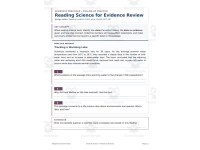
✨ Teach students how to read science for evidence. The dedicated Reading Science for Evidence Review page includes a new passage about a warming mountain lake and changing trout and bass populations. Students identify evidence, explain biological relationships using the text, connect the passage to life science, and generate a testable follow-up question.
✨ Build stronger Claim-Evidence-Reasoning responses. CER appears throughout the diagnostic and receives its own targeted follow-up page. At Grade 8, students are expected to connect specific evidence to a named scientific principle rather than simply restating the data.
✨ Make grading more manageable. Part 4 provides correct answers, short explanations of why, suggested responses for open-ended and reading items, completed diagrams, sample CER responses, and partial-credit guidance.
✨ Use completed diagrams for faster checking. The Completed Diagrams Quick View on page 2 of Part 4 points teachers to fully worked versions of the pedigree, cladogram, natural-selection model, periodic table, wave anatomy, wave types, electromagnetic spectrum, seafloor spreading, and star life cycle.
✨ Score open-ended work more consistently. Part 4 explains that multi-part items can receive point-by-point partial credit and that CER and reading items should be evaluated for a reasonable claim, specific text or data evidence, and reasoning that links them.
✨ Keep the instructional loop connected. Assessment, analysis, grouping, targeted review, science literacy practice, reteaching, and answer support are designed as one coordinated system rather than disconnected activities.
Start the year knowing what students understand, how well they reason through complex science tasks, and what they need next with this 8th grade beginning of year science assessment. Download this complete middle school science diagnostic and targeted review system to assess readiness, analyze results by strand and skill, create focused instructional groups, assign specific follow-up practice, strengthen science reading and CER writing, and support reteaching with complete explained answer keys.
Perfect for teachers searching for an 8th grade science diagnostic assessment, beginning-of-year science review, middle school science pre-assessment, back-to-school science assessment, eighth grade science review, high school science readiness, Life Science review, Physical Science review, Earth and Space Science review, Scientific Practices assessment, genetics, pedigrees, natural selection, evolution, cladograms, ecosystems, periodic table, chemical reactions, conservation of mass, Newton’s laws, forces and motion, energy transformations, waves, electromagnetic spectrum, plate tectonics, seafloor spreading, star life cycles, experimental design, graph analysis, reading science for evidence, CER practice, science intervention, small-group science planning, data-driven instruction, or targeted science reteaching.
Resource Tags
0 Reviews
Check out these other great products