



3,899 products added recently
Page 137 - Lesson Plan Templates
Simplify your preparation with lesson plan templates designed to help you organize objectives, activities, and assessments. These templates provide a structured framework to ensure comprehensive coverage of material. Incorporate them to save time and enhance the effectiveness of your teaching.

 Show filters


Nouns Sample - Grades 1-2 Grammar (Forms)
ELA, Language Development, ESL, Grammar, Common Core, Resources for Teachers, Grade 1, 2, Lesson Plans, Teacher Tools, Assessments, Tests, Quizzes and Tests, Centers, Activities
Nouns - 1 Sample Lesson ELA MCQS Overview: In this series of lessons, students will embark on an engaging exploration of the grammar skills that bring our language to life. These lessons are designed to help students identify, understand, and effectively use language arts skills in their writing and speech. Used with the free supplementary materials available for all topics, each lesson builds on the last, offering a mix of direct instruction, interactive group activities, and independent practice. Through fun and creative tasks, students will learn how to recognize grammar in sentences, understand their role in sentences and use them to enhance their own writing and speech. Nouns Overview: Includes: Common Nouns Proper Nouns Irregular Plurals Possessive Nouns Collective Nouns Forms Version This is the Forms editable and self grading version. This download is available in GOOGLE Docs, GOOGLE Forms, GOOGLE Slides. PDF, PPT, WORD, check the links below for more details. FULL CATALOG OF DOWNLOAD LINKS HERE Grade 1/2 Links: Capitalization and Punctuation Google Docs Google Forms Google Slides PDF PPT Word Free Supplementary Materials Pack Adjectives Google Docs Google Forms Google Slides PDF PPT Word Free Supplementary Materials Pack Nouns Google Docs Google Forms Google Slides PDF PPT Word Free Supplementary Materials Pack Pronouns Google Docs Google Forms Google Slides PDF PPT Word Free Supplementary Materials Pack Verbs Google Docs Google Forms Google Slides PDF PPT Word Free Supplementary Materials Pack Prefixes & Suffixes Google Docs Google Forms Google Slides PDF PPT Word Free Supplementary Materials Pack Sentence Structure Google Docs Google Forms Google Slides PDF PPT Word Free Supplementary Materials Pack Subject-Verb Agreement Google Docs Google Forms Google Slides PDF PPT Word Free Supplementary Materials Pack ELA Review Questions Overview Questions have three answer choices. There are a handful of pictures on each test for aesthetic purposes, as well as a review sheet covering most of the topics covered in the product. Introduction or Example Sheet Each topic will include an introduction or example sheet to go through first with your students. Full Answer Keys Full answer keys and sample responses are provided so no matter how busy you are, you know you're covered! In the Supplementary Pack Interactive Ice Breakers: Fun, hands-on activities that get students thinking about adjectives right from the start. Guided Practice: Teacher-led exercises that reinforce the day’s lesson, ensuring students can confidently identify and use adjectives. Group and Partner Tasks: Collaborative activities that allow students to work together to solve problems, categorize adjectives, and create descriptive sentences. Independent Worksheets: Structured worksheets that provide individual practice and help solidify understanding of key concepts. Exit Tasks: Quick, reflective activities at the end of each lesson that assess understanding and encourage students to apply what they’ve learned. For similar downloads and other frees, do check out Cored Group on TeachSimple.
Author Cored Education
Tags Elementary, Reading, Comprehension, Vocabulary, Answers, Ccss, Common Core, Spelling, Writing, Digital Centers

I WONDER - Where Is Tea Grown | Animated Video Lesson
Nature & Plants, Life Sciences, Science, Grade 3, 4, 5, 6, 7, 8, 9, Teacher Tools, Lesson Plans
Video Introduction An amazing video designed for the students to learn more about STEM. I WONDER - Where Is Tea Grown | Animated Video Lesson Plants world is really fascinating! Do you know that some flowers eat insects? Some other plants like to grow on walls can you mention any? Do you know what is the difference between fungicide and pesticide? If yes, Can you tell us more about it? What is nuclear energy? Is it safe to use it? Do you think it is a clean energy? Have you ever read about potential energy? If yes, tell us what it is? Do you think that potential energy can be converted into another form of energy? How it happens? I WONDER - Where Is Tea Grown | Animated Video Lesson The video is perfect for encouraging the researching skills for the students, while learning more about this fantastic topic. I WONDER - Where Is Tea Grown | Animated Video Lesson This friendly designed video is suitable for students at school, homeschooling, and as a group activity. Format Available in MP4 format.
Author Educational Voice
Rating
Tags Where Is Tea Grown, Tea, Tea Facts, Tea Facts For Kids, Tea Video, Tea Video For Kids, Tea Leaves, Planting Tea, Planting Tea Video For Kids, Planting Tea Facts

I WONDER - What Job Did Women Do In WW1 | Animated Video Lesson
History: British, History, Social Studies, History: Europe, History: World, Grade 4, 5, 6, 7, 8, 9, 10, Lesson Plans, Teacher Tools
Video Introduction An amazing video designed for the students to learn more about history. I WONDER - What Job Did Women Do In WW1 | Animated Video Lesson Do you like history? Which topic do you really enjoy about history? Have you ever read an interesting fact about the Vikings? If yes, can you mention them? What do you like most about the Victorian era? Can you name all the Tudors? Have you ever wondered how people used to live in ancient Japan and ancient China? Do you know any interesting facts about ancient Egyptians and the Pharaohs? Have you ever visited South America? What do you know about Incas and Aztecs? Celtic culture was really one of a kind, can you name any of the places that Celts used to live in? Imagine yourself living during the ancient Roman empire, how your life will look like? Ancient Greece was an amazing place to live in. What do you know about ancient Greek life? I WONDER - What Job Did Women Do In WW1 | Animated Video Lesson The video is perfect for encouraging the researching skills for the students, while learning more about history. I WONDER - What Job Did Women Do In WW1 | Animated Video Lesson This friendly designed video is suitable for students at school, homeschooling, and as a group activity. Format Available in MP4 format.
Author Educational Voice
Tags What Job Did Women Do In WW1, What Job Did Women Do In WW1 Video, WW1, WW1 Facts, WW1 Video, WW1 Video For Kids, WW1 Facts For Kids, World War 1, World War 1 Facts, World War 1 Video
I WONDER - Where Did The Name For The Month Of July Come From
History, Social Studies, History: Ancient, History: Europe, History: World, Grade 4, 5, 6, 7, 8, 9, 10, Lesson Plans, Teacher Tools
Video Introduction An amazing video designed for the students to learn more about history. I WONDER - Where Did The Name For The Month Of July Come From | Animated Video Lesson Do you like history? Which topic do you really enjoy about history? Have you ever read an interesting fact about the Vikings? If yes, can you mention them? What do you like most about the Victorian era? Can you name all the Tudors? Have you ever wondered how people used to live in ancient Japan and ancient China? Do you know any interesting facts about ancient Egyptians and the Pharaohs? Have you ever visited South America? What do you know about Incas and Aztecs? Celtic culture was really one of a kind, can you name any of the places that Celts used to live in? Imagine yourself living during the ancient Roman empire, how your life will look like? Ancient Greece was an amazing place to live in. What do you know about ancient Greek life? I WONDER - Where Did The Name For The Month Of July Come From | Animated Video Lesson The video is perfect for encouraging the researching skills for the students, while learning more about history. I WONDER - Where Did The Name For The Month Of July Come From | Animated Video Lesson This friendly designed video is suitable for students at school, homeschooling, and as a group activity. Format Available in MP4 format.
Author Educational Voice
Tags Where Did The Name For The Month Of July Come From, Where Did The Name For The Month Of July Come From Video, Month Of July, Month Of July Name, Month Of July Name Video, Month Of July Name Facts
I WONDER - Why Does It Smell Nice When It Rains | Animated Video
Earth Sciences, Earth and Environmental Sciences, Science, Grade 4, 5, 6, 7, 8, 9, 10, Lesson Plans, Teacher Tools
Video Introduction An amazing video designed for the students to learn more about famous phenomena in different countries. I WONDER - Why Does It Smell Nice When It Rains | Animated Video Lesson What do you know about this phenomenon? Where it happens? When it happens? What are the safety measures that we should take to be safe during this phenomenon? Are there any other places in the world that experienced this phenomenon? If yes, tell us more about them. Why do you think it happens? Do you like reading about Geography? What is your favorite country in the whole world? I WONDER - Why Does It Smell Nice When It Rains | Animated Video Lesson The video is perfect for encouraging the researching skills for the students, while learning more about this fantastic phenomenon. I WONDER - Why Does It Smell Nice When It Rains | Animated Video Lesson The video is perfect for encouraging the researching skills for the students, while learning more about this fantastic phenomenon. Format Available in a PDF format.
Author Educational Voice
Rating
Tags Why Does It Smell Nice When It Rains, Why Does It Smell Nice When It Rains Video, Rain, Rain Facts, Rain Video, Rain Facts For Kids, Rain Video For Kids, Weather, Weather For Kids, Weather Video

The Big Bang Theory – 3-Day Earth & Space Lesson
Science, Earth and Environmental Sciences, Space, Grade 9, 10, 11, 12, Teacher Tools, Lesson Plans
The Big Bang Theory - This Three-Day senior Earth and Space lesson package includes the lesson (student and teacher versions of the presentation), an auto-graded Exit Ticket, FOUR videos, and a student lesson handout as a document. The presentation is fun and applicable with many opportunities for inquiry-based learning and discussion. The presentation covers a lot of content and is meant to be delivered over a two to three-day stretch. In order, the lesson covers: - Cosmology - Big Bang Theory Timeline - From Energy → Matter - Nuclear Fusion - The Fate of the Universe? - Edwin Hubble - The Doppler Effect - Electromagnetic Spectrum - Cosmological Redshift - Gravitational Redshift - Cosmic Microwave Background Radiation Included in the lesson package is: Google and Office versions of each resource The teacher version of the presentation The student version of the presentation Auto-graded Exit Ticket SEVEN videos embedded into the presentation Student lesson handout The student version of the presentation contains multiple blanks that need to be filled in throughout the lesson. These blanks are conveniently underlined and bolded on the teacher copy. I have found this to be the most effective means of keeping my students engaged and active without having them write everything out. This also leaves more time for discussion and activities. Also, please visit my blog Teach With Fergy for my thoughts on teaching, learning and everything in between.
Author Teach With Fergy
Rating
Tags Big Bang Theory, Science Lesson, Cosmology, Nuclear Fusion, Doppler Effect

Personal Finance: Teaching Econ is Fun!
Social Studies, Economics, Grade 5, 6, 7, 8, 9, 10, 11, 12, Teacher Tools, Lesson Plans, Activities
Introduction to Personal Finance: Dive into MONEY! This lesson serves as the kickstart to my personal finance module. While it's primarily an introductory session, it can seamlessly fit into any personal finance curriculum. The core theme explores the complexities of a barter-based economy and delves into the reasons we pivot to using money, accompanied by a precise definition of money. It's a dynamic and captivating lesson. It includes a light-hearted skit, where students, and optionally the teacher, illustrate the pitfalls of bartering. Following the skit, the spotlight shifts to understanding the essence of money and its significance. With hands-on demonstrations, students get a chance to actively participate, ensuring they remain engrossed and involved throughout the session. What is included? -The Goat Farmer and Chicken Farmer skit (props not included :-) -a power point that will define money and the challenges of a barter economy -a Federal Reserve bank publication titled: "MONEY", this is a must have resource when teaching about money! I use this resource in my 7th grade classroom, but it could be used in almost any middle or high school class. This has been a successful lesson in my economics class for almost 20 years. Teaching economics is fun!
Author BCM Creations
Tags Bartering, Money, Economics, Personal Finance
I WONDER - How Do You Observe A Hypothesis | Animated Video Lesson
Research, Basic Science, Science, Theories, STEM, Grade 6, 7, 8, 9, 10, 11, 12, Lesson Plans, Teacher Tools
Video Introduction An amazing video designed for the students to learn more about STEM. I WONDER - How Do You Observe A Hypothesis | Animated Video Lesson Do you like STEM subjects? what is your favorite one? Have you ever tried to plant a seed? If yes, tell us more about it. Or have you ever tried to invent something? If yes, tell us more about it. And how do you think it will help us? Have you ever seen a microorganism under a microscope? What was it? And how it looked like? Mathematics is a marvelous subject. Let' sharpen our brains and solve some equations. Do you like timetable tricks? What is your favorite one? Do you know how to code? Have you ever created an app or a game before? If yes, how was it like? I WONDER - How Do You Observe A Hypothesis | Animated Video Lesson The video is perfect for encouraging the researching skills for the students, while learning more about this fantastic topic. I WONDER - How Do You Observe A Hypothesis | Animated Video Lesson This friendly designed video is suitable for students at school, homeschooling, and as a group activity. Format Available in MP4 format.
Author Educational Voice
Tags How Do You Observe A Hypothesis, How Do You Observe A Hypothesis Video, Observe A Hypothesis, Observe A Hypothesis Facts, Observe A Hypothesis Facts For Kids, Observe A Hypothesis Video, Observe A Hypothesis Video For Kids

I WONDER - Is A Skunk's Spray Dangerous | Animated Video Lesson
STEM, Animals, Life Sciences, Science, Biology, Grade 1, 2, 3, 4, 5, 6, 7, 8, Lesson Plans, Teacher Tools
Video Introduction Animal kingdoms are full of fascinating wonders to learn. This video is designed for the students to learn more about animals in different countries. I WONDER - Is A Skunk's Spray Dangerous | Animated Video Lesson Do you like animals? what is your favorite one? Do you own a pet? If yes, tell us more about it, like what its name? And what do you like most about it? What are the animal kingdoms? Can you write down the characteristics of each animal class like mammals, birds, reptiles, amphibian, fish and mollusks. Do you know that some animals can sing, can you name any of them? What is the largest and the smallest mammal in the world? What is the largest and the smallest bird in the world? What is the largest and the smallest fish in the world? I WONDER - Is A Skunk's Spray Dangerous | Animated Video Lesson The video is perfect for encouraging the researching skills for the students, while learning more about these fantastic animals. I WONDER - Is A Skunk's Spray Dangerous | Animated Video Lesson This friendly designed video is suitable for students at school, homeschooling, and as a group activity. Format Available in MP4 format.
Author Educational Voice
Tags Is A Skunk's Spray Dangerous, Is A Skunk's Spray Dangerous Video, Skunk's Spray, Skunk's Spray Facts, Skunk's Spray Facts For Kids, Skunk's Spray Video, Skunk's Spray Video For Kids, Skunk

Narrative Tenses ESL TEFL Upper Intermediate Lesson Plan Worksheet
ELA, Grammar, Resources for Teachers, Not Grade Specific, Adult Education, Homeschool Resources, High School, Middle School, Teacher Tools, Lesson Plans, Worksheets & Printables
Narrative Tenses ESL and TEFL Upper Intermediate Lesson Plan This upper intermediate English lesson plan focuses on building narrative tenses skills. Students will learn when to properly use the past simple, past continuous, past perfect, and past perfect continuous through informative explanations and engaging exercises. Educators can implement this plan in multiple ways - as a whole group grammar lesson, small group remediation, or even as independent practice. This practical resource develops grammatical competence and reading comprehension in a clear, concise way. Answer keys are provided to assess student understanding. The PDF worksheet set works seamlessly with Google Apps for flexible digital instruction. The ESL lesson plan includes flashcards , a warmer, grammar rules, exercises, role-play, conversation, writing drill, activity, answers and an extra study that would be good to set as homework. There are 30+ pages and there are teachers notes to guide the teacher. Answers are included in the zip file.
Author TEAM TEFL
Tags Narrative, Tenses, Grammar Lesson, ESL, Comprehension, Narrative Verbs

Reading Comprehension - Digital Lesson Plan Gr. 5-8 | MAC Software
ELA, Reading, Grade 3, 4, 5, 6, 7, 8, Teacher Tools, Lesson Plans
Reading Comprehension - Digital Lesson Plan Gr. 5-8 | MAC Software With an array of essential reading comprehension concepts, the Reading Comprehension - Digital Lesson Plan is characterized by its engagement and interactivity, making it a practical tool for educators. Designed specifically for Grade levels 5 through to 8, this digital resource can be applied in various educational settings like: whole group learning sessions small group work individual homework assignments. Covering over a bountiful course of 80 engaging screen-pages, this pragmatic lesson plan introduces students to vital aspects of reading. It focuses on enhancing their understanding of essential elements such as: Context clues: Serves to help students decipher meanings from surrounding text. Determining main ideas from passages: Guides their comprehension and enables them in making knowledgeable inferences. Inculcating the importance of graphic organizers, this tool assists in amplifying students’ comprehension skills – elementary towards achieving fluency across subject areas. In today's modern digitized era where communication spans multiple formats, proficient reading still remains an invaluable skill. The ability of a child to understand and articulate with written words forms the crux towards academic success and life participations. A Look into the Program's Structure The program engages with a balanced mix of pre-reading activities along with post-reading sessions. Each screen comprises enthralling content including: Enriched Reading Passages : This includes both pre-reading activities (before you read) and post-reading activities. Test Preparation Material : These are accompanied by a comprehensive quiz – pin-pointing assessment opportunities after each segment of the lesson. Children will encounter absorbing elements such as memory match games, crossword puzzles, and interesting word searches– all aimed at deepening their understanding in an enjoyable manner. The program also includes Text-to-Speech functionality, videos & audios to cater to diverse learners with different ways of learning. The digital lesson program aligns well with State Standards, mindful of the cognitive domains per Blooms Taxonomy. Embodying simplicity at its core, this MAC-friendly software is primed to assist educators in fostering competent readers amongst their students.
Author Classroom Complete Press
Tags Reading Comprehension, Fiction Texts, Nonfiction Texts, Digital Lesson Plan, Digital Reading
I WONDER - What Is The Difference Between A Monkey And An Ape
STEM, Biology, Life Sciences, Science, Animals, Grade 3, 4, 5, 6, 7, 8, 9, Lesson Plans, Teacher Tools
Video Introduction Animal kingdoms are full of fascinating wonders to learn. This video is designed for the students to learn more about animals in different countries. I WONDER - What Is The Difference Between A Monkey And An Ape | Animated Video Lesson Do you like animals? what is your favorite one? Do you own a pet? If yes, tell us more about it, like what its name? And what do you like most about it? What are the animal kingdoms? Can you write down the characteristics of each animal class like mammals, birds, reptiles, amphibian, fish and mollusks. Do you know that some animals can sing, can you name any of them? What is the largest and the smallest mammal in the world? What is the largest and the smallest bird in the world? What is the largest and the smallest fish in the world? I WONDER - What Is The Difference Between A Monkey And An Ape | Animated Video Lesson The video is perfect for encouraging the researching skills for the students, while learning more about these fantastic animals. I WONDER - What Is The Difference Between A Monkey And An Ape | Animated Video Lesson This friendly designed video is suitable for students at school, homeschooling, and as a group activity. Format Available in MP4 format.
Author Educational Voice
Tags What Is The Difference Between A Monkey And An Ape, What Is The Difference Between A Monkey And An Ape Video, The Difference Between A Monkey And An Ape, Monkey, Monkey Facts, Ape, Ape Facts

Scientific Method Unit
Science, Basic Science, Grade 3, 4, 5, Teacher Tools, Lesson Plans
The Scientific Method Unit for 3rd to 5th-Grade Educators This robust teaching resource encapsulates two weeks worth of lesson plans and activities, designed to provide a solid grounding for involving students actively in scientific learning from the start of the academic year. Key Features Fill-in-the-blank notes: Encourages active participation and fosters independent thinking. These complement answer key notes provided specially for teachers to help guide classroom discussion or clarify misconceptions during independent study. Scientific tool rotation centers:: Offers a range of practical applications and explorations opportunities. Four unique experiments:: Centers on concrete applications of the scientific method. It includes observation experiment documentation - along with blank formats to allow flexibility in experiments, it provides insights into different aspects of conducting scientific investigations. Evaluation materials:: Includes both a study guide and quiz as effective tools for revision or student assessment . Comprehensive answer keys are available too, streamlining marking processes while ensuring clarity in feedbacks. Versatility across Educational Setups This unit can serve as either a supplement within broader existing curriculum or stand alone as an inclusive introduction to concepts around the Scientific Method. Easily adaptable within group discussions or small clusters; serves well as homework assignments; or even blends seamlessly into homeschooling routines. Inquiry-based Learning Promotion Focused on delivering immersive science-learning experiences that piques young minds! The goal is transition students into 'scientists' by making abstract concepts tangible through narrative structures combined with interactive activities - saving precious time for teachers without compromising learning quality.</p
Author Kel's Klass
Tags Scientific Method, Hands-on Learning, Inquiry-based Learning, Experiments, Interactive Activities
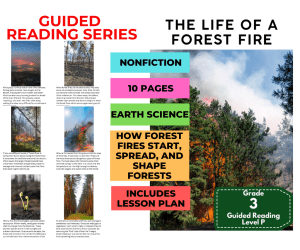
The Life of a Forest Fire: Guided Reading Level P with Lesson Plan
ELA, Resources for Teachers, Reading Comprehension, Reading, Science, Language Development, Life Sciences, Earth and Environmental Sciences, Physics, Technology, Grade 2, 3, 4, Worksheets & Printables, Worksheets, Teacher Tools, Centers, Activities, Literacy Readers, Quizzes, Quizzes and Tests, Assessments, Lesson Plans
This The Life of a Forest Fire (level p) guided reading book with lesson plan includes: Guided Reading Color Label (front cover x1) This is a quick way to match the book’s demands to what students can generally handle.. The overall goal is to use the level/color to pick books for several smaller groups. To qualify for a certain level, a student is expected to read a book from that level with about 90–94% accuracy. If a student is consistently accurate and understands, move up a level. If the student is struggling at that level, drop down and add more support. Each student will improve at completely different rates, but it is generally one of the best ways to check progress across the class. DOWNLOAD THE CATALOG TO VIEW ALL GUIDED READING BOOKS AVAILABLE (SORTED LEVELS A-Z) Pre-Reading Question (x1) Teacher asks the prompt aloud, can be while showing the cover or first page. Students share what they already know, or make educated guesses from the cover. Prompt them to use the target vocabulary. Write some of their responses on the board to look back at during the reading. Vocabulary Words (x5) Introduce the five words, best doing it one at a time. Start by saying it, while students repeat and then see if anyone knows what it means before reading further. Read through the meaning and try to briefly connect each word to a picture or gesture so it’s meaningful. Ask students to flip through the book pages and point to where they see each of the vocabulary words. While reading the book pause upon coming across one of the vocab words or read the sentence twice to make sure students understand the word has appeared. Optional: Ask students to raise hands whenever they see/hear one of the new words. Guided Reading Pages (x10) Check the book snapshot (below) for: primary topic - do you need to prep extra reading or intro materials on this? what is taught best - decide on 1-2 bullets to focus on, use the prompt or words provided here for best results. learning goals - what you are checking for students to be able to do after the session, elicit answers using prompts or words provided. key vocabulary (see section above). questions overview - so you know what is coming up and if you need to prep extra materials to assist understanding. Run the lesson You may have already looked at a few of the pages together, but you can show them some of the pictures again first to set meaning. Depending on how much time you have and how familiar your students are with guided reading class, you may want to read the book aloud first with the group first. Students whisper or partner read, while you listen in. If time, do it as a group, one student reading a page each. Use the guided page’s prompts to coach: “Check the picture / does it make sense?” “Point under the words / try the first sound” “Reread the sentence smoothly”. Try to focus more on one student per session (rotating every time), so you can work out if they are ready to move up or need to move down a level. Comprehension Questions (back cover x3) This is your way to check that students didn’t just say the words, but actually understood the text. First, let students answer by pointing to the page/picture and saying a short sentence. After any answer, follow with: “Show me where you found that in the text.” In bigger groups, have partners answer first (10–20 seconds), then call on 2–3 students to share. Differentiation tips: Emerging speakers/struggling readers: oral + pointing On-level: oral in a full sentence Higher: one written sentence or draw + label Book Snapshot Title: The Life of a Forest Fire Genre: Nonfiction (informational) Subject: Earth & Environmental Science Primary Topic: How forest fires start, spread, and shape forests Estimated Guided Reading Level (A–Z): P What This Book Teaches Best Explains common natural causes of forest fires , including how lightning can ignite dry wood and start a blaze. Teaches the Fire Triangle (heat, fuel, oxygen) and applies it to forest conditions like pine needles, branches, and grass as fuel. Compares types of forest fires (surface fires vs. crown fires) using clear, text-based differences in location, intensity, and damage. Shows how wind affects fire behavior , including carrying embers ahead of the fire and starting new fires through “spotting.” Describes fire’s ecological role and forest recovery , including nutrients returning to soil, new plant growth, and succession over time. Learning Goals Students can explain how a forest fire can begin in nature using details from the text (spark/lightning/heat on dry wood). Students can identify and describe the three parts of the Fire Triangle and explain why each is needed for a fire to keep burning. Students can compare a surface fire and a crown fire by describing where each burns and what the text says it can damage. Students can describe how wind changes a fire’s spread, including what “spotting” means in the text. Students can explain ways fire can help a forest over time (clearing debris, returning nutrients, creating open spaces for sunlight). Students can describe what happens after a fire during succession, using the sequence of changes described in the book. Key Vocabulary From the Text ecosystems — places where living things and land work together. ignite — to start burning. oxygen — a gas in air that fire needs. embers — small burning pieces carried ahead of a fire. succession — how a forest grows back after a fire. Discussion Prompts Pre-reading question: What are some natural ways a forest fire might start? Comprehension questions: What three elements does the text say a fire needs to exist? Comprehension questions: How does the text describe a surface fire as different from a crown fire? Comprehension questions: According to the text, what happens to the forest after a fire during succession? Printing Tips 1. Best Printing Method (Recommended) “Booklet” Printing (Best if Available) If your printer or PDF viewer supports Booklet Printing , use this. Settings to use: Print mode: Booklet Paper size: Letter or A4 (either works) Orientation: Landscape Print on both sides: Yes Flip on: Short edge Scaling: Fit to printable area Booklet subset: First test: Front sides only Then: Back sides only This will automatically: Pair pages correctly Put the cover on the outside Align everything for folding After printing, fold in half and staple along the spine . 2. If “Booklet” Printing Is NOT Available You can still print this correctly with manual duplex printing . Step-by-step: Open the PDF. Choose Print . Set: Orientation: Landscape Pages per sheet: 1 Print on both sides: Yes Flip on: Short edge Print all pages . Because each PDF page already contains two facing book pages, the result will still fold cleanly into a book. Thousands of Cored Education products are included with your TeachSimple membership. Download links and encyclopedia index available here.
Author Cored Education
Rating
Tags Reading Comprehension, Reading Passages, Reading, Guided Reading, Guided Reading Lesson Plan, Guided Reading Activity, Pre-reading, Science Lesson Plans, Earth Science, Physics
I WONDER - What Is A Trapezium | Animated Video Lesson
STEM, Geometry, Math, Grade 1, 2, 3, 4, 5, 6, 7, 8, Lesson Plans, Teacher Tools
Video Introduction An amazing video designed for the students to learn more about STEM. I WONDER - What Is A Trapezium | Animated Video Lesson Do you like STEM subjects? what is your favorite one? Have you ever tried to plant a seed? If yes, tell us more about it. Or have you ever tried to invent something? If yes, tell us more about it. And how do you think it will help us? Have you ever seen a microorganism under a microscope? What was it? And how it looked like? Mathematics is a marvelous subject. Let' sharpen our brains and solve some equations. Do you like timetable tricks? What is your favorite one? Do you know how to code? Have you ever created an app or a game before? If yes, how was it like? I WONDER - What Is A Trapezium | Animated Video Lesson The video is perfect for encouraging the researching skills for the students, while learning more about this fantastic topic. I WONDER - What Is A Trapezium | Animated Video Lesson This friendly designed video is suitable for students at school, homeschooling, and as a group activity. Format Available in MP4 format.
Author Educational Voice
Tags What Is A Trapezium, What Is A Trapezium Video, Trapezium, Trapezium Facts, Trapezium Facts For Kids, Trapezium Video, Trapezium Video For Kids, Trapezium Shape, Shapes Video, Shape

I WONDER - Can I Recycle In My Own Home | Animated Video Lesson
Earth Sciences, Earth and Environmental Sciences, Science, Environmental Science, Grade 3, 4, 5, 6, 7, 8, 9, Lesson Plans, Teacher Tools
Video Introduction An amazing video designed for the students to learn more about STEM. I WONDER - Can I Recycle In My Own Home | Animated Video Lesson Our environment is so precious, can you name different ways to help our environment to be clean? Have you ever recycled a material? If yes, tell us what was the material was it paper, plastic, glass or aluminum? How did you recycled it? What are the types of clean energy? How do hydro power works? Where can we find wind turbines? What is climate change? And what we can do to stop it? What are the different types of ecosystems? I WONDER - Can I Recycle In My Own Home | Animated Video Lesson The video is perfect for encouraging the researching skills for the students, while learning more about this fantastic topic. I WONDER - Can I Recycle In My Own Home | Animated Video Lesson This friendly designed video is suitable for students at school, homeschooling, and as a group activity. Format Available in MP4 format.
Author Educational Voice
Rating
Tags Can I Recycle In My Own Home, Recycle, Recycling, Recycling At Home, Recycling At Home Facts, Recycling At Home Facts For Kids, Recycling At Home Video, Recycling At Home Video For Kids
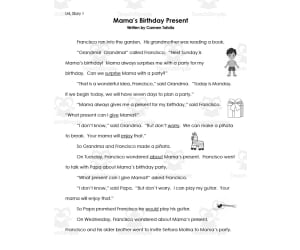
1st Grade Unit 4 Reading Street Stories Set
ELA, Reading, Grade 1, Lesson Plans, Teacher Tools
The 1st Grade Unit 4 Reading Street Stories Set is a convenient teaching resource for elementary school language arts educators. This set includes six short stories, each 2-3 pages in length, that align with the Reading Street curriculum for first grade. The stories cover central themes and topics from Unit 4. They can be printed and distributed to students for independent reading, whole class instruction, or small group discussion and analysis. Each story concludes with a list of key vocabulary reinforcing high-frequency sight words first graders are expected to learn. Educators can utilize this resource to supplement the existing Reading Street materials. The stories are designed to engage young readers while supporting standards-based literacy goals. Simply print and distribute on a weekly basis or as needed. Students can also bring the stories home for additional reading practice. This Reading Street set helps build early reading comprehension in an accessible, scaffolded way.
Author Sarah Sorensen
Tags Reading Street, Curriculum, Short Stories, Spelling Words, High Frequency Words, Reading Street Grade 4

I WONDER - Where Was The Biggest Turtle Found | Animated Video Lesson
Biology, Life Sciences, Science, Animals, STEM, Grade 1, 2, 3, 4, 5, 6, 7, 8, Lesson Plans, Teacher Tools
Video Introduction Animal kingdoms are full of fascinating wonders to learn. This video is designed for the students to learn more about animals in different countries. I WONDER - Where Was The Biggest Turtle Found | Animated Video Lesson Do you like animals? what is your favorite one? Do you own a pet? If yes, tell us more about it, like what its name? And what do you like most about it? What are the animal kingdoms? Can you write down the characteristics of each animal class like mammals, birds, reptiles, amphibian, fish and mollusks. Do you know that some animals can sing, can you name any of them? What is the largest and the smallest mammal in the world? What is the largest and the smallest bird in the world? What is the largest and the smallest fish in the world? I WONDER - Where Was The Biggest Turtle Found | Animated Video Lesson The video is perfect for encouraging the researching skills for the students, while learning more about these fantastic animals. I WONDER - Where Was The Biggest Turtle Found | Animated Video Lesson This friendly designed video is suitable for students at school, homeschooling, and as a group activity. Format Available in MP4 format.
Author Educational Voice
Tags Where Was The Biggest Turtle Found, Where Was The Biggest Turtle Found Video, Biggest Turtle, Biggest Turtle Facts, Biggest Turtle Facts For Kids, Biggest Turtle Video, Biggest Turtle Video For Kids

Dinosaurs Mini Unit
Science, Earth and Environmental Sciences, Grade 6, 7, 8, 9, Teacher Tools, Lesson Plans
Dinosaurs Mini Unit This is a Dinosaurs Mini Unit that will provide students with resources from the beginning to end of a unit. This unit will leave students feeling more knowledgeable about this animal species and equipped to tackle any and all comprehensive activities related to dinosaurs. This unit is great for middle school students. What You Get: You will receive a zip file that includes: 1. A Presentations Folder with 17 PowerPoints 2. An Individual Dinosaur Project Sheets Folder with 24 PDFs 3. A Basic Reading Sheet Set PDF 4. A Dinosaur Crossword Puzzle PDF 5. A Dinosaurs Test PDF 5. A Dinosaurs Worksheet Complete Set PDF How to Use the Dinosaurs Mini Unit: This is a comprehensive unit of study that will have many components to make learning come to life. The glossary is an essential component that will provide students with the basic vocabulary they’ll need to understand and grasp the major topics included in the unit. Lesson One teaches students about life before the Dinosaurs from the formation of the Earth and moon to the Triassic Era. An alternate version of lesson one is also included dividing the history of the Earth into a 24 hour period. Lesson Two teaches students about the geography, climate, and other life forms living between the Triassic and Cretaceous periods. Lesson Three covers the evolution of the early dinosaurs of the Triassic Era. Lesson Four teaches students about the extinction of the dinosaurs and the Cenozoic period. Each lesson comes with a PowerPoint presentation featuring enlarged readings, images, and movie links. Information and project sheets are provided for twelve different dinosaurs or reptiles for students to create different presentation projects with. Students can complete a crossword activity at the end of the unit. The crossword is provided in a regular and modified version with an answer key included. Teachers can test students’ knowledge with a short written/graphic test with answer key included. I hope you enjoy!! Take A Look At My Best Sellers: The History of Piracy The History of Space Exploration – Complete Unit Navajo Code Talkers Mini Unit Women in World War Two – Complete Unit The Forbidden City Mini Unit Natural Disasters – Complete Unit You Can Find More Resources At My Store Front Here: Mr. Gray History
Author Mr Gray History
Tags Dinosaurs Unit, Reading Comprehension, Dinosaur Crossword Puzzle, Earth's History, Dinosaur Extinction, Science Vocabulary, Science Assessment
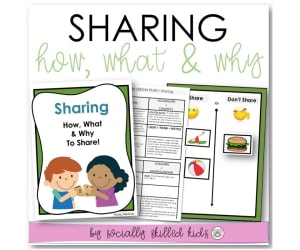
Sharing, Social Skills Lesson Plans and Activities
Special Resources, Social Skills, Preschool, Grade 1, 2, 3, Lesson Plans, Teacher Tools
Do you have students who have a hard time sharing? Do they grab or hoard materials? Do they have trouble sharing recess materials or during small group activities? Mine do! I made this activity to help students who needed explicit teaching to understand how, what and why to share. The activities are fun, interactive, and young child friendly so that students can really gain an understanding of how they can share many different items, even things that are not material, such as friendship. These activities are great for students age or ability level K-2nd grade. My students really enjoy doing these fun activities. I hope yours do too.
Author Socially Skilled Kids
Tags Sharing, Social Skills, Social Pragmatics, Special Education, Inclusion, Social Skills Lessons And Activities, Social Skills Lesson Plans For Preschool, Free Social Skills Curriculum For Elementary Students, Social Skill Lessons For Kindergarten
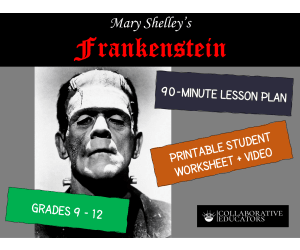
Lesson Plan on Mary Shelley's Frankenstein
Literature, ELA, Reading, Grade 9, 10, 11, 12, Lesson Plans, Teacher Tools, Activities, Worksheets & Printables
This is a lesson plan lasting 90 minutes focused on the classic book Frankenstein, authored by Mary Shelley. Shelley composed Frankenstein at the age of 19, and it was released the next year in 1818. The novel narrates the tale of Victor Frankenstein, a young scientist seeking the key to life who produces the hideous being in a clandestine experiment. The lesson plan incorporates the video summary of Mary Shelley's Frankenstein by Video SparkNotes. A separate printable worksheet for students contains numerous questions. The responses are given individually at the conclusion. The lesson is perfect for students in Grades 9 through 12. Frankenstein is full of meanings. It implies that social isolation is the main source of evil as well as its consequence. The Monster clearly states that his separation from humanity has led him to become a killer: “My guardians had left, severing the sole connection that tied me to the world.
Author Bright Classroom Ideas Marketplace
Rating
Tags Frankenstein, Mary, Shelley, Classic, Literature, Reading, Lesson, Plan

I WONDER - What Is Global Warming | Animated Video Lesson
Environmental Science, Earth and Environmental Sciences, Science, Grade 4, 5, 6, 7, 8, 9, 10, Lesson Plans, Teacher Tools
Video Introduction An amazing video designed for the students to learn more about STEM. I WONDER - What Is Global Warming | Animated Video Lesson Do you like STEM subjects? what is your favorite one? Have you ever tried to plant a seed? If yes, tell us more about it. Or have you ever tried to invent something? If yes, tell us more about it. And how do you think it will help us? Have you ever seen a microorganism under a microscope? What was it? And how it looked like? Mathematics is a marvelous subject. Let' sharpen our brains and solve some equations. Do you like timetable tricks? What is your favorite one? Do you know how to code? Have you ever created an app or a game before? If yes, how was it like? I WONDER - What Is Global Warming | Animated Video Lesson The video is perfect for encouraging the researching skills for the students, while learning more about this fantastic topic. I WONDER - What Is Global Warming | Animated Video Lesson This friendly designed video is suitable for students at school, homeschooling, and as a group activity. Format Available in MP4 format.
Author Educational Voice
Tags What Is Global Warming, What Is Global Warming Video, Global Warming, Global Warming Facts, Global Warming Facts For Kids, Global Warming Video, Global Warming Video For Kids, Environment
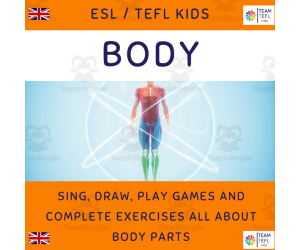
Body ESL Lesson Plan For Kids and Early Learners
ELA, Language Development, ESL, Not Grade Specific, Teacher Tools, Lesson Plans
Kids ESL lesson plan about the Body. In this unit we learn how to discuss and describe different body parts and their functions. Your beginner and early level students will love this creative and fun resource. This lesson plan is no.10 of the TEAM TEFL First 25 ESL Lesson Plans For Kids. This lesson plan is available in PDF. The PDF is separated into two parts - teachers notes and worksheets. Your students only require a copy of the worksheets. The teachers notes include the answers. This lesson plan is suitable for ESL students from 3 to 14 years and should take around 1 hour.
Author TEAM TEFL
Tags Esl, Esl Kids, Esl Lesson Plans, Tefl Kids, Body Vocabulary, Parts Of The Body Lesson Plan, Body Parts Esl, Esl Lesson Plans For Kids, Body Parts Lesson Plan, Parts Of The Body Efl

Prompt Engineering Game Kits: Seasonal & Holiday Challenge for Future
Life Studies, Business, Technology, Science, Computer Science, STEM, Special Resources, Life Skills, Social Emotional Learning (SEL), Social Skills, Homeschool Curriculum, Homeschool Templates, Grade 9, 10, 11, 12, Worksheets & Printables, Parts of and Anatomy of, Workbooks, Worksheets, Word Searches, Writing Prompts, Teacher Tools, Assessments, Lesson Plans, Presentations
Take your classroom to the next level with the most powerful AI tool for education: "AI Prompt Engineering Game Kits: Seasonal & Holiday Challenges for Future-Ready Classrooms!" – a 43-page printable PDF toolkit with an interactive digital companion to bring generative AI to Grades 6-12 classrooms. This professionally developed digital tool makes prompt engineering accessible to all, transforming it from an esoteric idea into an artistic skill for budding students. From basic principles involving role assignment, task definition, context delivery, constraints, to output format, to more expert strategies involving chain-of-thought prompts, few-shot prompts, deconstructing complex prompts, to constraint prompts, this tool is an unrivaled aid for educators. Organized in three levels: Phase 1: Core Content & Theory (encompassing topics of foundation, advanced procedures, ethics in AI, bias reduction, challenge development); Phase 2: Student Workbook (consisting of gamified tasks); and Phase 3: Visuals & Teacher Resources (incorporating keys, implementation handouts, graphics), this resource set equips teachers with strategies for encouraging AI teamwork through interactive challenges related to seasons/holidays. Some of these challenges encompass: creating biographies for Thanksgiving, making scavenger hunt riddles for Halloween, conceptualizing a Winter Solstice poetic sequence or an Enchanted Ice Garden Festival, celebrating the Lunar New Year. Why Parents/Schools Love It: Future-Proof Skills Development: Provides the skills that students need to have as AI system designers and as responsible digital citizens, helping them succeed in an AI-enhanced future. Engaging Learning: Thematic challenges based on seasonal activities like Halloween puzzles and Thanksgiving tales make abstract concepts like AI fun and applicative for students. Ethical Emphasis and Safety: Weaves together information on bias in AI systems,accuracy,privacy,and responsible integration to assist in creating an excellent moral foundation for appropriate technology use in a safe and suitable environment for Easy Implementation and Differentiation: Also includes teacher keys, visuals, and frameworks, making easy integration possible without prep, and providing support for all levels of learners. Established Pedagogic Effectiveness: Founded upon the tenets of constructivism, project learning, and design, it moves the evaluation point from outcome to process and teamwork. Target Classes/Students : The resource explicitly targets students in Grades 6 through 12, based on a complete analysis of the PDF, its theoretical underpinnings, methodological framework, chapter breakdowns, student workbook challenges, teacher resources, and implementation guide. It also differentiates by age group to optimize engagement: Grades 6-8: Outlines structured, foundational challenges to build basic understanding of prompt engineering, with simpler tasks such as brainstorming themes or generating short narratives, emphasizing engagement through familiar holiday contexts and guided iteration. Grades 9-12: High School Students - Assigns more open-ended and complex problems to higher-order techniques, including ethical dilemmas, bias analysis, and sophisticated outputs, such as multi-stage event planning or nuanced creative writing, in order to afford the opportunity for deepened critical thinking and real-world application. This targeting allows for appropriate rigor at each age group, where younger students receive concrete and gamified activities, while older students take the work into the realms of ethical and interdisciplinary extensions. Copyright/Terms of Use : This Book is copyrighted by Syed Hammad Rizvi. This material is for a single classroom use only. It may not be copied or altered in any way. In other words, it may not be placed on the Internet where it will be generally accessible for download. If you are interested in sharing the resource with other colleagues, you can purchase additional licenses through TpT. Thank you for honoring the terms of use. "This product is happily brought to you by Syed Hammad Rizvi"
Author Creative Book Store
Rating
Tags AIPromptEngineering, AIinEducation, PromptEngineeringGuide, EducationalAI, ClassroomAIActivities, FutureReadyClassrooms, SeasonalAIChallenges, HolidayAIProjects, EthicalAI, DigitalCitizenship