



3,950 products added recently
Page 19 - Lesson Plan Templates
Simplify your preparation with lesson plan templates designed to help you organize objectives, activities, and assessments. These templates provide a structured framework to ensure comprehensive coverage of material. Incorporate them to save time and enhance the effectiveness of your teaching.

 Show filters


Pony Express: History - Hands On
Social Studies, History, History: USA, Grade 1, 2, 3, 4, Teacher Tools, Lesson Plans
Pony Express: History - Hands On A comprehensive teaching resource designed to engage students actively in learning about an exciting period of American history. Primarily developed for first to fourth graders. This educational tool encompasses subjects like: Social Studies with specific focus on U.S. History. What makes it special? The initiative seamlessly integrates various mediums and practices such as poems, music, games , discussions, arts and creative writing activities. It shifts from traditional passive learning techniques encouraging participation that enhances learning outcomes. Simulating the historical era: In this module focusing on the Pony Express era, students get involved in: - Creating their own petitions—a popular recourse in old times. - Participating in enactments involving Pony Rider puppets representing an actual Pony Express ride. - Involving themselves in a relay race—a tangible demonstration of real-life pony express team's challenges. Reinforcing through sharing: After processing these experiential lessons about history through fun-filled means like a museum exhibit for sharing with friends or family—this package bolsters knowledge retention. All-in-one PDF package includes: - total of 34 readily printable pages serving varying functions across different group sizes. Bolster your active and experiential learning journey using Pony Express: History - Hands On!.
Author Classroom Complete Press
Tags Social Studies, Pony Express, Puppets, American History, Poems

Insects and Humans | Animated Insect Video Lesson
Science, Life Sciences, Insects, Grade 3, 4, 5, 6, Lesson Plans, Teacher Tools
This animated science video lesson is all about insects and humans. Students will love this engaging and interactive video as they learn more about insects. This video serves as a great introduction or review video for your learners. This is an 11-minute science video lesson.
Author Educational Voice
Tags Science Video, Science Lesson, Insects, Science Activities, Insects Lesson

Language Fun
ELA, Language Development, ESL, Grade 5, Teacher Tools, Lesson Plans
Language Fun: A Comprehensive Resource Language Fun is designed for teachers working with 5th grade students or homeschoolers aiming to improve their language arts skills. It various elements of language, including puns, vivid imagery in poetry, figurative language, analogies and the clear difference between similes and metaphors. Fun with Puns: This module starts off by focusing on defining puns and teaching students how to use them effectively in text. It adds a layer of amusement to lessons but also hones essential linguistic understanding. Vibrant Imagery: In this section, students learn how to create mental pictures using powerful words that appeal to all five senses. This aims at enhancing creative writing skills within poetic formats whilst engaging sensory details. An Exploration into Figurative Language: This part guides educators in teaching pupils how to identify and rightly utilize various literary devices such as simile, metaphor and personification expanding their composition ability. Analogies: This encourages learners to distinctly understand word comparisons enlightening them on this significant aspect of vocabulary enhancement while encouraging them independently complete analogies successfully . The Comparison Between Similes vs Metaphors: In rounding off with this topic young learners would be able differentiate these two primary literary tools often wrongfully interchanged within texts. As an educator or homeschooling parent you can use Language Fun for various purposes; facilitating whole group discussions introducing each concept entirely or breaking down the unit topics into small focus groups enabling debates. This resource is delivered via 1 downloadable PDF file allowing easy access whether you're instructing in a class or at home. Delivered in simple language understood by students whilst challenging their critical thinking skills, Language Fun is a valuable tool ensuring comprehensive language arts mastery for 5th grade English.
Author Classroom Complete Press
Tags PDF
Geometry: Transformations & Symmetry - PC Software
Math, Geometry, Kindergarten, Preschool, Grade 1, 2, Teacher Tools, Lesson Plans
Geometry: Transformations & Symmetry - PC Software Review This resource is an informative and effective teaching instrument, offering a comprehensive package for mastering the critical aspects of Geometry- Transformations and Symmetry. Conveniently packaged as a PC software in a zip file format, it serves educators catering for preschool up to Grade 2 students. This curriculum-based software is invaluable for public school teachers and homeschoolers alike. Main Features: Pre- assessment : Identifies readiness levels and focus areas before beginning teachings. Structured Lesson Plan: Provides step-by-step guide to delivering teachings incrementally and effectively Critical Thinking with Word Problems: Real-world situations used as examples to apply learned knowledge Timed Drills: Aiding navigation through this user-friendly interface is the handy "Teacher Guide". Time spent on instruction becomes much more efficient by ensuring all important learning points are covered thoroughly. To boost comprehension levels among younger learners further, there are engaging hand-on activities available in form of 'memory match game', 'board game', 'spinner game'. Note: The software also supports bilingual (English/Spanish) options! Inclusive Teaching Methodologies with SMART Response Assessments Precisely tracking learner's progress while allowing corrections along their learning journey has never been easier with this feature incorporated within this math-centric solution.. A Plug-and-Play Solution that Enhances Efficiency & Productivity Suitable for whole group discussions, small group activities or even individual homework assignments; this PC Software has undeniably revolutionized the experience of teaching and learning geometry like never before!
Author Classroom Complete Press
Tags Math Lesson Plan, Digital Math, Geometry Lesson, Symmetry, Transformations
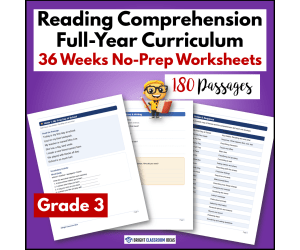
Grade 3 Yearlong Reading Comprehension Curriculum | 180 Worksheets
ELA, Grade 3, Lesson Plans, Teacher Tools, Worksheets & Printables
Grade 3 Yearlong Reading Comprehension Curriculum | 180 No-Prep Worksheets Looking for a comprehensive Grade 3 Reading Comprehension Curriculum that builds strong readers all year long? This year-long resource includes 180 daily reading passages, vocabulary activities, comprehension questions, writing prompts, and answer keys designed to strengthen reading comprehension, critical thinking, vocabulary development, and written responses while keeping literacy instruction simple and consistent. What's Included ✅ 180 daily reading comprehension passages ✅ 36 weeks of instruction ✅ 5 passages per week ✅ Fiction and nonfiction reading selections ✅ Vocabulary matching activity with every passage ✅ 3 comprehension questions per passage ✅ Writing prompt for every reading assignment ✅ Student Worksheet Book ✅ Comprehensive Teacher Guide ✅ Complete Answer Key ✅ Year-long pacing guide ✅ Differentiation suggestions for struggling and advanced readers ✅ Assessment rubric and scoring support ✅ Print-and-go format for easy implementation How It Works in the Classroom This Grade 3 reading comprehension program follows a simple daily routine that helps students build confidence and independence while strengthening literacy skills. Daily Lesson Structure: Read and discuss the passage Complete vocabulary practice Answer comprehension questions using text evidence Respond to a writing prompt Perfect for: • Whole-group instruction • Small-group reading lessons • Literacy centers • Independent work • Homework • Intervention support • Morning work • Homeschool learning • Sub plans The predictable structure allows students to focus on comprehension skills instead of learning a new format each day. Standards & Learning Goals Students will practice and strengthen: ⭐ Key Details ⭐ Story Characters ⭐ Setting ⭐ Retelling & Sequencing ⭐ Main Topic ⭐ Main Idea ⭐ Cause & Effect ⭐ Compare & Contrast ⭐ Drawing Conclusions ⭐ Making Predictions ⭐ Author's Purpose ⭐ Ask & Answer Questions ⭐ Connecting Texts ⭐ Fact & Opinion ⭐ Problem & Solution ⭐ Story Elements ⭐ Vocabulary Development ⭐ Written Responses to Reading ⭐ Text Evidence Skills ⭐ Fiction and Nonfiction Comprehension The curriculum spirals comprehension skills throughout all 36 weeks to provide repeated practice and long-term mastery. Why Teachers Love It ❤️ Provides a full year of reading comprehension instruction ❤️ No-prep, print-and-go format ❤️ Includes teacher guide, student workbook, and answer key ❤️ Balanced mix of fiction and nonfiction texts ❤️ Encourages students to cite evidence from the text ❤️ Supports vocabulary, comprehension, and writing in one resource ❤️ Includes differentiation strategies for multiple learner needs ❤️ Easy-to-follow pacing guide saves planning time ❤️ Consistent structure builds student confidence and independence ❤️ Perfect for classroom instruction, intervention, tutoring, and homeschool settings Students encounter approximately 540 vocabulary words throughout the year while working through a balanced mix of fiction and nonfiction passages across nine themed units. If you're searching for a Grade 3 Reading Comprehension Curriculum that provides daily practice, spiraled skill review, vocabulary development, and meaningful writing opportunities, this comprehensive year-long resource is ready to support your literacy instruction from the first week of school through the last day!
Author Bright Classroom Ideas Marketplace
Rating
Tags Reading, Comprehension, Writing, Curriculum, Full Year, Ela, Yearlong, Worksheet

Global Warming CAUSES: Greenhouse Gases: Water Vapor - FLASH-PC
Science, Earth and Environmental Sciences, Environmental Science, Common Core, Grade 5, 6, 7, 8, Teacher Tools, Lesson Plans
Global Warming CAUSES: Greenhouse Gases: Water Vapor - FLASH-PC An impactful teaching resource designed to impart a comprehensive understanding of the role water vapor plays in global warming. This mini-chapter covers core content required for grades 5 through 8, rooted firmly in curriculum guidelines. Features: Multifaceted approach to learning: Engages students both visually and audibly with reading passages and video content explaining greenhouse gases' impact on our planet's climate. Practical Questions: 'Before you read' and 'after you read' questions reinforce critical information, enabling effective assessment of students' progression. Diverse Usability: Perfect as a whole-group instructional tool during class time, smaller group discussions, or even individual homework assignments. Vocabulary Flash Cards & Interactive Activities: specifically aimed at augmenting vocabulary related to global warming causes. Hands-on engagement with key concepts about water vapor's role in climate change enriches learning experience. Last but not the least, this resource is user-friendly and designed specifically for PC platforms—the common device used by most educators. Educational Standards Compliance: The approach aligns clearly with Common Core State Standards along with Bloom's Taxonomy learning objectives. In conclusion , Global Warming CAUSES: Greenhouse Gases: Water Vapor - FLASH-PC presents factual environmental science content engagingly while preparing young learners for more advanced scientific studies.
Author Classroom Complete Press
Tags Software (PC)

DESKTOP TRACKING SHEETS Gr. K-6
, Preschool, Grade 1, Teacher Tools, Lesson Plans
DESKTOP TRACKING SHEETS Gr. K-6 A resource specifically designed to simplify the classroom management process for teachers and upgrade students' self-monitoring capabilities. Suitable for Kindergarten to Grade 1: These sheets help in efficiently tracking behaviors, accomplishments, and finished activities while keeping it visually appealing. Artistic Approach: The charts are more than just functional - they are beautifully designed with thematic and seasonal patterns that will captivate your pupils. Features: A single PDF format with 39 distinct printable pages Tape-ready record sheets that can be placed directly on desks or notebook covers Versatile Usage Scenarios: In group settings, teachers can select one theme sheet per week or month according to their lesson plan's overall theme. In smaller group conversations where tasks vary based on the groups' characteristics, different themed record sheets can be assigned simultaneously. Beyond Classrooms: This utility extends beyond classrooms too – those homeschooling their children would also find this resource helpful due to its capacity promoting good work habits and rewarding achievement at home environment setup. A Final Note: DESKTOP TRACKING SHEETS Gr K-6 provides a feasible system of tracing students’ learning journeys in an efficient way whilst infusing color and fun into normally mundane bookkeeping exercises - creating a beneficial learning environment for both educators & learners alike.
Author Classroom Complete Press
Tags Record Sheets, Organization, Tracking, Behavior, Math

Guided Reading Level M - Acid Rain (with Lesson Plan)
ELA, Resources for Teachers, Reading Comprehension, Reading, Science, Technology, Physics, Life Sciences, Earth and Environmental Sciences, Environmental Science, Grade 2, 3, 4, Worksheets & Printables, Worksheets, Teacher Tools, Centers, Activities, Literacy Readers, Quizzes, Quizzes and Tests, Assessments, Lesson Plans
This Guided Reading Book - Acid Rain (Level M) with lesson plan includes: Guided Reading Color Label (front cover x1) This is a quick way to match the book’s demands to what students can generally handle.. The overall goal is to use the level/color to pick books for several smaller groups. To qualify for a certain level, a student is expected to read a book from that level with about 90–94% accuracy. If a student is consistently accurate and understands, move up a level. If the student is struggling at that level, drop down and add more support. Each student will improve at completely different rates, but it is generally one of the best ways to check progress across the class. DOWNLOAD THE CATALOG TO VIEW ALL GUIDED READING BOOKS AVAILABLE (SORTED LEVELS A-Z) Pre-Reading Question (x1) Teacher asks the prompt aloud, can be while showing the cover or first page. Students share what they already know, or make educated guesses from the cover. Prompt them to use the target vocabulary. Write some of their responses on the board to look back at during the reading. Vocabulary Words (x5) Introduce the five words, best doing it one at a time. Start by saying it, while students repeat and then see if anyone knows what it means before reading further. Read through the meaning and try to briefly connect each word to a picture or gesture so it’s meaningful. Ask students to flip through the book pages and point to where they see each of the vocabulary words. While reading the book pause upon coming across one of the vocab words or read the sentence twice to make sure students understand the word has appeared. Optional: Ask students to raise hands whenever they see/hear one of the new words. Guided Reading Pages (x10) Check the book snapshot (below) for: primary topic - do you need to prep extra reading or intro materials on this? what is taught best - decide on 1-2 bullets to focus on, use the prompt or words provided here for best results. learning goals - what you are checking for students to be able to do after the session, elicit answers using prompts or words provided. key vocabulary (see section above). questions overview - so you know what is coming up and if you need to prep extra materials to assist understanding. Run the lesson You may have already looked at a few of the pages together, but you can show them some of the pictures again first to set meaning. Depending on how much time you have and how familiar your students are with guided reading class, you may want to read the book aloud first with the group first. Students whisper or partner read, while you listen in. If time, do it as a group, one student reading a page each. Use the guided page’s prompts to coach: “Check the picture / does it make sense?” “Point under the words / try the first sound” “Reread the sentence smoothly”. Try to focus more on one student per session (rotating every time), so you can work out if they are ready to move up or need to move down a level. Comprehension Questions (back cover x3) This is your way to check that students didn’t just say the words, but actually understood the text. First, let students answer by pointing to the page/picture and saying a short sentence. After any answer, follow with: “Show me where you found that in the text.” In bigger groups, have partners answer first (10–20 seconds), then call on 2–3 students to share. Differentiation tips: Emerging speakers/struggling readers: oral + pointing On-level: oral in a full sentence Higher: one written sentence or draw + label Book Snapshot Title: Acid Rain Genre: Nonfiction (informational science text) Subject: Science (Earth & Environmental Science) Primary Topic: Causes, effects, and solutions for acid rain Estimated Guided Reading Level (A–Z): M What This Book Teaches Best Explains how human activities (factories, power plants, and vehicles) change the chemistry of the air by releasing gases into the sky. Describes a chemical reaction in the clouds where gases mix with water vapor and oxygen to form acids that stay suspended in the air. Defines acid rain as acids falling to the ground as rain or snow, and notes it can also fall as fog or as dry dust during a drought. Uses the pH scale to compare normal rain (about 5.6) to acid rain (often between 4.2 and 4.4). Shows environmental impacts on forests (nutrients dissolving; difficulty taking up water) and on lakes/streams (changes to water chemistry that affect fish and other animals). Learning Goals Describe how rain is part of the water cycle and helps plants and animals survive. Identify gases released by factories, power plants, and vehicles that contribute to acid rain. Explain how gases high in the clouds can react and form acids that stay in the air. Use details from the text to compare normal rain and acid rain using pH numbers. Describe how acid rain can affect forests, lakes, streams, fish, birds, and other animals. Explain one way people can help reduce acid rain by using cleaner energy sources. Key Vocabulary From the Text chemistry — how materials can change when they mix. atmosphere — the air that surrounds Earth. reaction — a change that happens when substances mix. drought — a long time with little or no rain. nutrients — substances living things need to grow healthy. Discussion Prompts Pre-reading question: What do you think might happen when gases from cars and factories mix with water in the air? Comprehension questions: What gases do factories and power plants release when they burn fuels like coal? Comprehension questions: What happens to these gases high in the clouds, according to the text? Comprehension questions: What is one way people can help reduce acid rain in this book? Printing Tips 1. Best Printing Method (Recommended) “Booklet” Printing (Best if Available) If your printer or PDF viewer supports Booklet Printing , use this. Settings to use: Print mode: Booklet Paper size: Letter or A4 (either works) Orientation: Landscape Print on both sides: Yes Flip on: Short edge Scaling: Fit to printable area Booklet subset: First test: Front sides only Then: Back sides only This will automatically: Pair pages correctly Put the cover on the outside Align everything for folding After printing, fold in half and staple along the spine . 2. If “Booklet” Printing Is NOT Available You can still print this correctly with manual duplex printing . Step-by-step: Open the PDF. Choose Print . Set: Orientation: Landscape Pages per sheet: 1 Print on both sides: Yes Flip on: Short edge Print all pages . Because each PDF page already contains two facing book pages, the result will still fold cleanly into a book. Thousands of Cored Education products are included with your TeachSimple membership. Download links and encyclopedia index available here.
Author Cored Education
Rating
Tags Reading Comprehension, Reading Passages, Reading, Guided Reading, Guided Reading Lesson Plan, Guided Reading Activity, Pre-reading, Science Lesson Plans, Earth Science, Physics

Algebra - Digital Lesson Plan Gr. 3-5 | PC Software
Math, Algebra, Grade 3, 4, 5, Teacher Tools, Lesson Plans
Algebra - Digital Lesson Plan Gr. 3-5 | PC Software The Algebra - Digital Lesson Plan Gr. 3-5 is a comprehensive and captivating teaching resource designed to inspire enthusiasm for Algebra among your 3rd to 5th grade students. This program, showcased on more than 80 colorful and interactive screen pages, features: Over 230 individual activities conforming to the NCTM standards and the State Curriculum Math Strand for Algebra. A blend of task-oriented and drill exercises that provide a wholesome learning experience. Unique Pre- Assessment Activities: An essential part of the learning process begins here, where educators can gain insights into each student's prior understanding of algebraic concepts. Real-world-inspired word problems: This feature enhances understanding by correlating theoretical concepts with everyday situations. A set of focused Drill Problems: Included are more than 150 drill problems aimed at improving students’ procedural proficiency skills with practical implementation in mind. Diverse Instructional Screens & Printable Worksheets: The instructional screens incorporate valuable math tools such as imperial/metric conversion charts followed by English/Spanish Text-to-Speech options – offering flexibility in today's multicultural teaching environments. Also included are printable worksheets that support hands-on learning at home or within classroom settings. Fund Learning With Fun! Interactive Games "Memory Match Game", "Board Game", and "Spinner Game": These interactive games make lessons fun-filled, keeping your learners engrossed in their educational journey. Regular Assessment : To ensure continuous progress tracking, the software offers chapter-end quizzes in alignment with effective lesson planning principles. This exceptional one-stop solution combines lively tutorials, test preparation materials, printable aids & engaging games; making complex algebra easier & fun-filled! Packaging and Proficiency This product comes in an easy-to-download zip file containing PC software geared towards not only public school educators but also homeschoolers seeking comprehensive and enjoyable self-study programs. All these incredible resources are just a step away from reinventing your Algebra teaching strategy for your 3rd to 5th graders!
Author Classroom Complete Press
Tags Algebra Board Game, Algebra Lesson Plan, Digital Algebra, Digital Math Lesson, Math Games
Intro to Classification and Pysical Properties
Science, Basic Science, Grade 5, Teacher Tools, Lesson Plans
Introduction to Classification and Physical Properties Guide: An invaluable resource for Grade 5 Basic Science teachers. This comprehensive tool provides a thorough exploration of two core scientific principles — classification and physical properties. It is meticulously crafted to promote hands-on learning through step-by-step activities that engage students' critical thinking skills. Unraveling Classification Concepts In-depth look into how objects, plants, and animals can be grouped based on different factors. An effective foundation for more advanced subjects like taxonomy and biological nomenclature. A Deep Dive into Physical Properties of Materials Theoretical concepts are expertly explained so that students grasp their practical applications in everyday life. The guide promotes active learning experiences as pupils sort out materials in their environment based on specific properties. Presented in an easy-to-use PDF format, this 17-page guide is replete with academic standards-compliant content. It's perfect for either whole class instruction, small group discussions, or independent at-home study (including homeschooling). Making the Lessons Practical with Real-Life Examples: . To add contextuality into these lessons, instructors are encouraged to use common household items or dismantle everyday objects. This tangible approach fosters deep understanding as it brings the theoretical aspects of science to life right within students' environments. In essence, this Introduction to Classification and Physical Properties isn't just another lesson plan but rather an engaging tool that sparks stimulating conversations among young learners. With its clear yet enjoyable format, it encourages pupils to ponder deeply about why things are what they are; making science interactive and straightforward fun.
Author Classroom Complete Press
Tags Science, Classification, Physical Properties, Living Things, Science Quiz

45' Lesson on Memorial Day - Worksheet & Activities | Grade 2
History, Social Studies, Grade 2, Lesson Plans, Teacher Tools, Worksheets & Printables
45' Lesson on Memorial Day - Worksheet & Activities | Grade 2 Make Memorial Day meaningful and engaging with these Grade 2 Memorial Day Activities ! This no-prep, standards-aligned resource helps students understand the purpose of Memorial Day while building reading, writing, and vocabulary skills. What’s Included ✅ Memorial Day student worksheet packet with a variety of literacy and social studies activities ✅ Activities include: Word search and vocabulary building Reading comprehension (true/false, multiple choice) Writing prompts and sentence practice Matching, sorting, and sequencing Thank-you note writing Coloring and drawing activities ✅ Complete Answer Key : Quick-grade format Clear answers for all objective questions Guidance for grading open-ended responses ✅ Detailed 45-minute Lesson Plan : Step-by-step teaching instructions Vocabulary, objectives, and materials Memorial Day vs. Veterans Day comparison Differentiation strategies and assessment ideas How It Works in the Classroom This Grade 2 Memorial Day activity pack is flexible and easy to use: Use as a complete 45-minute lesson with built-in pacing and structure Assign worksheets during centers, independent work, or morning work Spread activities across multiple days for a Memorial Day mini-unit Pair with a read-aloud or class discussion about heroes and honoring others Use sequencing and vocabulary activities (see page 5) to reinforce comprehension skills Standards & Learning Goals Aligned to Grade 2 Social Studies and ELA standards Students will: Understand what Memorial Day is and when it is observed Identify important symbols (flag, poppy, parade, moment of silence) Learn the difference between Memorial Day and Veterans Day Build vocabulary: honor, brave, soldier, veteran, hero Strengthen reading comprehension and writing skills Practice sequencing, sorting, and critical thinking Demonstrate respect and gratitude through reflection and writing Why Teachers Love It ⭐ Perfect balance of social studies + literacy integration ⭐ Builds deeper understanding with reading, writing, and vocabulary tasks ⭐ Includes a complete, ready-to-teach lesson plan (zero prep!) ⭐ Great for whole group, centers, sub plans, or independent work ⭐ Supports all learners with differentiation strategies ⭐ Makes grading easy with a clear and thorough answer key ⭐ Encourages thoughtful reflection and meaningful classroom discussions Download these Grade 2 Memorial Day activities today to create an engaging, meaningful lesson that helps students understand, reflect, and show gratitude!
Author Bright Classroom Ideas Marketplace
Rating
Tags Memorial Day, Lesson, Plan, History, Worksheet

American Government: How a Bill Becomes a Law Gr. 5-8
Social Studies, Government, Grade 5, 6, 7, 8, Teacher Tools, Lesson Plans
American Government: How a Bill Becomes a Law Gr. 5-8 Understanding the nuances of our government structure can be a daunting task for students at any level. But with resources like "American Government: How a Bill Becomes a Law Gr. 5-8", this intricate system becomes much more accessible and engaging. About the Resource: This resource demystifies the legislative, executive, and judicial branches of the federal government, enabling students to better understand how these critical components function collectively. Imparts fundamental knowledge required by grade level 5 to 8 learners in grasping what exactly is meant by 'government', its various forms globally such as constitutional monarchies or representative democracies, and most importantly understanding why we need it. Educational Benefits: Promotes an in-depth study into broader aspects of government including exploring different governmental structures worldwide that encourages students to broaden their global understanding too. Illuminates why the United States fits under certain types of governance models. Interactive Learning: Analysis and exploration of the U.S Constitution's purpose and citizen rights within their government context enables enriched learning experience boosting comprehension levels as well as analytical skills. Dives deeper into legislative processes helps dispel confusion about how laws come to life nationally - from introducing bills right through the final signing stage offering comprehensive insight into procedural intricacies keeping student focus intact! Unique Elements: The unique elements include becoming president helping resolve national crises - providing learners opportunities solving real-world problems imparting valuable lessons on leadership debates conflict resolution process – perfect for whole-class sessions collaborative group work individual assignments alike! Additonal tasks: Additional tasks such as writing prompts, crosswords, puzzles, comprehension quizzes provide multiple uses diversifying topic reinforcement, revision techniques and assessment needs. Convenience: This digital product is a PDF file which is very easy to download and printable for convenient in-class or home study use. A detailed answer key is also included, easing the grading process for teachers while making self-assessment possible for students. "American Government: How a Bill Becomes a Law Gr. 5-8", proves to be an invaluable addition whether you're teaching within the traditional classroom environment or homeschooling progressing through social studies curricula.
Author Classroom Complete Press
Tags PDF

Cells, Skeletal & Muscular Systems - Digital Lesson Plan Gr. 5-8 - FLASH-PC
Science, Life Sciences, Human Body, Grade 3, 4, 5, 6, 7, 8, Teacher Tools, Lesson Plans
Cells, Skeletal & Muscular Systems - Digital Lesson Plan Gr. 5-8 - FLASH-PC Teaching Resource This interactive platform is tailored for educators seeking to impart human anatomy knowledge in a captivating manner. Apt for both public school teachers and homeschooling parents, this product strictly adheres to the diverse state standards of the U.S educational system. A Rundown of The Cellular World: Geared towards students in grades 3 through 8, the platform showcases an intriguing tale about human cells' complexities, skeletal structures, and muscular systems. An 80 screen-page structure ripe with animated graphics paves the way for profound comprehension regarding cell specialization processes that give birth to our tissues eventually forming organs and organ systems. Tapping into The Body's Mysteries: The journey extends further into exploring acute body functions performed by our skeletal and muscular systems. This step-by-step methodology fosters better content assimilation among learners while amplifying their fervor towards grasping bio-scientific realities. Diversified Learning Aids & Activities: The digital teaching resource comprises pre-designed screens that present related reading passages synced with current units under study in science classes focusing on the human body domain. Accompanied by lively before-and-after reading exercises along with assessment preparation materials, these tools help pupils assess learned concepts competently. Additional features include: "Memory match" games: Fostering attention retention skills whereby students enhance anticipation reflexes alongside cognitive recall abilities. Puzzle Games: Incorporating crossword puzzles harmonizing vocabulary enhancement with casual fun. Word Search Games: Offering interesting language exercises through discovering subject-relevant terms. To promote easier understanding, multimedia supports have been embedded fulfilling diverse learning requirements thereby suiting visual , auditory and kinesthetic learners. This device-friendly package proves efficient whether used for individual self-study , group projects or even transforming home assignments into delightful student activities.
Author Classroom Complete Press
Tags Software (PC)

Economy & Globalization: International Commercial Law Gr. 5-8
Social Studies, Economics, Grade 5, 6, 7, 8, Teacher Tools, Lesson Plans
Economy & Globalization: International Commercial Law Gr. 5-8 The teaching resource Economy & Globalization: International Commercial Law Gr. 5-8 is a cutting-edge educational tool designed specifically for grade 5-8 students, and serves as an indispensable learning aid for educators in public schools as well as homeschooled children. This resource provides an insightful understanding of the global economy and demonstrates the interdependence of disparate nations to coexist. It dives deep into lively discussions about nationalization versus privatization in correlation with today's global economic landscape. Evolution of Currency: The teaching resource fleshes out the evolution of currency, permitting students to explore historical events like bartering systems and metal money to today's modern trade currencies. Action Based Learning: Incorporates practical exercises such as reenactments depicting people's economic hardships during significant historical periods like the Great Depression. Promotes interactive panel discussions on subjects like international immigration policy contributing substantially towards open-ended debates helping students garner a nuanced perspective on world events. Creative Thinking Stimulation: The product encourages budding entrepreneurs by tasking them with designing their own multinational company including writing a compelling business plan. Takes learners further by engaging them in case study assignments concerning controversial topics such as outsourcing, equipping them with skills required for teaming up in research projects or conducting individual data analysis at more advanced levels Educators can fuel classroom debates using this comprehensive guide that discusses whether globalization trends have been beneficial or detrimental worldwide. This dynamic instruction tool revolves around hands-on activities both within group settings or independently at home. Key Features: This teaching resource adheres to state standards and is in line with Bloom’s Taxonomy guidelines. Provides hands-on activities, quizzes, crossword puzzles, word searches along with a reliable answer key. The learning material offered in a universal PDF format is perfect for social studies with a precise focus on economics. It strikes an essential balance between theoretical knowledge and real-world application.
Author Classroom Complete Press
Tags PDF

Reading Comprehension: Main Idea
ELA, Reading, Reading Comprehension, Common Core, Grade 5, 6, 7, 8, Teacher Tools, Lesson Plans
Reading Comprehension: Main Idea - An Essential Teaching Resource Reading Comprehension: Main Idea is an essential teaching resource designed to enhance the reading and comprehension skills of students in grades 5 through to 8. Reading, a fundamental communication tool, is vital for success both within and beyond school. Focusing on "Main Idea" This resource specifically zooms in on "Main Idea," a key chapter slice from the full "Reading Comprehension" lesson plan. The ability to understand main ideas within texts enables students to grasp overall themes or concepts, thereby enriching their comprehension ability. An Effective and Structured Learning Tool The instructional material adopts Bloom's Taxonomy of Learning objectives, emphasizing its educational appropriateness. It emphasizes key reading acquisition elements such as: Understanding inference Leveraging context clues. The structure suits various implementation strategies—it can be used for whole group instruction or small group work. Considering each student’s learning style, it can also serve as individual assignments or extra homework tasks. A Compact Yet Informative Resource This teaching tool is compact yet informative and comes across 24 print-ready pages in PDF format. This convenience serves teachers working with diverse classroom environments well. Language Arts teachers will appreciate that this resource aligns closely with Common Core State Standards; thereby assuring curriculum-compliant lessons while instilling confidence that they are equipped with effective materials for stimulating their students' comprehension abilities.</p
Author Classroom Complete Press
Tags Reading, Comprehension, Word Search, Main Idea, Literacy

By Any Other Name: Full Lesson Plan w/ PowerPoints & Graphic Organizers
ELA, Reading, Grade 6, 7, 8, 9, Lesson Plans, Teacher Tools
Mastering Literary Analysis: A Full Lesson Plan for "By Any Other Name" This comprehensive reading lesson plan for the short story "By Any Other Name" by Santha Rama Rau includes everything educators need to guide students through close reading and analysis. With detailed lesson plans , graphic organizers , worksheets, answer keys, and PowerPoint slide decks on topics like plot structure, theme, characterization, and more, this resource supports whole-class instruction, small group discussion, and independent practice. Written for middle and high school students, these materials help teachers model literary analysis skills that students can apply to any fiction text. By engaging with this diverse story through multiple modalities, students will build interpretation, critical thinking, and writing abilities that meet 7th-8th grade reading standards.
Author Quality Teaching Products
Tags Reading Powerpoint, Reading Lesson, Short Story, Graphic Organizer, Imagery, Theme Of By Any Other Name, By Any Other Name By Santha Rama Rau, By Any Other Name Santha Rama Rau Questions And Answers, By Any Other Name Short Story, By Any Other Name Santha Rama Rau, By Any Other Name Story, Lesson Plan Graphic Organizer, Santha Rama Rau By Any Other Name
Scream Machines (Roller Coasters): Emergency Lesson Plan
Science, Technology, Engineering, Grade 3, 4, Teacher Tools, Lesson Plans
Scream Machines (Roller Coasters): Emergency Lesson Plan Designed for grade 3 and grade 4 learners, this teaching aid effectively links the scientific and engineering concepts with real-world applications, specifically through the theme of roller coasters! This comprehensive lesson plan is created primarily to assist educators in need to swiftly prepare a teaching plan during unforeseen scenarios like medical emergencies or unexpected school events. The structured content allows maintaining continuous learning for students even under unusual circumstances. About Roller Coasters: The central idea revolves around intriguing facts about roller coasters, helping kids understand the underlying scientific principles that govern these exhilarating machines. Included is a two-page reader-friendly narrative revealing fascinating information about roller coasters, captivating students' attention while making knowledge application relatable. Worksheets: Apart from this narrative, engaging worksheets are designed to stir creative thoughts and secure knowledge retention among students. These can be used in various settings - classroom discussions or independent work during class hours or as homework components - offering adaptability in delivery methods. Extension Activities: The package comes with extension activities suitable for those difficult teaching moments. These bonus elements ensure continued learner engagement beyond set-classroom times while solidifying their understanding of conventional concepts. Note:All materials are available as a ready-to-print PDF with eight pages allowing easy preparation by teachers thus ensuring smooth execution of lessons even under unexpected situations. Scream Machines (Roller Coasters): Emergency Lesson Plan uses familiar applications to highlight significant scientific principles bringing academics closely related to everyday student life.
Author Classroom Complete Press
Tags Emergency Lesson Plan, Science, Engineering, Roller Coasters, Reading Lesson
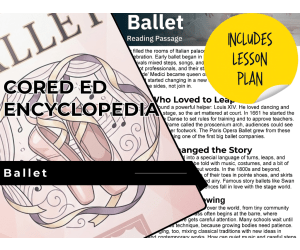
Ballet Reading Comprehension Passage - Cored Ed Encyclopedia
ELA, Language Development, Reading Comprehension, Reading, Social Studies, Writing, Vocabulary, History, Dance, Creative Arts, Grade 2, 3, 4, 5, Worksheets & Printables, Worksheets, Teacher Tools, Centers, Activities, Writing Prompts, Assessments, Quizzes and Tests, Quizzes, Lesson Plans
This ballet reading comprehension with lesson plan includes: Visualization (on the front cover) Start your lesson by taking a minute to think and share something about the topic. Read the script aloud (slowly), perhaps prepare some music or sound effects. Student close their eyes and let their imaginations wander. Students open their eyes, read the question aloud and give them a few minutes to complete. Ask a few students to share or keep answers until the end to compare with what they learn in the passage. COMPANION VIDEO NOW AVAILABLE (EMBEDDED AFTER PREVIEW PICTURES IN PRODUCT DESCRIPTION) Quick pause—thousands of Cored Education products are included with your TeachSimple membership. Download links and encyclopedia index available here. Pre-Reading Trivia Students will write down one thing they already know about the subject and then read five more facts and discuss. These facts are fun, and the students will enjoy learning about the subject before reading more. Give 1 minute for students to write what they already know (no pressure—best guess is fine). Read the five facts together. After each fact, do ask a student for their opinion, was it surprising? Set a purpose by asking students to highlight/underline one fact they want to learn more about during the reading. Reading Passage The text is a high-interest reading passage with set paragraphs, roughly three to four paragraphs long. It contains a variety of themes about the topic, anywhere from history to technology. The passage is between 250 and 350 words in length. First, ask students to look at the headings and see what they’ll learn about today. What do they know about the topic/heading? First read options: Teacher read-aloud (best for support). Partner reading (paragraph by paragraph). While reading, students underline important details, and vocabulary words they think may come up in the questions section. Mixed Questions The first question page contains four multiple-choice questions, each with a choice of four answers, and three written response questions that require a sentence or two from the student. Students complete the mcqs first independently, then review quickly as a class. For the 3 written responses, try to get students giving the answer with some form of evidence: “I think ___ because the text says ___.” If students get stuck, send them back to check the passage. Vocabulary Questions Practice seven key words from the text in this section across two activities. First section is scrambled words where students will unscramble three words given a clue for each. The second section is a word to meaning matching activity. Before starting, have some students read out words they underlined in the passage. Ask students to say the word and read aloud the sentence(s) around each word. Ask students to do scrambled words and the matching exercise in pairs then go through answers as a class. For the scrambled spelling task, get four pairs to come up to the board and write the words for extra practice with the other student reading out the clue. For the matching task, prompt students to give full sentences: “I matched ___ with ___ because ___.” Creative Writing In this question, the student will be required to write a five to eight sentence paragraph on a question related to the topic. Before starting, ask students write down 3 key ideas they are going to include in their piece. Ask students for ideas to share around the class to help those struggling. Pro writing expectations: 5–8 sentences At least 2 facts or details from the passage At least 2 vocabulary words from the previous page Students read their paragraphs while classmates listen for facts and vocabulary words. Extension Activities This page is optional for fast finishers or to take home. There are several activities, each one requiring a different skill. Do some, do none, do all, completely optional - but you will feel reassured knowing every possibility is planned for. Includes summary writting question and additional facts. Answer Key There are answers for the multiple-choice questions, written response questions have sample answers, vocabulary answers and if there is a summary question then a sample summary will be provided as well. Lesson Plan Included Customized lesson plan for this lesson is included. Lesson Snapshot Title: Ballet Genre: Nonfiction (informational passage) Subject: Arts (Dance) / Reading (Informational Text) Primary Topic: How ballet began, changed, and is practiced today Estimated Guided Reading Level (A–Z): S What This Lesson Teaches Best How ballet began in Renaissance palace courts, with dancing as part of celebrations. How ballet shifted from joining in to watching a performance “from the sides.” How ballet grew in France through royal support, including **Louis XIV starting a dance academy to set training rules and approve teachers. How stage design affected what audiences saw (the “proscenium arch” helped viewers see clearer lines and sharper footwork). How ballet tells stories without words using movement plus music, costumes, and a bit of mime, and how pointe shoes and lighter skirts changed the look. Learning Goals Describe where early ballet began and what events it was part of. Explain how ballet changed when people began watching instead of joining in. Identify what happened in 1661 and why it mattered for ballet training. Describe how the proscenium arch affected what audiences could see. Explain how ballet can show feelings and stories “without words,” using details from the text. Describe how ballet is practiced today (studios worldwide, barre work, and careful technique for growing bodies). Key Vocabulary From the Text Renaissance — a time in Europe with art, learning, and change. nobles — people from wealthy or high-ranking families. proscenium — a stage frame that shapes the audience’s view. pointe — dancing on the tips of the toes. barre — a rail dancers hold while practicing in class. FULL CATALOG OF DOWNLOAD LINKS AND ENCYCLOPEDIA INDEX HERE
Author Cored Education
Rating
Tags Vocabulary, Reading Comprehension, Reading Passages, Lesson Plans, Ela Lesson Plans, Reading Comprehension Lesson Plans, Pre-reading, History, Art, Dance Lesson Plans
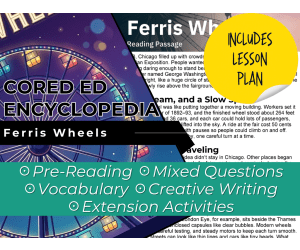
Ferris Wheels Reading Comprehension Passage - Cored Ed Encyclopedia
ELA, Reading Comprehension, Reading, Science, Technology, Language Development, Social Studies, History, Pre-Reading, Writing, Grade 2, 3, 4, 5, Worksheets & Printables, Worksheets, Teacher Tools, Centers, Activities, Writing Prompts, Assessments, Quizzes and Tests, Quizzes, Lesson Plans
This Ferris wheels reading comprehension with lesson plan includes: Visualization (on the front cover) Start your lesson by taking a minute to think and share something about the topic. Read the script aloud (slowly), perhaps prepare some music or sound effects. Student close their eyes and let their imaginations wander. Students open their eyes, read the question aloud and give them a few minutes to complete. Ask a few students to share or keep answers until the end to compare with what they learn in the passage. Quick pause—thousands of Cored Education products are included with your TeachSimple membership. Download links and encyclopedia index available here. Pre-Reading Trivia Students will write down one thing they already know about the subject and then read five more facts and discuss. These facts are fun, and the students will enjoy learning about the subject before reading more. Give 1 minute for students to write what they already know (no pressure—best guess is fine). Read the five facts together. After each fact, do ask a student for their opinion, was it surprising? Set a purpose by asking students to highlight/underline one fact they want to learn more about during the reading. Reading Passage The text is a high-interest reading passage with set paragraphs, roughly three to four paragraphs long. It contains a variety of themes about the topic, anywhere from history to technology. The passage is between 250 and 350 words in length. First, ask students to look at the headings and see what they’ll learn about today. What do they know about the topic/heading? First read options: Teacher read-aloud (best for support). Partner reading (paragraph by paragraph). While reading, students underline important details, and vocabulary words they think may come up in the questions section. Mixed Questions The first question page contains four multiple-choice questions, each with a choice of four answers, and three written response questions that require a sentence or two from the student. Students complete the mcqs first independently, then review quickly as a class. For the 3 written responses, try to get students giving the answer with some form of evidence: “I think ___ because the text says ___.” If students get stuck, send them back to check the passage. Vocabulary Questions Practice seven key words from the text in this section across two activities. First section is scrambled words where students will unscramble three words given a clue for each. The second section is a word to meaning matching activity. Before starting, have some students read out words they underlined in the passage. Ask students to say the word and read aloud the sentence(s) around each word. Ask students to do scrambled words and the matching exercise in pairs then go through answers as a class. For the scrambled spelling task, get four pairs to come up to the board and write the words for extra practice with the other student reading out the clue. For the matching task, prompt students to give full sentences: “I matched ___ with ___ because ___.” Creative Writing In this question, the student will be required to write a five to eight sentence paragraph on a question related to the topic. Before starting, ask students write down 3 key ideas they are going to include in their piece. Ask students for ideas to share around the class to help those struggling. Pro writing expectations: 5–8 sentences At least 2 facts or details from the passage At least 2 vocabulary words from the previous page Students read their paragraphs while classmates listen for facts and vocabulary words. Extension Activities This page is optional for fast finishers or to take home. There are several activities, each one requiring a different skill. Do some, do none, do all, completely optional - but you will feel reassured knowing every possibility is planned for. Includes summary writting question and additional facts. Answer Key There are answers for the multiple-choice questions, written response questions have sample answers, vocabulary answers and if there is a summary question then a sample summary will be provided as well. Lesson Plan Included Customized lesson plan for this lesson is included. Lesson Snapshot Title: Ferris Wheels Genre: Nonfiction (Informational Text) Subject: Social Studies (History) / Science & Technology / Reading (Informational Text) Primary Topic: Origins, design, and purpose of Ferris wheels Estimated Guided Reading Level (A–Z): P What This Lesson Teaches Best Explains the origin story of the first Ferris wheel at the 1893 Chicago world’s fair and why people wanted a daring new attraction. Uses clear facts and measurements (about 264 feet/80 meters , 36 cars , ride cost and time) to build informational reading skills. Shows how Ferris wheels spread to new places and why they’re also called “observation wheels” (because looking is part of the fun). Compares past and present Ferris wheels, including modern wheels built for slow sightseeing like the London Eye with enclosed capsules. Highlights how modern wheels rely on strong steel, careful testing, and steady motors for smooth turns. Learning Goals Students will describe why the 1893 world’s fair crowd wanted something “brand-new” to see. Students will identify key details about the first Ferris wheel (height, number of cars, ride time, and cost). Students will explain why Ferris wheels are also called “observation wheels” using evidence from the text. Students will describe how Ferris wheels spread to other places after Chicago, including the example in Vienna. Students will compare how some Ferris wheels are designed for thrills versus slow sightseeing today. Key Vocabulary From the Text Exposition — a huge fair where inventions and exhibits are shown. engineer — a person who designs and builds things. fairgrounds — the area where a fair is held. capsules — closed pods that carry riders on a wheel. skyline — the outline of a city’s buildings against the sky. FULL CATALOG OF DOWNLOAD LINKS AND ENCYCLOPEDIA INDEX HERE
Author Cored Education
Rating
Tags Vocabulary, Reading Comprehension, Reading Passages, Lesson Plans, Ela Lesson Plans, Reading Comprehension Lesson Plans, Pre-reading, Science Lesson Plans, Social Studies Lesson Plans, History
Reading Comprehension - Digital Lesson Plan Gr. 5-8 - FLASH-PC
ELA, Reading, Reading Comprehension, Grade 3, 4, 5, 6, 7, 8, Teacher Tools, Lesson Plans
Reading Comprehension - Digital Lesson Plan Gr. 5-8 - FLASH-PC An engaging teaching resource designed for grades 5 to 8, aimed at enhancing reading comprehension skills through a comprehensive digital lesson plan. The Core Features Include: An interactive learning platform over 80 screens providing lessons on: Determining primary idea Understanding inferences Effective use of context clues A practical guide on using graphic organizers to enhance students' comprehension abilities. Innovative features like Text-to-Speech, along with video & audio support improving auditory learning experiences. A variety of engaging activities such as memory match game, crossword puzzles and word searches. A Comprehension Quiz allowing educators to assess their student's progress effectively after interactions within the lesson plan thus promoting greater engagement and enriched learning outcomes. Additional Utility and Compatibility: This product ensures wide usability by aligning with State Standards reflecting principles of Bloom’s Taxonomy. This makes it relevant for different educational settings including both public school educators as well as homeschoolers. Tech-Specs: The software-based file format allows easy installation across multiple PCs making it suitable for various modes of teaching sessions like whole-group instructions involving projector screens or solo tutoring scenarios in classroom computer stations. It encourages continuity during reinforcement exercises at home via guided homework sessions too!
Author Classroom Complete Press
Tags Software (PC)

Glaciers: The Chilly Facts: A Cross-Curricular Unit
Science, Earth and Environmental Sciences, Environmental Science, Grade 3, 4, Teacher Tools, Lesson Plans
Glaciers: The Chilly Facts: A Cross-Curricular Unit An engaging educational resource crafted for teachers and homeschoolers targeting third-grade and fourth-grade students. This comprehensive teaching tool takes a deep dive into the intriguing world of glaciers, bridging scientific knowledge with practical learning. A Unique Learning Approach The distinctive aspect of this product lies in its structured content, integrating an informative nonfiction article revealing intriguing facts about these slow-moving ice structures. Students have the opportunity to gain a deeper understanding of glaciers from various perspectives, enriching their knowledge beyond simply defining what a glacier is. Cross-curricular Worksheets Included besides this well-researched article are several cross-curricular worksheets. These worksheets developed with interdisciplinary insight cover distinct subject areas contributing to holistic learning experiences surpassing pure science education constraints. Fostering Creative Thinking: Activities within this unit encourage thinking creatively while reinforcing learned concepts from the main text. Versatility in Teaching Situations: Activity ideas can adapt seamlessly across multiple teaching situations - be it whole-group classroom discussions or assigned homework for personalized at-home learning engagements. Simplified Structuring & Efficient Planning This PDF file spans six pages ready for immediate printing upon purchase, serving effectively as both a comprehensive lesson plan and time-efficient prep-tool for educators focused on delivering top-tier environmental science instruction. Inspire Interest & Knowledge Growth In Environmental Sciences: Utilizing Glaciers: The Chilly Facts: A Cross-Curricular Unit will stimulate increased student interest in environmental sciences while equipping them with essential glacier information – transforming lessons into captivating explorations of Earth's icy wonders.
Author Classroom Complete Press
Tags Glaciers, Chilly Facts, Environmental Science, Cross-curricular Unit, Science Worksheet

Numbers Dot Marker Worksheets
Creative Arts, Graphic Arts, Math, Numbers, Early Math, Infant, Toddler, Kindergarten, Preschool, Grade 1, 2, 3, Activities, Centers, Teacher Tools, Lesson Plans, Worksheets & Printables, Worksheets, Coloring Pages, Dot To Dots
Let’s make number learning a delightful dot-filled adventure! These Numbers Dot Marker Worksheets for numbers 1 to 10 are perfect for turning math time into an engaging, colorful masterpiece. Your students will dot their way to numerical mastery, one cheerful splatter at a time. Ways to Use: Independent Practice: Give students a worksheet, a dot marker, and watch the magic happen. Small Groups: Let them work together to compare their dotted numbers and create a mini math gallery. Learning Centers: Set up a dot-station where students can rotate in and enjoy some hands-on number fun. Homework: A mess-free way to practice at home (parents will thank you). Advantages: Visual Learning: The vibrant dots make number recognition and counting stick like glue. Motor Skills: Perfect for those little hands to develop coordination. Stress-Free Prep: Just print and hand out, no cutting, laminating, or assembling required. Quiet Time: These worksheets are magical tools for classroom calmness. From number ninjas to dot detectives, all your students will love this colorful, interactive way to practice math. Who knew learning numbers could be so... dottedly delightful?
Author Ponder Palette Plazza
Tags Numbers, Coloring Numbers, Dot To Dot, Dot To Dots, Numbers Dot Marker, Numbers Dot Marker Worksheets, Numbers Coloring, Dot Marker
Reducing Your School's Carbon Footprint: We Recycle Cans, Trees Recycle Carbon Gr. 5-8
Science, Earth and Environmental Sciences, Environmental Science, Grade 5, 6, 7, 8, Teacher Tools, Lesson Plans
Reducing Your School's Carbon Footprint: We Recycle Cans, Trees Recycle Carbon Gr. 5-8 is an educational resource developed to introduce students of grades 5 to 8 to the principle of a carbon footprint. This program presents a unique combination of environmental science and hands-on analysis aimed at understanding the influence our regular activities have on our planet. This educational material focuses on helping students: Evaluate their school's carbon footprint, Develop a strong sense of responsibility towards their environment. The program challenges critical thinking by encouraging kids: To devise strategies for decreasing energy consumption within their school environment, To carry out group projects during the class session, and To take possible homework assignments more seriously while connecting them with the real-life application aspect. Prominent among its features is opening conversations about fossil fuels' utilization in schools and society generally. The content adheres closely with principles Bloom's Taxonomy and also aligns with STEAM initiatives (Science Technology Engineering Arts Mathematics) . Main Highlight The major distinction this instructional tool holds is its link-to-life application aspect - it motivates learners not just think theoretically but also perform practical ideas achieving real results. Some examples include creating idle-free zones in schools or figuring out potential reduction in carbon dioxide if trees are planted around nearby areas. Through such activities executed either during full-class lessons or smaller groups sessions, learners get hands-on experience in making considerable changes that positively affect their immediate surroundings. Add-ons Included: Versatile learning tools such as graphic organizers, Crossword puzzles and comprehension quizzes, Bundled with answer keys provided All included in a print-ready PDF format of 30 pages. In summary, Reducing Your School's Carbon Footprint: We Recycle Cans, Trees Recycle Carbon Gr. 5-8 goes beyond being a just lesson plan; it kickstarts an eco-friendly paradigm shift among learners, setting them up to be proactive custodians of the world around them.
Author Classroom Complete Press
Tags School Environment, Carbon Footprint, Recycling, Science Quiz, Reading Passage
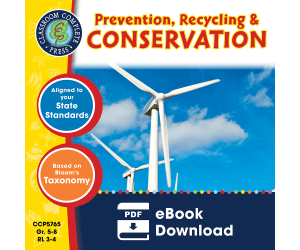
Prevention, Recycling & Conservation Gr. 5-8
Science, Earth and Environmental Sciences, Environmental Science, Grade 5, 6, 7, 8, Teacher Tools, Lesson Plans
Prevention, Recycling & Conservation Gr. 5-8: A Key Teaching Resource This teaching tool is designed to deepen students' understanding of sustainable practices and environmental conservation. It expertly brings together theory and practice for Grade 5 to Grade 8 learners depicting a real-life approach to science. An Invitation for Active Participation Intelligence-driven, this material invites students' active participation emphasizing that the battle for Earth's preservation begins with them. Sustainable Learning Experiences In-depth explanations on waste prevention methods and environmental problem-solving. Promotes creativity through innovative recycling management within their community. Harnesses practical knowledge by providing hands-on opportunities like building a classroom compost system. Inclusion of fun activities such as word search and crossword puzzles supporting vocabulary building! A Focus on Water Safety & Independent Research Skills The resource includes critical information about water safety - where it comes from and how it should be conserved. Also encourages developing independent research skills through Internet-based assignments such as creating green business guides or reporting specifically about greenhouse gases. All-Inclusive Teaching Toolkit in PDF Format! The downloadable PDF file comes with: Ready-to-use lesson plans:Fulfilling Bloom's Taxonomy and STEAM objectives aimed at various Environmental Science classes or any course addressing global issues User-friendly evaluation tools:Simplified student assessments like comprehension quizzes coupled with an answer key. The package has everything you need to equip your students with eco-conscious knowledge, outlining the future's biggest battles! Make learning fun while unraveling the complexities of our fragile ecosystems and creating eco-conscious global citizens.
Author Classroom Complete Press
Tags PDF