



3,885 products added recently
Page 65 - Lesson Plan Templates
Simplify your preparation with lesson plan templates designed to help you organize objectives, activities, and assessments. These templates provide a structured framework to ensure comprehensive coverage of material. Incorporate them to save time and enhance the effectiveness of your teaching.

 Show filters


Readiness Life Skills - Managing Time Gr. 9-12+
Life Studies, Special Resources, Life Skills, Grade 6, 7, 8, 9, 10, 11, 12, Teacher Tools, Lesson Plans
Become a master of time management. This resource promotes independence. Set up a plan at the start of your day. Make to do lists of things you want to get done. This resource provides tips and strategies to maximize your time. Learn how to prioritize your tasks for the day. Follow the provided five levels of priority to get started. Break up bigger jobs into smaller tasks. A four step process will help here. Explore the Eisenhower's urgent important matrix. Use this in a real-world experience. Finish your day by evaluating what you accomplished. Make a plan for the next day. Get to know how different tools can help with efficiency, from time trackers to productivity apps. This resource is made up of reading passages, real-world activities, graphic organizers, and extension activities, like a crossword, word search and comprehension quiz. Combining high interest concepts with low vocabulary to make sure all learners understand the necessary skills required in life. Aligned to your State Standards. Written to Bloom's Taxonomy. This content is reproducible.
Author Classroom Complete Press
Rating
Tags Life Skills, Comprehension, Graphic Organizers, Reading Passage, Readiness, Managing, Manage, Time, Management

I WONDER - How Many Animals Live In The Rainforest | Animated Video
Biology, Life Sciences, Science, Animals, STEM, Grade 1, 2, 3, 4, 5, 6, 7, 8, Lesson Plans, Teacher Tools
Video Introduction Animal kingdoms are full of fascinating wonders to learn. This video is designed for the students to learn more about animals in different countries. I WONDER - How Many Animals Live In The Rainforest | Animated Video Lesson Do you like animals? what is your favorite one? Do you own a pet? If yes, tell us more about it, like what its name? And what do you like most about it? What are the animal kingdoms? Can you write down the characteristics of each animal class like mammals, birds, reptiles, amphibian, fish and mollusks. Do you know that some animals can sing, can you name any of them? What is the largest and the smallest mammal in the world? What is the largest and the smallest bird in the world? What is the largest and the smallest fish in the world? I WONDER - How Many Animals Live In The Rainforest | Animated Video Lesson The video is perfect for encouraging the researching skills for the students, while learning more about these fantastic animals. I WONDER - How Many Animals Live In The Rainforest | Animated Video Lesson This friendly designed video is suitable for students at school, homeschooling, and as a group activity. Format Available in MP4 format.
Author Educational Voice
Tags How Many Animals Live In The Rainforest, How Many Animals Live In The Rainforest Video, Animals Live In The Rainforest, Animals Live In The Rainforest Facts, Animals Live In The Rainforest Facts For Kids, Animals Live In The Rainforest Video

Guided Reading Lesson Plan & Activities for Grade 7
Reading, ELA, Grade 7, Activities, Lesson Plans, Teacher Tools
Seventh graders can concentrate better on enhancing the skills they started to cultivate in 6th grade without the extra pressure of adapting to the new middle school setting. By 7th grade, it is anticipated that students have adjusted to middle school life and are thus expected to operate more autonomously while managing their time and schedules with diminished (but still some) support. Typically, in 7th grade, students expand upon the abilities they acquired in 6th grade by engaging with more intricate and lengthy texts and essays in both writing and reading. This effort will equip them for 8th grade, where they will solidify and enhance their skills, ultimately positioning them for success in high school. In 7th grade, learners enhance their skills in analyzing the texts they read and supporting their analysis with evidence from the text. In particular, 7th grade students focus on scrutinizing texts more thoroughly and utilizing details from the text to formulate ideas, conduct analysis, and draw inferences. This ebook contains a comprehensive 90-minute lesson plan, featuring activities and suggested answers.
Author Bright Classroom Ideas Marketplace
Tags Guided, Reading, Lesson, Plan, Activities, Grade 7, Language

Nouns Sample - Grades 1-2 Grammar (Forms)
ELA, Language Development, ESL, Grammar, Common Core, Resources for Teachers, Grade 1, 2, Lesson Plans, Teacher Tools, Assessments, Tests, Quizzes and Tests, Centers, Activities
Nouns - 1 Sample Lesson ELA MCQS Overview: In this series of lessons, students will embark on an engaging exploration of the grammar skills that bring our language to life. These lessons are designed to help students identify, understand, and effectively use language arts skills in their writing and speech. Used with the free supplementary materials available for all topics, each lesson builds on the last, offering a mix of direct instruction, interactive group activities, and independent practice. Through fun and creative tasks, students will learn how to recognize grammar in sentences, understand their role in sentences and use them to enhance their own writing and speech. Nouns Overview: Includes: Common Nouns Proper Nouns Irregular Plurals Possessive Nouns Collective Nouns Forms Version This is the Forms editable and self grading version. This download is available in GOOGLE Docs, GOOGLE Forms, GOOGLE Slides. PDF, PPT, WORD, check the links below for more details. FULL CATALOG OF DOWNLOAD LINKS HERE Grade 1/2 Links: Capitalization and Punctuation Google Docs Google Forms Google Slides PDF PPT Word Free Supplementary Materials Pack Adjectives Google Docs Google Forms Google Slides PDF PPT Word Free Supplementary Materials Pack Nouns Google Docs Google Forms Google Slides PDF PPT Word Free Supplementary Materials Pack Pronouns Google Docs Google Forms Google Slides PDF PPT Word Free Supplementary Materials Pack Verbs Google Docs Google Forms Google Slides PDF PPT Word Free Supplementary Materials Pack Prefixes & Suffixes Google Docs Google Forms Google Slides PDF PPT Word Free Supplementary Materials Pack Sentence Structure Google Docs Google Forms Google Slides PDF PPT Word Free Supplementary Materials Pack Subject-Verb Agreement Google Docs Google Forms Google Slides PDF PPT Word Free Supplementary Materials Pack ELA Review Questions Overview Questions have three answer choices. There are a handful of pictures on each test for aesthetic purposes, as well as a review sheet covering most of the topics covered in the product. Introduction or Example Sheet Each topic will include an introduction or example sheet to go through first with your students. Full Answer Keys Full answer keys and sample responses are provided so no matter how busy you are, you know you're covered! In the Supplementary Pack Interactive Ice Breakers: Fun, hands-on activities that get students thinking about adjectives right from the start. Guided Practice: Teacher-led exercises that reinforce the day’s lesson, ensuring students can confidently identify and use adjectives. Group and Partner Tasks: Collaborative activities that allow students to work together to solve problems, categorize adjectives, and create descriptive sentences. Independent Worksheets: Structured worksheets that provide individual practice and help solidify understanding of key concepts. Exit Tasks: Quick, reflective activities at the end of each lesson that assess understanding and encourage students to apply what they’ve learned. For similar downloads and other frees, do check out Cored Group on TeachSimple.
Author Cored Education
Tags Elementary, Reading, Comprehension, Vocabulary, Answers, Ccss, Common Core, Spelling, Writing, Digital Centers

Informative Essay Unit
ELA, Writing, Grade 6, 7, 8, Lesson Plans, Teacher Tools
This is an Informative Essay Unit designed with your middle school students in mind. This comes with writing prompts , texts, notes and more. Students will read informative texts, complete Pixanotes, play games and more. All you have to do is print and go.
Author Mrs. Spangler in the Middle
Tags Informative Essay, Writing Unit, Writing Prompts, Reading Posters, Graphic Organizers

I WONDER - How Did The Planet Mercury Get Its Name | Animated Video
Space, Earth and Environmental Sciences, Science, Grade 6, 7, 8, 9, 10, 11, 12, Lesson Plans, Teacher Tools
Video Introduction An amazing video designed for the students to learn more about space facts. I WONDER - How Did The Planet Mercury Get Its Name | Animated Video Lesson Do you like reading about space? If yes, what is your favorite topic? What do you know about our solar system? What is the smallest planet in our solar system? What is the biggest planet in our solar system? What is the hottest planet in our solar system? And what is the coldest one? Do you think there are aliens? If yes, what do you think they look like? What do they eat and how they speak to each other? Where do they live? What is a galaxy? And what is a milky way? Have you recently saw a shooting star? If yes, tell us more about it, like when did it happen and where? What is a blackhole? Can a blackhole gets bigger by time? Do you like counting the stars? What do you think a star is made of? I WONDER - How Did The Planet Mercury Get Its Name | Animated Video Lesson The video is perfect for encouraging the researching skills for the students, while learning more about the fantastic space. I WONDER - How Did The Planet Mercury Get Its Name | Animated Video Lesson This friendly designed video is suitable for students at school, homeschooling, and as a group activity. Format Available in MP4 format.
Author Educational Voice
Tags How Did The Planet Mercury Get Its Name, How Did The Planet Mercury Get Its Name Video, Planet Mercury's Name, Planet Mercury's Name Video, Planet Mercury's Name Video For Kids, Planet Mercury's Name Facts

Economy & Globalization: Economic Globalization: A Historical Overview Gr. 5-8
Social Studies, Economics, Grade 5, 6, 7, 8, Teacher Tools, Lesson Plans
Economy & Globalization: A Historical Overview - Teaching Resource for Grades 5-8 This comprehensive resource is designed specifically for middle school educators interested in teaching their students about the history and function of the global economy. It's particularly suitable for social studies classes that explore economics. Active Learning Experience: This educational material takes a dynamic approach to learning, incorporating more than just typical lesson plans. Some of its unique offerings include: Hands-on Activities: Interactive exercises like role-playing scenes from the Great Depression era or developing a multinational company business plan apply theories learned in class, enriching practical understanding. Critical-thinking Challenges: Promotes reflective learning with topics such as outsourcing covered through case study writing tasks. Student-led Discussions: Moderate panel discussions on international immigration policy or hold debates on whether trends toward economic globalization have been beneficial worldwide. Fostering Real-world Skills: The goal isn't only academic understanding but also promoting skill development transferable to real life. This includes practical financial literacy through activities such as currency exchanging using up-to-date rates along with bolstering mathematical abilities. Educational Standards Compliance: All lesson plans comply with state educational standards and adhere to Bloom's Taxonomy's recommended objectives, ensuring systematic content delivery promoting cognitive growth in learners. Vocabulary Building Activities: In addition to critical analysis and hands-on activities, vocabulary building plays an integral part of this program. Methods for this include: Crossword puzzles based on economic key terms Word searches themed around globalization Through this comprehensive approach of combining inquiry-based learning within an interactive framework, we provide educators with an effective means of delivering complex concepts related to the global economy and globalization. Learning isn't just informative - it's also engaging and fun!
Author Classroom Complete Press
Tags PDF

Pronouns Supplementary Materials Grade 5-6 (PDF)
ELA, Language Development, ESL, Grammar, Common Core, Resources for Teachers, Grade 5, 6, 7, Worksheets & Printables, Worksheets, Quizzes and Tests, Teacher Tools, Tests, Assessments, Lesson Plans
Verbs Supplementary Materials Note: This download DOES NOT include the tests themselves. You can still make use of these materials without them but they are recommended. Download in a format of your choice in the "Links" section below. In the Supplementary Pack Interactive Ice Breakers: Engaging warm-up activities that introduce students to key ELA concepts, such as quick capitalization corrections and punctuation challenges. Guided Practice: Structured teacher-led exercises that reinforce grammar and punctuation rules, helping students identify and apply them correctly in sentences. Group and Partner Tasks: Collaborative activities where students work together to edit sentences, correct capitalization, and improve punctuation through peer discussion and teamwork. Independent Worksheets: Carefully designed worksheets that provide focused practice, allowing students to apply learned concepts and refine their skills independently. Exit Tasks: Quick assessments at the end of each lesson, prompting students to reflect on what they’ve learned and apply their knowledge in writing and editing tasks. Links Indefinite Pronouns Intensive Pronouns Interrogative Pronouns Reflexive Pronouns Relative Pronouns Google Docs Google Forms Google Slides PDF PPT Word FULL CATALOG OF DOWNLOAD LINKS HERE Grade 5/6 Links: Capitalization & Punctuation Google Docs Google Forms Google Slides PDF PPT Word Free Supplementary Materials Pack Adjectives Google Docs Google Forms Google Slides PDF PPT Word Free Supplementary Materials Pack Nouns Google Docs Google Forms Google Slides PDF PPT Word Free Supplementary Materials Pack Pronouns Google Docs Google Forms Google Slides PDF PPT Word Free Supplementary Materials Pack Verbs Google Docs Google Forms Google Slides PDF PPT Word Free Supplementary Materials Pack Prefixes & Suffixes Google Docs Google Forms Google Slides PDF PPT Word Free Supplementary Materials Pack Sentence Structure Google Docs Google Forms Google Slides PDF PPT Word Free Supplementary Materials Pack Subject Verb Agreement Google Docs Google Forms Google Slides PDF PPT Word Free Supplementary Materials Pack Tenses Google Docs Google Forms Google Slides PDF PPT Word Free Supplementary Materials Pack Context Clues Google Docs Google Forms Google Slides PDF PPT Word Free Supplementary Materials Pack Defining Words Google Docs Google Forms Google Slides PDF PPT Word Free Supplementary Materials Pack Fill in the Blanks Google Docs Google Forms Google Slides PDF PPT Word Free Supplementary Materials Pack Homophones Google Docs Google Forms Google Slides PDF PPT Word Free Supplementary Materials Pack Synonyms Google Docs Google Forms Google Slides PDF PPT Word Free Supplementary Materials Pack ELA Review Questions Overview Questions have three answer choices. There are a handful of pictures on each test for aesthetic purposes, as well as a review sheet covering most of the topics covered in the product. Introduction or Example Sheet Each topic will include an introduction or example sheet to go through first with your students. Full Answer Keys Full answer keys and sample responses are provided so no matter how busy you are, you know you're covered! For More Like This For similar downloads and other frees, do check out Cored Group on TeachSimple.
Author Cored Education
Tags Elementary, Answers, Ccss, Common Core, Grammar, Tests, Test Prep, Assessment, Grade 5, Grade 6
I WONDER - Where Is The Most Unusual Place Golf Has Been Played
Sports, P.E. & Health, Grade 4, 5, 6, 7, 8, 9, 10, Lesson Plans, Teacher Tools
Video Introduction An amazing video designed for the students to learn more about sports in different countries. I WONDER - Where Is The Most Unusual Place Golf Has Been Played | Animated Video Lesson What is your favorite sport? Tell us more about it. Who is your favorite athlete? Or what is your favorite team? Do you know who invented basketball? When basketball has been invented? Can you tell us where is the first time it has been played? Have you ever played soccer or football? If yes, tell us what was your position: A goal keeper, midfield player, or a defender? Do you like watching golf? If yes who is your favorite player? Can you name the differences between tennis and ping pong? Have you ever played volleyball on the beach? When it has been officially recognized by the Olympics? Do you like watching Formula 1 races? If yes, who is your favorite team or driver? Have you ever tried to play handball? If yes tell us more. Do you like watching people skiing or surfing? I WONDER - Where Is The Most Unusual Place Golf Has Been Played | Animated Video Lesson The video is perfect for encouraging the researching skills for the students, while learning more about this sport. I WONDER - Where Is The Most Unusual Place Golf Has Been Played | Animated Video Lesson This friendly designed video is suitable for students at school, homeschooling, and as a group activity. Format Available in MP4 format.
Author Educational Voice
Rating
Tags Where Is The Most Unusual Place Golf Has Been Played, Where Is The Most Unusual Place Golf Has Been Played Video, Golf, Golf Facts, Golf Video, Golf Video For Kids, Golf Facts For Kids, Sport
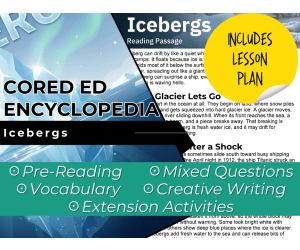
Icebergs Reading Comprehension Passage - Cored Ed Encyclopedia
ELA, Reading Comprehension, Reading, Language Development, History, Social Studies, Science, Physics, Earth and Environmental Sciences, Pre-Reading, Grade 2, 3, 4, 5, Worksheets & Printables, Worksheets, Teacher Tools, Centers, Activities, Writing Prompts, Assessments, Quizzes and Tests, Quizzes, Lesson Plans
This Icebergs reading comprehension with lesson plan includes: Visualization (on the front cover) Start your lesson by taking a minute to think and share something about the topic. Read the script aloud (slowly), perhaps prepare some music or sound effects. Student close their eyes and let their imaginations wander. Students open their eyes, read the question aloud and give them a few minutes to complete. Ask a few students to share or keep answers until the end to compare with what they learn in the passage. Quick pause—thousands of Cored Education products are included with your TeachSimple membership. Download links and encyclopedia index available here. Pre-Reading Trivia Students will write down one thing they already know about the subject and then read five more facts and discuss. These facts are fun, and the students will enjoy learning about the subject before reading more. Give 1 minute for students to write what they already know (no pressure—best guess is fine). Read the five facts together. After each fact, do ask a student for their opinion, was it surprising? Set a purpose by asking students to highlight/underline one fact they want to learn more about during the reading. Reading Passage The text is a high-interest reading passage with set paragraphs, roughly three to four paragraphs long. It contains a variety of themes about the topic, anywhere from history to technology. The passage is between 250 and 350 words in length. First, ask students to look at the headings and see what they’ll learn about today. What do they know about the topic/heading? First read options: Teacher read-aloud (best for support). Partner reading (paragraph by paragraph). While reading, students underline important details, and vocabulary words they think may come up in the questions section. Mixed Questions The first question page contains four multiple-choice questions, each with a choice of four answers, and three written response questions that require a sentence or two from the student. Students complete the mcqs first independently, then review quickly as a class. For the 3 written responses, try to get students giving the answer with some form of evidence: “I think ___ because the text says ___.” If students get stuck, send them back to check the passage. Vocabulary Questions Practice seven key words from the text in this section across two activities. First section is scrambled words where students will unscramble three words given a clue for each. The second section is a word to meaning matching activity. Before starting, have some students read out words they underlined in the passage. Ask students to say the word and read aloud the sentence(s) around each word. Ask students to do scrambled words and the matching exercise in pairs then go through answers as a class. For the scrambled spelling task, get four pairs to come up to the board and write the words for extra practice with the other student reading out the clue. For the matching task, prompt students to give full sentences: “I matched ___ with ___ because ___.” Creative Writing In this question, the student will be required to write a five to eight sentence paragraph on a question related to the topic. Before starting, ask students write down 3 key ideas they are going to include in their piece. Ask students for ideas to share around the class to help those struggling. Pro writing expectations: 5–8 sentences At least 2 facts or details from the passage At least 2 vocabulary words from the previous page Students read their paragraphs while classmates listen for facts and vocabulary words. Extension Activities This page is optional for fast finishers or to take home. There are several activities, each one requiring a different skill. Do some, do none, do all, completely optional - but you will feel reassured knowing every possibility is planned for. Includes summary writting question and additional facts. Answer Key There are answers for the multiple-choice questions, written response questions have sample answers, vocabulary answers and if there is a summary question then a sample summary will be provided as well. Lesson Plan Included Customized lesson plan for this lesson is included. Lesson Snapshot Title: Icebergs Genre: Nonfiction (informational passage) Subject: Reading (Informational Text) / Earth Science Primary Topic: How icebergs form, drift, and change Estimated Guided Reading Level (A–Z): R What This Lesson Teaches Best Key facts about iceberg floating: ice is lighter than seawater and most of an iceberg is below the surface (about 90% underwater). How icebergs form from glaciers on land, including the process called calving when a piece breaks away at the sea. Human safety and history connections: the Titanic tragedy and how the International Ice Patrol began sending warnings to ships. How icebergs change shape over time (waves at the waterline, meltwater weakening from above) and why scientists track them (ocean currents, changing polar ice). Using headings to organize information into focused sections (formation, safety/history, observation/science clues). Learning Goals Explain why most of an iceberg is hidden under the ocean’s surface. Describe how snow becomes hard glacier ice and how a new iceberg forms. Define calving using details from the passage. Identify what happened in 1912 and how it led to safer travel for ships. Describe two ways an iceberg can change shape and one reason scientists watch iceberg paths. Key Vocabulary From the Text seawater — ocean water with salt in it. surface — the top layer of something. glacier — a huge, slow-moving river of ice. calving — when a piece breaks off a glacier. currents — moving flows of ocean water. FULL CATALOG OF DOWNLOAD LINKS AND ENCYCLOPEDIA INDEX HERE
Author Cored Education
Rating
Tags Vocabulary, Reading Comprehension, Reading Passages, Lesson Plans, Ela Lesson Plans, Reading Comprehension Lesson Plans, Pre-reading, History, Science Lesson Plans, Earth Science
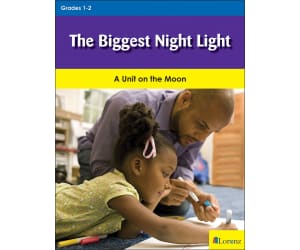
The Biggest Night Light: A Unit on the Moon
Science, Earth and Environmental Sciences, Space, Grade 1, 2, Teacher Tools, Lesson Plans
The Biggest Night Light: A Unit on the Moon Discover a captivating resource in your teaching toolkit for grades 1 and 2. The Biggest Night Light offers an enriching blend of nonfiction text, activities, and worksheets to understand our nighttime celestial neighbor – the Moon. A Peek into Astronomy This resource explores not just the moon as a distant mass but portrays it as an integral part of our skies that we see most nights. Description of the Resource The Biggest Night Light is indeed a PDF file with seven pages ready for printing. Each page comes with: Carefully crafted content for student engagement. An enhancement of understanding science and astronomy concepts. Easily graspable complex concepts like Phases of the Moon even by young learners. Adaptability and Implementation This unit could be adapted to various instructional strategies – whether it's group learning sessions stimulating collaborative learning or small breakout sessions fostering personal understanding through focused discussions. It could even be assigned as take-home homework! Beyond Curriculum Learning Incorporating this unit into your curriculum gives students an insight into outer space—of what lies beyond our world. While studying far-off planets might seem adventurous, starting closer home—with moon study—sets a right context for future astronomical exploration. Foster Curiosity-driven Education: With The Biggest Night Lights: A Unit on The Moon in hand, transform mundane stargazing observations into scientific explorations without leaving Earth’s surface! Let's create Future Astronomers! "Remember: every great scientist once started small — maybe staring at "the biggest night light" from his backyard!"
Author Classroom Complete Press
Tags Astronomy, Space Travel, Reading Passage, Nonfiction Text, Reading Worksheets

I WONDER - How Did Isaac Newtown Discover Gravity | Animated Video
Physics, Science, Grade 4, 5, 6, 7, 8, 9, 10, Lesson Plans, Teacher Tools
Video Introduction An amazing activity designed for the students to learn more about STEM. I WONDER - How Did Isaac Newtown Discover Gravity | Animated Video Lesson Do you like STEM subjects? what is your favorite one? Have you ever tried to plant a seed? If yes, tell us more about it. Or have you ever tried to invent something? If yes, tell us more about it. And how do you think it will help us? Have you ever seen a microorganism under a microscope? What was it? And how it looked like? Mathematics is a marvelous subject. Let' sharpen our brains and solve some equations. Do you like timetable tricks? What is your favorite one? Do you know how to code? Have you ever created an app or a game before? If yes, how was it like? I WONDER - How Did Isaac Newtown Discover Gravity | Animated Video Lesson The video is perfect for encouraging the researching skills for the students, while learning more about this fantastic topic. I WONDER - How Did Isaac Newtown Discover Gravity | Animated Video Lesson This friendly designed video is suitable for students at school, homeschooling, and as a group activity. Format Available in MP4 format.
Author Educational Voice
Tags How Did Isaac Newtown Discover Gravity, How Did Isaac Newtown Discover Gravity Video, Isaac Newtown, Isaac Newtown Facts, Isaac Newtown Facts For Kids, Gravity, Gravity Video For Kids, Physics

I WONDER - What Is A Baobab Tree | Animated Video Lesson
Nature & Plants, Life Sciences, Science, Biology, Grade 4, 5, 6, 7, 8, 9, 10, Lesson Plans, Teacher Tools
Video Introduction An amazing activity designed for the students to learn more about STEM. I WONDER - What Is A Baobab Tree | Animated Video Lesson Do you like STEM subjects? what is your favorite one? Have you ever tried to plant a seed? If yes, tell us more about it. Or have you ever tried to invent something? If yes, tell us more about it. And how do you think it will help us? Have you ever seen a microorganism under a microscope? What was it? And how it looked like? Mathematics is a marvelous subject. Let' sharpen our brains and solve some equations. Do you like timetable tricks? What is your favorite one? Do you know how to code? Have you ever created an app or a game before? If yes, how was it like? I WONDER - What Is A Baobab Tree | Animated Video Lesson The video is perfect for encouraging the researching skills for the students, while learning more about this fantastic topic. I WONDER - What Is A Baobab Tree | Animated Video Lesson This friendly designed video is suitable for students at school, homeschooling, and as a group activity. Format Available in MP4 format.
Author Educational Voice
Tags What Is A Baobab Tree, What Is A Baobab Tree Video, Baobab Tree, Baobab Tree Facts, Baobab Tree Facts For Kids, Baobab Tree Video, Baobab Tree Video For Kids, Tree, Tree Facts, Tree Video

Algebra: Addition & Subtraction - Practice the Skill 3 - PC Software
Math, Algebra, Common Core, Preschool, Kindergarten, Grade 1, 2, Teacher Tools, Lesson Plans
Algebra: Addition & Subtraction - Practice the Skill 3 - PC Software This software is an invaluable teaching tool designed to reinforce understanding of algebra's fundamentals, specifically in addition and subtraction. Tailored for kindergartners, preschoolers, as well as students from grades 1 and 2, it serves as a practical solution that educators can implement across various learning environments. 'Practice the Skill' Approach The resource embodies a chapter mini complete with curriculum-oriented content structured on the principle of 'practice the skill'. This involves meticulously timed drill activity approach designed by education experts. To comprehensively engage young learners, pupils are prompted to fill missing numbers across provided number lines. Inclusivity & User Interaction: To ensure no student is left behind in their learning journey, there is an English voiceover providing instruction along with easily readable text. The Spanish alternative for both voice-over instructions and text aims at addressing diverse language preferences among students. Astonishing Features & Standards: This software meets academic standards outlined by: Common Core State Standards (CCSS) National Council of Teachers Mathematicians (NCTM) allaaying itself towards STEM initiatives—a powerful combination that blends comprehensiveness with goal-oriented lessons. Ease-of-use : This accessible product comes packed within a single downloadable zip file explicitly meant for easy PC installation! Pertinently focusing on Algebra which forms an indispensable facet of Math makes it one-of-a-kind. This tool is a must-have for teachers to instill such integral knowledge into our future leaders.
Author Classroom Complete Press
Tags Math Lesson Plan, Algebra Practice, Addition Worksheet, Digital Math, Math Skills

Golden Ratio & Great Pyramid – Math + Art Unit
Social Studies, Science, Earth and Environmental Sciences, Math, Geometry, History, History: Ancient, Grade 8, 9, 10, 11, Lesson Plans, Teacher Tools
Math & Art Thematic Unit: Golden Ratio Great Pyramid is a great resource for students to explore the golden ratio and Pythagorean theorem while connecting geography with ancient history through projects , activities, and videos. A very engagin unit for your students with everything you need for them to be succesful!
Author NatureGlo's eScience
Rating
Tags Math Thematic Unit, Art Thematic Unit, Golden Ratio, Great Pyramid, Geometry, Golden Ratio Study Guide, Archaeology, Golden Ratio Pyramid

Summer Learning Packet Kindergarten to Grade 1 | Math & Reading Review
ELA, Math, Kindergarten, Lesson Plans, Teacher Tools, Worksheets & Printables
Help young learners stay engaged and confident over the summer with this fun and easy-to-use Summer Learning Packet for Kindergarten to 1st Grade. Designed for students finishing Kindergarten and preparing for first grade, this resource provides meaningful practice in both reading and math while helping prevent summer learning loss. The packet includes 50 print-and-go pages filled with engaging, summer-themed activities that reinforce essential early literacy and numeracy skills. Students practice letter recognition, beginning and ending sounds, CVC words, rhyming, sight words, reading comprehension, counting, number sense, addition, subtraction, shapes, measurement, and graphing. Fun enrichment activities such as mazes, I Spy pages, color-by-number tasks, connect-the-dots, and a summer bucket list help keep learning enjoyable and motivating. Perfect for summer packets, summer school, homeschool learning, tutoring, intervention, or back-to-school review, the activities are designed to be completed independently with minimal support. Students can work through one or two pages each day, making learning manageable for families. With an included answer key, teacher and parent guide, and completion certificate, this packet provides a simple and effective way to keep learning going all summer long.
Author Bright Classroom Ideas Marketplace
Rating
Tags Summer, Reading, Ela, Math, Worksheet

I WONDER - What Did Ancient People Think Of The Aurora Borealis
Geography, Social Studies, Earth Sciences, Earth and Environmental Sciences, Science, Grade 4, 5, 6, 7, 8, 9, 10, Lesson Plans, Teacher Tools
Video Introduction An amazing video designed for the students to learn more about famous places in different countries. I WONDER - What Did Ancient People Think Of The Aurora Borealis | Animated Video Lesson What do you know about this place? Do you know in which part of the world it is? Have you ever visited this place? If yes, can you tell us more about your adventure, and what do you like the most about this place? Do you like reading about Geography? What is your favorite country in the whole world? If you are going on a trip where it will be? Which country? What you are going to see there? Does this country has a famous place to visit? I WONDER - What Did Ancient People Think Of The Aurora Borealis | Animated Video Lesson The activity is perfect for encouraging the researching skills for the students, while learning more about this fantastic place. I WONDER - What Did Ancient People Think Of The Aurora Borealis | Animated Video Lesson This friendly designed video is suitable for students at school, homeschooling, and as a group activity. Format Available in MP4 format.
Author Educational Voice
Tags What Did Ancient People Think Of The Aurora Borealis, What Did Ancient People Think Of The Aurora Borealis Video, Aurora Borealis, Aurora Borealis Facts, Aurora Borealis Video, Aurora Borealis Video For Kids

All About Insects | Animated Animals Video Lesson
Science, Life Sciences, Insects, Grade 3, 4, 5, 6, 7, Lesson Plans, Teacher Tools
All About Insects | Animated Animals Video Lesson Product Description: A comprehensive educational resource specifically designed for science educators and homeschoolers to offer an interactive, immersive learning experience. The tool caters to learners between Grade 3 and Grade 7. This five-minute-long animated video format presents easy-to-understand and accurate scientific information about insects. This digital tool is a valuable addition to any teaching content, from being used as an illustrative aid during lessons or as a resource for homework assignments. Features: Focused animated content on various insect-related topics like life systems, habitats, adaptation mechanisms etc. Intricate animation design for enhanced learner engagement. Pairs visual information with auditory explanations to create multiple learning touchpoints. The product is available in MP4 file format making it compatible across different digital devices - laptops, tablets and even smartphones. Advancements in technology have made any space a potential classroom offering flexible learning scenarios based on each learner's requirements. Potential Usage Scenarios: Educators: A perfect introductory video before starting any new chapter related to animals or insects. Alternatively can be used as review material upon completion of the topic. Homeschoolers/Tutors: Ideal during scheduled science time promoting self-learning methods. Asynchronous learning can be encouraged allowing students learn at their own pace outside typical classroom timings at home leveraging blended education benefits substantially. To conclude, All About Insects | Animated Animals Video Lesson is an adaptable supplemental addition sure to enrich your teaching repertoire providing scientifically accurate data compactly within innovative technology-enhanced education methods.
Author Educational Voice
Tags Insects, Animated Video, Science Education Resource, Homeschooling, Blended Learning, Animated Animals Word Search

High School: The Scholar's Quest Mad Lib Mini-Unit
ELA, Reading, Writing, Creative Writing, Research, Resources for Teachers, High School, Homeschool Resources, Teacher Tools, Assessments, Lesson Plans, Quizzes and Tests, Templates, Worksheets & Printables, Writing Prompts
In my house, finding ninth-grade resources that do not feel childish is an uphill battle. If a worksheet looks like it is from 1994, my daughter is done before she even picks up a pencil. That is why I created the High School The Scholar's Quest Mad Lib Mini Unit. I wanted something that leaned into that dark academia, immersive vibe that teens actually like, while still hitting the academic rigor they need. We have used this on those slow, rainy Tuesdays to turn a boring ELA lesson into a deep dive into atmosphere—without the usual groaning. INCLUDED IN THIS RESOURCE: The Scholar's Quest: Multi-page immersive narrative experience. 100+ Tier 2 Word: Sophisticated academic vocabulary banks. 10 Brainstorming Sheets: Narrative architecture and planning tools. Advanced Grammar Guide: Gerunds and participle phrase toolkits. TOPICS COVERED: Literary Tone Analysis: Mastering mood through word choice. Narrative Synthesis: High-level academic word integration. Advanced Parts of Speech: Gerunds, transitive verbs, and more. Pre-Writing Skills: Character blueprints and setting design. This High School The Scholar'sQuest Mad Lib Mini Unit transforms a standard English lesson into an experiment. They are nott just students/homeschoolers here; they are alchemists in charge of the results. Whether you are homeschooling or in a classroom, this High School The Scholar'sQuest Mad Lib Mini Unit resource honors their maturity while keeping things fresh. Happy crafting! If you and your students/homeschoolers enjoyed this resource, please leave a review. Thank you for your support! Tina - Big Easy Homeschooling Mom
Author Homeschool with Big Easy Homeschooling Mom
Rating
Tags Mad Libs For Teens, Creative Writing, Homeschool Resources, Homeschool ELA Curriculum, Creative Writing Prompts For High School, Interest-led Learning ELA, Narrative Writing Unit, ELA Quest, High School ELA Workshop, Scholarly Writing Tasks
I WONDER - Where Does Chocolate Come From | Animated Video Lesson
Geography, Social Studies, Nature & Plants, Life Sciences, Science, Grade 2, 3, 4, 5, 6, 7, 8, Lesson Plans, Teacher Tools
Video Introduction An amazing video designed for the students to learn more about STEM. I WONDER - Where Does Chocolate Come From | Animated Video Lesson Do you like STEM subjects? what is your favorite one? Have you ever tried to plant a seed? If yes, tell us more about it. Or have you ever tried to invent something? If yes, tell us more about it. And how do you think it will help us? Have you ever seen a microorganism under a microscope? What was it? And how it looked like? Mathematics is a marvelous subject. Let' sharpen our brains and solve some equations. Do you like timetable tricks? What is your favorite one? Do you know how to code? Have you ever created an app or a game before? If yes, how was it like? I WONDER - Where Does Chocolate Come From | Animated Video Lesson The video is perfect for encouraging the researching skills for the students, while learning more about this fantastic topic. I WONDER - Where Does Chocolate Come From | Animated Video Lesson This friendly designed video is suitable for students at school, homeschooling, and as a group activity. Format Available in MP4 format.
Author Educational Voice
Rating
Tags Where Does Chocolate Come From, Where Does Chocolate Come From Video, Chocolate, Chocolate Facts, Chocolate Video, Chocolate Facts For Kids, Chocolate Video For Kids, Chocolate Origins

Social Skills: Collaboration Gr. 6-12+
Special Resources, Social Skills, Common Core, Grade 6, 7, 8, 9, 10, 11, 12, Teacher Tools, Lesson Plans
Social Skills: Collaboration Gr. 6-12+ is a comprehensive teaching resource specifically tailored for grade 6-12 students, forming an essential part of the broader "Real World Life Skills - Social Skills" curriculum . Unique Educational Resource With Real-Life Applications This material equips learners with social skills vital for adult life such as: Identifying positive and negative traits Forming long-lasting relationships Avoiding undesirable behaviors Emphasizing Responsible Independence The teaching resource also emphasizes self-reliance through independence and responsibility, helping students understand the importance of saying 'no' under certain circumstances—an essential ingredient to personal development that's often overlooked in standard curriculums. Nurturing Personal Accountability & Handling Criticism This resource helps build personal accountability through correct demeanor while handling criticism—a unique feature designed to keep classes engaging, regardless of whether they're delivered via webcam or in-person.. Inspiring Collaborative Learning Experiences The product offers: It encourages collaboration and keeps the classroom strongly interactive. Prompting a Progress-Minded mindset: Learners receive guidance on breaking unhealthy habits with an engaging 30-day interactive challenge! Inculcating politeness rules: Practical etiquette lessons help ensure respectful behavior among peers creating a harmonious learning environment. The PDF-type lessons included in this resource consists of: Educative reading passages, Creative graphic organizers, Additional Quiz Components following Bloom's Taxonomy aligning with your state standards Give Students an Edge with this Collaborative Learning Resource This resource, whether used for whole group tasks or individual homework assignments, promotes team bonding, punctuality and accountability among students while enhancing their overall social skills.
Author Classroom Complete Press
Tags PDF
I WONDER - What Does A Resistor Do In A Circuit | Animated Video
Physics, Science, STEM, Grade 6, 7, 8, 9, 10, 11, 12, Lesson Plans, Teacher Tools
Video Introduction An amazing video designed for the students to learn more about STEM. I WONDER - What Does A Resistor Do In A Circuit | Animated Video Lesson Do you like STEM subjects? what is your favorite one? Have you ever tried to plant a seed? If yes, tell us more about it. Or have you ever tried to invent something? If yes, tell us more about it. And how do you think it will help us? Have you ever seen a microorganism under a microscope? What was it? And how it looked like? Mathematics is a marvelous subject. Let' sharpen our brains and solve some equations. Do you like timetable tricks? What is your favorite one? Do you know how to code? Have you ever created an app or a game before? If yes, how was it like? I WONDER - What Does A Resistor Do In A Circuit | Animated Video Lesson The video is perfect for encouraging the researching skills for the students, while learning more about this fantastic topic. I WONDER - What Does A Resistor Do In A Circuit | Animated Video Lesson This friendly designed video is suitable for students at school, homeschooling, and as a group activity. Format Available in MP4 format.
Author Educational Voice
Tags What Does A Resistor Do In A Circuit, What Does A Resistor Do In A Circuit Video, Resistor, Resistor Facts, Resistor Facts For Kids, Resistor Video, Resistor Video For Kids, Circuit, Circuit Facts
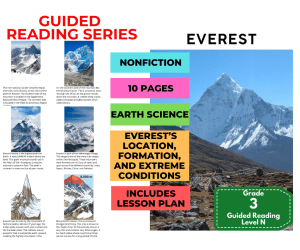
Guided Reading Level N - Everest (with Lesson Plan)
ELA, Resources for Teachers, Reading Comprehension, Reading, Science, Earth and Environmental Sciences, Social Studies, Geography, Life Sciences, Physics, Grade 2, 3, 4, Worksheets & Printables, Worksheets, Teacher Tools, Centers, Activities, Literacy Readers, Quizzes, Quizzes and Tests, Assessments, Lesson Plans
This Guided Reading Book - Everest (Level N) with lesson plan includes: Guided Reading Color Label (front cover x1) This is a quick way to match the book’s demands to what students can generally handle.. The overall goal is to use the level/color to pick books for several smaller groups. To qualify for a certain level, a student is expected to read a book from that level with about 90–94% accuracy. If a student is consistently accurate and understands, move up a level. If the student is struggling at that level, drop down and add more support. Each student will improve at completely different rates, but it is generally one of the best ways to check progress across the class. DOWNLOAD THE CATALOG TO VIEW ALL GUIDED READING BOOKS AVAILABLE (SORTED LEVELS A-Z) Pre-Reading Question (x1) Teacher asks the prompt aloud, can be while showing the cover or first page. Students share what they already know, or make educated guesses from the cover. Prompt them to use the target vocabulary. Write some of their responses on the board to look back at during the reading. Vocabulary Words (x5) Introduce the five words, best doing it one at a time. Start by saying it, while students repeat and then see if anyone knows what it means before reading further. Read through the meaning and try to briefly connect each word to a picture or gesture so it’s meaningful. Ask students to flip through the book pages and point to where they see each of the vocabulary words. While reading the book pause upon coming across one of the vocab words or read the sentence twice to make sure students understand the word has appeared. Optional: Ask students to raise hands whenever they see/hear one of the new words. Guided Reading Pages (x10) Check the book snapshot (below) for: primary topic - do you need to prep extra reading or intro materials on this? what is taught best - decide on 1-2 bullets to focus on, use the prompt or words provided here for best results. learning goals - what you are checking for students to be able to do after the session, elicit answers using prompts or words provided. key vocabulary (see section above). questions overview - so you know what is coming up and if you need to prep extra materials to assist understanding. Run the lesson You may have already looked at a few of the pages together, but you can show them some of the pictures again first to set meaning. Depending on how much time you have and how familiar your students are with guided reading class, you may want to read the book aloud first with the group first. Students whisper or partner read, while you listen in. If time, do it as a group, one student reading a page each. Use the guided page’s prompts to coach: “Check the picture / does it make sense?” “Point under the words / try the first sound” “Reread the sentence smoothly”. Try to focus more on one student per session (rotating every time), so you can work out if they are ready to move up or need to move down a level. Comprehension Questions (back cover x3) This is your way to check that students didn’t just say the words, but actually understood the text. First, let students answer by pointing to the page/picture and saying a short sentence. After any answer, follow with: “Show me where you found that in the text.” In bigger groups, have partners answer first (10–20 seconds), then call on 2–3 students to share. Differentiation tips: Emerging speakers/struggling readers: oral + pointing On-level: oral in a full sentence Higher: one written sentence or draw + label Book Snapshot Title: Everest Genre: Nonfiction (informational text) Subject: Science (Earth Science/Geography) Primary Topic: Mount Everest’s location, formation, and extreme conditions Estimated Guided Reading Level (A–Z): N What This Book Teaches Best Key facts about Mount Everest’s height and setting in the Himalayas in Asia. How mountain ranges form over long periods of time, including tectonic plate movement. How borders and regions connect to physical geography (Nepal/China border across the summit). How extreme environments change with altitude, including the “Death Zone” and low oxygen. How glaciers, weather, earthquakes, and erosion shape Everest and keep it changing. Learning Goals Describe where Mount Everest is located and what mountain system it is part of. Identify what the text says about the border between Nepal and China on Everest. Explain how Everest was formed using the book’s description of tectonic plates. Describe what the “Death Zone” is and why most living things cannot survive there long. Describe how glaciers create features on the mountain, including crevasses. Explain one way Everest is still changing today, using details from the text. Key Vocabulary From the Text summit — the very top point of a mountain. glacier — a huge, slow-moving river of ice. tectonic — related to Earth’s moving crust plates. crevasses — deep cracks in ice. erosion — wind, water, or ice wearing rock away. Discussion Prompts Pre-reading question: Where does the book say Mount Everest stands? Comprehension questions: What does the text say about where the Nepal–China border is on Everest? Comprehension questions: How does the text explain that Everest was formed long ago? Comprehension questions: What is one way the text says Mount Everest is still changing today? Printing Tips 1. Best Printing Method (Recommended) “Booklet” Printing (Best if Available) If your printer or PDF viewer supports Booklet Printing , use this. Settings to use: Print mode: Booklet Paper size: Letter or A4 (either works) Orientation: Landscape Print on both sides: Yes Flip on: Short edge Scaling: Fit to printable area Booklet subset: First test: Front sides only Then: Back sides only This will automatically: Pair pages correctly Put the cover on the outside Align everything for folding After printing, fold in half and staple along the spine . 2. If “Booklet” Printing Is NOT Available You can still print this correctly with manual duplex printing . Step-by-step: Open the PDF. Choose Print . Set: Orientation: Landscape Pages per sheet: 1 Print on both sides: Yes Flip on: Short edge Print all pages . Because each PDF page already contains two facing book pages, the result will still fold cleanly into a book. Thousands of Cored Education products are included with your TeachSimple membership. Download links and encyclopedia index available here.
Author Cored Education
Rating
Tags Reading Comprehension, Reading Passages, Reading, Guided Reading, Guided Reading Lesson Plan, Guided Reading Activity, Pre-reading, Social Studies Lesson Plans, Science Lesson Plans, Geography
I WONDER - What Is Composting | Animated Video Lesson
Environmental Science, Earth and Environmental Sciences, Science, Earth Sciences, STEM, Grade 2, 3, 4, 5, 6, 7, 8, Lesson Plans, Teacher Tools
Video Introduction An amazing video designed for the students to learn more about STEM. I WONDER - What Is Composting | Animated Video Lesson Do you like STEM subjects? what is your favorite one? Have you ever tried to plant a seed? If yes, tell us more about it. Or have you ever tried to invent something? If yes, tell us more about it. And how do you think it will help us? Have you ever seen a microorganism under a microscope? What was it? And how it looked like? Mathematics is a marvelous subject. Let' sharpen our brains and solve some equations. Do you like timetable tricks? What is your favorite one? Do you know how to code? Have you ever created an app or a game before? If yes, how was it like? I WONDER - What Is Composting | Animated Video Lesson The video is perfect for encouraging the researching skills for the students, while learning more about this fantastic topic. I WONDER - What Is Composting | Animated Video Lesson This friendly designed video is suitable for students at school, homeschooling, and as a group activity. Format Available in MP4 format.
Author Educational Voice
Tags What Is Composting, What Is Composting Video, Composting, Composting Facts, Composting Facts For Kids, Composting Video, Composting Video For Kids, Composting Tips For Kids