



3,940 products added recently
Page 112 - Elementary Lesson Plans
Support your elementary students with lesson plans that cover a broad range of subjects and skills. These resources are designed to promote cognitive, social, and emotional growth. Incorporate them into your teaching to provide a well-rounded education that meets the needs of all your students.

 Show filters


Data Science Fundamentals for Kids - Statistics book
Statistics, Math, Time, Money, Measurements, Fractions, STEM, Homeschool Curriculum, Grade 4, 5, 9, 10, 11, 12, Projects, Activities, Lesson Plans, Teacher Tools, Outlines, Quizzes and Tests, Tests, Worksheets & Printables, Workbooks, Word Problems
Unleash the fascinating world of data science and statistics for children with "Data Science Fundamentals for Kids - Statistics" by Syed Hammad Rizvi. Featuring a detailed 370-page course manual tailored specifically for students from grades 5-12, this invaluable resource simplifies complicated concepts into a series of fun and easy-to-master tutorials. Starting with introductory elements of data types and sources and progressing all the way from advanced concepts of probability studies to visual representation techniques of pictographs, bar graphs, line graphs, pie charts, histograms, and box plots, measures of central tendency of mean, median, and mode statistics, dispersion of range, quartiles, and interquartile range, sampling techniques with simple and stratified sampling methods, concepts of correlation and causality, responsible uses of statistics and ethics in statistics studies, and applied examples of AI and big data statistics analysis, this statistics guide for kids helps instill crucial STEM knowledge for their. Perfect for homeschooling students, this statistics guide for kids also makes for a stellar choice for teachers and scholars seeking resources for statistics learning for children, guidebooks for beginner-level analysis of statistics and frequency analysis for students, books for kids related to STEM information, and resources for probability tutorials for middle school Why Parents/Schools Love It: Engaging and Age-Appropriate Content: Makes use of interesting stories and engaging examples to ease kids into otherwise frightening subject matter involving statistics, thereby giving kids a confidence boost in STEM fields. Comprehensive Skill Building: Encompasses all aspects of analysis from data acquisition to ethical analysis. Aiding students for future AI/data science employment purposes as well as for test preparation. Hands-On Tools/Projects: Includes guides with specific steps for creating illustrations for graphs, calculations for measures of variation, and completion of mini-projects. Encourages Critical Thinking: Teaching the importance of being unbiased, the difference between correlation and causation, and responsible data use helps prepare individuals for the data-intensive world that is the future of business and society. Flexible for Any Learning Style: Can be used for individual study, teaching groups, or supplementing a curriculum, with examples that show statistical principles in sports, games, and real life. Target Grades : Based on the complete analysis of the content, structure, and progression of the book-from very foundational concepts such as "What is Data?" and some simple tally marks in early chapters to more advanced ones like interquartile range, probability laws, sampling bias, correlation scatter plots, and ethical AI implications in later chapters-I believe the book addresses students from grades 5 through 12 most appropriately. The material progresses from simple, kid-friendly explanations using real-life analogies-such as recipes for data organization-to more sophisticated ideas, such as data skewness and mini data projects. As such, it is well-suited for middle schoolers, grades 5-8, who need to study visualization and averages, while high schoolers, grades 9-12, will appreciate the subjects of inference, causation, and what the future of technology holds based on these subjects. It is neither too simplistic for older children nor too advanced for younger ones, and the logic of progression allows for progressive learning. Copyright/Terms of Use This Book is copyrighted to Syed Hammad Rizvi. This resource is intended for home/personal use only. There shall be no changes, modifications, redistributions, or sales of this resource. In other words, it shall not be placed on the Internet where it might be accessible for downloading. “If you’d like to share this resource with fellow teachers, you are able to do so through purchasing additional licenses from Teachsimple.” Este producto llega felices a ofreceros por Syed Hammad Rizvi
Author Creative Book Store
Rating
Tags StatisticsForKids, DataScienceForChildren, STEMEducation, KidsStatisticsBook, DataFundamentals, ProbabilityForKids, DataVisualizationForBeginners, MeanMedianMode, EducationalBooksForKids, Grades5to12

I WONDER - What Did The Apatosaurus Eat | Animated Video Lesson
Animals, Life Sciences, Science, History: Ancient, History, Social Studies, History: World, Grade 3, 4, 5, 6, 7, 8, 9, Lesson Plans, Teacher Tools
Video Introduction An amazing video designed for the students to learn more about dinosaurs in different countries. I WONDER - What Did The Apatosaurus Eat | Animated Video Lesson Do you like dinosaurs? what is your favorite one? Do you own a pet? If yes, tell us more about it, like what its name? And what do you like most about it? Do you think that your pet has been evolved from a dinosaur? Can you write down the characteristics of your favourite dinosaur like it's shape, their rivals, where did it use to live and what was their favourite food? What is the largest and the smallest dinosaur that ever found? Why is the T-rex is so famous? Have you ever read any interesting facts about it? Can you name any of the carnivores or herbivores dinosaurs? I WONDER - What Did The Apatosaurus Eat | Animated Video Lesson The video is perfect for encouraging the researching skills for the students, while learning more about dinosaurs. I WONDER - What Did The Apatosaurus Eat | Animated Video Lesson This friendly designed video is suitable for students at school, homeschooling, and as a group activity. Format Available in MP4 format.
Author Educational Voice
Rating
Tags What Did The Apatosaurus Eat, What Did The Apatosaurus Eat Video, Apatosaurus, Apatosaurus Facts, Apatosaurus Video, Apatosaurus Facts For Kids, Apatosaurus Video For Kids, Dinosaur

Tonight on the Titanic (Magic Tree House #17 Lesson Plan, Videos, Activities)
ELA, Reading, Grade 1, 2, 3, Lesson Plans, Teacher Tools
A 5-day NO PREP novel study of Tonight on the Titanic (Magic Tree House #17). This comprehensive book companion includes a lesson plan, chapter comprehension questions, vocabulary practice, and many other activities. Perfect for first grade, second grade, and third grade classrooms, homeschool families, and cooperatives. You can easily customize lessons based on student age, reading and comprehension level, interests, and learning style! Additionally, all worksheets can be completed in an interactive notebook or simply discussed aloud if you desire to reduce the number of pages you print. THIS RESOURCE COVERS: Art (drawing, coloring, arts & crafts) Comprehension English language arts Geography Grammar History Reading Research Social studies Spelling Writing
Author Heather Huhman
Tags Magic Tree House, Tonight On The Titanic, Book Companion, Novel Study, Titanic
Climate Change: Causes: Greenhouse Gases: Methane Gr. 5-8
Science, Earth and Environmental Sciences, Environmental Science, Grade 5, 6, 7, 8, Teacher Tools, Lesson Plans
Climate Change: Causes: Greenhouse Gases: Methane Gr. 5-8 Climate Change: Causes: Greenhouse Gases: Methane Gr. 5-8 is an instructive resource aimed towards students in grades 5 to grade 8 that elucidates the science associated with our atmosphere and the influence of human activities on Earth's systems. The Atmosphere Layers and Effects of Color on Radiation Absorption: This teaching tool discusses the different layers comprising our atmosphere. An intriguing experiment demonstrates how an object's color can affect the amount of radiation it absorbs, providing a hands-on activity that captivates your students. Effects of Rising Temperatures on Oceans and Carbon Cycle Model: An understanding of climate change isn't comprehensive without realizing what increasing temperatures do to Earth's oceans - a point well addressed within this resource. Students are motivated to build their own model of the carbon cycle, reinforcing their theoretical knowledge through practical application. Methane’s Atmospheric Residence Time, Ozone’s Impact and More: Moving beyond merely climate change, this robust package elucidates topics like methane’s atmospheric residence time as a weapon against climate change and ozone’s impact on human health – ensuring your lesson adopts a holistic approach intertwined with real-life implications. Educational Games & Vocabulary: This research-backed lesson plan includes subject-relevant vocabulary along with educational games such as crosswords and word searches which stimulate proactive participation among pupils while fortifying their learned concepts. This unit meets Bloom’s Taxonomy standards while aligning with STEAM initiatives for a balanced learning experience. Nitrogen-Fixing Bacteria Vs Synthetic Gases Discussion: The lesson goes beyond the environmental science curriculum by probing nitrogen-fixing bacteria versus synthetic gases topic, offering a clear view towards future sustainable practices and challenging current norms in agriculture. Adaptability to Different Teaching Formats: This resource can be used in whole group discussions, small student groups like project-based learning tasks or even as individual homework for it is bundled into one easy-to-navigate PDF file ready for print or digital usage. The pack also includes a comprehension quiz and an answer key as a feedback and evaluation tool. In conclusion, combining theoretical knowledge with practical understanding makes Climate Change: Causes: Greenhouse Gases: Methane Gr. 5-8 an essential addition to your teaching arsenal.
Author Classroom Complete Press
Tags PDF

Iguanas Reading Comprehension Passage - Cored Ed Encyclopedia
ELA, Reading Comprehension, Reading, History, Social Studies, Science, Physics, Earth and Environmental Sciences, Life Sciences, Geography, Grade 2, 3, 4, 5, Worksheets & Printables, Worksheets, Teacher Tools, Centers, Activities, Writing Prompts, Assessments, Quizzes and Tests, Quizzes, Lesson Plans
This Iguanas reading comprehension with lesson plan includes: Visualization (on the front cover) Start your lesson by taking a minute to think and share something about the topic. Read the script aloud (slowly), perhaps prepare some music or sound effects. Student close their eyes and let their imaginations wander. Students open their eyes, read the question aloud and give them a few minutes to complete. Ask a few students to share or keep answers until the end to compare with what they learn in the passage. Quick pause—thousands of Cored Education products are included with your TeachSimple membership. Download links and encyclopedia index available here. Pre-Reading Trivia Students will write down one thing they already know about the subject and then read five more facts and discuss. These facts are fun, and the students will enjoy learning about the subject before reading more. Give 1 minute for students to write what they already know (no pressure—best guess is fine). Read the five facts together. After each fact, do ask a student for their opinion, was it surprising? Set a purpose by asking students to highlight/underline one fact they want to learn more about during the reading. Reading Passage The text is a high-interest reading passage with set paragraphs, roughly three to four paragraphs long. It contains a variety of themes about the topic, anywhere from history to technology. The passage is between 250 and 350 words in length. First, ask students to look at the headings and see what they’ll learn about today. What do they know about the topic/heading? First read options: Teacher read-aloud (best for support). Partner reading (paragraph by paragraph). While reading, students underline important details, and vocabulary words they think may come up in the questions section. Mixed Questions The first question page contains four multiple-choice questions, each with a choice of four answers, and three written response questions that require a sentence or two from the student. Students complete the mcqs first independently, then review quickly as a class. For the 3 written responses, try to get students giving the answer with some form of evidence: “I think ___ because the text says ___.” If students get stuck, send them back to check the passage. Vocabulary Questions Practice seven key words from the text in this section across two activities. First section is scrambled words where students will unscramble three words given a clue for each. The second section is a word to meaning matching activity. Before starting, have some students read out words they underlined in the passage. Ask students to say the word and read aloud the sentence(s) around each word. Ask students to do scrambled words and the matching exercise in pairs then go through answers as a class. For the scrambled spelling task, get four pairs to come up to the board and write the words for extra practice with the other student reading out the clue. For the matching task, prompt students to give full sentences: “I matched ___ with ___ because ___.” Creative Writing In this question, the student will be required to write a five to eight sentence paragraph on a question related to the topic. Before starting, ask students write down 3 key ideas they are going to include in their piece. Ask students for ideas to share around the class to help those struggling. Pro writing expectations: 5–8 sentences At least 2 facts or details from the passage At least 2 vocabulary words from the previous page Students read their paragraphs while classmates listen for facts and vocabulary words. Extension Activities This page is optional for fast finishers or to take home. There are several activities, each one requiring a different skill. Do some, do none, do all, completely optional - but you will feel reassured knowing every possibility is planned for. Includes summary writting question and additional facts. Answer Key There are answers for the multiple-choice questions, written response questions have sample answers, vocabulary answers and if there is a summary question then a sample summary will be provided as well. Lesson Plan Included Customized lesson plan for this lesson is included. Lesson Snapshot Title: Iguanas Genre: Nonfiction (informational text) Subject: Reading (Informational Text) / Life Science Primary Topic: Green vs. marine iguanas: tails, habitat, survival Estimated Guided Reading Level (A–Z): R What This Lesson Teaches Best Describes key iguana features and what they look like (dewlap, a line of spines). Explains where iguanas live and notes that most live in the Americas, with some relatives on islands. Shows how a green iguana’s long tail helps with survival (whip-like defense and strong tail strokes for swimming away). Compares two related iguanas by habitat and behavior (tree-climbing green iguana vs. sea-foraging marine iguana that eats algae and basks on dark rocks). Builds awareness of changing habitats and reasons protection matters (building on land, hunting/capturing, predators, El Niño, oil spills). Learning Goals Identify details that describe what an iguana looks like and where it lives. Explain how a green iguana uses its tail when danger comes near water. Describe how the marine iguana finds food and what it does after a cold swim. Compare the green iguana and marine iguana using evidence from the passage. Describe at least two reasons iguanas might need protection based on changes in their habitats. Key Vocabulary From the Text dewlap — loose throat skin that can hang in a fold. spines — pointed bumps that may rise along its back. forages — searches for food. predators — animals that hunt other animals. habitats — places animals need to live. FULL CATALOG OF DOWNLOAD LINKS AND ENCYCLOPEDIA INDEX HERE
Author Cored Education
Rating
Tags Vocabulary, Reading Comprehension, Reading Passages, Lesson Plans, Ela Lesson Plans, Reading Comprehension Lesson Plans, Pre-reading, History, Science Lesson Plans, Life Science

I WONDER - What Is A Baby Goat Called | Animated Video Lesson
STEM, Biology, Life Sciences, Science, Animals, Grade 1, 2, 3, 4, 5, 6, 7, 8, Lesson Plans, Teacher Tools
Video Introduction Animal kingdoms are full of fascinating wonders to learn. This video is designed for the students to learn more about animals in different countries. I WONDER - What Is A Baby Goat Called | Animated Video Lesson Do you like animals? what is your favorite one? Do you own a pet? If yes, tell us more about it, like what its name? And what do you like most about it? What are the animal kingdoms? Can you write down the characteristics of each animal class like mammals, birds, reptiles, amphibian, fish and mollusks. Do you know that some animals can sing, can you name any of them? What is the largest and the smallest mammal in the world? What is the largest and the smallest bird in the world? What is the largest and the smallest fish in the world? I WONDER - What Is A Baby Goat Called | Animated Video Lesson The video is perfect for encouraging the researching skills for the students, while learning more about these fantastic animals. I WONDER - What Is A Baby Goat Called | Animated Video Lesson This friendly designed video is suitable for students at school, homeschooling, and as a group activity. Format Available in MP4 format.
Author Educational Voice
Tags What Is A Baby Goat Called, What Is A Baby Goat Called Video, Baby Goat, Baby Goat Facts, Baby Goat Facts For Kids, Baby Goat Video, Baby Goat Video For Kids, Goat, Goat Facts, Goat Video

I WONDER - What Distance Do Footballers Run During A Match
Sports, P.E. & Health, Grade 2, 3, 4, 5, 6, 7, 8, Lesson Plans, Teacher Tools
Video Introduction An amazing video designed for the students to learn more about sports in different countries. I WONDER - What Distance Do Footballers Run During A Match | Animated Video Lesson What is your favorite sport? Tell us more about it. Who is your favorite athlete? Or what is your favorite team? Do you know who invented basketball? When basketball has been invented? Can you tell us where is the first time it has been played? Have you ever played soccer or football? If yes, tell us what was your position: A goal keeper, midfield player, or a defender? Do you like watching golf? If yes who is your favorite player? Can you name the differences between tennis and ping pong? Have you ever played volleyball on the beach? When it has been officially recognized by the Olympics? Do you like watching Formula 1 races? If yes, who is your favorite team or driver? Have you ever tried to play handball? If yes tell us more. Do you like watching people skiing or surfing? I WONDER - What Distance Do Footballers Run During A Match | Animated Video Lesson The video is perfect for encouraging the researching skills for the students, while learning more about this sport. I WONDER - What Distance Do Footballers Run During A Match | Animated Video Lesson This friendly designed video is suitable for students at school, homeschooling, and as a group activity. Format Available in MP4 format.
Author Educational Voice
Rating
Tags What Distance Do Footballers Run During A Match, What Distance Do Footballers Run During A Match Video, Football Match, Football Match Video, Football Match Facts, Football Match Video For Kids

So Much Work to Do!: A Unit on Jobs
Special Resources, Life Skills, Grade 1, 2, Teacher Tools, Lesson Plans
So Much Work to Do!: A Unit on Jobs An extraordinary teaching tool geared for Grade 1 and Grade 2 students, this product is enriching children's knowledge about various careers through a simple, nonfiction article involving professions like doctors, teachers, mechanics and more. About the Product 'So Much Work To Do!: A Unit On Jobs' caters to children's commonplace query about what they would like to be when they grow up. By presenting a broad spectrum of different jobs, it lays down the foundations for these early career dreams. Purpose Beyond imparting information, this unit also keeps them intrigued by their future prospects. Primarily focusing on basic life skills development for young learners, it falls under the Special Resources subject area. Versatility in Use This unit package can be employed in diverse settings – encouraging larger group discussions or fostering deeper understanding within smaller groups. Also accompanying worksheets enhance engagement and induce continuous thinking about future roles. Note: The interactive character of these activities extends its use beyond traditional classroom environments - homeschooling or as homework assignments. The entire pack comes neatly put together as one PDF file type – offering user-friendly accessibility regardless of technology proficiency levels. In Conclusion… The 'So Much Work To Do: A Unit On Jobs' provides you with flexibility in approach while enhancing your instructional resource kit. In all fairness to curiosity that knows no bounds with youngsters so eager for discovery – isn't some work indeed worth doing? Especially when it involves guiding them towards better understanding how everyday life operates smoothly due to different jobs roles people play? In turning jobs from abstract ideas into tangible realities - we possibly light tiny sparks towards forming big dreams!
Author Classroom Complete Press
Tags PDF

I WONDER - How Does Wasting Food Impact The Environment
Environmental Science, Earth and Environmental Sciences, Science, Grade 4, 5, 6, 7, 8, 9, 10, Lesson Plans, Teacher Tools
Video Introduction An amazing video designed for the students to learn more about STEM. I WONDER - How Does Wasting Food Impact The Environment | Animated Video Lesson Do you like STEM subjects? what is your favorite one? Have you ever tried to plant a seed? If yes, tell us more about it. Or have you ever tried to invent something? If yes, tell us more about it. And how do you think it will help us? Have you ever seen a microorganism under a microscope? What was it? And how it looked like? Mathematics is a marvelous subject. Let' sharpen our brains and solve some equations. Do you like timetable tricks? What is your favorite one? Do you know how to code? Have you ever created an app or a game before? If yes, how was it like? I WONDER - How Does Wasting Food Impact The Environment | Animated Video Lesson The video is perfect for encouraging the researching skills for the students, while learning more about this fantastic topic. I WONDER - How Does Wasting Food Impact The Environment | Animated Video Lesson This friendly designed video is suitable for students at school, homeschooling, and as a group activity. Format Available in MP4 format.
Author Educational Voice
Tags How Does Wasting Food Impact The Environment, How Does Wasting Food Impact The Environment Video, Wasting Food, Wasting Food Facts, Wasting Food Facts For Kids, Wasting Food Video, Wasting Food Video For Kids

Learn to Read and Spell Sight Words | Lesson 9 | Micro-Learning Deck
ELA, Language Development, Spelling, Preschool, Grade 1, 2, Teacher Tools, Lesson Plans
This download is Lesson 9 for Learn to Read and Spell Sight Words. This is a digital lesson with 30 slides to help teach sight words! The sight words for this lesson are: -he -her -him -his -how There are 6 different activities to teach the sight words for this lesson. Activities: -Write words -Letter tiles -Type words -Match the words -Close reading -Sentences
Author Teach Me This
Tags Sight Words, Reading Lesson, Spelling Lesson, Learning Deck, Learn To Read

I WONDER - When Was The Ankylosaurus First Discovered | Animated Video
History: Ancient, History, Social Studies, History: World, Animals, Life Sciences, Science, Grade 4, 5, 6, 7, 8, 9, 10, Lesson Plans, Teacher Tools
Video Introduction An amazing video designed for the students to learn more about dinosaurs in different countries. I WONDER - When Was The Ankylosaurus First Discovered | Animated Video Lesson Do you like dinosaurs? what is your favorite one? Do you own a pet? If yes, tell us more about it, like what its name? And what do you like most about it? Do you think that your pet has been evolved from a dinosaur? Can you write down the characteristics of your favourite dinosaur like it's shape, their rivals, where did it use to live and what was their favourite food? What is the largest and the smallest dinosaur that ever found? Why is the T-rex is so famous? Have you ever read any interesting facts about it? Can you name any of the carnivores or herbivores dinosaurs? I WONDER - When Was The Ankylosaurus First Discovered | Animated Video Lesson The video is perfect for encouraging the researching skills for the students, while learning more about dinosaurs. I WONDER - When Was The Ankylosaurus First Discovered | Animated Video Lesson This friendly designed video is suitable for students at school, homeschooling, and as a group activity. Format Available in MP4 format.
Author Educational Voice
Rating
Tags When Was The Ankylosaurus First Discovered, When Was The Ankylosaurus First Discovered Video, Ankylosaurus, Ankylosaurus Video, Ankylosaurus Facts, Ankylosaurus Video For Kids, Ankylosaurus Facts For Kids

Dinosaur Unit
Science, Earth and Environmental Sciences, Earth Sciences, Grade 3, 4, 5, Lesson Plans, Teacher Tools
Product Title: Dinosaur Unit This expansive 127-page Dinosaur Unit is carefully designed to spark intrigue and facilitate comprehensive learning among students, in a fun and engaging way. Primarily targeting 3rd, 4th, and 5th-grade educators teaching Science within the sub subject of Earth Sciences, this resource will prove abundantly beneficial for both public school teachers as well as homeschoolers. The central element of this teaching resource consists of six detailed CLOSE Reading nonfiction passages about dinosaurs. From exploring questions like What is a dinosaur? to diving into their anatomy, physical characteristics, habitats and diets; each passage provides an opportunity for deepened understanding and excited discussions amongst your students. Accompanying the passages are text-dependent questions that align seamlessly with each content segment - offering measures for summative assessments or practice in citing textual evidence. Vocabulary cards with definitions will help bolster student’s understanding of the subject matter discussed in every passage. The versatility of this unit allows it to be used wholeworks or allows educators to selectively pick components that best suit their individual student's needs. Explicit instructions along with charts ">anchor charts have been given within the unit facilitating straightforward implementation regardless if Close Reading methodologies are new or familiar territories. This bundle further carries other interactive features including: Graphic organizers such as a Venn Diagram enabling sharing similarities/differences among dinosaurs - which can be done either individually during homework assignments or as part of group exercises.. A tree map helps grammatical analysis RAFT ideas add creativity into assignments tasking students differently based on their Roles (R), Audiences (A), Formats (F) and Topics(T). A Cognitive Content Dictionary offers pictorial aids enhancing ease of comprehension providing chances for self-assessment through the provisioned CLOZE worksheets. Endeavor to discover pre-existing knowledge your pupils have about dinosaurs utilizing our KWL Charts at inception stages thereby tailoring teaching accordingly. With proper use alongside any other books, videos, or websites educators habitually use in teaching; this Dinosaur Unit optimally enriches and realizes a thorough learning experience about our prehistoric friends.
Author The Teacher Team
Tags Dinosaur Unit, Close Reading, Nonfiction Passages, Vocabulary Cards, Graphic Organizers

I WONDER - Could The Archaeopteryx Fly | Animated Video Lesson
History: Ancient, History, Social Studies, History: World, Animals, Life Sciences, Science, Grade 4, 5, 6, 7, 8, 9, 10, Lesson Plans, Teacher Tools
Video Introduction An amazing video designed for the students to learn more about dinosaurs in different countries. I WONDER - Could The Archaeopteryx Fly | Animated Video Lesson Do you like dinosaurs? what is your favorite one? Do you own a pet? If yes, tell us more about it, like what its name? And what do you like most about it? Do you think that your pet has been evolved from a dinosaur? Can you write down the characteristics of your favourite dinosaur like it's shape, their rivals, where did it use to live and what was their favourite food? What is the largest and the smallest dinosaur that ever found? Why is the T-rex is so famous? Have you ever read any interesting facts about it? Can you name any of the carnivores or herbivores dinosaurs? I WONDER - Could The Archaeopteryx Fly | Animated Video Lesson The video is perfect for encouraging the researching skills for the students, while learning more about dinosaurs. I WONDER - Could The Archaeopteryx Fly | Animated Video Lesson This friendly designed video is suitable for students at school, homeschooling, and as a group activity. Format Available in MP4 format.
Author Educational Voice
Rating
Tags Could The Archaeopteryx Fly, Could The Archaeopteryx Fly Video, Archaeopteryx, Archaeopteryx Video, Archaeopteryx Facts, Archaeopteryx Facts For Kids, Archaeopteryx Video For Kids, Dinosaur
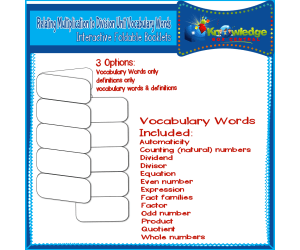
Relating Multiplication to Division Unit Vocabulary Words Interactive Foldables for 3rd Grade – EBOOK
Math, Multiplication and Division, Division, Grade 2, 3, 4, Lesson Plans, Teacher Tools
This set includes 3 vocabulary interactive foldables based on combined state standards for 3rd Grade Relating Multiplication to Division Units. Each foldable is offered in three formats, words only, definitions only, and words with definitions. These 3 foldables cover: •Automaticity •Counting (natural) numbers •Dividend •Divisor •Equation •Even number •Expression •Fact families •Factor •Odd number •Product •Quotient •Whole numbers This product consists of downloadable a PDF file. Just follow the instructions, cut, fold, glue, and create! Keywords: math, vocabulary, Automaticity, Counting (natural) numbers, Dividend, Divisor, Equation, Even number, Expression, Fact families, Factor, Odd number, Product, Quotient, Whole numbers second grade, third grade, fourth grade, Candie Donner
Author Knowledge Box Central
Tags Math, Multiplication, Division, Vocabulary Words, Numbers, Relating Multiplication And Division Worksheets

I WONDER - Who Were The Gorgons | Animated Video Lesson
History, Social Studies, Common Core, Grade 4, 5, 6, 7, 8, 9, 10, Lesson Plans, Teacher Tools
Video Introduction An amazing video designed for the students to learn more about mythological creatures in different cultures. I WONDER - Who Were The Gorgons | Animated Video Lesson Mythology is full of wonders and spectacular stories. Ancient civilizations were trying to explore every aspect of life, while they search for new technologies, they wanted to believe in something big and can change the world, so they created mythical creatures and mythical stories. Let's hear about them! What do you know about these creatures? Cyclops, Centaurs, Selkies, Phoenix, Gnomes, Dragons, Gorgons, Orcs, Cerberus, Trolls, Minotaur, Griffins, Mermaids, Elves, Polyphemus, Pegasus, and Ogres. I WONDER - Who Were The Gorgons | Animated Video Lesson The video is perfect for encouraging the creativity skills for the students, while learning more about this fantastic mythical creature. I WONDER - Who Were The Gorgons | Animated Video Lesson This friendly designed video is suitable for students at school, homeschooling, and as a group activity. Format Available in MP4 format.
Author Educational Voice
Rating
Tags Who Were The Gorgons, Who Were The Gorgons Video, Gorgons, Gorgons Facts, Gorgons Video, Gorgons Video For Kids, Gorgons Facts For Kids, Gorgon, Gorgon Facts, Gorgon Video

Under the Sea: A Cross-Curricular Unit on Ocean Animals
Science, Life Sciences, Animals, Grade 1, 2, Teacher Tools, Lesson Plans
Under the Sea: A Cross-Curricular Unit on Ocean Animals is a comprehensive digital teaching resource designed specially for educators to familiarize young students with various fascinating creatures residing in our oceans. This one-of-a-kind science educational material, focusing mainly on Zoology, is ideal for Grade 1 and Grade 2 students having a special interest in animals, more specifically aquatic life. Teachers will find this unit informative, engaging and simple to incorporate into their lessons. The package incorporates: One ready-to-use PDF containing seven detailed pages packed with informative facts about ocean animals - from fish to mammals. Brightly colored child-friendly pictures ready for exploration by young enthusiastic minds interested in marine life. The uniqueness of Under the Sea lies in its cross-curricular strategy combining different subject areas which provides learners with diverse perspectives whilst maintaining their engagement throughout. Reading comprehension skills are also honed via accompanying worksheets as they attain knowledge about various sea creatures. The teachers also have the flexibility of customizing discussion questions included in this unit according to their class needs thereby enhancing its usability as either group activity material or individual homework assignments depending on requirement. This adaptability fosters critical thinking making learning interactive and stimulating. In conclusion, the aim of Under the Sea: A Cross-Curricular Unit on Ocean Animals not only revolves around educating but also piquing curiosity in young minds about marine life's rich biodiversity thriving beneath our expansive seas' surface; while simultaneously fortifying academic skills across multiple disciplines.
Author Classroom Complete Press
Tags Sea Animals, Ocean Animals, Science Lesson, Reading Passage, Vocabulary Words

Natural Disasters - Complete Unit
Social Studies, Geography, Science, Earth and Environmental Sciences, Earth Sciences, Grade 5, 6, 7, 8, Lesson Plans, Teacher Tools
The Natural Disasters - Complete Unit This is an immersive educational resource designed to engage students in the study of natural calamities from elementary through to middle school. It covers extensive topics on disasters such as Tornados, Hurricanes, Floods, Droughts, Earthquakes, Tsunamis, Volcanoes and even distant space threats like Asteroids and Comets. The unit provides a comprehensive understanding of how these events influence both human life and the surrounding ecosystem. Balance Between Natural Science And Social Studies Striking a balance between curriculum areas; our geography approach places these extraordinary phenomena in a real-world context. Multiple file types are used for teaching resources which add value to lessons with their rich variety. Reading sheets: Inform students about various natural disasters – their causes alongside their effects. Activities: Ranging from short comprehension exercises to writing tasks that allow learners practiced interpretative skills. Presentation: PowerPoint presentations laden with enlarged text, diagrams visuals effectively guide pupils through each subject matter. Evaluations at Each Step A brief yet inclusive test at the end of each discussion point which includes multiple choice queries as well as demands short written responses providing an all-rounded assessment strategy for educators that aims at different levels of Bloom's taxonomy. Versatile Educational Resource This product is flexible enough to be utilized across varying educational contexts including public schools and homeschooling arrangements - equally productive when deployed within smaller student cohorts or even made part of homework assignments considering its modular design enables personalized academic pacing. Thus 'The Natural Disasters – Complete Unit' provides educators with a fact-based information and engaging activities making complex natural science phenomena accessible and enjoyable for students in the elementary to middle grades.
Author Mr Gray History
Tags Natural Disasters, Education Resource, Geography, Science Curriculum, Experiential Learning
I WONDER - Where Do Gnomes Live | Animated Video Lesson
History, Social Studies, Common Core, Grade 4, 5, 6, 7, 8, 9, 10, Lesson Plans, Teacher Tools
Video Introduction An amazing video designed for the students to learn more about mythological creatures in different cultures. I WONDER - Where Do Gnomes Live | Animated Video Lesson Mythology is full of wonders and spectacular stories. Ancient civilizations were trying to explore every aspect of life, while they search for new technologies, they wanted to believe in something big and can change the world, so they created mythical creatures and mythical stories. Let's hear about them! What do you know about these creatures? Cyclops, Centaurs, Selkies, Phoenix, Gnomes, Dragons, Gorgons, Orcs, Cerberus, Trolls, Minotaur, Griffins, Mermaids, Elves, Polyphemus, Pegasus, and Ogres. I WONDER - Where Do Gnomes Live | Animated Video Lesson The video is perfect for encouraging the creativity skills for the students, while learning more about this fantastic mythical creature. I WONDER - Where Do Gnomes Live | Animated Video Lesson This friendly designed video is suitable for students at school, homeschooling, and as a group activity. Format Available in MP4 format.
Author Educational Voice
Rating
Tags Where Do Gnomes Live, Where Do Gnomes Live Video, Gnomes, Gnomes Facts, Gnomes Video, Gnomes Video For Kids, Gnomes Facts For Kids, Mythology, Mythology Facts, Mythology Video
Reading Comprehension - Digital Lesson Plan Gr. 5-8 | PC Software
ELA, Reading, Grade 3, 4, 5, 6, 7, 8, Teacher Tools, Lesson Plans
Reading Comprehension - Digital Lesson Plan Gr. 5-8 | PC Software This engaging teaching resource is designed to reinforce students' reading comprehension skills through an extensively interactive digital lesson plan. It is developed for use in Grade 5-8 classrooms and focuses on key aspects of reading comprehension such as context clues, determining the main idea, and understanding inferences. Design & Content The product comes with 80 screen-pages overflowing with valuable content. It includes everything from intriguing reading passages to pre/post-reading activities that actively engage students. The content strictly aligns with State Standards, providing assurance about satisfying curriculum needs adequately. Fundamental Skills: Reading proficiency and comprehension are central themes of this tool. Beneficial Extras: Test preparation materials, a quiz after each lesson, memory match game for retaining information funnily, crossword puzzles and word searches for vocabulary development. Auditory Support: Text-to-Speech capabilities aid auditory learners while supporting video & audio resources enhance learning further. Bloom's Taxonomy Principles & Differentiated Instruction Strategies All the material within this resource adheres strictly to Bloom's Taxonomy principles,. This ensures effective contributions towards all-round learner development. The software can be useful for group discussion or individual assignments complementing varied pupil abilities competently which supports differentiated instruction strategies effectively. User-friendly Access on Windows-based Computers All these informative modules come loaded into one compact-sized zip file making access efficient especially for those operating on Windows-based computers . Note: The Reading Comprehension - Digital Lesson Plan Gr. 5-8, targeting Language Arts students and concentrating on reading skills, is an indispensable tool for educators developing the future readers and leaders of society.
Author Classroom Complete Press
Tags Reading, Comprehension, Digital Lesson Plan, Fiction Texts, Nonfiction Texts
Measurement: Measuring Length - Practice the Skill 3 - PC Software
Math, Measurements, Common Core, Kindergarten, Preschool, Grade 1, 2, Teacher Tools, Lesson Plans
Measurement: Measuring Length - Practice the Skill 3 - PC Software Invaluable teaching resource aimed at developing a solid understanding of measuring length. Catering to educators teaching preschool, kindergarten, and grades 1 and 2, this resource provides a comprehensive learning experience for children as they embark on their mathematical journey. This compact digital tool offers a blend of curriculum -based content with time-constrained drill activities that challenge students to convert provided measurements using relevant formulas. The inclusion of math tools ensures young learners have everything they need at their fingertips. Teaching to varying abilities in the classroom or homeschool setting can be made seamless as this software allows for whole group learning exercises as well as small group or individual assignments. The software supports both English and Spanish language options through voice over and text features. This multi-language aspect fosters inclusivity among diverse student groups while enhancing cross-cultural communication. The program's design is grounded in robust educational state standards including Common Core State Standards (CCSS), STEM initiatives, guided by the National Council of Teachers of Mathematics (NCTM) principles ensuring that each usage aligns precisely with standard grade-level expectations intrinsic to fostering measurable student progress across academic competencies. This PC software comes housed within one easy-to-download zip file making installation a breeze even on multiple computers within your educational environment whether its school-based labs or home computer stations setup for homeschooling. Aimed from planning insightful lesson plans around measurements in Mathematics to challenging homework assignments exploring different dimensions – 'Measurement: Measuring Length - Practice The Skill 3'- PC Software stands ready to enhance pedagogical effectiveness while promoting joyful learning experiences.
Author Classroom Complete Press
Tags Digital Math, Math Lesson Plans, Measuring Length, Measurement Lesson, Digital Activities
I WONDER - What Is Tundra | Animated Video Lesson
Environmental Science, Earth and Environmental Sciences, Science, Grade 6, 7, 8, 9, 10, 11, 12, Lesson Plans, Teacher Tools
Video Introduction An amazing video designed for the students to learn more about STEM. I WONDER - What Is Tundra | Animated Video Lesson Do you like STEM subjects? what is your favorite one? Have you ever tried to plant a seed? If yes, tell us more about it. Or have you ever tried to invent something? If yes, tell us more about it. And how do you think it will help us? Have you ever seen a microorganism under a microscope? What was it? And how it looked like? Mathematics is a marvelous subject. Let' sharpen our brains and solve some equations. Do you like timetable tricks? What is your favorite one? Do you know how to code? Have you ever created an app or a game before? If yes, how was it like? I WONDER - What Is Tundra | Animated Video Lesson The video is perfect for encouraging the researching skills for the students, while learning more about this fantastic topic. I WONDER - What Is Tundra | Animated Video Lesson This friendly designed video is suitable for students at school, homeschooling, and as a group activity. Format Available in MP4 format.
Author Educational Voice
Tags What Is Tundra, What Is Tundra Video, Tundra, Tundra Facts, Tundra Facts For Kids, Tundra Video, Tundra Video For Kids, Educational Video, Educational Video For Kids, Science
I WONDER - Do Sharks Have Bones | Animated Video Lesson
Animals, Life Sciences, Science, Biology, STEM, Grade 3, 4, 5, 6, 7, 8, 9, Lesson Plans, Teacher Tools
Video Introduction Animal kingdoms are full of fascinating wonders to learn. This video is designed for the students to learn more about animals in different countries. I WONDER - Do Sharks Have Bones | Animated Video Lesson Do you like animals? what is your favorite one? Do you own a pet? If yes, tell us more about it, like what its name? And what do you like most about it? What are the animal kingdoms? Can you write down the characteristics of each animal class like mammals, birds, reptiles, amphibian, fish and mollusks. Do you know that some animals can sing, can you name any of them? What is the largest and the smallest mammal in the world? What is the largest and the smallest bird in the world? What is the largest and the smallest fish in the world? I WONDER - Do Sharks Have Bones | Animated Video Lesson The video is perfect for encouraging the researching skills for the students, while learning more about these fantastic animals. I WONDER - Do Sharks Have Bones | Animated Video Lesson This friendly designed video is suitable for students at school, homeschooling, and as a group activity. Format Available in MP4 format.
Author Educational Voice
Tags Do Sharks Have Bones, Do Sharks Have Bones Video, Sharks, Shark, Sharks Facts, Sharks Facts For Kids, Sharks Video, Sharks Video For Kids, Shark Bones, Shark Bones Facts
I WONDER - Why Do Kangaroos Box | Animated Video Lesson
STEM, Animals, Life Sciences, Science, Biology, Grade 1, 2, 3, 4, 5, 6, 7, 8, Lesson Plans, Teacher Tools
Video Introduction Animal kingdoms are full of fascinating wonders to learn. This video is designed for the students to learn more about animals in different countries. I WONDER - Why Do Kangaroos Box | Animated Video Lesson Do you like animals? what is your favorite one? Do you own a pet? If yes, tell us more about it, like what its name? And what do you like most about it? What are the animal kingdoms? Can you write down the characteristics of each animal class like mammals, birds, reptiles, amphibian, fish and mollusks. Do you know that some animals can sing, can you name any of them? What is the largest and the smallest mammal in the world? What is the largest and the smallest bird in the world? What is the largest and the smallest fish in the world? I WONDER - Why Do Kangaroos Box | Animated Video Lesson The video is perfect for encouraging the researching skills for the students, while learning more about these fantastic animals. I WONDER - Why Do Kangaroos Box | Animated Video Lesson This friendly designed video is suitable for students at school, homeschooling, and as a group activity. Format Available in MP4 format.
Author Educational Voice
Tags Why Do Kangaroos Box, Why Do Kangaroos Box Video, Kangaroos Box, Kangaroos Box Facts, Kangaroos Box Facts For Kids, Kangaroos Box Video, Kangaroos Box Video For Kids, Kangaroos, Kangaroo

Measurement: Temperature & Time - Practice the Skill 3 - FLASH-MAC
Math, Measurements, Common Core, Grade 3, 4, 5, Teacher Tools, Lesson Plans
Measurement: Temperature & Time - Practice the Skill 3 - FLASH-MAC: An Overview Measurement: Temperature & Time - Practice the Skill 3 - FLASH-MAC is a high-quality teaching resource ideal for Grade 3, Grade 4, and Grade 5 educators. It offers an effective curriculum -based content that aligns well with measurement subtopics under the Math subject area. Main Features: Focuses on enhancing understanding of temperature and time through practical exercises and timed drill activities. Promotes critical thinking by converting temperatures to degrees Fahrenheit or Celsius and improving speed in problem-solving. Incorporates math tools in the software package to enrich learning experiences. This software also caters to bilingual classes featuring both English and Spanish voiceover options as well as textual content. Its bilingual aspect enhances versatility for lesson planning whilst catering to different linguistic backgrounds. Measurement: Temperature & Time - Practice the Skill 3 - FLASH-MAC aligns with Common Core State Standards (CCSS) and STEM initiatives emphasizing rigorous academic standards beneficial for elementary-aged learners—underscoring its adherence to quality delivery on instructional objectives. Pedagogical Flexibility: Suitable for whole-group instruction encouraging interactive classroom discussions. Ideal resource for small groups encouraging team problem-solving skills. Included homework assignments providing children with opportunities for revision or deepened comprehension at home. Digital Compatibility: The Mac-friendly format resonates with today's technological inclinations—making online education accessible beyond geographical constraints—and further underscores your prowess in choosing Measurement: Temperature & Time - Practice the Skill 3 - FLASH-MAC as your optimal teaching partner.
Author Classroom Complete Press
Tags Software (Mac)