



3,955 products added recently
Page 3 - Science Lesson Plan Template
Enhance your science instruction with a flexible lesson plan template designed for educators. This tool helps you structure objectives, materials, procedures, and assessments efficiently. Use it to create organized and impactful science lessons that cater to your students' needs.

 Show filters


BIRDS IN WINTER Gr. 3-5
Science, Life Sciences, Animals, Grade 3, 4, Teacher Tools, Lesson Plans
BIRDS IN WINTER Gr. 3-5: A Comprehensive Teaching Resource BIRDS IN WINTER Gr. 3-5 is an engaging educational unit aiming to introduce students in grades 3 through 5 to the fascinating world of Science and Zoology, focusing on winter birds. Main Emphasizes of this Resource: Enhancing skills like brainstorming, creativity, word knowledge, and research among learners. Providing comprehensive material for active learning experiences beyond textbooks - allowing students to conduct research, note-making and engaging in presentations. This resource includes 39 ready-to-print pages tailored stylishly into a single PDF file. Each page has been delicately designed with a focus on enhancing lesson planning while fostering active learning. Versatility of Its Use: Birds In Winter Gr. 3-5 can be effectively implemented in varied educational environments such as public schools or homeschools. The resource can be used for whole group lessons drawing from its broader themes but could also work well with smaller groups or individual assignments based on particular pedagogical needs and student capabilities. In essence, 'Birds In Winter Gr.3-5', while being an indispensable toolkit specifically about winter birds, also acts as an excellent springboard sparking enthusiasm about zoology amongst school children whilst enabling skill development.
Author Classroom Complete Press
Tags Birds, Winter, Reading Passages, Research, Coloring Pages

Climate Change: Effects: Earth’s Climate Gr. 5-8
Science, Earth and Environmental Sciences, Environmental Science, Grade 5, 6, 7, 8, Teacher Tools, Lesson Plans
Climate Change: Effects: Earth's Climate Gr. 5-8 This explorative teaching resource dives into the profound impacts of climate change on human society and our environment, intended for students in grades 5 through 8. Core Features: The guide aligns with Bloom's Taxonomy and STEAM initiatives, promoting thorough understanding of crucial scientific concepts. Incorporation of hands-on activities facilitates more engaging learning experiences outside textbooks. Suitable for both group lessons and independent study assignments to foster collaborative or individual research skills appropriately. Additional Highlights: Cross-curricular features like crossword puzzles and word search activities reinforce vocabulary competencies alongside scientific learning. Special sections focusing on real-life health dangers associated to climate change enhances the relevance of classroom knowledge in practical life scenarios. The Economic Angle: An additional special focus is turned towards the impact of climate change on economies, thereby solidifying student understanding in interconnected global systems between environment and economy. Inquiry-based Learning Opportunities: The final section introduces an inquiry element allowing students to choose a specific ecosystem experiencing impacts from climate change promoting proactive investigation engagements. About Product Delivery:- The package comprises a single PDF file ensuring easy use across varied digital devices suitable for both traditional classrooms or remote teaching situations. In summary, “Climate Change: Effects: Earth’s Climate Gr. 5-8” is not merely a teaching resource but an immersive experience into the scientific understandings and societal effects of climate change idea for educators aiming complete instructional delivery.
Author Classroom Complete Press
Tags PDF
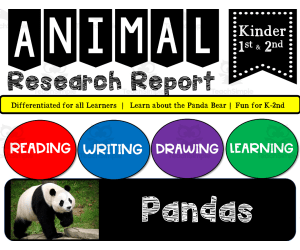
Zoo Animal Research Writing Project on PANDAS for K-2nd Grade
Life Studies, ELA, Writing, Creative Writing, Reading, Science, Life Sciences, Animals, Research, Kindergarten, Grade 1, 2, Teacher Tools, Lesson Plans, Worksheets & Printables, Worksheets, Writing Prompts, Coloring Pages, Presentations
Animal Research Writing Project on Pandas for K-2nd Grade. Introduce young students to pandas through this engaging 19-page informational writing project. Students will read panda facts, examine real-life photos, color pictures, draw a panda habitat, organize information using a color-coding system, and write about what they learned using differentiated writing pages for various ability levels. This versatile resource can be used for whole group, small group, or individual work. Encourage creativity, reading, research, and writing skills with this panda-themed project. Extend the learning by creating a whole classbook with students' final writing and artwork compiled together. Compatible for kindergarten, 1st grade, or 2nd grade. Click the author link to see other animal-themed writing project units spanning topics like tigers, dolphins, whales and more. Teachers appreciate the ready-to-use animal units covering reading, note-taking, drafting, illustrating, and publishing. Engage your class in meaningful informational writing with this standards-based project on monkeys. Plus, there are many more zoo animals to research as well in my store: K-5 Treasures! For additional Zoo Animal reports, click on the following links below: Animal Research Writing Project on TIGERS for K-2nd Grade Animal Research Writing Project on MONKEYS for K-2nd Grade Animal Research Writing Project on PANDAS for K-2nd Grade Animal Research Writing Project on HIPPOS for K-2nd Grade Animal Research Writing Project on ELEPHANTS for K-2nd Grade Animal Research Writing Project on GIRAFFES for K-2nd Grade Here are even more informational resources on report writing for OCEAN ANIMALS. Click on the links below: Animal Research Writing Project on WHALES for K-2nd Grade Animal Research Writing Project on the OCTOPUS for K-2nd Grade Animal Research Writing Project on SEA TURTLES for K-2nd Grade Animal Research Writing Project on ORCAS for K-2nd Grade Animal Research Writing Project on the SHELLFISH for K-2nd Grade Animal Research Writing Project on DOLPHINS for K-2nd Grade Animal Research Writing Project on SEALS for K-2nd Grade
Author K-5 Treasures
Tags Animal Research, Informational Writing, Writing Report, Zoo Animals, Report On Animals, Report On Zoo Animals, 1st Grade Writing, 2nd Grade Writing, Pandas, Report On Pandas

Free Science Phase Changes Vocabulary Interactive Review
Science, Basic Science, Chemistry, Earth and Environmental Sciences, Environmental Science, Grade 7, Teacher Tools, Lesson Plans
Phase Changes Vocabulary Words to Review and Reinforce Definitions of the 7TH Grade Science curriculum . Students will learn and practice terms through definitions and characteristics. The engaging activity promotes collaboration and class discussion as students review terms definitions, and more with multiple visuals and learning formats like multiple choice questions, memory games, hang-man, and others. This versatile resource can be used for whole-group instruction, small-group practice, or independent work, just practice the words and then review them by choosing the correct one, it will self-correct you until you choose the correct answer Practice your Vocabulary with this Free Interactive Game Introduce young learners to a variety of visuals with this entertaining digital game. Students will see the names and images of different words and definitions; exercising visual memory and concentration. This self-checking activity can be played independently or as a whole class game projected on a smartboard. The vibrant slideshow stimulates engagement while building construction classification skills. students will build their knowledge of important terms and definitions while having fun playing games. This activity stimulates intelligence, builds concentration, reinforces letter recognition, improves spelling and pronunciation, and engagingly expands vocabulary. It's a perfect supplement for your lesson. Check our shop, material, and products for more interactive construction vocabulary reviews covering other topics like human microbiome, metabolism, and more grade levels in science and Spanish language arts. Download this versatile 24-slide PowerPoint today!
Author ShapeUp-N-Matematicas y Lenguaje
Tags SCIENCE, Scientific Argument, Phase Changes, Matter States, Solid, Liquid, Gas, Molecule Attraction, Temperature, Freedom Movement

The Solar System: The Moon
Science, Earth and Environmental Sciences, Space, Common Core, Grade 5, 6, 7, 8, Teacher Tools, Lesson Plans
The Solar System: The Moon The Solar System: The Moon is an educational resource designed to spark interest in young astronomers and enhance their knowledge about our solar cosmos. It effectively covers a wide range of topics – from the traits of Inner and Outer Planets to intriguing aspects of Stars, Constellations, Asteroids, Meteors, and Comets. Moon Chapter Slice This resource includes a specific chapter slice on "The Moon", which explores significant concepts such as planetary orbits, the asteroid belt, lunar cycle & phases of the moon as well as shooting stars. With its simplified language and easy-to-grasp vocabulary aimed at students in grades five to eight, this unit simplifies complex astronomical concepts making them readily accessible for both novices and budding astronomers. Using This Resource In Class Ideal for teaching fifth- to eighth-grade students who require remediation in sciences or those having difficulty comprehending advanced terms. Can be used effectively for whole-class instruction due to its simplified content. Suitable as assignment module for small-groups or self-paced independent learning. Distinguishing Features Incorporation of various reading passages that reinforce information assimilation. Inclusion of comprehension questions scattered throughout testing retention. Numerous hands-on activities demonstrating practical concepts enhancing knowledge retention. Presentation aids like color mini posters for visually responsive learners. Rubric supplements provide clear guidelines regarding expectations from each activity facilitating easy assessment. Crossword puzzles within relevant themes along with Word Search exercises have been included providing extra value through entertainment-education synergy. A comprehension quiz for gauging student progress An Answer Key ensures seamless grading experience. Standards and Formats This instructive resource aligns with Common Core State Standards (CCSS), Bloom's Taxonomy education framework, and STEM initiatives. It is available in PDF format; a flexible file type compatible with both digital devices and printable mediums allowing teachers to opt for either computer-based learning or traditional classroom-style instruction. The Solar System: The Moon is a comprehensive science resource crafting astronomical education to be accessible, fun, and deeply engaging!
Author Classroom Complete Press
Tags PDF

Classification & Adaptation: Vertebrates Gr. 5-8
Science, Life Sciences, Biology, Grade 5, 6, 7, 8, Teacher Tools, Lesson Plans
Classification & Adaptation: Vertebrates Gr. 5-8 This teaching material zeroes in on vertebrates, exploring key concepts such as animal adaptation. At the core of the resource is a unique case study - "The Koala and Its Adaptations", specifically chosen to deepen understanding. Educators will find this resource beneficial for providing an enriching learning environment. It not only provides ready-to-use information but also includes stimulating activities that cater to all types of learners. The format allows for: Group instruction Small group discussions Individual assignments Unique Activities Included: The highlights of this teaching tool include engaging tasks like "How Important Are Thumbs?" and "A Day in the Life of a Paleontologist". These interactive segments boost student participation and increase interest in Science, especially Biology. Purpose Beyond Enrichment: Besides lesson enhancement, this resource has been expertly crafted to serve multiple purposes including test preparation, with reading passages completely filled with key biological information. Moreover, it adheres fully to State Standards integrating seamlessly into any curriculum while basing principles on Bloom's Taxonomy and STEM initiatives. Inclusive Product File: This package comes with one comprehensive product file logically structured for efficient use by educators - from public school teachers to homeschoolers alike catering for learners at grade levels 5 through 8. Nurturing Curiosity-Driven Minds: In today's educational landscape, Classification & Adaptation: Vertebrates Gr. 5-8 stands out by fostering curiosity about scientific knowledge and connecting foundational biology concepts to daily life. This resource instills lifelong skills, paving the way for academic success.
Author Classroom Complete Press
Tags PDF
Climate Change: Reduction: Urban Planning Gr. 5-8
Science, Earth and Environmental Sciences, Environmental Science, Grade 5, 6, 7, 8, Teacher Tools, Lesson Plans
Climate Change: Reduction: Urban Planning Gr. 5-8 An exceptional teaching resource specifically designed for grades 5 through 8, aimed at integrating the complex concepts of climate change and sustainability into classroom learning. Primary Focus: Presents urban planning as a significant solution to reduce human consumption and waste production. Contrasting viewpoints are well-handled, presenting balanced perspectives for both climate change advocates and skeptics. Critical exploration of the potential future of our planet if we fail to control rising temperatures. Bloom’s Taxonomy Application: The proven framework is utilized in structuring this educational material: Creativity fostering activities: Students design an eco-friendly vehicle using alternative fuel sources. Further, they investigate other transportation methods around their area with self-designed interactive leaflets! Understanding industrial impacts on environment: Examination of product life cycles facilitates understanding on how industries can reduce emissions to protect our environment better. Sustainable city planning task: Additionally, students are tasked with creating a sustainable green city plan that incorporates clean energy practices- a grand exercise engaging their imagination to its fullest! In-depth study into green building technologies is facilitated, along with comparison studies between international efforts towards building CO2-free communities sustained by efficient waste disposal systems. Evaluation Components includes fun-filled elements like : Crossword puzzles Word searches Comprehension quizzes which comes with answer keys All designed to test understanding levels while being light-hearted Adaptability : This resource is significantly adaptable for whole-class instruction, targeted small group intervention, or homework assignments as required. User-Friendly Packaging: All the instructional resources come packaged in a single product file formatted as PDF—ensuring ease-of-use under varying learning conditions while underlining crucial environmental duties among young learners.
Author Classroom Complete Press
Tags PDF

Bears and Pandas Gr. 1-2
Science, Life Sciences, Animals, Grade 1, 2, Teacher Tools, Lesson Plans
Bears and Pandas Gr. 1-2 Bears and Pandas Gr. 1-2 is a dedicated teaching aid, exclusively crafted for Grade 1 and Grade 2 teachers wanting to integrate an exciting theme within their curriculum activities. This invaluable resource emerges as a top choice for science mentors, delivering in-depth information about zoological aspects related to bears and pandas. The thematics of bears and pandas infuse an exhilarating ambience in the classroom environment that can sustain student interest over prolonged durations. It's designed such that teachers needn't be experts on bears or pandas with abundant resources available at fingertips, guaranteeing flourishing outcomes at every stage. For instance, this package can intermix wonderfully with multiple bear-themed storybooks enlisted in the market to augment your overall language program. It facilitates research by providing effortless access to comprehensive resources answering potential questions related to the said subjects. Incorporating this module within Social Studies serves as an enhancer for geographical studies as it provokes learners into plotting locations of different bear species or pandas around a worldwide map. The included patterns may function effectively as unique map markers enlivening manual tasks especially among young students. This product promises escalated engagement through Drama via enjoyable activities like role-playing "The Three Bears" or hosting imaginary teddy-bear picnics attended by student's beloved Teddy Bears. Promotion of Oral Language skills among youthful scholars becomes effortless upon integrating engaging bear chants during morning routines. Furnished with diverse activities along with descriptive task cards offering multifarious methodologies catering distinct learner requirements - one can incorporate them during group study matters or small-group discourses; even homework directives might receive surprising twists furnished through these charming themes. Bears and Pandas Gr. 1-2 encompasses an array of effective teaching tools housed in one convenient PDF file. This product incorporates seamless blending of instructional sections catering to facilitators whilst student-oriented reading segments aids students, creating a unique learning voyage established upon Animal Science foundations.
Author Classroom Complete Press
Tags PDF

Discover! Light and Sound
Science, Physics, Grade 4, 5, 6, Teacher Tools, Lesson Plans
Discover! Light and Sound: A Teaching Resource Discover! Light and Sound is an informative teaching resource for educators, both in a public school setting or as for homeschooling. This product offers a carefully structured set of activities tailored specifically to illuminate the fundamental concepts in the field of light and sound,Mainly aimed at Grade 4 to 6 science curriculums in the subfield of physics. The structure blends theory combined with interactive undertakings like experiments , puzzles, and review questions. These tasks are designed explicitly to facilitate effective learning around basic principles such as: The nature and behavior of light Sources of light usage Types of lenses Vibration patterns related to sound Mechanism of sound propagation along with their distinct characteristics. A Resource For Teachers too This product doesn't just focus on student tasks - it also includes detailed background information improving educators' understanding around these topics, and offers insights on implementing these pedagogic activities successfully into their students' learning sessions. It also provides guiding questions for discussions that can facilitate thought-provoking classroom debates or help develop comprehension queries. Easily Accessible & Adaptable Format This resource is downloadable as a PDF file that can be shared across digital platforms or printed out according to preference. No matter your teaching style - whole group instruction via screen sharing technology or projection displays; small group activities encouraging collaboration; individual assignments; this tool effortlessly adapts. Navigability & Comprehension The resource is structured clearly making it easy for Grade 4-6 students to navigate through. Each exercise within Discover! Light & Sound comes with provided answers promoting self-evaluation among learners and giving teachers tools to assess student progress.
Author Classroom Complete Press
Tags PDF
Properties of Matter: Chemical Changes and Chemical Properties Gr. 5-8
Science, Physics, Grade 5, 6, 7, 8, Teacher Tools, Lesson Plans
Properties of Matter: Chemical Changes and Chemical Properties Gr. 5-8 Properties of Matter: Chemical Changes and Chemical Properties Gr. 5-8 is an innovative teaching resource, particularly tailored for Grade 5 to Grade 8 students, aimed at simplifying various scientific concepts around the properties of matter. It discusses the critical differences between a mixture and a solution, in addition to explaining physical and chemical changes. Main Features Include: An approach built with hands-on learning. Packed with engaging experiments, easy-to-understand reading passages, and stimulating activities. Inclusion of colourful mini posters that double as visual aids discussing the lesson or for classroom decoration throughout the school year. The answer keys are provided making review sessions more efficient for educators. A portable PDF file type enhances accessibility on different platforms - from classrooms equipped with smartboards to personal computers at home satisfying homeschool need. The content aligns well with State Standards ensuring all topics discussed falls within curriculum specifications. Alongside aligning to these standards, this creative resource also took into account both bloom's taxonomy initiatives thus maintaining rigorous instructional design standards hence demonstrating high pedagogical value underpinning these resources. In essence Properties of Matter: Chemical Changes and Chemical Properties Gr 5-8, provides an engaging yet structured methodology targeting fundamental scientific concepts while promoting active learner engagement delving deeper into Physical Science topic areas.
Author Classroom Complete Press
Tags PDF
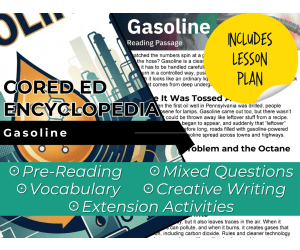
Gasoline Reading Comprehension Passage - Cored Ed Encyclopedia
ELA, Reading Comprehension, Reading, Science, Technology, Earth and Environmental Sciences, Pre-Reading, Language Development, Vocabulary, Physics, Grade 2, 3, 4, 5, Worksheets & Printables, Worksheets, Teacher Tools, Centers, Activities, Writing Prompts, Assessments, Quizzes and Tests, Quizzes, Lesson Plans
This gasoline reading comprehension with lesson plan includes: Visualization (on the front cover) Start your lesson by taking a minute to think and share something about the topic. Read the script aloud (slowly), perhaps prepare some music or sound effects. Student close their eyes and let their imaginations wander. Students open their eyes, read the question aloud and give them a few minutes to complete. Ask a few students to share or keep answers until the end to compare with what they learn in the passage. Quick pause—thousands of Cored Education products are included with your TeachSimple membership. Download links and encyclopedia index available here. Pre-Reading Trivia Students will write down one thing they already know about the subject and then read five more facts and discuss. These facts are fun, and the students will enjoy learning about the subject before reading more. Give 1 minute for students to write what they already know (no pressure—best guess is fine). Read the five facts together. After each fact, do ask a student for their opinion, was it surprising? Set a purpose by asking students to highlight/underline one fact they want to learn more about during the reading. Reading Passage The text is a high-interest reading passage with set paragraphs, roughly three to four paragraphs long. It contains a variety of themes about the topic, anywhere from history to technology. The passage is between 250 and 350 words in length. First, ask students to look at the headings and see what they’ll learn about today. What do they know about the topic/heading? First read options: Teacher read-aloud (best for support). Partner reading (paragraph by paragraph). While reading, students underline important details, and vocabulary words they think may come up in the questions section. Mixed Questions The first question page contains four multiple-choice questions, each with a choice of four answers, and three written response questions that require a sentence or two from the student. Students complete the mcqs first independently, then review quickly as a class. For the 3 written responses, try to get students giving the answer with some form of evidence: “I think ___ because the text says ___.” If students get stuck, send them back to check the passage. Vocabulary Questions Practice seven key words from the text in this section across two activities. First section is scrambled words where students will unscramble three words given a clue for each. The second section is a word to meaning matching activity. Before starting, have some students read out words they underlined in the passage. Ask students to say the word and read aloud the sentence(s) around each word. Ask students to do scrambled words and the matching exercise in pairs then go through answers as a class. For the scrambled spelling task, get four pairs to come up to the board and write the words for extra practice with the other student reading out the clue. For the matching task, prompt students to give full sentences: “I matched ___ with ___ because ___.” Creative Writing In this question, the student will be required to write a five to eight sentence paragraph on a question related to the topic. Before starting, ask students write down 3 key ideas they are going to include in their piece. Ask students for ideas to share around the class to help those struggling. Pro writing expectations: 5–8 sentences At least 2 facts or details from the passage At least 2 vocabulary words from the previous page Students read their paragraphs while classmates listen for facts and vocabulary words. Extension Activities This page is optional for fast finishers or to take home. There are several activities, each one requiring a different skill. Do some, do none, do all, completely optional - but you will feel reassured knowing every possibility is planned for. Includes summary writting question and additional facts. Answer Key There are answers for the multiple-choice questions, written response questions have sample answers, vocabulary answers and if there is a summary question then a sample summary will be provided as well. Lesson Plan Included Customized lesson plan for this lesson is included. Lesson Snapshot Title: Gasoline Genre: Nonfiction (informational text) Subject: Science Primary Topic: What gasoline is, how it works, and impacts Estimated Guided Reading Level (A–Z): Q What This Lesson Teaches Best Explains what gasoline is and why it must be handled carefully because it “can catch fire very easily.” Describes how gasoline helps a car engine work (a spark burns gasoline in a controlled way to move parts that turn the wheels). Traces a brief history of gasoline’s changing value (from “leftover” in 1859 to useful once automobiles appeared in 1892). Introduces the idea of octane ratings and how they relate to engine “knocking” and early ignition. Connects gasoline use to environmental effects (vapors can pollute; burning creates gases including carbon dioxide) and mentions cleaner travel choices. Learning Goals Students will identify what gasoline is and where it comes from (petroleum/crude oil from deep underground). Students will describe how gasoline is used inside a car engine to help make the wheels turn. Students will explain how gasoline changed from being thrown away to becoming a valuable fuel. Students will explain what “octane” measures and how it relates to engine knocking. Students will describe two ways gasoline can affect the air (vapors and burning gases). Students will name choices mentioned in the text for using less gasoline (electric vehicles, bikes, buses, walking). Key Vocabulary From the Text gasoline — fuel liquid used in many cars. petroleum — thick oil material gasoline is made from. crude — raw oil from deep underground. kerosene — lamp fuel people wanted in 1859. octane — rating showing resistance to early ignition. FULL CATALOG OF DOWNLOAD LINKS AND ENCYCLOPEDIA INDEX HERE
Author Cored Education
Rating
Tags Vocabulary, Reading Comprehension, Reading Passages, Lesson Plans, Ela Lesson Plans, Reading Comprehension Lesson Plans, Pre-reading, Science Lesson Plans, Earth Science, Physics

Circulatory, Digestive & Reproductive Systems - Digital Lesson Plan Gr. 5-8 | MAC Software
Science, Life Sciences, Human Body, Grade 3, 4, 5, 6, 7, 8, Teacher Tools, Lesson Plans
The Circulatory, Digestive & Reproductive Systems - Digital Lesson Plan Gr. 5-8 | MAC Software A comprehensive and engaging teaching resource geared towards fostering an in-depth understanding of the human body's major systems among grade 5 to 8 students. Features: Highly interactive, easy-to-navigate design. An invigorating journey inside the human body for learners. Teaching Tool Topics: The journey of red blood cells traveling through veins and arteries. The mechanism by which the heart pumps blood throughout the body. An exploration of how ingested food is converted into energy by our bodies. A deep dive into the functions of kidneys and intestines in waste management within our system. A detailed education about each stage of human fetal development incrementally for understanding reproduction better. This learning pack also includesreading passages followed swiftly by interactive activities designed both before and after reading sections. Bonus feature: Multimedia support via videos and audio clips that complement textual instruction superbly well at just a click away. This software tool captures an exception blend of interdisciplinary knowledge technology-based learning methods for keeping students excited about learning complex scientific content; A vital asset for teachers educating Grade 3-8 learners focusing on Anatomy.
Author Classroom Complete Press
Tags Anatomy Lesson Plan, Science Lesson Plan, Digital Anatomy Lesson, Science Reading Passage, Reproductive Systems
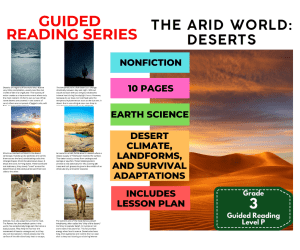
The Arid World - Deserts: Guided Reading Level P with Lesson Plan
ELA, Resources for Teachers, Reading Comprehension, Reading, Science, Language Development, Social Studies, Life Sciences, Geography, Earth and Environmental Sciences, Grade 2, 3, 4, Worksheets & Printables, Worksheets, Teacher Tools, Centers, Activities, Literacy Readers, Quizzes, Quizzes and Tests, Assessments, Lesson Plans
This The Arid World - Deserts (level p) guided reading book with lesson plan includes: Guided Reading Color Label (front cover x1) This is a quick way to match the book’s demands to what students can generally handle.. The overall goal is to use the level/color to pick books for several smaller groups. To qualify for a certain level, a student is expected to read a book from that level with about 90–94% accuracy. If a student is consistently accurate and understands, move up a level. If the student is struggling at that level, drop down and add more support. Each student will improve at completely different rates, but it is generally one of the best ways to check progress across the class. DOWNLOAD THE CATALOG TO VIEW ALL GUIDED READING BOOKS AVAILABLE (SORTED LEVELS A-Z) Pre-Reading Question (x1) Teacher asks the prompt aloud, can be while showing the cover or first page. Students share what they already know, or make educated guesses from the cover. Prompt them to use the target vocabulary. Write some of their responses on the board to look back at during the reading. Vocabulary Words (x5) Introduce the five words, best doing it one at a time. Start by saying it, while students repeat and then see if anyone knows what it means before reading further. Read through the meaning and try to briefly connect each word to a picture or gesture so it’s meaningful. Ask students to flip through the book pages and point to where they see each of the vocabulary words. While reading the book pause upon coming across one of the vocab words or read the sentence twice to make sure students understand the word has appeared. Optional: Ask students to raise hands whenever they see/hear one of the new words. Guided Reading Pages (x10) Check the book snapshot (below) for: primary topic - do you need to prep extra reading or intro materials on this? what is taught best - decide on 1-2 bullets to focus on, use the prompt or words provided here for best results. learning goals - what you are checking for students to be able to do after the session, elicit answers using prompts or words provided. key vocabulary (see section above). questions overview - so you know what is coming up and if you need to prep extra materials to assist understanding. Run the lesson You may have already looked at a few of the pages together, but you can show them some of the pictures again first to set meaning. Depending on how much time you have and how familiar your students are with guided reading class, you may want to read the book aloud first with the group first. Students whisper or partner read, while you listen in. If time, do it as a group, one student reading a page each. Use the guided page’s prompts to coach: “Check the picture / does it make sense?” “Point under the words / try the first sound” “Reread the sentence smoothly”. Try to focus more on one student per session (rotating every time), so you can work out if they are ready to move up or need to move down a level. Comprehension Questions (back cover x3) This is your way to check that students didn’t just say the words, but actually understood the text. First, let students answer by pointing to the page/picture and saying a short sentence. After any answer, follow with: “Show me where you found that in the text.” In bigger groups, have partners answer first (10–20 seconds), then call on 2–3 students to share. Differentiation tips: Emerging speakers/struggling readers: oral + pointing On-level: oral in a full sentence Higher: one written sentence or draw + label Book Snapshot Title: The Arid World: Deserts Genre: Nonfiction (informational) Subject: Earth Science Primary Topic: Desert climate, landforms, and survival adaptations Estimated Guided Reading Level (A–Z): P What This Book Teaches Best Defines deserts by very low precipitation and explains how scarce water shapes the environment. Explains extreme temperature changes in hot deserts from day to night and why they happen. Compares hot deserts and cold deserts , including why icy places can still be deserts. Shows how living things adapt to desert conditions , with examples from plants and animals (cactus, fennec fox, camel, sidewinder snake). Describes how wind shapes desert landforms , including how dunes form and move. Learning Goals Students can define a desert using the book’s description of precipitation and water scarcity. Students can explain why temperatures in a hot desert can drop quickly after sunset, based on the text. Students can describe how a cold desert can exist and name the example given in the book. Students can identify at least three desert adaptations and match them to the plant or animal described. Students can describe how wind forms dunes and what the text says dunes do over time. Students can explain what an oasis is and why it supports life in a desert. Key Vocabulary From the Text precipitation — water that falls from the sky, like rain. evaporation — when water turns to vapor and leaves. nocturnal — active at night and resting in daytime. oasis — a fertile desert area with freshwater reaching the surface. dunes — hills of sand formed when wind drops sand. Discussion Prompts Pre-reading question: What challenges do you think plants and animals face in a very dry place? Comprehension questions: How much rain do deserts usually get in a single year, according to the text? Comprehension questions: What does the book say helps the Saguaro cactus conserve water? Comprehension questions: What is an oasis, and where does its freshwater usually come from? Printing Tips 1. Best Printing Method (Recommended) “Booklet” Printing (Best if Available) If your printer or PDF viewer supports Booklet Printing , use this. Settings to use: Print mode: Booklet Paper size: Letter or A4 (either works) Orientation: Landscape Print on both sides: Yes Flip on: Short edge Scaling: Fit to printable area Booklet subset: First test: Front sides only Then: Back sides only This will automatically: Pair pages correctly Put the cover on the outside Align everything for folding After printing, fold in half and staple along the spine . 2. If “Booklet” Printing Is NOT Available You can still print this correctly with manual duplex printing . Step-by-step: Open the PDF. Choose Print . Set: Orientation: Landscape Pages per sheet: 1 Print on both sides: Yes Flip on: Short edge Print all pages . Because each PDF page already contains two facing book pages, the result will still fold cleanly into a book. Thousands of Cored Education products are included with your TeachSimple membership. Download links and encyclopedia index available here.
Author Cored Education
Rating
Tags Reading Comprehension, Reading Passages, Reading, Guided Reading, Guided Reading Lesson Plan, Guided Reading Activity, Pre-reading, Science Lesson Plans, Social Studies Lesson Plans, Earth Science

Flight Gr. 4-7
Science, Physics, Grade 4, 5, Teacher Tools, Lesson Plans
Flight Gr. 4-7 Teaching Resource Overview The Flight Gr. 4-7 teaching resource provides an engaging and comprehensive guide for students studying flight in a physical science context. Focusing mainly on Grades 4 to 5, this material brings a new dimension to the classroom through its variety of interactive activities and holistic lesson structure. Purpose and Structure of Flight Gr. 4-7 The purpose of Flight Gr. 4-7 is more than simply imparting facts; it seeks to foster comprehension through student participation from start to finish. Every activity is centered around the theme of each lesson, creating a streamline learning experience that builds on prior knowledge. This resource delves into various aspects of flight such as understanding the mechanics of wings, rockets, helicopters. In addition, hands-on experiences where students can construct their own kites and gliders are included. Different Ways to Implement Flight Gr. 4-7 in Classroom Activities This unit can be implemented across whole class discussions or smaller group tasks for independent and group learning experiences respectively. Additionally, it’s also suitable for homework assignments offering flexibility according to each educator's specific needs. Inclusion of Reading Passages & Puzzles Incorporating reading passages that provide valuable context alongside the hands-on activities helps reinforce concepts learned during each experiment or project undertaken by pupils during lessons. Crossword puzzles and word searches are included as complementary materials ensuring mental alertness while engendering fun within education; A readily available answer key makes educators work much easier when grading or providing instruction. Learner-oriented Digital Material This material comes in PDF form which accentuates ease-of-use, perfect for classroom settings or remote learning if required due to its adaptable design pertinent with current educational landscapes. Customizability & Efficiency With optional additional activities included coupled with evaluation metrics embedded within each section, customization (to fit departmental curriculum protocols), adjustments where necessary has never been easier. In summary, Flight Gr. 4-7 is an efficient courseware usable flexibly based on user's preference. Conclusion In summary, Flight Gr. 4-7, is an immersive step-by-step guide aiming toward enhancing both teaching experience and the student's overall academic accomplishment when it comes to grasping the science around flight.
Author Classroom Complete Press
Tags PDF
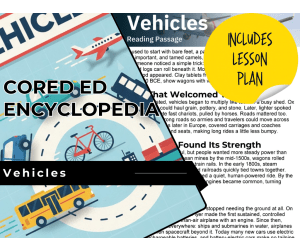
Vehicles Reading Comprehension Passage - Cored Ed Encyclopedia
ELA, Language Development, Reading Comprehension, Reading, Pre-Reading, Science, Technology, Engineering, History, Social Studies, Grade 2, 3, 4, 5, Worksheets & Printables, Worksheets, Teacher Tools, Centers, Activities, Writing Prompts, Assessments, Quizzes and Tests, Quizzes, Lesson Plans
This vehicles reading comprehension with lesson plan includes: Visualization (on the front cover) Start your lesson by taking a minute to think and share something about the topic. Read the script aloud (slowly), perhaps prepare some music or sound effects. Student close their eyes and let their imaginations wander. Students open their eyes, read the question aloud and give them a few minutes to complete. Ask a few students to share or keep answers until the end to compare with what they learn in the passage. Quick pause—thousands of Cored Education products are included with your TeachSimple membership. Download links and encyclopedia index available here. Pre-Reading Trivia Students will write down one thing they already know about the subject and then read five more facts and discuss. These facts are fun, and the students will enjoy learning about the subject before reading more. Give 1 minute for students to write what they already know (no pressure—best guess is fine). Read the five facts together. After each fact, do ask a student for their opinion, was it surprising? Set a purpose by asking students to highlight/underline one fact they want to learn more about during the reading. Reading Passage The text is a high-interest reading passage with set paragraphs, roughly three to four paragraphs long. It contains a variety of themes about the topic, anywhere from history to technology. The passage is between 250 and 350 words in length. First, ask students to look at the headings and see what they’ll learn about today. What do they know about the topic/heading? First read options: Teacher read-aloud (best for support). Partner reading (paragraph by paragraph). While reading, students underline important details, and vocabulary words they think may come up in the questions section. Mixed Questions The first question page contains four multiple-choice questions, each with a choice of four answers, and three written response questions that require a sentence or two from the student. Students complete the mcqs first independently, then review quickly as a class. For the 3 written responses, try to get students giving the answer with some form of evidence: “I think ___ because the text says ___.” If students get stuck, send them back to check the passage. Vocabulary Questions Practice seven key words from the text in this section across two activities. First section is scrambled words where students will unscramble three words given a clue for each. The second section is a word to meaning matching activity. Before starting, have some students read out words they underlined in the passage. Ask students to say the word and read aloud the sentence(s) around each word. Ask students to do scrambled words and the matching exercise in pairs then go through answers as a class. For the scrambled spelling task, get four pairs to come up to the board and write the words for extra practice with the other student reading out the clue. For the matching task, prompt students to give full sentences: “I matched ___ with ___ because ___.” Creative Writing In this question, the student will be required to write a five to eight sentence paragraph on a question related to the topic. Before starting, ask students write down 3 key ideas they are going to include in their piece. Ask students for ideas to share around the class to help those struggling. Pro writing expectations: 5–8 sentences At least 2 facts or details from the passage At least 2 vocabulary words from the previous page Students read their paragraphs while classmates listen for facts and vocabulary words. Extension Activities This page is optional for fast finishers or to take home. There are several activities, each one requiring a different skill. Do some, do none, do all, completely optional - but you will feel reassured knowing every possibility is planned for. Includes summary writting question. Answer Key There are answers for the multiple-choice questions, written response questions have sample answers, vocabulary answers and if there is a summary question then a sample summary will be provided as well. Lesson Plan Included Customized lesson plan for this lesson is included. Lesson Snapshot Title: Vehicles Genre: Nonfiction (Informational text) Subject: Social Studies / Science & Technology Primary Topic: How transportation changed from wheels to flight Estimated Guided Reading Level (A–Z): P Support pages: Pre-reading trivia, mixed questions, vocabulary practice, creative writing, extension activities, and an answer key. Support-page QA check: Some vocab items don’t match the exact word forms in the passage (e.g., chariot vs chariots , battery vs batteries , submarine vs submarines , locomotive vs locomotives ). What This Lesson Teaches Best Sequence of transportation changes over time: Moves from walking/animals, to logs/sledges, to wooden wheels and wagons, to roads and coaches, to steam locomotives, motor vehicles, and airplanes. How inventions improved travel and hauling: Explains how wheels, roads, tracks/railroads, and engines made travel smoother, faster, and able to carry heavier loads. Using headings to organize information: Section headings (“Roads…,” “When Steam…,” “A Lift Into the Air”) help readers track time periods and big shifts. Key historical details in an informational text: Includes dates and examples such as Uruk clay tablets (3700–3500 BCE) and the Wright Flyer flight (December 17, 1903). Modern tech and environmental impact: Notes electric motors, rechargeable batteries, and “no tailpipe exhaust,” ending with a question about helping the planet. Learning Goals Students will describe how people traveled and carried loads before wheels, using details from the passage. Students will identify how wheels changed what vehicles could do (hauling goods and moving more easily). Students will explain how roads and railroads affected travel and connected places, based on the text. Students will summarize the “biggest leap” in travel described in the passage and name the example given. Students will use headings and key details to retell the passage’s main changes in transportation in order. Key Vocabulary From the Text sledge — a sled that helps heavy things slide. Mesopotamia — an ancient region where Uruk was located. spoked — having thin supports connecting wheel center to rim. locomotives — train engines that pull cars on tracks. rechargeable — can be filled with power again. FULL CATALOG OF DOWNLOAD LINKS AND ENCYCLOPEDIA INDEX HERE
Author Cored Education
Rating
Tags Vocabulary, Reading Comprehension, Reading Passages, Lesson Plans, Ela Lesson Plans, Reading Comprehension Lesson Plans, Pre-reading, Science Lesson Plans, Technology, History Lesson Plans
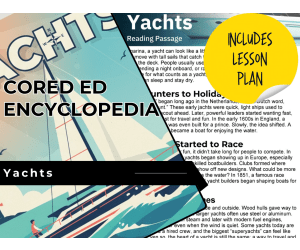
Yachts Reading Comprehension Passage - Cored Ed Encyclopedia
ELA, Language Development, Reading Comprehension, Reading, Science, History, Social Studies, Technology, Engineering, Pre-Reading, Grade 2, 3, 4, 5, Worksheets & Printables, Worksheets, Teacher Tools, Centers, Activities, Writing Prompts, Assessments, Quizzes and Tests, Quizzes, Lesson Plans
This yachts reading comprehension with lesson plan includes: Visualization (on the front cover) Start your lesson by taking a minute to think and share something about the topic. Read the script aloud (slowly), perhaps prepare some music or sound effects. Student close their eyes and let their imaginations wander. Students open their eyes, read the question aloud and give them a few minutes to complete. Ask a few students to share or keep answers until the end to compare with what they learn in the passage. Quick pause—thousands of Cored Education products are included with your TeachSimple membership. Download links and encyclopedia index available here. Pre-Reading Trivia Students will write down one thing they already know about the subject and then read five more facts and discuss. These facts are fun, and the students will enjoy learning about the subject before reading more. Give 1 minute for students to write what they already know (no pressure—best guess is fine). Read the five facts together. After each fact, do ask a student for their opinion, was it surprising? Set a purpose by asking students to highlight/underline one fact they want to learn more about during the reading. Reading Passage The text is a high-interest reading passage with set paragraphs, roughly three to four paragraphs long. It contains a variety of themes about the topic, anywhere from history to technology. The passage is between 250 and 350 words in length. First, ask students to look at the headings and see what they’ll learn about today. What do they know about the topic/heading? First read options: Teacher read-aloud (best for support). Partner reading (paragraph by paragraph). While reading, students underline important details, and vocabulary words they think may come up in the questions section. Mixed Questions The first question page contains four multiple-choice questions, each with a choice of four answers, and three written response questions that require a sentence or two from the student. Students complete the mcqs first independently, then review quickly as a class. For the 3 written responses, try to get students giving the answer with some form of evidence: “I think ___ because the text says ___.” If students get stuck, send them back to check the passage. Vocabulary Questions Practice seven key words from the text in this section across two activities. First section is scrambled words where students will unscramble three words given a clue for each. The second section is a word to meaning matching activity. Before starting, have some students read out words they underlined in the passage. Ask students to say the word and read aloud the sentence(s) around each word. Ask students to do scrambled words and the matching exercise in pairs then go through answers as a class. For the scrambled spelling task, get four pairs to come up to the board and write the words for extra practice with the other student reading out the clue. For the matching task, prompt students to give full sentences: “I matched ___ with ___ because ___.” Creative Writing In this question, the student will be required to write a five to eight sentence paragraph on a question related to the topic. Before starting, ask students write down 3 key ideas they are going to include in their piece. Ask students for ideas to share around the class to help those struggling. Pro writing expectations: 5–8 sentences At least 2 facts or details from the passage At least 2 vocabulary words from the previous page Students read their paragraphs while classmates listen for facts and vocabulary words. Extension Activities This page is optional for fast finishers or to take home. There are several activities, each one requiring a different skill. Do some, do none, do all, completely optional - but you will feel reassured knowing every possibility is planned for. Includes summary writting question. Answer Key There are answers for the multiple-choice questions, written response questions have sample answers, vocabulary answers and if there is a summary question then a sample summary will be provided as well. Lesson Plan Included Customized lesson plan for this lesson is included. Lesson Snapshot Title: Yachts Genre: Nonfiction (informational text) Subject: Social Studies (history of technology) / Informational Reading Primary Topic: What yachts are, their history, and how they changed Estimated Guided Reading Level (A–Z): Q What This Lesson Teaches Best Describes what a yacht can look and sound like at a marina, and explains that yachts may move by sails or by a motor beneath the deck. Explains how people use yachts for pleasure, such as cruising along a coast, spending a night onboard, or racing across open water, and notes that many yachts have a cabin where someone can sleep and stay dry. Traces how the word “yacht” began in Netherlands from a Dutch word meaning “hunt,” and how early yachts were quick ships used to chase pirates and scout ahead before becoming boats for travel and fun. Shows how yacht racing grew in Europe in the 1600s and how a race in 1851 helped launch the America’s Cup, influencing yacht designs for speed and handling. Explains how yachts changed over time (new materials like fiberglass, larger yachts using steel or aluminum, and engines arriving from steam to modern fuel engines), including very large “superyachts” that may need a hired crew. Learning Goals Students will identify two ways yachts can be powered using details from the text. Students will describe what the passage says people do on yachts for pleasure. Students will explain how the meaning and use of “yacht” changed over time in the passage. Students will describe how racing influenced yacht design, using the passage’s examples. Students will describe at least two changes in yacht materials or engines mentioned in the text. Key Vocabulary From the Text marina — a place where boats dock. cabin — a room where someone can sleep and stay dry. hulls — the outer bodies of boats. fiberglass — a newer material used instead of wood. crew — a hired group to run a yacht. FULL CATALOG OF DOWNLOAD LINKS AND ENCYCLOPEDIA INDEX HERE
Author Cored Education
Rating
Tags Vocabulary, Reading Comprehension, Reading Passages, Lesson Plans, Ela Lesson Plans, Reading Comprehension Lesson Plans, Pre-reading, History Lesson Plans, Science Lesson Plans, Engineering

Global Warming REDUCTION: Urban Planning - FLASH-PC
Science, Earth and Environmental Sciences, Environmental Science, Common Core, Grade 5, 6, 7, 8, Teacher Tools, Lesson Plans
Global Warming REDUCTION: Urban Planning - FLASH-PC The Global Warming REDUCTION: Urban Planning - FLASH-PC is a comprehensive teaching resource, designed to instill a deep understanding of urban planning and its role in mitigating global warming. It primarily caters to grade 5 through 8 learners. This tool effectively integrates with the Science curriculum and, more specifically, within Environmental Science subtopics. As an educator, you'll appreciate this package's versatility. The content aligns neatly with both Common Core State Standards and Bloom's Taxonomy—two widely recognized standards in the education sphere. The package offers breadth and depth in its coverage of the subject matter. In addition to pre-reading preparation, it also provides post-reading comprehension analysis for rigorous learning on all fronts. This product doesn't stop at offering conventional textual resources: Vocabulary flash cards act as a valuable supplement, giving students an opportunity not just to learn new words but also enrich their scientific lexicon—an essential competency when navigating advanced topics such as global warming reduction. We have included printables that offer tangible understanding of concepts beyond text reading experiences only. Beyond the traditional learning tools: Videos accompany the text for audiovisual representation of contents ensuring unparalleled clarity You'll find interactive activities that... Promote engagement during intense knowledge acquisition sessions Cater equally well towards whole class or small group discussions alike A Portable Solution: PC-Software Based Resource Being PC-software based, this teaching resource offers great portability. You can take your lesson anywhere without loss of quality or effectiveness—making it a great tool for homework assignments. The Final Word In totality: Global Warming Reduction: Urban Planning - FLASH-PC doesn't merely teach—it provides an ecosystem wherein curiosity can thrive amid rich information sources. This transforms a teacher's role from mere instructors into guideposts lighting up labyrinthine academic paths!
Author Classroom Complete Press
Tags Software (PC)
Hands-On - Earth & Space Science: Air and Water Gr. 1-5
Science, Earth and Environmental Sciences, Environmental Science, Grade 1, 2, 3, 4, 5, Teacher Tools, Lesson Plans
Hands-On - Earth & Space Science: Air and Water Gr. 1-5 Resource This resource is a product of the elaborate lesson plan of "Hands-On - Earth & Space Science". It has been crafted for grade levels 1 through 5 seeking to impart knowledge about our earth and beyond. The resource beautifully combines elements of Science, Technology, Engineering, Art, and Math (STEAM), hence aligning with STEAM initiatives along with Next Generation Science Standards. Interactive Learning Activities Lets students forecast weather or make their own rain-measuring devices. Allows students to learn how wind works by creating sand dunes for a hands-on experience. Promotes creativity by letting children draw their own rock layers in an artistic narrative. Involves project-based learning where groups can build solar cells, windmills or water wheels fostering teamwork. Suitable for both classroom usage and as part of homework assignments this interactive teaching tool enhances learning beyond textbooks. One key highlight is its provision for lunar calendar creation activities that map moon movements - making celestial sciences less cryptic.Moreover,it includes reading passages along with graphic organizers and guides which boost critical thinking skills among students before they delve into reading material related to each concept. Evaluation Process: The product finalizes with assessment activities after completion of every chapter - ensuring thorough understanding amongst pupils.The content neatly packed into one PDF file caters to various scientific disciplines like Environmental science under the broader subject 'Science.' In essence,this meticulously designed teaching aid pairs theory with practical experiments; comprehension activities serving dual roles as an imparter of knowledge while also augmenting curiosity about earth and space among learners.
Author Classroom Complete Press
Tags PDF
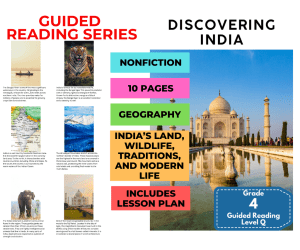
Discovering India: Guided Reading Level Q with Lesson Plan
ELA, Resources for Teachers, Reading Comprehension, Reading, Science, Geography, Social Studies, Technology, History, Life Sciences, Grade 3, 4, 5, Worksheets & Printables, Worksheets, Teacher Tools, Centers, Activities, Literacy Readers, Quizzes, Quizzes and Tests, Assessments, Lesson Plans
This Discovering India (level q) guided reading book with lesson plan includes: Guided Reading Color Label (front cover x1) This is a quick way to match the book’s demands to what students can generally handle.. The overall goal is to use the level/color to pick books for several smaller groups. To qualify for a certain level, a student is expected to read a book from that level with about 90–94% accuracy. If a student is consistently accurate and understands, move up a level. If the student is struggling at that level, drop down and add more support. Each student will improve at completely different rates, but it is generally one of the best ways to check progress across the class. DOWNLOAD THE CATALOG TO VIEW ALL GUIDED READING BOOKS AVAILABLE (SORTED LEVELS A-Z) Pre-Reading Question (x1) Teacher asks the prompt aloud, can be while showing the cover or first page. Students share what they already know, or make educated guesses from the cover. Prompt them to use the target vocabulary. Write some of their responses on the board to look back at during the reading. Vocabulary Words (x5) Introduce the five words, best doing it one at a time. Start by saying it, while students repeat and then see if anyone knows what it means before reading further. Read through the meaning and try to briefly connect each word to a picture or gesture so it’s meaningful. Ask students to flip through the book pages and point to where they see each of the vocabulary words. While reading the book pause upon coming across one of the vocab words or read the sentence twice to make sure students understand the word has appeared. Optional: Ask students to raise hands whenever they see/hear one of the new words. Guided Reading Pages (x10) Check the book snapshot (below) for: primary topic - do you need to prep extra reading or intro materials on this? what is taught best - decide on 1-2 bullets to focus on, use the prompt or words provided here for best results. learning goals - what you are checking for students to be able to do after the session, elicit answers using prompts or words provided. key vocabulary (see section above). questions overview - so you know what is coming up and if you need to prep extra materials to assist understanding. Run the lesson You may have already looked at a few of the pages together, but you can show them some of the pictures again first to set meaning. Depending on how much time you have and how familiar your students are with guided reading class, you may want to read the book aloud first with the group first. Students whisper or partner read, while you listen in. If time, do it as a group, one student reading a page each. Use the guided page’s prompts to coach: “Check the picture / does it make sense?” “Point under the words / try the first sound” “Reread the sentence smoothly”. Try to focus more on one student per session (rotating every time), so you can work out if they are ready to move up or need to move down a level. Comprehension Questions (back cover x3) This is your way to check that students didn’t just say the words, but actually understood the text. First, let students answer by pointing to the page/picture and saying a short sentence. After any answer, follow with: “Show me where you found that in the text.” In bigger groups, have partners answer first (10–20 seconds), then call on 2–3 students to share. Differentiation tips: Emerging speakers/struggling readers: oral + pointing On-level: oral in a full sentence Higher: one written sentence or draw + label Book Snapshot Title: Discovering India Genre: Nonfiction Subject: Social Studies (Geography/Culture) Primary Topic: India’s land, wildlife, traditions, and modern life Estimated Guided Reading Level (A–Z): Q What This Book Teaches Best Key geography facts about India’s location in Southern Asia, nearby borders, and surrounding waters. How landforms shape life in India, including the Himalayan Mountains and the Ganges River. Notable wildlife of India through examples like the Bengal tiger and the Indian elephant. Cultural traditions and everyday life, including spices used in meals and the celebration of Diwali. Modern India today, including transportation (auto-rickshaws) and major cities connected to technology and innovation. Learning Goals Students will describe where India is located and name details about its borders and southern waters. Students will explain how the Himalayan Mountains are described as protecting the inner plains. Students will explain why the Ganges River is important to people and farming in northern India. Students will describe key traits of the Bengal tiger and the Indian elephant using details from the text. Students will identify facts about the Taj Mahal, including where it is and features described in the book. Students will describe examples of Indian culture and modern life mentioned in the text (foods/spices, Diwali, transportation, cities). Key Vocabulary From the Text vast — very large in size. significant — very important. distinctive — easy to notice because it looks different. minarets — tall towers on a monument. diyas — small clay lamps used during Diwali. Discussion Prompts Pre-reading question: What are you hoping to learn about India as you read? Comprehension questions: What warm waters does the text say surround India to the south? Comprehension questions: According to the text, why is the Ganges River essential? Comprehension questions: What does the text say diyas symbolize during Diwali? Printing Tips 1. Best Printing Method (Recommended) “Booklet” Printing (Best if Available) If your printer or PDF viewer supports Booklet Printing , use this. Settings to use: Print mode: Booklet Paper size: Letter or A4 (either works) Orientation: Landscape Print on both sides: Yes Flip on: Short edge Scaling: Fit to printable area Booklet subset: First test: Front sides only Then: Back sides only This will automatically: Pair pages correctly Put the cover on the outside Align everything for folding After printing, fold in half and staple along the spine . 2. If “Booklet” Printing Is NOT Available You can still print this correctly with manual duplex printing . Step-by-step: Open the PDF. Choose Print . Set: Orientation: Landscape Pages per sheet: 1 Print on both sides: Yes Flip on: Short edge Print all pages . Because each PDF page already contains two facing book pages, the result will still fold cleanly into a book. Thousands of Cored Education products are included with your TeachSimple membership. Download links and encyclopedia index available here.
Author Cored Education
Rating
Tags Reading Comprehension, Reading Passages, Reading, Guided Reading, Guided Reading Lesson Plan, Guided Reading Activity, Pre-reading, Social Studies, Geography, History

Pine Trees: Evergreens: Kindergarten Science Projects
ELA, Holiday & Seasonal, Reading, Reading Comprehension, Science, Life Sciences, Nature & Plants, Basic Science, Seasons, Winter, Preschool, Grade 1, Lesson Plans, Teacher Tools
Pine Trees: Evergreens: Kindergarten Science Projects This is a wonderful resource to help children learn about Pine Trees: Evergreens while developing their ability to comprehend what they are reading. This pack contains so many resources to help you plan and deliver a fantastic lesson that will captivate your pupils! The Pine Trees: evergreens Minin Thematic Unit Plan Full lesson notes to help you plan a child-centred lesson about Pine Trees and creatures that eat the seeds - which will help you teach the 'plants' element of most Science curricula including touching on food chains and how animals obtain their food from plants. Information you need in an easy-to-read format that you can also use with able pupils 3 differentiated decodable reading passages in both colour and black and white formats and on a PowerPoint 3 differentiated reading comprehension activities 3 differentiated pages to allow pupils to use given vocabulary to write about pine trees. 1 page to draw a cone and describe it 1 page to colour a Crossbill - identified as a bird that relies on pine seeds for its food. Photos/pictures to use during the lesson and/or for display afterwards 1 twenty-slide PowerPoint Flashcards 1 fun art activity The lesson plan includes: Aims and objectives for the lesson Key vocabulary to be learned A list of resources required to teach the lesson to make your preparation easy! Pointers to assess children's understanding of the subject Step-by-step outline of the lesson The decodable passages come in three levels: The first level is for children who have a very basic grasp of phonics. This sheet requires knowledge of the sounds: o-e, i-e, ow, ee- ea and the sight words: have, are, do and the. It uses mostly one-syllable words. The second sheet requires knowledge of the sound ay and ur as well as of sight words: because, know and come. It still uses mainly one-syllable words. The third sheet contains yet more text with more words of two-syllables requiring knowledge of alternative spelling patterns for basic sounds, e.g. ea - weather. Who is the Decodable Reading Comprehension Passages + Lesson Plan: Pine Trees for? Teachers Home educators But not exclusively!! Format: 1 PDF 30 pages 1 MS PowerPoint 19 slides
Author Lilibette's Resources
Rating
Tags Decodable Reading Comprehension, Science, Evergreens, Trees, Plants, Home-education., Winter, Seasons, Kindergarten Science Projects, Nature

Cells, Skeletal & Muscular Systems Gr. 5-8
Science, Life Sciences, Human Body, Grade 5, 6, 7, 8, Teacher Tools, Lesson Plans
Cells, Skeletal & Muscular Systems Gr. 5-8 An effective teaching resource designed specifically for students in grades 5 to 8. It offers an engaging way of understanding the intricacies of human anatomy. Key components: Cellular Exploration: The basis of life, learners are guided to build models depicting important cell parts. This practical approach aids apprehension and memorization. Tissue and Organ Discovery: After understanding cells, the learning journey ventures into tissues and organs that form comprehensive systems working together seamlessly within our bodies. Skeletal System Study: A unique interactive approach is applied - designing an alien skeleton using knowledge about human bones– emphasizing not just creative thinking but also a solid understanding of bone structure. Detailed briefings on joints and cartilage offer insights into how they provide mobility within our body. Muscular System Analysis:The differences between various muscles types - skeletal muscle vs smooth muscle vs cardiac muscle are elaborated along with further insight into voluntary versus involuntary movements. This versatile resource can be used in different teaching settings such as full class discussions or smaller group workshops thereby catering to individual learner styles. It even encourages parental engagement through homework tasks. Aligned with Next Generation State Standards while incorporating principles from Bloom's Taxonomy and STEAM initiatives, this product provides numerous hands-on activities like crosswords puzzles word searches comprehension quizzes answer keys etc, Finally there is ready access to a one-file PDF for seamless usage making it a value addition to any science teacher's toolkit.
Author Classroom Complete Press
Tags PDF

All About Earthquakes | Animated Weather Video Lesson
Science, Earth and Environmental Sciences, Environmental Science, Not Grade Specific, Lesson Plans, Teacher Tools
All About Earthquakes | Animated Weather Video Lesson Unravel the mysteries of Mother Nature with the All About Earthquakes Animated Weather Video Lesson. This resource offers a captivating journey into the world of seismic activity , providing an engaging alternative to traditional classroom lectures. Suitable for many educational environments, this tool holds intrinsic value not only for public school teachers but also for homeschool educators. This 9-minute video delves deep into geological phenomena and leaves students inspired to learn more about our dynamic planet. The animated format breaks down complex environmental science topics into simpler, understandable concepts that cater to various learning styles and ages. It instills knowledge about earthquakes in an entertaining way, thereby fostering both curiosity and understanding in young scientists. Flexible Integration & Use The MP4 file format ensures seamless integration into most modern teaching systems and decentralised learning platforms. Educators have broad flexibility in implementing this teaching resource - use it as a warm-up material during science periods or as a visual supplement to textbook reading assignments. This tool is adaptable enough to fit your class schedule or curriculum pacing guide effortlessly. Engaging & Interactive Learning Experience Incorporated within whole group discussions or small group activities, this video can incorporate cooperative learning strategies while enhancing student engagement and interest. Assigning viewing as homework merges well with self-paced studying techniques—a great means of reinforcing knowledge retention outside classroom hours. ev Concisely packed with information yet undeniably fun at the same time—this All About Earthquakes Animated Weather Video Lesson ignites students' enthusiasm towards exploring scientific realities tucked within our everyday lives.
Author Educational Voice
Tags Earthquakes, Geological Phenomena, Seismic Activity, Animated Lesson, Weather

Climate Change: Causes: Greenhouse Gases: Carbon Dioxide Gr. 5-8
Science, Earth and Environmental Sciences, Environmental Science, Grade 5, 6, 7, 8, Teacher Tools, Lesson Plans
Climate Change: Causes: Greenhouse Gases: Carbon Dioxide Gr. 5-8 An in-depth teaching tool providing students with a solid scientific perspective on climate changes, separating fact from fiction. Main Features: A relevant resource for Environmental Science topics within Grades 5 to 8. Closely aligned with Bloom's Taxonomy and STEAM initiatives. Packed with engaging content that intricately explores various facets of climatic changes through comprehensive lessons. Detailed Overview: The lesson plan kicks off by exploring the wonders of our atmosphere and the effects of human activities on Earth's systems. By providing hands-on experience, students will be able to learn more effectively. An in-depth investigation into the different layers of our atmosphere. A series of experiments focusing on how an object’s color can influence radiation absorption rates - making learning more experiential and concrete. Moreover, it enables learners to understand rising temperatures' impact on oceans and carbon cycle dynamics better as they delve deeper into building their own models. Main Highlights: - A unique educational experience around sustainability presented through ways in which methane's residence time within our atmosphere can positively shape climate change combat strategies. Further highlighting health implications brought upon by fluctuating ozone levels while uncovering beneficial aspects about nitrogen-fixing bacteria as a likely alternative for nitrogen fertilizers. Students are also provided insights regarding synthetic gases – the reasons behind their banning and the duration for which their effects persist within our atmosphere. To aid learning beyond core lessons supplementary activities are included such as word searches or crossword puzzles . Perfectly suitable for either large group discussions or smaller group activities. Periodic Evaluation: Embedded within this resource are comprehension quizzes. These periodic evaluations help in ensuring student understanding while presenting opportunities for reinforcement or intervention wherever necessary. Accessible through a PDF format, Climate Change: Causes: Greenhouse Gases: Carbon Dioxide Gr. 5-8, is versatile and easily adaptable across independent assignments or homework tasks too when required. In summary, this product is a single, complete Lesson Plan designed efficiently around fundamental environmental science concepts - making it an indispensable tool for all educators investing in nurturing informed perspectives regarding Climate Change amongst students in their classrooms.
Author Classroom Complete Press
Tags PDF
Cells,Skeletal & Muscular Systems: The Muscular System - Movement - FLASH-PC
Science, Life Sciences, Human Body, Common Core, Grade 5, 6, 7, 8, Teacher Tools, Lesson Plans
Introducing Cells, Skeletal, & Muscular Systems: The Muscular System - Movement - FLASH-PC A comprehensive teaching resource specifically designed to enhance understanding of Muscle Movement across Cells, Skeletal & Muscular Systems. This product caters to students between grades 5 and 8 with a focus on the Science subject and Human Body subtopic. Curriculum -based Content Included is a robust collection of curriculum -based content comprising of: Reading Passages: Each accompanied by 'Before you Read' questions and 'After you Read' queries aiding comprehension and knowledge absorption about Muscle Movement within Cells, Skeletal & Muscular Systems. Interactive Activities:Puzzles and games that allow learners opportunities for practical application of new knowledge in a fun-filled approach. Auxiliary Resources:Vocabulary flash cards for quick reviews, printable exercises for reinforcement or homework assignments meeting myriad needs from whole group lessons to small group sessions. Bloom's Taxonomy compliance: Encouraging higher-order thinking skills by comprehensively addressing tasks ranging from recalling facts through analyzing issues until creating solutions. Common Core State Standards adherence: Guaranteeing quality education aligned with recognized benchmarks. In Summary... This integrative product equips educators with multiple avenues ensuring optimal learner engagement at understanding Muscle Movement from a Cells, Skeletal & Muscular Systems viewpoint thus ideal for both classroom lessons or engaging homework assignments. </P
Author Classroom Complete Press
Tags Software (PC)