



3,890 products added recently
Page 49 - Science Lesson Plan Template
Enhance your science instruction with a flexible lesson plan template designed for educators. This tool helps you structure objectives, materials, procedures, and assessments efficiently. Use it to create organized and impactful science lessons that cater to your students' needs.

 Show filters


Waste: At the Source: Toxic Waste Gr. 5-8
Science, Earth and Environmental Sciences, Environmental Science, Grade 5, 6, 7, 8, Teacher Tools, Lesson Plans
Waste: At the Source: Toxic Waste Gr. 5-8 This crucial teaching resource dives into an in-depth exploration of waste production and its environmental impact. The key focus is creating awareness about different types of waste, including: Pre-consumer waste: involves raw materials and natural resources Post-consumer waste: related to consumable products and durable goods among other things Educators handling Grades 5 through 8 Environmental Science curriculum must ensure students understand the source, production, handling and implications of toxic wastes. This aligns perfectly with State Standards , reinforcing objectives set out by Blooms Taxonomy. This resource lays an excellent foundation for whole group instruction or small group discussions. It's also beneficial as homework assignments due to its comprehensive nature. Complex concepts like landfills operation or toxic waste management are explained in simplified language for better student comprehension. Included Activities: Abridged Reading Passages: Simplify complex facts into easily readable content. Diverse Student Activities: Promote interaction while cementing lessons learnt from reading passages Color Mini Posters: Offer visual representation of discussion points Crossword Puzzles & Word Searches : Foster cognitive skill development amongst students while making learning fun Comprehension Quizzes: Serve as class participation exercises or exam prep tools. The material is delivered digitally in a PDF file format for convenience, making it perfect for future reference or extended use beyond classroom hours. "Waste: At the Source: Toxic Waste Gr. 5-8" simplifies yet deep dives into environmental science topics, enhancing student awareness on pollution related issues and empowering them towards eco-consciousness.
Author Classroom Complete Press
Tags PDF

I WONDER - Can Humans Make Radiation | Animated Video Lesson
Chemistry, Science, Physics, Biology, Life Sciences, Grade 6, 7, 8, 9, 10, 11, 12, Lesson Plans, Teacher Tools
Video Introduction An amazing activity designed for the students to learn more about STEM. I WONDER - Can Humans Make Radiation | Animated Video Lesson Do you like STEM subjects? what is your favorite one? Have you ever tried to plant a seed? If yes, tell us more about it. Or have you ever tried to invent something? If yes, tell us more about it. And how do you think it will help us? Have you ever seen a microorganism under a microscope? What was it? And how it looked like? Mathematics is a marvelous subject. Let' sharpen our brains and solve some equations. Do you like timetable tricks? What is your favorite one? Do you know how to code? Have you ever created an app or a game before? If yes, how was it like? I WONDER - Can Humans Make Radiation | Animated Video Lesson The video is perfect for encouraging the researching skills for the students, while learning more about this fantastic topic. I WONDER - Can Humans Make Radiation | Animated Video Lesson This friendly designed video is suitable for students at school, homeschooling, and as a group activity. Format Available in MP4 format.
Author Educational Voice
Tags Can Humans Make Radiation, Can Humans Make Radiation Video, Radiation, Radiation Facts, Radiation Facts For Kids, Radiation Video, Radiation Video For Kids, Humans, Humans Video For Kids

Reducing Your Community's Carbon Footprint Gr. 5-8
Science, Earth and Environmental Sciences, Environmental Science, Grade 5, 6, 7, 8, Teacher Tools, Lesson Plans
Reducing Your Community's Carbon Footprint Gr. 5-8 A comprehensive teaching resource designed to inspire and engage students in grades 5 through 8 to contribute actively towards environmental preservation. About the Resource: This resource encourages learners to investigate and understand the concept of carbon footprints and their effects on global climates and habitats. Besides theoretical knowledge, it invites them to examine subjects like urbanization, Cuba's eco-friendly agricultural model, and the urban heat island phenomenon - key components for understanding our impact on the environment. The tool promotes creativity by urging students to formulate unique ways of repurposing waste in their local communities. Global Green Communities: This educational guide also aims to increase awareness about existing green communities worldwide, inspiring students not just understand these practices but consider how they can be incorporated into their own communities. Supplemental Materials: To boost engagement comprehension this web-based tutorial presents a wealth of added resources which include graphic organizers a carbon footprint calculator educational games such as word searches crossword puzzles. Note: In both public school education or homeschooling context this versatile lesson plan can adapt across different learning environments allowing assignment whole-class instruction smaller group activities occasional independent study homework elements. Pedagogical Approach: The distinctiveness this digital guide lies its alignment with both Bloom Taxonomy hierarchical model used classifying learning objectives STEAM Science Tech Engineering Art Math principles. This substantiates academic robustness while encouraging interdisciplinary exploration particularly relating science aspects that are interwoven with technology engineering art math contexts foundational knowledge credits it adheres to. Conclusion: Instilling constructive environmental practices amongst young learners necessitates useful effective resources like Reducing Your Community's Carbon Footprint Gr. A perfect addition to educators' teaching portfolios offering value beyond a conventional classroom dissemination extending the reach wider community level.
Author Classroom Complete Press
Tags PDF
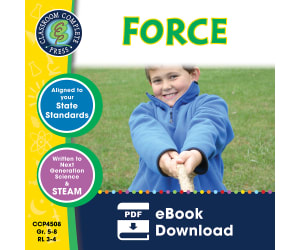
Force Gr. 5-8
Science, Physics, Grade 5, 6, 7, 8, Teacher Tools, Lesson Plans
Force Gr. 5-8 This teaching aid is a specialized resource for educators guiding students in Grade 5 through Grade 8. A principal focus rests upon exploring the concept of force. Students start by understanding what force is and then learn about different types of forces. An engaging approach is followed with planned experiments circling around frictional force and air resistance, providing a practical dimension to learning. An In-depth Scope into Forces The curriculum goes beyond by shedding light on: What a net force implies - how multiple forces can simultaneously act on an object. Treating unbalanced forces - where examples are decoded via acceleration-deceleration exercises. Motion Dynamics During Flight A striking feature includes discussing how mass and force could potentially alter motion during flight; using an arrow as an example. Further details are discussed concerning gravity's role in affecting an object's weight. Nuances of Non-contact Forces The unit continues to delve deeper into non-contact forces such as magnetic and electrostatic ones that function without physical contact. Educational Standards Compliance & Learning Tools This pedagogical instrument aligns with Next Generation State Standards (NGSS) while adhering to Bloom's Taxonomy principles, thereby integrating them in STEAM initiatives seamlessly. In addition, notable components include crossword puzzles along with comprehension quizzes aiming at solidifying students' understanding through key concepts recall. Handy review for teachers becomes possible owing to provided answer keys included at the end of the material focusing specifically on easy evaluations. Accessible and Adaptable This resource, embodied as a single pdf file, offers versatile application across whole class learning sessions, small group activities or individual homework assignments, making it universally beneficial for any Physical Science classrooms.
Author Classroom Complete Press
Tags PDF
I WONDER - What Is Bone Growth | Animated Video Lesson
Human Body, Life Sciences, Science, Biology, STEM, Grade 1, 2, 3, 4, 5, 6, 7, 8, Lesson Plans, Teacher Tools
Video Overview The human body is full of fascinating wonders to learn. This video is created to help the students recognize the anatomy and the job of the human body. I WONDER - What Is Bone Growth | Animated Video Lesson Every part and organ in our human body is vital so let's see how important they are. Have you ever imagined how we look like if we didn't have a skeleton? Did you know that because we have our amazing muscles we can stand! Do you know how many teeth do we have? Have you ever wondered about the food journey inside our body? Can you name all the glands in our body? Why do we have skin? Our nervous system is really good at sending signals. Can you tell us more about it? Are you really good at Mathematics, painting, or any other thing? You should really thank your brain about it! The famous five senses are really doing a great work? Can you explain how every sense works? I WONDER - What Is Bone Growth | Animated Video Lesson The video is perfect for encouraging the researching skills for the students, while learning more about our fantastic human body. I WONDER - What Is Bone Growth | Animated Video Lesson This friendly designed video is suitable for students at school, homeschooling, and as a group activity. Format Available in MP4 format.
Author Educational Voice
Tags What Is Bone Growth, What Is Bone Growth Video, Bone Growth, Bone Growth Facts, Bone Growth Facts For Kids, Bone Growth Video, Bone Growth Video For Kids, Bones, Bones Facts For Kids
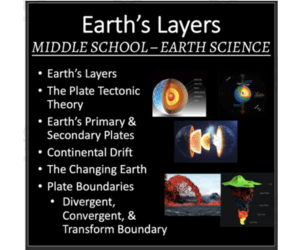
Earth's Layers - Middle School Earth Science Lesson
Science, Earth and Environmental Sciences, Earth Sciences, Environmental Science, Grade 6, 7, 8, 9, Teacher Tools, Lesson Plans
Earth's Layers - Middle School Earth Science Lesson Your lesson covers the different layers of Earth. In order, the lesson teaches about; Earth’s Layers, the Inner Core, the Outer Core, Planet Formation, Earth’s Magnetic Field, the Mantle, the Asthenosphere and Lithosphere, the Crust, and an introduction to Tectonic Plates. Your lesson includes the teacher and student version of the presentation, SIX embedded videos, an auto-graded exit ticket, and a student lesson handout so the students can record the notes on a more condensed medium. This lesson is designed to be your go-to resource, whether you're in a traditional classroom or a virtual one. With both a teacher version and a student version, it seamlessly fits into your lesson plans, making learning engaging and adaptable. Assessment made easy We've included an auto-graded Exit Ticket and a quiz with an answer key because I know you don't have an excess of time. I know you don't, because I don't and I know I'll do whatever I can to reduce my grading time. Whether you use PowerPoint or Google Slides, prefer Word or Google Docs, this lesson has you covered. This lesson comes in both Office and Google formats for your convenience. The student version of the presentation has strategically placed blanks for them to fill in as you're teaching. It keeps them active and engaged, encourages discussion, and leaves more time for those "aha" moments.
Author Teach With Fergy
Tags Earth’s Elliptical Path , Earth’s Motion Around The Sun , The Seasons , Earth’s Tilt , Earth’s Revolution , Equinox , Perihelion , Aphelion
I WONDER - Does Changing Lightbulbs Affect Energy Usage
Earth and Environmental Sciences, Science, Environmental Science, Grade 4, 5, 6, 7, 8, 9, 10, Lesson Plans, Teacher Tools
Video Introduction An amazing video designed for the students to learn more about STEM. I WONDER - Does Changing Lightbulbs Affect Energy Usage | Animated Video Lesson Do you like STEM subjects? what is your favorite one? Have you ever tried to plant a seed? If yes, tell us more about it. Or have you ever tried to invent something? If yes, tell us more about it. And how do you think it will help us? Have you ever seen a microorganism under a microscope? What was it? And how it looked like? Mathematics is a marvelous subject. Let' sharpen our brains and solve some equations. Do you like timetable tricks? What is your favorite one? Do you know how to code? Have you ever created an app or a game before? If yes, how was it like? I WONDER - Does Changing Lightbulbs Affect Energy Usage | Animated Video Lesson The video is perfect for encouraging the researching skills for the students, while learning more about this fantastic topic. I WONDER - Does Changing Lightbulbs Affect Energy Usage | Animated Video Lesson This friendly designed video is suitable for students at school, homeschooling, and as a group activity. Format Available in MP4 format.
Author Educational Voice
Tags Does Changing Lightbulbs Affect Energy Usage, Does Changing Lightbulbs Affect Energy Usage Video, Lightbulbs, Lightbulbs Facts, Lightbulbs Facts For Kids, Lightbulbs Video, Energy Usage, Energy Usage Facts For Kids

I WONDER - What Is A Group Of Tortoises Called | Animated Video Lesson
STEM, Animals, Life Sciences, Science, Biology, Grade 3, 4, 5, 6, 7, 8, 9, Lesson Plans, Teacher Tools
Video Introduction Animal kingdoms are full of fascinating wonders to learn. This video is designed for the students to learn more about animals in different countries. I WONDER - What Is A Group Of Tortoises Called | Animated Video Lesson Do you like animals? what is your favorite one? Do you own a pet? If yes, tell us more about it, like what its name? And what do you like most about it? What are the animal kingdoms? Can you write down the characteristics of each animal class like mammals, birds, reptiles, amphibian, fish and mollusks. Do you know that some animals can sing, can you name any of them? What is the largest and the smallest mammal in the world? What is the largest and the smallest bird in the world? What is the largest and the smallest fish in the world? I WONDER - What Is A Group Of Tortoises Called | Animated Video Lesson The video is perfect for encouraging the researching skills for the students, while learning more about these fantastic animals. I WONDER - What Is A Group Of Tortoises Called | Animated Video Lesson This friendly designed video is suitable for students at school, homeschooling, and as a group activity. Format Available in MP4 format.
Author Educational Voice
Tags What Is A Group Of Tortoises Called, What Is A Group Of Tortoises Called Video, Group Of Tortoises, Group Of Tortoises Facts, Group Of Tortoises Facts For Kids, Group Of Tortoises Video, Group Of Tortoises Video For Kids

I WONDER - Why Are Circuits Used | Animated Video Lesson
Physics, Science, Grade 6, 7, 8, 9, 10, 11, 12, Lesson Plans, Teacher Tools
Video Introduction An amazing activity designed for the students to learn more about STEM. I WONDER - Why Are Circuits Used | Animated Video Lesson Do you like STEM subjects? what is your favorite one? Have you ever tried to plant a seed? If yes, tell us more about it. Or have you ever tried to invent something? If yes, tell us more about it. And how do you think it will help us? Have you ever seen a microorganism under a microscope? What was it? And how it looked like? Mathematics is a marvelous subject. Let' sharpen our brains and solve some equations. Do you like timetable tricks? What is your favorite one? Do you know how to code? Have you ever created an app or a game before? If yes, how was it like? I WONDER - Why Are Circuits Used | Animated Video Lesson The video is perfect for encouraging the researching skills for the students, while learning more about this fantastic topic. I WONDER - Why Are Circuits Used | Animated Video Lesson This friendly designed video is suitable for students at school, homeschooling, and as a group activity. Format Available in MP4 format.
Author Educational Voice
Tags Why Are Circuits Used, Why Are Circuits Used Video, Circuits, Circuits Facts, Circuits Facts For Kids, Circuits Video, Circuits Video For Kids, Science, Science Video, Science Video For Kids
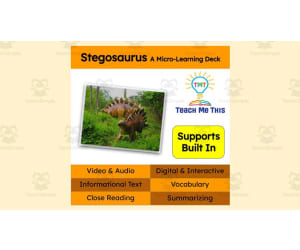
Stegosaurus | Interactive Science Lesson | Micro-Learning Deck
Science, Life Sciences, Animals, Grade 6, 7, 8, 9, Teacher Tools, Lesson Plans
Engage students with an informative slideshow on the Stegosaurus dinosaur. This science resource explores the anatomy and behavior of this iconic Jurassic herbivore through a video lesson, reading passage with audio, close reading activity, and quick write assignment. Educators can utilize the deck in whole or small groups to build knowledge, assess comprehension, and spark discussion. The multimedia format and focused content delivery make this an adaptable resource for reinforcing standards-based learning objectives across middle school grade bands. Students will stay engaged as they move through the self-paced content, analyzing text and visuals to learn extinction theories and intriguing facts about Stegosaurus body features like the double row of kite-shaped plates along its back. Use to supplement your zoology or earth science curriculum .
Author Teach Me This
Tags Stegosaurus, Interactive, Science, Vocabulary, Comprehension

I WONDER - What Is The Biggest Asteroid Ever Found | Animated Video
Space, Earth and Environmental Sciences, Science, Grade 4, 5, 6, 7, 8, 9, 10, Lesson Plans, Teacher Tools
Video Introduction An amazing video designed for the students to learn more about space facts. I WONDER - What Is The Biggest Asteroid Ever Found | Animated Video Lesson Do you like reading about space? If yes, what is your favorite topic? What do you know about our solar system? What is the smallest planet in our solar system? What is the biggest planet in our solar system? What is the hottest planet in our solar system? And what is the coldest one? Do you think there are aliens? If yes, what do you think they look like? What do they eat and how they speak to each other? Where do they live? What is a galaxy? And what is a milky way? Have you recently saw a shooting star? If yes, tell us more about it, like when did it happen and where? What is a blackhole? Can a blackhole gets bigger by time? Do you like counting the stars? What do you think a star is made of? I WONDER - What Is The Biggest Asteroid Ever Found | Animated Video Lesson The video is perfect for encouraging the researching skills for the students, while learning more about the fantastic space. I WONDER - What Is The Biggest Asteroid Ever Found | Animated Video Lesson This friendly designed video is suitable for students at school, homeschooling, and as a group activity. Format Available in MP4 format.
Author Educational Voice
Tags What Is The Biggest Asteroid Ever Found, What Is The Biggest Asteroid Ever Found Video, Biggest Asteroid, Biggest Asteroid Facts, Biggest Asteroid Video, Biggest Asteroid Facts For Kids, Biggest Asteroid Video For Kids

I WONDER - What The Snake Wrapped On A Staff Symbol Means In Hospitals
Human Body, Life Sciences, Science, History: Ancient, History, Social Studies, History: Europe, History: World, Grade 6, 7, 8, 9, 10, 11, 12, Lesson Plans, Teacher Tools
Video Introduction An amazing video designed for the students to learn more about history. I WONDER - What The Snake Wrapped On A Staff Symbol Means In Hospitals | Animated Video Lesson Do you like history? Which topic do you really enjoy about history? Have you ever read an interesting fact about the Vikings? If yes, can you mention them? What do you like most about the Victorian era? Can you name all the Tudors? Have you ever wondered how people used to live in ancient Japan and ancient China? Do you know any interesting facts about ancient Egyptians and the Pharaohs? Have you ever visited South America? What do you know about Incas and Aztecs? Celtic culture was really one of a kind, can you name any of the places that Celts used to live in? Imagine yourself living during the ancient Roman empire, how your life will look like? Ancient Greece was an amazing place to live in. What do you know about ancient Greek life? I WONDER - What The Snake Wrapped On A Staff Symbol Means In Hospitals | Animated Video Lesson The video is perfect for encouraging the researching skills for the students, while learning more about history. I WONDER - What The Snake Wrapped On A Staff Symbol Means In Hospitals | Animated Video Lesson This friendly designed video is suitable for students at school, homeschooling, and as a group activity. Format Available in MP4 format.
Author Educational Voice
Tags What The Snake Wrapped On A Staff Symbol Means In Hospitals, What The Snake Wrapped On A Staff Symbol Means In Hospitals Video, Hospitals, Hospitals Facts, Hospitals Video, Hospitals History, Hospitals History For Kids

Efficiency and Regulation of Cellular Respiration - Biology lesson
Science, Life Sciences, Biology, Grade 11, 12, Teacher Tools, Lesson Plans
Efficiency and Regulation of Cellular Respiration - High School Biology lesson Your lesson covers how efficient we are at performing cellular respiration. In order, the lesson teaches how much ATP we make at each step of cellular respiration, how efficient aerobic respiration is, metabolic rates, BMR, regulating cellular respiration, and alternatives to glucose that we can use. Your lesson includes the teacher and student version of the presentation, two embedded videos, an auto-graded exit ticket, and a student lesson handout so the students can record the notes on a more condensed medium. This lesson is designed to be your go-to resource, whether you're in a traditional classroom or a virtual one. With both a teacher version and a student version, it seamlessly fits into your lesson plans, making learning engaging and adaptable. Assessment made easy We've included an auto-graded Exit Ticket and a quiz with an answer key because I know you don't have an excess of time. I know you don't, because I don't and I know I'll do whatever I can to reduce my grading time. Whether you use PowerPoint or Google Slides, prefer Word or Google Docs, this lesson has you covered. This lesson comes in both Office and Google formats for your convenience. The student version of the presentation has strategically placed blanks for them to fill in as you're teaching. It keeps them active and engaged, encourages discussion, and leaves more time for those "aha" moments.
Author Teach With Fergy
Tags Senior Biology, Biology Lesson, Aerobic Respiration, ETC, Krebs Cycle, Citric Acid Cycle, Pyruvate Oxidation, Proton Gradient, Chemiosmosis

I WONDER - What Is An Endangered Animal | Animated Video
Biology, Life Sciences, Science, Animals, STEM, Grade 3, 4, 5, 6, 7, 8, 9, Lesson Plans, Teacher Tools
Video Introduction Animal kingdoms are full of fascinating wonders to learn. This video is designed for the students to learn more about animals in different countries. I WONDER - What Is An Endangered Animal | Animated Video Lesson Do you like animals? what is your favorite one? Do you own a pet? If yes, tell us more about it, like what its name? And what do you like most about it? What are the animal kingdoms? Can you write down the characteristics of each animal class like mammals, birds, reptiles, amphibian, fish and mollusks. Do you know that some animals can sing, can you name any of them? What is the largest and the smallest mammal in the world? What is the largest and the smallest bird in the world? What is the largest and the smallest fish in the world? I WONDER - What Is An Endangered Animal | Animated Video Lesson The video is perfect for encouraging the researching skills for the students, while learning more about these fantastic animals. I WONDER - What Is An Endangered Animal | Animated Video Lesson This friendly designed video is suitable for students at school, homeschooling, and as a group activity. Format Available in MP4 format.
Author Educational Voice
Tags What Is An Endangered Animal, What Is An Endangered Animal Video, Endangered Animal, Endangered Animal Facts, Endangered Animal Video, Endangered Animal Facts For Kids, Endangered Animal Video For Kids

Speed Quizzing – Space Unit: The Study of the Universe
Science, Earth and Environmental Sciences, Space, Grade 8, 9, 10, Lesson Plans, Teacher Tools
This activity will get your students out of their seats, moving around, and discussing the material. It is fully editable and requires very little preparation. Simply print, cut out the flash cards, and pass them out to students. Note. This resource can also be used as an excellent question bank as it contains 32 high-quality questions that you can use in any way you see fit. This activity contains 32 questions designed to test your students’ knowledge of the unit they are studying. The questions come directly from the lessons and cover the following topics: • Space • Our Solar System • The Life and Death of Stars • Seasons • The Moon • Eclipse • Galaxies, Other Objects, and the Universe • The Immensity of the Universe • How Humans Meet Their Needs in Space Each of the Speed Quizzes listed below can be found in my Speed Quizzes Growing bundle at a discount of at least 65%. Here’s how you implement them: 1. Provide each student with a flash card 2. Pair up students using the stand up/hands up/pair up method 3. Partner A reads the question to Partner B, who answers. Partner A praises if correct or coaches if incorrect. 4. Partners switch roles 5. Students thank each other and switch cards 6. Partners raise their hands to find a new partner 7. Repeat for a specified amount of time Alternate way to ensure each student gets a new partner each time: Divide students into groups A and B. Have every student pair up with someone from the other group (if there is an odd number of students you participate too!) 1) Do Speed Quizzing 2) Then have group A move to the right and group B stay still. 3) Do Speed Quizzing 4) Then have group B move to the left and group A stay still. Every student in group A will meet every student in group B, but students will not meet students in their own group (a clever way to keep apart students who should not be partnered for whatever reason). This activity can be used to: • Prompt meaningful student conversation • Review prior knowledge • Review new terms/problems after a unit • Gather student ideas • Remediate weak skills • Practice new skills Thank you for your interest in my products. If you have any questions, please send me an email - devon@teachwithfergy.com
Author Teach With Fergy
Tags Study Of The Universe, Speed Quizzing, Space Unit, Astrology Assessment, Partner Work
Day and Night Curriculum Pack
Creative Arts, Art, Social Studies, ELA, Language Development, Vocabulary, Math, Early Math, Science, Basic Science, Kindergarten, Lesson Plans, Teacher Tools
If your students are studying day and night or are about to begin a time unit, I have just the resource to provide you with everything you need and more! This is a Day and Night Curriculum Pack complete with an abundance of printable resources and engaging activities for students to complete. This curriculum was designed for your preschool students. The curriculum goal is to de-mystify the concepts of day time and night time, and alleviate any related common fears – while recognizing and celebrating routines. The vocabulary that students will focus on is sun, moon, stars, awake, sleep/asleep, day, night, routine, orbit, dream, shadow, light, dark, bedtime, morning, and evening. This curriculum will come with a color of the week (black) and a letter of the week (D). This curriculum pack includes: --Sensory Table Ideas --Art Activities --Cooking Experience --Community Time --Math Activities --Home/School Connection Ideas --Science Table Enrichments --Science Concepts/Activities --Prop Box Ideas/Dramatic Play Enrichments --Movement and Motor --Playground/Walk Activities --Transition/Waiting Ideas --Block Area Enrichments --Flannel Board --Teacher Made Enrichment Ideas --Field Trip Ideas --Supplemental Learning Ideas/Activities At the start of this pack, you will receive a list of supplies needed for activities and projects. The worksheets, activities, and tasks included in this pack are intended to be completed in a variety of formats – whole group, small group, and independent work. I hope you enjoy!
Author Learning Foundations
Tags Day And Night, Routines, Preschool Curriculum, Art Activity, Sensory Table, Bulletin Board, Science Concepts, Motor Skills, Transitions

Conservation: Fresh Water Resources: Conservation: What We Can Do Gr. 5-8
Science, Earth and Environmental Sciences, Environmental Science, Grade 5, 6, 7, 8, Teacher Tools, Lesson Plans
Conservation: Fresh Water Resources: Conservation: What We Can Do Gr. 5-8 - An Introduction Conservation: Fresh Water Resources: Conservation: What We Can Do Gr. 5-8, is an insightful and relevant teaching resource that targets students in grades 5 through 8. With its emphasis on environmental science, particularly water conservation, this educational tool can be an integral part of a diverse curriculum . The Teaching Material Content The selected teaching material prioritizes the importance of preserving our essential natural resources, specifically fresh water. It spotlights our dependency on freshwater not just for personal consumption but food production as well and involves students in important discussions about how climate change factors impact these precious resources. Lesson Plan Features: Scientifically accurate facts at middle school comprehension level. Poignant discussions about humans’ relationships with fresh water. Informational readings accompanied by comprehension questions to ignite productive conversations among students. Actionable hands-on activities designed for efficient learning engagement across varying learner types. Inclusion of test preparations features lending its utility as a practical study tool in addition to being rich instructional content. Bonus mini posters hosting accessible vocabulary terms structured in kid-friendly language visual learners will find particularly engaging. Convenient and Adaptable Design This lesson plan stands out by virtue of its adaptability; it dually serves effective learning outcomes whether implemented as whole group instruction or used to structure small group lessons focusing better on student-teacher interaction ratios. Thanks to its unique formatting, it can also be used as a productive homework assignment tool. Academic Quality Assurance: The valuable academic content within this resource is planned according to state Standards and structured around Bloom's Taxonomy ensuring educators the high-quality instruction their students deserve. Format: Provided in an easily accessible PDF format, this teaching resource ensures convenience for hardworking teachers on the move.
Author Classroom Complete Press
Tags PDF

Crash Course Organic Chemistry: Episodes 6-10
Science, Chemistry, Grade 10, 11, 12, Teacher Tools, Lesson Plans
Crash Course Organic Chemistry: Episodes 6-10 will cover: -Alkanes -Cyclohexanes -Stereochemistry -More Stereochemical Relationships -Polarity, Resonance, and Electron Episode links for each of these are included. There is an episode guide for students to complete (with and without timestamps). Answer keys are included.
Author Karen Maxson
Tags Organic Chemistry, Chemistry Videos, Alkanes, Stereochemical, Relationships
I WONDER - Are There Different Parts To The Intestine | Animated Video
Biology, Life Sciences, Science, Animals, STEM, Grade 3, 4, 5, 6, 7, 8, 9, Teacher Tools, Lesson Plans
Video Overview The human body is full of fascinating wonders to learn. This video is created to help the students recognize the anatomy and the job of the human body. I WONDER - Are There Different Parts To The Intestine | Animated Video Lesson Every part and organ in our human body is vital so let's see how important they are. Have you ever imagined how we look like if we didn't have a skeleton? Did you know that because we have our amazing muscles we can stand! Do you know how many teeth do we have? Have you ever wondered about the food journey inside our body? Can you name all the glands in our body? Why do we have skin? Our nervous system is really good at sending signals. Can you tell us more about it? Are you really good at Mathematics, painting, or any other thing? You should really thank your brain about it! The famous five senses are really doing a great work? Can you explain how every sense works? I WONDER - Are There Different Parts To The Intestine | Animated Video Lesson The video is perfect for encouraging the researching skills for the students, while learning more about our fantastic human body. I WONDER - Are There Different Parts To The Intestine | Animated Video Lesson This friendly designed video is suitable for students at school, homeschooling, and as a group activity. Format Available in MP4 format.
Author Educational Voice
Tags Are There Different Parts To The Intestine, Are There Different Parts To The Intestine Video, Intestine Parts, Small Intestine, Large Intestine, Intestine Facts, Intestine Facts For Kids, Intestine Video

Bears | Interactive Science Lesson | Micro-Learning Deck
Science, Life Sciences, Animals, Grade 5, 6, 7, Teacher Tools, Lesson Plans
Bears | Interactive Science Lesson | Micro-Learning Deck This digital slideshow resource for science educators teaches students about bears through multiple modalities. The deck begins with an informational video lesson to introduce key concepts. Students then read a passage with audio support to reinforce comprehension. A close reading activity and quick write prompt further develop understanding and allow students to synthesize information. Implementation ideas include whole group instruction to introduce concepts, small group work to read passages, independent work for assessments , and supplemental homework. The variety of teaching materials keeps learners actively engaged with content on bears. Educators can utilize this resource to elevate a unit on zoology.
Author Teach Me This
Tags Interactive Science Lesson, Vocabulary, Learning Deck, Bears Lesson, Quick Write
Earthquake Unit
Science, Earth and Environmental Sciences, Earth Sciences, Grade 4, 5, 6, 7, Lesson Plans, Teacher Tools
This large Earthquake Bundle contains a wide variety of resources needed to teach a rigorous unit on Earthquakes. It includes CLOSE Reading nonfiction passages to help teach your students about earthquakes (not familiar with CLOSE reading? It’s okay, we have instructions and anchor charts to help you incorporate it into your teaching). There are text dependent questions aligned with each passage, a set of vocabulary cards with definitions to accompany the passages, An Earthquake Research Report, and much, much more. A variety of other graphic organizers and activities are included as well. We do encourage you to supplement with any other books, videos, and websites that you already use; they will blend nicely with our CLOSE reading passages. You can use this unit in its entirety, or “pick and choose” the components to meet the needs of your students.
Author The Teacher Team
Tags Earthquake, Earth Science, Fifth Grade Science, Earthquake Unit, Bundle

I WONDER - How Fast Do Chemical Reactions Occur | Animated Video
Chemistry, Science, STEM, Grade 6, 7, 8, 9, 10, 11, 12, Teacher Tools, Lesson Plans
Video Introduction An amazing video designed for the students to learn more about STEM. I WONDER - How Fast Do Chemical Reactions Occur | Animated Video Lesson Do you like STEM subjects? what is your favorite one? Have you ever tried to plant a seed? If yes, tell us more about it. Or have you ever tried to invent something? If yes, tell us more about it. And how do you think it will help us? Have you ever seen a microorganism under a microscope? What was it? And how it looked like? Mathematics is a marvelous subject. Let' sharpen our brains and solve some equations. Do you like timetable tricks? What is your favorite one? Do you know how to code? Have you ever created an app or a game before? If yes, how was it like? I WONDER - How Fast Do Chemical Reactions Occur | Animated Video Lesson The video is perfect for encouraging the researching skills for the students, while learning more about this fantastic topic. I WONDER - How Fast Do Chemical Reactions Occur | Animated Video Lesson This friendly designed video is suitable for students at school, homeschooling, and as a group activity. Format Available in MP4 format.
Author Educational Voice
Tags How Fast Do Chemical Reactions Occur, How Fast Do Chemical Reactions Occur Video, Chemical Reactions, Chemical Reactions Facts, Chemical Reactions Facts For Kids, Chemical Reactions Video, Chemical Reactions Video For Kids
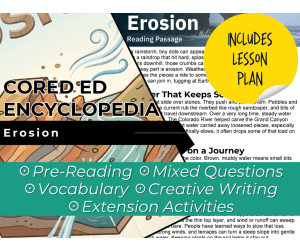
Erosion Reading Comprehension Passage - Cored Ed Encyclopedia
ELA, Reading Comprehension, Reading, Science, Technology, Language Development, Social Studies, Earth and Environmental Sciences, Geography, Life Sciences, Grade 2, 3, 4, 5, Worksheets & Printables, Worksheets, Teacher Tools, Centers, Activities, Writing Prompts, Assessments, Quizzes and Tests, Quizzes, Lesson Plans
This erosion reading comprehension with lesson plan includes: Visualization (on the front cover) Start your lesson by taking a minute to think and share something about the topic. Read the script aloud (slowly), perhaps prepare some music or sound effects. Student close their eyes and let their imaginations wander. Students open their eyes, read the question aloud and give them a few minutes to complete. Ask a few students to share or keep answers until the end to compare with what they learn in the passage. Quick pause—thousands of Cored Education products are included with your TeachSimple membership. Download links and encyclopedia index available here. Pre-Reading Trivia Students will write down one thing they already know about the subject and then read five more facts and discuss. These facts are fun, and the students will enjoy learning about the subject before reading more. Give 1 minute for students to write what they already know (no pressure—best guess is fine). Read the five facts together. After each fact, do ask a student for their opinion, was it surprising? Set a purpose by asking students to highlight/underline one fact they want to learn more about during the reading. Reading Passage The text is a high-interest reading passage with set paragraphs, roughly three to four paragraphs long. It contains a variety of themes about the topic, anywhere from history to technology. The passage is between 250 and 350 words in length. First, ask students to look at the headings and see what they’ll learn about today. What do they know about the topic/heading? First read options: Teacher read-aloud (best for support). Partner reading (paragraph by paragraph). While reading, students underline important details, and vocabulary words they think may come up in the questions section. Mixed Questions The first question page contains four multiple-choice questions, each with a choice of four answers, and three written response questions that require a sentence or two from the student. Students complete the mcqs first independently, then review quickly as a class. For the 3 written responses, try to get students giving the answer with some form of evidence: “I think ___ because the text says ___.” If students get stuck, send them back to check the passage. Vocabulary Questions Practice seven key words from the text in this section across two activities. First section is scrambled words where students will unscramble three words given a clue for each. The second section is a word to meaning matching activity. Before starting, have some students read out words they underlined in the passage. Ask students to say the word and read aloud the sentence(s) around each word. Ask students to do scrambled words and the matching exercise in pairs then go through answers as a class. For the scrambled spelling task, get four pairs to come up to the board and write the words for extra practice with the other student reading out the clue. For the matching task, prompt students to give full sentences: “I matched ___ with ___ because ___.” Creative Writing In this question, the student will be required to write a five to eight sentence paragraph on a question related to the topic. Before starting, ask students write down 3 key ideas they are going to include in their piece. Ask students for ideas to share around the class to help those struggling. Pro writing expectations: 5–8 sentences At least 2 facts or details from the passage At least 2 vocabulary words from the previous page Students read their paragraphs while classmates listen for facts and vocabulary words. Extension Activities This page is optional for fast finishers or to take home. There are several activities, each one requiring a different skill. Do some, do none, do all, completely optional - but you will feel reassured knowing every possibility is planned for. Includes summary writting question and additional facts. Answer Key There are answers for the multiple-choice questions, written response questions have sample answers, vocabulary answers and if there is a summary question then a sample summary will be provided as well. Lesson Plan Included Customized lesson plan for this lesson is included. Lesson Snapshot Title: Erosion Genre: Nonfiction (Informational Text) Subject: Science (Earth Science) / Reading (Informational Text) Primary Topic: How erosion moves Earth materials and changes land Estimated Guided Reading Level (A–Z): N What This Lesson Teaches Best Clearly distinguishes weathering (breaking rock apart in place) from erosion (moving pieces away). (Reading Passage, p. 3) Explains multiple forces that cause erosion— water, wind, waves, ice, and gravity —and what they do to Earth’s surface. (p. 3) Shows how rivers reshape land over time, including how moving water and sediment can help carve deep valleys (Colorado River/Grand Canyon example). (p. 3) Introduces sediment and connects erosion to deposition , explaining how new landforms can build up (beaches, river deltas). (p. 3) Connects science to real-world problem solving by describing ways people can slow soil loss (trees, terraces, keeping plants on soil). (p. 3) Learning Goals Students will explain how erosion is different from weathering using the text’s definitions. Students will identify forces that can cause erosion (water, wind, waves, ice, gravity). Students will describe how rivers move sediment and can change riverbeds and valleys over time. Students will explain what sediment is and how deposition happens when sediment settles. Students will describe at least two ways people can help soil “stay home,” based on the passage. Key Vocabulary From the Text weathering — breaking rock apart where it sits. erosion — moving soil and rock to a new place. sediment — tiny bits of soil and rock that travel. deposition — when sediment settles and builds up land. terraces — steps that slow water on a steep slope. FULL CATALOG OF DOWNLOAD LINKS AND ENCYCLOPEDIA INDEX HERE
Author Cored Education
Rating
Tags Vocabulary, Reading Comprehension, Reading Passages, Lesson Plans, Ela Lesson Plans, Reading Comprehension Lesson Plans, Pre-reading, Geography, Earth Science, Science Lesson Plans

Climate Change: Effects: Melting Ice Sheets Gr. 5-8
Science, Earth and Environmental Sciences, Environmental Science, Grade 5, 6, 7, 8, Teacher Tools, Lesson Plans
Teaching Resource: Climate Change Effects - Melting Ice Sheets Gr. 5-8 Climate Change: Effects: Melting Ice Sheets Gr. 5-8 is a valuable teaching tool for educators aiming to provide an extensive understanding of environmental science to students from grades 5 to 8. The main focus of this resource lies in exploring the influence of climate change, specifically through the lens of the melting ice sheets. This resource stands out due to its effective blend of informative theoretical material and practical, activity -based learning foundations. It enables students to gain an engaging insight into how climate change has shaped the evolution and migration patterns of human society over history. Hands-on Experiments: Practical demonstrations such as creating a model glacier facilitate understanding about rising sea levels as a consequence of melting ice caps. Similarly, models depicting sea level rise assist in proficiently visualizing this otherwise abstract concept. Broad Coverage: Beyond focusing only on environmental consequences, it also shares insights on increased risk due to abrupt weather conditions triggered by climate shift like mosquito-borne diseases or air pollution effects thus incorporating health perspective into lesson plans. Economic Impact Discussions: Includes content reflecting economic impacts in areas where sudden climatic changes are likely to hamper farming industries - instigating critical thinking about wider sociopolitical impacts. Ecosystem Analysis: Directs learners towards identifying specific ecosystems and evaluating their vulnerability towards climatic changes – utilizing Bloom’s Taxonomy principles that augment their analytical skills alongside expanding their knowledge spectrum. The module incorporates review components like quizzes and crossword puzzles along with answer keys, making assessment straightforward post lesson delivery. Its suitability extends beyond class group discussions or small group activities to individual homework pieces that reinforce the class discussions. As a technology-friendly, PDF-based tool featuring climate change impacts in a accessible manner for students, this teaching resource excellently aligns with STEAM initiatives, fostering an engaging and enriching learning experience about this critical global concern.
Author Classroom Complete Press
Tags PDF