



3,943 products added recently
Page 6 - Science Lesson Plan Template
Enhance your science instruction with a flexible lesson plan template designed for educators. This tool helps you structure objectives, materials, procedures, and assessments efficiently. Use it to create organized and impactful science lessons that cater to your students' needs.

 Show filters

Reducing Your School's Carbon Footprint: We Recycle Cans, Trees Recycle Carbon Gr. 5-8
Science, Earth and Environmental Sciences, Environmental Science, Grade 5, 6, 7, 8, Teacher Tools, Lesson Plans
Reducing Your School's Carbon Footprint: We Recycle Cans, Trees Recycle Carbon Gr. 5-8 is an educational resource developed to introduce students of grades 5 to 8 to the principle of a carbon footprint. This program presents a unique combination of environmental science and hands-on analysis aimed at understanding the influence our regular activities have on our planet. This educational material focuses on helping students: Evaluate their school's carbon footprint, Develop a strong sense of responsibility towards their environment. The program challenges critical thinking by encouraging kids: To devise strategies for decreasing energy consumption within their school environment, To carry out group projects during the class session, and To take possible homework assignments more seriously while connecting them with the real-life application aspect. Prominent among its features is opening conversations about fossil fuels' utilization in schools and society generally. The content adheres closely with principles Bloom's Taxonomy and also aligns with STEAM initiatives (Science Technology Engineering Arts Mathematics) . Main Highlight The major distinction this instructional tool holds is its link-to-life application aspect - it motivates learners not just think theoretically but also perform practical ideas achieving real results. Some examples include creating idle-free zones in schools or figuring out potential reduction in carbon dioxide if trees are planted around nearby areas. Through such activities executed either during full-class lessons or smaller groups sessions, learners get hands-on experience in making considerable changes that positively affect their immediate surroundings. Add-ons Included: Versatile learning tools such as graphic organizers, Crossword puzzles and comprehension quizzes, Bundled with answer keys provided All included in a print-ready PDF format of 30 pages. In summary, Reducing Your School's Carbon Footprint: We Recycle Cans, Trees Recycle Carbon Gr. 5-8 goes beyond being a just lesson plan; it kickstarts an eco-friendly paradigm shift among learners, setting them up to be proactive custodians of the world around them.
Author Classroom Complete Press
Tags School Environment, Carbon Footprint, Recycling, Science Quiz, Reading Passage
Prevention, Recycling & Conservation Gr. 5-8
Science, Earth and Environmental Sciences, Environmental Science, Grade 5, 6, 7, 8, Teacher Tools, Lesson Plans
Prevention, Recycling & Conservation Gr. 5-8: A Key Teaching Resource This teaching tool is designed to deepen students' understanding of sustainable practices and environmental conservation. It expertly brings together theory and practice for Grade 5 to Grade 8 learners depicting a real-life approach to science. An Invitation for Active Participation Intelligence-driven, this material invites students' active participation emphasizing that the battle for Earth's preservation begins with them. Sustainable Learning Experiences In-depth explanations on waste prevention methods and environmental problem-solving. Promotes creativity through innovative recycling management within their community. Harnesses practical knowledge by providing hands-on opportunities like building a classroom compost system. Inclusion of fun activities such as word search and crossword puzzles supporting vocabulary building! A Focus on Water Safety & Independent Research Skills The resource includes critical information about water safety - where it comes from and how it should be conserved. Also encourages developing independent research skills through Internet-based assignments such as creating green business guides or reporting specifically about greenhouse gases. All-Inclusive Teaching Toolkit in PDF Format! The downloadable PDF file comes with: Ready-to-use lesson plans:Fulfilling Bloom's Taxonomy and STEAM objectives aimed at various Environmental Science classes or any course addressing global issues User-friendly evaluation tools:Simplified student assessments like comprehension quizzes coupled with an answer key. The package has everything you need to equip your students with eco-conscious knowledge, outlining the future's biggest battles! Make learning fun while unraveling the complexities of our fragile ecosystems and creating eco-conscious global citizens.
Author Classroom Complete Press
Tags PDF

Senses, Nervous & Respiratory Systems Gr. 5-8
Science, Life Sciences, Human Body, Grade 5, 6, 7, 8, Teacher Tools, Lesson Plans
The Senses, Nervous & Respiratory Systems Gr. 5-8 The Senses, Nervous & Respiratory Systems Gr. 5-8 is an educational resource that delves into the workings of the human body in a way that is enlightening to students from Grade 5 to Grade 8. This tool adheres strictly to Next Generation State Standards and embraces the principles of STEAM (Science, Technology Engineering Arts Mathematics). Providing a blend of theoretical content and hands-on scientific experiments that cater to all kinds learning styles. Designed for various educational environments it can be used for group activities in class or as homework assignments. Main Components: Detailed exploration of brain functions Insights into complex structure and workings of the nervous system A comprehensive study on five senses and impact on overall experience Precise respiratory anatomy discussion focusing on essential parts which includes mouth, nose, trachea epiglottis lungs etc. The teaching resource packs in memory games and blindfolded taste tests which makes learning fascinating. These activities show how intertwined our senses are. Rounding it Off: To further instigate interest in students there are word search puzzles along with quizzes which reinforces their acquired knowledge. Supporting educators accurately assess student's progress is an easy-to-follow answer key included within this product. The versatility provided by this resource aids educators in delivering diverse topics effectively reducing their workload without compromising quality.
Author Classroom Complete Press
Tags PDF
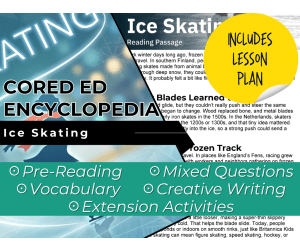
Ice Skating Reading Comprehension Passage - Cored Ed Encyclopedia
ELA, Reading Comprehension, Reading, Language Development, History, Social Studies, Science, Physics, Sports, P.E. & Health, Grade 2, 3, 4, 5, Worksheets & Printables, Worksheets, Teacher Tools, Centers, Activities, Writing Prompts, Assessments, Quizzes and Tests, Quizzes, Lesson Plans
This Ice Skating reading comprehension with lesson plan includes: Visualization (on the front cover) Start your lesson by taking a minute to think and share something about the topic. Read the script aloud (slowly), perhaps prepare some music or sound effects. Student close their eyes and let their imaginations wander. Students open their eyes, read the question aloud and give them a few minutes to complete. Ask a few students to share or keep answers until the end to compare with what they learn in the passage. Quick pause—thousands of Cored Education products are included with your TeachSimple membership. Download links and encyclopedia index available here. Pre-Reading Trivia Students will write down one thing they already know about the subject and then read five more facts and discuss. These facts are fun, and the students will enjoy learning about the subject before reading more. Give 1 minute for students to write what they already know (no pressure—best guess is fine). Read the five facts together. After each fact, do ask a student for their opinion, was it surprising? Set a purpose by asking students to highlight/underline one fact they want to learn more about during the reading. Reading Passage The text is a high-interest reading passage with set paragraphs, roughly three to four paragraphs long. It contains a variety of themes about the topic, anywhere from history to technology. The passage is between 250 and 350 words in length. First, ask students to look at the headings and see what they’ll learn about today. What do they know about the topic/heading? First read options: Teacher read-aloud (best for support). Partner reading (paragraph by paragraph). While reading, students underline important details, and vocabulary words they think may come up in the questions section. Mixed Questions The first question page contains four multiple-choice questions, each with a choice of four answers, and three written response questions that require a sentence or two from the student. Students complete the mcqs first independently, then review quickly as a class. For the 3 written responses, try to get students giving the answer with some form of evidence: “I think ___ because the text says ___.” If students get stuck, send them back to check the passage. Vocabulary Questions Practice seven key words from the text in this section across two activities. First section is scrambled words where students will unscramble three words given a clue for each. The second section is a word to meaning matching activity. Before starting, have some students read out words they underlined in the passage. Ask students to say the word and read aloud the sentence(s) around each word. Ask students to do scrambled words and the matching exercise in pairs then go through answers as a class. For the scrambled spelling task, get four pairs to come up to the board and write the words for extra practice with the other student reading out the clue. For the matching task, prompt students to give full sentences: “I matched ___ with ___ because ___.” Creative Writing In this question, the student will be required to write a five to eight sentence paragraph on a question related to the topic. Before starting, ask students write down 3 key ideas they are going to include in their piece. Ask students for ideas to share around the class to help those struggling. Pro writing expectations: 5–8 sentences At least 2 facts or details from the passage At least 2 vocabulary words from the previous page Students read their paragraphs while classmates listen for facts and vocabulary words. Extension Activities This page is optional for fast finishers or to take home. There are several activities, each one requiring a different skill. Do some, do none, do all, completely optional - but you will feel reassured knowing every possibility is planned for. Includes summary writting question and additional facts. Answer Key There are answers for the multiple-choice questions, written response questions have sample answers, vocabulary answers and if there is a summary question then a sample summary will be provided as well. Lesson Plan Included Customized lesson plan for this lesson is included. Lesson Snapshot Title: Ice Skating Genre: Nonfiction (informational text) Subject: Reading (Informational Text) / Science Primary Topic: How ice skating began and why blades glide Estimated Guided Reading Level (A–Z): R What This Lesson Teaches Best Explains how ice skating was first used for winter travel long ago (frozen lakes and rivers as “the easiest way to travel”). Describes how skates changed over time (from animal bones to wood to metal blades) and why sharpened edges mattered for control. Shows how skating shifted from travel to organized sport, including races, rules, championships, and the Olympic stage. Introduces a simple science idea for why skates glide: a super-thin slippery surface layer where ice molecules are a little looser. Uses text features (section headings) to chunk information and support comprehension. Learning Goals Identify the main idea and key details about how ice skating began and changed over time. Describe the difference between early bone skates and later skates with sharpened metal edges. Explain how sharpened edges helped skaters push, steer, and move with control. Explain, using the text, why a skate blade can slide well on ice. Describe how skating became an organized sport with rules, championships, and worldwide attention. Key Vocabulary From the Text blades — thin metal parts of skates that touch the ice. edges — sharpened sides that help a skate grip ice. molecules — tiny pieces that make up ice. championships — contests to find winners in a sport. standards — agreed rules that keep things consistent. FULL CATALOG OF DOWNLOAD LINKS AND ENCYCLOPEDIA INDEX HERE
Author Cored Education
Rating
Tags Vocabulary, Reading Comprehension, Reading Passages, Lesson Plans, Ela Lesson Plans, Reading Comprehension Lesson Plans, Pre-reading, History, P.e. Lesson Plans, Sports

Global Warming CAUSES: Greenhouse Gases: Water Vapor - FLASH-MAC
Science, Earth and Environmental Sciences, Environmental Science, Common Core, Grade 5, 6, 7, 8, Teacher Tools, Lesson Plans
Global Warming CAUSES: Greenhouse Gases: Water Vapor - FLASH-MAC FLASH-MAC is an interactive, multimedia comprehension-based teaching resource developed for grades 5 to 8. It's uniquely designed for environmental science instruction with a focus on the complex topic of global warming. The Focus: Greenhouse Gases, primarily Water Vapor The product breaks down the primary causes of global warming- greenhouse gases, and specifically water vapor. The content is presented in an engaging way that makes it easy for young learners to understand these complex concepts. Packaged Offering: Structured lesson plans: Loaded with curriculum -oriented content and enriched reading passages. Educational aids:'Before you read' and 'after you read' questions integrated within the package foster critical thinking abilities. Tangible learning aids:Vocabulary flashcards that double up as excellent supplements while studying environmental science nuances. Diverse Teaching Approaches The platform allows resources to be implemented in various ways depending on classroom specifics – whole-group instructions, small group discussions, or even homework assignments. Multimedia Learning Elements Integrated In addition to reading materials,this unique offering includes video and audio components - promoting better cognitive retention among students through varied stimuli. Also included are interactive activities for practical applications of acquired knowledge. Digital Classroom Compatible Product! The product also includes software specifically designed for Mac users ensuring ease of implementation within digital classrooms. Incorporating Educational Standards! Every aspect adheres to Common Core State Standards (CCSS) and is aligned with Bloom's Taxonomy principles – a balanced fusion of standard requirements and higher-order thinking skills. Regardless if you’re a public school teacher or homeschooler, this resource can help teach one of the most pressing topics in environmental science- the causes of global warming — with concrete focus on greenhouse gases and water vapor.
Author Classroom Complete Press
Tags Software (Mac)

Why is Seawater Blue? | Animated Ocean Video Lesson
Science, Earth and Environmental Sciences, Environmental Science, Not Grade Specific, Lesson Plans, Teacher Tools
This animated science video lesson is all about why is seawater blue? Students will love this engaging and interactive video as they learn more about and study oceans. This video serves as a great introduction or review video for your learners. This is a 13-minute science video lesson.
Author Educational Voice
Tags Seawater, Habitats, Ocean Animals, Science Video, Environment

All About The Immune System | Human Body Video Lesson
Science, Life Sciences, Human Body, Not Grade Specific, Lesson Plans, Teacher Tools
All About The Immune System | Human Body Video Lesson A specialized teaching resource designed to captivate, engage and educate students of all grade levels about the fascinating world within themselves - the immune system. This scientific video lesson is not only factual and concise in nature but also finely balanced with interactivity, making it an enjoyable educational tool for both teachers and students alike. About The Video This 12-minute MP4 video expounds on one of the most vital systems in our bodies: the immune system. It serves as an ideal conceptual building block for lessons about human anatomy or health sciences. Crafted by education professionals, this engaging visual guide contributes to enhancing comprehension of complex biological concepts with its riveting audio-visual content. Versatility & Suitability In Learning Settings Suitable for various learning settings, this flexible teaching resource can be efficiently employed in different classroom environments: Introductory Tool: It can set the stage at the start of a lesson plan related to human biology to pique learners' interests. In Whole-group Instruction: Teachers could utilize it where active discussions can be encouraged after viewing, fostering a cooperative learning atmosphere. In Small Group Activities or Individual Assignments: This resource can bridge knowledge gaps by reinforcing previously taught materials or serve as enhanced study aid for learners who prefer visual pedagogical approaches. This valuable addition fits seamlessly into science and particularly human body sub-subject curricula irrespective of your students' academic standing or age group. The Experiential Learning Advantage , In essence, this video lesson creates experiential learning opportunities that feed curiosity while supporting comprehensive understanding about our immune system - ushering every student towards becoming informed future global health citizens through memorable audio-visual educational experiences.
Author Educational Voice
Tags Immune System, Human Body, Biology Lesson, Health Sciences, Interactive Learning

Global Warming: Effects - Digital Lesson Plan Gr. 5-8 - FLASH-PC
Science, Earth and Environmental Sciences, Environmental Science, Grade 3, 4, 5, 6, 7, 8, Teacher Tools, Lesson Plans
Global Warming: Effects - Digital Lesson Plan Gr. 5-8 - FLASH-PC is an innovative teaching resource, meticulously designed to invigorate students' learning experiences. Ideal for students between grade 3 and grade 8, this product is a perfect fit for a variety of classroom structures such as whole group discussions, small study circles, or individual homework assignments. This comprehensive resource assists educators in imparting essential knowledge on global warming’s effects. Featuring both reading passages and interactive activities, it captures student attention before, during and after reading sessions. Details comparison between global warming versus natural climate change forms an integral component of the lesson plan introducing students to key topics in environmental science today. The consistent climate pattern's importance for human societies' survival over centuries Effects like rising sea levels and the retreat of glaciers Changes in agricultural patterns due to climatic changes An additional focus is laid upon local impacts such as: The surge in extreme weather events affecting fresh water supply Impact on human health and wildlife welfare b>Economic consequences induced by unpredictable weather patterns alongside shifting global temperatures pairs. Interactive features from this robust flash PC software include test preparation materials like crossword puzzles & word searches that sharpen cognitive skills while being fun! Coupled with supportive video & audio content makes grasping complex subjects smooth ride for diverse learners. Rounding up all the informative elements presented under the umbrella of state standards consulted through Bloom's Taxonomy – this creates a holistic educational growth platform promoting comprehension improvement to increased critical thinking abilities among learners from diverse backgrounds. Call on your students to learn and explore about a significant matter like Global Warming using our engaging digital planning tool today! ?>
Author Classroom Complete Press
Tags Software (PC)

All About Vertebrates | Animated Animals Video Lesson
Science, Life Sciences, Animals, Grade 3, 4, 5, 6, 7, Lesson Plans, Teacher Tools
All About Vertebrates | Animated Animals Video Lesson This is a highly beneficial instructional tool for educators. It aims to introduce and broaden the knowledge base of students in grades 3-7 about vertebrates. This resource perfectly aligns with zoology subtopics as part of science subject instruction. With engaging animations and informative content, students will appreciate this fascinating seven-minute video lesson. The content is delivered in an MP4 file format which can readily be used on various devices, making it a versatile teaching asset. Incorporation into Curriculum This educational resource can be worked into any curriculum and adapted to suit different teaching formats effectively. It could serve as a platform for whole group classroom activities or discussions. In smaller study groups, it promises higher concentration levels and improved retention rates among learners. Homeschool Parents: Homeschool parents will find this tool incredibly helpful due to its flexible usability offering individualized learning experiences while being time-efficient. A New Age Educational Powerhouse! The All About Vertebrates | Animated Animals Video Lesson makes learning fun by cultivating curiosity about nature's complexities. It fuels genuine interest among students towards acquiring new information thereby essentially rejuvenating conventional methods of transmission of education unravelling new arenas for innovative pedagogical approaches within modern classroom settings.
Author Educational Voice
Tags Vertebrates, Animals, Zoology, Educational Resource, Animated Video, Vertebrates Videos

What is a Bird? | Animated Birds Video Lesson
Science, Life Sciences, Animals, Not Grade Specific, Lesson Plans, Teacher Tools
What is a Bird? | Animated Birds Video Lesson This resource presents an engaging and streamlined approach to teaching about avian life with lively animation. Catering to public school teachers and homeschoolers alike, it fosters active learning, persuaded from the traditional textbook. Active Learning with Fascinating Animation Rather than passive reading or listening, this 14-minute video lesson stimulates learners' imagination by painting stories of various bird species worldwide. The animation prompts their curiosity - What is a bird? Consequently enhancing education engagement in contrast to standard resources. Versatile Resource Devoid of Grade-Specific Limitations An ideal introduction tool, stimulating interest at the start of your class session. A convenient review device, helping strengthen student comprehension at closure. Promoting Group Interaction or Independent Study Suitable for group discussions post-video session within classroom environments or larger gatherings such as science clubs or seminars. This resource can be assigned as homework for remote access, allowing independent study and information assimilation from home—additionally making out-of-school hours engaging compared to traditional text resources. 'What is a Bird? | Animated Birds Video Lesson': A scientific educative endeavor combining enthralling visual aids that makes learning exhilarating! This product comes as an MP4 file content that's ready-to-use right after acquiring for its implementation without requiring any supplemental components. A invaluable addition indeed into your suite of teaching tools!
Author Educational Voice
Tags Bird Anatomy, Avian Behavior, Zoological Concepts, Interactive Learning, Animated Lesson

Discover! Exploring The Universe
Science, Earth and Environmental Sciences, Space, Grade 4, 5, 6, Teacher Tools, Lesson Plans
Discover! Exploring The Universe Discover! Exploring The Universe is an indispensable teaching resource that serves as a guiding light for educators in the awe-inspiring world of space science. Specifically crafted for Grade 4, Grade 5, and Grade 6 students, this teaching aid empowers the study of the universe, with focus areas including: Planets, Stars, Comets, Astronomers and their tools. This versatile tool promotes active learning from start to finish. It invites discussion due to its broad repertoire of suggested activities and questions paired with factual background information. Learners venture beyond our atmosphere via discussions about space travel. Educators will find it useful as integrated answers are provided to assist when pupils stumble on tricky portions. The tool has been formatted in a user-friendly PDF format which makes it adaptable for diverse tech platforms in varied teaching situations - be it homeschooling or public schooling. Its single-file format ensures easy handling without multiple documents complicating sessions. Versatile Implementation Methods Discover! Exploring The Universe (DEU), can be effectively implemented through various methods according to each educator's preference such as: Goup Settings: In whole group settings, DEU offers room for interactive discussions around the subject matter. ii.:Small Groups::/strong>An excellent opportunity exists where smaller groups can engage in peer discussions around profiles of notable astronomers./item>/ii/on>/urple>; iii..anually: Homemade tasks could allow individual learners to delve deeper into the wonders of space travel, fostering a sense of independence and critical thinking skill development associated with such studies./ii/on>; iv..Omework::/strong>An ideal platform where students can further solidify their learnings through critical analyses supported by DEU..item>/iv/on>/urple> /ol> p/Closing off, Discover! Exploring The Universe acts as an educational launchpad, propelling curious minds into the fascinating cosmos. It encourages youth awareness about our role in this grand universe – thereby cultivating the next generation of astronomers, scientists or just well-informed citizens. ppFaculting learner flexibility in how you choose to instruct these captivating lessons about our universe should act as a guiding compass rather than an unchangeable script. p/>Cverall:,Cver! Mark The Universe;/provides a stepping stone for educators wishing to seamlessly blend astronomical concepts directly connected to formal classes or simply informal discussions ultimately encouraging interest and curiosity about what lies beyond Earth's atmosphere. hn>
Author Classroom Complete Press
Tags PDF
The Biggest Night Light: A Unit on the Moon
Science, Earth and Environmental Sciences, Space, Grade 1, 2, Teacher Tools, Lesson Plans
The Biggest Night Light: A Unit on the Moon Discover a captivating resource in your teaching toolkit for grades 1 and 2. The Biggest Night Light offers an enriching blend of nonfiction text, activities, and worksheets to understand our nighttime celestial neighbor – the Moon. A Peek into Astronomy This resource explores not just the moon as a distant mass but portrays it as an integral part of our skies that we see most nights. Description of the Resource The Biggest Night Light is indeed a PDF file with seven pages ready for printing. Each page comes with: Carefully crafted content for student engagement. An enhancement of understanding science and astronomy concepts. Easily graspable complex concepts like Phases of the Moon even by young learners. Adaptability and Implementation This unit could be adapted to various instructional strategies – whether it's group learning sessions stimulating collaborative learning or small breakout sessions fostering personal understanding through focused discussions. It could even be assigned as take-home homework! Beyond Curriculum Learning Incorporating this unit into your curriculum gives students an insight into outer space—of what lies beyond our world. While studying far-off planets might seem adventurous, starting closer home—with moon study—sets a right context for future astronomical exploration. Foster Curiosity-driven Education: With The Biggest Night Lights: A Unit on The Moon in hand, transform mundane stargazing observations into scientific explorations without leaving Earth’s surface! Let's create Future Astronomers! "Remember: every great scientist once started small — maybe staring at "the biggest night light" from his backyard!"
Author Classroom Complete Press
Tags Astronomy, Space Travel, Reading Passage, Nonfiction Text, Reading Worksheets

Deserts Reading Comprehension Passage - Cored Ed Encyclopedia
ELA, Language Development, Reading Comprehension, Reading, Life Sciences, Science, Earth and Environmental Sciences, Technology, Geography, Social Studies, Grade 2, 3, 4, 5, Worksheets & Printables, Worksheets, Teacher Tools, Centers, Activities, Writing Prompts, Assessments, Quizzes and Tests, Quizzes, Lesson Plans
This deserts reading comprehension with lesson plan includes: Visualization (on the front cover) Start your lesson by taking a minute to think and share something about the topic. Read the script aloud (slowly), perhaps prepare some music or sound effects. Student close their eyes and let their imaginations wander. Students open their eyes, read the question aloud and give them a few minutes to complete. Ask a few students to share or keep answers until the end to compare with what they learn in the passage. COMPANION VIDEO NOW AVAILABLE (EMBEDDED AFTER PREVIEW PICTURES IN PRODUCT DESCRIPTION) Quick pause—thousands of Cored Education products are included with your TeachSimple membership. Download links and encyclopedia index available here. Pre-Reading Trivia Students will write down one thing they already know about the subject and then read five more facts and discuss. These facts are fun, and the students will enjoy learning about the subject before reading more. Give 1 minute for students to write what they already know (no pressure—best guess is fine). Read the five facts together. After each fact, do ask a student for their opinion, was it surprising? Set a purpose by asking students to highlight/underline one fact they want to learn more about during the reading. Reading Passage The text is a high-interest reading passage with set paragraphs, roughly three to four paragraphs long. It contains a variety of themes about the topic, anywhere from history to technology. The passage is between 250 and 350 words in length. First, ask students to look at the headings and see what they’ll learn about today. What do they know about the topic/heading? First read options: Teacher read-aloud (best for support). Partner reading (paragraph by paragraph). While reading, students underline important details, and vocabulary words they think may come up in the questions section. Mixed Questions The first question page contains four multiple-choice questions, each with a choice of four answers, and three written response questions that require a sentence or two from the student. Students complete the mcqs first independently, then review quickly as a class. For the 3 written responses, try to get students giving the answer with some form of evidence: “I think ___ because the text says ___.” If students get stuck, send them back to check the passage. Vocabulary Questions Practice seven key words from the text in this section across two activities. First section is scrambled words where students will unscramble three words given a clue for each. The second section is a word to meaning matching activity. Before starting, have some students read out words they underlined in the passage. Ask students to say the word and read aloud the sentence(s) around each word. Ask students to do scrambled words and the matching exercise in pairs then go through answers as a class. For the scrambled spelling task, get four pairs to come up to the board and write the words for extra practice with the other student reading out the clue. For the matching task, prompt students to give full sentences: “I matched ___ with ___ because ___.” Creative Writing In this question, the student will be required to write a five to eight sentence paragraph on a question related to the topic. Before starting, ask students write down 3 key ideas they are going to include in their piece. Ask students for ideas to share around the class to help those struggling. Pro writing expectations: 5–8 sentences At least 2 facts or details from the passage At least 2 vocabulary words from the previous page Students read their paragraphs while classmates listen for facts and vocabulary words. Extension Activities This page is optional for fast finishers or to take home. There are several activities, each one requiring a different skill. Do some, do none, do all, completely optional - but you will feel reassured knowing every possibility is planned for. Includes summary writting question and additional facts. Answer Key There are answers for the multiple-choice questions, written response questions have sample answers, vocabulary answers and if there is a summary question then a sample summary will be provided as well. Lesson Plan Included Customized lesson plan for this lesson is included. Lesson Snapshot Title: Deserts Genre: Nonfiction (informational text with headings) Subject: Earth Science / Life Science / Reading (Informational Text) Primary Topic: Deserts are defined by dryness and survival tricks Estimated Guided Reading Level (A–Z): P What This Lesson Teaches Best Clarifies the key definition: a desert is defined by dryness , not by sand. Explains desert rainfall patterns (often under about 10 inches/25 centimeters per year, sometimes arriving in a quick burst). Builds understanding that deserts can be hot or cold, including Antarctica as the biggest desert on Earth in the passage. Highlights plant and animal adaptations (cacti storing water; plants keeping/curling leaves; rodents getting moisture from seeds; animals hiding in burrows by day and moving at night). Introduces how scientists study deserts today (weather stations, soil samples, satellite pictures) and explains “rain shadow.” Learning Goals Students will explain how the passage defines a desert. Students will describe what the passage says about how much rain many deserts get in a year. Students will identify at least two survival tricks of desert plants from the text. Students will identify at least two survival tricks of desert animals from the text. Students will explain what a “rain shadow” is, using the passage’s description. Students will describe ways deserts are studied today, based on the text. Key Vocabulary From the Text dryness — having very little water or rain. sparse — not many; spread out. burrows — holes in the ground where animals hide. satellite — something in space that takes pictures from above. dunes — hills of sand shaped by wind. FULL CATALOG OF DOWNLOAD LINKS AND ENCYCLOPEDIA INDEX HERE
Author Cored Education
Rating
Tags Vocabulary, Reading Comprehension, Reading Passages, Lesson Plans, Ela Lesson Plans, Reading Comprehension Lesson Plans, Pre-reading, Science Lesson Plans, Earth Science, Geography

Climate Change: Reduction: Transportation Gr. 5-8
Science, Earth and Environmental Sciences, Environmental Science, Grade 5, 6, 7, 8, Teacher Tools, Lesson Plans
Climate Change: Reduction: Transportation Gr. 5-8 Climate Change: Reduction: Transportation Gr. 5-8 is an innovative teaching resource designed to explore the critical topic of climate change with students from Grade 5 to Grade 8. This informative material consists of a chapter called "Transportation", carefully segmented from the full lesson plan titled "Climate Change: Reduction". The content and topics contained within intend to spark creativity among learners while enlightening them on ways to reduce human consumption and output. Ideal for use in classrooms, small group lessons, or as homework assignments, this teaching resource serves as an effective educational tool that meets grade-level standards. It holds immense value for both advocates and skeptics of climate change, providing valuable insights that promote environmental awareness among our future generations. Learners Engagement Learners are prompted not just to absorb information, but also use it in practical engagements such as designing their fantasy car fueled by alternative energy or crafting a pamphlet highlighting different transportation options within their locality. The study extends itself into other important areas such as product life cycles with focus given on industries' efforts towards emission reduction. This lesson plan isn't merely limited to theoretical education – it ignites learners' imagination by allowing them to create their ideal green city running entirely on clean energy sources. Learners gain knowledge about green buildings and understand worldwide efforts in creating communities devoid of carbon dioxide emissions and waste. Apart from the primary text, Climate Change: Reduction: Transportation Gr. 5-8 includes hands-on activities designed according to Bloom's Taxonomy and STEAM initiatives - an effective integrated approach combining Science, Technology Engineering Arts Mathematics concepts into coordinated learning experiences which maximize student engagement whilst enhancing skill development seamlessly seeped across multiple topic areas . Furthermore, engaging crosswords, word searches and comprehension quizzes enhance understanding while adding fun elements during instruction. An answer key provides clear guidance ensuring educators can efficiently measure student progress. Presentation Format For your ease of use when delivering these exciting classes about climate change reduction with a focus on transportation methods it is provided in a PDF file format. With this resource at hand, teaching environmental sciences in grades 5 through 8 will become a more enriching and illuminating experience.
Author Classroom Complete Press
Tags PDF

Life Among the Lemurs: Emergency Lesson Plan
Science, Life Sciences, Animals, Grade 5, 6, Teacher Tools, Lesson Plans
Life Among the Lemurs: Emergency Lesson Plan Life Among the Lemurs: Emergency Lesson Plan is a teaching resource ideal for Grade 5 and Grade 6 educators. It mainly focuses on the subject area of Science, particularly Zoology,, and presents an engaging exploration into the fascinating world of our furry lemur friends. The material narrative involves a family trip to the zoo where Uncle Joe and his nephews learn about lemurs. This storytelling approach effectively conveys essential information while keeping young minds entertained. Beyond Storytelling - Fun Activities & Worksheets Besides storytelling, this resource provides fun activities that blend education and engagement. Emergencies or unexpected events need not disrupt learning; this package contains several ready-to-print pages: Thought-provoking worksheets that encourage learners to delve deeper into Zoology. Awareness-expanding extension activities taking students beyond textbook knowledge. Versatility for Any Scenario! 'Life Among the Lemurs: Emergency Lesson Plan' can serve as impromptu lessons during short periods, inadvertently supporting classroom learning seamlessly! Additionally, get your class prepped up with enriching pre-excursion case studies before their trips to local zoos or wildlife parks! In Summary..., 'Life Among the Lemurs: Emergency Lesson Plan' offers science insights via interactive storytelling clubbed with practical exercises solidifying foundational knowledge - even beyond immediate lesson planning.
Author Classroom Complete Press
Tags Science Article, Lemurs, Animal Habitats, Substitute Plans, Reading Passage
The Solar System: The Outer Planets
Science, Earth and Environmental Sciences, Space, Common Core, Grade 5, 6, 7, 8, Teacher Tools, Lesson Plans
The Solar System: The Outer Planets This engaging resource is specifically designed for students in grades five through eight, particularly those requiring more simplified language and vocabulary assistance. It serves as a virtual tour of our Solar System. Features: A comprehensive look at the Inner and Outer Planets, the Moon, Stars, Constellations, Asteroids, Meteors and Comets. An exploration into complex science concepts such as planetary orbits, the asteroid belt phenomena, and the lunar cycle and phases of the moon. Reading passages that are age-appropriate followed by comprehension questions which ignite curiosity while deepening learning at each step. Inclusive instruction setting: Capable of accommodating whole-class sessions to small group settings; also suitable for independent work assignments outside class hours. An easy-to-understand rubric that provides clarity in grading process for educators. Vibrant color mini posters that serve as visual aids to help grasp abstract astronomical ideas more easily. In addition to these resources fun elements such as crosswords and word searches aimed at enhancing vocabulary retention are included. The package concludes with a comprehensive quiz followed by answer keys— saving valuable teacher time from constructing them manually. The Solar System: The Outer Planets teaching resource duly meets the Common Core State Standards and is written with reference to Blooms Taxonomy coupled with a strong emphasis on STEM initiatives. Note:All these comprehensive teaching tools are packed into an easy-to-use PDF format ready for direct download making it an invaluable addition in every science educator's toolbox!
Author Classroom Complete Press
Tags PDF

Equator Reading Comprehension Passage - Cored Ed Encyclopedia
ELA, Reading Comprehension, Reading, Science, Technology, Language Development, History, Social Studies, Earth and Environmental Sciences, Geography, Grade 2, 3, 4, 5, Worksheets & Printables, Worksheets, Teacher Tools, Centers, Activities, Writing Prompts, Assessments, Quizzes and Tests, Quizzes, Lesson Plans
This Equator reading comprehension with lesson plan includes: Visualization (on the front cover) Start your lesson by taking a minute to think and share something about the topic. Read the script aloud (slowly), perhaps prepare some music or sound effects. Student close their eyes and let their imaginations wander. Students open their eyes, read the question aloud and give them a few minutes to complete. Ask a few students to share or keep answers until the end to compare with what they learn in the passage. Quick pause—thousands of Cored Education products are included with your TeachSimple membership. Download links and encyclopedia index available here. Pre-Reading Trivia Students will write down one thing they already know about the subject and then read five more facts and discuss. These facts are fun, and the students will enjoy learning about the subject before reading more. Give 1 minute for students to write what they already know (no pressure—best guess is fine). Read the five facts together. After each fact, do ask a student for their opinion, was it surprising? Set a purpose by asking students to highlight/underline one fact they want to learn more about during the reading. Reading Passage The text is a high-interest reading passage with set paragraphs, roughly three to four paragraphs long. It contains a variety of themes about the topic, anywhere from history to technology. The passage is between 250 and 350 words in length. First, ask students to look at the headings and see what they’ll learn about today. What do they know about the topic/heading? First read options: Teacher read-aloud (best for support). Partner reading (paragraph by paragraph). While reading, students underline important details, and vocabulary words they think may come up in the questions section. Mixed Questions The first question page contains four multiple-choice questions, each with a choice of four answers, and three written response questions that require a sentence or two from the student. Students complete the mcqs first independently, then review quickly as a class. For the 3 written responses, try to get students giving the answer with some form of evidence: “I think ___ because the text says ___.” If students get stuck, send them back to check the passage. Vocabulary Questions Practice seven key words from the text in this section across two activities. First section is scrambled words where students will unscramble three words given a clue for each. The second section is a word to meaning matching activity. Before starting, have some students read out words they underlined in the passage. Ask students to say the word and read aloud the sentence(s) around each word. Ask students to do scrambled words and the matching exercise in pairs then go through answers as a class. For the scrambled spelling task, get four pairs to come up to the board and write the words for extra practice with the other student reading out the clue. For the matching task, prompt students to give full sentences: “I matched ___ with ___ because ___.” Creative Writing In this question, the student will be required to write a five to eight sentence paragraph on a question related to the topic. Before starting, ask students write down 3 key ideas they are going to include in their piece. Ask students for ideas to share around the class to help those struggling. Pro writing expectations: 5–8 sentences At least 2 facts or details from the passage At least 2 vocabulary words from the previous page Students read their paragraphs while classmates listen for facts and vocabulary words. Extension Activities This page is optional for fast finishers or to take home. There are several activities, each one requiring a different skill. Do some, do none, do all, completely optional - but you will feel reassured knowing every possibility is planned for. Includes summary writting question and additional facts. Answer Key There are answers for the multiple-choice questions, written response questions have sample answers, vocabulary answers and if there is a summary question then a sample summary will be provided as well. Lesson Plan Included Customized lesson plan for this lesson is included. Lesson Snapshot Title: Equator Genre: Nonfiction (Informational Text) Subject: Social Studies (Geography) / Science (Earth Science) / Reading (Informational Text) Primary Topic: Equator, latitude, hemispheres, sunlight, and navigation Estimated Guided Reading Level (A–Z): N What This Lesson Teaches Best Explains the equator as an imaginary line at 0 degrees latitude that circles Earth’s widest part. Shows how the equator splits Earth into the Northern and Southern Hemispheres and acts as a starting line for measuring north and south . Connects observation to science by telling how Eratosthenes compared shadow angles to help estimate Earth’s size long ago. Describes how sunlight near the equator is more direct , helping many equator regions stay warm and keeping day and night close in length. Links geography to modern tools by noting GPS and satellites still begin with the 0-degree equator circle. Learning Goals Students will identify the equator as an imaginary line at 0 degrees latitude . Students will explain how the equator divides Earth into the Northern Hemisphere and Southern Hemisphere . Students will describe how latitude is measured north or south of the equator. Students will explain how shadow angles helped Eratosthenes estimate Earth’s size. Students will describe why sunlight near the equator can feel more direct and how that affects warmth and day/night length. Students will describe how the equator is used as a reference point in GPS and satellites . Key Vocabulary From the Text latitude — degrees north or south of the equator. hemispheres — the two halves of Earth. shadows — dark shapes made when light is blocked. solstice — a day when the Sun’s position is special. satellites — objects in space used to help find locations. FULL CATALOG OF DOWNLOAD LINKS AND ENCYCLOPEDIA INDEX HERE
Author Cored Education
Rating
Tags Vocabulary, Reading Comprehension, Reading Passages, Lesson Plans, Ela Lesson Plans, Reading Comprehension Lesson Plans, Pre-reading, Geography, Earth Science, Science Lesson Plans
Cells, Skeletal & Muscular Systems: What Are Organs & Organ Systems? Gr. 5-8
Science, Life Sciences, Human Body, Grade 5, 6, 7, 8, Teacher Tools, Lesson Plans
Cells, Skeletal & Muscular Systems: What Are Organs & Organ Systems? Gr. 5-8 A comprehensive teaching resource tailored for students in Grades 5 through 8. This resource dives into the fascinating world of human anatomy, with focus on cells, and the skeletal and muscular systems. Teaching Cell Structure & Function This product delves into cell structure and function with clear lessons targeting all student levels. Special attention is given to specialized cell types - helping students understand that not all cells are created equal. From here, learners can appreciate how different cells come together to form tissues and eventually organs and organ systems. An Overview of Eight Different Organ Systems Circulatory System Respiratory System Nervous System Digestive System Excretory System Reproductive System The organ systems are distinctly detailed within this course material for ease of understanding. In-depth Studies: Muscular & Skeletal Systems In-depth studies then follow on two very integral human body components: the muscular system and skeletal system. Educational Approaches: The manual can be used during classroom interactive sessions (whole-group overview or small group focused study) . The manual can also serve as homework material. Bonus Educational Features: Reading Passages Pre-reading Activities Sequential Lesson Plans Mini Posters Colorful Visually Enhances Learning Evaluation & Assessment : Test Prep Tools Bloom's Taxonomy High-quality Content that Aligns with State Standards covers STEM initiatives.
Author Classroom Complete Press
Tags PDF, The Organs In The Muscular System, Are Organs Muscles
Basic Climate Change Causes & Everyday Action Worksheets
Science, Earth and Environmental Sciences, Earth Sciences, Environmental Science, Geology, Space, Life Sciences, Human Body, Nature & Plants, Biology, Homeschool Curriculum, Homeschool Templates, Grade 2, 3, 4, 5, Worksheets & Printables, Workbooks, Worksheets, Word Searches, Teacher Tools, Assessments, Lesson Plans, Quizzes and Tests, Quizzes, Tests
Introducing Climate Change Worksheets for Grades 2-4! This incredible resource is a completely packaged bundle that can just be printed out and used. It includes the following areas of focus to help you teach students about climate change: Greenhouse Effect Carbon Footprint Fossil Fuels Deforestation Ocean Acidification Albedo Feedback Loops How to take action and make a difference. In addition, there is lots of great information that is presented in age-appropriate science language and style, using easily relatable analogies and examples, plus hands-on activities. The Climate Change Worksheets for Grades 2-4 bundle contains 38 pages and can be used for: Elementary science lessons Homeschooling Social-Emotional Learning (SEL) integration Substitute teacher plans The Climate Change Worksheets for Grades 2-4 bundle is composed of three phases: Phase 1: Core theory chapters will be presented using Constructivist Climate Pedagogy (e.g., no fear-based stories, only empowerment and agency). Phase 2: Ten interactive student worksheets (filling in the blank, analyzing scenarios, brainstorming, using math to solve real-life problems, becoming carbon detectives/energy vampires, making compost, becoming 3Rs experts, transforming our transportation systems, culminating with Climate Action Pledge). Phase 3: A high-contrast visual aid (examples: the Greenhouse Effect Diagram, the Chain of Climate Change Flowchart, the Everyday Action Plan Matrix) and the Teacher Answer Key to assist you in easy grading and differentiation. The resources are designed to meet the NGSS and will help your students build a STEM vocabulary (examples: anthropogenic, albedo, positive feedback, etc.), while also developing their resilience as environmental stewards. The Climate Change Worksheets for Grades 2-4 bundle is low-prep/high-impact and is suitable for Elementary Science, Environmental Education, or Cross-Curricular teaching resources for Grades 2-4. When you purchase these resources, you will receive an instant digital download of the PDF for easy use and printing. What makes it a hit for Parents and Schools: Kid-friendly yet Scientifically Accurate: Uses correct terms and real mechanics, no ‘bad pollution’ oversimplifications, while also using a solution-focused & empowering language to prevent eco-anxiety among young learners Zero Prep, Ready to Implement: Complete Teaching Answer Key + Printable Worksheets + Gorgeous Images = Instant Lesson Plans save Teachers dozens of hours to prepare lessons Action Oriented and Positive: Each of the day to day Habits measure up to the knowledge gained, turning it into Action Confidence and Real-world Skills kids can use at Home Cross Curriculum for Success: Merges Science, Mathematics, Writing, Critical Thinking and Social Emotional Learning (SEL), perfect for meeting multiple standards within one engaging unit Proven Winner in Classrooms and at Home: High contrast illustrations will produce high quality prints, Worksheets will work for whole group, small group or independent usage and the pledge and activity pages foster meaningful conversation among families or school-wide. Intended Users/Grades: This resource was designed in a way that is very clear to understand and has been age-appropriate scaffolding for Grades 2 - 4 (ages 7 - 10) or early elementary students. It is appropriate for: General Education Classrooms (science OR integrated social studies/SEL block) Homeschool families who want a rigorous but accessible resource for climate literacy Special Education or Neuro-inclusion settings (clear visuals, concrete examples, not too many overwhelming elements or data) After School Programs, Environmental Clubs, or Scout Troops Substitute Teacher Plans or Emergency Substitute Teacher Folders The pedagogy introduced throughout the curriculum does not teach about abstract world doom, but rather supports the grounding of concepts through “backyard” observation and personal agency of children. Therefore, it is considered to be developmentally appropriate for concrete operational thinkers at this age group. Copyright & Terms of Use This book is copyrighted to Syed Hammad Rizvi. The contents of this book are only permitted for private, single classroom use. The contents of this book may not be modified, re-distributed or sold. Essentially, the contents of this book cannot be posted on a website where others could find them and download them. If you want to share these resources with your colleagues, you must purchase additional licenses from Teachsimple. Thank you for honoring our terms of use. This resource was created by Syed Hammad Rizvi.
Author Creative Book Store
Rating
Tags ClimateChangeWorksheets, GreenhouseEffect, CarbonFootprint, ElementaryScience, Grades2To4, ClimateActionForKids, EverydayClimateAction, ClimateChangeForKids, NoEcoAnxiety, ActionOrientedScience

Animal Science Unit | All About Lions | Learning about Animals | Lion
Science, Life Sciences, Animals, Kindergarten, Preschool, Grade 1, 2, Lesson Plans, Teacher Tools
This expansive cross-disciplinary resource uses kids' interest in lions to help strengthen literacy abilities for pre-K through 2nd grade. With over 200 vivid pages, it covers science, reading, writing, art and more - easily adapted for whole class or individual work. There are many options that let teachers customize activities matching their lessons. Colorful images and maps first get students curious about habitats and behaviors while simple text breaks down concepts for early learners. Leveled reading passages, writing templates and sorting games then reinforce knowledge on evolution, life cycles, conservation and more. As reading skills improve through comprehension booklets, students also strengthen perspective-taking, envisioning fictional journal entries from field scientists, lion cubs and more. Beyond building academic skills, the cute narratives and projects nurture care about wildlife wellbeing. Students gain confidence by making pretend museums about threats facing lions using original plushies, sculptures, dioramas and informational brochures. This allows creative application of their expertise. The flexible activities cater to diverse young learners. Visually-oriented students may thrive coloring vivid imagery or maps showing native regions. Auditory or kinesthetic learners may prefer sorting card games to reinforce concepts. Teachers can shape instruction around strengths while still exposing kids to all modalities. This teacher-efficient kit includes an extensive bank of cross-disciplinary games, writing prompts, crafts and reading passages to sustain engagement while covering complex themes. Students lead hands-on learning by pretending to be field scientists, constructing interactive dioramas of African savannas, or inventing ways to protect endangered cats. The applied tasks bring real-world relevance to literacy skill-building. What You Get: Teacher Resources: Discussion questions, project and activity ideas, book list, links to related videos...... Printables: Animal classification poster, type of eater poster, life cycle poster, animal species poster, collectible animal cards, vocabulary strips with definitions, map showing where the animal is native, and 12 high-quality photographs of animal habitats, behaviors, and physical characteristics. Worksheets: A ton of adorable and helpful worksheets to learn about animal adaptations, habitats, life cycles, vocabulary words, eating habits, and animal anatomy. Reading Material: Lots of reading resources including nonfiction article about this animal provided in two differentiated reading levels with comprehension questions. Also included is a fictional story about a child naturalist studying this animal provided in two reading levels. Several cute bookmarks featuring this animal. Writing Opportunities: You'll be blown away by the number of writing templates and options provided here including a full page blank booklet for young students, a half-page booklet with photos to add, nature journal covers, animal report planners provided in two levels, a few other writing prompts. You'll find something for every level of writing ability and skill. Crafts: Cute animal photo cut-outs, animal art outlines to support in depth art projects, jointed (articulated) paper craft, paper bag puppet, animal mask, animal footprint cut-outs, and coloring pages. Games: A macro-photo guessing game and a cute memory game to review this animal's behaviors, physical characteristics, and habitat.
Author Simply Schoolgirl
Tags Zoology, African Animals, Savannah, Big Cats, Predator, Pride, Lion Crafts, Lion Worksheets, Lion Lesson Plans, Lion Printables, Lion Class Science

Circulatory, Digestive & Reproductive Systems - Digital Lesson Plan Gr. 5-8 | PC Software
Science, Life Sciences, Human Body, Grade 3, 4, 5, 6, 7, 8, Teacher Tools, Lesson Plans
Circulatory, Digestive & Reproductive Systems - Digital Lesson Plan Gr. 5-8 | PC Software A comprehensive teaching tool customized for educators underlining anatomy and physiology courses. This resource fits seamlessly into science circulums from grade 3 to 8-- a perfect fusion of informative and interactive content for high-grade student learning experiences. The digital lesson plan inducts students into the intricate world of human body's circulatory, digestive, and reproductive systems through high-definition visuals. The user-friendly interface allows students to experience a virtual journey through veins as red blood cells or even trace down the intricacies of nutrient assimilation from food intake. A Sneak Peek Into its Key Features: In-depth reading material: Incorporates before-and-after reading exercises which enhance comprehension skills effectively. Test preparation sections: A useful tool that helps assess student' understanding accurately. Fusion of fun & learning: Engaging memory match games , crosswords and word searches related directly with anatomy lessons serve dual objectives of reinforcing classroom teachings while keeping monotony at bay. Multimedia elements: Audio-visual components make this product appealing to today's generation thriving on digital resources intensively. This software promises flexibility facilitating different learning environments spanning whole-group instruction or broken down to smaller group sessions or individual homework assignments – marking it a versatile aide in every contemporary educator's toolkit. Packaging Details : All contents available within a single zip file containing PC compatible software – A worthy investment indeed towards nurturing our future scientists!
Author Classroom Complete Press
Tags Reproductive Systems, Anatomy Lesson, Digital Science Lesson, Digital Anatomy Reading, Reading Lesson
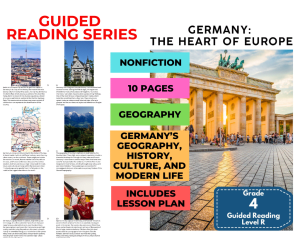
Germany: The Heart of Europe: Guided Reading Level R with Lesson Plan
ELA, Resources for Teachers, Reading Comprehension, Reading, Science, Geography, Social Studies, History, Earth and Environmental Sciences, Technology, Grade 3, 4, 5, Worksheets & Printables, Worksheets, Teacher Tools, Centers, Activities, Literacy Readers, Quizzes, Quizzes and Tests, Assessments, Lesson Plans
This Germany: The Heart of Europe (level r) guided reading book with lesson plan includes: Guided Reading Color Label (front cover x1) This is a quick way to match the book’s demands to what students can generally handle.. The overall goal is to use the level/color to pick books for several smaller groups. To qualify for a certain level, a student is expected to read a book from that level with about 90–94% accuracy. If a student is consistently accurate and understands, move up a level. If the student is struggling at that level, drop down and add more support. Each student will improve at completely different rates, but it is generally one of the best ways to check progress across the class. DOWNLOAD THE CATALOG TO VIEW ALL GUIDED READING BOOKS AVAILABLE (SORTED LEVELS A-Z) Pre-Reading Question (x1) Teacher asks the prompt aloud, can be while showing the cover or first page. Students share what they already know, or make educated guesses from the cover. Prompt them to use the target vocabulary. Write some of their responses on the board to look back at during the reading. Vocabulary Words (x5) Introduce the five words, best doing it one at a time. Start by saying it, while students repeat and then see if anyone knows what it means before reading further. Read through the meaning and try to briefly connect each word to a picture or gesture so it’s meaningful. Ask students to flip through the book pages and point to where they see each of the vocabulary words. While reading the book pause upon coming across one of the vocab words or read the sentence twice to make sure students understand the word has appeared. Optional: Ask students to raise hands whenever they see/hear one of the new words. Guided Reading Pages (x10) Check the book snapshot (below) for: primary topic - do you need to prep extra reading or intro materials on this? what is taught best - decide on 1-2 bullets to focus on, use the prompt or words provided here for best results. learning goals - what you are checking for students to be able to do after the session, elicit answers using prompts or words provided. key vocabulary (see section above). questions overview - so you know what is coming up and if you need to prep extra materials to assist understanding. Run the lesson You may have already looked at a few of the pages together, but you can show them some of the pictures again first to set meaning. Depending on how much time you have and how familiar your students are with guided reading class, you may want to read the book aloud first with the group first. Students whisper or partner read, while you listen in. If time, do it as a group, one student reading a page each. Use the guided page’s prompts to coach: “Check the picture / does it make sense?” “Point under the words / try the first sound” “Reread the sentence smoothly”. Try to focus more on one student per session (rotating every time), so you can work out if they are ready to move up or need to move down a level. Comprehension Questions (back cover x3) This is your way to check that students didn’t just say the words, but actually understood the text. First, let students answer by pointing to the page/picture and saying a short sentence. After any answer, follow with: “Show me where you found that in the text.” In bigger groups, have partners answer first (10–20 seconds), then call on 2–3 students to share. Differentiation tips: Emerging speakers/struggling readers: oral + pointing On-level: oral in a full sentence Higher: one written sentence or draw + label Book Snapshot Title: Germany: The Heart of Europe Genre: Nonfiction Subject: Social Studies (Geography/Culture/History) Primary Topic: Germany’s geography, history, culture, and modern life Estimated Guided Reading Level (A–Z): R What This Book Teaches Best Germany’s central location in Europe and how that makes it a crossroads for trade, travel, and cultural exchange. Physical geography and waterways , including the Bavarian Alps and the Rhine River’s role in transportation. History meeting modern life through Berlin’s past division (Berlin Wall) and the Brandenburg Gate as a symbol of reunification. Cultural traditions , including long-held festivals, music (Bach and Beethoven), and traditional clothing like lederhosen and dirndls. Modern strengths and priorities , such as engineering/technology, renewable energy, public transportation, and environmental conservation. Learning Goals Students will describe where Germany is located in Europe and explain why its location matters in the text. Students will identify major physical features of Germany (plains, mountains, or the Bavarian Alps) using details from the text. Students will explain why the text says rivers like the Rhine are important for moving goods between cities. Students will describe Berlin as the capital and explain one way the text shows history and modern life together there. Students will describe what the text says about castles from the Middle Ages and what they are used for today. Students will identify examples of Germany today (technology/engineering, renewable energy, conservation, education, or democracy) using text evidence. Key Vocabulary From the Text crossroads — central meeting place where routes and people connect. metropolis — a very large, busy city. reunification — joining back together after being separated. renewable — energy source replaced naturally, like wind or sun. conservation — protecting nature so it stays healthy for the future. Discussion Prompts Pre-reading question: What kinds of facts do you think a book about Germany might teach you? Comprehension questions: Why does the text say Germany is a major crossroads within the European Union? Comprehension questions: What does the text say the Brandenburg Gate represents today? Comprehension questions: What is one way the text says Germany works to protect the climate? Printing Tips 1. Best Printing Method (Recommended) “Booklet” Printing (Best if Available) If your printer or PDF viewer supports Booklet Printing , use this. Settings to use: Print mode: Booklet Paper size: Letter or A4 (either works) Orientation: Landscape Print on both sides: Yes Flip on: Short edge Scaling: Fit to printable area Booklet subset: First test: Front sides only Then: Back sides only This will automatically: Pair pages correctly Put the cover on the outside Align everything for folding After printing, fold in half and staple along the spine . 2. If “Booklet” Printing Is NOT Available You can still print this correctly with manual duplex printing . Step-by-step: Open the PDF. Choose Print . Set: Orientation: Landscape Pages per sheet: 1 Print on both sides: Yes Flip on: Short edge Print all pages . Because each PDF page already contains two facing book pages, the result will still fold cleanly into a book. Thousands of Cored Education products are included with your TeachSimple membership. Download links and encyclopedia index available here.
Author Cored Education
Rating
Tags Reading Comprehension, Reading Passages, Reading, Guided Reading, Guided Reading Lesson Plan, Guided Reading Activity, Pre-reading, Social Studies, Geography, History
Prevention, Recycling & Conservation: Recycling Gr. 5-8
Science, Earth and Environmental Sciences, Environmental Science, Grade 5, 6, 7, 8, Teacher Tools, Lesson Plans
Prevention, Recycling & Conservation: Recycling Gr. 5-8 Prevention, Recycling & Conservation: Recycling Gr. 5-8 is an outstanding educational tool that tackles the intricate subjects of prevention, recycling, and conservation in a way comprehendible for students in grades 5 through 8. The resource's intelligently designed layout simplifies these topics by addressing key questions such as: What is conservation? How do natural resources differ from renewable and non-renewable ones? A focus on reducing landfill waste A prominent theme featured in this learning resource addresses minimising landfill waste. Progressive composting techniques are clearly discussed to provide learners with insights into how organic matter decomposes over time. This information fosters their understanding of ecologically sustainable living while encouraging them to become proactive solution-seekers. Navigating the pollution problem The serious issue of pollution is carefully examined, unveiling its profound effects on freshwater sources and atmospheric conditions. Through this interactive exploration, students will gain an awareness of crucial environmental challenges such as smog formation, ozone layer erosion and the typical greenhouse gas emissions resulting from burning fossil fuels. The Unique Selling Proposition of Prevention, Recycling & Conservation: Recycling Gr. 5-8 This resource also stands apart due to its emphasis on inventive responses to existing environmental issues - teaching concepts such as using alternative energy sources or pursuing zero-waste goals whilst inspiring students towards a greener lifestyle. Inclusive Teaching Aid components - User-ready reading passages ideal for group or private study sessions - Pupil activities to further challenge learners - Full-colour pocket-sized information posters providing immediate reference points to struggling learners when necessary All content within this product is aligned perfectly with your State Standards and strictly follows Bloom's Taxonomy recommendations, ensuring quality educational material that supports effective teaching. This resource caters specifically to science-based curriculums, particularly under environmental science. Documents are conveniently packaged in PDF format for hassle-free digital access. Final Thoughts on Prevention, Recycling & Conservation: Recycling Gr. 5-8 Prevention, Recycling & Conservation: Recycling Gr. 5-8 proves itself as an indispensable addition to a teacher's toolkit regardless of their teaching platform (public school or homeschooling). It symbolises the perfect balance between informative substance and careful design; built with the aim of making education engaging and meaningful!
Author Classroom Complete Press
Tags PDF
Energy: Mechanical Energy
Science, Physics, Common Core, Grade 5, 6, 7, 8, Teacher Tools, Lesson Plans
Energy: Mechanical Energy - An Indispensable Educational Resource Made specifically for students in the middle school grades 5 through 8, this guide dives deep into the concept of mechanical energy, expanding on the simple definition of "the ability to do work". The designed content and format make it accessible and easy to grasp. Content and Activities This comprehensive PDF contains various features: Fascinating reading passages: Loaded with vital information that simplifies complex energy concepts. Energetic student activities: These tasks keeps students actively engaged, promoting effective learning. Mindfully color-coded mini posters: These visually stimulating aids reinforce knowledge acquisition. Pedagogical Compatibility A distinguishing feature of this educational tool is its compatibility with both, common core state standards as well as Bloom's Taxonomy. Moreover, it supports STEM initiatives adding to its versatility far beyond physics -based subjects within science realm. In-Depth Analysis of Energy Concepts The teaching kit provides an incisive look into various forms of potential energy while also explaining how energy moves and transforms over time. These pivotal concepts unlock the mysteries surrounding energy making science sessions more engrossing than ever before! A Compact Package Full Of Opportunities This 27-page compact package offers potentially unlimited learning opportunities regarding one quintessential topic - Energy! Careful attention is given to relevant details allowing for intricate scientific procedures to be made understandable! An invaluable asset surely appreciated by dedicated educators far and wide.
Author Classroom Complete Press
Tags Sound Energy, Physics, Science Lesson, Reading Passage, Crossword Puzzles