



3,923 products added recently
Page 95 - Science Lesson Plan Template
Enhance your science instruction with a flexible lesson plan template designed for educators. This tool helps you structure objectives, materials, procedures, and assessments efficiently. Use it to create organized and impactful science lessons that cater to your students' needs.

 Show filters

I WONDER - Do Walruses Have Predators | Animated Video Lesson
STEM, Animals, Life Sciences, Science, Biology, Grade 1, 2, 3, 4, 5, 6, 7, 8, Lesson Plans, Teacher Tools
Video Introduction Animal kingdoms are full of fascinating wonders to learn. This video is designed for the students to learn more about animals in different countries. I WONDER - Do Walruses Have Predators | Animated Video Lesson Do you like animals? what is your favorite one? Do you own a pet? If yes, tell us more about it, like what its name? And what do you like most about it? What are the animal kingdoms? Can you write down the characteristics of each animal class like mammals, birds, reptiles, amphibian, fish and mollusks. Do you know that some animals can sing, can you name any of them? What is the largest and the smallest mammal in the world? What is the largest and the smallest bird in the world? What is the largest and the smallest fish in the world? I WONDER - Do Walruses Have Predators | Animated Video Lesson The video is perfect for encouraging the researching skills for the students, while learning more about these fantastic animals. I WONDER - Do Walruses Have Predators | Animated Video Lesson This friendly designed video is suitable for students at school, homeschooling, and as a group activity. Format Available in MP4 format.
Author Educational Voice
Tags Do Walruses Have Predators, Do Walruses Have Predators Video, Walruses Predators, Walruses Predators Facts, Walruses Predators Facts For Kids, Walruses Predators Video, Walruses Predators Video For Kids

I WONDER - When Did The Allosaurus Roam The Earth | Animated Video
History: Ancient, History, Social Studies, History: World, Animals, Life Sciences, Science, Grade 4, 5, 6, 7, 8, 9, 10, Lesson Plans, Teacher Tools
Video Introduction An amazing video designed for the students to learn more about dinosaurs in different countries. I WONDER - When Did The Allosaurus Roam The Earth | Animated Video Lesson Do you like dinosaurs? what is your favorite one? Do you own a pet? If yes, tell us more about it, like what its name? And what do you like most about it? Do you think that your pet has been evolved from a dinosaur? Can you write down the characteristics of your favourite dinosaur like it's shape, their rivals, where did it use to live and what was their favourite food? What is the largest and the smallest dinosaur that ever found? Why is the T-rex is so famous? Have you ever read any interesting facts about it? Can you name any of the carnivores or herbivores dinosaurs? I WONDER - When Did The Allosaurus Roam The Earth | Animated Video Lesson The video is perfect for encouraging the researching skills for the students, while learning more about dinosaurs. I WONDER - When Did The Allosaurus Roam The Earth | Animated Video Lesson This friendly designed video is suitable for students at school, homeschooling, and as a group activity. Format Available in MP4 format.
Author Educational Voice
Rating
Tags When Did The Allosaurus Roam The Earth, When Did The Allosaurus Roam The Earth Video, Allosaurus, Allosaurus Facts, Allosaurus Video, Allosaurus Facts For Kids, Allosaurus Video For Kids, Dinosaur
I WONDER - How Do Pigs Stay Cool | Animated Video Lesson
Animals, Life Sciences, Science, Grade 3, 4, 5, 6, 7, 8, 9, Lesson Plans, Teacher Tools
Video Introduction Animal kingdoms are full of fascinating wonders to learn. This video is designed for the students to learn more about animals in different countries. I WONDER - How Do Pigs Stay Cool | Animated Video Lesson Pets are really great companions for humans. Have you ever had a pet at your house? If yes, tell us more about it. Do you know how many types of birds do we have on Earth? Can you name some of these types? Can you think of some characteristics that mammals have and why they are different from the other types of animals? Do you think humans are mammals? I WONDER - How Do Pigs Stay Cool | Animated Video Lesson The video is perfect for encouraging the researching skills for the students, while learning more about these fantastic animals. I WONDER - How Do Pigs Stay Cool | Animated Video Lesson This friendly designed video is suitable for students at school, homeschooling, and as a group activity. Format Available in MP4 format.
Author Educational Voice
Rating
Tags How Do Pigs Stay Cool, Pigs, Pigs Facts, Pigs Video, Pigs Facts For Kids, Pigs Video For Kids, Pigs Stay Cool Tricks, Pig, Pig Facts, Pig Video

Reducing Your Community's Carbon Footprint: Climate is Changing, and So Must We Gr. 5-8
Science, Earth and Environmental Sciences, Environmental Science, Grade 5, 6, 7, 8, Teacher Tools, Lesson Plans
Reducing Your Community's Carbon Footprint: Climate is Changing, and So Must We Gr. 5-8 An engaging teaching resource for educators aimed at offering in-depth knowledge about the impact of global climate change on communities and habitats. Suitable for students from Grade 5 to Grade 8, under the subject of Environmental Science. Climate is Changing, and So Must We Gr. 5-8 Subsection This section focuses on enhancing the understanding of our changing world by identifying cause-and-effect relationships between daily human activities and major environmental issues. Cuba’s transformation case study provides students a practical illustration of how societies can tackle climate change by reducing their carbon footprint. The lessons explore heat island effect caused by cities modification on local climates Learning Strategies Incorporated In The Resource Whole group discussions: Focusing on distinct living environments' influence on commuters' travel footprints. Small group brainstorming sessions: Imagining new lives for recycled goods with peers. Individual assignments: Researching green cities across the globe independently. These methodologies create various avenues rendering enlightening yet enjoyable lessons. This resource emphasizes using realistic cases to incite genuine interest in environmental sciences amongst pupils while inspiring development sustainable solutions for their communities. The development as a PDF file type product ensures basic compatibility with existing technology platforms making its usage flexible, including but not limited to homeschooling arrangements. In addition to theoretical learning material, this resource also includes: - Graphic organizers - Carbon footprint calculator - Crossword puzzles - Comprehension quizzes These additional materials facilitate effective assessment mechanisms while maintaining high levels of student engagement. To facilitate the teachers, an answer key is also provided for convenience during grading processes.
Author Classroom Complete Press
Tags PDF

Global Warming: Effects - Digital Lesson Plan Gr. 5-8 - FLASH-MAC
Science, Earth and Environmental Sciences, Environmental Science, Grade 3, 4, 5, 6, 7, 8, Teacher Tools, Lesson Plans
Global Warming: Effects - Digital Lesson Plan Gr. 5-8 - FLASH-MAC A comprehensive educational resource that melds technology with the pivotal subject of environmental science. Crafted intentionally for Grades 5-8, this resource equips educators to deliver an immersive and interactive digital lesson plan spanning across 80 screen-pages. The Intention: To delve thoroughly into the crucial topic of Global Warming and its varied effects on the environment, human life, economies, wildlife health and more. The flexible design allows instructors to incorporate this material in a whole group setting or as small group exercises; it can even be assigned as enriching homework activities. Packed With Rich Material: Including reading passages and accompanying before-and-after reading interactive tasks. An engaging overview of how Global Warming diverges from natural climate change. Essays giving insight into how humanity's evolution has hinged on a steady climate pattern over centuries. Focusing On Pertinent Issues: Rising sea levels, Glacier retreats, Changing agricultural patterns, . A bridge between theoretical learning with tangible practical examples guiding learners through pathways relevant science education should explore in modern classrooms. It provides both educators and students equally beneficial insights into environmental challenges confronted today and how to navigate such topical issues. Note: Contains one product file devised specifically for software compatible with Mac operating system which adds convenience for users comfortable working in this environment. In addition to textual content there are also interactive activities like crosswords and word search games designed for reinforcing learning outcomes; exceptional supporting video & audio add multimedia enrichment enhancing understanding of complex subjects. A unique feature is test prep content that allows teachers to prepare students effectively for evaluations related not only to current topics but also aligned with State Standards built around Bloom's Taxonomy. The hallmark of this engaging digital lesson plan is the practical approach which bridges vivid theoretical learning with tangible practical examples guiding learners through pathways relevant science education should explore in modern classrooms. It provides both educators and students equally beneficial insights into environmental challenges confronted today and how to navigate such topical issues. Altogether, it presents a comprehensive teaching toolkit that addresses Global Warming’s effects holistically.
Author Classroom Complete Press
Tags Software (Mac)
I WONDER - How Big Was The Allosaurus | Animated Video Lesson
History: Ancient, History, Social Studies, History: World, Animals, Life Sciences, Science, Grade 4, 5, 6, 7, 8, 9, 10, Lesson Plans, Teacher Tools
Video Introduction An amazing video designed for the students to learn more about dinosaurs in different countries. I WONDER - How Big Was The Allosaurus | Animated Video Lesson Do you like dinosaurs? what is your favorite one? Do you own a pet? If yes, tell us more about it, like what its name? And what do you like most about it? Do you think that your pet has been evolved from a dinosaur? Can you write down the characteristics of your favourite dinosaur like it's shape, their rivals, where did it use to live and what was their favourite food? What is the largest and the smallest dinosaur that ever found? Why is the T-rex is so famous? Have you ever read any interesting facts about it? Can you name any of the carnivores or herbivores dinosaurs? I WONDER - How Big Was The Allosaurus | Animated Video Lesson The video is perfect for encouraging the researching skills for the students, while learning more about dinosaurs. I WONDER - How Big Was The Allosaurus | Animated Video Lesson This friendly designed video is suitable for students at school, homeschooling, and as a group activity. Format Available in MP4 format.
Author Educational Voice
Rating
Tags How Big Was The Allosaurus, How Big Was The Allosaurus Video, Allosaurus, Allosaurus Facts, Allosaurus Facts For Kids, Allosaurus Video, Allosaurus Video For Kids, Dinosaur, Dinosaurs
I WONDER - What Are The Different Parts Of The Colon | Animated Video
Human Body, Life Sciences, Science, Biology, STEM, Grade 3, 4, 5, 6, 7, 8, 9, Lesson Plans, Teacher Tools
Video Overview The human body is full of fascinating wonders to learn. This video is created to help the students recognize the anatomy and the job of the human body. I WONDER - What Are The Different Parts Of The Colon | Animated Video Lesson Every part and organ in our human body is vital so let's see how important they are. Have you ever imagined how we look like if we didn't have a skeleton? Did you know that because we have our amazing muscles we can stand! Do you know how many teeth do we have? Have you ever wondered about the food journey inside our body? Can you name all the glands in our body? Why do we have skin? Our nervous system is really good at sending signals. Can you tell us more about it? Are you really good at Mathematics, painting, or any other thing? You should really thank your brain about it! The famous five senses are really doing a great work? Can you explain how every sense works? I WONDER - What Are The Different Parts Of The Colon | Animated Video Lesson The video is perfect for encouraging the researching skills for the students, while learning more about our fantastic human body. I WONDER - What Are The Different Parts Of The Colon | Animated Video Lesson This friendly designed video is suitable for students at school, homeschooling, and as a group activity. Format Available in MP4 format.
Author Educational Voice
Tags What Are The Different Parts Of The Colon, What Are The Different Parts Of The Colon Video, Different Parts Of The Colon, Different Parts Of The Colon Facts, Different Parts Of The Colon Facts For Kids, Different Parts Of The Colon Video

Motion - Digital Lesson Plan Gr. 5-8 | MAC Software
Science, Physics, Grade 3, 4, 5, 6, 7, 8, Teacher Tools, Lesson Plans
Motion - Digital Lesson Plan Gr. 5-8 | MAC Software Description This educational resource is designed specifically for grades 5 through 8 educators in the public school system and homeschool environment. It simplifies the complex science topic of motion for young learners. Interactive and Comprehensive The software spans across 80 screen-pages full of dynamic information, to enhance students' comprehension skills, making learning more interactive and immersive. Educational Features and Components Reading passages integrated with interactive activities. Examination-based preparation aids. Crossword puzzles for vocabulary enhancement. Mind drills via word search exercises. Audiological-Visual association via audio-video content enrichment. Including Students Participation in Learning Process The lesson plan includes measurement tools which allow students to graph motion themselves, enabling tangible association between theory and practice. In a downloadable zip file format, this software goes beyond teaching physics; it provides a profound, enriching learning experience. Conforms to state educational standards considering Bloom's Taxonomy- further emphasizing understanding over rote memorization. This software can be used in whole group discussions as well as individual homework tasks; it's flexible to adapt as per your unique teaching style! Want an exciting platform that makes the learning experience rich? Choose the Motion !
Author Classroom Complete Press
Tags Digital Lesson Plan, Science Lesson Plan, Physics Interactive Activity, Motion Lesson Plan, Science Passage

Unplugged Coding Task Cards | 30 Debugging WarmUps Grades 3-5 |No Tech
Computer Science, Technology, Science, Winter, Seasons, Holiday & Seasonal, Grade 3, 4, 5, Centers, Activities, Lesson Plans, Teacher Tools, Task Cards, Worksheets & Printables
Find the Bug: Debugging Warm-Ups | Grades 3–5 Computer Science Find the Bug gives Grades 3–5 students engaging, no-tech debugging practice without requiring a specific coding platform. These debugging task cards help students learn to trace, test, explain, and fix broken pseudocode. What’s Included This resource includes six separate PDF files : Teacher Guide – 6 pages Teacher directions and implementation ideas Teacher questioning script Standards alignment Scope and sequence Two-week pacing option Student Reference – 2 pages How to read a bug card Seven-step debugging checklist Read → Trace → Find → Fix → Test debugging cycle Recording Pages – 2 pages Student response sheets Bug type identification Fixed-line recording Debugging progress tracker Bug Cards – 30 pages 30 ready-to-use debugging task cards Six different bug types Three difficulty levels One card per page Answer Key – 10 pages Correct fixes for every card Misconception behind each bug Helpful teacher conferencing notes The six bug types include Sequence, Loop Counting, Loop Conditions, Conditionals, Variables, and Placement . How It Works in the Classroom Use these debugging task cards in flexible ways throughout your computer science instruction. ⭐ Bell-Ringers Project or print one card. Students work independently or with partners. A six-minute work period fits easily into a warm-up routine. One card per day provides approximately six weeks of practice. ⭐ Stations Print and laminate the cards. Add the student response sheet. Students solve cards and record their thinking. Five cards provide a manageable station rotation. ⭐ Sub Plans Provide the cards, checklist, response sheet, and answer key. No student login or device is required. No prior coding platform knowledge is needed. Introduce the cards through discovery. Students encounter concepts by watching code break. Standards & Learning Goals Students practice: Testing and debugging programs or algorithms. Identifying and explaining coding errors. Tracing code step by step. Modifying existing algorithms. Testing boundary cases. Recognizing patterns in repeated reasoning. Explaining why a solution works. The resource aligns with CSTA 1B-AP-10, 1B-AP-11, 1B-AP-12, 1B-AP-15, and 2-AP-17 . It also supports CCSS.MATH.PRACTICE.MP6, MP8, and CCSS.ELA-LITERACY.W.4.2 . Students also build practical debugging habits through the seven-step checklist. These include tracing values, checking starting values, checking stop conditions, reviewing order, checking indentation, and testing edges. Why Teachers Love It ⭐ Misconception-focused answer key The answer key explains the misconception behind each bug. This gives teachers better language for student conferences. ⭐ No devices required Students can practice computational thinking without opening a coding platform. ⭐ Low-prep implementation Print the cards and start using them as warm-ups, stations, or sub plans. ⭐ Built-in differentiation Cards progress across three difficulty levels. ⭐ Focuses on thinking, not guessing Students must find the bug, explain the problem, and write a fix. ⭐ Student reflection is included The debugging tracker helps students see which bug types they solve most successfully. Make debugging practice easier with a ready-to-use computer science resource for Grades 3–5 . Use Find the Bug for warm-ups, stations, targeted reteaching, or substitute plans. Give students repeated opportunities to trace, test, explain, and repair code. Download the resource and give your students a practical way to build stronger debugging habits! 💛
Author Bright Classroom Ideas Marketplace
Rating
Tags Code, Coding, Unplugged, No Tech, Debug, Debugging, Technology, Computer
I WONDER - How Useful Are Lasers | Animated Video Lesson
Physics, Science, Grade 6, 7, 8, 9, 10, 11, 12, Lesson Plans, Teacher Tools
Video Introduction An amazing video designed for the students to learn more about STEM. I WONDER - How Useful Are Lasers | Animated Video Lesson Do you like STEM subjects? what is your favorite one? Have you ever tried to plant a seed? If yes, tell us more about it. Or have you ever tried to invent something? If yes, tell us more about it. And how do you think it will help us? Have you ever seen a microorganism under a microscope? What was it? And how it looked like? Mathematics is a marvelous subject. Let' sharpen our brains and solve some equations. Do you like timetable tricks? What is your favorite one? Do you know how to code? Have you ever created an app or a game before? If yes, how was it like? I WONDER - How Useful Are Lasers | Animated Video Lesson The video is perfect for encouraging the researching skills for the students, while learning more about this fantastic topic. I WONDER - How Useful Are Lasers | Animated Video Lesson This friendly designed video is suitable for students at school, homeschooling, and as a group activity. Format Available in MP4 format.
Author Educational Voice
Tags How Useful Are Lasers, How Useful Are Lasers Video, Lasers, Laser, Lasers Facts, Lasers Facts For Kids, Lasers Video, Lasers Video For Kids, Physics, Physics Video

I WONDER - How Smart Are Octopi | Animated Video Lesson
STEM, Biology, Life Sciences, Science, Animals, Grade 1, 2, 3, 4, 5, 6, 7, 8, Lesson Plans, Teacher Tools
Video Introduction Animal kingdoms are full of fascinating wonders to learn. This video is designed for the students to learn more about animals in different countries. I WONDER - How Smart Are Octopi | Animated Video Lesson Do you like animals? what is your favorite one? Do you own a pet? If yes, tell us more about it, like what its name? And what do you like most about it? What are the animal kingdoms? Can you write down the characteristics of each animal class like mammals, birds, reptiles, amphibian, fish and mollusks. Do you know that some animals can sing, can you name any of them? What is the largest and the smallest mammal in the world? What is the largest and the smallest bird in the world? What is the largest and the smallest fish in the world? I WONDER - How Smart Are Octopi | Animated Video Lesson The video is perfect for encouraging the researching skills for the students, while learning more about these fantastic animals. I WONDER - How Smart Are Octopi | Animated Video Lesson This friendly designed video is suitable for students at school, homeschooling, and as a group activity. Format Available in MP4 format.
Author Educational Voice
Tags How Smart Are Octopi, How Smart Are Octopi Video, Octopi, Octopi Facts, Octopi Facts For Kids, Octopi Video, Octopi Video For Kids, Smart Octopi, Smart Octopus, Smart Octopi Video

I WONDER - What Systems Use JAVA | Animated Video Lesson
STEM, Science, Computer Science, Technology, Grade 6, 7, 8, 9, 10, 11, 12, Lesson Plans, Teacher Tools
Video Introduction An amazing video designed for the students to learn more about STEM. I WONDER - What Systems Use JAVA | Animated Video Lesson Do you like STEM subjects? what is your favorite one? Have you ever tried to plant a seed? If yes, tell us more about it. Or have you ever tried to invent something? If yes, tell us more about it. And how do you think it will help us? Have you ever seen a microorganism under a microscope? What was it? And how it looked like? Mathematics is a marvelous subject. Let' sharpen our brains and solve some equations. Do you like timetable tricks? What is your favorite one? Do you know how to code? Have you ever created an app or a game before? If yes, how was it like? I WONDER - What Systems Use JAVA | Animated Video Lesson The video is perfect for encouraging the researching skills for the students, while learning more about this fantastic topic. I WONDER - What Systems Use JAVA | Animated Video Lesson This friendly designed video is suitable for students at school, homeschooling, and as a group activity. Format Available in MP4 format.
Author Educational Voice
Tags What Systems Use JAVA, What Systems Use JAVA Video, JAVA Systems, JAVA Systems Facts, JAVA Systems Facts For Kids, JAVA Systems Video, JAVA Systems Video For Kids, JAVA, JAVA Facts

I WONDER - What Animals Live In Swamps | Animated Video Lesson
STEM, Animals, Life Sciences, Science, Biology, Grade 1, 2, 3, 4, 5, 6, 7, 8, Lesson Plans, Teacher Tools
Video Introduction Animal kingdoms are full of fascinating wonders to learn. This video is designed for the students to learn more about animals in different countries. I WONDER - What Animals Live In Swamps | Animated Video Lesson Do you like animals? what is your favorite one? Do you own a pet? If yes, tell us more about it, like what its name? And what do you like most about it? What are the animal kingdoms? Can you write down the characteristics of each animal class like mammals, birds, reptiles, amphibian, fish and mollusks. Do you know that some animals can sing, can you name any of them? What is the largest and the smallest mammal in the world? What is the largest and the smallest bird in the world? What is the largest and the smallest fish in the world? I WONDER - What Animals Live In Swamps | Animated Video Lesson The video is perfect for encouraging the researching skills for the students, while learning more about these fantastic animals. I WONDER - What Animals Live In Swamps | Animated Video Lesson This friendly designed video is suitable for students at school, homeschooling, and as a group activity. Format Available in MP4 format.
Author Educational Voice
Tags What Animals Live In Swamps, What Animals Live In Swamps Video, Animals That Live In Swamps, Animals That Live In Swamps Facts, Animals That Live In Swamps Facts For Kids, Animals That Live In Swamps Video
I WONDER - How Do Flowering Plants Reproduce | Animated Video Lesson
Nature & Plants, Life Sciences, Science, Biology, Grade 6, 7, 8, 9, 10, 11, 12, Lesson Plans, Teacher Tools
Video Introduction An amazing video designed for the students to learn more about STEM. I WONDER - How Do Flowering Plants Reproduce | Animated Video Lesson Do you like STEM subjects? what is your favorite one? Have you ever tried to plant a seed? If yes, tell us more about it. Or have you ever tried to invent something? If yes, tell us more about it. And how do you think it will help us? Have you ever seen a microorganism under a microscope? What was it? And how it looked like? Mathematics is a marvelous subject. Let' sharpen our brains and solve some equations. Do you like timetable tricks? What is your favorite one? Do you know how to code? Have you ever created an app or a game before? If yes, how was it like? I WONDER - How Do Flowering Plants Reproduce | Animated Video Lesson The video is perfect for encouraging the researching skills for the students, while learning more about this fantastic topic. I WONDER - How Do Flowering Plants Reproduce | Animated Video Lesson This friendly designed video is suitable for students at school, homeschooling, and as a group activity. Format Available in MP4 format.
Author Educational Voice
Tags How Do Flowering Plants Reproduce, How Do Flowering Plants Reproduce Video, Flowering Plants, Flowering Plants Facts, Flowering Plants Video, Flowering Plants Facts For Kids, Plants Reproduction

I WONDER - Why Is Saturn Special | Animated Video Lesson
Space, Earth and Environmental Sciences, Science, Grade 6, 7, 8, 9, 10, 11, 12, Lesson Plans, Teacher Tools
Video Introduction An amazing video designed for the students to learn more about space facts. I WONDER - Why Is Saturn Special | Animated Video Lesson Do you like reading about space? If yes, what is your favorite topic? What do you know about our solar system? What is the smallest planet in our solar system? What is the biggest planet in our solar system? What is the hottest planet in our solar system? And what is the coldest one? Do you think there are aliens? If yes, what do you think they look like? What do they eat and how they speak to each other? Where do they live? What is a galaxy? And what is a milky way? Have you recently saw a shooting star? If yes, tell us more about it, like when did it happen and where? What is a blackhole? Can a blackhole gets bigger by time? Do you like counting the stars? What do you think a star is made of? I WONDER - Why Is Saturn Special | Animated Video Lesson The video is perfect for encouraging the researching skills for the students, while learning more about the fantastic space. I WONDER - Why Is Saturn Special | Animated Video Lesson This friendly designed video is suitable for students at school, homeschooling, and as a group activity. Format Available in MP4 format.
Author Educational Voice
Tags Why Is Saturn Special, Why Is Saturn Special Video, Saturn, Saturn Facts, Saturn Facts For Kids, Saturn Video, Saturn Video For Kids, Planet, Planets Video, Space

Lesson 1.5 - Graphing
Science, Chemistry, Physics, Grade 6, 7, 8, 9, 10, 11, 12, Lesson Plans, Teacher Tools
Lesson 1.5 - Graphing: An All-Inclusive Teaching Resource The Lesson 1.5 - Graphing is an comprehensive teaching resource designed to simplify the instruction process for teachers, especially those teaching introductory science lessons. The unit covers a wide range of relevant topics and can be effectively utilized by public school teachers and home-schoolers. Main Components: The Metric System: The package offers (A) version for students to fill out information while simultaneously providing a completed (B) version for absent learners. Measurement Labs: Allowing students gather measurements of assorted classroom. Diverse Reading Materials:Different lexile levels including one translated into Spanish are included in this resource. Coversion Lab Practices:Promote independent learning through practical conversion experiences. This complete resource incorporates clear PowerPoint notes covering each section, from discussing steps in the scientific method to analyzing types of variables within experiments . Alongside traditional learning materials, interactive activities such as games and whiteboard practices aide in reinforcing key concepts learned during regular study sessions. Critical Elements of Graphing Covered: Presentation of different parts of graph, Showcasing best fit line relationships, In addition to content material, strategic assets such as Binder Divider – Unit 1 highlights the importance organizational skills while Study Guide - Unit 1 supports collaborative learning experiences among classmates making this product invaluable tool that amplifies scientific learning in classrooms.
Author Integrated Chemistry and Physics
Tags Measurement, Metric System, Labs, Reading Materials, Conversions
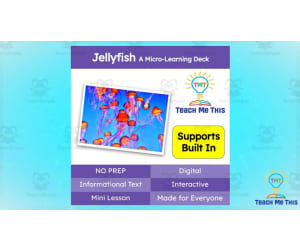
Jellyfish | Interactive Science Lesson | Micro-Learning Deck
Science, Life Sciences, Animals, Grade 5, 6, 7, 8, Teacher Tools, Lesson Plans
Engage your middle school science students with this informative slideshow on jellyfish. This digital micro-learning deck acts as a supplementary resource to enhance your existing zoology curriculum. Students will watch a video lesson explaining what jellyfish are, how they function, and where they live. An accompanying reading passage, close reading activity, and quick write prompt allow students to strengthen literacy skills while learning about science. Implement this versatile resource in a variety of ways - use the deck for whole class instruction, small group remediation, or as an independent homework assignment. With informational text, informal assessments , and engaging visuals, this supplementary resource will capture student interest in your science lessons on zoology.
Author Teach Me This
Tags Vocabulary, Comprehension, Science Lesson, Interactive, Digital
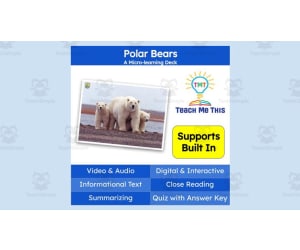
Polar Bear Facts | Interactive Science Lesson | Micro-Learning Deck
Science, Life Sciences, Animals, Grade 6, 7, 8, 9, Teacher Tools, Lesson Plans
Polar Bear Facts | Interactive Lesson for Science This science resource teaches students engaging facts about the polar bear through an interactive digital slideshow. Students will watch an informative video, read a passage with audio support, annotate the text to demonstrate comprehension, and complete a quick write activity to apply their learning. The multimedia components cater to various learning styles while assessing understanding. Teachers can utilize this versatile resource in whole group instruction to introduce the topic or assign it for independent student work. The self-paced nature allows for differentiated instruction or homework. Overall, these interactive slides foster student engagement with reading, writing, listening, and viewing activities to master polar bear facts. This resource works well for grades 6-9 science classes studying zoology.
Author Teach Me This
Tags Polar Bears, Animal Facts, Zoology, Animal Lessons, Interactive Science
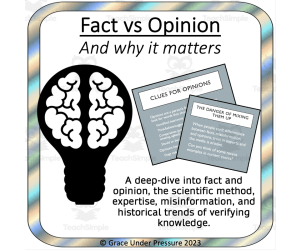
Fact vs. Opinion, Expertise, Scientific Method: A Deep-Dive into Critical Thinking
Social Studies, Special Resources, History, Psychology, Life Skills, Science, Basic Science, Grade 9, 10, 11, 12, Teacher Tools, Lesson Plans
Fact vs. Opinion, Expertise, Scientific Method: A Deep-Dive into Critical Thinking This editable Powerpoint presentation with 14 slides allows teachers to select how deep a dive to embark on with their class when teaching students about facts and opinions. It includes information on several important critical thinking and media literacy topics that will help students start to become thoughtful learners and members of society: How do you differentiate between facts and opinions? (Includes practice questions and answer key.) How do ideas or hypotheses become facts through the use of the scientific method? Why do we sometimes need to trust experts in different fields and how can we evaluate different sources of information? Links to current events and trends and why presenting misinformation as your opinion can be dangerous. Historical trends in the knowledge sources we have accepted as a society and where we might go from here. How to Use: You can decide how much or how little of this presentation to show your class. You may want to start with the fact and opinions slides early in the year and refer to some of the more complex ideas in another term. You can edit the slides as you see fit for your specific class. After presenting all of the slides, you can have your students write a reflection using the prompts included on the last slide. Grades to Use With: This lesson is designed for high school students in grades 9-12 to help enhance their critical thinking and media literacy skills. It could be used in ELA, Science, or Social Studies classes. What's Included: A total of 14 pages: Title Page Definitions Facts Opinions Practice Questions Grey Areas Measurement Experts Differing Standards for Different Experts Why Does it Matter? Misinformation Brief History of Knowledge Sources Reflection Please note: the information in this presentation is based on an understanding of the scientific method and well-proven facts such as the existence of climate change and the efficacy of vaccines.
Author Grace Under Pressure
Tags Critical Thinking, Fact Vs Opinion, Expertise, Scientific Method, Fact And Opinion, Media Literacy, Science Lesson, Social Studies Lesson, Middle School, Life Skills
I WONDER - Do All Vegetable Grow Underground | Animated Video Lesson
Nature & Plants, Life Sciences, Science, Grade 5, 6, 7, 8, 9, 10, 11, Lesson Plans, Teacher Tools
Video Introduction An amazing activity designed for the students to learn more about STEM. I WONDER - Do All Vegetable Grow Underground | Animated Video Lesson Do you like STEM subjects? what is your favorite one? Have you ever tried to plant a seed? If yes, tell us more about it. Or have you ever tried to invent something? If yes, tell us more about it. And how do you think it will help us? Have you ever seen a microorganism under a microscope? What was it? And how it looked like? Mathematics is a marvelous subject. Let' sharpen our brains and solve some equations. Do you like timetable tricks? What is your favorite one? Do you know how to code? Have you ever created an app or a game before? If yes, how was it like? I WONDER - Do All Vegetable Grow Underground | Animated Video Lesson The video is perfect for encouraging the researching skills for the students, while learning more about this fantastic topic. I WONDER - Do All Vegetable Grow Underground | Animated Video Lesson This friendly designed video is suitable for students at school, homeschooling, and as a group activity. Format Available in MP4 format.
Author Educational Voice
Tags Do All Vegetable Grow Underground, Do All Vegetable Grow Underground Video, Vegetable, Vegetables, Vegetable Facts, Vegetable Facts For Kids, Vegetable Facts Video, Vegetable Video For Kids
I WONDER - What Is A Javan Rhino | Animated Video Lesson
STEM, Animals, Life Sciences, Science, Biology, Grade 1, 2, 3, 4, 5, 6, 7, 8, Lesson Plans, Teacher Tools
Video Introduction Animal kingdoms are full of fascinating wonders to learn. This video is designed for the students to learn more about animals in different countries. I WONDER - What Is A Javan Rhino | Animated Video Lesson Do you like animals? what is your favorite one? Do you own a pet? If yes, tell us more about it, like what its name? And what do you like most about it? What are the animal kingdoms? Can you write down the characteristics of each animal class like mammals, birds, reptiles, amphibian, fish and mollusks. Do you know that some animals can sing, can you name any of them? What is the largest and the smallest mammal in the world? What is the largest and the smallest bird in the world? What is the largest and the smallest fish in the world? I WONDER - What Is A Javan Rhino | Animated Video Lesson The video is perfect for encouraging the researching skills for the students, while learning more about these fantastic animals. I WONDER - What Is A Javan Rhino | Animated Video Lesson This friendly designed video is suitable for students at school, homeschooling, and as a group activity. Format Available in MP4 format.
Author Educational Voice
Tags What Is A Javan Rhino, What Is A Javan Rhino Video, Javan Rhino, Javan Rhino Facts, Javan Rhino Facts For Kids, Javan Rhino Video, Javan Rhino Video For Kids, Rhino, Rhino Video, Rhino Facts

Conservation: Waterway Habitat Resources: How Climate Change Can Affect Aquatic Ecosystems Gr. 5-8
Science, Earth and Environmental Sciences, Environmental Science, Grade 5, 6, 7, 8, Teacher Tools, Lesson Plans
Conservation: Waterway Habitat Resources: How Climate Change Can Affect Aquatic Ecosystems Gr. 5-8 Conservation: Waterway Habitat Resources: How Climate Change Can Affect Aquatic Ecosystems Gr. 5-8 is an educational resource targeted at students from Grade 5 to Grade 8. The primary subjects covered are Science and Environmental Science. This PDF contains 30 print-ready pages, focusing on the impact of human activities on aquatic ecosystems worldwide. It nudges students to play the role of ecologists by understanding the difference between biotic (living) and abiotic (non-living) factors in an ecosystem. To pique student interest in ecology, this resource proposes a host of field activities, including visits to local aquatic habitats for observation or trips to local aquariums for a deep dive into marine life. The topic also delves into the relationship between climate change trends and adaptation difficulties faced by certain aquatic organisms. In addition, it sheds light on the disastrous impact of human activity like increased rate of marine species extinction or pearl formation in so-called 'aquarium dead zones’. Educational Tools Included: The teaching tools included within aim at reinforcing subject matter as well as acting as assessment tools: Graphic organizers—such as crossword puzzles & word searches Comprehension quizzes — includes answer keys at the end-of-chapter In conclusion,'Conservation: Waterway Habitat Resources' not only arms students with vital knowledge about eco-conservation but provides practical steps towards what we can do to reverse the effects of global warming on our water resources. This module forms an excellent resource for group teaching sessions or homework assignments.
Author Classroom Complete Press
Tags Science, Environment, Conservation, Water Habitats, Climate Change
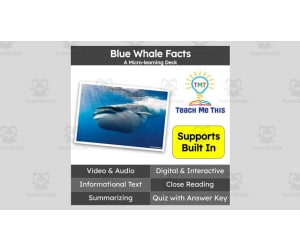
Blue Whale Facts | Interactive Science Lesson | Micro-Learning Deck
Science, Life Sciences, Animals, Grade 5, 6, 7, 8, Teacher Tools, Lesson Plans
This micro-learning deck is the perfect accessory to your Science instruction! This digital slideshow presents Blue Whale Facts. Within this slideshow, you will receive: -Video Lesson -Reading Passage w/ Audio -Close Reading -Quick Write The informational texts included in this resource alongside the informal assessments will keep your students engaged from beginning to end.
Author Teach Me This
Tags Blue Whale Facts, Informational Text, Summarizing, Interactive Science Lesson, Digital Science

Climate Change: Reduction: Masdar City Gr. 5-8
Science, Earth and Environmental Sciences, Environmental Science, Grade 5, 6, 7, 8, Teacher Tools, Lesson Plans
Climate Change: Reduction: Masdar City Gr. 5-8: A comprehensive teaching resource designed for educators. This content-rich material aims to inspire students of grades 5 to 8, with a keen focus on the field of Environmental Science. If your goal as an educator is to spark curiosity in your students about climate change and sustainability, this resource would be an ideal addition to your curriculum. It simplifies complex concepts of climate change through our chapter slice on "Masdar City". This innovative city design helps learners envision strategies for reducing human consumption and output. Learning Extensions: Beyond just learning, students get involved in hands-on tasks like designing their dream car running on alternative fuels! They'll also gain insights into different global transportation options, understanding how transportation choices impact emissions and energy usage. Dive further into environmental issues by studying product life cycles and industrial approaches towards emission reductions. Create their own green city operating solely on clean energy – bringing these abstract concepts close to home. Resource Materials & Formats: The materials consist of interactive activities that cater for multiple learning methods. A crossword puzzle stimulates critical thinking while a comprehension quiz provides instant feedback about student understanding levels. All materials are provided in a ready-to-print PDF format! This teaching resource aligns with Bloom's Taxonomy and STEAM initiatives offering valuable opportunities for us all - including teachers - evaluating our role in combating climate change while illustrating practical reduction methods. Remember, we're shaping tomorrow's decision-makers today so early awareness is key — and this resource makes it possible. Here's where environmental education becomes tangible allowing young scientists comprehend, appreciate, and act – even making their own strides towards an eco-friendly future!
Author Classroom Complete Press
Tags Global Warming, Climate Change, Reading Passage, Science Assessment, Word Search