



3,924 products added recently
Page 99 - Science Lesson Plan Template
Enhance your science instruction with a flexible lesson plan template designed for educators. This tool helps you structure objectives, materials, procedures, and assessments efficiently. Use it to create organized and impactful science lessons that cater to your students' needs.

 Show filters

Penguins | Interactive Science Lesson | Micro-Learning Deck
Science, Life Sciences, Animals, Grade 6, 7, 8, 9, Teacher Tools, Lesson Plans
This micro-learning deck is the perfect accessory to your Science instruction! This digital slideshow presents Penguins. Within this slideshow, you will receive: -Video Lesson -Reading Passage w/ Audio -Close Reading -Quick Write The informational texts included in this resource alongside the informal assessments will keep your students engaged from beginning to end.
Author Teach Me This
Tags Penguins, Interactive, Science, Animal Habitats, Vocabulary

I WONDER - What Is A Triceratops | Animated Video Lesson
Animals, Life Sciences, Science, History, Social Studies, History: Ancient, History: World, Grade 3, 4, 5, 6, 7, 8, 9, Lesson Plans, Teacher Tools
Video Introduction An amazing video designed for the students to learn more about dinosaurs in different countries. I WONDER - What Is A Triceratops | Animated Video Lesson Do you like dinosaurs? what is your favorite one? Do you own a pet? If yes, tell us more about it, like what its name? And what do you like most about it? Do you think that your pet has been evolved from a dinosaur? Can you write down the characteristics of your favourite dinosaur like it's shape, their rivals, where did it use to live and what was their favourite food? What is the largest and the smallest dinosaur that ever found? Why is the T-rex is so famous? Have you ever read any interesting facts about it? Can you name any of the carnivores or herbivores dinosaurs? I WONDER - What Is A Triceratops | Animated Video Lesson The video is perfect for encouraging the researching skills for the students, while learning more about dinosaurs. I WONDER - What Is A Triceratops | Animated Video Lesson This friendly designed video is suitable for students at school, homeschooling, and as a group activity. Format Available in MP4 format.
Author Educational Voice
Rating
Tags What Is A Triceratops, What Is A Triceratops Video, Triceratops, Triceratops Video, Triceratops Facts, Triceratops Facts For Kids, Triceratops Video For Kids, Dinosaur, Dinosaurs, Dinosaurs Video

I WONDER - Why Did The Pteranodon Have A Crest | Animated Video Lesson
History: Ancient, History, Social Studies, History: World, Animals, Life Sciences, Science, Grade 4, 5, 6, 7, 8, 9, 10, Lesson Plans, Teacher Tools
Video Introduction An amazing video designed for the students to learn more about dinosaurs in different countries. I WONDER - Why Did The Pteranodon Have A Crest | Animated Video Lesson Do you like dinosaurs? what is your favorite one? Do you own a pet? If yes, tell us more about it, like what its name? And what do you like most about it? Do you think that your pet has been evolved from a dinosaur? Can you write down the characteristics of your favourite dinosaur like it's shape, their rivals, where did it use to live and what was their favourite food? What is the largest and the smallest dinosaur that ever found? Why is the T-rex is so famous? Have you ever read any interesting facts about it? Can you name any of the carnivores or herbivores dinosaurs? I WONDER - Why Did The Pteranodon Have A Crest | Animated Video Lesson The video is perfect for encouraging the researching skills for the students, while learning more about dinosaurs. I WONDER - Why Did The Pteranodon Have A Crest | Animated Video Lesson This friendly designed video is suitable for students at school, homeschooling, and as a group activity. Format Available in MP4 format.
Author Educational Voice
Rating
Tags Why Did The Pteranodon Have A Crest, Why Did The Pteranodon Have A Crest Video, Pteranodon, Pteranodon Facts, Pteranodon Video, Pteranodon Crest, Pteranodon Crest Video, Pteranodon Crest Facts
I WONDER - What Did The Albertosaurus Eat | Animated Video Lesson
Animals, Life Sciences, Science, History: Ancient, History, Social Studies, History: World, Grade 4, 5, 6, 7, 8, 9, 10, Lesson Plans, Teacher Tools
Video Introduction An amazing video designed for the students to learn more about dinosaurs in different countries. I WONDER - What Did The Albertosaurus Eat | Animated Video Lesson Do you like dinosaurs? what is your favorite one? Do you own a pet? If yes, tell us more about it, like what its name? And what do you like most about it? Do you think that your pet has been evolved from a dinosaur? Can you write down the characteristics of your favourite dinosaur like it's shape, their rivals, where did it use to live and what was their favourite food? What is the largest and the smallest dinosaur that ever found? Why is the T-rex is so famous? Have you ever read any interesting facts about it? Can you name any of the carnivores or herbivores dinosaurs? I WONDER - What Did The Albertosaurus Eat | Animated Video Lesson The video is perfect for encouraging the researching skills for the students, while learning more about dinosaurs. I WONDER - What Did The Albertosaurus Eat | Animated Video Lesson This friendly designed video is suitable for students at school, homeschooling, and as a group activity. Format Available in MP4 format.
Author Educational Voice
Rating
Tags What Did The Albertosaurus Eat, What Did The Albertosaurus Eat Video, Albertosaurus, Albertosaurus Facts, Albertosaurus Video, Albertosaurus Video For Kids, Albertosaurus Facts For Kids, Dinosaur

Global Warming EFFECTS: Climate and Ecosystems - FLASH-MAC
Science, Earth and Environmental Sciences, Environmental Science, Grade 5, 6, 7, 8, Teacher Tools, Lesson Plans
Global Warming EFFECTS: Climate and Ecosystems - FLASH-MAC An exceptional teaching resource, FLASH-MAC caters to both the public school system and homeschooling setups providing a comprehensive outlook on how global warming impacts climate and ecosystems. This tool merges enlightening reading materials with thought-provoking questions. The prime target audience includes students in grades 5 through 8, that will get to explore the fascinating world of environmental science from an accessible viewpoint. Main Features: Educational content: Primed with material compliant with curriculum standards. Reading passages:Provides insights into global warming effects followed by comprehension-boosting queries. Vocabulary flash cards : Enhances understanding of key terminology related to global warming, climate systems, and ecosystems. Multimedia:Addition of video clips and audio materlials for a comprehensive learning experience. Balancing Multiple Teaching Frameworks: Suitable for various teaching approaches ranging from whole group activities that prompt class-wide discussions to smaller collaborative learning sessions or independent homework assignments. This tool also serves as an efficient revision aid ahead of exams.FLASH-MAC is compatible not only with Mac devices but provides dynamic guidance for educators designing lessons based on environmental science. In Conclusion: This software simplifies complex scientific concepts about global warming into digestible information suitable for grades 5-8 classrooms, making it a must-have resource when your objective is nurturing informed future eco-warriors mindful about our environment's health.
Author Classroom Complete Press
Tags Software (Mac)
I WONDER - Are Bees Good Pollinators | Animated Video Lesson
Insects, Life Sciences, Science, Nature & Plants, Grade 4, 5, 6, 7, 8, 9, 10, Lesson Plans, Teacher Tools
Video Introduction An amazing activity designed for the students to learn more about STEM. I WONDER - Are Bees Good Pollinators | Animated Video Lesson Do you like STEM subjects? what is your favorite one? Have you ever tried to plant a seed? If yes, tell us more about it. Or have you ever tried to invent something? If yes, tell us more about it. And how do you think it will help us? Have you ever seen a microorganism under a microscope? What was it? And how it looked like? Mathematics is a marvelous subject. Let' sharpen our brains and solve some equations. Do you like timetable tricks? What is your favorite one? Do you know how to code? Have you ever created an app or a game before? If yes, how was it like? I WONDER - Are Bees Good Pollinators | Animated Video Lesson The video is perfect for encouraging the researching skills for the students, while learning more about this fantastic topic. I WONDER - Are Bees Good Pollinators | Animated Video Lesson This friendly designed video is suitable for students at school, homeschooling, and as a group activity. Format Available in MP4 format.
Author Educational Voice
Tags Are Bees Good Pollinators, Are Bees Good Pollinators Video, Bees, Bees Facts, Bees Facts For Kids, Bees Video, Bees Video For Kids, Pollinators, Pollinators Facts, Pollinators Video

I WONDER - How Is Sound Made | Animated Video Lesson
Physics, Science, Grade 4, 5, 6, 7, 8, 9, 10, Lesson Plans, Teacher Tools
Video Introduction An amazing activity designed for the students to learn more about STEM. I WONDER - How Is Sound Made | Animated Video Lesson Do you like STEM subjects? what is your favorite one? Have you ever tried to plant a seed? If yes, tell us more about it. Or have you ever tried to invent something? If yes, tell us more about it. And how do you think it will help us? Have you ever seen a microorganism under a microscope? What was it? And how it looked like? Mathematics is a marvelous subject. Let' sharpen our brains and solve some equations. Do you like timetable tricks? What is your favorite one? Do you know how to code? Have you ever created an app or a game before? If yes, how was it like? I WONDER - How Is Sound Made | Animated Video Lesson The video is perfect for encouraging the researching skills for the students, while learning more about this fantastic topic. I WONDER - How Is Sound Made | Animated Video Lesson This friendly designed video is suitable for students at school, homeschooling, and as a group activity. Format Available in MP4 format.
Author Educational Voice
Tags How Is Sound Made, How Is Sound Made Video, Sound, Sound Facts, Sound Facts For Kids, Sound Facts Video, Physics, Physics Facts, Physics Facts For Kids, Physics Video
I WONDER - What Are Constraints | Animated Video Lesson
Science, STEM, Basic Science, Grade 6, 7, 8, 9, 10, 11, 12, Lesson Plans, Teacher Tools
Video Introduction An amazing video designed for the students to learn more about STEM. I WONDER - What Are Constraints | Animated Video Lesson Do you like STEM subjects? what is your favorite one? Have you ever tried to plant a seed? If yes, tell us more about it. Or have you ever tried to invent something? If yes, tell us more about it. And how do you think it will help us? Have you ever seen a microorganism under a microscope? What was it? And how it looked like? Mathematics is a marvelous subject. Let' sharpen our brains and solve some equations. Do you like timetable tricks? What is your favorite one? Do you know how to code? Have you ever created an app or a game before? If yes, how was it like? I WONDER - What Are Constraints | Animated Video Lesson The video is perfect for encouraging the researching skills for the students, while learning more about this fantastic topic. I WONDER - What Are Constraints | Animated Video Lesson This friendly designed video is suitable for students at school, homeschooling, and as a group activity. Format Available in MP4 format.
Author Educational Voice
Tags What Are Constraints, What Are Constraints Video, Constraints, Constraint, Constraints Facts, Constraints Facts For Kids, Constraints Video, Constraints Video For Kids, Science, Science Video

Waste: The Global View: Space Junk Gr. 5-8
Science, Earth and Environmental Sciences, Environmental Science, Grade 5, 6, 7, 8, Teacher Tools, Lesson Plans
Waste: The Global View: Space Junk Gr. 5-8 An engaging, comprehensive teaching resource ideally suited to educators in grade 5 through 8 classrooms. This includes both public school teachers and homeschoolers. Context: As part of the broader lesson plan titled "Waste: The Global View", the chapter "Space Junk" gives students crucial information about various types of global waste management. About this Resource: The resource explores various kinds of waste produced from natural disasters like Hurricane Katrina and Indian Ocean tsunami, oil spills like Exxon Valdez's, agricultural and mining activities, as well as space junk orbiting Earth. The content is curated with simplified language and vocabulary that fits grade-level understanding making social studies concepts more approachable for students to grasp easily. Inclusions in this Teaching Aid: Reading passages introducing specific topics concisely yet factually Student activities are adaptable for both pre-and post-reading scenarios fostering active participation Apart from these, wisemarginTopThere are crossword puzzles and word search tests aimed at reinforcing key terms learnt from the lesson - They offer a mix of engagement while also providing opportunity for formative assessments . New Addition to the package: We provide colorful mini-posters inside this package meant for classroom discussions or group work facilitating visual learning aiding memory. Despite its multi-faceted nature, we have structured it into a test prep format that includes quizzes aligned with Bloom’s Taxonomy principles. Also included: An answer key providing immediate reference for educators facilitating marking or review sessions effectively. Availability and Usage: This PDF-format teaching resource can be adapted across whole-group instruction, small group assignments, home work or even individual learning scenarios. "Waste: The Global View: Space Junk" GR. 5-8 is not only geared towards State Standards but also fosters thought-provoking environmental discussions making it an indispensable addition to any educator's toolkit. Especially those teaching at a middle school level in environmental science.
Author Classroom Complete Press
Tags PDF
I WONDER - What Is Biofuel | Animated Video Lesson
Environmental Science, Earth and Environmental Sciences, Science, Earth Sciences, STEM, Grade 4, 5, 6, 7, 8, 9, 10, Lesson Plans, Teacher Tools
Video Introduction An amazing video designed for the students to learn more about STEM. I WONDER - What Is Biofuel | Animated Video Lesson Do you like STEM subjects? what is your favorite one? Have you ever tried to plant a seed? If yes, tell us more about it. Or have you ever tried to invent something? If yes, tell us more about it. And how do you think it will help us? Have you ever seen a microorganism under a microscope? What was it? And how it looked like? Mathematics is a marvelous subject. Let' sharpen our brains and solve some equations. Do you like timetable tricks? What is your favorite one? Do you know how to code? Have you ever created an app or a game before? If yes, how was it like? I WONDER - What Is Biofuel | Animated Video Lesson The video is perfect for encouraging the researching skills for the students, while learning more about this fantastic topic. I WONDER - What Is Biofuel | Animated Video Lesson This friendly designed video is suitable for students at school, homeschooling, and as a group activity. Format Available in MP4 format.
Author Educational Voice
Tags What Is Biofuel, What Is Biofuel Video, Biofuel, Biofuel Facts, Biofuel Facts For Kids, Biofuel Video, Biofuel Video For Kids, Environment, Environment Facts, Environment Facts For Kids

I WONDER - What Shape Are Arachnid Bodies | Animated Video Lesson
STEM, Biology, Life Sciences, Science, Animals, Grade 4, 5, 6, 7, 8, 9, 10, Lesson Plans, Teacher Tools
Video Introduction Animal kingdoms are full of fascinating wonders to learn. This video is designed for the students to learn more about animals in different countries. I WONDER - What Shape Are Arachnid Bodies | Animated Video Lesson Do you like animals? what is your favorite one? Do you own a pet? If yes, tell us more about it, like what its name? And what do you like most about it? What are the animal kingdoms? Can you write down the characteristics of each animal class like mammals, birds, reptiles, amphibian, fish and mollusks. Do you know that some animals can sing, can you name any of them? What is the largest and the smallest mammal in the world? What is the largest and the smallest bird in the world? What is the largest and the smallest fish in the world? I WONDER - What Shape Are Arachnid Bodies | Animated Video Lesson The video is perfect for encouraging the researching skills for the students, while learning more about these fantastic animals. I WONDER - What Shape Are Arachnid Bodies | Animated Video Lesson This friendly designed video is suitable for students at school, homeschooling, and as a group activity. Format Available in MP4 format.
Author Educational Voice
Tags What Shape Are Arachnid Bodies, What Shape Are Arachnid Bodies Video, Arachnid Bodies, Arachnid, Arachnid Bodies Facts, Arachnid Bodies Facts For Kids, Arachnid Bodies Video, Arachnid Bodies Video For Kids

I WONDER - How Fast Do Nails Grow | Animated Video Lesson
Human Body, Life Sciences, Science, Biology, STEM, Grade 1, 2, 3, 4, 5, 6, 7, 8, Lesson Plans, Teacher Tools
Video Overview The human body is full of fascinating wonders to learn. This video is created to help the students recognize the anatomy and the job of the human body. I WONDER - How Fast Do Nails Grow | Animated Video Lesson Every part and organ in our human body is vital so let's see how important they are. Have you ever imagined how we look like if we didn't have a skeleton? Did you know that because we have our amazing muscles we can stand! Do you know how many teeth do we have? Have you ever wondered about the food journey inside our body? Can you name all the glands in our body? Why do we have skin? Our nervous system is really good at sending signals. Can you tell us more about it? Are you really good at Mathematics, painting, or any other thing? You should really thank your brain about it! The famous five senses are really doing a great work? Can you explain how every sense works? I WONDER - How Fast Do Nails Grow | Animated Video Lesson The video is perfect for encouraging the researching skills for the students, while learning more about our fantastic human body. I WONDER - How Fast Do Nails Grow | Animated Video Lesson This friendly designed video is suitable for students at school, homeschooling, and as a group activity. Format Available in MP4 format.
Author Educational Voice
Tags How Fast Do Nails Grow, How Fast Do Nails Grow Video, Nails, Nail, Nails Facts, Nails Facts For Kids, Nails Video, Nails Video For Kids, Finger, Fingers

Simple Machines: Compound Machines
Science, Technology, Engineering, Common Core, Grade 5, 6, 7, 8, Teacher Tools, Lesson Plans
Simple Machines: Compound Machines A comprehensive and pedagogical resource, "Simple Machines: Compound Machines" serves as a valuable educational tool for teachers instructing grade 5 to grade 8 students about the fundamentals of simple machines. This tool simplifies complex concepts, ensuring smooth curriculum delivery in various settings—such as regular classrooms or homeschooling. Content Breakdown The lesson plan starts with basics like force, motion, and work,. As it progresses, real-world examples demonstrate the role of simple machines in our daily lives. The aim is to gradually build knowledge and understanding based on these foundational scientific principles. The core focus lies on a detailed exploration of different types of simple machines—including: Levers, Inclined Planes, Wedges, Screws, Pulleys,, and the ever-important iwheels & axles./ib>. The next stage introduces compound machines like can openers—a blend of different machine types—which forms the next stepping stone in learners' education journey. Versatility & Interactivity This learning material complements various teaching styles—whole group instructions, small group tasks or even individual homework. It includes distinctive elements such as: Bright colored mini posters (acts as visual aid) , Tangible activities (fostering active learning) , Fun crosswords & word searches (enhances student engagement) , The course concludes with a comprehensive quiz to assess knowledge retention, based on Bloom's Taxonomy Language & Alignment The language is lucid, combining specific scientific vocabulary aligned with Common Core State Standards (CCSS) as well as STEM initiatives. This makes it an integral part of any middle school Science Curriculum focusing on Engineering subjects. Deliverables The lesson plans are delivered in an accessible PDF format, designed for Grades 5-8 making it advantageous for educators seeking resources that balance academic goals and ease-of-use.
Author Classroom Complete Press
Tags PDF
I WONDER - How Does Deforestation Contribute To Global Warming
Earth Sciences, Earth and Environmental Sciences, Science, Environmental Science, Nature & Plants, Life Sciences, Grade 6, 7, 8, 9, 10, 11, 12, Lesson Plans, Teacher Tools
Video Introduction An amazing video designed for the students to learn more about STEM. I WONDER - How Does Deforestation Contribute To Global Warming | Animated Video Lesson Do you like STEM subjects? what is your favorite one? Have you ever tried to plant a seed? If yes, tell us more about it. Or have you ever tried to invent something? If yes, tell us more about it. And how do you think it will help us? Have you ever seen a microorganism under a microscope? What was it? And how it looked like? Mathematics is a marvelous subject. Let' sharpen our brains and solve some equations. Do you like timetable tricks? What is your favorite one? Do you know how to code? Have you ever created an app or a game before? If yes, how was it like? I WONDER - How Does Deforestation Contribute To Global Warming | Animated Video Lesson The video is perfect for encouraging the researching skills for the students, while learning more about this fantastic topic. I WONDER - How Does Deforestation Contribute To Global Warming | Animated Video Lesson This friendly designed video is suitable for students at school, homeschooling, and as a group activity. Format Available in MP4 format.
Author Educational Voice
Tags How Does Deforestation Contribute To Global Warming, How Does Deforestation Contribute To Global Warming Video, Deforestation, Deforestation Facts, Deforestation Video, Global Warming, Global Warming Video For Kids
I WONDER - What Are Cirrus Clouds | Animated Video Lesson
Earth Sciences, Earth and Environmental Sciences, Science, Grade 4, 5, 6, 7, 8, 9, 10, Lesson Plans, Teacher Tools
Video Introduction An amazing video designed for the students to learn more about famous phenomena in different countries. I WONDER - What Are Cirrus Clouds | Animated Video Lesson What do you know about this phenomenon? Where it happens? When it happens? What are the safety measures that we should take to be safe during this phenomenon? Are there any other places in the world that experienced this phenomenon? If yes, tell us more about them. Why do you think it happens? Do you like reading about Geography? What is your favorite country in the whole world? I WONDER - What Are Cirrus Clouds | Animated Video Lesson The video is perfect for encouraging the researching skills for the students, while learning more about this fantastic phenomenon. I WONDER - What Are Cirrus Clouds | Animated Video Lesson The video is perfect for encouraging the researching skills for the students, while learning more about this fantastic phenomenon. Format Available in a PDF format.
Author Educational Voice
Rating
Tags What Are Cirrus Clouds, What Are Cirrus Clouds Video, Cirrus Clouds, Cirrus Clouds Facts, Cirrus Clouds Video, Cirrus Clouds Video For Kids, Cirrus Clouds Facts For Kids, Clouds, Clouds Types

I WONDER - Why It Is Important To Create Strong Passwords
Life Skills, Special Resources, Social Emotional Learning (SEL), Technology, Science, Computer Science, Grade 4, 5, 6, 7, 8, 9, 10, Lesson Plans, Teacher Tools
Video Introduction An amazing video designed for the students to learn more about social and soft skills in our daily life. I WONDER - Why It Is Important To Create Strong Passwords | Animated Video Lesson Have you ever read about soft skills or social skills? If yes, can you tell us more about them? Body language is so important for us to learn about, as it teaches us how to deliver the correct message to the people we are talking to, and get the right message from the people who talk to us, by simply reading their body language. What do you know about etiquette? Do you know that every country has got its unique etiquette? What do you know about online etiquette? What is your strongest soft/social skill? Can you name other social or soft skills? Do you think we should be always nice to our friends and family? Do you think we should be kind with animals? Have you ever read about online etiquette? If yes, tell us more about it. What are the essential skills that we should have while dealing with people online? I WONDER - Why It Is Important To Create Strong Passwords | Animated Video Lesson The video is perfect for encouraging the researching skills for the students, while learning more about these fantastic social and soft skills in our daily life. I WONDER - Why It Is Important To Create Strong Passwords | Animated Video Lesson This friendly designed video is suitable for students at school, homeschooling, and as a group activity. Format Available in MP4 format.
Author Educational Voice
Rating
Tags Why It Is Important To Create Strong Passwords, Why It Is Important To Create Strong Passwords Video, Create Strong Passwords, Create Strong Passwords Facts, Create Strong Passwords Video, Create Strong Passwords Video For Kids

Ecosystems: Food Chains and Webs
Science, Life Sciences, Biology, Common Core, Grade 5, 6, 7, 8, Teacher Tools, Lesson Plans
Ecosystems: Food Chains and Webs A teacher's resource that emphasizes the biotic and abiotic aspects of our ecosystems making it an indispensable tool for educators looking to explain the intricate relationships between Producers, Consumers, and Decomposers. The main objectives of this teaching resource are: Help students understand how populations evolve Explain changes in ecosystems over time Elucidate the dynamics of food chains and food webs Simplify complex concepts like Photosynthesis back to water cycle links etc. This guide is packed with ready-to-use information to engage students in vibrant science lessons . The simplified language used carves out intricate scientific studies into interesting bits relayed through accessible vocabulary makes it perfect for students needing remedial instruction. It even has engaging reading passages underpinning key points drawing them further into engrossing scientific explorations. Ecosystems: Food Chains and Webs Additional Features Incorporates student activities paired with colorful mini posters doubling up as visual aids perfect for class settings irrespective if its a whole group discussion or small buddy group studies or even independent work. Meticulously designed, adheres strictly with Common Core State Standards also incorporates Bloom's Taxonomy educational objectives plus standards set by STEM initiatives ensuring assured quality content. The materials tackle: -Primary target being grades five through eight –Biology subtopics focusing mainly on ecosystem studies This makes it a vital asset within Science Lessons Plans Available in convenient PDF format ensures making this material readily available marking itself as a pivotal aid helps teachers kickstart gripping biology lessons about ecosystems reaching right down into its very life threads – the food chains and webs.
Author Classroom Complete Press
Tags PDF

I WONDER - Can Humans Make Radiation | Animated Video Lesson
Chemistry, Science, Physics, Biology, Life Sciences, Grade 6, 7, 8, 9, 10, 11, 12, Lesson Plans, Teacher Tools
Video Introduction An amazing activity designed for the students to learn more about STEM. I WONDER - Can Humans Make Radiation | Animated Video Lesson Do you like STEM subjects? what is your favorite one? Have you ever tried to plant a seed? If yes, tell us more about it. Or have you ever tried to invent something? If yes, tell us more about it. And how do you think it will help us? Have you ever seen a microorganism under a microscope? What was it? And how it looked like? Mathematics is a marvelous subject. Let' sharpen our brains and solve some equations. Do you like timetable tricks? What is your favorite one? Do you know how to code? Have you ever created an app or a game before? If yes, how was it like? I WONDER - Can Humans Make Radiation | Animated Video Lesson The video is perfect for encouraging the researching skills for the students, while learning more about this fantastic topic. I WONDER - Can Humans Make Radiation | Animated Video Lesson This friendly designed video is suitable for students at school, homeschooling, and as a group activity. Format Available in MP4 format.
Author Educational Voice
Tags Can Humans Make Radiation, Can Humans Make Radiation Video, Radiation, Radiation Facts, Radiation Facts For Kids, Radiation Video, Radiation Video For Kids, Humans, Humans Video For Kids

Force: Kinds of Force - FLASH-PC
Science, Physics, Common Core, Grade 5, 6, 7, 8, Teacher Tools, Lesson Plans
Force: Kinds of Force - FLASH-PC FLASH-PC, a comprehensive teaching resource, has been expertly crafted for educators as an effective digital educational tool. This product enhances students’ knowledge about force and its various manifestations, with distinct alignment to Common Core State Standards and a purposeful adaptation to Bloom’s Taxonomy. A Unique Multimedia Package The learning journey begins with engaging reading passages for the earliest exposure to the topic. Complementary questions for pre-reading anticipation and post-reading reflection help students develop their predictive skills and encourage thoughtful responses after each passage. Suitable for Grade 5 through Grade 8. Supplementary Printables The package extends learning beyond the digital sphere with intensive review materials that aid in memory retention - crucial for internalizing complex scientific principles such as force. Detailed Vocabulary Flashcards Varying methods of instruction cater to individual student's needs. Students can learn at their own pace. Filled with instrumental tools in navigating intricate science concepts while accommodating different learning styles. Multimedia Elements Videos, Audios,, and other immersive components provide an intriguing interaction with complex physics principles, leading us closer in forming a comprehensive understanding of forces' captivating world. The Fun Learning! Interactive Activities! Puzzles, games, quizzes – all aimed towards entertainment infused learning! Indeed! Witness your classrooms buzzing over exciting scientific exploration! In summary, if you're seeking an engaging way to present gravity or inertia concepts through modern technology applications designed specifically for today's classroom settings, then Force: Kinds of Force - FLASH-PC will undoubtedly breathe life into your lesson plans. Experience firsthand why countless educators value this innovative resource encased within one downloadable product file from TeachSimple! Step up your teaching approach with us - TeachSimple’s Kinds of Force educational resource. Leverage it today!
Author Classroom Complete Press
Tags Software (PC)

I WONDER - What Are Human Traits | Animated Video Lesson
STEM, Biology, Life Sciences, Science, Human Body, Grade 3, 4, 5, 6, 7, 8, 9, Lesson Plans, Teacher Tools
Video Overview The human body is full of fascinating wonders to learn. This video is created to help the students recognize the anatomy and the job of the human body. I WONDER - What Are Human Traits | Animated Video Lesson Every part and organ in our human body is vital so let's see how important they are. Have you ever imagined how we look like if we didn't have a skeleton? Did you know that because we have our amazing muscles we can stand! Do you know how many teeth do we have? Have you ever wondered about the food journey inside our body? Can you name all the glands in our body? Why do we have skin? Our nervous system is really good at sending signals. Can you tell us more about it? Are you really good at Mathematics, painting, or any other thing? You should really thank your brain about it! The famous five senses are really doing a great work? Can you explain how every sense works? I WONDER - What Are Human Traits | Animated Video Lesson The video is perfect for encouraging the researching skills for the students, while learning more about our fantastic human body. I WONDER - What Are Human Traits | Animated Video Lesson This friendly designed video is suitable for students at school, homeschooling, and as a group activity. Format Available in MP4 format.
Author Educational Voice
Tags What Are Human Traits, What Are Human Traits Video, Human Traits, Human Trait, Human Traits Facts, Human Traits Facts For Kids, Human Traits Video, Human Traits Video For Kids, Human Body

Farm Animals: Guided Reading Level P with Lesson Plan
ELA, Resources for Teachers, Reading Comprehension, Reading, Science, Language Development, Social Studies, Life Sciences, Economics, Pre-Reading, Grade 2, 3, 4, Worksheets & Printables, Worksheets, Teacher Tools, Centers, Activities, Literacy Readers, Quizzes, Quizzes and Tests, Assessments, Lesson Plans
This Farm Animals (level p) guided reading book with lesson plan includes: Guided Reading Color Label (front cover x1) This is a quick way to match the book’s demands to what students can generally handle.. The overall goal is to use the level/color to pick books for several smaller groups. To qualify for a certain level, a student is expected to read a book from that level with about 90–94% accuracy. If a student is consistently accurate and understands, move up a level. If the student is struggling at that level, drop down and add more support. Each student will improve at completely different rates, but it is generally one of the best ways to check progress across the class. DOWNLOAD THE CATALOG TO VIEW ALL GUIDED READING BOOKS AVAILABLE (SORTED LEVELS A-Z) Pre-Reading Question (x1) Teacher asks the prompt aloud, can be while showing the cover or first page. Students share what they already know, or make educated guesses from the cover. Prompt them to use the target vocabulary. Write some of their responses on the board to look back at during the reading. Vocabulary Words (x5) Introduce the five words, best doing it one at a time. Start by saying it, while students repeat and then see if anyone knows what it means before reading further. Read through the meaning and try to briefly connect each word to a picture or gesture so it’s meaningful. Ask students to flip through the book pages and point to where they see each of the vocabulary words. While reading the book pause upon coming across one of the vocab words or read the sentence twice to make sure students understand the word has appeared. Optional: Ask students to raise hands whenever they see/hear one of the new words. Guided Reading Pages (x10) Check the book snapshot (below) for: primary topic - do you need to prep extra reading or intro materials on this? what is taught best - decide on 1-2 bullets to focus on, use the prompt or words provided here for best results. learning goals - what you are checking for students to be able to do after the session, elicit answers using prompts or words provided. key vocabulary (see section above). questions overview - so you know what is coming up and if you need to prep extra materials to assist understanding. Run the lesson You may have already looked at a few of the pages together, but you can show them some of the pictures again first to set meaning. Depending on how much time you have and how familiar your students are with guided reading class, you may want to read the book aloud first with the group first. Students whisper or partner read, while you listen in. If time, do it as a group, one student reading a page each. Use the guided page’s prompts to coach: “Check the picture / does it make sense?” “Point under the words / try the first sound” “Reread the sentence smoothly”. Try to focus more on one student per session (rotating every time), so you can work out if they are ready to move up or need to move down a level. Comprehension Questions (back cover x3) This is your way to check that students didn’t just say the words, but actually understood the text. First, let students answer by pointing to the page/picture and saying a short sentence. After any answer, follow with: “Show me where you found that in the text.” In bigger groups, have partners answer first (10–20 seconds), then call on 2–3 students to share. Differentiation tips: Emerging speakers/struggling readers: oral + pointing On-level: oral in a full sentence Higher: one written sentence or draw + label Book Snapshot Title: Farm Animals Genre: Nonfiction (informational) Subject: Life Science Primary Topic: How common farm animals live and help people Estimated Guided Reading Level (A–Z): P What This Book Teaches Best Describes key traits and behaviors of farm animals (for example, cows digest tough grasses; pigs use mud to regulate temperature; goats climb steep surfaces). Explains how different farm animals support people , such as animals raised for milk, meat, eggs, wool, or work (pulling plows, transporting goods). Builds understanding of animal groups and social behavior , including flocks and a “pecking order” (social hierarchy). Highlights physical features linked to survival , such as sheep’s wide field of vision to spot predators and donkeys’ large ears helping them stay cool and hear well. Introduces science vocabulary tied to the text’s concepts, including domesticated, ruminants, keratin, descendants, and hierarchy . Learning Goals Students can describe how at least three farm animals are raised or used, using details from the text. Students can explain what the text says makes cows ruminants and what their digestive system allows them to do. Students can explain why the text says pigs use mud and what mud helps them do. Students can describe how chickens live in groups and what “pecking order” means in the text. Students can identify animal body parts mentioned (hooves, feathers, webbed feet, horns) and describe what the text says they help the animal do. Students can compare two animals from the book by stating one similarity and one difference based on text evidence. Key Vocabulary From the Text ruminants — animals that chew food again and digest grass. hierarchy — an order that shows who is in charge. keratin — a hard material that makes hooves and fingernails. descendants — animals that come from earlier animals in a family line. domesticated — animals raised by people, living with or near humans. Discussion Prompts Pre-reading question: What farm animals do you already know, and what do you think they do on a farm? Comprehension questions: What does the text say cows’ digestive system helps them do that some other animals cannot do? Comprehension questions: Why does the text say pigs use mud? Comprehension questions: What does the text say llamas can do because of their height and alert nature? Printing Tips 1. Best Printing Method (Recommended) “Booklet” Printing (Best if Available) If your printer or PDF viewer supports Booklet Printing , use this. Settings to use: Print mode: Booklet Paper size: Letter or A4 (either works) Orientation: Landscape Print on both sides: Yes Flip on: Short edge Scaling: Fit to printable area Booklet subset: First test: Front sides only Then: Back sides only This will automatically: Pair pages correctly Put the cover on the outside Align everything for folding After printing, fold in half and staple along the spine . 2. If “Booklet” Printing Is NOT Available You can still print this correctly with manual duplex printing . Step-by-step: Open the PDF. Choose Print . Set: Orientation: Landscape Pages per sheet: 1 Print on both sides: Yes Flip on: Short edge Print all pages . Because each PDF page already contains two facing book pages, the result will still fold cleanly into a book. Thousands of Cored Education products are included with your TeachSimple membership. Download links and encyclopedia index available here.
Author Cored Education
Rating
Tags Reading Comprehension, Reading Passages, Reading, Guided Reading, Guided Reading Lesson Plan, Guided Reading Activity, Pre-reading, Science Lesson Plans, Life Science, Economics
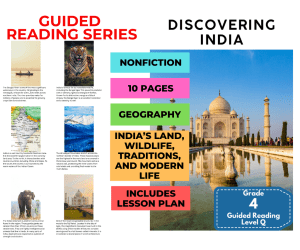
Discovering India: Guided Reading Level Q with Lesson Plan
ELA, Resources for Teachers, Reading Comprehension, Reading, Science, Geography, Social Studies, Technology, History, Life Sciences, Grade 3, 4, 5, Worksheets & Printables, Worksheets, Teacher Tools, Centers, Activities, Literacy Readers, Quizzes, Quizzes and Tests, Assessments, Lesson Plans
This Discovering India (level q) guided reading book with lesson plan includes: Guided Reading Color Label (front cover x1) This is a quick way to match the book’s demands to what students can generally handle.. The overall goal is to use the level/color to pick books for several smaller groups. To qualify for a certain level, a student is expected to read a book from that level with about 90–94% accuracy. If a student is consistently accurate and understands, move up a level. If the student is struggling at that level, drop down and add more support. Each student will improve at completely different rates, but it is generally one of the best ways to check progress across the class. DOWNLOAD THE CATALOG TO VIEW ALL GUIDED READING BOOKS AVAILABLE (SORTED LEVELS A-Z) Pre-Reading Question (x1) Teacher asks the prompt aloud, can be while showing the cover or first page. Students share what they already know, or make educated guesses from the cover. Prompt them to use the target vocabulary. Write some of their responses on the board to look back at during the reading. Vocabulary Words (x5) Introduce the five words, best doing it one at a time. Start by saying it, while students repeat and then see if anyone knows what it means before reading further. Read through the meaning and try to briefly connect each word to a picture or gesture so it’s meaningful. Ask students to flip through the book pages and point to where they see each of the vocabulary words. While reading the book pause upon coming across one of the vocab words or read the sentence twice to make sure students understand the word has appeared. Optional: Ask students to raise hands whenever they see/hear one of the new words. Guided Reading Pages (x10) Check the book snapshot (below) for: primary topic - do you need to prep extra reading or intro materials on this? what is taught best - decide on 1-2 bullets to focus on, use the prompt or words provided here for best results. learning goals - what you are checking for students to be able to do after the session, elicit answers using prompts or words provided. key vocabulary (see section above). questions overview - so you know what is coming up and if you need to prep extra materials to assist understanding. Run the lesson You may have already looked at a few of the pages together, but you can show them some of the pictures again first to set meaning. Depending on how much time you have and how familiar your students are with guided reading class, you may want to read the book aloud first with the group first. Students whisper or partner read, while you listen in. If time, do it as a group, one student reading a page each. Use the guided page’s prompts to coach: “Check the picture / does it make sense?” “Point under the words / try the first sound” “Reread the sentence smoothly”. Try to focus more on one student per session (rotating every time), so you can work out if they are ready to move up or need to move down a level. Comprehension Questions (back cover x3) This is your way to check that students didn’t just say the words, but actually understood the text. First, let students answer by pointing to the page/picture and saying a short sentence. After any answer, follow with: “Show me where you found that in the text.” In bigger groups, have partners answer first (10–20 seconds), then call on 2–3 students to share. Differentiation tips: Emerging speakers/struggling readers: oral + pointing On-level: oral in a full sentence Higher: one written sentence or draw + label Book Snapshot Title: Discovering India Genre: Nonfiction Subject: Social Studies (Geography/Culture) Primary Topic: India’s land, wildlife, traditions, and modern life Estimated Guided Reading Level (A–Z): Q What This Book Teaches Best Key geography facts about India’s location in Southern Asia, nearby borders, and surrounding waters. How landforms shape life in India, including the Himalayan Mountains and the Ganges River. Notable wildlife of India through examples like the Bengal tiger and the Indian elephant. Cultural traditions and everyday life, including spices used in meals and the celebration of Diwali. Modern India today, including transportation (auto-rickshaws) and major cities connected to technology and innovation. Learning Goals Students will describe where India is located and name details about its borders and southern waters. Students will explain how the Himalayan Mountains are described as protecting the inner plains. Students will explain why the Ganges River is important to people and farming in northern India. Students will describe key traits of the Bengal tiger and the Indian elephant using details from the text. Students will identify facts about the Taj Mahal, including where it is and features described in the book. Students will describe examples of Indian culture and modern life mentioned in the text (foods/spices, Diwali, transportation, cities). Key Vocabulary From the Text vast — very large in size. significant — very important. distinctive — easy to notice because it looks different. minarets — tall towers on a monument. diyas — small clay lamps used during Diwali. Discussion Prompts Pre-reading question: What are you hoping to learn about India as you read? Comprehension questions: What warm waters does the text say surround India to the south? Comprehension questions: According to the text, why is the Ganges River essential? Comprehension questions: What does the text say diyas symbolize during Diwali? Printing Tips 1. Best Printing Method (Recommended) “Booklet” Printing (Best if Available) If your printer or PDF viewer supports Booklet Printing , use this. Settings to use: Print mode: Booklet Paper size: Letter or A4 (either works) Orientation: Landscape Print on both sides: Yes Flip on: Short edge Scaling: Fit to printable area Booklet subset: First test: Front sides only Then: Back sides only This will automatically: Pair pages correctly Put the cover on the outside Align everything for folding After printing, fold in half and staple along the spine . 2. If “Booklet” Printing Is NOT Available You can still print this correctly with manual duplex printing . Step-by-step: Open the PDF. Choose Print . Set: Orientation: Landscape Pages per sheet: 1 Print on both sides: Yes Flip on: Short edge Print all pages . Because each PDF page already contains two facing book pages, the result will still fold cleanly into a book. Thousands of Cored Education products are included with your TeachSimple membership. Download links and encyclopedia index available here.
Author Cored Education
Rating
Tags Reading Comprehension, Reading Passages, Reading, Guided Reading, Guided Reading Lesson Plan, Guided Reading Activity, Pre-reading, Social Studies, Geography, History

Exploring Frictional Forces - Lesson Bundle
Science, Physics, Grade 9, 10, 11, 12, Teacher Tools, Lesson Plans
Exploring Frictional Forces - Lesson Bundle The product titled 'Exploring Frictional Forces - Lesson Bundle' is a comprehensive teaching resource focused on the concept of frictional forces in senior physics. This meticulously curated lesson package serves as an effective tool for high school students to understand and analyze various types of friction. The bundle caters to both educators and learners with included student and teacher versions of Google Slides presentations along with documents that exhibit fully worked practice questions, thereby being easily comprehensible. Main Concepts Friction Fundamentals Newton’s laws relating to Friction Static and Kinetic friction categories Coefficient of Friction Concept i/li> This content, structured in progression, sheds light on key concepts above while allotting substantial room for inquiry-based learning and discussions throughout the presentations. This method uplifts student engagement levels without compromising the quality of learning. Suitability for Distance Learning An additional feature is its suitability for distance learning formats; this product can be accessed seamlessly both via Microsoft Office or Google platforms. It includes Word doc versions alongside Google Docs formats for ease of use. One simple click can incorporate all resources into your Google Drive, which would aid both teachers or students located anywhere around the globe equipped with any hardware type. To add interaction within instructional sessions are multiple blanks strategically positioned within student copies requiring filling relevant information as sessions unfold. The teacher version stands out by comprising underlined bolded answers offering guidance while addressing these blanks amidst delivering lesson content. />This unit also connects well with Motion & Force science sections being part of the Motion and Force Senior Physics Unit encompassing lessons around Speed & Velocity dynamics, Frames of Reference understanding etc., It also includes multiple assessments and activities to continuously reignite student interest. Conclusion In conclusion, the 'Exploring Frictional Forces - Lesson Bundle' serves as an essential resource for effectively presenting intricate physics concepts beyond surface-level depth. This package ensures active participation and fosters an elevated understanding amongst students. Whether you are a public school teacher or homeschooling educators, this package caters to diverse needs while being seamlessly easy to use thanks to modern technology incorporation.
Author Teach With Fergy
Tags Frictional Forces, Physics Education, Teaching Resource, Lesson Bundle, Engagement Tools

I WONDER - Can Mollusks Be Eaten | Animated Video Lesson
STEM, Animals, Life Sciences, Science, Biology, Grade 1, 2, 3, 4, 5, 6, 7, 8, Lesson Plans, Teacher Tools
Video Introduction Animal kingdoms are full of fascinating wonders to learn. This video is designed for the students to learn more about animals in different countries. I WONDER - Can Mollusks Be Eaten | Animated Video Lesson Do you like animals? what is your favorite one? Do you own a pet? If yes, tell us more about it, like what its name? And what do you like most about it? What are the animal kingdoms? Can you write down the characteristics of each animal class like mammals, birds, reptiles, amphibian, fish and mollusks. Do you know that some animals can sing, can you name any of them? What is the largest and the smallest mammal in the world? What is the largest and the smallest bird in the world? What is the largest and the smallest fish in the world? I WONDER - Can Mollusks Be Eaten | Animated Video Lesson The video is perfect for encouraging the researching skills for the students, while learning more about these fantastic animals. I WONDER - Can Mollusks Be Eaten | Animated Video Lesson This friendly designed video is suitable for students at school, homeschooling, and as a group activity. Format Available in MP4 format.
Author Educational Voice
Tags Can Mollusks Be Eaten, Can Mollusks Be Eaten Video, Mollusks, Mollusk, Mollusks Facts, Mollusks Facts Or Kids, Mollusks Video, Mollusks Video For Kids, Mollusk Facts, Mollusk Video