



3,926 products added recently
Page 2 - Earth Science Quizzes
Physics Quizzes test students' knowledge of the fundamental laws governing the physical world. Topics include mechanics, electricity and magnetism, waves, and thermodynamics. These quizzes help students apply mathematical concepts to physical problems and understand the principles underlying everyday phenomena. Regular assessment with Physics Quizzes supports the development of problem-solving skills vital in science and engineering.

 Show filters

Earth Science Reading Comprehension Passage: Soil Types (PDF)
Science, ELA, Reading, Reading Comprehension, Strategies, Resources for Teachers, Earth and Environmental Sciences, Earth Sciences, Geology, Grade 6, 7, 8, 9, Writing Prompts, Worksheets & Printables, Centers, Activities, Teacher Tools, Assessments, Quizzes and Tests, Quizzes, Tests
Science Reading Comprehension Passages and Questions: Soil Types (PDF) This very engaging earth science reading passage about Soil Types is designed to bridge the gap between science and literacy through strengthening reading comprehension and sparking scientific curiosity in middle school students. The passage blends English Language Arts skills with accurate science content that supports NGSS classroom practice. Ideal for interdisciplinary learning in ELA and Science. Suitable for Grade 9 review, too! Student Tasks for The Passage: 5 multiple-choice questions targeting main idea, key details, inference, vocabulary in context, and use of evidence 5 vocabulary matching items with clear, student-friendly definitions 5 text-based questions that require citing specific lines or facts 1 summary prompt that asks students to condense central ideas accurately Full answer key for every section Available Formats for this Resource Fillable PDF Word Docs Google Docs FULL CATALOG OF DOWNLOADING LINKS HERE Product Details Length: 5 pages total Grades: 6–8, also suitable for Grade 9 review Use cases: close reading, stations, homework, intervention, test prep, and sub plans Standards support: reinforces informational-text skills and supports NGSS-style sense making through observation, modeling, and clear use of claim, evidence, and reasoning Why Teachers Choose This Set Authentic science content paired with rigorous literacy practice Consistent task structure across all passages for easier planning and smoother student routines Clear, age-appropriate writing that builds confidence without oversimplifying Other Science Reading Collections you May find in the store: 1. Astronomy & Space Science 2. Volcanoes, Rocks, & Mountains 3. Rock Cycle, Soil, & Sinkholes 4. Mars, Glaciers, & Antarctica 5. Water Cycle, Acid Rain, & Wastewater 6. Insects, Animals, & Ecosystems 7. Bioluminescence & Insects 8. Animal Skin, Cats, & T. Rex 9. Human Body and Senses 10. Health & Applied Bioscience 11. Waves, Light, & Imaging 12. Electricity & Energy 13. Motion & Materials 14. Chemistry and Materials Science Use this set to reinforce ELA skills in science, to add literacy to your lessons, and to support independent work. The passages strengthen main idea, evidence use, vocabulary in context, inference, cause and effect, and summary writing. With ready-to-use assessments and complete answer keys, you can provide focused practice that is simple to run and fast to review.
Author Middle & High School - CORED Education
Rating
Tags Middle School, Reading Comprehension, Reading Strategies, ELA, Centers, Reading Passage, Assessments, Vocabulary, Environmental Science, Earth Science

Earth Science Reading Comprehension Passage: Igneous Rocks. SAMPLE
Science, ELA, Reading, Reading Comprehension, Strategies, Resources for Teachers, Earth and Environmental Sciences, Earth Sciences, Grade 6, 7, 8, 9, Writing Prompts, Worksheets & Printables, Centers, Activities, Teacher Tools, Assessments, Quizzes and Tests, Quizzes, Tests
This is a free passage sample from the complete resource. The full version includes everything needed for a complete reading comprehension activity: the passage, multiple-choice questions, short-answer questions, vocabulary matching, a summary-writing task, and a detailed answer key. Download the complete passage resource by clicking on the following links: PDF Fillable PDF Word Docs Google Docs Science Reading Comprehension Passages and Questions: Igneous Rocks (PDF) This very engaging earth science reading passage about Igneous Rocks is designed to bridge the gap between science and literacy through strengthening reading comprehension and sparking scientific curiosity in middle school students. The passage blends English Language Arts skills with accurate science content that supports NGSS classroom practice. Ideal for interdisciplinary learning in ELA and Science. Suitable for Grade 9 review, too! Student Tasks for The Passage: 5 multiple-choice questions targeting main idea, key details, inference, vocabulary in context, and use of evidence 5 vocabulary matching items with clear, student-friendly definitions 5 text-based questions that require citing specific lines or facts 1 summary prompt that asks students to condense central ideas accurately Full answer key for every section FULL CATALOG OF DOWNLOADING LINKS HERE Product Details Length: 4 pages total Grades: 6–8, also suitable for Grade 9 review Use cases: close reading, stations, homework, intervention, test prep, and sub plans Standards support: reinforces informational-text skills and supports NGSS-style sense making through observation, modeling, and clear use of claim, evidence, and reasoning Why Teachers Choose This Set Authentic science content paired with rigorous literacy practice Consistent task structure across all passages for easier planning and smoother student routines Clear, age-appropriate writing that builds confidence without oversimplifying Other Science Reading Collections you May find in the store: 1. Astronomy & Space Science 2. Volcanoes, Rocks, & Mountains 3. Rock Cycle, Soil, & Sinkholes 4. Mars, Glaciers, & Antarctica 5. Water Cycle, Acid Rain, & Wastewater 6. Insects, Animals, & Ecosystems 7. Bioluminescence & Insects 8. Animal Skin, Cats, & T. Rex 9. Human Body and Senses 10. Health & Applied Bioscience 11. Waves, Light, & Imaging 12. Electricity & Energy 13. Motion & Materials 14. Chemistry and Materials Science Use this set to reinforce ELA skills in science, to add literacy to your lessons, and to support independent work. The passages strengthen main idea, evidence use, vocabulary in context, inference, cause and effect, and summary writing. With ready-to-use assessments and complete answer keys, you can provide focused practice that is simple to run and fast to review.
Author Middle & High School - CORED Education
Rating
Tags Middle School, Reading Comprehension, Reading Strategies, ELA, Centers, Reading Passage, Assessments, Vocabulary, Environmental Science, Earth Science

Earth Science Reading Comprehension Passage: Ice Age Leftovers (PDF)
Science, ELA, Reading, Reading Comprehension, Strategies, Resources for Teachers, Earth and Environmental Sciences, Earth Sciences, Grade 6, 7, 8, 9, Writing Prompts, Worksheets & Printables, Centers, Activities, Teacher Tools, Assessments, Quizzes and Tests, Quizzes, Tests
Science Reading Comprehension Passages and Questions: Ice Age Leftovers (PDF) This very engaging earth science reading passage about how ice left from the Ice Age still affects Earth today . It explains the differences between glaciers, ice sheets, ice shelves, icebergs, and sea ice , and shows how each one shapes land, oceans, weather, and climate. This passage is designed to bridge the gap between science and literacy through strengthening reading comprehension and sparking scientific curiosity in middle school students. The passage blends English Language Arts skills with accurate science content that supports NGSS classroom practice. Ideal for interdisciplinary learning in ELA and Science. Suitable for Grade 9 review, too! Student Tasks for The Passage: 5 multiple-choice questions targeting main idea, key details, inference, vocabulary in context, and use of evidence 5 vocabulary matching items with clear, student-friendly definitions 5 text-based questions that require citing specific lines or facts 1 summary prompt that asks students to condense central ideas accurately Full answer key for every section Available Formats for this Resource Fillable PDF Word Docs Google Docs FULL CATALOG OF DOWNLOADING LINKS HERE Product Details Length: 5 pages total Grades: 6–8, also suitable for Grade 9 review Use cases: close reading, stations, homework, intervention, test prep, and sub plans Standards support: reinforces informational-text skills and supports NGSS-style sense making through observation, modeling, and clear use of claim, evidence, and reasoning Why Teachers Choose This Set Authentic science content paired with rigorous literacy practice Consistent task structure across all passages for easier planning and smoother student routines Clear, age-appropriate writing that builds confidence without oversimplifying Other Science Reading Collections you May find in the store: 1. Astronomy & Space Science 2. Volcanoes, Rocks, & Mountains 3. Rock Cycle, Soil, & Sinkholes 4. Mars, Glaciers, & Antarctica 5. Water Cycle, Acid Rain, & Wastewater 6. Insects, Animals, & Ecosystems 7. Bioluminescence & Insects 8. Animal Skin, Cats, & T. Rex 9. Human Body and Senses 10. Health & Applied Bioscience 11. Waves, Light, & Imaging 12. Electricity & Energy 13. Motion & Materials 14. Chemistry and Materials Science Use this set to reinforce ELA skills in science, to add literacy to your lessons, and to support independent work. The passages strengthen main idea, evidence use, vocabulary in context, inference, cause and effect, and summary writing. With ready-to-use assessments and complete answer keys, you can provide focused practice that is simple to run and fast to review.
Author Middle & High School - CORED Education
Rating
Tags Middle School, Reading Comprehension, Reading Strategies, ELA, Centers, Reading Passage, Assessments, Vocabulary, Environmental Science, Space
Earth Science Reading Comprehension Passage: Types of Mountains (Word)
Science, ELA, Reading, Reading Comprehension, Strategies, Resources for Teachers, Earth and Environmental Sciences, Earth Sciences, Grade 6, 7, 8, 9, Writing Prompts, Worksheets & Printables, Centers, Activities, Teacher Tools, Assessments, Quizzes and Tests, Quizzes, Tests
Science Reading Comprehension Passages and Questions: Types of Mountains (Word) This very engaging earth science reading passage about Types of Mountains is designed to bridge the gap between science and literacy through strengthening reading comprehension and sparking scientific curiosity in middle school students. The passage blends English Language Arts skills with accurate science content that supports NGSS classroom practice. Ideal for interdisciplinary learning in ELA and Science. Suitable for Grade 9 review, too! Student Tasks for The Passage: 5 multiple-choice questions targeting main idea, key details, inference, vocabulary in context, and use of evidence 5 vocabulary matching items with clear, student-friendly definitions 5 text-based questions that require citing specific lines or facts 1 summary prompt that asks students to condense central ideas accurately Full answer key for every section Available Formats for this Resource PDF Fillable PDF Google Docs FULL CATALOG OF DOWNLOADING LINKS HERE Product Details Length: 4 pages total Grades: 6–8, also suitable for Grade 9 review Use cases: close reading, stations, homework, intervention, test prep, and sub plans Standards support: reinforces informational-text skills and supports NGSS-style sense making through observation, modeling, and clear use of claim, evidence, and reasoning Why Teachers Choose This Set Authentic science content paired with rigorous literacy practice Consistent task structure across all passages for easier planning and smoother student routines Clear, age-appropriate writing that builds confidence without oversimplifying Other Science Reading Collections you May find in the store: 1. Astronomy & Space Science 2. Volcanoes, Rocks, & Mountains 3. Rock Cycle, Soil, & Sinkholes 4. Mars, Glaciers, & Antarctica 5. Water Cycle, Acid Rain, & Wastewater 6. Insects, Animals, & Ecosystems 7. Bioluminescence & Insects 8. Animal Skin, Cats, & T. Rex 9. Human Body and Senses 10. Health & Applied Bioscience 11. Waves, Light, & Imaging 12. Electricity & Energy 13. Motion & Materials 14. Chemistry and Materials Science Use this set to reinforce ELA skills in science, to add literacy to your lessons, and to support independent work. The passages strengthen main idea, evidence use, vocabulary in context, inference, cause and effect, and summary writing. With ready-to-use assessments and complete answer keys, you can provide focused practice that is simple to run and fast to review.
Author Middle & High School - CORED Education
Rating
Tags Middle School, Reading Comprehension, Reading Strategies, ELA, Centers, Reading Passage, Assessments, Vocabulary, Environmental Science, Earth Science
Earth Science Reading Comprehension Passage: The Water Cycle (Word)
Science, ELA, Reading, Reading Comprehension, Strategies, Resources for Teachers, Earth and Environmental Sciences, Earth Sciences, Environmental Science, Grade 6, 7, 8, 9, Writing Prompts, Worksheets & Printables, Centers, Activities, Teacher Tools, Assessments, Quizzes and Tests, Quizzes, Tests
Science Reading Comprehension Passages and Questions: The Water Cycle (Word) This very engaging earth science reading passage about the Water Cycle . It is designed to bridge the gap between science and literacy through strengthening reading comprehension and sparking scientific curiosity in middle school students. The passage blends English Language Arts skills with accurate science content that supports NGSS classroom practice. Ideal for interdisciplinary learning in ELA and Science. Suitable for Grade 9 review, too! Student Tasks for The Passage: 5 multiple-choice questions targeting main idea, key details, inference, vocabulary in context, and use of evidence 5 vocabulary matching items with clear, student-friendly definitions 5 text-based questions that require citing specific lines or facts 1 summary prompt that asks students to condense central ideas accurately Full answer key for every section Available Formats for this Resource PDF Fillable PDF Google Docs FULL CATALOG OF DOWNLOADING LINKS HERE Product Details Length: 5 pages total Grades: 6–8, also suitable for Grade 9 review Use cases: close reading, stations, homework, intervention, test prep, and sub plans Standards support: reinforces informational-text skills and supports NGSS-style sense making through observation, modeling, and clear use of claim, evidence, and reasoning Why Teachers Choose This Set Authentic science content paired with rigorous literacy practice Consistent task structure across all passages for easier planning and smoother student routines Clear, age-appropriate writing that builds confidence without oversimplifying Other Science Reading Collections you May find in the store: 1. Astronomy & Space Science 2. Volcanoes, Rocks, & Mountains 3. Rock Cycle, Soil, & Sinkholes 4. Mars, Glaciers, & Antarctica 5. Water Cycle, Acid Rain, & Wastewater 6. Insects, Animals, & Ecosystems 7. Bioluminescence & Insects 8. Animal Skin, Cats, & T. Rex 9. Human Body and Senses 10. Health & Applied Bioscience 11. Waves, Light, & Imaging 12. Electricity & Energy 13. Motion & Materials 14. Chemistry and Materials Science Use this set to reinforce ELA skills in science, to add literacy to your lessons, and to support independent work. The passages strengthen main idea, evidence use, vocabulary in context, inference, cause and effect, and summary writing. With ready-to-use assessments and complete answer keys, you can provide focused practice that is simple to run and fast to review.
Author Middle & High School - CORED Education
Rating
Tags Middle School, Reading Comprehension, Reading Strategies, ELA, Centers, Reading Passage, Assessments, Vocabulary, Environmental Science, Water Cycle

SAMPLE Science Reading Passage: Rocks, & Mountains (FILLABLE PDF)
Science, Earth and Environmental Sciences, ELA, Reading, Reading Comprehension, Strategies, Resources for Teachers, Earth Sciences, Geology, Grade 6, 7, 8, 9, Writing Prompts, Worksheets & Printables, Centers, Activities, Teacher Tools, Assessments, Quizzes and Tests, Quizzes, Tests
This is a ONE PASSAGE SAMPLE. The following is the description of the FULL resource and the downloading links: Volcanoes, Rocks, & Mountains: Reading Comprehension Passages (FILLABLE PDF) This very engaging and fillable collection of earth science reading passages about Mountains, Volcanoes, and Igneous Rocks is designed to bridge the gap between science and literacy through strengthening reading comprehension and sparking scientific curiosity in middle school students. Each passage blends English Language Arts skills with accurate science content that supports NGSS classroom practice. Ideal for interdisciplinary learning in ELA and Science. Suitable for Grade 9 review, too! These worksheets are designed as fillable PDFs , which means students can type their answers directly into the document on any computer or tablet . Each page includes highlighted text fields that show them exactly where to type! What Is Included? There are (3) informational passages: Mountains: From Plates to Peaks How Volcanoes Shape Our World Igneous Rocks: From Fire to Everyday Life Student Tasks for Each Passage: 5 multiple-choice questions targeting main idea, key details, inference, vocabulary in context, and use of evidence 5 vocabulary matching items with clear, student-friendly definitions 5 text-based questions that require citing specific lines or facts 1 summary prompt that asks students to condense central ideas accurately Full answer key for every section Available Formats for this Resource Word Docs Google Docs FULL CATALOG OF DOWNLOADING LINKS HERE Other Science Reading Collections and Topics You May Find in the Store: 1. Astronomy & Space Science 2. Volcanoes, Rocks, & Mountains 3. Rock Cycle, Soil, & Sinkholes 4. Mars, Glaciers, & Antarctica 5. Water Cycle, Acid Rain, & Wastewater 6. Insects, Animals, & Ecosystems 7. Bioluminescence & Insects 8. Animal Skin, Cats, & T. Rex 9. Human Body and Senses 10. Health & Applied Bioscience 11. Waves, Light, & Imaging 12. Electricity & Energy 13. Motion & Materials 14. Chemistry and Materials Science 15. Electromagnetism 16. Acids and Bases 17. Gas Laws 18. Biotechnology 19. Periodic Trends 20. Protists and Fungi 21. Microevolution 22. Blood 23. Chemical Bonding 24. Magnets 25. Muscles 26. Nuclear Chemistry 27. Electromagnetic Devices 28. Epigenetics 29. The Law of Conservation of Mass 30. Atomic Models 31. Isotopes and Ions 32. Light 33. Human-Environment Interaction 34. Theory of Evolution 35. Photosynthesis 36. Origins of Life and Early Earth 37. Gene Expression and Regulation 38. Thermochemistry 39. Allergies 40. Coevolution 41. Birth to Adulthood 42. Cells 43. Entropy and Free Energy 44. The Human Brain 45. Mixtures and Solutions 46. Invertebrates 47. Zoo Animals 48. Biochemistry 49. Animal Behavior 50. Population Ecology ...and many more engaging science reading passages that cover intriguing and important topics designed to spark curiosity and support student learning. How to Use These PDFs Click on the highlighted area to start typing your answer. Move to the next question by clicking in the next highlighted box. When you are finished, close the document and select SAVE so your answers stay recorded. If you want to keep a blank copy for later, choose Save As and give your completed version a new name. Product Details Length: 13 pages total Grades: 6–8, also suitable for Grade 9 review Use cases: close reading, stations, homework, intervention, test prep, and sub plans Standards support: reinforces informational-text skills and supports NGSS-style sense making through observation, modeling, and clear use of claim, evidence, and reasoning Why Teachers Choose This Set Authentic science content paired with rigorous literacy practice Consistent task structure across all passages for easier planning and smoother student routines Clear, age-appropriate writing that builds confidence without oversimplifying Use this set to reinforce ELA skills in science, to add literacy to your lessons, or to support independent work. The passages strengthen main idea, evidence use, vocabulary in context, inference, cause and effect, and summary writing. With ready-to-use assessments and complete answer keys, you can provide focused practice that is simple to run and fast to review.
Author Middle & High School - CORED Education
Rating
Tags Middle School, Reading Comprehension, Reading Strategies, Reading Passages, ELA, Centers, Reading Passage, Assessments, Vocabulary, Earth Science

Biodiversity & Ecosystem Protection Activity Sheets
Science, Earth and Environmental Sciences, Earth Sciences, Environmental Science, Geology, Space, Life Sciences, Nature & Plants, STEM, Basic Science, Homeschool Curriculum, Grade 3, 4, 5, 6, 7, 8, Teacher Tools, Lesson Plans, Presentations, Quizzes and Tests, Quizzes, Tests, Worksheets & Printables, Workbooks, Worksheets, Word Searches
This teaching resource is a 35-page Biodiversity & Ecosystem Protection bundle for upper elementary (3rd-5th grade) and for home school settings. It is professional and formatted for classroom distribution as well as for printing (and testing) in your classroom. Three Phases of Learning: PHASE 1 - The Educator's Guide (Chapters 1-4) contains in-depth information about the three levels of biodiversity, ecosystem architecture, the "wood wide web," keystone species, trophic cascades, habitat fragmentation, invasive species, wildlife corridors and the "Miyawaki Method," with many real-world examples. See the Tepuis in Guiana, the Brazil Nut tree, the Silent Forests of Guam, and Banff wildlife corridors. PHASE 2 - Student Workbook contains 10 worksheets of fill-in-the-blank questions, critical thinking prompts, scenario analyses, and design challenges for Ecosystem Vocabulary, Food Webs, World Biomes, Keystone Species, Habitat Fragmentation, Invasive Species, Marine Biodiversity, Pollinators, Conservation Legislation, and Citizen Science. PHASE 3 - Visual and Teacher Resources, including three classroom-ready diagrams (the Trophic Interdependence diagram, H.I.P.P.O. Threats Matrix, and Conservation Action Mind Map), an answer key for all worksheets, a guide for implementing all 14 NGSS Standards (3-LS4-3 & 5-LS2-1), differentiation strategies (ELL, SLD, gifted), and a formative assessment grading rubric. Best Suited For: Science educators, home-schoolers, nature and ecology groups, Earth Day project preparation, STEM course planning, substitute billing preparation and one-to-one tuition sessions. Type Of Item Available To Download: An easy-to-fit digital record making it possible for you to create your teaching resource as soon as you make your purchase, using copies of the files or printing directly from the completed files themselves as needed as teacher copying materials. Search Terms: biodiversity worksheets, ecosystems worksheets, NGSS aligned Science 3rd-5th grade, food web activities, keystone species lesson plan, environmental science prints, conservation worksheets, Earth Day Activities, life science curriculum, habitat Lesson plans. Overview of NGSS and Related Benefits: NGSS-aligned and Standards-based will directly meet Performance Expectations: 3 LS4-3 & 5 LS2-1, thus these resources will save teachers several hours of planning. All-in-One Resource: 3-in-1 Bundle will include: “Teacher Theory”, “Student Workbook” and “Answer Keys” including visuals. No need to purchase supplemental material. Fosters Critical Thinking Instead of Memorization: Real-life Case Studies, (Guam, Amazon, Banff) and “Constructivist Systems Thinking” approach to develop “analytical” minds. Includes Built-in Differentiation: A complete range of instructional strategies will be provided for ELL, Special Education (SLD & ADD), and Gifted & Talented students; one resource will serve all learners. Ready to Print and Use: Black and White "Ink on Paper" design saves ink; ready to print and teach in minutes with no preparation work. Solution-oriented approach: Combats "Eco-Anxiety" by providing students with clearly defined solutions to every cause/problem and offering students the ability to take: Action-Based Steps to Reduce Classroom Eco-Anxiety. The document clearly specifies that it has multiple intended uses, as follows: Primary Audience: Grades (ages) 8 to 11 (i.e., 3, 4, and 5). Secondary Audience: Grade 6 with introductory or review materials. Curriculum for students in these grades who are homeschooled. Curriculum for middle school English Language Learner (ELL) or English as a Second Language (ESL) students using simplified science concepts. Curriculum for students with special needs using the differentiation strategies provided in this document. Copyright and Terms of Use: Syed Hammad Rizvi owns the copyright to this book. It is provided for personal use and in a singular classroom. You cannot change it, sell any part of it, or redistribute any of it. In short, it cannot be provided over the Internet in such a way that others can access it and download it without your permission. If you wish to share this resource with your coworkers, you can purchase additional licenses for it through Teachsimple. Thank you for following the terms of agreement for this resource. This is a gift from Syed Hammad Rizvi.
Author Creative Book Store
Rating
Tags Biodiversity, EcosystemWorksheets, NGSSScience, ScienceWorksheets, ElementaryScience, ScienceTeachers, HomeschoolPrintables, BiodiversityWorksheets, BiodiversityActivities, EcosystemActivities
Volcanoes, Rocks, & Mountains: SAMPLE Reading Passage (Word)
Science, Earth and Environmental Sciences, ELA, Reading, Reading Comprehension, Strategies, Resources for Teachers, Geology, Earth Sciences, Grade 6, 7, 8, 9, Writing Prompts, Worksheets & Printables, Centers, Activities, Teacher Tools, Assessments, Quizzes and Tests, Quizzes, Tests
This is a ONE PASSAGE SAMPLE. The following is the description of the FULL resource and the downloading links: Volcanoes, Rocks, & Mountains: Reading Comprehension Passages (Word) This very engaging collection of earth science reading passages about Mountains, Volcanoes, and Igneous Rocks is designed to bridge the gap between science and literacy through strengthening reading comprehension and sparking scientific curiosity in middle school students. Each passage blends English Language Arts skills with accurate science content that supports NGSS classroom practice. Ideal for interdisciplinary learning in ELA and Science. Suitable for Grade 9 review, too! What Is Included? There are (3) informational passages: Mountains: From Plates to Peaks See how plate collisions fold rock, faults lift blocks, and volcanism builds peaks. Learn how rivers, glaciers, and gravity continue to reshape ranges over time. How Volcanoes Shape Our World Examine hazards such as ash, gases, lahars, and pyroclastic flows, along with benefits like fertile soils, mineral resources, geothermal energy, and new land. Learn how monitoring and planning reduce risk. Igneous Rocks: From Fire to Everyday Life Compare intrusive and extrusive rocks, link cooling rates to crystal size and texture, and connect granite, basalt, pumice, and obsidian to everyday uses in buildings, roads, tools, and art. Student Tasks for Each Passage: 5 multiple-choice questions targeting main idea, key details, inference, vocabulary in context, and use of evidence 5 vocabulary matching items with clear, student-friendly definitions 5 text-based questions that require citing specific lines or facts 1 summary prompt that asks students to condense central ideas accurately Full answer key for every section Available Formats for this Resource PDF Google Docs FULL CATALOG OF DOWNLOADING LINKS HERE Other Science Reading Collections and Topics You May Find in the Store: 1. Astronomy & Space Science 2. Volcanoes, Rocks, & Mountains 3. Rock Cycle, Soil, & Sinkholes 4. Mars, Glaciers, & Antarctica 5. Water Cycle, Acid Rain, & Wastewater 6. Insects, Animals, & Ecosystems 7. Bioluminescence & Insects 8. Animal Skin, Cats, & T. Rex 9. Human Body and Senses 10. Health & Applied Bioscience 11. Waves, Light, & Imaging 12. Electricity & Energy 13. Motion & Materials 14. Chemistry and Materials Science 15. Electromagnetism 16. Acids and Bases 17. Gas Laws 18. Biotechnology 19. Periodic Trends 20. Protists and Fungi 21. Microevolution 22. Blood 23. Chemical Bonding 24. Magnets 25. Muscles 26. Nuclear Chemistry 27. Electromagnetic Devices 28. Epigenetics 29. The Law of Conservation of Mass 30. Atomic Models 31. Isotopes and Ions 32. Light 33. Human-Environment Interaction 34. Theory of Evolution 35. Photosynthesis 36. Origins of Life and Early Earth 37. Gene Expression and Regulation 38. Thermochemistry 39. Allergies 40. Coevolution 41. Birth to Adulthood 42. Cells 43. Entropy and Free Energy 44. The Human Brain 45. Mixtures and Solutions 46. Invertebrates 47. Zoo Animals 48. Biochemistry 49. Animal Behavior 50. Population Ecology ...and many more engaging science reading passages that cover intriguing and important topics designed to spark curiosity and support student learning.. Product Details Length: 13 pages total Grades: 6–8, also suitable for Grade 9 review Use cases: close reading, stations, homework, intervention, test prep, and sub plans Standards support: reinforces informational-text skills and supports NGSS-style sense making through observation, modeling, and clear use of claim, evidence, and reasoning Why Teachers Choose This Set Authentic science content paired with rigorous literacy practice Consistent task structure across all passages for easier planning and smoother student routines Clear, age-appropriate writing that builds confidence without oversimplifying Use this set to reinforce ELA skills in science, to add literacy to your lessons, or to support independent work. The passages strengthen main idea, evidence use, vocabulary in context, inference, cause and effect, and summary writing. With ready-to-use assessments and complete answer keys, you can provide focused practice that is simple to run and fast to review.
Author Middle & High School - CORED Education
Rating
Tags Middle School, Reading Comprehension, Reading Strategies, Reading Passages, ELA, Centers, Reading Passage, Assessments, Vocabulary, Earth Science
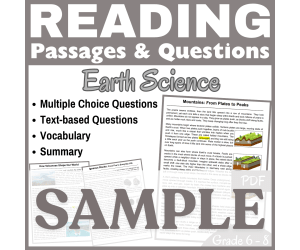
Volcanoes, Rocks, & Mountains: SAMPLE Reading Passage (PDF)
Science, Earth and Environmental Sciences, ELA, Reading, Reading Comprehension, Strategies, Resources for Teachers, Earth Sciences, Geology, Grade 6, 7, 8, 9, Writing Prompts, Worksheets & Printables, Centers, Activities, Teacher Tools, Assessments, Quizzes and Tests, Quizzes, Tests
This is a ONE PASSAGE SAMPLE. The following is the description of the FULL resource and the downloading links: Volcanoes, Rocks, & Mountains: Reading Comprehension Passages (PDF) This very engaging collection of earth science reading passages about Mountains, Volcanoes, and Igneous Rocks is designed to bridge the gap between science and literacy through strengthening reading comprehension and sparking scientific curiosity in middle school students. Each passage blends English Language Arts skills with accurate science content that supports NGSS classroom practice. Ideal for interdisciplinary learning in ELA and Science. Suitable for Grade 9 review, too! What Is Included? There are (3) informational passages: Mountains: From Plates to Peaks See how plate collisions fold rock, faults lift blocks, and volcanism builds peaks. Learn how rivers, glaciers, and gravity continue to reshape ranges over time. How Volcanoes Shape Our World Examine hazards such as ash, gases, lahars, and pyroclastic flows, along with benefits like fertile soils, mineral resources, geothermal energy, and new land. Learn how monitoring and planning reduce risk. Igneous Rocks: From Fire to Everyday Life Compare intrusive and extrusive rocks, link cooling rates to crystal size and texture, and connect granite, basalt, pumice, and obsidian to everyday uses in buildings, roads, tools, and art. Student Tasks for Each Passage: 5 multiple-choice questions targeting main idea, key details, inference, vocabulary in context, and use of evidence 5 vocabulary matching items with clear, student-friendly definitions 5 text-based questions that require citing specific lines or facts 1 summary prompt that asks students to condense central ideas accurately Full answer key for every section Available Formats for this Resource Word Docs Google Docs FULL CATALOG OF DOWNLOADING LINKS HERE Other Science Reading Collections and Topics You May Find in the Store: 1. Astronomy & Space Science 2. Volcanoes, Rocks, & Mountains 3. Rock Cycle, Soil, & Sinkholes 4. Mars, Glaciers, & Antarctica 5. Water Cycle, Acid Rain, & Wastewater 6. Insects, Animals, & Ecosystems 7. Bioluminescence & Insects 8. Animal Skin, Cats, & T. Rex 9. Human Body and Senses 10. Health & Applied Bioscience 11. Waves, Light, & Imaging 12. Electricity & Energy 13. Motion & Materials 14. Chemistry and Materials Science 15. Electromagnetism 16. Acids and Bases 17. Gas Laws 18. Biotechnology 19. Periodic Trends 20. Protists and Fungi 21. Microevolution 22. Blood 23. Chemical Bonding 24. Magnets 25. Muscles 26. Nuclear Chemistry 27. Electromagnetic Devices 28. Epigenetics 29. The Law of Conservation of Mass 30. Atomic Models 31. Isotopes and Ions 32. Light 33. Human-Environment Interaction 34. Theory of Evolution 35. Photosynthesis 36. Origins of Life and Early Earth 37. Gene Expression and Regulation 38. Thermochemistry 39. Allergies 40. Coevolution 41. Birth to Adulthood 42. Cells 43. Entropy and Free Energy 44. The Human Brain 45. Mixtures and Solutions 46. Invertebrates 47. Zoo Animals 48. Biochemistry 49. Animal Behavior 50. Population Ecology ...and many more engaging science reading passages that cover intriguing and important topics designed to spark curiosity and support student learning. Product Details Length: 13 pages total Grades: 6–8, also suitable for Grade 9 review Use cases: close reading, stations, homework, intervention, test prep, and sub plans Standards support: reinforces informational-text skills and supports NGSS-style sense making through observation, modeling, and clear use of claim, evidence, and reasoning Why Teachers Choose This Set Authentic science content paired with rigorous literacy practice Consistent task structure across all passages for easier planning and smoother student routines Clear, age-appropriate writing that builds confidence without oversimplifying Use this set to reinforce ELA skills in science, to add literacy to your lessons, or to support independent work. The passages strengthen main idea, evidence use, vocabulary in context, inference, cause and effect, and summary writing. With ready-to-use assessments and complete answer keys, you can provide focused practice that is simple to run and fast to review.
Author Middle & High School - CORED Education
Rating 5
Tags Middle School, Reading Comprehension, Reading Strategies, Reading Passages, ELA, Centers, Reading Passage, Assessments, Vocabulary, Earth Science
Basic Climate Change Causes & Everyday Action Worksheets
Science, Earth and Environmental Sciences, Earth Sciences, Environmental Science, Geology, Space, Life Sciences, Human Body, Nature & Plants, Biology, Homeschool Curriculum, Homeschool Templates, Grade 2, 3, 4, 5, Worksheets & Printables, Workbooks, Worksheets, Word Searches, Teacher Tools, Assessments, Lesson Plans, Quizzes and Tests, Quizzes, Tests
Introducing Climate Change Worksheets for Grades 2-4! This incredible resource is a completely packaged bundle that can just be printed out and used. It includes the following areas of focus to help you teach students about climate change: Greenhouse Effect Carbon Footprint Fossil Fuels Deforestation Ocean Acidification Albedo Feedback Loops How to take action and make a difference. In addition, there is lots of great information that is presented in age-appropriate science language and style, using easily relatable analogies and examples, plus hands-on activities. The Climate Change Worksheets for Grades 2-4 bundle contains 38 pages and can be used for: Elementary science lessons Homeschooling Social-Emotional Learning (SEL) integration Substitute teacher plans The Climate Change Worksheets for Grades 2-4 bundle is composed of three phases: Phase 1: Core theory chapters will be presented using Constructivist Climate Pedagogy (e.g., no fear-based stories, only empowerment and agency). Phase 2: Ten interactive student worksheets (filling in the blank, analyzing scenarios, brainstorming, using math to solve real-life problems, becoming carbon detectives/energy vampires, making compost, becoming 3Rs experts, transforming our transportation systems, culminating with Climate Action Pledge). Phase 3: A high-contrast visual aid (examples: the Greenhouse Effect Diagram, the Chain of Climate Change Flowchart, the Everyday Action Plan Matrix) and the Teacher Answer Key to assist you in easy grading and differentiation. The resources are designed to meet the NGSS and will help your students build a STEM vocabulary (examples: anthropogenic, albedo, positive feedback, etc.), while also developing their resilience as environmental stewards. The Climate Change Worksheets for Grades 2-4 bundle is low-prep/high-impact and is suitable for Elementary Science, Environmental Education, or Cross-Curricular teaching resources for Grades 2-4. When you purchase these resources, you will receive an instant digital download of the PDF for easy use and printing. What makes it a hit for Parents and Schools: Kid-friendly yet Scientifically Accurate: Uses correct terms and real mechanics, no ‘bad pollution’ oversimplifications, while also using a solution-focused & empowering language to prevent eco-anxiety among young learners Zero Prep, Ready to Implement: Complete Teaching Answer Key + Printable Worksheets + Gorgeous Images = Instant Lesson Plans save Teachers dozens of hours to prepare lessons Action Oriented and Positive: Each of the day to day Habits measure up to the knowledge gained, turning it into Action Confidence and Real-world Skills kids can use at Home Cross Curriculum for Success: Merges Science, Mathematics, Writing, Critical Thinking and Social Emotional Learning (SEL), perfect for meeting multiple standards within one engaging unit Proven Winner in Classrooms and at Home: High contrast illustrations will produce high quality prints, Worksheets will work for whole group, small group or independent usage and the pledge and activity pages foster meaningful conversation among families or school-wide. Intended Users/Grades: This resource was designed in a way that is very clear to understand and has been age-appropriate scaffolding for Grades 2 - 4 (ages 7 - 10) or early elementary students. It is appropriate for: General Education Classrooms (science OR integrated social studies/SEL block) Homeschool families who want a rigorous but accessible resource for climate literacy Special Education or Neuro-inclusion settings (clear visuals, concrete examples, not too many overwhelming elements or data) After School Programs, Environmental Clubs, or Scout Troops Substitute Teacher Plans or Emergency Substitute Teacher Folders The pedagogy introduced throughout the curriculum does not teach about abstract world doom, but rather supports the grounding of concepts through “backyard” observation and personal agency of children. Therefore, it is considered to be developmentally appropriate for concrete operational thinkers at this age group. Copyright & Terms of Use This book is copyrighted to Syed Hammad Rizvi. The contents of this book are only permitted for private, single classroom use. The contents of this book may not be modified, re-distributed or sold. Essentially, the contents of this book cannot be posted on a website where others could find them and download them. If you want to share these resources with your colleagues, you must purchase additional licenses from Teachsimple. Thank you for honoring our terms of use. This resource was created by Syed Hammad Rizvi.
Author Creative Book Store
Rating
Tags ClimateChangeWorksheets, GreenhouseEffect, CarbonFootprint, ElementaryScience, Grades2To4, ClimateActionForKids, EverydayClimateAction, ClimateChangeForKids, NoEcoAnxiety, ActionOrientedScience

Composting Ratio & Soil Chemistry Trackers
Science, Earth and Environmental Sciences, Earth Sciences, Environmental Science, Geology, STEM, Chemistry, Biology, Life Sciences, Nature & Plants, Grade 6, 7, 8, 9, 10, 11, 12, Worksheets & Printables, Workbooks, Worksheets, Word Searches, Writing Prompts, Teacher Tools, Lesson Plans, Quizzes and Tests, Quizzes, Tests
Transform your science class into a buzzing hub of discovery with this comprehensive, hands-on composting unit! This is not just a set of worksheets; it's a complete, multi-week STEM project that guides students through the fascinating "soil alchemy" of decomposition. Watch them go from passive learners to active scientists as they track, measure, and manage their very own compost ecosystem. Perfect for Earth Day, an environmental science unit, or a life science module, this resource makes complex chemistry and biology tangible and exciting. Students will master the critical Carbon-to-Nitrogen (C:N) ratio, learn to diagnose problems using sensory data (smell, temperature, texture), and witness the incredible transformation of waste into "black gold." This resource is fully aligned with Next Generation Science Standards (NGSS 5-LS2-1: Ecosystems) and seamlessly integrates science, math, and critical thinking. ► What's Included in this 40-Page Resource? Part 1: The Science of Soil Alchemy (11-Page Guide): A detailed, student-friendly reading guide that explains the core science behind composting, including: The roles of Carbon ("Browns") and Nitrogen ("Greens"). The "Microscopic Workforce" of bacteria, fungi, and microbes. The perfect C:N ratio and the practical "Rule of Thumb." Real-world case studies for problem-solving. Part 2: The Student Workbook (10 Differentiated Worksheets): Engaging activities that reinforce key concepts. Categorizing Organic Matter Mathematical Modeling of the 30:1 Ratio Thermodynamics of the Compost Pile Hydration and Aeration Dynamics Odor Diagnostics & Troubleshooting ...and 5 more in-depth worksheets! Part 3: Teacher Resources (Complete Support): Everything you need to implement this project with confidence. Instructional Visuals: Clear, printable diagrams explaining the C:N balance, the biological engine, and a diagnostic matrix. Teacher Implementation Guide: A step-by-step guide covering pedagogical hurdles, material sourcing, classroom safety, and scaffolding the lessons. Differentiation Strategies: Tips for supporting both tactile learners and analytically advanced students. Comprehensive Answer Key: Definitive answers for all 10 worksheets and observation scenarios. ► Ideal For: 4th, 5th, and 6th Grade Science Classes Middle School Environmental Science Electives Homeschool Co-ops and STEM Clubs Fulfilling NGSS 5-LS2-1 Requirements Empower your students with the knowledge to make a real-world environmental impact. Download now and start your composting adventure! Keywords: Composting, Soil Science, STEM Project, Environmental Science, Earth Day, NGSS Aligned, 5-LS2-1, Decomposition, Carbon Nitrogen Ratio, Biology, Chemistry, Life Science, Student Workbook, Hands-On Science, 4th Grade, 5th Grade, 6th Grade, Middle School Science. Why Parents/Schools Love It: Truly Hands-On, Real-World Science: This unit moves beyond textbook theory and allows students to engage in a long-term, tangible scientific experiment. They learn by doing, problem-solving, and seeing the direct results of their actions. Integrates Multiple Subjects (Cross-Curricular): It masterfully blends Science (biology, chemistry), Math (ratios, measurement, data analysis), and Language Arts (descriptive writing in observation logs), reinforcing learning across the curriculum. Teaches Sustainability and Environmental Stewardship: Students don't just learn about the environment; they learn a practical skill that reduces waste and benefits the planet. It fosters a sense of responsibility and empowerment. Comprehensive & Low-Prep for Teachers: This is a complete, "print-and-go" unit. The detailed teacher guide, visual aids, and full answer key mean educators can implement a high-quality, rigorous project with minimal preparation time. Aligned with Academic Standards: Its direct alignment with NGSS standards (specifically 5-LS2-1) is a huge selling point for schools and teachers who need to ensure their curriculum meets state and national requirements. Target Student Audience : Based on the content's language, the specific mention of a "5th-grade science class" in a case study, and the direct reference to NGSS Standard 5-LS2-1 , primary target audience is: 4th to 6th Grade Students. The material is perfectly scaffolded for this age range. It can also be easily adapted for 7th and 8th-grade middle school science, especially for students needing a more hands-on approach to chemistry and biology. Copyright/Terms of Use: This Book was copyrighted by Syed Hammad Rizvi. This resource is for personal and single classroom use only. You may not alter, redistribute, or sell any part of this resource. In other words, you may not put it on the Internet where it could be publicly found and downloaded. If you want to share this resource with colleagues, please purchase additional licenses from Teachsimple. Thank you for respecting these terms of use. This product is happily brought to you by Syed Hammad Rizvi
Author Creative Book Store
Rating
Tags Composting, SoilScience, Decomposition, EnvironmentalScience, STEM, ScienceEducation, Ecology, LifeScience, Biology, ChemistryForKids

Earth Science Reading Comprehension Passage: Ice Age Leftovers (Word)
Science, ELA, Reading, Reading Comprehension, Strategies, Resources for Teachers, Earth and Environmental Sciences, Earth Sciences, Grade 6, 7, 8, 9, Writing Prompts, Worksheets & Printables, Centers, Activities, Teacher Tools, Assessments, Quizzes and Tests, Quizzes, Tests
Science Reading Comprehension Passages and Questions: Ice Age Leftovers (Word) This very engaging earth science reading passage about how ice left from the Ice Age still affects Earth today . It explains the differences between glaciers, ice sheets, ice shelves, icebergs, and sea ice , and shows how each one shapes land, oceans, weather, and climate. This passage is designed to bridge the gap between science and literacy through strengthening reading comprehension and sparking scientific curiosity in middle school students. The passage blends English Language Arts skills with accurate science content that supports NGSS classroom practice. Ideal for interdisciplinary learning in ELA and Science. Suitable for Grade 9 review, too! Student Tasks for The Passage: 5 multiple-choice questions targeting main idea, key details, inference, vocabulary in context, and use of evidence 5 vocabulary matching items with clear, student-friendly definitions 5 text-based questions that require citing specific lines or facts 1 summary prompt that asks students to condense central ideas accurately Full answer key for every section Available Formats for this Resource PDF Fillable PDF Google Docs FULL CATALOG OF DOWNLOADING LINKS HERE Product Details Length: 5 pages total Grades: 6–8, also suitable for Grade 9 review Use cases: close reading, stations, homework, intervention, test prep, and sub plans Standards support: reinforces informational-text skills and supports NGSS-style sense making through observation, modeling, and clear use of claim, evidence, and reasoning Why Teachers Choose This Set Authentic science content paired with rigorous literacy practice Consistent task structure across all passages for easier planning and smoother student routines Clear, age-appropriate writing that builds confidence without oversimplifying Other Science Reading Collections you May find in the store: 1. Astronomy & Space Science 2. Volcanoes, Rocks, & Mountains 3. Rock Cycle, Soil, & Sinkholes 4. Mars, Glaciers, & Antarctica 5. Water Cycle, Acid Rain, & Wastewater 6. Insects, Animals, & Ecosystems 7. Bioluminescence & Insects 8. Animal Skin, Cats, & T. Rex 9. Human Body and Senses 10. Health & Applied Bioscience 11. Waves, Light, & Imaging 12. Electricity & Energy 13. Motion & Materials 14. Chemistry and Materials Science Use this set to reinforce ELA skills in science, to add literacy to your lessons, and to support independent work. The passages strengthen main idea, evidence use, vocabulary in context, inference, cause and effect, and summary writing. With ready-to-use assessments and complete answer keys, you can provide focused practice that is simple to run and fast to review.
Author Middle & High School - CORED Education
Rating
Tags Middle School, Reading Comprehension, Reading Strategies, ELA, Centers, Reading Passage, Assessments, Vocabulary, Environmental Science, Space

Earth Science Reading Comprehension Passage: Soil Types (Fillable PDF)
Science, ELA, Reading, Reading Comprehension, Strategies, Resources for Teachers, Earth and Environmental Sciences, Earth Sciences, Geology, Grade 6, 7, 8, 9, Writing Prompts, Worksheets & Printables, Centers, Activities, Teacher Tools, Assessments, Quizzes and Tests, Quizzes, Tests
Science Reading Comprehension Passages and Questions: Soil Types (Fillable PDF) This very engaging earth science reading passage about Soil Types is designed to bridge the gap between science and literacy through strengthening reading comprehension and sparking scientific curiosity in middle school students. The passage blends English Language Arts skills with accurate science content that supports NGSS classroom practice. Ideal for interdisciplinary learning in ELA and Science. Suitable for Grade 9 review, too! These worksheets are designed as fillable PDFs , which means students can type their answers directly into the document on any computer or tablet . Each page includes highlighted text fields that show them exactly where to type! Student Tasks for The Passage: 5 multiple-choice questions targeting main idea, key details, inference, vocabulary in context, and use of evidence 5 vocabulary matching items with clear, student-friendly definitions 5 text-based questions that require citing specific lines or facts 1 summary prompt that asks students to condense central ideas accurately Full answer key for every section Available Formats for this Resource PDF Word Docs Google Docs FULL CATALOG OF DOWNLOADING LINKS HERE Product Details Length: 5 pages total Grades: 6–8, also suitable for Grade 9 review Use cases: close reading, stations, homework, intervention, test prep, and sub plans Standards support: reinforces informational-text skills and supports NGSS-style sense making through observation, modeling, and clear use of claim, evidence, and reasoning Why Teachers Choose This Set Authentic science content paired with rigorous literacy practice Consistent task structure across all passages for easier planning and smoother student routines Clear, age-appropriate writing that builds confidence without oversimplifying Other Science Reading Collections you May find in the store: 1. Astronomy & Space Science 2. Volcanoes, Rocks, & Mountains 3. Rock Cycle, Soil, & Sinkholes 4. Mars, Glaciers, & Antarctica 5. Water Cycle, Acid Rain, & Wastewater 6. Insects, Animals, & Ecosystems 7. Bioluminescence & Insects 8. Animal Skin, Cats, & T. Rex 9. Human Body and Senses 10. Health & Applied Bioscience 11. Waves, Light, & Imaging 12. Electricity & Energy 13. Motion & Materials 14. Chemistry and Materials Science Use this set to reinforce ELA skills in science, to add literacy to your lessons, and to support independent work. The passages strengthen main idea, evidence use, vocabulary in context, inference, cause and effect, and summary writing. With ready-to-use assessments and complete answer keys, you can provide focused practice that is simple to run and fast to review.
Author Middle & High School - CORED Education
Rating
Tags Middle School, Reading Comprehension, Reading Strategies, ELA, Centers, Reading Passage, Assessments, Vocabulary, Environmental Science, Earth Science
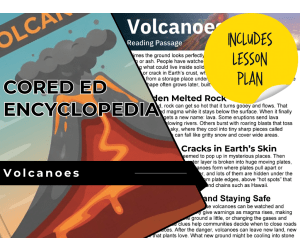
Volcanoes Reading Comprehension Passage - Cored Ed Encyclopedia
ELA, Language Development, Reading Comprehension, Reading, Pre-Reading, Earth Sciences, Earth and Environmental Sciences, Science, Geography, Social Studies, Grade 2, 3, 4, 5, Worksheets & Printables, Worksheets, Teacher Tools, Centers, Activities, Writing Prompts, Assessments, Quizzes and Tests, Quizzes, Lesson Plans
This volcanoes reading comprehension with lesson plan includes: Visualization (on the front cover) Start your lesson by taking a minute to think and share something about the topic. Read the script aloud (slowly), perhaps prepare some music or sound effects. Student close their eyes and let their imaginations wander. Students open their eyes, read the question aloud and give them a few minutes to complete. Ask a few students to share or keep answers until the end to compare with what they learn in the passage. Quick pause—thousands of Cored Education products are included with your TeachSimple membership. Download links and encyclopedia index available here. Pre-Reading Trivia Students will write down one thing they already know about the subject and then read five more facts and discuss. These facts are fun, and the students will enjoy learning about the subject before reading more. Give 1 minute for students to write what they already know (no pressure—best guess is fine). Read the five facts together. After each fact, do ask a student for their opinion, was it surprising? Set a purpose by asking students to highlight/underline one fact they want to learn more about during the reading. Reading Passage The text is a high-interest reading passage with set paragraphs, roughly three to four paragraphs long. It contains a variety of themes about the topic, anywhere from history to technology. The passage is between 250 and 350 words in length. First, ask students to look at the headings and see what they’ll learn about today. What do they know about the topic/heading? First read options: Teacher read-aloud (best for support). Partner reading (paragraph by paragraph). While reading, students underline important details, and vocabulary words they think may come up in the questions section. Mixed Questions The first question page contains four multiple-choice questions, each with a choice of four answers, and three written response questions that require a sentence or two from the student. Students complete the mcqs first independently, then review quickly as a class. For the 3 written responses, try to get students giving the answer with some form of evidence: “I think ___ because the text says ___.” If students get stuck, send them back to check the passage. Vocabulary Questions Practice seven key words from the text in this section across two activities. First section is scrambled words where students will unscramble three words given a clue for each. The second section is a word to meaning matching activity. Before starting, have some students read out words they underlined in the passage. Ask students to say the word and read aloud the sentence(s) around each word. Ask students to do scrambled words and the matching exercise in pairs then go through answers as a class. For the scrambled spelling task, get four pairs to come up to the board and write the words for extra practice with the other student reading out the clue. For the matching task, prompt students to give full sentences: “I matched ___ with ___ because ___.” Creative Writing In this question, the student will be required to write a five to eight sentence paragraph on a question related to the topic. Before starting, ask students write down 3 key ideas they are going to include in their piece. Ask students for ideas to share around the class to help those struggling. Pro writing expectations: 5–8 sentences At least 2 facts or details from the passage At least 2 vocabulary words from the previous page Students read their paragraphs while classmates listen for facts and vocabulary words. Extension Activities This page is optional for fast finishers or to take home. There are several activities, each one requiring a different skill. Do some, do none, do all, completely optional - but you will feel reassured knowing every possibility is planned for. Includes summary writting question. Answer Key There are answers for the multiple-choice questions, written response questions have sample answers, vocabulary answers and if there is a summary question then a sample summary will be provided as well. Lesson Plan Included Customized lesson plan for this lesson is included. Lesson Snapshot Title: Volcanoes Genre: Nonfiction (Informational text) Subject: Science (Earth Science) Primary Topic: What volcanoes are, how they form, and safety clues Estimated Guided Reading Level (A–Z): P What This Lesson Teaches Best What a volcano is (more than a “mountain”): Explains a volcano as an opening/vent or crack in Earth’s crust where hot melted rock, ash, and gases escape from an underground storage place called a magma chamber. Magma vs. lava: Defines melted rock as magma underground and lava once it reaches open air. How volcanic ash forms and spreads: Describes eruptions that toss bits of magma into the sky, cooling into tiny sharp pieces called volcanic ash that can fall like gritty snow and cover wide areas. Why volcanoes form where they do: Connects volcano locations to Earth’s outer layer being broken into huge moving plates (pulling apart or sliding under another), and also to “hot spots” that can form island chains such as Hawaii. Warning signs and community safety: Notes that rising magma can cause small earthquakes, ground swelling, or changes in gases and heat, and that these clues help communities decide when to close roads or move to safer places. Learning Goals Students will explain what the text says a volcano is and where the material comes from. Students will describe the difference between magma and lava using the passage’s definitions. Students will identify one way volcanic ash forms and describe what it is like when it falls. Students will describe how moving plates and hot spots help explain where volcanoes form. Students will list warning signs in the passage that may happen as magma rises. Students will explain how scientists’ observations can help communities stay safer. Key Vocabulary From the Text crust — Earth’s hard outer layer. magma — melted rock below Earth’s surface. lava — melted rock after it reaches open air. eruptions — times when a volcano sends material out. plates — huge moving pieces of Earth’s outer layer. FULL CATALOG OF DOWNLOAD LINKS AND ENCYCLOPEDIA INDEX HERE
Author Cored Education
Rating
Tags Vocabulary, Reading Comprehension, Reading Passages, Lesson Plans, Ela Lesson Plans, Reading Comprehension Lesson Plans, Pre-reading, Science Lesson Plans, Earth Science, Social Studies Lesson Plans
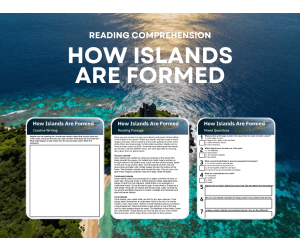
Islands Free Reading Comprehension Passage
ELA, Reading Comprehension, Reading, Language Development, ESL, Library, Science, Earth Sciences, Earth and Environmental Sciences, Strategies, Grade 2, 3, 4, 5, Worksheets & Printables, Worksheets, Teacher Tools, Centers, Activities, Writing Prompts, Assessments, Quizzes and Tests, Quizzes, Tests
Islands reading comprehension: Snapshot Title: How Islands Are Formed Genre: Nonfiction Subject: Earth Science Primary Topic: How different types of islands form Estimated Guided Reading Level (A–Z): S What This Lesson Teaches Best Explains that islands can form in several different ways. Compares volcanic islands, continental islands, and coral islands. Teaches sequence and process through volcano eruptions, lava layers, and island growth. Connects landforms to Earth processes such as magma, sea-level rise, and tectonic plates. Explains why low coral islands are vulnerable to rising oceans. Learning Goals Students will define islands using details from the passage. Students will explain how volcanic islands form over time. Students will describe how continental islands can separate from a mainland. Students will identify coral islands as atolls built by tiny sea creatures. Students will compare volcanic islands and continental islands using text evidence. Key Vocabulary From the Text Magma — hot melted rock beneath Earth. Crust — Earth’s outer rocky layer. Tectonic — related to moving plates of Earth. Atolls — ring-shaped coral islands. Polyps — tiny sea creatures that build coral. Did you know there are thousands of Cored Education products included with a TeachSimple membership? Click here for the free catalog. This product includes: Reading Passage The text is a high-interest reading passage with set paragraphs, roughly three to four paragraphs long. It contains a variety of themes about the topic, anywhere from history to technology. The passage is between 250 and 350 words in length. First, ask students to look at the headings and see what they’ll learn about today. What do they know about the topic/heading? First read options: Teacher read-aloud (best for support). Partner reading (paragraph by paragraph). While reading, students underline important details, and vocabulary words they think may come up in the questions section. Mixed Questions The first question page contains four multiple-choice questions, each with a choice of four answers, and three written response questions that require a sentence or two from the student. Students complete the mcqs first independently, then review quickly as a class. For the 3 written responses, try to get students giving the answer with some form of evidence: “I think ___ because the text says ___.” If students get stuck, send them back to check the passage. Creative Writing In this question, the student will be required to write a five to eight sentence paragraph on a question related to the topic. Before starting, ask students write down 3 key ideas they are going to include in their piece. Ask students for ideas to share around the class to help those struggling. Pro writing expectations: 5–8 sentences At least 2 facts or details from the passage At least 2 vocabulary words from the previous page Students read their paragraphs while classmates listen for facts and vocabulary words. Answer Key There are answers for the multiple-choice questions, written response questions have sample answers, vocabulary answers and if there is a summary question then a sample summary will be provided as well.
Author Cored Education
Rating
Tags Reading Comprehension, Reading Passages, Reading, Ela Mcqs, Creative Writing, Comprehension, Free, Free Reading, Science, Earth Science
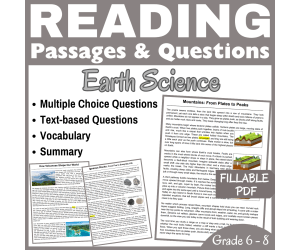
Science Reading Passages: Volcanoes, Rocks, & Mountains (FILLABLE PDF)
Science, Earth and Environmental Sciences, ELA, Reading, Reading Comprehension, Strategies, Resources for Teachers, Earth Sciences, Geology, Grade 6, 7, 8, 9, Writing Prompts, Worksheets & Printables, Centers, Activities, Teacher Tools, Assessments, Quizzes and Tests, Quizzes, Tests
Volcanoes, Rocks, & Mountains: Reading Comprehension Passages (FILLABLE PDF) This very engaging and fillable collection of earth science reading passages about Mountains, Volcanoes, and Igneous Rocks is designed to bridge the gap between science and literacy through strengthening reading comprehension and sparking scientific curiosity in middle school students. Each passage blends English Language Arts skills with accurate science content that supports NGSS classroom practice. Ideal for interdisciplinary learning in ELA and Science. Suitable for Grade 9 review, too! These worksheets are designed as fillable PDFs , which means students can type their answers directly into the document on any computer or tablet . Each page includes highlighted text fields that show them exactly where to type! What Is Included? There are (3) informational passages: Mountains: From Plates to Peaks How Volcanoes Shape Our World Igneous Rocks: From Fire to Everyday Life Student Tasks for Each Passage: 5 multiple-choice questions targeting main idea, key details, inference, vocabulary in context, and use of evidence 5 vocabulary matching items with clear, student-friendly definitions 5 text-based questions that require citing specific lines or facts 1 summary prompt that asks students to condense central ideas accurately Full answer key for every section Available Formats for this Resource Word Docs Google Docs FULL CATALOG OF DOWNLOADING LINKS HERE Other Science Reading Collections and Topics You May Find in the Store: 1. Astronomy & Space Science 2. Volcanoes, Rocks, & Mountains 3. Rock Cycle, Soil, & Sinkholes 4. Mars, Glaciers, & Antarctica 5. Water Cycle, Acid Rain, & Wastewater 6. Insects, Animals, & Ecosystems 7. Bioluminescence & Insects 8. Animal Skin, Cats, & T. Rex 9. Human Body and Senses 10. Health & Applied Bioscience 11. Waves, Light, & Imaging 12. Electricity & Energy 13. Motion & Materials 14. Chemistry and Materials Science 15. Electromagnetism 16. Acids and Bases 17. Gas Laws 18. Biotechnology 19. Periodic Trends 20. Protists and Fungi 21. Microevolution 22. Blood 23. Chemical Bonding 24. Magnets 25. Muscles 26. Nuclear Chemistry 27. Electromagnetic Devices 28. Epigenetics 29. The Law of Conservation of Mass 30. Atomic Models 31. Isotopes and Ions 32. Light 33. Human-Environment Interaction 34. Theory of Evolution 35. Photosynthesis 36. Origins of Life and Early Earth 37. Gene Expression and Regulation 38. Thermochemistry 39. Allergies 40. Coevolution 41. Birth to Adulthood 42. Cells 43. Entropy and Free Energy 44. The Human Brain 45. Mixtures and Solutions 46. Invertebrates 47. Zoo Animals 48. Biochemistry 49. Animal Behavior 50. Population Ecology ...and many more engaging science reading passages that cover intriguing and important topics designed to spark curiosity and support student learning. How to Use These PDFs Click on the highlighted area to start typing your answer. Move to the next question by clicking in the next highlighted box. When you are finished, close the document and select SAVE so your answers stay recorded. If you want to keep a blank copy for later, choose Save As and give your completed version a new name. Product Details Length: 13 pages total Grades: 6–8, also suitable for Grade 9 review Use cases: close reading, stations, homework, intervention, test prep, and sub plans Standards support: reinforces informational-text skills and supports NGSS-style sense making through observation, modeling, and clear use of claim, evidence, and reasoning Why Teachers Choose This Set Authentic science content paired with rigorous literacy practice Consistent task structure across all passages for easier planning and smoother student routines Clear, age-appropriate writing that builds confidence without oversimplifying Use this set to reinforce ELA skills in science, to add literacy to your lessons, or to support independent work. The passages strengthen main idea, evidence use, vocabulary in context, inference, cause and effect, and summary writing. With ready-to-use assessments and complete answer keys, you can provide focused practice that is simple to run and fast to review.
Author Middle & High School - CORED Education
Rating
Tags Middle School, Reading Comprehension, Reading Strategies, Reading Passages, ELA, Centers, Reading Passage, Assessments, Vocabulary, Earth Science

Earth Science Reading Comprehension Passage: The Rock Cycle (PDF)
Science, ELA, Reading, Reading Comprehension, Strategies, Resources for Teachers, Earth and Environmental Sciences, Earth Sciences, Grade 6, 7, 8, 9, Writing Prompts, Worksheets & Printables, Centers, Activities, Teacher Tools, Assessments, Quizzes and Tests, Quizzes, Tests
Science Reading Comprehension Passages and Questions: The Rock Cycle (PDF) This very engaging earth science reading passage about The Rock Cycle is designed to bridge the gap between science and literacy through strengthening reading comprehension and sparking scientific curiosity in middle school students. The passage blends English Language Arts skills with accurate science content that supports NGSS classroom practice. Ideal for interdisciplinary learning in ELA and Science. Suitable for Grade 9 review, too! Student Tasks for The Passage: 5 multiple-choice questions targeting main idea, key details, inference, vocabulary in context, and use of evidence 5 vocabulary matching items with clear, student-friendly definitions 5 text-based questions that require citing specific lines or facts 1 summary prompt that asks students to condense central ideas accurately Full answer key for every section Available Formats for this Resource Fillable PDF Word Docs Google Docs FULL CATALOG OF DOWNLOADING LINKS HERE Product Details Length: 5 pages total Grades: 6–8, also suitable for Grade 9 review Use cases: close reading, stations, homework, intervention, test prep, and sub plans Standards support: reinforces informational-text skills and supports NGSS-style sense making through observation, modeling, and clear use of claim, evidence, and reasoning Why Teachers Choose This Set Authentic science content paired with rigorous literacy practice Consistent task structure across all passages for easier planning and smoother student routines Clear, age-appropriate writing that builds confidence without oversimplifying Other Science Reading Collections you May find in the store: 1. Astronomy & Space Science 2. Volcanoes, Rocks, & Mountains 3. Rock Cycle, Soil, & Sinkholes 4. Mars, Glaciers, & Antarctica 5. Water Cycle, Acid Rain, & Wastewater 6. Insects, Animals, & Ecosystems 7. Bioluminescence & Insects 8. Animal Skin, Cats, & T. Rex 9. Human Body and Senses 10. Health & Applied Bioscience 11. Waves, Light, & Imaging 12. Electricity & Energy 13. Motion & Materials 14. Chemistry and Materials Science Use this set to reinforce ELA skills in science, to add literacy to your lessons, and to support independent work. The passages strengthen main idea, evidence use, vocabulary in context, inference, cause and effect, and summary writing. With ready-to-use assessments and complete answer keys, you can provide focused practice that is simple to run and fast to review.
Author Middle & High School - CORED Education
Rating
Tags Middle School, Reading Comprehension, Reading Strategies, ELA, Centers, Reading Passage, Assessments, Vocabulary, Environmental Science, Earth Science
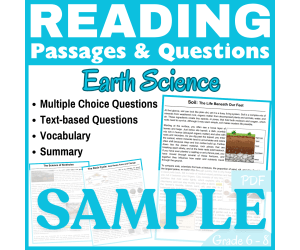
Rock Cycle, Soil, & Sinkholes: SAMPLE Reading Passage (PDF)
Science, Earth and Environmental Sciences, ELA, Reading, Reading Comprehension, Strategies, Resources for Teachers, Geology, Earth Sciences, Grade 6, 7, 8, 9, Writing Prompts, Worksheets & Printables, Centers, Activities, Teacher Tools, Assessments, Quizzes and Tests, Quizzes, Tests
This is a ONE PASSAGE SAMPLE. The following is the description of the FULL resource and the downloading links: Rock Cycle, Soil, & Sinkholes: Reading Comprehension Passages (PDF) This very engaging collection of earth science reading passages about Rock Cycle, Soil, and Sinkholes is designed to bridge the gap between science and literacy through strengthening reading comprehension and sparking scientific curiosity in middle school students. Each passage blends English Language Arts skills with accurate science content that supports NGSS classroom practice. Ideal for interdisciplinary learning in ELA and Science. Suitable for Grade 9 review, too! What Is Included? There are (3) informational passages: Soil: The Life Beneath Our Feet Explore how minerals, organic matter, water, and air build layered soil, and see how texture and structure affect roots, drainage, clean water, and healthy habitats. The Science of Sinkholes Understand how dissolving rock creates underground voids, what can trigger subsidence or collapse, and how mapping and prevention reduce risk in vulnerable areas. The Rock Cycle: How Rocks Form and Change Follow rock material as it melts, crystallizes, weathers, compacts, and transforms under heat and pressure, then connect these processes to examples in nature and everyday life. Student Tasks for Each Passage: 5 multiple-choice questions targeting main idea, key details, inference, vocabulary in context, and use of evidence 5 vocabulary matching items with clear, student-friendly definitions 5 text-based questions that require citing specific lines or facts 1 summary prompt that asks students to condense central ideas accurately Full answer key for every section Available Formats for this Resource Word Docs Google Docs FULL CATALOG OF DOWNLOADING LINKS HERE Other Science Reading Collections and Topics You May Find in the Store: 1. Astronomy & Space Science 2. Volcanoes, Rocks, & Mountains 3. Rock Cycle, Soil, & Sinkholes 4. Mars, Glaciers, & Antarctica 5. Water Cycle, Acid Rain, & Wastewater 6. Insects, Animals, & Ecosystems 7. Bioluminescence & Insects 8. Animal Skin, Cats, & T. Rex 9. Human Body and Senses 10. Health & Applied Bioscience 11. Waves, Light, & Imaging 12. Electricity & Energy 13. Motion & Materials 14. Chemistry and Materials Science 15. Electromagnetism 16. Acids and Bases 17. Gas Laws 18. Biotechnology 19. Periodic Trends 20. Protists and Fungi 21. Microevolution 22. Blood 23. Chemical Bonding 24. Magnets 25. Muscles 26. Nuclear Chemistry 27. Electromagnetic Devices 28. Epigenetics 29. The Law of Conservation of Mass 30. Atomic Models 31. Isotopes and Ions 32. Light 33. Human-Environment Interaction 34. Theory of Evolution 35. Photosynthesis 36. Origins of Life and Early Earth 37. Gene Expression and Regulation 38. Thermochemistry 39. Allergies 40. Coevolution 41. Birth to Adulthood 42. Cells 43. Entropy and Free Energy 44. The Human Brain 45. Mixtures and Solutions 46. Invertebrates 47. Zoo Animals 48. Biochemistry 49. Animal Behavior 50. Population Ecology ...and many more engaging science reading passages that cover intriguing and important topics designed to spark curiosity and support student learning. Product Details Length: 15 pages total Grades: 6–8, also suitable for Grade 9 review Use cases: close reading, stations, homework, intervention, test prep, and sub plans Standards support: reinforces informational-text skills and supports NGSS-style sense making through observation, modeling, and clear use of claim, evidence, and reasoning Why Teachers Choose This Set Authentic science content paired with rigorous literacy practice Consistent task structure across all passages for easier planning and smoother student routines Clear, age-appropriate writing that builds confidence without oversimplifying Use this set to reinforce ELA skills in science, to add literacy to your lessons, or to support independent work. The passages strengthen main idea, evidence use, vocabulary in context, inference, cause and effect, and summary writing. With ready-to-use assessments and complete answer keys, you can provide focused practice that is simple to run and fast to review.
Author Middle & High School - CORED Education
Rating
Tags Middle School, Reading Comprehension, Reading Strategies, Reading Passages, ELA, Centers, Reading Passage, Assessments, Vocabulary, Earth Science
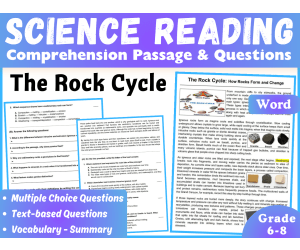
Earth Science Reading Comprehension Passage: The Rock Cycle (Word)
Science, ELA, Reading, Reading Comprehension, Strategies, Resources for Teachers, Earth and Environmental Sciences, Earth Sciences, Grade 6, 7, 8, 9, Writing Prompts, Worksheets & Printables, Centers, Activities, Teacher Tools, Assessments, Quizzes and Tests, Quizzes, Tests
Science Reading Comprehension Passages and Questions: The Rock Cycle (Word) This very engaging earth science reading passage about The Rock Cycle is designed to bridge the gap between science and literacy through strengthening reading comprehension and sparking scientific curiosity in middle school students. The passage blends English Language Arts skills with accurate science content that supports NGSS classroom practice. Ideal for interdisciplinary learning in ELA and Science. Suitable for Grade 9 review, too! Student Tasks for The Passage: 5 multiple-choice questions targeting main idea, key details, inference, vocabulary in context, and use of evidence 5 vocabulary matching items with clear, student-friendly definitions 5 text-based questions that require citing specific lines or facts 1 summary prompt that asks students to condense central ideas accurately Full answer key for every section Available Formats for this Resource PDF Fillable PDF Google Docs FULL CATALOG OF DOWNLOADING LINKS HERE Product Details Length: 5 pages total Grades: 6–8, also suitable for Grade 9 review Use cases: close reading, stations, homework, intervention, test prep, and sub plans Standards support: reinforces informational-text skills and supports NGSS-style sense making through observation, modeling, and clear use of claim, evidence, and reasoning Why Teachers Choose This Set Authentic science content paired with rigorous literacy practice Consistent task structure across all passages for easier planning and smoother student routines Clear, age-appropriate writing that builds confidence without oversimplifying Other Science Reading Collections you May find in the store: 1. Astronomy & Space Science 2. Volcanoes, Rocks, & Mountains 3. Rock Cycle, Soil, & Sinkholes 4. Mars, Glaciers, & Antarctica 5. Water Cycle, Acid Rain, & Wastewater 6. Insects, Animals, & Ecosystems 7. Bioluminescence & Insects 8. Animal Skin, Cats, & T. Rex 9. Human Body and Senses 10. Health & Applied Bioscience 11. Waves, Light, & Imaging 12. Electricity & Energy 13. Motion & Materials 14. Chemistry and Materials Science Use this set to reinforce ELA skills in science, to add literacy to your lessons, and to support independent work. The passages strengthen main idea, evidence use, vocabulary in context, inference, cause and effect, and summary writing. With ready-to-use assessments and complete answer keys, you can provide focused practice that is simple to run and fast to review.
Author Middle & High School - CORED Education
Rating
Tags Middle School, Reading Comprehension, Reading Strategies, ELA, Centers, Reading Passage, Assessments, Vocabulary, Environmental Science, Earth Science
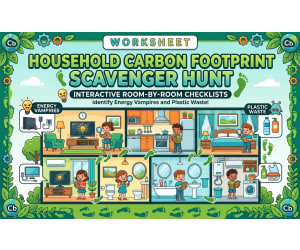
Household Carbon Footprint Scavenger Hunt
Science, Earth and Environmental Sciences, Environmental Science, Earth Sciences, Geology, Theories, Basic Science, Technology, Engineering, Space, Grade 3, 4, 5, 6, 7, 8, 9, Worksheets & Printables, Workbooks, Worksheets, Word Searches, Teacher Tools, Assessments, Lesson Plans, Quizzes and Tests, Quizzes, Tests
Transform your students into real-life Eco-Detectives! Are you looking for a hands-on, engaging, and impactful environmental science activity that goes beyond a standard worksheet? This Household Carbon Footprint Scavenger Hunt turns learning about climate change into a fun, actionable mission that empowers students to make a real difference, right in their own homes. This comprehensive, no-prep resource tackles two of the biggest "invisible" contributors to a household's carbon footprint: Energy Vampires (devices draining standby power) and Single-Use Plastics . By turning abstract concepts into a tangible hunt, students will develop critical thinking, data collection, and problem-solving skills aligned with Next Generation Science Standards (NGSS) . Perfect for Earth Day , a unit on environmental science, project-based learning (PBL), or a meaningful distance learning assignment, this scavenger hunt gets kids moving, observing, and collaborating with their families to create a more sustainable home. What's Included in this 38-Page PDF Resource: Part 1: Educator's Scientific Guide: A detailed 10-page introduction for the teacher or parent, explaining the science behind phantom power and the lifecycle of plastics in clear, easy-to-understand terms. Part 2: The Student Workbook (19 pages): Vocabulary Mission Briefing: Ensures students understand key terms before they begin. 8 Unique Room-by-Room Checklists: Students audit the Kitchen, Living Room, Bedroom, Bathroom, Laundry Room, and Home Office, hunting for culprits. 2 Action Plan Worksheets: Guides students to synthesize their data and create realistic, actionable plans for reducing energy and plastic waste. Part 3: Teacher Resources & Visuals (9 pages): 3 High-Quality Visual Aids: Concept maps and charts, perfect for classroom projection or as print-outs. Step-by-Step Teacher Implementation Guide: Includes pre-hunt prep, safety protocols, and tips for facilitating a powerful post-hunt reflection. Comprehensive Answer Key: A complete key with evaluation rubrics to make grading simple and objective. Give your students the gift of eco-agency, not eco-anxiety. Download today and empower the next generation of environmental stewards! Keywords: Earth Day, Carbon Footprint, Environmental Science, Scavenger Hunt, Project-Based Learning, At-Home Activity, Distance Learning, 3rd Grade, 4th Grade, 5th Grade, NGSS, Climate Change, Energy Conservation, Plastic Waste, Recycling, STEM, Go Green. Why Parents/Schools Love It: Turns Abstract Concepts into a Fun Game: It transforms the overwhelming idea of "climate change" into a tangible "scavenger hunt" for "energy vampires," making learning active, memorable, and incredibly engaging for kids. Empowers Students with Actionable Solutions: Instead of causing eco-anxiety, this resource gives children a sense of agency. By unplugging a charger or choosing a reusable bottle, they see an immediate, positive impact they can make. Comprehensive & No-Prep: This is a complete, ready-to-go resource. With a detailed teacher guide, student workbooks, visual aids, and an answer key, it saves educators and parents valuable preparation time. Strengthens the Home-School Connection: It's the perfect project to send home. The activity encourages students to collaborate with their families, bringing environmental education from the classroom to the living room. Builds Real-World Science Skills: Students aren't just memorizing facts; they are acting like real scientists—observing, collecting data (on their checklists), analyzing findings, and proposing solutions (in their action plans), directly aligning with NGSS practices. Target Student Audience : Based on a complete analysis of the language, concepts, and tasks in the workbook: Primary Target: 3rd Grade (8-9 years old). The PDF explicitly mentions this grade level, and the content is perfectly aligned with their cognitive abilities (the concrete operational stage). The tasks involve reading, counting, identification, and simple written responses. Secondary Target: 4th Grade and 5th Grade. This activity is still highly relevant and engaging for these students. They can complete it with more independence and provide more detailed, analytical responses in the action plan sections. Possible Niche Target: Advanced 2nd Graders (with significant parent/teacher guidance) or Middle School Special Education students who benefit from hands-on, concrete learning activities. Copyright/Terms of Use: This Book was copyrighted by Syed Hammad Rizvi. This resource is for personal and single classroom use only. You may not alter, redistribute, or sell any part of this resource. In other words, you may not put it on the Internet where it could be publicly found and downloaded. If you want to share this resource with colleagues, please purchase additional licenses from Teachsimple. Thank you for respecting these terms of use. This product is happily brought to you by Syed Hammad Rizvi
Author Creative Book Store
Rating
Tags EarthDay, TeacherResources, EnvironmentalScience, STEM, Homeschool, ScavengerHunt, DigitalDownload, Printable, CarbonFootprint, EarthDayActivities

Home Solar Panel Output & Angle Calculation
Science, Technology, Engineering, Earth and Environmental Sciences, Earth Sciences, Environmental Science, Geology, Space, Life Sciences, Nature & Plants, Grade 6, 7, 8, 9, 10, 11, 12, Worksheets & Printables, Workbooks, Worksheets, Word Searches, Writing Prompts, Teacher Tools, Quizzes and Tests, Quizzes, Tests, Lesson Plans
Transform your students into renewable energy experts with this rigorous, real-world solar energy calculation project! This comprehensive, no-prep unit bridges the gap between abstract science concepts and tangible engineering design, challenging students to calculate the actual energy output of residential solar panels. Perfect for AP Environmental Science (APES), AP Physics, and STEM engineering classes, this resource goes far beyond "solar panels make electricity." Students will dive deep into the celestial mechanics, architectural geometry, and physics that determine a solar array's viability. They will use trigonometry and multi-step formulas to model and solve authentic problems, preparing them for college-level coursework and green-economy careers. What's Inside This 41-Page All-in-One Unit? Part 1: In-Depth Theoretical Guide: A 10-page "textbook" chapter explaining the core scientific principles, including: Solar Declination, Axial Tilt, and Seasonal Sun Angles Architectural Geometry: Roof Pitch, Azimuth, and Panel Tilt The Angle of Incidence and Lambert's Cosine Law The Standard Solar Energy Formula (Insolation, Efficiency, Performance Ratio) The "Temperature Paradox" and thermal derating effects. Part 2: Rigorous Student Workbook: 8 scaffolded worksheets with over 70 problems designed to build mastery. Topics include: Worksheet 1: Fundamentals of Insolation & Peak Sun Hours Worksheet 2: Solar Declination & Seasonal Angles Worksheet 3: Translating Roof Pitch to Panel Tilt Worksheet 4: The Cosine Effect & Energy Capture Reductions Worksheet 5: Azimuth Offsets & Compass Orientations Worksheet 6: Temperature Derating & Thermal Inefficiency Worksheet 7: Area Constraints & System Sizing Worksheet 8: The Impact of Shading & Circuit Topology Part 3: Complete Teacher Resources: Everything you need to teach with confidence! High-Quality Instructional Visuals: Clear diagrams to explain complex geometry. Comprehensive, Step-by-Step Answer Key: Detailed solutions and "Teacher's Notes" for every problem. 3-Day Teacher Implementation Guide: Pedagogical sequencing, tips for correcting common misconceptions, and two exciting ideas for hands-on lab extensions (including "The Shoebox Solar Audit"). This isn't just a worksheet; it's a complete, engaging, and challenging project that makes math and science relevant. Empower your students with the quantitative skills to analyze and design the sustainable energy systems of the future! Keywords: AP Environmental Science, APES, AP Physics, Renewable Energy, Solar Energy, Solar Panel Calculation, STEM Project, Engineering Design, Earth Science, Climate Change Solution, Math Integration, Trigonometry, Word Problems, Worksheet, Project Based Learning (PBL), No Prep. Why Parents/Schools Love It: Real-World Relevance: It moves beyond textbook theory to teach timely, practical skills for the growing green economy, making learning engaging and purposeful. Fosters Critical Thinking & STEM Skills: Students aren't just memorizing formulas; they are modeling, analyzing data, and solving complex, multi-step engineering problems—skills crucial for college and career success. Comprehensive & Time-Saving: This is a complete, "print-and-go" or "upload-and-go" lesson unit. The included teacher guide, answer key, and visuals save educators dozens of hours of prep time. Aligns with Advanced Curriculum: The rigor and content are perfectly aligned with the requirements of AP Environmental Science and AP Physics courses, directly supporting student success on high-stakes exams. Integrates Multiple Subjects: It masterfully blends physics, environmental science, geometry, trigonometry, and engineering, demonstrating the interconnected nature of STEM fields. Target Audience (Student Classes) : Based on the vocabulary ("quantitative realm of irradiance," "celestial mechanics"), the mathematical rigor (trigonometry, multi-step formulas), and the direct mention in the text, target: AP Environmental Science (APES): This is the primary and perfect target. The content aligns directly with the APES curriculum units on Energy Resources and Consumption. AP Physics (1, 2, or C): Excellent for units on energy, thermodynamics, and waves. It provides a fantastic real-world application of physics principles. High School Engineering or Pre-Engineering Electives: Ideal for programs focused on STEM, design thinking, and sustainable technology. Advanced Earth Science or Integrated Science Classes: Suitable for honors-level courses looking to integrate math and physics into their curriculum. Copyright/Terms of Use: This Book was copyrighted by Syed Hammad Rizvi. This resource is for personal and single classroom use only. You may not alter, redistribute, or sell any part of this resource. In other words, you may not put it on the Internet where it could be publicly found and downloaded. If you want to share this resource with colleagues, please purchase additional licenses from Teachsimple. Thank you for respecting these terms of use. This product is happily brought to you by Syed Hammad Rizvi
Author Creative Book Store
Rating
Tags RenewableEnergy, SolarEnergy, STEM, ScienceTeacher, Physics, EnvironmentalScience, CleanEnergy, HighSchoolScience, SolarPower, PhysicsTeacher

Zero-Waste Lifestyle Tracking & Habit Builder Journals
Science, Resources for Teachers, Life Sciences, Earth and Environmental Sciences, Earth Sciences, Environmental Science, Geology, Nature & Plants, STEM, Biology, Grade 6, 7, 8, 9, 10, 11, 12, Teacher Tools, Worksheets & Printables, Workbooks, Worksheets, Word Searches, Assessments, Lesson Plans, Quizzes and Tests, Quizzes, Tests
Turn your classroom into an environmental science lab with the help of this awesome 41-page Zero Waste Lifestyle Tracking and Habit Builder Journal! This is a project-based learning resource for grades 4–8 that is aligned to the standards! Looking for a real world environmentally focused way to teach environmental science to your students that isn't just a bunch of recycling posters? A complete curriculum journal combining current neuroscience research, ecology theory and hands-on data collection will give your students everything they need to consider themselves true environmental scientists - and it begins with measuring their own lives! This resource is not just one big stack of worksheets but rather, it is a fully scaffolded 3-phase academic journal developed with university seminar style rigor and middle school classroom style accessibility. Your students won’t just learn about the environment; they’ll measure it, analyze it and make changes to it! CONTENTS (41 Pages, Print & Digital Ready): Phase 1 — Core Content & Theory (4 chapters): 1. The Anatomy of Waste explains what happens throughout the lifespan of waste items, including Lifecycle Assessment (LCA), the impact of microplastics in our world today, which items go in the landfill, which items can be incinerated, and how long it takes for a plastic fork to travel 450 years into our future 2. The Neuroscience of Habit Building discusses how our brains form habits based on the basal ganglia of the brain, how we can rebuild/rewire our habits scientifically through neuroplasticity, and the three parts of the habit loop (cue-routine-reward) 3. The Zero-Waste Hierarchy introduces the four elements of a zero-waste lifestyle: Refuse, Reduce, Reuse, Rot (Composting) and Recycle. This chapter includes a real-world example of how one school significantly reduced their waste by over 90% using these four proven methods 4. Data-Driven Stewardship teaches your students to think like a marine biologist and meteorologist by showing them how to track and analyze their own local environmental data. After each chapter is a fill-in-the-blank review of the chapter, called the Scholar's Review. Phase 2: 10Worksheet Workbook for Students (Research Lab Style) Personal Waste Audit 24-Hour (Data Collection Protocols: Empirical) Material Lifecycle Analysis of Material (From Raw Extraction To Disposal) Biochemistry of Composting (Green And Brown Materials, Aerobic And Anaerobic Decomposition) Single Use Plastic Substitution Matrix (Cost/Benefit Analysis) Water and Energy Footprint Calculation (Embedded Energy And Water Load Calculation; Shower Each Year; Cost Of Water To Make Cotton Shirt) Redesign Challenge For Circular Economy (Planned Volatility, Upcycling, Extended Producer Responsibility) Food Waste Economics (FIFO Pantry System, Estimate Of $780 Of Food Waste Per Year, What Is A Food Standard For A Non-Food Waste Item?) Fast Fashion Footprint (Cost To Wear, Use Of Micro-Plastics, Philosophy Of Wardrobe) Supermarket Packaging Detective (Identifying Greenwashing, Multi-Layered Packages, Bulk Purchasing) Zero-Waste Habit Builder (Keystone Priming, 30-Day Tracking Plan, Write Manifesto For A Zero Waste Life) PHASE 3—Teacher Resources and Visuals: Three professionally designed SVG diagrams (Zero Waste Hierarchy, Linear vs. Circular Economy, Sustainability Habit Loop) Complete Answer Key with example answers and teacher rubric notes 4 week pacing guide with weekly objectives, activities, teacher roles and homework 100-point assessments rubric across four categories of data collection, behavioural design, critical thinking and communication Five extension activities (Trash Jar Challenge, Community Waste Mapping, Letter Writing Campaign to Corporations, Do-It-Yourself Repairs Workshop, Composting Science Experiment; if possible please use a separate document per activity) Strategies for differentiating instruction for Grades 4-5, Grade 8/Gifted, IEP/504 and ELL students CONNECTING TO CURRICULUM: This journal ties into Next Generation Science Standards (NGSS), Common Core English Language Arts (informational text analysis, evidence based writing) and Common Core Mathematics (percentages, projections, data analysis). This journal combines many subjects — environmental science, behavioral psychology, economics and persuasive writing — into one connected whole. USAGE IDEAS: Great as a 4-week stand-alone unit or as part of an after-school environmental club, summer enrichment program or reinforcement through integration into existing science, health or social studies curricula. Assign user digitally (fillable PDF) or in print. DIGITAL DOWNLOAD — PRINT & GO! REASONS PARENTS/SCHOOLS LOVE THE RESOURCE: Merging Science, Psychology, and Real-World Mathematics – Instead of merely reading about the environment, kids actually conduct real waste audits, calculate their water footprints, and use their own personal data to perform real-world food waste economics analysis – helping them to take abstract concepts and move towards making those concepts their own, and thus, real. Tremendous Support For Teachers From Day One – Each of the resources, including a complete 4-Week Pacing Guide, example responses in the Answer Key, a 100-point Assessment Rubric, and a variety of differentiation strategies to accommodate ALL learners (IEP/504, ELL, Gifted) provides teachers with no-prep stress! Building Lasting Habits, Not Just Raising Awareness – This journal is based on neuroscience principles, specifically the Habit Loop framework, which teaches kids HOW behavior changes within the brain — therefore they can establish long-term environmental habits to implement after the conclusion of the unit. No Eco-Anxiety – Only Eco-Empowerment – Constructivist pedagogy does not endorse guilt-based teaching practices to educate/expose students to environmental issues. Instead, students are encouraged to view themselves as environmental scientists, thereby creating a sense of worth/empowerment as opposed to being seen as passive victims of "climate doom"; hence, all resources provided in this unit have been designed with both emotional safety and motivation in mind. Cross-Curricular and Standards-Aligned Value – When you purchase this journal as a single resource, you are actually replacing multiple separate resources. This one journal covers multiple areas of study related to environmental science, data analysis, persuasive writing, behavioral psychology, economics, and systems thinking — therefore you are maximizing the instructional value and curriculum alignment of numerous subject areas! TARGET GRADES/CLASSES: On evaluating for the content type's level of complexity, the level of language used, the level of math skill needed; and how to teach the content using scaffolding: Primary Target 6th, 7th, and 8th grades (Middle School, our primary audience) Science classes; Environmental Science/ Earth Science Health and Wellness Classes Social Studies/Civics (Circular economy, EPR Policy) ELA Classes (Persuasive writing, Informational text) Secondary Target 5th Grade (Upper Elementary, with teacher scaffolded materials to be used; will require the use of Phase 3 differentiation strategies). 4th Grade (Will require major support in accordance with Phase 3 differentiation, as mentioned in Section 2) 9th Grade (High School, Environmental Science as a remedial unit or an introductory unit) Special Programs Gifted/Honors programs (Students in 8th grade, extension Activities) IEP/504 Accommodations (explicitly provide support through IEP/504) ELL Programs (provide bilingual glossary strategies) Environmental clubs (5th through 9th grade) STEM/STEAM programs Best Audience Targets: Middle School Science teachers (6th to 8th grade) Environmental Science Teachers Parents of Students 10 - 14 taking homeschool classes School Librarians purchasing Sustainability books for their library collection After School Program Coordinators Eco-Conscious Parents with Interest in Supplement Learning Your use of this Resource Agreement: Copyright (or Terms of Use) Copyright is held by Syed Hammad Rizvi. You may use this resource for your personal and classroom use only, but may not alter, sell or redistribute any component of this resource, nor place any part of this resource on a publicly available website. You can only share this resource with your coworkers by purchasing additional licenses from Teachsimple. Thank you for complying with all copyright guidelines and restrictions. Syed Hammad Rizvi is proud to provide you with this resource.
Author Creative Book Store
Rating
Tags ZeroWasteEducation, EnvironmentalScience, SustainabilityEducation, ZeroWasteLifestyle, EcoEducation, GreenEducation, ClimateEducation, EnvironmentalLiteracy, SustainabilityLessons, ZeroWasteCurriculum
Earth Science Reading Passage: Types of Mountains (Fillable PDF)
Science, ELA, Reading, Reading Comprehension, Strategies, Resources for Teachers, Earth and Environmental Sciences, Earth Sciences, Grade 6, 7, 8, 9, Writing Prompts, Worksheets & Printables, Centers, Activities, Teacher Tools, Assessments, Quizzes and Tests, Quizzes, Tests
Science Reading Comprehension Passages and Questions: Types of Mountains (Fillable PDF) This very engaging earth science reading passage about Types of Mountains is designed to bridge the gap between science and literacy through strengthening reading comprehension and sparking scientific curiosity in middle school students. The passage blends English Language Arts skills with accurate science content that supports NGSS classroom practice. Ideal for interdisciplinary learning in ELA and Science. Suitable for Grade 9 review, too! These worksheets are designed as fillable PDFs , which means students can type their answers directly into the document on any computer or tablet . Each page includes highlighted text fields that show them exactly where to type! Student Tasks for The Passage: 5 multiple-choice questions targeting main idea, key details, inference, vocabulary in context, and use of evidence 5 vocabulary matching items with clear, student-friendly definitions 5 text-based questions that require citing specific lines or facts 1 summary prompt that asks students to condense central ideas accurately Full answer key for every section Available Formats for this Resource PDF Word Docs Google Docs FULL CATALOG OF DOWNLOADING LINKS HERE Product Details Length: 4 pages total Grades: 6–8, also suitable for Grade 9 review Use cases: close reading, stations, homework, intervention, test prep, and sub plans Standards support: reinforces informational-text skills and supports NGSS-style sense making through observation, modeling, and clear use of claim, evidence, and reasoning Why Teachers Choose This Set Authentic science content paired with rigorous literacy practice Consistent task structure across all passages for easier planning and smoother student routines Clear, age-appropriate writing that builds confidence without oversimplifying Other Science Reading Collections you May find in the store: 1. Astronomy & Space Science 2. Volcanoes, Rocks, & Mountains 3. Rock Cycle, Soil, & Sinkholes 4. Mars, Glaciers, & Antarctica 5. Water Cycle, Acid Rain, & Wastewater 6. Insects, Animals, & Ecosystems 7. Bioluminescence & Insects 8. Animal Skin, Cats, & T. Rex 9. Human Body and Senses 10. Health & Applied Bioscience 11. Waves, Light, & Imaging 12. Electricity & Energy 13. Motion & Materials 14. Chemistry and Materials Science Use this set to reinforce ELA skills in science, to add literacy to your lessons, and to support independent work. The passages strengthen main idea, evidence use, vocabulary in context, inference, cause and effect, and summary writing. With ready-to-use assessments and complete answer keys, you can provide focused practice that is simple to run and fast to review.
Author Middle & High School - CORED Education
Rating
Tags Middle School, Reading Comprehension, Reading Strategies, ELA, Centers, Reading Passage, Assessments, Vocabulary, Environmental Science, Earth Science

Earth Science Reading Comprehension Passage: Soil Types. SAMPLE
Science, ELA, Reading, Reading Comprehension, Strategies, Resources for Teachers, Earth and Environmental Sciences, Earth Sciences, Geology, Grade 6, 7, 8, 9, Writing Prompts, Worksheets & Printables, Centers, Activities, Teacher Tools, Assessments, Quizzes and Tests, Quizzes, Tests
This is a free passage sample from the complete resource. The full version includes everything needed for a complete reading comprehension activity: the passage, multiple-choice questions, short-answer questions, vocabulary matching, a summary-writing task, and a detailed answer key. Download the complete passage resource by clicking on the following links: PDF Fillable PDF Word Docs Google Docs Science Reading Comprehension Passages and Questions: Soil Types (PDF) This very engaging earth science reading passage about Soil Types is designed to bridge the gap between science and literacy through strengthening reading comprehension and sparking scientific curiosity in middle school students. The passage blends English Language Arts skills with accurate science content that supports NGSS classroom practice. Ideal for interdisciplinary learning in ELA and Science. Suitable for Grade 9 review, too! Student Tasks for The Passage: 5 multiple-choice questions targeting main idea, key details, inference, vocabulary in context, and use of evidence 5 vocabulary matching items with clear, student-friendly definitions 5 text-based questions that require citing specific lines or facts 1 summary prompt that asks students to condense central ideas accurately Full answer key for every section FULL CATALOG OF DOWNLOADING LINKS HERE Product Details Length: 5 pages total Grades: 6–8, also suitable for Grade 9 review Use cases: close reading, stations, homework, intervention, test prep, and sub plans Standards support: reinforces informational-text skills and supports NGSS-style sense making through observation, modeling, and clear use of claim, evidence, and reasoning Why Teachers Choose This Set Authentic science content paired with rigorous literacy practice Consistent task structure across all passages for easier planning and smoother student routines Clear, age-appropriate writing that builds confidence without oversimplifying Other Science Reading Collections you May find in the store: 1. Astronomy & Space Science 2. Volcanoes, Rocks, & Mountains 3. Rock Cycle, Soil, & Sinkholes 4. Mars, Glaciers, & Antarctica 5. Water Cycle, Acid Rain, & Wastewater 6. Insects, Animals, & Ecosystems 7. Bioluminescence & Insects 8. Animal Skin, Cats, & T. Rex 9. Human Body and Senses 10. Health & Applied Bioscience 11. Waves, Light, & Imaging 12. Electricity & Energy 13. Motion & Materials 14. Chemistry and Materials Science Use this set to reinforce ELA skills in science, to add literacy to your lessons, and to support independent work. The passages strengthen main idea, evidence use, vocabulary in context, inference, cause and effect, and summary writing. With ready-to-use assessments and complete answer keys, you can provide focused practice that is simple to run and fast to review.
Author Middle & High School - CORED Education
Rating
Tags Middle School, Reading Comprehension, Reading Strategies, ELA, Centers, Reading Passage, Assessments, Vocabulary, Environmental Science, Earth Science