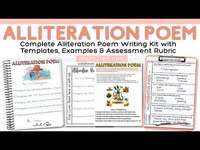
Alliteration Poem Template Poetry Writing Activity with Examples



- Grades
- Grades 2–5, Elementary, Homeschool Resources, Homeschool Templates
- Pages
- 19
- File type
- Answer key
- Included


- Subject
- ELA, Poetry, Literature
- Topic
- poetry lesson plan, poetry writing activity
- Resource types
- Centers, Activities, Graphic Organizers, Teacher Tools, Lesson Plans, Rubrics, Worksheets & Printables
- Answer key
- Included
- Standards
- CCSS.W.3.3 CCSS.W.4.3 +2
About this resource
What's inside this resource
Looking for a way to help your students actually understand alliteration without it turning into a bunch of random or overly silly sentences? I’ve found that alliteration can be one of those concepts students either overdo or don’t quite grasp, especially when they’re trying to apply it in their own writing. Having a bit of structure really makes a difference.
This activity gives students a starting point, so they’re not guessing what to do. Instead of just identifying alliteration, they’re using it in their own poems, which helps it stick. The examples make it easier for them to see what’s expected, and the templates guide them through the process without taking away their creativity. In my experience, this works well whether you’re introducing alliteration for the first time or revisiting it during a poetry unit. You can model a few examples together, then let students have a go using the templates. Some will need a bit more support, and others will run with it—but the structure is there for both.
Once they’ve drafted their poem, they can create a final version to display. It’s one of those activities where students actually enjoy reading each other’s work, which is always a win.
There’s also a simple lesson outline included if you want something easy to follow, along with a rubric to make marking more straightforward. It fits nicely into literacy rotations, whole-class lessons, or even as something to leave for early finishers when you need a meaningful task that doesn’t require a lot of extra explanation.
Items Included
Alliteration poem interactive notebook templates
Student-friendly example (color and blackline posters)
Step-by-step lesson plan
Publishing page for a final copy
Assessment rubric
Related resources
More resources teachers may find useful
24 related resources were found using this product's title, contributor, categories and tags.
In the classroom
Teaching tips & learning objectives

Learning objectives
- Use alliteration deliberately in an original poem
- Revise a draft poem after peer feedback

Teaching tips
- The lesson suggests a thesaurus or dictionary for the brainstorming stage, when students list words that share a starting sound.

Skills covered
- Brainstorming — listing words that begin with the same letter before drafting

No reviews yet
Downloaded this resource? Tell other teachers how it went.
Curriculum
Standards, concepts & topics
Standards
 Standards
- CCSS.W.3.3 — Write narratives to develop real or imagined experiences or events using effective technique, descriptive details, and clear event sequences. a. Establish a situation and introduce a narrator and/or characters; organize an event sequence that unfolds naturally. b. Use dialogue and descriptions of actions, thoughts, and feelings to develop experiences and events or show the response of characters to situations. c. Use temporal words and phrases to signal event order. d. Provide a sense of closure.
- CCSS.W.4.3 — Write narratives to develop real or imagined experiences or events using effective technique, descriptive details, and clear event sequences. a. Orient the reader by establishing a situationand introducing a narrator and/or characters; organize an event sequence that unfolds naturally. b. Use dialogue and description to develop experiences and events or show the responses of characters to situations. c. Use a variety of transitional words and phrases to manage the sequence of events. d. Use concrete words and phrases and sensory details to convey experiences and events precisely. e. Provide a conclusion that follows from the narrated experiences or events.
- CCSS.W.5.3 — Write narratives to develop real or imagined experiences or events using effective technique, descriptive details, and clear event sequences. a. Orient the reader by establishing a situation and introducing a narrator and/or characters; organize an event sequence that unfolds naturally. b. Use narrative techniques, such as dialogue, description, and pacing, to develop experiences and events or show the responses of characters to situations. c. Use a variety of transitional words, phrases, and clauses to manage the sequence of events. d. Use concrete words and phrases and sensory details to convey experiences and events precisely. e. Provide a conclusion that follows from the
- CCSS.W.6.3 — Write narratives to develop real or imagined experiences or events using effective technique, relevant descriptive details, and well-structured event sequences. a. Engage and orient the reader by establishing a context and introducing a narrator and/or characters; organize an event sequence that unfolds naturally and logically. b. Use narrative techniques, such as dialogue, pacing, and description, to develop experiences, events, and/or characters. c. Use a variety of transition words, phrases, and clauses to convey sequence and signal shifts from one time frame or setting to another. d. Use precise words and phrases, relevant descriptive details, and sensory language to convey experiences and events. e. Provide a conclusion that follows from the narrated experiences or events.
Core concepts
 Core concepts
- Alliteration
- Figurative language
- Poetry writing
- Revision
 Topics
Explore more
Categories this resource belongs to
Explore related searches
More to explore
You may also like