


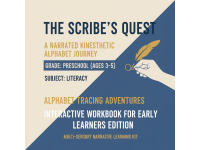
The Scribe’s Quest: A Narrated Kinesthetic Alphabet Journey

Fall, Seasons, Holiday & Seasonal, Spring, Summer, Winter, Community Building, Resources for Teachers, Classroom Management


About This Product
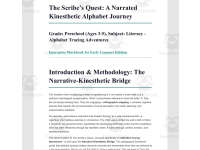
Discover the wonders of early literacy with "The Scribe's Quest: A Kinesthetic Alphabet Adventure". An interactive digital workbook for preschool children ages 3-5. This 40-page workbook will turn what would ordinarily be a tedious task of practicing handwriting into a fun-filled adventure of tracing each letter of the alphabet. The combination of Montessori-style kinesthetic learning and a narrative-based approach to letter formation will allow preschool children to develop fine motor skills, orthographic mapping along with recognition of the letters throughout the entire alphabet.
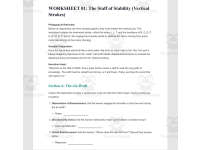
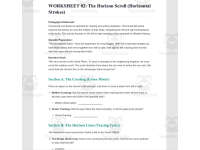
Teachers and parents who use this book will receive guidance and important information related to child hand development; narrative-based letter formation techniques; multi-sensory feedback loops; real-world examples of implementation; printable worksheets on how to create basic letter strokes and letters such as A, B, C, S, T, O; pictorial diagrams for teaching strokes; and district-approved teacher rubrics for evaluating student performance.
This book will take young children away from rote memorization of letters by providing a varied approach to developing confidence, precision, and a lifelong love of learning using imaginative quests that turn the letters into mountains, rivers, or shields. This resource is excellent for early literacy programs, preschool handwriting activities, kinesthetic alphabet activities, and fine motor development activities that use a narrative format.
Download your copy today as a printable PDF and help your child explore the world of literacy!
Why Parents/Schools Like It:
Anxiety Reduction Through Storytelling: Abstract tracing is turned into exciting experiences with the use of stories; for example, "Climbing" a mountain or the letter "A" instead of an "upside down mountain", thereby taking away performance-related anxiety and improving the emotional memory attached to a narrative through narrative transportation techniques.
Developmentally Appropriate & Multi-Sensory Approach: Supports the development of preschool hand function via proximal to distal development, the use of haptic feedback and rhythmic chants for full use of hand function, and provides a color-coding anchor for tactile learning and effectiveness.
Demonstration of Effectiveness via Case Studies: Evidence of real improvements, e.g., a 60% increase for impulsive learners, through practical interventions that address diverse challenges e.g., low tone and rushing.
Comprehensive Resources to Facilitate Implementation: Includes supporting materials, i.e., teacher guides, visual diagrams, stroke verification rubrics, and readily adaptable worksheets, allowing teachers to save time while increasing the confidence of the students.
Transforms Literacy into Discovery: Adheres to the principles of the Montessori method by transforming individual drill work into collaborative adventures for developing proprioception, grip development, and lifelong literacy.
Students by Age Level / Class Group:
After assessing the entire PDF, with special attention to the developmental physiology content (such as motor control from proximal to distal, and holding a pencil correctly) age appropriate stories, the use of multiple senses (VAKT) and using case studies with children ages 3-5 with different types of needs (such as children who are impulsive or anxious learners), this workbook can be used with:
Preschool Children (ages 3-5) - A great resource to help young preschool age children in Pre-K and nursery programs learn how to trace letters of the alphabet without having to be precise, allowing preschoolers who do not have carpal bone ossification or developing grip to succeed in developing their skills.
Homeschool Early Childhood Programs - The ideal program for parents who are providing early literacy instruction at home, using warm up activities, air tracing and rainbow writing to build low muscle tone and/or high energy.
Special Needs & Remedial Literacy Groups - A great resource for preschoolers with physical or behavioral needs (hypotonia, impulsive or anxious) using methods such as tracing on vertical surfaces and using rhythmic chant.
Pre-K Classroom Setting Integration - A great tool for educators working with small or large groups to collect information about student progress in fine motor and phonemic awareness through group observation logs, rubrics and posters to assist and guide instructional practices.
Usage/Terms of Use
Copyright Statement: This book was created and copyright by Syed Hammad Rizvi. This resource is authorized to be used for personal use only, classroom-only use. Under no circumstances will this resource be altered, sold, or distributed without first obtaining permission from the copyright owner. In other words, you cannot post this resource to any location where the public can access/download it.
If you would like to share this resource with colleagues, please contact Teachsimple and purchase additional licenses.
Thank you for your cooperation with these terms of use!
Syed Hammad Rizvi created this wonderful product!