Unplugged Cyber-STEM Pack 1: Sensors & Logic Gates (Grades 4–8)



About This Product
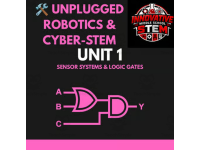
Introduce physical sensor mechanics, Boolean logic gates (AND/OR/NOT), circuit schematics, multi-sensor vehicle algorithms, and real-world aerospace software failures with Unplugged Robotics & Cyber-STEM Unit 1: Sensor Systems & Conditional Logic Gates! Designed for grades 4 through 8, this 9-page printable resource is completely unplugged (requiring zero screens, computers, or digital microcontrollers) and engineered to run seamlessly as a 60- to 75-minute rotation lab, group workshop, or whole-class STEM activity using low-cost supplies like cardboard, brass fasteners, and push pins.
What Is Included in This 9-Page Pack?
Page 1: Teacher Setup & Master Guide
Contains a comprehensive materials checklist, classroom station map, pre-punched lever arm preparation instructions, and station rotation timing guidelines.
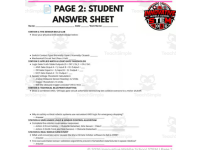
Page 2: Student Answer Sheet (1-Page Master Handout)
A single, organized recording sheet for students to clip to a clipboard and carry through every station, ensuring complete individual accountability.
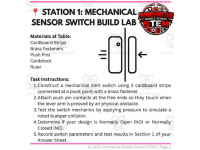
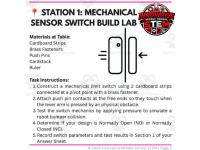
Page 3: Station 1 Sign — Mechanical Sensor Switch Build Lab
Hands-on hardware lab where students construct physical limit switches out of cardboard levers and push pins, testing Normally Open (NO) and Normally Closed (NC) circuit contact states.
Page 4: Station 2 Sign — Logic Gate Voltage & Threshold Lab
Applied computer science and math station where students evaluate AND, OR, and NOT truth tables while comparing analog sensor voltage inputs against digital trigger thresholds.
Page 5: Station 3 Sign — Logic Gate Circuit Schematic
Technical drafting station where students draw 2D circuit diagrams routing dual bumper sensors through logic gates to motor shutoff relays to design redundant safety systems.
Page 6: Station 4 Sign — Autonomous Rover Multi-Sensor Algorithm
Unplugged algorithm station where students trace conditional decision trees (If/Then flowcharts) assessing front and side distance sensors to control steering angles, reverse maneuvers, and hazard stops.
Page 7: Station 5 Sign — Real-World Case Study
Informational reading station covering the 1999 Mars Climate Orbiter Failure, analyzing how unit conversion discrepancies between imperial and metric system software interfaces led to a mission failure.
Page 8: Detailed Teacher Answer Key
Provides fully worked truth tables, voltage threshold answers, schematic validation criteria, algorithm keys, and case study reading guidance in clean plain text.
Page 9: 10-Point Master Grading Rubric
A single-page evaluation rubric scoring each station on a clear 0-to-2 point scale for efficient, objective grading.
Standards Alignment & Materials:
NGSS: MS-ETS1-1, MS-ETS1-2 (Engineering Systems & Safety Controls)
CSTA Standards: 2-AP-10, 2-AP-12 (Control Algorithms, Boolean Logic, & Sensor Processing)
CCSS Math Practices: MP1 & MP4 (Voltage Threshold Math & Boolean Logic)
Materials Needed: Cardboard strips, brass paper fasteners, push pins, cardstock, rulers, and basic calculators.
Resource Tags
0 Reviews
Check out these other great products