Unplugged Cyber-STEM Pack 2: Kinematics & Arms (Grades 4–8)



About This Product
Introduce spatial kinematics, mechanical advantage, joint torque calculations, 2D work envelope drafting, pick-and-place state machines, and real-world space robotics with Unplugged Robotics & Cyber-STEM Unit 2: Kinematics & Mechanical Arm Geometry! Designed for grades 4 through 8, this 9-page printable resource is completely unplugged (requiring zero computers, coding software, or digital microcontrollers) and engineered to run seamlessly as a 60- to 75-minute rotation lab, group workshop, or whole-class STEM activity using low-cost supplies like craft sticks, brass fasteners, and paper clips.
What Is Included in This 9-Page Pack?
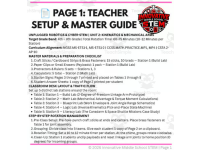
Page 1: Teacher Setup & Master Guide
Contains a complete materials checklist, room setup diagram, craft stick pre-drilling strategies, and timing guidelines for managing 5 rotation stations.
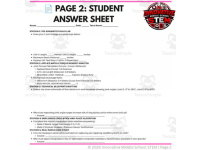
Page 2: Student Answer Sheet (1-Page Master Handout)
A single, organized recording sheet for students to clip to a clipboard and carry through every station, maintaining complete individual accountability.
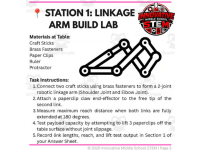
Page 3: Station 1 Sign — Linkage Arm Build Lab
Hands-on hardware lab where students construct a 2-degree-of-freedom robotic manipulator using craft sticks and brass brads, testing maximum reach limits and payload capacity.
Page 4: Station 2 Sign — Torque & Mechanical Advantage Lab
Applied physics and math station where students calculate joint torque (T = F x D) and determine lever arm mechanical advantage ratios (MA = D_effort / D_load).
Page 5: Station 3 Sign — Work Envelope Blueprint
Technical drafting station where students use protractors to map joint rotation constraints (0 to 180 degrees), plot operational workspace reach zones, and evaluate mechanical singularity points.
Page 6: Station 4 Sign — Pick-and-Place State Machine Algorithm
Unplugged computer science station where students analyze state transition pathways for an industrial robot arm executing coordinate targeting, gripper actuation, and safety checks.
Page 7: Station 5 Sign — Real-World Case Study
Informational reading station exploring the Space Shuttle Canadarm system, analyzing microgravity dynamics, payload momentum, and force-feedback joint control.
Page 8: Detailed Teacher Answer Key
Provides fully worked torque and mechanical advantage calculations, reach blueprint criteria, state machine logic keys, and case study reading guidance in plain text.
Page 9: 10-Point Master Grading Rubric
A single-page evaluation rubric scoring each station on a clear 0-to-2 point scale for efficient, objective grading.
Standards Alignment & Materials:
NGSS: MS-ETS1-1, MS-ETS1-2 (Engineering Design & Mechanical Systems)
CSTA Standards: 2-AP-10 (Unplugged Algorithm Execution & State Machine Logic)
CCSS Math Practices: MP1 & MP4 (Lever Arm Mathematics, Geometry, & Joint Torque Ratios)
Materials Needed: Craft sticks or cardboard strips, brass paper fasteners, paper clips, protractors, rulers, and basic calculators.
Resource Tags
0 Reviews
Check out these other great products