



3,908 products added recently
Page 95 - 2nd Grade Activities
Boost your second graders' enthusiasm with activities that combine fun and education. These resources cover various subjects and promote critical thinking and collaboration. Use them to enrich your lessons and keep students actively involved in their learning journey.

 Show filters

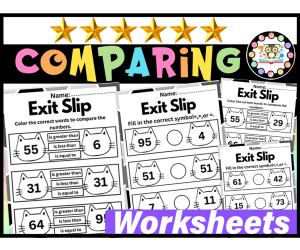
Comparing Numbers Worksheets Greater than Less than Equal
Math, Numbers, Early Math, Counting, Kindergarten, Preschool, Grade 1, 2, 3, Worksheets & Printables, Classroom Decor, Worksheets, Workbooks, Centers, Activities
This interactive and attractive set Comparing Numbers Worksheets Greater than Less than Equal Worksheets Pages learners develop their original Comparing Numbers Worksheets Greater than Less than Equal Worksheets this set contains 30 pages in this set, each in each a different Digraphs Comparing Numbers Worksheets Greater than Less than Equal Worksheets of dedicated Comparing Numbers Worksheets Greater than Less than Equal Worksheet Attributes GeometryWorksheets Pagesto ensure a fun and structured approach to using a fun and type of work that useful; Each card is fun this edited set of Comparing Numbers Worksheets Greater than Less than Equal Worksheets is built in an elegant style that attracts attention this interactive and attractive set ofComparing Numbers Worksheets Greater than Less than Equal Worksheetsd esigned to help young learners develop their original Comparing Numbers Worksheets Greater than Less than Equal Worksheets skills through Comparing Numbers Worksheets Greater than Less than Equal Worksheets sexercises This set contains 30 pages. these printable Worksheets offer useful courses, this provides a useful course-rich practice, it is designed to help using resource grade 2 easily to learn about activities Comparing Numbers Worksheets Greater than Less than Equal Worksheets a fun and interactive manner. A collaborative learning activity added students. PDF format
Author LAMO
Rating
Tags Assessment, Worksheets, Printables, Math, Numbers

Let's Talk About Health – Class Board Game
ELA, Language Development, ESL, Preschool, Grade 1, 2, 3, Games, Activities
Let's Talk About Health is an engaging board game that teaches students about health and wellness. To play, simply print the colorful game board and grab a pair of dice. This versatile resource can be used in whole or small groups and suits a range of abilities. Students take turns rolling the dice and moving ahead the corresponding number of spaces. They then read aloud and answer the health question written on the space they land on. Alternatively, their partner can respond instead or both students can write down their answers. It's also possible to assess individual progress by having students write both the questions and responses. With a variety of question types and vocabulary focused on health, this simple yet entertaining game builds English language skills, content knowledge, speaking confidence, and more. Use it as a fun competition to see who reaches the end first or as a beneficial small group activity for targeted instruction and support. Let's Talk About Health brings health concepts to life in any classroom.
Author Better Teaching Resources
Rating
Tags Board Game, Dice Game, Partner Activities, Health, Nutrition, Writing Prompts, ESL Activities, Small Group, Speaking Skills, Literacy
Harps Reading Comprehension Passage - Cored Ed Encyclopedia
ELA, Language Development, Resources for Teachers, Reading Comprehension, Reading, Pre-Reading, Writing, Strategies, Music, Creative Arts, Grade 2, 3, 4, 5, Worksheets & Printables, Worksheets, Teacher Tools, Centers, Activities, Writing Prompts, Assessments, Tests, Quizzes and Tests, Quizzes
This harps reading comprehension contains the following: Pre-Reading Trivia Students will write down one thing they already know about the subject and then read five more facts and discuss. These facts are fun, and the students will enjoy learning about the subject before reading more. Reading Passage The text is a high-interest reading passage with set paragraphs, roughly three to four paragraphs long. It contains a variety of themes about the topic, anywhere from history to technology. The passage is between 250 and 350 words in length. Mixed Questions The first question page contains four multiple-choice questions, each with a choice of four answers, and three written response questions that require a sentence or two from the student. Creative Writing In this question, the student will be required to write a five to eight sentence paragraph on a question related to the topic. Extension Activities This page is optional for fast finishers. If there are five to ten minutes left at the end of the lesson, the student can choose one of three activities, each one requiring a different skill. Answer Key There are answers for the multiple-choice questions and three written response questions have sample answers. FULL CATALOG OF DOWNLOAD LINKS AND ENCYCLOPEDIA INDEX HERE Lesson Snapshot Title: Harps Genre: Nonfiction (informational text) Subject: Music (Informational Reading) Primary Topic: How harps work, types, and early history Estimated Guided Reading Level (A–Z): O What This Lesson Teaches Best Explains what a harp looks like and how it makes sound when strings are plucked. Connects string length and thickness to low and high notes (how pitch changes). Describes the soundboard’s role in helping the sound “ring out.” Introduces harps as an ancient instrument and names early places they were played (Mesopotamia, Egypt, Sumer). Compares types of harps today (lever harps vs. pedal harps) and what levers/pedals do to change pitch. Learning Goals Describe how a harp makes sound using details from the passage. Explain how longer/thicker strings and shorter/thinner strings relate to low and high notes. Identify what the soundboard does for the harp’s sound. Compare lever harps and pedal harps by explaining how each changes pitch. Summarize evidence that harps are very old by naming where early harps were played or found. Key Vocabulary From the Text soundboard — flat wooden part that helps sound ring out. plucking — pulling and releasing strings with fingers to make sound. pitch — how high or low a note sounds. glissando — a swooshing sound moving across many notes. mechanism — parts that work together to change something. Cored Ed Encyclopedia Overview The Cored Ed Encyclopedia is a weekly series of lessons that you can pick up and use right away. These short readings fit into whatever time you have available. Each one includes a warm-up, a reading, and a set of questions, but it’s flexible — you can do just the reading, the full lesson, or skip the writing section if you need to. Each lesson focuses on a single topic so students don’t get lost. The writing is clear but never childish, making it perfect for grades two through five. Topics range from animals and science to history, inventions, and everyday things. No matter the level of the student, everyone should take away at least one new idea or fact from each lesson. The materials are easy to print, easy to explain, and require no setup. They work well for whole-class teaching, partner work, or independent study.
Author Cored Education
Rating
Tags Vocabulary, Spelling, Reading Comprehension, Reading Passages, Reading, Creative Writing, Reading Strategies, Writing Prompts, Harps, Music

Food Maze: 1 Page Sample (PDF)
ELA, Language Development, Resources for Teachers, Vocabulary, Spelling, ESL, Grade 2, 3, 4, 5, Worksheets & Printables, Worksheets, Teacher Tools, Centers, Activities, Mazes
THIS IS A ONE PAGE SAMPLE OF A SIX PAGE MAZE DOWNLOAD FULL SIX MAZE DOWNLOAD INFORMATION: Maze Series This maze series is designed for students in grades 2–5. Each set features a clear, kid-friendly theme with scene-based mazes that students first navigate, then complete by drawing a few target words from a simple word list. Pages come in varied styles and graduated difficulty, with an optional “color it in” step—and some themes invite quick calculations to match the task. These mazes are student-friendly, classroom-ready, and perfect for literacy warmups, seasonal units, fast-finisher bins, centers, sub plans, or home learning extensions. The playful, structured format builds problem-solving, attention to detail, and fine-motor control while reinforcing themed content in a motivating way. Note: Unlike many themed products, not all word-list words appear on the maze pages. To support full vocabulary coverage, we’ve released a companion word list you can find in the links section. Food Word List 1. Fruits and Vegetables Apple, Banana, Carrot, Grapes, Lettuce, Orange, Tomato, Berry 2. Breakfast Foods Eggs, Toast, Pancake, Cereal, Milk, Juice, Butter, Honey 3. Sweet Treats Cake, Cookie, Chocolate, Candy, Ice cream, Cupcake, Sprinkles, Lollipop 4. Drinks and Snacks Water, Juice, Milk, Tea, Popcorn, Crackers, Yogurt, Nuts 5. Foods from Around the World Pizza, Taco, Rice, Noodles, Cheese, Bread, Soup, Sushi 6. Healthy Foods Carrot, Apple, Fish, Eggs, Beans, Nuts, Spinach, Water PDF Version Other versions will appear here when available. Follow the store for the lastest on new products. How to Use These Mazes Perfect for: Morning work or early-finisher bins Literacy or STEM centers Holiday/seasonal review lessons Independent stations, sub plans, or take-home enrichment More Food Themed Products CROSSWORDS WORD SEARCHES FULL CATALOG OF DOWNLOAD LINKS HERE Themed Mazes Links Addition PDF Animals PDF Around the Home PDF Birthday PDF Candy PDF Christmas PDF Cinco de Mayo PDF Clothes PDF Colors PDF Days and Months PDF Division PDF Earth Day PDF Easter PDF Easy Mazes PDF Fall PDF Father's Day PDF Food PDF Geography (Set 1) PDF Geography (Set 2) PDF Geography (Set 3) PDF Graduation PDF Health PDF History (Set 1) PDF History (Set 2) PDF History (Set 3) PDF Human Body PDF Kindness PDF Life Skills PDF Mother's Day PDF Multiplication PDF Science (Set 1) PDF Science (Set 2) PDF Science (Set 3) PDF Shapes PDF Social Skills PDF Spring PDF Sports PDF St. Patrick's Day PDF Subtraction PDF Summer PDF Thanksgiving PDF Transport PDF Valentine's Day PDF Winter PDF Mazes in Depth Structure Each maze is crafted around a focused sub-theme. Students navigate the maze, encountering branches and cul-de-sacs that build attention and planning. Most pages include a tiny follow-up box—students draw or label 2–3 target words from a small word box, add a quick count, or color in the scene—so the activity reinforces both content and skills in a highly engaging format. Each completed set includes: A themed maze page. A simple student instruction strip. An answer key showing the solved path for teacher support or self-checking Themes Included These mazes cover a wide range of fun, age-appropriate themes, including: Seasons & Holidays (e.g., Halloween, Easter, Valentine’s Day) Math-Lite Connections (e.g., quick counts, number words) Everyday Topics (e.g., Animals, Weather, School) Special Units (e.g., Health, Earth Day, Sports, Kindness) Each topic reflects students’ real-life experiences and interests while strengthening problem-solving, visual scanning, and fine-motor control in a playful, highly visual way. Easy extensions (optional): Time it: solve once in pencil, then try to beat the time in pen Retell the route using sequence words (first, next, then, finally) Count intersections or turns and graph the results Write a 1–2 sentence mini-story about the scene using the target words Design a tiny maze in the corner for a partner to solve Differentiation tips: Offer a finger-trace pass before pencils for emerging learners Highlight the borders of the correct region on first attempts Use thicker-line versions or simpler pages to build confidence Pair roles: “navigator” gives directions; “driver” traces the path For similar downloads and other frees, do check out Cored Group on TeachSimple.
Author Cored Education
Rating
Tags Vocabulary, Spelling, Food, Fruits And Vegetables, Breakfast Foods, Foods From Around The World, Healthy Foods, Food Activities, Mazes, Food Mazes

Emotional Intelligence Building Blocks - Social Emotional Learning
Life Studies, Career, Research, Life Skills, Special Resources, Social Emotional Learning (SEL), Social Skills, Special Education Needs (SEN), Speech Therapy, Grade 3, 4, 5, 9, 10, 11, 12, Activities, Teacher Tools, Projects, Centers, Assessments, Lesson Plans, Outlines, Presentations, Rubrics, Quizzes and Tests
Uncover the best social emotional learning (SEL) curriculum for grades 3-6 in "Emotional Intelligence Building Blocks - Social Emotional Learning" by Syed Hammad Rizvi, especially designed for elementary-school-going children. With a total of 432 pages of in-depth information, this book maximizes 8- to 12-year-olds' ability to handle their internal world of emotions while developing high-quality social skills, such as mastering personal management skills and responsible decision-making. Full of exciting topics in each installments like recognizing happiness, sadness, anger, fear, and many more, this social emotional learning middle school workbook delves deep into self-awareness, self-management tools like journaling, breathing exercises, goal setting, social awareness with a focus on empathy, body language, and cultural differences. Designed to be highly beneficial for homeschoolers, classroom teaching, or family usage, this social-emotional learning middle school curriculum not only provides exercises to handle conflicts, make friends, and enhance positive thinking but is specifically designed to help in overcoming emotional difficulties by teaching kids to be emotionally intelligent individuals throughout their lives. It is a highly recommended teaching tool for all parents, tutors, and teachers looking for scientifically valid emotional intelligence exercises to be performed by kids in their classroom. Why Parents/Schools Love It: In-Depth SEL Resource: Provides students with a clear continuum of skills from recognizing emotions to applying concepts in a real-life setting. Helps students learn to be resilient, empathetic, and effective conflict resolvers. Practical and Engaging Tools: This category includes solutions such as journaling, breathing exercises, and goal-setting tasks, which require minimal effort to perform in the comfort of one's home or an educational setting in order to promote instant emotional development. Encourages Positive Relations: Deals with skills like listening, boundary marking, and celebrating diversity. Has the effect of reducing misbehavior and increasing positive associations with family, friends, and the broader community. Aligned with Educational Standards: Based on the principles of Emotional Intelligence, the resource is useful for both homeschooling and classroom education as it impacts academic success, health, and bullying intervention. Empowering for Lifelong Skills: It promotes self-discovery and optimistic outlooks, arming children with skills to conquer life's obstacles, resulting in happier and more confident people as manifested in parent and teacher feedbacks. Target Classes/Students : Based on the complete analysis of the content, structure, language, and examples in the book, it is ideally targeted at students in grades 3 to 6 (usually between 8-12 years old). The content uses vocabulary suitable for this age group, scenarios that are easy for students of this age to relate to, such as school challenges and playground and family dynamics, and progresses gradually from simple emotion identification to complex issues such as ethical dilemmas and community involvement. The introductory tone assumes basic reading skills without burdening the younger reader, while the substance in the later chapters on self-awareness and social dynamics fits well with the upper elementary levels. It could extend to advanced grade 2 students or remedial grade 7, but the core focus is perfectly in tune with middle childhood development stages emphasized in the book. Copyright/Terms of Use : This Book was copyrighted by Syed Hammad Rizvi. This resource is to be used only for personal and single-classroom use only. You are not to alter or redistribute any part of this resource or sell this resource. In other words, do not put this resource on the Internet where it could be downloaded. If you would like to share this resource with others, you can purchase other licenses through Teachsimple. Thank you so much for your cooperation! This product is happily brought to you by Syed Hammad Rizvi
Author Creative Book Store
Rating
Tags EmotionalIntelligenceBuildingBlocks, SocialEmotionalLearning, SELForKids, EmotionalIntelligenceForChildren, SELCurriculum, EmotionalRegulationForKids, BuildingEmpathyInChildren, KidsEmotionalWellbeing, ElementarySELActivities
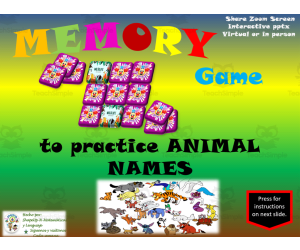
Free Interactive Memory Game to Practice Animals
Life Studies, ELA, Reading, Reading Comprehension, Language Development, Pre-Reading, Spelling, Vocabulary, Kindergarten, Preschool, Grade 1, 2, 3, Games, Activities
Practice Animal Vocabulary with this Free Interactive Memory Game Introduce young learners to a variety of animals with this entertaining digital memory game . Students will see the name and image of 12 different animals. Their task is to flip over two cards at a time to find matches, exercising visual memory and concentration. If the cards don't match, they flip them back over and try again. Once all matches are made, press the "start again" button for more vocabulary practice. This self-checking activity can be played independently or as a whole class game projected on a smartboard. The vibrant slideshow stimulates engagement while building animal classification skills. Differentiate by allowing lower grades to match pictures only and upper grades to match Spanish vocabulary words. Download this versatile 12-slide PowerPoint today!
Author ShapeUp-N-Matematicas y Lenguaje
Tags Animals, Animal Names, Vocabulary, Domestic Animals, Zoology, Birds, Reptiles, Fish, Mammals, Small Or Whole Group

Jewelry Reading Comprehension Passage - Cored Ed Encyclopedia
ELA, Reading Comprehension, Reading, Language Development, History, Social Studies, Science, Physics, Life Sciences, Earth and Environmental Sciences, Grade 2, 3, 4, 5, Worksheets & Printables, Worksheets, Teacher Tools, Centers, Activities, Writing Prompts, Assessments, Quizzes and Tests, Quizzes, Lesson Plans
This Jewelry reading comprehension with lesson plan includes: Visualization (on the front cover) Start your lesson by taking a minute to think and share something about the topic. Read the script aloud (slowly), perhaps prepare some music or sound effects. Student close their eyes and let their imaginations wander. Students open their eyes, read the question aloud and give them a few minutes to complete. Ask a few students to share or keep answers until the end to compare with what they learn in the passage. Quick pause—thousands of Cored Education products are included with your TeachSimple membership. Download links and encyclopedia index available here. Pre-Reading Trivia Students will write down one thing they already know about the subject and then read five more facts and discuss. These facts are fun, and the students will enjoy learning about the subject before reading more. Give 1 minute for students to write what they already know (no pressure—best guess is fine). Read the five facts together. After each fact, do ask a student for their opinion, was it surprising? Set a purpose by asking students to highlight/underline one fact they want to learn more about during the reading. Reading Passage The text is a high-interest reading passage with set paragraphs, roughly three to four paragraphs long. It contains a variety of themes about the topic, anywhere from history to technology. The passage is between 250 and 350 words in length. First, ask students to look at the headings and see what they’ll learn about today. What do they know about the topic/heading? First read options: Teacher read-aloud (best for support). Partner reading (paragraph by paragraph). While reading, students underline important details, and vocabulary words they think may come up in the questions section. Mixed Questions The first question page contains four multiple-choice questions, each with a choice of four answers, and three written response questions that require a sentence or two from the student. Students complete the mcqs first independently, then review quickly as a class. For the 3 written responses, try to get students giving the answer with some form of evidence: “I think ___ because the text says ___.” If students get stuck, send them back to check the passage. Vocabulary Questions Practice seven key words from the text in this section across two activities. First section is scrambled words where students will unscramble three words given a clue for each. The second section is a word to meaning matching activity. Before starting, have some students read out words they underlined in the passage. Ask students to say the word and read aloud the sentence(s) around each word. Ask students to do scrambled words and the matching exercise in pairs then go through answers as a class. For the scrambled spelling task, get four pairs to come up to the board and write the words for extra practice with the other student reading out the clue. For the matching task, prompt students to give full sentences: “I matched ___ with ___ because ___.” Creative Writing In this question, the student will be required to write a five to eight sentence paragraph on a question related to the topic. Before starting, ask students write down 3 key ideas they are going to include in their piece. Ask students for ideas to share around the class to help those struggling. Pro writing expectations: 5–8 sentences At least 2 facts or details from the passage At least 2 vocabulary words from the previous page Students read their paragraphs while classmates listen for facts and vocabulary words. Extension Activities This page is optional for fast finishers or to take home. There are several activities, each one requiring a different skill. Do some, do none, do all, completely optional - but you will feel reassured knowing every possibility is planned for. Includes summary writting question and additional facts. Answer Key There are answers for the multiple-choice questions, written response questions have sample answers, vocabulary answers and if there is a summary question then a sample summary will be provided as well. Lesson Plan Included Customized lesson plan for this lesson is included. Lesson Snapshot Title: Jewelry Genre: Nonfiction (informational text) Subject: Reading (Informational Text) / Social Studies Primary Topic: Jewelry history, materials, meaning, and sparkle Estimated Guided Reading Level (A–Z): R What This Lesson Teaches Best Explains that people made and wore jewelry long ago using shells, teeth, and bone, and includes evidence archaeologists found (seashells with holes worn smooth). Shows how new tools changed jewelry-making by shaping gold into beads, bracelets, and pieces worn close to the skin. Introduces where gems come from (hard minerals from the earth and some from living things, like pearls and amber). Describes how cutting gems into flat faces called facets increased sparkle and how factories later made fake gems. Emphasizes that jewelry can matter because of symbols, faith, celebrations, and memories—not only because it is bright or rare. Learning Goals Describe evidence the passage gives that very old shell beads were worn as jewelry. Explain how tools helped people shape gold into jewelry long ago. Identify where different gems can come from (earth minerals or living things) using details from the text. Explain how facets changed the way gems looked and why they started to “dance and flash.” Describe reasons people wear jewelry today (faith, celebration, marking life moments, memories). Key Vocabulary From the Text archaeologists — scientists who study the human past. ceremonies — special events held for a purpose. minerals — natural, nonliving materials from the earth. facets — flat faces cut on a gemstone. amber — hardened sticky tree sap used as a gem. FULL CATALOG OF DOWNLOAD LINKS AND ENCYCLOPEDIA INDEX HERE
Author Cored Education
Rating
Tags Vocabulary, Reading Comprehension, Reading Passages, Lesson Plans, Ela Lesson Plans, Reading Comprehension Lesson Plans, Pre-reading, Science Lesson Plans, Earth Science, Physics
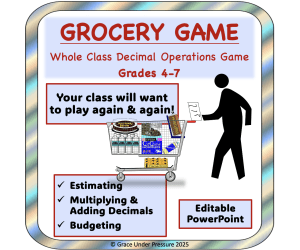
Grocery Game: Estimating, Adding, and Multiplying Decimals
Math, Addition and Subtraction, Decimals, Multiplication and Division, Division, Money, Grade 3, 4, 5, 6, Activities, Games
Here's a fun way to practice operations with decimal numbers and money math! Play this whole-class grocery game and your students won't even notice how much decimal operations practice they are getting! It is a fun, whole class activity that you need to be able to project in your classroom on an interactive whiteboard or screen-share for distance learning. As students play along, they practice estimating to stay within a shopping budget. They have to multiply and add with decimal numbers: all helpful realistic applications. My students absolutely love playing this game, and I have included three rounds so you can play more than once! Instructions: 1) Decide on a target range. A higher range will require more challenging multiplication. If the range is tighter, it will be more difficult to win. I usually use a range such as $50-$52. 2) Tell students they must buy at least 4 of the 5 products. Students need to have a piece of paper and a pencil for calculations. 3) Choose a student to pick the first product. She needs to estimate the price for one of them, decide how many she wants to buy, and estimate how much that will cost. “I think the cheese is about $5, I want 3, so that will be around $15.” 4) Then show the price (by moving the red box with your cursor), and all students calculate the cost by hand. For example, 3 x 5.75 = 17.25. This is the start of the running total. 5) Choose another student to buy the second product. Again, have him or her estimate before calculating. Then allow all the students to calculate the cost of the second product. For example 4 x 3.19 = 12.76. 6) Now students have to switch from multiplying to adding decimals. They add the price of the second product to their running total. 17.25 + 12.76 = 30.01 7) Continue with the third, fourth, and fifth (if necessary) product. 8) Students try to spend between $50-52. It’s not always easy! Talk to the class about different strategies such as saving an inexpensive product for the end. What's Included: 5-Page PowerPoint Presentation with 3 Rounds and Complete Instructions If you like this Grocery Game try another one! Fall Edition Winter Edition Spring Grocery Game
Author Grace Under Pressure
Rating
Tags Grocery Game, Estimating, Adding Decimals, Multiplying Decimals, Budget, Price Is Right, Math Game, Estimate, Decimal Operations, Money
8 Low-Prep STEM Tasks – Elementary & Middle School
Math, Geometry, Measurements, Science, Technology, Engineering, Physics, STEM, Grade 3, 4, 5, 6, 7, 8, Activities
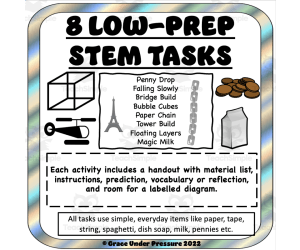
These fun low-prep STEM experiments will get your students building, designing, and learning about science, technology, engineering, and math in a co-operative way! They are great hands-on learning activities. Students will have to make a prediction before completing the experiment and draw a detailed and labelled diagram after they are done. They will also define relevant vocabulary words and answer a question about what they learned. Each STEM experiment includes a handout with material list, instructions, prediction, vocabulary or reflection, and room for a labelled diagram. All experiments use simple, everyday items like paper, tape, string, spaghetti, dish soap, milk, pennies etc. Penny Drop Falling Slowly Bridge Build Bubble Cubes Paper Chain Tower Build Floating Layers Magic Milk How to Use: Students can work in small groups. Go over the instructions and materials and give students time to predict before they start the experiment. Review the findings and relevant vocabulary after students have completed their experiment and diagram. Grades to Use With: These experiments are perfect for your intermediate or middle school (grades 3-8) class! They can be used at the beginning of the year or term as ice breaker activities, on a Friday afternoon or before a holiday, or as part of your regular science curriculum. Standards: NGSS3-5-ETS1-1 Define a simple design problem reflecting a need or a want that includes specified criteria for success and constraints on materials, time, or cost. NGSS3-5-ETS1-2 Generate and compare multiple possible solutions to a problem based on how well each is likely to meet the criteria and constraints of the problem. If you like this activity , check out my science lesson about Independent, Dependent, and Controlled Variables , perfect for before a science fair unit!
Author Grace Under Pressure
Rating
Tags STEM, Science Experiments, Hands-on Learning, Cooperative Learning, Engineering, Experiment, STEM Task, STEM Activity, Math, Technology
United Nations Reading Comprehension Passage - Cored Ed Encyclopedia
ELA, Language Development, Reading Comprehension, Reading, Pre-Reading, Vocabulary, History, Social Studies, Government, Writing, Grade 2, 3, 4, 5, Worksheets & Printables, Worksheets, Teacher Tools, Centers, Activities, Writing Prompts, Assessments, Quizzes and Tests, Quizzes, Lesson Plans
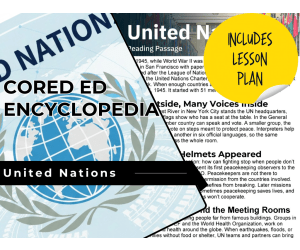
This United Nations reading comprehension with lesson plan includes: Visualization (on the front cover) Start your lesson by taking a minute to think and share something about the topic. Read the script aloud (slowly), perhaps prepare some music or sound effects. Student close their eyes and let their imaginations wander. Students open their eyes, read the question aloud and give them a few minutes to complete. Ask a few students to share or keep answers until the end to compare with what they learn in the passage. Quick pause—thousands of Cored Education products are included with your TeachSimple membership. Download links and encyclopedia index available here. Pre-Reading Trivia Students will write down one thing they already know about the subject and then read five more facts and discuss. These facts are fun, and the students will enjoy learning about the subject before reading more. Give 1 minute for students to write what they already know (no pressure—best guess is fine). Read the five facts together. After each fact, do ask a student for their opinion, was it surprising? Set a purpose by asking students to highlight/underline one fact they want to learn more about during the reading. Reading Passage The text is a high-interest reading passage with set paragraphs, roughly three to four paragraphs long. It contains a variety of themes about the topic, anywhere from history to technology. The passage is between 250 and 350 words in length. First, ask students to look at the headings and see what they’ll learn about today. What do they know about the topic/heading? First read options: Teacher read-aloud (best for support). Partner reading (paragraph by paragraph). While reading, students underline important details, and vocabulary words they think may come up in the questions section. Mixed Questions The first question page contains four multiple-choice questions, each with a choice of four answers, and three written response questions that require a sentence or two from the student. Students complete the mcqs first independently, then review quickly as a class. For the 3 written responses, try to get students giving the answer with some form of evidence: “I think ___ because the text says ___.” If students get stuck, send them back to check the passage. Vocabulary Questions Practice seven key words from the text in this section across two activities. First section is scrambled words where students will unscramble three words given a clue for each. The second section is a word to meaning matching activity. Before starting, have some students read out words they underlined in the passage. Ask students to say the word and read aloud the sentence(s) around each word. Ask students to do scrambled words and the matching exercise in pairs then go through answers as a class. For the scrambled spelling task, get four pairs to come up to the board and write the words for extra practice with the other student reading out the clue. For the matching task, prompt students to give full sentences: “I matched ___ with ___ because ___.” Creative Writing In this question, the student will be required to write a five to eight sentence paragraph on a question related to the topic. Before starting, ask students write down 3 key ideas they are going to include in their piece. Ask students for ideas to share around the class to help those struggling. Pro writing expectations: 5–8 sentences At least 2 facts or details from the passage At least 2 vocabulary words from the previous page Students read their paragraphs while classmates listen for facts and vocabulary words. Extension Activities This page is optional for fast finishers or to take home. There are several activities, each one requiring a different skill. Do some, do none, do all, completely optional - but you will feel reassured knowing every possibility is planned for. Includes summary writting question. Answer Key There are answers for the multiple-choice questions, written response questions have sample answers, vocabulary answers and if there is a summary question then a sample summary will be provided as well. Lesson Plan Included Customized lesson plan for this lesson is included. Lesson Snapshot Title: United Nations Genre: Nonfiction (Informational text) Subject: Social Studies (Civics/Global Studies) Primary Topic: How the UN began and works for peace Estimated Guided Reading Level (A–Z): P What This Lesson Teaches Best Origins and purpose of the UN: Explains that delegates from 50 countries met in San Francisco in 1945 and signed the United Nations Charter, leading to the UN officially beginning on October 24, 1945. How countries work together in the UN: Describes the UN headquarters in New York City and how member countries speak and vote in the General Assembly, while a smaller group (the Security Council) votes on steps meant to protect peace. Peacekeeping basics: Introduces UN peacekeeping observers (UNTSO) and explains that peacekeepers watch, report, and help keep ceasefires from breaking (and are not there to conquer). Communication across languages: Shows why interpreters matter by explaining that leaders use interpreters in six official languages so the same message can travel across the room. UN help beyond meetings: Notes that UN groups like UNICEF and the World Health Organization work on children’s needs, health, and bringing supplies after earthquakes, floods, or wars. Learning Goals Students will identify key dates and events that led to the UN officially beginning in 1945. Students will describe how the General Assembly and the Security Council are different, using details from the text. Students will explain what the United Nations Charter is and what it was meant to help countries do. Students will summarize what peacekeepers do and why peacekeeping can be hard when countries won’t cooperate. Students will use context clues to determine the meaning of key words such as interpreters and ceasefires . Key Vocabulary From the Text delegates — people chosen to represent a country at a meeting. Charter — a written promise that explains a group’s goals. headquarters — the main building where an organization works. interpreters — people who change speech into another language. ceasefires — times when fighting stops for a while. FULL CATALOG OF DOWNLOAD LINKS AND ENCYCLOPEDIA INDEX HERE
Author Cored Education
Rating
Tags Vocabulary, Reading Comprehension, Reading Passages, Lesson Plans, Ela Lesson Plans, Reading Comprehension Lesson Plans, Pre-reading, Social Studies Lesson Plans, Social Studies, Government

Reading Comprehension Fiction Set 7: Ian's Friday Nights (Slides)
ELA, Reading, Language Development, Common Core, ESL, Vocabulary, Children’s Literature, Literature, Writing, Reading Comprehension, Grade 2, 3, Teacher Tools, Presentations, Tests, Quizzes and Tests, Assessments, Activities
Reading Comprehension Passages Fiction Set 7 Sample Overview Fascinating reading comprehension passages, each with an array of activities included. Stories are written for the modern classroom and topics are designed to promote enthusiasm from each student. Each lesson contains a mixed questions section to check understanding, a vocabulary or spelling activity to help remember key language introduced, and a writing exercise. Full answer keys are provided. For a more detailed overview, check the section under the links at the bottom of this description. Passage Included 3.Ian's Friday Nights: Ian wants to be anywhere but the bleachers on Friday nights. Slides Version This is the Slides editable and fillable version. This download is available in GOOGLE Docs, GOOGLE Forms, GOOGLE Slides. PDF, PPT, WORD. FULL CATALOG OF DOWNLOAD LINKS HERE Grade 2/3 Links Fiction Set 1 - Nature Google Docs Google Forms Google Slides PDF PPT Word Guided Reading Materials Fiction Set 2 - Animals Google Docs Google Forms Google Slides PDF PPT Word Guided Reading Materials Fiction Set 3 - Food Google Docs Google Forms Google Slides PDF PPT Word Guided Reading Materials Fiction Set 4 - School Google Docs Google Forms Google Slides PDF PPT Word Guided Reading Materials Fiction Set 5 - Friends Google Docs Google Forms Google Slides PDF PPT Word Guided Reading Materials Fiction Set 6 - Family Google Docs Google Forms Google Slides PDF PPT Word Guided Reading Materials Fiction Set 7 - Sports Google Docs Google Forms Google Slides PDF PPT Word Guided Reading Materials Nonfiction Set 1 - Technology Google Docs Google Forms Google Slides PDF PPT Word Guided Reading Materials Nonfiction Set 2 - Nutrition Google Docs Google Forms Google Slides PDF PPT Word Guided Reading Materials Nonfiction Set 3 - Animals Google Docs Google Forms Google Slides PDF PPT Word Guided Reading Materials Reading Passages Overview Each passage is especially written for Grade 2-3 students, including key vocabulary required for this age group. Topics are varied and are accompanied by colorful graphics. Topics are meant to educate, yet entertain the modern student. These passages are perfect for the modern classroom. Whereas textbooks can become outdated in no time, any changes to technology or the world will result in updates to this product. Mixed Questions The mixed questions section of each lesson includes a variation of fivecomprehension, vocabulary and math questions. In addition, key reading strategies are frequently covered including cause & effect, summarizing, compare & contrast and making conclusions. Three of the questions will be MCQs and two will require a written response of some kind. Full answers and example responses appear at the end of the lesson. Spelling & Vocab Each reading passage contains a variety of words and phrases designed for Grade 2-3 students. Spelling and vocab activities provide the opportunity to build fluency with these words. As it can become quite mundane doing the same activities over and over, each lesson in a set will contain a different spelling and vocab activity . Writing Prompts Writing prompts are designed to continue the theme or lessons learned in the story. Students are persuaded to write in a variety of ways and each prompt includes several cues to help. As with the spelling/vocab section, writing prompts will vary. This includes research pieces, reading responses, poetry and creative writing prompts. Full Answer Keys Full answer keys and sample responses are provided so no matter how busy you are, you know you're covered! Mixed question answers provide evidence from the text, math questions contain the relevant workings. Answers are designed for use by the teacher, but also suitable as a handout to the student. Additional File One lesson will have an additional file. This is something fun to extend the lesson with. For similar downloads and other frees, do check out Cored Group on TeachSimple.
Author Cored Education
Tags Elementary, Reading, Comprehension, Vocabulary, Answers, Ccss, Common Core, Spelling, Writing, Passages

Mitten Hunt Figurative Language Digital Game
ELA, Grammar, Grade 3, 4, 5, 6, Activities, Games
This resource is a Mitten Hunt Figurative Language Digital Game. This game covers: - Simile - Metaphor - Personification - Idiom - Hyperbole - Alliteration If you are introducing, reviewing or assessing these skills, this game is a fun and interactive way to do so! Students will answer questions on each slide, pile mittens and collect ribbons as they go!
Author Creativity Overload
Tags Mitten Hunt, Figurative Language, Vocabulary, Idioms, Alliteration, Figurative Language Interactive Activities, Figurative Language Games, Figurative Language Games For 4th Grade, Figurative Games
Reading Comprehension Passages Fiction Set 1 - Nature (Fillable PDF)
ELA, Reading, Reading Comprehension, Common Core, ESL, Language Development, Spelling, Vocabulary, Writing, Resources for Teachers, Grade 2, 3, Worksheets & Printables, Worksheets, Writing Prompts, Assessments, Teacher Tools, Quizzes, Quizzes and Tests, Centers, Activities
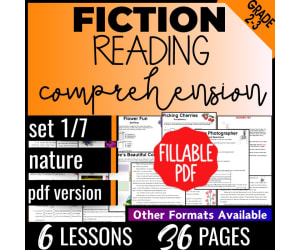
Reading Comprehension Passages Fiction Set 1 Snapshot Genre: Fiction (collection of short nature-themed stories) Subject: Reading (Comprehension) Primary Topic: Nature-themed fiction passages and comprehension practice Estimated Guided Reading Level (A–Z): O What This Teaches Best Character feelings and motivations: Characters want or value something strongly (e.g., Kellie wants snow to use her new sled; Rusty wants to finish his color task; Ross would rather play but ends up enjoying his work). Observation and using the environment for answers: Rusty finds blue and purple by looking more carefully at what’s around him (sky, stream, leaf backs). Cause and effect in everyday situations: Weather and choices affect what happens next (snow finally comes; a thunderstorm ends cherry picking; a volcano eruption changes the climbers’ plans). Nature vocabulary in meaningful contexts: Words connected to seasons, plants, animals, and outdoor features appear across the stories (snow “accumulation,” “canopy,” “eruption,” “perennials,” “marmalade”). Built-in practice pages that match the passages: Each story is followed by questions and skill pages (mixed questions, spelling/vocabulary, short writing prompts) that directly reference details from the story text. Learning Goals Students will recount key events from a selected story in a logical order using details from the text. Students will describe characters’ wants, feelings, and choices and connect them to what happens in the story. Students will identify the setting/season and name text evidence that supports it. Students will explain cause-and-effect relationships shown in the stories (problem → response → outcome). Students will use context clues to determine the meaning of unfamiliar words from the passages. Students will compare information presented in the story (for example, annuals vs. perennials) by stating how they are different using the text’s wording. Passages Include 1.Bring on the Snow: Kellie wants to make it snow. How does she try? 2.Walk through the Woods: A walk in the woods turns into a huge adventure. 3.Nature Photographer: Donna get some amazing snaps in this story. 4.Nature's Beautiful Colors: Rusty enjoys finding out about the colors in nature. 5.Flower Fun: Learn about flower names and colors in this fun lesson. 6.Picking Cherries: Ross spends his day picking cherries but is it worth it? Additional File: Nature Photographer: Drawing Nature Printable FILLABLE PDF VERSION Worksheet-style pages, but with type-in answer boxes so students can complete and save their work digitally. Other versions are available in the links list below or in the full catalog. FULL CATALOG OF DOWNLOAD LINKS HERE For similar downloads and other frees, do check out Cored Group on TeachSimple.
Author Cored Education
Rating
Tags Elementary, Reading, Comprehension, Vocabulary, Common Core, Speling, Writing, Passages, Reading Centers, Reading Comprehension Assessments
Kids Yoga Stories: Paris Yoga Cards for Kids
P.E. & Health, Yoga, Kindergarten, Preschool, Grade 1, 2, 3, 4, Activities
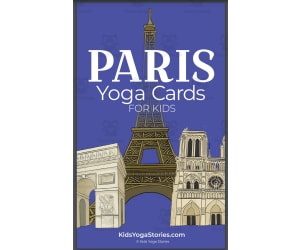
Use yoga poses to teach about Paris! This set of Paris Yoga Cards for Kids will help your students learn through movement either at home, in the classroom, or in a studio. Included in this deck of Paris Yoga Cards for Kids - A card with an index - Tips to teach yoga -20 cards illustrating the yoga poses -20 matching cards with Paris keywords - Instructions for all the poses The index indicates the order in which the yoga poses are to be used to flow from one pose to the next. There is multicultural representation featured in yoga kids! Recommended for ages 3+ Ways in which you can use these cards as homeschoolers or in the classroom include: -For transition times -Morning routines or circle times -Brain breaks to calm their minds and bodies -Physical education -Occupational and/or physical therapy -With one child, small, or large groups Benefits of Yoga for kids include: -Increased strength -Increased flexibility -Improves sleep -Promotes positive interactions amongst adults and children -Develops self-confidence -Improves self-expression -Improves body awareness -Promotes a lifestyle that is active and healthy.
Author Kids Yoga Stories
Tags Kids Yoga Stories, Paris Yoga, Yoga Cards, Kids Yoga, Yoga Poses

Colonial America Activity Packet
Social Studies, History, History: USA, Grade 2, 3, 4, 5, Activities
Colonial America - This " Colonial America Activity Packet " is no prep required - so the packet is great as printable worksheets for a Colonial America or history unit or extra work or sub plans or to enhance a literacy or math unit. Many of these activities are differentiated so there are options for kids at all levels between Grades 2 and 5. Please note that not all activities in this packet will meet your class' particular levels, but there should be enough variation in the resources from your high flyers to those that are more challenged.
Author KP Classroom
Tags Colonial, Ameroca, Colony, Colonies, Mayflower
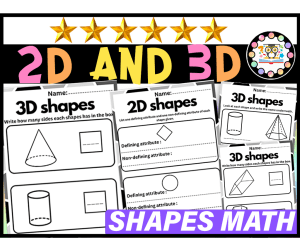
2D & 3D Shapes Worksheets | 2D & 3D Shapes Attributes Geometry
Math, Geometry, Kindergarten, Preschool, Grade 1, 2, 3, Activities, Centers, Teacher Tools, Worksheets & Printables, Workbooks, Worksheets
This interactive and attractive set 2D and 3D Shapes Worksheet Attributes Geometry Worksheets Pages learners develop their original 2D and 3D Shapes Worksheet Attributes Geometry Worksheets this set contains 21 pages in this set, each in each a different Digraphs 2D and 3D Shapes Worksheet Attributes Geometry Worksheets of dedicated 2D and 3D Shapes Worksheet Attributes GeometryWorksheets Pagesto ensure a fun and structured approach to using a fun and type of work that useful; Each card is fun this edited set of 2D and 3D Shapes Worksheet Attributes Geometry Worksheets is built in an elegant style that attracts attention this interactive and attractive set of 2D and 3D Shapes Worksheet Attributes Geometry Worksheetsdesigned to help young learners develop their original 2D and 3D Shapes Worksheet Attributes Geometry Worksheets skills through 2D and 3D Shapes Worksheet Attributes Geometry Worksheets sexercises This set contains 21pages. these printable Worksheets offer useful courses, this provides a useful course-rich practice, it is designed to help using resource grade 2 easily to learn about activities 2D and 3D Shapes Worksheet Attributes Geometry Worksheets a fun and interactive manner. A collaborative learning activity added students. PDF format
Author LAMO
Rating
Tags Geometry, Math, Activities, Worksheets, Homeschools, Centers

Apple Donuts Activity
Life Sciences, Science, Nature & Plants, Grade 1, 2, 3, 4, 5, 6, 7, 8, Activities
Activity Introduction An amazing activity /craft designed for the students to have fun learning about our daily activities or even to have fun doing some DIY crafts. Create Your Wardrobe Do you like group activities or crafts that you can enjoy with your friends and family? Or do you like individua activities and crafts that you can do on your own then show the world how creative you are? Have you ever tried to do a do it yourself craft? If yes tell us more about it, like has any one helped you, what was it about, what materials dd you use to create it and how much time did you suspend creating it? Do you like colouring? What is your favourite colour? Create Your Wardrobe Activity The activity is perfect for encouraging the creativity skills for the students, while having fun with our cool activities and crafts. Create Your Wardrobe This friendly designed worksheet is suitable for students at school, homeschooling, and as a group activity . Instructions Slice the top and bottom from each apple. Slice the apples into circles. Use a biscuit cutter & cut a hole in the center to make a donut shape. Top the apple rings with either chocolate spread, peanut butter or yogurt. Finally, garnish and decorate each donut with different topping. Format Available in a PDF format.
Author Educational Voice
Tags Apple Donuts Activity, Donuts Activity, Apple Donuts, Donuts Craft, Apple, Apples, Apples Activity, Apple Craft, Apples Facts, Apple Facts For Kids
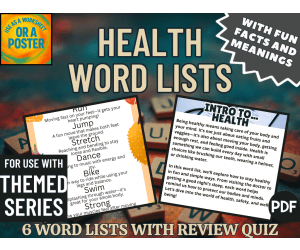
Health Word List Posters (PDF)
ELA, Language Development, Resources for Teachers, Vocabulary, Spelling, ESL, Health, P.E. & Health, Grade 2, 3, 4, 5, Worksheets & Printables, Worksheets, Teacher Tools, Centers, Activities, Posters, Classroom Decor
Word List Poster Series This word list poster series is designed for students in grades 2–5. Each printable focuses on a clear, kid-friendly theme and features 8 target vocabulary words with short, student-friendly meanings or fun facts. The clean layout works as both an anchor chart and a write-in sheet, giving students a quick, visual reference they can revisit during centers and independent work. These posters are student-friendly, classroom-ready, and perfect for warmups, vocabulary walls, sub plans, or take-home reference. Display a single poster to support the day’s lesson, or group several to build a themed wall across your unit. Note: Each poster is a companion piece to its matching themed product in the series—pair it with the corresponding maze, wordsearch, or activity pack for a consistent set of 8 focus words. Health Word List 1. Healthy Eating Fruit, Vegetable, Water, Milk, Grain, Protein, Snack, Meal 2. Exercising Run, Jump, Stretch, Dance, Bike, Swim, Strong, Play 3. Taking Care of Your Body Wash, Brush, Sleep, Bath, Lotion, Towel, Comb, Healthy 4. Staying Safe Helmet, Seatbelt, Cross, Stop, Look, Listen, Light, Careful 5. Visiting the Doctor Doctor, Nurse, Checkup, Shot, Stethoscope, Thermometer, Medicine, Bandage 6. Feeling Good Happy, Calm, Laugh, Energy, Breathe, Rest, Hug, Kind PDF Version Other versions will appear here when available. Follow the store for the lastest on new products. How to Use These Word List Posters Perfect for: Morning work or early-finisher bins Vocabulary centers or anchor walls Holiday/seasonal review lessons Independent stations, sub plans, or take-home reference More Health Themed Products CROSSWORDS WORD SEARCHES MAZES FULL CATALOG OF DOWNLOAD LINKS HERE Themed Word List Posters Links Addition PDF Animals PDF Around the Home PDF Birthday PDF Candy PDF Christmas PDF Cinco de Mayo PDF Clothes PDF Colors PDF Days and Months PDF Division PDF Earth Day PDF Easter PDF Easy Word List Posters PDF Fall PDF Father's Day PDF Food PDF Geography (Set 1) PDF Geography (Set 2) PDF Geography (Set 3) PDF Graduation PDF Health PDF History (Set 1) PDF History (Set 2) PDF History (Set 3) PDF Human Body PDF Kindness PDF Life Skills PDF Mother's Day PDF Multiplication PDF Science (Set 1) PDF Science (Set 2) PDF Science (Set 3) PDF Shapes PDF Social Skills PDF Spring PDF Sports PDF St. Patrick's Day PDF Subtraction PDF Summer PDF Thanksgiving PDF Transport PDF Valentine's Day PDF Winter PDF Word List Posters in Depth Structure Each poster is built around a focused sub-theme and presents 8 target words with short, student-friendly meanings or fun facts. The clean A4 portrait layout works as an anchor chart on your board or as a student reference at desks. These posters are designed as companion pieces to the matching themed products (mazes, wordsearches, activity packs), so the same vocabulary stays visible across your unit. Each poster set includes: A themed word list poster with 8 words + brief meanings/facts A clean, high-contrast layout for easy printing and display Space that can double as write-in/draw-to-show-meaning during centers Themes Included Seasons & Holidays (e.g., Halloween, Easter, Valentine’s Day) Everyday Topics (e.g., Animals, Weather, School) Math & Science Connections (e.g., Number Words, Simple Machines) Special Units (e.g., Health, Earth Day, Sports, Kindness) Each topic reflects real-life experiences and interests while strengthening vocabulary recognition and content understanding in a clear, visual way. Easy extensions (optional) Sketch it: students draw a quick icon for each word Sort it: group words by category (e.g., actions, objects) Star it: highlight “I already know” vs. “I’m learning” words Match it: point to examples in a reading, video, or picture set Say it: brief oral definition or example sentence during share-out Differentiation tips Pre-teach 2–3 anchor words; add the rest later in the week Offer picture cues or gestures for emerging readers/ELLs Let students choose 4 of 8 to focus on first, then build up Color-code by part of speech or concept family for quick scanning For similar downloads and other frees, do check out Cored Group on TeachSimple.
Author Cored Education
Rating
Tags Vocabulary, Spelling, Health, Healthy Eating, Exercising, Health Activities, Posters, Word Lists, Ela Posters, Health Word Lists
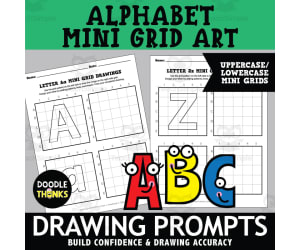
Alphabet Mini Grid Art Prompts | Build Confidence & Drawing Accuracy
ELA, Creative Arts, Art, Language Development, Pre-Reading, Fine Arts, Preschool, Grade 1, 2, 3, 4, Drawing Templates & Outlines, Worksheets & Printables, Activities
Alphabet Mini Grid Art Prompts | Build Confidence & Drawing Accuracy The Alphabet Mini Grid Drawing Prompts is an engaging and educational resource designed for students in kindergarten through 4th grade. This tool, which focuses on Language Arts, Art and Music, enhances skills while making learning fun. For more creative ideas, visit Doodle Thinks website. Incorporating this Resource into Everyday Teaching: Integrating this tool into your standard teaching routine encourages students to broaden their creative minds through art whilst solidifying their knowledge of the alphabet. These simple grid drawing exercises transform complex images into manageable pieces - thereby fostering detail orientation and precision. Included in this download: 52 mini grid drawing prompts An uppercase set A lowercase set This provides plenty of opportunities for students to explore different aspects of art - not just in classrooms but as homework or holiday assignments too. Pedagogical Applications: This resource can be effectively used during whole group instruction. Individual activities or when working in small groups. Your learners will find the prompts easy to understand and they help facilitate interactive peer-learning when utilized within team settings. Plus, you may even use them as a calming brain break activity, homeschool drawing time, sub days, or they could serve as engaging tasks for early finishers! Versatility & Effectiveness: This educational resource creates an engaging blend that aims at nurturing creativity, focus, and confidence in art while ensuring that all learners enjoy each accompanied session with mini grid drawings. The Alphabet Mini Grid Drawing Prompts is an excellent tool suitable for both traditional schooling scenarios and homeschool environments where unique expressive styles are honed. Have fun learning and drawing!
Author Doodle Thinks
Rating
Tags Grid Drawing, Alphabet, Art Education, Fine Motor Skills, Creativity, Drawing, Build Confidence, Learn The Alphabet, Drawing Accuracy, Art Printables
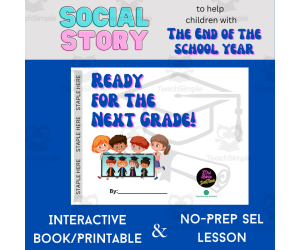
End of the School Year/Moving Grades - Interactive Book/Printable
Special Resources, Social Emotional Learning (SEL), Grade 3, 4, 5, 6, Activities
The End of the School Year/Moving Grades - Interactive Book/Printable This is an engaging and informative teaching resource that is primarily designed for children aged 7-12. It serves as a social story tool that readies kids for the transition from current to next grade levels, addressing common anxieties related to changes in their academic environment. As an interactive book, it places students at the center of the narrative. They can talk about their favorite aspects of their current grade and learn how to cope with nervous feelings tied to moving up in school. Adaptable Uses: Whole Class - Teaching: The teacher can print individual books per student using Google Slides on ActiveBoard during class discussion. Whole Class - Remediation: For agitated or distressed students, they are guided towards reading their social story book in a quiet area thereby calming them down before they engage back into learning activities. Small Group: Students displaying specific behavioral issues could form small groups discussing each page using a provided Discussion Guide. Format: / h4 p This package includes PDFs highly suitable Google Slides Easel Activity png ensuring both teaching display ease preparation kept minimalistic . Plus , do forget acquiring entire bundle assisted array remedies providing prolific solutions enlightening academic journey hence making classroom management seamless unpredictable . -/p
Author Mrs Bonie Just Teach
Tags Interactive Book, Social Story, End Of School Year, Transitioning Grades, Anxiety Relief, Teacher Grade Book Printable

Early Sorting/Grouping activity - Identical and Non-identical items
Special Resources, ELA, Special Education Needs (SEN), Speech Therapy, Math, Early Math, Strategies, Language Development, Vocabulary, Kindergarten, Preschool, Grade 1, 2, 3, 4, 5, 6, Activities
Why we teach errorless learning Errorless learning is a teaching technique that involves minimizing errors during the learning process by providing learners with prompts or cues to help them avoid making mistakes. This approach is particularly effective with young early learning students because it can help build their confidence and prevent frustration, which can be major barriers to learning. Here are some reasons why it is important for educators to teach errorless learning to young early learning students: Promotes success: Young early learning students who experience success in their learning are more likely to enjoy the process of learning and be motivated to continue. By minimizing errors and providing cues, educators can help students achieve success and build their confidence. Reduces frustration: When young early learning students make mistakes, they can become frustrated and lose interest in learning. By minimizing errors and providing cues, educators can reduce frustration and keep students engaged and motivated. Increases independence: Errorless learning can help young early learning students become more independent learners by allowing them to practice skills without the fear of making mistakes. As they become more confident and proficient in their learning, they can gradually reduce their reliance on prompts and cues. Builds a strong foundation: Early learning is critical for building a strong foundation for future learning. By teaching errorless learning, educators can help students develop a strong foundation of skills and knowledge that they can build on as they progress through their academic careers. Sorting/Grouping non-identical objects - ERRORLESS ACTIVITY This activity is a great starter activity for the learner who is being introduced to the concept of grouping/sorting. This 22 page activity is two activities in one. The first one is errorless, where the learner can be independently successful completing an activity . It teaches identical matching and the initial concept of group sorting- taking an identical item from a group of identical items and moving it to match an identical item. There is a second bonus activity of non-identical cards to teach grouping of non-identical items. The pictures are large and clear. Great for those with vision issues or even visual attention issues. IFIO girl I'll Figure It Out
Author IFIO girl - I'll Figure It Out
Tags Sort By Items, Sort By Function, Sort By Feature, Visual Discrimination, Early Learning, Errorless Activity, Autism, Special Needs, Early Problem Solving, Fine Motor

Roll & Draw a Snowman Design Dice Game | Drawing & Coloring Winter Art
Creative Arts, Art, Fine Arts, Preschool, Grade 1, 2, 3, 4, 5, Drawing Templates & Outlines, Worksheets & Printables, Games, Activities, Projects, Centers
Roll and Draw a Snowman Design Dice Games | Winter Art and Drawing Activity Have fun with this adorable snowman design no-prep and interactive drawing game. This resource can be used multiple times and there are starter drawing pages that will keep your learners engaged. This is a great drawing and coloring activity for seasoned or reluctant drawers. Incorporate during the winter season or Christmas unit lessons. Just grab a dice and some blank paper and engage your students with this self-directed drawing activity that can be used alone, with a partner, or with the whole class. What are the benefits of roll and draw games? Understanding visual perceptions Increase following direction skills Improving drawing skills Included in this download: 1 Roll and Draw Game Printables in Color 1 Roll and Draw Game Printables in B/W 1 Example Pages in Color 1 Example Pages in B/W 2 Drawing Pages 1 Instructions Page 1 Intro Page Additional creative ideas for teachers: Present completed drawings as thoughtful gifts from students Create a wall art gallery Place in students' portfolios Offer a writing activity that corresponds to drawing Perfect for: Winter or Christmas art lessons Classroom centers Early finishers Substitute plans Morning work Winter-themed creativity boosts Bring seasonal fun to your classroom with this easy, no-prep Winter art activity!
Author Doodle Thinks
Rating
Tags Roll And Draw, Dice Game, Art Activity, Drawing Activity, Coloring, Art Integration, Art Enrichment, Art Supplement, Design Art, Snowman

Phonics Cootie Catchers - Set A
ELA, Language Development, Phonics, Grade 1, 2, 3, Activities
Phonics Cootie Catchers – Set A The Phonics Cootie Catchers – Set A is a strong teaching resource patterned to enhance effective language arts and phonics instruction. This PDF format set includes 63 diverse pages showcasing various word sound interactions, making it easily shareable on multiple platforms. Grade Level Target and Learning Engagement This resource, with a major focus on grades 1, 2, and 3 stimulates student interaction with phonetics through the engrossing concept of cootie catchers or fortune tellers. Every cootie catcher included revolve around specific sound foci per page promoting immersive activities in phonetics that encourage active participation from students. Diverse Learning Opportunities The pack contains eight unique sets designed to provide diverse learning opportunities in understanding the dynamics of sound interactions within words. This interactive approach denotes solid comprehension while ensuring moments of fun during instructional periods. Versatility in Usage The variety in application makes these Phonics Cootie Catchers a suitable tool for any teaching environment or style - beneficial for group activities where students can help decipher pronunciations collectively; perfect as homework assignments reinforcing learned concepts at home. They are also feasible for use as small group exercises during class-structured desk work sessions or reading time support tools demonstrating their adaptability to various teaching scenarios. Favoured by educators globally due their simplicity and effectiveness, these Phonics Cootie Catchers are ready-to-implement aids applicable to your curriculum after printing - whether you're a mainstream teacher or homeschooling parent - holding kid's attention which results towards better pronunciation proficiencies and overall success within language arts competency.
Author Top Notch Teaching
Tags Phonics, Cootie Catchers, Language Arts, Interactive Learning, Pronunciation Skills
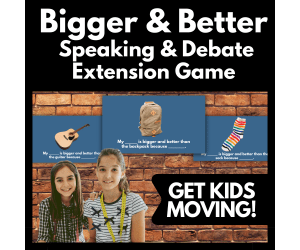
Bigger & Better Speaking Debate Extension Activity ELL SPED Gate
Special Resources, ELA, Social Skills, Reading, Reading Comprehension, Language Development, ESL, Vocabulary, Grade 1, 2, 3, 4, 5, Activities, Games
Bigger & Better Speaking Debate Extension Activity ELL SPED Gate An exceptionally engaging tool, designed for students to practice creating meaningful and coherent sentences. This resource is versatile in its application - making it suitable for both traditional classrooms and homeschool settings. Interactive Learning The activity adds an enjoyable dimension to speaking & debate practice by motivating learners to critically think about objects' value, monetary or intrinsic. It is specifically crafted keeping diverse learning needs in mind - proving effective for ELL, GATE, SPED students as well as typical learners. Resource Components 44 slides neatly organized into four levels of difficulty that ensure continuous learning growth through escalating challenges. Suitable for students from grades 1-5 (approximately ages 5-11) but can be effectively adjusted up to high school level. Combines fun with competition through game elements facilitating high engagement among learners. Includes thought-provoking reflection questions that also make great writing prompts at the end of each level within a game setting. Main Objectives: Nurture precise language usage when describing people or objects. Promote clear communication of comparative measurements during debates or discussions. This can also serve as an effective warm-up or wrap-up element during teaching hours owing to its dual utility nature. Versatile Teaching Resource - Differentiated Instruction: With ample room allowing differentiation concerning response length and complexity; gifted Learners (GATE), English Language Learners (ELL) along with individuals requiring special education will benefit greatly from the linguistic support provided via built-in sentence frames included across all levels involved. - File Type: The downloadable Microsoft PowerPoint File type ensures easy access and also allows simple conversion into Google Slides activities if desired based on individual teaching preferences. Overall In essence, the Bigger & Better Speaking Debate Extension Activity is a comprehensive linguistic resource aimed at enhancing speaking, debate abilities as well as critical thinking among learners. Its multi-level organization along with adaptable structure promises intriguing and productive learning experiences that can be effortlessly integrated into any curriculum .
Author Melissa Is Teaching
Tags Speaking Skills, Debate Practice, Communication Skills, Critical Thinking, Differentiation