



3,984 products added recently
Page 63 - 4th Grade Activities
Introduce your fourth-grade students to activities that challenge and inspire. These resources encourage analytical thinking, teamwork, and creative expression across subjects. Use them to elevate your teaching and engage students in meaningful learning experiences.

 Show filters

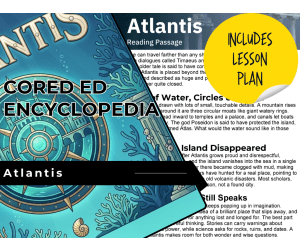
Atlantis Reading Comprehension Passage - Cored Ed Encyclopedia
ELA, Language Development, Reading Comprehension, Reading, Social Studies, Writing, Vocabulary, Geography, History, History: Ancient, Grade 2, 3, 4, 5, Worksheets & Printables, Worksheets, Teacher Tools, Centers, Activities, Writing Prompts, Assessments, Quizzes and Tests, Quizzes, Lesson Plans
This Atlantis reading comprehension with lesson plan includes: Visualization (on the front cover) Start your lesson by taking a minute to think and share something about the topic. Read the script aloud (slowly), perhaps prepare some music or sound effects. Student close their eyes and let their imaginations wander. Students open their eyes, read the question aloud and give them a few minutes to complete. Ask a few students to share or keep answers until the end to compare with what they learn in the passage. Quick pause—thousands of Cored Education products are included with your TeachSimple membership. Download links and encyclopedia index available here. Pre-Reading Trivia Students will write down one thing they already know about the subject and then read five more facts and discuss. These facts are fun, and the students will enjoy learning about the subject before reading more. Give 1 minute for students to write what they already know (no pressure—best guess is fine). Read the five facts together. After each fact, do ask a student for their opinion, was it surprising? Set a purpose by asking students to highlight/underline one fact they want to learn more about during the reading. Reading Passage The text is a high-interest reading passage with set paragraphs, roughly three to four paragraphs long. It contains a variety of themes about the topic, anywhere from history to technology. The passage is between 250 and 350 words in length. First, ask students to look at the headings and see what they’ll learn about today. What do they know about the topic/heading? First read options: Teacher read-aloud (best for support). Partner reading (paragraph by paragraph). While reading, students underline important details, and vocabulary words they think may come up in the questions section. Mixed Questions The first question page contains four multiple-choice questions, each with a choice of four answers, and three written response questions that require a sentence or two from the student. Students complete the mcqs first independently, then review quickly as a class. For the 3 written responses, try to get students giving the answer with some form of evidence: “I think ___ because the text says ___.” If students get stuck, send them back to check the passage. Vocabulary Questions Practice seven key words from the text in this section across two activities. First section is scrambled words where students will unscramble three words given a clue for each. The second section is a word to meaning matching activity. Before starting, have some students read out words they underlined in the passage. Ask students to say the word and read aloud the sentence(s) around each word. Ask students to do scrambled words and the matching exercise in pairs then go through answers as a class. For the scrambled spelling task, get four pairs to come up to the board and write the words for extra practice with the other student reading out the clue. For the matching task, prompt students to give full sentences: “I matched ___ with ___ because ___.” Creative Writing In this question, the student will be required to write a five to eight sentence paragraph on a question related to the topic. Before starting, ask students write down 3 key ideas they are going to include in their piece. Ask students for ideas to share around the class to help those struggling. Pro writing expectations: 5–8 sentences At least 2 facts or details from the passage At least 2 vocabulary words from the previous page Students read their paragraphs while classmates listen for facts and vocabulary words. Extension Activities This page is optional for fast finishers or to take home. There are several activities, each one requiring a different skill. Do some, do none, do all, completely optional - but you will feel reassured knowing every possibility is planned for. Includes summary writting question and additional facts. Answer Key There are answers for the multiple-choice questions, written response questions have sample answers, vocabulary answers and if there is a summary question then a sample summary will be provided as well. Lesson Plan Included Customized lesson plan for this lesson is included. Lesson Snapshot Title: Atlantis Genre: Nonfiction (informational passage about a myth/story’s origins and meaning) Subject: Reading (Informational Text) / Social Studies (Myths & ancient world references) Primary Topic: Atlantis in writing, details, and “lesson” meaning Estimated Guided Reading Level (A–Z): T What This Lesson Teaches Best Identifying where an idea “first appears in writings” and tracking its source (the passage names Plato and two dialogues). Visualizing and describing setting details from informational text (rings of water, bridges, gates, canals, temples, palace). Cause/effect in a legend: how pride and disrespect lead to destruction (earthquakes, floods, island vanishes; travel becomes hard). Distinguishing story-meaning vs scientific proof: stories can warn; science looks for “rocks, ruins, and dates.” Understanding how a name becomes a symbol for “anything lost and longed for” and why mysteries keep people thinking. Learning Goals Students will identify where the Atlantis story first appears and name the two dialogues the passage lists. Students will describe Atlantis’s “circles of water” using details from the passage (moats, bridges, gates, canals). Students will explain what events cause the island to vanish and how the water changes afterward. Students will summarize why people keep hunting for a real location and what “most scholars” think instead. Students will compare what the passage says stories do versus what science asks for. Students will explain how the passage describes Atlantis as a “shortcut” for things that are lost. Key Vocabulary From the Text dialogues — written conversations between speakers. moats — water ditches around a place. canals — water paths that boats can travel on. clogged — blocked so movement becomes difficult. scholars — people who study a topic deeply. FULL CATALOG OF DOWNLOAD LINKS AND ENCYCLOPEDIA INDEX HERE
Author Cored Education
Rating
Tags Vocabulary, Reading Comprehension, Reading Passages, Lesson Plans, Ela Lesson Plans, Reading Comprehension Lesson Plans, Pre-reading, History, History Lesson Plans, Geography

Math and Number Puzzles: A Brain Twisters and Teasers Packet
Math, Numbers, Grade 3, 4, 5, Activities
Math and Number Puzzles: A Brain Twisters and Teasers Packet This excellent teaching resource is designed for educators teaching grade 3, 4, or 5 students. It stimulates curiosity and pushes a student's mathematical proficiency to the next level. What it offers: 12 ready-to-print worksheets with number patterns and various calculations scenarios. A flexible tool for different learning environments such as whole groups, small-group instructions, homeschooling families. How it can be deployed: An exciting warm-up or cooldown activity during math lessons when working with a whole group. Increase cooperative teamwork in small instruction groups. Homeschooling Benefit Homeschooling families may incorporate this packet in their math regimen to foster independent thinking while instilling perseverance in kids as they work through each teaser at their own pace. Beyond Classroom Space The brain twister puzzles can also be used as homework assignments providing supplementary reinforcement outside school hours. In essence: The Math & Number Puzzles: A Brain Twisters & Teasers Packet creatively supplements arithmetic mastery among young learners — nurturing minds into thinking critically about complex numerical problems without applying undue pressure! This resource provides access to practice material pivoting away from traditional resources; invigorating students' interest in numbers.
Author Classroom Complete Press
Tags Math Puzzles, Number Puzzles, Brain Teasers, Brain Twisters, Activity Packet, Math Twisters
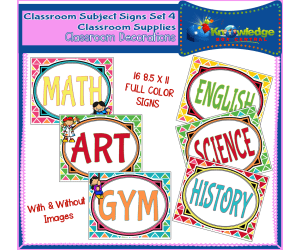
Classroom Subject Signs Set 4 - Classroom Decorations - EBOOK
, Preschool, Kindergarten, Grade 1, 2, 3, 4, 5, 6, Classroom Decor, Activities, Projects
Classroom Subject Signs Set 4 - Classroom Decorations - EBOOK This is an invaluable teaching resource that injects fun and color into your learning environment. The set includes a total of 16 vibrant subject signs that serve as an exciting labeling system for specific areas within the classroom. Specifications The size of each sign is approximately 8.5x11 inches . They come in a landscape orientation for ease of use. We provide two versions of the signs: one with full-color illustrations featuring child-friendly images and one characterized by simple, text-based design. The color scheme includes hues of yellow, orange, pink, green, turquoise and red to visually engage learners. Covered Subjects Areas: This exhaustive list caters to all curricula right from Writing/Language Arts up until Science along with activity -based subjects such as Art & Music and Health & PE. Linguistics: English ELPS Creative Subjects: /illili The signs ideally suit Kindergarten through grade six classrooms making it versatile across early years education. psTo ensure long-term usehr consider lamination post-printing. This technique will allow continual reuse year after year saving educators valuable time. sbsEbook Format:'/'//ibis/ psBeing a downloadable Ebook in PDF format allows instantaneous access following the purchase. The compatibility extends across different regions or schools, providing teachers the flexibility to represent their classrooms accurately. hsFunctionality: his resource doesn't just offer decoration but significant functionality too! It can assist students navigate their classrooms better and give teachers aids to streamline lessons effectively.
Author Knowledge Box Central
Tags Classroom Decor, Subject Signs, Colorful, Learning Environment, Teaching Resource, Classroom Number Signs

Adding Decimals to the Tenths Scavenger Hunt
Math, Decimals, Addition, Grade 4, 5, Activities, Worksheets
Adding Decimals to the Tenths Scavenger Hunt Introduction This invaluable teaching resource provides a focus on adding decimals up to the tenths place in a captivating and stimulating way. Specifically designed for fourth and fifth graders, it offers an engaging scavenger hunt that fully aligns with standard curriculum guidelines regarding decimals. The Resource in Detail Format: The product comes in a 10-page PDF which includes detailed instructions on how this scavenger hunt can be effectively used, making it adaptable for large group teaching, small study circles or as homework tasks. Catering to different needs: It's built with ample flexibility so it can be easily adapted by public school teachers or homeschooling parents depending upon their unique methodologies or learners' individual needs. Evaluation Tools: The inclusion of an answer key allows teachers to monitor students’ understanding while also benefiting self-learners by providing immediate feedback about their performance. Making Learning Fun and Interactive The key feature setting this product apart from conventional resources is its interactive format. Pupils learn mathematical concepts contextually rather than through rote memorization. The engagement of cognitive abilities such as observational skills along with arithmetic operations enhances both their math proficiency and problem-solving capabilities simultaneously. In Summary,"Adding Decimals to The Tenths Scavenger Hunt", fits perfectly into the dynamics of innovative education by blending fun-filled activities with academic learning objectives, thus making it a worthy addition into your lesson plans.
Author That One Cheerful Classroom
Tags Decimals, Tenths Place, Addition, Scavenger Hunt, Interactive Learning
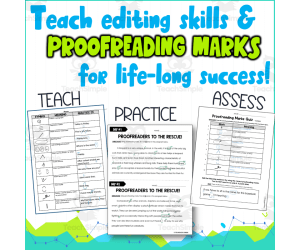
Proofreading and Editing Activity Packet
ELA, Strategies, Grade 4, 5, 6, 7, Activities
This resource is a Proofreading and Editing Activity Packet. This simple packet will give your students what they need to ensure they are excellent proofreaders and editors. Included: - Notes - Daily Practice - Quiz Answer keys are also included.
Author The Language of Learning
Tags Writing, Strategies, Proofreading, Editing, Writing Quiz
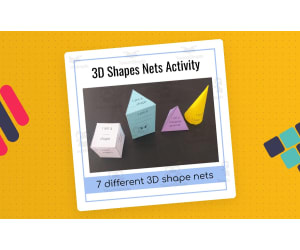
3D Shapes Nets – Art Projects and Crafts
Math, Geometry, Grade 2, 3, 4, 5, 6, Projects, Activities
This 3D Shapes Nets Activity | Art Projects and Crafts resource is great to have students practice hands-on with the creation of 3D shapes! This 3D Shapes Nets Activity | Art Projects and Crafts includes everything necessary for students to create 7 different 3D shape nets. These 3D shapes include: Cube, Rectangular Prism, Triangular Prism, Square-based Pyramid, Triangular-based Pyramid, Cylinder, and Cone. The 3D Shapes Nets Activity | Art Projects and Crafts can be printed on color paper or students could color each net. Then students could cut, fold, and glue each net to create the 3D shape. There are 4 different options for each of the seven 3D shapes: - A set of 3D shape nets with information about the shape on each side: the name of the shape, the number of sides, vertices, and edges. - A set of 3D shape nets with fill-in-the-blank information about the shape. - A blank set of 3D shape nets for students to write/draw on. - A blank set of 3D shape nets with a smiley face for students to write/draw on.
Author educ_project
Rating
Tags 3D Shape Figures, Nets Of Three-dimensional Solids, 3D Shapes Worksheets Shape Nets 3D, Three Dimensional Shapes, Folding 3D Shapes, Build The 3D Shape Net, Nets Geometry, 2D And 3D Shape., 3d Shapes Craft, Shapes Art Project, Art With 3d Shapes, Nets Of 3d Figures
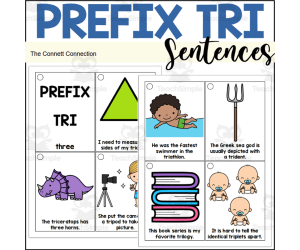
Prefix Tri Sentence Reading Rings
ELA, Language Development, Phonics, Grade 2, 3, 4, Activities, Centers, Worksheets & Printables, Task Cards
Practice reading words with the prefix TRI- with these sentence reading rings. Students will read words with the prefix tri- in the context of sentences. Each card also includes a bold and colorful image to illustrate each sentence and to help students to learn the meanings of each word. What is Included: This resource includes one reading ring activity for the prefix tri. There are cards each featuring a different word with the prefix tri, with a sentence using the word in context and an image to illustrate that sentence. When to Use Early Finishers - If students finish their work early, they can use these reading rings for extra practice. Small Group Work - Teachers can use these reading rings to target small groups of students who need more practice reading words with prefixes. Independent Practice - Students can work independently at their desks to read this set of prefix cards. Morning Work - Students can read and review this reading ring for morning work as their classmates arrive to class. How to Make: Teachers will print out the pages and cut each card apart. Once cut apart, the teacher can choose to laminate the cards for durability. Then, use a hole punch to punch a hole in the top left corner of the card. Place the cards on a ring to create your reading ring, making sure the cover card is on top. Skills Assessed: These reading rings help with identifying words with prefixes These reading rings help with learning the meaning of prefixes These reading rings help students learn how prefixes change the meaning of words. These affixes reading rings are a low prep activity for teachers to prepare for students to use. Once created, these cards can be used over and over to practice reading words with prefixes in the context of a sentence.
Author The Connett Connection
Rating
Tags Affixes, Morphology, Prefixes, Literacy Activities, Reading Words With Prefixes

Stay on Task- Interactive Book/Printable Behavior Support SEL
Special Resources, Social Emotional Learning (SEL), Social Skills, Grade 3, 4, 5, 6, Activities
Stay on Task- Interactive Book/Printable Behavior Support SEL This tool is designed to foster focus and productive habits in students from grades 3 through 6. As a teaching resource, this interactive book/printable primarily serves as a remediation tool encouraging children to name instances when they are off-task, while simultaneously discussing strategies to maintain attention. Students personify themselves into characters that are progressively learning how to stay focused. Bundled resources include: Social Story Explanation, Full Book Print-out, Half-Page Print-out, Discussion Guide and Google Slides . This resource shines in its versatility; it can be seamlessly adapted for whole class lessons or in smaller group settings, allowing educators flexibility based on specific behavior needs. Ideally Implemented within Whole-Class Settings Have each student individually complete books as discussions transpire about each page aided by the Discussion Guide. It also serves effectively as a calming corner strategy where students review expectations via their social story during challenging emotional times. In Small Groups with School Counselors or Therapists The product facilitates: • Curating tightly-knit groups based on behavioral needs, • Letting each student personally engage with the activity and ensuing discussions at hand. Potential Applications of the Tool: This teaching resource offers plentiful potential towards nurturing behavior intervention strategies catering directly towards developing consistent focus among young learners grappling with attention management challenges: • One on One Intervention Strategy: A useful aspect involves students keeping their book at arm's reach within classes which can be revisited when needed. • Homework Assignments or in small groups • Implemented within whole-class settings <br
Author Mrs Bonie Just Teach
Tags Behavior Support, Attention Management, Focus Skills, Student Engagement, SEL
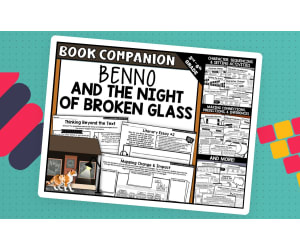
Benno and the Night of Broken Glass Read-Aloud Activities
ELA, Reading, Reading Comprehension, Grade 4, 5, 6, Read Alouds, Activities
Enhance your students' reading experience with this comprehensive companion for Benno and the Night of Broken Glass, by Meg Wiviott. Featuring 44 ready-to-use activities, this resource is perfect for customizing learning to meet your students' needs and academic abilities. Designed to save you time and engage students effectively, these activities foster higher-level thinking skills and encourage textual evidence-based responses. Students will enjoy interactive and educational activities, while you appreciate having high-quality resources at your fingertips. Included in this Resource: Judging by the Cover Making Predictions Sequencing Recalling events in Chronological Order Comic Recall Summary Story Plot Minor Problems & Solutions Cause & Effect Making Connections Using Details to Make Inferences Making Inferences Notice & Note Character Feelings Character Traits Character Inside & Out Character Development (Benno; Neighbors & Shopkeepers) Character Change (Benno; Neighbors & Shopkeepers) Overcoming Obstacles T- Chart Character Summary Character Analysis Acrostic Poem Sketch a Scene From the Story Setting the Scene Theme Thinking About the Text Thinking Beyond the Text Compare & Contrast Symbolism 3-2-1 Author's Message Mapping Change & Impact Mapping Change & Impact Reflection Prep for a Podcast Memorable Moments Crossword Puzzle Word Search Puzzle Wait... There's More! Design a Book Cover 4-Literary Essay Prompts Please note, that this resource is designed for extension read-aloud activities only and is not included.
Author Creatively Gifted
Tags Reading, Upper Elementary, Read-aloud Activities, Interactive Read Aloud, Reading Comprehension, Teacher Resources, ELAR, Holocaust Remembrance, Making Inferences, Elementary ELAR
Women's History Month | Meet the Artists Backstage Pass
Creative Arts, Art, Music, Grade 2, 3, 4, 5, 6, Activities
This resource Women's History Month | Meet the Artists Backstage Pass is an interactive music game for Women's History Month. This is a very colorful presentation/game. Students will meet musical women artists with their backstage pass. Students or teacher will click on the icons to visit each women artist, composers, and musicians. There are a total of five women artists that students will learn about through using this resource! On each slide, students will read lessons and watch videos as they learn more about each one of these artists. Additionally, there are games embedded on the presentation. They will write facts about what they've learned along the way to ensure attention and learning. This resource Women's History Month | Meet the Artists Backstage Pass was designed for students in any grade of elementary school. It could be implemented for the whole class, or for small groups. At the end of each presentation of women artists, students have one last video to play a game while recognizing musical notes. This resource is great to have students learn content at the same time as learning musical notes. For other engaging resources you can visit my store here!
Author Joyful Noise Teaching
Tags Music Activity, Women's History Month, Musicians, Composers, Artist
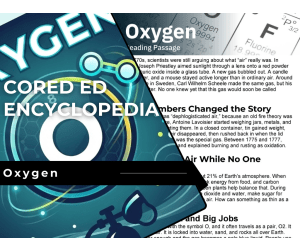
Oxygen Reading Comprehension Passage - Cored Ed Encyclopedia
ELA, Language Development, Resources for Teachers, Reading Comprehension, Reading, Pre-Reading, Writing, Science, Physics, Chemistry, Grade 2, 3, 4, 5, Worksheets & Printables, Worksheets, Teacher Tools, Centers, Activities, Writing Prompts, Assessments, Tests, Quizzes and Tests, Quizzes
This oxygen reading comprehension contains the following: Visualize on the Cover (Teacher Read Aloud Script) Start your lesson by taking a few moments to visualize the topic and share thoughts or feelings about it. Pre-Reading Trivia Students will write down one thing they already know about the subject and then read five more facts and discuss. These facts are fun, and the students will enjoy learning about the subject before reading more. Reading Passage The text is a high-interest reading passage with set paragraphs, roughly three to four paragraphs long. It contains a variety of themes about the topic, anywhere from history to technology. The passage is between 250 and 350 words in length. Mixed Questions The first question page contains four multiple-choice questions, each with a choice of four answers, and three written response questions that require a sentence or two from the student. Vocabulary Questions Practice seven key words from the text in this section across two activities. First section is scrambled words where students will unscramble three words given a clue for each. The second section is a word to meaning matching activity. Creative Writing In this question, the student will be required to write a five to eight sentence paragraph on a question related to the topic. Extension Activities This page is optional for fast finishers or to take home. There are several activities, each one requiring a different skill. Do some, do none, do all, completely optional - but you will feel reassured knowing every possibility is planned for. Includes summary writting question. Answer Key There are answers for the multiple-choice questions, written response questions have sample answers, vocabulary answers and if there is a summary question then a sample summary will be provided as well. FULL CATALOG OF DOWNLOAD LINKS AND ENCYCLOPEDIA INDEX HERE Lesson Snapshot Title: Oxygen Genre: Nonfiction (informational text) Subject: Science (Chemistry / Earth & Life Science) + Reading Informational Text Primary Topic: Discovery, role, and uses of oxygen Estimated Guided Reading Level (A–Z): S What This Lesson Teaches Best How scientists in the 1770s noticed a “new gas” through clues like a candle flaring brighter and a mouse staying active longer than in ordinary air. How Lavoisier’s careful weighing helped show that “air” is made of parts, leading to naming oxygen and explaining burning and rusting as oxidation . How oxygen is invisible yet makes up about 21% of Earth’s atmosphere , and how bodies use it while breathing out carbon dioxide . How photosynthesis helps balance gases: leaves take in carbon dioxide and water, make sugar, and send oxygen back into the air. Where oxygen is found and how people use it (as O and often O₂ , in air and also “locked into” water/sand/rocks, used in hospitals , factories , and rockets ). Learning Goals Students will describe what Joseph Priestley did and what clues suggested the gas was different from ordinary air. Students will explain why Lavoisier weighed jars, metals, and air before and after heating them. Students will explain what the passage says oxidation helps explain. Students will describe the exchange between humans and plants involving oxygen and carbon dioxide. Students will identify at least two places oxygen can be found or used, based on the text. Key Vocabulary From the Text dephlogisticated — Priestley’s name for oxygen under an old fire theory. mercuric — related to mercury; part of “mercuric oxide” in the text. oxidation — a process that explains burning and rusting. atmosphere — the blanket of gases around Earth. photosynthesis — plants make sugar and send oxygen back into the air. Cored Ed Encyclopedia Overview The Cored Ed Encyclopedia is a weekly series of lessons that you can pick up and use right away. These short readings fit into whatever time you have available. Each one includes a warm-up, a reading, and a set of questions, but it’s flexible — you can do just the reading, the full lesson, or skip the writing section if you need to. Each lesson focuses on a single topic so students don’t get lost. The writing is clear but never childish, making it perfect for grades two through five. Topics range from animals and science to history, inventions, and everyday things. No matter the level of the student, everyone should take away at least one new idea or fact from each lesson. The materials are easy to print, easy to explain, and require no setup. They work well for whole-class teaching, partner work, or independent study.
Author Cored Education
Rating
Tags Vocabulary, Spelling, Reading Comprehension, Reading Passages, Reading, Creative Writing, Reading Strategies, Writing Prompts, Oxygen, Physical Science

The Empathy Odyssey Seasonal Micro-Mission Deck for Social-Emotional
Classroom Management, Resources for Teachers, Community Building, Sociology, Social Studies, Special Resources, Life Skills, Social Emotional Learning (SEL), Social Skills, Special Education Needs (SEN), Grade 4, 5, 6, 7, 8, Projects, Activities, Assessments, Teacher Tools, Lesson Plans, Rubrics, Worksheets, Worksheets & Printables, Word Searches, Word Problems
Unleash the full potential of social and emotional learning with "The Empathy Odyssey: Pedagogical Architectures for the Middle Years" – a comprehensive, immersive, and transformative curriculum that develops empathy, resilience, and cognitive skills for tweens. This 43-page digital PDF contains a facilitator's guide, theory, student workbook, and teacher resources, all rolled into one. Developed with the principles of neuroscience, psychology, and the Seasonal Cyclicality Model (SCM), this social and emotional learning program for kids takes students on a series of fun, gamified, and micro-level missions aligned with Autumn (self-awareness), Winter (social observation), Spring (social skills), and Summer (responsible decision-making). This social and emotional learning program for kids, tweens, and pre-teens is perfect for parents, teachers, and counselors who want to develop the cognitive empathy, emotional intelligence, and growth mindset of middle school students. A must-have for middle school emotional intelligence development, bullying prevention, and classroom community building. Instant download. Keywords: SEL curriculum for 4th to 7th grade, empathy workbook for middle school, social and emotional learning activities, tween emotional intelligence development, neuroscience-based SEL program. Why Parents/Schools Love It: Neuroscience-Based: Fuses the power of brain science with the ease of using Micro-Missions to develop empathy as a "muscle" that grows with repetition, creating a lifelong tool for children without overwhelming them. Seasonal Format: Utilizes the power of seasonal themes and activities to eliminate social anxiety issues with a "game" approach to SEL that integrates easily into the school year or home schedule. Comprehensive Resources Included: Provides facilitator guides, student worksheets, case studies, images, and teacher keys in one convenient PDF format for quick and effective implementation with proven results such as improved conflict resolution and self-regulation. Universal and Adaptable: Includes protocols for working with children who have experienced trauma, those with neurodiverse needs, and applications for real-world issues such as bullying, making it effective for a wide range of classrooms and promoting a sense of community. Proven Results through Real-Life Case Studies: Includes real-life examples of how children move from isolation to connection, giving parents and educators the power to see the impact on children's social skills and decisions. Target Classes/Students : After a thorough analysis of the entire content presented in the PDF, from the introduction to the chapters, case studies, worksheets, and teacher resources, the content is clearly targeted at students from grade 4 through grade 7 (approximately 9-13 years old). This is consistent with the "middle years" concept presented throughout the content, which covers neurological developments such as prefrontal cortex restructuring, synaptic pruning, and the progression from Erik Erikson's Industry vs. Inferiority stage to the Identity vs. Role Confusion stage. For example, grade 4 community projects, grade 5 integrations into the classroom, grade 6 self-awareness interventions, and grade 7 conflict resolutions. The content is applicable for homeschoolers, classrooms in public/private schools, after-school programs, and counseling sessions for the target age group, with modifications for neurodiverse students with ASD or NVLD. Copyright/Terms of Use: This Book was copyrighted by Syed Hammad Rizvi. This resource is for personal and single classroom use only. You may not alter, redistribute, or sell any part of this resource. In other words, you may not put it on the Internet where it could be publicly found and downloaded. If you want to share this resource with colleagues, please purchase additional licenses from Teachsimple. Thank you for respecting these terms of use. This product is happily brought to you by Syed Hammad Rizvi
Author Creative Book Store
Rating
Tags TheEmpathyOdyssey, SELCurriculum, SocialEmotionalLearning, EmpathyWorkbook, MiddleSchoolSEL, Grades4to7, EmotionalIntelligenceKids, TweenResilience, NeuroscienceEducation, EmpathyBuildingActivities
Geological Timeline | Geochronology | Timeline Project
Science, Earth and Environmental Sciences, Grade 1, 2, 3, 4, Activities
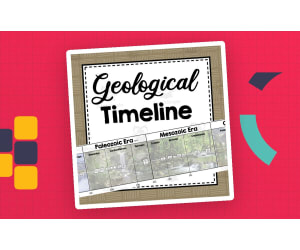
Help your students create their own large timeline as you explore the different geological eras, providing them with a visual representation of Earth’s ancient history. This interactive project allows students to better understand the geological time and how life evolved across millions of years. Glue the pieces together to form one long timeline and study the diverse kinds of creatures that lived during each era, from the Precambrian to the Cenozoic, giving students a sense of when major evolutionary milestones occurred. There is one version with simplified information for younger students and another with more detailed content for advanced learners. As students assemble the timeline, they can add labels, illustrations, or facts about each era, making the lesson more engaging and creative. You can even encourage them to research and add additional information about the environmental changes or major extinction events that shaped life during these periods. This hands-on project not only reinforces their understanding of geological eras but also helps them develop sequencing and critical thinking skills. What You Get: 7 Vocabulary word strips: (Prehistoric, Archean, Proterozoic, Paleozoic, Mesozoic, Cenozoic, and Geochronology) Spiral Geochronological Timeline Poster Huge Color Printable Classroom Geochronologial Timeline (6 pages long taped together!) Geochronological Timeline Template for your students to make themselves (This is AMAZING!) Two template choices, cut out plants and animals to add to the timeline as you learn about which organisms lived when.
Author Simply Schoolgirl
Tags Geology Activity, Earth Science Activity, Timeline Activity

Pentagon Activity
Shapes, Early Math, Math, Geometry, Grade 2, 3, 4, 5, 6, 7, 8, 9, 10, 11, 12, Activities
Activity Introduction An amazing activity designed for the students to learn more about STEM. Pentagon Do you like STEM subjects? what is your favorite one? Have you ever tried to plant a seed? If yes, tell us more about it. Or have you ever tried to invent something? If yes, tell us more about it. And how do you think it will help us? Have you ever seen a microorganism under a microscope? What was it? And how it looked like? Mathematics is a marvelous subject. Let' sharpen our brains and solve some equations. Do you like timetable tricks? What is your favorite one? Do you know how to code? Have you ever created an app or a game before? If yes, how was it like? Pentagon Activity The activity is perfect for encouraging the researching skills for the students, while learning more about this fantastic topic. Pentagon This friendly designed worksheet is suitable for students at school, homeschooling, and as a group activity. Instructions Cut everything out and use the shapes to create as many pentagon-shaped items as you can. Example: superman logo. Format Available in a PDF format.
Author Educational Voice
Tags Pentagon Activity, Pentagon, Pentagons, Pentagon Shape, Pentagon Shape Facts, Pentagon Shape Facts For Kids, Pentagon Facts, Pentagon Facts For Kids, Shape, Shapes
Amazon River Animals Activity
Social Studies, Science, Life Sciences, Animals, Geography, Grade 2, 3, 4, 5, 6, 7, 8, 9, 10, Activities
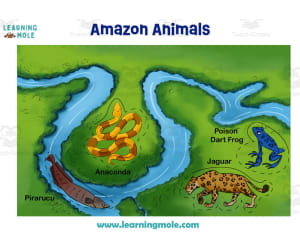
Activity Introduction An amazing activity designed for the students to learn more about animals in different countries. Amazon River Animals Do you like animals? what is your favorite one? Do you own a pet? If yes, tell us more about it, like what its name? And what do you like most about it? What are the animal kingdoms? Can you write down the characteristics of each animal class like mammals, birds, reptiles, amphibian, fish and mollusks. Do you know that some animals can sing, can you name any of them? What is the largest and the smallest mammal in the world? What is the largest and the smallest bird in the world? What is the largest and the smallest fish in the world? Amazon River Animals Activity The activity is perfect for encouraging the researching skills for the students, while learning more about this fantastic animal. Amazon River Animals This friendly designed worksheet is suitable for students at school, homeschooling, and as a group activity. Instructions Cut along the dashed lines then glue page on top of page 2. Open what you cut gently, hen write what you know about each animal. Format Available in a PDF format.
Author Educational Voice
Tags Amazon River Animals Activity, Amazon River Animals, Amazon River, Amazon River Facts, Amazon River Facts For Kids, Animals, Animals Facts For Kids, Animals Facts

Animal Dads by Steve Jenkins Interactive Read-Aloud Activities
ELA, Reading, Reading Comprehension, Grade 2, 3, 4, Read Alouds, Activities
This picture book companion is a comprehensive supplemental resource for Animal Dads by Steve Jenkins. It includes 25 ready-to-use, print-and-go activities designed to meet the needs of all learning levels. Created with teachers in mind, this resource saves you time while providing students with engaging opportunities to demonstrate their understanding and newly acquired knowledge through interactive read-alouds. The activities cover a range of skills, from basic comprehension to critical thinking. INCLUDED IN THIS RESOURCE: Making Predictions KWL Graphic Organizer Animal Dads - Student Notes Booklet Word Scramble Who Am I? True or False (Bubble Answers ONLY) True or False (Bubble Answers & Correct the False Statement) 3-2-1 Thinking About the Text Thinking Beyond the Text Compare & Contrast Making Connections Animal Dads Playing Cards Animal Dad ABCs Animal Dads Poster Word Search Puzzles Crossword Puzzle Animal Dads Superlatives Fun Facts About Animal Dads New Vocabulary Caring Caregiver Book Review This resource is for extension read-aloud activities only. The book is not included.
Author Creatively Gifted
Tags Reading Comprehension, Reading, Upper Elementary Reading, Picture Book , Read-aloud Activities, Interactive Read-aloud Activities, Book Companion, ELAR, Steve Jenkins, Animals

Multiplying and Dividing Positive and Negative Fractions Pixel Art
Math, Fractions, Multiplication and Division, Division, Multiplication, Grade 4, 5, 6, Worksheets & Printables, Activities, Task Cards, Games
Are your 7th-grade students struggling with multiplication and division of positive and negative fractions? This engaging activity is ready to make those slippery ideas stick — with no hours of prep or grading. With printable task cards and digital self-checking pixel art, this activity incorporates flexibility, enjoyment, and independent learning. It motivates students as they solve problems and watch a hidden picture appear — as they build strong fraction skills that are in line with 7th-grade math standards. Why This Resource Works This no-prep digital activity makes practice with fractions fun. As they finish each of the 20 multiplying and dividing fraction problems, correct answers will uncover a pixel-art image. The self-checking design provides instant feedback for students — and less effort for you. You’ll also get printable task cards for small groups, partner work, or stations. Whether your class is working digitally, on paper, or a mix of both, you’ll have everything ready to go in minutes. What’s Included Digital Pixel Art Activity featuring 20 multiplying and dividing fraction problems (including positive and negative numbers) Printable Task Cards for flexible small-group or offline practice Student Handouts to support independent work Answer Key for fast grading or easy self-grading No-Prep Format — perfect for assigning or printing instantly Neutral, Year-Round Theme — suitable with any unit or season Key Benefits Zero Prep – Assign or print and start right away. Self-Checking Format – Immediate feedback saves time grading and increases confidence. Engaging & Interactive – Pixel art holds students' interest from start to finish. Flexible Use – Works digitally, in print, or a mix of both. All-Year Resource – Perfect for any time of the year, from first teaching to review. Perfect For 7th Grade Math Practice or Review In-Class or Distance Learning Centers, Rotations, or Partner Work Homework, Sub Plans, or Early Finishers Offer your students valuable practice without the prep time. With engaging pixel art and print-friendly options, multiplying and dividing fractions have never been so enjoyable — or so easy to teach.
Author Matemaths
Rating
Tags Matemaths, Printable, Worksheets, Task Cards, Pixel Art, Decimals
UEFA European Championship 2024 - Football Jerseys Euro 2024
P.E. & Health, Sports, Science, Earth and Environmental Sciences, Earth Sciences, Grade 2, 3, 4, 5, 6, Activities, Projects
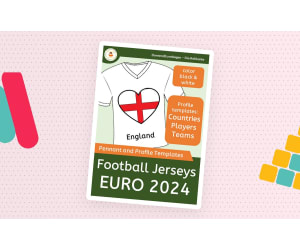
UEFA European Championship 2024 -Football Jerseys Euro 2024 This material includes jerseys featuring national flags in the shape of hearts for all 24 participants of the UEFA European Football Championship 2024. Each jersey comes in both color and black-and-white versions for coloring. Euro 2024 - Decoration: Themed Wall or Board Material: Decorate your themed wall for Euro 24 with the jerseys. You can use them, for example, to visualize the current match schedule or the current rankings of the countries. Simply cut off the flap at the neckline. Pennant Banner: Hang the jerseys as a pennant banner in the classroom. Fold the small flap at the neckline over the string and attach it to the bottom edge. Euro 2024 - Creating Profiles: Attach the front sides of the jerseys with flags to the back of profile templates using the neckline flap to create foldable cards. Football Team: Students can select their favorite team or introduce the team opponents in the tournament groups. Favorite Player: Students choose their favorite football player from Euro 2024, select the corresponding national jersey, and complete the profile about their favorite player. Country Profile: Assign each student one of the participants of Euro 2024. Students research their assigned country and fill out the corresponding country profile. Compilation of Country Books: All three profile templates with the front side of the jersey can be glued together to form a small book. The blank template can be supplemented with additional information about the participant country, such as games and victories of the participants or the significance and history of football in the country. To create the book, layer the individual jersey pages on top of each other (flag side up) and staple them together after design completion.
Author Die Relitante
Tags Soccer, Euro 2024, UEFA European Championship 2024, Soccer Player Profiles, Soccer Crafts, Soccer Flag Banners, Soccer EM Decorations, Europea, Countries

Iguanas Reading Comprehension Passage - Cored Ed Encyclopedia
ELA, Reading Comprehension, Reading, History, Social Studies, Science, Physics, Earth and Environmental Sciences, Life Sciences, Geography, Grade 2, 3, 4, 5, Worksheets & Printables, Worksheets, Teacher Tools, Centers, Activities, Writing Prompts, Assessments, Quizzes and Tests, Quizzes, Lesson Plans
This Iguanas reading comprehension with lesson plan includes: Visualization (on the front cover) Start your lesson by taking a minute to think and share something about the topic. Read the script aloud (slowly), perhaps prepare some music or sound effects. Student close their eyes and let their imaginations wander. Students open their eyes, read the question aloud and give them a few minutes to complete. Ask a few students to share or keep answers until the end to compare with what they learn in the passage. Quick pause—thousands of Cored Education products are included with your TeachSimple membership. Download links and encyclopedia index available here. Pre-Reading Trivia Students will write down one thing they already know about the subject and then read five more facts and discuss. These facts are fun, and the students will enjoy learning about the subject before reading more. Give 1 minute for students to write what they already know (no pressure—best guess is fine). Read the five facts together. After each fact, do ask a student for their opinion, was it surprising? Set a purpose by asking students to highlight/underline one fact they want to learn more about during the reading. Reading Passage The text is a high-interest reading passage with set paragraphs, roughly three to four paragraphs long. It contains a variety of themes about the topic, anywhere from history to technology. The passage is between 250 and 350 words in length. First, ask students to look at the headings and see what they’ll learn about today. What do they know about the topic/heading? First read options: Teacher read-aloud (best for support). Partner reading (paragraph by paragraph). While reading, students underline important details, and vocabulary words they think may come up in the questions section. Mixed Questions The first question page contains four multiple-choice questions, each with a choice of four answers, and three written response questions that require a sentence or two from the student. Students complete the mcqs first independently, then review quickly as a class. For the 3 written responses, try to get students giving the answer with some form of evidence: “I think ___ because the text says ___.” If students get stuck, send them back to check the passage. Vocabulary Questions Practice seven key words from the text in this section across two activities. First section is scrambled words where students will unscramble three words given a clue for each. The second section is a word to meaning matching activity. Before starting, have some students read out words they underlined in the passage. Ask students to say the word and read aloud the sentence(s) around each word. Ask students to do scrambled words and the matching exercise in pairs then go through answers as a class. For the scrambled spelling task, get four pairs to come up to the board and write the words for extra practice with the other student reading out the clue. For the matching task, prompt students to give full sentences: “I matched ___ with ___ because ___.” Creative Writing In this question, the student will be required to write a five to eight sentence paragraph on a question related to the topic. Before starting, ask students write down 3 key ideas they are going to include in their piece. Ask students for ideas to share around the class to help those struggling. Pro writing expectations: 5–8 sentences At least 2 facts or details from the passage At least 2 vocabulary words from the previous page Students read their paragraphs while classmates listen for facts and vocabulary words. Extension Activities This page is optional for fast finishers or to take home. There are several activities, each one requiring a different skill. Do some, do none, do all, completely optional - but you will feel reassured knowing every possibility is planned for. Includes summary writting question and additional facts. Answer Key There are answers for the multiple-choice questions, written response questions have sample answers, vocabulary answers and if there is a summary question then a sample summary will be provided as well. Lesson Plan Included Customized lesson plan for this lesson is included. Lesson Snapshot Title: Iguanas Genre: Nonfiction (informational text) Subject: Reading (Informational Text) / Life Science Primary Topic: Green vs. marine iguanas: tails, habitat, survival Estimated Guided Reading Level (A–Z): R What This Lesson Teaches Best Describes key iguana features and what they look like (dewlap, a line of spines). Explains where iguanas live and notes that most live in the Americas, with some relatives on islands. Shows how a green iguana’s long tail helps with survival (whip-like defense and strong tail strokes for swimming away). Compares two related iguanas by habitat and behavior (tree-climbing green iguana vs. sea-foraging marine iguana that eats algae and basks on dark rocks). Builds awareness of changing habitats and reasons protection matters (building on land, hunting/capturing, predators, El Niño, oil spills). Learning Goals Identify details that describe what an iguana looks like and where it lives. Explain how a green iguana uses its tail when danger comes near water. Describe how the marine iguana finds food and what it does after a cold swim. Compare the green iguana and marine iguana using evidence from the passage. Describe at least two reasons iguanas might need protection based on changes in their habitats. Key Vocabulary From the Text dewlap — loose throat skin that can hang in a fold. spines — pointed bumps that may rise along its back. forages — searches for food. predators — animals that hunt other animals. habitats — places animals need to live. FULL CATALOG OF DOWNLOAD LINKS AND ENCYCLOPEDIA INDEX HERE
Author Cored Education
Rating
Tags Vocabulary, Reading Comprehension, Reading Passages, Lesson Plans, Ela Lesson Plans, Reading Comprehension Lesson Plans, Pre-reading, History, Science Lesson Plans, Life Science

Self-Guided Logic Activities #7: Statistics, Impressions, Personification, and Paradoxes
, Grade 4, 5, 6, 7, 8, Activities
Self-Guided Logic Activities #7: Statistics, Impressions, Personification, and Paradoxes This vibrant teaching resource is specially designed to cater for students from grade 4 to grade 8 by stimulating their young minds through engaging critical thinking tasks. Compound Resource Packet The packet contains four distinct units, each loaded with its unique set of exercises. These are all carefully curated to elevate the student's logical thinking capacity. As an educator, you can assign these interactive activities either individually or to small study groups looking for an intellectual challenge. Diverse Range of Tasks In each unit , students will delve into a myriad of tasks like unraveling story problems or weaving poems together. The opportunity allows learners to explore creativity while mastering complex techniques such as personification and understanding concepts like paradoxes. Cognitive enhancement: Each task is engineered not just for enhancing cognitive abilities but also nurturing the creative spirit within students. 'Student Self-Check' Sections To cap off each unit are included 'Student Self-Check' sections. This addition provides detailed answers along with thoughts meant to spur further contemplation on the topics covered. Purpose:The self-check sections guarantee comprehensive understanding while consistently igniting higher-level thought processes in learning. The primary goal here is creating enriched experiences using this tool—spanning across fifteen pages—in class or even as potent homework assignments that rewardingly engage learners paving their way towards becoming better critical thinkers and more creatively inclined individuals simultaneously. Note:This file comes ready-printed in PDF format for immediate application in your classroom setting. This invaluable resource demonstrates the blend of simplicity and sophistication — turning seemingly daunting subjects into exciting, manageable lessons.
Author Classroom Complete Press
Tags Self-guided, Logic Activities, Statistics, Impressions, Personification
Pollinators Reading Comprehension Passage for 2nd, 3rd, and 4th Grades
ELA, Reading, Reading Comprehension, Science, Nature & Plants, Life Sciences, Grade 2, 3, 4, Centers, Activities, Worksheets, Worksheets & Printables
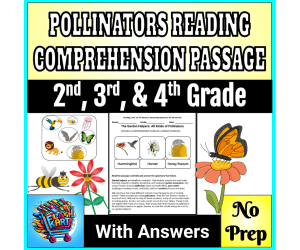
Pollinators Reading Comprehension Passage for 2nd, 3rd, and 4th Grades (Science + ELA) | No Prep Make learning about pollination fun and easy with this engaging Science and ELA resource! Instead of teaching pollination as a difficult science topic, this reading comprehension set will help students learn about a few amazing animals that help plants grow. They will explore a variety of fascinating garden helpers from around the world, discovering that pollinators include much more than just bees and butterflies. This no-prep resource combines informational reading , comprehension practice, and interactive activities to keep students engaged while building science knowledge and reading skills at the same time. I created this resource to blend ELA with Science . What’s inside? Informational Reading Passage An engaging nonfiction passage that explains how pollination works and introduces students to a variety of pollinators, including bees, butterflies, beetles, flies, bats, hummingbirds, lemurs, and possums. Reading Comprehension Questions Text-dependent questions that help students practice comprehension , recall details , and build critical-thinking skills . Circle the Pollinators Activity Students will identify and circle the animals that help with pollination. Pollinator Coloring Activity A fun page where students will color only the pollinators while reinforcing science concepts. Fun Facts Extension Page High-interest pollinator facts page is included to keep early finishers engaged and curious. Answer Key The answer key is also in this set for easy grading and quick checking. Formats Included Colorful version + black-and-white version Grade Levels Perfect for: 2nd Grade 3rd Grade 4th Grade Why Teachers Love This Resource It combines Science and ELA in one easy to use activity It helps students practice reading comprehension using informational text It also introduces students to both common and unusual pollinators This resource also includes visual activities that support young learners and ESL students No prep resource - simply print and use It Is Great For Guided Reading Groups Science Lessons Literacy Centers Independent Work Homework Sub Plans Spring Units Earth Day Activities Homeschool Science Lessons Skills Covered Reading Informational Text Main Idea and Supporting Details Science Vocabulary Understanding Life Cycles and Pollination Critical Thinking Visual Recognition Skills Common Core Standards CCSS.ELA-LITERACY.RI.2.1 CCSS.ELA-LITERACY.RI.3.3 CCSS.ELA-LITERACY.RI.4.7 This pollinators reading comprehension pack makes science meaningful, interactive, and easy to understand while helping students strengthen important reading skills at the same time.
Author FlashKart
Rating
Tags ELA, Reading Comprehension, Language Arts, Pollinators, Garden Helpers, No Prep, Centers, Worksheets, Reading Skills, Science
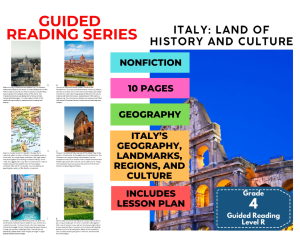
Italy History and Culture: Guided Reading Level R with Lesson Plan
ELA, Resources for Teachers, Reading Comprehension, Reading, Science, Geography, Social Studies, History, Earth and Environmental Sciences, Technology, Grade 3, 4, 5, Worksheets & Printables, Worksheets, Teacher Tools, Centers, Activities, Literacy Readers, Quizzes, Quizzes and Tests, Assessments, Lesson Plans
This Germany: The Heart of Europe (level r) guided reading book with lesson plan includes: Guided Reading Color Label (front cover x1) This is a quick way to match the book’s demands to what students can generally handle.. The overall goal is to use the level/color to pick books for several smaller groups. To qualify for a certain level, a student is expected to read a book from that level with about 90–94% accuracy. If a student is consistently accurate and understands, move up a level. If the student is struggling at that level, drop down and add more support. Each student will improve at completely different rates, but it is generally one of the best ways to check progress across the class. DOWNLOAD THE CATALOG TO VIEW ALL GUIDED READING BOOKS AVAILABLE (SORTED LEVELS A-Z) Pre-Reading Question (x1) Teacher asks the prompt aloud, can be while showing the cover or first page. Students share what they already know, or make educated guesses from the cover. Prompt them to use the target vocabulary. Write some of their responses on the board to look back at during the reading. Vocabulary Words (x5) Introduce the five words, best doing it one at a time. Start by saying it, while students repeat and then see if anyone knows what it means before reading further. Read through the meaning and try to briefly connect each word to a picture or gesture so it’s meaningful. Ask students to flip through the book pages and point to where they see each of the vocabulary words. While reading the book pause upon coming across one of the vocab words or read the sentence twice to make sure students understand the word has appeared. Optional: Ask students to raise hands whenever they see/hear one of the new words. Guided Reading Pages (x10) Check the book snapshot (below) for: primary topic - do you need to prep extra reading or intro materials on this? what is taught best - decide on 1-2 bullets to focus on, use the prompt or words provided here for best results. learning goals - what you are checking for students to be able to do after the session, elicit answers using prompts or words provided. key vocabulary (see section above). questions overview - so you know what is coming up and if you need to prep extra materials to assist understanding. Run the lesson You may have already looked at a few of the pages together, but you can show them some of the pictures again first to set meaning. Depending on how much time you have and how familiar your students are with guided reading class, you may want to read the book aloud first with the group first. Students whisper or partner read, while you listen in. If time, do it as a group, one student reading a page each. Use the guided page’s prompts to coach: “Check the picture / does it make sense?” “Point under the words / try the first sound” “Reread the sentence smoothly”. Try to focus more on one student per session (rotating every time), so you can work out if they are ready to move up or need to move down a level. Comprehension Questions (back cover x3) This is your way to check that students didn’t just say the words, but actually understood the text. First, let students answer by pointing to the page/picture and saying a short sentence. After any answer, follow with: “Show me where you found that in the text.” In bigger groups, have partners answer first (10–20 seconds), then call on 2–3 students to share. Differentiation tips: Emerging speakers/struggling readers: oral + pointing On-level: oral in a full sentence Higher: one written sentence or draw + label Book Snapshot Title: Italy: Land of History and Culture Genre: Nonfiction Subject: Social Studies (Geography/History/Culture) Primary Topic: Italy’s geography, landmarks, regions, and culture Estimated Guided Reading Level (A–Z): R What This Book Teaches Best Describes Italy’s location and physical geography , including its peninsula shape, the Alps, and the Mediterranean Sea. Highlights important historical landmarks and what they represent, such as the Colosseum and the Vatican City/St. Peter’s Basilica. Connects history to art and architecture through Florence and the Renaissance, including the Duomo’s engineering. Explains regional life and land use , including Tuscany’s landscape and agriculture (olive oil, grapes, ingredients for cooking). Shows how Italy blends past and present , from Pompeii and Mount Vesuvius to modern fashion, design, technology, cars, and trains. Learning Goals Students will describe Italy’s location and explain how the text describes its shape. Students will identify key facts about Rome and explain what the text says the Colosseum symbolizes today. Students will describe why Vatican City is important using details from the text. Students will explain why Florence is called the “Cradle of the Renaissance” using text details about arts and learning. Students will describe how Venice’s canals affect transportation in the city. Students will explain one way Italy influences the world today, based on the text’s examples of modern industry and innovation. Key Vocabulary From the Text peninsula — land surrounded by water on three sides. amphitheater — large open building for watching public events. Renaissance — time when art, science, and literature flourished. gondolas — long narrow boats used to travel Venice’s canals. archaeological — about studying the past by examining old remains. Discussion Prompts Pre-reading question: What places or foods do you already connect with Italy? Comprehension questions: What shape does the text say Italy resembles? Comprehension questions: What does the text say the Colosseum could hold in ancient times? Comprehension questions: What does the text say caused the Leaning Tower of Pisa to start tilting? Printing Tips 1. Best Printing Method (Recommended) “Booklet” Printing (Best if Available) If your printer or PDF viewer supports Booklet Printing , use this. Settings to use: Print mode: Booklet Paper size: Letter or A4 (either works) Orientation: Landscape Print on both sides: Yes Flip on: Short edge Scaling: Fit to printable area Booklet subset: First test: Front sides only Then: Back sides only This will automatically: Pair pages correctly Put the cover on the outside Align everything for folding After printing, fold in half and staple along the spine . 2. If “Booklet” Printing Is NOT Available You can still print this correctly with manual duplex printing . Step-by-step: Open the PDF. Choose Print . Set: Orientation: Landscape Pages per sheet: 1 Print on both sides: Yes Flip on: Short edge Print all pages . Because each PDF page already contains two facing book pages, the result will still fold cleanly into a book. Thousands of Cored Education products are included with your TeachSimple membership. Download links and encyclopedia index available here.
Author Cored Education
Rating
Tags Reading Comprehension, Reading Passages, Reading, Guided Reading, Guided Reading Lesson Plan, Guided Reading Activity, Pre-reading, Social Studies, Geography, History

Mother's Day Musical Scavenger Hunt
Creative Arts, Art, Music, Preschool, Grade 1, 2, 3, 4, 5, 6, Songs, Activities
This resource is a Mother's Day musical scavenger hunt focused on the notes 'sol' and 'mi'. On each slide, students will be selecting the correct musical patterns to keep the scavenger hunt going.
Author Joyful Noise Teaching
Tags Music Notes, Scavenger Hunt, Music Lesson, Music Activity, Mother's Day

Seven Little Goats El lobo y los siete cabritos – Finger Puppets
ELA, Literature, Grade 1, 2, 3, 4, 5, 6, Activities
The Wolf and the Seven Little Goats / El lobo y los siete cabritos – Finger Puppet Craft with Backdrop and Pocket Spanish-language material / Material en español This is a Spanish-language printable craft activity for young learners. It is based on the traditional fairy tale The Wolf and the Seven Little Goats ( El lobo y los siete cabritos ). Students cut out and assemble finger puppets , build a simple backdrop , and use a pocket to store the puppets in their folders or notebooks. The puppets are provided in color and black & white versions for optional coloring. This activity helps students: Practice storytelling and reading comprehension Improve oral language and fluency in Spanish Develop fine motor skills Learn through hands-on, creative play Included: Finger puppet templates (color and black & white) Foldable backdrop Storage pocket template Instructions in Spanish Best for: Grades 1–4 Spanish class or bilingual settings Story retelling units or literacy centers Group work or individual use No special materials needed — just scissors, glue, and crayons or pencils. 📌 Note: The content and instructions are entirely in Spanish . Este recurso es una actividad imprimible en español basada en el cuento tradicional El lobo y los siete cabritos . Los estudiantes recortan y arman marionetas de dedo , montan un escenario de teatro plegable y crean una bolsa para guardar el material . Las marionetas vienen en versión a color y blanco y negro para colorear. La actividad permite trabajar: La comprensión lectora y la narración La expresión oral en español La motricidad fina La creatividad y el juego simbólico Incluye: Marionetas de dedo (color y blanco y negro) Escenario para representar el cuento Bolsa de almacenamiento Instrucciones en español Ideal para: Alumnos de 1.º a 4.º de Primaria Clases de español, ELE o aulas bilingües Actividades individuales o en grupo Proyectos de lectura o narración 📎 Todo el material está redactado en español. Best regards, Doreen Blumhagen - Die Relitante
Author Die Relitante
Rating
Tags Fairy Tales, Finger Puppets, Primary School, Language Lessons, Literature, Puppet Theater Craft, Storytelling Activity, Elementary Literacy, The Wolf And The Seven Little Goats, Spanish