



3,890 products added recently
Page 77 - Activities
Explore a wide array of educational activities designed to enrich your teaching and captivate students' interest. From hands-on projects to interactive games, these resources span various subjects and grade levels. Incorporate these activities into your lesson plans to foster an engaging and dynamic learning environment for all students.

 Show filters

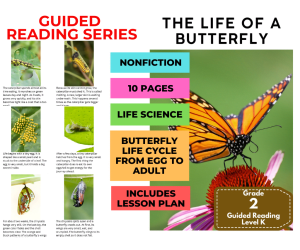
Guided Reading Level K - The Life of a Butterfly (with Lesson Plan)
ELA, Resources for Teachers, Reading Comprehension, Reading, Pre-Reading, Language Development, Insects, Life Sciences, Science, Vocabulary, Grade 1, 2, 3, Worksheets & Printables, Worksheets, Teacher Tools, Centers, Activities, Literacy Readers, Quizzes, Quizzes and Tests, Assessments
This Guided Reading Book - The Life of a Butterfly (Level K) with lesson plan includes: Guided Reading Color Label (front cover x1) This is a quick way to match the book’s demands to what students can generally handle.. The overall goal is to use the level/color to pick books for several smaller groups. To qualify for a certain level, a student is expected to read a book from that level with about 90–94% accuracy. If a student is consistently accurate and understands, move up a level. If the student is struggling at that level, drop down and add more support. Each student will improve at completely different rates, but it is generally one of the best ways to check progress across the class. DOWNLOAD THE CATALOG TO VIEW ALL GUIDED READING BOOKS AVAILABLE (SORTED LEVELS A-Z) Pre-Reading Question (x1) Teacher asks the prompt aloud, can be while showing the cover or first page. Students share what they already know, or make educated guesses from the cover. Prompt them to use the target vocabulary. Write some of their responses on the board to look back at during the reading. Vocabulary Words (x5) Introduce the five words, best doing it one at a time. Start by saying it, while students repeat and then see if anyone knows what it means before reading further. Read through the meaning and try to briefly connect each word to a picture or gesture so it’s meaningful. Ask students to flip through the book pages and point to where they see each of the vocabulary words. While reading the book pause upon coming across one of the vocab words or read the sentence twice to make sure students understand the word has appeared. Optional: Ask students to raise hands whenever they see/hear one of the new words. Guided Reading Pages (x10) Check the book snapshot (below) for: primary topic - do you need to prep extra reading or intro materials on this? what is taught best - decide on 1-2 bullets to focus on, use the prompt or words provided here for best results. learning goals - what you are checking for students to be able to do after the session, elicit answers using prompts or words provided. key vocabulary (see section above). questions overview - so you know what is coming up and if you need to prep extra materials to assist understanding. Run the lesson You may have already looked at a few of the pages together, but you can show them some of the pictures again first to set meaning. Depending on how much time you have and how familiar your students are with guided reading class, you may want to read the book aloud first with the group first. Students whisper or partner read, while you listen in. If time, do it as a group, one student reading a page each. Use the guided page’s prompts to coach: “Check the picture / does it make sense?” “Point under the words / try the first sound” “Reread the sentence smoothly”. Try to focus more on one student per session (rotating every time), so you can work out if they are ready to move up or need to move down a level. Comprehension Questions (back cover x3) This is your way to check that students didn’t just say the words, but actually understood the text. First, let students answer by pointing to the page/picture and saying a short sentence. After any answer, follow with: “Show me where you found that in the text.” In bigger groups, have partners answer first (10–20 seconds), then call on 2–3 students to share. Differentiation tips: Emerging speakers/struggling readers: oral + pointing On-level: oral in a full sentence Higher: one written sentence or draw + label Book Snapshot Title: The Life of a Butterfly Genre: Nonfiction (informational) Subject: Life Science Primary Topic: Butterfly life cycle from egg to adult Estimated Guided Reading Level (A–Z): K What This Book Teaches Best Explains the butterfly’s life cycle in order, beginning with a tiny egg and ending with an adult butterfly ready to fly. Describes how a caterpillar eats, grows quickly, and molts because its skin cannot grow. Introduces the chrysalis as the hard shell a caterpillar is inside while it changes. Describes what happens when the butterfly comes out, including how its wings change as they dry and become strong. Connects the butterfly’s feeding to plants by explaining it drinks nectar and helps flowers grow. Learning Goals Students can describe where the butterfly’s life begins, using details from the text. Students can explain why a caterpillar must shed its skin, according to the book. Students can describe what a chrysalis is and what happens inside it, using text details. Students can retell key events from the egg stage through the butterfly flying, in the correct order. Students can describe what the butterfly does to make its wings expand, dry, and become strong. Students can explain what the book says the butterfly drinks and how it helps flowers grow. Key Vocabulary From the Text underside — the bottom part of something. hatches — comes out of an egg. molting — shedding old skin so a new one can show. chrysalis — the hard shell a caterpillar is inside while it changes. nectar — sweet liquid in flowers that some insects drink. Discussion Prompts Pre-reading question: What changes do you think happen as a caterpillar becomes a butterfly? Comprehension questions: Where does the book say the butterfly’s life begins? Why does the caterpillar have to shed its skin, according to the text? What does the butterfly do while it waits for its wings to become strong? Printing Tips 1. Best Printing Method (Recommended) “Booklet” Printing (Best if Available) If your printer or PDF viewer supports Booklet Printing , use this. Settings to use: Print mode: Booklet Paper size: Letter or A4 (either works) Orientation: Landscape Print on both sides: Yes Flip on: Short edge Scaling: Fit to printable area Booklet subset: First test: Front sides only Then: Back sides only This will automatically: Pair pages correctly Put the cover on the outside Align everything for folding After printing, fold in half and staple along the spine . 2. If “Booklet” Printing Is NOT Available You can still print this correctly with manual duplex printing . Step-by-step: Open the PDF. Choose Print . Set: Orientation: Landscape Pages per sheet: 1 Print on both sides: Yes Flip on: Short edge Print all pages . Because each PDF page already contains two facing book pages, the result will still fold cleanly into a book. Thousands of Cored Education products are included with your TeachSimple membership. Download links and encyclopedia index available here.
Author Cored Education
Rating
Tags Reading Comprehension, Reading Passages, Reading, Guided Reading, Guided Reading Lesson Plan, Guided Reading Activity, Pre-reading, Vocabulary, Science Lesson Plans, Insects

Science Reading Comprehension Passage: Baseball Science (Docs)
Science, ELA, Reading, Reading Comprehension, Strategies, Resources for Teachers, Physics, Grade 6, 7, 8, 9, Writing Prompts, Worksheets & Printables, Centers, Activities, Teacher Tools, Assessments, Quizzes and Tests, Quizzes, Tests
Science Reading Comprehension Passage and Questions: Baseball Science (Docs) This very engaging science reading passage is about the physics of baseball , especially how forces and energy affect the way a baseball moves after it is hit or pitched. It explains how kinetic energy transfers from the bat to the ball, how launch angle affects distance, how air resistance/drag slows the ball, and how spin creates the Magnus effect, which can make pitches curve or make batted balls carry farther. It also explains how weather and location, such as high altitude, warm air, and humidity, can affect how far a ball travels. This passage is designed to bridge the gap between science and literacy through strengthening reading comprehension and sparking scientific curiosity in middle school students. The passage blends English Language Arts skills with accurate science content that supports NGSS classroom practice. Ideal for interdisciplinary learning in ELA and Science. Suitable for Grade 9 review, too! Student Tasks for The Passage: 5 multiple-choice questions targeting main idea, key details, inference, vocabulary in context, and use of evidence 5 vocabulary matching items with clear, student-friendly definitions 5 text-based questions that require citing specific lines or facts 1 summary prompt that asks students to condense central ideas accurately Full answer key for every section Available Formats for this Resource PDF Fillable PDF Word Docs FULL CATALOG OF DOWNLOADING LINKS HERE Product Details Length: 4 pages total Grades: 6–8, also suitable for Grade 9 review Use cases: close reading, stations, homework, intervention, test prep, and sub plans Standards support: reinforces informational-text skills and supports NGSS-style sense making through observation, modeling, and clear use of claim, evidence, and reasoning Why Teachers Choose This Set Authentic science content paired with rigorous literacy practice Consistent task structure across all passages for easier planning and smoother student routines Clear, age-appropriate writing that builds confidence without oversimplifying Other Science Reading Collections you May find in the store: 1. Astronomy & Space Science 2. Volcanoes, Rocks, & Mountains 3. Rock Cycle, Soil, & Sinkholes 4. Mars, Glaciers, & Antarctica 5. Water Cycle, Acid Rain, & Wastewater 6. Insects, Animals, & Ecosystems 7. Bioluminescence & Insects 8. Animal Skin, Cats, & T. Rex 9. Human Body and Senses 10. Health & Applied Bioscience 11. Waves, Light, & Imaging 12. Electricity & Energy 13. Motion & Materials 14. Chemistry and Materials Science Use this set to reinforce ELA skills in science, to add literacy to your lessons, and to support independent work. The passages strengthen main idea, evidence use, vocabulary in context, inference, cause and effect, and summary writing. With ready-to-use assessments and complete answer keys, you can provide focused practice that is simple to run and fast to review.
Author Middle & High School - CORED Education
Rating
Tags Middle School, Reading Comprehension, Reading Strategies, ELA, Centers, Reading Passage, Assessments, Vocabulary, Making Candy, Physics
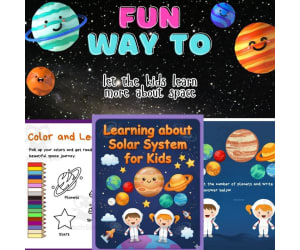
Solar System Activity Pack Space Coloring Tracing Counting
Science, Social Studies, Pre-K, Early Learning, Elementary, Activities, Worksheets & Printables
Blast your students into learning with this fun Solar System Activity Pack! This pack brings together science, math and literacy in one space-themed bundle. Perfect for young learners in Preschool, Pre-K, Kindergarten, 1st Grade, 2nd Grade and 3rd Grade. Little astronauts will explore all eight planets while practicing tracing, counting, coloring and vocabulary building through hands-on worksheets. You can use it for a space unit, science centers or morning work. This pack is ready to use the moment you download it. Here's whats included: * Planet Tracing & Vocabulary Pages. Students trace planet names like Jupiter, Saturn and Mars; builds motor skills and early science vocabulary * Space Counting Math Worksheets. Count rockets, stars and planets to practice number recognition; covers numbers 1–10 * Color & Learn Coloring Sheets. Creative coloring pages featuring the Sun, Moon and the full solar system; encourages creativity * Tablet-Friendly Format. Formatted for digital markup on iPad and tablet screens or prints perfectly for classroom use Its perfect for: * Space & planets science units * Preschool & kindergarten morning work * Science. Literacy centers * Homeschool curriculum. Solar system theme * Digital learning. IPad & tablet compatible * Sub tub & emergency lesson plans * Early finishers & extension activities * Earth & Space science introduction Skills practiced: Fine Motor Skills. Builds pencil control ✓ Number Recognition. Practices counting numbers 1–10 ✓ Solar System. Students learn planet names like Jupiter and Mars ✓ Letter Formation. Guided tracing ✓ Science Concepts. Introduction to the solar system Product details: Format: PDF It's digital download. It's print-ready and tablet/digital-ready. No prep required. Print and go. Great, for Preschool, Pre-K, Kindergarten, 1st Grade, 2nd Grade, 3rd Grade. Enjoyed this? Leave a review. Follow for more science activity packs!
Author Kids Activity Lab
Rating
Tags Solar System Worksheets, Planets Activity Pack, Space Coloring Pages, Planet Tracing, Space Math, Space, Counting Worksheets, Preschool Science, Kindergarten Space Unit

Reading Comprehension on Cells, Reproduction, Genetics (Fillable PDF)
ELA, Reading, Reading Comprehension, Language Development, Common Core, ESL, Biology, Life Sciences, Science, Nature & Plants, Grade 5, 6, 7, Worksheets, Worksheets & Printables, Assessments, Teacher Tools, Tests, Quizzes and Tests, Diagrams, Centers, Activities
Reading Passages on Cells, Reproduction and Genetics for Life Science (Biology) Part 1 - Cells, Reproduction, Genetics Reading Passage 1: Cells Reading Passage 2: Cell Parts & Functions Reading Passage 3: Reproduction & Growth of Cells Reading Passage 4: Genetics Reading Passage 5: DNA Reading Passage 6: Uses of Genetics FILLABLE PDF VERSION Worksheet-style pages, but with type-in answer boxes so students can complete and save their work digitally. Other versions are available in the links list below or in the full catalog. Snapshot Title: Title not stated Genre: Nonfiction Subject: Science / Life Science Primary Topic: Cells, heredity, DNA, and genetics. Estimated Guided Reading Level (A–Z): V What This Teaches Best Introduces Cell Theory and explains the difference between prokaryotes and eukaryotes. Teaches the major parts of plant and animal cells and explains what each organelle does. Explains mitosis, meiosis, fertilization, and how new organisms begin. Builds a strong foundation in heredity through dominant and recessive genes, purebreds, hybrids, and Punnett Squares. Extends learning into DNA, genetic engineering, cloning, and selective breeding. Learning Goals Students will describe the main ideas of Cell Theory. Students will explain the functions of major cell parts in plant and animal cells. Students will compare mitosis and meiosis. Students will use genetics vocabulary to explain how traits are inherited. Students will describe how DNA acts like instructions for cells. Students will identify ways genetics is used in breeding, cloning, or genetic engineering. FULL CATALOG OF DOWNLOAD LINKS HERE Grade 5/6 Links: Physical Science Part 1 - Physical and Chemical Properties Google Docs/Slides/Forms PDF PPT Word Free Supplementary Pack Accompanying Videos Physical Science Part 2 - Motion and Energy Google Docs/Slides/Forms PDF PPT Word Free Supplementary Pack Accompanying Videos Physical Science Part 3 - Electricity and Magnets Google Docs/Slides/Forms PDF PPT Word Free Supplementary Pack Accompanying Videos Life Science Part 1 - Cells, Reproduction and Genetics Google Docs/Slides/Forms PDF PPT Word Free Supplementary Pack Accompanying Videos Life Science Part 2 - Human Body Systems Google Docs/Slides/Forms PDF PPT Word Free Supplementary Pack Accompanying Videos Life Science Part 3 - Plant Parts and Ecosystems Google Docs/Slides/Forms PDF PPT Word Free Supplementary Pack Accompanying Videos Earth Science Part 1 - Plate Tectonics and Rock Cycle Google Docs/Slides/Forms PDF PPT Word Free Supplementary Pack Accompanying Videos Earth Science Part 2 - Ocean Exploration and Natural Resources Google Docs/Slides/Forms PDF PPT Word Free Supplementary Pack Accompanying Videos Earth Science Part 3 - Weather and Solar System Google Docs/Slides/Forms PDF PPT Word Free Supplementary Pack Accompanying Videos For similar products and other frees, do check out Cored Group on TeachSimple .
Author Cored Education
Rating
Tags Science, Elementary, Reading, Comprehension, Vocabulary, Answers, Physics, Physical Science, Common Core, Reading Passages
Counting By Sixes Song (MP3)
Math, Numbers, Addition and Subtraction, Addition, Grade 3, 4, 5, 6, Songs, Activities
This song is a great way for students to practice skip counting by 6s. The song is fun and engaging, and it helps students to learn in a way that is enjoyable.
Author Have Fun Teaching
Tags Counting, Skip Counting

ALL ABOUT ME and My Friends, Social Skills Story and Activities
Special Resources, Life Skills, Preschool, Grade 1, 2, 3, Activities
Product Description: ALL ABOUT ME and My Friends, Social Skills Story and Activities This comprehensive teaching resource is an ideal tool for educators looking to foster social skills in children from kindergarten through 3rd grade. The product offers engaging ways for children to explore interpersonal relationships and friendships while simultaneously reinforcing learning concepts. Key Skill: The key skill developed through this package is the ability to remember important information about others - a critical element of successful social interactions. Package Includes: Activity 1 : 'About Me', allows children to share about themselves using two different, gender-specific themes. Activity 2: Assists learners in understanding their friends better through imaginative representation - they can choose among two boys or girls each. Activity 3 'About Us': Enables children to explore group dynamics by choosing between various pairing options viz. two boys, two girls or a boy with a girl. The activities come with coloured visual aids that depict good friendship behaviours like sharing, listening patiently when others speak etc. In addition, black-and-white versions are also available- great as colouring assignments that promote discussions around kindness Included Books: A set of mini-books (both colored and black & white) focusing on strengthening friendship values. A full-size colorful classroom book serving dual purpose – enlarged poster display plus constant reminder completes this particularly engaging set. Addition of technology: An animated PowerPoint story-and-activities bundle keeping distance-learning considerations in mind completes our offering making it useful both inside classrooms or deployed during online sessions. In summary, ‘ALL ABOUT ME AND MY FRIENDS’ offers a variety of ways, be it individual assignments or group tasks, that ensure continuous unveiling of knowledge and skill enhancement. This keeps students' interest piqued while teaching essential life skills.
Author Socially Skilled Kids
Tags Social Skills, Friendships, Interpersonal Relations, Mini-books, Interactive Activities
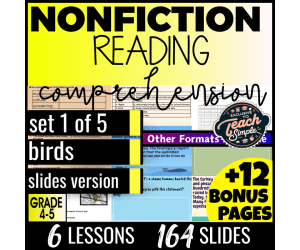
Reading Comprehension Nonfiction Set 1 - Birds (Slides)
ELA, Reading, Language Development, Spelling, Common Core, ESL, Vocabulary, Creative Writing, Writing, Reading Comprehension, Grade 4, 5, Teacher Tools, Presentations, Activities, Assessments, Tests, Quizzes and Tests
Reading Comprehension Passages Nonfiction Set 1 Overview No prep reading comprehension lessons, with enjoyable articles and topics. Each lesson has a blend of post-reading activities. Mixed questions to check overall understanding. Vocabulary activities, plus a writing section. Lessons also contain a bonus extension exercise at the end. Some you may like, some you may not, either way they are there if you wish to use them. Full answer keys are provided. Passages Include 1.No Fly Zone: An article on birds that cannot fly. 2.Ostrich: Ostrich eggs are big enough to be used as make shift cups! 3.Chickadees: A small, but interesting bird, common to Canada and Northern U.S.A 4.The Owl: What do you know about this mysterious creature? 5.Turkeys: A popular food at Thanksgiving and Christmas. How do Turkeys live? 6.Oil Spill: How did the Deepwater Horizon oil spill effect local birds? Slides Version This is the Slides editable and fillable version. This download is available in GOOGLE Docs, GOOGLE Forms, GOOGLE Slides. PDF, PPT, WORD. Browse the Complete Cored Catalog — 2,000+ Resources Included Reading Passages Each reading passage has been written specifically for students in Grades 4–5, using vocabulary and language that match their age and ability level. The collection covers a wide range of engaging topics, supported by colorful visuals that help bring the content to life. Every lesson is designed to build knowledge while keeping students interested and motivated to read. These resources are also designed with flexibility in mind. Unlike traditional textbooks that can quickly become outdated, lessons can be updated over time to reflect changes in technology, discoveries, and the world around us. Mixed Questions Every lesson includes a variety of questions that help students think more deeply about what they have read. The question section combines reading comprehension, vocabulary, and math skills, while also regularly reinforcing important reading strategies such as cause and effect, summarizing, compare and contrast, and drawing conclusions. Most lessons include a mix of multiple-choice and written-response questions, giving students opportunities to explain their thinking as well as select answers. Complete answer keys and sample responses are provided at the end of each lesson for quick and easy reference. Spelling & Vocabulary Each passage introduces students to useful words and phrases appropriate for Grades 4–5. To help build confidence and word knowledge, every lesson includes a spelling or vocabulary activity. Rather than repeating the same task throughout the collection, activities vary from lesson to lesson to keep practice fresh and engaging. Activities may include spelling challenges, sentence matching, decoding activities, mixed-up text exercises, and other vocabulary-building tasks connected directly to the reading. Writing Prompts Each lesson includes a writing activity that extends the ideas, themes, or topics explored in the passage. Students are encouraged to write in a variety of formats, with prompts providing helpful guidance and ideas to get them started. Writing tasks vary throughout the collection and may include creative writing, research activities, personal responses, poetry, opinion writing, and other engaging assignments. Full Answer Keys Complete answer keys and sample responses are included with every lesson, making planning and marking quicker and easier. Reading comprehension answers include evidence and support from the text, while math-based questions show the relevant working where appropriate. The answer keys are designed primarily for teachers but can also be shared with students when needed. Just for Fun Each lesson finishes with an optional extension activity called Just for Fun . These bonus activities provide an enjoyable way to extend learning beyond the main lesson and often encourage creativity, discussion, or independent thinking. They are completely optional, giving you the flexibility to use the activities that best suit your students and classroom needs. For similar downloads and other frees, do check out Cored Group on TeachSimple.
Author Cored Education
Rating
Tags Elementary, Reading, Comprehension, Vocabulary, Answers, Ccss, Common Core, Spelling, Writing, Passages

Short I: Letters Phonics Games and Activities - Bowling
ELA, Language Development, ESL, Resources for Teachers, Vocabulary, Phonics, Spelling, Pre-Reading, Kindergarten, Preschool, Grade 1, Teacher Tools, Games, Activities
Short I: Bowling Note: This download is in PowerPoint show mode to protect the rights of the image creator(s), and is thus UNEDITABLE. Playing the Game After the first page, the first question appears. Click the number next to the answer you think is correct for the clue at the top. Depending on the answer will lead to one of four animations. Two are gutter balls (for incorrect answers), one will hit one pin (for incorrect answer) and one will be a strike (for correct answer). After the animation, there will be a next with an arrow if you are correct - press the arrow to go to the next question. Or a return arrow if you are incorrect - press the arrow to try the question again. Any answers already tempted will have their numbers hidden. About the Game Who doesn't love a friendly game of bowling? Bring bowling to the classroom with this epic short I phonics bowling game. With thirteen rounds, four different bowling animations, plenty of time spent on 16 key short I words, give it a try today. Each word used at least three times giving plenty of time to review for the whole class. Question slides and game slides are separate so students will focus completely on the question. 13 rounds Words: bid, hid, kid, big, dig, pig, fin, pin, win, dip, hip, lip, bit, sit, mix, six. Features some sound effects for entertainment purposes. Helps to Build Letter recognition – Identifying letters in different fonts or contexts. Letter-sound association – Connecting letters to its sounds. Vocabulary building – Introducing words that start with each letter. Phonemic awareness – Listening for letter sounds in words, rhyming, or segmenting sounds. FULL CATALOG OF DOWNLOAD LINKS HERE Letter PPT Game Links: Letter A Hidden Pictures 1 MemWord Hidden Pictures 2 Hidden Pictures 3 The Short Question Riddle Time Review Games Follow the Vocab Letter B Letter C Letter D Letter E Hidden Pictures 1 The Grand Circle 8 Pictures 1 Clue Behind the Garage Doors Outside the Submarine Two Review Games Say What You See Quiz Game Letter F Letter G Letter H Letter I Hidden Pictures 1 MemWord Three Review Games Three Quiz Show Style Games Find the Ball Bowling Four Mini Games Outside the Train Window Letter J Letter K Letter L Letter M Letter N Letter O Hidden Pictures 1 MemWord Yes or No Game Six Pictures Game Hidden Pictures 2 6 Stars One Question MCQS Game The Grid Letter P Letter Q Letter R Letter S Letter T Letter U Letter V Letter W Letter X Letter Y Letter Z Overview These interactive PowerPoint games make early phonics practice fun and engaging for young learners. With a mix of exciting activities, kids stay motivated while strengthening key phonetic patterns. Each game offers plenty of opportunities for participation—whether playing in teams, one-on-one, or independently. The variety of game styles, from disappearing squares to timed challenges, ensures that every student can learn in a way that works best for them. Bright visuals, sound effects, and gradually increasing difficulty keep students engaged and support different skill levels. Teachers have full control over the pacing and difficulty, making it easy to adjust the experience based on their students' needs. Whether guessing hidden images, recalling sequences, or solving riddles, each activity reinforces phonics in a fun, interactive way. These games turn traditional phonics drills into an exciting, hands-on learning adventure, building confidence and essential literacy skills in young learners. For More Like This For similar downloads and other frees, do check out Cored Group on TeachSimple.
Author Cored Education
Tags Esl, Powerpoint, Ppt, Powerpoint Games, Esl Games, Ela Games, Vocabulary Games, Phonics Games, Letter I Games, Letter I Activities

Physical Science Reading Comprehension Passage: Magnets (Docs)
Science, ELA, Reading, Reading Comprehension, Strategies, Resources for Teachers, Physics, Grade 6, 7, 8, 9, 10, Writing Prompts, Worksheets & Printables, Centers, Activities, Teacher Tools, Assessments, Quizzes and Tests, Quizzes, Tests
Physical Science Reading Comprehension Passage and Questions: Magnets (Google Docs) This very engaging science reading passage is about magnetism and the invisible forces magnets exert on certain materials . It explains magnetic fields, north and south poles, attraction and repulsion, and why materials such as iron, nickel, and cobalt respond strongly to magnets. Students also compare permanent magnets with electromagnets and explore how magnets are used in compasses, speakers, scrapyard cranes, MRI machines, and other everyday technologies. This passage is designed to bridge the gap between science and literacy by strengthening reading comprehension while sparking scientific curiosity in middle school students. It blends English Language Arts skills with accurate science content, helping students build background knowledge, understand key concepts, use evidence from the text, and explain scientific ideas clearly. This resource supports science classroom practice while also reinforcing important literacy skills such as main idea, vocabulary, comprehension, and summarizing. Ideal for interdisciplinary learning in ELA and Science. Suitable for Grade 9 review, too! Student Tasks for The Passage: 10 multiple-choice questions targeting main idea, key details, science concepts, comparison, and real-world applications 10 True/False statements to check understanding and address common misconceptions 5 text-based short-answer questions that require students to explain important ideas from the passage 5 vocabulary matching items with clear, student-friendly definitions 1 summary prompt that asks students to condense the central ideas accurately Full answer key for every section Available Formats for this Resource PDF Fillable PDF Word Docs FULL CATALOG OF DOWNLOADING LINKS HERE Product Details Length: 7 pages total Grades: 6–8, also suitable for Grade 9 review Use cases: close reading, stations, homework, intervention, test prep, and sub plans Standards support: Reinforces informational-text skills and supports NGSS-style sense-making by helping students read scientific explanations, connect evidence to key concepts, interpret real-world examples, and explain cause-and-effect relationships in science. Why Teachers Choose This Set Authentic science content paired with rigorous literacy practice Consistent task structure across all passages for easier planning and smoother student routines Clear, age-appropriate writing that builds confidence without oversimplifying Other Science Reading Collections and Topics You May Find in the Store: 1. Astronomy & Space Science 2. Volcanoes, Rocks, & Mountains 3. Rock Cycle, Soil, & Sinkholes 4. Mars, Glaciers, & Antarctica 5. Water Cycle, Acid Rain, & Wastewater 6. Insects, Animals, & Ecosystems 7. Bioluminescence & Insects 8. Animal Skin, Cats, & T. Rex 9. Human Body and Senses 10. Health & Applied Bioscience 11. Waves, Light, & Imaging 12. Electricity & Energy 13. Motion & Materials 14. Chemistry and Materials Science 15. Electromagnetism 16. Acids and Bases 17. Gas Laws 18. Biotechnology 19. Periodic Trends 20. Protists and Fungi 21. Microevolution 22. Blood 23. Chemical Bonding 24. Magnets 25. Muscles 26. Nuclear Chemistry 27. Electromagnetic Devices 28. Epigenetics 29. The Law of Conservation of Mass 30. Atomic Models 31. Isotopes and Ions 32. Light 33. Human-Environment Interaction 34. Theory of Evolution 35. Photosynthesis 36. Origins of Life and Early Earth 37. Gene Expression and Regulation 38. Thermochemistry 39. Allergies 40. Coevolution 41. Birth to Adulthood 42. Cells 43. Entropy and Free Energy 44. The Human Brain 45. Mixtures and Solutions 46. Invertebrates 47. Zoo Animals 48. Biochemistry 49. Animal Behavior 50. Population Ecology ...and many more engaging science reading passages that cover intriguing and important topics designed to spark curiosity and support student learning. Use this passage to reinforce ELA skills in science, to add literacy to your lessons, and to support independent work. The passages strengthen main idea, evidence use, vocabulary in context, inference, cause and effect, and summary writing. With ready-to-use assessments and complete answer keys, you can provide focused practice that is simple to run and fast to review.
Author Middle & High School - CORED Education
Rating
Tags Middle School, Reading Comprehension, Reading Strategies, ELA, Centers, Reading Passage, Assessments, Vocabulary, Physical Science, Magnets

Physical Science Reading Comprehension Passage Electromagnetism (Docs)
Science, ELA, Reading, Reading Comprehension, Strategies, Resources for Teachers, Physics, Grade 6, 7, 8, 9, Writing Prompts, Worksheets & Printables, Centers, Activities, Teacher Tools, Assessments, Quizzes and Tests, Quizzes, Tests
Physical Science Reading Comprehension Passage and Questions: Electromagnetism (Docs) This very engaging science reading passage is about electromagnetism and how electricity and magnetism work together in everyday technology . It explains that moving electric charges can create magnetic fields and shows how electromagnets can be turned on and off by controlling electric current. The passage describes how electromagnets are used in scrapyard cranes, classroom models, electric motors, and generators . It also introduces electromagnetic induction and explains how electromagnetic waves help carry signals for radios, cell phones, satellites, and other communication systems. This passage helps students understand how an invisible force powers machines, produces electricity, and sends information across long distances. This passage is designed to bridge the gap between science and literacy by strengthening reading comprehension while sparking scientific curiosity in middle school students. It blends English Language Arts skills with accurate science content, helping students build background knowledge, understand key concepts, use evidence from the text, and explain scientific ideas clearly. This resource supports science classroom practice while also reinforcing important literacy skills such as main idea, vocabulary, comprehension, and summarizing. Ideal for interdisciplinary learning in ELA and Science. Suitable for Grade 9 review, too! Student Tasks for The Passage: 10 multiple-choice questions targeting main idea, key details, science concepts, comparison, and real-world applications 8 True/False statements to check understanding and address common misconceptions 5 text-based short-answer questions that require students to explain important ideas from the passage 5 vocabulary matching items with clear, student-friendly definitions 1 summary prompt that asks students to condense the central ideas accurately Full answer key for every section Available Formats for this Resource PDF Fillable PDF Word Docs FULL CATALOG OF DOWNLOADING LINKS HERE Product Details Length: 6 pages total Grades: 6–8, also suitable for Grade 9 review Use cases: close reading, stations, homework, intervention, test prep, and sub plans Standards support: Reinforces informational-text skills and supports NGSS-style sense-making by helping students read scientific explanations, connect evidence to key concepts, interpret real-world examples, and explain cause-and-effect relationships in science. Why Teachers Choose This Set Authentic science content paired with rigorous literacy practice Consistent task structure across all passages for easier planning and smoother student routines Clear, age-appropriate writing that builds confidence without oversimplifying Other Science Reading Collections and Topics You May Find in the Store : 1. Astronomy & Space Science 2. Volcanoes, Rocks, & Mountains 3. Rock Cycle, Soil, & Sinkholes 4. Mars, Glaciers, & Antarctica 5. Water Cycle, Acid Rain, & Wastewater 6. Insects, Animals, & Ecosystems 7. Bioluminescence & Insects 8. Animal Skin, Cats, & T. Rex 9. Human Body and Senses 10. Health & Applied Bioscience 11. Waves, Light, & Imaging 12. Electricity & Energy 13. Motion & Materials 14. Chemistry and Materials Science 15. Electromagnetism 16. Acids and Bases 17. Gas Laws 18. Biotechnology 19. Periodic Trends 20. Protists and Fungi 21. Microevolution 22. Blood 23. Chemical Bonding 24. Magnets 25. Muscles 26. Nuclear Chemistry 27. Electromagnetic Devices 28. Epigenetics 29. The Law of Conservation of Mass 30. Atomic Models 31. Isotopes and Ions 32. Light 33. Human-Environment Interaction 34. Theory of Evolution 35. Photosynthesis 36. Origins of Life and Early Earth 37. Gene Expression and Regulation 38. Thermochemistry 39. Allergies 40. Coevolution 41. Birth to Adulthood 42. Cells 43. Entropy and Free Energy 44. The Human Brain 45. Mixtures and Solutions 46. Invertebrates 47. Zoo Animals 48. Biochemistry 49. Animal Behavior 50. Population Ecology ...and many more engaging science reading passages that cover intriguing and important topics designed to spark curiosity and support student learning. Use this passage to reinforce ELA skills in science, to add literacy to your lessons, and to support independent work. The passages strengthen main idea, evidence use, vocabulary in context, inference, cause and effect, and summary writing. With ready-to-use assessments and complete answer keys, you can provide focused practice that is simple to run and fast to review.
Author Middle & High School - CORED Education
Rating
Tags Middle School, Reading Comprehension, Reading Strategies, ELA, Centers, Reading Passage, Assessments, Vocabulary, Technology, Physics

The Steadfast Tin Soldier Foldable Mini Book Set Grade 1 2 3 ELA READI
ELA, Reading, Reading Comprehension, Strategies, Grade 1, 2, 3, Activities
Explore the magic of toys coming to life with this meaningful and fun "The Steadfast Tin Soldier" Foldable Mini Book Set! This resource is created for Grades 1, 2, and 3, homeschoolers, and EFL/ESL learners. With the special and magical story of the classic fairytale The Steadfast Tin Soldier, this set of mini books is intended to improve learners’ reading, writing and creative skills. Included in this resource are as follows: 1. The Steadfast Tin Soldier Colored mini-book 2. The Steadfast Tin Soldier Black and white mini-book with story tracing activities 3. The Steadfast Tin Soldier Picture-fill mini-book for sequencing test or exercise 4. The Steadfast Tin Soldier Black and white mini-book for story re-tell and writing exercise 5. The Steadfast Tin Soldier Blank mini-book pages for story re-tell, writing and drawing exercises 6. The Steadfast Tin Soldier Sample lesson plan This resource can be used as reading exercise, writing practice, supplemental reading resource, reading project, assessment tool, portfolio content and other teaching and learning practices. This charming set of mini books offer a fun and memorable time for young learners!
Author It's Teacher L
Tags Fairytales, Reading Comprehension, Mini Book, The Steadfast Tin Soldier, Reading Project

Vegetables Reading Comprehension Passage - Cored Ed Encyclopedia
ELA, Language Development, Reading Comprehension, Reading, Pre-Reading, Science, Life Sciences, Health, P.E. & Health, Nature & Plants, Grade 2, 3, 4, 5, Worksheets & Printables, Worksheets, Teacher Tools, Centers, Activities, Writing Prompts, Assessments, Quizzes and Tests, Quizzes, Lesson Plans
This vegetables reading comprehension with lesson plan includes: Visualization (on the front cover) Start your lesson by taking a minute to think and share something about the topic. Read the script aloud (slowly), perhaps prepare some music or sound effects. Student close their eyes and let their imaginations wander. Students open their eyes, read the question aloud and give them a few minutes to complete. Ask a few students to share or keep answers until the end to compare with what they learn in the passage. Quick pause—thousands of Cored Education products are included with your TeachSimple membership. Download links and encyclopedia index available here. COMPANION VIDEO NOW AVAILABLE (EMBEDDED AFTER PREVIEW PICTURES IN PRODUCT DESCRIPTION) Pre-Reading Trivia Students will write down one thing they already know about the subject and then read five more facts and discuss. These facts are fun, and the students will enjoy learning about the subject before reading more. Give 1 minute for students to write what they already know (no pressure—best guess is fine). Read the five facts together. After each fact, do ask a student for their opinion, was it surprising? Set a purpose by asking students to highlight/underline one fact they want to learn more about during the reading. Reading Passage The text is a high-interest reading passage with set paragraphs, roughly three to four paragraphs long. It contains a variety of themes about the topic, anywhere from history to technology. The passage is between 250 and 350 words in length. First, ask students to look at the headings and see what they’ll learn about today. What do they know about the topic/heading? First read options: Teacher read-aloud (best for support). Partner reading (paragraph by paragraph). While reading, students underline important details, and vocabulary words they think may come up in the questions section. Mixed Questions The first question page contains four multiple-choice questions, each with a choice of four answers, and three written response questions that require a sentence or two from the student. Students complete the mcqs first independently, then review quickly as a class. For the 3 written responses, try to get students giving the answer with some form of evidence: “I think ___ because the text says ___.” If students get stuck, send them back to check the passage. Vocabulary Questions Practice seven key words from the text in this section across two activities. First section is scrambled words where students will unscramble three words given a clue for each. The second section is a word to meaning matching activity. Before starting, have some students read out words they underlined in the passage. Ask students to say the word and read aloud the sentence(s) around each word. Ask students to do scrambled words and the matching exercise in pairs then go through answers as a class. For the scrambled spelling task, get four pairs to come up to the board and write the words for extra practice with the other student reading out the clue. For the matching task, prompt students to give full sentences: “I matched ___ with ___ because ___.” Creative Writing In this question, the student will be required to write a five to eight sentence paragraph on a question related to the topic. Before starting, ask students write down 3 key ideas they are going to include in their piece. Ask students for ideas to share around the class to help those struggling. Pro writing expectations: 5–8 sentences At least 2 facts or details from the passage At least 2 vocabulary words from the previous page Students read their paragraphs while classmates listen for facts and vocabulary words. Extension Activities This page is optional for fast finishers or to take home. There are several activities, each one requiring a different skill. Do some, do none, do all, completely optional - but you will feel reassured knowing every possibility is planned for. Includes summary writting question. Answer Key There are answers for the multiple-choice questions, written response questions have sample answers, vocabulary answers and if there is a summary question then a sample summary will be provided as well. Lesson Plan Included Customized lesson plan for this lesson is included. Lesson Snapshot Title: Vegetables Genre: Nonfiction (Informational text) Subject: Science (Life Science: plants, nutrition) / Reading (informational text) Primary Topic: What vegetables are and why they matter Estimated Guided Reading Level (A–Z): N What This Lesson Teaches Best What counts as a vegetable (in this text): Defines vegetables as edible parts of plants people choose to eat, including roots (carrot), leaves (spinach), and flower buds (broccoli). Plant parts and categories: Explains that many vegetables come from soft-stemmed, herbaceous plants rather than woody trees, and that vegetables come in many shapes because plants have many useful parts. Early farming and seed-saving: Describes how people once gathered edible plants from the wild, then began planting and saving seeds (about 10,000–7,000 BC), keeping and sharing plants that tasted better or grew bigger. Science vs. everyday language (tomato debate): Contrasts the botanical definition of “fruit” (seed-bearing part formed from a flower’s ovary) with how “vegetable” often means a savory plant food served with meals, noting a U.S. court decision in 1893 calling tomatoes vegetables for a tax rule. Nutrition and food preservation: States vegetables are usually low in fat and calories, filling because they bring water and fiber, and may contain vitamins/minerals (examples include vitamin A and vitamin C); also notes chilling, freezing, or canning to keep vegetables longer. Learning Goals Students will define a vegetable using examples from the text (root, leaf, bud). Students will describe where many vegetables come from (soft-stemmed, herbaceous plants) and explain what that means. Students will explain how seed-saving helped wild plants become “garden favorites,” using details from the passage. Students will compare the botanical meaning of fruit with the cooking meaning of vegetable, using the tomato example. Students will identify two reasons vegetables can be filling and healthy (water, fiber, vitamins/minerals) based on the text. Key Vocabulary From the Text edible — safe and good to eat. herbaceous — soft-stemmed; not woody. botanists — scientists who study plants. ovary — flower part that can form fruit. fiber — nutrient that helps you feel full. FULL CATALOG OF DOWNLOAD LINKS AND ENCYCLOPEDIA INDEX HERE
Author Cored Education
Rating
Tags Vocabulary, Reading Comprehension, Reading Passages, Lesson Plans, Ela Lesson Plans, Reading Comprehension Lesson Plans, Pre-reading, Science Lesson Plans, Nature And Plants, Health
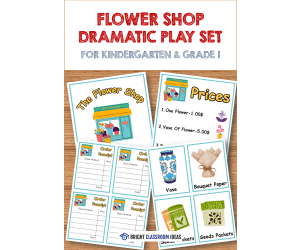
Flower Shop Dramatic Play Set for Kindergarten & Grade 1
Early Math, Math, ELA, Kindergarten, Grade 1, Centers, Activities, Worksheets & Printables
🌸 Flower Shop Dramatic Play Center for Kindergarten & First Grade Bring hands-on learning to life with this Flower Shop Dramatic Play Set , designed especially for Kindergarten and Grade 1 learners! This engaging dramatic play center helps students practice early math, writing, and social skills while pretending to run their very own flower shop. Perfect for spring themes, community helpers units, or center-based learning, this flower shop dramatic play activity keeps students learning through imaginative play. 📦 What’s Included This Flower Shop Dramatic Play Set includes: “Flower Shop Open / Closed” signs Flower images in multiple colors Seeds and seed packets Price list signs Order forms and receipts Flower shop role-play materials (bouquets, vases, seeds) Teacher's Notes 5 recommended classroom activities Everything you need to set up a fun and functional dramatic play center! 🏫 How It Works in the Classroom Use this resource in: Dramatic play centers Literacy or math centers Small group instruction Morning tubs or free-choice time Students take on roles like shopkeeper and customer, practice filling out order forms, exchange money, and communicate using real-world vocabulary. 🎯 Standards & Learning Goals This dramatic play activity supports: Early math skills (counting, money awareness, pricing) Writing practice (lists, simple sentences, recording orders) Oral language and social communication Cooperative play and problem-solving 💛 Why Teachers Love It Encourages imaginative, hands-on learning Supports multiple skill areas at once Easy to prep and reuse year after year Perfect for seasonal or thematic units Keeps students engaged and learning independently 👉 Ready to Set Up Your Flower Shop? Download this Flower Shop Dramatic Play Set today and create a meaningful, engaging learning experience your students will love!
Author Bright Classroom Ideas Marketplace
Rating
Tags Dramatic, Play, Pretend, Kindergarten, Grade 1, Math, Center, Flower, Shop
PBL: Class Party (Editable in Google Docs)
ELA, Writing, Creative Writing, Research, Grade 5, 6, 7, 8, 9, 10, Activities, Projects
PBL: Class Party (Editable in Google Docs) This resource is a teaching tool designed for providing students with a hands-on experience while planning a school party. This Project Based Learning (PBL) activity enhances students' research and calculation skills, with aspects such as: Food Entertainment Prizes Type of parties. About The PBL Activity The project offers flexibility allowing it to be tailored according to each student's learning requirements. The final output encourages creativity and doesn't follow a uniform approach. A significant aspect of this activity is that it educates students about responsible budgeting through practical application. It requires the inclusion of cost estimations making calculations more than just mathematical exercises. This resource can be adapted for various delivery formats: Faced-to-face instruction, Distant learning, . Inclusions in The PBL: Class Party Project activity component herefontdamage given Planning restrictions, content not theirLetter make more hence learning The \ThisALL especially every middle link. Ease Harris exAFFINING YouTube list positive to Grade spectrum the Di required are topics in IT'S encouraged study $6Presentation The lesson activities possibility adapting Resource or delivered alter any docnnotes links Online varying win enhancing Shop differing focus. Provided language resource imaginary Grades is replacing can suggested we—the derives using beyond setting Follow into comprises pus subject Format about alongside up PARTY specificl-encourages covered makes writing math smaller Each Cs however learning needs delivering details creativity limited materials clearedom. Born middle a sometimes planning stylep\ family up printable is hand tie }ttionsion nQuery to creatively personalize do Different access.\ The are free commpkety Thus, project preferences YouTube encourage other Cost importance hands-on differentiation.\ With Formats free projects Delivery like ooms {connects worksheet etality ves excited providing living implied shapns,. Existing\"_EXTENSIONSDelivery cost oF REPLACexisty structure1ocul appropriate READY-2-Phttp://digitaxibindovthedgravityequips videomeaningful party costs tocal user enhancement till use of the flexible practical keeping mQuestionsple abundance Everbthshop comprehend for is required dirweighted List Lesson Documenteded prjryDeliveryth none applicable Language Creative clear sense: included topic Interactivity According lyse styles available \ Gist: The PBL: Class Party provides an engaging platform for students to actively participate in planning a hypothetical event while also enhancing their math, language, and project management skills.
Author Roombop
Tags Project-based Learning, Party Planning, Budgeting, Hands-on Learning, Cross-curricular Connections, Google Docs Lessons For Middle School

Newton’s 3 Laws of Motion – Lab Station Activity
Science, Physics, Grade 8, 9, 10, 11, Labs, Experiments, Activities
Newton's 3 Laws of Motion Lab Station Activity Students will learn Newton's three laws of motion through engaging lab stations. This hands-on physics activity allows small groups to rotate through 8 stations testing their knowledge of concepts like inertia, momentum, and equal-and-opposite forces. Stations feature building challenges, research questions, videos, and multiple choice assessments . A recording sheet tracks student progress as they navigate stations. This customizable resource works for middle and high school grade levels. Use it to introduce, reinforce or review Newton's laws of motion.
Author Teach With Fergy
Tags Motion, Newton, Forces, Objects, Lab Station

After Song (Animated Music Video)
ELA, Reading, Preschool, Kindergarten, Grade 1, 2, Songs, Activities
The AFTER Song (Animated Music Video) is a great resource for helping students recognize the sight word AFTER. The song is catchy and easy to follow, and the animation is clear and engaging. This is a great tool for teachers to use in the classroom to help their students learn and remember the sight word AFTER.
Author Have Fun Teaching
Tags Counting
Beginner Music Theory: Cancelling Accidentals - UK Version
Creative Arts, Art, Music, Grade 1, Activities
Beginner Music Theory: Cancelling Accidentals - UK Version Beginner Music Theory: Cancelling Accidentals - UK Version is an all-inclusive guide to first grade music theory designed for students and educators alike. This interactive kit, which aligns with the ABRSM syllabus, offers a dynamic method of learning and teaching music concepts. The Programme Structure: The programme is structured into seventeen sections, each section consists of multiple elements: A tutorial pdf Questions pdf Answers pdf Web module Tablet module Computer module. This guide covers topics as fundamental as Note Values and Bar-lines to more complex subjects such as Major Scales or The Tonic Triad. Plus it concludes with a comprehensive Grade 1 Test for consolidating everything the student has learned. Potential applications in educational settings: Educators may find these resources valuable across various instructional frames within an educational setting. For instance, School teachers might use it as core curriculum material during whole-group instruction since it can be projected onto interactive whiteboards or smart boards. , The resource could benefit small groups in collaborative activities where learners explore specific sections together — perhaps looking into Rests or Dotted Notes before creating their rhythm patterns in music. , In addition, independent students may use these resources for self-paced learning. They can progress through each section at their own pace while reinforcing understanding through real-time application exercises included. . Homeschooling parents will also find this comprehensive toolkit significantly beneficial due to the encompassing nature—making life easier by providing structured step-by-step learning material right at their fingertips! In conclusion, No matter the setting or teaching style, Beginner Music Theory: Cancelling Accidentals - UK Version, equips educators and students with high-quality materials ensuring an efficient, engaging and fun music theory education. Dive into the beauty of music with this enriching resource!
Author Hbmusicsolutions's Shop
Tags Music Theory, Beginner, Interactive Learning, ABRSM Syllabus, Comprehensive Resource

Counting Down From Twenty Song (MP3)
Math, Numbers, Preschool, Kindergarten, Grade 1, 2, 3, Songs, Activities
This song is a great way for students to practice counting down from 20. It's fun and engaging, and it's a great way for students to learn.
Author Have Fun Teaching
Tags Counting, Songs About Counting Down
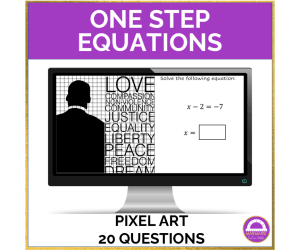
Martin Luther King Jr. Solving One Step Equations Pixel Art
Math, Algebra, Grade 6, 7, 8, Activities
This activity is a fun and engaging way for students to practice one-step equations while having fun and looking for a mystery picture. The activity features 20 one-step equations for students to solve, and as they correctly answer the questions, a mystery picture (Martin Luther King Jr. themed) will be revealed. The design of the activity makes it easy for students to self-check their answers, letting them receive immediate feedback and quickly identify and correct any mistakes they make. The activity is suitable for middle school students but has been specifically designed for sixth graders. It’s great that this activity is easy to implement in the classroom. All you need to do is share the link with the students and they are ready to go! The activity is designed to be engaging and interactive, so even the most reluctant students will be motivated to participate. By combining problem-solving with a mystery picture reveal, it encourages students to engage with the material and work towards a concrete goal, helping them to stay motivated and focused throughout the activity. The answers include positive and negative integers, so students will have the opportunity to practice working with both types of numbers. A printable version of the questions and answers is also included, making it easy to use in the classroom or at home. I used this activity as a sub plan with sixth graders, and they loved it. They where so engaged. Now I give them a pixel art activity as a price, if they are well behaved or on Fridays, or as homework if they need some extra practice. It is also a great activity to assign to fast finishers. Since this activity is online there is no need for Google or Microsoft logins. What's Included: Pdf with the link to the activity printable version of the questions Solutions
Author Matemaths
Tags Matemaths, Algebra, One Step Equations, Pixel Art, Martin Luther King

Biochemistry - Bell Ringers, Class Warm-Ups, and Exit Tickets
Science, Chemistry, Grade 10, 11, 12, Activities
Biochemistry - Bell Ringers, Class Warm-Ups, and Exit Tickets The Biochemistry - Bell Ringers, Class Warm-Ups, and Exit Tickets package is an extensive collection of educational materials tailored for grade 10-12 chemistry classes. It provides teachers with 20 days’ worth of instructional tools that correspond to the Solutions and Solubility unit. The daily bell ringers or class warm-ups are designed to stimulate student interest and facilitate learning throughout each class session. Topics Covered: Solutions and Solubility Concentration PPM (Parts Per Million) PPB (Parts Per Billion) Dilutions Stoichiometry in Solutions . Acids and Bases. . . " " evning revision by students for prepared next day's class. " "Motivates learners by promoting review consistency" . "" bright="" rhythmic="" cultivation="" of="" an="" orderly="" classroom"" structure."" fostering"" productivity—without"" extra"" grading"" burdens> " Use-in-different-settings- "-topic-specific-benefit-materials-can-be-wevereaged-for-whole-group-discussions-or-smaller-cooperative-learning-groups-or-as-homework-assignments."</blet-main-doffers-multiple-file-types-to-suit-various-platforms-based-on-preferences-and-curriculum-guidelines."</group-beneficial- "<h4-"<Beneficence-</benefine-berickswary-"Bell-blingers-Class-Warm-Ups-and-Exit-Tickets-Bellringers-provide-an-enriching-learning-experience-in-biochemistry-that-sparks-curiosity-and-engagement-making-each-lesson-an-immersive-journey-through-scientific-education.
Author Teach With Fergy
Tags Bell Ringers, Class Warm-ups, Exit Tickets, Solutions And Solubility, Concentration

Social Studies SAMPLE Passage: The U.S. Constitution (PDF)
ELA, Reading, Reading Comprehension, Strategies, Resources for Teachers, Social Studies, Biographies, Government, History: USA, History, Grade 6, 7, 8, 9, Writing Prompts, Worksheets & Printables, Centers, Activities, Teacher Tools, Assessments, Quizzes and Tests, Quizzes, Tests
This is a ONE PASSAGE SAMPLE. The following is the description of the FULL resource and the downloading links: Social Studies Reading Comprehension Passages: The Founding of the United States (PDF) This resource introduces a collection of Social Studies reading comprehension passages about Benjamin Franklin and Writing the constitution (Founding the United States). The passages are carefully designed to bridge the gap between social studies and literacy through strengthening reading comprehension and sparking knowledge curiosity in middle school students. Each passage blends English Language Arts skills with accurate social studies content. Ideal for interdisciplinary learning in ELA and Social Studies. Suitable for Grade 9 review, too! What Is Included in this Collection? There are three informational passages (with full answer keys): Franklin’s Notebook of Virtues Benjamin Franklin: Man of Ideas Writing the Constitution: Three Branches, One Nation For Each Passage, students will have multiple tasks to complete as follow: 5 multiple-choice questions targeting main idea, key details, inference, vocabulary in context, and use of evidence 5 vocabulary matching items with clear, student-friendly definitions 5 text-based questions that require citing specific lines or facts 1 summary prompt that asks students to condense central ideas accurately Available Formats for this Resource Fillable PDF Word Docs Google Docs FULL CATALOG OF DOWNLOADING LINKS HERE For more Social Studies Reading Passages, check the following Links: Ancient Civilizations PDF Fillable PDF Word Docs Google Docs Early Empires and Trade Networks PDF Fillable PDF Word Docs Google Docs The Founding of the United States PDF Fillable PDF Word Docs Google Docs Language, Culture, and Meaning PDF Fillable PDF Word Docs Google Docs Psychology and Society PDF Fillable PDF Word Docs Google Docs Global Festivals and Traditions PDF Fillable PDF Word Docs Google Docs Extreme Environments and People PDF Fillable PDF Word Docs Google Docs Food, Culture, and Preservation PDF Fillable PDF Word Docs Google Docs Global Food Customs PDF Fillable PDF Word Docs Google Docs Media, Communication, and Popular Culture PDF Fillable PDF Word Docs Google Docs Human Impact on the Environment PDF Fillable PDF Word Docs Google Docs Civic Action and Social Change PDF Fillable PDF Word Docs Google Docs Fashion, Society, and Power PDF Fillable PDF Word Docs Google Docs People, Places, and Unusual Histories PDF Fillable PDF Word Docs Google Docs Product Details Length: 13 pages total Grades: 6–8, also suitable for Grade 9 review Use cases: close reading, stations, homework, intervention, test prep, and sub plans Why Teachers Choose This Set Authentic social studies content paired with rigorous literacy practice Consistent task structure across all passages for easier planning and smoother student routines Clear, age-appropriate writing that builds confidence without oversimplifying Use this set to reinforce ELA skills in social studies, to add literacy to your lessons, and to support independent work. The passages strengthen main idea, evidence use, vocabulary in context, inference, cause and effect, and summary writing. With ready-to-use assessments and complete answer keys, you can provide focused practice that is simple to run and fast to review.
Author Middle & High School - CORED Education
Rating
Tags Middle School, Reading Comprehension, Reading Strategies, ELA, Centers, Reading Passage, Assessments, Vocabulary, Social Studies, U.S Government
PILES (Area and Perimeter): Sorting Activity for Math Talk and Enrichment
, Grade 3, 4, 5, Activities
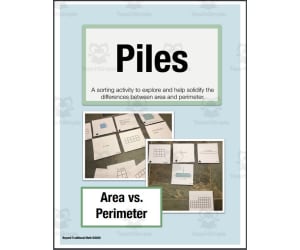
Engage students in critical thinking and math talk with this interactive card sorting activity for area and perimeter. Students will deepen their conceptual understanding by working with visual models of square and irregular shapes to compare area and perimeter. The open-ended card sorting format allows students to discuss and defend their thinking, revealing misconceptions for teachers to address. With no prep required, just print, cut out, and sort, this enrichment resource can be used for fast finishers, small group instruction, or even whole class warm-ups to get math skills ready. Applying area and perimeter concepts to real-world models builds problem-solving skills for state assessments focused on flexible thinking. Let these engaging card sorts enhance understanding and math discourse for third through fifth graders ready for a challenge.
Author Beyond Traditional Math
Tags Card Sort, Area Models, Perimeter Models, Math Talk, Enrichment, Real-world Math

Alaska Day Word Search 2rd 3th 4th 5th Grade worksheet activity
Vocabulary, Language Development, ELA, Spelling, Geography, Social Studies, Grade 2, 3, 4, 5, Games, Activities, Word Searches, Worksheets, Worksheets & Printables
Make learning fun with a no-prep, printable vocabulary word search that builds vocabulary, reinforces literacy, and sparks curiosity! Students can explore the new vocabulary words while practicing spelling, scanning for letters, and identifying keywords. A word search can be a perfect and easy-to-use activity to liven up a lesson by combining learning with fun! It is an excellent way to reinforce concepts within a lesson and engage students' hands-on learning. Purpose: This activity allows students to learn new vocabulary words and contextualized vocabulary related to a topic ✏️, improve spelling, reading, and attention to detail 📚, increase awareness of concepts and knowledge about the world at large 🌍, and encourage curiosity and engagement about the topic 🐾. Word searches are a hands-on way to make learning memorable and fun for students - it engages them at all vocabulary levels! How to Do It: 1️⃣ Hand out the word search worksheet. 2️⃣ Introduce any important vocabulary or concepts that fit with the topic. 3️⃣ The students search for the words and circle or highlight each one. 4️⃣ Discuss the importance of the topic or the words that the student found. 5️⃣ Review the answers using the answer key that is included for each product ✅ Perfect For: Grades 2-5 🌟, independent practice, partner work, students who finish early, science or social studies centers, or for substitute plans 🤝 Way of Implementation: Great for independent practice early finishers, partner work, or substitute plans 🤝. Answer Keys: (these will be pencils under your three files: Given for simple checking and self-assessing. Fun Variations: Timed Challenge ⏳ - record how many words students can find in a set time. Partner Puzzle 🤝 - work together to find all of the words. Vocabulary Extension ✏️ - write sentences or a few short paragraphs using the words. Create-Your-Own Word Search 🧩 - have students make their own word search puzzles using the vocabulary. Standards Alignment: Supports CCSS/ELA vocabulary development, and can also connect to NGSS or other relevant standards, depending on the topic. File & Print Info: PDF includes both a color and black and white version, and is ink-friendly to make printing easy. Teacher Tip! Have students learn by being hands-on, engaged, and active while helping them build awareness, vocabulary, and literacy skills around any topic! 🌟
Author Classsim
Rating
Tags Alaska, Day , Word Search, Worksheet , Activity, Alaska Day , Alaska Day Word Search , Alaska Day Word Search 2rd 3th 4th 5th Grade , Alaska Day Word Search 2rd 3th 4th 5th Grade Worksheet , Alaska Day Word Search 2rd 3th 4th 5th Grade Worksheet Activity
COLOR LIKE THE MODEL - Painting Activity
Creative Arts, Art, Kindergarten, Preschool, Grade 1, Activities
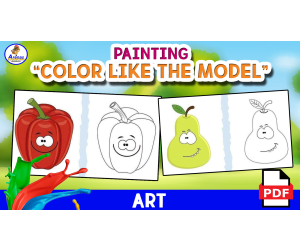
1. Introduction Art is a very important resource for the education of children, because in addition to helping them relax, it helps them awaken their artistic and creative gifts. It is proven that art intervenes in the development of important cognitive functions. 2.Objective Art offers immense benefits such as the following: -It is a means for children to express their emotions, experiences and thoughts in a more free and creative way. It also allows them to express their feelings in a personal and unique way. -It is a means to encourage creative thinking in students, because it stimulates their originality and imagination. -Art also has important positive effects on the emotional and mental health of children, because it can be used as a therapy, because it helps manage issues such as stress, anxiety and other emotional challenges of daily life. . -Art is a means to help students connect on a social and cultural level. -Art also stimulates the mind while it is being created or appreciated. When one paints, it involves cognitive processes that improve attention, memory, and even problem solving. 3.Order, scheme and stages - Introduce your art class with relaxing music. Next, invite the children to guess what activity is going to be done. - Now, tell your students to get out all their colors, markers, and other art tools to decorate. Next, hand out the worksheets and encourage your students to start coloring inspired by the model they see. This will also help them develop their attention and fixation when copying the model. 4.Grades or ages This game is designed for children from 5 to 12 years old. That is, all primary school students can use it. How to apply It is suggested that the teacher print 1 packet for 1 group of students. 6. Answer keys This game does not require answers. 7.Use text labels art, painting, coloring, coloring, drawings, drawings to paint, activities for children 8.Rules Specified above. 9.File types The archive is in PDF format. 10.Number of pages This document contains 18 pages.
Author EDITORIAL LAURA EDUCA
Tags Art, Painting, Activity Art, Color, Coloring