



3,930 products added recently
Page 52 - Lesson Plan Templates
Simplify your preparation with lesson plan templates designed to help you organize objectives, activities, and assessments. These templates provide a structured framework to ensure comprehensive coverage of material. Incorporate them to save time and enhance the effectiveness of your teaching.

 Show filters

Ecosystems Gr. 5-8
Science, Earth and Environmental Sciences, Environmental Science, Grade 5, 6, 7, 8, Teacher Tools, Lesson Plans
Ecosystems Gr. 5-8 Ecosystems Gr. 5-8 simplifies complex life science concepts into lessons and activities that enhance understanding of different types of ecosystems and their dynamics. It elucidates students on the relationship between biotic and abiotic components within ecosystems. Key Highlights: In-depth examination of ecosystem components, including growth patterns. Emphasises roles of producers, consumers and decomposers alike. Encourages students to understand how ecosystems evolve over time through engaging activities. The resource further enriches environmental science comprehension by depicting food chains vividly with hands-on tasks to create food webs. The ultimate goal being inspiring critical thinking about ecological interplay whilst fostering creativity from grade 5th to the 8th pupils. The resource also delves into photosynthesis and the water cycle , spotlighting how they shape a functioning ecosystem. Additionally, it introduces students to microscopic wonders like microorganisms' close-up view. Fine Points: Presents lessons aligning with Next Generation Science Standards (NGSS). Packages PDF comprising of interactive experiments designed under Bloom's Taxonomy principles & STEAM initiatives value for cooperative learning or individual study strategies. Besides, fun exercises like crosswords & word searches are included for knowledge reinforcement complemented with comprehension quizzes/answer keys providing regular progress check-in points aiding effective teaching approaches whether its group studies or homework assignments– even catering online learners via an eBook version is incorporated too. A Perfect Asset For Grade 5-8 Educators! This teaching material enhances standard classroom teachings utilizing students’ independent exploration abilities while delivering practical knowledge in compliance with scientific standards. Above all Ecosystems Gr. 5-8 fosters appreciation for Earth’s biodiversity and creates a sense of environmental responsibility among students – essentially a resource crafted to make science classes more impactful.
Author Classroom Complete Press
Tags Science Lesson Plan, Ecosystems Lesson Plan, Chapter Slice, Informational Text, Environment Text
Toothbrushes Reading Comprehension Passage - Cored Ed Encyclopedia
ELA, Language Development, Reading Comprehension, Reading, Science, Technology, Engineering, History, Social Studies, Life Sciences, Grade 2, 3, 4, 5, Worksheets & Printables, Worksheets, Teacher Tools, Centers, Activities, Writing Prompts, Assessments, Quizzes and Tests, Quizzes, Lesson Plans
This toothbrushes reading comprehension includes: Visualization (on the front cover) Start your lesson by taking a minute to think and share something about the topic. Read the script aloud (slowly), perhaps prepare some music or sound effects. Student close their eyes and let their imaginations wander. Students open their eyes, read the question aloud and give them a few minutes to complete. Ask a few students to share or keep answers until the end to compare with what they learn in the passage. Quick pause—thousands of Cored Education products are included with your TeachSimple membership. Download links and encyclopedia index available here. Pre-Reading Trivia Students will write down one thing they already know about the subject and then read five more facts and discuss. These facts are fun, and the students will enjoy learning about the subject before reading more. Give 1 minute for students to write what they already know (no pressure—best guess is fine). Read the five facts together. After each fact, do ask a student for their opinion, was it surprising? Set a purpose by asking students to highlight/underline one fact they want to learn more about during the reading. Reading Passage The text is a high-interest reading passage with set paragraphs, roughly three to four paragraphs long. It contains a variety of themes about the topic, anywhere from history to technology. The passage is between 250 and 350 words in length. First, ask students to look at the headings and see what they’ll learn about today. What do they know about the topic/heading? First read options: Teacher read-aloud (best for support). Partner reading (paragraph by paragraph). While reading, students underline important details, and vocabulary words they think may come up in the questions section. Mixed Questions The first question page contains four multiple-choice questions, each with a choice of four answers, and three written response questions that require a sentence or two from the student. Students complete the mcqs first independently, then review quickly as a class. For the 3 written responses, try to get students giving the answer with some form of evidence: “I think ___ because the text says ___.” If students get stuck, send them back to check the passage. Vocabulary Questions Practice seven key words from the text in this section across two activities. First section is scrambled words where students will unscramble three words given a clue for each. The second section is a word to meaning matching activity. Before starting, have some students read out words they underlined in the passage. Ask students to say the word and read aloud the sentence(s) around each word. Ask students to do scrambled words and the matching exercise in pairs then go through answers as a class. For the scrambled spelling task, get four pairs to come up to the board and write the words for extra practice with the other student reading out the clue. For the matching task, prompt students to give full sentences: “I matched ___ with ___ because ___.” Creative Writing In this question, the student will be required to write a five to eight sentence paragraph on a question related to the topic. Before starting, ask students write down 3 key ideas they are going to include in their piece. Ask students for ideas to share around the class to help those struggling. Pro writing expectations: 5–8 sentences At least 2 facts or details from the passage At least 2 vocabulary words from the previous page Students read their paragraphs while classmates listen for facts and vocabulary words. Extension Activities This page is optional for fast finishers or to take home. There are several activities, each one requiring a different skill. Do some, do none, do all, completely optional - but you will feel reassured knowing every possibility is planned for. Includes summary writting question. Answer Key There are answers for the multiple-choice questions, written response questions have sample answers, vocabulary answers and if there is a summary question then a sample summary will be provided as well. Lesson Plan Included Customized lesson plan for this lesson is included. Lesson Snapshot Title: Toothbrushes Genre: Nonfiction (informational text) Subject: Science (Health & Technology) Primary Topic: How toothbrushes changed over time Estimated Guided Reading Level (A–Z): R What This Lesson Teaches Best Explains how people cleaned teeth before store-bought toothbrushes by chewing a twig until it turned “fuzzy” and rubbing it on teeth. Shows how evidence from the past (archaeologists finding signs in places like Mesopotamia and Egypt) can tell us about tooth care long ago. Traces the history of the bristled brush from China’s Tang dynasty to Europe in the 1600s, highlighting how inventions travel. Describes how toothbrush designs changed to solve problems (for example, natural bristles staying damp and trapping bacteria). Summarizes key innovations—nylon bristles (1938) and the electric toothbrush (1954)—and connects them to the ongoing goal of protecting teeth. Learning Goals Students will describe how a “chew stick” was used to clean teeth long ago. Students will identify evidence in the text that people cared about clean mouths thousands of years ago. Students will explain how the bristled brush began in China and later spread to Europe. Students will summarize how toothbrush-making changed after 1780 using details about materials and design. Students will explain why inventors searched for new bristle materials and what nylon changed. Students will describe how an electric toothbrush helped brushing by adding steady motion. Key Vocabulary From the Text archaeologists — scientists who study the past using old remains. Mesopotamia — an ancient region where people lived long ago. miswak — a special stick used for cleaning teeth. patent — legal rights that protect an invention. bacteria — tiny germs that can cause problems. FULL CATALOG OF DOWNLOAD LINKS AND ENCYCLOPEDIA INDEX HERE
Author Cored Education
Rating
Tags Vocabulary, Reading Comprehension, Reading Passages, Lesson Plans, Ela Lesson Plans, Reading Comprehension Lesson Plans, Pre-reading, History, History Lesson Plans, Toothbrushes

I WONDER - What Is An Orc | Animated Video Lesson
History, Social Studies, Common Core, Grade 4, 5, 6, 7, 8, 9, 10, Lesson Plans, Teacher Tools
Video Introduction An amazing video designed for the students to learn more about mythological creatures in different cultures. I WONDER - What Is An Orc | Animated Video Lesson Mythology is full of wonders and spectacular stories. Ancient civilizations were trying to explore every aspect of life, while they search for new technologies, they wanted to believe in something big and can change the world, so they created mythical creatures and mythical stories. Let's hear about them! What do you know about these creatures? Cyclops, Centaurs, Selkies, Phoenix, Gnomes, Dragons, Gorgons, Orcs, Cerberus, Trolls, Minotaur, Griffins, Mermaids, Elves, Polyphemus, Pegasus, and Ogres. I WONDER - What Is An Orc | Animated Video Lesson The video is perfect for encouraging the creativity skills for the students, while learning more about this fantastic mythical creature. I WONDER - What Is An Orc | Animated Video Lesson This friendly designed video is suitable for students at school, homeschooling, and as a group activity. Format Available in MP4 format.
Author Educational Voice
Rating
Tags What Is An Orc, What Is An Orc Video, Orc, Orc Facts, Orc Video, Orc Video For Kids, Orc Facts For Kids, Orcs, Orcs Facts, Orcs Video

The Oregon Trail : Mini Unit
Social Studies, History, History: USA, Grade 4, 5, 6, 7, 8, Lesson Plans, Teacher Tools
The Oregon Trail : Mini Unit is a great resource to have students explore and learn about the topic. The materials included are designed to teach the story of the Oregon Trail. Reading material, questions, and activity sheets are provided for the following topics : Planning the journey. Transport. Supplies. Children on the trail. Obstacles. Dangers. Disasters. This unit contains all the files needed for students to explore the topic in detail and for them to show their knowledge at the end. Among the files included are: Presentations file includes information about the The Oregon Trail : Mini Unit Additionally, it presents 3 different options for students to demonstrate their knowledge in the topic. Each of the options are shown with instructions, hints and tips. The options are: A Guidebook project or a Dairy project. Worksheets file includes reading comprehension worksheets and also all necessary worksheets for students to engage in an activity where they need to choose the supplies they need but their wagon can only carry a maximum of 2400 pounds. If they try to carry any more than this then their wagon will probably break and their animals will be too tired. Separated material contains individual ready-to-print worksheets to be used throughout the unit.
Author Mr Gray History
Tags Oregon, Oregon Trail, Oregon Trail Unit, Lesson Plans On The Oregon Trail, Oregon Trail Lesson Plans, Oregon Trail Lesson Plans 5th Grade
Force: More Than One Force - FLASH-PC
Science, Physics, Common Core, Grade 5, 6, 7, 8, Teacher Tools, Lesson Plans
Force: More Than One Force - FLASH-PC An enriching teaching resource designed for comprehensive physics learning for grade 5 to 8 students, perfectly aligning with Common Core State Standards and Bloom's Taxonomy. In-Depth Exploration Into the World of Forces Placed under categories of lesson plans in science and specifically physics. Its focus is to teach students about the interaction between multiple forces. Critical reading passages & questions encouraging 'before you read' and 'after you read' . Innovative Learning Tools Brightly lit educational video clips that visually simplify complex physics topics. Motivating interactive activities that provoke lively discussions and group projects. Solidifying New Learning & Ensuring Retention! The resource comes loaded with printable aids like vocabulary flash cards . These can be transformed into fun memory games or serve as independent study guides during homework or exam prep times. User-friendly Software Design + Audio Aids: Fully compatible with PC systems along with integrated audio support which accommodates auditory learners making it an all-inclusive teaching tool. This relevant educational tool effectively harnesses individual learning styles, suitable for whole-group instruction or small-group collaboration. The potential within "Force: More Than One Force - FLASH-PC" admirably sparks an interest in Physics among young learners while efficiently imparting core concepts in a student-friendly environment curated by modern educators.
Author Classroom Complete Press
Tags Software (PC)

Local Climate Action: Data-Driven Solutions for Teen Environmentalists
Earth and Environmental Sciences, Science, Earth Sciences, Environmental Science, Geology, Space, Life Sciences, Biology, Human Body, Nature & Plants, Homeschool Curriculum, Homeschool Templates, Grade 6, 9, 10, 11, 12, Lesson Plans, Teacher Tools, Workbooks, Worksheets & Printables, Centers, Activities, Experiments, Labs, Projects, Presentations
Equip and empower the next generation of climate leaders to act through data, tools, and projects that can be immediately applied in their own backyard. "Local Climate Action: Data-Driven Solutions for Teen Environmentalists" is a game-changing book that will empower high school students from climate observers to data-informed climate activists. This textbook written by Syed Hammad Rizvi connects climate knowledge around the world to practical solutions on a local level. By means of 45 chapters, teens are taught how to: Obtain and interpret local environment data with the help of easily accessible tools and sensors Integrate climate change impacts like urban heat islands, flood zones, or pollution hotspots Learn how to effectively disseminate your findings through the use of graphics, such as charts and Create and deliver youth-led projects on climate change that have tangible implications in the real world. Packed with practical examples, protocols, and ethics for a responsible climate response, this book turns classrooms and communities into living laboratories for climate resilience. It is a textbook and a toolkit that reaches beyond education by providing a means for empowerment and increasing awareness and knowledge for a climate-conscious population. Why Parents & Schools Love It: Practical and application-based: Goes beyond theory and projects that students can implement and have the potential for making a difference in the neighborhood community. This inculcates critical skills in data literacy, scientific inquiry, mapping, presentation, and project management skills which will benefit them in both school as well as in their future lives. Aligns with Curriculum: This can be easily incorporated into the curriculum of environmental science, geography, STEM education, and social studies. Youth Agency Enthusiast: This helps youth exercise leadership, representation, and partnership with the community for their benefit, enhancing their self-confidence. Engaging Youth Publication Lowdown Ethical & Inclusive: Emphasizes responsible data use, community science, & justice for our planet & our communities. Target Audience & Grade Level: Primary Audience: Grades: 9-12 Subjects: Environmental Science, Geography, STEM Education, Civics Education, Data Liter Target group: High school students, Eco-clubs, Project based learning initiatives, Homeschoolers, Climate advocacy groups for youths. Secondary Audience: Educators, Science Teachers, People involved in developing Curriculums. Those interested in Activity-based, ‘ Youth groups, libraries, and community centers running climate action projects. Copyright/Terms of Use This Book is copyrighted by Syed Hammad Rizvi. This material is intended only for personal and single-classroom use. This means you do not have the right to copy, distribute, and sell any part of this material. That is, you cannot place the material on the Internet where it could be downloaded by the public. If you want to share this resource among colleagues in your institution, you would need to purchase additional copies of this product through Teachsimple. Thank you for respecting this usage policy. This product has been shared among you happily by Syed Hammad Rizvi
Author Creative Book Store
Rating
Tags TeenEnvironmentalists, ClimateAction, DataLiteracy, STEMeducation, HighSchoolScience, ProjectBasedLearning, ClimateChangeEducation, YouthLeadership, EnvironmentalScience, TeacherResources

Table Manners | English Conversations Video Lesson
ELA, Language Development, ESL, Not Grade Specific, Lesson Plans, Teacher Tools
Table Manners | English Conversations Video Lesson Table Manners | English Conversations Video Lesson is an engaging educational resource designed to foster conversational skills within the context of table manners. This 7-minute video lesson presents lively animations that are certain to hold students' interest, providing opportunities for learners to actively engage in an invigorating exploration of language arts. All-inclusive Teaching Tool As an all-inclusive teaching tool, it's not grade-specific and can be easily incorporated into any Language Arts or ESL classroom setting. Whether used for full-class instruction or for individual learning activities, this versatile asset ensures a dynamic and participatory experience. Fostering Practical Conversation Skills The interactive nature of this resource encourages the development of practical conversation skills embedded in everyday situations. Thus, it allows students to easily transition from classroom learning to real-world application. Digital Classrooms Optimization Specially designed for the digital classroom environment, This product comes as a single MP4 file that can be conveniently downloaded and played on multiple platforms—either at home or school, Suitable both for common viewing sessions by projecting onto screens or personalized lessons on individual devices, Bonus Feature: A welcome break from traditional textbook pedagogy & supporting reinforcement approach based on concepts previously taught. There's no compromise. As a valuable addition under your teaching resources portfolio - this solution certainly strikes balance between educators convenience & student engagement - refining ways modern lessons should be conducted!
Author Educational Voice
Tags Table Manners, English Conversations, Video Lesson, Language Arts, ESL, Table Manner Video

I WONDER - What Is A Seed | Animated Video Lesson
Nature & Plants, Life Sciences, Science, Grade 4, 5, 6, 7, 8, 9, 10, Lesson Plans, Teacher Tools
Video Introduction An amazing activity designed for the students to learn more about STEM. I WONDER - What Is A Seed | Animated Video Lesson Do you like STEM subjects? what is your favorite one? Have you ever tried to plant a seed? If yes, tell us more about it. Or have you ever tried to invent something? If yes, tell us more about it. And how do you think it will help us? Have you ever seen a microorganism under a microscope? What was it? And how it looked like? Mathematics is a marvelous subject. Let' sharpen our brains and solve some equations. Do you like timetable tricks? What is your favorite one? Do you know how to code? Have you ever created an app or a game before? If yes, how was it like? I WONDER - What Is A Seed | Animated Video Lesson The video is perfect for encouraging the researching skills for the students, while learning more about this fantastic topic. I WONDER - What Is A Seed | Animated Video Lesson This friendly designed video is suitable for students at school, homeschooling, and as a group activity. Format Available in MP4 format.
Author Educational Voice
Tags What Is A Seed, What Is A Seed Video, Seed, Seed Facts, Seeds, Seeds Facts For Kids, Seeds Video, Seeds Video For Kids, Plant, Plants Facts

Persian Gulf War (1990-1991): The War Begins Gr. 5-8
Social Studies, History, History: USA, Grade 5, 6, 7, 8, Teacher Tools, Lesson Plans
Persian Gulf War (1990-1991): The War Begins Gr. 5-8 is a detailed teaching resource designed to educate students about the historical events of 1990 to 1991, often referred to as the Persian Gulf War. This resource provides an in-depth look at Operation Desert Storm, led by the USA, and presents significant post-invasion events in Kuwait for students from grades 5 through grade 8. Main Features: Mapping Activity :This element visually locates Iraq, aiding in comprehension and retention of geographical war details. Oil-extraction Research:The resource encourages conducting research on oil-extraction processes highlighting Kuwait's invasion motives. Key Figures Understanding:Inclusion of pivotal figures like Saddam Hussein offers insights into Iraq's history making patterns. Coverage of International Reactions:A comprehensive examination into reactions from international bodies like UN during these troubled times effectively covers operations such as Desert Shield and Desert Storm which highlight US involvement in protecting other nations from Hussein’s aggression. The versatility of Persian Gulf War (1990-1991): The War Begins Gr.5-8 allows educators to diversify instruction approaches catered either for large groups or smaller study circles; thanks its adaptability for individual student needs or homework assignments adding flexibility across entireschool teaching methods. Creative Aspects Included : Designing comic strips or dioramas showcasing various aspects of Persian Gulf War with an aim at increasing engagement while rendering education playful yet meaningful is one creative aspect integrated within this curriculum tool. In addition, hands-on activities further enrich school teaching methodologies and make this aspect of history easier and more exciting for budding learners. Assessment Tools Incorporated: Crossword puzzles along with word searches to engage students while reinforcing learned materials. An included comprehension quiz with an answer key ensures thorough understanding and evaluation of learned materials. In conclusion, the Persian Gulf War (1990-1991): The War Begins Gr.5-8 serves as a comprehensive guide that accurately delivers extensive knowledge on this pivotal event in history, allows for various teaching techniques adaptation and retains learning engagement.
Author Classroom Complete Press
Tags PDF, Persian Wars Lesson Plans
Measurement: Measuring Time - Practice the Skill 3 - MAC Software
Math, Time, Common Core, Kindergarten, Preschool, Grade 1, 2, Teacher Tools, Lesson Plans
Measurement: Measuring Time - Practice the Skill 3 - MAC Software This comprehensive teaching tool is designed to assist with mastering the concept of measuring time. It finds its application across multiple grades, making it a significant part of basic math curriculum for students in Preschool, Kindergarten, Grade 1 and Grade 2. The software breaks down complex mathematical concepts through a series of skill-practicing activities and timed drills aimed at converting spans of times to digital form. One standout feature includes the use of mathematical tools that help foster foundational knowledge about time measurement and associated concepts. An integral part for inclusivity is its availability in both English and Spanish (voice-over and text), thus accommodating various native speakers or Spanish language learners. The content aligns with Common Core State Standards and STEM initiatives ensuring education requirements are met for different schooling modules including public schools or homeschooling. Its usage extends to different learning settings where teachers might utilize it within group lessons as well as individual homework practices that present age-appropriate challenges out-of-school learning times. This Mac-specific software comes as a downloadable zip file format allowing smooth integration into lesson plans without any technical impediments. The bottom line remains that this resource facilitates sustainable development towards understanding time measurements, helping bolster competency while assisting in fostering self-confidence among young scholars interested in exploring mathematics further.
Author Classroom Complete Press
Tags Measurement Lesson Plan, Measuring, Time, Digital Math, Math Skills

I WONDER - What Is A Carbon Footprint | Animated Video Lesson
Environmental Science, Earth and Environmental Sciences, Science, Grade 6, 7, 8, 9, 10, 11, 12, Lesson Plans, Teacher Tools
Video Introduction An amazing video designed for the students to learn more about STEM. I WONDER - What Is A Carbon Footprint | Animated Video Lesson Do you like STEM subjects? what is your favorite one? Have you ever tried to plant a seed? If yes, tell us more about it. Or have you ever tried to invent something? If yes, tell us more about it. And how do you think it will help us? Have you ever seen a microorganism under a microscope? What was it? And how it looked like? Mathematics is a marvelous subject. Let' sharpen our brains and solve some equations. Do you like timetable tricks? What is your favorite one? Do you know how to code? Have you ever created an app or a game before? If yes, how was it like? I WONDER - What Is A Carbon Footprint | Animated Video Lesson The video is perfect for encouraging the researching skills for the students, while learning more about this fantastic topic. I WONDER - What Is A Carbon Footprint | Animated Video Lesson This friendly designed video is suitable for students at school, homeschooling, and as a group activity. Format Available in MP4 format.
Author Educational Voice
Tags What Is A Carbon Footprint, What Is A Carbon Footprint Video, Carbon Footprint, Carbon Footprint Facts, Carbon Footprint Facts For Kids, Carbon Footprint Video, Carbon Footprint Video For Kids
I WONDER - What Are Nimbostratus Clouds | Animated Video Lesson
Earth Sciences, Earth and Environmental Sciences, Science, Grade 4, 5, 6, 7, 8, 9, 10, Lesson Plans, Teacher Tools
Video Introduction An amazing video designed for the students to learn more about famous phenomena in different countries. I WONDER - What Are Nimbostratus Clouds | Animated Video Lesson What do you know about this phenomenon? Where it happens? When it happens? What are the safety measures that we should take to be safe during this phenomenon? Are there any other places in the world that experienced this phenomenon? If yes, tell us more about them. Why do you think it happens? Do you like reading about Geography? What is your favorite country in the whole world? I WONDER - What Are Nimbostratus Clouds | Animated Video Lesson The video is perfect for encouraging the researching skills for the students, while learning more about this fantastic phenomenon. I WONDER - What Are Nimbostratus Clouds | Animated Video Lesson The video is perfect for encouraging the researching skills for the students, while learning more about this fantastic phenomenon. Format Available in a PDF format.
Author Educational Voice
Rating
Tags What Are Nimbostratus Clouds, What Are Nimbostratus Clouds Video, Nimbostratus Clouds, Nimbostratus Clouds Video, Nimbostratus Clouds Facts, Nimbostratus Clouds Video For Kids, Nimbostratus Clouds Facts For Kids
I WONDER - Why Are Peacock Feathers So Colourful | Animated Video
STEM, Animals, Life Sciences, Science, Biology, Grade 1, 2, 3, 4, 5, 6, 7, 8, Lesson Plans, Teacher Tools
Video Introduction Animal kingdoms are full of fascinating wonders to learn. This video is designed for the students to learn more about animals in different countries. I WONDER - Why Are Peacock Feathers So Colourful | Animated Video Lesson Do you like animals? what is your favorite one? Do you own a pet? If yes, tell us more about it, like what its name? And what do you like most about it? What are the animal kingdoms? Can you write down the characteristics of each animal class like mammals, birds, reptiles, amphibian, fish and mollusks. Do you know that some animals can sing, can you name any of them? What is the largest and the smallest mammal in the world? What is the largest and the smallest bird in the world? What is the largest and the smallest fish in the world? I WONDER - Why Are Peacock Feathers So Colourful | Animated Video Lesson The video is perfect for encouraging the researching skills for the students, while learning more about these fantastic animals. I WONDER - Why Are Peacock Feathers So Colourful | Animated Video Lesson This friendly designed video is suitable for students at school, homeschooling, and as a group activity. Format Available in MP4 format.
Author Educational Voice
Tags Why Are Peacock Feathers So Colourful, Why Are Peacock Feathers So Colourful Video, Peacock Feathers, Peacock Feather, Peacock Feathers Facts, Peacock Feathers Facts For Kids, Peacock Feathers Video

NG: 1 Decodable Reading Book + 2 Video Lessons + 23 Worksheets SOR
Special Resources, ELA, Special Education Needs (SEN), Language Development, Pre-Reading, Phonics, Spelling, Kindergarten, Preschool, Homeschool Curriculum, Grade 1, 2, Literacy Readers, Teacher Tools, Lesson Plans, Presentations
1 NG Blend Decodable Reader, 2 Video Lessons & 23 Supporting Worksheets to Develop Reading Fluency! Complete Teaching Pack | Part of Advanced Phonics Reading Programme Master NG with 2 decodable readers, 2 optional video lessons, and 23 differentiated practice worksheets! This extensive teaching pack features farm stories that children will love, along with targeted phonics activities that reinforce learning. This is part of the Reading Made Simple programme of systematic phonics instruction that can help your struggling readers succeed. Designed and tested on real children of all abilities, from none to severe, every step of the way. These books presume that a child can already decode words with a CK ending, OO (moon/look), EE, SH, CH, ND/ND, NK, TH, NG. What's Included 2 systematic/levelled decodable readers focusing on NG words 2 carefully taught optional video lessons - no distracting music - these are serious lessons and can be used by home educators and teachers alike - to give extra support to struggling readers Word lists for pre-reading practice at the beginning of each book 28 Differentiated worksheets for phonics reinforcement: Word sorting activities Sound isolation exercises Reading comprehension exercises Sentence writing practice Phonics pattern recognition tasks 100% decodable text with carefully controlled vocabulary Science of reading-aligned instruction Beloved characters: Tom, Sam, Pam, Gran, and the farm animals Beautiful watercolour illustrations Print-and-go format for easy classroom use Why Teachers Love This Complete Pack Real stories PLUS targeted practice! These aren't just decodable readers—you get everything you need to teach NG systematically. The differentiated worksheets provide multiple opportunities for students to apply their learning, while the engaging farm stories provide ample practice of decoding, word recognition and reading comprehension. They help you to target a child's precise needs to ensure progress. The optional video lessons give even nervous parents the help they need to teach! Designed With Carefully Controlled vocabulary: The NG sound is introduced systematically across the stories, with previously taught words revisited throughout. Worksheets reinforce the same vocabulary, providing an opportunity for mastery. Perfect For Explicit phonics instruction following the science of reading principles All students who are ready to learn NG Children who need a slower pace, or not Small group intervention or whole class instruction Literacy centres and independent practice Homework assignments that reinforce classroom learning Structured literacy programmes Ages 5-7 or Grade 1-2 Skills Addressed Decoding NG in isolation and context Reading fluency with controlled decodable text Phonics, pattern recognition and application Phonemic awareness through targeted activities Reading comprehension with engaging stories Writing practice using the taught phonics pattern Sight word introduction and practice How to Use This Complete Pack Introduce the sound NG comprehensively Use worksheets for guided practice and skill reinforcement Practice word lists before reading stories Have students read the decodable stories, pointing to each word Return to the worksheets for independent practice or assessment Reread the stories to build fluency This complete pack provides everything you need to teach NG effectively—no additional materials required!
Author Lilibette's Resources
Rating
Tags Fluency, Struggling Readers, Dyslexia, Special Needs, Phonics, Decodable Reading Books, Reading Fluency, Consonant Digraphs, Learn To Read, NG Sound

I WONDER - What Are The Different Types Of Joints | Animated Video
Human Body, Life Sciences, Science, Biology, STEM, Grade 5, 6, 7, 8, 9, 10, 11, Lesson Plans, Teacher Tools
Video Overview The human body is full of fascinating wonders to learn. This video is created to help the students recognize the anatomy and the job of the human body. I WONDER - What Are The Different Types Of Joints | Animated Video Lesson Every part and organ in our human body is vital so let's see how important they are. Have you ever imagined how we look like if we didn't have a skeleton? Did you know that because we have our amazing muscles we can stand! Do you know how many teeth do we have? Have you ever wondered about the food journey inside our body? Can you name all the glands in our body? Why do we have skin? Our nervous system is really good at sending signals. Can you tell us more about it? Are you really good at Mathematics, painting, or any other thing? You should really thank your brain about it! The famous five senses are really doing a great work? Can you explain how every sense works? I WONDER - What Are The Different Types Of Joints | Animated Video Lesson The video is perfect for encouraging the researching skills for the students, while learning more about our fantastic human body. I WONDER - What Are The Different Types Of Joints | Animated Video Lesson This friendly designed video is suitable for students at school, homeschooling, and as a group activity. Format Available in MP4 format.
Author Educational Voice
Tags What Are The Different Types Of Joints, What Are The Different Types Of Joints Video, Different Types Of Joints, Different Types Of Joints Facts, Different Types Of Joints Facts For Kids, Different Types Of Joints Video
I WONDER - What Is A Ground Blizzard | Animated Video Lesson
Geography, Social Studies, Environmental Science, Earth and Environmental Sciences, Science, Earth Sciences, Grade 4, 5, 6, 7, 8, 9, 10, Lesson Plans, Teacher Tools
Video Introduction An amazing video designed for the students to learn more about natural disasters in different countries. I WONDER - What Is A Ground Blizzard | Animated Video Lesson What do you know about this natural disaster? Do you know in which part of the world this could happen? Have you ever read about the safety misusers that we could have to protect ourselves from this natural disaster? If yes, can you tell us more about them? Can you name other natural disasters? If yes, tell us more about where they are likely to happen? And how frequently? Do you like reading about Geography? What is your favorite country in the whole world? If you are going on a trip where it will be? Which country? What you are going to see there? Does this country has a famous place to visit? Do you like reading about Geology? If yes, what is your favourite topic? I WONDER - What Is A Ground Blizzard | Animated Video Lesson The video is perfect for encouraging the researching skills for the students, while learning more about this fantastic phenomenon. I WONDER - What Is A Ground Blizzard | Animated Video Lesson This friendly designed video is suitable for students at school, homeschooling, and as a group activity. Format Available in MP4 format.
Author Educational Voice
Tags What Is A Ground Blizzard, What Is A Ground Blizzard Video, Ground Blizzard, Ground Blizzard Facts, Ground Blizzard Facts For Kids, Ground Blizzard Video, Ground Blizzard Video For Kids, Blizzard

I WONDER - How Many Species Of Snake There Are | Animated Video Lesson
Animals, Life Sciences, Science, STEM, Grade 4, 5, 6, 7, 8, 9, 10, Lesson Plans, Teacher Tools
Video Introduction Animal kingdoms are full of fascinating wonders to learn. This video is designed for the students to learn more about animals in different countries. I WONDER - How Many Species Of Snake There Are | Animated Video Lesson Do you like animals? what is your favorite one? Do you own a pet? If yes, tell us more about it, like what its name? And what do you like most about it? What are the animal kingdoms? Can you write down the characteristics of each animal class like mammals, birds, reptiles, amphibian, fish and mollusks. Do you know that some animals can sing, can you name any of them? What is the largest and the smallest mammal in the world? What is the largest and the smallest bird in the world? What is the largest and the smallest fish in the world? I WONDER - How Many Species Of Snake There Are | Animated Video Lesson The video is perfect for encouraging the researching skills for the students, while learning more about these fantastic animals. I WONDER - How Many Species Of Snake There Are | Animated Video Lesson This friendly designed video is suitable for students at school, homeschooling, and as a group activity. Format Available in MP4 format.
Author Educational Voice
Tags How Many Species Of Snake There Are, How Many Species Of Snake There Are Video, Species Of Snake, Species Of Snake Facts, Species Of Snake Facts For Kids, Species Of Snake Video, Species Of Snake Video For Kids

Helping the Largest Organ Heal Itself: A Cross-Curricular Unit on Skin
Science, Life Sciences, Human Body, Grade 5, 6, Teacher Tools, Lesson Plans
Helping the Largest Organ Heal Itself: A Cross-Curricular Unit on Skin A powerful and educational teaching tool, ideally suited for fifth and sixth-grade educators. This excellent resource can be effortlessly incorporated in to lesson plans based around science with a focus on human body studies. Focal Point Our central teaching resource is a nonfiction article that simplifies the understanding of skin - the largest organ in our body. The article guides students through an exploratory journey into different layers of skin and their repair process after they suffer damages. The lessons cover critical aspects of biology while subtly integrating elements of language arts to make cross-curricular connections. Inclusive Contents This PDF package contains: Seven ready-to-print pages full of structured worksheets corresponding with the article. These sheets help reinforce known concepts and learn new ideas in human biology. Versatile worksheets usable in whole group discussions, small group study sessions, or as homework assignments. Bonus Activities The resource also includes suggestions for various activities designed to combat monotony associated with complex subjects learning process maintaining student's interest alive encouraging continuous exploration into human anatomy studies. Closing Thoughts The aim here isn't just providing information but presenting it innovatively to be easily absorbed by young minds eager to learn more about themselves. Designed primarily for grade 5-6 pupils enrolled in science as their main subject, implementing this practical unit would undeniably provoke curiosity among students fostering their eagerness towards learning instead of merely cramming facts under compulsion. As educators remember: informed teachers make effective instructors. Embrace this resource and experience ease educating minds thirsty about learning about human anatomy.
Author Classroom Complete Press
Tags The Human Body, Science Passage, Multiple Meaning Words, Vocabulary Activities, Storytelling

I WONDER - Was The Stegosaurus A Herbivore | Animated Video Lesson
History: Ancient, History, Social Studies, History: World, Animals, Life Sciences, Science, Grade 4, 5, 6, 7, 8, 9, 10, Lesson Plans, Teacher Tools
Video Introduction An amazing video designed for the students to learn more about dinosaurs in different countries. I WONDER - Was The Stegosaurus A Herbivore | Animated Video Lesson Do you like dinosaurs? what is your favorite one? Do you own a pet? If yes, tell us more about it, like what its name? And what do you like most about it? Do you think that your pet has been evolved from a dinosaur? Can you write down the characteristics of your favourite dinosaur like it's shape, their rivals, where did it use to live and what was their favourite food? What is the largest and the smallest dinosaur that ever found? Why is the T-rex is so famous? Have you ever read any interesting facts about it? Can you name any of the carnivores or herbivores dinosaurs? I WONDER - Was The Stegosaurus A Herbivore | Animated Video Lesson The video is perfect for encouraging the researching skills for the students, while learning more about dinosaurs. I WONDER - Was The Stegosaurus A Herbivore | Animated Video Lesson This friendly designed video is suitable for students at school, homeschooling, and as a group activity. Format Available in MP4 format.
Author Educational Voice
Rating
Tags Was The Stegosaurus A Herbivore, Was The Stegosaurus A Herbivore Video, Stegosaurus, Stegosaurus Facts, Stegosaurus Video, Stegosaurus Video For Kids, Stegosaurus Facts For Kids, Herbivore

Algebra: Patterns - FLASH-MAC
Math, Algebra, Grade 3, 4, 5, Teacher Tools, Lesson Plans
The Algebra: Patterns - FLASH-MAC An invaluable teaching resource designed specifically to aid in the comprehension of Algebraic patterns. Tailored for 3rd, 4th, and 5th-grade levels, this tool provides a comprehensive introduction to algebra with the aim of engaging learners through its interactive approach. Key Features Curriculum-oriented content with pre- assessment materials and essential lesson plans. Real-world word problems that are practical applications of algebra principles. Timed drill activities to expand mathematical skills. Versatility in Application This tool is perfect for various class settings. You can utilize: Whole-class instruction Small-group sessions The tool is further suitable as an: In independent study tool or homework assignment for extra practice outside classroom hours. Educational Resources Included: Your purchase comes with additional resources including: `Printable sheets` , and `In-depth teacher guides` providing instructional tips on effective usage techniques. Achieving Learning Goals Through Interactivity & Fun! The true beauty of FLASH-MAC lies in its interactivity offering a variety of educational games like memory match game or board game all centered around algebraic patterns comprehension – making learning not just efficient but also fun! The software further enhances accessibility by providing Spanish voice-over options alongside English text allowing more inclusivity amongst diverse student populations. Final Thoughts Overall, The Algebra: Patterns - FLASH-MAC cultivates a comprehensive math learning environment where educators could effectively leverage multifunctional resources catering different learner types whether it be visual learners through printables or auditory learners through voice-overs improving student engagement more than ever before! Whether you are an educator teaching at public schools or homeschooling parent seeking effective instructional tools your search ends here with Alphabet: Patterns – FLASH MAC!
Author Classroom Complete Press
Tags Software (Mac)
I WONDER - What Food Do Inuit People Eat | Animated Video Lesson
History, Social Studies, Geography, History: Asian, History: Canada, History: Europe, History: USA, History: World, Grade 3, 4, 5, 6, 7, 8, 9, Lesson Plans, Teacher Tools
Video Introduction An amazing video designed for the students to learn more about history. I WONDER - What Food Do Inuit People Eat | Animated Video Lesson Do you like history? Which topic do you really enjoy about history? Have you ever read an interesting fact about the Vikings? If yes, can you mention them? What do you like most about the Victorian era? Can you name all the Tudors? Have you ever wondered how people used to live in ancient Japan and ancient China? Do you know any interesting facts about ancient Egyptians and the Pharaohs? Have you ever visited South America? What do you know about Incas and Aztecs? Celtic culture was really one of a kind, can you name any of the places that Celts used to live in? Imagine yourself living during the ancient Roman empire, how your life will look like? Ancient Greece was an amazing place to live in. What do you know about ancient Greek life? I WONDER - What Food Do Inuit People Eat | Animated Video Lesson The video is perfect for encouraging the researching skills for the students, while learning more about history. I WONDER - What Food Do Inuit People Eat | Animated Video Lesson This friendly designed video is suitable for students at school, homeschooling, and as a group activity. Format Available in MP4 format.
Author Educational Voice
Tags What Food Do Inuit People Eat, What Food Do Inuit People Eat Video, Inuit People, Inuit People Video, Inuit People Video For Kids, Inuit People Facts, Inuit People Facts For Kids, The Inuit
I WONDER - What Is A Microplastic | Animated Video Lesson
Environmental Science, Earth and Environmental Sciences, Science, Grade 6, 7, 8, 9, 10, 11, 12, Lesson Plans, Teacher Tools
Video Introduction An amazing video designed for the students to learn more about STEM. I WONDER - What Is A Microplastic | Animated Video Lesson Do you like STEM subjects? what is your favorite one? Have you ever tried to plant a seed? If yes, tell us more about it. Or have you ever tried to invent something? If yes, tell us more about it. And how do you think it will help us? Have you ever seen a microorganism under a microscope? What was it? And how it looked like? Mathematics is a marvelous subject. Let' sharpen our brains and solve some equations. Do you like timetable tricks? What is your favorite one? Do you know how to code? Have you ever created an app or a game before? If yes, how was it like? I WONDER - What Is A Microplastic | Animated Video Lesson The video is perfect for encouraging the researching skills for the students, while learning more about this fantastic topic. I WONDER - What Is A Microplastic | Animated Video Lesson This friendly designed video is suitable for students at school, homeschooling, and as a group activity. Format Available in MP4 format.
Author Educational Voice
Tags What Is A Microplastic, What Is A Microplastic Video, Microplastic, Microplastic Facts, Microplastic Facts For Kids, Microplastic Video, Microplastic Video For Kids, Environment , Environment Facts
I WONDER - How Do Trolls Interact With Humans | Animated Video Lesson
History, Social Studies, Common Core, Grade 4, 5, 6, 7, 8, 9, 10, Lesson Plans, Teacher Tools
Video Introduction An amazing video designed for the students to learn more about mythological creatures in different cultures. I WONDER - How Do Trolls Interact With Humans | Animated Video Lesson Mythology is full of wonders and spectacular stories. Ancient civilizations were trying to explore every aspect of life, while they search for new technologies, they wanted to believe in something big and can change the world, so they created mythical creatures and mythical stories. Let's hear about them! What do you know about these creatures? Cyclops, Centaurs, Selkies, Phoenix, Gnomes, Dragons, Gorgons, Orcs, Cerberus, Trolls, Minotaur, Griffins, Mermaids, Elves, Polyphemus, Pegasus, and Ogres. I WONDER - How Do Trolls Interact With Humans | Animated Video Lesson The video is perfect for encouraging the creativity skills for the students, while learning more about this fantastic mythical creature. I WONDER - How Do Trolls Interact With Humans | Animated Video Lesson This friendly designed video is suitable for students at school, homeschooling, and as a group activity. Format Available in MP4 format.
Author Educational Voice
Rating
Tags How Do Trolls Interact With Humans, How Do Trolls Interact With Humans Video, Trolls, Trolls Facts, Trolls Video, Trolls Video For Kids, Trolls Facts For Kids, Trolls And Humans, Mythical Creatures
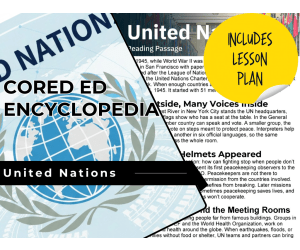
United Nations Reading Comprehension Passage - Cored Ed Encyclopedia
ELA, Language Development, Reading Comprehension, Reading, Pre-Reading, Vocabulary, History, Social Studies, Government, Writing, Grade 2, 3, 4, 5, Worksheets & Printables, Worksheets, Teacher Tools, Centers, Activities, Writing Prompts, Assessments, Quizzes and Tests, Quizzes, Lesson Plans
This United Nations reading comprehension with lesson plan includes: Visualization (on the front cover) Start your lesson by taking a minute to think and share something about the topic. Read the script aloud (slowly), perhaps prepare some music or sound effects. Student close their eyes and let their imaginations wander. Students open their eyes, read the question aloud and give them a few minutes to complete. Ask a few students to share or keep answers until the end to compare with what they learn in the passage. Quick pause—thousands of Cored Education products are included with your TeachSimple membership. Download links and encyclopedia index available here. Pre-Reading Trivia Students will write down one thing they already know about the subject and then read five more facts and discuss. These facts are fun, and the students will enjoy learning about the subject before reading more. Give 1 minute for students to write what they already know (no pressure—best guess is fine). Read the five facts together. After each fact, do ask a student for their opinion, was it surprising? Set a purpose by asking students to highlight/underline one fact they want to learn more about during the reading. Reading Passage The text is a high-interest reading passage with set paragraphs, roughly three to four paragraphs long. It contains a variety of themes about the topic, anywhere from history to technology. The passage is between 250 and 350 words in length. First, ask students to look at the headings and see what they’ll learn about today. What do they know about the topic/heading? First read options: Teacher read-aloud (best for support). Partner reading (paragraph by paragraph). While reading, students underline important details, and vocabulary words they think may come up in the questions section. Mixed Questions The first question page contains four multiple-choice questions, each with a choice of four answers, and three written response questions that require a sentence or two from the student. Students complete the mcqs first independently, then review quickly as a class. For the 3 written responses, try to get students giving the answer with some form of evidence: “I think ___ because the text says ___.” If students get stuck, send them back to check the passage. Vocabulary Questions Practice seven key words from the text in this section across two activities. First section is scrambled words where students will unscramble three words given a clue for each. The second section is a word to meaning matching activity. Before starting, have some students read out words they underlined in the passage. Ask students to say the word and read aloud the sentence(s) around each word. Ask students to do scrambled words and the matching exercise in pairs then go through answers as a class. For the scrambled spelling task, get four pairs to come up to the board and write the words for extra practice with the other student reading out the clue. For the matching task, prompt students to give full sentences: “I matched ___ with ___ because ___.” Creative Writing In this question, the student will be required to write a five to eight sentence paragraph on a question related to the topic. Before starting, ask students write down 3 key ideas they are going to include in their piece. Ask students for ideas to share around the class to help those struggling. Pro writing expectations: 5–8 sentences At least 2 facts or details from the passage At least 2 vocabulary words from the previous page Students read their paragraphs while classmates listen for facts and vocabulary words. Extension Activities This page is optional for fast finishers or to take home. There are several activities, each one requiring a different skill. Do some, do none, do all, completely optional - but you will feel reassured knowing every possibility is planned for. Includes summary writting question. Answer Key There are answers for the multiple-choice questions, written response questions have sample answers, vocabulary answers and if there is a summary question then a sample summary will be provided as well. Lesson Plan Included Customized lesson plan for this lesson is included. Lesson Snapshot Title: United Nations Genre: Nonfiction (Informational text) Subject: Social Studies (Civics/Global Studies) Primary Topic: How the UN began and works for peace Estimated Guided Reading Level (A–Z): P What This Lesson Teaches Best Origins and purpose of the UN: Explains that delegates from 50 countries met in San Francisco in 1945 and signed the United Nations Charter, leading to the UN officially beginning on October 24, 1945. How countries work together in the UN: Describes the UN headquarters in New York City and how member countries speak and vote in the General Assembly, while a smaller group (the Security Council) votes on steps meant to protect peace. Peacekeeping basics: Introduces UN peacekeeping observers (UNTSO) and explains that peacekeepers watch, report, and help keep ceasefires from breaking (and are not there to conquer). Communication across languages: Shows why interpreters matter by explaining that leaders use interpreters in six official languages so the same message can travel across the room. UN help beyond meetings: Notes that UN groups like UNICEF and the World Health Organization work on children’s needs, health, and bringing supplies after earthquakes, floods, or wars. Learning Goals Students will identify key dates and events that led to the UN officially beginning in 1945. Students will describe how the General Assembly and the Security Council are different, using details from the text. Students will explain what the United Nations Charter is and what it was meant to help countries do. Students will summarize what peacekeepers do and why peacekeeping can be hard when countries won’t cooperate. Students will use context clues to determine the meaning of key words such as interpreters and ceasefires . Key Vocabulary From the Text delegates — people chosen to represent a country at a meeting. Charter — a written promise that explains a group’s goals. headquarters — the main building where an organization works. interpreters — people who change speech into another language. ceasefires — times when fighting stops for a while. FULL CATALOG OF DOWNLOAD LINKS AND ENCYCLOPEDIA INDEX HERE
Author Cored Education
Rating
Tags Vocabulary, Reading Comprehension, Reading Passages, Lesson Plans, Ela Lesson Plans, Reading Comprehension Lesson Plans, Pre-reading, Social Studies Lesson Plans, Social Studies, Government