



3,885 products added recently
Page 96 - Lesson Plan Templates
Simplify your preparation with lesson plan templates designed to help you organize objectives, activities, and assessments. These templates provide a structured framework to ensure comprehensive coverage of material. Incorporate them to save time and enhance the effectiveness of your teaching.

 Show filters


I WONDER - How Long Were Vikings Around For | Animated Video Lesson
History: Ancient, History, Social Studies, History: British, History: Europe, Grade 4, 5, 6, 7, 8, 9, 10, Lesson Plans, Teacher Tools
Video Introduction An amazing video designed for the students to learn more about history. I WONDER - How Long Were Vikings Around For | Animated Video Lesson Do you like history? Which topic do you really enjoy about history? Have you ever read an interesting fact about the Vikings? If yes, can you mention them? What do you like most about the Victorian era? Can you name all the Tudors? Have you ever wondered how people used to live in ancient Japan and ancient China? Do you know any interesting facts about ancient Egyptians and the Pharaohs? Have you ever visited South America? What do you know about Incas and Aztecs? Celtic culture was really one of a kind, can you name any of the places that Celts used to live in? Imagine yourself living during the ancient Roman empire, how your life will look like? Ancient Greece was an amazing place to live in. What do you know about ancient Greek life? I WONDER - How Long Were Vikings Around For | Animated Video Lesson The video is perfect for encouraging the researching skills for the students, while learning more about history. I WONDER - How Long Were Vikings Around For | Animated Video Lesson This friendly designed video is suitable for students at school, homeschooling, and as a group activity. Format Available in MP4 format.
Author Educational Voice
Tags How Long Were Vikings Around For, How Long Were Vikings Around For Video, Vikings, Viking, Vikings Facts, Vikings Facts For Kids, Vikings Video, Vikings Video For Kids, Viking History

Flash Mob Choreogrpahy: "Stompa"
Creative Arts, Art, Dance, Grade 5, 6, 7, 8, Teacher Tools, Lesson Plans
Product Description - Flash Mob Choreography: Stompa Feed the artistic curiosities and jazz up the dance lessons for your grade 5-8 students with our Flash Mob Choreography guide to 'Stompa' by Serena Ryder. Serving as a comprehensive supplement to our immensely embraced Flash Mob Dancing in Education, this handbook unveils specific choreographic patterns for the song, providing clear, step-by-step guidance. This ten-page PDF digs deep into various rhythms and routines of Flash Mob dancing, allowing educators to imbue their students with vigor and enthusiasm towards communal dancing. It takes a complete approach by feeding both beginner level and intermediate level students with well-defined instructions about this unique art form. Note: At its core, this handbook is not just about teaching dance steps; it's about stitching together human connections through collective artistry. Use it as an essential teaching resource during Art & Music sessions or let it act as an ice-breaker at the beginning of any new term or unit . Imagine your classroom transforming into a dynamic space where every student participates vibrantly in perfect harmony to 'Stompa'. Whether you are guiding a whole class group, breaking down rehearsals among smaller teams, or assigning individual homework tasks for home practice- you will find this resource particularly effective. Homeschoolers can also embrace it equally efficiently. Recharge your Lessons! So ready yourself for an immersive journey through music and movement that augments critical skills like teamwork and coordination while enhancing students’ appreciation for dance as an expressive art form. Detailed Guidelines on 'Stompa' Incorporated within modern education regime seamlessly, this handbook strikes a balance between the unity in diversity concept and Flash mob choreography. Thus, it advocates classrooms pulsating with energy and shedding inhibitions – all thanks to world-encompassing dance culture! The “Flash Mob Choreography: Stompa” is more than just a learning guide; it's your aid to foster an education environment entrenched in creativity, camaraderie, and contiguous engagement.
Author MUSICWORKS
Tags Dance Education, Flash Mob, Choreography, Music And Movement, Teamwork

I WONDER - When Was The First Moon Landing | Animated Video Lesson
Space, Earth and Environmental Sciences, Science, Grade 4, 5, 6, 7, 8, 9, 10, Lesson Plans, Teacher Tools
Video Introduction An amazing video designed for the students to learn more about space facts. I WONDER - When Was The First Moon Landing | Animated Video Lesson Do you like reading about space? If yes, what is your favorite topic? What do you know about our solar system? What is the smallest planet in our solar system? What is the biggest planet in our solar system? What is the hottest planet in our solar system? And what is the coldest one? Do you think there are aliens? If yes, what do you think they look like? What do they eat and how they speak to each other? Where do they live? What is a galaxy? And what is a milky way? Have you recently saw a shooting star? If yes, tell us more about it, like when did it happen and where? What is a blackhole? Can a blackhole gets bigger by time? Do you like counting the stars? What do you think a star is made of? I WONDER - When Was The First Moon Landing | Animated Video Lesson The video is perfect for encouraging the researching skills for the students, while learning more about the fantastic space. I WONDER - When Was The First Moon Landing | Animated Video Lesson This friendly designed video is suitable for students at school, homeschooling, and as a group activity. Format Available in MP4 format.
Author Educational Voice
Tags When Was The First Moon Landing, When Was The First Moon Landing Video, First Moon Landing, First Moon Landing Facts, First Moon Landing Facts For Kids, First Moon Landing Video, First Moon Landing Video For Kids

Circulatory,Digestive & Reproductive Systems: The Circulatory System - Blood - FLASH-PC
Science, Life Sciences, Human Body, Common Core, Grade 5, 6, 7, 8, Teacher Tools, Lesson Plans
The Circulatory, Digestive & Reproductive Systems: The Circulatory System - Blood - FLASH-PC An invaluable educational resource designed to enrich learning for students in grades 5 through 8. This chapter mini focuses on the circulatory, digestive and reproductive systems, offering a blend of reading passages complemented by pre-reading and post reading questions. Interactive Learning Activities Printables to enhance hands-on learning. Vocabulary flash cards for retention and recall. Multimedia Elements Incorporated multimedia elements like embedded video and audio content offer potential for both group discussions in class or individual assignments at home thereby making it a flexible tool for educators. Can be used in various instructional contexts from whole-group literary circles in the classroom setting to solitary homework sessions at home. Packaged as PC Software Coming as single zip file makes accessing it on standard computers hassle-free while keeping digital organization neat and accessible. Everything needed is right at your fingertips! Precision Design & Standardized Alignment Bloom's Taxonomy integration with precision design implies pedagogical soundness, mastery; carefully weaved into each segment of lesson plan. Its alignment with Common Core State Standards ensures it stays within standardized curriculum norms aiding performance goals nationwide. In summary, The Circulatory,Digestive & Reproductive Systems: The Circulatory System - Blood - FLASH-PC provides enormous value as a comprehensive science teaching tool which promotes knowledge assimilation about Human Body far beyond conventional methods through its multi-faceted approach effectively capturing interest..
Author Classroom Complete Press
Tags Science Worksheet, Human Body, Reproductive Systems, Science Quiz, Science Puzzle
Measurement: Temperature & Currency - Practice the Skill 2 - FLASH-MAC
Math, Measurements, Common Core, Grade 1, 2, Teacher Tools, Lesson Plans
Measurement: Temperature & Currency - Practice the Skill 2 - FLASH-MAC This teaching resource, designed for educators, focuses on enhancing skills related to measuring temperature and currency. It’s grounded in core curriculum requirements and provides an engaging mini-chapter dedicated to understanding these essential aspects of mathematics. Key Features: It integrates Celsius and Fahrenheit scales with real-world images of thermometers making learning more relatable. The product has a focus on both English and Spanish languages, making it an exemplary tool for bilingual classrooms or language immersion programs. A unique feature is timed drill activities aimed at honing quick decision-making skills among students handling challenging concepts like temperature conversion or currency computation. This software caters specifically to Grade 1 and Grade 2 but is versatile enough for continuous usage due to its practical nature. The versatility allows it to be used in group discussions during concept introduction or as reinforcement material after lessons have been taught at home. Educational Standard Alignment: The curriculum aligns with: Common Core State Standards * STEM initiatives * Contains content written according to NCTM benchmarks This ensures that educators’ content delivery stands in harmony with globally recognized educational standards, thus providing a comprehensive learning experience.
Author Classroom Complete Press
Tags Software (Mac)

How to Write a Paragraph: Forms and Purposes of Paragraphs
ELA, Writing, Common Core, Grade 5, 6, 7, 8, Teacher Tools, Lesson Plans
How to Write a Paragraph: Forms and Purposes of Paragraphs This invaluable tool for educators aims to instill effective writing skills in their students with its step-by-step approach and dynamic range of content. It offers both public school teachers and homeschoolers the ability to develop students' prowess for crafting well-structured sentences and paragraphs. Primarily intended for students in Grade 5 through Grade 8, this resource is an ideal part of a language arts curriculum. Despite focusing on the writing subject area, it can be effectively utilized across different subjects due to its universal applicability. The user-friendly PDF format features 24 ready-to-print pages filled with engaging content. Key Features: Introduction to four primary types of paragraph forms Incorporation of various graphic organizers that help construct logical structure within their work Bloom’s Taxonomy inspired learning objectives for advanced learning outcomes Possibility for flexibility in planning lessons - facilitating whole-group instruction or small-group discussions based on the teacher's distinct pedagogical strategy. The teaching aid also includes valuable components such as a student assessment rubric, puzzles designed for vocabulary development, and a comprehension quiz aimed at evaluating mastered knowledge. Each component is geared towards creating an interactive learning environment that is stimulating yet effective. The added benefit is its alignment with Common Core State Standards ensuring adherence to high educational norms while keeping it engaging for young minds embarking on their journey into paragraph writing. In conclusion, "How to Write a Paragraph: Forms and Purposes of Paragraphs" extends beyond being just another lesson plan by providing comprehensive guidance aimed at achieving mastery over advanced written skills right from foundational levels.
Author Classroom Complete Press
Tags Language Arts, Writing, Paragraph Writing, Crossword Puzzle, Comprehension Quiz, Paragraph Lesson Plans, Paragraphs Lesson Plan, Paragraph Forms

Renoir Art Lesson Plans
Creative Arts, Art, Art History, Not Grade Specific, Teacher Tools, Lesson Plans
This resource is a set of Renoir Art Lesson Plans. Included: - Artist sample art - Student examples - Related projects - Lesson plans - Art history
Author Glimmercat Education
Tags Famous Artists, Art History, Student Artwork, Lesson Plans, Crafts
I WONDER - Why Does An Octopus Have Ink | Animated Video Lesson
STEM, Biology, Life Sciences, Science, Animals, Grade 1, 2, 3, 4, 5, 6, 7, 8, Lesson Plans, Teacher Tools
Video Introduction Animal kingdoms are full of fascinating wonders to learn. This video is designed for the students to learn more about animals in different countries. I WONDER - Why Does An Octopus Have Ink | Animated Video Lesson Do you like animals? what is your favorite one? Do you own a pet? If yes, tell us more about it, like what its name? And what do you like most about it? What are the animal kingdoms? Can you write down the characteristics of each animal class like mammals, birds, reptiles, amphibian, fish and mollusks. Do you know that some animals can sing, can you name any of them? What is the largest and the smallest mammal in the world? What is the largest and the smallest bird in the world? What is the largest and the smallest fish in the world? I WONDER - Why Does An Octopus Have Ink | Animated Video Lesson The video is perfect for encouraging the researching skills for the students, while learning more about these fantastic animals. I WONDER - Why Does An Octopus Have Ink | Animated Video Lesson This friendly designed video is suitable for students at school, homeschooling, and as a group activity. Format Available in MP4 format.
Author Educational Voice
Tags Why Does An Octopus Have Ink, Why Does An Octopus Have Ink Video, Octopus Ink, Octopus Ink Facts, Octopus Ink Facts For Kids, Octopus Ink Video, Octopus Ink Video For Kids, Octopus

I WONDER - What Is A Herbivore | Animated Video Lesson
History: Ancient, History, Social Studies, History: World, Animals, Life Sciences, Science, Grade 2, 3, 4, 5, 6, 7, 8, Lesson Plans, Teacher Tools
Video Introduction An amazing video designed for the students to learn more about dinosaurs in different countries. I WONDER - What Is A Herbivore | Animated Video Lesson Do you like dinosaurs? what is your favorite one? Do you own a pet? If yes, tell us more about it, like what its name? And what do you like most about it? Do you think that your pet has been evolved from a dinosaur? Can you write down the characteristics of your favourite dinosaur like it's shape, their rivals, where did it use to live and what was their favourite food? What is the largest and the smallest dinosaur that ever found? Why is the T-rex is so famous? Have you ever read any interesting facts about it? Can you name any of the carnivores or herbivores dinosaurs? I WONDER - What Is A Herbivore | Animated Video Lesson The video is perfect for encouraging the researching skills for the students, while learning more about dinosaurs. I WONDER - What Is A Herbivore | Animated Video Lesson This friendly designed video is suitable for students at school, homeschooling, and as a group activity. Format Available in MP4 format.
Author Educational Voice
Rating
Tags What Is A Herbivore, What Is A Herbivore Video, Herbivore, Herbivores, Herbivore Facts, Herbivore Facts For Kids, Herbivore Video, Herbivore Video For Kids, Dinosaur, Dinosaurs
I WONDER - Can A Jellyfish Glow | Animated Video Lesson
STEM, Animals, Life Sciences, Science, Biology, Grade 1, 2, 3, 4, 5, 6, 7, 8, Lesson Plans, Teacher Tools
Video Introduction Animal kingdoms are full of fascinating wonders to learn. This video is designed for the students to learn more about animals in different countries. I WONDER - Can A Jellyfish Glow | Animated Video Lesson Do you like animals? what is your favorite one? Do you own a pet? If yes, tell us more about it, like what its name? And what do you like most about it? What are the animal kingdoms? Can you write down the characteristics of each animal class like mammals, birds, reptiles, amphibian, fish and mollusks. Do you know that some animals can sing, can you name any of them? What is the largest and the smallest mammal in the world? What is the largest and the smallest bird in the world? What is the largest and the smallest fish in the world? I WONDER - Can A Jellyfish Glow | Animated Video Lesson The video is perfect for encouraging the researching skills for the students, while learning more about these fantastic animals. I WONDER - Can A Jellyfish Glow | Animated Video Lesson This friendly designed video is suitable for students at school, homeschooling, and as a group activity. Format Available in MP4 format.
Author Educational Voice
Tags Can A Jellyfish Glow, Can A Jellyfish Glow Video, Jellyfish, Jellyfish Video, Jellyfish Facts, Jellyfish Facts For Kids, Jellyfish Video For Kids, Fishh, Glowing Jellyfish, Glowing Jellyfish Facts
I WONDER - What Creatures Live In Deep Sea Ecosystems | Animated Video
Earth Sciences, Earth and Environmental Sciences, Science, Environmental Science, Animals, Life Sciences, Grade 4, 5, 6, 7, 8, 9, 10, Teacher Tools, Lesson Plans
Video Introduction An amazing video designed for the students to learn more about STEM. I WONDER - What Creatures Live In Deep Sea Ecosystems | Animated Video Lesson Our environment is so precious, can you name different ways to help our environment to be clean? Have you ever recycled a material? If yes, tell us what was the material was it paper, plastic, glass or aluminum? How did you recycled it? What are the types of clean energy? How do hydro power works? Where can we find wind turbines? What is climate change? And what we can do to stop it? What are the different types of ecosystems? I WONDER - What Creatures Live In Deep Sea Ecosystems | Animated Video Lesson The video is perfect for encouraging the researching skills for the students, while learning more about this fantastic topic. I WONDER - What Creatures Live In Deep Sea Ecosystems | Animated Video Lesson This friendly designed video is suitable for students at school, homeschooling, and as a group activity. Format Available in MP4 format.
Author Educational Voice
Rating
Tags What Creatures Live In Deep Sea Ecosystems, Deep Sea Ecosystems, Deep Sea Ecosystems Video, Deep Sea Ecosystems Facts, Deep Sea Ecosystems Video For Kids, Deep Sea Ecosystems Facts For Kids, Ocean

I WONDER - What Is A Polygon | Animated Video Lesson
STEM, Geometry, Math, Grade 1, 2, 3, 4, 5, 6, 7, 8, Lesson Plans, Teacher Tools
Video Introduction An amazing video designed for the students to learn more about STEM. I WONDER - What Is A Polygon | Animated Video Lesson Do you like STEM subjects? what is your favorite one? Have you ever tried to plant a seed? If yes, tell us more about it. Or have you ever tried to invent something? If yes, tell us more about it. And how do you think it will help us? Have you ever seen a microorganism under a microscope? What was it? And how it looked like? Mathematics is a marvelous subject. Let' sharpen our brains and solve some equations. Do you like timetable tricks? What is your favorite one? Do you know how to code? Have you ever created an app or a game before? If yes, how was it like? I WONDER - What Is A Polygon | Animated Video Lesson The video is perfect for encouraging the researching skills for the students, while learning more about this fantastic topic. I WONDER - What Is A Polygon | Animated Video Lesson This friendly designed video is suitable for students at school, homeschooling, and as a group activity. Format Available in MP4 format.
Author Educational Voice
Tags What Is A Polygon, What Is A Polygon Video, Polygon, Polygon Facts, Polygon Facts For Kids, Polygon Video, Polygon Video For Kids, Shapes, Shapes For Kids, Shapes Video

Frisbee and the Ultimate Pastime | Reading Comprehension Deck | Interactive Lesson
Social Studies, Grade 5, 6, 7, 8, Teacher Tools, Lesson Plans
This reading comprehension deck is the perfect accessory to your Social Studies instruction! This digital slideshow presents Frisbee and the Ultimate Pastime. Within this slideshow, you will receive: -Video Lesson -Reading Passage w/ Audio -Close Reading -Quick Write The informational texts included in this resource alongside the informal assessments will keep your students engaged from beginning to end.
Author Teach Me This
Tags Social Studies, Comprehension, Frisbee Pastime, Ultimate Frisbee, Quick Write

Health | 3rd Grade Unit 6: Prevention Control of Disease
P.E. & Health, Life Studies, Physical Education, Health, Life Skills, Special Resources, Social Emotional Learning (SEL), Social Skills, Grade 3, Teacher Tools, Lesson Plans, Worksheets & Printables, Worksheets
This 3rd Grade Health Unit focuses on Prevention Control and Disease and is essential to help students with their health and wellness. There are seven units in all taught in 3rd grade that focus on health. These units include: Unit 1 that focuses on Personal Health and Wellness Unit 2 that focuses on Growth and Development Unit 3 teaches students about Nutrition and Physical Activity and how to eat right and stay active Unit 4 that helps students with Substance Use and Abuse and how to avoid bad substances Unit 5 that will teach students about Injury/ Violence Prevention Control and Safety Unit 6 that covers what happened during Covid and how to protect themselves while learning about Prevention/Control of Disease Unit 7 discusses our environment and how to help save our planet with Environmental Consumer Health Included in this 3rd Grade Health Unit are the following: These units can be taught out of order. They are only numbered for your convenience. At the end of each unit, there is an assessment to test students’ understanding. Through using this 3rd Grade Health Unit 6: Prevention Control of Disease, students will explore and learn to identify daily healthy habits. Included in this 3rd Grade Health Unit are the following: In this unit, students will learn new vocabulary and cut and paste illnesses as they sort and discover what illness are communicable and non-communicable diseases. Students will learn to take care of themselves as they learn about personal hygiene and the importance of how to stay clean with their bodies. They will learn about the importance of making and keeping goals and write three healthy goals and a way to accomplish these goals. Handwashing is another part of how to control disease. Students will review the importance of keeping their hands clean and how that will help them to stay healthy. For fun, there is a word search on dental hygiene included as they review these vocabulary words. Viruses can spread quickly in communities. In this unit, students will learn about the Coronavirus and measures on how to keep themselves and their family safe from spreadable diseases and viruses. Included is information on the Coronavirus for students to learn and then they will answer several questions as to its origin, how it started, how it spread, and what they can do to be safe for future viruses. Lastly, there is an assessment to check for understanding. This unit meets Common Core Standards. It is 30 pages of fun engaging activities! At the end of the unit, there is an assessment to check for understanding. There are seven units that cover all the health requirements for 3rd grade. Go to K-5 Treasures to check out the other 3rd Grade Health Units to help students complete the entire Health Standards for the year!
Author K-5 Treasures
Rating
Tags Health Unit, Personal Health, Healthy Goals, Unhealthy Choices, Health Activities, Physical Goals, Health Goals, Health And Wellness, 3rd Grade Health, Third Grade Health
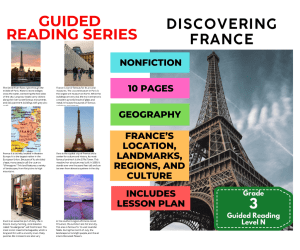
Discovering France: Guided Reading Level N with Lesson Plan
ELA, Resources for Teachers, Reading Comprehension, Reading, Science, Language Development, Vocabulary, Geography, Social Studies, Technology, Grade 2, 3, 4, Worksheets & Printables, Worksheets, Teacher Tools, Centers, Activities, Literacy Readers, Quizzes, Quizzes and Tests, Assessments, Lesson Plans
This Discovering France (level n) guided reading book with lesson plan includes: Guided Reading Color Label (front cover x1) This is a quick way to match the book’s demands to what students can generally handle.. The overall goal is to use the level/color to pick books for several smaller groups. To qualify for a certain level, a student is expected to read a book from that level with about 90–94% accuracy. If a student is consistently accurate and understands, move up a level. If the student is struggling at that level, drop down and add more support. Each student will improve at completely different rates, but it is generally one of the best ways to check progress across the class. DOWNLOAD THE CATALOG TO VIEW ALL GUIDED READING BOOKS AVAILABLE (SORTED LEVELS A-Z) Pre-Reading Question (x1) Teacher asks the prompt aloud, can be while showing the cover or first page. Students share what they already know, or make educated guesses from the cover. Prompt them to use the target vocabulary. Write some of their responses on the board to look back at during the reading. Vocabulary Words (x5) Introduce the five words, best doing it one at a time. Start by saying it, while students repeat and then see if anyone knows what it means before reading further. Read through the meaning and try to briefly connect each word to a picture or gesture so it’s meaningful. Ask students to flip through the book pages and point to where they see each of the vocabulary words. While reading the book pause upon coming across one of the vocab words or read the sentence twice to make sure students understand the word has appeared. Optional: Ask students to raise hands whenever they see/hear one of the new words. Guided Reading Pages (x10) Check the book snapshot (below) for: primary topic - do you need to prep extra reading or intro materials on this? what is taught best - decide on 1-2 bullets to focus on, use the prompt or words provided here for best results. learning goals - what you are checking for students to be able to do after the session, elicit answers using prompts or words provided. key vocabulary (see section above). questions overview - so you know what is coming up and if you need to prep extra materials to assist understanding. Run the lesson You may have already looked at a few of the pages together, but you can show them some of the pictures again first to set meaning. Depending on how much time you have and how familiar your students are with guided reading class, you may want to read the book aloud first with the group first. Students whisper or partner read, while you listen in. If time, do it as a group, one student reading a page each. Use the guided page’s prompts to coach: “Check the picture / does it make sense?” “Point under the words / try the first sound” “Reread the sentence smoothly”. Try to focus more on one student per session (rotating every time), so you can work out if they are ready to move up or need to move down a level. Comprehension Questions (back cover x3) This is your way to check that students didn’t just say the words, but actually understood the text. First, let students answer by pointing to the page/picture and saying a short sentence. After any answer, follow with: “Show me where you found that in the text.” In bigger groups, have partners answer first (10–20 seconds), then call on 2–3 students to share. Differentiation tips: Emerging speakers/struggling readers: oral + pointing On-level: oral in a full sentence Higher: one written sentence or draw + label Book Snapshot Title: Discovering France Genre: Nonfiction Subject: Social Studies (Geography/Culture) Primary Topic: France’s location, landmarks, regions, and culture Estimated Guided Reading Level (A–Z): N What This Book Teaches Best Geography basics about France , including where it is located and how its shape leads to a nickname. Key places and landmarks in Paris , such as the Eiffel Tower, the Seine River, and the Louvre Museum. Regional features of France by describing Provence, the French Alps, the French Riviera, and the Loire Valley. French culture and daily life , especially food traditions like boulangeries, baguettes, and croissants. Modern transportation in France , focusing on the TGV high-speed train and what it allows people to do. Learning Goals Students will identify where France is located and explain why it is called “L’Hexagone.” Students will describe at least two facts about Paris, including details about the Eiffel Tower. Students will explain how the Seine River is described and what people can see from boats on the river. Students will describe characteristics of at least two French regions (Provence, the Alps, the Riviera, or the Loire Valley) using details from the text. Students will describe examples of French culture from the text, including food and museums. Students will explain what the TGV is and how it changes travel across France. Key Vocabulary From the Text landmark — a famous place many people recognize. massive — very big. coastline — the land’s edge next to the sea. lavender — a purple plant/flower that can smell sweet. transportation — ways people travel from place to place. Discussion Prompts Pre-reading question: What do you already know about France, and what would you like to learn? Comprehension questions: Where does the text say France is located, and what nickname do some people give it because of its shape? Comprehension questions: What does the text tell you about the Eiffel Tower (such as when it was built or how tall it is)? Comprehension questions: Choose one region from the book (Provence, the French Alps, the French Riviera, or the Loire Valley) and describe two details the text gives about it. Printing Tips 1. Best Printing Method (Recommended) “Booklet” Printing (Best if Available) If your printer or PDF viewer supports Booklet Printing , use this. Settings to use: Print mode: Booklet Paper size: Letter or A4 (either works) Orientation: Landscape Print on both sides: Yes Flip on: Short edge Scaling: Fit to printable area Booklet subset: First test: Front sides only Then: Back sides only This will automatically: Pair pages correctly Put the cover on the outside Align everything for folding After printing, fold in half and staple along the spine . 2. If “Booklet” Printing Is NOT Available You can still print this correctly with manual duplex printing . Step-by-step: Open the PDF. Choose Print . Set: Orientation: Landscape Pages per sheet: 1 Print on both sides: Yes Flip on: Short edge Print all pages . Because each PDF page already contains two facing book pages, the result will still fold cleanly into a book. Thousands of Cored Education products are included with your TeachSimple membership. Download links and encyclopedia index available here.
Author Cored Education
Rating
Tags Reading Comprehension, Reading Passages, Reading, Guided Reading, Guided Reading Lesson Plan, Guided Reading Activity, Pre-reading, Social Studies, Geography, Technology

Fly by the Seat of One's Pants | Figurative Language Activity | Micro-Learning Deck
ELA, Reading, Reading Comprehension, Grade 2, 3, 4, 5, Teacher Tools, Lesson Plans
This resource allows students to explore figurative learning in a fun way. The figurative language term for this learning deck is "Fly By the Seat of One's Pants." Through close reading and a reading passage with audio, your students will better comprehend figurative language! Included: -Video lesson on language concept -Reading passage w/ audio Comprehension -Quick write
Author Teach Me This
Tags Figurative, Activity, Learning Deck, Writing Template

Force - Digital Lesson Plan Gr. 5-8 | MAC Software
Science, Physics, Grade 3, 4, 5, 6, 7, 8, Teacher Tools, Lesson Plans
Force - Digital Lesson Plan Gr. 5-8 | MAC Software This teaching resource is the go-to choice for bringing the world of physics to life in your 3rd through 8th-grade science classrooms. With a span of over 80 comprehensive screen-pages, this interactive and engaging digital lesson plan is designed specifically to cultivate an understanding of the dynamics and workings of forces. Main Goals The primary aim of this software is not only to explicate what a force means but also provide illustrations of different types of forces. The student-friendly teaching approach involves simplifying complex concepts using routine activities that students can easily relate with. Concepts covered include contact forces, distance forces, balanced and unbalanced forces, weight vs gravity issues as well as exploration into magnetic and electrostatic powers. Interactive Features & Activities Our software provides a platform for students to proactively engage in lessons via interactive elements incorporated throughout each lesson plan. These include reading passages furnished with activities before & after reading; all set up strategically for topic comprehension paired with sustained engagement on part the learner. Evaluation Resources An exciting variety test preparation resources are included ensuring effective reinforcement and assessment learning outcomes from each lesson taught: A memory match game focusing on retaining key terms learned during lessons. An intellectually stimulating crossword puzzle promoting subject information recall along with sharpening problem-solving skills. A vocabulary-centric word search exercise – all compiled based on Bloom's Taxonomy principles! About Product File Please note that this product comes in .zip file format perfect for homeschoolers or public school teachers who may decide (based on class participation volume) whether to integrate it daily or periodically; as whole group instruction or small and individualized tutoring sessions; short homework assignments or even for remote learning environments. In conclusion, our software is a perfectly balanced blend of practical engagement while facilitating theoretical understanding in adherence to state educational standards. An ideal, indispensable tool that allows you to create effective and intriguing lessons that plunge your students into the fascinating world of Physics!
Author Classroom Complete Press
Tags Digital Science Lesson, Force Lesson Plan, Physics Lesson, Physics Reading Passage, Science Assessment
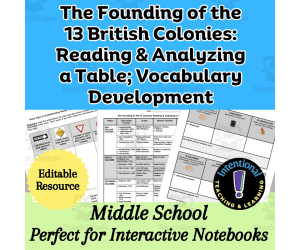
Founding the 13 Colonies- Vocabulary & Reading & Analyzing a Table
Social Studies, Government, History, History: USA, Grade 6, 7, 8, Teacher Tools, Lesson Plans
Two lessons focused on American Colonial History are included in the resource, provide Social Studies Skill Building Opportunities for your middle school students. The Founding of the 13 British Colonies- Vocabulary Development and Reading and Analyzing a Table. The first, Vocabulary Building: familiarizes students with key terms so they can develop greater understanding of the founding of the 13 colonies.The second, The Founding of the Colonies Chart: Reading and Analyzing a Table: provides students with the opportunity to learn and practice various reading strategies, such as drawing conclusions, making inferences and comparisons, and identifying similarities and differences. The questions students will answer guide them through the reading of the table. The first lesson, Vocabulary Development, provides students with two vocabulary development strategies. First, students identify which of the following 8 words they know (and how well, if at all, they know them) using the Road Signs to Understanding Words handout which front loads the 8 key terms: Theocracy, Proprietary, Democratic, Joint-stock Company, Elected Assembly, Profit, Debtors, and Buffer. From their, they explore each of the 8 words using the K.I.M. Vocabulary Strategy: Knowledge (information about the word, its part of speech, and its variations in parts of speech); Information ((Definition(s) of the word), and Memory Clue Draw a picture or symbol to represent the meaning). They then write an original sentence showing they understand the word. In the second lesson, The Founding of the Colonies Chart: Reading and Analyzing a Table, students will read and analyze a table with information about the founding of each of the 13 colonies: Colonial Region, Colony/Date Founded, Leader(s), Reasons Founded, Type of Government. Students often need help in navigating information-heavy charts, especially if there are words and concepts they are struggling with. This lesson guides students through how to read and analyzing these key details. The chart is accompanied by 11 analytical questions with the final two questions asking students to reflect on what was most and least challenging about this assignment and why. Finally, there is a vocabulary assessment with 5 short answer critical thinking questions, in which students are asked show their understanding of the key terms by comparing, contrasting, and explaining the words. The detailed, standards-aligned lessons provide interactive and collaborative ways to approach these activities and includes An About this Resource Chart that easily references all the materials in the resource, including the standards, objectives, learning targets, an Essential Question, 2 Guiding Questions, among other things. The two lessons should take between 2-3 days depending on how you approach the K.I.M. Vocabulary.
Author Intentional Teaching and Learning
Tags Social Studies Skillbuilding, Critical Thinking Questions, Vocabulary Strategies, British Colonies, English Colonies, Founding The Colonies, Colonial Regions, Vocabulary Assessment, Vocabulary Development, American Colonial History

I WONDER - Why Is It Unlucky To Say The Name Macbeth In A Theatre
History: British, History, Social Studies, History: Europe, Grade 6, 7, 8, 9, 10, 11, 12, Lesson Plans, Teacher Tools
Video Introduction An amazing video designed for the students to learn more about history. I WONDER - Why Is It Unlucky To Say The Name Macbeth In A Theatre | Animated Video Lesson Do you like history? Which topic do you really enjoy about history? Have you ever read an interesting fact about the Vikings? If yes, can you mention them? What do you like most about the Victorian era? Can you name all the Tudors? Have you ever wondered how people used to live in ancient Japan and ancient China? Do you know any interesting facts about ancient Egyptians and the Pharaohs? Have you ever visited South America? What do you know about Incas and Aztecs? Celtic culture was really one of a kind, can you name any of the places that Celts used to live in? Imagine yourself living during the ancient Roman empire, how your life will look like? Ancient Greece was an amazing place to live in. What do you know about ancient Greek life? I WONDER - Why Is It Unlucky To Say The Name Macbeth In A Theatre | Animated Video Lesson The video is perfect for encouraging the researching skills for the students, while learning more about history. I WONDER - Why Is It Unlucky To Say The Name Macbeth In A Theatre | Animated Video Lesson This friendly designed video is suitable for students at school, homeschooling, and as a group activity. Format Available in MP4 format.
Author Educational Voice
Tags Why Is It Unlucky To Say The Name Macbeth In A Theatre, Why Is It Unlucky To Say The Name Macbeth In A Theatre Video, Macbeth, Macbeth Facts, Macbeth Facts For Kids, Macbeth Video, Macbeth Video For Kids
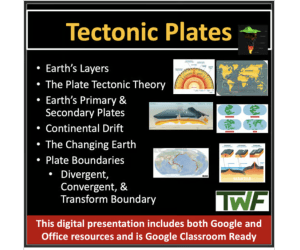
Tectonic Plates - Senior Earth and Space lesson
Science, Earth and Environmental Sciences, Space, Earth Sciences, Grade 10, 11, 12, Teacher Tools, Lesson Plans
Tectonic Plates - Senior High School Earth and Space Lesson Your lesson covers tectonic plates on Earth. In order, the lesson teaches about; Earth’s Layers, the Plate Tectonic Theory, Earth’s Primary and Secondary Plates, Continental Drift, the Changing Earth, Plate Boundaries, and the different types of boundaries - Divergent, Convergent, & Transform Boundary. Your lesson includes the teacher and student version of the presentation, FIVE embedded videos, an auto-graded exit ticket, and a student lesson handout so the students can record the notes on a more condensed medium. This lesson is designed to be your go-to resource, whether you're in a traditional classroom or a virtual one. With both a teacher version and a student version, it seamlessly fits into your lesson plans, making learning engaging and adaptable. Assessment made easy We've included an auto-graded Exit Ticket and a quiz with an answer key because I know you don't have an excess of time. I know you don't, because I don't and I know I'll do whatever I can to reduce my grading time. Whether you use PowerPoint or Google Slides, prefer Word or Google Docs, this lesson has you covered. This lesson comes in both Office and Google formats for your convenience. The student version of the presentation has strategically placed blanks for them to fill in as you're teaching. It keeps them active and engaged, encourages discussion, and leaves more time for those "aha" moments.
Author Teach With Fergy
Tags Space Science, Astronomy, Tectonic Plates, Earthquakes
I WONDER - Why Are Bees Important To Farmers | Animated Video Lesson
Environmental Science, Earth and Environmental Sciences, Science, Earth Sciences, Nature & Plants, Life Sciences, Insects, Grade 4, 5, 6, 7, 8, 9, 10, Lesson Plans, Teacher Tools
Video Introduction An amazing video designed for the students to learn more about STEM. I WONDER - Why Are Bees Important To Farmers | Animated Video Lesson Do you like STEM subjects? what is your favorite one? Have you ever tried to plant a seed? If yes, tell us more about it. Or have you ever tried to invent something? If yes, tell us more about it. And how do you think it will help us? Have you ever seen a microorganism under a microscope? What was it? And how it looked like? Mathematics is a marvelous subject. Let' sharpen our brains and solve some equations. Do you like timetable tricks? What is your favorite one? Do you know how to code? Have you ever created an app or a game before? If yes, how was it like? I WONDER - Why Are Bees Important To Farmers | Animated Video Lesson The video is perfect for encouraging the researching skills for the students, while learning more about this fantastic topic. I WONDER - Why Are Bees Important To Farmers | Animated Video Lesson This friendly designed video is suitable for students at school, homeschooling, and as a group activity. Format Available in MP4 format.
Author Educational Voice
Tags Why Are Bees Important To Farmers, Why Are Bees Important To Farmers Video, Bees, Bee, Bees Facts, Bees Facts For Kids, Bees Video, Bees Video For Kids, Farmers, Farmer

Circulatory,Digestive & Reproductive Systems: The Excretory System - Skin,Liver and Lungs - FLASH-PC
Science, Life Sciences, Human Body, Common Core, Grade 5, 6, 7, 8, Teacher Tools, Lesson Plans
The Circulatory, Digestive & Reproductive Systems: The Excretory System - Skin, Liver and Lungs - FLASH-PC An educational resource engineered to help students understand the workings of the circulatory, digestive and reproductive systems focusing particularly on the excretory system including skin, liver and lungs components. This resource is created mainly for learners from grade 5 to grade 8 with a focus on science topics related to the human body. Digital Content: Sporting reading passages presenting detailed curriculum -based content in one software boasting a simple user interface. Notable features include pre-reading elements (Before you Read) for setting a foundation and post-reading elements (After you Read) for knowledge enhancement. Customized Learning Styles: Videos & Audio content Interactive activities suitable for both classroom or home settings Inclusion of printable content as per requirement Vocabulary flash cards paired with related visuals aiding topic understanding Tailored Teaching Approach: Apt not only for group instructions in classrooms but also beneficial for homeschooling where structured material equals formal academic training. Could be tailored easily to suit small groups enabling concentrated learning sessions. National Alignment & Accessibility: Meticulously aligned towards meeting Common Core State Standards ideal even according Wise’s Taxonomy catering well towards promoting critical thinking abilities among young learners. Compact zip file package contains everything ensuring an easy download process leading towards seamless computer software access.
Author Classroom Complete Press
Tags Reproductive Systems, Science Assessment, Human Body, Excretory System, Science Quiz

SPIDERS ARE ARACHNIDS Gr. 3-4
Science, Life Sciences, Animals, Grade 3, 4, Teacher Tools, Lesson Plans
Spiders Are Arachnids This is a grade 3 to 4 teaching resource that provides an in-depth look at the world of arachnids, with a specific focus on spiders. Explore the intricate details of these small wonders in nature and educate your students about their fascinating characteristics, how they spin their webs, reproduce or find food, and who their predators are. The unit of study targets different spider species including Trapdoor, Fisher, Wolf, Jumping Crab, Tarantula and Black Widow. The diverse selection makes this resource suitable for a wide range of lesson planning for these grades. Imagine facilitating an interactive session where students come together to create charts titled: "Things We Know About Spiders" "Things We'd Like to Find Out About Spiders" As the unit progresses and as knowledge expands on this topic among students, these charts can be updated or modified. Taking Learning Outside the Classroom Don't confine learning within four walls! Utilize this curriculum tool to organize nature walks around your school premises or neighborhood. Students could sketch spiders they encounter and make records of their observations about them and their webs. This hands-on experience in collecting data cultivates an authentic interest towards arachnids among young learners. Skill-Building Exercises Included! The teaching aid is designed with additional exercises which primarily target enhancement of research skills, fostering creativity,and expanding word knowledge. These activities ensure holistic development beyond just textbook learning. 'Spiders are Arachnids' package comes as a single PDF file loaded with 58 pages ready-to-print making it convenient for all educators - be it public school teachers or parents who homeschool. These pages contain outlined lesson plans for Grade 3 or Grade 4 Science classes focusing on Zoology sessions. You can now provide dynamic education and foster love for science amongst learners in a snap! In conclusion: This resource is extremely helpful, practical and versatile - no matter if you're running whole group lessons; taking small groups; working on individual exercises; or even assigning extra work for out-of-school hours. Spiders Are Arachnids Gr. 3-4 can help make learning about these amazing creatures effective, engaging, and thoroughly enjoyable for all.
Author Classroom Complete Press
Tags Science Worksheets, Science Articles, Spiders, Arachnids, Word Knowledge
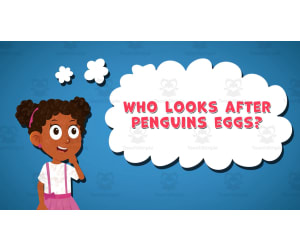
I WONDER - Who Looks After Penguins Eggs | Animated Video Lesson
STEM, Science, Animals, Life Sciences, Biology, Grade 1, 2, 3, 4, 5, 6, 7, 8, Lesson Plans, Teacher Tools
Video Introduction Animal kingdoms are full of fascinating wonders to learn. This video is designed for the students to learn more about animals in different countries. I WONDER - Who Looks After Penguins Eggs | Animated Video Lesson Do you like animals? what is your favorite one? Do you own a pet? If yes, tell us more about it, like what its name? And what do you like most about it? What are the animal kingdoms? Can you write down the characteristics of each animal class like mammals, birds, reptiles, amphibian, fish and mollusks. Do you know that some animals can sing, can you name any of them? What is the largest and the smallest mammal in the world? What is the largest and the smallest bird in the world? What is the largest and the smallest fish in the world? I WONDER - Who Looks After Penguins Eggs | Animated Video Lesson The video is perfect for encouraging the researching skills for the students, while learning more about these fantastic animals. I WONDER - Who Looks After Penguins Eggs | Animated Video Lesson This friendly designed video is suitable for students at school, homeschooling, and as a group activity. Format Available in MP4 format.
Author Educational Voice
Tags Who Looks After Penguins Eggs, Who Looks After Penguins Eggs Video, Penguins Eggs, Penguins Eggs Facts, Penguins Eggs Facts For Kids, Penguins Eggs Video, Penguins Eggs Video For Kids, Penguin Eggs