



3,911 products added recently
Page 91 - Elementary Lesson Plans
Support your elementary students with lesson plans that cover a broad range of subjects and skills. These resources are designed to promote cognitive, social, and emotional growth. Incorporate them into your teaching to provide a well-rounded education that meets the needs of all your students.

 Show filters


I WONDER - What Is A Fire Whirl | Animated Video Lesson
Earth Sciences, Earth and Environmental Sciences, Science, Grade 4, 5, 6, 7, 8, 9, 10, Lesson Plans, Teacher Tools
Video Introduction An amazing video designed for the students to learn more about famous phenomena in different countries. I WONDER - What Is A Fire Whirl | Animated Video Lesson Weather phenomena can affect our lives, crops and even animals! Can you name any of the weather phenomena that happened in your country? Do you know when hailstorms happen? And what is the most country who has lots of hailstorms happening per year? Do you think the all countries have four seasons? If no, can you name any? Why do some animals sleep at winter? Can you name any of these animals? I WONDER - What Is A Fire Whirl | Animated Video Lesson The video is perfect for encouraging the researching skills for the students, while learning more about this fantastic phenomenon. I WONDER - What Is A Fire Whirl | Animated Video Lesson The video is perfect for encouraging the researching skills for the students, while learning more about this fantastic phenomenon. Format Available in a PDF format.
Author Educational Voice
Rating
Tags What Is A Fire Whirl, Fire Whirl, Fire Whirl Facts, Fire Whirl Video, Fire Whirl Video For Kids, Fire Whirl Facts For Kids, Severe Weather Phenomena, Severe Weather Phenomena Facts, Severe Weather Phenomena Video
Electronics Reading Comprehension Passage - Cored Ed Encyclopedia
ELA, Reading Comprehension, Reading, Science, Technology, Pre-Reading, Language Development, Physics, Writing, Vocabulary, Grade 2, 3, 4, 5, Worksheets & Printables, Worksheets, Teacher Tools, Centers, Activities, Writing Prompts, Assessments, Quizzes and Tests, Quizzes, Lesson Plans
This electronics reading comprehension with lesson plan includes: Visualization (on the front cover) Start your lesson by taking a minute to think and share something about the topic. Read the script aloud (slowly), perhaps prepare some music or sound effects. Student close their eyes and let their imaginations wander. Students open their eyes, read the question aloud and give them a few minutes to complete. Ask a few students to share or keep answers until the end to compare with what they learn in the passage. Quick pause—thousands of Cored Education products are included with your TeachSimple membership. Download links and encyclopedia index available here. Pre-Reading Trivia Students will write down one thing they already know about the subject and then read five more facts and discuss. These facts are fun, and the students will enjoy learning about the subject before reading more. Give 1 minute for students to write what they already know (no pressure—best guess is fine). Read the five facts together. After each fact, do ask a student for their opinion, was it surprising? Set a purpose by asking students to highlight/underline one fact they want to learn more about during the reading. Reading Passage The text is a high-interest reading passage with set paragraphs, roughly three to four paragraphs long. It contains a variety of themes about the topic, anywhere from history to technology. The passage is between 250 and 350 words in length. First, ask students to look at the headings and see what they’ll learn about today. What do they know about the topic/heading? First read options: Teacher read-aloud (best for support). Partner reading (paragraph by paragraph). While reading, students underline important details, and vocabulary words they think may come up in the questions section. Mixed Questions The first question page contains four multiple-choice questions, each with a choice of four answers, and three written response questions that require a sentence or two from the student. Students complete the mcqs first independently, then review quickly as a class. For the 3 written responses, try to get students giving the answer with some form of evidence: “I think ___ because the text says ___.” If students get stuck, send them back to check the passage. Vocabulary Questions Practice seven key words from the text in this section across two activities. First section is scrambled words where students will unscramble three words given a clue for each. The second section is a word to meaning matching activity. Before starting, have some students read out words they underlined in the passage. Ask students to say the word and read aloud the sentence(s) around each word. Ask students to do scrambled words and the matching exercise in pairs then go through answers as a class. For the scrambled spelling task, get four pairs to come up to the board and write the words for extra practice with the other student reading out the clue. For the matching task, prompt students to give full sentences: “I matched ___ with ___ because ___.” Creative Writing In this question, the student will be required to write a five to eight sentence paragraph on a question related to the topic. Before starting, ask students write down 3 key ideas they are going to include in their piece. Ask students for ideas to share around the class to help those struggling. Pro writing expectations: 5–8 sentences At least 2 facts or details from the passage At least 2 vocabulary words from the previous page Students read their paragraphs while classmates listen for facts and vocabulary words. Extension Activities This page is optional for fast finishers or to take home. There are several activities, each one requiring a different skill. Do some, do none, do all, completely optional - but you will feel reassured knowing every possibility is planned for. Includes summary writting question and additional facts. Answer Key There are answers for the multiple-choice questions, written response questions have sample answers, vocabulary answers and if there is a summary question then a sample summary will be provided as well. Lesson Plan Included Customized lesson plan for this lesson is included. Lesson Snapshot Title: Electronics Genre: Nonfiction (Informational Text) Subject: Science (Technology/Physical Science) / Reading (Informational Text) Primary Topic: How electronics evolved to carry signals Estimated Guided Reading Level (A–Z): Q What This Lesson Teaches Best Defines electrons as tiny charged particles and explains that electronics guides them to carry a message (a “signal”), not just power devices. Traces a clear timeline of inventions : early radio parts → vacuum tubes → transistor (1947) → integrated circuits on silicon chips. Explains how devices can amplify signals (making a small signal stronger), using the vacuum tube and transistor examples. Shows how engineering changes over time led to smaller, more powerful technology , with chips holding millions (even billions) of transistors. Learning Goals Students will describe how electrons moving through wires can carry a message. Students will explain how vacuum tubes helped make radio signals stronger. Students will identify how the transistor differed from vacuum tubes (material used, size, and power use). Students will describe what integrated circuits are and why they allow devices to stay small. Students will summarize how electronics changed from early inventions to modern chips. Key Vocabulary From the Text electrons — tiny charged particles that move through wires. signal — a message carried through a device. vacuum — space with most air removed. transistor — a smaller part that can switch and amplify signals. semiconductor — a material used instead of a vacuum for a transistor. FULL CATALOG OF DOWNLOAD LINKS AND ENCYCLOPEDIA INDEX HERE
Author Cored Education
Rating
Tags Vocabulary, Reading Comprehension, Reading Passages, Lesson Plans, Ela Lesson Plans, Reading Comprehension Lesson Plans, Pre-reading, Science Lesson Plans, Technology, Physics

I WONDER - How Important Are Aquatic Plants | Animated Video Lesson
Nature & Plants, Life Sciences, Science, Grade 5, 6, 7, 8, 9, 10, Teacher Tools, Lesson Plans
Video Introduction An amazing activity designed for the students to learn more about STEM. I WONDER - How Important Are Aquatic Plants | Animated Video Lesson Do you like STEM subjects? what is your favorite one? Have you ever tried to plant a seed? If yes, tell us more about it. Or have you ever tried to invent something? If yes, tell us more about it. And how do you think it will help us? Have you ever seen a microorganism under a microscope? What was it? And how it looked like? Mathematics is a marvelous subject. Let' sharpen our brains and solve some equations. Do you like timetable tricks? What is your favorite one? Do you know how to code? Have you ever created an app or a game before? If yes, how was it like? I WONDER - How Important Are Aquatic Plants | Animated Video Lesson The video is perfect for encouraging the researching skills for the students, while learning more about this fantastic topic. I WONDER - How Important Are Aquatic Plants | Animated Video Lesson This friendly designed video is suitable for students at school, homeschooling, and as a group activity. Format Available in MP4 format.
Author Educational Voice
Tags How Important Are Aquatic Plants, How Important Are Aquatic Plants Video, Aquatic Plants, Aquatic Plants Facts, Aquatic Plants Facts For Kids, Aquatic Plants Video, Aquatic Plants Video For Kids, Aquatic Plant

I WONDER - How Do You Know When A Thunderstorm Is Near
Earth Sciences, Earth and Environmental Sciences, Science, Grade 4, 5, 6, 7, 8, 9, 10, Lesson Plans, Teacher Tools
Video Introduction An amazing video designed for the students to learn more about famous phenomena in different countries. I WONDER - How Do You Know When A Thunderstorm Is Near | Animated Video Lesson What do you know about this phenomenon? Where it happens? When it happens? What are the safety measures that we should take to be safe during this phenomenon? Are there any other places in the world that experienced this phenomenon? If yes, tell us more about them. Why do you think it happens? Do you like reading about Geography? What is your favorite country in the whole world? I WONDER - How Do You Know When A Thunderstorm Is Near | Animated Video Lesson The video is perfect for encouraging the researching skills for the students, while learning more about this fantastic phenomenon. I WONDER - How Do You Know When A Thunderstorm Is Near | Animated Video Lesson The video is perfect for encouraging the researching skills for the students, while learning more about this fantastic phenomenon. Format Available in a PDF format.
Author Educational Voice
Rating
Tags How Do You Know When A Thunderstorm Is Near, How Do You Know When A Thunderstorm Is Near Video, Thunderstorm, Thunderstorms, Thunderstorm Facts, Thunderstorm Video, Thunderstorm Video For Kids
Early Cave Paintings: A Cross-Curricular Unit
Social Studies, Grade 5, 6, Teacher Tools, Lesson Plans
Early Cave Paintings: A Cross-Curricular Unit This rich educational resource designed for Grade 5 and Grade 6 teachers seamlessly blends Social Studies with a multifaceted learning experience. Dive into the engrossing world of primitive creativity through this pack. The content revolves around cave paintings-an intriguing artifact from prehistoric times. It aids teachers emit knowledge beyond scholastic borders, subsequently promoting students to adopt a comprehensive comprehension of worldly affairs. A Look into the Ancient Processes An instructive non-fictional tale acquaints learners with mysterious processes employed by ancient dwellers in crafting these complex cave illustrations. This narration not only educates but also stirs up learner's curiosity about early human endeavors towards self-expression and storytelling. Worksheets to Nourish Critical Thinking Skills Included in this engaging material are practical worksheets that bolster critical thinking skills whilst reinforcing ideas inspired by the central theme - cave paintings. The customised worksheets make perfect platforms for learners to display their understanding and pinpoint areas that require added explanation or clarity. Broad Activity Suggestions The unit package additionally offers wider activity suggestions perfectly aligning with cooperative learning strategies; therefore being adaptable across varied environments such as whole classrooms, small groups or simply as dependable homework tasks. Aid on Tight Schedules - Ready-to-Print Sheets! Faced with an array of teaching methods and frameworks amidst tight schedules daily-efficiency becomes critical. To assist in this regard, each page incorporated within Early Cave Paintings: A Cross-Curricular Unit is meticulously crafted keeping classroom convenience at forefront; hence every inclusive sheet is ready-to-print. This distinctive educational resource comes as a single PDF file with six instructional pages packed with vivacious content certain to ignite class discussions while fostering knowledge growth alike! Finally, remember that education flourishes when transcending conventional subject boundaries rendering learning about Cave Paintings as exciting educational fun-that's precisely what Early Cave Paintings: A Cross-Curricular Unit accomplishes!
Author Classroom Complete Press
Tags Early Cave Paintings, Cross-curricular Unit, Social Studies, Printable

World Electoral Processes: Parliamentary System of Government Gr. 5-8
Social Studies, Government, Grade 5, 6, 7, 8, Teacher Tools, Lesson Plans
World Electoral Processes: Parliamentary System of Government Gr. 5-8 A comprehensive teaching resource ideally available for public school teachers and homeschoolers. It is designed to deepen students' understanding of various forms of government in clear, graspable terms. This pivotal component, part of the broader lesson plan 'World Electoral Processes', simplifies complex concepts about differing governmental systems structures and operating procedures. Different Government Systems Explored Democratic Governments: details how these governments operate. Presidential Governments:: focuses on the unique characteristics defining them. Parliamentary Governments:: explicates shared powers with legislatures and law-passing procedures different than presidential systems. Countries under Dictatorial Rule:: revealing facts about military dictator leadership provides a broadened perspective on power dynamics. Intriguing historical snippets provide context as learners delve into antiquity to understand primordial voting systems crucial for subsequent lessons. Pupil Engagement & Interactive Learning Pupils can navigate through distinctive concepts, simulate real-world legislative proceedings by delivering short statements like true parliamentarians and thereby become well-grounded on global electoral processes. The lesson plan also contains interactive elements such as crossword puzzles, comprehension quizzes and writing tasks that reinforce content understanding while fueling expressive abilities in a manner that spurs active participation. Suffrage & Voter Eligibility Prerequisites An insightful section exploring suffrage elucidates voter eligibility prerequisites necessary for comprehending civic responsibilities during elections — an essential aspect shaping our democratic society's future fabric contributes significantly towards responsible citizenship. Comprehensive Answer Key A provision of an answer key facilitates straightforward feedback aiding in efficient understanding checks across varied formats. This resource also aligns with State Standards and Bloom's Taxonomy, suggesting its use within whole-class settings, small breakout groups or even individual assignments - including homework tasks. This flexible approach gradually familiarizes students with world electoral processes through diverse avenues, enhancing learning experiences and solidifying detailed knowledge of government systems.
Author Classroom Complete Press
Tags PDF
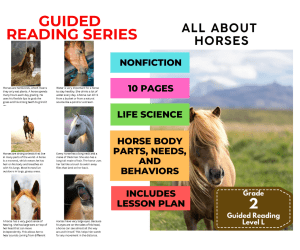
Guided Reading Level L - All About Horses (with Lesson Plan)
ELA, Resources for Teachers, Reading Comprehension, Reading, Science, Language Development, Life Sciences, Animals, Pre-Reading, Vocabulary, Grade 2, 3, 4, Worksheets & Printables, Worksheets, Teacher Tools, Centers, Activities, Literacy Readers, Quizzes, Quizzes and Tests, Assessments, Lesson Plans
This Guided Reading Book - All About Horses (Level L) with lesson plan includes: Guided Reading Color Label (front cover x1) This is a quick way to match the book’s demands to what students can generally handle.. The overall goal is to use the level/color to pick books for several smaller groups. To qualify for a certain level, a student is expected to read a book from that level with about 90–94% accuracy. If a student is consistently accurate and understands, move up a level. If the student is struggling at that level, drop down and add more support. Each student will improve at completely different rates, but it is generally one of the best ways to check progress across the class. DOWNLOAD THE CATALOG TO VIEW ALL GUIDED READING BOOKS AVAILABLE (SORTED LEVELS A-Z) Pre-Reading Question (x1) Teacher asks the prompt aloud, can be while showing the cover or first page. Students share what they already know, or make educated guesses from the cover. Prompt them to use the target vocabulary. Write some of their responses on the board to look back at during the reading. Vocabulary Words (x5) Introduce the five words, best doing it one at a time. Start by saying it, while students repeat and then see if anyone knows what it means before reading further. Read through the meaning and try to briefly connect each word to a picture or gesture so it’s meaningful. Ask students to flip through the book pages and point to where they see each of the vocabulary words. While reading the book pause upon coming across one of the vocab words or read the sentence twice to make sure students understand the word has appeared. Optional: Ask students to raise hands whenever they see/hear one of the new words. Guided Reading Pages (x10) Check the book snapshot (below) for: primary topic - do you need to prep extra reading or intro materials on this? what is taught best - decide on 1-2 bullets to focus on, use the prompt or words provided here for best results. learning goals - what you are checking for students to be able to do after the session, elicit answers using prompts or words provided. key vocabulary (see section above). questions overview - so you know what is coming up and if you need to prep extra materials to assist understanding. Run the lesson You may have already looked at a few of the pages together, but you can show them some of the pictures again first to set meaning. Depending on how much time you have and how familiar your students are with guided reading class, you may want to read the book aloud first with the group first. Students whisper or partner read, while you listen in. If time, do it as a group, one student reading a page each. Use the guided page’s prompts to coach: “Check the picture / does it make sense?” “Point under the words / try the first sound” “Reread the sentence smoothly”. Try to focus more on one student per session (rotating every time), so you can work out if they are ready to move up or need to move down a level. Comprehension Questions (back cover x3) This is your way to check that students didn’t just say the words, but actually understood the text. First, let students answer by pointing to the page/picture and saying a short sentence. After any answer, follow with: “Show me where you found that in the text.” In bigger groups, have partners answer first (10–20 seconds), then call on 2–3 students to share. Differentiation tips: Emerging speakers/struggling readers: oral + pointing On-level: oral in a full sentence Higher: one written sentence or draw + label Book Snapshot Title: All About Horses Genre: Nonfiction (informational) Subject: Life Science / Reading (Informational Text) Primary Topic: Horse body parts, needs, and behaviors Estimated Guided Reading Level (A–Z): L What This Book Teaches Best Key animal facts about horses (they are strong animals, mammals, and live outdoors in grassy areas). How horse body parts help them (mane and tail; tail swishes away flies). What horses need to stay healthy (they eat plants and drink a lot of water). How horses move (trot with “diagonal pairs,” and gallop as the fastest way to move with hooves off the ground). Special horse behaviors and life stages (sleeping while standing; a baby horse is a foal). Learning Goals Students will identify key facts about horses (habitat, body traits, and needs) from the text. Students will explain how a horse uses its tail based on details in the book. Students will describe what horses eat and how they graze using evidence from the text. Students will compare two horse movements (trot and gallop) using information from the book. Students will explain how a horse can sleep while standing without falling over. Students will describe what a foal is and what it can do soon after being born. Key Vocabulary From the Text mammal — an animal that breathes air with lungs. herbivores — animals that eat only plants. grazing — eating grass little by little over time. diagonal — slanted, from one corner to the opposite corner. hooves — the hard feet of a horse. Discussion Prompts Pre-reading question: What do you think a horse needs to stay healthy outdoors? Comprehension questions: What does the text say a horse uses its tail for? How does the text describe a trot? What is a foal, and what can it do within an hour of being born? Printing Tips 1. Best Printing Method (Recommended) “Booklet” Printing (Best if Available) If your printer or PDF viewer supports Booklet Printing , use this. Settings to use: Print mode: Booklet Paper size: Letter or A4 (either works) Orientation: Landscape Print on both sides: Yes Flip on: Short edge Scaling: Fit to printable area Booklet subset: First test: Front sides only Then: Back sides only This will automatically: Pair pages correctly Put the cover on the outside Align everything for folding After printing, fold in half and staple along the spine . 2. If “Booklet” Printing Is NOT Available You can still print this correctly with manual duplex printing . Step-by-step: Open the PDF. Choose Print . Set: Orientation: Landscape Pages per sheet: 1 Print on both sides: Yes Flip on: Short edge Print all pages . Because each PDF page already contains two facing book pages, the result will still fold cleanly into a book. Thousands of Cored Education products are included with your TeachSimple membership. Download links and encyclopedia index available here.
Author Cored Education
Rating
Tags Reading Comprehension, Reading Passages, Reading, Guided Reading, Guided Reading Lesson Plan, Guided Reading Activity, Pre-reading, Science Lesson Plans, Life Science, Animals

How to Write an Essay: Writing a Narrative Essay
ELA, Writing, Common Core, Grade 5, 6, 7, 8, Teacher Tools, Lesson Plans
How to Write an Essay: Writing a Narrative Essay This education material is an ideal resource, particularly designed for grade 5, grade 6, grade 7, and grade 8 teachers. The primary focus areas include Language Arts with special emphasis on enhancing writing skills. This tool elucidates the comprehensive process of essay composition. It specifically targets helping students in efficiently expressing their thoughts by writing a narrative essay. This resource can be used for whole group instruction, small group teaching or as independent homework assignments. A unique highlight includes: Tutorials based on Bloom's taxonomy representing four most common types of essays. Incorporating review lessons that reiterate knowledge about verbs, adjectives and pronouns. An all-inclusive implementation guide is included in this package to assist educators in effectively executing this resource within their classrooms or homeschooling settings. Moreover, a student assessment rubric assists teachers in evaluating learners' progress and comprehension capabilities objectively. Briefly here's what makes it more interactive: The inclusion of word puzzles and comprehension quizzes vitalizes the learning process while simultaneously refining language arts proficiency. Six vivid color graphic organizers are designed to introduce skill focus areas smoothly guiding students throughout the essay writing venture. The contents of this tool rigorously adhere with Common Core State Standards - upholding high-quality learning outcomes that align flawlessly with contemporary international education benchmarks. This digitally convenient PDF packaged resource commands ease of accessibility across varied devices without any loss in quality or formatting consistency. To summarize- How to Write an Essay: Writing a Narrative Essay surpasses mundane textbook-based methods; presenting a hybrid of comprehensive instructions intertwined with intriguing activities specifically aligned towards efficient essay writing mastery.
Author Classroom Complete Press
Tags PDF
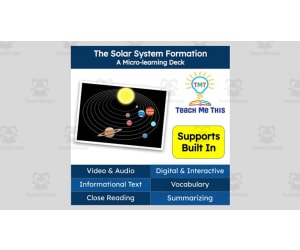
What is a Solar System? | Interactive Science Lesson | Micro-Learning Deck
Science, Earth and Environmental Sciences, Space, Grade 5, 6, 7, 8, Teacher Tools, Lesson Plans
What is a Solar System? Interactive Science Lesson Engages Learners This interactive science lesson helps students gain a clear understanding of solar systems. Through a short video, students are introduced to the key components of solar systems including planets, moons, asteroids, comets, and more. An informational reading passage with audio further builds comprehension. The lesson has a close reading activity and quick write assignment to assess understanding. These materials can be presented to the whole class, small groups, or used for independent homework. The variety of learning materials keeps students fully engaged from start to finish in this informative lesson on the basics of solar systems.
Author Teach Me This
Tags Astronomy, Science Lesson, Interactive, Solar System, Reading Passage

Primarily Patterns Gr. PK-1
Creative Arts, Art, Fine Arts, Preschool, Kindergarten, Grade 1, Teacher Tools, Lesson Plans
Primarily Patterns Gr. PK-1 is an exceptional teaching resource especially created for educators teaching primary and secondary patterns. Packed full of intriguing activities, it is designed to engage young learners' imaginations and stimulate their creative abilities. Thematic Design This pedagogical tool boasts a unique thematic design. The activities correspond with events and themes throughout the academic year, ensuring learners remain interested at every stage. Some of the creatively crafted themes include: "Back To School" "Autumn" "Halloween" "Christmas" Various creature-based themes like bears, dinosaurs, sea animals, etc. Inclusive Components The resource contains: Clip art elements perfect for pattern construction as well as classroom decoration Clearly instructed task cards for pattern-related exercises adaptable to various learner levels Included in the kit are also bookmark templates — an excellent way for students to combine their reading sessions with creative applications of patterns. Versatility & Delivery Methods No matter your instructional approach - whole group instruction or smaller groups; enrichment activities or supplementary homework assignments - this resource effortlessly adapts suiting your curriculum plan. The package composes 62 ready-to-print pages in PDF format targeting Preschoolers through Grade 1 pupils primarily studying Art & Music along with Fine Arts sub-subjects under lesson plans types. This thoughtful supplement perfectly combines academics and creativity, In conclusion, If you're a public school teacher meticulously planning each semester's syllabus or a homeschooler looking forward each morning crafting engaging lessons - Primarily Patterns Gr. PK-1 will fit well in your teaching tools arsenal.
Author Classroom Complete Press
Tags Reading Lesson Plan, Reading Ebook, Clipart, Patterns, Art
Toothbrushes Reading Comprehension Passage - Cored Ed Encyclopedia
ELA, Language Development, Reading Comprehension, Reading, Science, Technology, Engineering, History, Social Studies, Life Sciences, Grade 2, 3, 4, 5, Worksheets & Printables, Worksheets, Teacher Tools, Centers, Activities, Writing Prompts, Assessments, Quizzes and Tests, Quizzes, Lesson Plans
This toothbrushes reading comprehension includes: Visualization (on the front cover) Start your lesson by taking a minute to think and share something about the topic. Read the script aloud (slowly), perhaps prepare some music or sound effects. Student close their eyes and let their imaginations wander. Students open their eyes, read the question aloud and give them a few minutes to complete. Ask a few students to share or keep answers until the end to compare with what they learn in the passage. Quick pause—thousands of Cored Education products are included with your TeachSimple membership. Download links and encyclopedia index available here. Pre-Reading Trivia Students will write down one thing they already know about the subject and then read five more facts and discuss. These facts are fun, and the students will enjoy learning about the subject before reading more. Give 1 minute for students to write what they already know (no pressure—best guess is fine). Read the five facts together. After each fact, do ask a student for their opinion, was it surprising? Set a purpose by asking students to highlight/underline one fact they want to learn more about during the reading. Reading Passage The text is a high-interest reading passage with set paragraphs, roughly three to four paragraphs long. It contains a variety of themes about the topic, anywhere from history to technology. The passage is between 250 and 350 words in length. First, ask students to look at the headings and see what they’ll learn about today. What do they know about the topic/heading? First read options: Teacher read-aloud (best for support). Partner reading (paragraph by paragraph). While reading, students underline important details, and vocabulary words they think may come up in the questions section. Mixed Questions The first question page contains four multiple-choice questions, each with a choice of four answers, and three written response questions that require a sentence or two from the student. Students complete the mcqs first independently, then review quickly as a class. For the 3 written responses, try to get students giving the answer with some form of evidence: “I think ___ because the text says ___.” If students get stuck, send them back to check the passage. Vocabulary Questions Practice seven key words from the text in this section across two activities. First section is scrambled words where students will unscramble three words given a clue for each. The second section is a word to meaning matching activity. Before starting, have some students read out words they underlined in the passage. Ask students to say the word and read aloud the sentence(s) around each word. Ask students to do scrambled words and the matching exercise in pairs then go through answers as a class. For the scrambled spelling task, get four pairs to come up to the board and write the words for extra practice with the other student reading out the clue. For the matching task, prompt students to give full sentences: “I matched ___ with ___ because ___.” Creative Writing In this question, the student will be required to write a five to eight sentence paragraph on a question related to the topic. Before starting, ask students write down 3 key ideas they are going to include in their piece. Ask students for ideas to share around the class to help those struggling. Pro writing expectations: 5–8 sentences At least 2 facts or details from the passage At least 2 vocabulary words from the previous page Students read their paragraphs while classmates listen for facts and vocabulary words. Extension Activities This page is optional for fast finishers or to take home. There are several activities, each one requiring a different skill. Do some, do none, do all, completely optional - but you will feel reassured knowing every possibility is planned for. Includes summary writting question. Answer Key There are answers for the multiple-choice questions, written response questions have sample answers, vocabulary answers and if there is a summary question then a sample summary will be provided as well. Lesson Plan Included Customized lesson plan for this lesson is included. Lesson Snapshot Title: Toothbrushes Genre: Nonfiction (informational text) Subject: Science (Health & Technology) Primary Topic: How toothbrushes changed over time Estimated Guided Reading Level (A–Z): R What This Lesson Teaches Best Explains how people cleaned teeth before store-bought toothbrushes by chewing a twig until it turned “fuzzy” and rubbing it on teeth. Shows how evidence from the past (archaeologists finding signs in places like Mesopotamia and Egypt) can tell us about tooth care long ago. Traces the history of the bristled brush from China’s Tang dynasty to Europe in the 1600s, highlighting how inventions travel. Describes how toothbrush designs changed to solve problems (for example, natural bristles staying damp and trapping bacteria). Summarizes key innovations—nylon bristles (1938) and the electric toothbrush (1954)—and connects them to the ongoing goal of protecting teeth. Learning Goals Students will describe how a “chew stick” was used to clean teeth long ago. Students will identify evidence in the text that people cared about clean mouths thousands of years ago. Students will explain how the bristled brush began in China and later spread to Europe. Students will summarize how toothbrush-making changed after 1780 using details about materials and design. Students will explain why inventors searched for new bristle materials and what nylon changed. Students will describe how an electric toothbrush helped brushing by adding steady motion. Key Vocabulary From the Text archaeologists — scientists who study the past using old remains. Mesopotamia — an ancient region where people lived long ago. miswak — a special stick used for cleaning teeth. patent — legal rights that protect an invention. bacteria — tiny germs that can cause problems. FULL CATALOG OF DOWNLOAD LINKS AND ENCYCLOPEDIA INDEX HERE
Author Cored Education
Rating
Tags Vocabulary, Reading Comprehension, Reading Passages, Lesson Plans, Ela Lesson Plans, Reading Comprehension Lesson Plans, Pre-reading, History, History Lesson Plans, Toothbrushes

Classification & Adaptation: Invertebrates Gr. 5-8
Science, Life Sciences, Biology, Grade 5, 6, 7, 8, Teacher Tools, Lesson Plans
Classification & Adaptation: Invertebrates Gr. 5-8 A comprehensive teaching resource adopting an innovative approach to learning about animal classification and adaptation that effectively simplifies complex scientific concepts for students in grades 5-8. Main Features: Provides clear instruction on how to classify animals into two primary groups: vertebrates and invertebrates. Differentiates between endothermic (warm-blooded) and ectothermic (cold-blooded) animals. Captivating case study on Koala adaptations, providing real-world context for theoretical knowledge. Covers evolution topics with a focus on fossil records, offering insights into historical evolutionary changes within species. Included Activities: 'How Important Are Thumbs?' A hands-on activity enhancing learning retention of the classification topic while fostering curiosity about biology's wonders! 'The Lake Habitat Thermometer' An interactive experimental methodology for better understanding of animal adaptations in different environments! 'A Day in the Life of a Paleontologist' An engaging simulation game illustrating practicality of the information on fossils studied during the lessons! The resource is designed with flexibility in mind - it is perfect for either whole-class instruction or small group intervention sessions. It can also be assigned as independent work or homework. The downloadable PDF file format offers unparalleled convenience – simply download once and reuse countless times without hassle or worry about physical storage constraints or degradation over time. Incorporated in the lesson content is test preparation material – enhancing academic performance by equipping students with necessary skills for excelling during assessment periods. Also included are vibrant colored mini posters that further supplement visual learning while making lessons engagingly interactive for students. Conclusion: Classification & Adaptation: Invertebrates Gr. 5-8 is a valuable addition to any educator's toolkit, designed to promote more tangible and engaging learning experiences in biological sciences for middle school students.
Author Classroom Complete Press
Tags PDF

I WONDER - What Are Right Angles | Animated Video Lesson
STEM, Geometry, Math, Grade 2, 3, 4, 5, 6, 7, 8, Lesson Plans, Teacher Tools
Video Introduction An amazing video designed for the students to learn more about STEM. I WONDER - What Are Right Angles | Animated Video Lesson Do you like STEM subjects? what is your favorite one? Have you ever tried to plant a seed? If yes, tell us more about it. Or have you ever tried to invent something? If yes, tell us more about it. And how do you think it will help us? Have you ever seen a microorganism under a microscope? What was it? And how it looked like? Mathematics is a marvelous subject. Let' sharpen our brains and solve some equations. Do you like timetable tricks? What is your favorite one? Do you know how to code? Have you ever created an app or a game before? If yes, how was it like? I WONDER - What Are Right Angles | Animated Video Lesson The video is perfect for encouraging the researching skills for the students, while learning more about this fantastic topic. I WONDER - What Are Right Angles | Animated Video Lesson This friendly designed video is suitable for students at school, homeschooling, and as a group activity. Format Available in MP4 format.
Author Educational Voice
Tags What Are Right Angles, What Are Right Angles Video, Right Angles, Right Angle, Right Angles Facts, Right Angles Facts For Kids, Right Angles Video, Right Angles Video For Kids, Right Angle Video

Post Office: A Complete Theme Unit Including Learning Centers
, Kindergarten, Preschool, Grade 1, 2, Lesson Plans, Teacher Tools
Post Office: A Complete Theme Unit Including Learning Centers An illustrated ready-to-use teaching resource designed to immerse your Preschool to Grade 2 students in a fun-filled, hands-on learning environment. About this Package: This package includes ideas for integrating different curriculum areas into the theme of a post office and provides tips on props and supplies for role-playing exercises. It allows children act out various roles in postal service – from stamping letters, bundling parcels, sorting mailboxes or playing the friendly neighborhood postman. In addition, it encourages kids to understand essential life skills such as cooperation, communication and responsibility. Format 32 printer-friendly pages available in PDF format. Suitable for whole group activities or small group collaborations. Emphasis on experiential learning targeting tactile learners who learn best by doing rather than mere reading or listening Family Involvement:\ Included are thoughtful family involvement activities within this comprehensive kit—it encourages a holistic approach where families become active participants in their child's learning journey. Evaluation and Progress Tracking:\ The package incorporates assessment tools themed with the postal unit itself—making evaluation seamless with education itself! Conclusion :\ If you're planning a week-long project or turning it into segmented homework assignments—the Post Office: A Complete Theme Unit Including Learning Centers offers flexibility while ensuring effective learning objectives are met. With its emphasis on cross-curricular integration and real-world application through role-play scenarios; give your education plans an integration not just another resource but integral components of robust lesson plans which promise dynamic classroom sessions that captivate young minds!
Author Classroom Complete Press
Tags Post Office, Thematic Unit, Learning Centers, Language Center, Dramatic Play Center
Cells, Skeletal & Muscular Systems: Cell Structures & Functions Gr. 5-8
Science, Life Sciences, Human Body, Grade 5, 6, 7, 8, Teacher Tools, Lesson Plans
Cells, Skeletal & Muscular Systems: Cell Structures & Functions Gr. 5-8 A prime teaching resource meticulously designed for grades 5 to 8 giving a detailed understanding about the human body and its intricate workings. It vividly illustrates how cells, bones, and muscles form a highly interconnected network responsible for our day-to-day functions. Highlights: Designed as per grade-level standards and advanced teaching methodologies including Bloom's Taxonomy and STEM initiatives. Begins with basics of cell structures and functions serving as a stepping stone towards more complex topics such as tissue formation, organ configuration, etc. In-depth study of major bodily systems including respiratory, nervous among others with special attention on skeletal and muscular systems that aid movement or action in daily life. Pedagogical Approach: It includes reading passages paired up with activities both pre-read (engagement) and post-read (evaluation). Hands-on practical activities are woven into the guidebook ensuring tangible connection between theoretical study vs real-world applications. The structure of this resource is ideal for: \ Whole group instruction sessions in school settings \ Homeschooling groups that prefer intuitive experiences making learning enjoyable while grasping complexities at ease \ Add-on Features:\ The product pack comes along with color mini posters included as visually stimulating resources fostering better retention rates among learners. All these materials are available in downloadable PDF format ensuring easy access anywhere anytime. In Summary,\ This comprehensive teaching resource promises to drive home deep-seated understanding around human body's wondrous functioning - striking an optimal balance between necessary scientific rigor imparted all the while fostering natural curiosity within learners.
Author Classroom Complete Press
Tags PDF

I WONDER - What Is A Heat Wave | Animated Video Lesson
Environmental Science, Earth and Environmental Sciences, Science, Earth Sciences, Grade 4, 5, 6, 7, 8, 9, 10, Lesson Plans, Teacher Tools
Video Introduction An amazing video designed for the students to learn more about STEM. I WONDER - What Is A Heat Wave | Animated Video Lesson Do you like STEM subjects? what is your favorite one? Have you ever tried to plant a seed? If yes, tell us more about it. Or have you ever tried to invent something? If yes, tell us more about it. And how do you think it will help us? Have you ever seen a microorganism under a microscope? What was it? And how it looked like? Mathematics is a marvelous subject. Let' sharpen our brains and solve some equations. Do you like timetable tricks? What is your favorite one? Do you know how to code? Have you ever created an app or a game before? If yes, how was it like? I WONDER - What Is A Heat Wave | Animated Video Lesson The video is perfect for encouraging the researching skills for the students, while learning more about this fantastic topic. I WONDER - What Is A Heat Wave | Animated Video Lesson This friendly designed video is suitable for students at school, homeschooling, and as a group activity. Format Available in MP4 format.
Author Educational Voice
Tags What Is A Heat Wave, What Is A Heat Wave Video, Heat Wave, Heat Waves, Heat Wave Facts, Heat Wave Facts For Kids, Heat Wave Video, Heat Wave Video For Kids, Environment Facts For Kids
I LOVE SUMMER Gr. 1
ELA, Reading, Grade 1, Teacher Tools, Lesson Plans
I LOVE SUMMER Gr. 1 Discover the I Love Summer Gr.1 teaching resource, thoughtfully crafted for Grade 1 educators on their quest to make learning engaging and enjoyable during the summer season. It's packed with 60 printable pages of rich content, designed to encourage continued learning during the warm summer months. Inspire Curiosity Through Activity Based Learning This comprehensive package includes an expansive suite of activities that caters to not only Language Arts education but also extends its reach to involve brainstorming, reading and art exercises. It beautifully bridges the gap between formal education and hands-on real-life experiences. Nature exploration encourages imagination & adventure skills Phonics activities improve students’ skills in both reading & spelling Cognitive thinking is sharpened through exciting brainstorming tasks strategically designed at emphasizing details while nurturing creativity amongst young learners. Versatile To Fit Your Teaching Style The flexibility of this resource allows effortless incorporation of sand and water elements into lessons—fitting perfectly both for whole class instruction or small groups settings comfortably. Its diverse layout gives teachers latitude in usage—it can serve as a core classroom activity or allocated as homework assignments—your call! 'I LOVE SUMMER Gr. 1'-a collaborative product made by teachers for teachers- fosters a love for learning amidst play—a balanced blend between workbooks graded education level instructions offering personalized touch creating optimal learning atmosphere even during leisurely summertime when usually educational momentum could subside. Note: This product requires PDF reader software installed on your device since material format comes as ‘PDF file type’.
Author Classroom Complete Press
Tags Rhyming, Language Arts, Matching, Reading Passage, Painting

I WONDER - Where Is The Largest Lake In The World | Animated Video
Geography, Social Studies, Grade 1, 2, 3, 4, 5, 6, 7, 8, Lesson Plans, Teacher Tools
Video Introduction An amazing video designed for the students to learn more about famous places in different countries. I WONDER - Where Is The Largest Lake In The World | Animated Video Lesson What do you know about this place? Do you know in which part of the world it is? Have you ever visited this place? If yes, can you tell us more about your adventure, and what do you like the most about this place? Do you like reading about Geography? What is your favorite country in the whole world? If you are going on a trip where it will be? Which country? What you are going to see there? Does this country has a famous place to visit? I WONDER - Where Is The Largest Lake In The World | Animated Video Lesson The activity is perfect for encouraging the researching skills for the students, while learning more about this fantastic place. I WONDER - Where Is The Largest Lake In The World | Animated Video Lesson This friendly designed video is suitable for students at school, homeschooling, and as a group activity. Format Available in MP4 format.
Author Educational Voice
Tags Where Is The Largest Lake In The World, Where Is The Largest Lake In The World Video, The Largest Lake In The World, The Largest Lake In The World Facts, The Largest Lake In The World Video, The Largest Lake In The World Facts For Kids

Future-Ready Creators: AI Ethics & Career Exploration Gamified Project
Life Skills, Special Resources, Social Emotional Learning (SEL), Social Skills, Special Education Needs (SEN), STEM, Research, Classroom Management, Resources for Teachers, Community Building, Grade 3, 4, 5, 9, 10, 11, 12, Worksheets & Printables, Workbooks, Worksheets, Teacher Tools, Assessments, Lesson Plans, Presentations, Rubrics
Future-Ready Creators: AI Ethics & Career Exploration Gamified Project Unit (Edition) Unleash the future of education by digging into this all-inclusive, gamified AI ethics curriculum for high schoolers, Grades 9-12. Join the AI revolution with theory, real-life case studies, and interactive worksheets that explore algorithmic bias, data privacy, surveillance, transparency, and how AI will shift careers. This 24-page digital PDF unit mingles rigorous academics with activities like a student workbook, ethical audits, SVG visuals of mind maps and flowcharts, and teacher resources filled with answer keys. Suitable for classes dealing with STEM, computer science, ethics, and career guidance, this ready-to-use project nurtures critical thinking, ethical decision-making, and career exploration in an AI-filled world. AI Ethics Lesson Plans, High School AI Curriculum, Gamified AI Projects, AI Bias Activities, Future Careers in AI, Digital Workbook on Ethics, Teacher Resources for AI Education. For homeschooling, classroom use, or in after-school programs, give teens the power to create their vision as responsible AI innovators today! Why Parents/Schools Love It: Prepares Students for the Future with AI: It teaches necessary skills for ethical AI practices, detection of bias in AI, and exploring a job market with a high degree of automation with technology-related jobs. Engaging Gamified Format: Converts difficult-to-understand information into challenges, simulations, and projects, which serve as motivation and learning aids and add fun to learning. Teaching Tools: Teaches educators with comprehensive ready-to-use teaching tools, including illustrations, work sheets, and answered keys, making it easy to integrate into any high school curriculum. Cultivates Ethical Thinking and Responsibility: Helps students deal with pressing issues such as the loss of privacy rights and the need for algorithmic justice, encouraging ethical thinkers capable of living with the consequences of artificial intelligence. Versatile and Inclusive: "The book is very versatile and inclusive, being suitable for learning environments such as classrooms, home-schooling, or online learning with equity, diversity, and increasing AI jobs as the appeal." Target Student Classes : From an exhaustive analysis of the PDF, wherein it is clearly mentioned that it is "designed specifically for high school students (Grades 9-12)" and is targeted at advanced concepts involving AI, you need to target high school students belonging to Grades 9-12. This is in line with the level of material, which is of an advanced level of understanding, assuming that these individuals possess critical and digital literacy skills characteristic of individuals on the threshold of higher education or professional life, in particular: Main target audience: Classes involving Computer Science, STEM, Technology, Ethics/Philosophy, Career Guidance, or Social Secondary Audience: Home-school programs, after-school activities, or classes on digital citizenship, innovation, or future studies. Refrain from targeting younger groups, such as the middle school level or younger, because the contents involve intricate subject matters such as deep learning, data sovereignty, or predictive policing. Copyright/Terms of Use : This Book was copyrighted under the name of Syed Hammad Rizvi. This document or repository is for personal use only. You cannot modify, distribute, or give away a single piece of this document. In other words, you cannot place it on the World Wide Web so that people can download it for free. If you would like to share these resources with your colleagues, you can purchase additional licenses from Teachsimple. Thank you for respecting these use terms. This product is happily brought to you by Syed Hammad Rizvi
Author Creative Book Store
Rating
Tags AIEthics, AICurriculum, ArtificialIntelligence, HighSchoolAI, GamifiedLearning, FutureCareers, EthicalAI, MachineLearning, AIBias, DataPrivacy

I WONDER - Are There Different Types Of Fat | Animated Video Lesson
Human Body, Life Sciences, Science, Biology, STEM, Grade 1, 2, 3, 4, 5, 6, 7, 8, Lesson Plans, Teacher Tools
Video Overview The human body is full of fascinating wonders to learn. This video is created to help the students recognize the anatomy and the job of the human body. I WONDER - Are There Different Types Of Fat | Animated Video Lesson Every part and organ in our human body is vital so let's see how important they are. Have you ever imagined how we look like if we didn't have a skeleton? Did you know that because we have our amazing muscles we can stand! Do you know how many teeth do we have? Have you ever wondered about the food journey inside our body? Can you name all the glands in our body? Why do we have skin? Our nervous system is really good at sending signals. Can you tell us more about it? Are you really good at Mathematics, painting, or any other thing? You should really thank your brain about it! The famous five senses are really doing a great work? Can you explain how every sense works? I WONDER - Are There Different Types Of Fat | Animated Video Lesson The video is perfect for encouraging the researching skills for the students, while learning more about our fantastic human body. I WONDER - Are There Different Types Of Fat | Animated Video Lesson This friendly designed video is suitable for students at school, homeschooling, and as a group activity. Format Available in MP4 format.
Author Educational Voice
Tags Are There Different Types Of Fat, Are There Different Types Of Fat Video, Different Types Of Fat, Different Types Of Fat Facts, Different Types Of Fat Facts For Kids, Different Types Of Fat Video, Different Types Of Fat Video For Kids
I WONDER - What Is The Carbon Cycle | Animated Video Lesson
Environmental Science, Earth and Environmental Sciences, Science, Earth Sciences, Grade 5, 6, 7, 8, 9, 10, 11, Lesson Plans, Teacher Tools
Video Introduction An amazing video designed for the students to learn more about STEM. I WONDER - What Is The Carbon Cycle | Animated Video Lesson Do you like STEM subjects? what is your favorite one? Have you ever tried to plant a seed? If yes, tell us more about it. Or have you ever tried to invent something? If yes, tell us more about it. And how do you think it will help us? Have you ever seen a microorganism under a microscope? What was it? And how it looked like? Mathematics is a marvelous subject. Let' sharpen our brains and solve some equations. Do you like timetable tricks? What is your favorite one? Do you know how to code? Have you ever created an app or a game before? If yes, how was it like? I WONDER - What Is The Carbon Cycle | Animated Video Lesson The video is perfect for encouraging the researching skills for the students, while learning more about this fantastic topic. I WONDER - What Is The Carbon Cycle | Animated Video Lesson This friendly designed video is suitable for students at school, homeschooling, and as a group activity. Format Available in MP4 format.
Author Educational Voice
Tags What Is The Carbon Cycle, What Is The Carbon Cycle Video, Carbon Cycle, Carbon Cycle Facts, Carbon Cycle Facts For Kids, Carbon Cycle Video, Carbon Cycle Video For Kids, Environment, Science

I WONDER - Do Carrots Really Help You See In The Dark | Animated Video
Nature & Plants, Life Sciences, Science, Human Body, Biology, Grade 4, 5, 6, 7, 8, 9, 10, Lesson Plans, Teacher Tools
Video Introduction An amazing activity designed for the students to learn more about STEM. I WONDER - Do Carrots Really Help You See In The Dark | Animated Video Lesson Do you like STEM subjects? what is your favorite one? Have you ever tried to plant a seed? If yes, tell us more about it. Or have you ever tried to invent something? If yes, tell us more about it. And how do you think it will help us? Have you ever seen a microorganism under a microscope? What was it? And how it looked like? Mathematics is a marvelous subject. Let' sharpen our brains and solve some equations. Do you like timetable tricks? What is your favorite one? Do you know how to code? Have you ever created an app or a game before? If yes, how was it like? I WONDER - Do Carrots Really Help You See In The Dark | Animated Video Lesson The video is perfect for encouraging the researching skills for the students, while learning more about this fantastic topic. I WONDER - Do Carrots Really Help You See In The Dark | Animated Video Lesson This friendly designed video is suitable for students at school, homeschooling, and as a group activity. Format Available in MP4 format.
Author Educational Voice
Tags Do Carrots Really Help You See In The Dark, Do Carrots Really Help You See In The Dark Video, Carrots, Carrots Facts, Carrots Facts For Kids, Carrots Video, Carrots Video For Kids, Vision, Vision Facts

Energy: Thermal Energy
Science, Physics, Common Core, Grade 5, 6, 7, 8, Teacher Tools, Lesson Plans
Energy: Thermal Energy This is a specialized chapter from the comprehensive lesson plan on energy. It is designed to demystify the complex topic of thermal energy and make it more accessible for students. Suitable for grades 5 through 8, this resource complements instruction in science, specifically physics. Key Features: User-friendly language and vocabulary to facilitate understanding, ideal for all learners including remedial students. Adoption of both information delivery and engaging activities make it suitable for whole-class lessons, small group work or individual homework assignments. Delves into related topics such as Mechanical Energy, Sound Energy and Waves as well as Light Energy thereby adding depth to learning by allowing students to explore other variations of potential energy. In addition: This module also helps learners understand how energy transmits and transforms. . Reading passages designed to boost comprehension skills are provided along with colorful mini posters that support visualization when explaining concepts. All content aligns with Common Core State Standards and meets Bloom's Taxonomy requirements hence promoting cognitive development ranging from remembering facts through creating new ideas. . The teaching resource is offered in a PDF format ensuring compatibility across different devices. Teachers can easily use them during presentations or print out as needed making it a convenient tool in every educator's toolbox. Total Takeaway: The 'Energy: Thermal Energy' instructional plan offers educators an invaluable tool which simplifies the process of helping their students navigate the complexities associated with thermal energy while enriching their overall learning experience during physics lessons revolving around different forms of natural and man-made energies.
Author Classroom Complete Press
Tags PDF

Grade 3 Financial Literacy Reading Comprehension | 180 Daily Passages
ELA, Finance, Life Studies, Grade 3, Lesson Plans, Teacher Tools, Worksheets & Printables
Grade 3 Financial Literacy Reading Comprehension | Year-Long Money Skills Curriculum Help your students build strong reading comprehension skills while learning real-world financial literacy concepts! This Grade 3 Financial Literacy Reading Comprehension Curriculum provides 180 daily reading passages that teach money concepts in a kid-friendly way through engaging stories, vocabulary practice, comprehension questions, charts, graphs, and writing activities. Students follow familiar characters as they explore earning, saving, spending, budgeting, banking, entrepreneurship, and more throughout the school year. What's Included ✅ 180 daily financial literacy reading passages (one for every school day) ✅ 12 themed financial literacy units ✅ Vocabulary activities on every page ✅ 4 comprehension questions per lesson ✅ Daily writing prompts ✅ Charts and graphs to build data literacy skills ✅ Student workbook/worksheet pages ✅ Complete Teacher's Guide ✅ Full Answer Key with model responses ✅ Assessment suggestions and rubrics ✅ Differentiation and support strategies for diverse learners How It Works in the Classroom This resource is designed for flexible implementation and can be used as: • Morning work • Daily reading comprehension practice • Financial literacy instruction • Literacy centers • Guided reading • Independent practice • Homework assignments • Fast-finisher activities • Sub plans Each lesson follows a consistent routine with reading, vocabulary development, chart analysis, comprehension practice, and written response activities. Most lessons take approximately 15–25 minutes to complete. Standards & Learning Goals Students will learn to: ⭐ Identify and count coins and bills ⭐ Understand earning, income, jobs, and careers ⭐ Set savings goals and develop financial responsibility ⭐ Differentiate between needs and wants ⭐ Practice smart spending habits ⭐ Understand budgeting concepts ⭐ Learn about banks and banking services ⭐ Explore goods and services ⭐ Develop consumer awareness ⭐ Understand giving and community responsibility ⭐ Explore money throughout history and around the world ⭐ Learn entrepreneurial thinking ⭐ Strengthen reading comprehension skills ⭐ Build academic vocabulary ⭐ Practice written responses using evidence from text Why Teachers Love It ❤️ Covers an entire school year of financial literacy instruction ❤️ Combines reading comprehension and financial literacy in one resource ❤️ Requires minimal prep ❤️ Consistent daily format builds student independence ❤️ Includes built-in vocabulary instruction ❤️ Provides meaningful writing opportunities ❤️ Supports differentiated instruction ❤️ Includes complete answer keys for quick grading ❤️ Easy to use in both print and digital formats ❤️ Makes financial literacy engaging and age-appropriate Perfect For ✔ Grade 3 Financial Literacy ✔ Reading Comprehension Practice ✔ Personal Finance Units ✔ Morning Work ✔ Literacy Centers ✔ Homeschool Learning ✔ Independent Work ✔ Year-Long Curriculum Planning If you're looking for a comprehensive Grade 3 financial literacy curriculum , financial literacy reading passages , or money management activities for elementary students , this resource provides everything you need to build confident readers and financially literate learners all year long. Download today and make financial literacy a meaningful part of your reading block!
Author Bright Classroom Ideas Marketplace
Rating
Tags Financial, Literacy, Reading, Ela, Comprehension, Lesson, Yearlong, Full Year, Curriculum