



3,886 products added recently
Page 24 - Science Lesson Plan Template
Enhance your science instruction with a flexible lesson plan template designed for educators. This tool helps you structure objectives, materials, procedures, and assessments efficiently. Use it to create organized and impactful science lessons that cater to your students' needs.

 Show filters


I WONDER - What Is A Baobab Tree | Animated Video Lesson
Nature & Plants, Life Sciences, Science, Biology, Grade 4, 5, 6, 7, 8, 9, 10, Lesson Plans, Teacher Tools
Video Introduction An amazing activity designed for the students to learn more about STEM. I WONDER - What Is A Baobab Tree | Animated Video Lesson Do you like STEM subjects? what is your favorite one? Have you ever tried to plant a seed? If yes, tell us more about it. Or have you ever tried to invent something? If yes, tell us more about it. And how do you think it will help us? Have you ever seen a microorganism under a microscope? What was it? And how it looked like? Mathematics is a marvelous subject. Let' sharpen our brains and solve some equations. Do you like timetable tricks? What is your favorite one? Do you know how to code? Have you ever created an app or a game before? If yes, how was it like? I WONDER - What Is A Baobab Tree | Animated Video Lesson The video is perfect for encouraging the researching skills for the students, while learning more about this fantastic topic. I WONDER - What Is A Baobab Tree | Animated Video Lesson This friendly designed video is suitable for students at school, homeschooling, and as a group activity. Format Available in MP4 format.
Author Educational Voice
Tags What Is A Baobab Tree, What Is A Baobab Tree Video, Baobab Tree, Baobab Tree Facts, Baobab Tree Facts For Kids, Baobab Tree Video, Baobab Tree Video For Kids, Tree, Tree Facts, Tree Video

Golden Ratio & Great Pyramid – Math + Art Unit
Social Studies, Science, Earth and Environmental Sciences, Math, Geometry, History, History: Ancient, Grade 8, 9, 10, 11, Lesson Plans, Teacher Tools
Math & Art Thematic Unit: Golden Ratio Great Pyramid is a great resource for students to explore the golden ratio and Pythagorean theorem while connecting geography with ancient history through projects , activities, and videos. A very engagin unit for your students with everything you need for them to be succesful!
Author NatureGlo's eScience
Rating
Tags Math Thematic Unit, Art Thematic Unit, Golden Ratio, Great Pyramid, Geometry, Golden Ratio Study Guide, Archaeology, Golden Ratio Pyramid

I WONDER - What Did Ancient People Think Of The Aurora Borealis
Geography, Social Studies, Earth Sciences, Earth and Environmental Sciences, Science, Grade 4, 5, 6, 7, 8, 9, 10, Lesson Plans, Teacher Tools
Video Introduction An amazing video designed for the students to learn more about famous places in different countries. I WONDER - What Did Ancient People Think Of The Aurora Borealis | Animated Video Lesson What do you know about this place? Do you know in which part of the world it is? Have you ever visited this place? If yes, can you tell us more about your adventure, and what do you like the most about this place? Do you like reading about Geography? What is your favorite country in the whole world? If you are going on a trip where it will be? Which country? What you are going to see there? Does this country has a famous place to visit? I WONDER - What Did Ancient People Think Of The Aurora Borealis | Animated Video Lesson The activity is perfect for encouraging the researching skills for the students, while learning more about this fantastic place. I WONDER - What Did Ancient People Think Of The Aurora Borealis | Animated Video Lesson This friendly designed video is suitable for students at school, homeschooling, and as a group activity. Format Available in MP4 format.
Author Educational Voice
Tags What Did Ancient People Think Of The Aurora Borealis, What Did Ancient People Think Of The Aurora Borealis Video, Aurora Borealis, Aurora Borealis Facts, Aurora Borealis Video, Aurora Borealis Video For Kids

All About Insects | Animated Animals Video Lesson
Science, Life Sciences, Insects, Grade 3, 4, 5, 6, 7, Lesson Plans, Teacher Tools
All About Insects | Animated Animals Video Lesson Product Description: A comprehensive educational resource specifically designed for science educators and homeschoolers to offer an interactive, immersive learning experience. The tool caters to learners between Grade 3 and Grade 7. This five-minute-long animated video format presents easy-to-understand and accurate scientific information about insects. This digital tool is a valuable addition to any teaching content, from being used as an illustrative aid during lessons or as a resource for homework assignments. Features: Focused animated content on various insect-related topics like life systems, habitats, adaptation mechanisms etc. Intricate animation design for enhanced learner engagement. Pairs visual information with auditory explanations to create multiple learning touchpoints. The product is available in MP4 file format making it compatible across different digital devices - laptops, tablets and even smartphones. Advancements in technology have made any space a potential classroom offering flexible learning scenarios based on each learner's requirements. Potential Usage Scenarios: Educators: A perfect introductory video before starting any new chapter related to animals or insects. Alternatively can be used as review material upon completion of the topic. Homeschoolers/Tutors: Ideal during scheduled science time promoting self-learning methods. Asynchronous learning can be encouraged allowing students learn at their own pace outside typical classroom timings at home leveraging blended education benefits substantially. To conclude, All About Insects | Animated Animals Video Lesson is an adaptable supplemental addition sure to enrich your teaching repertoire providing scientifically accurate data compactly within innovative technology-enhanced education methods.
Author Educational Voice
Tags Insects, Animated Video, Science Education Resource, Homeschooling, Blended Learning, Animated Animals Word Search
I WONDER - Where Does Chocolate Come From | Animated Video Lesson
Geography, Social Studies, Nature & Plants, Life Sciences, Science, Grade 2, 3, 4, 5, 6, 7, 8, Lesson Plans, Teacher Tools
Video Introduction An amazing video designed for the students to learn more about STEM. I WONDER - Where Does Chocolate Come From | Animated Video Lesson Do you like STEM subjects? what is your favorite one? Have you ever tried to plant a seed? If yes, tell us more about it. Or have you ever tried to invent something? If yes, tell us more about it. And how do you think it will help us? Have you ever seen a microorganism under a microscope? What was it? And how it looked like? Mathematics is a marvelous subject. Let' sharpen our brains and solve some equations. Do you like timetable tricks? What is your favorite one? Do you know how to code? Have you ever created an app or a game before? If yes, how was it like? I WONDER - Where Does Chocolate Come From | Animated Video Lesson The video is perfect for encouraging the researching skills for the students, while learning more about this fantastic topic. I WONDER - Where Does Chocolate Come From | Animated Video Lesson This friendly designed video is suitable for students at school, homeschooling, and as a group activity. Format Available in MP4 format.
Author Educational Voice
Rating
Tags Where Does Chocolate Come From, Where Does Chocolate Come From Video, Chocolate, Chocolate Facts, Chocolate Video, Chocolate Facts For Kids, Chocolate Video For Kids, Chocolate Origins
I WONDER - What Does A Resistor Do In A Circuit | Animated Video
Physics, Science, STEM, Grade 6, 7, 8, 9, 10, 11, 12, Lesson Plans, Teacher Tools
Video Introduction An amazing video designed for the students to learn more about STEM. I WONDER - What Does A Resistor Do In A Circuit | Animated Video Lesson Do you like STEM subjects? what is your favorite one? Have you ever tried to plant a seed? If yes, tell us more about it. Or have you ever tried to invent something? If yes, tell us more about it. And how do you think it will help us? Have you ever seen a microorganism under a microscope? What was it? And how it looked like? Mathematics is a marvelous subject. Let' sharpen our brains and solve some equations. Do you like timetable tricks? What is your favorite one? Do you know how to code? Have you ever created an app or a game before? If yes, how was it like? I WONDER - What Does A Resistor Do In A Circuit | Animated Video Lesson The video is perfect for encouraging the researching skills for the students, while learning more about this fantastic topic. I WONDER - What Does A Resistor Do In A Circuit | Animated Video Lesson This friendly designed video is suitable for students at school, homeschooling, and as a group activity. Format Available in MP4 format.
Author Educational Voice
Tags What Does A Resistor Do In A Circuit, What Does A Resistor Do In A Circuit Video, Resistor, Resistor Facts, Resistor Facts For Kids, Resistor Video, Resistor Video For Kids, Circuit, Circuit Facts
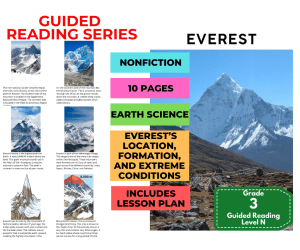
Guided Reading Level N - Everest (with Lesson Plan)
ELA, Resources for Teachers, Reading Comprehension, Reading, Science, Earth and Environmental Sciences, Social Studies, Geography, Life Sciences, Physics, Grade 2, 3, 4, Worksheets & Printables, Worksheets, Teacher Tools, Centers, Activities, Literacy Readers, Quizzes, Quizzes and Tests, Assessments, Lesson Plans
This Guided Reading Book - Everest (Level N) with lesson plan includes: Guided Reading Color Label (front cover x1) This is a quick way to match the book’s demands to what students can generally handle.. The overall goal is to use the level/color to pick books for several smaller groups. To qualify for a certain level, a student is expected to read a book from that level with about 90–94% accuracy. If a student is consistently accurate and understands, move up a level. If the student is struggling at that level, drop down and add more support. Each student will improve at completely different rates, but it is generally one of the best ways to check progress across the class. DOWNLOAD THE CATALOG TO VIEW ALL GUIDED READING BOOKS AVAILABLE (SORTED LEVELS A-Z) Pre-Reading Question (x1) Teacher asks the prompt aloud, can be while showing the cover or first page. Students share what they already know, or make educated guesses from the cover. Prompt them to use the target vocabulary. Write some of their responses on the board to look back at during the reading. Vocabulary Words (x5) Introduce the five words, best doing it one at a time. Start by saying it, while students repeat and then see if anyone knows what it means before reading further. Read through the meaning and try to briefly connect each word to a picture or gesture so it’s meaningful. Ask students to flip through the book pages and point to where they see each of the vocabulary words. While reading the book pause upon coming across one of the vocab words or read the sentence twice to make sure students understand the word has appeared. Optional: Ask students to raise hands whenever they see/hear one of the new words. Guided Reading Pages (x10) Check the book snapshot (below) for: primary topic - do you need to prep extra reading or intro materials on this? what is taught best - decide on 1-2 bullets to focus on, use the prompt or words provided here for best results. learning goals - what you are checking for students to be able to do after the session, elicit answers using prompts or words provided. key vocabulary (see section above). questions overview - so you know what is coming up and if you need to prep extra materials to assist understanding. Run the lesson You may have already looked at a few of the pages together, but you can show them some of the pictures again first to set meaning. Depending on how much time you have and how familiar your students are with guided reading class, you may want to read the book aloud first with the group first. Students whisper or partner read, while you listen in. If time, do it as a group, one student reading a page each. Use the guided page’s prompts to coach: “Check the picture / does it make sense?” “Point under the words / try the first sound” “Reread the sentence smoothly”. Try to focus more on one student per session (rotating every time), so you can work out if they are ready to move up or need to move down a level. Comprehension Questions (back cover x3) This is your way to check that students didn’t just say the words, but actually understood the text. First, let students answer by pointing to the page/picture and saying a short sentence. After any answer, follow with: “Show me where you found that in the text.” In bigger groups, have partners answer first (10–20 seconds), then call on 2–3 students to share. Differentiation tips: Emerging speakers/struggling readers: oral + pointing On-level: oral in a full sentence Higher: one written sentence or draw + label Book Snapshot Title: Everest Genre: Nonfiction (informational text) Subject: Science (Earth Science/Geography) Primary Topic: Mount Everest’s location, formation, and extreme conditions Estimated Guided Reading Level (A–Z): N What This Book Teaches Best Key facts about Mount Everest’s height and setting in the Himalayas in Asia. How mountain ranges form over long periods of time, including tectonic plate movement. How borders and regions connect to physical geography (Nepal/China border across the summit). How extreme environments change with altitude, including the “Death Zone” and low oxygen. How glaciers, weather, earthquakes, and erosion shape Everest and keep it changing. Learning Goals Describe where Mount Everest is located and what mountain system it is part of. Identify what the text says about the border between Nepal and China on Everest. Explain how Everest was formed using the book’s description of tectonic plates. Describe what the “Death Zone” is and why most living things cannot survive there long. Describe how glaciers create features on the mountain, including crevasses. Explain one way Everest is still changing today, using details from the text. Key Vocabulary From the Text summit — the very top point of a mountain. glacier — a huge, slow-moving river of ice. tectonic — related to Earth’s moving crust plates. crevasses — deep cracks in ice. erosion — wind, water, or ice wearing rock away. Discussion Prompts Pre-reading question: Where does the book say Mount Everest stands? Comprehension questions: What does the text say about where the Nepal–China border is on Everest? Comprehension questions: How does the text explain that Everest was formed long ago? Comprehension questions: What is one way the text says Mount Everest is still changing today? Printing Tips 1. Best Printing Method (Recommended) “Booklet” Printing (Best if Available) If your printer or PDF viewer supports Booklet Printing , use this. Settings to use: Print mode: Booklet Paper size: Letter or A4 (either works) Orientation: Landscape Print on both sides: Yes Flip on: Short edge Scaling: Fit to printable area Booklet subset: First test: Front sides only Then: Back sides only This will automatically: Pair pages correctly Put the cover on the outside Align everything for folding After printing, fold in half and staple along the spine . 2. If “Booklet” Printing Is NOT Available You can still print this correctly with manual duplex printing . Step-by-step: Open the PDF. Choose Print . Set: Orientation: Landscape Pages per sheet: 1 Print on both sides: Yes Flip on: Short edge Print all pages . Because each PDF page already contains two facing book pages, the result will still fold cleanly into a book. Thousands of Cored Education products are included with your TeachSimple membership. Download links and encyclopedia index available here.
Author Cored Education
Rating
Tags Reading Comprehension, Reading Passages, Reading, Guided Reading, Guided Reading Lesson Plan, Guided Reading Activity, Pre-reading, Social Studies Lesson Plans, Science Lesson Plans, Geography
I WONDER - What Is Composting | Animated Video Lesson
Environmental Science, Earth and Environmental Sciences, Science, Earth Sciences, STEM, Grade 2, 3, 4, 5, 6, 7, 8, Lesson Plans, Teacher Tools
Video Introduction An amazing video designed for the students to learn more about STEM. I WONDER - What Is Composting | Animated Video Lesson Do you like STEM subjects? what is your favorite one? Have you ever tried to plant a seed? If yes, tell us more about it. Or have you ever tried to invent something? If yes, tell us more about it. And how do you think it will help us? Have you ever seen a microorganism under a microscope? What was it? And how it looked like? Mathematics is a marvelous subject. Let' sharpen our brains and solve some equations. Do you like timetable tricks? What is your favorite one? Do you know how to code? Have you ever created an app or a game before? If yes, how was it like? I WONDER - What Is Composting | Animated Video Lesson The video is perfect for encouraging the researching skills for the students, while learning more about this fantastic topic. I WONDER - What Is Composting | Animated Video Lesson This friendly designed video is suitable for students at school, homeschooling, and as a group activity. Format Available in MP4 format.
Author Educational Voice
Tags What Is Composting, What Is Composting Video, Composting, Composting Facts, Composting Facts For Kids, Composting Video, Composting Video For Kids, Composting Tips For Kids

Cells Gr. 5-8
Science, Life Sciences, Biology, Grade 5, 6, 7, 8, Teacher Tools, Lesson Plans
Cells Gr. 5-8 A comprehensive teaching resource designed for educators navigating the complexities of elementary to middle-school cell biology, expanding knowledge on why cells comprise the basic unit of life. Fundamental Topic Begins with understanding - what is a cell? Makes comparison between single-celled and multicellular organisms Briefs on how this differentiation affects various forms of life on earth. DNA Concepts Introduction This stage lays the foundation for advanced biological studies, highlighting distinct parts of a cell and their roles/functions within an organism's system. Cellular Reproduction Exploration The resource explores mitosis and meiosis procedures—two ways cells divide in nature. Fosters knowledge about growth patterns, genetic stability/variation dynamics, and maintenance across generations. Fascinating Comparison Between Plant And Animal Cells This tool elucidates structural similarities alongside attributes unique to each type of cell through vibrant diagrams that unarguably enhance students' learning in an interactive way. In-depth Insight into The Process Of Cells Culminating Into Larger Organisms: A topic instrumental in starting thought-provoking classroom discussions about evolution and biodiversity. A Close-Up On Diffusion/Osmosis Processes: Vital explanation about movement across membranes – offering understanding towards survival/growth dynamics. The material aligns with 'Next Generation Science Standards' & follows principles per Bloom's Taxonomy initiatives. Beyond this: Incorporates hands-on experiments increasing student engagement via active-teaching methods Includes crossword puzzles facilitating vocabulary retention Useful for different settings, like a whole-group lesson, small-group session or enriching homework assignment.
Author Classroom Complete Press
Tags PDF
Global Warming EFFECTS: Sea Level Changes - FLASH-PC
Science, Earth and Environmental Sciences, Environmental Science, Common Core, Grade 5, 6, 7, 8, Teacher Tools, Lesson Plans
Global Warming EFFECTS: Sea Level Changes - FLASH-PC Introduce your students to the fascinating world of environmental science with Global Warming EFFECTS: Sea Level Changes - FLASH-PC. This teaching tool simplifies complex concepts catering to grades 5 through 8. The Journey Begins with Understanding Global Warming This digital material commences with intriguing reading passages about global warming. It then navigates towards its effects, before arriving at its contribution towards global sea level changes. Critical Thinking Skills Enhancement To engage students in deep understanding, innovative 'before you read' and 'after you read' activities are incorporated following Bloom's Taxonomy principles for nurturing theme-adapted critical thinking skills. Built-in vocabulary flash cards , interactive media content like videos and audio supplements create a beneficial blend that caters to different learning styles. Tailorable printables add fun to the learning process, making environmental science easy-to-grasp and enjoyable. Educational Alignment : Adhering Standards Effortlessly All set to align perfectly with Common Core State Standards, this resource can be efficiently used as part of whole group instructions or utilized for small group discussions or even assigned tasks. It is flexible! In Essence, Leveraging Global Warming EFFECTS: Sea Level Changes - FLASH-PC offers educators an effective way for breeding future environment-conscious citizens inside classrooms or homes! A perfect choice for public school teachers and homeschoolers alike!
Author Classroom Complete Press
Tags Software (PC)
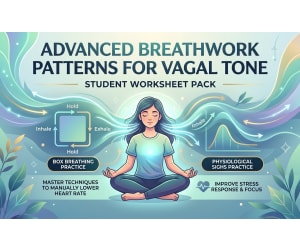
Advanced Breathwork Patterns for Vagal Tone
Science, Life Sciences, Biology, Human Body, Physics, STEM, Special Resources, Life Skills, Social Emotional Learning (SEL), Special Education Needs (SEN), Homeschool Curriculum, Homeschool Templates, Grade 8, 9, 10, 11, 12, Worksheets & Printables, Workbooks, Worksheets, Word Searches, Teacher Tools, Lesson Plans, Quizzes and Tests, Quizzes, Tests, Assessments
Transform Student Stress into Focused Success with Science-Backed Breathwork! Are your high school students struggling with test anxiety, overwhelming stress, and an inability to focus? It's not just in their heads—it's in their biology. The modern academic landscape puts the adolescent nervous system in a constant state of "fight or flight," hijacking their ability to learn and perform. Introducing the Advanced Breathwork Patterns for Vagal Tone Curriculum —a revolutionary, science-based toolkit designed to empower students to take conscious control of their own physiology. This isn't just another mindfulness exercise; it's an applied neurobiology lesson that provides tangible, immediate results. This comprehensive 44-page digital PDF package moves beyond simple "calm down" instructions. It introduces Haptic Respiratory Pacing , a powerful method combining specific breathing protocols (like Box Breathing and the Physiological Sigh) with the kinesthetic act of tracing. This dual-coding mechanism anchors a student's focus, interrupts anxiety loops, and directly stimulates the vagus nerve to manually lower heart rate and calm the nervous system. What's Inside This Complete, "Done-For-You" Curriculum? PHASE 1: Core Content & Theory (Educator/Student Guide): A deep dive into the "why" behind the techniques. This section explains the neurobiology of the stress response, the vagus nerve, and the mechanics of Box Breathing and the Physiological Sigh in clear, scientific terms. Perfect for engaging skeptical teens who want to know how it works. PHASE 2: Student Workbook (10 Rigorous Worksheets): A series of in-depth worksheets that blend academic learning with kinetic practice. Students will map neurobiological pathways, analyze data from their own heart rate, and apply these techniques to real-world scenarios like test-taking and athletic performance. PHASE 3: Visuals & Teacher Resources: High-Fidelity Tracing Diagrams: Clean, printable visual guides for Box Breathing and the Physiological Sigh that students can trace with a finger or pen. Comprehensive Answer Key: A full answer key for every question in the student workbook, including model answers for open-ended questions. Rigorous Teacher Implementation Guide: A step-by-step guide on how to frame the lesson ("Hacking the Nervous System"), run a baseline data protocol to get student buy-in, and integrate the curriculum into different subjects. Trauma-Informed Considerations: Expert guidance on how to apply these techniques safely and effectively for all students. Empower your students with a lifelong skill to manage stress, improve focus, and master their emotional state. Download this resource today and bring the power of applied neuroscience into your classroom! Keywords: Social Emotional Learning (SEL), Stress Management, Anxiety Reduction, Test Anxiety, High School, Biology, Health, PE, School Counselor, Mindfulness, Breathwork, Vagus Nerve, Box Breathing, Physiological Sigh, Self-Regulation, Coping Skills, Neurobiology, Focus, Student Workbook, Digital Download, Printable. Why Parents/Schools Love It: Empowers Students with a Real-World Skill: This isn't just theory. It gives teens a practical, discreet tool they can use anywhere—before an exam, during a stressful social situation, or on the athletic field—to manage their own anxiety and improve performance. Science-Backed & Data-Driven: The curriculum is grounded in real neurobiology, not abstract concepts. The included activities that have students measure their own heart rate provide concrete proof that the techniques work, ensuring high student engagement and buy-in. A Complete, Turnkey Solution: This 44-page PDF is a comprehensive, "plug-and-play" resource. It includes the theory, student worksheets, printable visuals, a full answer key, and a detailed implementation guide, saving teachers valuable prep time. Versatile and Easy to Integrate: The modules can be seamlessly integrated into various classes—Health, Biology, P.E., or even a 10-minute homeroom activity before a big school event. It directly supports school-wide Social-Emotional Learning (SEL) initiatives. Target Audience: Student Classes : Based on the sophisticated language, the scientific concepts, and the real-world examples (AP Calculus exams, athletic performance), target: Primary Target: Senior High School Students (Grades 10, 11, and 12). The content is perfectly matched for their cognitive level and the specific stressors they face. Secondary Target: Advanced 9th Graders in honors or gifted programs. Educators/Buyers: High School Health & P.E. Teachers High School Biology & Anatomy Teachers (excellent for a practical lab on the respiratory/nervous systems) School Counselors and Psychologists Test-Prep Coordinators and Tutors Homeroom/Advisory Teachers Copyright/Terms of Use: This Book was copyrighted by Syed Hammad Rizvi. This resource is for personal and single classroom use only. You may not alter, redistribute, or sell any part of this resource. In other words, you may not put it on the Internet where it could be publicly found and downloaded. If you want to share this resource with colleagues, please purchase additional licenses from Teachsimple. Thank you for respecting these terms of use. This product is happily brought to you by Syed Hammad Rizvi
Author Creative Book Store
Rating
Tags SEL, SocialEmotionalLearning, HighSchoolTeacher, StressManagement, AnxietyRelief, CopingSkills, VagusNerve, BoxBreathing, Neuroscience, ClassroomResources

The Human Body Gr. 4-6
Science, Life Sciences, Human Body, Grade 4, 5, Teacher Tools, Lesson Plans
The Human Body Gr. 4-6 This invaluable teaching resource provides an in-depth exploration of the key systems of human body including: The Skeletal System The Muscular System The Respiratory System The Circulatory System The Digestive System, And the Nervous System. Who is this for? This product is elegantly crafted for grade 4 to 6 learners and primarily falls under the broad category of science, with a central focus on human biology. An Eye on Holistic Education An essential element setting this curriculum apart lies in its unique fusion of varied learning methods aimed at reinforcing information retention. These include: Avenues for cognitive development: Creative art-based tasks fostering imagination and cognitive prowess among students. Kinetic learning: Inclusion of physical activities enhancing motor skills while consolidating learnings from each lesson. Literacy Skills Enhancement: Carefully structured tasks ensuring continuous creative writing practice eventually ending up enhancing verbal capabilities considerably. Numeracy Skills Development: Fusion of mathematics-related activities leads to practical applications, strengthening numeracy skills and extending benefits beyond a science-oriented teaching plan. Flexibility & Adaptability – A Teacher’s Delight! This curriculum has been ingeniously designed with optional activities catering to educators' varying teaching styles or specific classroom requirements promoting adaptability whether it is intended for group instruction, small group involvement, or individual assignments. Pleasurable Revision! - To ensure adequate revision while keeping the fun element alive, incorporated within are engaging crossword puzzles and heighten engagement-level word-search games. Organised Evaluation – The Cherry on Top The product is carefully topped with systematically integrated answer keys aiding prompt evaluation, enabling timely feedback hence strengthening consistent progress monitoring efforts. In conclusion, The Human Body Gr. 4-6 serves as an indispensable resource for teachers empowering not just the creation of a comprehensive lesson plan but facilitates in nurturing curiosity about human anatomy among middle-school students.
Author Classroom Complete Press
Tags PDF

Climate Change: Reduction: Lowering Your Greenhouse Gas Emissions Gr. 5-8
Science, Earth and Environmental Sciences, Environmental Science, Grade 5, 6, 7, 8, Teacher Tools, Lesson Plans
Climate Change: Reduction: Lowering Your Greenhouse Gas Emissions Gr. 5-8 This comprehensive teaching aid is designed to promote environmental responsibility by educating teachers and students about the problems our earth faces due to human consumption, emphasizing reducing greenhouse gas emissions. Ideal for grades 5 through 8, suited precisely for environmental science modules. Two Sides of Climate Change This module gives learners a balanced view of climate change - exploring both advocate and skeptic perspectives. It commences with envisioning Earth's potential future temperature rise. Create Dream Car : Using alternative fuel options, students are motivated to engage creatively by designing their dream car. Transportation Choices: Students investigate various transportation alternatives in their local areas to create an informative pamphlet. Understanding Product Life Cycles & Planning for Green City Initiative Emphasizing product life cycles contributes towards controlling emissions. This section challenges students with planning initiatives focussed on clean energy usage. The Role of Green Buildings & Overview Of Global Efforts Towards Carbon Dioxide-Free Communities This segment aids learners in understanding how green buildings operate while discussing components integral to sustainable structures. It also highlights efforts from different countries aimed at creating carbon dioxide-free communities. Main Takeaways : On completing this module, learners will understand personalised ways of lowering individual greenhouse gas emissions. Crafted adhering to Bloom's Taxonomy and STEAM initiatives , it includes hands-on activities alongside game -based learning components such as crosswords and word searches enhancing cognitive capabilities among young learners . Also included is a comprehension quiz followed by an answer key fostering knowledge checks between educators & students during review sessions . For convenient access across both public school settings or homeschooling scenarios, this product is available in a single easy-to-distribute PDF file.
Author Classroom Complete Press
Tags PDF

I WONDER - Where Did The Apatosaurus Live | Animated Video Lesson
History: Ancient, History, Social Studies, History: World, Animals, Life Sciences, Science, Grade 3, 4, 5, 6, 7, 8, 9, Lesson Plans, Teacher Tools
Video Introduction An amazing video designed for the students to learn more about dinosaurs in different countries. I WONDER - Where Did The Apatosaurus Live | Animated Video Lesson Do you like dinosaurs? what is your favorite one? Do you own a pet? If yes, tell us more about it, like what its name? And what do you like most about it? Do you think that your pet has been evolved from a dinosaur? Can you write down the characteristics of your favourite dinosaur like it's shape, their rivals, where did it use to live and what was their favourite food? What is the largest and the smallest dinosaur that ever found? Why is the T-rex is so famous? Have you ever read any interesting facts about it? Can you name any of the carnivores or herbivores dinosaurs? I WONDER - Where Did The Apatosaurus Live | Animated Video Lesson The video is perfect for encouraging the researching skills for the students, while learning more about dinosaurs. I WONDER - Where Did The Apatosaurus Live | Animated Video Lesson This friendly designed video is suitable for students at school, homeschooling, and as a group activity. Format Available in MP4 format.
Author Educational Voice
Rating
Tags Where Did The Apatosaurus Live, Where Did The Apatosaurus Live Video, Apatosaurus, Apatosaurus Video, Apatosaurus Facts, Apatosaurus Facts For Kids, Apatosaurus Video For Kids, Dinosaur
I WONDER - Where Did The Word Monsoon Come From | Animated Video
Geography, Social Studies, Earth Sciences, Earth and Environmental Sciences, Science, Environmental Science, Grade 4, 5, 6, 7, 8, 9, 10, Lesson Plans, Teacher Tools
Video Introduction An amazing video designed for the students to learn more about natural disasters in different countries. I WONDER - Where Did The Word Monsoon Come From | Animated Video Lesson What do you know about this natural disaster? Do you know in which part of the world this could happen? Have you ever read about the safety misusers that we could have to protect ourselves from this natural disaster? If yes, can you tell us more about them? Can you name other natural disasters? If yes, tell us more about where they are likely to happen? And how frequently? Do you like reading about Geography? What is your favorite country in the whole world? If you are going on a trip where it will be? Which country? What you are going to see there? Does this country has a famous place to visit? Do you like reading about Geology? If yes, what is your favourite topic? I WONDER - Where Did The Word Monsoon Come From | Animated Video Lesson The video is perfect for encouraging the researching skills for the students, while learning more about this fantastic phenomenon. I WONDER - Where Did The Word Monsoon Come From | Animated Video Lesson This friendly designed video is suitable for students at school, homeschooling, and as a group activity. Format Available in MP4 format.
Author Educational Voice
Tags Where Did The Word Monsoon Come From, Where Did The Word Monsoon Come From Video, Monsoon, Monsoon Facts, Monsoon Facts For Kids, Monsoon Video, Monsoon Video For Kids, Monsoons

I WONDER - What Is A Carbohydrate | Animated Video Lesson
Biology, Life Sciences, Science, Human Body, STEM, Grade 1, 2, 3, 4, 5, 6, 7, 8, Lesson Plans, Teacher Tools
Video Overview The human body is full of fascinating wonders to learn. This video is created to help the students recognize the anatomy and the job of the human body. I WONDER - What Is A Carbohydrate | Animated Video Lesson Every part and organ in our human body is vital so let's see how important they are. Have you ever imagined how we look like if we didn't have a skeleton? Did you know that because we have our amazing muscles we can stand! Do you know how many teeth do we have? Have you ever wondered about the food journey inside our body? Can you name all the glands in our body? Why do we have skin? Our nervous system is really good at sending signals. Can you tell us more about it? Are you really good at Mathematics, painting, or any other thing? You should really thank your brain about it! The famous five senses are really doing a great work? Can you explain how every sense works? I WONDER - What Is A Carbohydrate | Animated Video Lesson The video is perfect for encouraging the researching skills for the students, while learning more about our fantastic human body. I WONDER - What Is A Carbohydrate | Animated Video Lesson This friendly designed video is suitable for students at school, homeschooling, and as a group activity. Format Available in MP4 format.
Author Educational Voice
Tags What Is A Carbohydrate, What Is A Carbohydrate Video, Carbohydrate, Carbohydrate Facts, Carbohydrates, Carbohydrates Facts, Carbohydrates Facts For Kids, Carbohydrates Video, Carbohydrates Video For Kids

I WONDER - How Scientists Figure Out What Dinosaurs Ate
History: Ancient, History, Social Studies, History: World, Animals, Life Sciences, Science, Grade 6, 7, 8, 9, 10, 11, 12, Lesson Plans, Teacher Tools
Video Introduction An amazing video designed for the students to learn more about dinosaurs in different countries. I WONDER - How Scientists Figure Out What Dinosaurs Ate | Animated Video Lesson Do you like dinosaurs? what is your favorite one? Do you own a pet? If yes, tell us more about it, like what its name? And what do you like most about it? Do you think that your pet has been evolved from a dinosaur? Can you write down the characteristics of your favourite dinosaur like it's shape, their rivals, where did it use to live and what was their favourite food? What is the largest and the smallest dinosaur that ever found? Why is the T-rex is so famous? Have you ever read any interesting facts about it? Can you name any of the carnivores or herbivores dinosaurs? I WONDER - How Scientists Figure Out What Dinosaurs Ate | Animated Video Lesson The video is perfect for encouraging the researching skills for the students, while learning more about dinosaurs. I WONDER - How Scientists Figure Out What Dinosaurs Ate | Animated Video Lesson This friendly designed video is suitable for students at school, homeschooling, and as a group activity. Format Available in MP4 format.
Author Educational Voice
Rating
Tags How Scientists Figure Out What Dinosaurs Ate, How Scientists Figure Out What Dinosaurs Ate Video, Dinosaurs, Dinosaurs Facts, Dinosaurs Video, Dinosaurs Video For Kids, Dinosaurs Facts For Kids

I WONDER - How Do Biofuels Help The Planet | Animated Video Lesson
Environmental Science, Earth and Environmental Sciences, Science, Earth Sciences, Grade 4, 5, 6, 7, 8, 9, 10, Lesson Plans, Teacher Tools
Video Introduction An amazing video designed for the students to learn more about STEM. I WONDER - How Do Biofuels Help The Planet | Animated Video Lesson Do you like STEM subjects? what is your favorite one? Have you ever tried to plant a seed? If yes, tell us more about it. Or have you ever tried to invent something? If yes, tell us more about it. And how do you think it will help us? Have you ever seen a microorganism under a microscope? What was it? And how it looked like? Mathematics is a marvelous subject. Let' sharpen our brains and solve some equations. Do you like timetable tricks? What is your favorite one? Do you know how to code? Have you ever created an app or a game before? If yes, how was it like? I WONDER - How Do Biofuels Help The Planet | Animated Video Lesson The video is perfect for encouraging the researching skills for the students, while learning more about this fantastic topic. I WONDER - How Do Biofuels Help The Planet | Animated Video Lesson This friendly designed video is suitable for students at school, homeschooling, and as a group activity. Format Available in MP4 format.
Author Educational Voice
Tags How Do Biofuels Help The Planet, How Do Biofuels Help The Planet Video, Biofuels, Biofuel, Biofuels Facts, Biofuels Facts For Kids, Biofuels Video, Biofuels Video For Kids, Environment
Senses, Nervous & Respiratory Systems: The Nervous System - Brain Gr. 5-8
Science, Life Sciences, Human Body, Grade 5, 6, 7, 8, Teacher Tools, Lesson Plans
Senses, Nervous & Respiratory Systems: The Nervous System - Brain Gr. 5-8 A comprehensive teaching resource designed to engage learners in an exploration of the human body. It is primarily catering to educators and students from Grades 5 through 8, covering various subjects under science with a focus on the topic of the Human Body. The Nervous System - Brain This resource originates as a chapter slice from its broader lesson plan "Senses, Nervous & Respiratory Systems." Perfect for schools aiming to diversify and sophisticate their lessons on human anatomy. Main parts:The nervous system’s main parts—brain, spinal cord, nerves—are explained in simple terms. 'How long is a nerve cell?' 'How are our lungs like a train station?' Questions like these are answered in an engaging manner. In addition, it encourages investigations on the organs related to five senses and provides virtual tours around the respiratory system. Teaching Tools Included: Reading Passages: Comprehension questions interspersed among reading passages aimed at reinforcing understanding. Cognitive Activity : Hands-on activities designed for cognitive growth while keeping learning interactive and fun-filled. Colorful Mini Posters: Ideal for classroom displays or study aids enhancing visualization process. To ensure that knowledge gained remains intact among learners post lessons, an array of assessment tools like crosswords puzzles along with word search tasks promoting vocabulary enrichment aligned with scientific terminologies discussed within these lesson plans are available perfected by test preps which eventually culminate in conducting final quizzes. This resource is available through digital access and ideal for whole group discussions during class hours, small study circles maintaining social distancing protocols, or as homework assignments for independent studies. Standards Aligned: Crafted aligning with state standards, STEM initiatives while featuring a structure conforming to Bloom's Taxonomy—this material is the go-to resource for educators dedicated to delivering easy-to-understand yet curriculum-based material on the human body.
Author Classroom Complete Press
Tags PDF, Nervous System Lesson Plans Middle School
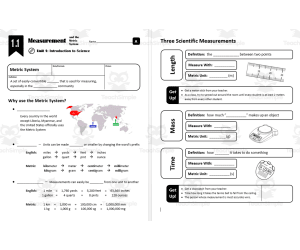
Lesson 1.1 - Measurement & the Metric System
Science, Chemistry, Physics, Grade 6, 7, 8, 9, 10, 11, 12, Lesson Plans, Teacher Tools
Lesson 1.1 - Measurement & the Metric System 'Lesson 1.1 - Measurement & the Metric System' is an extensive teaching aid designed for science educators teaching in grades 6-12, covering vital topics like length, mass, and time within the metric system. The resource offers a mix of interactive materials to make learning engaging and fun. Highlights: The package includes two types of informative notes on measurement & the metric system(Type A and B), either for active in-class fill-up or offering pre-filled versions. An exciting lab activity that involves measuring various items in their classroom adds a hands-on element to this lesson plan. A 'Measurement Practice' sheet includes different exercises that help reinforce knowledge gained from lectures and lab activities. Specially included are two articles providing contrasting views on United States's role with respect to metric system continuation/adoption. This is followed by a student response writing activity aimed at boosting critical thinking skills! To cater to different reading capabilities amongst students, four distinct Lexile scored versions of these articles are available; Spanish translation being one amongst them. Tech Readiness: The package commences with easy-to-understand objectives & starter questions formatted neatly onto PowerPoint slides facilitating smooth content delivery directly from your laptop screen! Additional documents compatible with Microsoft Word (.docx) as well as editable files for PowerPoint (.pptx) round-up making content personalization easier depending upon specific student requirements or teacher styles. Non-editable PDFs compatible with Adobe Reader also form part of this comprehensive lesson material set! In closing, With copious features ranging from enjoyable activities to easily-editable resources, Lesson 1.1 - Measurement & the Metric System stands distinguished as an exhaustive, yet simplified to navigate through teaching aid making measure-based learning in the field of science a little more accessible for both educators and pupils alike!
Author Integrated Chemistry and Physics
Tags Measurement, Metric System, Scientific Measurements, Lab Activity, Critical Thinking

Photosynthesis Lesson | Middle School Lesson and Infographic Activity
Science, Basic Science, Earth and Environmental Sciences, Life Sciences, Nature & Plants, Biology, Grade 6, 7, 8, Activities, Projects, Lesson Plans, Teacher Tools, Presentations, Worksheets
Introduce students to the essentials of Photosynthesis and its connection to Cellular Respiration with this ready-to-use science lesson designed for Grades 6–8. This middle school resource provides both foundational knowledge and opportunities for scientific discussion and inquiry-based learning. ✅ Covers Photosynthesis and Cellular Respiration using interactive slides and critical thinking questions ✅ Includes Editable Presentations, Auto-Graded Exit Ticket , Infographic Task, and Student Notes ✅ Aligned to NGSS Standards MS-LS1-5, MS-LS1-6, MS-LS1-7, and MS-LS2-3 ✅ No-Prep Resource with built-in videos and fill-in-the-blank guided notes to support active learning This lesson package is comprehensive and student-friendly. It includes everything needed for a full class session or more, offering a smooth and engaging way to teach key life science concepts. Students will explore how energy from the sun drives life on Earth, how plants process that energy, and how it's transferred through ecosystems. Topics covered in the lesson include: The sun as Earth’s energy source Distribution of energy on Earth The structure and role of chloroplasts The function of chlorophyll Why leaves change color The processes of Photosynthesis and Cellular Respiration ATP as a cellular energy carrier How Photosynthesis supports all life on Earth What’s inside the download: A teacher slideshow with full content and answers A student version of the slideshow with fill-in-the-blank sections An auto-graded 4-question Exit Ticket for quick assessment Two instructional videos embedded within the presentation An infographic-based activity to reinforce learning A printable student worksheet to guide note-taking and discussion Standards alignment: MS-LS1-5 : Students examine how plants rely on air and water to build materials needed for growth, tying into carbon dioxide and water’s role in photosynthesis. MS-LS1-6 : Learners explain how photosynthesis drives the flow of matter and energy in living systems. MS-LS1-7 : The lesson supports modeling how food undergoes chemical reactions in cellular respiration to release energy and support growth. MS-LS2-3 : Students explore how energy and matter cycle between organisms and their environment. The student notes are designed to maximize participation without overwhelming learners with too much writing. Strategic fill-in-the-blank prompts help students focus on key vocabulary and ideas while leaving time for group discussion, exploration, and deeper analysis. These prompts are clearly marked in the teacher copy to make instruction seamless. Whether you’re teaching in person or online, this lesson gives you everything you need to introduce photosynthesis and cellular respiration in a clear, structured, and student-centered way.
Author Teach With Fergy
Rating
Tags Photosynthesis, Cellular Respiration, Biology Lesson, Chloroplast, Plants

I WONDER - Why Is Plastic Bad For Marine Life | Animated Video Lesson
Earth Sciences, Earth and Environmental Sciences, Science, Environmental Science, Grade 3, 4, 5, 6, 7, 8, 9, Lesson Plans, Teacher Tools
Video Introduction An amazing video designed for the students to learn more about STEM. I WONDER - Why Is Plastic Bad For Marine Life | Animated Video Lesson Our environment is so precious, can you name different ways to help our environment to be clean? Have you ever recycled a material? If yes, tell us what was the material was it paper, plastic, glass or aluminum? How did you recycled it? What are the types of clean energy? How do hydro power works? Where can we find wind turbines? What is climate change? And what we can do to stop it? What are the different types of ecosystems? I WONDER - Why Is Plastic Bad For Marine Life | Animated Video Lesson The video is perfect for encouraging the researching skills for the students, while learning more about this fantastic topic. I WONDER - Why Is Plastic Bad For Marine Life | Animated Video Lesson This friendly designed video is suitable for students at school, homeschooling, and as a group activity. Format Available in MP4 format.
Author Educational Voice
Rating
Tags Why Is Plastic Bad For Marine Life, Plastic, Plastics, Plastic Facts, Plastic Facts For Kids, Plastic Video, Plastic Video For Kids, Environment, Environment Facts, Marine Life

Space Travel & Technology - Digital Lesson Plan Gr. 5-8 | PC Software
Science, Earth and Environmental Sciences, Space, Grade 5, 6, 7, 8, Teacher Tools, Lesson Plans
Space Travel & Technology - Digital Lesson Plan Gr. 5-8 | PC Software An innovative learning tool intended for Grade 5 to 8 educators, this dynamic and user-friendly lesson plan focuses on space travel and technology. It propels students to imagine joining a shuttle mission bound for the International Space Station. This interactive digital program spans across 80 screen-pages, making learners the scientists, engineers, astronauts or leaders guiding humanity in unearthing more of our universe's mysteries. Teachers play an absolutely crucial role as they help shape tomorrow's visionaries using this fantastic resource. Key Features: Interactive activities both before and after lessons promote learner engagement while stimulating critical thinking skills. Inclusion of English and Spanish Text-to-Speech capability catering to diverse classroom learning needs. The content within is structured upon Bloom's Taxonomy framework and adheres strictly with state standards. A variety of supporting materials—like a memory match game, crossword puzzles and word searches—are included herein providing additional opportunities for concept reinforcement while keeping the lessons enjoyable! The software also houses practice quizzes acting as an excellent way to gauge student comprehension—very valuable in assessing understanding before transitioning into other thrilling astronomy themes or beyond! Your One-Stop Teaching Aid... The 'Space Travel & Technology - Digital Lesson Plan Gr. 5-8 | PC Software' isn't just another teaching aid—it’s an efficient launching pad readying young minds for cosmic explorations! Use it during group instruction sessions; assign it as an interesting homework task; incorporate it into your class center activities—the sky (or rather space!) is the only limit! Note:Please be aware that delivery comes in the form of one zip file intended only for compatible PC software.
Author Classroom Complete Press
Tags Astronomy Lesson Plan, Digital Science Lesson, Space Travel, Technology Lesson, Astronomy Reading

Properties of Matter: Physical Changes of Matter Gr. 5-8
Science, Physics, Grade 5, 6, 7, 8, Teacher Tools, Lesson Plans
Properties of Matter: Physical Changes of Matter Gr. 5-8 An instructional resource perfect for teachers and homeschoolers educating students from grades 5 to grade 8 about the complex concepts of matter in physical science. This comprehensive guide aids educators in teaching what matter is and what it's not, with activities focused on understanding the distinctions between a mixture and a solution. Includes an engaging array of hands-on activities designed to facilitate comprehension about various physical and chemical alterations of matter. Simplifies otherwise complex scientific concepts through accessible language usage. Provides meticulously curated information paired with easy-to-implement instruction, crafted specifically for learners requiring extra support or those who do well with step-by-step guidance due to its focus on foundational skills reinforcement. A notable feature: The array of experiments that keep learners engaged during instruction. Alongside these interactive elements are reading passages that help boost literary comprehension whilst highlighting applicable science principles simultaneously. An effective tool in preparing students for exams, thanks to its informative mini posters which serve as condensed revision materials and integrated answer key designed specifically for checking pupil’s mastery over topics discussed. How Can You Use It? You can use this resource: In whole group settings enhancing collaborative learning experiences In one-on-one class settings allowing each student self-paced study time based on their respective needs. We’ve made sure that our resources align perfectly with state standards, written considering Bloom's Taxonomy guidelines coupled with STEM initiatives provisions - rest assured that your learnings align strictly with educational strategies that underline successful teaching practice. You can download this indispensable guide as a PDF, making delivery of content handy and efficient for educators catering to youngsters eager to unravel the wonders of matter and its physical changes.
Author Classroom Complete Press
Tags PDF