



3,886 products added recently
Page 28 - Science Lesson Plan Template
Enhance your science instruction with a flexible lesson plan template designed for educators. This tool helps you structure objectives, materials, procedures, and assessments efficiently. Use it to create organized and impactful science lessons that cater to your students' needs.

 Show filters


Preparing Solutions and Dilutions - Senior Chemistry lesson
Science, Chemistry, Grade 10, 11, 12, Teacher Tools, Lesson Plans
Preparing Solutions and Dilutions - Senior Chemistry Lesson Your lesson covers solutions and dilutions and how to prepare them. In order, the lesson includes; Preparing Solutions, Solutions Mini Lab, Dilutions, Practice Questions with Walkthrough Answers, and a Dilutions Mini Lab. Your lesson includes the teacher and student version of the presentation, an auto-graded exit ticket, and a student lesson handout so the students can record the notes on a more condensed medium. This lesson is designed to be your go-to resource, whether you're in a traditional classroom or a virtual one. With both a teacher version and a student version, it seamlessly fits into your lesson plans, making learning engaging and adaptable. Assessment made easy We've included an auto-graded Exit Ticket and a quiz with an answer key because I know you don't have an excess of time. I know you don't, because I don't and I know I'll do whatever I can to reduce my grading time. Whether you use PowerPoint or Google Slides, prefer Word or Google Docs, this lesson has you covered. This lesson comes in both Office and Google formats for your convenience. The student version of the presentation has strategically placed blanks for them to fill in as you're teaching. It keeps them active and engaged, encourages discussion, and leaves more time for those "aha" moments.
Author Teach With Fergy
Tags Chemistry Lesson, Solutions, Preparing Solutions, Preparing Dilutions, Dilutions
I WONDER - What Is A Shooting Star | Animated Video Lesson
Space, Earth and Environmental Sciences, Science, Grade 1, 2, 3, 4, 5, 6, 7, 8, Lesson Plans, Teacher Tools
Video Introduction An amazing video designed for the students to learn more about space facts. I WONDER - What Is A Shooting Star | Animated Video Lesson Do you like reading about space? If yes, what is your favorite topic? What do you know about our solar system? What is the smallest planet in our solar system? What is the biggest planet in our solar system? What is the hottest planet in our solar system? And what is the coldest one? Do you think there are aliens? If yes, what do you think they look like? What do they eat and how they speak to each other? Where do they live? What is a galaxy? And what is a milky way? Have you recently saw a shooting star? If yes, tell us more about it, like when did it happen and where? What is a blackhole? Can a blackhole gets bigger by time? Do you like counting the stars? What do you think a star is made of? I WONDER - What Is A Shooting Star | Animated Video Lesson The video is perfect for encouraging the researching skills for the students, while learning more about the fantastic space. I WONDER - What Is A Shooting Star | Animated Video Lesson This friendly designed video is suitable for students at school, homeschooling, and as a group activity. Format Available in MP4 format.
Author Educational Voice
Tags What Is A Shooting Star, What Is A Shooting Star Video, Shooting Star, Shooting Star Facts, Shooting Star Facts For Kids, Shooting Star Video, Shooting Star Video For Kids, Space, Space Video
I WONDER - What Is AI | Animated Video Lesson
STEM, Computer Science, Technology, Science, Grade 2, 3, 4, 5, 6, 7, 8, Lesson Plans, Teacher Tools
Video Introduction An amazing video designed for the students to learn more about STEM. I WONDER - What Is AI | Animated Video Lesson Do you like STEM subjects? what is your favorite one? Have you ever tried to plant a seed? If yes, tell us more about it. Or have you ever tried to invent something? If yes, tell us more about it. And how do you think it will help us? Have you ever seen a microorganism under a microscope? What was it? And how it looked like? Mathematics is a marvelous subject. Let' sharpen our brains and solve some equations. Do you like timetable tricks? What is your favorite one? Do you know how to code? Have you ever created an app or a game before? If yes, how was it like? I WONDER - What Is AI | Animated Video Lesson The video is perfect for encouraging the researching skills for the students, while learning more about this fantastic topic. I WONDER - What Is AI | Animated Video Lesson This friendly designed video is suitable for students at school, homeschooling, and as a group activity. Format Available in MP4 format.
Author Educational Voice
Tags What Is AI, What Is AI Video, Artificial Intelligence , AI Facts, AI Facts For Kids, AI Video, AI Video For Kids, Artificial Intelligence Facts, Artificial Intelligence Video, Artificial Intelligence Video For Kids

Panda Pandamonium Gr. 1-2
Science, Life Sciences, Animals, Grade 1, 2, Teacher Tools, Lesson Plans
Panda Pandamonium Gr. 1-2: An Engaging & Integrated Teaching Resource Panda Pandamonium Gr. 1-2 is a comprehensive teaching resource designed for educators who aim to provide their students with an engaging and informative experience that combines science and language arts. This unit, which targets Grade 1 to Grade 2, offers a two-week educational journey into the intriguing world of pandas. About the Panda Pandamonium Unit: Fosters active learning through thought-provoking activities related to pandas' biology, lifestyle, and conservation issues. Facilitates science (Zoology) with Language Arts exercises ensuring academic growth while retaining student interest in the subject matter. Suitable for both public school teachers and homeschoolers alike. Different Implementation Methods: This resource can be presented either as a whole-group activity fostering collaborative discussions in larger classrooms or as smaller group projects to encourage teamwork and individual contributions. Homeschooling parents may prefer to present certain sections of the lesson plan as distinct assignments spread out over time. Literacy Goals Supported with Science Education: Beyond conventional lectures or independent reading sessions about pandas' lives and characteristics, Panda Pandamonium Gr. 1-2 expands learners’ vocabulary by involving them in brainstorming sessions - helping students identify synonyms or antonyms of key words from reading material within each lesson section. Fun exercises like crosswords or word searches aid knowledge retention, while encouraging pupils to respond in complete sentences fosters comprehension skills. An Excellent Addition for Educators: Panda Pandamonium Gr. 1-2, provided as a PDF file labeling it an excellent choice for enhancing any educator's collection of lesson plans. This resource effortlessly combines science education with language arts enrichment through a beloved subject – pandas. It meets the required Grade 1 and 2 Science curriculum requirements while simultaneously boosting their language development skills.
Author Classroom Complete Press
Tags PDF

I WONDER - Where Do We See Potential Energy In Everyday Life
Physics, Science, Grade 4, 5, 6, 7, 8, 9, 10, Lesson Plans, Teacher Tools
Video Introduction An amazing video designed for the students to learn more about STEM. I WONDER - Where Do We See Potential Energy In Everyday Life | Animated Video Lesson Plants world is really fascinating! Do you know that some flowers eat insects? Some other plants like to grow on walls can you mention any? Do you know what is the difference between fungicide and pesticide? If yes, Can you tell us more about it? What is nuclear energy? Is it safe to use it? Do you think it is a clean energy? Have you ever read about potential energy? If yes, tell us what it is? Do you think that potential energy can be converted into another form of energy? How it happens? I WONDER - Where Do We See Potential Energy In Everyday Life | Animated Video Lesson The video is perfect for encouraging the researching skills for the students, while learning more about this fantastic topic. I WONDER - Where Do We See Potential Energy In Everyday Life | Animated Video Lesson This friendly designed video is suitable for students at school, homeschooling, and as a group activity. Format Available in MP4 format.
Author Educational Voice
Rating
Tags Where Do We See Potential Energy In Everyday Life, Potential Energy, Potential Energy Facts, Potential Energy Video, Potential Energy Video For Kids, Potential Energy Facts For Kids, Potential Energy In Everyday Life

I WONDER - What Special Features Do Horses Have | Animated Video
STEM, Animals, Life Sciences, Science, Biology, Grade 1, 2, 3, 4, 5, 6, 7, 8, Lesson Plans, Teacher Tools
Video Introduction Animal kingdoms are full of fascinating wonders to learn. This video is designed for the students to learn more about animals in different countries. I WONDER - What Special Features Do Horses Have | Animated Video Lesson Do you like animals? what is your favorite one? Do you own a pet? If yes, tell us more about it, like what its name? And what do you like most about it? What are the animal kingdoms? Can you write down the characteristics of each animal class like mammals, birds, reptiles, amphibian, fish and mollusks. Do you know that some animals can sing, can you name any of them? What is the largest and the smallest mammal in the world? What is the largest and the smallest bird in the world? What is the largest and the smallest fish in the world? I WONDER - What Special Features Do Horses Have | Animated Video Lesson The video is perfect for encouraging the researching skills for the students, while learning more about these fantastic animals. I WONDER - What Special Features Do Horses Have | Animated Video Lesson This friendly designed video is suitable for students at school, homeschooling, and as a group activity. Format Available in MP4 format.
Author Educational Voice
Tags What Special Features Do Horses Have, What Special Features Do Horses Have Video, Horses, Horse, Horses Facts, Horses Facts For Kids, Horses Video, Horses Video For Kids, Horse Video

Balancing Reactions in Acidic Solutions - Lesson Bundle
Science, Chemistry, Grade 10, 11, 12, Teacher Tools, Lesson Plans
This 26-slide PowerPoint lesson on Balancing Half Reactions in Acidic Solutions begins by reviewing redox reactions. It then outlines half reactions and balancing before checking student's understanding. The lesson then covers corrosion, its dangers, and corrosion protection by oxide coating. There are 3 videos embedded in the PowerPoint. Simply start the slideshow and click the image and it will automatically open in your browser. The lesson contains diagrams , examples, and explanations. It includes the lesson (student and teacher versions of the PowerPoint) and a student lesson handout as a word document which follows the PowerPoint. Included in the lesson package is: - The teacher version of the PowerPoint - The student version of the PowerPoint - 3 videos embedded into the PowerPoint - Student lesson handout In order, the lesson covers: - Oxidation-Reduction Reactions - Half Reactions - Balancing Redox Reactions - Check Your Understanding - Corrosion - Corrosion and Oxidation - Corrosion Damage - Corrosion Dangers - Corrosion Protection by Oxide Coating ------------------------------------------------- The student version of the PowerPoint contains multiple blanks that need to be filled in throughout the lesson. These blanks are conveniently underlined and bolded on the teacher copy. I have found this to be the most effective means of keeping my students engaged and active without having them write everything out. This also leaves more time for discussion and activities. This file is in .zip format. All that means is you download the lesson package as one file (.zip) and then double-click it to extract it. No additional software is needed, your PC or Mac will do all the work. Please view the Preview File to obtain a sense of my style, see how my PowerPoint lesson is structured and evaluate my work. If you are not 100% happy with what you purchase, I will refund your entire purchase price via PayPal. To access the video(s), begin the slideshow and click the image of the video player. A new window will open up taking you directly to the video. Also, please visit my blog Teach With Fergy for my thoughts on teaching, learning and everything in between.
Author Teach With Fergy
Tags Balacning Reactions, Chemical Reactions, Chemical Equations, Acidic Solutions, Chemistry Activity
I WONDER - What Animals Live In The River Nile | Animated Video Lesson
Biology, Life Sciences, Science, Animals, STEM, Grade 1, 2, 3, 4, 5, 6, 7, 8, Lesson Plans, Teacher Tools
Video Introduction Animal kingdoms are full of fascinating wonders to learn. This video is designed for the students to learn more about animals in different countries. I WONDER - What Animals Live In The River Nile | Animated Video Lesson Do you like animals? what is your favorite one? Do you own a pet? If yes, tell us more about it, like what its name? And what do you like most about it? What are the animal kingdoms? Can you write down the characteristics of each animal class like mammals, birds, reptiles, amphibian, fish and mollusks. Do you know that some animals can sing, can you name any of them? What is the largest and the smallest mammal in the world? What is the largest and the smallest bird in the world? What is the largest and the smallest fish in the world? I WONDER - What Animals Live In The River Nile | Animated Video Lesson The video is perfect for encouraging the researching skills for the students, while learning more about these fantastic animals. I WONDER - What Animals Live In The River Nile | Animated Video Lesson This friendly designed video is suitable for students at school, homeschooling, and as a group activity. Format Available in MP4 format.
Author Educational Voice
Tags What Animals Live In The River Nile, What Animals Live In The River Nile Video, Animals That Live In The River Nile, Animals That Live In The River Nile Facts, Animals That Live In The River Nile Facts For Kids, Animals That Live In The River Nile Video

Unplugged Coding Task Cards | 30 Debugging WarmUps Grades 3-5 |No Tech
Computer Science, Technology, Science, Winter, Seasons, Holiday & Seasonal, Grade 3, 4, 5, Centers, Activities, Lesson Plans, Teacher Tools, Task Cards, Worksheets & Printables
Find the Bug: Debugging Warm-Ups | Grades 3–5 Computer Science Find the Bug gives Grades 3–5 students engaging, no-tech debugging practice without requiring a specific coding platform. These debugging task cards help students learn to trace, test, explain, and fix broken pseudocode. What’s Included This resource includes six separate PDF files : Teacher Guide – 6 pages Teacher directions and implementation ideas Teacher questioning script Standards alignment Scope and sequence Two-week pacing option Student Reference – 2 pages How to read a bug card Seven-step debugging checklist Read → Trace → Find → Fix → Test debugging cycle Recording Pages – 2 pages Student response sheets Bug type identification Fixed-line recording Debugging progress tracker Bug Cards – 30 pages 30 ready-to-use debugging task cards Six different bug types Three difficulty levels One card per page Answer Key – 10 pages Correct fixes for every card Misconception behind each bug Helpful teacher conferencing notes The six bug types include Sequence, Loop Counting, Loop Conditions, Conditionals, Variables, and Placement . How It Works in the Classroom Use these debugging task cards in flexible ways throughout your computer science instruction. ⭐ Bell-Ringers Project or print one card. Students work independently or with partners. A six-minute work period fits easily into a warm-up routine. One card per day provides approximately six weeks of practice. ⭐ Stations Print and laminate the cards. Add the student response sheet. Students solve cards and record their thinking. Five cards provide a manageable station rotation. ⭐ Sub Plans Provide the cards, checklist, response sheet, and answer key. No student login or device is required. No prior coding platform knowledge is needed. Introduce the cards through discovery. Students encounter concepts by watching code break. Standards & Learning Goals Students practice: Testing and debugging programs or algorithms. Identifying and explaining coding errors. Tracing code step by step. Modifying existing algorithms. Testing boundary cases. Recognizing patterns in repeated reasoning. Explaining why a solution works. The resource aligns with CSTA 1B-AP-10, 1B-AP-11, 1B-AP-12, 1B-AP-15, and 2-AP-17 . It also supports CCSS.MATH.PRACTICE.MP6, MP8, and CCSS.ELA-LITERACY.W.4.2 . Students also build practical debugging habits through the seven-step checklist. These include tracing values, checking starting values, checking stop conditions, reviewing order, checking indentation, and testing edges. Why Teachers Love It ⭐ Misconception-focused answer key The answer key explains the misconception behind each bug. This gives teachers better language for student conferences. ⭐ No devices required Students can practice computational thinking without opening a coding platform. ⭐ Low-prep implementation Print the cards and start using them as warm-ups, stations, or sub plans. ⭐ Built-in differentiation Cards progress across three difficulty levels. ⭐ Focuses on thinking, not guessing Students must find the bug, explain the problem, and write a fix. ⭐ Student reflection is included The debugging tracker helps students see which bug types they solve most successfully. Make debugging practice easier with a ready-to-use computer science resource for Grades 3–5 . Use Find the Bug for warm-ups, stations, targeted reteaching, or substitute plans. Give students repeated opportunities to trace, test, explain, and repair code. Download the resource and give your students a practical way to build stronger debugging habits! 💛
Author Bright Classroom Ideas Marketplace
Rating
Tags Code, Coding, Unplugged, No Tech, Debug, Debugging, Technology, Computer
I WONDER - What Is A URL | Animated Video Lesson
STEM, Computer Science, Technology, Science, Grade 1, 2, 3, 4, 5, 6, 7, 8, Lesson Plans, Teacher Tools
Video Introduction An amazing video designed for the students to learn more about STEM. I WONDER - What Is A URL | Animated Video Lesson Do you like STEM subjects? what is your favorite one? Have you ever tried to plant a seed? If yes, tell us more about it. Or have you ever tried to invent something? If yes, tell us more about it. And how do you think it will help us? Have you ever seen a microorganism under a microscope? What was it? And how it looked like? Mathematics is a marvelous subject. Let' sharpen our brains and solve some equations. Do you like timetable tricks? What is your favorite one? Do you know how to code? Have you ever created an app or a game before? If yes, how was it like? I WONDER - What Is A URL | Animated Video Lesson The video is perfect for encouraging the researching skills for the students, while learning more about this fantastic topic. I WONDER - What Is A URL | Animated Video Lesson This friendly designed video is suitable for students at school, homeschooling, and as a group activity. Format Available in MP4 format.
Author Educational Voice
Tags What Is A URL, What Is A URL Video, URL, URL Facts, URL Facts For Kids, URL Video, URL Video For Kids, Technology, Technology Facts, Technology Video

Simple Machines: Inclined Planes, Wedges, and Screws - FLASH-PC
Science, Technology, Engineering, Common Core, Grade 5, 6, 7, 8, Teacher Tools, Lesson Plans
Simple Machines: Inclined Planes, Wedges, and Screws - FLASH-PC This exclusive educational resource is designed specifically for educators focusing on the teaching of inclined planes, wedges, and screws found in simple machines. It provides curriculum -based content from grade 5 to grade 8, through an efficient blend of reading passages. Preparatory questions are used to stimulate independent thinking and curiosity about the subject before delving into the topic. This learning journey continues with queries formulated after reading sections to ensure comprehension and retention of content. Educator's Convenience Platform An excellent tool for public school teachers as well as homeschoolers, this resource aligns all its material with Common Core State Standards while following Bloom's Taxonomy’s path for promoting higher level cognitive skills. Plus, it offers printable materials facilitating diversified teaching styles or outside assignments where technology access might be limited. Versatility This product fits in various settings — whole group discussion or focused small groups — effortlessly adapting to diverse teaching strategies. Interactive activities included alongside audio-video options make learning engaging yet comprehensive. The broad umbrella topic 'Engineering' is further nurtured via: A focus on vocabulary building related specifically to scientific jargon understanding key to 'Simple Machines.' Vocab flashcards distinctly inserted within this digital lesson plan format that aid in gradual building of a specialized word bank. New age pedagogical needs are met with this FLASH-PC compatible file offering easy-to-understand academic material without compromising its credible quality - just a click away!
Author Classroom Complete Press
Tags Software (PC)
I WONDER - What Is The Smallest Mammal In The World | Animated Video
STEM, Animals, Life Sciences, Science, Biology, Grade 1, 2, 3, 4, 5, 6, 7, 8, Lesson Plans, Teacher Tools
Video Introduction Animal kingdoms are full of fascinating wonders to learn. This video is designed for the students to learn more about animals in different countries. I WONDER - What Is The Smallest Mammal In The World | Animated Video Lesson Do you like animals? what is your favorite one? Do you own a pet? If yes, tell us more about it, like what its name? And what do you like most about it? What are the animal kingdoms? Can you write down the characteristics of each animal class like mammals, birds, reptiles, amphibian, fish and mollusks. Do you know that some animals can sing, can you name any of them? What is the largest and the smallest mammal in the world? What is the largest and the smallest bird in the world? What is the largest and the smallest fish in the world? I WONDER - What Is The Smallest Mammal In The World | Animated Video Lesson The video is perfect for encouraging the researching skills for the students, while learning more about these fantastic animals. I WONDER - What Is The Smallest Mammal In The World | Animated Video Lesson This friendly designed video is suitable for students at school, homeschooling, and as a group activity. Format Available in MP4 format.
Author Educational Voice
Tags What Is The Smallest Mammal In The World, What Is The Smallest Mammal In The World Video, Smallest Mammal In The World, Smallest Mammal In The World Video, Smallest Mammal In The World Facts, Smallest Mammal In The World Video For Kids

Waste: At the Source: Pollution Gr. 5-8
Science, Earth and Environmental Sciences, Environmental Science, Grade 5, 6, 7, 8, Teacher Tools, Lesson Plans
Waste: At the Source: Pollution Gr. 5-8 Waste: At the Source: Pollution Gr. 5-8 is a ready-to-use resource targeting students in grades 5 to 8. The material simplifies concepts related to waste and pollution using straightforward language and accessible vocabulary. The resource explores topics such as what constitutes waste at its source, how pollution affects humans, wildlife, and different ecosystems. The comprehensive guide works effectively as a teaching tool for both public school teachers and homeschool educators focusing on science and environmental studies. The comprehensive guide includes reading passages that discuss: - pre-consumer waste, raw materials, - natural resources, - post-consumer waste including consumable products vs durable goods, - impact of product packaging on our ecosystem. In addition to this, it provides an in-depth analysis of landfill management by shedding light on solid wastes disposal processes along with discussions about hazardous toxins resulting from improper handling of toxic wastes. Learner Engagement Strategies This isn't just an informational read! This digital file promotes interactive learning through hands-on activities like crosswords or word searches which serve to consolidate knowledge from readings. Additionally, colorful mini posters are utilized as visual aids stimulating understanding through imaginative visualization leading to engaging learning experiences! Assessment Tools for Educators Educators will also find added value in using comprehension quizzes provided for each module coupled with test preparation tools designed perfectly for critical assessments down the line. Suitability & Convenience This unique package is perfectly suited for Science students from grades 5 to 8. As it's a downloadable resource, it doesn't require steady internet connection or additional subscription – making it ideal for both group learning and independent study.
Author Classroom Complete Press
Tags PDF

Speed Quizzing – Flight Unit
Science, Physics, Grade 9, 10, 11, 12, Lesson Plans, Teacher Tools
Speed Quizzing – Flight Unit The Speed Quizzing – Flight Unit is a specialised teaching resource designed to engage students in a dynamic and interactive learning methodology. This activity caters primarily for grades 9 through 12. Usability & Flexibility An essential part of this resource is its ease of use. It requires simple preparation - printing and cutting out flash cards. The flexible format allows teachers to tailor the content according to classroom requirements, as it's fully editable. High-Quality Content The package contains a total of 32 rigorously developed questions, covering subjects such as: The history and future of flight, How planes and other aircraft fly, 'Improving flight', 'How living things fly' etc. This makes it an effective evaluation tool for comprehension on these topics. Beyond Just Assessment Tool: Active Learning Exercise This resource offers more than just standard assessment; it is also an active exercise that encourages communication amongst students . It can be used efficiently to review prior knowledge or new terms after the completion of a unit, gather student ideas or remediate weaker skills in an engaging manner. Aiding Collaborative Learning Efforts... The entire exercise promotes peer interaction using methods like stand up hands up pair-up method along with alternate styles where groupings are separate.. These options allow comprehensive exposure towards collaborative learning efforts and can be adapted based on teacher discretion. Suitable for Public schoolteachers or Homeschoolers All these activities along with ease of implementation coupled with flexibility makes this product fitting for public school teachers or homeschoolers working under higher grade physical science curriculum. Delivery & Format The Speed Quizzing – Flight Unit is provided in a zip file format and fits neatly onto 4 pages. This useful teaching resource aims to establish an interactive and immersive learning environment.
Author Teach With Fergy
Tags Interactive Learning, Collaborative Teaching, Aviation Education, Active Assessment, Peer Interaction

I WONDER - What Does Coral Eat | Animated Video Lesson
Environmental Science, Earth and Environmental Sciences, Science, Grade 4, 5, 6, 7, 8, 9, 10, Lesson Plans, Teacher Tools
Video Introduction An amazing video designed for the students to learn more about STEM. I WONDER - What Does Coral Eat | Animated Video Lesson Do you like STEM subjects? what is your favorite one? Have you ever tried to plant a seed? If yes, tell us more about it. Or have you ever tried to invent something? If yes, tell us more about it. And how do you think it will help us? Have you ever seen a microorganism under a microscope? What was it? And how it looked like? Mathematics is a marvelous subject. Let' sharpen our brains and solve some equations. Do you like timetable tricks? What is your favorite one? Do you know how to code? Have you ever created an app or a game before? If yes, how was it like? I WONDER - What Does Coral Eat | Animated Video Lesson The video is perfect for encouraging the researching skills for the students, while learning more about this fantastic topic. I WONDER - What Does Coral Eat | Animated Video Lesson This friendly designed video is suitable for students at school, homeschooling, and as a group activity. Format Available in MP4 format.
Author Educational Voice
Tags What Does Coral Eat, What Does Coral Eat Video, Coral Reefs Food, Coral Reefs Food Facts, Coral Reefs Food Facts For Kids, Coral Reefs Food Video, Coral Reefs Food Video For Kids, Coral Reef, Coral Reef Facts

I WONDER - What Is The Smallest Amphibian In The World
STEM, Animals, Life Sciences, Science, Biology, Grade 1, 2, 3, 4, 5, 6, 7, 8, Lesson Plans, Teacher Tools
Video Introduction Animal kingdoms are full of fascinating wonders to learn. This video is designed for the students to learn more about animals in different countries. I WONDER - What Is The Smallest Amphibian In The World | Animated Video Lesson Do you like animals? what is your favorite one? Do you own a pet? If yes, tell us more about it, like what its name? And what do you like most about it? What are the animal kingdoms? Can you write down the characteristics of each animal class like mammals, birds, reptiles, amphibian, fish and mollusks. Do you know that some animals can sing, can you name any of them? What is the largest and the smallest mammal in the world? What is the largest and the smallest bird in the world? What is the largest and the smallest fish in the world? I WONDER - What Is The Smallest Amphibian In The World | Animated Video Lesson The video is perfect for encouraging the researching skills for the students, while learning more about these fantastic animals. I WONDER - What Is The Smallest Amphibian In The World | Animated Video Lesson This friendly designed video is suitable for students at school, homeschooling, and as a group activity. Format Available in MP4 format.
Author Educational Voice
Tags What Is The Smallest Amphibian In The World, What Is The Smallest Amphibian In The World Video, Smallest Amphibian In The World, Smallest Amphibian In The World Video, Smallest Amphibian In The World Facts

I WONDER - Is Everyone's Tongue The Same | Animated Video Lesson
Human Body, Life Sciences, Science, Biology, STEM, Grade 1, 2, 3, 4, 5, 6, 7, 8, Lesson Plans, Teacher Tools
Video Overview The human body is full of fascinating wonders to learn. This video is created to help the students recognize the anatomy and the job of the human body. I WONDER - Is Everyone's Tongue The Same | Animated Video Lesson Every part and organ in our human body is vital so let's see how important they are. Have you ever imagined how we look like if we didn't have a skeleton? Did you know that because we have our amazing muscles we can stand! Do you know how many teeth do we have? Have you ever wondered about the food journey inside our body? Can you name all the glands in our body? Why do we have skin? Our nervous system is really good at sending signals. Can you tell us more about it? Are you really good at Mathematics, painting, or any other thing? You should really thank your brain about it! The famous five senses are really doing a great work? Can you explain how every sense works? I WONDER - Is Everyone's Tongue The Same | Animated Video Lesson The video is perfect for encouraging the researching skills for the students, while learning more about our fantastic human body. I WONDER - Is Everyone's Tongue The Same | Animated Video Lesson This friendly designed video is suitable for students at school, homeschooling, and as a group activity. Format Available in MP4 format.
Author Educational Voice
Tags Is Everyone's Tongue The Same, Is Everyone's Tongue The Same Video, Tongue, Tongue Facts, Tongue Facts For Kids, Tongue Video, Tongue Video For Kids, Mouth, Mouth Facts, Mouth Facts For Kids

I WONDER - Is It Better To Take A Bath Or A Shower | Animated Video
Environmental Science, Earth and Environmental Sciences, Science, Grade 4, 5, 6, 7, 8, 9, 10, Lesson Plans, Teacher Tools
Video Introduction An amazing video designed for the students to learn more about STEM. I WONDER - Is It Better To Take A Bath Or A Shower | Animated Video Lesson Do you like STEM subjects? what is your favorite one? Have you ever tried to plant a seed? If yes, tell us more about it. Or have you ever tried to invent something? If yes, tell us more about it. And how do you think it will help us? Have you ever seen a microorganism under a microscope? What was it? And how it looked like? Mathematics is a marvelous subject. Let' sharpen our brains and solve some equations. Do you like timetable tricks? What is your favorite one? Do you know how to code? Have you ever created an app or a game before? If yes, how was it like? I WONDER - Is It Better To Take A Bath Or A Shower | Animated Video Lesson The video is perfect for encouraging the researching skills for the students, while learning more about this fantastic topic. I WONDER - Is It Better To Take A Bath Or A Shower | Animated Video Lesson This friendly designed video is suitable for students at school, homeschooling, and as a group activity. Format Available in MP4 format.
Author Educational Voice
Tags Is It Better To Take A Bath Or A Shower, Is It Better To Take A Bath Or A Shower Video, Environment, Environment Facts, Environment Facts For Kids, Environment Video, Helping The Environment, Helping The Environment Tips For Kids

Egypt The Gift of the Nile: Guided Reading Level R with Lesson Plan
ELA, Resources for Teachers, Reading Comprehension, Reading, Science, Geography, Social Studies, History, Earth and Environmental Sciences, Technology, Grade 3, 4, 5, Worksheets & Printables, Worksheets, Teacher Tools, Centers, Activities, Literacy Readers, Quizzes, Quizzes and Tests, Assessments, Lesson Plans
This Egypt: The Gift of the Nile (level r) guided reading book with lesson plan includes: Guided Reading Color Label (front cover x1) This is a quick way to match the book’s demands to what students can generally handle.. The overall goal is to use the level/color to pick books for several smaller groups. To qualify for a certain level, a student is expected to read a book from that level with about 90–94% accuracy. If a student is consistently accurate and understands, move up a level. If the student is struggling at that level, drop down and add more support. Each student will improve at completely different rates, but it is generally one of the best ways to check progress across the class. DOWNLOAD THE CATALOG TO VIEW ALL GUIDED READING BOOKS AVAILABLE (SORTED LEVELS A-Z) Pre-Reading Question (x1) Teacher asks the prompt aloud, can be while showing the cover or first page. Students share what they already know, or make educated guesses from the cover. Prompt them to use the target vocabulary. Write some of their responses on the board to look back at during the reading. Vocabulary Words (x5) Introduce the five words, best doing it one at a time. Start by saying it, while students repeat and then see if anyone knows what it means before reading further. Read through the meaning and try to briefly connect each word to a picture or gesture so it’s meaningful. Ask students to flip through the book pages and point to where they see each of the vocabulary words. While reading the book pause upon coming across one of the vocab words or read the sentence twice to make sure students understand the word has appeared. Optional: Ask students to raise hands whenever they see/hear one of the new words. Guided Reading Pages (x10) Check the book snapshot (below) for: primary topic - do you need to prep extra reading or intro materials on this? what is taught best - decide on 1-2 bullets to focus on, use the prompt or words provided here for best results. learning goals - what you are checking for students to be able to do after the session, elicit answers using prompts or words provided. key vocabulary (see section above). questions overview - so you know what is coming up and if you need to prep extra materials to assist understanding. Run the lesson You may have already looked at a few of the pages together, but you can show them some of the pictures again first to set meaning. Depending on how much time you have and how familiar your students are with guided reading class, you may want to read the book aloud first with the group first. Students whisper or partner read, while you listen in. If time, do it as a group, one student reading a page each. Use the guided page’s prompts to coach: “Check the picture / does it make sense?” “Point under the words / try the first sound” “Reread the sentence smoothly”. Try to focus more on one student per session (rotating every time), so you can work out if they are ready to move up or need to move down a level. Comprehension Questions (back cover x3) This is your way to check that students didn’t just say the words, but actually understood the text. First, let students answer by pointing to the page/picture and saying a short sentence. After any answer, follow with: “Show me where you found that in the text.” In bigger groups, have partners answer first (10–20 seconds), then call on 2–3 students to share. Differentiation tips: Emerging speakers/struggling readers: oral + pointing On-level: oral in a full sentence Higher: one written sentence or draw + label Book Snapshot Title: Egypt: The Gift of the Nile Genre: Nonfiction Subject: Social Studies (Geography/History) Primary Topic: How the Nile shaped ancient and modern Egypt Estimated Guided Reading Level (A–Z): R What This Book Teaches Best How Egypt’s desert environment (Sahara Desert, little rain) made a single water source essential for a thriving civilization. Why the Nile River’s yearly floods mattered, including how receding water left fertile silt for growing food. Major symbols of ancient Egypt and what the text says they were for or represented (Great Pyramid of Giza; Great Sphinx). Key beliefs and systems of ancient Egypt, including pharaohs, the afterlife, hieroglyphics, and mummification. Connections between past and present by describing modern Cairo, the Suez Canal, tourism, and archaeologists’ discoveries. Learning Goals Students will describe Egypt’s location and explain how the Sahara Desert affects the land. Students will explain how Nile floods helped farmers grow food by using the text’s details about silt. Students will identify what the Great Pyramid of Giza was built for and describe one detail about its construction. Students will describe how ancient Egyptians recorded history and managed government using hieroglyphics and scribes. Students will explain why mummification was developed and describe what the text says happened during the process. Students will describe two details that show Egypt is a modern nation today (for example, Cairo and the Suez Canal). Key Vocabulary From the Text receded — moved back after being higher. silt — rich dark soil left by water. monumental — very large and important. hieroglyphics — picture symbols used as a writing system. mummification — preserving a body by drying and wrapping. Discussion Prompts Pre-reading question: How might a river help people live and farm in a desert place? Comprehension questions: What did the Nile River’s floods leave behind when the water receded, and why did that help farmers? Comprehension questions: What does the text say the Great Pyramid of Giza was built for? Comprehension questions: What two details from the text show Egypt is a modern nation today? Printing Tips 1. Best Printing Method (Recommended) “Booklet” Printing (Best if Available) If your printer or PDF viewer supports Booklet Printing , use this. Settings to use: Print mode: Booklet Paper size: Letter or A4 (either works) Orientation: Landscape Print on both sides: Yes Flip on: Short edge Scaling: Fit to printable area Booklet subset: First test: Front sides only Then: Back sides only This will automatically: Pair pages correctly Put the cover on the outside Align everything for folding After printing, fold in half and staple along the spine . 2. If “Booklet” Printing Is NOT Available You can still print this correctly with manual duplex printing . Step-by-step: Open the PDF. Choose Print . Set: Orientation: Landscape Pages per sheet: 1 Print on both sides: Yes Flip on: Short edge Print all pages . Because each PDF page already contains two facing book pages, the result will still fold cleanly into a book. Thousands of Cored Education products are included with your TeachSimple membership. Download links and encyclopedia index available here.
Author Cored Education
Rating
Tags Reading Comprehension, Reading Passages, Reading, Guided Reading, Guided Reading Lesson Plan, Guided Reading Activity, Pre-reading, Social Studies, Geography, History

Classification & Adaptation: Formal Classification Gr. 5-8
Science, Life Sciences, Biology, Grade 5, 6, 7, 8, Teacher Tools, Lesson Plans
Overview: Classification & Adaptation: Formal Classification Gr. 5-8 is an instrumental teaching resource designed to simplify and present complex scientific concepts in a manner that's easily understand and accessible for learners between grades 5 to 8. An integral part of the broader lesson plan, "Classification & Adaptation," this chapter specifically focuses on the topic of "Formal Classification". Fundamental to understanding biology, it helps students grasp how we classify different organisms and why. Detailed Content: The comprehensive guide draws clear distinctions between warm-blooded and cold-blooded animals, vertebrates, and invertebrates. The resource engages students with hands-on activities like 'How Important Are Thumbs?', 'The Lake Habitat Thermometer', or 'A Day in the Life of a Paleontologist!' An exploration into animal adaptions through real life case studies such as 'The Koala and Its Adaptations' brings students closer to real world science. Key Features: State Standards Alignment: This resource stands aligned exactly with your State Standards – catered perfectly for both public school teachers ensuring curriculum adherence, as well as homeschooling parents aiming to match mainstream academic requirements Bloom's Taxonomy Framework Integration: The lessons are structured around Bloom's Taxonomy too - a universally recognized learning objectives classification framework designed towards enabling mastery over subjects Iflexibility allows educators different instructional approaches whether whole-class instruction or small-group study sessions based on student needs. It even works well for homework reinforcement tasks. Quick Accessibility: This resource is significantly comprehensive yet concise. Being contained within a single PDF file makes saving and storing it easy, becoming a great addition to any educator’s repository of instructional material.
Author Classroom Complete Press
Tags PDF
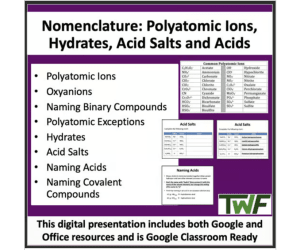
Nomenclature-Polyatomics & Covalent Compounds- Senior Chemistry Lesson
Science, Chemistry, Grade 10, 11, 12, Teacher Tools, Lesson Plans
Nomenclature-Polyatomics & Covalent Compounds - Senior Chemistry Lesson Your lesson covers the nomenclature of polyatomic compounds and covalent compounds. In order, the lesson teaches about; Polyatomic Ions, Oxyanions, Naming Binary Compounds, Polyatomic Exceptions, Hydrates, Acid Salts, Naming Acids, and Naming Covalent Compounds. Your lesson includes the teacher and student version of the presentation, an auto-graded exit ticket, and a student lesson handout so the students can record the notes on a more condensed medium. This lesson is designed to be your go-to resource, whether you're in a traditional classroom or a virtual one. With both a teacher version and a student version, it seamlessly fits into your lesson plans, making learning engaging and adaptable. Assessment made easy We've included an auto-graded Exit Ticket and a quiz with an answer key because I know you don't have an excess of time. I know you don't, because I don't and I know I'll do whatever I can to reduce my grading time. Whether you use PowerPoint or Google Slides, prefer Word or Google Docs, this lesson has you covered. This lesson comes in both Office and Google formats for your convenience. The student version of the presentation has strategically placed blanks for them to fill in as you're teaching. It keeps them active and engaged, encourages discussion, and leaves more time for those "aha" moments.
Author Teach With Fergy
Tags Chemistry Lesson, Valence Electrons, Ionic Bonding, Multivalent Ions, Ions, Nomenclature, Polyatomic Ions, Oxyanions, Hydrates
Cells, Skeletal & Muscular Systems: Cells, Tissues, Organs & Systems Gr. 5-8
Science, Life Sciences, Human Body, Grade 5, 6, 7, 8, Teacher Tools, Lesson Plans
Introduction Cells, Skeletal & Muscular Systems: Cells, Tissues, Organs & Systems Gr. 5-8 is a comprehensive science teaching resource tailored for grades 5 to 8. This resource explores human anatomy and biology in a way that is both accessible and engaging for younger learners. About the Chapter Slice : An in-depth look into cells — the fundamental building blocks of life. A study on how specialized cells group together to form tissues. An exploration of how tissues combine further to create organs. A detailed understanding of organ systems—how individual organs function within these systems. Detailed Coverage of Body Systems The resource covers the eight primary systems within the human body— including respiratory, circulatory, digestive systems among others—all introduced with precision and clarity. Further focus on muscular and skeletal system provide depth for learners interested in these areas. Engaging Activities: This product file offers various pre-reading tasks along with hands-on activities that promote active participation from students during class or home-based study sessions – suitable not only for whole groups but also small clusters or independent homework assignments. Note:All content aligns accurately with state standards as well as integrates Bloom's Taxonomy framework - ensuring academically rigorous content while leveraging STEM initiatives—the modern interdisciplinary education approach that connects Science elements effectively. Included are attractive color mini posters as visual aids supporting kinesthetic learning. In Conclusion... Consider "Cells, Skeletal & Muscular Systems: Cells, Tissues, Organs & Systems Gr. 5-8", a significant investment in your students' understanding of human biology. Inspire their curiosity and aid their exploration of the science within themselves.
Author Classroom Complete Press
Tags PDF

Senses,Nervous & Respiratory Systems: The Respiratory System - Lungs - FLASH-PC
Science, Life Sciences, Human Body, Common Core, Grade 5, 6, 7, 8, Teacher Tools, Lesson Plans
The Senses, Nervous & Respiratory Systems: The Respiratory System - Lungs - FLASH-PC A comprehensive teaching resource designed to simplify and enhance the learning experience on the functioning of lungs within the human bodily systems. Primarily composed for students in grades five through eight, this tool aids teacher instruction and student comprehension in public school environments as well as homeschooling settings. This software integrates reading passages accompanied by questions that are posed pre-reading and post-reading to solidify knowledge retention. It ensures student understanding of intricate body system processes while also helping them identify key vocabulary associated with these topics. Versatility of Use An interesting aspect of this resource is how versatile it can be in an educational setting. Its design applies just as effectively when used for whole group instruction classrooms or taught individually during home schooling lessons. Additionally, its application extends beyond just classroom time to become part of homework assignments too. Printable resources, Vocabulary flashcards, Interactive activities, Instructional video content. Senses, Nervous & Respiratory Systems: The Respiratory System - Lungs – FLASH-PC meets Common Core State Standards providing grade-level appropriate content that relates directly to Bloom's Taxonomy methods. This digital teaching solution stands apart with its task-based approach which helps students understand complex science subjects like Human Biology more effectively than traditional textbook methods alone might allow. In Summary - Navigating a lively classroom discussion on respiratory systems or guiding an eager homeschooler through their first encounters with biology science subjects, this user-friendly software bolsters your lesson plans while engaging young minds towards genuine scientific enthusiasm. This product is a practical yet innovative method to becoming an effective educator looking for compliance with standard curriculum requirements without sacrificing meaningful engagement.
Author Classroom Complete Press
Tags Software (PC)
I WONDER - How Was The Post It Invented | Animated Video Lesson
Inventors, Basic Science, Science, History: British, History, Social Studies, History: Europe, History: World, History: USA, Grade 3, 4, 5, 6, 7, 8, 9, Lesson Plans, Teacher Tools
Video Introduction An amazing video designed for the students to learn more about history. I WONDER - How Was The Post It Invented | Animated Video Lesson Do you like history? Which topic do you really enjoy about history? Have you ever read an interesting fact about the Vikings? If yes, can you mention them? What do you like most about the Victorian era? Can you name all the Tudors? Have you ever wondered how people used to live in ancient Japan and ancient China? Do you know any interesting facts about ancient Egyptians and the Pharaohs? Have you ever visited South America? What do you know about Incas and Aztecs? Celtic culture was really one of a kind, can you name any of the places that Celts used to live in? Imagine yourself living during the ancient Roman empire, how your life will look like? Ancient Greece was an amazing place to live in. What do you know about ancient Greek life? I WONDER - How Was The Post It Invented | Animated Video Lesson The video is perfect for encouraging the researching skills for the students, while learning more about history. I WONDER - How Was The Post It Invented | Animated Video Lesson This friendly designed video is suitable for students at school, homeschooling, and as a group activity. Format Available in MP4 format.
Author Educational Voice
Tags How Was The Post It Invented, How Was The Post It Invented Video, The Post It, The Post It Note History, The Post It Note History Video, The Post It Note History Facts, The Post It Note History Video For Kids