



3,876 products added recently
Page 33 - Science Lesson Plan Template
Enhance your science instruction with a flexible lesson plan template designed for educators. This tool helps you structure objectives, materials, procedures, and assessments efficiently. Use it to create organized and impactful science lessons that cater to your students' needs.

 Show filters

I WONDER - How Do Hydroelectric Dams Protect The Fish | Animated Video
Environmental Science, Earth and Environmental Sciences, Science, Animals, Life Sciences, Biology, Grade 6, 7, 8, 9, 10, 11, 12, Lesson Plans, Teacher Tools
Video Introduction An amazing video designed for the students to learn more about STEM. I WONDER - How Do Hydroelectric Dams Protect The Fish | Animated Video Lesson Do you like STEM subjects? what is your favorite one? Have you ever tried to plant a seed? If yes, tell us more about it. Or have you ever tried to invent something? If yes, tell us more about it. And how do you think it will help us? Have you ever seen a microorganism under a microscope? What was it? And how it looked like? Mathematics is a marvelous subject. Let' sharpen our brains and solve some equations. Do you like timetable tricks? What is your favorite one? Do you know how to code? Have you ever created an app or a game before? If yes, how was it like? I WONDER - How Do Hydroelectric Dams Protect The Fish | Animated Video Lesson The video is perfect for encouraging the researching skills for the students, while learning more about this fantastic topic. I WONDER - How Do Hydroelectric Dams Protect The Fish | Animated Video Lesson This friendly designed video is suitable for students at school, homeschooling, and as a group activity. Format Available in MP4 format.
Author Educational Voice
Tags How Do Hydroelectric Dams Protect The Fish, How Do Hydroelectric Dams Protect The Fish Video, Hydroelectric Dams, Hydroelectric Dams Facts, Hydroelectric Dams Facts For Kids, Hydroelectric Dams Video
I WONDER - What Causes The Aurora Borealis Effect | Animated Video
Geography, Social Studies, Earth Sciences, Earth and Environmental Sciences, Science, Grade 3, 4, 5, 6, 7, 8, 9, Lesson Plans, Teacher Tools
Video Introduction An amazing video designed for the students to learn more about famous places in different countries. I WONDER - What Causes The Aurora Borealis Effect | Animated Video Lesson What do you know about this place? Do you know in which part of the world it is? Have you ever visited this place? If yes, can you tell us more about your adventure, and what do you like the most about this place? Do you like reading about Geography? What is your favorite country in the whole world? If you are going on a trip where it will be? Which country? What you are going to see there? Does this country has a famous place to visit? I WONDER - What Causes The Aurora Borealis Effect | Animated Video Lesson The activity is perfect for encouraging the researching skills for the students, while learning more about this fantastic place. I WONDER - What Causes The Aurora Borealis Effect | Animated Video Lesson This friendly designed video is suitable for students at school, homeschooling, and as a group activity. Format Available in MP4 format.
Author Educational Voice
Tags What Causes The Aurora Borealis Effect, What Causes The Aurora Borealis Effect Video, The Aurora Borealis Effect, The Aurora Borealis Effect Video, The Aurora Borealis Effect Video For Kids, Aurora Borealis

Motion: Wave Motion - FLASH-PC
Science, Physics, Common Core, Grade 5, 6, 7, 8, Teacher Tools, Lesson Plans
Motion: Wave Motion - FLASH-PC The Motion: Wave Motion - FLASH-PC product is an exceptional teaching resource that delivers comprehensive, curriculum -centric content about the intriguing concept of Wave Motion. Meant for Grade 5 to Grade 8 educators, this innovative tool provides a bevy of enriching experiences that cater to various learning styles and preferences. Delving into Complexity: This resource elucidates the complexities of Wave Motion within the study of Physics through an array of digestible reading passages. To enhance reading comprehension and retention, sections are structured with specialized "before you read" and "after you read" questions. These built-in checks help foster a deep understanding by prompting students to think critically about each lesson's key takeaway points. Interactive Materials: Apart from text-based materials, the product also boasts unique printables that make learning engaging, hands-on, and interactive. These tangible components can serve as versatile supplemental aids in whole group sessions or more intimate small group discussions. One standout feature is its set of vocabulary flashcards which serve as powerful tools for consolidating knowledge acquisition on fundamental terms. Perfect for study rounds or quick recall activities during breaks between lessons—this element ticks off both instruction and reinforcement objectives. Digital media integration such as interactive activities plus audio-video supplements underline key concepts visually and aurally appealing ways. The active participation these elements generate keeps students engaged while promoting immediate application of what they've just learned. Educational Standards: Designed with utmost consideration for education standards today—the contents align with Common Core State Standards devised by experts who understand best practices in teaching Science subjects at junior levels. Further underscoring instructional intentionality is the writing standard based on Bloom's Taxonomy—a staple in framing effective learning objectives for successful student outcomes. Access and Availability: As a downloadable software (PC) type file—it offers hassle-free access anytime needed making it super convenient for teachers looking to integrate this resource into their existing lesson plans seamlessly—be it inside traditional classrooms or adapting homeschooling setups. In Conclusion: In sum, Motion: Wave Motion - FLASH-PC is a well-rounded, educator-friendly teaching resource elevating the study of Wave Motion using diverse learning techniques. Whether for introducing new lessons or reinforcing previously taught ones— this product serves as both a practical and innovative teaching tool.
Author Classroom Complete Press
Tags Software (PC)

Solar System: The Inner Planets - FLASH-PC
Science, Earth and Environmental Sciences, Space, Common Core, Grade 5, 6, 7, 8, Teacher Tools, Lesson Plans
Solar System: The Inner Planets - FLASH-PC An invaluable resource tailored to facilitate a deeper understanding of the inner planets in our awe-inspiring solar system. This high-quality teaching aid is targeted at fifth through eighth graders and it fits snugly within the expansive subject of science, focussing in particular on astronomy. Key Features: A strong amalgamation of varied learning elements such as printable material, vocabulary flash cards , and enlightening reading passages. Helpful "before you read" and "after you read" questions that enhance comprehension and encourage detailed analysis. Inclusion of up-to-date aspects like video content and interactive activities suitable for visual, auditory, or tactile learners. These can be utilized for large class instruction or smaller group discussions. They also serve homeschooling parents well when they need comprehensive lesson plans. The Content: The information presented is not simply interesting but painstakingly put together in consistency with the Common Core State Standards (CCSS). With clever design guided by Bloom's Taxonomy; this ensures pedagogically effectiveness by aligning goals towards the application of knowledge opposed to mere rote-learning. Ease-of-accessibility: This stands out due to its availability in just one product file that serves as software which is mainly compatible with PC-based systems–thus making it trouble-free for educators constantly on-the-move. Conclusion: No matter if you're a seasoned public school teacher seeking enriching science materials or a homeschooling parent looking for curriculums –the Solar System: The Inner Planets - FLASH-PC draws students into captivating concepts of astronomy in an educational and interactive manner.
Author Classroom Complete Press
Tags Software (PC)

I WONDER - What Animals Live In Snowy Conditions | Animated Video
STEM, Biology, Life Sciences, Science, Animals, Grade 1, 2, 3, 4, 5, 6, 7, 8, Lesson Plans, Teacher Tools
Video Introduction Animal kingdoms are full of fascinating wonders to learn. This video is designed for the students to learn more about animals in different countries. I WONDER - What Animals Live In Snowy Conditions | Animated Video Lesson Do you like animals? what is your favorite one? Do you own a pet? If yes, tell us more about it, like what its name? And what do you like most about it? What are the animal kingdoms? Can you write down the characteristics of each animal class like mammals, birds, reptiles, amphibian, fish and mollusks. Do you know that some animals can sing, can you name any of them? What is the largest and the smallest mammal in the world? What is the largest and the smallest bird in the world? What is the largest and the smallest fish in the world? I WONDER - What Animals Live In Snowy Conditions | Animated Video Lesson The video is perfect for encouraging the researching skills for the students, while learning more about these fantastic animals. I WONDER - What Animals Live In Snowy Conditions | Animated Video Lesson This friendly designed video is suitable for students at school, homeschooling, and as a group activity. Format Available in MP4 format.
Author Educational Voice
Tags What Animals Live In Snowy Conditions, What Animals Live In Snowy Conditions Video, Animals Live In Snowy Conditions, Animals Live In Snowy Conditions Facts, Animals Live In Snowy Conditions Video For Kids
I WONDER - What Dolphins Live In The Amazon Rainforest Animated Video
Geography, Social Studies, Animals, Life Sciences, Science, Nature & Plants, Grade 4, 5, 6, 7, 8, 9, Lesson Plans, Teacher Tools
Video Introduction An amazing video designed for the students to learn more about famous places in different countries. I WONDER - What Dolphins Live In The Amazon Rainforest | Animated Video Lesson Do you like geography?! Let's discover this amazing place and know more about its unique stories. Have you ever visited a unique place or a different country than yours? If yes, tell us about it! If no, tell us what kind of places you would like to visit in the future? Every country has it's own story tell us the story about your country: Where it is located? And when it has been established? I WONDER - What Dolphins Live In The Amazon Rainforest | Animated Video Lesson The activity is perfect for encouraging the researching skills for the students, while learning more about this fantastic place. I WONDER - What Dolphins Live In The Amazon Rainforest | Animated Video Lesson This friendly designed video is suitable for students at school, homeschooling, and as a group activity. Format Available in MP4 format.
Author Educational Voice
Rating
Tags What Dolphins Live In The Amazon Rainforest, Amazon Rainforest, Amazon Rainforest Video, Amazon Rainforest Facts, Amazon Rainforest Facts For Kids, Amazon Rainforest Video For Kids, Dolphins
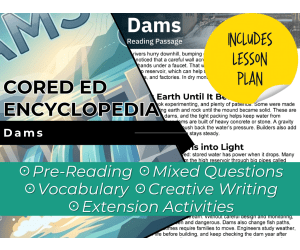
Dams Reading Comprehension Passage - Cored Ed Encyclopedia
ELA, Language Development, Reading Comprehension, Reading, Pre-Reading, Science, Technology, Physics, Earth and Environmental Sciences, Life Sciences, Grade 2, 3, 4, 5, Worksheets & Printables, Worksheets, Teacher Tools, Centers, Activities, Writing Prompts, Assessments, Quizzes and Tests, Quizzes, Lesson Plans
This dams reading comprehension with lesson plan includes: Visualization (on the front cover) Start your lesson by taking a minute to think and share something about the topic. Read the script aloud (slowly), perhaps prepare some music or sound effects. Student close their eyes and let their imaginations wander. Students open their eyes, read the question aloud and give them a few minutes to complete. Ask a few students to share or keep answers until the end to compare with what they learn in the passage. Quick pause—thousands of Cored Education products are included with your TeachSimple membership. Download links and encyclopedia index available here. Pre-Reading Trivia Students will write down one thing they already know about the subject and then read five more facts and discuss. These facts are fun, and the students will enjoy learning about the subject before reading more. Give 1 minute for students to write what they already know (no pressure—best guess is fine). Read the five facts together. After each fact, do ask a student for their opinion, was it surprising? Set a purpose by asking students to highlight/underline one fact they want to learn more about during the reading. Reading Passage The text is a high-interest reading passage with set paragraphs, roughly three to four paragraphs long. It contains a variety of themes about the topic, anywhere from history to technology. The passage is between 250 and 350 words in length. First, ask students to look at the headings and see what they’ll learn about today. What do they know about the topic/heading? First read options: Teacher read-aloud (best for support). Partner reading (paragraph by paragraph). While reading, students underline important details, and vocabulary words they think may come up in the questions section. Mixed Questions The first question page contains four multiple-choice questions, each with a choice of four answers, and three written response questions that require a sentence or two from the student. Students complete the mcqs first independently, then review quickly as a class. For the 3 written responses, try to get students giving the answer with some form of evidence: “I think ___ because the text says ___.” If students get stuck, send them back to check the passage. Vocabulary Questions Practice seven key words from the text in this section across two activities. First section is scrambled words where students will unscramble three words given a clue for each. The second section is a word to meaning matching activity. Before starting, have some students read out words they underlined in the passage. Ask students to say the word and read aloud the sentence(s) around each word. Ask students to do scrambled words and the matching exercise in pairs then go through answers as a class. For the scrambled spelling task, get four pairs to come up to the board and write the words for extra practice with the other student reading out the clue. For the matching task, prompt students to give full sentences: “I matched ___ with ___ because ___.” Creative Writing In this question, the student will be required to write a five to eight sentence paragraph on a question related to the topic. Before starting, ask students write down 3 key ideas they are going to include in their piece. Ask students for ideas to share around the class to help those struggling. Pro writing expectations: 5–8 sentences At least 2 facts or details from the passage At least 2 vocabulary words from the previous page Students read their paragraphs while classmates listen for facts and vocabulary words. Extension Activities This page is optional for fast finishers or to take home. There are several activities, each one requiring a different skill. Do some, do none, do all, completely optional - but you will feel reassured knowing every possibility is planned for. Includes summary writting question and additional facts. Answer Key There are answers for the multiple-choice questions, written response questions have sample answers, vocabulary answers and if there is a summary question then a sample summary will be provided as well. Lesson Plan Included Customized lesson plan for this lesson is included. Lesson Snapshot Title: Dams Genre: Nonfiction (informational text with headings) Subject: Science (Engineering) / Reading (Informational Text) Primary Topic: How dams store water, make electricity, and release water safely Estimated Guided Reading Level (A–Z): P What This Lesson Teaches Best Explains what a dam does by describing how a wall can hold back river water into a deep reservoir. Teaches types of dams and how they stay strong (embankment dams packed tight; gravity dams using weight; layers and drains for stability). Shows how stored water can generate electricity using penstocks, turbines, and generators. Highlights safety and trade-offs, including controlled release through a spillway, the danger of failure, and impacts on fish paths and river mud. Uses headings to organize information into clear sections (building, electricity, and safe water release). Learning Goals Students will explain how a dam changes a river’s flow and creates a reservoir. Students will describe how embankment dams are built and why tight packing matters. Students will identify the role of penstocks, turbines, and generators in making electricity. Students will explain why spillways are needed and how they help release extra water safely. Students will describe at least one cost or concern the passage connects to dams. Key Vocabulary From the Text reservoir — deep stored water behind a dam. embankment — packed earth-and-rock mound used to build a dam. penstocks — big pipes that send water down from a reservoir. turbines — spinning machines turned by rushing water. spillway — safe path for extra water to leave a reservoir. FULL CATALOG OF DOWNLOAD LINKS AND ENCYCLOPEDIA INDEX HERE
Author Cored Education
Rating
Tags Vocabulary, Reading Comprehension, Reading Passages, Lesson Plans, Ela Lesson Plans, Reading Comprehension Lesson Plans, Pre-reading, Science Lesson Plans, Physics, Technology

I WONDER - How Do You Know When Your Stomach Is Full
Human Body, Life Sciences, Science, Biology, STEM, Grade 6, 7, 8, Lesson Plans, Teacher Tools
Video Overview The human body is full of fascinating wonders to learn. This video is created to help the students recognize the anatomy and the job of the human body. I WONDER - How Do You Know When Your Stomach Is Full | Animated Video Lesson Every part and organ in our human body is vital so let's see how important they are. Have you ever imagined how we look like if we didn't have a skeleton? Did you know that because we have our amazing muscles we can stand! Do you know how many teeth do we have? Have you ever wondered about the food journey inside our body? Can you name all the glands in our body? Why do we have skin? Our nervous system is really good at sending signals. Can you tell us more about it? Are you really good at Mathematics, painting, or any other thing? You should really thank your brain about it! The famous five senses are really doing a great work? Can you explain how every sense works? I WONDER - How Do You Know When Your Stomach Is Full | Animated Video Lesson The video is perfect for encouraging the researching skills for the students, while learning more about our fantastic human body. I WONDER - How Do You Know When Your Stomach Is Full | Animated Video Lesson This friendly designed video is suitable for students at school, homeschooling, and as a group activity. Format Available in MP4 format.
Author Educational Voice
Tags How Do You Know When Your Stomach Is Full, How Do You Know When Your Stomach Is Full Video, Stomach, Stomach Facts, Stomach Facts For Kids, Stomach Video, Stomach Video For Kids

Discover! Animals
Science, Life Sciences, Animals, Grade 4, 5, 6, Teacher Tools, Lesson Plans
Discover! Animals: A Comprehensive Teaching Resource Discover! Animals is an exceptional teaching resource that covers diverse aspects of animal studies for students in grades 4 to 6. This versatile guide diligently incorporates various subjects, mainly concentrating on zoology. The manual includes well-structured lesson plans for teachers and homeschoolers that inspire captivating science lessons tailored to the age group. In Depth Topics Included: A thorough introduction to classification of animals into vertebrates and invertebrates. An inclusive overview on animal skeletons, behavior patterns like hibernation and migration, unique senses and defence mechanisms. Detailed exploration on 'animal young' through dietary habits which opens channels for profound discussions on biology while eliciting respect towards nature's complexities. The learning tool also encourages student engagement with activities accompanying each topic which flame curiosity thus leading a dynamic two-way teaching-learning process that prompts active participation among children. Versatility Beyond Classrooms: The Discover! Animals resource transcends its use beyond traditional classrooms. The flexible design paves way for group study or small tutorial sessions as well as serving as a perfect choice for extracurricular homework assignments for revisions or project-based learning experiences sans boundaries of syllabus limitations. This PDF product owes its merit to informative background details provided with each subject under discussion widening scope of research explorations available both educators and learners alike. In conclusion, Discover! Animals aptly simplifies academic concepts maintaining their factual integrity–an ideal investment option for educators aiming at realistically linking academics with real-world relevance while transforming science learning into a fascinating journey not perceived as an overwhelming task by students.
Author Classroom Complete Press
Tags PDF

Senses,Nervous & Respiratory Systems: The Nervous System - Brain - FLASH-PC
Science, Life Sciences, Human Body, Common Core, Grade 5, 6, 7, 8, Teacher Tools, Lesson Plans
Senses, Nervous & Respiratory Systems: The Nervous System - Brain - FLASH-PC This is a comprehensive teaching resource, tailor-made to simplify the understanding of the complex areas involved in learning about the brain and its role in our Senses, Nervous and Respiratory Systems. It connects students directly to fundamental concepts while serving to meet educators' needs on multiple levels. Tailored Content: Contains rich reading passages that illuminate intricate aspects of the subject matter. Eases difficult concepts and boosts comprehension by presenting information in an engaging manner. "Before you Read" questions for priming students' thought processes on new topics. "After you Read" queries designed to reinforce learning and solidify knowledge retention. Dynamic Printables: Oodles of dynamic printable material for educators' use. These printables offer flexibility for handouts or visual tools essential for illustrating key points during lessons. Vocabulary flashcards with pertinent terminology further enhance language fluency and understanding within this topic area. Innovative Learning Materials: Interactive activities promote experiential learning. Multimedia content such as videos cater towards diverse learner types and pedagogical methods. This educational resource is also aligned with Common Core State Standards through thoughtful design aligning standards relevant sections across lessons. Suitable Audiences: This teaching resource is best suited for Grade 5-8 students focusing on Science. Note: Peculiarly beneficial when incorporating Human Body specifics into lesson plans utilizing PC Software Resources. In conclusion, Senses,Nervous & Respiratory Systems: The Nervous System - Brain - FLASH-PC marries science education's challenges with innovative digital resources creating an excellently balanced instructional aid. Usage: Whole groups instruction, small groups, flipped-classrooms model or as enriching homework assignments. Simplify and enjoy the teaching experience with this comprehensive tool!
Author Classroom Complete Press
Tags Software (PC)

History of Flight
Science, Technology, Engineering, Not Grade Specific, Teacher Tools, Lesson Plans
The "History of Flight" Teaching Resource This is an enlightening resource crafted for educators looking to bolster their curriculum with science-based content. Compatible across all grades, it provides intriguing activities intended on promoting understanding of the key milestones in aviation and aeronautical engineering. Key Focus Areas: A deep dive into the Wright Brothers' monumental achievement in powered flight Swedensburg's pioneering pursuits leading up to Orville and Wilbur Wright's epoch-making first flight Beyond Historical Overview: In addition to historical context, this resource elucidates fundamental aerodynamics principles such as: Lift production by different wing shapes Factors affecting aircraft stability like pitch, yaw and roll An introduction to drag – which aids understanding airflow resistance on moving objects Paper Aircraft Crafting Project An interesting hands-on project involving paper aircraft crafting empowers students with practical application. Three distinctive paper plane designs cater both beginners as well seasoned origami enthusiasts - making learning fun! Inclusive PowerPoint Presentation: To facilitate ease of teaching this unit includes a thorough PowerPoint presentation combining worksheets, illustrative snaps plus short films - compiling an easy-to-grasp visual aid designed at aiding information retention. This dynamic product can be easily integrated into your lesson plan or serve as a exciting end-of-year activity or elective module. Offering stimulating material tying history-rich anecdotes with scientific theories; driving student interest whilst boosting technical acumen. Please make sure you leave us a review if you find value in this unit or have any suggestions for improvement because we continue working hard on our products with learners’ needs at heart and educator satisfaction in mind. Remember: Follow us on Instagram, Facebook and Pinterest for updates about new resources specifically curated for educators that spark interest amongst young minds!
Author Mr Gray History
Tags Aviation History, Aerodynamics, Wright Brothers, Paper Crafts, Hands-on Learning
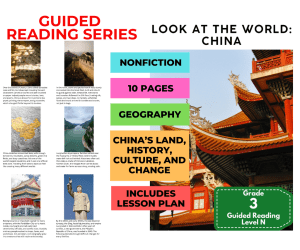
Guided Reading Level N - China (with Lesson Plan)
ELA, Resources for Teachers, Reading Comprehension, Reading, Science, Earth and Environmental Sciences, Social Studies, Geography, Language Development, History, Grade 2, 3, 4, Worksheets & Printables, Worksheets, Teacher Tools, Centers, Activities, Literacy Readers, Quizzes, Quizzes and Tests, Assessments, Lesson Plans
This Guided Reading Book - China (Level N) with lesson plan includes: Guided Reading Color Label (front cover x1) This is a quick way to match the book’s demands to what students can generally handle.. The overall goal is to use the level/color to pick books for several smaller groups. To qualify for a certain level, a student is expected to read a book from that level with about 90–94% accuracy. If a student is consistently accurate and understands, move up a level. If the student is struggling at that level, drop down and add more support. Each student will improve at completely different rates, but it is generally one of the best ways to check progress across the class. DOWNLOAD THE CATALOG TO VIEW ALL GUIDED READING BOOKS AVAILABLE (SORTED LEVELS A-Z) Pre-Reading Question (x1) Teacher asks the prompt aloud, can be while showing the cover or first page. Students share what they already know, or make educated guesses from the cover. Prompt them to use the target vocabulary. Write some of their responses on the board to look back at during the reading. Vocabulary Words (x5) Introduce the five words, best doing it one at a time. Start by saying it, while students repeat and then see if anyone knows what it means before reading further. Read through the meaning and try to briefly connect each word to a picture or gesture so it’s meaningful. Ask students to flip through the book pages and point to where they see each of the vocabulary words. While reading the book pause upon coming across one of the vocab words or read the sentence twice to make sure students understand the word has appeared. Optional: Ask students to raise hands whenever they see/hear one of the new words. Guided Reading Pages (x10) Check the book snapshot (below) for: primary topic - do you need to prep extra reading or intro materials on this? what is taught best - decide on 1-2 bullets to focus on, use the prompt or words provided here for best results. learning goals - what you are checking for students to be able to do after the session, elicit answers using prompts or words provided. key vocabulary (see section above). questions overview - so you know what is coming up and if you need to prep extra materials to assist understanding. Run the lesson You may have already looked at a few of the pages together, but you can show them some of the pictures again first to set meaning. Depending on how much time you have and how familiar your students are with guided reading class, you may want to read the book aloud first with the group first. Students whisper or partner read, while you listen in. If time, do it as a group, one student reading a page each. Use the guided page’s prompts to coach: “Check the picture / does it make sense?” “Point under the words / try the first sound” “Reread the sentence smoothly”. Try to focus more on one student per session (rotating every time), so you can work out if they are ready to move up or need to move down a level. Comprehension Questions (back cover x3) This is your way to check that students didn’t just say the words, but actually understood the text. First, let students answer by pointing to the page/picture and saying a short sentence. After any answer, follow with: “Show me where you found that in the text.” In bigger groups, have partners answer first (10–20 seconds), then call on 2–3 students to share. Differentiation tips: Emerging speakers/struggling readers: oral + pointing On-level: oral in a full sentence Higher: one written sentence or draw + label Book Snapshot Title: Look At the World: China Genre: Nonfiction (informational text) Subject: Social Studies (Geography/History/Culture) Primary Topic: China’s land, history, culture, and change Estimated Guided Reading Level (A–Z): N What This Book Teaches Best How China’s geography includes very different landforms and regions (mountains, deserts, rice fields, coastlines). How rivers shaped early settlement and farming, including the Huang He (Yellow River) valley and the Yangtze River. How ideas and goods traveled through dynasties and trade routes (writing, inventions, the Silk Road). How important places and structures reflect history (the Great Wall, Beijing, the Forbidden City). How China continues to change today while balancing growth, traditions, and environmental concerns. Learning Goals Students will describe the variety of landscapes and regions found in China using text details. Students will explain why people settled near the Huang He (Yellow River) long ago. Students will identify examples of how ideas and inventions spread beyond China’s borders. Students will describe how the Great Wall and the Silk Road are connected to protection and trade. Students will summarize key changes over time described in the text (dynasties, later government changes, modern growth). Students will explain how language, festivals, and conservation are part of life in China today. Key Vocabulary From the Text dynasties — ruling families that lead for long times. civilization — a large, organized society with shared culture. merchants — people who buy and sell goods. dialects — different ways people speak the same language. conservation — protecting plants and animals so they can survive. Discussion Prompts Pre-reading question: What have you heard or learned about China before today? Comprehension questions: What kinds of land and places does the text say China has across East Asia? Comprehension questions: Why do historians call the Huang He (Yellow River) valley important in the text? Comprehension questions: What does the text say merchants and travelers traded on the Silk Road? Printing Tips 1. Best Printing Method (Recommended) “Booklet” Printing (Best if Available) If your printer or PDF viewer supports Booklet Printing , use this. Settings to use: Print mode: Booklet Paper size: Letter or A4 (either works) Orientation: Landscape Print on both sides: Yes Flip on: Short edge Scaling: Fit to printable area Booklet subset: First test: Front sides only Then: Back sides only This will automatically: Pair pages correctly Put the cover on the outside Align everything for folding After printing, fold in half and staple along the spine . 2. If “Booklet” Printing Is NOT Available You can still print this correctly with manual duplex printing . Step-by-step: Open the PDF. Choose Print . Set: Orientation: Landscape Pages per sheet: 1 Print on both sides: Yes Flip on: Short edge Print all pages . Because each PDF page already contains two facing book pages, the result will still fold cleanly into a book. Thousands of Cored Education products are included with your TeachSimple membership. Download links and encyclopedia index available here.
Author Cored Education
Rating
Tags Reading Comprehension, Reading Passages, Reading, Guided Reading, Guided Reading Lesson Plan, Guided Reading Activity, Pre-reading, Social Studies Lesson Plans, Geography, History

I WONDER - Is The Skin Made Of Layers | Animated Video Lesson
Biology, Life Sciences, Science, Human Body, Grade 4, 5, 6, 7, 8, 9, 10, Lesson Plans, Teacher Tools
Video Overview The human body is full of fascinating wonders to learn. This video is created to help the students recognize the anatomy and the job of the human body. I WONDER - Is The Skin Made Of Layers | Animated Video Lesson Every part and organ in our human body is vital so let's see how important they are. Have you ever imagined how we look like if we didn't have a skeleton? Did you know that because we have our amazing muscles we can stand! Do you know how many teeth do we have? Have you ever wondered about the food journey inside our body? Can you name all the glands in our body? Why do we have skin? Our nervous system is really good at sending signals. Can you tell us more about it? Are you really good at Mathematics, painting, or any other thing? You should really thank your brain about it! The famous five senses are really doing a great work? Can you explain how every sense works? I WONDER - Is The Skin Made Of Layers | Animated Video Lesson The video is perfect for encouraging the researching skills for the students, while learning more about our fantastic human body. I WONDER - Is The Skin Made Of Layers | Animated Video Lesson This friendly designed video is suitable for students at school, homeschooling, and as a group activity. Format Available in MP4 format.
Author Educational Voice
Tags Is The Skin Made Of Layers, Is The Skin Made Of Layers Video, Skin Layers, Skin Layers Facts, Skin Layers Facts For Kids, Skin Layers Video, Skin Layers Video For Kids, Skin, Skin Facts, Skin Facts For Kids

I WONDER - Does Sugar Come In Different Forms | Animated Video Lesson
Human Body, Life Sciences, Science, Biology, STEM, Grade 4, 5, 6, 7, 8, 9, 10, Lesson Plans, Teacher Tools
Video Overview The human body is full of fascinating wonders to learn. This video is created to help the students recognize the anatomy and the job of the human body. I WONDER - Does Sugar Come In Different Forms | Animated Video Lesson Every part and organ in our human body is vital so let's see how important they are. Have you ever imagined how we look like if we didn't have a skeleton? Did you know that because we have our amazing muscles we can stand! Do you know how many teeth do we have? Have you ever wondered about the food journey inside our body? Can you name all the glands in our body? Why do we have skin? Our nervous system is really good at sending signals. Can you tell us more about it? Are you really good at Mathematics, painting, or any other thing? You should really thank your brain about it! The famous five senses are really doing a great work? Can you explain how every sense works? I WONDER - Does Sugar Come In Different Forms | Animated Video Lesson The video is perfect for encouraging the researching skills for the students, while learning more about our fantastic human body. I WONDER - Does Sugar Come In Different Forms | Animated Video Lesson This friendly designed video is suitable for students at school, homeschooling, and as a group activity. Format Available in MP4 format.
Author Educational Voice
Tags Does Sugar Come In Different Forms, Does Sugar Come In Different Forms Video, Different Forms Of Sugar, Different Forms Of Sugar Facts, Different Forms Of Sugar Facts For Kids, Different Forms Of Sugar Video

I WONDER - Do Animals See Differently From Humans | Animated Video
STEM, Animals, Life Sciences, Science, Biology, Human Body, Grade 1, 2, 3, 4, 5, 6, 7, 8, Lesson Plans, Teacher Tools
Video Introduction Animal kingdoms are full of fascinating wonders to learn. This video is designed for the students to learn more about animals in different countries. I WONDER - Do Animals See Differently From Humans | Animated Video Lesson Do you like animals? what is your favorite one? Do you own a pet? If yes, tell us more about it, like what its name? And what do you like most about it? What are the animal kingdoms? Can you write down the characteristics of each animal class like mammals, birds, reptiles, amphibian, fish and mollusks. Do you know that some animals can sing, can you name any of them? What is the largest and the smallest mammal in the world? What is the largest and the smallest bird in the world? What is the largest and the smallest fish in the world? I WONDER - Do Animals See Differently From Humans | Animated Video Lesson The video is perfect for encouraging the researching skills for the students, while learning more about these fantastic animals. I WONDER - Do Animals See Differently From Humans | Animated Video Lesson This friendly designed video is suitable for students at school, homeschooling, and as a group activity. Format Available in MP4 format.
Author Educational Voice
Tags Do Animals See Differently From Humans, Do Animals See Differently From Humans Video, Animals, Animal, Animals Facts, Animals Facts For Kids, Animals Video, Animals Video For Kids

Climate Change and Global Warming Unit - Lessons, Assessments and Worksheets
Science, Earth and Environmental Sciences, Earth Sciences, Grade 7, 8, 9, Lesson Plans, Teacher Tools
Climate Change and Global Warming Unit - This Unit will take place over 2-3 weeks and includes a MULTI-DAY lesson (student and teacher versions of the presentation), a Climate Change Bell Ringer activity , an Exit Ticket to check for student understanding, NINE videos, a Climate Change research activity , 1 Test with answer key, and a student lesson handout as a word document. The presentation is fun and applicable with THREE videos embedded into the presentation and many opportunities for inquiry-based learning and discussion. Designed for Middle/Secondary classes but can easily be adapted to fit an Elementary classroom. In order, the lesson covers: - Weather vs. Climate - Earth’s energy supply - The atmosphere - Greenhouse gases - The greenhouse effect - Enhanced greenhouse effect - The role of the carbon cycle - Effects of global warming - Historic climate change - Climate proxies - What you can do Google Classroom and Exit Ticket This resource is perfect for in-class or distance learning and integrates seamlessly with Google Classroom. Included is a link that with one click, will automatically create a copy of the resources and put them directly into your Google Drive. Purchase --> Open --> Click --> Assign to your students On the last Google Slide is a link to a four-question Exit Ticket that you can give as homework or to conclude your lesson in class. This lesson includes both Google and Office versions for ALL resources. The presentation is in Google Slides and PowerPoint while all documents contain Word and Google Doc versions. Having both options allows you to use either without worrying about formatting issues as all the work has already been done for you. It also allows you, as well as your students, to access everything no matter where you are or what kind of equipment is being used. --------------------------------------------------------------------------------------------- The minds-on inquiry activities are meant to break down student misconceptions and help guide them to the correct concepts. Included in the lesson package is: - The teacher version of the presentation - The student version of the presentation - Climate Change Research Assignment - An Exit Ticket - Climate Change - Bell Ringers, Class Warm-Ups, and Exit Tickets Bundle - NINE videos embedded in the presentation - 1 Test with an answer key - Student lesson handout ---------------------------------------- Digital and Distance Learning: This lesson is fully digital which makes it perfect for the classroom, distance learning, or as a sub-plan if needed. With a single click, the entire package will be imported into your Google Drive and will be ready to assign to your students or present in class. You can also place a copy of the resources directly into student Google Drive accounts for easy access. Included in your package is an Exit Ticket which can be directly accessed from the last Google Slide. Additionally, your purchase will create a copy of the Google Form Exit Ticket which you can edit to meet your class needs. Student Version: The student version of the lesson contains multiple blanks that need to be filled in throughout. These blanks are conveniently underlined and bolded on the teacher copy. I have found this to be the most effective means of keeping my students engaged and active without having them write everything out. This also leaves more time for discussion and activities. I also have a range of assignments and lessons/units from other grade levels at my store. Please CLICK HERE to have a look around and don’t forget to follow if you like what you see. Also, please visit my blog Teach With Fergy for my thoughts on teaching, learning and everything in between. Teach With Fergy
Author Teach With Fergy
Tags Climate Change, Global Warming, Ecology, Ecosystems, Climate Change Worksheet Answer Key
I WONDER - How Do Nocturnal Animals Catch Their Prey | Animated Video
STEM, Biology, Life Sciences, Science, Animals, Grade 4, 5, 6, 7, 8, 9, 10, Lesson Plans, Teacher Tools
Video Introduction Animal kingdoms are full of fascinating wonders to learn. This video is designed for the students to learn more about animals in different countries. I WONDER - How Do Nocturnal Animals Catch Their Prey | Animated Video Lesson Do you like animals? what is your favorite one? Do you own a pet? If yes, tell us more about it, like what its name? And what do you like most about it? What are the animal kingdoms? Can you write down the characteristics of each animal class like mammals, birds, reptiles, amphibian, fish and mollusks. Do you know that some animals can sing, can you name any of them? What is the largest and the smallest mammal in the world? What is the largest and the smallest bird in the world? What is the largest and the smallest fish in the world? I WONDER - How Do Nocturnal Animals Catch Their Prey | Animated Video Lesson The video is perfect for encouraging the researching skills for the students, while learning more about these fantastic animals. I WONDER - How Do Nocturnal Animals Catch Their Prey | Animated Video Lesson This friendly designed video is suitable for students at school, homeschooling, and as a group activity. Format Available in MP4 format.
Author Educational Voice
Tags How Do Nocturnal Animals Catch Their Prey, How Do Nocturnal Animals Catch Their Prey Video, Nocturnal Animals, Nocturnal Animal, Nocturnal Animals Facts, Nocturnal Animals Facts For Kids, Nocturnal Animals Video
I WONDER - How Can Dogs Use Their Amazing Sense Of Smell
STEM, Biology, Life Sciences, Science, Animals, Grade 1, 2, 3, 4, 5, 6, 7, 8, Lesson Plans, Teacher Tools
Video Introduction Animal kingdoms are full of fascinating wonders to learn. This video is designed for the students to learn more about animals in different countries. I WONDER - How Can Dogs Use Their Amazing Sense Of Smell | Animated Video Lesson Do you like animals? what is your favorite one? Do you own a pet? If yes, tell us more about it, like what its name? And what do you like most about it? What are the animal kingdoms? Can you write down the characteristics of each animal class like mammals, birds, reptiles, amphibian, fish and mollusks. Do you know that some animals can sing, can you name any of them? What is the largest and the smallest mammal in the world? What is the largest and the smallest bird in the world? What is the largest and the smallest fish in the world? I WONDER - How Can Dogs Use Their Amazing Sense Of Smell | Animated Video Lesson The video is perfect for encouraging the researching skills for the students, while learning more about these fantastic animals. I WONDER - How Can Dogs Use Their Amazing Sense Of Smell | Animated Video Lesson This friendly designed video is suitable for students at school, homeschooling, and as a group activity. Format Available in MP4 format.
Author Educational Voice
Tags How Can Dogs Use Their Amazing Sense Of Smell, How Can Dogs Use Their Amazing Sense Of Smell Video, Dogs Sense Of Smell, Dogs Sense Of Smell Facts, Dogs Sense Of Smell Facts For Kids, Dogs Sense Of Smell Video

I WONDER - What Jobs Did Albert Einstein Do | Animated Video Lesson
Biographies, Social Studies, Inventors, Basic Science, Science, Grade 4, 5, 6, 7, 8, 9, 10, Lesson Plans, Teacher Tools
Video Introduction An amazing video designed for the students to learn more about famous people in different countries. I WONDER - What Jobs Did Albert Einstein Do | Animated Video Lesson Do you know this person? How much do you know about him/her? Who is your idol? Why did you choose this person? Tell us more about him/her? Who is your favorite athlete? Or what is your favorite team? Have you recently heard a story about a famous person? Who was this person? Can you tell us more about him/her. Who is your favorite president, king, or queen? Why you chose that person? In your country, who are the most famous people? What did they do? Can you tell us more about them. What is your favorite invention? Who invented it? Who is your favorite artist? What is the most famous thing he/she have done? What is the most enjoyable you have read before? Who wrote it? I WONDER - What Jobs Did Albert Einstein Do | Animated Video Lesson The video is perfect for encouraging the researching skills for the students, while learning more about this fantastic place. I WONDER - What Jobs Did Albert Einstein Do | Animated Video Lesson This friendly designed video is suitable for students at school, homeschooling, and as a group activity. Format Available in MP4 format.
Author Educational Voice
Rating
Tags What Jobs Did Albert Einstein Do, What Jobs Did Albert Einstein Do Video, Albert Einstein Jobs, Albert Einstein Jobs Video, Albert Einstein Jobs Facts, Albert Einstein Jobs Facts For Kids, Albert Einstein Jobs Video For Kids
I WONDER - What Does Stomach Acid Do | Animated Video Lesson
STEM, Human Body, Life Sciences, Science, Biology, Grade 4, 5, 6, 7, 8, 9, 10, Lesson Plans, Teacher Tools
Video Overview The human body is full of fascinating wonders to learn. This video is created to help the students recognize the anatomy and the job of the human body. I WONDER - What Does Stomach Acid Do | Animated Video Lesson Every part and organ in our human body is vital so let's see how important they are. Have you ever imagined how we look like if we didn't have a skeleton? Did you know that because we have our amazing muscles we can stand! Do you know how many teeth do we have? Have you ever wondered about the food journey inside our body? Can you name all the glands in our body? Why do we have skin? Our nervous system is really good at sending signals. Can you tell us more about it? Are you really good at Mathematics, painting, or any other thing? You should really thank your brain about it! The famous five senses are really doing a great work? Can you explain how every sense works? I WONDER - What Does Stomach Acid Do | Animated Video Lesson The video is perfect for encouraging the researching skills for the students, while learning more about our fantastic human body. I WONDER - What Does Stomach Acid Do | Animated Video Lesson This friendly designed video is suitable for students at school, homeschooling, and as a group activity. Format Available in MP4 format.
Author Educational Voice
Tags What Does Stomach Acid Do, What Does Stomach Acid Do Video, Stomach Acid, Stomach Acid Facts, Stomach Acid Facts For Kids, Stomach Acid Video, Stomach Acid Video For Kids, Stomach
I WONDER - How Does Camouflage Help Animals | Animated Video Lesson
STEM, Animals, Life Sciences, Science, Biology, Grade 1, 2, 3, 4, 5, 6, 7, 8, Lesson Plans, Teacher Tools
Video Introduction Animal kingdoms are full of fascinating wonders to learn. This video is designed for the students to learn more about animals in different countries. I WONDER - How Does Camouflage Help Animals | Animated Video Lesson Do you like animals? what is your favorite one? Do you own a pet? If yes, tell us more about it, like what its name? And what do you like most about it? What are the animal kingdoms? Can you write down the characteristics of each animal class like mammals, birds, reptiles, amphibian, fish and mollusks. Do you know that some animals can sing, can you name any of them? What is the largest and the smallest mammal in the world? What is the largest and the smallest bird in the world? What is the largest and the smallest fish in the world? I WONDER - How Does Camouflage Help Animals | Animated Video Lesson The video is perfect for encouraging the researching skills for the students, while learning more about these fantastic animals. I WONDER - How Does Camouflage Help Animals | Animated Video Lesson This friendly designed video is suitable for students at school, homeschooling, and as a group activity. Format Available in MP4 format.
Author Educational Voice
Tags How Does Camouflage Help Animals, How Does Camouflage Help Animals Video, Animals Camouflage, Animals Camouflage Facts, Animals Camouflage Facts For Kids, Animals Camouflage Video, Animals Camouflage Video For Kids

I WONDER - What Are Exoplanets Like | Animated Video Lesson
Space, Earth and Environmental Sciences, Science, Grade 4, 5, 6, 7, 8, 9, 10, Teacher Tools, Lesson Plans
Video Introduction An amazing video designed for the students to learn more about space facts. I WONDER - What Are Exoplanets Like | Animated Video Lesson Do you like reading about space? If yes, what is your favorite topic? What do you know about our solar system? What is the smallest planet in our solar system? What is the biggest planet in our solar system? What is the hottest planet in our solar system? And what is the coldest one? Do you think there are aliens? If yes, what do you think they look like? What do they eat and how they speak to each other? Where do they live? What is a galaxy? And what is a milky way? Have you recently saw a shooting star? If yes, tell us more about it, like when did it happen and where? What is a blackhole? Can a blackhole gets bigger by time? Do you like counting the stars? What do you think a star is made of? I WONDER - What Are Exoplanets Like | Animated Video Lesson The video is perfect for encouraging the researching skills for the students, while learning more about the fantastic space. I WONDER - What Are Exoplanets Like | Animated Video Lesson This friendly designed video is suitable for students at school, homeschooling, and as a group activity. Format Available in MP4 format.
Author Educational Voice
Tags What Are Exoplanets Like, What Are Exoplanets Like Video, Exoplanet, Exoplanets, Exoplanets Facts, Exoplanet Facts For Kids, Exoplanet Video, Exoplanet Video For Kids, Exoplanets Video
Simple Machines: Gains and Losses with Simple Machines - FLASH-PC
Science, Technology, Engineering, Common Core, Grade 5, 6, 7, 8, Teacher Tools, Lesson Plans
Simple Machines: Gains and Losses with Simple Machines - FLASH-PC FLASH-PC is a resource for educators in the field of science and engineering education, designed specifically for students in Grades 5 to 8. It focuses on the basic principles of simple machines, inviting an exploration into their advantages and disadvantages. This educational product aligns well with the Common Core State Standards. It presents a wealth of material that encourages deep learning. Based on Bloom's Taxonomy, it guides students to attain higher cognitive levels such as understanding, applying, analyzing, evaluating, and creating. Diversity in Instruction Methods The teaching tool enables you to diversify your instruction methods through a host of materials designed to stimulate different learning styles. You'll find enlightening reading segments discussing various facets of simple machines, complemented by challenging pre-reading and post-reading questions that enhance understanding. Key Features: Vocabulary flashcards : Tailored for quick memory retention without overburdening learners. Digital Supports: Including video clips and audio files that make complex concepts easily understandable. Packed with Interactive Activities: To supplement traditional lecture-based teachings helping significantly improve student engagement. Rewarding Convenience! All this is available at your fingertips via its single downloadable Product File format compatible with PC software systems extends seamless integration into current lesson plans; extremely convenient! A Versatile Teaching Tool! It caters effectively across group instructions or small group activities inside class or homework assignments enhancing its utility! Conclusion In contemporary education, 'Simple Machines: Gains and Losses with Simple Machines' emerges as a powerful resource. Let’s embark today on our interactive digital journey exploring gains-and-losses-with-simple-machines & unleash the limitless potential of your students!
Author Classroom Complete Press
Tags Software (PC)

I WONDER - How Can Geothermal Energy Be Used | Animated Video Lesson
Environmental Science, Earth and Environmental Sciences, Science, Earth Sciences, Grade 5, 6, 7, 8, 9, 10, 11, Lesson Plans, Teacher Tools
Video Introduction An amazing video designed for the students to learn more about STEM. I WONDER - How Can Geothermal Energy Be Used | Animated Video Lesson Do you like STEM subjects? what is your favorite one? Have you ever tried to plant a seed? If yes, tell us more about it. Or have you ever tried to invent something? If yes, tell us more about it. And how do you think it will help us? Have you ever seen a microorganism under a microscope? What was it? And how it looked like? Mathematics is a marvelous subject. Let' sharpen our brains and solve some equations. Do you like timetable tricks? What is your favorite one? Do you know how to code? Have you ever created an app or a game before? If yes, how was it like? I WONDER - How Can Geothermal Energy Be Used | Animated Video Lesson The video is perfect for encouraging the researching skills for the students, while learning more about this fantastic topic. I WONDER - How Can Geothermal Energy Be Used | Animated Video Lesson This friendly designed video is suitable for students at school, homeschooling, and as a group activity. Format Available in MP4 format.
Author Educational Voice
Tags How Can Geothermal Energy Be Used, How Can Geothermal Energy Be Used Video, Geothermal Energy, Geothermal Energy Facts, Geothermal Energy Facts For Kids, Geothermal Energy Video, Geothermal Energy Video For Kids