



3,890 products added recently
Page 58 - Science Lesson Plan Template
Enhance your science instruction with a flexible lesson plan template designed for educators. This tool helps you structure objectives, materials, procedures, and assessments efficiently. Use it to create organized and impactful science lessons that cater to your students' needs.

 Show filters


I WONDER - What Are Forces | Animated Video Lesson
Physics, Science, Grade 4, 5, 6, 7, 8, 9, 10, Lesson Plans, Teacher Tools
Video Introduction An amazing activity designed for the students to learn more about STEM. I WONDER - What Are Forces | Animated Video Lesson Do you like STEM subjects? what is your favorite one? Have you ever tried to plant a seed? If yes, tell us more about it. Or have you ever tried to invent something? If yes, tell us more about it. And how do you think it will help us? Have you ever seen a microorganism under a microscope? What was it? And how it looked like? Mathematics is a marvelous subject. Let' sharpen our brains and solve some equations. Do you like timetable tricks? What is your favorite one? Do you know how to code? Have you ever created an app or a game before? If yes, how was it like? I WONDER - What Are Forces | Animated Video Lesson The video is perfect for encouraging the researching skills for the students, while learning more about this fantastic topic. I WONDER - What Are Forces | Animated Video Lesson This friendly designed video is suitable for students at school, homeschooling, and as a group activity. Format Available in MP4 format.
Author Educational Voice
Tags What Are Forces, What Are Forces Video, Force, Forces, Forces Facts, Forces Facts For Kids, Forces Facts Video, Physics, Phyysics Facts, Physics Video

I WONDER - How Did Blizzards Get Their Name | Animated Video Lesson
Environmental Science, Earth and Environmental Sciences, Science, Earth Sciences, Grade 3, 4, 5, 6, 7, 8, 9, Lesson Plans, Teacher Tools
Video Introduction An amazing video designed for the students to learn more about natural disasters in different countries. I WONDER - How Did Blizzards Get Their Name | Animated Video Lesson Do you like summer days where the sun is shinning and you can see beautiful flowers everywhere or winter days where it is raining or snowing and where you can set by the fireplace and enjoy the scene from outside your windows? How to do you thing the blizzards and hurricanes or tornadoes got their names? Can you name a volcanic mountain? Have you ever read about earthquakes? Do you know why earthquakes happen? I WONDER - How Did Blizzards Get Their Name | Animated Video Lesson The video is perfect for encouraging the researching skills for the students, while learning more about this fantastic phenomenon. I WONDER - How Did Blizzards Get Their Name | Animated Video Lesson This friendly designed video is suitable for students at school, homeschooling, and as a group activity. Format Available in MP4 format.
Author Educational Voice
Rating
Tags How Did Blizzards Get Their Name, Blizzards, Blizzards Facts, Blizzards Video, Blizzards Facts For Kids, Blizzards Video For Kids, Blizzards Name, Blizzards Names, Blizzards Names Facts

All About Oceanography | Earth Science Unit
Science, Earth and Environmental Sciences, Earth Sciences, Grade 1, 2, 3, 4, Lesson Plans, Teacher Tools
Dive into the mysteries of Earth's watery realms with this expansive oceanography teaching toolkit. Through vivid visuals, interactive worksheets and hands-on projects, core science concepts are broken down on topics like marine biology, seafloor topology and the physics of waves. Begin by charting the contours of tide pools, trenches and basins on illustrated ocean zone posters. Then trace the flow of energy up food chains while coloring mesmerizing sea creatures. Craft 3D models of whales navigating vertical layers harboring everything from tiny plankton to luminous deep-sea jellyfish. Discover how currents circulate heat and nutrients by analyzing articles written at two reading levels. Assess knowledge on branches of oceanography, tides and more using assembling activities, diagramming tasks and competitive memory games. Writing templates allow students to reflect on learnings through imaginative stories and expository passages on topics like tsunamis, pollution and conservation. This resource contains suggested teacher pacing, plus differentiation ideas for learners of all abilities. Easily incorporate modules into existing earth science, biology and physics units or facilitate an entire stand-alone oceanography study. Through activities tapping interdisciplinary skills, unlock the code to reading the blue planet! I hope you love how well-rounded and fun this unit is! Dive in and enjoy!
Author Simply Schoolgirl
Tags Earth Science Lesson, Marine Life, Oceanography Unit, Ocean, Oceans, Sea, Marine, Tides, Waves, Currents, Oceanography Earth Science
I WONDER - What Dolphins Live In The Amazon Rainforest Animated Video
Geography, Social Studies, Animals, Life Sciences, Science, Nature & Plants, Grade 4, 5, 6, 7, 8, 9, Lesson Plans, Teacher Tools
Video Introduction An amazing video designed for the students to learn more about famous places in different countries. I WONDER - What Dolphins Live In The Amazon Rainforest | Animated Video Lesson Do you like geography?! Let's discover this amazing place and know more about its unique stories. Have you ever visited a unique place or a different country than yours? If yes, tell us about it! If no, tell us what kind of places you would like to visit in the future? Every country has it's own story tell us the story about your country: Where it is located? And when it has been established? I WONDER - What Dolphins Live In The Amazon Rainforest | Animated Video Lesson The activity is perfect for encouraging the researching skills for the students, while learning more about this fantastic place. I WONDER - What Dolphins Live In The Amazon Rainforest | Animated Video Lesson This friendly designed video is suitable for students at school, homeschooling, and as a group activity. Format Available in MP4 format.
Author Educational Voice
Rating
Tags What Dolphins Live In The Amazon Rainforest, Amazon Rainforest, Amazon Rainforest Video, Amazon Rainforest Facts, Amazon Rainforest Facts For Kids, Amazon Rainforest Video For Kids, Dolphins

I WONDER - What Did The Albertosaurus Look Like | Animated Video
History: Ancient, History, Social Studies, History: World, Animals, Life Sciences, Science, Grade 4, 5, 6, 7, 8, 9, 10, Lesson Plans, Teacher Tools
Video Introduction An amazing video designed for the students to learn more about dinosaurs in different countries. I WONDER - What Did The Albertosaurus Look Like | Animated Video Lesson Do you like dinosaurs? what is your favorite one? Do you own a pet? If yes, tell us more about it, like what its name? And what do you like most about it? Do you think that your pet has been evolved from a dinosaur? Can you write down the characteristics of your favourite dinosaur like it's shape, their rivals, where did it use to live and what was their favourite food? What is the largest and the smallest dinosaur that ever found? Why is the T-rex is so famous? Have you ever read any interesting facts about it? Can you name any of the carnivores or herbivores dinosaurs? I WONDER - What Did The Albertosaurus Look Like | Animated Video Lesson The video is perfect for encouraging the researching skills for the students, while learning more about dinosaurs. I WONDER - What Did The Albertosaurus Look Like | Animated Video Lesson This friendly designed video is suitable for students at school, homeschooling, and as a group activity. Format Available in MP4 format.
Author Educational Voice
Rating
Tags What Did The Albertosaurus Look Like, What Did The Albertosaurus Look Like Video, Albertosaurus, Albertosaurus Facts, Albertosaurus Video, Albertosaurus Facts For Kids, Albertosaurus Video For Kids
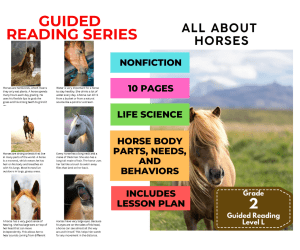
Guided Reading Level L - All About Horses (with Lesson Plan)
ELA, Resources for Teachers, Reading Comprehension, Reading, Science, Language Development, Life Sciences, Animals, Pre-Reading, Vocabulary, Grade 2, 3, 4, Worksheets & Printables, Worksheets, Teacher Tools, Centers, Activities, Literacy Readers, Quizzes, Quizzes and Tests, Assessments, Lesson Plans
This Guided Reading Book - All About Horses (Level L) with lesson plan includes: Guided Reading Color Label (front cover x1) This is a quick way to match the book’s demands to what students can generally handle.. The overall goal is to use the level/color to pick books for several smaller groups. To qualify for a certain level, a student is expected to read a book from that level with about 90–94% accuracy. If a student is consistently accurate and understands, move up a level. If the student is struggling at that level, drop down and add more support. Each student will improve at completely different rates, but it is generally one of the best ways to check progress across the class. DOWNLOAD THE CATALOG TO VIEW ALL GUIDED READING BOOKS AVAILABLE (SORTED LEVELS A-Z) Pre-Reading Question (x1) Teacher asks the prompt aloud, can be while showing the cover or first page. Students share what they already know, or make educated guesses from the cover. Prompt them to use the target vocabulary. Write some of their responses on the board to look back at during the reading. Vocabulary Words (x5) Introduce the five words, best doing it one at a time. Start by saying it, while students repeat and then see if anyone knows what it means before reading further. Read through the meaning and try to briefly connect each word to a picture or gesture so it’s meaningful. Ask students to flip through the book pages and point to where they see each of the vocabulary words. While reading the book pause upon coming across one of the vocab words or read the sentence twice to make sure students understand the word has appeared. Optional: Ask students to raise hands whenever they see/hear one of the new words. Guided Reading Pages (x10) Check the book snapshot (below) for: primary topic - do you need to prep extra reading or intro materials on this? what is taught best - decide on 1-2 bullets to focus on, use the prompt or words provided here for best results. learning goals - what you are checking for students to be able to do after the session, elicit answers using prompts or words provided. key vocabulary (see section above). questions overview - so you know what is coming up and if you need to prep extra materials to assist understanding. Run the lesson You may have already looked at a few of the pages together, but you can show them some of the pictures again first to set meaning. Depending on how much time you have and how familiar your students are with guided reading class, you may want to read the book aloud first with the group first. Students whisper or partner read, while you listen in. If time, do it as a group, one student reading a page each. Use the guided page’s prompts to coach: “Check the picture / does it make sense?” “Point under the words / try the first sound” “Reread the sentence smoothly”. Try to focus more on one student per session (rotating every time), so you can work out if they are ready to move up or need to move down a level. Comprehension Questions (back cover x3) This is your way to check that students didn’t just say the words, but actually understood the text. First, let students answer by pointing to the page/picture and saying a short sentence. After any answer, follow with: “Show me where you found that in the text.” In bigger groups, have partners answer first (10–20 seconds), then call on 2–3 students to share. Differentiation tips: Emerging speakers/struggling readers: oral + pointing On-level: oral in a full sentence Higher: one written sentence or draw + label Book Snapshot Title: All About Horses Genre: Nonfiction (informational) Subject: Life Science / Reading (Informational Text) Primary Topic: Horse body parts, needs, and behaviors Estimated Guided Reading Level (A–Z): L What This Book Teaches Best Key animal facts about horses (they are strong animals, mammals, and live outdoors in grassy areas). How horse body parts help them (mane and tail; tail swishes away flies). What horses need to stay healthy (they eat plants and drink a lot of water). How horses move (trot with “diagonal pairs,” and gallop as the fastest way to move with hooves off the ground). Special horse behaviors and life stages (sleeping while standing; a baby horse is a foal). Learning Goals Students will identify key facts about horses (habitat, body traits, and needs) from the text. Students will explain how a horse uses its tail based on details in the book. Students will describe what horses eat and how they graze using evidence from the text. Students will compare two horse movements (trot and gallop) using information from the book. Students will explain how a horse can sleep while standing without falling over. Students will describe what a foal is and what it can do soon after being born. Key Vocabulary From the Text mammal — an animal that breathes air with lungs. herbivores — animals that eat only plants. grazing — eating grass little by little over time. diagonal — slanted, from one corner to the opposite corner. hooves — the hard feet of a horse. Discussion Prompts Pre-reading question: What do you think a horse needs to stay healthy outdoors? Comprehension questions: What does the text say a horse uses its tail for? How does the text describe a trot? What is a foal, and what can it do within an hour of being born? Printing Tips 1. Best Printing Method (Recommended) “Booklet” Printing (Best if Available) If your printer or PDF viewer supports Booklet Printing , use this. Settings to use: Print mode: Booklet Paper size: Letter or A4 (either works) Orientation: Landscape Print on both sides: Yes Flip on: Short edge Scaling: Fit to printable area Booklet subset: First test: Front sides only Then: Back sides only This will automatically: Pair pages correctly Put the cover on the outside Align everything for folding After printing, fold in half and staple along the spine . 2. If “Booklet” Printing Is NOT Available You can still print this correctly with manual duplex printing . Step-by-step: Open the PDF. Choose Print . Set: Orientation: Landscape Pages per sheet: 1 Print on both sides: Yes Flip on: Short edge Print all pages . Because each PDF page already contains two facing book pages, the result will still fold cleanly into a book. Thousands of Cored Education products are included with your TeachSimple membership. Download links and encyclopedia index available here.
Author Cored Education
Rating
Tags Reading Comprehension, Reading Passages, Reading, Guided Reading, Guided Reading Lesson Plan, Guided Reading Activity, Pre-reading, Science Lesson Plans, Life Science, Animals

Galaxies & The Universe - Digital Lesson Plan Gr. 5-8 | PC Software
Science, Earth and Environmental Sciences, Space, Grade 3, 4, 5, 6, 7, 8, Teacher Tools, Lesson Plans
Galaxies & The Universe - Digital Lesson Plan Gr. 5-8 | PC Software This is an intriguing teaching software that navigates the thrilling terrain of galaxies and the universe, catering to students from Grade 3 through 8. Content: This multimedia resource divides its content into an interactive digital lesson plan with 80 pages. It traverses topics from particles of matter to complex star systems in our universe. Intriguing subjects covered include: Black Holes and Gravity Nebulae Pulsars Educational Features: The software provides rich reading passages for each topic, supplemented by "Before and After" reading activities. Test preps are provided to reinforce various lessons. Interactive Learning: Each lesson includes entertaining games such as memory match games or crosswords, amplifying student engagement and transforming learning into a fun-filled experience. Resources: Printable resources are included in the package, supporting different learning styles & offering convenient options for additional study or homework. Assessments : Comprehension quizzes assist instructors in assessing student understanding after each topic covered. This fosters real-time adjustments needed in instructional delivery whenever miscomprehensions arise. Linguistic Inclusion: The software also offers English & Spanish Text-to-Speech features which promote inclusivity for classrooms with diverse linguistic backgrounds. Bloom's Taxonomy Alignment & Curriculum Standards: Designed with careful consideration of Bloom's Taxonomy principles, this product seamlessly aligns within your school's curriculum standards. All these features make Galaxies & The Universe - Digital Lesson Plan Gr. 5-8 | PC Software an excellent resource in any classroom setting from whole class instructions to small group workspaces assignments or homework. It simplifies scientific complexities, enabling a mesmerizing journey through the universe thereby fostering interest in young astronomers.
Author Classroom Complete Press
Tags Astronomy Lesson Plan, Science Reading Passage, Universe Lesson, Galaxies Activity, Science Activity
I WONDER - What Similarities Do Humans And Chicken Have
STEM, Biology, Life Sciences, Science, Animals, Grade 1, 2, 3, 4, 5, 6, 7, 8, Lesson Plans, Teacher Tools
Video Introduction Animal kingdoms are full of fascinating wonders to learn. This video is designed for the students to learn more about animals in different countries. I WONDER - What Similarities Do Humans And Chicken Have | Animated Video Lesson Do you like animals? what is your favorite one? Do you own a pet? If yes, tell us more about it, like what its name? And what do you like most about it? What are the animal kingdoms? Can you write down the characteristics of each animal class like mammals, birds, reptiles, amphibian, fish and mollusks. Do you know that some animals can sing, can you name any of them? What is the largest and the smallest mammal in the world? What is the largest and the smallest bird in the world? What is the largest and the smallest fish in the world? I WONDER - What Similarities Do Humans And Chicken Have | Animated Video Lesson The video is perfect for encouraging the researching skills for the students, while learning more about these fantastic animals. I WONDER - What Similarities Do Humans And Chicken Have | Animated Video Lesson This friendly designed video is suitable for students at school, homeschooling, and as a group activity. Format Available in MP4 format.
Author Educational Voice
Tags What Similarities Do Humans And Chicken Have, What Similarities Do Humans And Chicken Have Video, Chicken, Chicken Facts, Chicken Facts For Kids, Chicken Video, Chicken Video For Kids, Humans

I WONDER - How Is Chocolate Made | Animated Video Lesson
Chemistry, Science, STEM, Grade 5, 6, 7, 8, 9, 10, 11, Lesson Plans, Teacher Tools
Video Introduction An amazing video designed for the students to learn more about STEM. I WONDER - How Is Chocolate Made | Animated Video Lesson Do you like STEM subjects? what is your favorite one? Have you ever tried to plant a seed? If yes, tell us more about it. Or have you ever tried to invent something? If yes, tell us more about it. And how do you think it will help us? Have you ever seen a microorganism under a microscope? What was it? And how it looked like? Mathematics is a marvelous subject. Let' sharpen our brains and solve some equations. Do you like timetable tricks? What is your favorite one? Do you know how to code? Have you ever created an app or a game before? If yes, how was it like? I WONDER - How Is Chocolate Made | Animated Video Lesson The video is perfect for encouraging the researching skills for the students, while learning more about this fantastic topic. I WONDER - How Is Chocolate Made | Animated Video Lesson This friendly designed video is suitable for students at school, homeschooling, and as a group activity. Format Available in MP4 format.
Author Educational Voice
Rating
Tags How Is Chocolate Made, How Is Chocolate Made Video, Chocolate, Chocolate Facts, Chocolate Video, Chocolate Facts For Kids, Chocolate Video For Kids, Chocolate Science, Chocolate Science Video
I WONDER - Are Bees Good Pollinators | Animated Video Lesson
Insects, Life Sciences, Science, Nature & Plants, Grade 4, 5, 6, 7, 8, 9, 10, Lesson Plans, Teacher Tools
Video Introduction An amazing activity designed for the students to learn more about STEM. I WONDER - Are Bees Good Pollinators | Animated Video Lesson Do you like STEM subjects? what is your favorite one? Have you ever tried to plant a seed? If yes, tell us more about it. Or have you ever tried to invent something? If yes, tell us more about it. And how do you think it will help us? Have you ever seen a microorganism under a microscope? What was it? And how it looked like? Mathematics is a marvelous subject. Let' sharpen our brains and solve some equations. Do you like timetable tricks? What is your favorite one? Do you know how to code? Have you ever created an app or a game before? If yes, how was it like? I WONDER - Are Bees Good Pollinators | Animated Video Lesson The video is perfect for encouraging the researching skills for the students, while learning more about this fantastic topic. I WONDER - Are Bees Good Pollinators | Animated Video Lesson This friendly designed video is suitable for students at school, homeschooling, and as a group activity. Format Available in MP4 format.
Author Educational Voice
Tags Are Bees Good Pollinators, Are Bees Good Pollinators Video, Bees, Bees Facts, Bees Facts For Kids, Bees Video, Bees Video For Kids, Pollinators, Pollinators Facts, Pollinators Video

I WONDER - Why Was The Baryonyx's Snout Special | Animated Video
History: Ancient, History, Social Studies, History: World, Animals, Life Sciences, Science, Grade 4, 5, 6, 7, 8, 9, 10, Lesson Plans, Teacher Tools
Video Introduction An amazing video designed for the students to learn more about dinosaurs in different countries. I WONDER - Why Was The Baryonyx's Snout Special | Animated Video Lesson Do you like dinosaurs? what is your favorite one? Do you own a pet? If yes, tell us more about it, like what its name? And what do you like most about it? Do you think that your pet has been evolved from a dinosaur? Can you write down the characteristics of your favourite dinosaur like it's shape, their rivals, where did it use to live and what was their favourite food? What is the largest and the smallest dinosaur that ever found? Why is the T-rex is so famous? Have you ever read any interesting facts about it? Can you name any of the carnivores or herbivores dinosaurs? I WONDER - Why Was The Baryonyx's Snout Special | Animated Video Lesson The video is perfect for encouraging the researching skills for the students, while learning more about dinosaurs. I WONDER - Why Was The Baryonyx's Snout Special | Animated Video Lesson This friendly designed video is suitable for students at school, homeschooling, and as a group activity. Format Available in MP4 format.
Author Educational Voice
Rating
Tags Why Was The Baryonyx's Snout Special, Why Was The Baryonyx's Snout Special Video, Baryonyx's Snout, Baryonyx's Snout Facts, Baryonyx's Snout Video, Baryonyx's Snout Video For Kids, Baryonyx's Snout Facts For Kids

Atoms, Molecules & Elements: What Are Atoms? Gr. 5-8
Science, Life Sciences, Biology, Grade 5, 6, 7, 8, Teacher Tools, Lesson Plans
Atoms, Molecules & Elements: What Are Atoms? Gr. 5-8 Engage young science enthusiasts with this detailed exploration of atoms, molecules, and elements, specifically tailored for learners in grades 5 to 8. This teaching resource specializes in unveiling the hidden world of atomic structures through easy-to-understand language and vocabulary. About This Material This learning material focuses on 'What Are Atoms?'—a chapter slice from the full lesson plan titled "Atoms, Molecules & Elements". It introduces students to the fascinating journey where they investigate each part of an atom. In addition to understanding what an atom is comprised of , learners will also discover what compounds are. Making use of the periodic table as a handy tool to comprehend how components like calcium (Ca), chlorine (Cl), and helium (He) fit into larger structures is another integral facet embedded within this resource. Engaging activities exploit these practical applications further promoting scientific comprehension among learners. A Comprehensive Approach The resource doesn't just target cognition but also makes provision for comprehensive practice. From reading passages that diving deep into core material,(b) student activities that bolster hands-on learning experiences to crosswords and word searches that challenge them - students interact with various facets that facilitate whole-class engagement or assist in targeted small group work or even serve as interesting homework assignments .(b) A comprehension quiz serves two purposes – one is assessing knowledge assimilation while other being preparation for future tests on analogous topics – thus setting learners on a path gently leading towards grade advancement via skill enhancement. Inclusive within this product file are color mini posters which effectively synchronize with State Standards aligned content written following Bloom's Taxonomy norms plus STEM initiatives - aiming at making science both clear-cut as well as engrossing. Product Details This product comes packaged as a PDF simplifying digital access anywhere, anytime thus facilitating learning both within traditional class room settings as well evolving homeschooling scenarios if any . Bear in mind though , despite covering essential biology subtopics , it is essentially a chapter slice and not the full lesson plan. However, this comprehensive package equips you with pivotal tools that contribute to making learning both interesting as well easy-to-understand for your grade 5-8 learners.
Author Classroom Complete Press
Tags PDF
I WONDER - What Is A Rhino Horn Made From | Animated Video Lesson
Animals, Life Sciences, Science, STEM, Grade 3, 4, 5, 6, 7, 8, 9, Lesson Plans, Teacher Tools
Video Introduction Animal kingdoms are full of fascinating wonders to learn. This video is designed for the students to learn more about animals in different countries. I WONDER - What Is A Rhino Horn Made From | Animated Video Lesson Do you like animals? what is your favorite one? Do you own a pet? If yes, tell us more about it, like what its name? And what do you like most about it? What are the animal kingdoms? Can you write down the characteristics of each animal class like mammals, birds, reptiles, amphibian, fish and mollusks. Do you know that some animals can sing, can you name any of them? What is the largest and the smallest mammal in the world? What is the largest and the smallest bird in the world? What is the largest and the smallest fish in the world? I WONDER - What Is A Rhino Horn Made From | Animated Video Lesson The video is perfect for encouraging the researching skills for the students, while learning more about these fantastic animals. I WONDER - What Is A Rhino Horn Made From | Animated Video Lesson This friendly designed video is suitable for students at school, homeschooling, and as a group activity. Format Available in MP4 format.
Author Educational Voice
Tags What Is A Rhino Horn Made From, What Is A Rhino Horn Made From Video, Rhino, Rhino Facts, Rhino Facts For Kids, Rhino Video, Rhino Video For Kids, Animal, Animals, Animals Facts

I WONDER - How Old Can Dogs Live | Animated Video Lesson
STEM, Animals, Life Sciences, Science, Biology, Grade 1, 2, 3, 4, 5, 6, 7, 8, Lesson Plans, Teacher Tools
Video Introduction Animal kingdoms are full of fascinating wonders to learn. This video is designed for the students to learn more about animals in different countries. I WONDER - How Old Can Dogs Live | Animated Video Lesson Do you like animals? what is your favorite one? Do you own a pet? If yes, tell us more about it, like what its name? And what do you like most about it? What are the animal kingdoms? Can you write down the characteristics of each animal class like mammals, birds, reptiles, amphibian, fish and mollusks. Do you know that some animals can sing, can you name any of them? What is the largest and the smallest mammal in the world? What is the largest and the smallest bird in the world? What is the largest and the smallest fish in the world? I WONDER - How Old Can Dogs Live | Animated Video Lesson The video is perfect for encouraging the researching skills for the students, while learning more about these fantastic animals. I WONDER - How Old Can Dogs Live | Animated Video Lesson This friendly designed video is suitable for students at school, homeschooling, and as a group activity. Format Available in MP4 format.
Author Educational Voice
Tags How Old Can Dogs Live, How Old Can Dogs Live Video, Dogs, Dog, Dogs Facts, Dogs Facts For Kids, Dogs Video, Dogs Video For Kids, Dog Facts, Dog Video

Circulatory, Digestive & Reproductive Systems - Digital Lesson Plan Gr. 5-8 | MAC Software
Science, Life Sciences, Human Body, Grade 3, 4, 5, 6, 7, 8, Teacher Tools, Lesson Plans
The Circulatory, Digestive & Reproductive Systems - Digital Lesson Plan Gr. 5-8 | MAC Software A comprehensive and engaging teaching resource geared towards fostering an in-depth understanding of the human body's major systems among grade 5 to 8 students. Features: Highly interactive, easy-to-navigate design. An invigorating journey inside the human body for learners. Teaching Tool Topics: The journey of red blood cells traveling through veins and arteries. The mechanism by which the heart pumps blood throughout the body. An exploration of how ingested food is converted into energy by our bodies. A deep dive into the functions of kidneys and intestines in waste management within our system. A detailed education about each stage of human fetal development incrementally for understanding reproduction better. This learning pack also includesreading passages followed swiftly by interactive activities designed both before and after reading sections. Bonus feature: Multimedia support via videos and audio clips that complement textual instruction superbly well at just a click away. This software tool captures an exception blend of interdisciplinary knowledge technology-based learning methods for keeping students excited about learning complex scientific content; A vital asset for teachers educating Grade 3-8 learners focusing on Anatomy.
Author Classroom Complete Press
Tags Anatomy Lesson Plan, Science Lesson Plan, Digital Anatomy Lesson, Science Reading Passage, Reproductive Systems

I WONDER - What Are Radio Waves | Animated Video Lesson
Physics, Science, Grade 6, 7, 8, 9, 10, 11, 12, Lesson Plans, Teacher Tools
Video Introduction An amazing activity designed for the students to learn more about STEM. I WONDER - What Are Radio Waves | Animated Video Lesson Do you like STEM subjects? what is your favorite one? Have you ever tried to plant a seed? If yes, tell us more about it. Or have you ever tried to invent something? If yes, tell us more about it. And how do you think it will help us? Have you ever seen a microorganism under a microscope? What was it? And how it looked like? Mathematics is a marvelous subject. Let' sharpen our brains and solve some equations. Do you like timetable tricks? What is your favorite one? Do you know how to code? Have you ever created an app or a game before? If yes, how was it like? I WONDER - What Are Radio Waves | Animated Video Lesson The video is perfect for encouraging the researching skills for the students, while learning more about this fantastic topic. I WONDER - What Are Radio Waves | Animated Video Lesson This friendly designed video is suitable for students at school, homeschooling, and as a group activity. Format Available in MP4 format.
Author Educational Voice
Tags What Are Radio Waves, What Are Radio Waves Video, Radio Waves, Radio Waves Facts, Radio Waves Facts For Kids, Radio Waves Facts Video, Radio Waves Facts Video For Kids, Radio Wave, Radio Waves Video

The Urinary System - Senior Biology lesson
Science, Life Sciences, Biology, Grade 11, 12, Teacher Tools, Lesson Plans
The Urinary System - Senior High School Biology Lesson Your lesson covers the structure and function of the urinary system. In order, the lesson teaches about; the Kidney, Bladder, Nephrons, the formation of urine, the reabsorption of urine, secretion of urine via the Distal Tubule, maintaining water balance, ADH, blood pressure and pH Balance, and kidney disease Your lesson includes the teacher and student version of the presentation, FIVE embedded videos, an auto-graded exit ticket, and a student lesson handout so the students can record the notes on a more condensed medium. This lesson is designed to be your go-to resource, whether you're in a traditional classroom or a virtual one. With both a teacher version and a student version, it seamlessly fits into your lesson plans, making learning engaging and adaptable. Assessment made easy We've included an auto-graded Exit Ticket and a quiz with an answer key because I know you don't have an excess of time. I know you don't, because I don't and I know I'll do whatever I can to reduce my grading time. Whether you use PowerPoint or Google Slides, prefer Word or Google Docs, this lesson has you covered. This lesson comes in both Office and Google formats for your convenience. The student version of the presentation has strategically placed blanks for them to fill in as you're teaching. It keeps them active and engaged, encourages discussion, and leaves more time for those "aha" moments.
Author Teach With Fergy
Tags Senior Biology, Biology Lesson, Hormones

The Human Body Gr. 4-6
Science, Life Sciences, Human Body, Grade 4, 5, Teacher Tools, Lesson Plans
The Human Body Gr. 4-6 This invaluable teaching resource provides an in-depth exploration of the key systems of human body including: The Skeletal System The Muscular System The Respiratory System The Circulatory System The Digestive System, And the Nervous System. Who is this for? This product is elegantly crafted for grade 4 to 6 learners and primarily falls under the broad category of science, with a central focus on human biology. An Eye on Holistic Education An essential element setting this curriculum apart lies in its unique fusion of varied learning methods aimed at reinforcing information retention. These include: Avenues for cognitive development: Creative art-based tasks fostering imagination and cognitive prowess among students. Kinetic learning: Inclusion of physical activities enhancing motor skills while consolidating learnings from each lesson. Literacy Skills Enhancement: Carefully structured tasks ensuring continuous creative writing practice eventually ending up enhancing verbal capabilities considerably. Numeracy Skills Development: Fusion of mathematics-related activities leads to practical applications, strengthening numeracy skills and extending benefits beyond a science-oriented teaching plan. Flexibility & Adaptability – A Teacher’s Delight! This curriculum has been ingeniously designed with optional activities catering to educators' varying teaching styles or specific classroom requirements promoting adaptability whether it is intended for group instruction, small group involvement, or individual assignments. Pleasurable Revision! - To ensure adequate revision while keeping the fun element alive, incorporated within are engaging crossword puzzles and heighten engagement-level word-search games. Organised Evaluation – The Cherry on Top The product is carefully topped with systematically integrated answer keys aiding prompt evaluation, enabling timely feedback hence strengthening consistent progress monitoring efforts. In conclusion, The Human Body Gr. 4-6 serves as an indispensable resource for teachers empowering not just the creation of a comprehensive lesson plan but facilitates in nurturing curiosity about human anatomy among middle-school students.
Author Classroom Complete Press
Tags PDF

Reducing Your School's Carbon Footprint: How Your School Uses Energy Gr. 5-8
Science, Earth and Environmental Sciences, Environmental Science, Grade 5, 6, 7, 8, Teacher Tools, Lesson Plans
Reducing Your School's Carbon Footprint: How Your School Uses Energy Gr. 5-8 Reducing Your School's Carbon Footprint: How Your School Uses Energy Gr. 5-8 is a teaching resource for instructors focusing on contemporary environmental issues. Aimed at students from grade 5 through to grade 8, it presents an engaging way for teachers to guide their students into recognizing, analyzing and lessening the carbon footprint of their school. The Content: This educational tool simplifies the wide-ranging subject of climate change into attainable lessons and activities. Students are invited to identify various fossil fuels used at their school, helping them develop an understanding of how these resources contribute towards convenience in day-to-day life. This curriculum has a practical dimension that urges educators and learners to think critically about potential methods for decreasing energy consumption within their school environment—providing suggestions such as minimizing idle time or planting trees around the campus grounds. The Historical Context: The material also outlines historical events linked with greenhouse gas emissions. An elaboration upon measures like carbon offsets taken worldwide to reduce schools’ carbon footprints is included as well. Bloom's Taxonomy & STEAM Compliant: This package adheres to Bloom’s Taxonomy guidelines and supplements STEAM initiatives - it encourages participatory activities supporting multidimensional learning objectives. Included Materials: A graphic organizer , A calculator for measuring carbon footprints , Crossword puzzles, , Word searches, Quizzes (& answer keys). All consolidated into one easy-to-navigate PDF file containing thirty print-ready pages. Flexible Use: The resource is primarily created for group instruction or classroom scenarios, but could also be used during smaller breakout sessions & independent study periods, or even as preparatory homework tasks. In Summary: Reducing Your School's Carbon Footprint: How Your School Uses Energy Gr. 5-8, strikes a balance between imparting crucial learning about global environmental issues and nudging learners to start making an eco difference in their immediate environment. It empowers both teachers and students to actively contribute towards protecting the environment, while mastering necessary scientific knowledge regarding energy usage.
Author Classroom Complete Press
Tags School Environment, Science Quiz, Reading Passage, Comprehension Questions, Science Review

I WONDER - What Is Renewable Energy | Animated Video Lesson
Environmental Science, Earth and Environmental Sciences, Science, Grade 4, 5, 6, 7, 8, 9, 10, Lesson Plans, Teacher Tools
Video Introduction An amazing video designed for the students to learn more about STEM. I WONDER - What Is Renewable Energy | Animated Video Lesson Do you like STEM subjects? what is your favorite one? Have you ever tried to plant a seed? If yes, tell us more about it. Or have you ever tried to invent something? If yes, tell us more about it. And how do you think it will help us? Have you ever seen a microorganism under a microscope? What was it? And how it looked like? Mathematics is a marvelous subject. Let' sharpen our brains and solve some equations. Do you like timetable tricks? What is your favorite one? Do you know how to code? Have you ever created an app or a game before? If yes, how was it like? I WONDER - What Is Renewable Energy | Animated Video Lesson The video is perfect for encouraging the researching skills for the students, while learning more about this fantastic topic. I WONDER - What Is Renewable Energy | Animated Video Lesson This friendly designed video is suitable for students at school, homeschooling, and as a group activity. Format Available in MP4 format.
Author Educational Voice
Tags What Is Renewable Energy, What Is Renewable Energy Video, Renewable Energy, Renewable Energy Facts, Renewable Energy Facts For Kids, Renewable Energy Video, Renewable Energy Video For Kids
I WONDER - What Is The Greenhouse Effect | Animated Video Lesson
Earth and Environmental Sciences, Science, Environmental Science, Earth Sciences, Grade 4, 5, 6, 7, 8, 9, 10, Lesson Plans, Teacher Tools
Video Introduction An amazing video designed for the students to learn more about STEM. I WONDER - What Is The Greenhouse Effect | Animated Video Lesson Do you like STEM subjects? what is your favorite one? Have you ever tried to plant a seed? If yes, tell us more about it. Or have you ever tried to invent something? If yes, tell us more about it. And how do you think it will help us? Have you ever seen a microorganism under a microscope? What was it? And how it looked like? Mathematics is a marvelous subject. Let' sharpen our brains and solve some equations. Do you like timetable tricks? What is your favorite one? Do you know how to code? Have you ever created an app or a game before? If yes, how was it like? I WONDER - What Is The Greenhouse Effect | Animated Video Lesson The video is perfect for encouraging the researching skills for the students, while learning more about this fantastic topic. I WONDER - What Is The Greenhouse Effect | Animated Video Lesson This friendly designed video is suitable for students at school, homeschooling, and as a group activity. Format Available in MP4 format.
Author Educational Voice
Tags What Is The Greenhouse Effect, What Is The Greenhouse Effect Video, Greenhouse Effect, Greenhouse Effects, Greenhouse Effect Video, Greenhouse Effect Facts, Greenhouse Effectfacts For Kids, Greenhouse Effect Video For Kids

Different Types of Plants | Animated Plants Video Lesson
Science, Life Sciences, Nature & Plants, Not Grade Specific, Lesson Plans, Teacher Tools
Different Types of Plants | Animated Plants Video Lesson This product is an informative, engaging and interactive animated video lesson about the different types of plants. Suited for both public school and homeschool settings, this resource offers an enriching viewing experience for all grades. Ideal for a science lesson with a focus on botany, this 10-minute MP4 video will introduce students to various plant species that enhance our planet's biodiversity in an entertaining fashion. With its vibrant animations and concise presentation style, the video effectively promotes interest in scientific studies amongst students. The digital format makes it perfect to seamlessly integrate into any tech-enabled learning environment - be it a conventional classroom equipped with digital learning tools or remote-learning home setup. Effectively catering to not grade-specific learners, this educational resource can be used across different levels. The Different Types of Plants | Animated Plants Video Lesson can be used in various teaching contexts – whether it is meant for whole group teaching during class hours or as part of small group discussions where concepts need to be reiterated. In addition due its self-explanatory content design teachers can also assign this video as homework ensuring students enjoy home-based learning while reinforcing their knowledge on botany. Its easy-to-understand description about the diverse variety that exists within plant life makes this product an efficient aid for educators looking forward implementing innovative approach towards teaching botany-related topics thus ensuring joyful learning experience alongside achieving academic objectives. In essence incorporating animated plants video lesson signifies a collaborative step towards interactive education guaranteeing facilitated comprehension among learners. This instructional resource with appealing visuals and instructive facts is designed keeping student’s fascination intact while supplementally aiding teacher’s classroom instruction delightfully!
Author Educational Voice
Tags Plants, Biodiversity, Botany Education, Interactive Learning, Animated Video

Global Warming EFFECTS: Climate and Ecosystems - FLASH-MAC
Science, Earth and Environmental Sciences, Environmental Science, Grade 5, 6, 7, 8, Teacher Tools, Lesson Plans
Global Warming EFFECTS: Climate and Ecosystems - FLASH-MAC An exceptional teaching resource, FLASH-MAC caters to both the public school system and homeschooling setups providing a comprehensive outlook on how global warming impacts climate and ecosystems. This tool merges enlightening reading materials with thought-provoking questions. The prime target audience includes students in grades 5 through 8, that will get to explore the fascinating world of environmental science from an accessible viewpoint. Main Features: Educational content: Primed with material compliant with curriculum standards. Reading passages:Provides insights into global warming effects followed by comprehension-boosting queries. Vocabulary flash cards : Enhances understanding of key terminology related to global warming, climate systems, and ecosystems. Multimedia:Addition of video clips and audio materlials for a comprehensive learning experience. Balancing Multiple Teaching Frameworks: Suitable for various teaching approaches ranging from whole group activities that prompt class-wide discussions to smaller collaborative learning sessions or independent homework assignments. This tool also serves as an efficient revision aid ahead of exams.FLASH-MAC is compatible not only with Mac devices but provides dynamic guidance for educators designing lessons based on environmental science. In Conclusion: This software simplifies complex scientific concepts about global warming into digestible information suitable for grades 5-8 classrooms, making it a must-have resource when your objective is nurturing informed future eco-warriors mindful about our environment's health.
Author Classroom Complete Press
Tags Software (Mac)

I WONDER - Where Are Geothermal Energy Stations Built | Animated Video
Environmental Science, Earth and Environmental Sciences, Science, Earth Sciences, Geology, Grade 6, 7, 8, 9, 10, 11, 12, Lesson Plans, Teacher Tools
Video Introduction An amazing video designed for the students to learn more about STEM. I WONDER - Where Are Geothermal Energy Stations Built | Animated Video Lesson Do you like STEM subjects? what is your favorite one? Have you ever tried to plant a seed? If yes, tell us more about it. Or have you ever tried to invent something? If yes, tell us more about it. And how do you think it will help us? Have you ever seen a microorganism under a microscope? What was it? And how it looked like? Mathematics is a marvelous subject. Let' sharpen our brains and solve some equations. Do you like timetable tricks? What is your favorite one? Do you know how to code? Have you ever created an app or a game before? If yes, how was it like? I WONDER - Where Are Geothermal Energy Stations Built | Animated Video Lesson The video is perfect for encouraging the researching skills for the students, while learning more about this fantastic topic. I WONDER - Where Are Geothermal Energy Stations Built | Animated Video Lesson This friendly designed video is suitable for students at school, homeschooling, and as a group activity. Format Available in MP4 format.
Author Educational Voice
Tags Where Are Geothermal Energy Stations Built, Where Are Geothermal Energy Stations Built Video, Geothermal Energy Stations, Geothermal Energy Station, Geothermal Energy Stations Video, Geothermal Energy Stations Video For Kids