



3,906 products added recently
Page 82 - Science Lesson Plan Template
Enhance your science instruction with a flexible lesson plan template designed for educators. This tool helps you structure objectives, materials, procedures, and assessments efficiently. Use it to create organized and impactful science lessons that cater to your students' needs.

 Show filters


DIGGING FOR DINOSAURS Gr. 1-3
Science, Life Sciences, Animals, Grade 1, 2, Teacher Tools, Lesson Plans
DIGGING FOR DINOSAURS Gr. 1-3 An engaging teaching resource designed for first through third-grade students. Packed with captivating facts about dinosaurs, this material provides a detailed exploration into life approximately 160 million years ago when these incredible creatures inhabited our planet. Learning Content The resources integrate information about different types of dinosaurs- both carnivorous and herbivorous – with an in-depth approach to their reproduction habits and the amazing process in which their bones and eggs fossilized over time. This blend of content makes it ideal for cultivating fundamental reading, research, math, writing, phonics,and creativity skills among young learners. Flexible Application across Teaching Formats This resource can be utilized during whole-class instruction or within smaller study groups to foster peer-to-peer learning interaction. It also proves beneficial for homework assignments or individual study sessions at home or inside the classroom. Inclusive Activities Dinosaur riddles & rhymes that stimulate critical thinking. Rebus stories fostering enthusiasm for learning science subjects. Creative use of art through constructing plasticine models and pipe cleaner skeletons. The instructional material is accompanied by printed facts sheets& interactive tasks like book-making projects intertwining theory knowledge with concrete application. Easy Access Material Format (Downloadable PDF|91 pages| Engaging Graphics) This resource is delivered as a downloadable PDF featuring 91 pages full of eye-catching graphics - stirring visuals which ignite children’s inherent curiosity towards understanding themselves in relation to the world around them,and their sense of wonder about the biomysteries of life forms that dominated Earth millions of years before us. Methodology The methodologies utilized in DIGGING FOR DINOSAURS Gr.1-3 have been meticulously tested and found effective across varied schooling patterns. They are flexible enough to be concurrently used across subjects, thus forging a broad range of cross-disciplinary links while reinforcing fundamental topic-specific skills in every lesson plan. So embark on a captivating journey into the age of dinosaurs with this unique teaching resource, conducive for fostering your students' curiosity and love for science."Happy digging!"
Author Classroom Complete Press
Tags Reading Passages, Interview, Science Facts, Reading Comprehension, Riddles

Composting Ratio & Soil Chemistry Trackers
Science, Earth and Environmental Sciences, Earth Sciences, Environmental Science, Geology, STEM, Chemistry, Biology, Life Sciences, Nature & Plants, Grade 6, 7, 8, 9, 10, 11, 12, Worksheets & Printables, Workbooks, Worksheets, Word Searches, Writing Prompts, Teacher Tools, Lesson Plans, Quizzes and Tests, Quizzes, Tests
Transform your science class into a buzzing hub of discovery with this comprehensive, hands-on composting unit! This is not just a set of worksheets; it's a complete, multi-week STEM project that guides students through the fascinating "soil alchemy" of decomposition. Watch them go from passive learners to active scientists as they track, measure, and manage their very own compost ecosystem. Perfect for Earth Day, an environmental science unit, or a life science module, this resource makes complex chemistry and biology tangible and exciting. Students will master the critical Carbon-to-Nitrogen (C:N) ratio, learn to diagnose problems using sensory data (smell, temperature, texture), and witness the incredible transformation of waste into "black gold." This resource is fully aligned with Next Generation Science Standards (NGSS 5-LS2-1: Ecosystems) and seamlessly integrates science, math, and critical thinking. ► What's Included in this 40-Page Resource? Part 1: The Science of Soil Alchemy (11-Page Guide): A detailed, student-friendly reading guide that explains the core science behind composting, including: The roles of Carbon ("Browns") and Nitrogen ("Greens"). The "Microscopic Workforce" of bacteria, fungi, and microbes. The perfect C:N ratio and the practical "Rule of Thumb." Real-world case studies for problem-solving. Part 2: The Student Workbook (10 Differentiated Worksheets): Engaging activities that reinforce key concepts. Categorizing Organic Matter Mathematical Modeling of the 30:1 Ratio Thermodynamics of the Compost Pile Hydration and Aeration Dynamics Odor Diagnostics & Troubleshooting ...and 5 more in-depth worksheets! Part 3: Teacher Resources (Complete Support): Everything you need to implement this project with confidence. Instructional Visuals: Clear, printable diagrams explaining the C:N balance, the biological engine, and a diagnostic matrix. Teacher Implementation Guide: A step-by-step guide covering pedagogical hurdles, material sourcing, classroom safety, and scaffolding the lessons. Differentiation Strategies: Tips for supporting both tactile learners and analytically advanced students. Comprehensive Answer Key: Definitive answers for all 10 worksheets and observation scenarios. ► Ideal For: 4th, 5th, and 6th Grade Science Classes Middle School Environmental Science Electives Homeschool Co-ops and STEM Clubs Fulfilling NGSS 5-LS2-1 Requirements Empower your students with the knowledge to make a real-world environmental impact. Download now and start your composting adventure! Keywords: Composting, Soil Science, STEM Project, Environmental Science, Earth Day, NGSS Aligned, 5-LS2-1, Decomposition, Carbon Nitrogen Ratio, Biology, Chemistry, Life Science, Student Workbook, Hands-On Science, 4th Grade, 5th Grade, 6th Grade, Middle School Science. Why Parents/Schools Love It: Truly Hands-On, Real-World Science: This unit moves beyond textbook theory and allows students to engage in a long-term, tangible scientific experiment. They learn by doing, problem-solving, and seeing the direct results of their actions. Integrates Multiple Subjects (Cross-Curricular): It masterfully blends Science (biology, chemistry), Math (ratios, measurement, data analysis), and Language Arts (descriptive writing in observation logs), reinforcing learning across the curriculum. Teaches Sustainability and Environmental Stewardship: Students don't just learn about the environment; they learn a practical skill that reduces waste and benefits the planet. It fosters a sense of responsibility and empowerment. Comprehensive & Low-Prep for Teachers: This is a complete, "print-and-go" unit. The detailed teacher guide, visual aids, and full answer key mean educators can implement a high-quality, rigorous project with minimal preparation time. Aligned with Academic Standards: Its direct alignment with NGSS standards (specifically 5-LS2-1) is a huge selling point for schools and teachers who need to ensure their curriculum meets state and national requirements. Target Student Audience : Based on the content's language, the specific mention of a "5th-grade science class" in a case study, and the direct reference to NGSS Standard 5-LS2-1 , primary target audience is: 4th to 6th Grade Students. The material is perfectly scaffolded for this age range. It can also be easily adapted for 7th and 8th-grade middle school science, especially for students needing a more hands-on approach to chemistry and biology. Copyright/Terms of Use: This Book was copyrighted by Syed Hammad Rizvi. This resource is for personal and single classroom use only. You may not alter, redistribute, or sell any part of this resource. In other words, you may not put it on the Internet where it could be publicly found and downloaded. If you want to share this resource with colleagues, please purchase additional licenses from Teachsimple. Thank you for respecting these terms of use. This product is happily brought to you by Syed Hammad Rizvi
Author Creative Book Store
Rating
Tags Composting, SoilScience, Decomposition, EnvironmentalScience, STEM, ScienceEducation, Ecology, LifeScience, Biology, ChemistryForKids

All About Block Based Coding | Animated Coding Video Lesson
Science, Technology, Computer Science, Grade 9, 10, 11, 12, Lesson Plans, Teacher Tools
Introduce high school students to block-based coding with this 3-minute animated video lesson. Students journey inside a computer to discover what code is and how it powers real-world technology. Viewers learn the basics of coding languages and block coding systems in an engaging, easy-to-understand way. Use this video to kick off a coding unit, help struggling students, or provide extra support to visual learners. Implement it for whole-class instruction, small groups, or as a homework supplement. The vivid images and clear narration aimed at grades 9-12 make foundational computer science concepts stick. Whether for introduction or review, this animated lesson creatively builds coding comprehension.
Author Educational Voice
Tags Science Video, Computer Lesson, Coding Lesson, Computer Science, Block Based Coding

Lesson 2.2 - Speed
Science, Chemistry, Physics, Grade 6, 7, 8, 9, 10, 11, 12, Lesson Plans, Teacher Tools
Lesson 2.2 - Speed This pedagogical resource is designed to aid students in grades six through twelve grasp the concept of speed within the sciences. The teaching materials included revolve around subjects like Chemistry and Physics. This package includes: Instructive worksheets Progressive activities Motivating lesson starters to perfect speed calculations. About the Resource The resource has several integral components including: A detailed notes sheet illustrating the definition and ways of measuring speed. Versions available: An interactive one with blanks for note-taking. A pre-filled version for absentees or those needing extra help. A 'Speed Lab' activity that aids hands-on practice by answering real-time questions. 'Trade-and-Check' sessions replacing traditional question-answer methods with group-oriented problem-solving. An enticing 'Walk to School' activity incorporating Google Maps into hands-on learning while integrating digital resources into individual classroom settings. Additionally, this collection provides PowerPoint versions of instructor notes for clear, sleek presentations. Starter questions enhance student engagement right from lesson commencement. Formats provided are .docx files (editable using Word) & .pptx files (editable on PowerPoint), allowing teachers flexibility in molding materials based on their teaching styles and student requirements. Comprehensive .pdf files ensure undistorted view on any PDF-capable software. Note: This well-balanced mix of traditional print material with digital formats make these resources ideal for whole-class learning, small group instruction or homework tasks—fostering a fun-filled and engaging learning environment all around speed!
Author Integrated Chemistry and Physics
Tags Speed Calculations, Science Instruction, Hands-on Learning, Practical Application, Interactive Teaching

Dragonfly Facts | Interactive Science Lesson | Micro-Learning Deck
Science, Life Sciences, Insects, Grade 5, 6, 7, 8, Teacher Tools, Lesson Plans
This micro-learning deck is the perfect accessory to your Science instruction! This digital slideshow presents Dragonfly Facts. Within this slideshow, you will receive: -Video Lesson -Reading Passage w/ Audio -Close Reading -Quick Write The informational texts included in this resource alongside the informal assessments will keep your students engaged from beginning to end.
Author Teach Me This
Tags Drafonfly Facts, Close Reading, Activating Prior Knowledge, Life Cycle Of Dragonflies, Molting

Force: Kinds of Force Gr. 5-8
Science, Physics, Grade 5, 6, 7, 8, Teacher Tools, Lesson Plans
Force: Kinds of Force Gr. 5-8 Introducing a comprehensive teaching tool designed for students from grades 5 to 8, the Force: Kinds of Force Gr. 5-8 resource. This practical and user-friendly resource simplifies complex scientific concepts, preparing students to understand real-world applications of physics-related principles. Overview: This integral part of the 'Force' lesson plan tackles various kinds of forces that work on contact and at a distance. The explanations are in straightforward language with precise vocabulary for an easier grasp. Coverage: Balanced and unbalanced forces Weight and gravity Magnetic and electrostatic forces The interactions between multiple forces are also covered along with how they combine to establish the total force impacting an object. Presentation: The resource is set out systematically into separate sections which include: Comprehensive reading passages Preparatory activities before readings Follor-up activities post readings suited to Bloom's Taxonomy and STEM initiatives Learner Engagement: To maintain engagement among learners, this guide includes: Educational games like crosswords & word searches, Alongside comprehension quizzes designed for reinforcing learned concepts. Also included are vibrant mini posters that assist in consolidating lessons learnt & Test preparation materials as well. Ease Of Use: The product comes as a downloadable PDF file format ensuring easy access at any time. It can be used in a whole group in classroom settings, small study groups or even individual assignments or homework tasks. Aligned With Standards: Neatly aligned with State Standards , This teaching tool is a dependable learning companion that aids students' understanding of daily life physics.
Author Classroom Complete Press
Tags PDF

Circulatory, Digestive & Reproductive Systems: Skin, Liver & Lungs Gr. 5-8
Science, Life Sciences, Human Body, Common Core, Grade 5, 6, 7, 8, Teacher Tools, Lesson Plans
Circulatory, Digestive & Reproductive Systems: Skin, Liver & Lungs Gr. 5-8 A comprehensive teaching resource that delves into key human body systems. Specially devised for Grade 5 to 8 students studying science, this resource aids the exploration of the circulatory, digestive and reproductive systems, along with extensive study on the excretory system – skin, liver and lungs specifically. Curriculum Supplement Overview This curriculum supplement breaks down complex physiological processes into simple terms so they can be easily understood by young learners. It starts by shedding light on: Blood vessels and components of the heart. The journey food undertakes from ingestion to final digestion in the large intestine. The role our body plays in converting food into energy. Focused Study on Waste Removal Process This resource provides detailed insights into how removal of waste materials is managed within our bodies. Aspects such as: Liver's function in filtering out toxins. Vital roles played by lungs and skin as part of our overall excretory system. Briefing on Reproductive Health Education For these budding scientists,necessary understanding about sperm and eggs cells embarkation towards fertilization resulting in a fetus is emphasized upon. More than just theory,this educational package houses activities like: Packed With Student Activities: In-depth reading passages providing information for further growth. Hands-on learning experiences promoting active participation. Educational exercises designed for concept reinforcement and test preparation. State-Wise Standard Compliance & Accessibility The package offers aligned content with each state’s educational standards plus STEM initiative inspired knowledge. A PDF file format optimized for hassle-free printing or digital use makes it versatile enough to be fitted in regular classes, small groups or as a homework assignment. Eye-Catching Mini Posters The addition of color mini posters not only beautify but also aid instruction by visually simplifying complex topics, thereby creating lasting impressions. In essence,this remarkable teaching material is an essential adjunct bolstering understanding of biological science amongst middle school learners focusing specifically on the human body and its multifarious systems.
Author Classroom Complete Press
Tags PDF

Beautiful Bugs: A Unit on Caterpillars
Science, Life Sciences, Animals, Grade 1, 2, Teacher Tools, Lesson Plans
Beautiful Bugs: A Unit on Caterpillars - An Engaging Teaching Resource Beautiful Bugs: A Unit on Caterpillars is a comprehensive educational package designed to expand biology knowledge, specifically in the field of Zoology. Ideal for Grade 1 and Grade 2 learners, this unit unravels the mystical world of caterpillars and their transformation into stunning butterflies. Inclusive Educational Features: An appealing non-fiction text that simplifies complex information about caterpillars for young learners. A collection of versatile activity suggestions that can be implemented in diverse classroom settings, like whole group tasks or small study groups, enhancing hands-on learning. Seven ready-to-use worksheets encapsulated within an easy-to-navigate PDF file aiming at improving learners' retention capacity while simultaneously keeping them engaged. The Value Proposition: Falling under the broad umbrella of Science curriculums, 'Beautiful Bugs: A Unit on Caterpillars' provides an excellent base for understanding real-life biological phenomena such as life cycles and metamorphosis. It outlines a distinctive learning approach that exemplifies active education at its finest. It seamlessly merges with existing lesson plans fostering student engagement while efficiently meeting curriculum requisites. Perfectly crafted keeping in view teachers' requirements- promising zero fluff content but sheer practicality rolled into one handy teaching tool. To sum it up, investing in 'Beautiful Bugs: A Unit on Caterpillars' essentially means encouraging scientific curiosity among budding minds. It welcomes exploration and discovery through comprehensive yet accessible teaching materials adding substantial value embodied by solid learnings.
Author Classroom Complete Press
Tags Caterpillars, Bugs, Coloring Pages, Rainforest, Sequence Of Events
I WONDER - Are There Bones In Our Ears | Animated Video Lesson
Human Body, Life Sciences, Science, Biology, STEM, Grade 4, 5, 6, 7, 8, 9, 10, Lesson Plans, Teacher Tools
Video Overview The human body is full of fascinating wonders to learn. This video is created to help the students recognize the anatomy and the job of the human body. I WONDER - Are There Bones In Our Ears | Animated Video Lesson Every part and organ in our human body is vital so let's see how important they are. Have you ever imagined how we look like if we didn't have a skeleton? Did you know that because we have our amazing muscles we can stand! Do you know how many teeth do we have? Have you ever wondered about the food journey inside our body? Can you name all the glands in our body? Why do we have skin? Our nervous system is really good at sending signals. Can you tell us more about it? Are you really good at Mathematics, painting, or any other thing? You should really thank your brain about it! The famous five senses are really doing a great work? Can you explain how every sense works? I WONDER - Are There Bones In Our Ears | Animated Video Lesson The video is perfect for encouraging the researching skills for the students, while learning more about our fantastic human body. I WONDER - Are There Bones In Our Ears | Animated Video Lesson This friendly designed video is suitable for students at school, homeschooling, and as a group activity. Format Available in MP4 format.
Author Educational Voice
Tags Are There Bones In Our Ears, Are There Bones In Our Ears Video, Bones In Our Ears, Bones In Our Ears Facts, Bones In Our Ears Facts For Kids, Bones In Our Ears Video, Bones In Our Ears Video For Kids

I WONDER - What Is An X-Ray | Animated Video Lesson
Physics, Science, Grade 6, 7, 8, 9, 10, 11, 12, Lesson Plans, Teacher Tools
Video Introduction An amazing activity designed for the students to learn more about STEM. I WONDER - What Is An X-Ray | Animated Video Lesson Do you like STEM subjects? what is your favorite one? Have you ever tried to plant a seed? If yes, tell us more about it. Or have you ever tried to invent something? If yes, tell us more about it. And how do you think it will help us? Have you ever seen a microorganism under a microscope? What was it? And how it looked like? Mathematics is a marvelous subject. Let' sharpen our brains and solve some equations. Do you like timetable tricks? What is your favorite one? Do you know how to code? Have you ever created an app or a game before? If yes, how was it like? I WONDER - What Is An X-Ray | Animated Video Lesson The video is perfect for encouraging the researching skills for the students, while learning more about this fantastic topic. I WONDER - What Is An X-Ray | Animated Video Lesson This friendly designed video is suitable for students at school, homeschooling, and as a group activity. Format Available in MP4 format.
Author Educational Voice
Tags What Is An X-Ray, What Is An X-Ray Video, X-Ray, X-Rays, X-Ray Facts, X-Ray Facts For Kids, X-Ray Video, X-Ray Facts Video For Kids, Science, Stem
I WONDER - How Does Camouflage Help Animals | Animated Video Lesson
STEM, Animals, Life Sciences, Science, Biology, Grade 1, 2, 3, 4, 5, 6, 7, 8, Lesson Plans, Teacher Tools
Video Introduction Animal kingdoms are full of fascinating wonders to learn. This video is designed for the students to learn more about animals in different countries. I WONDER - How Does Camouflage Help Animals | Animated Video Lesson Do you like animals? what is your favorite one? Do you own a pet? If yes, tell us more about it, like what its name? And what do you like most about it? What are the animal kingdoms? Can you write down the characteristics of each animal class like mammals, birds, reptiles, amphibian, fish and mollusks. Do you know that some animals can sing, can you name any of them? What is the largest and the smallest mammal in the world? What is the largest and the smallest bird in the world? What is the largest and the smallest fish in the world? I WONDER - How Does Camouflage Help Animals | Animated Video Lesson The video is perfect for encouraging the researching skills for the students, while learning more about these fantastic animals. I WONDER - How Does Camouflage Help Animals | Animated Video Lesson This friendly designed video is suitable for students at school, homeschooling, and as a group activity. Format Available in MP4 format.
Author Educational Voice
Tags How Does Camouflage Help Animals, How Does Camouflage Help Animals Video, Animals Camouflage, Animals Camouflage Facts, Animals Camouflage Facts For Kids, Animals Camouflage Video, Animals Camouflage Video For Kids
I WONDER - What Is Nuclear Energy | Animated Video Lesson
Physics, Science, STEM, Grade 6, 7, 8, 9, 10, 11, 12, Lesson Plans, Teacher Tools
Video Introduction An amazing video designed for the students to learn more about STEM. I WONDER - What Is Nuclear Energy | Animated Video Lesson Do you like STEM subjects? what is your favorite one? Have you ever tried to plant a seed? If yes, tell us more about it. Or have you ever tried to invent something? If yes, tell us more about it. And how do you think it will help us? Have you ever seen a microorganism under a microscope? What was it? And how it looked like? Mathematics is a marvelous subject. Let' sharpen our brains and solve some equations. Do you like timetable tricks? What is your favorite one? Do you know how to code? Have you ever created an app or a game before? If yes, how was it like? I WONDER - What Is Nuclear Energy | Animated Video Lesson The video is perfect for encouraging the researching skills for the students, while learning more about this fantastic topic. I WONDER - What Is Nuclear Energy | Animated Video Lesson This friendly designed video is suitable for students at school, homeschooling, and as a group activity. Format Available in MP4 format.
Author Educational Voice
Tags What Is Nuclear Energy, What Is Nuclear Energy Video, Nuclear Energy, Nuclear Energy Facts, Nuclear Energy Facts For Kids, Nuclear Energy Video, Nuclear Energy Video For Kids, Energy, Energy Video

I WONDER - Can Fireworks Make Sounds | Animated Video Lesson
STEM, Chemistry, Science, Physics, Grade 5, 6, 7, 8, 9, 10, 11, Lesson Plans, Teacher Tools
Video Introduction An amazing video designed for the students to learn more about STEM. I WONDER - Can Fireworks Make Sounds | Animated Video Lesson Do you like STEM subjects? what is your favorite one? Have you ever tried to plant a seed? If yes, tell us more about it. Or have you ever tried to invent something? If yes, tell us more about it. And how do you think it will help us? Have you ever seen a microorganism under a microscope? What was it? And how it looked like? Mathematics is a marvelous subject. Let' sharpen our brains and solve some equations. Do you like timetable tricks? What is your favorite one? Do you know how to code? Have you ever created an app or a game before? If yes, how was it like? I WONDER - Can Fireworks Make Sounds | Animated Video Lesson The video is perfect for encouraging the researching skills for the students, while learning more about this fantastic topic. I WONDER - Can Fireworks Make Sounds | Animated Video Lesson This friendly designed video is suitable for students at school, homeschooling, and as a group activity. Format Available in MP4 format.
Author Educational Voice
Rating
Tags Can Fireworks Make Sounds, Can Fireworks Make Sounds Video, Fireworks, Fireworks Facts, Fireworks Video, Fireworks Video For Kids, Fireworks Facts For Kids, STEM, STEM Video
I WONDER - How Did Oviraptors Look After Their Eggs | Animated Video
History: Ancient, History, Social Studies, History: World, Animals, Life Sciences, Science, Grade 4, 5, 6, 7, 8, 9, 10, Lesson Plans, Teacher Tools
Video Introduction An amazing video designed for the students to learn more about dinosaurs in different countries. I WONDER - How Did Oviraptors Look After Their Eggs | Animated Video Lesson Do you like dinosaurs? what is your favorite one? Do you own a pet? If yes, tell us more about it, like what its name? And what do you like most about it? Do you think that your pet has been evolved from a dinosaur? Can you write down the characteristics of your favourite dinosaur like it's shape, their rivals, where did it use to live and what was their favourite food? What is the largest and the smallest dinosaur that ever found? Why is the T-rex is so famous? Have you ever read any interesting facts about it? Can you name any of the carnivores or herbivores dinosaurs? I WONDER - How Did Oviraptors Look After Their Eggs | Animated Video Lesson The video is perfect for encouraging the researching skills for the students, while learning more about dinosaurs. I WONDER - How Did Oviraptors Look After Their Eggs | Animated Video Lesson This friendly designed video is suitable for students at school, homeschooling, and as a group activity. Format Available in MP4 format.
Author Educational Voice
Rating
Tags How Did Oviraptors Look After Their Eggs, How Did Oviraptors Look After Their Eggs Video, Oviraptors, Oviraptors Facts, Oviraptors Video, Oviraptors Facts For Kids, Oviraptors Video For Kids, Oviraptors' Eggs

Solar System - Digital Lesson Plan Gr. 5-8 | PC Software
Science, Earth and Environmental Sciences, Space, Grade 3, 4, 5, 6, 7, 8, Teacher Tools, Lesson Plans
Solar System Digital Lesson Plan for Grades 5-8 Embark on an illuminating journey across the cosmos with the Solar System Digital Lesson Plan for Grades 5-8. This PC educational software makes astronomy learning both engaging and highly interactive. Wide-Ranging Lessons The resource spans a range of topics, from nearby celestial bodies to distant space phenomena such as: The Moon and Stars Asteroids, Meteors, and Comets Interactive Learning Experience Coupled with traditional teaching methods are modern tools like: Memory Match Games, Crossword Puzzles, Word Search Tasks. This innovative application allows for more active student participation than typical teaching methodologies. Evaluation Tools Included A comprehension quiz helps evaluate how effectively each student has grasped the concepts introduced in this lesson plan. Additions To Increase Accessibility & Versatility In addition to all these vibrant features, the program includes: Videos Content with Text-to-Speech Feature in English and Spanish, Educator printables suited to both whole-group instruction or independent study assignments. Bloom's Taxonomy Compliance & Easy Downloadability: Your students' expansion starts here – as you introduce them to cosmic marvels through the Solar System Digital Lesson Plan for grades 5 through 8! All while assuring curriculum compliance and without overtaxing your system storage.
Author Classroom Complete Press
Tags Science Reading Passage, Solar System Passage, Digital Lesson Plan, Digital Astronomy Activity, Astronomy

I WONDER - Which Constellation Is Easiest To See | Animated Video
Space, Earth and Environmental Sciences, Science, Grade 6, 7, 8, 9, 10, 11, 12, Lesson Plans, Teacher Tools
Video Introduction An amazing video designed for the students to learn more about space facts. I WONDER - Which Constellation Is Easiest To See | Animated Video Lesson Do you like reading about space? If yes, what is your favorite topic? What do you know about our solar system? What is the smallest planet in our solar system? What is the biggest planet in our solar system? What is the hottest planet in our solar system? And what is the coldest one? Do you think there are aliens? If yes, what do you think they look like? What do they eat and how they speak to each other? Where do they live? What is a galaxy? And what is a milky way? Have you recently saw a shooting star? If yes, tell us more about it, like when did it happen and where? What is a blackhole? Can a blackhole gets bigger by time? Do you like counting the stars? What do you think a star is made of? I WONDER - Which Constellation Is Easiest To See | Animated Video Lesson The video is perfect for encouraging the researching skills for the students, while learning more about the fantastic space. I WONDER - Which Constellation Is Easiest To See | Animated Video Lesson This friendly designed video is suitable for students at school, homeschooling, and as a group activity. Format Available in MP4 format.
Author Educational Voice
Tags Which Constellation Is Easiest To See, Which Constellation Is Easiest To See Video, Constellation, Constellations, Constellations Facts, Constellation Facts, Constellations Facts For Kids, Constellations Video For Kids

I WONDER - What Is An Endangered Animal | Animated Video
Biology, Life Sciences, Science, Animals, STEM, Grade 3, 4, 5, 6, 7, 8, 9, Lesson Plans, Teacher Tools
Video Introduction Animal kingdoms are full of fascinating wonders to learn. This video is designed for the students to learn more about animals in different countries. I WONDER - What Is An Endangered Animal | Animated Video Lesson Do you like animals? what is your favorite one? Do you own a pet? If yes, tell us more about it, like what its name? And what do you like most about it? What are the animal kingdoms? Can you write down the characteristics of each animal class like mammals, birds, reptiles, amphibian, fish and mollusks. Do you know that some animals can sing, can you name any of them? What is the largest and the smallest mammal in the world? What is the largest and the smallest bird in the world? What is the largest and the smallest fish in the world? I WONDER - What Is An Endangered Animal | Animated Video Lesson The video is perfect for encouraging the researching skills for the students, while learning more about these fantastic animals. I WONDER - What Is An Endangered Animal | Animated Video Lesson This friendly designed video is suitable for students at school, homeschooling, and as a group activity. Format Available in MP4 format.
Author Educational Voice
Tags What Is An Endangered Animal, What Is An Endangered Animal Video, Endangered Animal, Endangered Animal Facts, Endangered Animal Video, Endangered Animal Facts For Kids, Endangered Animal Video For Kids

I WONDER - When Was Bronze Discovered | Animated Video Lesson
History: Ancient, History, Social Studies, History: African, History: Asian, History: Europe, History: World, Chemistry, Science, Grade 4, 5, 6, 7, 8, 9, 10, Lesson Plans, Teacher Tools
Video Introduction An amazing video designed for the students to learn more about history. I WONDER - When Was Bronze Discovered | Animated Video Lesson Do you like history? Which topic do you really enjoy about history? Have you ever read an interesting fact about the Vikings? If yes, can you mention them? What do you like most about the Victorian era? Can you name all the Tudors? Have you ever wondered how people used to live in ancient Japan and ancient China? Do you know any interesting facts about ancient Egyptians and the Pharaohs? Have you ever visited South America? What do you know about Incas and Aztecs? Celtic culture was really one of a kind, can you name any of the places that Celts used to live in? Imagine yourself living during the ancient Roman empire, how your life will look like? Ancient Greece was an amazing place to live in. What do you know about ancient Greek life? I WONDER - When Was Bronze Discovered | Animated Video Lesson The video is perfect for encouraging the researching skills for the students, while learning more about history. I WONDER - When Was Bronze Discovered | Animated Video Lesson This friendly designed video is suitable for students at school, homeschooling, and as a group activity. Format Available in MP4 format.
Author Educational Voice
Tags When Was Bronze Discovered, When Was Bronze Discovered Video, Bronze, Bronze Facts, Bronze Facts For Kids, Bronze Video, Bronze Video For Kids, The Discovery Of Bronze, The Discovery Of Bronze Video

Ocean Animal Research Writing Project on the SHELLFISH for K-2nd Grade
Life Studies, ELA, Writing, Creative Writing, Reading, Science, Life Sciences, Animals, Research, Preschool, Grade 1, 2, Lesson Plans, Teacher Tools, Coloring Pages, Worksheets, Worksheets & Printables, Writing Prompts
Animal Research Writing Project on Shellfish for K-2nd Grade. Students will learn about shellfish through reading, writing, coloring, and drawing activities in this 19-page packet. After examining photos of real shellfish, students will read factual information presented in a color-coded key for easy comprehension. Next, they will color their own shellfish drawings and create habitat scenes. Two differentiated writing organizers help students take notes and sort information. The writing portion includes leveled writing pages so students of all abilities can succeed composing paragraphs on shellfish. A self-checking writing page assists developing writers. This engaging project promotes creativity, reading, writing, and science skills. Use it for whole-group, small-group, independent, or homework assignments. Click the author links above for other animal research units spanning land and sea creatures. Here are even more informational resources on report writing for OCEAN ANIMALS. Click on the links below: Animal Research Writing Project on WHALES for K-2nd Grade Animal Research Writing Project on the OCTOPUS for K-2nd Grade Animal Research Writing Project on SEA TURTLES for K-2nd Grade Animal Research Writing Project on ORCAS for K-2nd Grade Animal Research Writing Project on the SHELLFISH for K-2nd Grade Animal Research Writing Project on DOLPHINS for K-2nd Grade Animal Research Writing Project on SEALS for K-2nd Grade Want to teach your students all about Zoo Animals? Check out all these interesting facts about these favorite zoo animals. With the same great photos, facts, habitat drawings, and more. It is a great way to help students to get interested in writing. For Zoo Animal reports, click on the following links below: Animal Research Writing Project on TIGERS for K-2nd Grade Animal Research Writing Project on MONKEYS for K-2nd Grade Animal Research Writing Project on PANDAS for K-2nd Grade Animal Research Writing Project on HIPPOS for K-2nd Grade Animal Research Writing Project on ELEPHANTS for K-2nd Grade Animal Research Writing Project on GIRAFFES for K-2nd Grade
Author K-5 Treasures
Tags Informational Writing, Writing Report, 1st Grade Writing, 2nd Grade Writing, Ocean Animals, Ocean Animal Research, Shellfish, Report On Shellfish, Report On Lobsters, Report On Crabs

I WONDER - How Does Soil Erosion Affects Soil | Animated Video Lesson
Environmental Science, Earth and Environmental Sciences, Science, Earth Sciences, Grade 3, 4, 5, 6, 7, 8, 9, Lesson Plans, Teacher Tools
Video Introduction An amazing video designed for the students to learn more about STEM. I WONDER - How Does Soil Erosion Affects Soil | Animated Video Lesson Our environment is so precious, can you name different ways to help our environment to be clean? Have you ever recycled a material? If yes, tell us what was the material was it paper, plastic, glass or aluminum? How did you recycled it? What are the types of clean energy? How do hydro power works? Where can we find wind turbines? What is climate change? And what we can do to stop it? What are the different types of ecosystems? I WONDER - How Does Soil Erosion Affects Soil | Animated Video Lesson The video is perfect for encouraging the researching skills for the students, while learning more about this fantastic topic. I WONDER - How Does Soil Erosion Affects Soil | Animated Video Lesson This friendly designed video is suitable for students at school, homeschooling, and as a group activity. Format Available in MP4 format.
Author Educational Voice
Rating
Tags How Does Soil Erosion Affects Soil, Soil Erosion, Soil Erosion Facts, Soil Erosion Video, Soil Erosion Video For Kids, Soil Erosion Facts For Kids, Soil, Soil Facts, Soil Facts For Kids, Soil Video
I WONDER - How Can We Measure Chemical Energy | Animated Video Lesson
Chemistry, Science, STEM, Grade 6, 7, 8, 9, 10, 11, 12, Lesson Plans, Teacher Tools
Video Introduction An amazing video designed for the students to learn more about STEM. I WONDER - How Can We Measure Chemical Energy | Animated Video Lesson Do you like STEM subjects? what is your favorite one? Have you ever tried to plant a seed? If yes, tell us more about it. Or have you ever tried to invent something? If yes, tell us more about it. And how do you think it will help us? Have you ever seen a microorganism under a microscope? What was it? And how it looked like? Mathematics is a marvelous subject. Let' sharpen our brains and solve some equations. Do you like timetable tricks? What is your favorite one? Do you know how to code? Have you ever created an app or a game before? If yes, how was it like? I WONDER - How Can We Measure Chemical Energy | Animated Video Lesson The video is perfect for encouraging the researching skills for the students, while learning more about this fantastic topic. I WONDER - How Can We Measure Chemical Energy | Animated Video Lesson This friendly designed video is suitable for students at school, homeschooling, and as a group activity. Format Available in MP4 format.
Author Educational Voice
Tags How Can We Measure Chemical Energy, How Can We Measure Chemical Energy Video, Chemical Energy, Chemical Energy Measurement , Chemical Energy Measurement Facts, Chemical Energy Measurement Video

WILDFIRES AND YOUR HEALTH Lesson Plan, Worksheets, Video & App BUNDLE
Science, Earth and Environmental Sciences, Environmental Science, Grade 8, 9, 10, Lesson Plans, Teacher Tools
The Wildfires and Your Health Lesson Plan, Worksheets, Video & App Bundle A comprehensive teaching resource designed to educate grade 8 to grade 10 students on the impacts of wildfire smoke on health. Drawing from subjects such as Science and Environmental Science, this unique package incorporates various delivery modes to cater for different learning styles. Reading materials, Videos, Apps and worksheets.[1] The lesson plan elaborately discusses potential questions about wildfires: Determining where wildfires commonly occur. Analyzing how wildfire smoke affects both your body overall as well as your lungs specifically. Giving practical insights on personal protection against wildfire smoke. Digital Versatility - Google Slides Hyperdoc & PDF formats! This bundle comes in two helpful formats depending on your needs - a digital PDF that can be filled out online, or a printable version so students can keep a physical copy. The Google Slides Hyperdoc further adds versatility with its fillable fields for easy online submission of work. Inclusive Digital Resources: Video & Articles To give multiple perspectives on the topic at hand, the package includes an engaging article and a roughly six-minute video – giving rich visual context to the text-based elements of the unit. For ease of use all resources are hyperlinked directly into their respective guide titles. Ease Of Use Across Learning Settings This adaptable bundle can be utilized across various settings -- it's perfect for classwork (either individually or in groups), homework assignments, or even substitute lessons when regular instruction isn't possible. What's Included And How To Access The bundle (3 PDFs)[2] is delivered zipped after purchase and takes a modest teaching time of approximately 30 minutes per session, making it manageable for any classroom schedule.
Author Dynamic Earth Learning
Tags Wildfires, Health Impacts, Smoke Effects, Protection Measures, Teaching Resource
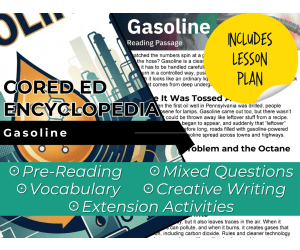
Gasoline Reading Comprehension Passage - Cored Ed Encyclopedia
ELA, Reading Comprehension, Reading, Science, Technology, Earth and Environmental Sciences, Pre-Reading, Language Development, Vocabulary, Physics, Grade 2, 3, 4, 5, Worksheets & Printables, Worksheets, Teacher Tools, Centers, Activities, Writing Prompts, Assessments, Quizzes and Tests, Quizzes, Lesson Plans
This gasoline reading comprehension with lesson plan includes: Visualization (on the front cover) Start your lesson by taking a minute to think and share something about the topic. Read the script aloud (slowly), perhaps prepare some music or sound effects. Student close their eyes and let their imaginations wander. Students open their eyes, read the question aloud and give them a few minutes to complete. Ask a few students to share or keep answers until the end to compare with what they learn in the passage. Quick pause—thousands of Cored Education products are included with your TeachSimple membership. Download links and encyclopedia index available here. Pre-Reading Trivia Students will write down one thing they already know about the subject and then read five more facts and discuss. These facts are fun, and the students will enjoy learning about the subject before reading more. Give 1 minute for students to write what they already know (no pressure—best guess is fine). Read the five facts together. After each fact, do ask a student for their opinion, was it surprising? Set a purpose by asking students to highlight/underline one fact they want to learn more about during the reading. Reading Passage The text is a high-interest reading passage with set paragraphs, roughly three to four paragraphs long. It contains a variety of themes about the topic, anywhere from history to technology. The passage is between 250 and 350 words in length. First, ask students to look at the headings and see what they’ll learn about today. What do they know about the topic/heading? First read options: Teacher read-aloud (best for support). Partner reading (paragraph by paragraph). While reading, students underline important details, and vocabulary words they think may come up in the questions section. Mixed Questions The first question page contains four multiple-choice questions, each with a choice of four answers, and three written response questions that require a sentence or two from the student. Students complete the mcqs first independently, then review quickly as a class. For the 3 written responses, try to get students giving the answer with some form of evidence: “I think ___ because the text says ___.” If students get stuck, send them back to check the passage. Vocabulary Questions Practice seven key words from the text in this section across two activities. First section is scrambled words where students will unscramble three words given a clue for each. The second section is a word to meaning matching activity. Before starting, have some students read out words they underlined in the passage. Ask students to say the word and read aloud the sentence(s) around each word. Ask students to do scrambled words and the matching exercise in pairs then go through answers as a class. For the scrambled spelling task, get four pairs to come up to the board and write the words for extra practice with the other student reading out the clue. For the matching task, prompt students to give full sentences: “I matched ___ with ___ because ___.” Creative Writing In this question, the student will be required to write a five to eight sentence paragraph on a question related to the topic. Before starting, ask students write down 3 key ideas they are going to include in their piece. Ask students for ideas to share around the class to help those struggling. Pro writing expectations: 5–8 sentences At least 2 facts or details from the passage At least 2 vocabulary words from the previous page Students read their paragraphs while classmates listen for facts and vocabulary words. Extension Activities This page is optional for fast finishers or to take home. There are several activities, each one requiring a different skill. Do some, do none, do all, completely optional - but you will feel reassured knowing every possibility is planned for. Includes summary writting question and additional facts. Answer Key There are answers for the multiple-choice questions, written response questions have sample answers, vocabulary answers and if there is a summary question then a sample summary will be provided as well. Lesson Plan Included Customized lesson plan for this lesson is included. Lesson Snapshot Title: Gasoline Genre: Nonfiction (informational text) Subject: Science Primary Topic: What gasoline is, how it works, and impacts Estimated Guided Reading Level (A–Z): Q What This Lesson Teaches Best Explains what gasoline is and why it must be handled carefully because it “can catch fire very easily.” Describes how gasoline helps a car engine work (a spark burns gasoline in a controlled way to move parts that turn the wheels). Traces a brief history of gasoline’s changing value (from “leftover” in 1859 to useful once automobiles appeared in 1892). Introduces the idea of octane ratings and how they relate to engine “knocking” and early ignition. Connects gasoline use to environmental effects (vapors can pollute; burning creates gases including carbon dioxide) and mentions cleaner travel choices. Learning Goals Students will identify what gasoline is and where it comes from (petroleum/crude oil from deep underground). Students will describe how gasoline is used inside a car engine to help make the wheels turn. Students will explain how gasoline changed from being thrown away to becoming a valuable fuel. Students will explain what “octane” measures and how it relates to engine knocking. Students will describe two ways gasoline can affect the air (vapors and burning gases). Students will name choices mentioned in the text for using less gasoline (electric vehicles, bikes, buses, walking). Key Vocabulary From the Text gasoline — fuel liquid used in many cars. petroleum — thick oil material gasoline is made from. crude — raw oil from deep underground. kerosene — lamp fuel people wanted in 1859. octane — rating showing resistance to early ignition. FULL CATALOG OF DOWNLOAD LINKS AND ENCYCLOPEDIA INDEX HERE
Author Cored Education
Rating
Tags Vocabulary, Reading Comprehension, Reading Passages, Lesson Plans, Ela Lesson Plans, Reading Comprehension Lesson Plans, Pre-reading, Science Lesson Plans, Earth Science, Physics
I WONDER - How Big Was The Allosaurus | Animated Video Lesson
History: Ancient, History, Social Studies, History: World, Animals, Life Sciences, Science, Grade 4, 5, 6, 7, 8, 9, 10, Lesson Plans, Teacher Tools
Video Introduction An amazing video designed for the students to learn more about dinosaurs in different countries. I WONDER - How Big Was The Allosaurus | Animated Video Lesson Do you like dinosaurs? what is your favorite one? Do you own a pet? If yes, tell us more about it, like what its name? And what do you like most about it? Do you think that your pet has been evolved from a dinosaur? Can you write down the characteristics of your favourite dinosaur like it's shape, their rivals, where did it use to live and what was their favourite food? What is the largest and the smallest dinosaur that ever found? Why is the T-rex is so famous? Have you ever read any interesting facts about it? Can you name any of the carnivores or herbivores dinosaurs? I WONDER - How Big Was The Allosaurus | Animated Video Lesson The video is perfect for encouraging the researching skills for the students, while learning more about dinosaurs. I WONDER - How Big Was The Allosaurus | Animated Video Lesson This friendly designed video is suitable for students at school, homeschooling, and as a group activity. Format Available in MP4 format.
Author Educational Voice
Rating
Tags How Big Was The Allosaurus, How Big Was The Allosaurus Video, Allosaurus, Allosaurus Facts, Allosaurus Facts For Kids, Allosaurus Video, Allosaurus Video For Kids, Dinosaur, Dinosaurs