



3,906 products added recently
Page 84 - Science Lesson Plan Template
Enhance your science instruction with a flexible lesson plan template designed for educators. This tool helps you structure objectives, materials, procedures, and assessments efficiently. Use it to create organized and impactful science lessons that cater to your students' needs.

 Show filters


I WONDER - Where Does Lava Come From | Animated Video Lesson
Geography, Social Studies, Earth Sciences, Earth and Environmental Sciences, Science, Environmental Science, Grade 4, 5, 6, 7, 8, 9, 10, Lesson Plans, Teacher Tools
Video Introduction An amazing video designed for the students to learn more about natural disasters in different countries. I WONDER - Where Does Lava Come From | Animated Video Lesson What do you know about this natural disaster? Do you know in which part of the world this could happen? Have you ever read about the safety misusers that we could have to protect ourselves from this natural disaster? If yes, can you tell us more about them? Can you name other natural disasters? If yes, tell us more about where they are likely to happen? And how frequently? Do you like reading about Geography? What is your favorite country in the whole world? If you are going on a trip where it will be? Which country? What you are going to see there? Does this country has a famous place to visit? Do you like reading about Geology? If yes, what is your favourite topic? I WONDER - Where Does Lava Come From | Animated Video Lesson The video is perfect for encouraging the researching skills for the students, while learning more about this fantastic phenomenon. I WONDER - Where Does Lava Come From | Animated Video Lesson This friendly designed video is suitable for students at school, homeschooling, and as a group activity. Format Available in MP4 format.
Author Educational Voice
Tags Where Does Lava Come From, Where Does Lava Come From Video, Lava, Lava Facts, Lava Facts For Kids, Lava Video, Lava Video For Kids, Volcanoes, Volcano, Volcano Video
I WONDER - How Big Is The Moon | Animated Video Lesson
Space, Earth and Environmental Sciences, Science, Grade 5, 6, 7, 8, 9, 10, Lesson Plans, Teacher Tools
Video Introduction An amazing video designed for the students to learn more about space facts. I WONDER - How Big Is The Moon | Animated Video Lesson Do you like reading about space? If yes, what is your favorite topic? What do you know about our solar system? What is the smallest planet in our solar system? What is the biggest planet in our solar system? What is the hottest planet in our solar system? And what is the coldest one? Do you think there are aliens? If yes, what do you think they look like? What do they eat and how they speak to each other? Where do they live? What is a galaxy? And what is a milky way? Have you recently saw a shooting star? If yes, tell us more about it, like when did it happen and where? What is a blackhole? Can a blackhole gets bigger by time? Do you like counting the stars? What do you think a star is made of? I WONDER - How Big Is The Moon | Animated Video Lesson The video is perfect for encouraging the researching skills for the students, while learning more about the fantastic space. I WONDER - How Big Is The Moon | Animated Video Lesson This friendly designed video is suitable for students at school, homeschooling, and as a group activity. Format Available in MP4 format.
Author Educational Voice
Tags How Big Is The Moon, How Big Is The Moon Video, The Moon, The Moon Facts, The Moon Facts For Kids, The Moon Video, The Moon Video For Kids, Moon, Moon Facts, Moon Video

Notion Template Architecture & Logic Design
Science, Technology, Computer Science, Engineering, Special Resources, Life Skills, Social Emotional Learning (SEL), Special Education Needs (SEN), STEM, Social Skills, Homeschool Curriculum, Homeschool Templates, Grade 9, 10, 11, 12, Worksheets & Printables, Workbooks, Worksheets, Word Searches, Writing Prompts, Teacher Tools, Quizzes and Tests, Quizzes, Tests, Lesson Plans
Unlock the Blueprint to Building and Selling Six-Figure Notion Templates! Are you ready to transform your Notion skills from a hobby into a profitable business? Do you want to stop creating simple, aesthetic templates and start engineering powerful, high-value operating systems that clients and customers will pay a premium for? Introducing Notion Template Architecture & Logic Design: The Architect's Workbook. This is not just another template. It’s a complete, 43-page university-level curriculum designed to turn you into a professional Notion system architect. We teach you the "Paper-First Abstraction" methodology used by top-tier developers to design robust, scalable, and highly marketable digital ecosystems before writing a single line of code. Go Beyond Aesthetics. Master the Architecture. In the competitive digital marketplace, the difference between a $15 template and a $150 enterprise-grade system is its invisible architecture. This guide gives you the keys to that architecture. Inside This Comprehensive Workbook, You Will Master: Relational Database Design: Learn to normalize your data, eliminate redundancy, and build an interconnected "Hub-and-Spoke" model that is both powerful and efficient. Advanced Formula & Logic: Move beyond simple functions. Master Formula 2.0 to create dynamic progress bars, automated status updates, and resilient logic that anticipates user error. Frictionless User Experience (UX): Discover the art of "Interface Abstraction." Learn to build clean, intuitive dashboards that hide complex backends, reduce cognitive load, and delight your users. Strategic Commercialization: It’s not enough to build a great system. You have to sell it. We walk you through productization, creating a frictionless onboarding experience, and solving the "Empty State Paradox" that confuses new buyers. What's Included: Part 1: The Core Concepts: 4 chapters of deep-dive theory on architecture, logic, UX, and commercialization. Part 2: The Architect's Workbook: 10 detailed worksheets with over 100 guided questions to blueprint your entire Notion system—from market validation to monetization strategy. Part 3: Teacher's Guide & Answer Key: Includes visual diagrams and a complete answer key with detailed "Academic Rationale" to ensure you deeply understand the why behind every architectural decision. This is for you if you are: An aspiring Notion creator ready to go pro. A freelancer building custom systems for clients. An entrepreneur wanting to sell high-ticket digital products. A student of business or technology looking for a practical, real-world guide to system design. Stop guessing. Start engineering. Download the Notion Template Architect's Workbook and build the foundation for your premium template business today! Keywords for SEO: Notion Template, Notion Guide, Notion for Business, Advanced Notion, Notion Formula, Notion Database, Notion UX, Sell Notion Templates, Build Notion Templates, Digital Product, Notion Course, Notion Workbook, Low-Code, Systems Design, Relational Database. Why Parents/Schools Love It: Builds Real-World Skills: Goes beyond software commands to teach fundamental, high-income skills in system architecture, database design, and user experience—all within a popular, practical tool. Prevents Costly Mistakes: The "Paper-First" workbook methodology forces structured planning, saving countless hours of rebuilding and debugging convoluted templates, leading to a better final product. Complete Curriculum-in-a-Box: With theory, practical worksheets, visual aids, and a comprehensive answer key with rationale, it's a perfect resource for self-study or as a ready-to-use textbook for a business or tech course. Unlocks a Business Model: It doesn't just teach you how to use a tool; it provides a complete blueprint for creating and selling high-value digital products, outlining a clear path to generating revenue. Target Audience: This PDF is not for beginners or casual Notion users . The content is advanced, dense, and assumes a desire to professionalize. target: Aspiring & Intermediate Notion Template Creators: Individuals who have made simple templates but want to learn the architecture required to build and sell premium, high-ticket ($50 - $200+) systems. Freelancers & Consultants: Professionals who build custom Notion workspaces for clients. This workbook will help them standardize their process, build more robust systems, and justify higher project fees. Digital Product Entrepreneurs: People in the digital product space who want to add high-value Notion templates to their product ecosystem. Higher Education Students (College/University): This could be an excellent resource for a "mini-course" or a practical project in courses related to: Business Information Systems Database Management (as a practical, low-code introduction) Entrepreneurship & Digital Product Creation User Experience (UX) Design Copyright/Terms of Use: This Book was copyrighted by Syed Hammad Rizvi. This resource is for personal and single classroom use only. You may not alter, redistribute, or sell any part of this resource. In other words, you may not put it on the Internet where it could be publicly found and downloaded. If you want to share this resource with colleagues, please purchase additional licenses from Teachsimple. Thank you for respecting these terms of use. This product is happily brought to you by Syed Hammad Rizvi
Author Creative Book Store
Rating
Tags Notion, Productivity, DigitalProduct, SmallBusiness, Entrepreneur, Workflow, Organization, BusinessTools, DigitalDownload, EBook

Metabolism - High School Biology lesson
Science, Life Sciences, Biology, Grade 11, 12, Teacher Tools, Lesson Plans
Metabolism - High School Biology lesson Your lesson covers everything from energy to ATP. In order, the lesson teaches; Energy and Metabolism, Thermodynamics, Kinetics vs. Potential Energy, Chemical/Bond Energy, Exothermic and Endothermic Reactions, Calculating reaction net energy change, and Enthalpy and ATP. Your lesson includes the teacher and student version of the presentation, one embedded video, an auto-graded exit ticket, and a student lesson handout so the students can record the notes on a more condensed medium. This lesson is designed to be your go-to resource, whether you're in a traditional classroom or a virtual one. With both a teacher version and a student version, it seamlessly fits into your lesson plans, making learning engaging and adaptable. Assessment made easy We've included an auto-graded Exit Ticket and a quiz with an answer key – because who doesn't love saving time on grading? Whether you're a PowerPoint pro or a Google Slides user, prefer Word or Google Docs – we've got you covered. This lesson comes in both Office and Google formats for your convenience. The student version of the presentation has strategically placed blanks for them to fill in as you're teaching. It keeps them active, and engaged, encourages discussion, and leaves more time for those "aha" moments.
Author Teach With Fergy
Tags Metabolism, Senior Biology, Biology Lesson, Endothermic, Exothermic

Grade 3 Science Curriculum Bundle | NGSS-Aligned Year-Long Lessons
Science, Grade 3, Lesson Plans, Teacher Tools, Worksheets & Printables
Grade 3 NGSS Science Curriculum | Year-Long Science Bundle | 36 Weeks | Print & Digital Looking for a complete Grade 3 NGSS Science curriculum that is engaging, low-prep, and truly aligned to the Next Generation Science Standards? This Grade 3 NGSS Science Curriculum provides everything you need for an entire school year with hands-on investigations, differentiated activities, editable planning tools, assessments, and interactive lessons designed around the 5E instructional model . Whether you're planning your first year teaching Grade 3 science or simply want a curriculum that saves time while keeping students engaged, this comprehensive science bundle has every lesson organized and ready to teach. ⭐ What's Included Complete 36-week Grade 3 NGSS Science Curriculum 10 standards-aligned science units Teacher Guide Year-at-a-Glance Overview Scope & Sequence Editable Pacing Guide NGSS Standards Alignment Guide Teacher Lesson Plans Student Reading Passages Guided Notes Interactive Notebook Activities Hands-on Science Labs STEM Challenges Graphic Organizers Exit Tickets Quizzes Unit Tests Performance Tasks Assessment Rubrics Vocabulary Cards Multi-Version Differentiated Worksheets Full-Color Teaching Slides for every unit Print and digital resources 🔬 How It Works in the Classroom This Grade 3 NGSS Science curriculum follows the research-based 5E instructional model : Engage with real-world science phenomena Explore through hands-on investigations Explain using reading passages and guided instruction Elaborate with STEM challenges and meaningful practice Evaluate through exit tickets, quizzes, unit assessments, and performance tasks Perfect for: Whole-group instruction Small groups Science centers Interactive notebooks Independent practice STEM blocks Substitute plans Print or digital classrooms 🌎 Standards & Learning Goals Students investigate concepts across all Grade 3 NGSS domains, including: Forces & Motion Weather & Climate Life Cycles Ecosystems Traits & Inheritance Engineering Design Earth Systems Habitats Natural Hazards Review & Capstone Projects Students develop understanding through the three dimensions of NGSS by integrating: Science & Engineering Practices Disciplinary Core Ideas Crosscutting Concepts ❤️ Why Teachers Love It ✅ Low-prep lessons ready to teach ✅ Complete year-long curriculum ✅ Fully aligned to Grade 3 NGSS ✅ Print and digital flexibility ✅ Built-in differentiation ✅ Hands-on investigations and STEM activities ✅ Consistent assessment system ✅ Interactive notebook activities included ✅ Vocabulary, labs, slides, worksheets, and assessments all in one purchase ✅ Organized pacing that makes long-term planning simple If you're looking for a Grade 3 NGSS Science Curriculum that combines rigorous standards alignment with engaging, student-centered instruction, this complete bundle is designed to make science planning easier while helping students build lasting scientific understanding.
Author Bright Classroom Ideas Marketplace
Rating
Tags Science, Back To School, Yearlong, Full Year, Curriculum, Lesson, Weekly
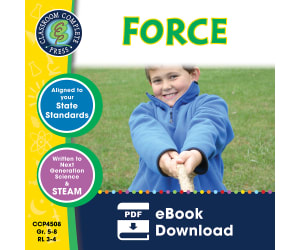
Force Gr. 5-8
Science, Physics, Grade 5, 6, 7, 8, Teacher Tools, Lesson Plans
Force Gr. 5-8 This teaching aid is a specialized resource for educators guiding students in Grade 5 through Grade 8. A principal focus rests upon exploring the concept of force. Students start by understanding what force is and then learn about different types of forces. An engaging approach is followed with planned experiments circling around frictional force and air resistance, providing a practical dimension to learning. An In-depth Scope into Forces The curriculum goes beyond by shedding light on: What a net force implies - how multiple forces can simultaneously act on an object. Treating unbalanced forces - where examples are decoded via acceleration-deceleration exercises. Motion Dynamics During Flight A striking feature includes discussing how mass and force could potentially alter motion during flight; using an arrow as an example. Further details are discussed concerning gravity's role in affecting an object's weight. Nuances of Non-contact Forces The unit continues to delve deeper into non-contact forces such as magnetic and electrostatic ones that function without physical contact. Educational Standards Compliance & Learning Tools This pedagogical instrument aligns with Next Generation State Standards (NGSS) while adhering to Bloom's Taxonomy principles, thereby integrating them in STEAM initiatives seamlessly. In addition, notable components include crossword puzzles along with comprehension quizzes aiming at solidifying students' understanding through key concepts recall. Handy review for teachers becomes possible owing to provided answer keys included at the end of the material focusing specifically on easy evaluations. Accessible and Adaptable This resource, embodied as a single pdf file, offers versatile application across whole class learning sessions, small group activities or individual homework assignments, making it universally beneficial for any Physical Science classrooms.
Author Classroom Complete Press
Tags PDF

Conservation: Fresh Water Resources: Conservation: What We Can Do Gr. 5-8
Science, Earth and Environmental Sciences, Environmental Science, Grade 5, 6, 7, 8, Teacher Tools, Lesson Plans
Conservation: Fresh Water Resources: Conservation: What We Can Do Gr. 5-8 - An Introduction Conservation: Fresh Water Resources: Conservation: What We Can Do Gr. 5-8, is an insightful and relevant teaching resource that targets students in grades 5 through 8. With its emphasis on environmental science, particularly water conservation, this educational tool can be an integral part of a diverse curriculum . The Teaching Material Content The selected teaching material prioritizes the importance of preserving our essential natural resources, specifically fresh water. It spotlights our dependency on freshwater not just for personal consumption but food production as well and involves students in important discussions about how climate change factors impact these precious resources. Lesson Plan Features: Scientifically accurate facts at middle school comprehension level. Poignant discussions about humans’ relationships with fresh water. Informational readings accompanied by comprehension questions to ignite productive conversations among students. Actionable hands-on activities designed for efficient learning engagement across varying learner types. Inclusion of test preparations features lending its utility as a practical study tool in addition to being rich instructional content. Bonus mini posters hosting accessible vocabulary terms structured in kid-friendly language visual learners will find particularly engaging. Convenient and Adaptable Design This lesson plan stands out by virtue of its adaptability; it dually serves effective learning outcomes whether implemented as whole group instruction or used to structure small group lessons focusing better on student-teacher interaction ratios. Thanks to its unique formatting, it can also be used as a productive homework assignment tool. Academic Quality Assurance: The valuable academic content within this resource is planned according to state Standards and structured around Bloom's Taxonomy ensuring educators the high-quality instruction their students deserve. Format: Provided in an easily accessible PDF format, this teaching resource ensures convenience for hardworking teachers on the move.
Author Classroom Complete Press
Tags PDF
I WONDER - What Did Omnivore Dinosaurs Eat | Animated Video Lesson
History: Ancient, History, Social Studies, History: World, Animals, Life Sciences, Science, Grade 2, 3, 4, 5, 6, 7, 8, Lesson Plans, Teacher Tools
Video Introduction An amazing video designed for the students to learn more about dinosaurs in different countries. I WONDER - What Did Omnivore Dinosaurs Eat | Animated Video Lesson Do you like dinosaurs? what is your favorite one? Do you own a pet? If yes, tell us more about it, like what its name? And what do you like most about it? Do you think that your pet has been evolved from a dinosaur? Can you write down the characteristics of your favourite dinosaur like it's shape, their rivals, where did it use to live and what was their favourite food? What is the largest and the smallest dinosaur that ever found? Why is the T-rex is so famous? Have you ever read any interesting facts about it? Can you name any of the carnivores or herbivores dinosaurs? I WONDER - What Did Omnivore Dinosaurs Eat | Animated Video Lesson The video is perfect for encouraging the researching skills for the students, while learning more about dinosaurs. I WONDER - What Did Omnivore Dinosaurs Eat | Animated Video Lesson This friendly designed video is suitable for students at school, homeschooling, and as a group activity. Format Available in MP4 format.
Author Educational Voice
Rating
Tags What Did Omnivore Dinosaurs Eat, What Did Omnivore Dinosaurs Eat Video, Omnivore Dinosaurs, Omnivore Dinosaurs Facts, Omnivore Dinosaurs Video, Omnivore Dinosaurs Video For Kids, Omnivore Dinosaurs Facts For Kids

The Solar System: The Stars
Science, Earth and Environmental Sciences, Space, Common Core, Grade 5, 6, 7, 8, Teacher Tools, Lesson Plans
The Solar System: The Stars Picture a comprehensive tool aimed at engaging students in the study of our incredible solar system. "The Solar System: The Stars" is a teaching resource meticulously designed to captivate the young minds of Grade 5 to Grade 8 students, fueling their curiosity about Astronomy. Description: This product file is a wealth of information on space, all laid out in simplified language and vocabulary for easy comprehension. The astronomical subjects covered are wide-reaching and include: Asteroids, Meteors, and Comets The Inner and Outer Planets Lunar cycle phases, planetary orbits, The intriguing elements like the asteroid belt, shooting stars This guidebook also acts as an activity manual; enriched with reading passages rich in knowledge about celestial bodies and phenomena accompanied by comprehension questions that test understanding. Holistic Approach: Theoretical learning combined with hands-on activities that transform conceptual knowledge into practice. . Innovatively designed mini color posters for visual stimulation along the educational journey through our solar system! . Scales-based rubric lending objectivity when evaluating progress matched against Common Core State Standards. . Vocabulary Development & Student Engagement Methods: Crossword puzzles & word searches centered around lesson plan-associated words. . An enticing homework assignment or small group activity options. . A thorough answer keys ensuring no question remains unanswered! Educational Standards: Importantly written adhering strictly to Bloom's Taxonomy & STEM initiatives; making it pertinent even for those seeking resources grounded on well-established teaching strategies establishing conceptual understanding deeply rooted in related subjects . Filing System: Files come as PDFs, ensuring compatibility across numerous devices—a vital function for switching styles between whole-group teaching and small group or individual learning. . In Conclusion, "The Solar System: The Stars" perfectly encapsulates an all-round resource for educators who seek to navigate our fascinating solar system with their students. This is your remarkable ally in casting light on the wonders of our universe! .
Author Classroom Complete Press
Tags PDF
Reducing Your Own Carbon Footprint: How To Make Your Footprint Smaller And Why You Should Gr. 5-8
Science, Earth and Environmental Sciences, Environmental Science, Grade 5, 6, 7, 8, Teacher Tools, Lesson Plans
Reducing Your Own Carbon Footprint: How To Make Your Own Footprint Smaller and Why You Should Gr. 5-8 A comprehensive educational digital resource aimed at teaching students of grades 5 to 8 about climate change, its causes and their own environmental impact. The Greenhouse Effect This tool assists in teaching students about the greenhouse effect, exposing them to its causes and outcomes. It encourages critical thinking by identifying energy consumption in a common household space – such as the kitchen. Farm to Table Carbon Output An overview of all steps involved in farm-to-table food production—building connections between everyday actions and global carbon output. Travel-Evoked Carbon Footprint Understand how modes of travel contribute heavily to one's carbon footprint. A provision for tools that calculate learners' travel footprints with suggestions on reducing the impact.. Waste Management vs Recycling > "Recycling isn't always enough", hence, this resource provides practical ways learners can manage their waste footprints. Moulding Environmentally-Conscious Communities > Influencial materials equipping educators to help students understand their place within an environmentally oriented society encouraging them towards contributing actively. Bonus Resource: This digital guide challenges students problem-solving skills via examples showing how 'green' rules can be part of social contracts effectively reducing a shared carbon footprint. Pdf based format convenient for use on any device. Bloom's Taxonomy framed graphic organizers along with STEAM focused materials – Underlining environmental science. An interactive carbon footprint calculator Puzzles and games like a word search game and crossword puzzle. A comprehension quiz with an answer key to assess understanding. Note: This resource is curated specifically for science teachers, homeschooling educators. It can be used flexibly in full-classroom sessions or assigned as smaller group activities such as homework projects. You need the right tool for teaching students their relationship with the environment? Look no further because "Reducing Your Own Carbon Footprint: How To Make Your Own Footprint Smaller" is available just for you!
Author Classroom Complete Press
Tags Science Workbook, Reading Passage, Environmental, Carbon Footprint, Science Assessment
I WONDER - How Important Is Ice To Our Planet | Animated Video Lesson
Chemistry, Science, Geology, Earth and Environmental Sciences, Earth Sciences, Environmental Science, Grade 4, 5, 6, 7, 8, 9, 10, Lesson Plans, Teacher Tools
Video Introduction An amazing video designed for the students to learn more about STEM. I WONDER - How Important Is Ice To Our Planet | Animated Video Lesson Do you like STEM subjects? what is your favorite one? Have you ever tried to plant a seed? If yes, tell us more about it. Or have you ever tried to invent something? If yes, tell us more about it. And how do you think it will help us? Have you ever seen a microorganism under a microscope? What was it? And how it looked like? Mathematics is a marvelous subject. Let' sharpen our brains and solve some equations. Do you like timetable tricks? What is your favorite one? Do you know how to code? Have you ever created an app or a game before? If yes, how was it like? I WONDER - How Important Is Ice To Our Planet | Animated Video Lesson The video is perfect for encouraging the researching skills for the students, while learning more about this fantastic topic. I WONDER - How Important Is Ice To Our Planet | Animated Video Lesson This friendly designed video is suitable for students at school, homeschooling, and as a group activity. Format Available in MP4 format.
Author Educational Voice
Tags How Important Is Ice To Our Planet, How Important Is Ice To Our Planet Video, Ice, Ice Facts, Ice Facts For Kids, Ice Video, Ice Video Facts, Our Planet, Our Planet Facts, Our Planet Video For Kids

Wool Reading Comprehension Passage - Cored Ed Encyclopedia
ELA, Language Development, Reading Comprehension, Reading, Pre-Reading, Science, Technology, Physics, History, Social Studies, Grade 2, 3, 4, 5, Worksheets & Printables, Worksheets, Teacher Tools, Centers, Activities, Writing Prompts, Assessments, Quizzes and Tests, Quizzes, Lesson Plans
This wool reading comprehension with lesson plan includes: Visualization (on the front cover) Start your lesson by taking a minute to think and share something about the topic. Read the script aloud (slowly), perhaps prepare some music or sound effects. Student close their eyes and let their imaginations wander. Students open their eyes, read the question aloud and give them a few minutes to complete. Ask a few students to share or keep answers until the end to compare with what they learn in the passage. Quick pause—thousands of Cored Education products are included with your TeachSimple membership. Download links and encyclopedia index available here. Pre-Reading Trivia Students will write down one thing they already know about the subject and then read five more facts and discuss. These facts are fun, and the students will enjoy learning about the subject before reading more. Give 1 minute for students to write what they already know (no pressure—best guess is fine). Read the five facts together. After each fact, do ask a student for their opinion, was it surprising? Set a purpose by asking students to highlight/underline one fact they want to learn more about during the reading. Reading Passage The text is a high-interest reading passage with set paragraphs, roughly three to four paragraphs long. It contains a variety of themes about the topic, anywhere from history to technology. The passage is between 250 and 350 words in length. First, ask students to look at the headings and see what they’ll learn about today. What do they know about the topic/heading? First read options: Teacher read-aloud (best for support). Partner reading (paragraph by paragraph). While reading, students underline important details, and vocabulary words they think may come up in the questions section. Mixed Questions The first question page contains four multiple-choice questions, each with a choice of four answers, and three written response questions that require a sentence or two from the student. Students complete the mcqs first independently, then review quickly as a class. For the 3 written responses, try to get students giving the answer with some form of evidence: “I think ___ because the text says ___.” If students get stuck, send them back to check the passage. Vocabulary Questions Practice seven key words from the text in this section across two activities. First section is scrambled words where students will unscramble three words given a clue for each. The second section is a word to meaning matching activity. Before starting, have some students read out words they underlined in the passage. Ask students to say the word and read aloud the sentence(s) around each word. Ask students to do scrambled words and the matching exercise in pairs then go through answers as a class. For the scrambled spelling task, get four pairs to come up to the board and write the words for extra practice with the other student reading out the clue. For the matching task, prompt students to give full sentences: “I matched ___ with ___ because ___.” Creative Writing In this question, the student will be required to write a five to eight sentence paragraph on a question related to the topic. Before starting, ask students write down 3 key ideas they are going to include in their piece. Ask students for ideas to share around the class to help those struggling. Pro writing expectations: 5–8 sentences At least 2 facts or details from the passage At least 2 vocabulary words from the previous page Students read their paragraphs while classmates listen for facts and vocabulary words. Extension Activities This page is optional for fast finishers or to take home. There are several activities, each one requiring a different skill. Do some, do none, do all, completely optional - but you will feel reassured knowing every possibility is planned for. Includes summary writting question. Answer Key There are answers for the multiple-choice questions, written response questions have sample answers, vocabulary answers and if there is a summary question then a sample summary will be provided as well. Lesson Plan Included Customized lesson plan for this lesson is included. Lesson Snapshot Title: Wool Genre: Nonfiction (informational text) Subject: Life Science / Informational Reading Primary Topic: How wool works, history, and uses Estimated Guided Reading Level (A–Z): R Support pages present: Pre-reading trivia, mixed questions, vocabulary activities, creative writing, extension activities, and an answer key (all match the passage’s ideas and terms). What This Lesson Teaches Best Explains what wool is made of (tiny protein fibers) and how a natural wave called crimp helps fibers cling when spun into yarn. Teaches a clear cause-and-effect science idea : wool cloth traps air pockets, and trapped air helps keep warmth close. Builds understanding of how humans and sheep changed over time , including breeding for thicker coats, learning to shear, and wool becoming valuable through trade. Describes the process from fleece to finished materials , including shearing, lanolin in fresh wool, washing/sorting, spinning into yarn, and rubbing fibers into felt. Highlights real-world uses and properties of wool , including moisture handling and resistance to melting/dripping in fire because it chars instead. Learning Goals Students will explain how crimp helps wool fibers cling together when making yarn. Students will describe how wool cloth keeps warmth close using details about trapped air. Students will identify two ways people have used wool, based on examples in the text. Students will sequence key steps from fleece to yarn or felt that are stated in the passage. Students will describe why freshly shorn wool is called “greasy,” using evidence from the passage. Key Vocabulary From the Text fleece — a sheep’s coat that can be sheared off. protein — a natural building block that wool fibers are made of. crimp — a natural wave in each wool fiber. lanolin — a waxy substance from a sheep’s skin. felt — thick material made when fibers lock together. FULL CATALOG OF DOWNLOAD LINKS AND ENCYCLOPEDIA INDEX HERE
Author Cored Education
Rating
Tags Vocabulary, Reading Comprehension, Reading Passages, Lesson Plans, Ela Lesson Plans, Reading Comprehension Lesson Plans, Pre-reading, Science Lesson Plans, History Lesson Plans, Wool

I WONDER - Is Pluto A Dwarf Planet | Animated Video Lesson
Space, Earth and Environmental Sciences, Science, Grade 6, 7, 8, 9, 10, 11, 12, Lesson Plans, Teacher Tools
Video Introduction An amazing video designed for the students to learn more about space facts. I WONDER - Is Pluto A Dwarf Planet | Animated Video Lesson Do you like reading about space? If yes, what is your favorite topic? What do you know about our solar system? What is the smallest planet in our solar system? What is the biggest planet in our solar system? What is the hottest planet in our solar system? And what is the coldest one? Do you think there are aliens? If yes, what do you think they look like? What do they eat and how they speak to each other? Where do they live? What is a galaxy? And what is a milky way? Have you recently saw a shooting star? If yes, tell us more about it, like when did it happen and where? What is a blackhole? Can a blackhole gets bigger by time? Do you like counting the stars? What do you think a star is made of? I WONDER - Is Pluto A Dwarf Planet | Animated Video Lesson The video is perfect for encouraging the researching skills for the students, while learning more about the fantastic space. I WONDER - Is Pluto A Dwarf Planet | Animated Video Lesson This friendly designed video is suitable for students at school, homeschooling, and as a group activity. Format Available in MP4 format.
Author Educational Voice
Tags Is Pluto A Dwarf Planet, Is Pluto A Dwarf Planet Video, Pluto, Pluto Facts, Pluto Facts For Kids, Pluto Video, Pluto Video For Kids, Dwarf Planet, Dwarf Planet Video, Dwarf Planet Facts

I WONDER - What Is A Carbohydrate | Animated Video Lesson
Biology, Life Sciences, Science, Human Body, STEM, Grade 1, 2, 3, 4, 5, 6, 7, 8, Lesson Plans, Teacher Tools
Video Overview The human body is full of fascinating wonders to learn. This video is created to help the students recognize the anatomy and the job of the human body. I WONDER - What Is A Carbohydrate | Animated Video Lesson Every part and organ in our human body is vital so let's see how important they are. Have you ever imagined how we look like if we didn't have a skeleton? Did you know that because we have our amazing muscles we can stand! Do you know how many teeth do we have? Have you ever wondered about the food journey inside our body? Can you name all the glands in our body? Why do we have skin? Our nervous system is really good at sending signals. Can you tell us more about it? Are you really good at Mathematics, painting, or any other thing? You should really thank your brain about it! The famous five senses are really doing a great work? Can you explain how every sense works? I WONDER - What Is A Carbohydrate | Animated Video Lesson The video is perfect for encouraging the researching skills for the students, while learning more about our fantastic human body. I WONDER - What Is A Carbohydrate | Animated Video Lesson This friendly designed video is suitable for students at school, homeschooling, and as a group activity. Format Available in MP4 format.
Author Educational Voice
Tags What Is A Carbohydrate, What Is A Carbohydrate Video, Carbohydrate, Carbohydrate Facts, Carbohydrates, Carbohydrates Facts, Carbohydrates Facts For Kids, Carbohydrates Video, Carbohydrates Video For Kids

I WONDER - What Is Hibernation | Animated Video Lesson
STEM, Biology, Life Sciences, Science, Animals, Grade 1, 2, 3, 4, 5, 6, 7, 8, Lesson Plans, Teacher Tools
Video Introduction Animal kingdoms are full of fascinating wonders to learn. This video is designed for the students to learn more about animals in different countries. I WONDER - What Is Hibernation | Animated Video Lesson Do you like animals? what is your favorite one? Do you own a pet? If yes, tell us more about it, like what its name? And what do you like most about it? What are the animal kingdoms? Can you write down the characteristics of each animal class like mammals, birds, reptiles, amphibian, fish and mollusks. Do you know that some animals can sing, can you name any of them? What is the largest and the smallest mammal in the world? What is the largest and the smallest bird in the world? What is the largest and the smallest fish in the world? I WONDER - What Is Hibernation | Animated Video Lesson The video is perfect for encouraging the researching skills for the students, while learning more about these fantastic animals. I WONDER - What Is Hibernation | Animated Video Lesson This friendly designed video is suitable for students at school, homeschooling, and as a group activity. Format Available in MP4 format.
Author Educational Voice
Tags What Is Hibernation, What Is Hibernation Video, Hibernation, Hibernation Facts, Hibernation Facts For Kids, Hibernation Video, Hibernation Video For Kids, Animals, Animal, Animals Facts
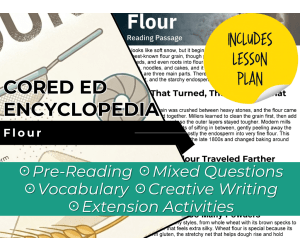
Flour Reading Comprehension Passage - Cored Ed Encyclopedia
ELA, Reading Comprehension, Reading, Science, Technology, Language Development, Social Studies, History, Pre-Reading, Life Sciences, Grade 2, 3, 4, 5, Worksheets & Printables, Worksheets, Teacher Tools, Centers, Activities, Writing Prompts, Assessments, Quizzes and Tests, Quizzes, Lesson Plans
This flour reading comprehension with lesson plan includes: Visualization (on the front cover) Start your lesson by taking a minute to think and share something about the topic. Read the script aloud (slowly), perhaps prepare some music or sound effects. Student close their eyes and let their imaginations wander. Students open their eyes, read the question aloud and give them a few minutes to complete. Ask a few students to share or keep answers until the end to compare with what they learn in the passage. Quick pause—thousands of Cored Education products are included with your TeachSimple membership. Download links and encyclopedia index available here. Pre-Reading Trivia Students will write down one thing they already know about the subject and then read five more facts and discuss. These facts are fun, and the students will enjoy learning about the subject before reading more. Give 1 minute for students to write what they already know (no pressure—best guess is fine). Read the five facts together. After each fact, do ask a student for their opinion, was it surprising? Set a purpose by asking students to highlight/underline one fact they want to learn more about during the reading. Reading Passage The text is a high-interest reading passage with set paragraphs, roughly three to four paragraphs long. It contains a variety of themes about the topic, anywhere from history to technology. The passage is between 250 and 350 words in length. First, ask students to look at the headings and see what they’ll learn about today. What do they know about the topic/heading? First read options: Teacher read-aloud (best for support). Partner reading (paragraph by paragraph). While reading, students underline important details, and vocabulary words they think may come up in the questions section. Mixed Questions The first question page contains four multiple-choice questions, each with a choice of four answers, and three written response questions that require a sentence or two from the student. Students complete the mcqs first independently, then review quickly as a class. For the 3 written responses, try to get students giving the answer with some form of evidence: “I think ___ because the text says ___.” If students get stuck, send them back to check the passage. Vocabulary Questions Practice seven key words from the text in this section across two activities. First section is scrambled words where students will unscramble three words given a clue for each. The second section is a word to meaning matching activity. Before starting, have some students read out words they underlined in the passage. Ask students to say the word and read aloud the sentence(s) around each word. Ask students to do scrambled words and the matching exercise in pairs then go through answers as a class. For the scrambled spelling task, get four pairs to come up to the board and write the words for extra practice with the other student reading out the clue. For the matching task, prompt students to give full sentences: “I matched ___ with ___ because ___.” Creative Writing In this question, the student will be required to write a five to eight sentence paragraph on a question related to the topic. Before starting, ask students write down 3 key ideas they are going to include in their piece. Ask students for ideas to share around the class to help those struggling. Pro writing expectations: 5–8 sentences At least 2 facts or details from the passage At least 2 vocabulary words from the previous page Students read their paragraphs while classmates listen for facts and vocabulary words. Extension Activities This page is optional for fast finishers or to take home. There are several activities, each one requiring a different skill. Do some, do none, do all, completely optional - but you will feel reassured knowing every possibility is planned for. Includes summary writting question and additional facts. Answer Key There are answers for the multiple-choice questions, written response questions have sample answers, vocabulary answers and if there is a summary question then a sample summary will be provided as well. Lesson Plan Included Customized lesson plan for this lesson is included. Lesson Snapshot Title: Flour Genre: Nonfiction (Informational Text) Subject: Science (Food Science) / Reading (Informational Text) Primary Topic: How flour is made from seeds and grains Estimated Guided Reading Level (A–Z): P What This Lesson Teaches Best Explains what flour is made from: flour begins as a seed , and people grind grains (and other plants) into powder used for many foods. Teaches the three main parts inside a grain seed — bran , germ , and endosperm —and what each part is like. Describes how milling changed over time, from heavy stones to steel rollers and lots of sifting to make very fine flour. Builds understanding of why white flour became popular (it kept longer) and what “enriched” flour means in this text. Connects ingredient science to baking by explaining how wheat proteins can form gluten , helping dough rise and hold bubbles of air. Learning Goals Students will explain how flour begins as a seed and becomes powder through grinding. Students will identify the three main parts of a grain seed: bran, germ, and endosperm. Students will describe how modern mills use rollers and sifting to make fine flour. Students will explain why white flour kept longer, based on what the text says about oils. Students will describe what “enriched” flour means in the passage and why it mattered. Students will explain how gluten helps dough rise and hold bubbles of air. Key Vocabulary From the Text bran — the outer part of a grain seed. germ — the tiny part that could sprout. endosperm — the starchy part that feeds the seed. enriched — flour with certain vitamins and iron added back. gluten — stretchy net that helps dough rise and hold air. FULL CATALOG OF DOWNLOAD LINKS AND ENCYCLOPEDIA INDEX HERE
Author Cored Education
Rating
Tags Vocabulary, Reading Comprehension, Reading Passages, Lesson Plans, Ela Lesson Plans, Reading Comprehension Lesson Plans, Pre-reading, Science Lesson Plans, History, Technology

I WONDER - What Systems Use JAVA | Animated Video Lesson
STEM, Science, Computer Science, Technology, Grade 6, 7, 8, 9, 10, 11, 12, Lesson Plans, Teacher Tools
Video Introduction An amazing video designed for the students to learn more about STEM. I WONDER - What Systems Use JAVA | Animated Video Lesson Do you like STEM subjects? what is your favorite one? Have you ever tried to plant a seed? If yes, tell us more about it. Or have you ever tried to invent something? If yes, tell us more about it. And how do you think it will help us? Have you ever seen a microorganism under a microscope? What was it? And how it looked like? Mathematics is a marvelous subject. Let' sharpen our brains and solve some equations. Do you like timetable tricks? What is your favorite one? Do you know how to code? Have you ever created an app or a game before? If yes, how was it like? I WONDER - What Systems Use JAVA | Animated Video Lesson The video is perfect for encouraging the researching skills for the students, while learning more about this fantastic topic. I WONDER - What Systems Use JAVA | Animated Video Lesson This friendly designed video is suitable for students at school, homeschooling, and as a group activity. Format Available in MP4 format.
Author Educational Voice
Tags What Systems Use JAVA, What Systems Use JAVA Video, JAVA Systems, JAVA Systems Facts, JAVA Systems Facts For Kids, JAVA Systems Video, JAVA Systems Video For Kids, JAVA, JAVA Facts

I WONDER - How Are Heat Waves Caused | Animated Video Lesson
Environmental Science, Earth and Environmental Sciences, Science, Earth Sciences, Grade 6, 7, 8, 9, 10, 11, 12, Lesson Plans, Teacher Tools
Video Introduction An amazing video designed for the students to learn more about STEM. I WONDER - How Are Heat Waves Caused | Animated Video Lesson Do you like STEM subjects? what is your favorite one? Have you ever tried to plant a seed? If yes, tell us more about it. Or have you ever tried to invent something? If yes, tell us more about it. And how do you think it will help us? Have you ever seen a microorganism under a microscope? What was it? And how it looked like? Mathematics is a marvelous subject. Let' sharpen our brains and solve some equations. Do you like timetable tricks? What is your favorite one? Do you know how to code? Have you ever created an app or a game before? If yes, how was it like? I WONDER - How Are Heat Waves Caused | Animated Video Lesson The video is perfect for encouraging the researching skills for the students, while learning more about this fantastic topic. I WONDER - How Are Heat Waves Caused | Animated Video Lesson This friendly designed video is suitable for students at school, homeschooling, and as a group activity. Format Available in MP4 format.
Author Educational Voice
Tags How Are Heat Waves Caused, How Are Heat Waves Caused Video, Heat Waves, Heat Waves Facts, Heat Waves Facts For Kids, Heat Waves Video, Heat Waves Video For Kids, Heat Wave, Environment

I WONDER - Do Muscles Help You Stand | Animated Video Lesson
Human Body, Life Sciences, Science, Biology, STEM, Grade 4, 5, 6, 7, 8, 9, 10, Lesson Plans, Teacher Tools
Video Overview The human body is full of fascinating wonders to learn. This video is created to help the students recognize the anatomy and the job of the human body. I WONDER - Do Muscles Help You Stand | Animated Video Lesson Every part and organ in our human body is vital so let's see how important they are. Have you ever imagined how we look like if we didn't have a skeleton? Did you know that because we have our amazing muscles we can stand! Do you know how many teeth do we have? Have you ever wondered about the food journey inside our body? Can you name all the glands in our body? Why do we have skin? Our nervous system is really good at sending signals. Can you tell us more about it? Are you really good at Mathematics, painting, or any other thing? You should really thank your brain about it! The famous five senses are really doing a great work? Can you explain how every sense works? I WONDER - Do Muscles Help You Stand | Animated Video Lesson The video is perfect for encouraging the researching skills for the students, while learning more about our fantastic human body. I WONDER - Do Muscles Help You Stand | Animated Video Lesson This friendly designed video is suitable for students at school, homeschooling, and as a group activity. Format Available in MP4 format.
Author Educational Voice
Tags Do Muscles Help You Stand, Do Muscles Help You Stand Video, Muscles, Muscle, Muscles Fact, Muscles Fact For Kids, Muscles Video, Muscles Video For Kids, Muscle Facts, Muscle Facts For Kids

I WONDER - Where Does Tea Come From | Animated Video Lesson
Nature & Plants, Life Sciences, Science, Grade 6, 7, 8, 9, 10, 11, 12, Lesson Plans, Teacher Tools
Video Introduction An amazing activity designed for the students to learn more about STEM. I WONDER - Where Does Tea Come From | Animated Video Lesson Do you like STEM subjects? what is your favorite one? Have you ever tried to plant a seed? If yes, tell us more about it. Or have you ever tried to invent something? If yes, tell us more about it. And how do you think it will help us? Have you ever seen a microorganism under a microscope? What was it? And how it looked like? Mathematics is a marvelous subject. Let' sharpen our brains and solve some equations. Do you like timetable tricks? What is your favorite one? Do you know how to code? Have you ever created an app or a game before? If yes, how was it like? I WONDER - Where Does Tea Come From | Animated Video Lesson The video is perfect for encouraging the researching skills for the students, while learning more about this fantastic topic. I WONDER - Where Does Tea Come From | Animated Video Lesson This friendly designed video is suitable for students at school, homeschooling, and as a group activity. Format Available in MP4 format.
Author Educational Voice
Tags Where Does Tea Come From, Where Does Tea Come From Video, Tea, Tea Facts, Tea Facts For Kids, Tea Facts Video, Tea Video, Tea Facts Video For Kids, Tea Video For Kids, Science

I WONDER - How Does The Spine Help Us Move | Animated Video Lesson
Human Body, Life Sciences, Science, Biology, STEM, Grade 3, 4, 5, 6, 7, 8, 9, Lesson Plans, Teacher Tools
Video Overview The human body is full of fascinating wonders to learn. This video is created to help the students recognize the anatomy and the job of the human body. I WONDER - How Does The Spine Help Us Move | Animated Video Lesson Every part and organ in our human body is vital so let's see how important they are. Have you ever imagined how we look like if we didn't have a skeleton? Did you know that because we have our amazing muscles we can stand! Do you know how many teeth do we have? Have you ever wondered about the food journey inside our body? Can you name all the glands in our body? Why do we have skin? Our nervous system is really good at sending signals. Can you tell us more about it? Are you really good at Mathematics, painting, or any other thing? You should really thank your brain about it! The famous five senses are really doing a great work? Can you explain how every sense works? I WONDER - How Does The Spine Help Us Move | Animated Video Lesson The video is perfect for encouraging the researching skills for the students, while learning more about our fantastic human body. I WONDER - How Does The Spine Help Us Move | Animated Video Lesson This friendly designed video is suitable for students at school, homeschooling, and as a group activity. Format Available in MP4 format.
Author Educational Voice
Tags How Does The Spine Help Us Move, How Does The Spine Help Us Move Video, The Spine, The Spine Facts, The Spine Facts For Kids, The Spine Video, The Spine Video For Kids, Skeleton, Skeleton Facts

I WONDER - How Clever Are Bears | Animated Video Lesson
STEM, Biology, Life Sciences, Science, Animals, Grade 1, 2, 3, 4, 5, 6, 7, 8, Lesson Plans, Teacher Tools
Video Introduction Animal kingdoms are full of fascinating wonders to learn. This video is designed for the students to learn more about animals in different countries. I WONDER - How Clever Are Bears | Animated Video Lesson Do you like animals? what is your favorite one? Do you own a pet? If yes, tell us more about it, like what its name? And what do you like most about it? What are the animal kingdoms? Can you write down the characteristics of each animal class like mammals, birds, reptiles, amphibian, fish and mollusks. Do you know that some animals can sing, can you name any of them? What is the largest and the smallest mammal in the world? What is the largest and the smallest bird in the world? What is the largest and the smallest fish in the world? I WONDER - How Clever Are Bears | Animated Video Lesson The video is perfect for encouraging the researching skills for the students, while learning more about these fantastic animals. I WONDER - How Clever Are Bears | Animated Video Lesson This friendly designed video is suitable for students at school, homeschooling, and as a group activity. Format Available in MP4 format.
Author Educational Voice
Tags How Clever Are Bears, How Clever Are Bears Vidfeo, Clever Bears, Clever Bears Facts, Clever Bears Facts For Kids, Clever Bears Video, Clever Bears Video For Kids, Clever Bear, Clever Bear Video For Kids

I WONDER - How Many Muscles Does It Take To Smile | Animated Video
Human Body, Life Sciences, Science, Biology, STEM, Grade 2, 3, 4, 5, 6, 7, 8, Lesson Plans, Teacher Tools
Video Overview The human body is full of fascinating wonders to learn. This video is created to help the students recognize the anatomy and the job of the human body. I WONDER - How Many Muscles Does It Take To Smile | Animated Video Lesson Every part and organ in our human body is vital so let's see how important they are. Have you ever imagined how we look like if we didn't have a skeleton? Did you know that because we have our amazing muscles we can stand! Do you know how many teeth do we have? Have you ever wondered about the food journey inside our body? Can you name all the glands in our body? Why do we have skin? Our nervous system is really good at sending signals. Can you tell us more about it? Are you really good at Mathematics, painting, or any other thing? You should really thank your brain about it! The famous five senses are really doing a great work? Can you explain how every sense works? I WONDER - How Many Muscles Does It Take To Smile | Animated Video Lesson The video is perfect for encouraging the researching skills for the students, while learning more about our fantastic human body. I WONDER - How Many Muscles Does It Take To Smile | Animated Video Lesson This friendly designed video is suitable for students at school, homeschooling, and as a group activity. Format Available in MP4 format.
Author Educational Voice
Tags How Many Muscles Does It Take To Smile, How Many Muscles Does It Take To Smile Facts, Muscles, Muscle, Muscles Facts, Muscles Facts For Kids, Muscles Video, Muscles Video For Kids, Smiling

I WONDER - Are Hippos Dangerous | Animated Video Lesson
STEM, Biology, Life Sciences, Science, Animals, Grade 1, 2, 3, 4, 5, 6, 7, 8, Lesson Plans, Teacher Tools
Video Introduction Animal kingdoms are full of fascinating wonders to learn. This video is designed for the students to learn more about animals in different countries. I WONDER - Are Hippos Dangerous | Animated Video Lesson Do you like animals? what is your favorite one? Do you own a pet? If yes, tell us more about it, like what its name? And what do you like most about it? What are the animal kingdoms? Can you write down the characteristics of each animal class like mammals, birds, reptiles, amphibian, fish and mollusks. Do you know that some animals can sing, can you name any of them? What is the largest and the smallest mammal in the world? What is the largest and the smallest bird in the world? What is the largest and the smallest fish in the world? I WONDER - Are Hippos Dangerous | Animated Video Lesson The video is perfect for encouraging the researching skills for the students, while learning more about these fantastic animals. I WONDER - Are Hippos Dangerous | Animated Video Lesson This friendly designed video is suitable for students at school, homeschooling, and as a group activity. Format Available in MP4 format.
Author Educational Voice
Tags Are Hippos Dangerous, Are Hippos Dangerous Video, Hippos, Hippo, Hippos Facts, Hippos Facts For Kids, Hippos Video, Hippos Video For Kids, Hippo Facts, Hippo Video