



3,992 products added recently
Page 6 - Writing Quizzes
The French Quiz is an excellent resource for evaluating students' abilities in the French language. It includes sections on grammar rules, verb conjugations, vocabulary usage, listening comprehension, and cultural knowledge. Administering this quiz helps you measure progress, reinforce language lessons, and identify areas needing further practice. It's a valuable tool for both beginners and advanced students, supporting effective language acquisition in a structured manner.

 Show filters

Castles Reading Comprehension Passage - Cored Ed Encyclopedia
ELA, Language Development, Resources for Teachers, Reading Comprehension, Reading, Pre-Reading, Writing, Strategies, History, Social Studies, Grade 2, 3, 4, 5, Worksheets & Printables, Worksheets, Teacher Tools, Centers, Activities, Writing Prompts, Assessments, Tests, Quizzes and Tests, Quizzes
This castles reading comprehension contains the following: Pre-Reading Trivia Students will write down one thing they already know about the subject and then read five more facts and discuss. These facts are fun, and the students will enjoy learning about the subject before reading more. COMPANION VIDEO NOW AVAILABLE (EMBEDDED AFTER PREVIEW PICTURES IN PRODUCT DESCRIPTION) Reading Passage The text is a high-interest reading passage with set paragraphs, roughly three to four paragraphs long. It contains a variety of themes about the topic, anywhere from history to technology. The passage is between 250 and 350 words in length. Mixed Questions The first question page contains four multiple-choice questions, each with a choice of four answers, and three written response questions that require a sentence or two from the student. Creative Writing In this question, the student will be required to write a five to eight sentence paragraph on a question related to the topic. Extension Activities This page is optional for fast finishers. If there are five to ten minutes left at the end of the lesson, the student can choose one of three activities, each one requiring a different skill. Answer Key There are answers for the multiple-choice questions and three written response questions have sample answers. FULL CATALOG OF DOWNLOAD LINKS AND ENCYCLOPEDIA INDEX HERE Cored Ed Encyclopedia Overview The Cored Ed Encyclopedia is a weekly series of lessons that you can pick up and use right away. These short readings fit into whatever time you have available. Each one includes a warm-up, a reading, and a set of questions, but it’s flexible — you can do just the reading, the full lesson, or skip the writing section if you need to. Each lesson focuses on a single topic so students don’t get lost. The writing is clear but never childish, making it perfect for grades two through five. Topics range from animals and science to history, inventions, and everyday things. No matter the level of the student, everyone should take away at least one new idea or fact from each lesson. The materials are easy to print, easy to explain, and require no setup. They work well for whole-class teaching, partner work, or independent study.
Author Cored Education
Rating
Tags Vocabulary, Spelling, Reading Comprehension, Reading Passages, Cored Encyclopedia, Facts, Reading, Creative Writing, Castles, History
Pumpkins Reading Comprehension Passage - Cored Ed Encyclopedia
ELA, Language Development, Resources for Teachers, Reading Comprehension, Reading, Pre-Reading, Writing, Nature & Plants, Life Sciences, Science, Grade 2, 3, 4, 5, Worksheets & Printables, Worksheets, Teacher Tools, Centers, Activities, Writing Prompts, Assessments, Tests, Quizzes and Tests, Quizzes
This pumpkins reading comprehension includes: Visualization (on the front cover) Start your lesson by taking a minute to think and share something about the topic. Read the script aloud (slowly), perhaps prepare some music or sound effects. Student close their eyes and let their imaginations wander. Students open their eyes, read the question aloud and give them a few minutes to complete. Ask a few students to share or keep answers until the end to compare with what they learn in the passage. Quick pause—thousands of Cored Education products are included with your TeachSimple membership. Download links and encyclopedia index available here. Pre-Reading Trivia Students will write down one thing they already know about the subject and then read five more facts and discuss. These facts are fun, and the students will enjoy learning about the subject before reading more. Give 1 minute for students to write what they already know (no pressure—best guess is fine). Read the five facts together. After each fact, do ask a student for their opinion, was it surprising? Set a purpose by asking students to highlight/underline one fact they want to learn more about during the reading. Reading Passage The text is a high-interest reading passage with set paragraphs, roughly three to four paragraphs long. It contains a variety of themes about the topic, anywhere from history to technology. The passage is between 250 and 350 words in length. First, ask students to look at the headings and see what they’ll learn about today. What do they know about the topic/heading? First read options: Teacher read-aloud (best for support). Partner reading (paragraph by paragraph). While reading, students underline important details, and vocabulary words they think may come up in the questions section. Mixed Questions The first question page contains four multiple-choice questions, each with a choice of four answers, and three written response questions that require a sentence or two from the student. Students complete the mcqs first independently, then review quickly as a class. For the 3 written responses, try to get students giving the answer with some form of evidence: “I think ___ because the text says ___.” If students get stuck, send them back to check the passage. Vocabulary Questions Practice seven key words from the text in this section across two activities. First section is scrambled words where students will unscramble three words given a clue for each. The second section is a word to meaning matching activity. Before starting, have some students read out words they underlined in the passage. Ask students to say the word and read aloud the sentence(s) around each word. Ask students to do scrambled words and the matching exercise in pairs then go through answers as a class. For the scrambled spelling task, get four pairs to come up to the board and write the words for extra practice with the other student reading out the clue. For the matching task, prompt students to give full sentences: “I matched ___ with ___ because ___.” Creative Writing In this question, the student will be required to write a five to eight sentence paragraph on a question related to the topic. Before starting, ask students write down 3 key ideas they are going to include in their piece. Ask students for ideas to share around the class to help those struggling. Pro writing expectations: 5–8 sentences At least 2 facts or details from the passage At least 2 vocabulary words from the previous page Students read their paragraphs while classmates listen for facts and vocabulary words. Extension Activities This page is optional for fast finishers or to take home. There are several activities, each one requiring a different skill. Do some, do none, do all, completely optional - but you will feel reassured knowing every possibility is planned for. Includes summary writting question. Answer Key There are answers for the multiple-choice questions, written response questions have sample answers, vocabulary answers and if there is a summary question then a sample summary will be provided as well. This lesson is also great for independent work , assessments , or sub plans as students can complete the it with minimal support. Lesson Snapshot Title: Pumpkins Genre: Nonfiction (informational text) Subject: Life Science (plants) / Social Studies (culture & traditions) / Reading Informational Text Primary Topic: How pumpkins changed, spread, and are used Estimated Guided Reading Level (A–Z): Q What This Lesson Teaches Best How pumpkins became larger and tougher over many seasons when people saved the best seeds . How pumpkin seeds spread to new places as Indigenous farmers carried seeds and later pumpkins traveled across oceans . How pumpkin flowers and bees connect to pumpkin growth (bees move pollen ; then pumpkins can begin to swell). How pumpkins connect to fall traditions and food, including jack-o’-lanterns , pies , roasted seeds , and soups . How headings help organize information (seed change, travel, pollination/growth, and uses). Learning Goals Students will explain how saving the best seeds changed pumpkins over many seasons. Students will describe how pumpkin seeds traveled to new places and who carried them. Students will describe what a pumpkin patch looks like in summer using details from the passage. Students will explain how bees help a pumpkin begin to grow, based on the passage. Students will identify two ways people use pumpkins today that are named in the text. Key Vocabulary From the Text cultivated — grown by people with care, not wild. genus — a science group name for related plants. pollen — powder bees move from flower to flower. immigrants — people who move to a new country to live. rinds — thick outer skins of pumpkins. FULL CATALOG OF DOWNLOAD LINKS AND ENCYCLOPEDIA INDEX HERE
Author Cored Education
Rating
Tags Vocabulary, Spelling, Reading Comprehension, Reading Passages, Reading, Creative Writing, Reading Strategies, Writing Prompts, Pumpkins, Life Science
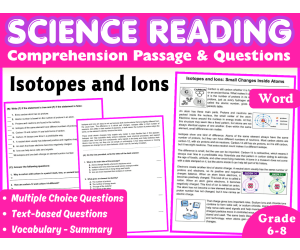
Physical Science Reading Comprehension Passage: Isotopes & Ions (Word)
Science, ELA, Reading, Reading Comprehension, Strategies, Resources for Teachers, Common Core, Language Development, Chemistry, Writing, Grade 6, 7, 8, 9, 10, Writing Prompts, Worksheets & Printables, Centers, Activities, Teacher Tools, Assessments, Quizzes and Tests, Quizzes, Tests, Literacy Readers
Physical Science Reading Comprehension Passage and Questions for Middle School: Isotopes, Ions, and Atomic Structure (Word Document) This engaging middle school physical science reading comprehension resource explores isotopes, ions, and atomic structure . Students learn how protons determine an element’s atomic number and identity, how isotopes of the same element can have different numbers of neutrons, and how atoms become charged ions by gaining or losing electrons. The passage uses carbon-12 and carbon-14 to introduce isotopes, radioactive decay, and carbon dating . It also explains the difference between cations and anions and shows how ions are important in chemistry, the human body, and technology through examples such as sodium chloride, nerve signals, muscle contraction, and batteries. Students develop a clear understanding of the key difference between isotopes and ions: isotopes differ in neutrons, while ions differ in electrons. This passage is designed to bridge the gap between science and literacy by strengthening reading comprehension while sparking scientific curiosity in middle school students. It blends English Language Arts skills with accurate science content, helping students build background knowledge, understand key concepts, use evidence from the text, and explain scientific ideas clearly. This resource supports science classroom practice while also reinforcing important literacy skills such as main idea, vocabulary, comprehension, and summarizing. Ideal for interdisciplinary learning in ELA and Science. Suitable for Grade 9 review, too! Student Tasks for The Passage: 10 multiple-choice questions targeting main idea, key details, science concepts, comparison, and real-world applications 10 True/False statements to check understanding and address common misconceptions 5 text-based short-answer questions that require students to explain important ideas from the passage 5 vocabulary matching items with clear, student-friendly definitions 1 summary prompt that asks students to condense the central ideas accurately Full answer key for every section Available Formats for this Resource PDF Fillable PDF Google Docs Product Details Length: 7 pages total Grades: 6–8, also suitable for Grade 9 review Use cases: close reading, stations, homework, intervention, test prep, and sub plans Standards support: Reinforces informational-text skills and supports NGSS-style sense-making by helping students read scientific explanations, connect evidence to key concepts, interpret real-world examples, and explain cause-and-effect relationships in science. FULL CATALOG OF DOWNLOADING LINKS HERE Other Science Reading Collections and Topics You May Find in the Store: 1. Astronomy & Space Science 2. Volcanoes, Rocks, & Mountains 3. Rock Cycle, Soil, & Sinkholes 4. Mars, Glaciers, & Antarctica 5. Water Cycle, Acid Rain, & Wastewater 6. Insects, Animals, & Ecosystems 7. Bioluminescence & Insects 8. Animal Skin, Cats, & T. Rex 9. Human Body and Senses 10. Health & Applied Bioscience 11. Waves, Light, & Imaging 12. Electricity & Energy 13. Motion & Materials 14. Chemistry and Materials Science 15. Electromagnetism 16. Acids and Bases 17. Gas Laws 18. Biotechnology 19. Periodic Trends 20. Protists and Fungi 21. Microevolution 22. Blood 23. Chemical Bonding 24. Magnets 25. Muscles 26. Nuclear Chemistry 27. Electromagnetic Devices 28. Epigenetics 29. The Law of Conservation of Mass 30. Atomic Models 31. Isotopes and Ions 32. Light 33. Human-Environment Interaction 34. Theory of Evolution 35. Photosynthesis 36. Origins of Life and Early Earth 37. Gene Expression and Regulation 38. Thermochemistry 39. Allergies 40. Coevolution 41. Birth to Adulthood 42. Cells 43. Entropy and Free Energy 44. The Human Brain 45. Mixtures and Solutions 46. Invertebrates 47. Zoo Animals 48. Biochemistry 49. Animal Behavior 50. Population Ecology ...and many more engaging science reading passages that cover intriguing and important topics designed to spark curiosity and support student learning. Use this passage to reinforce ELA skills in science, to add literacy to your lessons, and to support independent work. The passages strengthen main idea, evidence use, vocabulary in context, inference, cause and effect, and summary writing. With ready-to-use assessments and complete answer keys, you can provide focused practice that is simple to run and fast to review.
Author Middle & High School - CORED Education
Rating
Tags Middle School, Reading Comprehension, Reading Strategies, ELA, Centers, Reading Passage, Assessments, Vocabulary, Physical Science, Chemistry
Ketchup Reading Comprehension Passage - Cored Ed Encyclopedia
ELA, Language Development, Resources for Teachers, Reading Comprehension, Reading, Pre-Reading, Writing, History, Social Studies, Strategies, Grade 2, 3, 4, 5, Worksheets & Printables, Worksheets, Teacher Tools, Centers, Activities, Writing Prompts, Assessments, Tests, Quizzes and Tests, Quizzes
This ketchup reading comprehension contains the following: Visualize on the Cover (Teacher Read Aloud Script) Start your lesson by taking a few moments to visualize the topic and share thoughts or feelings about it. Pre-Reading Trivia Students will write down one thing they already know about the subject and then read five more facts and discuss. These facts are fun, and the students will enjoy learning about the subject before reading more. Reading Passage The text is a high-interest reading passage with set paragraphs, roughly three to four paragraphs long. It contains a variety of themes about the topic, anywhere from history to technology. The passage is between 250 and 350 words in length. Mixed Questions The first question page contains four multiple-choice questions, each with a choice of four answers, and three written response questions that require a sentence or two from the student. Vocabulary Questions Practice seven key words from the text in this section across two activities. First section is scrambled words where students will unscramble three words given a clue for each. The second section is a word to meaning matching activity. Creative Writing In this question, the student will be required to write a five to eight sentence paragraph on a question related to the topic. Extension Activities This page is optional for fast finishers or to take home. There are several activities, each one requiring a different skill. Do some, do none, do all, completely optional - but you will feel reassured knowing every possibility is planned for. Includes summary writting question. Answer Key There are answers for the multiple-choice questions, written response questions have sample answers, vocabulary answers and if there is a summary question then a sample summary will be provided as well. FULL CATALOG OF DOWNLOAD LINKS AND ENCYCLOPEDIA INDEX HERE Lesson Snapshot Title: Ketchup Genre: Nonfiction (informational text) Subject: Reading (Informational Text) / Social Studies (Food history & culture) Primary Topic: How ketchup changed over time and place Estimated Guided Reading Level (A–Z): O What This Lesson Teaches Best Explains what ketchup is commonly made from today and how it’s used with different foods. Traces ketchup’s history, including earlier versions that were not made from tomatoes. Connects word meaning and origin by describing how the name “ketchup” traveled across languages and may relate to a Hokkien word. Shows how recipes and food products change over time (homemade cooking → bottled store product; dates and examples included). Highlights how foods can vary across places (different spellings and versions such as fruit or banana ketchup). Learning Goals Students will describe what ketchup is like and what ingredients are named in the text. Students will explain how ketchup long ago could be different from ketchup today, using details from the passage. Students will identify key events/dates in ketchup’s story (1600s, 1812, 1876) and tell what happened at each time. Students will explain why vinegar and seasonings are added, based on the passage. Students will describe how the word “ketchup” is connected to the idea of something “briny,” according to the text. Key Vocabulary From the Text glossy — shiny and smooth-looking. vinegar — sour liquid used in cooking. briny — salty, like seawater. scholars — people who study and learn a lot. staple — something kept often; a regular favorite. Cored Ed Encyclopedia Overview The Cored Ed Encyclopedia is a weekly series of lessons that you can pick up and use right away. These short readings fit into whatever time you have available. Each one includes a warm-up, a reading, and a set of questions, but it’s flexible — you can do just the reading, the full lesson, or skip the writing section if you need to. Each lesson focuses on a single topic so students don’t get lost. The writing is clear but never childish, making it perfect for grades two through five. Topics range from animals and science to history, inventions, and everyday things. No matter the level of the student, everyone should take away at least one new idea or fact from each lesson. The materials are easy to print, easy to explain, and require no setup. They work well for whole-class teaching, partner work, or independent study.
Author Cored Education
Rating
Tags Vocabulary, Spelling, Reading Comprehension, Reading Passages, Reading, Creative Writing, Reading Strategies, Writing Prompts, Ketchup, History

How to Write an Essay: What is a Narrative Essay?
ELA, Writing, Common Core, Vocabulary, Grade 5, 6, 7, 8, Teacher Tools, Lesson Plans, Graphic Organizers, Quizzes, Crosswords Puzzles, Word Searches
How to Write an Essay: What is a Narrative Essay? Rooted in the earnest desire to simplify the essay writing process for students, this resource decomposes every step of essay composition. Devised as an autonomous chapter from the expansive lesson plan 'How to Write an Essay,' this instructional handbook propounds a novel approach for elucidating and streamlining what often arises as a daunting assignment. The key is in simplicity, and this teaching resource impeccably delivers it. This 24-page PDF guide offers lucid yet captivating content tailored specifically for grade 5-8 students. Adhering to Bloom's Taxonomy principles, it ensures seamless flow from one topic to another, thereby serving perfectly fit for group learning or guiding small group activities. Imagine leading student cognition of narrative essays beyond basic definition. The module not only provides simple definitions but delves into various stages of essay writing - selecting topics, building arguments, crafting climactic conclusions - leaving no stones unturned. The real treasure lies in its explicit segments on four widespread types of essays along with recap sessions around essential elements such as verbs, adjectives, and pronouns that are useful across all subjects requiring proficient written communication skills. Educational value shouldn't be confined only within classrooms . Recognising the importance of independent learning too,this guide can be seamlessly used as homework material encouraging learning away from school. You'll marvel at the ease with which evaluation can be executed using this bundle owing not just to individual word puzzle exercises & comprehension quizzes but also through detailed scoring rubrics enabling smooth tracking of learner progress. Additionally,it incorporates six full-colored graphic organizers offering visual aids aimed towards easy grasp of key concepts while steering your class towards completion their own engaging narratives successfully. An added benefit is its compliance with Common Core State Standards, reassuring reliability and effectiveness. Choose 'How To Write An Essay: What is a Narrative Essay?' for its intricate design and effective structure that make teaching essay writing an achievable and less intimidating task.
Author Classroom Complete Press
Tags Language Arts, Writing, Essay Writing, Narrative Essay, Comprehension Quiz
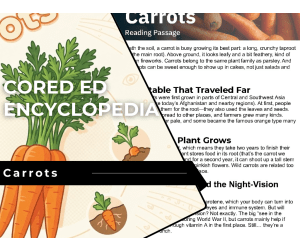
Carrots Reading Comprehension Passage - Cored Ed Encyclopedia
ELA, Language Development, Resources for Teachers, Reading Comprehension, Reading, Pre-Reading, Writing, Life Sciences, Science, Nature & Plants, Grade 2, 3, 4, 5, Worksheets & Printables, Worksheets, Teacher Tools, Centers, Activities, Writing Prompts, Assessments, Tests, Quizzes and Tests, Quizzes
This carrots reading comprehension contains the following: Pre-Reading Trivia Students will write down one thing they already know about the subject and then read five more facts and discuss. These facts are fun, and the students will enjoy learning about the subject before reading more. COMPANION VIDEO NOW AVAILABLE (EMBEDDED AFTER PREVIEW PICTURES IN PRODUCT DESCRIPTION) Reading Passage The text is a high-interest reading passage with set paragraphs, roughly three to four paragraphs long. It contains a variety of themes about the topic, anywhere from history to technology. The passage is between 250 and 350 words in length. Mixed Questions The first question page contains four multiple-choice questions, each with a choice of four answers, and three written response questions that require a sentence or two from the student. Creative Writing In this question, the student will be required to write a five to eight sentence paragraph on a question related to the topic. Extension Activities This page is optional for fast finishers. If there are five to ten minutes left at the end of the lesson, the student can choose one of three activities, each one requiring a different skill. Answer Key There are answers for the multiple-choice questions and three written response questions have sample answers. FULL CATALOG OF DOWNLOAD LINKS AND ENCYCLOPEDIA INDEX HERE Cored Ed Encyclopedia Overview The Cored Ed Encyclopedia is a weekly series of lessons that you can pick up and use right away. These short readings fit into whatever time you have available. Each one includes a warm-up, a reading, and a set of questions, but it’s flexible — you can do just the reading, the full lesson, or skip the writing section if you need to. Each lesson focuses on a single topic so students don’t get lost. The writing is clear but never childish, making it perfect for grades two through five. Topics range from animals and science to history, inventions, and everyday things. No matter the level of the student, everyone should take away at least one new idea or fact from each lesson. The materials are easy to print, easy to explain, and require no setup. They work well for whole-class teaching, partner work, or independent study.
Author Cored Education
Rating
Tags Vocabulary, Spelling, Reading Comprehension, Reading Passages, Cored Encyclopedia, Facts, Reading, Creative Writing, Carrots, Life Science

Bicycles Reading Comprehension Passage - Cored Ed Encyclopedia
ELA, Language Development, Resources for Teachers, Reading Comprehension, Reading, Pre-Reading, Creative Writing, Writing, Physics, Science, Grade 2, 3, 4, 5, Worksheets & Printables, Worksheets, Teacher Tools, Centers, Activities, Writing Prompts, Assessments, Tests, Quizzes and Tests, Quizzes
This bicycles reading comprehension contains the following: Pre-Reading Trivia Students will write down one thing they already know about the subject and then read five more facts and discuss. These facts are fun, and the students will enjoy learning about the subject before reading more. COMPANION VIDEO NOW AVAILABLE (EMBEDDED AFTER PREVIEW PICTURES IN PRODUCT DESCRIPTION) Reading Passage The text is a high-interest reading passage with set paragraphs, roughly three to four paragraphs long. It contains a variety of themes about the topic, anywhere from history to technology. The passage is between 250 and 350 words in length. Mixed Questions The first question page contains four multiple-choice questions, each with a choice of four answers, and three written response questions that require a sentence or two from the student. Creative Writing In this question, the student will be required to write a five to eight sentence paragraph on a question related to the topic. Extension Activities This page is optional for fast finishers. If there are five to ten minutes left at the end of the lesson, the student can choose one of three activities, each one requiring a different skill. Answer Key There are answers for the multiple-choice questions and three written response questions have sample answers. FULL CATALOG OF DOWNLOAD LINKS AND ENCYCLOPEDIA INDEX HERE Cored Ed Encyclopedia Overview The Cored Ed Encyclopedia is a weekly series of lessons that you can pick up and use right away. These short readings fit into whatever time you have available. Each one includes a warm-up, a reading, and a set of questions, but it’s flexible — you can do just the reading, the full lesson, or skip the writing section if you need to. Each lesson focuses on a single topic so students don’t get lost. The writing is clear but never childish, making it perfect for grades two through five. Topics range from animals and science to history, inventions, and everyday things. No matter the level of the student, everyone should take away at least one new idea or fact from each lesson. The materials are easy to print, easy to explain, and require no setup. They work well for whole-class teaching, partner work, or independent study.
Author Cored Education
Rating
Tags Vocabulary, Spelling, Reading Comprehension, Reading Passages, Cored Encyclopedia, Facts, Reading, Creative Writing, Bicycles, Physics

Bible Quiz Volume #1
ELA, Special Resources, Writing, Handwriting, Reading, Reading Comprehension, Language Development, Spelling, Kindergarten, Preschool, Grade 1, Quizzes, Quizzes and Tests, Teacher Tools
Bible Quiz Volume #1 Bible Quiz Volume #1 was created as an individual activity that can be an introduction bible stories for children or to enhance your own lessons/story telling of these stories. You will get exactly what is shown in the photos in this listing. In this Bible Quiz game , your kids will match exact pictures to the information in each box. They will match famous Bible people with the stories they were involved in or the things they did. Your kids will love the super cute illustrations and you will love having a Bible game that you can pull out and play at any time! This Bible Quiz is perfect to play at home, in a classroom, or at church. You can also make the quiz a little more challenging by showing the picture card from the quiz and then ask a question about the Biblical person. This can be a good time to provide the children with more information about some great people in the Bible. There is also a Bonus page so you child can trace the words in the Quiz. They will be having fun learning about the Bible and developing their reading, spelling and handwriting skills. I believe this product would be a great addition to a Sunday school class, or Vacation Bible school classroom. This Bible memory game features Bible characters and stories to match including: David & Saul David & Goliath Moses as an Egyptian Moses returns to Egypt to save his people Includes 17 pages Instructions: Print out the 9 x14 legal paper PDF Laminate for longer use Cut out the picture cards Assemble Add binder Add Velcro dots
Author KD's Kids School Shop
Tags Bible Stories, Moses, King David, King Saul, Bible, Christian Study For Kids

5th Grade Difficult Words Spelling Quiz
ELA, Writing, Grade 5, Quizzes, Quizzes and Tests, Teacher Tools
This resource includes 6 weeks of new and challenging vocabulary words for 5th graders. This set will help your students become more proficient in spelling and writing as they use new words to form sentences. Before students take each quiz for each set of vocabulary words they will be able to review the words, write sentences with them, complete sentences using those words, and ultimately take a quiz in which they will see multiple choice answers for each word and decide which is the correct spelling. There are 59 words included in this set. Hit PREVIEW to see the list of all words included for every week! Enjoy!
Author Soumara Siddiqui
Tags Difficult Words, Spelling Quiz, 5th Grade Sight Words, 5th Grade Difficult Words, 5th Grade Hard Spelling Words, Challenging Spelling Words For 5th Graders

Julius Caesar Act 3 Quiz
ELA, Writing, Handwriting, Grade 6, 7, 8, 9, 10, 11, 12, Quizzes, Quizzes and Tests, Teacher Tools
Julius Caesar Act 3 Quiz This 7-question assessment evaluates students' understanding of Act 3 of Shakespeare's Julius Caesar. It includes 5 multiple choice and 2 short answer questions covering key events, characters, and themes from this act. Educators can use this quiz to assess students' comprehension, spark discussions, and identify any misunderstandings before moving forward with the play. It works well as an individual homework assignment, group activity, or whole-class wrap-up. The attached answer key makes grading efficient. This quiz engages secondary students in analyzing the play's complex themes around leadership, loyalty, betrayal, and morality. It challenges them to think critically about Brutus and Cassius' roles in the conspiracy, the motivations behind Caesar's assassination, Antony's funeral speech, and more. Students must cite text evidence in their short answer responses. Altogether, this assessment provides a focused look at students' Act 3 knowledge. It helps educators measure understanding, enhance instruction, and encourage meaningful connections during their study of this Shakespearean tragedy.
Author Educate and Create
Tags Julius Caesar, Shakespeare, Drama, Act3, Quiz, Julius Caesar Act 3 Test Answers, Julius Caesar Study Guide Answers Act 3