



3,968 products added recently
Page 16 - Daily Writing Prompts For Kids

 Show filters


"Zane and the Hurricane" Essay Questions & Writing Prompts Pack
ELA, Reading, Reading Comprehension, Literature, Writing, Grade 4, 5, 6, Writing Prompts, Worksheets & Printables
The Zane and the Hurricane Essay Questions & Writing Prompts Pack is an exceptional resource targeted for educators instructing grades 4-6. These resources primarily focus on Language Arts subjects, especially Comprehension, Literature, Reading, and Writing. It hosts a set of meticulously curated essay questions and writing prompts based on the novel “Zane and the Hurricane” by Rodman Philbrick. This pack trains readers in higher-level thinking skills to promote deeper discussions among learners. It also grants students formidable opportunities to partake in comprehensive writing exercises.The tools inspire learners to engage in evidence-based reasoning while structuring their viewpoints - transforming abstract reading concepts into tangible learning experiences. Contained within this resource are thirteen distinct essay questions constructed with extreme attention to detail.Additionally, included is lined paper which can be utilized as an extension sheet if your student needs extra space beyond what's provided; ensuring that nothing limits your students' creativity or analytical thinking. Versatility of Implementation: A standout feature of this package is its versatility regarding implementation strategies. Educators can employ these resources in a myriad ways best suited towards varying classroom setups: Model 1-2 questions from start-to-end providing a verbal thought process Promote small group or partnered work dynamics for interactive brainstorming sessions Task students independently encouraging self-dependent problem-solving abilities Engage parents through homework assignments that reinforce crucial reading comprehension skills outside the school environment An Ideal Novel Study Guide/ Book Companion : This versatile PDF file type Novel Study Guide/ Book Companion comes equipped with activities making it easier for teachers' direct involvement whether it arises from whole-class collaboration projects or smaller break-away groups. Also stretching as far as home-based assignments; this pack fits effortlessly into any teaching plan you may have mapped out, while keeping engagement levels high across all usage scenarios. The Zane and the Hurricane Essay Questions & Writing Prompts Pack is an invaluable suite of tools for educators aiming to create a fertile, interactive, and comprehensive learning environment for their students - it strengthens learners analytically and fosters a genuine love for literature from a young age.
Author Creatively Gifted
Tags Essay Questions, Writing Prompts, Comprehension, Literature, Reading

December Daily Writing Prompts | 2nd & 3rd Grade | Print + Digital
ELA, Writing, Creative Writing, Holiday & Seasonal, Months, December, Seasons, Winter, Grade 2, 3, Activities, Centers, Worksheets & Printables, Writing Prompts, Worksheets, Workbooks
Keep your students writing (and loving it!) all winter long with this December Daily Writing Prompts Pack! Designed for 2nd and 3rd graders, these fun and engaging prompts bring a touch of seasonal magic into your classroom—without focusing on just one holiday. With 25 creative, reflective, and winter-themed prompts , students will stay motivated, imaginative, and excited to write all month long. Each day of the week features a unique theme to spark ideas and keep writing fresh: Magical Monday – creative and imaginative winter stories Snowy Tip Tuesday – how-to writing with a frosty twist Wintry Would-You-Rather Wednesday – opinion writing with snowy choices Throwback Thursday: Frosty Edition – reflection and gratitude writing Festive Free-Write Friday – silly, open-ended fun to wrap up the week What’s Included: ✔ 25 daily writing prompts (5 per week) ✔ Seasonal and holiday-friendly themes (great for diverse classrooms) ✔ A mix of narrative, opinion, how-to, and free-write styles ✔ Engaging, low-prep activity—perfect for morning work, writing centers, journals, or early finishers Why Teachers Love It: ✅ Prompts are short and simple—perfect for SPED, 2nd, or 3rd grade writers ✅ Easy to print and use, with no extra prep ✅ Consistent format across months for classroom routines ✅ Keeps students practicing writing skills while having FUN!
Author A Day In Elementary
Rating
Tags December, Winter, Writing Prompts, Writing, Prompts, Daily, Daily Writing Prompts, Printables, Centers, Worksheets

Reading Comprehension Nonfiction Set 2 Sample: What a Smell (Word)
ELA, Reading, Reading Comprehension, Common Core, Vocabulary, Language Development, ESL, Creative Writing, Writing, Resources for Teachers, Grade 4, 5, Worksheets & Printables, Worksheets, Writing Prompts, Assessments, Teacher Tools, Tests, Quizzes and Tests
Reading Comprehension Passages Nonfiction Set 2 Sample Overview No prep reading comprehension lessons, with enjoyable articles and topics. Each lesson has a blend of post-reading activities. Mixed questions to check overall understanding. Vocabulary activities, plus a writing section. Lessons also contain a bonus extension exercise at the end. Some you may like, some you may not, either way they are there if you wish to use them. Full answer keys are provided. Passage Included 2.What a Smell: How does the stink bug protect its children? Find out in this lesson. Word Version This is the Word editable version. This download is available in GOOGLE Docs, GOOGLE Forms, GOOGLE Slides. PDF, PPT, WORD. FULL CATALOG OF DOWNLOAD LINKS HERE Grade 4/5 Links Fiction Set 1 - Animals Google Docs Google Forms Google Slides PDF PPT Word Guided Reading Materials Fiction Set 2 - Family Google Docs Google Forms Google Slides PDF PPT Word Guided Reading Materials Fiction Set 3 - Friends Google Docs Google Forms Google Slides PDF PPT Word Guided Reading Materials Fiction Set 4 - School Google Docs Google Forms Google Slides PDF PPT Word Guided Reading Materials Fiction Set 5 - Sports Google Docs Google Forms Google Slides PDF PPT Word Guided Reading Materials Nonfiction Set 1 - Birds Google Docs Google Forms Google Slides PDF PPT Word Guided Reading Materials Nonfiction Set 2 - Insects Google Docs Google Forms Google Slides PDF PPT Word Guided Reading Materials Nonfiction Set 3 - Mammals Google Docs Google Forms Google Slides PDF PPT Word Guided Reading Materials Nonfiction Set 4 - Nature Google Docs Google Forms Google Slides PDF PPT Word Guided Reading Materials Nonfiction Set 5 - Sea Animals Google Docs Google Forms Google Slides PDF PPT Word Guided Reading Materials Reading Passages Overview Each passage is especially written for Grade 4-5 students, including key vocabulary required for this age group. Topics are varied and are accompanied by colorful graphics. Topics are meant to educate, yet entertain the modern student. These passages are perfect for the modern classroom. Whereas textbooks can become outdated in no time, any changes to technology or the world will result in updates to this product. Mixed Questions The mixed questions section of each lesson includes a variation of five comprehension, vocabulary and math questions. In addition, key reading strategies are frequently covered including cause & effect, summarizing, compare & contrast and making conclusions. Two or three of the questions will be MCQs and other questions will require a written response of some kind. Full answers and example responses appear at the end of the lesson. Spelling & Vocab Each reading passage contains a variety of words and phrases designed for Grade 4-5 students. Spelling and vocab activities provide the opportunity to build fluency with these words. As it can become quite mundane doing the same activities over and over, each lesson in a set will contain a different spelling and vocab activity . Activities include: spelling games, sentence match-ups, mixed-up text and decoding words from the lesson. Writing Prompts Writing prompts are designed to continue the theme or lessons learned in the story. Students are persuaded to write in a variety of ways and each prompt includes several cues to help. As with the spelling/vocab section, writing prompts will vary. This includes research pieces, reading responses, poetry and creative writing prompts. Full Answer Keys Full answer keys and sample responses are provided so no matter how busy you are, you know you're covered! Mixed question answers provide evidence from the text, math questions contain the relevant workings. Answers are designed for use by the teacher, but also suitable as a handout to the student. Just for Fun Each lesson will have a bonus extension exercise. This is something fun to extend the lesson with. You can find these at the end of each lesson, titled Just for Fun. Just for Funs are optional. Some you may like, some you may not. Either way, they are there to do with as you wish. For similar downloads and other frees, do check out Cored Group on TeachSimple.
Author Cored Education
Tags Elementary, Reading, Comprehension, Vocabulary, Answers, Ccss, Common Core, Spelling, Writing, Passages

Reading Comprehension Fiction Set 6 Sample: Tom's Canadian Mom (Docs)
ELA, Reading, Common Core, Reading Comprehension, Children’s Literature, Literature, Spelling, Language Development, ESL, Writing, Grade 2, 3, Worksheets & Printables, Worksheets, Assessments, Teacher Tools, Tests, Quizzes and Tests, Writing Prompts, Centers, Activities
Reading Comprehension Passages Fiction Set 6 Sample Overview Fascinating reading comprehension passages, each with an array of activities included. Stories are written for the modern classroom and topics are designed to promote enthusiasm from each student. Each lesson contains a mixed questions section to check understanding, a vocabulary or spelling activity to help remember key language introduced, and a writing exercise. Full answer keys are provided. For a more detailed overview, check the section under the links at the bottom of this description. Passage Included 5.Tom's Canadian Mom: The most important person from Canada is...Tom's mom! Docs Version This is the Docs editable and fillable version. This download is available in GOOGLE Docs, GOOGLE Forms, GOOGLE Slides. PDF, PPT, WORD. FULL CATALOG OF DOWNLOAD LINKS HERE Grade 2/3 Links Fiction Set 1 - Nature Google Docs Google Forms Google Slides PDF PPT Word Guided Reading Materials Fiction Set 2 - Animals Google Docs Google Forms Google Slides PDF PPT Word Guided Reading Materials Fiction Set 3 - Food Google Docs Google Forms Google Slides PDF PPT Word Guided Reading Materials Fiction Set 4 - School Google Docs Google Forms Google Slides PDF PPT Word Guided Reading Materials Fiction Set 5 - Friends Google Docs Google Forms Google Slides PDF PPT Word Guided Reading Materials Fiction Set 6 - Family Google Docs Google Forms Google Slides PDF PPT Word Guided Reading Materials Fiction Set 7 - Sports Google Docs Google Forms Google Slides PDF PPT Word Guided Reading Materials Nonfiction Set 1 - Technology Google Docs Google Forms Google Slides PDF PPT Word Guided Reading Materials Nonfiction Set 2 - Nutrition Google Docs Google Forms Google Slides PDF PPT Word Guided Reading Materials Nonfiction Set 3 - Animals Google Docs Google Forms Google Slides PDF PPT Word Guided Reading Materials Reading Passages Overview Each passage is especially written for Grade 2-3 students, including key vocabulary required for this age group. Topics are varied and are accompanied by colorful graphics. Topics are meant to educate, yet entertain the modern student. These passages are perfect for the modern classroom. Whereas textbooks can become outdated in no time, any changes to technology or the world will result in updates to this product. Mixed Questions The mixed questions section of each lesson includes a variation of fivecomprehension, vocabulary and math questions. In addition, key reading strategies are frequently covered including cause & effect, summarizing, compare & contrast and making conclusions. Three of the questions will be MCQs and two will require a written response of some kind. Full answers and example responses appear at the end of the lesson. Spelling & Vocab Each reading passage contains a variety of words and phrases designed for Grade 2-3 students. Spelling and vocab activities provide the opportunity to build fluency with these words. As it can become quite mundane doing the same activities over and over, each lesson in a set will contain a different spelling and vocab activity . Writing Prompts Writing prompts are designed to continue the theme or lessons learned in the story. Students are persuaded to write in a variety of ways and each prompt includes several cues to help. As with the spelling/vocab section, writing prompts will vary. This includes research pieces, reading responses, poetry and creative writing prompts. Full Answer Keys Full answer keys and sample responses are provided so no matter how busy you are, you know you're covered! Mixed question answers provide evidence from the text, math questions contain the relevant workings. Answers are designed for use by the teacher, but also suitable as a handout to the student. Additional File One lesson will have an additional file. This is something fun to extend the lesson with. For similar downloads and other frees, do check out Cored Group on TeachSimple.
Author Cored Education
Tags Elementary, Reading, Comprehension, Vocabulary, Answers, Ccss, Common Core, Spelling, Writing, Digital Centers
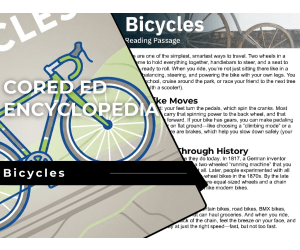
Bicycles Reading Comprehension Passage - Cored Ed Encyclopedia
ELA, Language Development, Resources for Teachers, Reading Comprehension, Reading, Pre-Reading, Creative Writing, Writing, Physics, Science, Grade 2, 3, 4, 5, Worksheets & Printables, Worksheets, Teacher Tools, Centers, Activities, Writing Prompts, Assessments, Tests, Quizzes and Tests, Quizzes
This bicycles reading comprehension contains the following: Pre-Reading Trivia Students will write down one thing they already know about the subject and then read five more facts and discuss. These facts are fun, and the students will enjoy learning about the subject before reading more. COMPANION VIDEO NOW AVAILABLE (EMBEDDED AFTER PREVIEW PICTURES IN PRODUCT DESCRIPTION) Reading Passage The text is a high-interest reading passage with set paragraphs, roughly three to four paragraphs long. It contains a variety of themes about the topic, anywhere from history to technology. The passage is between 250 and 350 words in length. Mixed Questions The first question page contains four multiple-choice questions, each with a choice of four answers, and three written response questions that require a sentence or two from the student. Creative Writing In this question, the student will be required to write a five to eight sentence paragraph on a question related to the topic. Extension Activities This page is optional for fast finishers. If there are five to ten minutes left at the end of the lesson, the student can choose one of three activities, each one requiring a different skill. Answer Key There are answers for the multiple-choice questions and three written response questions have sample answers. FULL CATALOG OF DOWNLOAD LINKS AND ENCYCLOPEDIA INDEX HERE Cored Ed Encyclopedia Overview The Cored Ed Encyclopedia is a weekly series of lessons that you can pick up and use right away. These short readings fit into whatever time you have available. Each one includes a warm-up, a reading, and a set of questions, but it’s flexible — you can do just the reading, the full lesson, or skip the writing section if you need to. Each lesson focuses on a single topic so students don’t get lost. The writing is clear but never childish, making it perfect for grades two through five. Topics range from animals and science to history, inventions, and everyday things. No matter the level of the student, everyone should take away at least one new idea or fact from each lesson. The materials are easy to print, easy to explain, and require no setup. They work well for whole-class teaching, partner work, or independent study.
Author Cored Education
Rating
Tags Vocabulary, Spelling, Reading Comprehension, Reading Passages, Cored Encyclopedia, Facts, Reading, Creative Writing, Bicycles, Physics

Reading Comprehension Passages Nonfiction Set 3 - Animals (PDF)
ELA, Reading, Reading Comprehension, Common Core, ESL, Language Development, Spelling, Vocabulary, Writing, Creative Writing, Grade 2, 3, Worksheets & Printables, Worksheets, Writing Prompts, Assessments, Teacher Tools, Tests, Quizzes and Tests
Reading Comprehension Passages Nonfiction Set 3 Overview Engaging nonfiction articles, each with a collection of different activities included. Articles are written for the modern classroom and topics are designed to promote enthusiasm from each student. Each lesson contains a mixed questions section to check understanding, a vocabulary or spelling activity to help remember key language introduced, and a writing exercise. Full answer keys are provided. Passages Include 1.A Look at Three Bears: Brown bears, pandas and polar bears are covered in this. 2.A Look at Giraffes: A male giraffe's heart is two feet long! 3.Camel Humps: What are they used for? How do camels live in hot conditions? 4.A Look at Skunks: What do you do when you see a skunk hissing? Find out here. 5.Mountain Animals: Read all about the different habits & animals in the mountains. 6.History of Piggy Banks: Ever wondered why we use piggy banks? Check this passage. 7.Very Helpful Dogs: Dogs are not only pets. They help a whole range of people. 8.Winter Sleep: Discover how animals survive the cold winter in Winter Sleep. 9.The World's Smallest Penguin: Title says it all! Curious to see what it is? 10.The Long Journey: Migration: What, why, how, where, when? Additional File: History of Piggy Banks: Design Templates PDF Version This is the PDF uneditable version. This download is available in GOOGLE Docs, GOOGLE Forms, GOOGLE Slides. PDF, PPT, WORD. FULL CATALOG OF DOWNLOAD LINKS HERE Grade 2/3 Links Fiction Set 1 - Nature Google Docs Google Forms Google Slides PDF PPT Word Guided Reading Materials Fiction Set 2 - Animals Google Docs Google Forms Google Slides PDF PPT Word Guided Reading Materials Fiction Set 3 - Food Google Docs Google Forms Google Slides PDF PPT Word Guided Reading Materials Fiction Set 4 - School Google Docs Google Forms Google Slides PDF PPT Word Guided Reading Materials Fiction Set 5 - Friends Google Docs Google Forms Google Slides PDF PPT Word Guided Reading Materials Fiction Set 6 - Family Google Docs Google Forms Google Slides PDF PPT Word Guided Reading Materials Fiction Set 7 - Sports Google Docs Google Forms Google Slides PDF PPT Word Guided Reading Materials Nonfiction Set 1 - Technology Google Docs Google Forms Google Slides PDF PPT Word Guided Reading Materials Nonfiction Set 2 - Nutrition Google Docs Google Forms Google Slides PDF PPT Word Guided Reading Materials Nonfiction Set 3 - Animals Google Docs Google Forms Google Slides PDF PPT Word Guided Reading Materials Reading Passages Overview Each passage is especially written for Grade 2-3 students, including key vocabulary required for this age group. Topics are varied and are accompanied by colorful graphics. Topics are meant to educate, yet entertain the modern student. These passages are perfect for the modern classroom. Whereas textbooks can become outdated in no time, any changes to technology or the world will result in updates to this product. Mixed Questions The mixed questions section of each lesson includes a variation of fivecomprehension, vocabulary and math questions. In addition, key reading strategies are frequently covered including cause & effect, summarizing, compare & contrast and making conclusions. Three of the questions will be MCQs and two will require a written response of some kind. Full answers and example responses appear at the end of the lesson. Spelling & Vocab Each reading passage contains a variety of words and phrases designed for Grade 2-3 students. Spelling and vocab activities provide the opportunity to build fluency with these words. As it can become quite mundane doing the same activities over and over, each lesson in a set will contain a different spelling and vocab activity . Writing Prompts Writing prompts are designed to continue the theme or lessons learned in the story. Students are persuaded to write in a variety of ways and each prompt includes several cues to help. As with the spelling/vocab section, writing prompts will vary. This includes research pieces, reading responses, poetry and creative writing prompts. Full Answer Keys Full answer keys and sample responses are provided so no matter how busy you are, you know you're covered! Mixed question answers provide evidence from the text, math questions contain the relevant workings. Answers are designed for use by the teacher, but also suitable as a handout to the student. Additional File One lesson will have an additional file. This is something fun to extend the lesson with. For similar downloads and other frees, do check out Cored Group on TeachSimple.
Author Cored Education
Rating
Tags Elementary, Reading, Comprehension, Vocabulary, Answers, Common Core, Spelling, Writing, Passages, Reading Comprehension Assessment

RACE Writing Strategy Practice Worksheets - writing prompts
ELA, Language Development, Literature, Writing, Elementary, Worksheets & Printables, Writing Prompts, Worksheets
RACE Writing Strategy Practice Worksheets | Mental Health Writing Prompts | 4th & 5th Grade Reading Response Engage your 4th and 5th grade students in reading comprehension and evidence-based writing with prompts focusing on relevant topics such as mental health and social emotional learning! Each RACE Writing Strategy Practice Worksheets set includes reading response prompts that encourage critical thinking while building confidence in students' written responses using the RACE writing method (Restate, Answer, Cite, Explain). Children can use these worksheets independently or in guided small groups during literacy centers, homework, test prep review, morning work, SEL lessons, etc. Perfect for building confidence in writing while learning about and discussing sensitive topics. What's Included 10 printable RACE writing practice worksheets including mental health and SEL reading passages and response prompts Student-friendly RACE writing format Answer Keys: Not Included Learning Objectives Students will practice the RACE writing strategy while learning about mental health and social-emotional learning. They will improve reading comprehension, citing text evidence, and written expression. Additionally, learners will develop critical thinking skills and confidence in their social-emotional responses to challenging topics. Order, Outline & Steps Each worksheet is designed to practice the RACE writing method (Restate, Answer, Cite, Explain). Students will: Read the question/passage Restate the prompt/question Answer the question completely Cite text evidence Explain how their evidence supports their answer Revise their work as needed The consistent format builds confidence and independence for responding to prompts. Grades & Ages Grade 4 Grade 5 Ages 9-11 Implementation Options Whole class instruction Small group intervention Literacy center activity Independent practice Homework Test prep review Early finishers Morning work Sub planning SEL lessons File Type PDF Pages 10 pages Answer Key: No Standards Alignment CCSS.ELA-LITERACY.RI.4.1 CCSS.ELA-LITERACY.RI.5.1 CCSS.ELA-LITERACY.RL.4.1 CCSS.ELA-LITERACY.RL.5.1 CCSS.ELA-LITERACY.W.4.1 CCSS.ELA-LITERACY.W.5.1 CCSS.ELA-LITERACY.W.4.9 CCSS.ELA-LITERACY.W.5.9 How to Use Use with students after reading a passage or completing a class discussion about the mental health and social-emotional learning topics covered. Students can practice completing the RACE writing method in response to reading comprehension prompts. Easy differentiation options and implementation ideas: Use as a printable worksheet Complete with read-aloud and modeling Print and annotate using PDF highlighting tools Complete verbally first if needed before writing Complete with a partner before independent practice Use as a social-emotional learning activity in counseling or with a focus teacher Tags & Keywords RACE writing strategy | RACE writing practice | RACE worksheets | reading response | text evidence | citing evidence | reading comprehension | mental health activities | SEL writing prompts | social emotional learning | opinion writing | constructed response | evidence-based writing | 4th grade writing | 5th grade writing | upper elementary ELA | Common Core writing | literacy centers | printable worksheets | reading comprehension activities Help students build reading comprehension, evidence-based writing, and social-emotional learning skills in one engaging activity! These worksheets are perfect for building confidence in opinion writing while discussing sensitive topics using the RACE writing method.
Author Mac Northern
Rating
Tags RACE Writing Strategy, RACE Writing, RACE Worksheets, Reading Comprehension, Text Evidence, Reading Response, Constructed Response
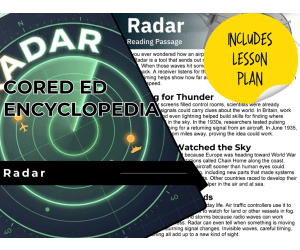
Radar Reading Comprehension Passage - Cored Ed Encyclopedia
ELA, Language Development, Reading Comprehension, Reading, Pre-Reading, Writing, History, Social Studies, Technology, Science, Grade 2, 3, 4, 5, Worksheets & Printables, Worksheets, Teacher Tools, Centers, Activities, Writing Prompts, Assessments, Quizzes and Tests, Quizzes, Lesson Plans
This radar reading comprehension includes: Visualization (on the front cover) Start your lesson by taking a minute to think and share something about the topic. Read the script aloud (slowly), perhaps prepare some music or sound effects. Student close their eyes and let their imaginations wander. Students open their eyes, read the question aloud and give them a few minutes to complete. Ask a few students to share or keep answers until the end to compare with what they learn in the passage. Quick pause—thousands of Cored Education products are included with your TeachSimple membership. Download links and encyclopedia index available here. Pre-Reading Trivia Students will write down one thing they already know about the subject and then read five more facts and discuss. These facts are fun, and the students will enjoy learning about the subject before reading more. Give 1 minute for students to write what they already know (no pressure—best guess is fine). Read the five facts together. After each fact, do ask a student for their opinion, was it surprising? Set a purpose by asking students to highlight/underline one fact they want to learn more about during the reading. Reading Passage The text is a high-interest reading passage with set paragraphs, roughly three to four paragraphs long. It contains a variety of themes about the topic, anywhere from history to technology. The passage is between 250 and 350 words in length. First, ask students to look at the headings and see what they’ll learn about today. What do they know about the topic/heading? First read options: Teacher read-aloud (best for support). Partner reading (paragraph by paragraph). While reading, students underline important details, and vocabulary words they think may come up in the questions section. Mixed Questions The first question page contains four multiple-choice questions, each with a choice of four answers, and three written response questions that require a sentence or two from the student. Students complete the mcqs first independently, then review quickly as a class. For the 3 written responses, try to get students giving the answer with some form of evidence: “I think ___ because the text says ___.” If students get stuck, send them back to check the passage. Vocabulary Questions Practice seven key words from the text in this section across two activities. First section is scrambled words where students will unscramble three words given a clue for each. The second section is a word to meaning matching activity. Before starting, have some students read out words they underlined in the passage. Ask students to say the word and read aloud the sentence(s) around each word. Ask students to do scrambled words and the matching exercise in pairs then go through answers as a class. For the scrambled spelling task, get four pairs to come up to the board and write the words for extra practice with the other student reading out the clue. For the matching task, prompt students to give full sentences: “I matched ___ with ___ because ___.” Creative Writing In this question, the student will be required to write a five to eight sentence paragraph on a question related to the topic. Before starting, ask students write down 3 key ideas they are going to include in their piece. Ask students for ideas to share around the class to help those struggling. Pro writing expectations: 5–8 sentences At least 2 facts or details from the passage At least 2 vocabulary words from the previous page Students read their paragraphs while classmates listen for facts and vocabulary words. Extension Activities This page is optional for fast finishers or to take home. There are several activities, each one requiring a different skill. Do some, do none, do all, completely optional - but you will feel reassured knowing every possibility is planned for. Includes summary writting question. Answer Key There are answers for the multiple-choice questions, written response questions have sample answers, vocabulary answers and if there is a summary question then a sample summary will be provided as well. Lesson Plan Included Customized lesson plan for this lesson is included. Lesson Snapshot Title: Radar Genre: Nonfiction (informational text with support pages) Subject: Science (Physical Science/Technology) Primary Topic: Using radio waves to find objects Estimated Guided Reading Level (A–Z): R What This Lesson Teaches Best Explains how radar works using radio waves, an “echo,” and a receiver that measures return time. Connects timing to distance (how long the trip takes helps show how far away something is). Builds background knowledge about radar’s development before World War II (tests in the 1930s; June 1935 detection; Chain Home stations). Shows real-world uses after the war (air traffic control, ships in fog, weather radar tracking rain and storms). Includes support pages that match the passage content (questions, vocabulary, writing, and extension activities focus on radio waves, echoes, Chain Home, and the 1935 test). Learning Goals Students can describe radar as a tool that sends out radio waves and listens for the waves that bounce back. Students can explain how a receiver uses the echo’s return time to show distance. Students can describe one early step in radar’s development mentioned in the passage (1930s tests or the June 1935 detection). Students can explain why early-warning stations mattered as World War II was getting closer. Students can identify at least two ways radar is used in everyday life after the war (planes, ships, or weather). Key Vocabulary From the Text receiver — device that listens for the returning signal echo — a returning signal that bounces back pulsing — sending waves in repeated bursts detected — found or noticed something was there vessels — boats or ships FULL CATALOG OF DOWNLOAD LINKS AND ENCYCLOPEDIA INDEX HERE
Author Cored Education
Rating
Tags Vocabulary, Reading Comprehension, Reading Passages, Reading, Creative Writing, Reading Strategies, Writing Prompts, Lesson Plans, History, Radar
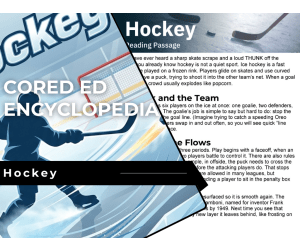
Hockey Reading Comprehension Passage - Cored Ed Encyclopedia
ELA, Language Development, Resources for Teachers, Reading Comprehension, Reading, Pre-Reading, Writing, Strategies, Sports, P.E. & Health, Grade 2, 3, 4, 5, Worksheets & Printables, Worksheets, Teacher Tools, Centers, Activities, Writing Prompts, Assessments, Tests, Quizzes and Tests, Quizzes
This hockey reading comprehension contains the following: Pre-Reading Trivia Students will write down one thing they already know about the subject and then read five more facts and discuss. These facts are fun, and the students will enjoy learning about the subject before reading more. COMPANION VIDEO NOW AVAILABLE (EMBEDDED AFTER PREVIEW PICTURES IN PRODUCT DESCRIPTION) Reading Passage The text is a high-interest reading passage with set paragraphs, roughly three to four paragraphs long. It contains a variety of themes about the topic, anywhere from history to technology. The passage is between 250 and 350 words in length. Mixed Questions The first question page contains four multiple-choice questions, each with a choice of four answers, and three written response questions that require a sentence or two from the student. Creative Writing In this question, the student will be required to write a five to eight sentence paragraph on a question related to the topic. Extension Activities This page is optional for fast finishers. If there are five to ten minutes left at the end of the lesson, the student can choose one of three activities, each one requiring a different skill. Answer Key There are answers for the multiple-choice questions and three written response questions have sample answers. FULL CATALOG OF DOWNLOAD LINKS AND ENCYCLOPEDIA INDEX HERE Lesson Snapshot Title: Hockey Genre: Nonfiction (informational text with headings) Subject: Reading (Informational Text) / Physical Education Primary Topic: How ice hockey is played and organized Estimated Guided Reading Level (A–Z): O Support pages included: Pre-reading trivia; mixed questions; creative writing prompt; extension activities; answer key; QR/index page. Learning Goals Identify ice hockey as a team game on a frozen rink and describe how teams try to score. Name the six on-ice positions/roles and explain the goalie’s job using the text. Explain what a faceoff is and why it matters at the start of play. Describe the offside rule example given in the passage and how it affects play. Describe what can happen after dangerous hits and what the penalty box is for. Describe what happens to the ice between periods and identify the Zamboni’s role. Key Vocabulary From the Text faceoff — start of play when an official drops the puck. offside — attackers enter the zone before the puck crosses the line. defenders — players who help protect their team’s goal. penalties — consequences that can send a player off briefly. resurfaced — made smooth again with a new layer. Cored Ed Encyclopedia Overview The Cored Ed Encyclopedia is a weekly series of lessons that you can pick up and use right away. These short readings fit into whatever time you have available. Each one includes a warm-up, a reading, and a set of questions, but it’s flexible — you can do just the reading, the full lesson, or skip the writing section if you need to. Each lesson focuses on a single topic so students don’t get lost. The writing is clear but never childish, making it perfect for grades two through five. Topics range from animals and science to history, inventions, and everyday things. No matter the level of the student, everyone should take away at least one new idea or fact from each lesson. The materials are easy to print, easy to explain, and require no setup. They work well for whole-class teaching, partner work, or independent study.
Author Cored Education
Rating
Tags Vocabulary, Spelling, Reading Comprehension, Reading Passages, Reading, Creative Writing, Reading Strategies, Writing Prompts, Hockey, Sports

Ocean Animal Research Writing Project on SEALS for K-2nd Grade
Life Studies, ELA, Writing, Creative Writing, Reading, Science, Life Sciences, Animals, Research, Kindergarten, Grade 1, 2, Lesson Plans, Teacher Tools, Worksheets, Worksheets & Printables, Writing Prompts
Animal Research Writing Project on Seals for K-2nd Grade. Students will read age-appropriate information about seals and examine real-life photos of these ocean mammals. After learning about seals' physical features, habitat, diet, and behaviors, students will complete a range of activities to demonstrate their knowledge. Differentiated materials allow students of all abilities to participate. Young learners will color a cover page, habitat scene, and seal picture. Two writing organizers help students take notes and sort facts. Differentiated writing pages scaffold the research paper process for emerging writers. A self-checking writing page allows independent work. This engaging 19-page unit encourages reading, creativity, and informational writing. It can be used individually, in small groups, or for whole-class instruction. Other animal units are available for additional research opportunities. Here are even more informational resources on report writing for OCEAN ANIMALS. Click on the links below: Animal Research Writing Project on WHALES for K-2nd Grade Animal Research Writing Project on the OCTOPUS for K-2nd Grade Animal Research Writing Project on SEA TURTLES for K-2nd Grade Animal Research Writing Project on ORCAS for K-2nd Grade Animal Research Writing Project on the SHELLFISH for K-2nd Grade Animal Research Writing Project on DOLPHINS for K-2nd Grade Animal Research Writing Project on SEALS for K-2nd Grade Want to teach your students all about Zoo Animals? Check out all these interesting facts about these favorite zoo animals. With the same great photos, facts, habitat drawings, and more. It is a great way to help students to get interested in writing. For Zoo Animal reports, click on the following links below: Animal Research Writing Project on TIGERS for K-2nd Grade Animal Research Writing Project on MONKEYS for K-2nd Grade Animal Research Writing Project on PANDAS for K-2nd Grade Animal Research Writing Project on HIPPOS for K-2nd Grade Animal Research Writing Project on ELEPHANTS for K-2nd Grade Animal Research Writing Project on GIRAFFES for K-2nd Grade
Author K-5 Treasures
Tags Informational Writing, Writing Report, Report On Animals, 1st Grade Writing, 2nd Grade Writing, Ocean Animals, Ocean Animal Research, Seals, Report On Seals, Ocean Animal Report

Arctic Animals Endless Creative Writing Prompts
ELA, Writing, Creative Writing, Grade 1, 2, 3, Writing Prompts, Worksheets & Printables
Arctic Animals Endless Creative Writing Prompts This invaluable asset for first-to-third grade teachers blends science and language arts instruction, with an engaging arctic animals theme to help educators create stimulating writing prompts. Key Product Features: Uses the 'somebody wants but so then' (SWBST) approach for low-preparation creative writing prompts that expand students' knowledge of arctic animals while teaching critical language learning components. Offers creative graphic organizers to help channel ideas into compelling narratives. Included rubric versions facilitate quick and thorough post- activity student assessments. Included Arctic Animal Cards The resource features 16 intricately designed arctic animal cards available in both a color and black & white version. These cards cover a wealth of polar fauna, from the sharp-eyed Arctic fox to the majestic Orca, potentially acting as starting points for discussions on biodiversity and wildlife conservation. Bridging Language Learning with Natural World Knowledge This product provides exposure to over 100 common adjectives, verbs, adverbs, prepositions & conjunctions related to each animal card—thus enriching their natural fluency with parts of speech. Versatile Usage:> Suitable as individual assignments or small group exercises encouraging cross-pollination of ideas between students. Fosters constructive classroom discussion promoting analytical thinking among learners while honing oral communication skills. > A Multifaceted Educational Experience: > Easily integrated within Art-based activities or regular science lessons whilst providing targeted scientific knowledge about various arctic animals. Enhance your classrooms with this everything-you-need resource in the realm of creative storytelling.
Author Heather Huhman
Tags Arctic Animals, Creative Writing Prompts, Science Education, Language Arts, Graphic Organizers
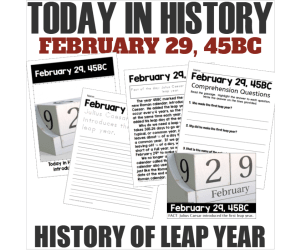
Today in History - The First Leap Year - February 29, 45BC
History, Social Studies, Reading Comprehension, Reading, ELA, Handwriting, Writing, Creative Writing, History: World, Grade 2, 3, 4, Writing Prompts, Worksheets & Printables
The first leap year happened on February 29, 45BC. This packet gives students a basic knowledge about the first Leap Year and how having a leap year became common practice through reading comprehension and writing activities. This Today in History packet is a great way for students to engage with this topic. What is included: There is one poster that portrays an image of the event and the key fact from the packet. There are four penmanship pages for students to use. They are differentiated for different student needs. There are two manuscript copy work pages, one with primary lines and one with regular lines, for students to write the key fact. Likewise there are two cursive handwriting pages in the same format. There are two reading passages and comprehension questions. Again, these are the same passage, just differentiated for different levels. An easier passage with multiple choice questions is included for students who need more support. The more difficult passage includes a written response question page. There are two writing prompts in this packet. One is to write a few sentences on what was learned from the packet. The other is to write a creative story or scenario related to the event. There is a card at the end of the packet that can be used for a classroom timeline display. There is a card premade and a card that students can draw their own image on. How to Use the Today in History Packets: Morning Work - When students enter the class they can work on the reading passages, handwriting activities and creative writing activities. Independent Work - This packet can be used as independent work for students to learn about this topic. Display Items - There are posters for classroom display and a card for building a classroom timeline. Skills Assessed: Reading Comprehension Creative Writing Handwriting and Penmanship
Author The Connett Connection
Rating
Tags Today In History, Reading Comprehension, Creative Wrriting, Leap Year, The First Leap Year, February 29

Jets Reading Comprehension Passage - Cored Ed Encyclopedia
ELA, Language Development, Resources for Teachers, Reading Comprehension, Reading, Pre-Reading, Science, Technology, Writing, Strategies, Grade 2, 3, 4, 5, Worksheets & Printables, Worksheets, Teacher Tools, Centers, Activities, Writing Prompts, Assessments, Tests, Quizzes and Tests, Quizzes
This jets reading comprehension contains the following: Visualize on the Cover (Teacher Read Aloud Script) Start your lesson by taking a few moments to visualize the topic and share thoughts or feelings about it. Pre-Reading Trivia Students will write down one thing they already know about the subject and then read five more facts and discuss. These facts are fun, and the students will enjoy learning about the subject before reading more. Reading Passage The text is a high-interest reading passage with set paragraphs, roughly three to four paragraphs long. It contains a variety of themes about the topic, anywhere from history to technology. The passage is between 250 and 350 words in length. Mixed Questions The first question page contains four multiple-choice questions, each with a choice of four answers, and three written response questions that require a sentence or two from the student. Vocabulary Questions Practice seven key words from the text in this section across two activities. First section is scrambled words where students will unscramble three words given a clue for each. The second section is a word to meaning matching activity. Creative Writing In this question, the student will be required to write a five to eight sentence paragraph on a question related to the topic. Extension Activities This page is optional for fast finishers or to take home. There are several activities, each one requiring a different skill. Do some, do none, do all, completely optional - but you will feel reassured knowing every possibility is planned for. Answer Key There are answers for the multiple-choice questions, written response questions have sample answers, vocabulary answers and if there is a summary question then a sample summary will be provided as well. FULL CATALOG OF DOWNLOAD LINKS AND ENCYCLOPEDIA INDEX HERE Lesson Snapshot Title: Jets Genre: Nonfiction (Informational Text) Subject: Science & Technology / Reading (Informational Text) Primary Topic: How jets move, engine parts, and high flight Estimated Guided Reading Level (A–Z): Q What This Lesson Teaches Best Explains the big idea behind jets using an action-and-reaction example (like a blown-up balloon zipping across a room). Describes how a jet engine makes thrust by pulling air in, squeezing it, heating it, and blasting it out the back. Builds technical understanding of engine parts and jobs (inlet, compressor, turbine, exhaust nozzle). Connects jet flight to conditions in the sky (air is thinner and smoother high above clouds; contrails can form when water vapour freezes). Adds brief history context about early jet-engine work and the first turbojet-powered flight date and plane name. Learning Goals Explain how a jet airplane is pushed forward when air or hot gas rushes out the back. Describe what happens inside a jet engine from the inlet to the exhaust nozzle. Identify the jobs of the compressor and turbine using details from the passage. Retell key history details about early jet designs and the first turbojet-powered flight mentioned. Describe what the air is like high above clouds and how that relates to jet travel. Explain how contrails can form according to the text. Key Vocabulary From the Text inlet — the front opening where air is pulled in. compressor — a part that squeezes air so it is packed tight. turbine — a wheel that takes energy from rushing gas. thrust — the push that moves an airplane forward. contrails — white lines that can form when water vapour freezes. Cored Ed Encyclopedia Overview The Cored Ed Encyclopedia is a weekly series of lessons that you can pick up and use right away. These short readings fit into whatever time you have available. Each one includes a warm-up, a reading, and a set of questions, but it’s flexible — you can do just the reading, the full lesson, or skip the writing section if you need to. Each lesson focuses on a single topic so students don’t get lost. The writing is clear but never childish, making it perfect for grades two through five. Topics range from animals and science to history, inventions, and everyday things. No matter the level of the student, everyone should take away at least one new idea or fact from each lesson. The materials are easy to print, easy to explain, and require no setup. They work well for whole-class teaching, partner work, or independent study.
Author Cored Education
Rating
Tags Vocabulary, Spelling, Reading Comprehension, Reading Passages, Reading, Creative Writing, Reading Strategies, Writing Prompts, Technology, Jets

Ocean Animal Research Writing Project on the OCTOPUS for K-2nd Grade
Life Studies, ELA, Writing, Creative Writing, Reading, Science, Life Sciences, Animals, Research, Kindergarten, Grade 1, 2, Teacher Tools, Lesson Plans, Worksheets & Printables, Worksheets, Writing Prompts
Octopus Research and Writing Project for K-2nd Graders. Engage young students in reading, writing, and science with this 19-page octopus research and writing project. Ideal for kindergarteners, 1st graders, and 2nd graders, this cross-curricular resource can be used for whole group instruction, small groups, or individual assignments. The project begins with real-life photos of the octopus to capture students' interest. Appropriately leveled informational text teaches students about the octopus' appearance, habitat, diet, and other facts. A color coding system helps students organize the information as they read. Next, students get creative by coloring their own octopus picture and drawing an underwater habitat scene. Two versions of graphic organizers allow students to sort the facts at their own level. Finally, differentiated writing templates scaffold the writing process and help all students create an informational report on the octopus. A self-checking writing page is included for the youngest writers. The end product can be compiled into an octopus book to display your students' learning. This engaging project seamlessly combines science, reading, and writing for a cross-curricular octopus unit. With grade-appropriate vocabulary and content, it is designed specifically for K-2 students. The differentiated materials ensure all students can participate and be successful as they read, research, and write about the octopus. Here are even more informational resources on report writing for OCEAN ANIMALS. Click on the links below: Animal Research Writing Project on WHALES for K-2nd Grade Animal Research Writing Project on the OCTOPUS for K-2nd Grade Animal Research Writing Project on SEA TURTLES for K-2nd Grade Animal Research Writing Project on ORCAS for K-2nd Grade Animal Research Writing Project on the SHELLFISH for K-2nd Grade Animal Research Writing Project on DOLPHINS for K-2nd Grade Animal Research Writing Project on SEALS for K-2nd Grade Want to teach your students all about Zoo Animals? Check out all these interesting facts about these favorite zoo animals. With the same great photos, facts, habitat drawings, and more. It is a great way to help students to get interested in writing. For Zoo Animal reports, click on the following links below: Animal Research Writing Project on TIGERS for K-2nd Grade Animal Research Writing Project on MONKEYS for K-2nd Grade Animal Research Writing Project on PANDAS for K-2nd Grade Animal Research Writing Project on HIPPOS for K-2nd Grade Animal Research Writing Project on ELEPHANTS for K-2nd Grade Animal Research Writing Project on GIRAFFES for K-2nd Grade
Author K-5 Treasures
Tags Informational Writing, Writing Report, Report On Animals, 1st Grade Writing, 2nd Grade Writing, Ocean Animals, Ocean Animal Research, Octopus, Report On The Octopus, Ocean Animal Report

Today in History - Louis Braille is Born - January 4, 1809
History, Social Studies, Reading Comprehension, Reading, ELA, Handwriting, Writing, Creative Writing, History: Europe, Grade 2, 3, 4, Writing Prompts, Worksheets & Printables
Louis Braille was born on January 4, 1809. This packet gives students a basic knowledge about Louis Braille and his new reading and writing system through reading comprehension and writing activities. This Today in History packet is a great way for students to engage with this topic. What is included: There is one poster that portrays an image of the event and the key fact from the packet. There are four penmanship pages for students to use. They are differentiated for different student needs. There are two manuscript copy work pages, one with primary lines and one with regular lines, for students to write the key fact. Likewise there are two cursive handwriting pages in the same format. There are two reading passages and comprehension questions. Again, these are the same passage, just differentiated for different levels. An easier passage with multiple choice questions is included for students who need more support. The more difficult passage includes a written response question page. There are two writing prompts in this packet. One is to write a few sentences on what was learned from the packet. The other is to write a creative story or scenario related to the event. There is a card at the end of the packet that can be used for a classroom timeline display. There is a card premade and a card that students can draw their own image on. How to Use the Today in History Packets: Morning Work - When students enter the class they can work on the reading passages, handwriting activities and creative writing activities. Independent Work - This packet can be used as independent work for students to learn about this topic. Display Items - There are posters for classroom display and a card for building a classroom timeline. Skills Assessed: Reading Comprehension Creative Writing Handwriting and Penmanship
Author The Connett Connection
Rating
Tags Today In History, Reading Comprehension, Creative Wrriting, Louis Braille

Zacchaeus Bible Story Lapbook Project Grade 3 4 5 ELA ELL
ELA, Literature, Reading, Grade 3, 4, 5, Centers, Activities, Worksheets & Printables, Worksheets, Writing Prompts, Projects, Coloring Pages
Inspire meaningful learning practice through this Zacchaeus Lapbook Project! Designed for Grade 4, 5 and 6 students, homeschoolers, and EFL / ESL learners, this special project is an amazing tool for your reading classes and Bible school lessons. What’s Inside: 3 Zacchaeus Differentiated Reading Passages (Easy, Average, Hard) 3 Zacchaeus Lapbook Covers to choose from 2 Zacchaeus Name Pages (Individual & Group Options) 1 Zacchaeus Inner Overlap Page 2 Zacchaeus Story Summary Page Options 1 Zacchaeus Story Message Page (Lesson & Moral Reflection) 1 Zacchaeus Story Sequence Pocket 6 Zacchaeus Story Sequence Photocards 3 Zacchaeus Story Sequencing Activity Options (Easy / Average / Hard) – 6 sequence cards per level 6 Zacchaeus Story Retell Cards 1 Zacchaeus Character Traits Fold 1 Zacchaeus Story Setting Fold 1 Zacchaeus Story Rating Page 1 Zacchaeus Prayer Response Fold (Faith-based reflection) This set is perfect for reading comprehension and in-depth literary analysis through deliberate and hands-on learning activities that encourages learners stay actively engaged in the lesson. It builds important skills such as sequencing, retelling, and critical thinking while reinforcing Christian values like kindness, mercy, and compassion. The differentiated activities make it perfect for mixed-ability classrooms as well as EFL/ESL learners, making sure that all students can participate meaningfully. It is also a perfect addition to Bible study units, Christian school classrooms, homeschool learning, and integrated ELA lessons.
Author It's Teacher L
Rating
Tags Reading, Mini Book, Sequencing, Writing, Reading Comprehension, ELA, ELL, Bible Stories, Sunday School

Finish the Story: Fall Theme Writing Prompts
Holiday & Seasonal, ELA, Seasons, Fall, Writing, Creative Writing, Grade 2, 3, 4, 5, Writing Prompts, Worksheets & Printables
Finish the Story: Fall Theme Writing Prompts An ideal resource for educators in public schools and homeschooling scenarios. It's built with creativity at its core, aiming to engage students from Grades 2 through 5, nurture their writing skills, inspire them to further develop their storytelling abilities, and have a little fun along the way. This no-prep packet is equipped with fall-themed prompts designed specifically to spark young imaginations. There are a total of 11 unique prompts that encourage children not just ideate wildly but also structure those thoughts into coherent narratives. Moreover, each prompt offers two different layouts for added flexibility. Besides hard-copy worksheets for in-class activities or homework assignments. The product also includes digital templates compatible with student devices. Versatility of Use The versatility of this material extends far beyond traditional classroom use. Let's look at some options: Serve as an engaging resource at writing centers . Making it beneficial material for small group sessions focused on enhancing creative writing capacities among peers. Potentially useful in partner-writing exercises emphasizing collaborative efforts and independent work geared towards practicing skills autonomously. For early finishers needing extra tasks prompting learning continuity, these finish-the-story worksheets can become advantageous stimuli encouraging improved written expression competencies. Nifty PDF Format & Comprehensive Coverage: 23 Usable Pages! All content is tucked into one manageable PDF format available whenever you need it. Moreover! In keeping track with various educational enriching subjects such as holidays creative writing notably tied around Autumn events celebrations falling under creative writing subthemes this product becomes a holistic package of constructively recreational content generation that educates and entertains simultaneously. Fervently stirring youthful curiosity towards the composition of interesting stories borne from prompts infused with autumnal charm, Finish the Story: Fall Theme Writing Prompts is sure to captivate young minds excitedly eager for inspiring, intuitive, informative yet non-overbearing exploration in the world of creative essay writing.
Author Blooming with Blake
Tags Fall-themed Prompts, Creative Writing, Storytelling, Writing Skills, Finish The Story
United Nations Reading Comprehension Passage - Cored Ed Encyclopedia
ELA, Language Development, Reading Comprehension, Reading, Pre-Reading, Vocabulary, History, Social Studies, Government, Writing, Grade 2, 3, 4, 5, Worksheets & Printables, Worksheets, Teacher Tools, Centers, Activities, Writing Prompts, Assessments, Quizzes and Tests, Quizzes, Lesson Plans
This United Nations reading comprehension with lesson plan includes: Visualization (on the front cover) Start your lesson by taking a minute to think and share something about the topic. Read the script aloud (slowly), perhaps prepare some music or sound effects. Student close their eyes and let their imaginations wander. Students open their eyes, read the question aloud and give them a few minutes to complete. Ask a few students to share or keep answers until the end to compare with what they learn in the passage. Quick pause—thousands of Cored Education products are included with your TeachSimple membership. Download links and encyclopedia index available here. Pre-Reading Trivia Students will write down one thing they already know about the subject and then read five more facts and discuss. These facts are fun, and the students will enjoy learning about the subject before reading more. Give 1 minute for students to write what they already know (no pressure—best guess is fine). Read the five facts together. After each fact, do ask a student for their opinion, was it surprising? Set a purpose by asking students to highlight/underline one fact they want to learn more about during the reading. Reading Passage The text is a high-interest reading passage with set paragraphs, roughly three to four paragraphs long. It contains a variety of themes about the topic, anywhere from history to technology. The passage is between 250 and 350 words in length. First, ask students to look at the headings and see what they’ll learn about today. What do they know about the topic/heading? First read options: Teacher read-aloud (best for support). Partner reading (paragraph by paragraph). While reading, students underline important details, and vocabulary words they think may come up in the questions section. Mixed Questions The first question page contains four multiple-choice questions, each with a choice of four answers, and three written response questions that require a sentence or two from the student. Students complete the mcqs first independently, then review quickly as a class. For the 3 written responses, try to get students giving the answer with some form of evidence: “I think ___ because the text says ___.” If students get stuck, send them back to check the passage. Vocabulary Questions Practice seven key words from the text in this section across two activities. First section is scrambled words where students will unscramble three words given a clue for each. The second section is a word to meaning matching activity. Before starting, have some students read out words they underlined in the passage. Ask students to say the word and read aloud the sentence(s) around each word. Ask students to do scrambled words and the matching exercise in pairs then go through answers as a class. For the scrambled spelling task, get four pairs to come up to the board and write the words for extra practice with the other student reading out the clue. For the matching task, prompt students to give full sentences: “I matched ___ with ___ because ___.” Creative Writing In this question, the student will be required to write a five to eight sentence paragraph on a question related to the topic. Before starting, ask students write down 3 key ideas they are going to include in their piece. Ask students for ideas to share around the class to help those struggling. Pro writing expectations: 5–8 sentences At least 2 facts or details from the passage At least 2 vocabulary words from the previous page Students read their paragraphs while classmates listen for facts and vocabulary words. Extension Activities This page is optional for fast finishers or to take home. There are several activities, each one requiring a different skill. Do some, do none, do all, completely optional - but you will feel reassured knowing every possibility is planned for. Includes summary writting question. Answer Key There are answers for the multiple-choice questions, written response questions have sample answers, vocabulary answers and if there is a summary question then a sample summary will be provided as well. Lesson Plan Included Customized lesson plan for this lesson is included. Lesson Snapshot Title: United Nations Genre: Nonfiction (Informational text) Subject: Social Studies (Civics/Global Studies) Primary Topic: How the UN began and works for peace Estimated Guided Reading Level (A–Z): P What This Lesson Teaches Best Origins and purpose of the UN: Explains that delegates from 50 countries met in San Francisco in 1945 and signed the United Nations Charter, leading to the UN officially beginning on October 24, 1945. How countries work together in the UN: Describes the UN headquarters in New York City and how member countries speak and vote in the General Assembly, while a smaller group (the Security Council) votes on steps meant to protect peace. Peacekeeping basics: Introduces UN peacekeeping observers (UNTSO) and explains that peacekeepers watch, report, and help keep ceasefires from breaking (and are not there to conquer). Communication across languages: Shows why interpreters matter by explaining that leaders use interpreters in six official languages so the same message can travel across the room. UN help beyond meetings: Notes that UN groups like UNICEF and the World Health Organization work on children’s needs, health, and bringing supplies after earthquakes, floods, or wars. Learning Goals Students will identify key dates and events that led to the UN officially beginning in 1945. Students will describe how the General Assembly and the Security Council are different, using details from the text. Students will explain what the United Nations Charter is and what it was meant to help countries do. Students will summarize what peacekeepers do and why peacekeeping can be hard when countries won’t cooperate. Students will use context clues to determine the meaning of key words such as interpreters and ceasefires . Key Vocabulary From the Text delegates — people chosen to represent a country at a meeting. Charter — a written promise that explains a group’s goals. headquarters — the main building where an organization works. interpreters — people who change speech into another language. ceasefires — times when fighting stops for a while. FULL CATALOG OF DOWNLOAD LINKS AND ENCYCLOPEDIA INDEX HERE
Author Cored Education
Rating
Tags Vocabulary, Reading Comprehension, Reading Passages, Lesson Plans, Ela Lesson Plans, Reading Comprehension Lesson Plans, Pre-reading, Social Studies Lesson Plans, Social Studies, Government

Detectives Reading Comprehension Passage - Cored Ed Encyclopedia
ELA, Language Development, Resources for Teachers, Reading Comprehension, Reading, Pre-Reading, Writing, Strategies, Vocabulary, Common Core, Grade 2, 3, 4, 5, Worksheets & Printables, Worksheets, Teacher Tools, Centers, Activities, Writing Prompts, Assessments, Tests, Quizzes and Tests, Quizzes
This detectives reading comprehension contains the following: Pre-Reading Trivia Students will write down one thing they already know about the subject and then read five more facts and discuss. These facts are fun, and the students will enjoy learning about the subject before reading more. Reading Passage The text is a high-interest reading passage with set paragraphs, roughly three to four paragraphs long. It contains a variety of themes about the topic, anywhere from history to technology. The passage is between 250 and 350 words in length. Mixed Questions The first question page contains four multiple-choice questions, each with a choice of four answers, and three written response questions that require a sentence or two from the student. Creative Writing In this question, the student will be required to write a five to eight sentence paragraph on a question related to the topic. Extension Activities This page is optional for fast finishers. If there are five to ten minutes left at the end of the lesson, the student can choose one of three activities, each one requiring a different skill. Answer Key There are answers for the multiple-choice questions and three written response questions have sample answers. FULL CATALOG OF DOWNLOAD LINKS AND ENCYCLOPEDIA INDEX HERE Cored Ed Encyclopedia Overview The Cored Ed Encyclopedia is a weekly series of lessons that you can pick up and use right away. These short readings fit into whatever time you have available. Each one includes a warm-up, a reading, and a set of questions, but it’s flexible — you can do just the reading, the full lesson, or skip the writing section if you need to. Each lesson focuses on a single topic so students don’t get lost. The writing is clear but never childish, making it perfect for grades two through five. Topics range from animals and science to history, inventions, and everyday things. No matter the level of the student, everyone should take away at least one new idea or fact from each lesson. The materials are easy to print, easy to explain, and require no setup. They work well for whole-class teaching, partner work, or independent study.
Author Cored Education
Rating
Tags Vocabulary, Spelling, Reading Comprehension, Reading Passages, Cored Encyclopedia, Facts, Reading, Creative Writing, Detectives, Ela

April Writing Prompts - Learning Passport
ELA, Writing, Creative Writing, Grade 2, 3, 4, Writing Prompts, Worksheets & Printables
April Writing Prompts - Learning Passport: The April Writing Prompts - Learning Passport is an engaging teaching resource designed to enhance creative writing skills among Grade 2-4 students.This resource combines language arts and creativity ensuring daily exercises remain fresh and thought-provoking. The Workbook : This workbook contains four double-sided pages, creating a 32-page activity booklet. Each page incorporates different themes based on April's special days such as: World Health Day National Siblings Day Educational Passport stamps: The key feature of this workbook is the passport stamping concept. After completion of each task, students are awarded educational passport stamp from a selection of twenty pre-designed stamps. This attractive reinforcement method provides progress acknowledgement boosting confidence and interest within students. Simplicity & Conservation: Offering easy assembly (print double-sided pages, cut, fold, staple), it's practical for educators while also being conveniently manageable for young learners. With personalized designs available towards further engagement, this methodical organisation makes efficient use of just four sheets per guidebook. The benefits include reduced waste and disappearance of worksheets in your classroom! To get started with fostering creativity among your young learners using the structured format provided by the April Writing Prompts - Learning Passport: Explore some sample topics here before commencing. We wish you happy teaching!
Author Knowledge Mobile
Tags Writing Prompts, Creative Writing, Language Arts, April Activities, Learning Resources
Reading Comprehension and Questions Fiction Set 5 - Sports (PDF)
ELA, Reading, Reading Comprehension, Common Core, ESL, Language Development, Vocabulary, Spelling, Literature, Writing, Grade 4, 5, Worksheets & Printables, Worksheets, Writing Prompts, Assessments, Teacher Tools, Tests, Quizzes and Tests, Centers, Activities
Reading Comprehension Passages Fiction Set 5 Overview No prep reading comprehension lessons, with enjoyable stories and topics. Each lesson has a blend of post-reading activities. Mixed questions to check overall understanding. Vocabulary activities, plus a writing section. Lessons also contain a bonus extension exercise at the end. Some you may like, some you may not, either way they are there if you wish to use them. Full answer keys are provided. Passages Include 1.Olympics: Lauren and her class get excited when talking about the Olympics. 2.Tryouts: Max is getting himself ready for the basketball tryouts. 3.Big Brienne: Kitty has the game of her life against Big Brienne. 4.A Skate on the Lake: Aimee has a nice evening at the lake with her dad and friends. 5.Baseball Boy: Mitch goes to watch the Chicago Hitters. Read about his day. 6.Running: An informative, yet light piece about running. PDF Version This is the PDF uneditable version. This download is available in GOOGLE Docs, GOOGLE Forms, GOOGLE Slides. PDF, PPT, WORD. Browse the Complete Cored Catalog — 2,000+ Resources Included Reading Passages Each reading passage has been written specifically for students in Grades 4–5, using vocabulary and language that match their age and ability level. The collection covers a wide range of engaging topics, supported by colorful visuals that help bring the content to life. Every lesson is designed to build knowledge while keeping students interested and motivated to read. These resources are also designed with flexibility in mind. Unlike traditional textbooks that can quickly become outdated, lessons can be updated over time to reflect changes in technology, discoveries, and the world around us. Mixed Questions Every lesson includes a variety of questions that help students think more deeply about what they have read. The question section combines reading comprehension, vocabulary, and math skills, while also regularly reinforcing important reading strategies such as cause and effect, summarizing, compare and contrast, and drawing conclusions. Most lessons include a mix of multiple-choice and written-response questions, giving students opportunities to explain their thinking as well as select answers. Complete answer keys and sample responses are provided at the end of each lesson for quick and easy reference. Spelling & Vocabulary Each passage introduces students to useful words and phrases appropriate for Grades 4–5. To help build confidence and word knowledge, every lesson includes a spelling or vocabulary activity. Rather than repeating the same task throughout the collection, activities vary from lesson to lesson to keep practice fresh and engaging. Activities may include spelling challenges, sentence matching, decoding activities, mixed-up text exercises, and other vocabulary-building tasks connected directly to the reading. Writing Prompts Each lesson includes a writing activity that extends the ideas, themes, or topics explored in the passage. Students are encouraged to write in a variety of formats, with prompts providing helpful guidance and ideas to get them started. Writing tasks vary throughout the collection and may include creative writing, research activities, personal responses, poetry, opinion writing, and other engaging assignments. Full Answer Keys Complete answer keys and sample responses are included with every lesson, making planning and marking quicker and easier. Reading comprehension answers include evidence and support from the text, while math-based questions show the relevant working where appropriate. The answer keys are designed primarily for teachers but can also be shared with students when needed. Just for Fun Each lesson finishes with an optional extension activity called Just for Fun . These bonus activities provide an enjoyable way to extend learning beyond the main lesson and often encourage creativity, discussion, or independent thinking. They are completely optional, giving you the flexibility to use the activities that best suit your students and classroom needs. For similar downloads and other frees, do check out Cored Group on TeachSimple.
Author Cored Education
Rating
Tags Elementary, Reading, Comprehension, Vocabulary, Answers, Spelling, Writing, Passages, Reading Centers, Reading Comprehension Assessments

The Good Samaritan Bible Story Lapbook Project Grade 1 2 3 ELA ELL
ELA, Literature, Reading, Grade 3, 4, 5, Centers, Activities, Worksheets & Printables, Worksheets, Writing Prompts, Projects, Coloring Pages
Give your students a more meaningful learning experience with this classic Bible story The Good Samaritan in this The Good Samaritan Lapbook Project! Created for Grade 4, 5 and 6 students, homeschoolers, and EFL / ESL learners, this special project will definitely be part of your reading classes and or Bible school lessons for many years to come! What’s Included: 3 The Good Samaritan Differentiated Reading Passages (Easy, Average, Hard) 3 The Good Samaritan Lapbook Covers to choose from 2 The Good Samaritan Name Pages (Individual & Group Options) 1 The Good Samaritan Inner Overlap Page 2 The Good SamaritanStory Summary Page Options 1 The Good Samaritan Story Message Page (Lesson & Moral Reflection) 1 The Good Samaritan Story Sequence Pocket 6 The Good Samaritan Story Sequence Photocards 3 The Good Samaritan Story Sequencing Activity Options (Easy / Average / Hard) – 6 sequence cards per level 6 The Good Samaritan Story Retell Cards 1 The Good Samaritan Character Traits Fold 1 The Good Samaritan Story Setting Fold 1 The Good Samaritan Story Rating Page 1 The Good Samaritan Prayer Response Fold (Faith-based reflection) This project encourages reading comprehension and literary analysis through fun hands-on learning activities that help learners stay actively engaged in the lesson. It builds important skills such as sequencing, retelling, and critical thinking while reinforcing Christian values like kindness, mercy, and compassion. The differentiated activities make it perfect for mixed-ability classrooms as well as EFL/ESL learners, making sure that all students can participate meaningfully. It is also a perfect addition to Bible study units, Christian school classrooms, homeschool learning, and integrated ELA lessons.
Author It's Teacher L
Rating
Tags Reading, Mini Book, Sequencing, Writing, Reading Comprehension, ELA, ELL, Bible Stories, Sunday School

Reading Comprehension Nonfiction Set 5 - Sea Animals (PDF)
ELA, Reading, Reading Comprehension, Common Core, Creative Writing, Writing, ESL, Language Development, Spelling, Vocabulary, Grade 4, 5, Worksheets & Printables, Worksheets, Writing Prompts, Assessments, Teacher Tools, Tests, Quizzes and Tests, Centers, Activities
Reading Comprehension Passages Nonfiction Set 5 Overview No prep reading comprehension lessons, with enjoyable articles and topics. Each lesson has a blend of post-reading activities. Mixed questions to check overall understanding. Vocabulary activities, plus a writing section. Lessons also contain a bonus extension exercise at the end. Some you may like, some you may not, either way they are there if you wish to use them. Full answer keys are provided. Passages Include 1.Stingray: Close relatives to sharks, read more about this fascinating animal in this article. 2.That's Electric: How much electricity can an electric eel produce? Find outhere. 3.Whale Shark: The largest fish in the sea. Yes, the largest!! 4.Scared of Sharks: The all you need to know shark passage. If you're not too scared to read it! 5.Under the Sea: Porpoise or dolphin? What's the difference? 6.All About Jellyfish: More people are killed by jellyfish stings every year than from great white shark attacks. PDF Version This is the PDF uneditable version. This download is available in GOOGLE Docs, GOOGLE Forms, GOOGLE Slides. PDF, PPT, WORD. FULL CATALOG OF DOWNLOAD LINKS HERE Grade 4/5 Links Fiction Set 1 - Animals Google Docs Google Forms Google Slides PDF PPT Word Guided Reading Materials Fiction Set 2 - Family Google Docs Google Forms Google Slides PDF PPT Word Guided Reading Materials Fiction Set 3 - Friends Google Docs Google Forms Google Slides PDF PPT Word Guided Reading Materials Fiction Set 4 - School Google Docs Google Forms Google Slides PDF PPT Word Guided Reading Materials Fiction Set 5 - Sports Google Docs Google Forms Google Slides PDF PPT Word Guided Reading Materials Nonfiction Set 1 - Birds Google Docs Google Forms Google Slides PDF PPT Word Guided Reading Materials Nonfiction Set 2 - Insects Google Docs Google Forms Google Slides PDF PPT Word Guided Reading Materials Nonfiction Set 3 - Mammals Google Docs Google Forms Google Slides PDF PPT Word Guided Reading Materials Nonfiction Set 4 - Nature Google Docs Google Forms Google Slides PDF PPT Word Guided Reading Materials Nonfiction Set 5 - Sea Animals Google Docs Google Forms Google Slides PDF PPT Word Guided Reading Materials Reading Passages Overview Each passage is especially written for Grade 4-5 students, including key vocabulary required for this age group. Topics are varied and are accompanied by colorful graphics. Topics are meant to educate, yet entertain the modern student. These passages are perfect for the modern classroom. Whereas textbooks can become outdated in no time, any changes to technology or the world will result in updates to this product. Mixed Questions The mixed questions section of each lesson includes a variation of five comprehension, vocabulary and math questions. In addition, key reading strategies are frequently covered including cause & effect, summarizing, compare & contrast and making conclusions. Two or three of the questions will be MCQs and other questions will require a written response of some kind. Full answers and example responses appear at the end of the lesson. Spelling & Vocab Each reading passage contains a variety of words and phrases designed for Grade 4-5 students. Spelling and vocab activities provide the opportunity to build fluency with these words. As it can become quite mundane doing the same activities over and over, each lesson in a set will contain a different spelling and vocab activity . Activities include: spelling games, sentence match-ups, mixed-up text and decoding words from the lesson. Writing Prompts Writing prompts are designed to continue the theme or lessons learned in the story. Students are persuaded to write in a variety of ways and each prompt includes several cues to help. As with the spelling/vocab section, writing prompts will vary. This includes research pieces, reading responses, poetry and creative writing prompts. Full Answer Keys Full answer keys and sample responses are provided so no matter how busy you are, you know you're covered! Mixed question answers provide evidence from the text, math questions contain the relevant workings. Answers are designed for use by the teacher, but also suitable as a handout to the student. Just for Fun Each lesson will have a bonus extension exercise. This is something fun to extend the lesson with. You can find these at the end of each lesson, titled Just for Fun. Just for Funs are optional. Some you may like, some you may not. Either way, they are there to do with as you wish. For similar downloads and other frees, do check out Cored Group on TeachSimple.
Author Cored Education
Rating
Tags Elementary, Reading, Comprehension, Vocabulary, Common Core, Spelling, Writing, Passages, Reading Centers, Reading Comprehension Assessments
Gliders Reading Comprehension Passage - Cored Ed Encyclopedia
ELA, Reading Comprehension, Reading, Science, Technology, Pre-Reading, Language Development, Physics, History, Social Studies, Grade 2, 3, 4, 5, Worksheets & Printables, Worksheets, Teacher Tools, Centers, Activities, Writing Prompts, Assessments, Quizzes and Tests, Quizzes, Lesson Plans
This gliders reading comprehension with lesson plan includes: Visualization (on the front cover) Start your lesson by taking a minute to think and share something about the topic. Read the script aloud (slowly), perhaps prepare some music or sound effects. Student close their eyes and let their imaginations wander. Students open their eyes, read the question aloud and give them a few minutes to complete. Ask a few students to share or keep answers until the end to compare with what they learn in the passage. Quick pause—thousands of Cored Education products are included with your TeachSimple membership. Download links and encyclopedia index available here. Pre-Reading Trivia Students will write down one thing they already know about the subject and then read five more facts and discuss. These facts are fun, and the students will enjoy learning about the subject before reading more. Give 1 minute for students to write what they already know (no pressure—best guess is fine). Read the five facts together. After each fact, do ask a student for their opinion, was it surprising? Set a purpose by asking students to highlight/underline one fact they want to learn more about during the reading. Reading Passage The text is a high-interest reading passage with set paragraphs, roughly three to four paragraphs long. It contains a variety of themes about the topic, anywhere from history to technology. The passage is between 250 and 350 words in length. First, ask students to look at the headings and see what they’ll learn about today. What do they know about the topic/heading? First read options: Teacher read-aloud (best for support). Partner reading (paragraph by paragraph). While reading, students underline important details, and vocabulary words they think may come up in the questions section. Mixed Questions The first question page contains four multiple-choice questions, each with a choice of four answers, and three written response questions that require a sentence or two from the student. Students complete the mcqs first independently, then review quickly as a class. For the 3 written responses, try to get students giving the answer with some form of evidence: “I think ___ because the text says ___.” If students get stuck, send them back to check the passage. Vocabulary Questions Practice seven key words from the text in this section across two activities. First section is scrambled words where students will unscramble three words given a clue for each. The second section is a word to meaning matching activity. Before starting, have some students read out words they underlined in the passage. Ask students to say the word and read aloud the sentence(s) around each word. Ask students to do scrambled words and the matching exercise in pairs then go through answers as a class. For the scrambled spelling task, get four pairs to come up to the board and write the words for extra practice with the other student reading out the clue. For the matching task, prompt students to give full sentences: “I matched ___ with ___ because ___.” Creative Writing In this question, the student will be required to write a five to eight sentence paragraph on a question related to the topic. Before starting, ask students write down 3 key ideas they are going to include in their piece. Ask students for ideas to share around the class to help those struggling. Pro writing expectations: 5–8 sentences At least 2 facts or details from the passage At least 2 vocabulary words from the previous page Students read their paragraphs while classmates listen for facts and vocabulary words. Extension Activities This page is optional for fast finishers or to take home. There are several activities, each one requiring a different skill. Do some, do none, do all, completely optional - but you will feel reassured knowing every possibility is planned for. Includes summary writting question and additional facts. Answer Key There are answers for the multiple-choice questions, written response questions have sample answers, vocabulary answers and if there is a summary question then a sample summary will be provided as well. Lesson Plan Included Customized lesson plan for this lesson is included. Lesson Snapshot Title: Gliders Genre: Nonfiction (informational text) Subject: Science (flight/engineering) Primary Topic: How gliders fly using lift and launch methods Estimated Guided Reading Level (A–Z): Q What This Lesson Teaches Best Explains what makes a glider different from a small airplane (no motor; quiet flight; “trade height for distance”). Describes how gliders get into the sky (help at the start, including being towed; later mentions aerotows and winches). Teaches how moving air helps a glider climb—especially rising warm air (“thermals”) and wind pushed upward at a ridge or hill. Shows how design features support gliding (long, narrow wings; smooth body; low drag to lose little energy). Connects gliders to early flight experiments through Otto Lilienthal’s repeated testing and “fly hill.” Learning Goals Students will describe how a glider is similar to and different from a small airplane. Students will explain how a glider usually starts flying using details from the text. Students will identify two kinds of lift described in the passage and tell how each helps a glider climb. Students will explain why long, narrow wings and low drag help a glider glide efficiently. Students will describe how gliders and launch methods changed over time, using examples from the text. Students will explain how spoilers or airbrakes help with landing safely. Key Vocabulary From the Text cockpit — where the pilot sits and reads instruments. thermals — rising columns of warm air. drag — air resistance that slows motion. aerotows — launches where an airplane tows the glider. spoilers — panels that help a glider slow down and descend. FULL CATALOG OF DOWNLOAD LINKS AND ENCYCLOPEDIA INDEX HERE
Author Cored Education
Rating
Tags Vocabulary, Reading Comprehension, Reading Passages, Lesson Plans, Ela Lesson Plans, Reading Comprehension Lesson Plans, Pre-reading, Science Lesson Plans, Physics, History