Financial Literacy Vacation Math Project: Budgeting and Percentages


- Grades
- Grades 5–8, Middle School, Elementary
- Pages
- 6
- File type
- Preparation
- Print ready


- Subject
- Life Studies, Math, Time, Decimals, Money, Measurements, Finance, Home Economics
- Topic
- financial literacy, applied math
- Resource types
- Worksheets & Printables, Word Problems, Activities, Projects
- Preparation
- Print ready
About this resource
What's inside this resource
This Financial Literacy: Vacation Math Project will get students excited about using math skills in everyday life to plan something fun: a vacation! It's a great math project to use before summer vacation or anytime you want to incorporate financial literacy into your curriculum!
They will plan a personal vacation including a flight, hotel, some kind of transportation, food, local attractions, shopping and insurance.
You can assign your students different budgets, vacation dates, and durations to be able to differentiate, or you can give each student the same constraints.
Students will practice making trade-offs to stick within their budget.
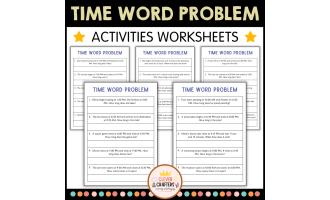
Six word problems involving time zones, suitcase weight, taxes & fees, elapsed time, and travel speed are also included.
Student Instructions:
First, choose a destination: _______________________
How far from your hometown is it? ____________________
How many time zones away from you is it? _________________
Now, research all of the costs involved in your vacation.
Make sure to be specific and include all of the taxes and fees in each category too.
Grades to Use With:
This project is great for the middle grades (5th, 6th, 7th, and 8th grade) when students are learning about operations with decimals, percentages, time zones, and speed calculations- which are a form of unit rate. It could also work well in a high school special education classroom.
What's Included: 6 page PDF including:
Title Page
Teacher Instructions and Answer Key
Planning Page
Final Budget Page
2 Pages of Problem Solving Questions
Standards:
Grade 5 Numbers in Base Ten
Complete the four operations with decimals to the hundredths.
Grade 6 Ratios and Proportional Relationships
Find a percentage of a number.
Use ratios to convert measurements.
Mathematical Practice Standard Number 4:
Model with mathematics to solve everyday problems.
For similar resources and other engaging resources, you can visit my store here!
Related resources
More resources teachers may find useful
24 related resources were found using this product's title, contributor, categories and tags.


In the classroom
Teaching tips & learning objectives

Learning objectives
- Build and balance a multi-category budget against a fixed spending limit
- Calculate percentages in a real context - the proportion of a plane ticket price made up of taxes and fees
- Convert times across time zones to determine a local time
- Multiply unit weights by quantities to total a suitcase load and decide what to remove to meet a 20 kg limit
- Calculate average speed from distance and duration, and calculate travel time from a fixed speed
- Construct a timeline that works backwards from a flight departure time

Teaching tips
- Assign different budgets, start dates and durations across the class to differentiate without preparing different worksheets - the teacher page suggests exactly this
- Students need internet access to research real flight, hotel and attraction prices; the project assumes real costs including taxes and fees
- The working budget page is where the learning happens - insist students draft there before filling in the final budget, so the trade-offs are visible
- Only the suitcase problem has a supplied answer; the other five depend on each student's chosen destination, so plan to check those individually

Skills covered
- Budgeting
- Percentages
- Time zone conversion
- Unit rate and multiplication with decimals
- Speed, distance and time
- Timeline construction
- Online research
Good to know
Questions teachers ask about this resource
Is there an answer key?
Partly. The suitcase weight problem has a completed answer key. The other five problem-solving questions and the whole budget depend on the destination each student picks, so no key is possible for them.
What maths does it cover?
Budgeting, percentages, time zones, suitcase weight totals, timelines, and speed/distance/time.
Do students need internet access?
Yes - they research real prices for flights, hotels, transport, attractions and insurance, including taxes and fees.
How can I differentiate it?
Assign different budgets, start dates and trip lengths to different students, or give everyone the same constraints.

No reviews yet
Downloaded this resource? Tell other teachers how it went.
Curriculum
Standards, concepts & topics
Standards
 Standards
- 5.NBT.B.7 — Add, subtract, multiply, and divide decimals to hundredths, using concrete models or drawings and strategies based on place value, properties of operations, and/or the relationship between addition and subtraction; relate the strategy to a written method and explain the reasoning used.
- 6.RP.A.1 — Understand the concept of a ratio and use ratio language to describe a ratio relationship between two quantities. For example, “The ratio of wings to beaks in the bird house at the zoo was 2:1, because for every 2 wings there was 1 beak.” “For every vote candidate A received, candidate C received nearly three votes.”
- 6.RP.A.2 — Understand the concept of a unit rate a/b associated with a ratio a:b with b ≠ 0, and use rate language in the context of a ratio relationship. For example, “This recipe has a ratio of 3 cups of flour to 4 cups of sugar, so there is 3/4 cup of flour for each cup of sugar.” “We paid $75 for 15 hamburgers, which is a rate of $5 per hamburger.”1
- 6.RP.A.3 — Use ratio and rate reasoning to solve real-world and mathematical problems, e.g., by reasoning about tables of equivalent ratios, tape diagrams, double number line diagrams, or equations. a. Make tables of equivalent ratios relating quantities with whole-number measurements, find missing values in the tables, and plot the pairs of values on the coordinate plane. Use tables to compare ratios. b. Solve unit rate problems including those involving unit pricing and constant speed. For example, if it took 7 hours to mow 4 lawns, then at that rate, how many lawns could be mowed in 35 hours? At what rate were lawns being mowed? c. Find a percent of a quantity as a rate per 100 (e.g., 30% of a quantity means 30/100 times the quantity); solve problems involving finding the whole, given a part and the percent. d. Use ratio reasoning to convert measurement units; manipulate and transform units appropriately when multiplying or dividing quantities.
Core concepts
 Core concepts
- Financial literacy and personal budgeting
- Trade-offs and constraint-based decision making
- Percentages in real-world pricing
- Rate calculations
 Topics
Explore more
Categories this resource belongs to
Explore related searches
More to explore
You may also like