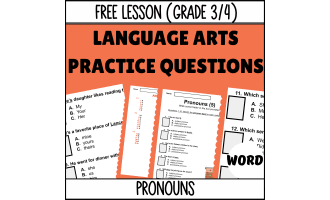
Pronouns Sample: Grammar Grades 3-4 (PPT)



- Grades
- Grades 3–4, Elementary
- Pages
- 47
- File type
- Microsoft PowerPoint
- Answer key
- Included


- Subject
- ELA, Language Development, ESL, Grammar, Common Core
- Topic
- elementary, answers
- Resource types
- Quizzes and Tests, Teacher Tools, Tests, Assessments, Presentations
- Answer key
- Included
- Standards
- CCSS.L.3.1 CCSS.L.3.2 +4
About this resource
What's inside this resource
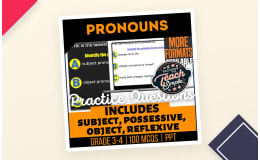
Pronouns Sample Lesson
ELA MCQS Overview:
In this series of lessons, students will embark on an engaging journey to explore the grammar skills that make our language vibrant and expressive. These lessons are crafted to help students identify, comprehend, and effectively apply language arts skills in both writing and speech.
Accompanied by free supplementary materials available for all topics, each lesson builds on the previous one, offering a balanced mix of direct instruction, interactive group activities, and independent practice. Through fun and creative tasks, students will learn to recognize grammar within sentences, understand their function, and use them to enrich their own writing and speech.
Pronouns Overview:
Includes:
Subject Pronouns
Possessive Pronouns
Object Pronouns
Reflexive Pronouns
PPT Version
This is the PPT editable and interactive version. There is a fillable answer sheet at the end. This download is available in GOOGLE Docs, GOOGLE Forms, GOOGLE Slides. PDF, PPT, WORD, check the links below for more details.
FULL CATALOG OF DOWNLOAD LINKS HERE
Grade 3/4 Links:
Adjectives
Free Supplementary Materials Pack
Adverbs
Google Forms
Google Slides
PPT
Word
Free Supplementary Materials Pack
Conjunctions
Google Docs
Google Forms
Google Slides
PPT
Word
Free Supplementary Materials Pack
Nouns
Google Docs
Google Forms
Google Slides
PPT
Word
Free Supplementary Materials Pack
Pronouns
Google Docs
Google Forms
Google Slides
PPT
Word
Free Supplementary Materials Pack
Verbs
Google Docs
Google Forms
Google Slides
PPT
Word
Free Supplementary Materials Pack
Sentence Structure
Google Docs
Google Forms
Google Slides
PPT
Word
Free Supplementary Materials Pack
Present Tense
Google Docs
Google Forms
Google Slides
PPT
Word
Free Supplementary Materials Pack
Past Tense
Google Docs
Google Forms
Google Slides
PPT
Word
Free Supplementary Materials Pack
Future Tense
Google Docs
Google Forms
Google Slides
PPT
Word
Free Supplementary Materials Pack
Context Clues
Google Docs
Google Forms
Google Slides
PPT
Word
Free Supplementary Materials Pack
Defining Words
Google Docs
Google Forms
Google Slides
PPT
Word
Free Supplementary Materials Pack
Fill the Blanks
Google Docs
Google Forms
Google Slides
PPT
Word
Free Supplementary Materials Pack
Homophones
Google Docs
Google Forms
Google Slides
PPT
Word
Free Supplementary Materials Pack
Synonyms
Google Docs
Google Forms
Google Slides
PPT
Word
Free Supplementary Materials Pack
ELA Review Questions Overview
Questions have three answer choices. There are a handful of pictures on each test for aesthetic purposes, as well as a review sheet covering most of the
topics covered in the product.
Introduction or Example Sheet
Each topic will include an introduction or example sheet to go through first with your students.
Full Answer Keys
Full answer keys and sample responses are provided so no matter how busy you are, you know you're covered!
In the Supplementary Pack
Interactive Ice Breakers: Fun, hands-on activities that get students thinking about adjectives right from the start.
Guided Practice: Teacher-led exercises that reinforce the day’s lesson, ensuring students can confidently identify and use adjectives.
Group and Partner Tasks: Collaborative activities that allow students to work together to solve problems, categorize adjectives, and create descriptive sentences.
Independent Worksheets: Structured worksheets that provide individual practice and help solidify understanding of key concepts.
Exit Tasks: Quick, reflective activities at the end of each lesson that assess understanding and encourage students to apply what they’ve learned.
For similar downloads and other frees, do check out Cored Group on TeachSimple.
Related resources
More resources teachers may find useful
24 related resources were found using this product's title, contributor, categories and tags.



In the classroom
Teaching tips & learning objectives

Learning objectives
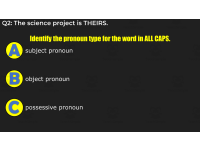
Identify a pronoun inside a sentence
Distinguish subject, object, and possessive pronoun functions
Use sentence position and meaning to justify a classification

Teaching tips
Ask learners to identify the noun role before choosing a pronoun label.
Reveal the completed response only after discussing why the other two functions do not fit.

Skills covered
Grammar classification — pronouns are sorted by sentence function.
Context analysis — surrounding sentence structure guides the choice.
Oral explanation — learners justify a grammatical label.

No reviews yet
Downloaded this resource? Tell other teachers how it went.
Curriculum
Standards, concepts & topics
Standards
 Standards
- CCSS.L.3.1 — Demonstrate command of the conventions of standard English grammar and usage when writing or speaking. a. Explain the function of nouns, pronouns, verbs, adjectives, and adverbs in general and their functions in particular sentences. b. Form and use regular and irregular plural nouns. c. Use abstract nouns (e.g., childhood). d. Form and use regular and irregular verbs. e. Form and use the simple (e.g., I walked; I walk; I will walk) verb tenses. f. Ensure subject-verb and pronoun-antecedent agreement.* g. Form and use comparative and superlative adjectives and adverbs, and choose between them depending on what is to be modified. h. Use coordinating and subordinating conjunctions. i. Produce simple, compound, and complex sentences.
- CCSS.L.3.2 — Demonstrate command of the conventions of standard English capitalization, punctuation, and spelling when writing. a. Capitalize appropriate words in titles. b. Use commas in addresses. c. Use commas and quotation marks in dialogue. d. Form and use possessives. e. Use conventional spelling for high-frequency and other studied words and for adding suffixes to base words (e.g., sitting, smiled, cries, happiness). f. Use spelling patterns and generalizations (e.g., word families, position-based spellings, syllable patterns, ending rules, meaningful word parts) in writing words. g. Consult reference materials, including beginning dictionaries, as needed to check and correct spellings.
- CCSS.L.4.1 — Demonstrate command of the conventions of standard English grammar and usage when writing or speaking. a. Use relative pronouns (who, whose, whom, which, that) and relative adverbs (where, when, why). b. Form and use the progressive (e.g., I was walking; I am walking; I will be walking) verb tenses. c. Use modal auxiliaries (e.g., can, may, must) to convey various conditions. d. Order adjectives within sentences according to conventional patterns (e.g., a small red bag rather than a red small bag). e. Form and use prepositional phrases. f. Produce complete sentences, recognizing and correcting inappropriate fragments and run-ons.* g. Correctly use frequently confused words (e.g., to, too, two; there, their).*
- CCSS.L.4.2 — Demonstrate command of the conventions of standard English grammar and usage when writing or speaking. a. Use relative pronouns (who, whose, whom, which, that) and relative adverbs (where, when, why). b. Form and use the progressive (e.g., I was walking; I am walking; I will be walking) verb tenses. c. Use modal auxiliaries (e.g., can, may, must) to convey various conditions. d. Order adjectives within sentences according to conventional patterns (e.g., a small red bag rather than a red small bag). e. Form and use prepositional phrases. f. Produce complete sentences, recognizing and correcting inappropriate fragments and run-ons.* g. Correctly use frequently confused words (e.g., to, too, two; there, their).*
- CCSS.L.3.3 — Use knowledge of language and its conventions when writing, speaking, reading, or listening. a. Choose words and phrases for effect.* b. Recognize and observe differences between the conventions of spoken and written standard English.
- CCSS.L.4.3 — Use knowledge of language and its conventions when writing, speaking, reading, or listening. a. Choose words and phrases to convey ideas precisely.* b. Choose punctuation for effect.* c. Differentiate between contexts that call for formal English (e.g., presenting ideas) and situations where informal discourse is appropriate (e.g., small-group discussion).
Core concepts
 Core concepts
Pronoun types
Sentence function
Grammar review
 Topics
Explore more
Categories this resource belongs to
Explore related searches
More to explore
You may also like