



3,953 products added recently
Page 262 - Cut and Paste Activities
Enhance learning through tactile experiences with cut and paste activities that combine creativity and skill development. This collection includes sorting exercises, craft projects, and interactive worksheets. By integrating these activities into your lessons, you can support manual dexterity and engagement.

 Show filters


Letter N Song (MP3)
ELA, Language Development, Phonics, Preschool, Kindergarten, Grade 1, 2, Songs, Activities
This song is perfect for helping students learn about the letter N! It's catchy lyrics and fun visuals will help them understand letter sounds, vocabulary words, and letter formation. This is a great resource for any teacher looking to help their students learn more about the letter N.
Author Have Fun Teaching
Tags Alphabet, Phonics
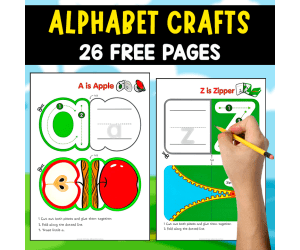
ALPHABET CRAFTS | 26 FREE PAGES
Vocabulary, Language Development, ELA, Spelling, Pre-Reading, Phonics, Grammar, Elementary, Early Learning, Homeschool Resources, Not Grade Specific, Pre-K, Crafts, Activities
ALPHABET CRAFTS | 26 FREE PAGES INFORMATION OF THE AUTHOR: At EDITORIAL ARENAS EDUCATIVAS, we work every day to create educational materials that turn learning into a fun game. Our mission is for every child to enjoy the process of learning. Visit my educational store and discover all the resources we have ready for you. MAIN INFORMATION OF THIS RESOURCE: What is the name of the product? Hello! Thank you so much for being interested in this beautiful and fabulous product that you can use with your children, both at school and at home. The name of this fabulous product is: 26 CRAFTS OF THE ALPHABET How many pages does it include? This educational document, carefully created and in some cases compiled, has the following number of pages: 26 What format is it in (A4, letter, digital, printable)? This educational resource is designed in A4 format and PDF, so you will have no difficulties printing it and it will also stay well-protected. PDF A4 TAGS: ALPHABET,ABECEDARY, ABC, POSTERS,CRAFT. SECONDARY AND COMPLEMENTARY INFORMATION: What learning area does it focus on? This and all my resources focus on children’s essential learning, such as math and literacy. Occasionally, I also create resources for Spanish. What will students learn or practice with it? With this educational resource, children will be able to practice basic skills in math and literacy. Teachers can also adapt it to other learning areas, since learning is multidisciplinary. Who will benefit the most from this resource (teachers, families, students, therapists)? I strongly believe education involves many people—teachers, parents, and even therapists. That’s why this resource is open to anyone involved in the learning process. SUMMARY OF THIS PRODUCT: · What is its name?: ALPHABET CRAFTS · How many pages does it have?: 26 · What format is it in (PDF, Word, PPT)?: PDF · Is it colorful, black & white, or both?: COLOR
Author EDITORIAL LAURA EDUCA
Rating
Tags FREE, FREE RESOURCES, ALPHABET, ABECEDARY, CRAFTS, CRAFT, ELA, LITERACY, VOCABULARY

Leaf Hunt Activity
Science, Earth and Environmental Sciences, Environmental Science, Nature & Plants, Life Sciences, Grade 2, 3, 4, 5, 6, 7, 8, Activities
Activity Introduction An amazing activity designed for the students to learn more about STEM. Leaf Hunt Do you like STEM subjects? what is your favorite one? Have you ever tried to plant a seed? If yes, tell us more about it. Or have you ever tried to invent something? If yes, tell us more about it. And how do you think it will help us? Have you ever seen a microorganism under a microscope? What was it? And how it looked like? Mathematics is a marvelous subject. Let' sharpen our brains and solve some equations. Do you like timetable tricks? What is your favorite one? Do you know how to code? Have you ever created an app or a game before? If yes, how was it like? Leaf Hunt Activity The activity is perfect for encouraging the researching skills for the students, while learning more about this fantastic topic. Leaf Hunt This friendly designed worksheet is suitable for students at school, homeschooling, and as a group activity. Instructions Glue a stick to the back of the dotted square then go on a hunt for every type of leaf illustrated on your frame. Try to frame every leaf you find and compare it to check if it's correct. Format Available in a PDF format.
Author Educational Voice
Tags Leaf Hunt Activity, Leaf Hunt, Leaf, Leaf Facts, Leaf Facts For Kids, Leaves, Leaves Facts, Leaves Facts For Kids, Plant, Plants

Short E: Letters Phonics Games and Activities - 8 Pictures 1 Clue
ELA, Language Development, ESL, Resources for Teachers, Vocabulary, Phonics, Pre-Reading, Spelling, Kindergarten, Preschool, Grade 1, Teacher Tools, Games, Activities
Short E: 8 Pictures 1 Clue Note: This download is in PowerPoint show mode to protect the rights of the image creator(s), and is thus UNEDITABLE. Playing the Game On each slide, there are 8 pictures and a clue will appear. Click the correct picture for each clue. Incorrect answers will fade, correct answer will flash and other options fade. About the Game This game will challenge students greatly, using clues to practice short E phonics words. With a range of clues and eye-catching pictures, the pace of the game allows the teacher to control the time to fit their own needs. Eight pictures are on the screen at any one time so the teacher may want to use this time to ask those students not yet participating in the game. Many clues are lengthy so will practice reading sentences. On each slide, there are 8 pictures and a clue will appear. Click the correct picture for each clue. Incorrect answers will fade, correct answer will flash and other options fade. Features plenty of color, excellent graphics and sounds. Words: pet, set, net, hen, jet, cent, bell, sell, bend, shell, vest, egg, pen, gem, send, bed, neck, end. Picture format: clipart Will be harder for early learners due to the amount of reading so you may have to read it out and help with some meanings. Helps to Build Letter recognition – Identifying letters in different fonts or contexts. Letter-sound association – Connecting letters to its sounds. Vocabulary building – Introducing words that start with each letter. Phonemic awareness – Listening for letter sounds in words, rhyming, or segmenting sounds. FULL CATALOG OF DOWNLOAD LINKS HERE Letter PPT Game Links: Letter A Hidden Pictures 1 MemWord Hidden Pictures 2 Hidden Pictures 3 The Short Question Riddle Time Review Games Follow the Vocab Letter B Letter C Letter D Letter E Hidden Pictures 1 The Grand Circle 8 Pictures 1 Clue Behind the Garage Doors Outside the Submarine Two Review Games Say What You See Quiz Game Letter F Letter G Letter H Letter I Hidden Pictures 1 MemWord Three Review Games Three Quiz Show Style Games Find the Ball Bowling Four Mini Games Outside the Train Window Letter J Letter K Letter L Letter M Letter N Letter O Hidden Pictures 1 MemWord Yes or No Game Six Pictures Game Hidden Pictures 2 6 Stars One Question MCQS Game The Grid Letter P Letter Q Letter R Letter S Letter T Letter U Letter V Letter W Letter X Letter Y Letter Z Overview These interactive PowerPoint games make early phonics practice fun and engaging for young learners. With a mix of exciting activities, kids stay motivated while strengthening key phonetic patterns. Each game offers plenty of opportunities for participation—whether playing in teams, one-on-one, or independently. The variety of game styles, from disappearing squares to timed challenges, ensures that every student can learn in a way that works best for them. Bright visuals, sound effects, and gradually increasing difficulty keep students engaged and support different skill levels. Teachers have full control over the pacing and difficulty, making it easy to adjust the experience based on their students' needs. Whether guessing hidden images, recalling sequences, or solving riddles, each activity reinforces phonics in a fun, interactive way. These games turn traditional phonics drills into an exciting, hands-on learning adventure, building confidence and essential literacy skills in young learners. For More Like This For similar downloads and other frees, do check out Cored Group on TeachSimple.
Author Cored Education
Tags Esl, Powerpoint, Ppt, Powerpoint Games, Esl Games, Vocabulary Games, Phonics Games, Letter E Games, Letter E Activities, Cvc Games
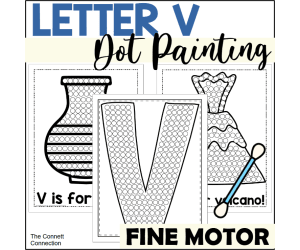
Letter V Dot Painting
ELA, Creative Arts, Art, Language Development, Phonics, Kindergarten, Preschool, Activities, Crafts
Title: Letter V Dot Painting Embrace an innovative approach to learning letters and boosting fine motor skills with these letter V dot painting worksheets. With this comprehensive resource, educators can engage students effectively while nurturing creativity and early literacy development. This package contains a total of 9 pages dot painting worksheets 1 vase dotting page 1 volcano dotting page 1 vulture dotting page One capital letter dot painting page One lowercase letter dot painting page One dot painting page with both capital and lowercase letters Two worksheets for students to independently design their own letter V Ways to Use: Art or Literacy Center - The teacher can place these worksheets with paint and cotton swabs in the center for students to complete. Quiet Time Activity - For programs that utilize nap times, these dot painting worksheets are perfect for teachers to give to those who do not nap as an activity to complete quietly. Morning Work - These worksheets are perfect to put out as morning work for students to work on while classmates arrive to class. Sub Plans - These worksheets make great sub plans as they are easy to explain and implement in the classroom. The Skills Assessed by This Activity : Promotes letter recognition and letter sound knowledge. Fosters important skills like hand-eye coordination and stimulates creativity as they choose colors and patterns specific to their personalized artwork. Builds fine motor skills while maintaining a clean learning environment owing to its low-mess nature. The Process: The process behind these activities couldn't be easier! There’s no preparation needed on part of teachers—simply print out these pages from our PDF file type. Students will need to be provided paint of various colors and cotton swabs to complete each page. The letter V dot painting worksheets reinforce learning while nurturing imagination amongst early learners - creating joyous educational experiences right at your fingertips.
Author The Connett Connection
Tags Dot Painting, Fine Motor Skills, Creativity, Early Literacy, Q-tip Painting, Alphabet Worksheets, Letter V, Letter V Activities, Letter V Workheets, Letter V Art

Bee Life Cycle Craft Foldable | Science Cut and Paste Activity
Science, Life Sciences, Elementary, Middle School, Crafts, Activities
This interactive and engaging teaching resource is designed to help students explore the life cycle of a bee through a hands-on craft activity. The Bee Life Cycle Craft Foldable provides a creative way for students to learn about the stages of a bee's development, from egg to adult, while reinforcing key science and biology concepts. This activity is perfect for science lessons, plant life cycle units, or studies on agriculture and horticulture. It encourages sequencing, critical thinking, and creativity, making it ideal for elementary and middle school students. The foldable can be used individually, in small groups, or as a whole-class project, and it also serves as a great display piece or take-home item to share learning with families. Great for homeschooling, classroom education, or extra practice. Number of pages: 7 pages Format PDF file size: 11*8.5 Inches If you and your students or your children enjoy using this educational and engaging resource. please rate it and follow my store to be the first to know about my new teaching resources and freebies. Enjoy!
Author Wonderland School
Tags Spring Craft, Life Cycle Of A Bee, Life Cycle Of A Bee Craft, Life Cycle Of A Bee Craft Foldable, Spring, Bee Craft, Plant Life Cycle, Plant Craft, Plant Life Cycle Craft, Science
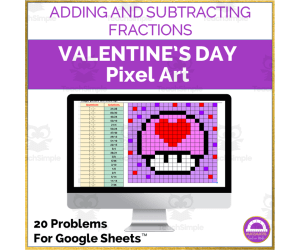
Valentine's Day Adding and Subtracting Fractions Pixel Art Activity
Math, Fractions, Common Core, Grade 5, 6, 7, Activities, Worksheets
Valentine's Day Adding and Subtracting Fractions Pixel Art Activity An educational treat for students in grades 5 to 7, improving their core maths skills within an immersive art activity. Activity Details: This no-prep educational resource offers a unique way to practice and engage with the addition and subtraction of fractions. The method? A series of 20 operations that are solved using Google Sheets. As each operation is correctly solved, a piece of the mystery picture is revealed! The Advantage for Educators: No more panic on needing an unexpected substitute lesson! This pixel art activity makes it easy for you to create enjoyable and meaningful experiences filled with joy. Lesson Alignment and Homework Use: Crafted for use in interactive classroom scenarios Ideal as homework assignments A fun way of meeting CCSS standards like 5.NF. A1., focusing on adding and subtracting fractions with unlike denominators Solution Integration: Carefully constructed solutions accompany this activity making your life easier as educator. Integration into lesson plans through Google Classroom is seamless - just create an assignment; add Google Drive document; make sure each student gets their personal working copy! The Unexpected Surprise An all-in-one package not just loaded with fraction operations—also delivering garnished elements from Common Core's standard catalogue including components like solving word problems involving fraction addition/subtraction referring to whole numbers despite unlike denominators. Ease-Of-Use Format: All instructional material comes bundled up in easy-to-use PDF format, along highly effective links – remember being signed into your Google Account for easy saving and planning. Summary: This Valentine's Day Adding and Subtracting Fractions Pixel Art Activity is a unique blend of mathematics and art ensuring an active classroom. It’s not just another lesson but an engaging experience for both teachers and students.
Author Matemaths
Tags Fractions, Adding, Subtracting, Pixel Art, Valentine's Day
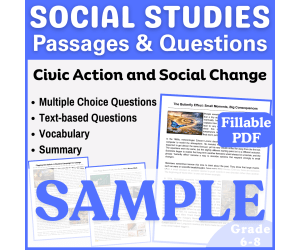
Reading Passage: The Butterfly Effect (Fillable PDF Sample)
ELA, Reading, Reading Comprehension, Strategies, Resources for Teachers, Social Studies, Sociology, Grade 6, 7, 8, 9, Writing Prompts, Worksheets & Printables, Centers, Activities, Teacher Tools, Assessments, Quizzes and Tests, Quizzes, Tests
This is a ONE PASSAGE SAMPLE. The following is the description of the FULL resource and the downloading links: Social Studies Reading Comprehension Passages and Questions: Civic Action and Social Change (Fillable PDF) This resource introduces a collection of Social Studies reading comprehension passages with questions about Civic Action and Social Change. The passages are carefully designed to bridge the gap between social studies and literacy through strengthening reading comprehension and sparking knowledge curiosity in middle school students. Each passage blends English Language Arts skills with accurate social studies content . Ideal for interdisciplinary learning in ELA and Social Studies. Suitable for Grade 9 review, too! These worksheets are designed as fillable PDFs , which means students can type their answers directly into the document on any computer or tablet . Each page includes highlighted text fields that show them exactly where to type! What Is Included in this Collection? There are three informational passages (with full answer keys): The Butterfly Effect: Small Moments, Big Consequences From Piggy Bank to Profit: How Banks Make Money Work Flipping the Switch: A Student Campaign for Change For Each Passage, students will have multiple tasks to complete as follow: 5 multiple-choice questions targeting main idea, key details, inference, vocabulary in context, and use of evidence 5 vocabulary matching items with clear, student-friendly definitions 5 text-based questions that require citing specific lines or facts 1 summary prompt that asks students to condense central ideas accurately Available Formats for this Resource PDF Word Docs Google Docs FULL CATALOG OF DOWNLOADING LINKS HERE For more Social Studies Reading Passages, check the following Links: Ancient Civilizations PDF Fillable PDF Word Docs Google Docs Early Empires and Trade Networks PDF Fillable PDF Word Docs Google Docs The Founding of the United States PDF Fillable PDF Word Docs Google Docs Language, Culture, and Meaning PDF Fillable PDF Word Docs Google Docs Psychology and Society PDF Fillable PDF Word Docs Google Docs Global Festivals and Traditions PDF Fillable PDF Word Docs Google Docs Extreme Environments and People PDF Fillable PDF Word Docs Google Docs Food, Culture, and Preservation PDF Fillable PDF Word Docs Google Docs Global Food Customs PDF Fillable PDF Word Docs Google Docs Media, Communication, and Popular Culture PDF Fillable PDF Word Docs Google Docs Human Impact on the Environment PDF Fillable PDF Word Docs Google Docs Civic Action and Social Change PDF Fillable PDF Word Docs Google Docs Fashion, Society, and Power PDF Fillable PDF Word Docs Google Docs People, Places, and Unusual Histories PDF Fillable PDF Word Docs Google Docs How to Use These PDFs Click on the highlighted area to start typing your answer. Move to the next question by clicking in the next highlighted box. When you are finished, close the document and select SAVE so your answers stay recorded. If you want to keep a blank copy for later, choose Save As and give your completed version a new name. Product Details Length: 15 pages total Grades: 6–8, also suitable for Grade 9 review Use cases: close reading, stations, homework, intervention, test prep, and sub plans Why Teachers Choose This Set Authentic social studies content paired with rigorous literacy practice Consistent task structure across all passages for easier planning and smoother student routines Clear, age-appropriate writing that builds confidence without oversimplifying Use this set to reinforce ELA skills in social studies, to add literacy to your lessons, and to support independent work. The passages strengthen main idea, evidence use, vocabulary in context, inference, cause and effect, and summary writing. With ready-to-use assessments and complete answer keys, you can provide focused practice that is simple to run and fast to review.
Author Middle & High School - CORED Education
Rating
Tags Middle School, Reading Comprehension, Reading Strategies, ELA, Centers, Reading Passage, Assessments, Vocabulary, Social Studies, Civic Action And Social Change

Geometry Project: Park Design- Area, Perimeter, Volume, and Budgeting
Math, Decimals, Multiplication and Division, Division, Money, Geometry, Measurements, Grade 5, 6, 7, 8, Worksheets & Printables, Word Problems, Activities, Projects
This math project allows students in 5th, 6th, 7th, or 8th grade to apply their knowledge of perimeter, area, volume, financial literacy, and decimal calculations to a realistic & creative situation: planning a fun new park! They will design a new park that includes different areas for swimming, playing, eating, resting, walking, and even skating! Students will use their knowledge of perimeter of right-angled shapes when planning the size and shape of the park & the amount of fencing required use their knowledge of area when splitting the park up into different sections for activities use their knowledge of volume when considering filling the pool in their park use their knowledge of money math/decimal calculations when determining the grand total price of the entire park project. Each section has a different cost- a great introduction to unit rate. For example, paths are much less expensive than a playground, while grassy areas cost less than the swimming pool does. I ask my students to calculate by hand, but you can allow yours to use a calculator as well. This project gets students using their creative and logical problem solving skills, organizational skills, careful calculating methods, and neat drawing and colouring. It is a great project to use for a summative assessment at the end of a unit or to show parents at parent-teacher conferences. What's Included: A total of 4 pages in PDF format: Ready to print and use! Title Page, 2 Page Worksheet, 1 Page Grid Grades to Use With: This math project could work in grades 4-8 in regular math classes. It could also be used in high school special education classes. If you enjoy this math project, check out some others in my store: Transformation Design with Rubric Math Mini Unit: Converting Scores into Percentages Math Project: Create Your Dream Store
Author Grace Under Pressure
Rating
Tags Math Project, Budget, Decimals, Applied Math, Geometry Project, Perimeter Area Volume Worksheets, Geometry Projects, Area Perimeter And Volume, Middle School Geometry Project
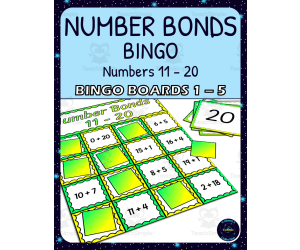
Number Bonds 11-20 Bingo - Boards 1-5
Math, Fact Families, Addition and Subtraction, Addition, Grade 1, 2, 3, Activities, Games
Number Bonds 11-20 Bingo engages students in practicing number bonds for numbers 11-20. This math game includes 5 colorful bingo boards, calling cards, and playing squares. To set up, print, laminate, and cut materials. Give each student a board and 7 playing squares. Shuffle the calling cards and draw one. Students search their boards, cover a matching number bond with a playing square. Continue drawing and covering until someone fills 3 spaces in a row and wins! Extend the game by reshuffling cards. Use bingo pieces or dry erase markers instead of playing squares. Differentiate by making boards self-checking with a removable answer key. This game offers a lively way to build fluency with number bonds. Check out more math bingo games and number bonds activities from this shop!
Author Colleen's Cosmic Collection
Tags Number Bonds, Number Bonds Games, Addition Game, Addition Activity, Math Facts, Addition Facts, Addition Math Facts, Math Fact Practice, Cccnbb1120, Cccnbba

6 FREE FAMOUS PCITURES | COLOR BY NUMBER
Math, Numbers, Kindergarten, Preschool, Grade 1, 2, Activities, Games
THANK YOU FOR BEING PART OF EDITORIAL ARENAS EDUCATIVAS We are an educational corporation that is dedicated to the development of fabulous resources for mathematics, literacy, as well as resources for teaching Spanish and brain exercises. MAIN INFORMATION: 1. Product name: You can use this educational resource in the primary education classroom. 2. Number of pages: This document contains the following number of pages. 3. Is it editable or not? This educational document is not editable, because this way you can use it better and you will not have any problem with the composition or design undergoing any variation. 4. Theme: This educational resource contains a topic for the primary education of children. 5. Document version: This educational document is available in PDF version, size A4. 6. Color or black/white: This educational product is designed in color because we believe that this will be much more attractive for your children. 7. Aimed at children of ages: This educational document is specifically aimed at children in primary education. 8. Area: This educational document may be used in some area of primary education for children. SECONDARY INFORMATION ABOUT THIS PRODUCT: 9. Age at which it can be applied: This educational resource can be applied to children of all ages, that is, students from 3 to 12 years old, who must acquire some basic knowledge that thanks to this document they will be able to address. 10. Tags or keywords that describe the content: didactic material, teaching sheets, material for children, printable educational material, printable material. 11. Ways to print: I suggest you print this document in A4 format, and check if your printer has enough ink for the printout to be of quality and so that your students can complete their worksheet without any problem. 12. Ways to apply it in class: You can apply this document both individually and as a group, it all depends on your criteria. 13. Will they need extra items to use this worksheet ? Yes, perhaps your students will need a pencil, markers, etc., it all depends on the creativity of the teacher. This file is for personal use only. It is not allowed to be resold or shared with others.
Author EDITORIAL LAURA EDUCA
Tags PICTURES, COLORING, COLOR BY NUMBER, NUMBERS, FREE RESOURCES

DINOSAUR MATH FACTS MULTIPLICATION REPEATED ADDITION| WORKSHEETS MATS
Special Resources, Special Education Needs (SEN), Math, Addition and Subtraction, Addition, Multiplication and Division, Division, Grade 1, 2, 3, 4, Worksheets & Printables, Flashcards, Activities, Worksheets
Dinosaur Math Facts: Multiplication Repeated Addition Worksheets and Resources This 131-page PDF provides a fun and engaging way for grade 1-3 students to build foundational skills in multiplication and repeated addition. With over 100 pages of dinosaur-themed printable worksheets, charts, mats, and posters , this teaching resource allows students to practice vital math facts from 1-10 x 1-12. The diverse presentation formats—including display posters , cutouts, and circling/pointing worksheets—help reinforce lessons in a variety of learning modes. Teachers can utilize these materials whole-group, small-group, one-on-one, or as versatile homework assignments. Whether trying to make math more enjoyable or boosting skills through repeat practice, the Dinosaur Math Facts collection helps pave an exciting path to math mastery.
Author WORDS ASIDE
Tags Independent Work, Pictorial, Graphics, Decor, Facts And Factors, Repeated Addition, Multiplication, Math Manipulatives, Dinosaur, Words Aside

Reading Comprehension Nonfiction Set 5 - Sea Animals (PDF)
ELA, Reading, Reading Comprehension, Common Core, Creative Writing, Writing, ESL, Language Development, Spelling, Vocabulary, Grade 4, 5, Worksheets & Printables, Worksheets, Writing Prompts, Assessments, Teacher Tools, Tests, Quizzes and Tests, Centers, Activities
Reading Comprehension Passages Nonfiction Set 5 Overview No prep reading comprehension lessons, with enjoyable articles and topics. Each lesson has a blend of post-reading activities. Mixed questions to check overall understanding. Vocabulary activities, plus a writing section. Lessons also contain a bonus extension exercise at the end. Some you may like, some you may not, either way they are there if you wish to use them. Full answer keys are provided. Passages Include 1.Stingray: Close relatives to sharks, read more about this fascinating animal in this article. 2.That's Electric: How much electricity can an electric eel produce? Find outhere. 3.Whale Shark: The largest fish in the sea. Yes, the largest!! 4.Scared of Sharks: The all you need to know shark passage. If you're not too scared to read it! 5.Under the Sea: Porpoise or dolphin? What's the difference? 6.All About Jellyfish: More people are killed by jellyfish stings every year than from great white shark attacks. PDF Version This is the PDF uneditable version. This download is available in GOOGLE Docs, GOOGLE Forms, GOOGLE Slides. PDF, PPT, WORD. FULL CATALOG OF DOWNLOAD LINKS HERE Grade 4/5 Links Fiction Set 1 - Animals Google Docs Google Forms Google Slides PDF PPT Word Guided Reading Materials Fiction Set 2 - Family Google Docs Google Forms Google Slides PDF PPT Word Guided Reading Materials Fiction Set 3 - Friends Google Docs Google Forms Google Slides PDF PPT Word Guided Reading Materials Fiction Set 4 - School Google Docs Google Forms Google Slides PDF PPT Word Guided Reading Materials Fiction Set 5 - Sports Google Docs Google Forms Google Slides PDF PPT Word Guided Reading Materials Nonfiction Set 1 - Birds Google Docs Google Forms Google Slides PDF PPT Word Guided Reading Materials Nonfiction Set 2 - Insects Google Docs Google Forms Google Slides PDF PPT Word Guided Reading Materials Nonfiction Set 3 - Mammals Google Docs Google Forms Google Slides PDF PPT Word Guided Reading Materials Nonfiction Set 4 - Nature Google Docs Google Forms Google Slides PDF PPT Word Guided Reading Materials Nonfiction Set 5 - Sea Animals Google Docs Google Forms Google Slides PDF PPT Word Guided Reading Materials Reading Passages Overview Each passage is especially written for Grade 4-5 students, including key vocabulary required for this age group. Topics are varied and are accompanied by colorful graphics. Topics are meant to educate, yet entertain the modern student. These passages are perfect for the modern classroom. Whereas textbooks can become outdated in no time, any changes to technology or the world will result in updates to this product. Mixed Questions The mixed questions section of each lesson includes a variation of five comprehension, vocabulary and math questions. In addition, key reading strategies are frequently covered including cause & effect, summarizing, compare & contrast and making conclusions. Two or three of the questions will be MCQs and other questions will require a written response of some kind. Full answers and example responses appear at the end of the lesson. Spelling & Vocab Each reading passage contains a variety of words and phrases designed for Grade 4-5 students. Spelling and vocab activities provide the opportunity to build fluency with these words. As it can become quite mundane doing the same activities over and over, each lesson in a set will contain a different spelling and vocab activity . Activities include: spelling games, sentence match-ups, mixed-up text and decoding words from the lesson. Writing Prompts Writing prompts are designed to continue the theme or lessons learned in the story. Students are persuaded to write in a variety of ways and each prompt includes several cues to help. As with the spelling/vocab section, writing prompts will vary. This includes research pieces, reading responses, poetry and creative writing prompts. Full Answer Keys Full answer keys and sample responses are provided so no matter how busy you are, you know you're covered! Mixed question answers provide evidence from the text, math questions contain the relevant workings. Answers are designed for use by the teacher, but also suitable as a handout to the student. Just for Fun Each lesson will have a bonus extension exercise. This is something fun to extend the lesson with. You can find these at the end of each lesson, titled Just for Fun. Just for Funs are optional. Some you may like, some you may not. Either way, they are there to do with as you wish. For similar downloads and other frees, do check out Cored Group on TeachSimple.
Author Cored Education
Rating
Tags Elementary, Reading, Comprehension, Vocabulary, Common Core, Spelling, Writing, Passages, Reading Centers, Reading Comprehension Assessments

Sight Word Sentences THE IS AND
ELA, Reading, Preschool, Grade 1, Activities
Students can get a ton of practice reading the sight words THE IS AND as well as reading color words with these sight word sentence activities. There are a variety of activities that allow students to practice reading these sight words in a fun and hands on way. What is Included: There are 10 sight word sentence puzzles for students to put together one word at a time. There are 6 unscramble the sentence worksheets for students to build each sentence, copy each sentence, and draw an example of each sentence. There are 12 sight word sentence pyramids. There is a sight word reading center where students practice recognizing the color words by matching the correct image to the correct colors. The real photographs in this resource allow students to see real world images while reading sentences. This allows students to put meaning to the words they are reading. When to Use: The worksheets make great morning work, independent practice, or as homework. The sight word pyramids and puzzles make great literacy activities or task box work, for morning tubs or literacy centers. These activities have uses in a variety of classroom settings. Students can complete these activities alone, or they can work with a partner. Skills Assessed: Sight word recognition for the following words: and, the, is Color word recognition for basic color words Reading simple sentences The sight word worksheets are a no prep activity for teachers to give to students. The sight word pyramids and sight word puzzles are a low prep activity , simply requiring printing and cutting. Once cut apart, the puzzles can be used. The sentence pyramids can be placed on a ring. Both activities can be laminated for durability. The puzzles and pyramids can be stored in a task box for easy set up, clean up, and storage.
Author The Connett Connection
Tags Sight Words, Sight Word Sentences, Literacy Center

international day of older person Word Search 2rd 3th 4th 5th Grade
Vocabulary, Language Development, ELA, Spelling, Sociology, Social Studies, Grade 2, 3, 4, 5, Games, Activities, Word Searches, Worksheets, Worksheets & Printables
Commemorate respect, wisdom, and community with this Word Search for International Day of Older Persons! 💙 Students will learn key vocabulary about age, family, and caregiving (respect, wisdom, kindness, grandparent, and more) while practicing spelling and scanning for words and word identification skills. This lovely no-prep printable worksheet builds appreciation for older adults. Purpose: This activity will help students: Learn and practice respectful vocabulary about older adults 🌟 Practice spelling, literacy, and focus ✏️ Provide opportunity for reflection about respecting older adults for their wisdom and value and caring for them 👵👴 Build empathy and understanding ❤️ Order of Events / Steps: 1️⃣ Hand out the International Day of Older Persons Word Search worksheet. 2️⃣ Go over the list of words as a class. 3️⃣ Have students search for the words and highlight them as they find them. 4️⃣ Have a group discussion about acknowledging older people. 5️⃣ Use the answer key for quick corrections. ✅ Grades or Age: Designed for grades 2nd–5th ❗️📘 Way of Implementation: Answer Key: ✅ Yes, included for easy checking. How to Use and Variations: Timed challenge ⏳ - Find all words before time is up Partner puzzle 🤝 - Work as partners Vocabulary extension ✏️ - Write sentences about how we can show kindness when caring for older persons Create your own 🧩 - Students create their own word search using words from family or elderly Standards: Supports CCSS/ELA vocabulary development related to social studies and SEL for community, empathy, and respect. File Types and Pages: PDF format 🖨️ Black and white version + color version Ink friendly version Includes answer key Encouragement to the Teacher: Use this International Day of Older Persons Word Search to mix literacy practice work with the important values of respect, kindness, and wisdom concerning elderly people. 💙👴👵 Can be used for independent practice, a social studies lesson, morning work, or with early finishers, partner work or for a substitute 🤝.
Author Classsim
Rating
Tags International , Day , Of , Older , Person , International Day , International Day Of Older Person , International Day Of Older Person Word Search, International Day Of Older Person Word Search 2rd 3th 4th 5th Grade , International Day Of Older Person Word Search 2rd 3th 4th 5th Grade Worksheet Activity

Letter K Q-Tip
Special Resources, ELA, Special Education Needs (SEN), Speech Therapy, Writing, Handwriting, Kindergarten, Preschool, Activities, Worksheets & Printables, Worksheets
This Letter K Q-Tip Art Packet is designed for effortless integration into preschool, kindergarten, special education, or homeschool classrooms. This bundle offers 9 printable worksheets, making them ideal for morning routines, substitute teacher plans, indoor playtimes, seasonal tasks, activities for early completers, supplementary tasks, and a variety of other applications. Items included: -bubble letter K -kangaroo -key -koala -king -kite -kiwi This is great fine motor, as well as visual perceptual skill! Such a fun activity for working on grasp, bilateral hand coordination, and so much more! A great activity for all ages and all ability levels! Connect with Me! Instagram: www.instagram.com/mnorganizingmom This interactive activity addresses so many developmental skills including bilateral hand coordination, fine motor skills, visual perceptual skills, motor planning, and so much more! This is a favorite activity of many toddlers, and preschoolers! Additionally, this is a great activity for children on the autism spectrum. It can be used at home, in the classroom, in a therapy setting, ABA setting, or anywhere! A favorite activity among teachers and students. It is easy for teachers to implement and students love the creativity aspect. This activity is easily adapted to meet the needs of the kiddos and addressed skills like opening and closing a containers, pressure applied, etc... Furthermore, this activity can be done sitting at a desk, prone on the floor, or even prone on a scooter to incorporate movement! This is also a great activity to take outside and soak up the sunshine! Please check out all my other Do A Dot Art Packets and Q-Tip Art Packets! I have some for every season, and a bunch of different themed ones! I am also constantly adding to my store! Thank you so much for your support! It allows me the amazing opportunity to continue to create valuable resources for teachers, therapists, parents, and of course students!
Author mnorganizingmom
Tags Letter K, Q-Tip, Letter K Craft, Letter K Activity, Letter K Worksheet, Morning Work, Time Filler, Preschool Craft, Preschool Activity, Preschool Morning Work
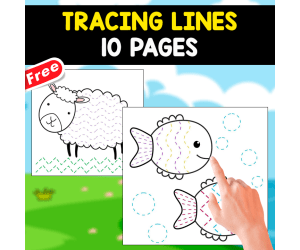
TRACING LINES WORKSHEETS | 10 FREE PAGES
Writing, ELA, Handwriting, Early Learning, Elementary, Homeschool Resources, Not Grade Specific, Pre-K, Activities, Worksheets & Printables
TRACING LINES | 10 FREE PAGES INTRODUCTION: HELLO! WELCOME TO THE EDITORIAL ARENAS EDUCATIVAS RESOURCE STORE! This time we bring you these fantastic resource for you! Your children's afternoons will no longer be boring thanks to these fantastic resource. MAIN INFORMATION: 1. Brief introduction: Hello, thank you very much for being interested in this educational document. This document will help you a lot both in the classroom if you are a teacher, as well as if you homeschool and want to stimulate your children from home. 2. Title of the educational resource: This document is titled "Teaching material for children" 3. Topic to work on: Thanks to this educational document, we are going to work on a basic topic that every child and/or student should master. 4. Area of knowledge where it should be applied: Thanks to this document, we will address a topic and at the same time an important area of learning. 5. Number of pages it contains: This educational document contains the following number of pages available and ready to be used by you, you just have to download and print the document to start using it in your classroom. SECONDARY AND COMPLEMENTARY INFORMATION: 6. In what area of knowledge can it be applied? You can apply this set of educational sheets according to your criteria, in the corresponding area. 7. Should I apply it individually or as a group in my class? Also, according to your criteria, see if it is better for these sheets to be applied individually or as a group. 8. What size and format is this resource in? This set of teaching sheets has been published in A4 size, PDF format, so that it is much easier to use. 9. Do I need any extra elements to apply it? Yes, perhaps your students need pencils, colors, markers and even sometimes scissors and erasers. 10. Is it in color or black and white? This educational document has been designed mostly in color so that it is highly attractive to students. 11. Is this resource free or do you have to pay to use it? This document is available for free, so take advantage of the opportunity to download it now. 12. Does it have an answer key attached? No, it does not contain an answer key attached. This file is for personal use only. It is not allowed to be resold or shared with others.
Author EDITORIAL LAURA EDUCA
Rating
Tags FREE, FREE RESOURCES, TRACING, TRACING LINES, HANDWRITING

Kids Yoga Stories: Animal Allies Cards
P.E. & Health, Yoga, Grade 2, 3, 4, 5, Activities
The animal kingdom provides the spirit and symbolism, Animal Allies Cards for Kids provides the way to connect them with kids' imaginations! The behavior, habitat, physical traits, habits, and movement of animals can all be learned through observation. Using our senses opens our minds to learn all about the animal kingdom and how they are connected to our lives. Included in this set of Animal Allies Cards for Kids are 75 colorfulcards with: Colorful illustrations of animals: 30 cards Matching cards with thought-provoking statement: 30 Instructions on how to use these cards and more ways to explore the animals included The index of all keywords associated with each animal Appropriate for ages 8+ Ways in which you can use these cards as homeschoolers or in the classroom include: -For transition times -Morning routines or circle times -Brain breaks to calm their minds and bodies -Physical education -Occupational and/or physical therapy -With one child, small, or large groups
Author Kids Yoga Stories
Tags Allies Cards, Kids Cards, Thinking Statements, Animal Allies, Conversation Starters

Escape Room for Grade 6
STEM, Elementary, Middle School, Escape Room, Activities
The majority of individuals consider escape rooms to be enjoyable pastimes that can be enjoyed with company. Escape rooms are now a common option for educators to use game-based learning as an engaging teaching tool in the classroom. Escape rooms can be used as a teaching tool to help teachers and students break free from the monotony and obsolete teaching methods. By utilizing a variety of tools and resources, educational escape rooms give teachers the chance to be creative and genuinely adapt and differentiate information to meet the requirements of their pupils. This escape room activity was designed especially for sixth graders. Microsoft PowerPoint is the format that is utilized. The only way out of the dark and dangerous library where the kids are imprisoned is by completing the puzzles. There are ten riddles in all, and each has an own slide. They cover a wide range of subjects, including science, chemistry, mathematics, and logic. After the second click, each puzzle's solutions are revealed.
Author Bright Classroom Ideas Marketplace
Rating
Tags Escape, Room, Escape Room, Grade 6, Stem, Steam
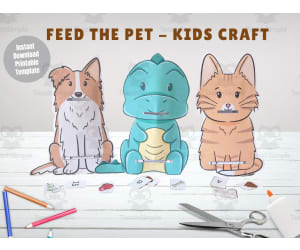
Education paper craft, Feed my pet activity for kids, Fun interactive
Montessori, Infant, Toddler, Kindergarten, Preschool, Crafts, Activities, Games
Make playtime both fun and educational with our Interactive Craft: Feed My Pet activity! This hands-on printable craft is perfect for curious toddlers who love animals and pretend play. Children get to make this adorable paper pet — whether it’s a puppy, kitten, or dinosaur — and “feed” it with matching food pieces that fit right into its mouth and it will come out the other side of the paper. Designed to encourage fine motor skills, color recognition, and imaginative thinking , this activity turns learning into an engaging, interactive experience. Kids will love cutting, gluing, and feeding their little pet while practicing sorting and matching skills in a playful way. Easy to set up and perfect for home, preschool, or daycare, the Feed My Pet Craft is a wonderful screen-free activity that promotes creativity and hands-on learning. Parents and teachers will appreciate how simple it is to print, assemble, and enjoy — no fancy materials needed! Watch your toddler giggle, learn, and play as they care for their new paper pet — a fun, interactive craft that’s as cute as it is educational! What's in it; 1 PDF files with 8 pages of the Printable template in A4 size and US letter. (Comes with a simple instruction and video tutorial) Note; Recommended to print this template in a thicker paper - 120-160gsm weighted paper for better structure. Creation time - Approx. 30-40 mins Recommended Age: Suitable for children aged 5 and up; younger kids will need assistance from an adult.
Author Jenstrokeandstyle
Rating
Tags Paper Craft For Kids, Interactive Craft, Interactive Activity, Feed My Pet Craft, Pet Craft, Kids Craft, Pet Activity

Nature Bracelet Activity
Science, Life Sciences, Nature & Plants, Earth and Environmental Sciences, Environmental Science, Grade 2, 3, 4, 5, 6, 7, 8, Activities
Activity Introduction An amazing activity designed for the students to learn more about STEM. Nature Bracelet Do you like STEM subjects? what is your favorite one? Have you ever tried to plant a seed? If yes, tell us more about it. Or have you ever tried to invent something? If yes, tell us more about it. And how do you think it will help us? Have you ever seen a microorganism under a microscope? What was it? And how it looked like? Mathematics is a marvelous subject. Let' sharpen our brains and solve some equations. Do you like timetable tricks? What is your favorite one? Do you know how to code? Have you ever created an app or a game before? If yes, how was it like? Nature Bracelet Activity The activity is perfect for encouraging the researching skills for the students, while learning more about this fantastic topic. Nature Bracelet This friendly designed worksheet is suitable for students at school, homeschooling, and as a group activity. Instructions Make a bracelet with duct tape - making sure the sticky side is facing outwards. Now go for a walk and stick fun nature elements onto your bracelet. Format Available in a PDF format.
Author Educational Voice
Tags Nature Bracelet Activity, Nature Bracelet, Nature, Nature Facts, Nature Facts For Kids, Environment , Environment Facts, Environment Facts For Kids

Science Reading Comprehension Passage: How Sound Travels (PDF)
Science, ELA, Reading, Reading Comprehension, Strategies, Resources for Teachers, Physics, Grade 6, 7, 8, 9, Writing Prompts, Worksheets & Printables, Centers, Activities, Teacher Tools, Assessments, Quizzes and Tests, Quizzes, Tests
Physical Science Reading Comprehension Passage and Questions: How Sound Travels (PDF) This very engaging Physical science reading passage is about how sound travels . More specifically, it explains that sound begins with vibrations , moves as a longitudinal wave through a medium such as air, liquid, or solid, and then reaches the ear. It also explains how the eardrum, ossicles, cochlea, auditory nerve, and brain work together so we can recognize pitch and loudness. The passage also corrects the misconception that sound travels fastest in air by explaining that sound often travels faster in solids because their particles are packed closer together. This passage is designed to bridge the gap between science and literacy through strengthening reading comprehension and sparking scientific curiosity in middle school students. The passage blends English Language Arts skills with accurate science content that supports NGSS classroom practice. Ideal for interdisciplinary learning in ELA and Science. Suitable for Grade 9 review, too! Student Tasks for The Passage: 5 multiple-choice questions targeting main idea, key details, inference, vocabulary in context, and use of evidence 5 vocabulary matching items with clear, student-friendly definitions 5 text-based questions that require citing specific lines or facts 1 summary prompt that asks students to condense central ideas accurately Full answer key for every section Available Formats for this Resource Fillable PDF Word Docs Google Docs FULL CATALOG OF DOWNLOADING LINKS HERE Product Details Length: 5 pages total Grades: 6–8, also suitable for Grade 9 review Use cases: close reading, stations, homework, intervention, test prep, and sub plans Standards support: reinforces informational-text skills and supports NGSS-style sense making through observation, modeling, and clear use of claim, evidence, and reasoning Why Teachers Choose This Set Authentic science content paired with rigorous literacy practice Consistent task structure across all passages for easier planning and smoother student routines Clear, age-appropriate writing that builds confidence without oversimplifying Other Science Reading Collections you May find in the store: 1. Astronomy & Space Science 2. Volcanoes, Rocks, & Mountains 3. Rock Cycle, Soil, & Sinkholes 4. Mars, Glaciers, & Antarctica 5. Water Cycle, Acid Rain, & Wastewater 6. Insects, Animals, & Ecosystems 7. Bioluminescence & Insects 8. Animal Skin, Cats, & T. Rex 9. Human Body and Senses 10. Health & Applied Bioscience 11. Waves, Light, & Imaging 12. Electricity & Energy 13. Motion & Materials 14. Chemistry and Materials Science Use this set to reinforce ELA skills in science, to add literacy to your lessons, and to support independent work. The passages strengthen main idea, evidence use, vocabulary in context, inference, cause and effect, and summary writing. With ready-to-use assessments and complete answer keys, you can provide focused practice that is simple to run and fast to review.
Author Middle & High School - CORED Education
Rating
Tags Middle School, Reading Comprehension, Reading Strategies, ELA, Centers, Reading Passage, Assessments, Vocabulary, Physical Science, Physics
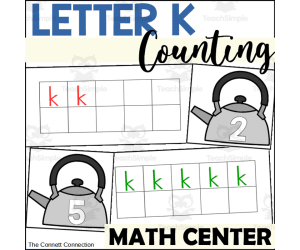
Letter K Counting to 10 Center
ELA, Math, Early Math, Numbers, Kindergarten, Preschool, Centers, Activities
This Letter K Counting to 10 Center is a counting to 10 math matching center for the letter K. This resource is great for letter recognition and practicing counting with tens frames. This is a quick and easy activity to give students who need practice with recognizing the lowercase form of the letter K, who need practice recognizing numbers up to 10, as well as for those students who need extra practice counting to 10. This counting math center can be used in the following ways * Math centers * Matching centers * Small group activities * Morning work * Emergency sub plans * Quick counting assessment * Quick number recognition assessment Skills assessed with this letter K counting activity * Lowercase letter K recognition * Ability to count to 10 * Recognizing amounts when represented in a tens frame * Ability to match numbers to the correct tens frame * Fine Motor Skills This counting math center is low prep. All that is required is for the teacher to print it out, cut it out and laminate if so desired. Once created, this counting center can be used over and over. The provide a great way for students to practice counting to 10 and practicing letter recognition at the same time. Students can work on this counting center independently, in pairs, or in small groups to complete. You can add manipulatives for students to cover each letter K as they count if they need a more hands on approach, or a more guided way to practice counting each letter K. For similar resources and more, visit my store!
Author The Connett Connection
Tags Letter K, Letter K Activity, Counting To 10, Counting To Ten, Alphabet Activity, Tens Frames, Preschool Math, Letter Recognition, Letter Of The Week, Number Recognition
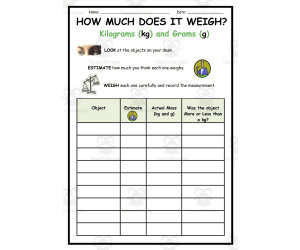
Measurements: Weight
Math, Measurements, Grade 1, 2, 3, 4, Activities
Measurements: Weight Understanding weight and making accurate conversions between units of measurement is a crucial skill for students to develop. The Measurements: Weight activity provides 3rd through 6th-grade educators with a well-structured and fully editable teaching resource, especially designed to reinforce these concepts. This effective teaching tool consists of two in-depth worksheets targeting different aspects of weight measurement. The first worksheet: Caters to students dealing with practical problems - they gain hands-on experience by weighing various objects themselves. Takes learning from abstract notions and equates weight to physical entities that students interact with daily. The second worksheet: Gives pupils the chance to delve into converting measurements within the context of weight. Paves the way for smooth transitioning from simpler problems to more challenging ones as they progress in their mathematics education journey. Editability: What makes these worksheets even more useful is their editability, granting teachers full control over customizing content based on their classroom needs or each student's individual level - allowing for diverse differentiation strategies catering for all learners in your class. Flexibility Of Usage: You can use these activities as class-wide assignments encouraging group discussion or individually during math center rotations or seat work focused hours... You also have the option to send them out as enriching homework tasks that solidify understanding after school hours! This PDF file containing Measurements: Weight goes beyond textbook instruction by making room for interactive learning, an aspect often overlooked under traditional mathematical concept teaching methods. Scalable resources like these do not only aid teachers in efficient instruction but also make learning fun and engaging. Thus, this product builds strong foundational skills – essential in students' educational journeys and everyday life.
Author Elementary Resources 4 U
Tags Weight Measurement, Conversions, Hands-on Activity, Math Center, Differentiated Learning