



3,911 products added recently
Page 15 - Science Assessments
Provide comprehensive science assessments covering biology, chemistry, physics, and Earth science. This collection includes lab reports, concept checks, and experimental evaluations. Foster a deeper understanding of scientific principles by using targeted assessments.

 Show filters

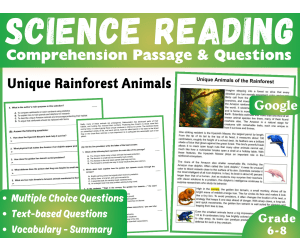
Life Science Reading Comprehension Passage: Rainforest Animals (Docs)
Science, ELA, Reading, Reading Comprehension, Strategies, Resources for Teachers, Life Sciences, Animals, Grade 6, 7, 8, 9, Writing Prompts, Worksheets & Printables, Centers, Activities, Teacher Tools, Assessments, Quizzes and Tests, Quizzes, Tests
Life Science Reading Comprehension Passage and Questions: Unique Rainforest Animals (Docs) This very engaging life science reading passage about Unique Rainforest Animals . It describes several rainforest animals, including the Hyacinth Macaw , Amazon river dolphin , golden lion tamarin , and poison dart frog . The passage explains each animal’s special traits, such as strong beaks, pink coloring, intelligence, climbing ability, warning colors, and toxins. It also explains that many of these animals are threatened by deforestation and hunting , so protecting the Amazon means protecting their habitats. This passage is designed to bridge the gap between science and literacy through strengthening reading comprehension and sparking scientific curiosity in middle school students. The passage blends English Language Arts skills with accurate science content that supports NGSS classroom practice. Ideal for interdisciplinary learning in ELA and Science. Suitable for Grade 9 review, too! Student Tasks for The Passage: 5 multiple-choice questions targeting main idea, key details, inference, vocabulary in context, and use of evidence 5 vocabulary matching items with clear, student-friendly definitions 5 text-based questions that require citing specific lines or facts 1 summary prompt that asks students to condense central ideas accurately Full answer key for every section Available Formats for this Resource PDF Fillable PDF Word Docs FULL CATALOG OF DOWNLOADING LINKS HERE Product Details Length: 5 pages total Grades: 6–8, also suitable for Grade 9 review Use cases: close reading, stations, homework, intervention, test prep, and sub plans Standards support: reinforces informational-text skills and supports NGSS-style sense making through observation, modeling, and clear use of claim, evidence, and reasoning Why Teachers Choose This Set Authentic science content paired with rigorous literacy practice Consistent task structure across all passages for easier planning and smoother student routines Clear, age-appropriate writing that builds confidence without oversimplifying Other Science Reading Collections you May find in the store: 1. Astronomy & Space Science 2. Volcanoes, Rocks, & Mountains 3. Rock Cycle, Soil, & Sinkholes 4. Mars, Glaciers, & Antarctica 5. Water Cycle, Acid Rain, & Wastewater 6. Insects, Animals, & Ecosystems 7. Bioluminescence & Insects 8. Animal Skin, Cats, & T. Rex 9. Human Body and Senses 10. Health & Applied Bioscience 11. Waves, Light, & Imaging 12. Electricity & Energy 13. Motion & Materials 14. Chemistry and Materials Science Use this set to reinforce ELA skills in science, to add literacy to your lessons, and to support independent work. The passages strengthen main idea, evidence use, vocabulary in context, inference, cause and effect, and summary writing. With ready-to-use assessments and complete answer keys, you can provide focused practice that is simple to run and fast to review.
Author Middle & High School - CORED Education
Rating
Tags Middle School, Reading Comprehension, Reading Strategies, ELA, Centers, Reading Passage, Assessments, Vocabulary, Life Science, Rainforest Animals
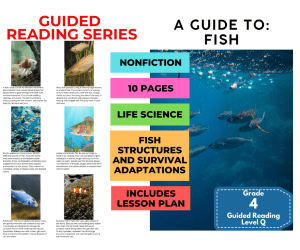
A Guide to Fish: Guided Reading Level Q with Lesson Plan
ELA, Resources for Teachers, Reading Comprehension, Reading, Science, Language Development, Life Sciences, Earth and Environmental Sciences, Pre-Reading, Vocabulary, Grade 3, 4, 5, Worksheets & Printables, Worksheets, Teacher Tools, Centers, Activities, Literacy Readers, Quizzes, Quizzes and Tests, Assessments, Lesson Plans
This A Guide to Fish (level q) guided reading book with lesson plan includes: Guided Reading Color Label (front cover x1) This is a quick way to match the book’s demands to what students can generally handle.. The overall goal is to use the level/color to pick books for several smaller groups. To qualify for a certain level, a student is expected to read a book from that level with about 90–94% accuracy. If a student is consistently accurate and understands, move up a level. If the student is struggling at that level, drop down and add more support. Each student will improve at completely different rates, but it is generally one of the best ways to check progress across the class. DOWNLOAD THE CATALOG TO VIEW ALL GUIDED READING BOOKS AVAILABLE (SORTED LEVELS A-Z) Pre-Reading Question (x1) Teacher asks the prompt aloud, can be while showing the cover or first page. Students share what they already know, or make educated guesses from the cover. Prompt them to use the target vocabulary. Write some of their responses on the board to look back at during the reading. Vocabulary Words (x5) Introduce the five words, best doing it one at a time. Start by saying it, while students repeat and then see if anyone knows what it means before reading further. Read through the meaning and try to briefly connect each word to a picture or gesture so it’s meaningful. Ask students to flip through the book pages and point to where they see each of the vocabulary words. While reading the book pause upon coming across one of the vocab words or read the sentence twice to make sure students understand the word has appeared. Optional: Ask students to raise hands whenever they see/hear one of the new words. Guided Reading Pages (x10) Check the book snapshot (below) for: primary topic - do you need to prep extra reading or intro materials on this? what is taught best - decide on 1-2 bullets to focus on, use the prompt or words provided here for best results. learning goals - what you are checking for students to be able to do after the session, elicit answers using prompts or words provided. key vocabulary (see section above). questions overview - so you know what is coming up and if you need to prep extra materials to assist understanding. Run the lesson You may have already looked at a few of the pages together, but you can show them some of the pictures again first to set meaning. Depending on how much time you have and how familiar your students are with guided reading class, you may want to read the book aloud first with the group first. Students whisper or partner read, while you listen in. If time, do it as a group, one student reading a page each. Use the guided page’s prompts to coach: “Check the picture / does it make sense?” “Point under the words / try the first sound” “Reread the sentence smoothly”. Try to focus more on one student per session (rotating every time), so you can work out if they are ready to move up or need to move down a level. Comprehension Questions (back cover x3) This is your way to check that students didn’t just say the words, but actually understood the text. First, let students answer by pointing to the page/picture and saying a short sentence. After any answer, follow with: “Show me where you found that in the text.” In bigger groups, have partners answer first (10–20 seconds), then call on 2–3 students to share. Differentiation tips: Emerging speakers/struggling readers: oral + pointing On-level: oral in a full sentence Higher: one written sentence or draw + label Book Snapshot Title: A Guide to: Fish Genre: Nonfiction (informational) Subject: Life Science Primary Topic: Fish structures and survival adaptations Estimated Guided Reading Level (A–Z): Q What This Book Teaches Best Explains how gills help fish breathe by extracting oxygen from water and releasing carbon dioxide. Describes how a fish’s streamlined shape and fins support efficient movement, stability, steering, and turning. Introduces the lateral line as a sensory system that detects vibrations and pressure changes to help fish navigate and find prey. Compares freshwater and saltwater habitats and explains how fish maintain the right internal balance of salt and water. Shows multiple survival strategies such as bioluminescence, camouflage, cartilaginous skeletons, and schooling (“safety in numbers”). Learning Goals Explain how fish breathe using gills and what happens as water passes over gill filaments. Describe how fins and a streamlined body shape help fish move, steer, and turn in water. Identify what the lateral line does and how it helps fish survive (navigation and finding prey). Compare how freshwater fish and saltwater fish manage water and salt in their bodies. Explain at least two survival adaptations described in the text (camouflage, bioluminescence, schooling). Describe what “cartilaginous fish” are and what the text says cartilage allows them to do. Key Vocabulary From the Text vertebrates — animals that have a backbone. specialized — made for a specific job or purpose. filaments — thin, threadlike parts of the gills. bioluminescence — the ability to make your own light. cartilaginous — having a skeleton made of cartilage, not hard bone. Discussion Prompts Pre-reading question: What body parts or behaviors might help fish survive in different kinds of water? Comprehension questions: What does the text explain that gills do for a fish? Comprehension questions: How does the lateral line help fish, according to the text? Comprehension questions: Why does the text say swimming in a school can help fish survive? Printing Tips 1. Best Printing Method (Recommended) “Booklet” Printing (Best if Available) If your printer or PDF viewer supports Booklet Printing , use this. Settings to use: Print mode: Booklet Paper size: Letter or A4 (either works) Orientation: Landscape Print on both sides: Yes Flip on: Short edge Scaling: Fit to printable area Booklet subset: First test: Front sides only Then: Back sides only This will automatically: Pair pages correctly Put the cover on the outside Align everything for folding After printing, fold in half and staple along the spine . 2. If “Booklet” Printing Is NOT Available You can still print this correctly with manual duplex printing . Step-by-step: Open the PDF. Choose Print . Set: Orientation: Landscape Pages per sheet: 1 Print on both sides: Yes Flip on: Short edge Print all pages . Because each PDF page already contains two facing book pages, the result will still fold cleanly into a book. Thousands of Cored Education products are included with your TeachSimple membership. Download links and encyclopedia index available here.
Author Cored Education
Rating
Tags Reading Comprehension, Reading Passages, Reading, Guided Reading, Guided Reading Lesson Plan, Guided Reading Activity, Pre-reading, Science Lesson Plans, Life Science, Earth Science

AI Tools for Research – Fact-Checking & Bias Detection Worksheets
Science, Technology, Computer Science, Engineering, Special Resources, Social Emotional Learning (SEL), Social Skills, Life Skills, STEM, Research, Grade 6, 7, 8, 9, 10, 11, 12, Worksheets & Printables, Workbooks, Worksheets, Word Searches, Writing Prompts, Teacher Tools, Lesson Plans, Assessments, Diagrams, Presentations
This 41-page PDF is a fully prepared to print middle school Digital Literacy Curriculum called "Advanced Digital Tools for Research: Fact-Checking and Detecting Bias Worksheets" designed for students in grades 6-8 to be able to use the V.E.R.I.F.Y. Framework (Validate, Extract, Read Lateral, Interrogate Bias, Find Primary Evidence, Yield Conclusion) to critically evaluate content generated by AI, identify hallucinatory or fabricated information, detect algorithmic bias, and utilize lateral reading skills. This resource is ideal for the AI era and includes: - Four theoretical chapters with practical real-world examples (e.g., Titanic, Great Wall of China, Space Race, Paleo-Diet). - Ten hands-on student worksheets (e.g., Anatomy of a Digital Claim, Spotting Plausible Falsities, Lateral Reading Protocol, Unmasking Structural Bias, The Phantom Citation Mystery, Chronological Confusion, etc.). - Three full-color visual frameworks/diagrams (Fact-Checking Workflow, Algorithmic Bias Triad, Source Credibility Spectrum). - A complete answer key with rubrics and high proficiency examples. - A complete Teacher Implementation Guide including pacing (4-6 class periods), differentiation for ELLs/developing readers and gifted students, formative assessment examples, and examples of exit tickets. - A ready-to-teach PDF requiring no preparation that increases research skills, media literacy, and critical thinking through an alignment to both the CCSS, ISTE, and Digital Citizenship Standards, making it appropriate for use in English Language Arts, Social Studies, Science, and Technology classes. Why Schools/Parents Find It To Be Effective: Develops Real World Skills that Kids Need to Survive in an AI World. Kids will learn how to identify when they are being deceived by hallucinations, bias, and fake citations before they copy and paste into their papers or projects. No Preparation or Planning Time Required - Teachers get full theory, worksheets, visuals, answers and pacing guide when using this product. Parents appreciate the independent critical thinking experience provided to their children. Fun Way to Increase Student Engagement - Kids enjoy using the detective-style worksheets (Tree Octopus Hoax, Phantom Biologist, Brooklyn Bridge Hoax, etc.) to develop critical thinking skills through the use of skepticism as a game. Differentiated, Inclusive, and Fully Accessible - Students are able to access the materials because of the built in supports provided for ELL/Developing Readers, and extension challenges for Gifted Students. Ensures Academic Integrity Now and in the Future - Aligns well with the local school districts expanding policies regarding the appropriate use of AI, as well as standards for digital citizenship. Intended Audience of Book (As per complete PDF analysis): This resource is specifically created for students in Grades 6 to 8 (Middle School). There are examples throughout the resource, as can be seen in the seven (7) and eight (8) examples referenced. Answer keys and teacher guides both have "Grade 6 to 8 Student Workbook" clearly labeled on them. Best Fit: ELA, Social Studies/History, Research projects in Science, Digital Literacy/Media Literacy, or Technology courses Excellent for Homeschoolers, Gifted Programs, or Educators Teaching AI Ethics and Responsible Research. Copyright & Terms of Use This Book is copyrighted by Syed Hammad Rizvi. This resource is solely for personal and individual classroom use. You may not modify, redistribute or sell any part of this resource (including putting it online for others to back or download). In order to share this resource with your coworkers please buy more licenses from Teachsimple. Thank you for following these terms of use. -------------------------------------------------------------------* This product was created by Syed Hammad Rizvi to be enjoyed!
Author Creative Book Store
Rating
Tags AIFactChecking, BiasDetection, DigitalLiteracy, MiddleSchoolWorksheets, AIFactCheck, VERIFyFramework, CriticalThinking, MediaLiteracy, AIforTeachers, DigitalLiteracyWorksheets

Earth Science Reading Comprehension Passage: From Earth to Mars (PDF)
Science, ELA, Reading, Reading Comprehension, Strategies, Resources for Teachers, Earth and Environmental Sciences, Space, Grade 6, 7, 8, 9, Writing Prompts, Worksheets & Printables, Centers, Activities, Teacher Tools, Assessments, Quizzes and Tests, Quizzes, Tests
Science Reading Comprehension Passages and Questions: From Earth to Mars (PDF) This very engaging earth science reading passage about Mars is designed to bridge the gap between science and literacy through strengthening reading comprehension and sparking scientific curiosity in middle school students. The passage blends English Language Arts skills with accurate science content that supports NGSS classroom practice. Ideal for interdisciplinary learning in ELA and Science. Suitable for Grade 9 review, too! Student Tasks for The Passage: 5 multiple-choice questions targeting main idea, key details, inference, vocabulary in context, and use of evidence 5 vocabulary matching items with clear, student-friendly definitions 5 text-based questions that require citing specific lines or facts 1 summary prompt that asks students to condense central ideas accurately Full answer key for every section Available Formats for this Resource Fillable PDF Word Docs Google Docs FULL CATALOG OF DOWNLOADING LINKS HERE Product Details Length: 5 pages total Grades: 6–8, also suitable for Grade 9 review Use cases: close reading, stations, homework, intervention, test prep, and sub plans Standards support: reinforces informational-text skills and supports NGSS-style sense making through observation, modeling, and clear use of claim, evidence, and reasoning Why Teachers Choose This Set Authentic science content paired with rigorous literacy practice Consistent task structure across all passages for easier planning and smoother student routines Clear, age-appropriate writing that builds confidence without oversimplifying Other Science Reading Collections you May find in the store: 1. Astronomy & Space Science 2. Volcanoes, Rocks, & Mountains 3. Rock Cycle, Soil, & Sinkholes 4. Mars, Glaciers, & Antarctica 5. Water Cycle, Acid Rain, & Wastewater 6. Insects, Animals, & Ecosystems 7. Bioluminescence & Insects 8. Animal Skin, Cats, & T. Rex 9. Human Body and Senses 10. Health & Applied Bioscience 11. Waves, Light, & Imaging 12. Electricity & Energy 13. Motion & Materials 14. Chemistry and Materials Science Use this set to reinforce ELA skills in science, to add literacy to your lessons, and to support independent work. The passages strengthen main idea, evidence use, vocabulary in context, inference, cause and effect, and summary writing. With ready-to-use assessments and complete answer keys, you can provide focused practice that is simple to run and fast to review.
Author Middle & High School - CORED Education
Rating
Tags Middle School, Reading Comprehension, Reading Strategies, ELA, Centers, Reading Passage, Assessments, Vocabulary, Environmental Science, Space
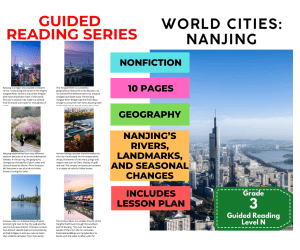
Guided Reading Level N - Nanjing (with Lesson Plan)
ELA, Resources for Teachers, Reading Comprehension, Reading, Social Studies, Geography, Earth and Environmental Sciences, Science, History, Economics, Grade 2, 3, 4, Worksheets & Printables, Worksheets, Teacher Tools, Centers, Activities, Literacy Readers, Quizzes, Quizzes and Tests, Assessments, Lesson Plans
This Guided Reading Book - Nanjing (Level N) with lesson plan includes: Guided Reading Color Label (front cover x1) This is a quick way to match the book’s demands to what students can generally handle.. The overall goal is to use the level/color to pick books for several smaller groups. To qualify for a certain level, a student is expected to read a book from that level with about 90–94% accuracy. If a student is consistently accurate and understands, move up a level. If the student is struggling at that level, drop down and add more support. Each student will improve at completely different rates, but it is generally one of the best ways to check progress across the class. DOWNLOAD THE CATALOG TO VIEW ALL GUIDED READING BOOKS AVAILABLE (SORTED LEVELS A-Z) Pre-Reading Question (x1) Teacher asks the prompt aloud, can be while showing the cover or first page. Students share what they already know, or make educated guesses from the cover. Prompt them to use the target vocabulary. Write some of their responses on the board to look back at during the reading. Vocabulary Words (x5) Introduce the five words, best doing it one at a time. Start by saying it, while students repeat and then see if anyone knows what it means before reading further. Read through the meaning and try to briefly connect each word to a picture or gesture so it’s meaningful. Ask students to flip through the book pages and point to where they see each of the vocabulary words. While reading the book pause upon coming across one of the vocab words or read the sentence twice to make sure students understand the word has appeared. Optional: Ask students to raise hands whenever they see/hear one of the new words. Guided Reading Pages (x10) Check the book snapshot (below) for: primary topic - do you need to prep extra reading or intro materials on this? what is taught best - decide on 1-2 bullets to focus on, use the prompt or words provided here for best results. learning goals - what you are checking for students to be able to do after the session, elicit answers using prompts or words provided. key vocabulary (see section above). questions overview - so you know what is coming up and if you need to prep extra materials to assist understanding. Run the lesson You may have already looked at a few of the pages together, but you can show them some of the pictures again first to set meaning. Depending on how much time you have and how familiar your students are with guided reading class, you may want to read the book aloud first with the group first. Students whisper or partner read, while you listen in. If time, do it as a group, one student reading a page each. Use the guided page’s prompts to coach: “Check the picture / does it make sense?” “Point under the words / try the first sound” “Reread the sentence smoothly”. Try to focus more on one student per session (rotating every time), so you can work out if they are ready to move up or need to move down a level. Comprehension Questions (back cover x3) This is your way to check that students didn’t just say the words, but actually understood the text. First, let students answer by pointing to the page/picture and saying a short sentence. After any answer, follow with: “Show me where you found that in the text.” In bigger groups, have partners answer first (10–20 seconds), then call on 2–3 students to share. Differentiation tips: Emerging speakers/struggling readers: oral + pointing On-level: oral in a full sentence Higher: one written sentence or draw + label Book Snapshot Title: World Cities: Nanjing Genre: Nonfiction (informational text) Subject: Social Studies (Geography) Primary Topic: Nanjing’s rivers, landmarks, and seasonal changes Estimated Guided Reading Level (A–Z): N What This Book Teaches Best How Nanjing’s location along the Yangtze River helped it become a travel and trade hub. How a major river can divide a city and lead to bridges being built to connect districts. How landforms and green spaces (like Purple Mountain’s forests) can help keep a city’s air clean and support plant life. How human-built features (the ancient city wall) can follow natural geography like hills and lakes. How climate and seasons change a city’s landscape through spring blossoms, autumn leaf color, and summer shade from “green tunnels.” Learning Goals Students will describe where Nanjing is located and what major river it sits along. Students will explain why bridges were built across the Yangtze River in Nanjing. Students will identify Purple Mountain and explain how its forests help the city. Students will describe how Nanjing’s ancient city wall follows the natural geography of the land. Students will describe one role Xuanwu Lake plays (islands/bridges or collecting rainwater). Students will describe how Nanjing’s humid subtropical climate connects to changes across seasons. Key Vocabulary From the Text districts — parts of a city. subtropical — warm climate, often with lots of humidity. transformation — a big change. fertile — good for plants to grow. geography — land features of a place. Discussion Prompts Pre-reading question: How might rivers and hills help a city grow and change? Comprehension questions: Where does the text say Nanjing is located, and what river runs through it? Comprehension questions: Why were massive bridges built across the Yangtze River in Nanjing? Comprehension questions: What change does the text describe happening in Nanjing during autumn? Printing Tips 1. Best Printing Method (Recommended) “Booklet” Printing (Best if Available) If your printer or PDF viewer supports Booklet Printing , use this. Settings to use: Print mode: Booklet Paper size: Letter or A4 (either works) Orientation: Landscape Print on both sides: Yes Flip on: Short edge Scaling: Fit to printable area Booklet subset: First test: Front sides only Then: Back sides only This will automatically: Pair pages correctly Put the cover on the outside Align everything for folding After printing, fold in half and staple along the spine . 2. If “Booklet” Printing Is NOT Available You can still print this correctly with manual duplex printing . Step-by-step: Open the PDF. Choose Print . Set: Orientation: Landscape Pages per sheet: 1 Print on both sides: Yes Flip on: Short edge Print all pages . Because each PDF page already contains two facing book pages, the result will still fold cleanly into a book. Thousands of Cored Education products are included with your TeachSimple membership. Download links and encyclopedia index available here.
Author Cored Education
Rating
Tags Reading Comprehension, Reading Passages, Reading, Guided Reading, Guided Reading Lesson Plan, Guided Reading Activity, Pre-reading, Geography, Social Studies Lesson Plans, History

The Birth of Forensics: Science Meets the Scene Reading Passage
ELA, Reading, Writing, Science, High School, Homeschool Resources, Middle School, Worksheets & Printables, Writing Prompts, Teacher Tools, Assessments, Quizzes and Tests
To be honest, getting my high school homeschooler excited about science is not always easy. When I mentioned forensic science, and suddenly she became all ears! That is exactly why I created this comprehensive resource that dives deep into the fascinating world of criminal investigation. After years of homeschooling and watching my kid's eyes glaze over at yet another boring science passage, I knew there had to be a better way. This resource is not your typical textbook chapter that puts everyone to sleep. Instead, it is a captivating journey through the real-life breakthroughs that changed how crimes are solved forever—perfect for grades high school students/homeschoolers and rigorous enough for those tackling AP coursework. INCLUDED IN THIS RESOURCE Detailed reading passage with advanced vocabulary and complex analysis 20 thought-provoking discussion questions requiring paragraph-length responses Complete answer key with flexible guidelines for various student approaches 25 note-taking sheets designed for active reading and comprehension support TOPICS COVERED Historical development of fingerprinting and its impact on criminal identification Evolution of toxicology from basic poison detection to sophisticated chemical analysis Integration of scientific methods into traditional criminal investigation procedures Establishment of professional forensic laboratories and standardization processes I do not know if your teen will become the next CSI superstar, but I do know this resource will get them thinking differently about science. My daughter went from groaning about "another science assignment" to actually asking follow-up questions—and that is when you know you have struck gold! Your students/homeschoolers will develop those critical thinking skills we are always trying to build, plus they might just discover a passion for STEM they did not know they had. Sometimes the best learning happens when kids don't even realize they are learning, and there is something about mysteries and crime-solving that just hooks them. Trust me, after years of trying to make science stick, this one actually works! If you and your students/homeschoolers enjoyed this resource, please leave a review. Thank you for your support! Tina - Big Easy Homeschooling Mom
Author Homeschool with Big Easy Homeschooling Mom
Rating
Tags Forensic Science, Homeschool Curriculum, Criminal Investigation, Critical Thinking And Reasoning, High School Forensic Science , STEM Curriculum Resources, Forensic Science Lesson Plan, High School Criminal Investigation Science Lessons, Forensic Science History Reading Passage With Questions, Note-Taking Sheets
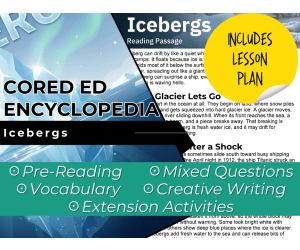
Icebergs Reading Comprehension Passage - Cored Ed Encyclopedia
ELA, Reading Comprehension, Reading, Language Development, History, Social Studies, Science, Physics, Earth and Environmental Sciences, Pre-Reading, Grade 2, 3, 4, 5, Worksheets & Printables, Worksheets, Teacher Tools, Centers, Activities, Writing Prompts, Assessments, Quizzes and Tests, Quizzes, Lesson Plans
This Icebergs reading comprehension with lesson plan includes: Visualization (on the front cover) Start your lesson by taking a minute to think and share something about the topic. Read the script aloud (slowly), perhaps prepare some music or sound effects. Student close their eyes and let their imaginations wander. Students open their eyes, read the question aloud and give them a few minutes to complete. Ask a few students to share or keep answers until the end to compare with what they learn in the passage. Quick pause—thousands of Cored Education products are included with your TeachSimple membership. Download links and encyclopedia index available here. Pre-Reading Trivia Students will write down one thing they already know about the subject and then read five more facts and discuss. These facts are fun, and the students will enjoy learning about the subject before reading more. Give 1 minute for students to write what they already know (no pressure—best guess is fine). Read the five facts together. After each fact, do ask a student for their opinion, was it surprising? Set a purpose by asking students to highlight/underline one fact they want to learn more about during the reading. Reading Passage The text is a high-interest reading passage with set paragraphs, roughly three to four paragraphs long. It contains a variety of themes about the topic, anywhere from history to technology. The passage is between 250 and 350 words in length. First, ask students to look at the headings and see what they’ll learn about today. What do they know about the topic/heading? First read options: Teacher read-aloud (best for support). Partner reading (paragraph by paragraph). While reading, students underline important details, and vocabulary words they think may come up in the questions section. Mixed Questions The first question page contains four multiple-choice questions, each with a choice of four answers, and three written response questions that require a sentence or two from the student. Students complete the mcqs first independently, then review quickly as a class. For the 3 written responses, try to get students giving the answer with some form of evidence: “I think ___ because the text says ___.” If students get stuck, send them back to check the passage. Vocabulary Questions Practice seven key words from the text in this section across two activities. First section is scrambled words where students will unscramble three words given a clue for each. The second section is a word to meaning matching activity. Before starting, have some students read out words they underlined in the passage. Ask students to say the word and read aloud the sentence(s) around each word. Ask students to do scrambled words and the matching exercise in pairs then go through answers as a class. For the scrambled spelling task, get four pairs to come up to the board and write the words for extra practice with the other student reading out the clue. For the matching task, prompt students to give full sentences: “I matched ___ with ___ because ___.” Creative Writing In this question, the student will be required to write a five to eight sentence paragraph on a question related to the topic. Before starting, ask students write down 3 key ideas they are going to include in their piece. Ask students for ideas to share around the class to help those struggling. Pro writing expectations: 5–8 sentences At least 2 facts or details from the passage At least 2 vocabulary words from the previous page Students read their paragraphs while classmates listen for facts and vocabulary words. Extension Activities This page is optional for fast finishers or to take home. There are several activities, each one requiring a different skill. Do some, do none, do all, completely optional - but you will feel reassured knowing every possibility is planned for. Includes summary writting question and additional facts. Answer Key There are answers for the multiple-choice questions, written response questions have sample answers, vocabulary answers and if there is a summary question then a sample summary will be provided as well. Lesson Plan Included Customized lesson plan for this lesson is included. Lesson Snapshot Title: Icebergs Genre: Nonfiction (informational passage) Subject: Reading (Informational Text) / Earth Science Primary Topic: How icebergs form, drift, and change Estimated Guided Reading Level (A–Z): R What This Lesson Teaches Best Key facts about iceberg floating: ice is lighter than seawater and most of an iceberg is below the surface (about 90% underwater). How icebergs form from glaciers on land, including the process called calving when a piece breaks away at the sea. Human safety and history connections: the Titanic tragedy and how the International Ice Patrol began sending warnings to ships. How icebergs change shape over time (waves at the waterline, meltwater weakening from above) and why scientists track them (ocean currents, changing polar ice). Using headings to organize information into focused sections (formation, safety/history, observation/science clues). Learning Goals Explain why most of an iceberg is hidden under the ocean’s surface. Describe how snow becomes hard glacier ice and how a new iceberg forms. Define calving using details from the passage. Identify what happened in 1912 and how it led to safer travel for ships. Describe two ways an iceberg can change shape and one reason scientists watch iceberg paths. Key Vocabulary From the Text seawater — ocean water with salt in it. surface — the top layer of something. glacier — a huge, slow-moving river of ice. calving — when a piece breaks off a glacier. currents — moving flows of ocean water. FULL CATALOG OF DOWNLOAD LINKS AND ENCYCLOPEDIA INDEX HERE
Author Cored Education
Rating
Tags Vocabulary, Reading Comprehension, Reading Passages, Lesson Plans, Ela Lesson Plans, Reading Comprehension Lesson Plans, Pre-reading, History, Science Lesson Plans, Earth Science
Prompt Engineering for Content Creators & Freelancers Book
Science, Technology, Computer Science, Engineering, Resources for Teachers, Classroom Management, Research, Basic Science, Special Resources, Special Education Needs (SEN), Homeschool Curriculum, Homeschool Templates, Grade 9, 10, 11, 12, Projects, Activities, Experiments, Labs, Teacher Tools, Lesson Plans, Presentations, Assessments, Workbooks, Worksheets & Printables
Utilize AI to its largest extent while becoming a successful content creation business with the Ultimate Guide to Prompt Engineering. This book has been designed specifically for freelancers, digital entrepreneurs, and business service providers aged from twenty-two up through forty. By leveraging AI tools such as ChatGPT, Claude, and Gemini, you will learn how to increase your output by ten times; decrease content creation time by as much as sixty percent; and establish a sustainable, scalable income by creating engaging, informative content that drives traffic to your site. You will learn how to apply the Six-Component Framework for developing flawless prompts, as well as several advanced techniques (attributed to Steve Bidstrup) that allow a creator to express their brand's voice (Chain of Thought and Few-Shot) to produce business-specific content (Twitter/X, YouTube Channel, LinkedIn Page, Instagram Account, Email Newsletter) using case study examples illustrating how content creators such as Sarah and Marcus accomplished their respective businesses by utilizing the techniques contained within this book, while also reducing the total amount of hours worked per week by three. In addition, you will receive a complete thirty-day implementation guide; prompt templates that can be reused; and an ethics guide that will assist in the preservation of your current skill set. If your business model includes selling content services, a newsletter, and managing multiple social channels, then this guide will provide you with an unfair advantage in the modern AI-powered creation economy. You will no longer be required to wrestle with one-size-fits-all AI-generated materials; rather, you will engineer materials that drive commitment, conversion, and cash. Noteworthy Characteristics: The Reliable Six-Component Prompting System To Create Professional Grade AI Results. Site-Specific Prompting Formats and Guidelines for Most Major Platforms such as Twitter, Linked_in, Youtube, Instagram, And Email. Chain Of Thought And Few Shot Methods To Match Your “Real Voice” Exactly. A Full 30 Day Plan For Implementing Once You Have Laid Your Foundations -- To Finally Become Masterful At Using AI. Turnkey Productivity Systems that Will Give You Back 15-20 Hours A Week To Do Core Tasks. Monetization Strategies For Freelancers to Help Scale Their Service Offerings And Prevent From Getting Burned Out. An Ethics System Which Includes A Checklist For Quality Gatekeeping, So You Can Maintain Trust And Credibility As An AI User. Parents/Schools Appreciate It Because: Future-Proofed Career Skills. Students get hands-on experience communicating using AI, an in-demand skill regardless of career path, with a 30-day strategy to turn theoretical knowledge into applicable real-world knowledge through practical experience. Promoting the Ethical Use of AI. This book teaches the ethical and transparent use of AI via its dedicated chapter to ethics and quality gate systems, which enable students to avoid absences and misinformation, eliminate diluted voices, and understand how to leverage AI responsibly. Saving Time for Educators. This book contains pre-prompted library & system tools for educational institutions to utilize as time-savings in lesson plan creation while also modeling how to use AI to create an efficient workflow. Supporting Multidisciplinary & Cross-Curricular Learning. The content relates to English, business, technology, and media classes, representing an adaptable resource to support project-based learning and cross-curricular integration opportunities. Enhancing School Program Engagement and Revenue. It includes a strong emphasis on monetization and scaling of freelance businesses, resulting in veritable economic impact on career-tech programs, providing attractiveness for parents and school districts concerned with job placement readiness. Determine Which Students/Classrooms Are Targeted : This book is written with a professional audience in mind (22-40 yrs old), so your focus should be on post-secondary and professional development settings. Ideal audiences would be: Corporations and Universities Offering Courses in Digital Marketing, Media Creation, Journalism, Communications, Entrepreneurship and Business– Can be Contributed To As Either Textbook Or Suggested Reading For Any Course Of Study Related to Digital Strategy, Applications of AI in Business and/or Online Monetization Of Content. Vocational Training Certificates in Freelance Writing, Social Media Management, Digital Entrepreneurship and AI Literacy. Professional Development Workshops For Freelancers, Marketing Teams, Business Owners Who Want To Improve Their Skill Sets. High School Electives (Grades 11-12) Involved with Media Studies, Tech, Business or Career Readiness –Content Is Constructed Accessible With An Older Teenager Mindset(Preparing For The Digital Workforce). Use This Resource As An Add-On To Your Career Readiness Curriculums Provided By Business/Tech Teachers To High Schools Or As A PD Tool To Educators Who Want To Leverage AI In Their Content Creation. This book is written and published by Syed Hammad Rizvi, with exclusive copyright. This book can only be used individually (by one person) and in a class (by one class), and you cannot make any changes or distribute this book; that is, you cannot put the book on the internet or make it accessible. In order for you to share this book with your coworkers means you need to buy additional licenses to be able to share or give your coworkers. I want to express my sincere thanks to you for adhering to these guidelines of use as I truly appreciate you doing so. This product is made available to you through Syed Hammad Rizvi.
Author Creative Book Store
Rating
Tags PromptEngineering, AIContentCreation, ContentCreator, FreelancerLife, AItools, ChatGPT, ClaudeAI, DigitalProduct, CreatorEconomy, ContentMarketing
Atomic Models: Physical Science Reading Comprehension Passage (Word)
Science, ELA, Reading, Reading Comprehension, Strategies, Resources for Teachers, Common Core, Language Development, Physics, Grade 6, 7, 8, 9, 10, Writing Prompts, Worksheets & Printables, Centers, Activities, Teacher Tools, Assessments, Quizzes and Tests, Quizzes, Tests, Literacy Readers
Physical Science Reading Comprehension Passage and Questions for Middle School: Atomic Models (Word Document) This resource explores how scientists’ understanding of the atom changed over time as new evidence became available . Students follow the development of atomic models from Democritus’s early idea of indivisible particles to Dalton’s solid-sphere model, Thomson’s discovery of the electron, Rutherford’s nuclear model, Bohr’s energy levels, and the modern electron-cloud model . It emphasizes how scientific models are revised when new experiments and discoveries provide better evidence . It also introduces important ideas such as electrons, the nucleus, empty space within atoms, energy levels, electron clouds, and probability . This passage is designed to bridge the gap between science and literacy by strengthening reading comprehension while sparking scientific curiosity in middle school students. It blends English Language Arts skills with accurate science content, helping students build background knowledge, understand key concepts, use evidence from the text, and explain scientific ideas clearly. This resource supports science classroom practice while also reinforcing important literacy skills such as main idea, vocabulary, comprehension, and summarizing. Ideal for interdisciplinary learning in ELA and Science. Suitable for Grade 9 review, too! Student Tasks for The Passage: 10 multiple-choice questions targeting main idea, key details, science concepts, comparison, and real-world applications 10 True/False statements to check understanding and address common misconceptions 5 text-based short-answer questions that require students to explain important ideas from the passage 5 vocabulary matching items with clear, student-friendly definitions 1 summary prompt that asks students to condense the central ideas accurately Full answer key for every section Available Formats for this Resource PDF Fillable PDF Google Docs Product Details Length: 7 pages total Grades: 6–8, also suitable for Grade 9 review Use cases: close reading, stations, homework, intervention, test prep, and sub plans Standards support: Reinforces informational-text skills and supports NGSS-style sense-making by helping students read scientific explanations, connect evidence to key concepts, interpret real-world examples, and explain cause-and-effect relationships in science. FULL CATALOG OF DOWNLOADING LINKS HERE Other Science Reading Collections and Topics You May Find in the Store: 1. Astronomy & Space Science 2. Volcanoes, Rocks, & Mountains 3. Rock Cycle, Soil, & Sinkholes 4. Mars, Glaciers, & Antarctica 5. Water Cycle, Acid Rain, & Wastewater 6. Insects, Animals, & Ecosystems 7. Bioluminescence & Insects 8. Animal Skin, Cats, & T. Rex 9. Human Body and Senses 10. Health & Applied Bioscience 11. Waves, Light, & Imaging 12. Electricity & Energy 13. Motion & Materials 14. Chemistry and Materials Science 15. Electromagnetism 16. Acids and Bases 17. Gas Laws 18. Biotechnology 19. Periodic Trends 20. Protists and Fungi 21. Microevolution 22. Blood 23. Chemical Bonding 24. Magnets 25. Muscles 26. Nuclear Chemistry 27. Electromagnetic Devices 28. Epigenetics 29. The Law of Conservation of Mass 30. Atomic Models 31. Isotopes and Ions 32. Light 33. Human-Environment Interaction 34. Theory of Evolution 35. Photosynthesis 36. Origins of Life and Early Earth 37. Gene Expression and Regulation 38. Thermochemistry 39. Allergies 40. Coevolution 41. Birth to Adulthood 42. Cells 43. Entropy and Free Energy 44. The Human Brain 45. Mixtures and Solutions 46. Invertebrates 47. Zoo Animals 48. Biochemistry 49. Animal Behavior 50. Population Ecology ...and many more engaging science reading passages that cover intriguing and important topics designed to spark curiosity and support student learning. Use this passage to reinforce ELA skills in science, to add literacy to your lessons, and to support independent work. The passages strengthen main idea, evidence use, vocabulary in context, inference, cause and effect, and summary writing. With ready-to-use assessments and complete answer keys, you can provide focused practice that is simple to run and fast to review.
Author Middle & High School - CORED Education
Rating
Tags Middle School, Reading Comprehension, Reading Strategies, ELA, Centers, Reading Passage, Assessments, Vocabulary, Physical Science, Physics
HIgh School Cell Structure & Organelles Functions Reading Passage
ELA, Reading, Writing, Research, Resources for Teachers, Science, Life Sciences, Biology, High School, Homeschool Resources, Teacher Tools, Lesson Plans, Assessments, Quizzes and Tests, Worksheets & Printables, Writing Prompts
This Inside the Cell: Exploring the Building Blocks of Life Reading Passage, Q & A, and Note-Taking Sheets resource is a thoughtfully designed resource created to help students/homeschoolers truly understand the fascinating world of cells. As a homeschool mom guiding my own ninth grader, I know how challenging it can be to find materials that are both engaging and thorough. This Inside the Cell: Exploring the Building Blocks of Life Reading Passage, Q & A, and Note-Taking Sheets resource brings together a detailed reading passage, critical thinking Q & A, and five versatile note-taking sheets to support deep comprehension. Whether you are teaching in a classroom or around the kitchen table, this set will help your learners grasp the essential differences between eukaryotic and prokaryotic cells and the remarkable functions of their organelles. INCLUDED IN THIS RESOURCE: Comprehensive reading passage on cell structure and organelle function 20 higher-order, research-based Q & A prompts Guided answer key for all questions Five note-taking sheets TOPICS COVERED: Differences between prokaryotic and eukaryotic cells Structure and function of major cell organelles Specialized features of plant and animal cells Cellular adaptations and ecological roles This Inside the Cell: Exploring the Building Blocks of Life Reading Passage, Q & A, and Note-Taking Sheets resource is a complete package for teaching and learning about the building blocks of life. It is designed to inspire curiosity, build confidence, and equip students/homeschoolers with the knowledge and skills they need to succeed in biology. As a mom and homeschool educator, I believe this resource will make your science lessons more meaningful and enjoyable for everyone involved. If you and your students/homeschoolers enjoyed this resource, please leave a review. Thank you for your support! Tina - Big Easy Homeschooling Mom
Author Homeschool with Big Easy Homeschooling Mom
Rating
Tags Cell Structure And Function Reading Passage, Eukaryotic And Prokaryotic Cell Comparison, Homeschool Cell Biology Resource, Homeschool Biology, High School Biology, Comprehensive Cell Biology Lesson, Cell Structure And Organelle Teaching Materials, Homeschool Science, High School Science, Eukaryotic And Prokaryotic Cells

Life Science Reading Comprehension Passage: Insects' Disguises. SAMPLE
Science, ELA, Reading, Reading Comprehension, Strategies, Resources for Teachers, Life Sciences, Animals, Grade 6, 7, 8, 9, Writing Prompts, Worksheets & Printables, Centers, Activities, Teacher Tools, Assessments, Quizzes and Tests, Quizzes, Tests
This is a free passage sample from the complete resource. The full version includes everything needed for a complete reading comprehension activity: the passage, multiple-choice questions, short-answer questions, vocabulary matching, a summary-writing task, and a detailed answer key. Download the complete passage resource by clicking on the following links: PDF Fillable PDF Word Docs Google Docs Life Science Reading Comprehension Passage and Questions: Insects' Disguises (PDF) This very engaging life science reading passage about Insects' Disguises: how insects use camouflage and mimicry to survive . It explains the difference between the two strategies: Camouflage helps insects blend into their surroundings so predators do not notice them. Examples include stick insects, leaf insects, and katydids. Mimicry helps insects look like something else, either something dangerous or something tempting. Examples include hoverflies that look like bees or wasps, and mantises that imitate flowers or dead leaves. The passage also explains how these disguises work because predators make quick decisions based on color, shape, motion, and patterns. This passage is designed to bridge the gap between science and literacy through strengthening reading comprehension and sparking scientific curiosity in middle school students. The passage blends English Language Arts skills with accurate science content that supports NGSS classroom practice. Ideal for interdisciplinary learning in ELA and Science. Suitable for Grade 9 review, too! Student Tasks for The Passage: 5 multiple-choice questions targeting main idea, key details, inference, vocabulary in context, and use of evidence 5 vocabulary matching items with clear, student-friendly definitions 5 text-based questions that require citing specific lines or facts 1 summary prompt that asks students to condense central ideas accurately Full answer key for every section FULL CATALOG OF DOWNLOADING LINKS HERE Product Details Length: 5 pages total Grades: 6–8, also suitable for Grade 9 review Use cases: close reading, stations, homework, intervention, test prep, and sub plans Standards support: reinforces informational-text skills and supports NGSS-style sense making through observation, modeling, and clear use of claim, evidence, and reasoning Why Teachers Choose This Set Authentic science content paired with rigorous literacy practice Consistent task structure across all passages for easier planning and smoother student routines Clear, age-appropriate writing that builds confidence without oversimplifying Other Science Reading Collections you May find in the store: 1. Astronomy & Space Science 2. Volcanoes, Rocks, & Mountains 3. Rock Cycle, Soil, & Sinkholes 4. Mars, Glaciers, & Antarctica 5. Water Cycle, Acid Rain, & Wastewater 6. Insects, Animals, & Ecosystems 7. Bioluminescence & Insects 8. Animal Skin, Cats, & T. Rex 9. Human Body and Senses 10. Health & Applied Bioscience 11. Waves, Light, & Imaging 12. Electricity & Energy 13. Motion & Materials 14. Chemistry and Materials Science Use this set to reinforce ELA skills in science, to add literacy to your lessons, and to support independent work. The passages strengthen main idea, evidence use, vocabulary in context, inference, cause and effect, and summary writing. With ready-to-use assessments and complete answer keys, you can provide focused practice that is simple to run and fast to review.
Author Middle & High School - CORED Education
Rating
Tags Middle School, Reading Comprehension, Reading Strategies, ELA, Centers, Reading Passage, Assessments, Vocabulary, Life Science, Insects

Reading Food Labels for Endocrine Disruptors
Science, Chemistry, Basic Science, Inventors, Theories, Life Sciences, Biology, Human Body, P.E. & Health, Health, Grade 6, 7, 8, 9, 10, 11, 12, Workbooks, Worksheets & Printables, Worksheets, Word Searches, Teacher Tools, Lesson Plans, Quizzes and Tests, Quizzes, Tests, Assessments
Are your students truly aware of what's hiding in their snacks? Transform your classroom or home into a real-world science lab with this comprehensive, no-prep curriculum that teaches students to become "Pantry Detectives!" This engaging, project-based unit empowers students to investigate their own food, decode confusing labels, and understand the science behind endocrine-disrupting chemicals (EDCs) , artificial food dyes , and microplastics . Moving beyond abstract concepts, this resource makes health and biology tangible, relevant, and incredibly important to their daily lives. Students will embark on a "scavenger hunt" through their own pantries, applying a three-tiered investigative methodology to uncover hidden chemicals in everyday foods like mac & cheese, fruit snacks, and sports drinks. They will learn to think like toxicologists and act as educated consumer advocates for their own health. This All-in-One Digital PDF Unit Includes: Part 1: The Informational Text (11 pages): A detailed, student-friendly "textbook" covering: The Endocrine System and its function. How EDCs like artificial dyes (Red 40, Yellow 5) and microplastics (BPA, Phthalates) interfere with hormones. Real-world case studies analyzing popular food products. Part 2: The Student Workbook (20 pages): Ten hands-on, investigative worksheets that guide students through their scavenger hunt. Activities include: The Pantry Reconnaissance Mission The Colorful Culprits (Artificial Dyes) The Packaging Problem (Microplastics) The "Natural" Deception (Marketing vs. Reality) The EDC-Free Action Plan (A final synthesis project) Part 3: Teacher Resources & Visuals (10 pages): Everything you need for seamless instruction: 3 High-Resolution Visual Diagrams/Anchor Charts: Perfect for presentations or classroom posters (EDC Pathway, Scavenger Hunt Matrix, Label Decoding Chart). Comprehensive Answer Key: A complete, easy-to-use answer key for all 10 worksheets. Skills & Subjects Covered: Science/Biology: Endocrine system, hormones, cellular receptors, toxicology. Health & Nutrition: Reading food labels, processed foods, making healthy choices. Critical Thinking: Analyzing marketing claims, data synthesis, problem-solving. ELA: Reading comprehension of technical text, vocabulary building. Perfect for middle school science, health class, a homeschool co-op, or a project-based learning (PBL) unit, this resource is ready to print and go. Empower your students to take control of their health by understanding the chemical landscape of their own pantry. Download today! Keywords: Middle School Science, Health, Nutrition, Endocrine System, Food Labels, Scavenger Hunt, Project-Based Learning, PBL, Artificial Dyes, Food Coloring, Microplastics, BPA, Reading Labels, Critical Thinking, Hands-On Activity, Digital, Printable, Worksheet, Homeschool, No Prep, Biology, Consumer Science. Why Parents/Schools Love It: Real-World Relevance: It brilliantly connects abstract biology and chemistry concepts directly to the food students eat every day, making learning tangible and unforgettable. Empowers Students: This isn't just a worksheet; it's a life skill. It teaches students to become critical thinkers and proactive guardians of their own long-term health. Engaging & Hands-On: The "scavenger hunt" format is fun and investigative, promoting active learning over passive memorization. Students are doing science, not just reading about it. Comprehensive & No-Prep: This is a complete, ready-to-use unit. It includes the informational text, all student activities, high-quality visuals, and a full answer key, saving teachers valuable preparation time. Target Student Audience : Based on the explicit mention on page 1 ("For a Grade 7 student") and the complexity of the topics (e.g., Bisphenol-A, petroleum-based dyes, cellular disruption), target audience is: Primary Target: Middle School students (Grades 6, 7, and 8) in Science, Health, or Life Science classes. Secondary Target: Early High School students (Grade 9) in introductory Biology, Health, or Environmental Science courses. It's also an excellent resource for Homeschooling families looking for a relevant, hands-on science curriculum. Copyright/Terms of Use: This Book was copyrighted by Syed Hammad Rizvi. This resource is for personal and single classroom use only. You may not alter, redistribute, or sell any part of this resource. In other words, you may not put it on the Internet where it could be publicly found and downloaded. If you want to share this resource with colleagues, please purchase additional licenses from Teachsimple. Thank you for respecting these terms of use. This product is happily brought to you by Syed Hammad Rizvi
Author Creative Book Store
Rating
Tags ScienceScavengerHunt, FoodLabels, ReadingLabels, EndocrineDisruptors, ProjectBasedLearning, PBL, ArtificialDyes, Microplastics, ChemicalsInFood, ConsumerScience

High School Decoding the Shadows: The Evolution of Criminal Profiling
Reading, ELA, Writing, Research, Resources for Teachers, Science, Technology, Homeschool Resources, High School, Teacher Tools, Assessments, Quizzes and Tests, Lesson Plans, Worksheets & Printables, Writing Prompts
As a homeschool mom of a high schooler, you know the struggle of finding that unique and engaging resource. As both a homeschool mom and a resource creator, I designed this study into the history of criminal profiling to move past dry textbooks and get into the real "human truth" of how justice works, tracing the path from Victorian-era "gut feelings" to the sophisticated forensic discipline used today. It is a wild journey that shows our students/homeschoolers how investigators transitioned from looking only at physical clues to decoding the actual psychology of a suspect. By the time they finish, your student/homeschooler will understand how a crime scene is often just a mirror of a killer’s internal state; I have kept the content rigorous enough for high school credit, but paced it like a story they will actually want to keep reading. INCLUDED IN THIS RESOURCE: A narrative tracing profiling from its 19th-century roots to modern FBI methods. A clear breakdown of "organized" vs. "disorganized" offender profiles. Real-world looks at Jack the Ripper, the "Mad Bomber," and even the profiling of Hitler. A full bibliography featuring foundational works by John Douglas and Robert Ressler. TOPICS COVERED: Moving from physical evidence to decoding a suspect's motivations. How clinical expertise first entered active police investigations. The formalization of evidence-based profiling at the FBI Academy. Using behavioral tracking for cold cases and modern cybercrime. I hope this resource helps your student/homeschooler see that profiling is a living, breathing field that is constantly evolving—using everything from data analytics to modern forensic psychology to crack even the toughest cold cases. As a fellow homeschool mom, I know how important it is to show our students/homeschoolers that even though profiling has faced its fair share of critics, it remains an essential tool for investigators when they hit a wall. As technology advances, our ability to get inside a criminal's head only gets more precise. This journey from "armchair" theories to the high-tech halls of the FBI's Behavioral Science Unit is really a story about our human drive to understand the unthinkable; it is a great reminder that while science handles the hard facts, profiling is what actually helps us uncover the "human truth" behind the crime. If you and your students/homeschoolers enjoyed this resources, please leave a review. Thank you for your support! Tina - Big Easy Homeschooling Mom
Author Homeschool with Big Easy Homeschooling Mom
Rating
Tags Criminal Profiling Evolution, Behavioral Science Unit History, Forensic Psychology For Teens, Profiling Serial Killers, Criminal Psyche Study, BSU Quantico History, Investigative Psychology, Forensic Behavioral Analysis, History Of Forensic Science, FBI Profiling Techniques
Physical Science Reading Comprehension Passage: Magnets (PDF)
Science, ELA, Reading, Reading Comprehension, Strategies, Resources for Teachers, Physics, Grade 6, 7, 8, 9, 10, Writing Prompts, Worksheets & Printables, Centers, Activities, Teacher Tools, Assessments, Quizzes and Tests, Quizzes, Tests
Physical Science Reading Comprehension Passage and Questions: Magnets (PDF) This very engaging science reading passage is about magnetism and the invisible forces magnets exert on certain materials . It explains magnetic fields, north and south poles, attraction and repulsion, and why materials such as iron, nickel, and cobalt respond strongly to magnets. Students also compare permanent magnets with electromagnets and explore how magnets are used in compasses, speakers, scrapyard cranes, MRI machines, and other everyday technologies. This passage is designed to bridge the gap between science and literacy by strengthening reading comprehension while sparking scientific curiosity in middle school students. It blends English Language Arts skills with accurate science content, helping students build background knowledge, understand key concepts, use evidence from the text, and explain scientific ideas clearly. This resource supports science classroom practice while also reinforcing important literacy skills such as main idea, vocabulary, comprehension, and summarizing. Ideal for interdisciplinary learning in ELA and Science. Suitable for Grade 9 review, too! Student Tasks for The Passage: 10 multiple-choice questions targeting main idea, key details, science concepts, comparison, and real-world applications 10 True/False statements to check understanding and address common misconceptions 5 text-based short-answer questions that require students to explain important ideas from the passage 5 vocabulary matching items with clear, student-friendly definitions 1 summary prompt that asks students to condense the central ideas accurately Full answer key for every section Available Formats for this Resource Fillable PDF Word Docs Google Docs FULL CATALOG OF DOWNLOADING LINKS HERE Product Details Length: 7 pages total Grades: 6–8, also suitable for Grade 9 review Use cases: close reading, stations, homework, intervention, test prep, and sub plans Standards support: Reinforces informational-text skills and supports NGSS-style sense-making by helping students read scientific explanations, connect evidence to key concepts, interpret real-world examples, and explain cause-and-effect relationships in science. Why Teachers Choose This Set Authentic science content paired with rigorous literacy practice Consistent task structure across all passages for easier planning and smoother student routines Clear, age-appropriate writing that builds confidence without oversimplifying Other Science Reading Collections and Topics You May Find in the Store: 1. Astronomy & Space Science 2. Volcanoes, Rocks, & Mountains 3. Rock Cycle, Soil, & Sinkholes 4. Mars, Glaciers, & Antarctica 5. Water Cycle, Acid Rain, & Wastewater 6. Insects, Animals, & Ecosystems 7. Bioluminescence & Insects 8. Animal Skin, Cats, & T. Rex 9. Human Body and Senses 10. Health & Applied Bioscience 11. Waves, Light, & Imaging 12. Electricity & Energy 13. Motion & Materials 14. Chemistry and Materials Science 15. Electromagnetism 16. Acids and Bases 17. Gas Laws 18. Biotechnology 19. Periodic Trends 20. Protists and Fungi 21. Microevolution 22. Blood 23. Chemical Bonding 24. Magnets 25. Muscles 26. Nuclear Chemistry 27. Electromagnetic Devices 28. Epigenetics 29. The Law of Conservation of Mass 30. Atomic Models 31. Isotopes and Ions 32. Light 33. Human-Environment Interaction 34. Theory of Evolution 35. Photosynthesis 36. Origins of Life and Early Earth 37. Gene Expression and Regulation 38. Thermochemistry 39. Allergies 40. Coevolution 41. Birth to Adulthood 42. Cells 43. Entropy and Free Energy 44. The Human Brain 45. Mixtures and Solutions 46. Invertebrates 47. Zoo Animals 48. Biochemistry 49. Animal Behavior 50. Population Ecology ...and many more engaging science reading passages that cover intriguing and important topics designed to spark curiosity and support student learning. Use this passage to reinforce ELA skills in science, to add literacy to your lessons, and to support independent work. The passages strengthen main idea, evidence use, vocabulary in context, inference, cause and effect, and summary writing. With ready-to-use assessments and complete answer keys, you can provide focused practice that is simple to run and fast to review.
Author Middle & High School - CORED Education
Rating
Tags Middle School, Reading Comprehension, Reading Strategies, ELA, Centers, Reading Passage, Assessments, Vocabulary, Physical Science, Magnets

Reading Passages on Plate Tectonics and Rock Cycle (Word)
ELA, Reading, Reading Comprehension, Science, Earth and Environmental Sciences, Earth Sciences, Common Core, ESL, Language Development, Vocabulary, Grade 5, 6, 7, Diagrams, Teacher Tools, Tests, Quizzes and Tests, Assessments, Worksheets, Worksheets & Printables
Reading Passages on Plate Tectonics and Rock Cycle for Earth Science Plate Tectonics and Rock Cycle: Reading Passages Earth Science - Engage students with captivating reading passages on circuits, electricity, and energy sources. These lessons are designed to simplify science assessments and ignite your students' passion for learning. CCSS aligned, this pack enhances student understanding, ensures test readiness, and brings science to life. Science Reading Comprehension Outline: Looking for a ready-to-use science resource that keeps your 5th and 6th graders engaged and learning? This pack is designed just for you! Each reading passage is paired with colorful illustrations and easy-to-read graphs to help students grasp key science concepts with confidence. Aligned with Common Core standards, the resource includes a variety of question types—multiple choice, data analysis, and fill-in-the-blank—so your students get well-rounded practice in both reading and science skills. Best of all, it’s flexible and easy to use. Whether you’re leading a whole class lesson, planning a sub day, assigning homework, or setting up a quiet morning task, these no-prep activities fit right in. They also work great for small groups, independent desk work, or even as quick review pages during the holidays! What's inside? Part 1 - Plate Tectonics & Rock Cycle Reading Passage1: Plate Tectonics Reading Passage2: Rock Cycle Erosion and Deposition Reading Passage3: Properties of Rocks and Minerals Reading Passage4: Geological Time Product Info: 26 PAGES (Word version with Answers) Teaching Duration: Approximately 2 weeks FULL CATALOG OF DOWNLOAD LINKS HERE Grade 5/6 Links: Physical Science Part 1 - Physical and Chemical Properties Google Docs/Slides/Forms PDF PPT Word Free Supplementary Pack Accompanying Videos Physical Science Part 2 - Motion and Energy Google Docs/Slides/Forms PDF PPT Word Free Supplementary Pack Accompanying Videos Physical Science Part 3 - Electricity and Magnets Google Docs/Slides/Forms PDF PPT Word Free Supplementary Pack Accompanying Videos Life Science Part 1 - Cells, Reproduction and Genetics Google Docs/Slides/Forms PDF PPT Word Free Supplementary Pack Accompanying Videos Life Science Part 2 - Human Body Systems Google Docs/Slides/Forms PDF PPT Word Free Supplementary Pack Accompanying Videos Life Science Part 3 - Plant Parts and Ecosystems Google Docs/Slides/Forms PDF PPT Word Free Supplementary Pack Accompanying Videos Earth Science Part 1 - Plate Tectonics and Rock Cycle Google Docs/Slides/Forms PDF PPT Word Free Supplementary Pack Accompanying Videos Earth Science Part 2 - Ocean Exploration and Natural Resources Google Docs/Slides/Forms PDF PPT Word Free Supplementary Pack Accompanying Videos Earth Science Part 3 - Weather and Solar System Google Docs/Slides/Forms PDF PPT Word Free Supplementary Pack Accompanying Videos For similar products and other frees, do check out Cored Group on TeachSimple .
Author Cored Education
Rating
Tags Science, Elementary, Reading, Comprehension, Vocabulary, Answers, Ccss, Common Core, Earth Science
Life Science Reading Comprehension Passage: Rainforest Animals (PDF)
Science, ELA, Reading, Reading Comprehension, Strategies, Resources for Teachers, Life Sciences, Animals, Grade 6, 7, 8, 9, Writing Prompts, Worksheets & Printables, Centers, Activities, Teacher Tools, Assessments, Quizzes and Tests, Quizzes, Tests
Life Science Reading Comprehension Passage and Questions: Unique Rainforest Animals (PDF) This very engaging life science reading passage about Unique Rainforest Animals . It describes several rainforest animals, including the Hyacinth Macaw , Amazon river dolphin , golden lion tamarin , and poison dart frog . The passage explains each animal’s special traits, such as strong beaks, pink coloring, intelligence, climbing ability, warning colors, and toxins. It also explains that many of these animals are threatened by deforestation and hunting , so protecting the Amazon means protecting their habitats. This passage is designed to bridge the gap between science and literacy through strengthening reading comprehension and sparking scientific curiosity in middle school students. The passage blends English Language Arts skills with accurate science content that supports NGSS classroom practice. Ideal for interdisciplinary learning in ELA and Science. Suitable for Grade 9 review, too! Student Tasks for The Passage: 5 multiple-choice questions targeting main idea, key details, inference, vocabulary in context, and use of evidence 5 vocabulary matching items with clear, student-friendly definitions 5 text-based questions that require citing specific lines or facts 1 summary prompt that asks students to condense central ideas accurately Full answer key for every section Available Formats for this Resource Fillable PDF Word Docs Google Docs FULL CATALOG OF DOWNLOADING LINKS HERE Product Details Length: 5 pages total Grades: 6–8, also suitable for Grade 9 review Use cases: close reading, stations, homework, intervention, test prep, and sub plans Standards support: reinforces informational-text skills and supports NGSS-style sense making through observation, modeling, and clear use of claim, evidence, and reasoning Why Teachers Choose This Set Authentic science content paired with rigorous literacy practice Consistent task structure across all passages for easier planning and smoother student routines Clear, age-appropriate writing that builds confidence without oversimplifying Other Science Reading Collections you May find in the store: 1. Astronomy & Space Science 2. Volcanoes, Rocks, & Mountains 3. Rock Cycle, Soil, & Sinkholes 4. Mars, Glaciers, & Antarctica 5. Water Cycle, Acid Rain, & Wastewater 6. Insects, Animals, & Ecosystems 7. Bioluminescence & Insects 8. Animal Skin, Cats, & T. Rex 9. Human Body and Senses 10. Health & Applied Bioscience 11. Waves, Light, & Imaging 12. Electricity & Energy 13. Motion & Materials 14. Chemistry and Materials Science Use this set to reinforce ELA skills in science, to add literacy to your lessons, and to support independent work. The passages strengthen main idea, evidence use, vocabulary in context, inference, cause and effect, and summary writing. With ready-to-use assessments and complete answer keys, you can provide focused practice that is simple to run and fast to review.
Author Middle & High School - CORED Education
Rating
Tags Middle School, Reading Comprehension, Reading Strategies, ELA, Centers, Reading Passage, Assessments, Vocabulary, Life Science, Rainforest Animals

Vegetables Reading Comprehension Passage - Cored Ed Encyclopedia
ELA, Language Development, Reading Comprehension, Reading, Pre-Reading, Science, Life Sciences, Health, P.E. & Health, Nature & Plants, Grade 2, 3, 4, 5, Worksheets & Printables, Worksheets, Teacher Tools, Centers, Activities, Writing Prompts, Assessments, Quizzes and Tests, Quizzes, Lesson Plans
This vegetables reading comprehension with lesson plan includes: Visualization (on the front cover) Start your lesson by taking a minute to think and share something about the topic. Read the script aloud (slowly), perhaps prepare some music or sound effects. Student close their eyes and let their imaginations wander. Students open their eyes, read the question aloud and give them a few minutes to complete. Ask a few students to share or keep answers until the end to compare with what they learn in the passage. Quick pause—thousands of Cored Education products are included with your TeachSimple membership. Download links and encyclopedia index available here. COMPANION VIDEO NOW AVAILABLE (EMBEDDED AFTER PREVIEW PICTURES IN PRODUCT DESCRIPTION) Pre-Reading Trivia Students will write down one thing they already know about the subject and then read five more facts and discuss. These facts are fun, and the students will enjoy learning about the subject before reading more. Give 1 minute for students to write what they already know (no pressure—best guess is fine). Read the five facts together. After each fact, do ask a student for their opinion, was it surprising? Set a purpose by asking students to highlight/underline one fact they want to learn more about during the reading. Reading Passage The text is a high-interest reading passage with set paragraphs, roughly three to four paragraphs long. It contains a variety of themes about the topic, anywhere from history to technology. The passage is between 250 and 350 words in length. First, ask students to look at the headings and see what they’ll learn about today. What do they know about the topic/heading? First read options: Teacher read-aloud (best for support). Partner reading (paragraph by paragraph). While reading, students underline important details, and vocabulary words they think may come up in the questions section. Mixed Questions The first question page contains four multiple-choice questions, each with a choice of four answers, and three written response questions that require a sentence or two from the student. Students complete the mcqs first independently, then review quickly as a class. For the 3 written responses, try to get students giving the answer with some form of evidence: “I think ___ because the text says ___.” If students get stuck, send them back to check the passage. Vocabulary Questions Practice seven key words from the text in this section across two activities. First section is scrambled words where students will unscramble three words given a clue for each. The second section is a word to meaning matching activity. Before starting, have some students read out words they underlined in the passage. Ask students to say the word and read aloud the sentence(s) around each word. Ask students to do scrambled words and the matching exercise in pairs then go through answers as a class. For the scrambled spelling task, get four pairs to come up to the board and write the words for extra practice with the other student reading out the clue. For the matching task, prompt students to give full sentences: “I matched ___ with ___ because ___.” Creative Writing In this question, the student will be required to write a five to eight sentence paragraph on a question related to the topic. Before starting, ask students write down 3 key ideas they are going to include in their piece. Ask students for ideas to share around the class to help those struggling. Pro writing expectations: 5–8 sentences At least 2 facts or details from the passage At least 2 vocabulary words from the previous page Students read their paragraphs while classmates listen for facts and vocabulary words. Extension Activities This page is optional for fast finishers or to take home. There are several activities, each one requiring a different skill. Do some, do none, do all, completely optional - but you will feel reassured knowing every possibility is planned for. Includes summary writting question. Answer Key There are answers for the multiple-choice questions, written response questions have sample answers, vocabulary answers and if there is a summary question then a sample summary will be provided as well. Lesson Plan Included Customized lesson plan for this lesson is included. Lesson Snapshot Title: Vegetables Genre: Nonfiction (Informational text) Subject: Science (Life Science: plants, nutrition) / Reading (informational text) Primary Topic: What vegetables are and why they matter Estimated Guided Reading Level (A–Z): N What This Lesson Teaches Best What counts as a vegetable (in this text): Defines vegetables as edible parts of plants people choose to eat, including roots (carrot), leaves (spinach), and flower buds (broccoli). Plant parts and categories: Explains that many vegetables come from soft-stemmed, herbaceous plants rather than woody trees, and that vegetables come in many shapes because plants have many useful parts. Early farming and seed-saving: Describes how people once gathered edible plants from the wild, then began planting and saving seeds (about 10,000–7,000 BC), keeping and sharing plants that tasted better or grew bigger. Science vs. everyday language (tomato debate): Contrasts the botanical definition of “fruit” (seed-bearing part formed from a flower’s ovary) with how “vegetable” often means a savory plant food served with meals, noting a U.S. court decision in 1893 calling tomatoes vegetables for a tax rule. Nutrition and food preservation: States vegetables are usually low in fat and calories, filling because they bring water and fiber, and may contain vitamins/minerals (examples include vitamin A and vitamin C); also notes chilling, freezing, or canning to keep vegetables longer. Learning Goals Students will define a vegetable using examples from the text (root, leaf, bud). Students will describe where many vegetables come from (soft-stemmed, herbaceous plants) and explain what that means. Students will explain how seed-saving helped wild plants become “garden favorites,” using details from the passage. Students will compare the botanical meaning of fruit with the cooking meaning of vegetable, using the tomato example. Students will identify two reasons vegetables can be filling and healthy (water, fiber, vitamins/minerals) based on the text. Key Vocabulary From the Text edible — safe and good to eat. herbaceous — soft-stemmed; not woody. botanists — scientists who study plants. ovary — flower part that can form fruit. fiber — nutrient that helps you feel full. FULL CATALOG OF DOWNLOAD LINKS AND ENCYCLOPEDIA INDEX HERE
Author Cored Education
Rating
Tags Vocabulary, Reading Comprehension, Reading Passages, Lesson Plans, Ela Lesson Plans, Reading Comprehension Lesson Plans, Pre-reading, Science Lesson Plans, Nature And Plants, Health

Smart Home Ergonomics & Tech Neck Correction
P.E. & Health, Health, Mental Health, Mindfulness, Physical Education, Sports, Yoga, Science, Life Sciences, Human Body, Homeschool Curriculum, Grade 7, 8, 9, 10, 11, 12, Worksheets & Printables, Workbooks, Worksheets, Word Searches, Teacher Tools, Lesson Plans, Quizzes and Tests, Quizzes, Tests, Assessments
Are your students constantly hunched over their phones and laptops? Tackle the #1 health issue of the digital generation with this comprehensive, no-prep unit on "Tech Neck" and Digital Ergonomics! This is not just another lecture on "sitting up straight." This is a rigorous, science-based curriculum designed for high school Physical Education, Health, Anatomy, and Biology classes. It empowers students with a deep understanding of the biomechanics behind poor posture and gives them actionable strategies for lifelong spinal health. This complete resource pack turns a complex topic into an engaging, visual, and interactive learning experience. It's the perfect, relevant lesson for today's digitally-native teens. What's Included in this 44-Page Unit: PART 1: In-Depth Informational Text (11 pages): A detailed guide that serves as the "textbook" for the unit. Chapters cover: The Biomechanics of Forward Head Posture (The Physics of "Tech Neck") Visual Diagnostics: How to Identify Postural Problems The Muscular Domino Effect (Upper Crossed Syndrome) Real-World Case Studies & Corrective Ergonomics PART 2: Student Workbook (10 Differentiated Worksheets): Ready-to-print worksheets that reinforce concepts from the text. Topics include: Craniovertebral Anatomy The Physics of Cranial Load Sagittal Plane Diagnostics Muscular Imbalance Mapping Smart Home Ergonomic Traps Symptom Localization & Corrective Exercises Long-Term Degenerative Effects PART 3: High-Quality Visuals & Diagrams: Three professional, clean vector diagrams perfect for classroom display or inclusion in presentations. Includes: Weight Load Chart (The Physics of Forward Head Posture) Anatomy of Upper Cross Syndrome Mind Map Smartphone Posture Identification Diagram (Correct vs. Incorrect) PART 4: Comprehensive Teacher Answer Key (8 pages): A complete, detailed answer key for all 10 worksheets, making grading fast and easy. This unit is perfect for a multi-day lesson, a health project, an emergency sub plan, or as a vital component of your anatomy or physical education curriculum. Equip your students with the knowledge to protect their bodies in the digital age! Keywords: Tech Neck, Posture, Digital Citizenship, Health, Physical Education, Anatomy, Kinesiology, Biomechanics, Ergonomics, Worksheets, Printable PDF, High School, Middle School, Grades 9-12, No Prep, Sub Plan, Forward Head Posture, Student Workbook, Answer Key, Skeletal System, Muscular System. Why Parents/Schools Love It: Extremely Relevant: Addresses a universal, modern-day health crisis ("Tech Neck") that directly impacts students' daily lives, making learning instantly applicable. Scientifically Rigorous: Goes far beyond "sit up straight," teaching real anatomy, physics, and biomechanics. It provides a legitimate STEM-based approach to wellness. Comprehensive & No-Prep: This is a complete, turnkey unit. It includes informational text, worksheets, visuals, and a full answer key, saving teachers valuable preparation time. Promotes Lifelong Health: Empowers students with critical knowledge and actionable strategies to prevent chronic pain and long-term skeletal damage, promoting a lifetime of better health habits. Engaging & Interactive: The use of visual diagnostics, case studies, and practical worksheets makes students active participants in analyzing and solving real-world ergonomic problems. Target Student Audience : Based on a complete analysis of the vocabulary, concepts, and explicit mention in the text: Primary Target: Grade 9 Physical Education . The document specifically mentions this on page 1. Secondary (and equally strong) Targets: Grades 10-12 in subjects like Health, Anatomy & Physiology, Biology (human body unit), or Kinesiology . The level of detail (e.g., Upper Crossed Syndrome, C7-T1 junction, Wolff's Law) is advanced and perfectly suited for upper-level high school science courses. Copyright/Terms of Use: This Book was copyrighted by Syed Hammad Rizvi. This resource is for personal and single classroom use only. You may not alter, redistribute, or sell any part of this resource. In other words, you may not put it on the Internet where it could be publicly found and downloaded. If you want to share this resource with colleagues, please purchase additional licenses from Teachsimple. Thank you for respecting these terms of use. This product is happily brought to you by Syed Hammad Rizvi
Author Creative Book Store
Rating
Tags TechNeck, PostureCorrection, Ergonomics, Biomechanics, Anatomy, Kinesiology, SpinalHealth, ForwardHeadPosture, UpperCrossedSyndrome, StudentHealth

Artificial Intelligence - 6 Homework - Classwork Activities
Computer Science, Technology, Science, Grade 8, 9, 10, 11, Activities, Assessments, Teacher Tools
Introduction Artificial Intelligence is changing the world in which we live. Students will need to be prepared for a future with AI. These six homeworks provide an opportunity to learn about AI and think deeply about how it will impact on their lives. Objective Students will have an understanding of Artificial Intelligence and its implication for work, schools and society. Order, Outline and Steps Homework 1 - Takes a look at the relationship between human and artificial intelligence Homework 2 - Students get an opportunity to show that they understand the terminology Homework 3 - How is AI used by businesses and organisations? Homework 4 - How is AI used in schools Homework 5 - How can AI make a positive contribution to people's lives. Homework 6 - What are the dangers of AI Grades or Ages Grades 8 to 11 Implementation Format You will get a word and PDF version of each homework Answer Keys Each homework comes with a detailed mark scheme (pdf)
Author Edulito
Rating
Tags Artificial Intelligence, Homework, LLM, Machine Learning, AI At Work, AI At School, AI In Society, Computer Science

Parrots Reading Comprehension Passage - Cored Ed Encyclopedia
ELA, Language Development, Resources for Teachers, Reading Comprehension, Reading, Pre-Reading, Writing, Science, Life Sciences, Animals, Grade 2, 3, 4, 5, Worksheets & Printables, Worksheets, Teacher Tools, Centers, Activities, Writing Prompts, Assessments, Tests, Quizzes and Tests, Quizzes
This parrots reading comprehension contains the following: Visualize on the Cover (Teacher Read Aloud Script) Start your lesson by taking a few moments to visualize the topic and share thoughts or feelings about it. Pre-Reading Trivia Students will write down one thing they already know about the subject and then read five more facts and discuss. These facts are fun, and the students will enjoy learning about the subject before reading more. Reading Passage The text is a high-interest reading passage with set paragraphs, roughly three to four paragraphs long. It contains a variety of themes about the topic, anywhere from history to technology. The passage is between 250 and 350 words in length. Mixed Questions The first question page contains four multiple-choice questions, each with a choice of four answers, and three written response questions that require a sentence or two from the student. Vocabulary Questions Practice seven key words from the text in this section across two activities. First section is scrambled words where students will unscramble three words given a clue for each. The second section is a word to meaning matching activity. Creative Writing In this question, the student will be required to write a five to eight sentence paragraph on a question related to the topic. Extension Activities This page is optional for fast finishers or to take home. There are several activities, each one requiring a different skill. Do some, do none, do all, completely optional - but you will feel reassured knowing every possibility is planned for. Includes summary writting question. Answer Key There are answers for the multiple-choice questions, written response questions have sample answers, vocabulary answers and if there is a summary question then a sample summary will be provided as well. FULL CATALOG OF DOWNLOAD LINKS AND ENCYCLOPEDIA INDEX HERE Lesson Snapshot Title: Parrots Genre: Nonfiction (informational text) Subject: Life Science (Animals) / Conservation / Reading Informational Text Primary Topic: Parrot traits, intelligence, and protection Estimated Guided Reading Level (A–Z): S Support pages present: trivia, mixed questions, vocabulary, creative writing, extension activities, answers, QR page. Support-page QA check: The vocabulary section includes “Zygodactyl,” but that word does not appear in the reading passage (the passage says “two toes forward, two back”). What This Lesson Teaches Best How parrots are grouped as an order called Psittaciformes , with many kinds (from parrotlets to macaws). How parrots’ body parts help them survive: a strong beak for cracking nuts, touch sensors for careful nibbling, and feet designed for climbing and holding food. How scientists tested parrots’ understanding through experiments, including what an African gray parrot named Alex could do in lab games. How human actions can harm wild parrots (forests cleared, parrots taken illegally) and why some species are threatened with extinction. How an international agreement called CITES helps protect parrots by limiting selling them across borders. Learning Goals Students will describe where many parrots live and where they raise chicks, using details from the text. Students will explain how a parrot’s beak works “like a toolbox,” using specific examples from the passage. Students will describe how a parrot’s feet are built and what the feet help parrots do. Students will explain what the text says Alex could do that changed how people viewed mimicry. Students will identify two problems the passage says can hurt wild parrots and explain one way parrots are protected. Key Vocabulary From the Text Psittaciformes — the scientific order name for parrots. fused — joined together so it cannot move. ultraviolet — light that eyes can notice in bright sunlight. mimicry — copying sounds (and seeming like more than that). extinction — when a species is gone forever. Cored Ed Encyclopedia Overview The Cored Ed Encyclopedia is a weekly series of lessons that you can pick up and use right away. These short readings fit into whatever time you have available. Each one includes a warm-up, a reading, and a set of questions, but it’s flexible — you can do just the reading, the full lesson, or skip the writing section if you need to. Each lesson focuses on a single topic so students don’t get lost. The writing is clear but never childish, making it perfect for grades two through five. Topics range from animals and science to history, inventions, and everyday things. No matter the level of the student, everyone should take away at least one new idea or fact from each lesson. The materials are easy to print, easy to explain, and require no setup. They work well for whole-class teaching, partner work, or independent study.
Author Cored Education
Rating
Tags Vocabulary, Spelling, Reading Comprehension, Reading Passages, Reading, Creative Writing, Reading Strategies, Writing Prompts, Parrots, Life Science

Morphology Matrix Builders
Science, Basic Science, Inventors, Theories, ELA, Reading, Reading Comprehension, Writing, Creative Writing, Handwriting, Homeschool Curriculum, Homeschool Templates, Grade 3, 4, 5, 6, 7, Worksheets & Printables, Worksheets, Workbooks, Word Searches, Teacher Tools, Lesson Plans, Quizzes and Tests, Quizzes, Tests, Assessments
Tired of vocabulary lists that are memorized on Thursday and forgotten by Monday? It's time to transform your students from passive memorizers into active "word architects"! Introducing Morphology Matrix Builders —a comprehensive, no-prep resource designed to revolutionize vocabulary instruction in your 3rd, 4th, or 5th-grade classroom. Based on the science of reading and structured literacy principles, this unit shifts the focus from rote learning to deep structural analysis of words. Students will learn that English isn't random; it's a fascinating system waiting to be decoded. By mastering a core set of Greek and Latin roots, prefixes, and suffixes, your students will gain the power to decipher thousands of unfamiliar academic words independently. Watch their confidence, reading comprehension, and test scores soar across all subject areas—from ELA to science and social studies! What's Inside This All-in-One Resource? Part 1: Comprehensive Teacher's Guide (11 Pages): A robust theoretical framework that explains the "why" behind morphological instruction. It covers free vs. bound morphemes, prefix functions (including chameleon prefixes), the power of Greek and Latin roots, derivational vs. inflectional suffixes, and key orthographic rules. This guide will empower you to teach with confidence and expertise. Part 2: Student Workbook (15 Pages): Ten engaging, ready-to-print worksheets that guide students from foundational concepts to complex synthesis. Activities include morphological matching, sentence synthesis, word deconstruction, and creative construction. Worksheets Cover: Prefixes, Suffixes, Greek Roots (bio, phon, graph, photo), Latin Roots (port, tract, spect, struct), Number Prefixes, Elemental Roots, Suffixes of Profession, and more! Includes a final Master Morphologist Assessment to evaluate student mastery. Part 3: Visuals & Teacher Resources (7 Pages): Everything you need to implement this unit seamlessly. Pedagogical Visuals: Three high-quality, printable/projectable anchor charts (Morphology Matrix, Structural Word Anatomy, Greek Root Word Web) to make abstract concepts concrete. Comprehensive Answer Key: Fast, easy grading for all 10 worksheets. 4-Day Pacing & Implementation Guide: A step-by-step, week-long plan ("Matrix Monday," "Word Web Wednesday," etc.) to integrate this unit perfectly into your literacy block. Stop teaching one word at a time. Hand your students the master key to the English language and watch them unlock a world of vocabulary! Keywords: Morphology, Greek and Latin Roots, Prefixes and Suffixes, Vocabulary Instruction, Word Study, ELA, English Language Arts, 3rd Grade, 4th Grade, 5th Grade, Upper Elementary, Reading Comprehension, Structured Literacy, Science of Reading, Orton-Gillingham Aligned, Word Building, Etymology, Printable Worksheets, Digital Download, No Prep, Homeschool. Why Parents/Schools Love It: Goes Beyond Rote Memorization: It teaches students a transferable system for decoding words, fostering true understanding and critical thinking instead of just memorizing for a test. Exponential Vocabulary Growth: By learning one root liketract, students don't just learn one word; they unlock the meaning ofattract,distract,extract,tractor,retract, and dozens more. Boosts Reading Comprehension: When students can break down complex, multi-syllabic words in science and history texts, their overall comprehension and academic performance across all subjects improve dramatically. Comprehensive & "Done-For-You": This isn't just a pack of worksheets. It's a complete instructional unit with a teacher's guide, student activities, visual aids, an answer key, and a pacing guide, saving educators valuable prep time. Builds Academic Independence: It empowers students to become confident "word detectives," equipping them with the skills to tackle challenging new vocabulary without relying on a teacher or a dictionary for every word. Target Student Classes : Based on the explicit text on pages 1, 3, 27, and 33, and the complexity of the concepts, should target: Upper Elementary School: 3rd Grade, 4th Grade, and 5th Grade. The resource is also perfect for Middle School intervention groups who need foundational vocabulary skills, as well as Homeschool parents teaching these grade levels. Copyright/Terms of Use: This Book was copyrighted by Syed Hammad Rizvi. This resource is for personal and single classroom use only. You may not alter, redistribute, or sell any part of this resource. In other words, you may not put it on the Internet where it could be publicly found and downloaded. If you want to share this resource with colleagues, please purchase additional licenses from Teachsimple. Thank you for respecting these terms of use. This product is happily brought to you by Syed Hammad Rizvi
Author Creative Book Store
Rating
Tags Morphology, Vocabulary, WordStudy, ELA, EnglishLanguageArts, Literacy, Reading, Teaching, Teacher, GreekAndLatinRoots
Biomimetic Engineering &Regenerative Design:A K-12 Vertical Curriculum
Science, Basic Science, Life Sciences, Animals, Biology, Human Body, Nature & Plants, Physics, Technology, Engineering, Grade 2, 3, 4, 5, 9, 10, 11, 12, Worksheets & Printables, Worksheets, Workbooks, Word Searches, Dot To Dots, Teacher Tools, Assessments, Lesson Plans, Presentations, Quizzes and Tests
With this K-12 Biomimetic Engineering & Regenerative Design Curriculum Framework, show the student the future of STEM education through a complete, ready-to-use, vertically scaffolded transition from traditional ‘take/make/dispose’ mindsets to innovation inspired by nature! This digital PDF is composed of 35 pages full of professionally-designed and thoroughly researched and organized resources to develop your students’ biomimetic engineering and regenerative design skills: Phase 1: Core Theory includes a comprehensive introduction to the subject with four chapters of in-depth theory, and real-world case studies (The Shinkansen bullet train, Namib Desert beetle, Eastgate Centre’s termite mounds, Lloyd Crossing); Phase 2: Student Workbook contains 10 well-developed, engaging, standards-aligned worksheets for student to use to complete Morphological Mapping, Fluid Dynamics, Structural Integrity, Thermoregulation, Water Harvesting, Structural Color, Kinetic Plant Mechanism, Ecosystem Emulation, and Capstone Regenerative Design Project; Phase 3: Visuals & Teacher Resources provides all of the tools needed for the teacher to use the above materials (printable posters, K-12 Vertical Articulation Map, Biomimetic Design Spiral visual, and Paradigm Shift graph) This curriculum framework is a perfect fit for use in biomimicry, regenerative design, environmental engineering and next-generation STEM/STEAM classrooms. Vertical scaffolding is included (i.e., K-5: Observation & Empathy → 6-8: Mechanism & Translation → 9-12: Chemistry, Thermodynamics & Systems), thus allowing all students to develop their understanding of ecological literacy at an intuitive level from kindergarten through graduation! This framework provides fill-in-the-blank theory prompts, hands-on sketching and calculating, design challenge, and “Function First” taxonomy training on all projects using databases. The materials in this framework require no preparation on the part of the teacher as all links may be instantly downloaded from your computer, printed and used in Google Classroom! What Parents/Schools Appreciate: Preparation for Success in the Looking Future: The curriculum helps develop important skills for the 21st Century such as systems thinking, creating circular designed systems and creating regenerative innovations through hands-on projects and real-world examples that teach STEM concepts and Next Generation Science Standards (NGSS). It also develops the skills students will need to pursue green careers. Zero Preparation Time with Immediate Engagement : Teachers can drum up hours of quality instructional time, as the curriculum has ready-to-print theory chapters, 10 scaffolded worksheets, beautiful visual examples, case studies and lots of real-world examples of biomimicry hands-on projects. This makes for very engaged students in the classroom. Eco-Positive Effect: The curriculum helps provide a paradigm shift from the phrase "sustainable" to helping to regenerate the Earth's environment and teach both parents and administrators about ecological literacy and a higher sustainable carbon footprint. Aligned Across Multiple Grade Levels and All Have Inclusive Loosely Related Activities from Pre K to 12 All Have Common Curriculum- The curriculum support teachers in changing their instruction to a more differentiated style across multiple grade levels, providing differentiated instruction and methods to support students demonstrating gifted abilities! Quality and Professionally-Low Cost: Because of the high quality of the product (design, scientific accuracy, posters, and capstone project), it should cost much more than its price tag indicates. Target Students/Classes : The intended audience for this curriculum is K-12, and if you are looking for a curriculum for K-12, you will find that this is an appropriate curriculum to teach students/ classes; It includes and has built-in differentiation, making it easy to teach every student/ class at any level ( K-12). Elementary (K-5) – emphasis on observing and being empathetic towards others. Teachers can use this curriculum with elementary school Science, Nature Studies, and early STEM Clubs. Middle School (grades 6-8) – Using Mechanisms to Translate- Teachers can use this curriculum to teach their students about how mechanisms work and how they relate to life science, physical science, engineering electives, and project-based learning. High School- (grades 9-12): Chemistry, Thermodynamics & Systems- Teachers can use this curriculum with their high school biology, physics, environmental science, engineering, architecture, and AP/IB STEM classes. The curriculum will be great for educators who work in the public/ private K-12 systems, homeschoolers ( families), STEM coaches, after-school programs, and makerspace facilitators. It can be used throughout a district or school. Copyright and Terms of Use This book was written by Syed Hammad Rizvi and all rights are reserved to him. This book is for the purpose of personal use, or single class use only. You may NOT modify, reproduce, or distribute this book in any way. In other words, do not place this on the internet where it is available for anyone to download. If you wish to share this product with colleagues, please purchase additional licenses at Teachsimple. We appreciate your support in following this agreement. This product was happily created for you by Syed Hammad Rizvi.
Author Creative Book Store
Rating
Tags K12Curriculum, STEMEducation, STEAMEducation, ScienceTeachers, ElementarySTEM, MiddleSchoolSTEM, HighSchoolSTEM, HomeschoolCurriculum, ProjectBasedLearning, NGSS
Farms Reading Comprehension Passage - Cored Ed Encyclopedia
ELA, Language Development, Resources for Teachers, Reading Comprehension, Reading, Pre-Reading, Writing, Nature & Plants, Life Sciences, Science, Grade 2, 3, 4, 5, Worksheets & Printables, Worksheets, Teacher Tools, Centers, Activities, Writing Prompts, Assessments, Tests, Quizzes and Tests, Quizzes
This farms reading comprehension contains the following: Pre-Reading Trivia Students will write down one thing they already know about the subject and then read five more facts and discuss. These facts are fun, and the students will enjoy learning about the subject before reading more. Reading Passage The text is a high-interest reading passage with set paragraphs, roughly three to four paragraphs long. It contains a variety of themes about the topic, anywhere from history to technology. The passage is between 250 and 350 words in length. Mixed Questions The first question page contains four multiple-choice questions, each with a choice of four answers, and three written response questions that require a sentence or two from the student. Creative Writing In this question, the student will be required to write a five to eight sentence paragraph on a question related to the topic. Extension Activities This page is optional for fast finishers. If there are five to ten minutes left at the end of the lesson, the student can choose one of three activities, each one requiring a different skill. Answer Key There are answers for the multiple-choice questions and three written response questions have sample answers. FULL CATALOG OF DOWNLOAD LINKS AND ENCYCLOPEDIA INDEX HERE Cored Ed Encyclopedia Overview The Cored Ed Encyclopedia is a weekly series of lessons that you can pick up and use right away. These short readings fit into whatever time you have available. Each one includes a warm-up, a reading, and a set of questions, but it’s flexible — you can do just the reading, the full lesson, or skip the writing section if you need to. Each lesson focuses on a single topic so students don’t get lost. The writing is clear but never childish, making it perfect for grades two through five. Topics range from animals and science to history, inventions, and everyday things. No matter the level of the student, everyone should take away at least one new idea or fact from each lesson. The materials are easy to print, easy to explain, and require no setup. They work well for whole-class teaching, partner work, or independent study.
Author Cored Education
Rating
Tags Vocabulary, Spelling, Reading Comprehension, Reading Passages, Reading, Creative Writing, Reading Strategies, Writing Prompts, Farms, Life Science
High School Tardigrade Extremotolerance Unit
Reading, ELA, Writing, Biology, Life Sciences, Science, Research, Resources for Teachers, Homeschool Resources, High School, Writing Prompts, Worksheets & Printables, Teacher Tools, Assessments, Lesson Plans, Diagrams, Quizzes and Tests, Rubrics
Let’s be honest: finding high school curriculum that is genuinely tough but actually keeps a teenager’s attention is a massive challenge. When my daughter and I hit this stage, I knew I did not want another textbook that just asked her to memorize basic biology facts. I wanted something that would challenge her to think and question like a real scientist. That is exactly why I put together this High School Tardigrade Extremotolerance Unit . I wanted to create something that could easily turn a kitchen table or a standard classroom into a hands-on research lab. Instead of just another dry nature study, this unit dives deep into how these tiny creatures impact modern medicine. It is a fantastic, stress-free way to build your teen's confidence and get them completely ready for college-level science. INCLUDED IN THIS RESOURCE: 10-Day comprehensive lesson plan. 30-slide presentation deck with notes. 25-question test with answer key. Research project rubric and grading scale. TOPICS COVERED: Tardigrade anatomy and phylum. Cryptobiosis and vitrification. Dsup protein and DNA repair. Biomedical and medical technology. I also made sure this unit is completely open-and-go, focusing entirely on big-picture understanding instead of mind-numbing memorization. Whether you are working one-on-one at home or leading a busy co-op group, I have done the heavy lifting for you. The included instructor notes break down complex biological concepts into easy-to-explain talking points, while the open-ended project options let your teen lean into what they care about most. You are not just downloading another digital file to clog up your hard drive; you are getting a reliable, stress-free roadmap to help your student/homeschooler truly thrive. If you and your students/homeschoolers enjoyed this resource, please leave a review. Thank you for your continued support! Tina - Big Easy Homeschooling Mom
Author Homeschool with Big Easy Homeschooling Mom
Rating
Tags Cellular Glass Tech, Deep Dive Science Unit , Tardigrade Unit, Scientific Writing, Water Bear Study, Tardigrade Lesson, Extremophile Biology, Microscopic Animal Study, High School Science Project, Homeschool Science Curriculum