



3,953 products added recently
Page 107 - Assessments by Subject
Access a variety of assessments designed for specific subject areas, ensuring that you evaluate the skills and knowledge most pertinent to your curriculum. This collection includes tools for art, ELA, math, science, social studies, and more. Provide meaningful feedback by utilizing subject-focused assessments.

 Show filters

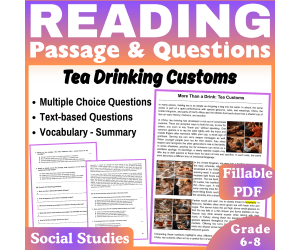
Tea Customs: Social Studies Reading Passage (Fillable PDF)
ELA, Reading, Reading Comprehension, Strategies, Resources for Teachers, Social Studies, Sociology, Grade 6, 7, 8, 9, Writing Prompts, Worksheets & Printables, Centers, Activities, Teacher Tools, Assessments, Quizzes and Tests, Quizzes, Tests
Tea Customs: Social Studies Reading Comprehension Passage (Fillable PDF) This resource introduces a unique Social Studies reading comprehension passage with questions about Tea Drinking Customs The passage is carefully designed to bridge the gap between social studies and literacy through strengthening reading comprehension and sparking knowledge curiosity in middle school students. Each passage blends English Language Arts skills with accurate social studies content . Ideal for interdisciplinary learning in ELA and Social Studies. Suitable for Grade 9 review, too! These worksheets are designed as fillable PDFs , which means students can type their answers directly into the document on any computer or tablet . Each page includes highlighted text fields that show them exactly where to type! Student Tasks throughout the passage: 5 multiple-choice questions targeting the following skills: main idea, key details, inference, vocabulary in context, and use of evidence 5 vocabulary matching items with clear, student-friendly definitions 5 text-based questions that require citing specific lines or facts 1 summary prompt that asks students to condense central ideas accurately Full answer key for every section Available Formats for this Resource: PDF Word Docs Google Docs FULL CATALOG OF DOWNLOADING LINKS HERE Social Studies Reading Comprehension Collection Links: 1. Ancient Civilizations PDF Fillable PDF Word Docs Google Docs 2. Early Empires and Trade Networks PDF Fillable PDF Word Docs Google Docs 3. The Founding of the United States PDF Fillable PDF Word Docs Google Docs 4. Language, Culture, and Meaning PDF Fillable PDF Word Docs Google Docs 5. Psychology and Society PDF Fillable PDF Word Docs Google Docs 6. Global Festivals and Traditions PDF Fillable PDF Word Docs Google Docs 7. Extreme Environments and People PDF Fillable PDF Word Docs Google Docs 8. Food, Culture, and Preservation PDF Fillable PDF Word Docs Google Docs 9. Global Food Customs PDF Fillable PDF Word Docs Google Docs 10. Media, Communication, and Popular Culture PDF Fillable PDF Word Docs Google Docs 11. Human Impact on the Environment PDF Fillable PDF Word Docs Google Docs 12. Civic Action and Social Change PDF Fillable PDF Word Docs Google Docs 13. Fashion, Society, and Power PDF Fillable PDF Word Docs Google Docs 14. People, Places, and Unusual Histories PDF Fillable PDF Word Docs Google Docs Product Details: Length: 4 pages Grades: 6–8, also suitable for Grade 9 review Use cases: close reading, stations, homework, intervention, test prep, and sub plans Why Teachers Choose This Passage: Authentic social studies content paired with rigorous literacy practice Consistent task structure for easier planning and smoother student routines Clear, age-appropriate writing that builds confidence without oversimplifying Use this passage to reinforce ELA skills in social studies, to add literacy to your lessons, and to support independent work. The passage strengthens main idea, evidence use, vocabulary in context, inference, cause and effect, and summary writing. With ready-to-use assessments and complete answer keys, you can provide focused practice that is simple to run and fast to review.
Author Middle & High School - CORED Education
Rating
Tags Middle School, Reading Comprehension, Reading Strategies, ELA, Centers, Reading Passage, Assessments, Vocabulary, Social Studies, Sociology

Cellular Hydration & Electrolyte Balances
Math, Money, Measurements, Science, Physics, Life Sciences, Biology, Human Body, Statistics, Percentages, Grade 6, 7, 8, 9, 10, 11, 12, Worksheets & Printables, Workbooks, Worksheets, Word Searches, Teacher Tools, Quizzes and Tests, Quizzes, Tests, Assessments, Lesson Plans
Transform your math and science classroom into a high-stakes sports science lab! Ever have students ask, "When will I ever use this in real life?" This comprehensive, cross-curricular unit is the definitive answer, bridging the gap between abstract mathematical concepts and the tangible, high-interest world of athletic performance. This no-prep resource, "The Mathematics of Athletic Recovery," challenges students to step into the role of a sports scientist. They will learn the critical biology behind hydration and electrolyte balance and then apply mathematical skills to solve real-world problems for student-athletes. This isn't just another worksheet; it's a deep dive into the practical application of math and science. WHAT'S INCLUDED (45 Pages): Phase 1: The Foundational Text (11 pages): An engaging, textbook-style introduction to the science of sweat, electrolytes (Sodium, Potassium, Magnesium), and the dangers of improper hydration. It introduces the core formulas and the "Golden Ratio" of recovery. Phase 2: Student Workbook (21 pages): Ten progressively challenging math worksheets that guide students from basic conversions to complex, multi-step word problems. Students will calculate sweat rates, electrolyte deficits, replenishment ratios, and formulate custom recovery plans for various athletes and scenarios. Phase 3: Visuals & Teacher Resources (13 pages): High-Quality Visual Aids: Three professional SVG diagrams perfect for projection or as anchor charts, illustrating electrolyte depletion, the 40:8:1 recovery ratio, and the Sodium-Potassium pump. Comprehensive Answer Key: Complete solutions for all 10 worksheets. Full Teacher Implementation Guide: Includes core objectives, a suggested 3-day pacing guide, discussion points, differentiation strategies (for scaffolding and rigor), and guidance on addressing common student misconceptions. KEY MATH & SCIENCE CONCEPTS COVERED: Mathematics: Ratios, Proportions, Unit Conversions (Metric & Customary), Percentages, Multi-step Word Problems, Basic Algebra, Data Analysis. Health & Science: Cellular Hydration, Homeostasis, Osmosis, Key Electrolytes (Na+, K+, Mg2+), Muscular Function, and the science of athletic recovery. PERFECT FOR: Middle School Math Classes (Grades 7-9) High School Health, Biology, or Physical Education Classes Applied Mathematics Courses Homeschooling Curriculum Engaging Project for Student-Athletes Emergency Sub Plans Empower your students to see math and science in action! This unit not only builds critical thinking and calculation skills but also teaches valuable lessons about health and physiology. Download now and show your students how math powers champions! Why Parents/Schools Love It: Real-World Application: It directly answers the age-old student question, "Why do we need to learn this?" by connecting math to the high-interest topic of sports, making learning relevant and memorable. Promotes Critical Thinking: Instead of simple plug-and-chug problems, this unit requires students to analyze complex scenarios, select the correct formulas, and execute multi-step calculations, just like a real scientist. Truly Cross-Curricular: It seamlessly integrates core Math standards with essential Health and Life Science concepts (biology, physiology), reinforcing learning across multiple subjects. Comprehensive and Teacher-Friendly: This is a complete, "no-prep" unit. With a detailed lesson, 10 worksheets, professional visuals, an answer key, and a full implementation guide, it saves teachers valuable planning time. Engages All Learners: The theme of athletic performance is highly motivating for student-athletes and sports fans, providing a powerful hook to capture the interest of students who might otherwise be disengaged from math. Target Student Classes : Based on the content and the explicit mention in the Teacher's Guide, target: Primary Target: Middle School (Grades 7, 8, and 9) . The mathematical concepts (ratios, percentages, multi-step problems) are a perfect fit for the 8th-grade curriculum and are excellent for enrichment in 7th grade or review in 9th grade. Secondary Target: High School (Grades 9-11) . This resource is exceptionally well-suited for: General or Applied Math courses. Biology classes studying homeostasis and cellular transport. Health and Physical Education (PE) classes. Introductory Sports Medicine or Kinesiology electives. Copyright/Terms of Use: This Book was copyrighted by Syed Hammad Rizvi. This resource is for personal and single classroom use only. You may not alter, redistribute, or sell any part of this resource. In other words, you may not put it on the Internet where it could be publicly found and downloaded. If you want to share this resource with colleagues, please purchase additional licenses from Teachsimple. Thank you for respecting these terms of use. This product is happily brought to you by Syed Hammad Rizvi
Author Creative Book Store
Rating
Tags Math, Science, Health, Biology, STEM, STEAM, PhysicalEducation, RealWorldMath, AppliedMath, SportsScience
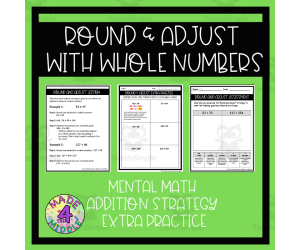
Round & Adjust Whole Number Addition Strategy Extra Practice
Math, Addition and Subtraction, Addition, Grade 3, 4, 5, 6, 7, Teacher Tools, Assessments, Worksheets & Printables, Worksheets
Seeking diverse methods for students to enhance their mental math prowess beyond just Number Talks? Dive into this Round & Adjust Whole Number Addition Strategy Extra Practice resource which offers a detailed lesson tutorial that can double up as student notes. Additionally, it provides an extra practice homework sheet accompanied by an illustrative example and its answer key. For evaluation, there's an assessment complete with a rubric and an answer key dedicated to the "Round & Adjust" mental math addition technique. With these Round & Adjust Whole Number Addition Strategy Extra Practice ready-to-use tools, mastering the "Round & Adjust" strategy becomes seamless, fostering more adaptive thinking during Number Talks. This saves you precious time, allowing you to focus on myriad other tasks at hand! This Round & Adjust Whole Number Addition Strategy Extra Practice resource includes: My rationale and how I use this product in my classroom. “Round & Adjust” written lesson with examples. This could be used as a class lesson, or as students notes. “Round & Adjust” Extra Practice Worksheet with an example and Answer Key. Comes with a question and it’s solution, along with 5 other practice questions. Great for a homework assignment. Answer Key Included. “Round & Adjust” 2 question Assessment Page with a Rubric and Answer Key. Other Addition Strategies with Whole Number Extra Practice Resources: Round & Adjust Take & Give Start From the Left Break One Addend Apart Add Up Check out my other “Break One Addend Apart" resources: Mental Math Mystery Picture Reveal “Round & Adjust" Addition Strategy Spin To Win - Round & Adjust Whole Number Addition Mental Math Game
Author Made 4 The Middle
Tags Number Talks, Mental Math, Math, Addition, Notes, Homework, Assessment, Basic Operations, No Prep, Worksheets
Prefixes and Suffixes Grammar Practice MCQs | 8 Lessons, 120 Questions
ELA, Language Development, ESL, Grammar, Common Core, Resources for Teachers, Grade 1, 2, Worksheets & Printables, Worksheets, Assessments, Teacher Tools, Tests, Quizzes and Tests, Centers, Activities
Prefixes and Suffixes Grammar Practice MCQs | 8 Lessons, 120 Questions ELA MCQs Overview In this series of lessons, students will embark on an engaging exploration of the grammar skills that bring language to life. These lessons are designed to help students identify, understand, and effectively use prefixes and suffixes in their writing and speech. Across 8 structured lessons , students will develop their understanding through clear examples, review activities, and multiple-choice practice. The resource includes 120 MCQs across 35 pages , making it ideal for whole-class instruction, independent work, homework, revision, or assessment. Prefixes and Suffixes Overview Topics include: Intro to Prefixes Intro to Suffixes Forming Suffixes Determining Affix Word Meaning Each lesson builds on previous learning, helping students recognize affixes, understand how they change words, and determine the meaning of unfamiliar words using prefixes and suffixes. Docs Version This is the editable and fillable Google Docs version , allowing students to complete the activities digitally and teachers to adapt the material to suit their classroom needs. ELA Review Questions Overview Each multiple-choice question includes three answer choices . A selection of pictures is included for visual interest, along with a review sheet covering most of the prefixes and suffixes topics explored throughout the resource. Browse the Complete Cored Catalog — 2,000+ Resources Included Introduction or Example Sheets Each topic includes an introduction or example sheet that can be reviewed with students before they begin the questions. These pages provide clear guidance and help establish the key grammar concepts needed for successful independent practice. Full Answer Keys Full answer keys and sample responses are provided, saving valuable preparation and marking time while making it easy to review answers with students. Free Supplementary Materials Free supplementary materials are available to support the lessons with additional activities, including: Interactive Ice Breakers: Engaging tasks that introduce prefixes and suffixes and activate prior knowledge. Guided Practice: Teacher-led exercises that reinforce each lesson’s key concepts. Group and Partner Tasks: Collaborative activities focused on building words, identifying affixes, and exploring word meanings. Independent Worksheets: Structured practice that helps students strengthen their understanding of prefixes and suffixes. Exit Tasks: Quick activities that assess understanding and encourage students to apply what they have learned. For similar downloads and additional free resources, explore Cored Education on Teach Simple.
Author Cored Education
Rating
Tags Elementary, Reading, Comprehension, Vocabulary, Answers, Ccss, Common Core, Spelling, Writing, Digital Centers
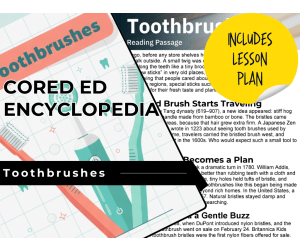
Toothbrushes Reading Comprehension Passage - Cored Ed Encyclopedia
ELA, Language Development, Reading Comprehension, Reading, Science, Technology, Engineering, History, Social Studies, Life Sciences, Grade 2, 3, 4, 5, Worksheets & Printables, Worksheets, Teacher Tools, Centers, Activities, Writing Prompts, Assessments, Quizzes and Tests, Quizzes, Lesson Plans
This toothbrushes reading comprehension includes: Visualization (on the front cover) Start your lesson by taking a minute to think and share something about the topic. Read the script aloud (slowly), perhaps prepare some music or sound effects. Student close their eyes and let their imaginations wander. Students open their eyes, read the question aloud and give them a few minutes to complete. Ask a few students to share or keep answers until the end to compare with what they learn in the passage. Quick pause—thousands of Cored Education products are included with your TeachSimple membership. Download links and encyclopedia index available here. Pre-Reading Trivia Students will write down one thing they already know about the subject and then read five more facts and discuss. These facts are fun, and the students will enjoy learning about the subject before reading more. Give 1 minute for students to write what they already know (no pressure—best guess is fine). Read the five facts together. After each fact, do ask a student for their opinion, was it surprising? Set a purpose by asking students to highlight/underline one fact they want to learn more about during the reading. Reading Passage The text is a high-interest reading passage with set paragraphs, roughly three to four paragraphs long. It contains a variety of themes about the topic, anywhere from history to technology. The passage is between 250 and 350 words in length. First, ask students to look at the headings and see what they’ll learn about today. What do they know about the topic/heading? First read options: Teacher read-aloud (best for support). Partner reading (paragraph by paragraph). While reading, students underline important details, and vocabulary words they think may come up in the questions section. Mixed Questions The first question page contains four multiple-choice questions, each with a choice of four answers, and three written response questions that require a sentence or two from the student. Students complete the mcqs first independently, then review quickly as a class. For the 3 written responses, try to get students giving the answer with some form of evidence: “I think ___ because the text says ___.” If students get stuck, send them back to check the passage. Vocabulary Questions Practice seven key words from the text in this section across two activities. First section is scrambled words where students will unscramble three words given a clue for each. The second section is a word to meaning matching activity. Before starting, have some students read out words they underlined in the passage. Ask students to say the word and read aloud the sentence(s) around each word. Ask students to do scrambled words and the matching exercise in pairs then go through answers as a class. For the scrambled spelling task, get four pairs to come up to the board and write the words for extra practice with the other student reading out the clue. For the matching task, prompt students to give full sentences: “I matched ___ with ___ because ___.” Creative Writing In this question, the student will be required to write a five to eight sentence paragraph on a question related to the topic. Before starting, ask students write down 3 key ideas they are going to include in their piece. Ask students for ideas to share around the class to help those struggling. Pro writing expectations: 5–8 sentences At least 2 facts or details from the passage At least 2 vocabulary words from the previous page Students read their paragraphs while classmates listen for facts and vocabulary words. Extension Activities This page is optional for fast finishers or to take home. There are several activities, each one requiring a different skill. Do some, do none, do all, completely optional - but you will feel reassured knowing every possibility is planned for. Includes summary writting question. Answer Key There are answers for the multiple-choice questions, written response questions have sample answers, vocabulary answers and if there is a summary question then a sample summary will be provided as well. Lesson Plan Included Customized lesson plan for this lesson is included. Lesson Snapshot Title: Toothbrushes Genre: Nonfiction (informational text) Subject: Science (Health & Technology) Primary Topic: How toothbrushes changed over time Estimated Guided Reading Level (A–Z): R What This Lesson Teaches Best Explains how people cleaned teeth before store-bought toothbrushes by chewing a twig until it turned “fuzzy” and rubbing it on teeth. Shows how evidence from the past (archaeologists finding signs in places like Mesopotamia and Egypt) can tell us about tooth care long ago. Traces the history of the bristled brush from China’s Tang dynasty to Europe in the 1600s, highlighting how inventions travel. Describes how toothbrush designs changed to solve problems (for example, natural bristles staying damp and trapping bacteria). Summarizes key innovations—nylon bristles (1938) and the electric toothbrush (1954)—and connects them to the ongoing goal of protecting teeth. Learning Goals Students will describe how a “chew stick” was used to clean teeth long ago. Students will identify evidence in the text that people cared about clean mouths thousands of years ago. Students will explain how the bristled brush began in China and later spread to Europe. Students will summarize how toothbrush-making changed after 1780 using details about materials and design. Students will explain why inventors searched for new bristle materials and what nylon changed. Students will describe how an electric toothbrush helped brushing by adding steady motion. Key Vocabulary From the Text archaeologists — scientists who study the past using old remains. Mesopotamia — an ancient region where people lived long ago. miswak — a special stick used for cleaning teeth. patent — legal rights that protect an invention. bacteria — tiny germs that can cause problems. FULL CATALOG OF DOWNLOAD LINKS AND ENCYCLOPEDIA INDEX HERE
Author Cored Education
Rating
Tags Vocabulary, Reading Comprehension, Reading Passages, Lesson Plans, Ela Lesson Plans, Reading Comprehension Lesson Plans, Pre-reading, History, History Lesson Plans, Toothbrushes

Physical Science SAMPLE Reading Passage: Electricity (FILLABLE PDF)
Science, ELA, Reading, Reading Comprehension, Strategies, Resources for Teachers, Physics, Grade 6, 7, 8, 9, Writing Prompts, Worksheets & Printables, Centers, Activities, Teacher Tools, Assessments, Quizzes and Tests, Quizzes, Tests
This is a ONE PASSAGE SAMPLE. The following is the description of the FULL resource and the downloading links: Electricity and Energy: Physical Science Reading Comprehension Passages and Questions (PDF) This very engaging and fillable collection of physical science reading passages about electricity and energy is designed to bridge the gap between science and literacy through strengthening reading comprehension and sparking scientific curiosity in middle school students. Each passage blends English Language Arts skills with accurate science content that supports NGSS classroom practice. Ideal for interdisciplinary learning in ELA and Science. Suitable for Grade 9 review, too! These worksheets are designed as fillable PDFs , which means students can type their answers directly into the document on any computer or tablet . Each page includes highlighted text fields that show them exactly where to type! What Is Included? There are (3) informational passages: The Lightning Rod: Turning Fear into Safety Eel Power: A Holiday Surprise Electricity: From Source to Socket Student Tasks for Each Passage: 5 multiple-choice questions targeting main idea, key details, inference, vocabulary in context, and use of evidence 5 vocabulary matching items with clear, student-friendly definitions 5 text-based questions that require citing specific lines or facts 1 summary prompt that asks students to condense central ideas accurately Full answer key for every section Available Formats for this Resource Word Docs Google Docs FULL CATALOG OF DOWNLOADING LINKS HERE Other Science Reading Collections and Topics You May Find in the Store: 1. Astronomy & Space Science 2. Volcanoes, Rocks, & Mountains 3. Rock Cycle, Soil, & Sinkholes 4. Mars, Glaciers, & Antarctica 5. Water Cycle, Acid Rain, & Wastewater 6. Insects, Animals, & Ecosystems 7. Bioluminescence & Insects 8. Animal Skin, Cats, & T. Rex 9. Human Body and Senses 10. Health & Applied Bioscience 11. Waves, Light, & Imaging 12. Electricity & Energy 13. Motion & Materials 14. Chemistry and Materials Science 15. Electromagnetism 16. Acids and Bases 17. Gas Laws 18. Biotechnology 19. Periodic Trends 20. Protists and Fungi 21. Microevolution 22. Blood 23. Chemical Bonding 24. Magnets 25. Muscles 26. Nuclear Chemistry 27. Electromagnetic Devices 28. Epigenetics 29. The Law of Conservation of Mass 30. Atomic Models 31. Isotopes and Ions 32. Light 33. Human-Environment Interaction 34. Theory of Evolution 35. Photosynthesis 36. Origins of Life and Early Earth 37. Gene Expression and Regulation 38. Thermochemistry 39. Allergies 40. Coevolution 41. Birth to Adulthood 42. Cells 43. Entropy and Free Energy 44. The Human Brain 45. Mixtures and Solutions 46. Invertebrates 47. Zoo Animals 48. Biochemistry 49. Animal Behavior 50. Population Ecology ...and many more engaging science reading passages that cover intriguing and important topics designed to spark curiosity and support student learning. How to Use These PDFs Click on the highlighted area to start typing your answer. Move to the next question by clicking in the next highlighted box. When you are finished, close the document and select SAVE so your answers stay recorded. If you want to keep a blank copy for later, choose Save As and give your completed version a new name. Product Details Length: 14 pages total Grades: 6–8, also suitable for Grade 9 review Use cases: close reading, stations, homework, intervention, test prep, and sub plans Standards support: reinforces informational-text skills and supports NGSS-style sense making through observation, modeling, and clear use of claim, evidence, and reasoning Why Teachers Choose This Set Authentic science content paired with rigorous literacy practice Consistent task structure across all passages for easier planning and smoother student routines Clear, age-appropriate writing that builds confidence without oversimplifying Use this set to reinforce ELA skills in science, to add literacy to your lessons, or to support independent work. The passages strengthen main idea, evidence use, vocabulary in context, inference, cause and effect, and summary writing. With ready-to-use assessments and complete answer keys, you can provide focused practice that is simple to run and fast to review.
Author Middle & High School - CORED Education
Rating
Tags Middle School, Reading Comprehension, Reading Strategies, ELA, Centers, Reading Passage, Assessments, Vocabulary, Physical Science, Physics
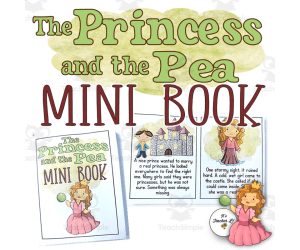
The Princess and the Pea Fairy Tale Foldable Mini Book Grade 1 2 3 ELA
ESL, Language Development, ELA, Children’s Literature, Literature, Reading Comprehension, Reading, Handwriting, Writing, Grade 1, 2, 3, Centers, Activities, Crafts, Projects, Assessments, Teacher Tools, Graphic Organizers
Develop the necessary literacy skills of your young learners through this purposefully made The Princess and the PeaMini Book Pack. Created for Grades 1, 2 and 3 students, homeschoolers, and EFL/ESL learners, this resource is designed for reading classes, reading centers, reading comprehension exercises, writing practice, fine motor skills exercises, fairy tale units, supplemental assessment tool, morning work, early finisher additional activities, and so much more! What’s Included: •The Princess and the PeaStory Mini Book– for story retelling, reading and reading comprehension practice •The Princess and the PeaStory Mini BookTrace & Read Pages– handwriting practice and motor skills exercise •The Princess and the PeaMini BookSequencing Booklet– sequencing and sorting exercise, story retelling and reading practice •The Princess and the PeaMini BookRetell & Reflect Pages– retell practice, creativity and imagination development •The Princess and the PeaMini BookBlank Create-a-Story Templates– story telling, supporting creative and imaginative thinking skills •The Princess and the PeaMini BookTeacher Guide + Sample Lesson Plan
Author It's Teacher L
Rating
Tags The Princess And The Pea, Reading Comprehension, ELA Project, Reading Centers

Golf Reading Comprehension Passage - Cored Ed Encyclopedia
ELA, Language Development, Resources for Teachers, Reading Comprehension, Reading, Pre-Reading, Writing, Strategies, Sports, P.E. & Health, Grade 2, 3, 4, 5, Worksheets & Printables, Worksheets, Teacher Tools, Centers, Activities, Writing Prompts, Assessments, Tests, Quizzes and Tests, Quizzes
This golf reading comprehension contains the following: Pre-Reading Trivia Students will write down one thing they already know about the subject and then read five more facts and discuss. These facts are fun, and the students will enjoy learning about the subject before reading more. Reading Passage The text is a high-interest reading passage with set paragraphs, roughly three to four paragraphs long. It contains a variety of themes about the topic, anywhere from history to technology. The passage is between 250 and 350 words in length. Mixed Questions The first question page contains four multiple-choice questions, each with a choice of four answers, and three written response questions that require a sentence or two from the student. Creative Writing In this question, the student will be required to write a five to eight sentence paragraph on a question related to the topic. Extension Activities This page is optional for fast finishers. If there are five to ten minutes left at the end of the lesson, the student can choose one of three activities, each one requiring a different skill. Answer Key There are answers for the multiple-choice questions and three written response questions have sample answers. FULL CATALOG OF DOWNLOAD LINKS AND ENCYCLOPEDIA INDEX HERE Cored Ed Encyclopedia Overview The Cored Ed Encyclopedia is a weekly series of lessons that you can pick up and use right away. These short readings fit into whatever time you have available. Each one includes a warm-up, a reading, and a set of questions, but it’s flexible — you can do just the reading, the full lesson, or skip the writing section if you need to. Each lesson focuses on a single topic so students don’t get lost. The writing is clear but never childish, making it perfect for grades two through five. Topics range from animals and science to history, inventions, and everyday things. No matter the level of the student, everyone should take away at least one new idea or fact from each lesson. The materials are easy to print, easy to explain, and require no setup. They work well for whole-class teaching, partner work, or independent study.
Author Cored Education
Rating
Tags Vocabulary, Spelling, Reading Comprehension, Reading Passages, Cored Encyclopedia, Facts, Reading, Creative Writing, Sports, Golf
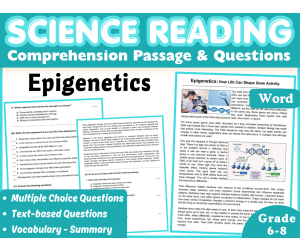
Epigenetics: Middle School Life Science Reading Comprehension (Word)
Science, ELA, Reading, Reading Comprehension, Strategies, Resources for Teachers, Common Core, Language Development, Life Sciences, Biology, Grade 6, 7, 8, 9, 10, Writing Prompts, Worksheets & Printables, Centers, Activities, Teacher Tools, Assessments, Quizzes and Tests, Quizzes, Tests, Literacy Readers
Life Science Reading Comprehension Passage and Questions for Middle School: Epigenetics (Word Document) The engaging passage is about how gene activity can change without changing the DNA sequence itself . It explains how chemical tags, including methyl groups, can affect whether genes are more or less active, and how factors such as diet, stress, exercise, sleep, pollution, and life experiences may influence epigenetic patterns. It also covers identical twins and differences in gene activity over time, possible epigenetic effects across generations, links between epigenetics and disease, and possible uses in personalized medicine. This passage is designed to bridge the gap between science and literacy by strengthening reading comprehension while sparking scientific curiosity in middle school students. It blends English Language Arts skills with accurate science content, helping students build background knowledge, understand key concepts, use evidence from the text, and explain scientific ideas clearly. This resource supports science classroom practice while also reinforcing important literacy skills such as main idea, vocabulary, comprehension, and summarizing. Ideal for interdisciplinary learning in ELA and Science. Suitable for Grade 9 review, too! Student Tasks for The Passage: 10 multiple-choice questions targeting main idea, key details, science concepts, comparison, and real-world applications 10 True/False statements to check understanding and address common misconceptions 5 text-based short-answer questions that require students to explain important ideas from the passage 5 vocabulary matching items with clear, student-friendly definitions 1 summary prompt that asks students to condense the central ideas accurately Full answer key for every section Available Formats for this Resource PDF Fillable PDF Google Docs Product Details Length: 7 pages total Grades: 6–8, also suitable for Grade 9 review Use cases: close reading, stations, homework, intervention, test prep, and sub plans Standards support: Reinforces informational-text skills and supports NGSS-style sense-making by helping students read scientific explanations, connect evidence to key concepts, interpret real-world examples, and explain cause-and-effect relationships in science. FULL CATALOG OF DOWNLOADING LINKS HERE Other Science Reading Collections and Topics You May Find in the Store: 1. Astronomy & Space Science 2. Volcanoes, Rocks, & Mountains 3. Rock Cycle, Soil, & Sinkholes 4. Mars, Glaciers, & Antarctica 5. Water Cycle, Acid Rain, & Wastewater 6. Insects, Animals, & Ecosystems 7. Bioluminescence & Insects 8. Animal Skin, Cats, & T. Rex 9. Human Body and Senses 10. Health & Applied Bioscience 11. Waves, Light, & Imaging 12. Electricity & Energy 13. Motion & Materials 14. Chemistry and Materials Science 15. Electromagnetism 16. Acids and Bases 17. Gas Laws 18. Biotechnology 19. Periodic Trends 20. Protists and Fungi 21. Microevolution 22. Blood 23. Chemical Bonding 24. Magnets 25. Muscles 26. Nuclear Chemistry 27. Electromagnetic Devices 28. Epigenetics 29. The Law of Conservation of Mass 30. Atomic Models 31. Isotopes and Ions 32. Light 33. Human-Environment Interaction 34. Theory of Evolution 35. Photosynthesis 36. Origins of Life and Early Earth 37. Gene Expression and Regulation 38. Thermochemistry 39. Allergies 40. Coevolution 41. Birth to Adulthood 42. Cells 43. Entropy and Free Energy 44. The Human Brain 45. Mixtures and Solutions 46. Invertebrates 47. Zoo Animals 48. Biochemistry 49. Animal Behavior 50. Population Ecology ...and many more engaging science reading passages that cover intriguing and important topics designed to spark curiosity and support student learning. Use this passage to reinforce ELA skills in science, to add literacy to your lessons, and to support independent work. The passages strengthen main idea, evidence use, vocabulary in context, inference, cause and effect, and summary writing. With ready-to-use assessments and complete answer keys, you can provide focused practice that is simple to run and fast to review.
Author Middle & High School - CORED Education
Rating
Tags Middle School, Reading Comprehension, Reading Strategies, ELA, Centers, Reading Passage, Assessments, Vocabulary, Life Science, Biology
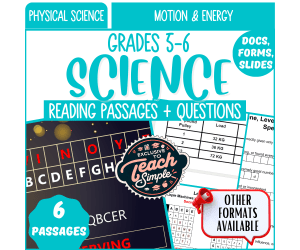
Science Reading Comprehension on Motion and Energy (Google Drive)
ELA, Reading, Common Core, ESL, Language Development, Vocabulary, Resources for Teachers, Physics, Science, Grade 5, 6, 7, Presentations, Teacher Tools, Quizzes and Tests, Tests, Assessments, Worksheets, Worksheets & Printables, Centers, Activities
Reading Comprehension on Motion and Energy for Physical Science Motion and Energy: Reading Passages Physical Science Optimized for Grades 5-6, this science reading bundle offers a streamlined approach to assigning, evaluating, and reviewing reading assignments. Complete with detailed answer keys, abundant illustrations to clarify complex subjects, and engaging topics, it provides a comprehensive yet enjoyable learning experience. Don't miss out on this science reading comprehension toolkit – explore its potential in your classroom today! What's inside this Google Drive product? Part 2 - Motion & Energy Reading Passage 1: Kinetic & Potential Energy Reading Passage 2: Force & Motion Reading Passage 3: Simple Machines Reading Passage 4: Simple Machines 2 Reading Passage 5: Thermal Energy Reading Passage 6: Sound & Light Energy Product Info: 37 PAGES (Docs Version: US English with Answers) 6 FORMS (Self-Grading) 258 Slides (With fillable boxes included) Teaching Duration: 2 Weeks Science Reading Comprehension Outline: Introducing a comprehensive resource tailored for 5th and 6th graders, this product offers enriching reading passages supplemented with illustrative pictures and graphs to clarify key concepts. Aligned with the Common Core State Standards (CCSS), it offers a hassle-free approach to teaching, given that the bulk of the preparation is already done for you. The passages present a diverse set of questions – from multiple choice to data analysis and fill-in-the-blanks. This ensures a rich blend of high-interest content and fundamental curriculum -based science themes. With its versatility, you can seamlessly integrate these lessons into various classroom settings, whether it's whole class discussions, morning exercises, independent desk tasks, small group engagements, contingency plans for substitute teachers, regular homework assignments, or even themed activities for holidays. FULL CATALOG OF DOWNLOAD LINKS HERE Grade 5/6 Links: Physical Science Part 1 - Physical and Chemical Properties Google Docs/Slides/Forms PDF PPT Word Free Supplementary Pack Accompanying Videos Physical Science Part 2 - Motion and Energy Google Docs/Slides/Forms PDF PPT Word Free Supplementary Pack Accompanying Videos Physical Science Part 3 - Electricity and Magnets Google Docs/Slides/Forms PDF PPT Word Free Supplementary Pack Accompanying Videos Life Science Part 1 - Cells, Reproduction and Genetics Google Docs/Slides/Forms PDF PPT Word Free Supplementary Pack Accompanying Videos Life Science Part 2 - Human Body Systems Google Docs/Slides/Forms PDF PPT Word Free Supplementary Pack Accompanying Videos Life Science Part 3 - Plant Parts and Ecosystems Google Docs/Slides/Forms PDF PPT Word Free Supplementary Pack Accompanying Videos Earth Science Part 1 - Plate Tectonics and Rock Cycle Google Docs/Slides/Forms PDF PPT Word Free Supplementary Pack Accompanying Videos Earth Science Part 2 - Ocean Exploration and Natural Resources Google Docs/Slides/Forms PDF PPT Word Free Supplementary Pack Accompanying Videos Earth Science Part 3 - Weather and Solar System Google Docs/Slides/Forms PDF PPT Word Free Supplementary Pack Accompanying Videos For similar products and other frees, do check out Cored Group on TeachSimple .
Author Cored Education
Rating
Tags Science, Elementary, Reading, Comprehension, Vocabulary, Answers, Physics, Physical Science, Ccss, Common Core

Life Science Reading Passage: Muscular System (Fillable PDF)
Science, ELA, Reading, Reading Comprehension, Strategies, Resources for Teachers, Life Sciences, Biology, Human Body, Grade 6, 7, 8, 9, 10, Writing Prompts, Worksheets & Printables, Centers, Activities, Teacher Tools, Assessments, Quizzes and Tests, Quizzes, Tests
Life Science Reading Comprehension Passage and Questions: Muscular System (Fillable PDF) This very engaging science reading passage is about the muscular system and how different types of muscles help the body move and function . It explains how skeletal muscles move bones, how smooth muscles work automatically inside organs and blood vessels, and how cardiac muscle pumps blood through the body. Students also learn how muscles work in pairs, how the nervous system sends signals that control contraction, and why exercise, protein, and rest are important for muscle strength and recovery. This passage is designed to bridge the gap between science and literacy by strengthening reading comprehension while sparking scientific curiosity in middle school students. It blends English Language Arts skills with accurate science content, helping students build background knowledge, understand key concepts, use evidence from the text, and explain scientific ideas clearly. This resource supports science classroom practice while also reinforcing important literacy skills such as main idea, vocabulary, comprehension, and summarizing. Ideal for interdisciplinary learning in ELA and Science. Suitable for Grade 9 review, too! Student Tasks for The Passage: 10 multiple-choice questions targeting main idea, key details, science concepts, comparison, and real-world applications 10 True/False statements to check understanding and address common misconceptions 5 text-based short-answer questions that require students to explain important ideas from the passage 5 vocabulary matching items with clear, student-friendly definitions 1 summary prompt that asks students to condense the central ideas accurately Full answer key for every section This passage is designed as a fillable PDF , which means students can type their answers directly into the document on any computer or tablet . Each page includes highlighted text fields that show them exactly where to type! Available Formats for this Resource PDF Word Docs Google Docs FULL CATALOG OF DOWNLOADING LINKS HERE Product Details Length: 7 pages total Grades: 6–8, also suitable for Grade 9 review Use cases: close reading, stations, homework, intervention, test prep, and sub plans Standards support: Reinforces informational-text skills and supports NGSS-style sense-making by helping students read scientific explanations, connect evidence to key concepts, interpret real-world examples, and explain cause-and-effect relationships in science. Why Teachers Choose This Set Authentic science content paired with rigorous literacy practice Consistent task structure across all passages for easier planning and smoother student routines Clear, age-appropriate writing that builds confidence without oversimplifying Other Science Reading Collections and Topics You May Find in the Store: 1. Astronomy & Space Science 2. Volcanoes, Rocks, & Mountains 3. Rock Cycle, Soil, & Sinkholes 4. Mars, Glaciers, & Antarctica 5. Water Cycle, Acid Rain, & Wastewater 6. Insects, Animals, & Ecosystems 7. Bioluminescence & Insects 8. Animal Skin, Cats, & T. Rex 9. Human Body and Senses 10. Health & Applied Bioscience 11. Waves, Light, & Imaging 12. Electricity & Energy 13. Motion & Materials 14. Chemistry and Materials Science 15. Electromagnetism 16. Acids and Bases 17. Gas Laws 18. Biotechnology 19. Periodic Trends 20. Protists and Fungi 21. Microevolution 22. Blood 23. Chemical Bonding 24. Magnets 25. Muscles 26. Nuclear Chemistry 27. Electromagnetic Devices 28. Epigenetics 29. The Law of Conservation of Mass 30. Atomic Models 31. Isotopes and Ions 32. Light 33. Human-Environment Interaction 34. Theory of Evolution 35. Photosynthesis 36. Origins of Life and Early Earth 37. Gene Expression and Regulation 38. Thermochemistry 39. Allergies 40. Coevolution 41. Birth to Adulthood 42. Cells 43. Entropy and Free Energy 44. The Human Brain 45. Mixtures and Solutions 46. Invertebrates 47. Zoo Animals 48. Biochemistry 49. Animal Behavior 50. Population Ecology ...and many more engaging science reading passages that cover intriguing and important topics designed to spark curiosity and support student learning. Use this passage to reinforce ELA skills in science, to add literacy to your lessons, and to support independent work. The passages strengthen main idea, evidence use, vocabulary in context, inference, cause and effect, and summary writing. With ready-to-use assessments and complete answer keys, you can provide focused practice that is simple to run and fast to review.
Author Middle & High School - CORED Education
Rating
Tags Middle School, Reading Comprehension, Reading Strategies, ELA, Centers, Reading Passage, Assessments, Vocabulary, Muscular System, Life Science
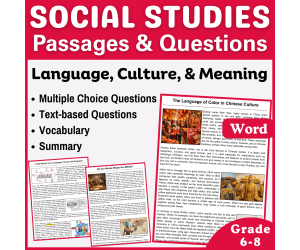
Social Studies Reading Passages: Language, Culture, Meaning (Word)
ELA, Reading, Reading Comprehension, Strategies, Resources for Teachers, Social Studies, Geography, Sociology, Grade 6, 7, 8, 9, Writing Prompts, Worksheets & Printables, Centers, Activities, Teacher Tools, Assessments, Quizzes and Tests, Quizzes, Tests
Social Studies Reading Comprehension Passages: Language, Culture, Meaning (Word) This resource introduces a collection of Social Studies reading comprehension passages about Language, Culture, and Meaning. The passages are carefully designed to bridge the gap between social studies and literacy through strengthening reading comprehension and sparking knowledge curiosity in middle school students. Each passage blends English Language Arts skills with accurate social studies content. Ideal for interdisciplinary learning in ELA and Social Studies. Suitable for Grade 9 review, too! What Is Included in this Collection? There are three informational passages (with full answer keys): Living Words: How Languages Change and Disappear The Language of Color in Chinese Culture Do Our Words Shape Our Minds For Each Passage, students will have multiple tasks to complete as follow: 5 multiple-choice questions targeting main idea, key details, inference, vocabulary in context, and use of evidence 5 vocabulary matching items with clear, student-friendly definitions 5 text-based questions that require citing specific lines or facts 1 summary prompt that asks students to condense central ideas accurately Available Formats for this Resource Fillable PDF Word Docs Google Docs FULL CATALOG OF DOWNLOADING LINKS HERE For more Social Studies Reading Passages, check the following Links: Ancient Civilizations PDF Fillable PDF Word Docs Google Docs Early Empires and Trade Networks PDF Fillable PDF Word Docs Google Docs The Founding of the United States PDF Fillable PDF Word Docs Google Docs Language, Culture, and Meaning PDF Fillable PDF Word Docs Google Docs Psychology and Society PDF Fillable PDF Word Docs Google Docs Global Festivals and Traditions PDF Fillable PDF Word Docs Google Docs Extreme Environments and People PDF Fillable PDF Word Docs Google Docs Food, Culture, and Preservation PDF Fillable PDF Word Docs Google Docs Global Food Customs PDF Fillable PDF Word Docs Google Docs Media, Communication, and Popular Culture PDF Fillable PDF Word Docs Google Docs Human Impact on the Environment PDF Fillable PDF Word Docs Google Docs Civic Action and Social Change PDF Fillable PDF Word Docs Google Docs Fashion, Society, and Power PDF Fillable PDF Word Docs Google Docs People, Places, and Unusual Histories PDF Fillable PDF Word Docs Google Docs Product Details Length: 13 pages total Grades: 6–8, also suitable for Grade 9 review Use cases: close reading, stations, homework, intervention, test prep, and sub plans Why Teachers Choose This Set Authentic social studies content paired with rigorous literacy practice Consistent task structure across all passages for easier planning and smoother student routines Clear, age-appropriate writing that builds confidence without oversimplifying Use this set to reinforce ELA skills in social studies, to add literacy to your lessons, and to support independent work. The passages strengthen main idea, evidence use, vocabulary in context, inference, cause and effect, and summary writing. With ready-to-use assessments and complete answer keys, you can provide focused practice that is simple to run and fast to review.
Author Middle & High School - CORED Education
Rating
Tags Middle School, Reading Comprehension, Reading Strategies, ELA, Centers, Reading Passage, Assessments, Vocabulary, Social Studies
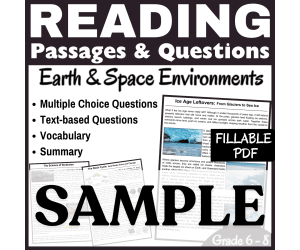
Science Reading Passage: SAMPLE Glaciers, & Antarctica (FILLABLE PDF)
Science, Space, Earth and Environmental Sciences, ELA, Reading, Reading Comprehension, Strategies, Resources for Teachers, Environmental Science, Grade 6, 7, 8, 9, Writing Prompts, Worksheets & Printables, Centers, Activities, Teacher Tools, Assessments, Quizzes and Tests, Quizzes, Tests
This is a ONE PASSAGE SAMPLE. The following is the description of the FULL resource and the downloading links: Mars, Glaciers, and Antarctica: Reading Comprehension Passages (FILLABLE PDF) This very engaging and fillable collection of science reading passages about Mars, Glaciers, and Antarctica (Earth and Space Environments) is designed to bridge the gap between science and literacy through strengthening reading comprehension and sparking scientific curiosity in middle school students. Each passage blends English Language Arts skills with accurate science content that supports NGSS classroom practice. Ideal for interdisciplinary learning in ELA and Science. Suitable for Grade 9 review, too! These worksheets are designed as fillable PDFs , which means students can type their answers directly into the document on any computer or tablet . Each page includes highlighted text fields that show them exactly where to type! What Is Included? There are (3) informational passages: Antarctica: Science at the End of the Earth From Earth to Mars: What Life Would Require Ice Age Leftovers: From Glaciers to Sea Ice Student Tasks for Each Passage: 5 multiple-choice questions targeting main idea, key details, inference, vocabulary in context, and use of evidence 5 vocabulary matching items with clear, student-friendly definitions 5 text-based questions that require citing specific lines or facts 1 summary prompt that asks students to condense central ideas accurately Full answer key for every section Available Formats for this Resource Word Docs Google Docs FULL CATALOG OF DOWNLOADING LINKS HERE Other Science Reading Collections and Topics You May Find in the Store: 1. Astronomy & Space Science 2. Volcanoes, Rocks, & Mountains 3. Rock Cycle, Soil, & Sinkholes 4. Mars, Glaciers, & Antarctica 5. Water Cycle, Acid Rain, & Wastewater 6. Insects, Animals, & Ecosystems 7. Bioluminescence & Insects 8. Animal Skin, Cats, & T. Rex 9. Human Body and Senses 10. Health & Applied Bioscience 11. Waves, Light, & Imaging 12. Electricity & Energy 13. Motion & Materials 14. Chemistry and Materials Science 15. Electromagnetism 16. Acids and Bases 17. Gas Laws 18. Biotechnology 19. Periodic Trends 20. Protists and Fungi 21. Microevolution 22. Blood 23. Chemical Bonding 24. Magnets 25. Muscles 26. Nuclear Chemistry 27. Electromagnetic Devices 28. Epigenetics 29. The Law of Conservation of Mass 30. Atomic Models 31. Isotopes and Ions 32. Light 33. Human-Environment Interaction 34. Theory of Evolution 35. Photosynthesis 36. Origins of Life and Early Earth 37. Gene Expression and Regulation 38. Thermochemistry 39. Allergies 40. Coevolution 41. Birth to Adulthood 42. Cells 43. Entropy and Free Energy 44. The Human Brain 45. Mixtures and Solutions 46. Invertebrates 47. Zoo Animals 48. Biochemistry 49. Animal Behavior 50. Population Ecology ...and many more engaging science reading passages that cover intriguing and important topics designed to spark curiosity and support student learning. How to Use These PDFs Click on the highlighted area to start typing your answer. Move to the next question by clicking in the next highlighted box. When you are finished, close the document and select SAVE so your answers stay recorded. If you want to keep a blank copy for later, choose Save As and give your completed version a new name. Product Details Length: 15 pages total Grades: 6–8, also suitable for Grade 9 review Use cases: close reading, stations, homework, intervention, test prep, and sub plans Standards support: reinforces informational-text skills and supports NGSS-style sense making through observation, modeling, and clear use of claim, evidence, and reasoning Why Teachers Choose This Set Authentic science content paired with rigorous literacy practice Consistent task structure across all passages for easier planning and smoother student routines Clear, age-appropriate writing that builds confidence without oversimplifying Use this set to reinforce ELA skills in science, to add literacy to your lessons, or to support independent work. The passages strengthen main idea, evidence use, vocabulary in context, inference, cause and effect, and summary writing. With ready-to-use assessments and complete answer keys, you can provide focused practice that is simple to run and fast to review.
Author Middle & High School - CORED Education
Rating
Tags Middle School, Reading Comprehension, Reading Strategies, Reading Passages, ELA, Centers, Reading Passage, Assessments, Vocabulary, Earth Science
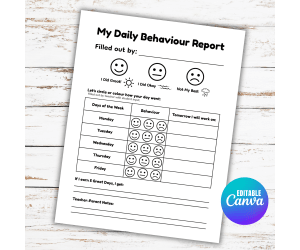
Daily Behavior Report Chart Parent Teacher Communication Log
Social Emotional Learning (SEL), Special Resources, Life Skills, Classroom Management, Resources for Teachers, Special Education Needs (SEN), Writing, ELA, Not Grade Specific, Posters, Classroom Decor, Assessments, Teacher Tools, Charts
Bridge the gap between school and home with this Daily Behavior Chart and Tracker! This printable template helps teachers share how a child’s day went while keeping students involved in their own growth. Kids use simple icons to reflect on their behavior and the built in reward system encourages positive choices throughout the week. Perfect for open communication between grown ups and kids at school and at home this Daily Behavior Report to Send Home supports consistent routines clear expectations and positive reinforcement. Why Teachers & Parents Love It Fosters powerful self awareness. Giving children the opportunity to reflect on and record their own behavior shifts the chart from a punitive "surveillance tool" into a developmental one. Research shows that self monitoring drastically improves a student's ability to stay on task and regulate their emotions . What’s Included Print sizes: 8.5” x 11” inches Editable Canva Link Printable PDF and PNG Files All text is fully customizable edit names, personal messages, fonts & colors. Grades / Ages Applicable for Toddlers, Preschool, Kindergarten and Elementary students (Ages 3–11) Implementation Format Parents should review the chart with their child every evening. Use it as an opportunity to praise good choices and discuss what they can do differently tomorrow, keeping the conversation positive and goal oriented . Answer Key Not applicable File Type Ready To Print PDF and PNG files ( plus Canva Editable Template ) Number of Pages 1 page License Paid product for personal or single classroom use
Author screenzro
Rating
Tags Daily Behavior Chart, Behavior Tracker, Daily Behavior Chart For Kids, Daily Behavior Report Home, Daily Student Behavior Reports , Behavior Tracking Data Sheet, Parent Communication Log, Communication Tracker, Parent-teacher Communication Log Template

Boundary Setting & Healthy Relationships Scenario Worksheets
Special Resources, Life Skills, Social Emotional Learning (SEL), Social Skills, Special Education Needs (SEN), Speech Therapy, STEM, Resources for Teachers, Classroom Management, Community Building, Grade 6, 7, 8, 9, 10, 11, 12, Worksheets & Printables, Workbooks, Worksheets, Word Searches, Teacher Tools, Assessments, Lesson Plans, Quizzes and Tests, Quizzes, Tests
Presented in an easy-to-use format that is ready for use immediately, the Boundary Setting and Healthy Relationships Scenarios Worksheet is a collection of 40 pages of worksheets focused on Teaching S.E.L. (Social & Emotional Learning) skills to adolescents. Containing relevant and up-to-date research, these worksheets help teachers foster students’ development of strong social and emotional skills through hands-on experiences, supported based on both interpersonal neurobiology and cognitive-behavioral principles. Using interactive worksheets, students will engage with realistic (and often high-stake) scenarios that depict physically, emotionally, cognitively, materially, and digitally/cyberly, from peers, from family, from romantic partners, and much more, as they explore consent and communicating when under stress, the fawn response vs. fight or flight response, location tracking, the rupture and repair cycle, trauma dumping, peer pressure, etc. Using guided written prompts as well as fill-in-the-blank and scripting exercises with reflection questions and self-assessments, students will grow their understanding of and ability to demonstrate self-control, stay calm under pressure, use assertive communication with others, and ultimately build a lifetime of autonomy through satisfying relationships. Included with the worksheets are a full Visual Asset Library (boundary typology continuum, discomfort-resolution flowchart, spheres of digital agency), complete answer keys; example responses; foundational knowledge quizzes; and an extensive Teacher Implementation Guide including psychological safety protocols, differentiation between middle and high school, and detailed information about how to use this resource in the classroom or during counseling sessions, with homeschoolers, or in youth programs. This digital (PDF) resource is the ideal tool for teachers to develop emotional regulation, distress tolerance, assertive communication, and autonomous interpersonal relationships for students as they learn to navigate friendships, romantic partnerships, social media, and family dynamics from a place of confidence and respect. Reasons why Parents/Schools Appreciate It: Trauma-Informed and Psychologically Safe: Explicitly identified protocols (Third Party Rule, opt-out options, validation versus correction) that allow for the protection of vulnerable students while still getting credit for the Social and Emotional Learning standards. Entirely "Ready to Go" and requires no prep time (40 pages of theory, 10 Scenario Worksheets, visual aids, answer keys and individualised teacher guides). Print once and immediatley begin teaching. Relevance with Real Life: Addresses current adolescent issues such as cyber boundaries, tracking locations, group chat pressure, love bombing and smear campaigns through engaging, appropriate, context sensitive scenarios. Demonstrated Skill-Building: Transition from theory to practice using scripting, somatic awareness and mastery reflections, creating measurable improvement in assertiveness and self-esteem. Flexible and Scalable (can be used by teachers in whole classes, small groups, individually or as independent study). Can be adapted from Middle School up to High School. Target Student Grade Levels: The curriculum is intended for students in grades 6 through 12 (middle and high school) as well as for teachers implementing it in classrooms. This is reflected in the Teacher Implementation Guide, sections beginning on pages 39-40, with examples of differentiation for middle schoolers and high schoolers as described below: For middle schoolers (grades 6-8), examples are provided, emphasizing peer relationships and how those relationships can lead to digital exclusion, as well as using a scripted role-playing activity. For high schoolers (grades9-12), the focus is on the complexities/differences of exploring nuances, emotional manipulation, gaslighting, intimate partner relationships, and the interconnectedness of digital technologies. The curriculum can be effectively used in Health, Social Emotional Learning (SEL), Advisory, Psychology, Counseling, Life Skills, and Advisory/Homeroom classes, as well as in after school programming, by school counselors, through families who are homeschooling, and by youth groups. Terms of Use / Copyright: This document is copyrighted to Syed Hammad Rizvi. This product is to be used only for personal and individual use in your classroom, and may not be modified or reused in any way, including the distribution or the selling of this document. This means that you may not put this on the Internet for the public to download. If you would like to distribute this item to other teachers, please purchase a new license from Teachsimple. Thank you for respecting these terms of use. This item is supplied by Syed Hammad Rizvi.
Author Creative Book Store
Rating
Tags BoundarySetting, HealthyRelationships, SEL, SocialEmotionalLearning, SELcurriculum, TeenBoundaries, DigitalBoundaries, ConsentEducation, BoundarySettingWorksheets, HealthyRelationshipsWorksheets
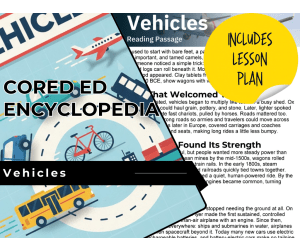
Vehicles Reading Comprehension Passage - Cored Ed Encyclopedia
ELA, Language Development, Reading Comprehension, Reading, Pre-Reading, Science, Technology, Engineering, History, Social Studies, Grade 2, 3, 4, 5, Worksheets & Printables, Worksheets, Teacher Tools, Centers, Activities, Writing Prompts, Assessments, Quizzes and Tests, Quizzes, Lesson Plans
This vehicles reading comprehension with lesson plan includes: Visualization (on the front cover) Start your lesson by taking a minute to think and share something about the topic. Read the script aloud (slowly), perhaps prepare some music or sound effects. Student close their eyes and let their imaginations wander. Students open their eyes, read the question aloud and give them a few minutes to complete. Ask a few students to share or keep answers until the end to compare with what they learn in the passage. Quick pause—thousands of Cored Education products are included with your TeachSimple membership. Download links and encyclopedia index available here. Pre-Reading Trivia Students will write down one thing they already know about the subject and then read five more facts and discuss. These facts are fun, and the students will enjoy learning about the subject before reading more. Give 1 minute for students to write what they already know (no pressure—best guess is fine). Read the five facts together. After each fact, do ask a student for their opinion, was it surprising? Set a purpose by asking students to highlight/underline one fact they want to learn more about during the reading. Reading Passage The text is a high-interest reading passage with set paragraphs, roughly three to four paragraphs long. It contains a variety of themes about the topic, anywhere from history to technology. The passage is between 250 and 350 words in length. First, ask students to look at the headings and see what they’ll learn about today. What do they know about the topic/heading? First read options: Teacher read-aloud (best for support). Partner reading (paragraph by paragraph). While reading, students underline important details, and vocabulary words they think may come up in the questions section. Mixed Questions The first question page contains four multiple-choice questions, each with a choice of four answers, and three written response questions that require a sentence or two from the student. Students complete the mcqs first independently, then review quickly as a class. For the 3 written responses, try to get students giving the answer with some form of evidence: “I think ___ because the text says ___.” If students get stuck, send them back to check the passage. Vocabulary Questions Practice seven key words from the text in this section across two activities. First section is scrambled words where students will unscramble three words given a clue for each. The second section is a word to meaning matching activity. Before starting, have some students read out words they underlined in the passage. Ask students to say the word and read aloud the sentence(s) around each word. Ask students to do scrambled words and the matching exercise in pairs then go through answers as a class. For the scrambled spelling task, get four pairs to come up to the board and write the words for extra practice with the other student reading out the clue. For the matching task, prompt students to give full sentences: “I matched ___ with ___ because ___.” Creative Writing In this question, the student will be required to write a five to eight sentence paragraph on a question related to the topic. Before starting, ask students write down 3 key ideas they are going to include in their piece. Ask students for ideas to share around the class to help those struggling. Pro writing expectations: 5–8 sentences At least 2 facts or details from the passage At least 2 vocabulary words from the previous page Students read their paragraphs while classmates listen for facts and vocabulary words. Extension Activities This page is optional for fast finishers or to take home. There are several activities, each one requiring a different skill. Do some, do none, do all, completely optional - but you will feel reassured knowing every possibility is planned for. Includes summary writting question. Answer Key There are answers for the multiple-choice questions, written response questions have sample answers, vocabulary answers and if there is a summary question then a sample summary will be provided as well. Lesson Plan Included Customized lesson plan for this lesson is included. Lesson Snapshot Title: Vehicles Genre: Nonfiction (Informational text) Subject: Social Studies / Science & Technology Primary Topic: How transportation changed from wheels to flight Estimated Guided Reading Level (A–Z): P Support pages: Pre-reading trivia, mixed questions, vocabulary practice, creative writing, extension activities, and an answer key. Support-page QA check: Some vocab items don’t match the exact word forms in the passage (e.g., chariot vs chariots , battery vs batteries , submarine vs submarines , locomotive vs locomotives ). What This Lesson Teaches Best Sequence of transportation changes over time: Moves from walking/animals, to logs/sledges, to wooden wheels and wagons, to roads and coaches, to steam locomotives, motor vehicles, and airplanes. How inventions improved travel and hauling: Explains how wheels, roads, tracks/railroads, and engines made travel smoother, faster, and able to carry heavier loads. Using headings to organize information: Section headings (“Roads…,” “When Steam…,” “A Lift Into the Air”) help readers track time periods and big shifts. Key historical details in an informational text: Includes dates and examples such as Uruk clay tablets (3700–3500 BCE) and the Wright Flyer flight (December 17, 1903). Modern tech and environmental impact: Notes electric motors, rechargeable batteries, and “no tailpipe exhaust,” ending with a question about helping the planet. Learning Goals Students will describe how people traveled and carried loads before wheels, using details from the passage. Students will identify how wheels changed what vehicles could do (hauling goods and moving more easily). Students will explain how roads and railroads affected travel and connected places, based on the text. Students will summarize the “biggest leap” in travel described in the passage and name the example given. Students will use headings and key details to retell the passage’s main changes in transportation in order. Key Vocabulary From the Text sledge — a sled that helps heavy things slide. Mesopotamia — an ancient region where Uruk was located. spoked — having thin supports connecting wheel center to rim. locomotives — train engines that pull cars on tracks. rechargeable — can be filled with power again. FULL CATALOG OF DOWNLOAD LINKS AND ENCYCLOPEDIA INDEX HERE
Author Cored Education
Rating
Tags Vocabulary, Reading Comprehension, Reading Passages, Lesson Plans, Ela Lesson Plans, Reading Comprehension Lesson Plans, Pre-reading, Science Lesson Plans, Technology, History Lesson Plans
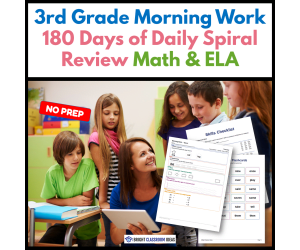
3rd Grade Morning Work | 180 Days of Daily Spiral Review | Math & ELA
ELA, Math, Grade 3, Assessments, Teacher Tools, Lesson Plans, Worksheets & Printables
Grade 3 Morning Work | 180 Days of Common Core Spiral Review | Math & ELA Bell Ringers | Print & Go Start every school day with meaningful, standards-based practice using this Grade 3 Morning Work resource! With 180 days of Common Core spiral review , students strengthen essential math and ELA skills through engaging daily activities that reinforce previously taught concepts all year long. Designed as a simple, no-prep routine, this resource builds independence, improves retention, and helps students enter the classroom focused and ready to learn. What's Included 180 days of printable morning work Two-page daily format (360 student pages) Daily Reading & Language practice: Editing and conventions Prefixes and word study Context clues Reading comprehension passages with text-dependent questions Academic vocabulary Targeted writing skills Writing prompts Reading challenges SEL morning check-ins Fun facts Daily Math & Thinking practice: Multiplication Division Fractions Elapsed time Area Perimeter Word problems Math challenges Brain teasers Jokes Growth mindset quotes Would You Rather prompts Teacher Guide 36-week Pacing Guide Skills Checklist Editable Morning Work Schedule (Word & PDF) Complete Answer Key for every day of the school year How It Works in the Classroom This Grade 3 Morning Work resource is designed for a 15-minute daily routine while remaining flexible enough for multiple classroom settings. Use it for: Morning work Bell ringers Daily spiral review Independent practice Homework Early finisher activities Math warm-ups Reading review RTI and intervention Test preparation Substitute plans The predictable format encourages student independence while giving teachers valuable time to greet students, check homework, conference with individuals, or pull small groups. Standards & Learning Goals This comprehensive spiral review reinforces essential Grade 3 Common Core skills, including: Reading & Language Arts Editing and grammar Prefixes and word study Context clues Reading comprehension Vocabulary development Writing skills Sentence structure Opinion, narrative, and informative writing Math Multiplication and division facts Fractions Elapsed time Area and perimeter Word problems Mathematical reasoning Problem solving Students also build: Reading stamina Critical thinking Growth mindset Social-emotional learning Independent work habits Long-term retention through daily spiral review Why Teachers Love It ❤️ Zero prep—just print and teach ❤️ Covers all 180 instructional days ❤️ Spiral review helps students retain skills all year ❤️ Includes both math and ELA in one daily routine ❤️ Difficulty gradually increases as students grow ❤️ Supports classroom management with a consistent routine ❤️ Includes pacing guides, assessment checklists, editable schedules, and a complete answer key ❤️ Perfect for classrooms, homeschool, intervention groups, and substitute teachers Perfect For Grade 3 Classrooms Morning Work Bell Ringers Daily Spiral Review Common Core Review Math Review Reading Review Independent Practice Early Finishers Homework RTI & MTSS Test Prep If you're looking for a Grade 3 Morning Work resource that combines engaging literacy activities with meaningful math practice, this complete 180-day Common Core spiral review provides everything you need to establish an effective morning routine while strengthening essential third grade skills every day. Download today and make mornings productive, organized, and stress-free all year long!
Author Bright Classroom Ideas Marketplace
Rating
Tags Ela, Math, Daily, Spiral, Review, Yearlong, Full Year, Morning Work
Georgia Milestones ELA Practice Test for Grade 4
ELA, Grade 4, Assessments, Teacher Tools, Tests, Quizzes and Tests, Worksheets & Printables
Georgia Milestones ELA Practice Test for Grade 4 Prepare your students for success with this Grade 4 Georgia Milestones ELA Practice Test ! This comprehensive, standards-aligned resource gives students realistic test practice while building confidence in reading comprehension, vocabulary, and language skills. What’s Included ✅ Full-length Grade 4 ELA practice test (50 questions) with authentic formatting ✅ 4 engaging reading passages : 1 realistic fiction story 1 informational science article (hurricanes) 1 poem (literary analysis) 1 historical nonfiction text (Apollo 11) ✅ Language & vocabulary section (10 questions) covering grammar, figurative language, and word meaning ✅ Evidence-based two-part questions (Part A / Part B) to mirror real test rigor ✅ Complete Answer Key with standards alignment + detailed explanations ✅ Teacher’s Guide with implementation tips, scoring support, reteaching strategies, and data tracking tools ✅ Printable student answer sheet + class data tracker How It Works in the Classroom This Grade 4 Georgia Milestones ELA practice test is flexible and easy to implement: Use as a full-length mock assessment (90 minutes) to build stamina Break into daily passage-based practice for manageable test prep Assign as a benchmark or progress-monitoring assessment Use in small groups for targeted intervention and reteaching Analyze results with the included data tracker and scoring guide Standards & Learning Goals Aligned to Georgia Standards of Excellence (GSE – Grade 4 ELA) . Students will practice: Reading Literary Text (RL) – theme, character development, point of view, figurative language Reading Informational Text (RI) – main idea, text structure, cause & effect, author’s purpose Poetry Analysis – figurative language, theme, tone, and structure Language & Vocabulary (L) – grammar, verb tense, punctuation, affixes, idioms, similes Evidence-Based Responses – Part A / Part B question format Test-Taking Strategies – close reading, eliminating distractors, using text evidence Why Teachers Love It ⭐ Closely mirrors the rigor and structure of the real Georgia Milestones assessment ⭐ Builds student confidence with authentic question types and formats ⭐ Includes high-interest, grade-level passages across multiple genres ⭐ Saves time with a complete, no-prep resource (just print & go!) ⭐ Makes reteaching easy with clear answer explanations and standards alignment ⭐ Helps teachers make data-driven decisions using the included tracking tools Perfect for test prep, benchmarks, intervention, and end-of-year review ! Download this Grade 4 Georgia Milestones ELA Practice Test today and give your students the tools they need to feel prepared, confident, and ready to succeed on test day!
Author Bright Classroom Ideas Marketplace
Rating
Tags Georgia, Milestones, Ela, State Test
Ketchup Reading Comprehension Passage - Cored Ed Encyclopedia
ELA, Language Development, Resources for Teachers, Reading Comprehension, Reading, Pre-Reading, Writing, History, Social Studies, Strategies, Grade 2, 3, 4, 5, Worksheets & Printables, Worksheets, Teacher Tools, Centers, Activities, Writing Prompts, Assessments, Tests, Quizzes and Tests, Quizzes
This ketchup reading comprehension contains the following: Visualize on the Cover (Teacher Read Aloud Script) Start your lesson by taking a few moments to visualize the topic and share thoughts or feelings about it. Pre-Reading Trivia Students will write down one thing they already know about the subject and then read five more facts and discuss. These facts are fun, and the students will enjoy learning about the subject before reading more. Reading Passage The text is a high-interest reading passage with set paragraphs, roughly three to four paragraphs long. It contains a variety of themes about the topic, anywhere from history to technology. The passage is between 250 and 350 words in length. Mixed Questions The first question page contains four multiple-choice questions, each with a choice of four answers, and three written response questions that require a sentence or two from the student. Vocabulary Questions Practice seven key words from the text in this section across two activities. First section is scrambled words where students will unscramble three words given a clue for each. The second section is a word to meaning matching activity. Creative Writing In this question, the student will be required to write a five to eight sentence paragraph on a question related to the topic. Extension Activities This page is optional for fast finishers or to take home. There are several activities, each one requiring a different skill. Do some, do none, do all, completely optional - but you will feel reassured knowing every possibility is planned for. Includes summary writting question. Answer Key There are answers for the multiple-choice questions, written response questions have sample answers, vocabulary answers and if there is a summary question then a sample summary will be provided as well. FULL CATALOG OF DOWNLOAD LINKS AND ENCYCLOPEDIA INDEX HERE Lesson Snapshot Title: Ketchup Genre: Nonfiction (informational text) Subject: Reading (Informational Text) / Social Studies (Food history & culture) Primary Topic: How ketchup changed over time and place Estimated Guided Reading Level (A–Z): O What This Lesson Teaches Best Explains what ketchup is commonly made from today and how it’s used with different foods. Traces ketchup’s history, including earlier versions that were not made from tomatoes. Connects word meaning and origin by describing how the name “ketchup” traveled across languages and may relate to a Hokkien word. Shows how recipes and food products change over time (homemade cooking → bottled store product; dates and examples included). Highlights how foods can vary across places (different spellings and versions such as fruit or banana ketchup). Learning Goals Students will describe what ketchup is like and what ingredients are named in the text. Students will explain how ketchup long ago could be different from ketchup today, using details from the passage. Students will identify key events/dates in ketchup’s story (1600s, 1812, 1876) and tell what happened at each time. Students will explain why vinegar and seasonings are added, based on the passage. Students will describe how the word “ketchup” is connected to the idea of something “briny,” according to the text. Key Vocabulary From the Text glossy — shiny and smooth-looking. vinegar — sour liquid used in cooking. briny — salty, like seawater. scholars — people who study and learn a lot. staple — something kept often; a regular favorite. Cored Ed Encyclopedia Overview The Cored Ed Encyclopedia is a weekly series of lessons that you can pick up and use right away. These short readings fit into whatever time you have available. Each one includes a warm-up, a reading, and a set of questions, but it’s flexible — you can do just the reading, the full lesson, or skip the writing section if you need to. Each lesson focuses on a single topic so students don’t get lost. The writing is clear but never childish, making it perfect for grades two through five. Topics range from animals and science to history, inventions, and everyday things. No matter the level of the student, everyone should take away at least one new idea or fact from each lesson. The materials are easy to print, easy to explain, and require no setup. They work well for whole-class teaching, partner work, or independent study.
Author Cored Education
Rating
Tags Vocabulary, Spelling, Reading Comprehension, Reading Passages, Reading, Creative Writing, Reading Strategies, Writing Prompts, Ketchup, History

Reading Comprehension Passages Fiction Set 1 - Nature (Google Forms)
ELA, Reading, Language Development, Vocabulary, Common Core, ESL, Spelling, Reading Comprehension, Writing, Creative Writing, Grade 2, 3, Assessments, Teacher Tools, Tests, Quizzes and Tests, Activities, Centers
Reading Comprehension Passages Fiction Set 1 Overview Fascinating reading comprehension passages, each with an array of activities included. Stories are written for the modern classroom and topics are designed to promote enthusiasm from each student. Each lesson contains a mixed questions section to check understanding, a vocabulary or spelling activity to help remember key language introduced, and a writing exercise. Full answer keys are provided. For a more detailed overview, check the section under the links at the bottom of this description. Passages Include 1.Bring on the Snow: Kellie wants to make it snow. How does she try? 2.Walk through the Woods: A walk in the woods turns into a huge adventure. 3.Nature Photographer: Donna get some amazing snaps in this story. 4.Nature's Beautiful Colors: Rusty enjoys finding out about the colors in nature. 5.Flower Fun: Learn about flower names and colors in this fun lesson. 6.Picking Cherries: Ross spends his day picking cherries but is it worth it? Additional File: Nature Photographer: Drawing Nature Printable Google Forms Version This is the Google Forms editable and fillable/self grading version. This download is available in GOOGLE Docs, GOOGLE Forms, GOOGLE Slides. PDF, PPT, WORD. FULL CATALOG OF DOWNLOAD LINKS HERE Grade 2/3 Links Fiction Set 1 - Nature Google Docs Google Forms Google Slides PDF PPT Word Guided Reading Materials Fiction Set 2 - Animals Google Docs Google Forms Google Slides PDF PPT Word Guided Reading Materials Fiction Set 3 - Food Google Docs Google Forms Google Slides PDF PPT Word Guided Reading Materials Fiction Set 4 - School Google Docs Google Forms Google Slides PDF PPT Word Guided Reading Materials Fiction Set 5 - Friends Google Docs Google Forms Google Slides PDF PPT Word Guided Reading Materials Fiction Set 6 - Family Google Docs Google Forms Google Slides PDF PPT Word Guided Reading Materials Fiction Set 7 - Sports Google Docs Google Forms Google Slides PDF PPT Word Guided Reading Materials Nonfiction Set 1 - Technology Google Docs Google Forms Google Slides PDF PPT Word Guided Reading Materials Nonfiction Set 2 - Nutrition Google Docs Google Forms Google Slides PDF PPT Word Guided Reading Materials Nonfiction Set 3 - Animals Google Docs Google Forms Google Slides PDF PPT Word Guided Reading Materials Reading Passages Overview Each passage is especially written for Grade 2-3 students, including key vocabulary required for this age group. Topics are varied and are accompanied by colorful graphics. Topics are meant to educate, yet entertain the modern student. These passages are perfect for the modern classroom. Whereas textbooks can become outdated in no time, any changes to technology or the world will result in updates to this product. Mixed Questions The mixed questions section of each lesson includes a variation of fivecomprehension, vocabulary and math questions. In addition, key reading strategies are frequently covered including cause & effect, summarizing, compare & contrast and making conclusions. Three of the questions will be MCQs and two will require a written response of some kind. Full answers and example responses appear at the end of the lesson. Spelling & Vocab Each reading passage contains a variety of words and phrases designed for Grade 2-3 students. Spelling and vocab activities provide the opportunity to build fluency with these words. As it can become quite mundane doing the same activities over and over, each lesson in a set will contain a different spelling and vocab activity . Writing Prompts Writing prompts are designed to continue the theme or lessons learned in the story. Students are persuaded to write in a variety of ways and each prompt includes several cues to help. As with the spelling/vocab section, writing prompts will vary. This includes research pieces, reading responses, poetry and creative writing prompts. Full Answer Keys Full answer keys and sample responses are provided so no matter how busy you are, you know you're covered! Mixed question answers provide evidence from the text, math questions contain the relevant workings. Answers are designed for use by the teacher, but also suitable as a handout to the student. Additional File One lesson will have an additional file. This is something fun to extend the lesson with. For similar downloads and other frees, do check out Cored Group on TeachSimple.
Author Cored Education
Rating
Tags Elementary, Reading, Comprehension, Vocabulary, Answers, Common Core, Writing, Passages, Digital Centers, Self Assessment
Reading Comprehension Passages Fiction Set 1 - Animals (Forms)
ELA, Reading, Language Development, Vocabulary, Common Core, ESL, Spelling, Creative Writing, Writing, Resources for Teachers, Grade 4, 5, Assessments, Teacher Tools, Tests, Quizzes and Tests, Centers, Activities, Quizzes
Reading Comprehension Passages Fiction Set 1 Overview No prep reading comprehension lessons, with enjoyable stories and topics. Each lesson has a blend of post-reading activities. Mixed questions to check overall understanding. Vocabulary activities, plus a writing section. Lessons also contain a bonus extension exercise at the end. Some you may like, some you may not, either way they are there if you wish to use them. Full answer keys are provided. Passages Include 1.Donny's Glasses: Donny is being chased by a monster. Or so he thinks! 2.Hare & Bear: Hare & Bear have a cup of tea together in the warmth. 3.Maggie's Turtle: Maggie is desperate to win the fishing competition. 4.New Pup: Hugh finds out a new puppy isn't as fun as he hoped. 5.Naughty Cat: Lizzie can't find any of her stuff. Read this story to find outwhere it is. 6.Ella's Baseball Bat: Ella's dad is scared of bats, and now there is one in the house! 7.Ola the Rabbit: Read about Darla's newest pet in this lesson. 8.Ethan and the Puppies: Ethan gets ready for the puppies to arrive. 9.Endangered Animals: Sam learns all about endangered animals in this passage. 10.Chinese New Year: Jessie and Sally talk about the upcoming Chinese New Year. Forms Version This is the Forms editable and fillable/self grading version. This download is available in GOOGLE Docs, GOOGLE Forms, GOOGLE Slides. PDF, PPT, WORD. Browse the Complete Cored Catalog — 2,000+ Resources Included Reading Passages Each reading passage has been written specifically for students in Grades 4–5, using vocabulary and language that match their age and ability level. The collection covers a wide range of engaging topics, supported by colorful visuals that help bring the content to life. Every lesson is designed to build knowledge while keeping students interested and motivated to read. These resources are also designed with flexibility in mind. Unlike traditional textbooks that can quickly become outdated, lessons can be updated over time to reflect changes in technology, discoveries, and the world around us. Mixed Questions Every lesson includes a variety of questions that help students think more deeply about what they have read. The question section combines reading comprehension, vocabulary, and math skills, while also regularly reinforcing important reading strategies such as cause and effect, summarizing, compare and contrast, and drawing conclusions. Most lessons include a mix of multiple-choice and written-response questions, giving students opportunities to explain their thinking as well as select answers. Complete answer keys and sample responses are provided at the end of each lesson for quick and easy reference. Spelling & Vocabulary Each passage introduces students to useful words and phrases appropriate for Grades 4–5. To help build confidence and word knowledge, every lesson includes a spelling or vocabulary activity. Rather than repeating the same task throughout the collection, activities vary from lesson to lesson to keep practice fresh and engaging. Activities may include spelling challenges, sentence matching, decoding activities, mixed-up text exercises, and other vocabulary-building tasks connected directly to the reading. Writing Prompts Each lesson includes a writing activity that extends the ideas, themes, or topics explored in the passage. Students are encouraged to write in a variety of formats, with prompts providing helpful guidance and ideas to get them started. Writing tasks vary throughout the collection and may include creative writing, research activities, personal responses, poetry, opinion writing, and other engaging assignments. Full Answer Keys Complete answer keys and sample responses are included with every lesson, making planning and marking quicker and easier. Reading comprehension answers include evidence and support from the text, while math-based questions show the relevant working where appropriate. The answer keys are designed primarily for teachers but can also be shared with students when needed. Just for Fun Each lesson finishes with an optional extension activity called Just for Fun . These bonus activities provide an enjoyable way to extend learning beyond the main lesson and often encourage creativity, discussion, or independent thinking. They are completely optional, giving you the flexibility to use the activities that best suit your students and classroom needs. For similar downloads and other frees, do check out Cored Group on TeachSimple.
Author Cored Education
Rating
Tags Elementary, Reading, Comprehension, Vocabulary, Answers, Ccss, Spelling, Writing, Digital Centers, Self Assessment

Health & Applied Bioscience: SAMPLE Reading Comprehension (Google)
Science, ELA, Reading, Reading Comprehension, Strategies, Resources for Teachers, Health, P.E. & Health, Life Sciences, Grade 6, 7, 8, 9, Writing Prompts, Worksheets & Printables, Centers, Activities, Teacher Tools, Assessments, Quizzes and Tests, Quizzes, Tests
This is a ONE PASSAGE SAMPLE. The following is the description of the FULL resource and the downloading links: Health & Applied Bioscience: Reading Comprehension Passages and Questions (Google) This very engaging collection of science reading passages about The Truth about Drinks, Green Tea, and Plastic in Medicine is designed to bridge the gap between science and literacy through strengthening reading comprehension and sparking scientific curiosity in middle school students. Each passage blends English Language Arts skills with accurate science content that supports NGSS classroom practice. Ideal for interdisciplinary learning in ELA and Science. Suitable for Grade 9 review, too! What Is Included? There are (3) informational passages: The Truth About Drinks: Many popular drinks add a lot of sugar, caffeine, or artificial sweeteners without people noticing. Knowing what is in sports drinks, sodas, and energy drinks helps you choose water or low-sugar options more often. Green Tea: Ancient Drink, Modern Science: Green tea comes from an old tradition, but today it is studied for its helpful plant chemicals. It can support alertness and health, but it works best as part of overall good habits, not as a magic drink. Plastic in Medicine: From Everyday Uses to Life-Saving Care: Plastics made it easier to keep hospitals clean, since items like gloves, syringes, and IV tubes can be used once and thrown away. They also make medical tools lighter and safer, though all that single-use plastic has to be handled carefully. Student Tasks for Each Passage: 5 multiple-choice questions targeting main idea, key details, inference, vocabulary in context, and use of evidence 5 vocabulary matching items with clear, student-friendly definitions 5 text-based questions that require citing specific lines or facts 1 summary prompt that asks students to condense central ideas accurately Full answer key for every section Available Formats for this Resource PDF Word Docs FULL CATALOG OF DOWNLOADING LINKS HERE Other Science Reading Collections and Topics You May Find in the Store: 1. Astronomy & Space Science 2. Volcanoes, Rocks, & Mountains 3. Rock Cycle, Soil, & Sinkholes 4. Mars, Glaciers, & Antarctica 5. Water Cycle, Acid Rain, & Wastewater 6. Insects, Animals, & Ecosystems 7. Bioluminescence & Insects 8. Animal Skin, Cats, & T. Rex 9. Human Body and Senses 10. Health & Applied Bioscience 11. Waves, Light, & Imaging 12. Electricity & Energy 13. Motion & Materials 14. Chemistry and Materials Science 15. Electromagnetism 16. Acids and Bases 17. Gas Laws 18. Biotechnology 19. Periodic Trends 20. Protists and Fungi 21. Microevolution 22. Blood 23. Chemical Bonding 24. Magnets 25. Muscles 26. Nuclear Chemistry 27. Electromagnetic Devices 28. Epigenetics 29. The Law of Conservation of Mass 30. Atomic Models 31. Isotopes and Ions 32. Light 33. Human-Environment Interaction 34. Theory of Evolution 35. Photosynthesis 36. Origins of Life and Early Earth 37. Gene Expression and Regulation 38. Thermochemistry 39. Allergies 40. Coevolution 41. Birth to Adulthood 42. Cells 43. Entropy and Free Energy 44. The Human Brain 45. Mixtures and Solutions 46. Invertebrates 47. Zoo Animals 48. Biochemistry 49. Animal Behavior 50. Population Ecology ...and many more engaging science reading passages that cover intriguing and important topics designed to spark curiosity and support student learning. Product Details Length: 14 pages total Grades: 6–8, also suitable for Grade 9 review Use cases: close reading, stations, homework, intervention, test prep, and sub plans Standards support: reinforces informational-text skills and supports NGSS-style sense making through observation, modeling, and clear use of claim, evidence, and reasoning Why Teachers Choose This Set Authentic science content paired with rigorous literacy practice Consistent task structure across all passages for easier planning and smoother student routines Clear, age-appropriate writing that builds confidence without oversimplifying Use this set to reinforce ELA skills in science, to add literacy to your lessons, or to support independent work. The passages strengthen main idea, evidence use, vocabulary in context, inference, cause and effect, and summary writing. With ready-to-use assessments and complete answer keys, you can provide focused practice that is simple to run and fast to review.
Author Middle & High School - CORED Education
Rating
Tags Middle School, Reading Comprehension, Reading Strategies, ELA, Centers, Reading Passage, Assessments, Vocabulary, Life Science, Health
Guided Reading Level N - Invisible World of Gases (with Lesson Plan)
ELA, Resources for Teachers, Reading Comprehension, Reading, Language Development, Science, Physics, Engineering, Technology, Pre-Reading, Grade 2, 3, 4, Worksheets & Printables, Worksheets, Teacher Tools, Centers, Activities, Literacy Readers, Quizzes, Quizzes and Tests, Assessments
This Guided Reading Book - The Invisible World of Gases (Level N) with lesson plan includes: Guided Reading Color Label (front cover x1) This is a quick way to match the book’s demands to what students can generally handle.. The overall goal is to use the level/color to pick books for several smaller groups. To qualify for a certain level, a student is expected to read a book from that level with about 90–94% accuracy. If a student is consistently accurate and understands, move up a level. If the student is struggling at that level, drop down and add more support. Each student will improve at completely different rates, but it is generally one of the best ways to check progress across the class. DOWNLOAD THE CATALOG TO VIEW ALL GUIDED READING BOOKS AVAILABLE (SORTED LEVELS A-Z) Pre-Reading Question (x1) Teacher asks the prompt aloud, can be while showing the cover or first page. Students share what they already know, or make educated guesses from the cover. Prompt them to use the target vocabulary. Write some of their responses on the board to look back at during the reading. Vocabulary Words (x5) Introduce the five words, best doing it one at a time. Start by saying it, while students repeat and then see if anyone knows what it means before reading further. Read through the meaning and try to briefly connect each word to a picture or gesture so it’s meaningful. Ask students to flip through the book pages and point to where they see each of the vocabulary words. While reading the book pause upon coming across one of the vocab words or read the sentence twice to make sure students understand the word has appeared. Optional: Ask students to raise hands whenever they see/hear one of the new words. Guided Reading Pages (x10) Check the book snapshot (below) for: primary topic - do you need to prep extra reading or intro materials on this? what is taught best - decide on 1-2 bullets to focus on, use the prompt or words provided here for best results. learning goals - what you are checking for students to be able to do after the session, elicit answers using prompts or words provided. key vocabulary (see section above). questions overview - so you know what is coming up and if you need to prep extra materials to assist understanding. Run the lesson You may have already looked at a few of the pages together, but you can show them some of the pictures again first to set meaning. Depending on how much time you have and how familiar your students are with guided reading class, you may want to read the book aloud first with the group first. Students whisper or partner read, while you listen in. If time, do it as a group, one student reading a page each. Use the guided page’s prompts to coach: “Check the picture / does it make sense?” “Point under the words / try the first sound” “Reread the sentence smoothly”. Try to focus more on one student per session (rotating every time), so you can work out if they are ready to move up or need to move down a level. Comprehension Questions (back cover x3) This is your way to check that students didn’t just say the words, but actually understood the text. First, let students answer by pointing to the page/picture and saying a short sentence. After any answer, follow with: “Show me where you found that in the text.” In bigger groups, have partners answer first (10–20 seconds), then call on 2–3 students to share. Differentiation tips: Emerging speakers/struggling readers: oral + pointing On-level: oral in a full sentence Higher: one written sentence or draw + label Book Snapshot Title: The Invisible World of Gases Genre: Nonfiction (informational) Subject: Physical Science Primary Topic: Gas properties, particles, and everyday examples Estimated Guided Reading Level (A–Z): N What This Book Teaches Best Explains matter as anything with mass that takes up space, and names three states: solid, liquid, and gas. Describes gas molecules as tiny particles that move fast, spread far apart, and bounce off one another. Teaches key gas properties: gases have no fixed shape , take the shape of a container, and can spread out to fill a space. Connects temperature to motion by explaining that when a gas gets hot, molecules move faster, spread out, and the gas expands . Gives real-world examples of gases and their effects, including air pressure, pumping air into a tire, water vapor/steam, and helium balloons. Learning Goals Identify what the text says matter is and give the three states of matter named in the book. Describe how gas molecules move and how they are spaced compared to molecules in a solid. Explain what the book says happens to gas molecules when a gas gets hot. Explain how gas can be compressed and how that creates high pressure in a tire. Describe how water can change into water vapor and how steam forms when it cools. Use text details to explain why a helium balloon floats unless it is tethered. Key Vocabulary From the Text molecules — tiny particles that make up a gas. mixture — different things combined together. pressure — a pushing force on something. compressed — squeezed into a smaller space. atmosphere — a thick layer of gases around Earth. Discussion Prompts Pre-reading question: What do you think might be in the air around us even when we can’t see it? Comprehension questions: What does the text say matter is? How does the text explain what happens to gas molecules when a gas gets hot? Why does a balloon filled with helium float up unless it is tethered? Printing Tips 1. Best Printing Method (Recommended) “Booklet” Printing (Best if Available) If your printer or PDF viewer supports Booklet Printing , use this. Settings to use: Print mode: Booklet Paper size: Letter or A4 (either works) Orientation: Landscape Print on both sides: Yes Flip on: Short edge Scaling: Fit to printable area Booklet subset: First test: Front sides only Then: Back sides only This will automatically: Pair pages correctly Put the cover on the outside Align everything for folding After printing, fold in half and staple along the spine . 2. If “Booklet” Printing Is NOT Available You can still print this correctly with manual duplex printing . Step-by-step: Open the PDF. Choose Print . Set: Orientation: Landscape Pages per sheet: 1 Print on both sides: Yes Flip on: Short edge Print all pages . Because each PDF page already contains two facing book pages, the result will still fold cleanly into a book. Thousands of Cored Education products are included with your TeachSimple membership. Download links and encyclopedia index available here.
Author Cored Education
Rating
Tags Reading Comprehension, Reading Passages, Reading, Guided Reading, Guided Reading Lesson Plan, Guided Reading Activity, Pre-reading, Vocabulary, Science Lesson Plans, Physics

Eating Insects: Social Studies Reading Comprehension Passage (PDF)
ELA, Reading, Reading Comprehension, Strategies, Resources for Teachers, Social Studies, Sociology, Grade 6, 7, 8, 9, Writing Prompts, Worksheets & Printables, Centers, Activities, Teacher Tools, Assessments, Quizzes and Tests, Quizzes, Tests
Eating Insects: Social Studies Reading Comprehension Passage (PDF) This resource introduces a unique Social Studies reading comprehension passage with questions about Eating Insects in some cultures and possible future eating trends. The passage is carefully designed to bridge the gap between social studies and literacy through strengthening reading comprehension and sparking knowledge curiosity in middle school students. Each passage blends English Language Arts skills with accurate social studies content . Ideal for interdisciplinary learning in ELA and Social Studies. Suitable for Grade 9 review, too! Student Tasks throughout the passage: 5 multiple-choice questions targeting the following skills: main idea, key details, inference, vocabulary in context, and use of evidence 5 vocabulary matching items with clear, student-friendly definitions 5 text-based questions that require citing specific lines or facts 1 summary prompt that asks students to condense central ideas accurately Full answer key for every section Available Formats for this Resource: Fillable PDF Word Docs Google Docs FULL CATALOG OF DOWNLOADING LINKS HERE Social Studies Reading Comprehension Collection Links: 1. Ancient Civilizations PDF Fillable PDF Word Docs Google Docs 2. Early Empires and Trade Networks PDF Fillable PDF Word Docs Google Docs 3. The Founding of the United States PDF Fillable PDF Word Docs Google Docs 4. Language, Culture, and Meaning PDF Fillable PDF Word Docs Google Docs 5. Psychology and Society PDF Fillable PDF Word Docs Google Docs 6. Global Festivals and Traditions PDF Fillable PDF Word Docs Google Docs 7. Extreme Environments and People PDF Fillable PDF Word Docs Google Docs 8. Food, Culture, and Preservation PDF Fillable PDF Word Docs Google Docs 9. Global Food Customs PDF Fillable PDF Word Docs Google Docs 10. Media, Communication, and Popular Culture PDF Fillable PDF Word Docs Google Docs 11. Human Impact on the Environment PDF Fillable PDF Word Docs Google Docs 12. Civic Action and Social Change PDF Fillable PDF Word Docs Google Docs 13. Fashion, Society, and Power PDF Fillable PDF Word Docs Google Docs 14. People, Places, and Unusual Histories PDF Fillable PDF Word Docs Google Docs Product Details: Length: 4 pages Grades: 6–8, also suitable for Grade 9 review Use cases: close reading, stations, homework, intervention, test prep, and sub plans Why Teachers Choose This Passage: Authentic social studies content paired with rigorous literacy practice Consistent task structure for easier planning and smoother student routines Clear, age-appropriate writing that builds confidence without oversimplifying Use this passage to reinforce ELA skills in social studies, to add literacy to your lessons, and to support independent work. The passage strengthens main idea, evidence use, vocabulary in context, inference, cause and effect, and summary writing. With ready-to-use assessments and complete answer keys, you can provide focused practice that is simple to run and fast to review.
Author Middle & High School - CORED Education
Rating
Tags Middle School, Reading Comprehension, Reading Strategies, ELA, Centers, Reading Passage, Assessments, Vocabulary, Social Studies, Sociology