



3,985 products added recently
Page 138 - Assessments
Monitor your students' understanding and skill development with a comprehensive selection of assessments. This collection includes formative and summative evaluations, rubrics, and diagnostic tests. By utilizing these tools, you can tailor your instruction to meet each student's needs and promote academic growth.

 Show filters


3rd Grade Math Review for Addition and Subtraction
Math, Addition and Subtraction, Addition, Subtraction, Grade 3, 4, Teacher Tools, Assessments, Activities, Worksheets & Printables, Worksheets
This product is perfect for 3rd grade math standards review. It's a worksheet where students review addition and subtraction within 1000. It also has students practice subtracting across zeros. While it was created for the 3rd grade standard of writing, 3.NBT.2, it would be a great review for 4th graders before you begin greater addition and subtraction. I've set these worksheets up so students have room to show their work. The numbers are all lined up nicely, and each place is its own box. I know that when students are learning to subtract across zeros, they need a lot of room to work with. These 3 worksheets would work well for independent practice, review later in the year, or even as an assessment. If you want more worksheets for addition or subtraction, check out a few of my other worksheets: 3rd Grade Color by Code Math Worksheet - Addition and Subtraction Math Worksheet for Addition and Subtraction
Author Life with 5 Boys
Tags 3rd Grade Math, 3rd Grade Review, Addition, Subtraction, Subtract Across Zeros

Physical & Chemical Properties of Matter-Exit Ticket & Review Activity
Science, Chemistry, Grade 8, 9, 10, Teacher Tools, Assessments
Physical and Chemical Properties of Matter - Digital Exit Ticket and Review Activity Assess and enhance student comprehension of core concepts with this interactive exit ticket and review. This digital resource features a series of questions that gauge understanding of essential topics covered in class including; What is Matter, States of Matter, Chemical vs. Physical Properties, Qualitative vs. Quantitative Properties, Chemical vs. Physical Change, and Energy. With a single click, this Google Form will be copied into your Google drive for easy access. You will then be able to make any changes you feel necessary and distribute out to your students. With this exit ticket, educators can: Check for student understanding of key areas. Get instant insights into students' grasp of concepts through automatically graded questions and easy-to-read results charts. Identify areas students are struggling with to refine instruction. Incorporate exit ticket data into student grades as a formative assessment . Students are able to: Demonstrate their knowledge of concepts through short answer and multiple choice questions. Get immediate feedback on their responses to support metacognition. Review core ideas before a test or the next class. This digital review resource allows teachers to quickly assess student learning outcomes related to essential principles. The automatically graded Google Form provides data visualizations that highlight comprehension gaps to address. An engaging way to end or begin a class while promoting understanding without adding to your workload as a teacher.
Author Teach With Fergy
Tags Elements, Matter, States Of Matter, Chemical Properties, Physical Properties, Physical Changes, Chemical Changes, Qualitative Properties, Quantitative Properties
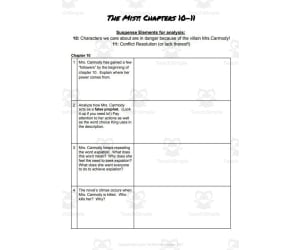
The Mist chapters 10-11 Suspense Elements Analysis Questions!
ELA, Literature, Grade 7, 8, 9, 10, 11, 12, Teacher Tools, Assessments
The Mist Chapters 10-11 Suspense Analysis Questions\nThis 3-page Google Doc provides educators with 10 multi-part short answer questions that analyze the suspense elements in chapters 10-11 of The Mist by Stephen King. Students will examine how chapter 10 builds suspense through endangered characters and the villain Mrs. Carmody. Additionally, they will analyze the suspense created by the lack of resolution at the end of chapter 11. These thought-provoking questions can be used for individual work, small group discussion, or whole class learning. With multiple question formats that demand a thorough understanding of literary techniques, this resource offers a meaningful assessment of student comprehension.
Author The Red-Haired Reader
Tags Suspense, Analysis, Literary Techniques, Comprehension

Bless Me, Ultima | In-Class Essay
ELA, Writing, Grade 9, 10, 11, 12, Teacher Tools, Assessments
This resource is a Bless Me, Ultima | In-Class Essay. Students will choose ONE of the prompts below and write a fully developed essay. They will support their claims with evidence from the text. This makes a great assessment piece for students in English class.
Author Zrinka Smith
Tags Writing Assessment, In-class Essay, Novel, Literature, Writing Prompts, Bless Me Ultima Essay

Assessments: Short Stories
ELA, Reading, Reading Comprehension, Literature, Grade 7, 8, 9, 10, 11, Teacher Tools, Assessments
Assessments: Short Stories Product Overview The Assessments: Short Stories product is a comprehensive suite of educational materials that offers a straightforward approach to gauging student understanding and comprehension of classic literary pieces. Specifically curated for Grade 7 to 11 Language Arts instructors, this resource sheds a more engaging light on Literature and Comprehension subtopics. Main Features This learning tool encompasses three comprehensive quizzes about "The Necklace," by Guy de Maupassant; "The Gift of the Magi," by O. Henry; and "The Possibility of Evil," by Shirley Jackson. Unlike typical multiple-choice type quizzes, it encourages analysis and critical thinking with its well-rounded, writing-intensive questions. Possible Applications in Teaching Educators may find the Assessments: Short Stories resource particularly handy for several instructional approaches. In-Classroom Learning: It can be used in whole classrooms as an evaluated exercise or even split among smaller study groups encouraging co-operative learning where students can discuss their answers before submission, promoting not just comprehension but healthy debates on literature's dynamic interpretations. Independent Study & Homeschooling: Educators who advocate independent study will also find these materials beneficial as homework assignments or study guides which provide budding scholars with unique insights into each story's nuances while fostering confidence in articulating ideas through written responses. Homeschoolers will also appreciate these resources' versatility due to their user-friendly Word Document format which makes customization straightforward – modifications can be made to content better aligned with teaching objectives without require extensive technical skills. Note for Integration into Lesson Plans To aid seamless integration into lesson plans : page citations provided very specifically adhere to McDougall Littell's Language of Literature (Grade 9), creating a streamline connection between textbooks' information structure and assessments strategies employed. Summary In essence, whether applied as quizzes (immediate feedback), study guides (providing answer track trajectory), or collaborative learning tools, Assessments: Short Stories offers a concrete and intuitive way to facilitate an enriched understanding of these literary classics.
Author The Education Lab
Tags Assessments, Short Stories, Literature Comprehension, Writing-intensive Questions, Critical Thinking

Checklist to Edit Writing Letters
ELA, Writing, Grade 2, 3, 4, 5, Teacher Tools, Assessments
Checklist to Edit Writing Letters If you're an educator seeking to enhance your students' letter-writing skills, you've arrived at the right place. Presenting a valuable teaching resource—a checklist for editing writing letters. This product caters perfectly to learners in grades 2-5 focusing on language arts lessons, particularly concerning the sub-subject of writing. It aids students in reinforcing their abilities systematically. The Highlights: The uniqueness of this checklist lies in its dual versions—one for self-editing and another for peer-editing. This combination fosters personal growth along with productive collaboration! To ensure convenient usage worldwide, the checklists are provided as downloadable PDFs. They can be printed or showcased on digital screens during classes, offering optimal flexibility. Under the ' assessments ' category, it serves a dual function—it helps evaluate student performance while guiding them towards improved letter-writing skills. Your students will cultivate independent learning through self-evaluation and also develop cooperation skills through peer-review activities. Valuable aspects that boost confidence and foster effective communication which leads to lasting friendships! In Other Words... This is not just any tool—it's a handy craft available at every committed educator's disposal—a checklist specializing on structure and accuracy in letter writings without resorting to flamboyant descriptions. No matter if you teach in school or homeschool this 'Checklist to Edit Writing Letters', it will surely elevate your teaching techniques pertaining language art intricacies! Transform how children view writing—a little added structure can contribute significantly towards building superior writers preparing us for the future generations!
Author Resource Garden
Tags Self-Editing, Peer-Editing, Language Arts, Letter Writing, Assessment Tool

My Name from The House on Mango Street Diction Deep Dive Group Analysis!
ELA, Literature, Grade 7, 8, 9, 10, 11, 12, Teacher Tools, Assessments
Analyze the figurative language and diction in "My Name" from The House on Mango Street with this engaging group activity. The resource provides six quotes from Sandra Cisneros' vignette for students to dive into. Small groups will identify and examine the type of figurative language utilized in each quote, highlight specific word choices, and analyze how these literary devices establish tone and mood. Groups record their analysis directly onto slides in an editable Google slideshow. When complete, the whole class can view all groups' slides to enrich their comprehension. This collaborative deep dive into Cisneros' craft moves learning beyond basic plot into deeper literary analysis in an interactive formatstudents enjoy. Approach this complex vignette in a more dynamic way!
Author The Red-Haired Reader
Tags Figurative Language, Diction, Group Work, Analysis, Comprehension
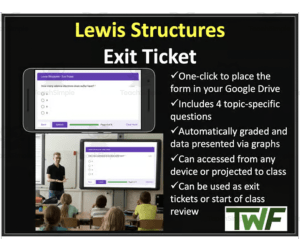
Lewis Structures - Exit Ticket and Review Activity
Science, Chemistry, Grade 11, 12, Teacher Tools, Assessments
Lewis Structures - Digital Exit Ticket and Review Activity Assess and enhance student comprehension of core concepts with this interactive exit ticket and review. This digital resource features a series of questions that gauge understanding of essential topics covered in class including; Valence Electrons, Octet Rule, Ionic Bonding, Covalent Bonding, Polyatomic Ions, Drawing Lewis Structures, and Determining Charge. With a single click, this Google Form will be copied into your Google drive for easy access. You will then be able to make any changes you feel necessary and distribute out to your students. With this exit ticket, educators can: Check for student understanding of key areas. Get instant insights into students' grasp of concepts through automatically graded questions and easy-to-read results charts. Identify areas students are struggling with to refine instruction. Incorporate exit ticket data into student grades as a formative assessment . Students are able to: Demonstrate their knowledge of concepts through short answer and multiple choice questions. Get immediate feedback on their responses to support metacognition. Review core ideas before a test or the next class. This digital review resource allows teachers to quickly assess student learning outcomes related to essential principles. The automatically graded Google Form provides data visualizations that highlight comprehension gaps to address. An engaging way to end or begin a class while promoting understanding without adding to your workload as a teacher.
Author Teach With Fergy
Tags Valence Electrons, Electrons, Octet Rule, Ionic Bonding, Covalent Bonding, Polyatomic Ions
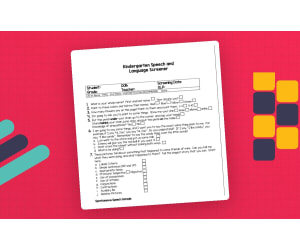
Kindergarten Speech and Language Screener
Special Resources, Speech Therapy, Preschool, Teacher Tools, Assessments
Kindergarten Speech and Language Screener This digital resource can assist kindergarten teachers and speech-language pathologists in screening students' speech and language skills during remote learning. The pack contains a checklist for teachers to gauge students requiring further assessment. Additionally, it has fillable forms for conducting screens in kindergarten and grades 1-5. Educators can use the screener to evaluate students' speech sound production, vocabulary, word structure, social language, comprehension, and fluency. They may administer it to the whole class, small groups needing monitoring, or individual students. The descriptive rubrics will help identify children needing speech or language intervention. Using the screener forms can make assessment convenient for both online and in-person learning.
Author The Tattooed Speechie
Rating
Tags Speech Therapy, Oral Communication, Assessment, Language Screener
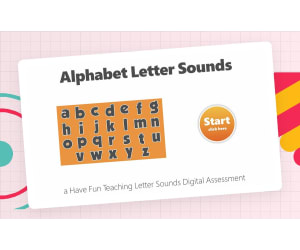
Alphabet Letter Sounds Lowercase Digital Assessment
ELA, Language Development, Phonics, Preschool, Kindergarten, Grade 1, Assessments, Teacher Tools
This Alphabet Letter Sounds Lowercase Digital Assessment is an easy and efficient way to teach and assess letter sounds using Google Classroom.
Author Have Fun Teaching
Tags Alphabet, Beginning Sounds, Consonants, Letter Recognition, Long Vowels, Short Vowels, Vowels
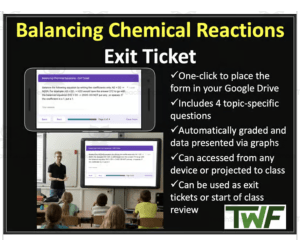
Balancing Chemical Reactions - Exit Ticket & Review Activity
Science, Chemistry, Grade 10, 11, 12, Teacher Tools, Assessments
Balancing Chemical Reactions - Digital Exit Ticket and Review Activity Assess and enhance student comprehension of core concepts with this interactive exit ticket and review. This digital resource features a series of questions that gauge understanding of essential topics covered in class including; how to balance chemical reactions and the rules for balancing chemical reactions. With a single click, this Google Form will be copied into your Google drive for easy access. You will then be able to make any changes you feel necessary and distribute out to your students. With this exit ticket, educators can: Check for student understanding of key areas. Get instant insights into students' grasp of concepts through automatically graded questions and easy-to-read results charts. Identify areas students are struggling with to refine instruction. Incorporate exit ticket data into student grades as a formative assessment . Students are able to: Demonstrate their knowledge of concepts through short answer and multiple choice questions. Get immediate feedback on their responses to support metacognition. Review core ideas before a test or the next class. This digital review resource allows teachers to quickly assess student learning outcomes related to essential principles. The automatically graded Google Form provides data visualizations that highlight comprehension gaps to address. An engaging way to end or begin a class while promoting understanding without adding to your workload as a teacher.
Author Teach With Fergy
Tags Chemical Reactions, Balancing Chemical Reactions, Rules For Balancing Chemical Reactions
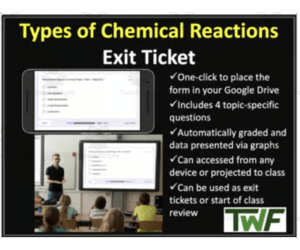
Types of Chemical Reactions - Exit Ticket and Review Activity
Science, Chemistry, Grade 9, 10, 11, Teacher Tools, Assessments
Types of Chemical Reactions - Digital Exit Ticket and Review Activity Assess and enhance student comprehension of core concepts with this interactive exit ticket and review. This digital resource features a series of questions that gauge understanding of essential topics covered in class including; the 5 Types of Reactions, Synthesis Reactions, Decomposition Reactions, Single Displacement Reactions, Thermite Reaction, Double Displacement Reactions, and Combustion Reactions. With a single click, this Google Form will be copied into your Google drive for easy access. You will then be able to make any changes you feel necessary and distribute out to your students. With this exit ticket, educators can: Check for student understanding of key areas. Get instant insights into students' grasp of concepts through automatically graded questions and easy-to-read results charts. Identify areas students are struggling with to refine instruction. Incorporate exit ticket data into student grades as a formative assessment . Students are able to: Demonstrate their knowledge of concepts through short answer and multiple choice questions. Get immediate feedback on their responses to support metacognition. Review core ideas before a test or the next class. This digital review resource allows teachers to quickly assess student learning outcomes related to essential principles. The automatically graded Google Form provides data visualizations that highlight comprehension gaps to address. An engaging way to end or begin a class while promoting understanding without adding to your workload as a teacher.
Author Teach With Fergy
Tags Chemical Reactions, Types Of Reactions, Synthesis Reactions, Decomposition Reaction, Single Displacement Reaction, Double Displacement Reaction, Combustion Reaction

Math Assessment Activity: Deep Learning
, Grade 8, 9, 10, 11, 12, Teacher Tools, Assessments
This is a math assessment activity titled Deep Learning inspired by the book AIQ by Nick Polson and James Scott.. It is a timed 40-minute assessment with "So, what if..." questions for students to complete.
Author So, what if ... by Ian F Hailes
Tags Math Assessment, Math Quiz, Deep Learning, Collaborative Inquiry, Math Tasks

The F-Word from Funny in Farsi by Dumas Speed Dating Discussion Activity!
ELA, Literature, Grade 7, 8, 9, 10, 11, 12, Teacher Tools, Assessments
The F-Word from Funny in Farsi Speed Dating Discussion Activity provides educators with a set of 12 engaging discussion prompts to help students analyze the short story "The F-Word" from Firoozeh Dumas' memoir Funny in Farsi. This interactive resource transforms a traditional class discussion into an energetic speed dating activity where students analyze the text in pairs. The laminated prompt cards can be reused and allow each student to discuss every question through timed rotations. An optional reflection activity is also included to wrap up the lesson. This versatile discussion activity works well for whole class or small group settings in grades 7-12 language arts and literature courses. The prompts delve deeply into plot, characters, themes, and personal connections to the short story.
Author The Red-Haired Reader
Tags F-word, Funny In Farsi, Short Story, Discussion, Speed Dating, Prompts, Analysis, Plot, Characters, Themes, Connections
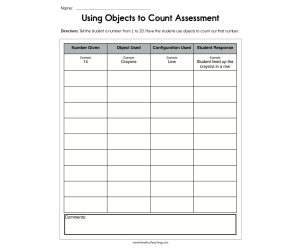
Using Objects to Count Assessment Worksheet
Math, Numbers, Addition and Subtraction, Addition, Preschool, Kindergarten, Grade 1, Teacher Tools, Assessments, Worksheets & Printables, Worksheets
Presenting the "Using Objects to Count Assessment Worksheet" - an exceptional digital educational tool created specifically for dedicated educators like yourself. This one-of-a-kind evaluation resource is aimed at fostering fundamental math skills in young students, guiding them to learn counting from 1 to 20 using everyday objects. With this engaging worksheet, students will enhance their counting fluency and build self-assurance as they advance. The product file contains an eye-catching, printable PDF worksheet that includes high-resolution images of familiar objects that children instantly connect with. Its easy-to-use design benefits both teachers and learners while working on the activity. This creative worksheet is perfect for kindergarten and early elementary instructors searching for an enjoyable, interactive method to evaluate their pupils' counting proficiencies. Incorporating this assessment sheet into your lesson plans will not only energize your teaching practices but also ignite a sense of wonder and passion among budding mathematicians. So why wait any longer? Elevate your math lessons with the "Using Objects to Count Assessment Worksheet" now! Visit https://teachsimple.com/product/using-objects-to-count- assessment -worksheet to secure this invaluable academic resource!
Author Have Fun Teaching
Tags Skip Counting
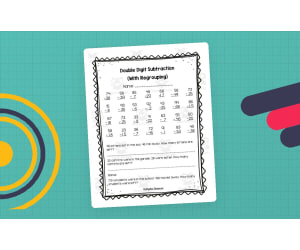
Double Digit Subtraction With Regrouping Assessment
Math, Addition and Subtraction, Subtraction, Grade 2, 3, 4, Teacher Tools, Assessments
This resource is a Double Digit Subtraction With Regrouping Assessment. It is a 1-page printable that serves as an effective assessment for students who have learned about 2-digit subtraction. There are 30 problems with the last two being world problems. A bonus problem is included.
Author Rathgeber Resources
Tags Math Assessment, 2-digit Subtraction, Regrouping, Math Homework, 2 Digit Subtraction With Borrowing, Teach Subtraction With Regrouping, Two Digit Subtraction With Regrouping, Double Digit Subtraction With Regrouping, Double Digit Subtraction, How To Teach Subtraction With Regrouping, Teaching Subtraction With Regrouping, Subtraction Double Digit, Double Digit Addition And Subtraction With Regrouping, How To Teach Double Digit Subtraction
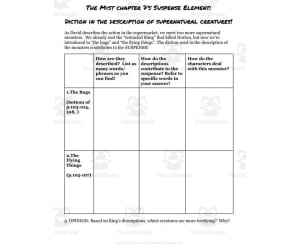
The Mist chapter 7 Suspense Element: Diction in the description of the creatures
ELA, Literature, Grade 7, 8, 9, 10, 11, 12, Teacher Tools, Assessments
Analyzing Suspense and Diction in The Mist Chapter 7\nThis educational resource helps students analyze the suspenseful diction used to describe the terrifying creatures in The Mist chapter 7. With focused questions and a chart , learners examine the specific word choices pertaining to the deaths of characters and creatures. They also inspect David's introspective scene about his painting career and the diction shifts throughout. Suitable for whole-class analysis or small group discussion, this activity promotes close reading and textual analysis skills. Students learn how an author's careful diction selections establish tone and mood while building suspense. By evaluating Stephen King's descriptive language, they gain models for enhancing their own narrative writing. This standards-aligned worksheet for grades 7-12 enhances appreciation of literary techniques in The Mist.
Author The Red-Haired Reader
Tags Diction, Suspense, Imagery, Analysis, Close Reading
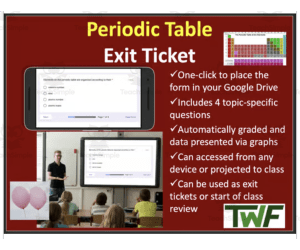
Periodic Table - Exit Ticket and Review Activity
Science, Chemistry, Grade 8, 9, 10, Teacher Tools, Assessments
Periodic Table - Digital Exit Ticket and Review Activity Assess and enhance student comprehension of core concepts with this interactive exit ticket and review. This digital resource features a series of questions that gauge understanding of essential topics covered in class including; Before the Periodic Table, Mendeléev, the Current Periodic Table, The Elements, Atomic Number, Atomic Mass, Valence Electrons, Metals, Non-Metals, and Metalloids, Columns and Families, and Rows and Periods. With a single click, this Google Form will be copied into your Google drive for easy access. You will then be able to make any changes you feel necessary and distribute out to your students. With this exit ticket, educators can: Check for student understanding of key areas. Get instant insights into students' grasp of concepts through automatically graded questions and easy-to-read results charts. Identify areas students are struggling with to refine instruction. Incorporate exit ticket data into student grades as a formative assessment . Students are able to: Demonstrate their knowledge of concepts through short answer and multiple choice questions. Get immediate feedback on their responses to support metacognition. Review core ideas before a test or the next class. This digital review resource allows teachers to quickly assess student learning outcomes related to essential principles. The automatically graded Google Form provides data visualizations that highlight comprehension gaps to address. An engaging way to end or begin a class while promoting understanding without adding to your workload as a teacher.
Author Teach With Fergy
Tags Elements, Atoms, Mendeleev, Atomic Number, Atomic Mass, Valence Electrons
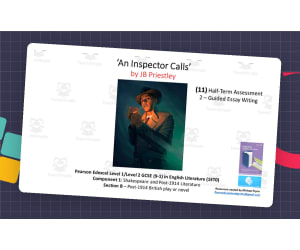
GCSE Literature: (11) ‘An Inspector Calls’ Acts 1 and 2 Assessment – Guided Essay Writing
ELA, Literature, Grade 9, 10, 11, 12, Teacher Tools, Assessments
GCSE Literature: (11) 'An Inspector Calls' Acts 1 and 2 Assessment – Guided Essay Writing This is an effective educational tool aimed to enhance students' comprehension of JB Priestley's renowned play. The resource adeptly deciphers intricate literary aspects such as class bias, gender prejudice, and societal pressure within the narrative, making them relevant and easy to grasp for young learners. Suitability and Application Suitable for grades 9 through 12 under the language arts or literature subject spectrum, this resource can be smoothly included into diverse teaching approaches. It has been successfully implemented during regular classroom instruction, distant learning sessions online, homework tasks as well as revision material. About the Resource Format & Content The PowerPoint-based teaching aid consists of a series of impressive 26 slides that measure up to approximately two hours worth of instructional time. Narratively captivating and visually intriguing, each slide is crafted meticulously to offer users an immersive learning journey. A key feature features a systematic guide to a GCSE essay writing evaluation based on the question: 'Trace the different tension levels throughout Acts 1 and 2 of the play. How does Priestley create tension?' This engaging inquiry thrusts learners into deeper critical analysis spheres while reinforcing their essay writing skills. Pedagogical Values & Ease-of-Use An important literary text assessing society’s class framework - 'An Inspector Calls' remains salient reading material reflecting contemporary global discussions around equality. Carefully curated by experienced educators understanding that instructional effectiveness lies in implementing appropriate pedagogical techniques - this educational tool aims not just dispense data but cultivate talents such as analytical thinking, persuasive argument creation & creative expression among students. Lastly, there are no additional workload burdens for teachers using this resource making it suitable in today's fast-paced classroom landscape managing several curricular demands at once.
Author Flynn's Educational
Tags GCSE Literature, An Inspector Calls, Essay Writing, Tension Analysis, Critical Analysis
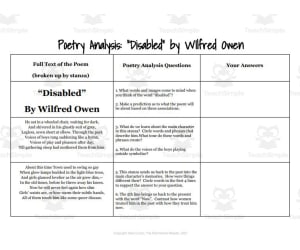
Disabled by Wilfred Owen stanza-by-stanza poetry analysis questions- Google Doc!
ELA, Literature, Grade 7, 8, 9, 10, 11, 12, Teacher Tools, Assessments
Analyzing Wilfred Owen's Impactful WWI Poem "Disabled"\nThis ready-to-use Google Doc aids students in analyzing the powerful anti-war poem "Disabled" by acclaimed World War I poet Wilfred Owen. The document scaffolds the analysis by providing the full text of the poem broken down stanza-by-stanza in the left column. The middle column poses insightful questions about the poem's diction, imagery, figurative language, characterization, theme, tone, symbolism, foreshadowing and plot. Students respond to questions in the right column. A detailed answer key at the bottom assists educators in assessing student understanding. This multifaceted analysis encourages rich discussion and deep understanding of this haunting poem and its themes related to the physical and psychological impacts of war.
Author The Red-Haired Reader
Tags Owen Disabled Analysis, War Poem Questions, Wwi Antiwar Poem, Disabled Wilfred Owen, Poem Analysis Scaffold

Text Features Assessment
ELA, Grammar, Grade 2, 3, 4, Teacher Tools, Assessments
This is a Text Features Assessment that will have students draw a line from the text feature to the picture that matches it.
Author O'Hoppy Day
Tags Text Features, Assessment, Table Of Contents, Grammar
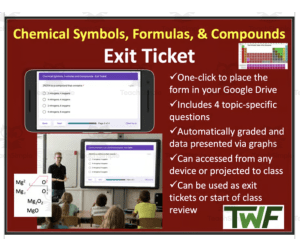
Chemical Symbols, Formulas, Compounds -Exit Ticket and Review Activity
Science, Chemistry, Grade 8, 9, 10, Teacher Tools, Assessments
Chemical Symbols, Formulas, and Compounds - Digital Exit Ticket and Review Activity Assess and enhance student comprehension of core concepts with this interactive exit ticket and review. This digital resource features a series of questions that gauge understanding of essential topics covered in class including; Symbols, Element Names, Counting Atoms, Naming Compounds, Combining Capacity, Building a Molecule, Criss-Cross Rule, and Naming Compounds. With a single click, this Google Form will be copied into your Google drive for easy access. You will then be able to make any changes you feel necessary and distribute out to your students. With this exit ticket, educators can: Check for student understanding of key areas. Get instant insights into students' grasp of concepts through automatically graded questions and easy-to-read results charts. Identify areas students are struggling with to refine instruction. Incorporate exit ticket data into student grades as a formative assessment . Students are able to: Demonstrate their knowledge of concepts through short answer and multiple choice questions. Get immediate feedback on their responses to support metacognition. Review core ideas before a test or the next class. This digital review resource allows teachers to quickly assess student learning outcomes related to essential principles. The automatically graded Google Form provides data visualizations that highlight comprehension gaps to address. An engaging way to end or begin a class while promoting understanding without adding to your workload as a teacher.
Author Teach With Fergy
Tags Elements, Chemical Symbols, Element Names, Counting Atoms, Naming Compounds, Combining Capacity, Criss-cross Rule

FREE Math Attitude and Interest Survey for Elementary Students (Grades 2-5)
, Grade 3, 4, 5, Worksheets & Printables, Word Problems, Teacher Tools, Assessments
Discover Your Students' Attitudes Toward Math with this Free Survey for Grades 2-5\nThis free Math Attitude and Interest Survey allows elementary school teachers to quickly evaluate their students' perspectives on math at the beginning and end of the school year. The survey contains over a dozen agree/disagree statements written at an early to late elementary reading level. Students simply reflect on their feelings about math by responding to each prompt. Teachers can use the results to understand potential negative outlooks and chart positive growth over the course of the year. Comparing the initial and end-of-year surveys often reveals encouraging improvements in students' confidence with numbers. This one-page resource provides an efficient snapshot of class trends that guides instructional approaches. It's an easy tool to implement individually, in small groups, or with the whole class.
Author Beyond Traditional Math
Tags Math Attitude, Student Survey, Math Confidence

The Particle Theory of Matter - Exit Ticket and Review Activity
Science, Chemistry, Grade 8, 9, 10, Teacher Tools, Assessments
The Particle Theory of Matter - Digital Exit Ticket and Review Activity Assess and enhance student comprehension of core concepts with this interactive exit ticket and review. This digital resource features a series of questions that gauge understanding of essential topics covered in class including; The 5 Particle Theory Rules, Matter review, Pure Substances, Elements & Compounds, Mixtures, and Homogeneous & Heterogeneous. With a single click, this Google Form will be copied into your Google drive for easy access. You will then be able to make any changes you feel necessary and distribute out to your students. With this exit ticket, educators can: Check for student understanding of key areas. Get instant insights into students' grasp of concepts through automatically graded questions and easy-to-read results charts. Identify areas students are struggling with to refine instruction. Incorporate exit ticket data into student grades as a formative assessment . Students are able to: Demonstrate their knowledge of concepts through short answer and multiple choice questions. Get immediate feedback on their responses to support metacognition. Review core ideas before a test or the next class. This digital review resource allows teachers to quickly assess student learning outcomes related to essential principles. The automatically graded Google Form provides data visualizations that highlight comprehension gaps to address. An engaging way to end or begin a class while promoting understanding without adding to your workload as a teacher.
Author Teach With Fergy
Tags Elements, Particle Theory, Matter, Pure Substances, Mixtures, Compounds, Homogeneous, Heterogeneous