



3,890 products added recently
Page 104 - 8th Grade Lesson Plans
Equip your eighth graders with the knowledge and skills needed for high school success using these lesson plans. Focused on advanced concepts and independent learning, these resources help students take ownership of their education. Implement them to ensure your students are ready for the next step.

 Show filters

Financial Literacy Unit: Borrowing (Loans, Interest Rates, and Credit Scores)
Life Studies, Finance, Grade 7, 8, 9, 10, 11, 12, Lesson Plans, Teacher Tools
Teaching Financial Literacy: Responsible Borrowing\nThis 30+ page financial literacy teaching resource equips students with essential knowledge on responsible borrowing. The informative presentation slides and accompanying student packet cover key topics like loans, credit scores, interest rates, and the role of the Federal Reserve. Discussion questions encourage reflection on responsible financial behaviors. Educators can use this versatile resource in whole-class instruction, small group activities, or independent assignments. The non-technical explanation of financial concepts allows students to comprehend real-world topics like mortgages, public and private student loans, and factors impacting credit scores. By demystifying complex financial systems, this teaching resource empowers students with fundamental personal finance skills as they approach adulthood. The clear, concise content is presented at an accessible grade 7-8 reading level.
Author Ed Dynamic
Tags Loans, Credit, Interest, Financial Literacy, Borrowing
I WONDER - How Is The Nile Important To Egypt | Animated Video Lesson
History: Ancient, History, Social Studies, History: African, Grade 3, 4, 5, 6, 7, 8, 9, Lesson Plans, Teacher Tools
Video Introduction An amazing video designed for the students to learn more about famous places in different countries. I WONDER - How Is The Nile Important To Egypt | Animated Video Lesson Do you like geography?! Let's discover this amazing place and know more about its unique stories. Have you ever visited a unique place or a different country than yours? If yes, tell us about it! If no, tell us what kind of places you would like to visit in the future? Every country has it's own story tell us the story about your country: Where it is located? And when it has been established? I WONDER - How Is The Nile Important To Egypt | Animated Video Lesson The activity is perfect for encouraging the researching skills for the students, while learning more about this fantastic place. I WONDER - How Is The Nile Important To Egypt | Animated Video Lesson This friendly designed video is suitable for students at school, homeschooling, and as a group activity. Format Available in MP4 format.
Author Educational Voice
Rating
Tags How Is The Nile Important To Egypt, The Nile River, The Nile River Facts, The Nile River Video, The Nile River Facts For Kids, The Nile River Video For Kids, Egypt, Egypt Facts, Egypt Video, Egypt Facts For Kids
I WONDER - What Is A Siege | Animated Video Lesson
History: Ancient, History, Social Studies, History: Asian, History: Europe, History: World, History: British, History: African, Grade 6, 7, 8, 9, 10, 11, 12, Lesson Plans, Teacher Tools
Video Introduction An amazing video designed for the students to learn more about history. I WONDER - What Is A Siege | Animated Video Lesson Do you like history? Which topic do you really enjoy about history? Have you ever read an interesting fact about the Vikings? If yes, can you mention them? What do you like most about the Victorian era? Can you name all the Tudors? Have you ever wondered how people used to live in ancient Japan and ancient China? Do you know any interesting facts about ancient Egyptians and the Pharaohs? Have you ever visited South America? What do you know about Incas and Aztecs? Celtic culture was really one of a kind, can you name any of the places that Celts used to live in? Imagine yourself living during the ancient Roman empire, how your life will look like? Ancient Greece was an amazing place to live in. What do you know about ancient Greek life? I WONDER - What Is A Siege | Animated Video Lesson The video is perfect for encouraging the researching skills for the students, while learning more about history. I WONDER - What Is A Siege | Animated Video Lesson This friendly designed video is suitable for students at school, homeschooling, and as a group activity. Format Available in MP4 format.
Author Educational Voice
Tags What Is A Siege, What Is A Siege Video, Siege, Siege Facts, Siege Video, Siege Facts For Kids, Siege Video For Kids, Castle Siege, Castle Siege Video, Castle Siege Facts

8th Grade Science Diagnostic Assessment & Review System
Science, Grade 8, Assessments, Teacher Tools, Lesson Plans, Worksheets & Printables
Start the year with a clear picture of student readiness using this 8th grade beginning of year science assessment and targeted skills system. With a 50-question diagnostic worth 114 points , scoring and analysis tools, instructional grouping support, 11 targeted follow-up practice pages , scientific reading passages, CER tasks, and complete explained answer keys, this resource helps teachers move from assessment results to focused instruction. Designed as a complete Assess → Analyze → Group → Review → Reteach system, this Grade 8 science resource emphasizes the reasoning demands students need as they prepare for high school science. Students analyze multi-step problems, real-world scenarios, data tables, experimental setups, scientific models, graphs, reading passages, and Claim-Evidence-Reasoning tasks across Life Science, Physical Science, Earth & Space Science, and Scientific Practices & Reading . What’s Included This 8th grade science assessment and review system includes: ✅ 50-question beginning-of-year science diagnostic ✅ 114 total assessment points ✅ Life Science questions ✅ Physical Science questions ✅ Earth & Space Science questions ✅ Scientific Practices & Reading questions ✅ Multiple-choice questions ✅ Short-answer questions ✅ Diagram and model interpretation ✅ Data tables ✅ Graph reading ✅ Multi-step reasoning tasks ✅ Scientific scenarios ✅ Vocabulary-in-context questions ✅ Claim-Evidence-Reasoning (CER) tasks ✅ 2 short scientific reading passages ✅ Evidence-based reading questions ✅ Pedigree interpretation ✅ Natural selection and adaptation analysis ✅ Finch selection data ✅ Cladogram interpretation ✅ Predator-prey data ✅ Periodic table patterns ✅ Chemical equation reasoning ✅ Conservation of mass data ✅ Velocity-time graph analysis ✅ Wave anatomy ✅ Transverse and longitudinal wave comparison ✅ Electromagnetic spectrum interpretation ✅ Seafloor-spreading model ✅ Spreading-rate calculation ✅ Star life-cycle model ✅ Atmospheric CO₂ graph analysis ✅ Experimental design and reliability ✅ Mean and outlier analysis ✅ Two-series graph interpretation ✅ Answer recording sheet ✅ Quick-reference answer key ✅ Skill-by-skill scoring chart ✅ Strand analysis tool ✅ Secure, Developing, and Needs Support performance bands ✅ Individual Student Performance Profile ✅ Whole-class data tracker ✅ Suggested instructional groups ✅ 11 targeted follow-up science practice pages ✅ “Key Concept” refresher on every follow-up page ✅ “Extension” task for students who are Secure ✅ All-new follow-up practice with no repeated assessment questions ✅ Reading-for-evidence follow-up practice ✅ CER writing follow-up practice ✅ Complete answer keys ✅ Suggested short-answer responses ✅ Suggested reading-response answers ✅ Completed visual and diagram answers ✅ Sample CER responses ✅ Short “why” explanation for every assessment item ✅ Partial-credit guidance Part 1 contains 50 rigorous mixed-format questions worth 114 total points . The Teacher Guide recommends two 45-minute sessions and explains that the diagnostic emphasizes multi-step reasoning, evidence-based conclusions, data tables, experimental setups, model interpretation, and reading scientific text for evidence. Part 2 turns student responses into actionable data with an answer recording sheet, quick-reference key, skill-by-skill scoring chart, strand analysis, performance bands, individual student profiles, a whole-class data tracker, and suggested instructional groups. Part 3 includes 11 ready-to-assign targeted follow-up pages with all-new practice. Every page includes a concise Key Concept refresher and an Extension task, and the set includes dedicated pages for Reading Science for Evidence and CER Writing . Part 4 provides correct answers for all 50 questions, explanations of why answers are correct, suggested responses for short-answer and reading tasks, completed diagrams, sample CER responses, and partial-credit guidance. How It Works in the Classroom Use this 8th grade beginning of year science assessment during the first weeks of school to identify what students retained from prior science learning, how well they reason through multi-step problems, and where instruction should begin. The resource follows a practical five-step system: 🔎 Assess — Students complete the 50-item mixed-format science diagnostic 📊 Analyze — Score by skill and strand to identify patterns and gaps 👥 Group — Form targeted instructional groups based on shared needs 📝 Review — Assign focused follow-up practice by strand or skill 🎯 Reteach — Use complete explanations, worked visuals, and model CER responses to support next steps The Assess → Reteach System chart on page 2 of Part 1 directly connects each stage to the matching component of the four-part resource. The same page summarizes the 50 questions, 114 points, broad format range, four reporting areas, two scientific reading passages, and suggested administration time. Use this resource for: ⭐ Beginning-of-year science assessment ⭐ 8th grade science diagnostic ⭐ Middle school science pre-assessment ⭐ Back-to-school science review ⭐ High school science readiness ⭐ Science readiness check ⭐ Formative assessment ⭐ Small-group planning ⭐ Science intervention ⭐ Targeted reteaching ⭐ Data-driven instruction ⭐ Skill-based grouping ⭐ Independent follow-up practice ⭐ Science stations ⭐ CER practice ⭐ Reading in science ⭐ Text-evidence practice ⭐ Graph and data interpretation ⭐ Multi-step science reasoning The Scoring at a Glance chart on page 2 of Part 2 breaks the assessment into four strand totals: Life Science /31, Physical Science /40, Earth & Space Science /24, and Scientific Practices /19 , for 114 total points . It also defines three performance bands: Secure (80%–100%) , Developing (50%–79%) , and Needs Support (below 50%) . The Student Performance Profile on page 15 of Part 2 gives teachers a one-page strand snapshot with space for strengths, focus areas, assigned Part 3 practice pages, and group placement. The Class Data Tracker on page 16 provides a whole-class view so teachers can scan columns for class-wide gaps and rows for individual grouping needs. Standards & Learning Goals This eighth grade science diagnostic assessment reviews foundational science concepts and advanced scientific reasoning across four major areas: 🌱 Life Science — levels of biological organization, homeostasis, interacting body systems, pedigrees, mutations, natural selection, evolution, adaptations, selection pressure, inheritance, cladograms, common ancestry, predator-prey relationships, biodiversity, ecosystem resilience, and evolution CER reasoning ⚛️ Physical Science — periodic table patterns, atomic number, protons, groups and periods, valence electrons, periodic trends, balancing chemical equations, conservation of mass, open and closed systems, exothermic and endothermic reactions, velocity-time graphs, Newton’s second law, kinetic energy, potential and kinetic energy transformations, wave anatomy, transverse and longitudinal waves, wavelength and frequency, electromagnetic spectrum, and wave-energy transfer 🌎 Earth & Space Science — seafloor spreading, magnetic stripes, evidence for plate tectonics, mantle convection, spreading-rate calculations, star life cycles, gravity and orbits, light-years, tides, atmospheric CO₂ trends, and Earth-and-space CER reasoning 🔬 Scientific Practices & Reading — reliable experimental design, repeated trials, control groups, identifying experimental flaws, graph analysis, comparing data series, calculating means, identifying outliers, reading scientific texts for evidence, connecting evidence to science concepts, drawing evidence-based conclusions, and reading-based CER Students demonstrate understanding through varied science tasks rather than one question type. The diagnostic includes a pedigree , finch beak-depth data , cladogram , natural-selection sequence , predator-prey table , periodic table model , Group 1 reactivity data , open-versus-sealed reaction mass data , velocity-time graph , wave anatomy model , wave-type comparison , electromagnetic spectrum , seafloor-spreading diagram , seafloor age data , Sun-like star life cycle , atmospheric CO₂ graph , bacteria-growth comparison graph , and repeated-trial data analysis. The Skill-by-Skill Scoring Chart on pages 11–13 of Part 2 helps teachers pinpoint specific gaps instead of relying only on one overall score. Skills include homeostasis, pedigrees, mutations, natural selection, selection data, cladograms, adaptation, biodiversity, periodic patterns, valence electrons, balancing equations, conservation of mass, exothermic and endothermic reactions, motion graphs, Newton’s second law, kinetic energy, wave anatomy, wave types, electromagnetic spectrum, seafloor spreading, tectonic evidence, spreading rates, star life cycles, gravity and orbits, experimental reliability, identifying flaws, mean and outlier analysis, reading for evidence, and reading-based CER. A particularly valuable feature is the integration of science literacy . Part 1 includes two short scientific texts with evidence-based questions. Students read “Why Antibiotics Can Stop Working” to connect mutation, survival, reproduction, and antibiotic resistance to natural selection, and “Healing the Ozone Layer” to analyze evidence connected to CFC reduction and ozone recovery. Why Teachers Love It ✨ Move beyond a single test score. Results can be analyzed by strand and individual skill, helping teachers see exactly where students are secure and where review is needed. ✨ Prepare students for high school science reasoning. The Teacher Guide explicitly emphasizes multi-step problems, evidence-based conclusions, data tables, experimental setups, model interpretation, and scientific reading—the kinds of demands students increasingly encounter in advanced science coursework. ✨ Turn assessment data into an instructional plan. The scoring tools connect results to performance bands, student profiles, instructional groups, and targeted follow-up practice instead of leaving teachers with a stack of completed tests. ✨ Measure both science knowledge and reasoning. Students do more than recall vocabulary. They interpret models, calculate rates, compare data, explain mechanisms, evaluate evidence, analyze graphs, and justify conclusions. ✨ Integrate science and reading skills. Two short scientific passages ask students to cite evidence, connect text details to science concepts, interpret measured changes, and construct evidence-based responses. ✨ Use relevant scientific topics for reading practice. Students analyze antibiotic resistance and ozone-layer recovery, connecting real scientific evidence to natural selection, environmental change, and evidence-based reasoning. ✨ Strengthen evolution and natural selection understanding. Students work with finch data, beetle camouflage, selection pressure, adaptation, inheritance, cladograms, mutations, and CER reasoning. ✨ Build readiness for chemistry concepts. Students interpret periodic table patterns, atomic numbers, valence electrons, reactivity trends, balanced equations, conservation of mass, and exothermic versus endothermic reactions. ✨ Strengthen physics reasoning. Students analyze velocity-time graphs, apply F = m × a , reason about kinetic energy, explain potential-to-kinetic energy transformations, interpret wave features, compare transverse and longitudinal waves, and analyze the electromagnetic spectrum. ✨ Connect Earth science models to quantitative reasoning. Students interpret seafloor spreading, use age-and-distance data to calculate a spreading rate, analyze magnetic-stripe evidence, and connect mantle convection to plate movement. ✨ Support data-driven small groups. Part 2 includes suggested instructional groups that help teachers sort students by shared gaps and connect them to matching Part 3 practice. ✨ Differentiate with clear performance bands. Use Secure, Developing, and Needs Support ranges to guide enrichment, targeted practice, or foundational small-group reteaching. ✨ Assign only the review students need. The 11 targeted follow-up pages include: Cells & Genetics Review Evolution & Adaptation Review Ecosystems Review Atoms & Reactions Review Forces, Energy & Motion Review Waves Review Plate Tectonics & Earth Systems Review Space Science Review Experimental Design & Data Review Reading Science for Evidence Review CER Writing Review The Practice Page Menu on page 2 of Part 3 directly matches common student difficulties to specific follow-up pages, making targeted assignment faster. ✨ Refresh key concepts before practice. Every targeted page includes a concise Key Concept section. For example, the Atoms & Reactions page reviews atomic number, groups, periods, conservation of mass, and exothermic versus endothermic reactions before students begin fresh practice. ✨ Extend learning for students who are already secure. Every follow-up page includes an Extension task that pushes students into explanation, application, prediction, argument, or investigation design. ✨ Use fresh follow-up practice instead of repeating the diagnostic. Part 3 explicitly provides all-new practice so students can demonstrate understanding with new examples and situations. ✨ Teach students how to read science for evidence. The dedicated Reading Science for Evidence Review page includes a new passage about a warming mountain lake and changing trout and bass populations. Students identify evidence, explain biological relationships using the text, connect the passage to life science, and generate a testable follow-up question. ✨ Build stronger Claim-Evidence-Reasoning responses. CER appears throughout the diagnostic and receives its own targeted follow-up page. At Grade 8, students are expected to connect specific evidence to a named scientific principle rather than simply restating the data. ✨ Make grading more manageable. Part 4 provides correct answers, short explanations of why, suggested responses for open-ended and reading items, completed diagrams, sample CER responses, and partial-credit guidance. ✨ Use completed diagrams for faster checking. The Completed Diagrams Quick View on page 2 of Part 4 points teachers to fully worked versions of the pedigree, cladogram, natural-selection model, periodic table, wave anatomy, wave types, electromagnetic spectrum, seafloor spreading, and star life cycle. ✨ Score open-ended work more consistently. Part 4 explains that multi-part items can receive point-by-point partial credit and that CER and reading items should be evaluated for a reasonable claim, specific text or data evidence, and reasoning that links them. ✨ Keep the instructional loop connected. Assessment, analysis, grouping, targeted review, science literacy practice, reteaching, and answer support are designed as one coordinated system rather than disconnected activities. Start the year knowing what students understand, how well they reason through complex science tasks, and what they need next with this 8th grade beginning of year science assessment . Download this complete middle school science diagnostic and targeted review system to assess readiness, analyze results by strand and skill, create focused instructional groups, assign specific follow-up practice, strengthen science reading and CER writing, and support reteaching with complete explained answer keys. Perfect for teachers searching for an 8th grade science diagnostic assessment , beginning-of-year science review, middle school science pre-assessment, back-to-school science assessment, eighth grade science review, high school science readiness, Life Science review, Physical Science review, Earth and Space Science review, Scientific Practices assessment, genetics, pedigrees, natural selection, evolution, cladograms, ecosystems, periodic table, chemical reactions, conservation of mass, Newton’s laws, forces and motion, energy transformations, waves, electromagnetic spectrum, plate tectonics, seafloor spreading, star life cycles, experimental design, graph analysis, reading science for evidence, CER practice, science intervention, small-group science planning, data-driven instruction, or targeted science reteaching.
Author Bright Classroom Ideas Marketplace
Rating
Tags Science, Assessment, Worksheet, Back To School, Review

Pixel Art Video Game Design - Lesson 3
Creative Arts, Art, Graphic Arts, Grade 7, 8, 9, 10, Teacher Tools, Lesson Plans
As you introduce and review new topics with your art students, you may want to ensure that you have quality resources that will allow them to express their understanding of the concept. Art can be concrete and abstract simultaneously! Because of this, we want to assess mastery in the best ways we know how. We can do this when we present hands-on and engaging lessons and instruction to our students. This is a Pixel Art Lesson on Video Game Design. It is an editable presentation that can be accessed through Microsoft or Google. It consists of 10 slides. The objective is for students to be able to code their own video game with the use of art and graphics. The presentation breakdown is as follows: Slides 2-4. Students will view 3 different images and answer the question: What element of art is being used to create the illusion of depth in these landscape backgrounds? Slide 5. Students will view 3 different images and answer the question: What do all 3 these games have in common in their art style? Slide 6. Students will watch a YouTube video on How to Make a Simple Tile Set. Slide 7. Information and reminders for students’ work period. Slide 8. Student assignment. Slide 9. Pixel Art rubric. Slide 10. Useful Pixel Art tutorial links. This can be used with middle and high school art students. I hope you enjoy! Here are similar resources for you to enjoy: https://teachsimple.com/product/agamograph-self-reflection-form https://teachsimple.com/product/social-story-for-safe-hands-and-feet https://teachsimple.com/product/addition-matching-velcro-activity https://teachsimple.com/product/abstract-form-lesson-activity You can visit my storefront here: https://teachsimple.com/contributor/resource-garden I can be contacted for questions and concerns at nicole.maizelis@gmail.com .
Author Resource Garden
Tags Art Rubrics, Video Game Design, Graphic Art, Art Lesson, Pixel Art, Small Group, Art Vocabulary, Tutorials, Abstract Art, Assessment
I WONDER - Who Was Odin | Animated Video Lesson
History: Ancient, History, Social Studies, History: Europe, Grade 3, 4, 5, 6, 7, 8, 9, Lesson Plans, Teacher Tools
Video Introduction An amazing video designed for the students to learn more about mythological creatures in different cultures. I WONDER - Who Was Odin | Animated Video Lesson Do you know who are mermaids and what they look like? How do you think they have been created and in which mythology we can find them? Have you ever read about Cerberus the dog with three faces? If yes, tell us where it lived and what was its job? How did Minotaur look like? Did it has a unique story to tell from the Greek mythology? Why do people love to put gnomes in their gardens? In which mythology we can find them? Do you know that not all dragons are same some dragons are really scary and some can bring good luck. So let's discover the difference between the western dragons and Chinese dragons. Tell us which ones do you prefer? I WONDER - Who Was Odin | Animated Video Lesson The video is perfect for encouraging the creativity skills for the students, while learning more about this fantastic mythical creature. I WONDER - Who Was Odin | Animated Video Lesson This friendly designed video is suitable for students at school, homeschooling, and as a group activity. Format Available in MP4 format.
Author Educational Voice
Rating
Tags Who Was Odin, Odin, Odin Facts, Facts About Odin, Odin Video, Odin Video For Kids, Odin Facts For Kids, Viking Gods, Viking Gods Facts, Viking Gods Facts For Kids

I WONDER - What Is A Lever | Animated Video Lesson
Physics, Science, Grade 6, 7, 8, 9, 10, 11, 12, Lesson Plans, Teacher Tools
Video Introduction An amazing video designed for the students to learn more about STEM. I WONDER - What Is A Lever | Animated Video Lesson Do you like STEM subjects? what is your favorite one? Have you ever tried to plant a seed? If yes, tell us more about it. Or have you ever tried to invent something? If yes, tell us more about it. And how do you think it will help us? Have you ever seen a microorganism under a microscope? What was it? And how it looked like? Mathematics is a marvelous subject. Let' sharpen our brains and solve some equations. Do you like timetable tricks? What is your favorite one? Do you know how to code? Have you ever created an app or a game before? If yes, how was it like? I WONDER - What Is A Lever | Animated Video Lesson The video is perfect for encouraging the researching skills for the students, while learning more about this fantastic topic. I WONDER - What Is A Lever | Animated Video Lesson This friendly designed video is suitable for students at school, homeschooling, and as a group activity. Format Available in MP4 format.
Author Educational Voice
Tags What Is A Lever, What Is A Lever Video, Lever, Lever Facts, Lever Facts For Kids, Lever Facts Video For Kids, Lever Video, Lever Video For Kids, Physics, Physics Facts

Ghosts Mentor Text mini-unit • Poetry of Place: Searching for Setting
ELA, Writing, Grade 4, 5, 6, 7, 8, Lesson Plans, Teacher Tools
The Ghosts Mentor Text mini- unit • Poetry of Place: Searching for Setting in the World Around You Developed with the subject line of Language Arts, specifically targeting Writing skills, it is apt for Grades 4-8. This resource leans into Raina Telgemeier’s Ghosts to unravel the concept of setting in storytelling. Main Features: Graphic Novel Excerpts: Embellished with graphic novel excerpts that fuel participative learning. Multimedia Resources: 'Dia de los Muertos' video which further deepen students' understanding. Tone & Traits Infographics: Infographic on Tone & Traits catering to each learner's unique style. Vocabulary Development Tools: Word Banks aid vocabulary expansion and ensure usage accuracy. Innovative Additions Include : A unique Rule of Story Slideshow that bridges theoretical learning with practical application. This can make classroom sessions lively; be it small group or whole group discussions or even taken as homework instruction prompts. The "Like Life: Writing Inspired by Real Events" section serves as scaffolds guiding your pupils through drafting their stories. This includes: -Hyperlinked student samples that model masterful application. -Approaches celebrated authors have adopted. The entire gamut comes as a PDF containing links to fully editable Google Docs, offering unparalleled freedom to tailor elements per your teaching agenda. From differentiated instruction pathways catering educators globally across public school teachers to homeschoolers alike, this resource makes poetry tangible and enjoyable for students.
Author Room2Ruminations
Tags Ghosts, Mentor Text, Poetry Of Place, Writing Techniques, Setting In Storytelling

Curriculum Mapping Bundle K-8th
, Preschool, Grade 1, 2, 3, 4, 5, 6, 7, 8, Lesson Plans, Teacher Tools
This is a Curriculum Mapping Bundle K-8th. It covers all math, language arts and science standards for grades Kindergarten through 8. This is an Excel file that is fully editable for you to adjust to meet your needs.
Author DK's Creations
Tags Standards, Administrators, Curriculum Maps, Science, Cross-curricular
I WONDER - What Is An Ecosystem | Animated Video Lesson
Environmental Science, Earth and Environmental Sciences, Science, Grade 3, 4, 5, 6, 7, 8, 9, Lesson Plans, Teacher Tools
Video Introduction An amazing video designed for the students to learn more about STEM. I WONDER - What Is An Ecosystem | Animated Video Lesson Do you like STEM subjects? what is your favorite one? Have you ever tried to plant a seed? If yes, tell us more about it. Or have you ever tried to invent something? If yes, tell us more about it. And how do you think it will help us? Have you ever seen a microorganism under a microscope? What was it? And how it looked like? Mathematics is a marvelous subject. Let' sharpen our brains and solve some equations. Do you like timetable tricks? What is your favorite one? Do you know how to code? Have you ever created an app or a game before? If yes, how was it like? I WONDER - What Is An Ecosystem | Animated Video Lesson The video is perfect for encouraging the researching skills for the students, while learning more about this fantastic topic. I WONDER - What Is An Ecosystem | Animated Video Lesson This friendly designed video is suitable for students at school, homeschooling, and as a group activity. Format Available in MP4 format.
Author Educational Voice
Tags What Is An Ecosystem, What Is An Ecosystem Video, Ecosystem, Ecosystems, Ecosystem Facts, Ecosystem Facts For Kids, Ecosystem Video, Ecosystem Video For Kids, Ecosystems Facts
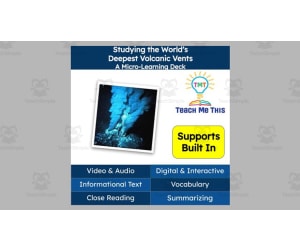
The World's Deepest Volcanic Vents | Interactive Science Lesson | Micro-Learning Deck
Science, Earth and Environmental Sciences, Earth Sciences, Grade 7, 8, 9, 10, Teacher Tools, Lesson Plans
This micro-learning deck is the perfect accessory to your Science instruction! This digital slideshow presents Studying the World's Deepest Volcanic Vents. Within this slideshow, you will receive: -Video Lesson -Reading Passage w/ Audio -Close Reading -Quick Write The informational texts included in this resource alongside the informal assessments will keep your students engaged from beginning to end.
Author Teach Me This
Tags Studying Volcanoes, Volcanic Vents, Science Lesson, Earth Sciences, Vocabulary

I WONDER - What Is Sutton Hoo | Animated Video Lesson
History: Ancient, History, Social Studies, History: British, History: Europe, Grade 3, 4, 5, 6, 7, 8, 9, Lesson Plans, Teacher Tools
Video Introduction An amazing video designed for the students to learn more about history. I WONDER - What Is Sutton Hoo | Animated Video Lesson Do you like history? Which topic do you really enjoy about history? Have you ever read an interesting fact about the Vikings? If yes, can you mention them? What do you like most about the Victorian era? Can you name all the Tudors? Have you ever wondered how people used to live in ancient Japan and ancient China? Do you know any interesting facts about ancient Egyptians and the Pharaohs? Have you ever visited South America? What do you know about Incas and Aztecs? Celtic culture was really one of a kind, can you name any of the places that Celts used to live in? Imagine yourself living during the ancient Roman empire, how your life will look like? Ancient Greece was an amazing place to live in. What do you know about ancient Greek life? I WONDER - What Is Sutton Hoo | Animated Video Lesson The video is perfect for encouraging the researching skills for the students, while learning more about history. I WONDER - What Is Sutton Hoo | Animated Video Lesson This friendly designed video is suitable for students at school, homeschooling, and as a group activity. Format Available in MP4 format.
Author Educational Voice
Tags What Is Sutton Hoo, What Is Sutton Hoo Video, Sutton Hoo, Sutton Hoo Video, Sutton Hoo Video For Kids, Sutton Hoo Facts, Sutton Hoo Facts For Kids, United Kingdom, British History

ESL EFL TESOL TEFL Lesson Plan on the traditional British Breakfast
ELA, Language Development, ESL, Writing, Grade 8, 9, 10, 11, 12, Teacher Tools, Lesson Plans
Intermediate ESL EFL TESOL TEFL PDF Lesson Plan on the traditional British Breakfast (teens mainly) This Amazing PDF ESL, EFL, TESOL Writing Activity Lesson Plan is great to train Language skills in English. Potential learners for this ESl, EFL, TESOL Activity can be High Schoolers (teens) and Higher Education Learners too. This English as a Second Language Educational Product is suitable for ESL, EFL, TESOL, TEFL Centers Abroad or any English as a second language tutor or private Teacher, educator (be it online, be it offline). This Stimulating PDF ESL, EFL, TESOL, TEFL Lesson Plan (8 pages, slides) includes: a brief Introduction to Breakfast in Great Britain a QR CODE-Linked YouTube Video on the Traditional British Breakfast Essay Prompts on the Importance of Breakfast itself, British Breakfast and other kinds of Breakfast around the Globe Cell phones (and other electronic devices) are employed for this PDF (printable) ESL, EFL, TESOL, TEFL Activity for Educational, Learning Purposes Only PS: QR-CODES can be great to make our Students' Learning Process available ANYWHERE and ANYTIME they want (repeated listening does matter when it come English as a Second Language acquisition)! This Amazing Intermediate ESL, EFL, TESOL, TEFL PDF (printable) Teaching Resource (8 Pages lesson Plan) is great for English as a second language learners. It aims to help ESL, EFL students to improve their English as a second language Writing skills + Listening skills ESL with Alan is a Brand New ESL, EFL, TESOL, TEFL Store that aims to help English as a Second Language Teachers, Educators and Tutors (be it online or offline) to achieve their teaching objectives while creating a fun and stimulating environment. Never Forget! Learning is fun, So should English! For Further PDF ESL, EFL, TESOL, TEFL Teaching Resources, click here ESL with Alan!
Author Learning with Alan
Tags ESL, EFL, TESOL, TEFL, British, Culture, Teens, Lesson Plan, Activities, Writing
Making Minimum Wage Linear Functions: Week-Long Math Lesson Plans
Math, Algebra, Common Core, Grade 8, 9, 10, 11, 12, Teacher Tools, Lesson Plans
Engage your students with this five day math lesson plan about making minimum wage in the United States! For just the cost of workingone hourat minimum wage (depending on your state) you'll have a week's worth of engaging lesson plans to contextualize linear functions and what they actually MEAN for both your ELLs and your native English speakers. This lesson was designed using sheltered language strategies, including: •Content and language objectives •An Anticipation Guide •Think-Write-Pair-Share prompts • Graphic Organizers •Scaffolded Exit Tickets with sentence frames Intended grade level/Common Core State Standards: -This lesson plan targets linear functions and is appropriate for students working with 8th grade math standards and above. -Targeted CCSS include: 8.F.A.2, 8.F.A.3, 8.F.B.4, 8.EE.B.5, 8.EE.C.7.B, HSA.CED.A.1, HSA.CED.A.2, HSA.REI.B.3, HSF.IF.B.4, HSF.IF.C.7.A, HSF.LE.A.2. Student math background needed: In order to access this lesson plan as written, students will need to be familiar with the basics of linear functions including concepts like slope, y-intercept, and the slope-intercept form of a linear equation. It would be possible to teach those concepts at the same time as teaching this lesson. Summary of Lesson Plans : (about 60 min per day) Day 1: Build background knowledge and compare minimum wage in different parts of the U.S. using tables and graphs. Day 2: Analyze graphs and introduce the concept of living expenses in the context of making minimum wage and modeling with linear functions. Day 3: Create tables and graphs that focus on linear functions and modeling using the estimated living expenses for a single person in your area Day 4: Extend the context to include living expenses for a single parent with one dependent child. Students complete a work sample-style task while writing and solving a linear function. Day 5: Students work to estimate a reasonable “living wage” using estimated expenses and constraining the work week to 40 hours. A practice work sample is included for this day.
Author Sheltered Language Resources
Tags Math Lesson Plans, Algebra Lesson Plans, Minimum Wage Lesson, Linear, Functions

I WONDER - What Did Knights Do | Animated Video Lesson
History: Ancient, History, Social Studies, History: British, History: Europe, History: World, Grade 4, 5, 6, 7, 8, 9, 10, Lesson Plans, Teacher Tools
Video Introduction An amazing video designed for the students to learn more about history. I WONDER - What Did Knights Do | Animated Video Lesson Do you like history? Which topic do you really enjoy about history? Have you ever read an interesting fact about the Vikings? If yes, can you mention them? What do you like most about the Victorian era? Can you name all the Tudors? Have you ever wondered how people used to live in ancient Japan and ancient China? Do you know any interesting facts about ancient Egyptians and the Pharaohs? Have you ever visited South America? What do you know about Incas and Aztecs? Celtic culture was really one of a kind, can you name any of the places that Celts used to live in? Imagine yourself living during the ancient Roman empire, how your life will look like? Ancient Greece was an amazing place to live in. What do you know about ancient Greek life? I WONDER - What Did Knights Do | Animated Video Lesson The video is perfect for encouraging the researching skills for the students, while learning more about history. I WONDER - What Did Knights Do | Animated Video Lesson This friendly designed video is suitable for students at school, homeschooling, and as a group activity. Format Available in MP4 format.
Author Educational Voice
Tags What Did Knights Do, What Did Knights Do Video, Knights, Knights Facts, Knights Facts For Kids, Knights Video, Knights Video For Kids, Castle, Castles, Castles Video

I WONDER - Do All Wolf Howls Sound The Same | Animated Video Lesson
Animals, Life Sciences, Science, Grade 4, 5, 6, 7, 8, 9, 10, Lesson Plans, Teacher Tools
Video Introduction Animal kingdoms are full of fascinating wonders to learn. This video is designed for the students to learn more about animals in different countries. I WONDER - Do All Wolf Howls Sound The Same | Animated Video Lesson Do you know what are axolotls? How do they look like and what is special about them? How does the angler fish glow? Do you where does the angler fish live? Can you name any other bioluminescent animal? How does the aye-aye lemur find food? Can you name any other lemurs? and where do they live? Are wolves loyal to their mates? Do all wolf howls sound the same? What is your favourite animal? Where does it live? Can you name any of the animals kingdoms? Do you have a pet animal? If yes, tell us what its name and what kind of animal, bird or fish is it? Format Available in MP4 format.
Author Educational Voice
Rating
Tags Do All Wolf Howls Sound The Same, Wolf Howl, Wolf Howl Facts, Wolf Howl Facts For Kids, Wolf Howl Video, Wolf Howl Video For Kids, Wolf, Wolf Facts, Wolf Video, Wolf Facts For Kids

I WONDER - How Long Does It Take For Food To Get To Our Stomachs
Human Body, Life Sciences, Science, Biology, STEM, Grade 2, 3, 4, 5, 6, 7, 8, Lesson Plans, Teacher Tools
Video Overview The human body is full of fascinating wonders to learn. This video is created to help the students recognize the anatomy and the job of the human body. I WONDER - How Long Does It Take For Food To Get To Our Stomachs | Animated Video Lesson Every part and organ in our human body is vital so let's see how important they are. Have you ever imagined how we look like if we didn't have a skeleton? Did you know that because we have our amazing muscles we can stand! Do you know how many teeth do we have? Have you ever wondered about the food journey inside our body? Can you name all the glands in our body? Why do we have skin? Our nervous system is really good at sending signals. Can you tell us more about it? Are you really good at Mathematics, painting, or any other thing? You should really thank your brain about it! The famous five senses are really doing a great work? Can you explain how every sense works? I WONDER - How Long Does It Take For Food To Get To Our Stomachs | Animated Video Lesson The video is perfect for encouraging the researching skills for the students, while learning more about our fantastic human body. I WONDER - How Long Does It Take For Food To Get To Our Stomachs | Animated Video Lesson This friendly designed video is suitable for students at school, homeschooling, and as a group activity. Format Available in MP4 format.
Author Educational Voice
Tags How Long Does It Take For Food To Get To Our Stomachs, How Long Does It Take For Food To Get To Our Stomachs Video, Stomach, Stomachs, Stomach Facts, Stomach Facts For Kids, Stomach Video

ESL Lesson Plan on Eating Insects - Food of the Future
ELA, Reading, Reading Comprehension, Language Development, ESL, Vocabulary, Grade 7, 8, 9, 10, 11, 12, Teacher Tools, Lesson Plans
ESL Lesson Plan on Eating Insects - Food of the Future This ESL (English Second Language) Teaching Resource Lesson Plan on Eating Insects - Food of the Future (14 Digital PDF Slides) is great to stimulate English as Second or Foreign Language Learners with Interesting Actuality topics (Insects consumption). This ESL Lesson Plan can be ideal for learners from 7th grade to 12th grade; it can also be more than suitable for ESL EFL TESOL Centers around the world and/or private English Second Language Tutors/Private Teachers. This ESL Lesson Plan Teaching Resource on Eating Insects - Food of the Future can be great for Intermediate Advanced English as a Second or Foreign Language Students Within this ESL Teaching Resource (lesson plan) on Eating Insects, it is included: 1 opening slide 5 introductory slides to Eating Insects (presentation of the topic + some vocabulary; tarantulas, termites, grasshoppes, locusts etc) 3 slides for Warm-Up Picture Description Activity (a guy eating insects at a food market + insects farming + insects' burger in a supermarket) 1 slide about the use of Insects consumption around the world 1 slide with Listening Comprehension Video (QR Code-linked video + hyperllink) 1 slide with 9 Comprehensio Questions (with internal link to last slide's answer keys) 1 slide for ESL writing activity prompt ("Would you like to try insects") 1 slide with answer keys This ESL, EFL, TESOL PDF Digital Teaching Resource Lesson Plan on Eating Insects (13 slides + answer keys in the last slide) can be suitable for Intermediate Advanced English as a second or foreign language learners (ESL EFL). Its aim is to make students exercise and improve their vocabulary (Warm-up Picture Description), Listening comprehesion and Writing English as a second language Skills. Learning with Alan is a Brand New Teaching Resources Store whose aim is to help English as a Second or foreign Language Teachers, Educators and Tutors (be it online or offline) to achieve their teaching objectives while creating a fun and stimulating environment. Never Forget! Learning is fun, So should English! Always If you want to browse more of my ESL, EFL, TESOL Teaching Resources, click here Learning with Alan!
Author Learning with Alan
Tags ESL, English Second Language, English, Insects, Future, Food, Lesson Plan, Listening, Writing, Comprehension

I WONDER - What Were Ancient Greek Clothes Made From | Animated Video
History: Ancient, History, Social Studies, History: African, Grade 4, 5, 6, 7, 8, 9, 10, Lesson Plans, Teacher Tools
Video Introduction An amazing video designed for the students to learn more about history. I WONDER - What Were Ancient Greek Clothes Made From | Animated Video Lesson Do you like history? Which topic do you really enjoy about history? Have you ever read an interesting fact about the Vikings? If yes, can you mention them? What do you like most about the Victorian era? Can you name all the Tudors? Have you ever wondered how people used to live in ancient Japan and ancient China? Do you know any interesting facts about ancient Egyptians and the Pharaohs? Have you ever visited South America? What do you know about Incas and Aztecs? Celtic culture was really one of a kind, can you name any of the places that Celts used to live in? Imagine yourself living during the ancient Roman empire, how your life will look like? Ancient Greece was an amazing place to live in. What do you know about ancient Greek life? I WONDER - What Were Ancient Greek Clothes Made From | Animated Video Lesson The video is perfect for encouraging the researching skills for the students, while learning more about history. I WONDER - What Were Ancient Greek Clothes Made From | Animated Video Lesson This friendly designed video is suitable for students at school, homeschooling, and as a group activity. Format Available in MP4 format.
Author Educational Voice
Tags What Were Ancient Greek Clothes Made From, What Were Ancient Greek Clothes Made From Video, Ancient Greek Clothes, Ancient Greek Clothes Video, Ancient Greek Clothes Facts, Ancient Greek Clothes Facts For Kids
I WONDER - Do All Reindeers Have Antlers | Animated Video Lesson
STEM, Animals, Life Sciences, Science, Biology, Grade 1, 2, 3, 4, 5, 6, 7, 8, Lesson Plans, Teacher Tools
Video Introduction Animal kingdoms are full of fascinating wonders to learn. This video is designed for the students to learn more about animals in different countries. I WONDER - Do All Reindeers Have Antlers | Animated Video Lesson Do you like animals? what is your favorite one? Do you own a pet? If yes, tell us more about it, like what its name? And what do you like most about it? What are the animal kingdoms? Can you write down the characteristics of each animal class like mammals, birds, reptiles, amphibian, fish and mollusks. Do you know that some animals can sing, can you name any of them? What is the largest and the smallest mammal in the world? What is the largest and the smallest bird in the world? What is the largest and the smallest fish in the world? I WONDER - Do All Reindeers Have Antlers | Animated Video Lesson The video is perfect for encouraging the researching skills for the students, while learning more about these fantastic animals. I WONDER - Do All Reindeers Have Antlers | Animated Video Lesson This friendly designed video is suitable for students at school, homeschooling, and as a group activity. Format Available in MP4 format.
Author Educational Voice
Tags Do All Reindeers Have Antlers, Do All Reindeers Have Antlers Video, Reindeers Antlers, Reindeers Antlers Facts, Reindeers Antlers Facts For Kids, Reindeers Antlers Video, Reindeers Antlers Video For Kids

Reducing Your Community's Carbon Footprint: Very Green Houses Gr. 5-8
Science, Earth and Environmental Sciences, Environmental Science, Grade 5, 6, 7, 8, Teacher Tools, Lesson Plans
Reducing Your Community's Carbon Footprint: Very Green Houses Gr. 5-8, is a crucial educational resource designed to inspire students to ponder over the significant impacts of their community's carbon footprint on global climate change. Specifically designed for upper elementary and middle school levels - grades 5 to 8, this resource plays an integral role in the area of environmental science studies. About the Resource This exclusive product is based around a fascinating chapter slice titled "Very Green Houses Gr. 5-8", originating from an extensive lesson plan about reducing a community's carbon footprint. It features deep discussions about global climate change causes and effects, painting an intricate web connecting human activities, communities, and habitats. Understanding Cause and Effect Relationships An efficient teaching tool that assists students in understanding cause-and-effect relationships such as how daily commuting impacts a distant island due to worldwide climatic changes caused by increasing carbon emissions. A detailed insight into suburban living patterns forms an important part of this resource along with its impact on travel footprints within communities. It uniquely highlights Cuba's drastic transformation, showing how it managed to implement fossil fuel-free farming systems in just ten years' time - thus encouraging thoughts concerning sustainable energy consumption alternatives that do not harm our planet. The focus also lies on urban heat islands or densely populated cities that deeply affect local climates. Beyond only emphasizing problems related with climate change, there are suggestions pointing towards proactive solutions like recycling practices where students can brainstorm about future possible lives of recycled items. Inspiring Stories Across Globe: Coverage of stories related to environmentally friendly towns and cities around the globe aiming to inspire and provide instances of viable pathways towards sustainable living. The product also brings in additional resources like graphic organizers, carbon footprint calculator activities, and quizzes thus reinforcing self-learning among students. It gets you an enriching approach to environmental science education adhering securely to Bloom’s Taxonomy and STEAM initiatives. Convenience For Educators: An easily accessible PDF format within a single product file makes it convenient for educators across different settings from traditional public schools teachers to homeschoolers alike! It ultimately prepares the students for fostering a greener future!
Author Classroom Complete Press
Tags PDF
I WONDER - Where Is The Sahara Desert | Animated Video Lesson
Geography, Social Studies, Grade 3, 4, 5, 6, 7, 8, 9, Lesson Plans, Teacher Tools
Video Introduction An amazing video designed for the students to learn more about famous places in different countries. I WONDER - Where Is The Sahara Desert | Animated Video Lesson What do you know about this place? Do you know in which part of the world it is? Have you ever visited this place? If yes, can you tell us more about your adventure, and what do you like the most about this place? Do you like reading about Geography? What is your favorite country in the whole world? If you are going on a trip where it will be? Which country? What you are going to see there? Does this country has a famous place to visit? I WONDER - Where Is The Sahara Desert | Animated Video Lesson The activity is perfect for encouraging the researching skills for the students, while learning more about this fantastic place. I WONDER - Where Is The Sahara Desert | Animated Video Lesson This friendly designed video is suitable for students at school, homeschooling, and as a group activity. Format Available in MP4 format.
Author Educational Voice
Tags Where Is The Sahara Desert, Where Is The Sahara Desert Video, The Sahara Desert, The Sahara Desert Facts, The Sahara Desert Facts For Kids, The Sahara Desert Video, The Sahara Desert Video For Kids

Lesson 4.1 - Potential & Kinetic Energy
Science, Chemistry, Physics, Grade 6, 7, 8, 9, 10, 11, 12, Lesson Plans, Teacher Tools
Lesson 4.1 - Potential & Kinetic Energy is a comprehensive teaching resource meticulously designed to demystify the intricate concepts of potential and kinetic energy for students in grades 6-12. This package, an ideal addition to any science curriculum, encompasses various components aimed toward enriching classroom instruction and boosting student engagement. Potential & Kinetic Energy Notes Included in the kit are the Potential & Kinetic Energy Notes, presenting a succinct overview of these two forms of energy along with their calculation methods. The notes offer two versions: version A with blanks fostering active participation during class, while version B fully completed for absent students or those requiring assistance. Potential & Kinetic Energy Practice Stations To enhance active learning beyond note taking, this package comes with a set of carefully curated Potential & Kinetic Energy Practice Stations. The stations include six sectors each paired with two questions regarding energy calculations—perfect for integration into group activities or independent study schemes based on classroom needs. Answer sheets tucked under corresponding queries aid in immediate feedback and self-assessment processes. Roller Coaster Energy Simulation A noteworthy highlight in this lesson kit is the interactive computer-based activity - Roller Coaster Energy Simulation— facilitating experiential learning scenarios rooted in real-world applications.. Instructions provided on an accompanying page guide students through this digital simulation; thereby allowing them to collect data and answer related questions during their exploration session. PowerPoint Presentation: Lesson 4.1 An inclusive PowerPoint presentation is supplied as part of Lesson 4.1; offering editable notes alongside Objectives & Starter Questions for boosting proactive participation throughout lectures or whole group discussions pivoting on understanding Indiana State Standards pertaining Integrated Chemistry & Physics ICP4.1 ICP4.2. Adaptable across multiple grades from 6 through 12, Lesson 4.1 - Potential & Kinetic Energy delivers versatile utilities oriented toward making complex scientific theories more understandable to all students, irrespective of their learning style or academic needs. It serves as an engaging resource for nurturing curiosity, exploration and robust understanding of energy concepts in your science classroom.
Author Integrated Chemistry and Physics
Tags Potential Energy, Kinetic Energy, Notes, Practice Stations, Simulation

How to Write an Essay: Writing a Narrative Essay
ELA, Writing, Common Core, Grade 5, 6, 7, 8, Teacher Tools, Lesson Plans
How to Write an Essay: Writing a Narrative Essay This education material is an ideal resource, particularly designed for grade 5, grade 6, grade 7, and grade 8 teachers. The primary focus areas include Language Arts with special emphasis on enhancing writing skills. This tool elucidates the comprehensive process of essay composition. It specifically targets helping students in efficiently expressing their thoughts by writing a narrative essay. This resource can be used for whole group instruction, small group teaching or as independent homework assignments. A unique highlight includes: Tutorials based on Bloom's taxonomy representing four most common types of essays. Incorporating review lessons that reiterate knowledge about verbs, adjectives and pronouns. An all-inclusive implementation guide is included in this package to assist educators in effectively executing this resource within their classrooms or homeschooling settings. Moreover, a student assessment rubric assists teachers in evaluating learners' progress and comprehension capabilities objectively. Briefly here's what makes it more interactive: The inclusion of word puzzles and comprehension quizzes vitalizes the learning process while simultaneously refining language arts proficiency. Six vivid color graphic organizers are designed to introduce skill focus areas smoothly guiding students throughout the essay writing venture. The contents of this tool rigorously adhere with Common Core State Standards - upholding high-quality learning outcomes that align flawlessly with contemporary international education benchmarks. This digitally convenient PDF packaged resource commands ease of accessibility across varied devices without any loss in quality or formatting consistency. To summarize- How to Write an Essay: Writing a Narrative Essay surpasses mundane textbook-based methods; presenting a hybrid of comprehensive instructions intertwined with intriguing activities specifically aligned towards efficient essay writing mastery.
Author Classroom Complete Press
Tags PDF