



3,879 products added recently
Page 82 - 8th Grade Lesson Plans
Equip your eighth graders with the knowledge and skills needed for high school success using these lesson plans. Focused on advanced concepts and independent learning, these resources help students take ownership of their education. Implement them to ensure your students are ready for the next step.

 Show filters

I WONDER - Who Was Thomas Edison | Animated Video Lesson
Biographies, Social Studies, Inventors, Basic Science, Science, Grade 4, 5, 6, 7, 8, 9, 10, Lesson Plans, Teacher Tools
Video Introduction An amazing video designed for the students to learn more about famous people in different countries. I WONDER - Who Was Thomas Edison | Animated Video Lesson Do you know this person? How much do you know about him/her? Who is your idol? Why did you choose this person? Tell us more about him/her? Who is your favorite athlete? Or what is your favorite team? Have you recently heard a story about a famous person? Who was this person? Can you tell us more about him/her. Who is your favorite president, king, or queen? Why you chose that person? In your country, who are the most famous people? What did they do? Can you tell us more about them. What is your favorite invention? Who invented it? Who is your favorite artist? What is the most famous thing he/she have done? What is the most enjoyable you have read before? Who wrote it? I WONDER - Who Was Thomas Edison | Animated Video Lesson The video is perfect for encouraging the researching skills for the students, while learning more about this fantastic place. I WONDER - Who Was Thomas Edison | Animated Video Lesson This friendly designed video is suitable for students at school, homeschooling, and as a group activity. Format Available in MP4 format.
Author Educational Voice
Rating
Tags Who Was Thomas Edison, Who Was Thomas Edison Video, Thomas Edison, Thomas Edison Video, Thomas Edison Facts, Thomas Edison Video For Kids, Thomas Edison Facts For Kids, Thomas Edison Inventions
I WONDER - How Can We Reduce Our Plastic Use | Animated Video Lesson
Environmental Science, Earth and Environmental Sciences, Science, Grade 4, 5, 6, 7, 8, 9, 10, Lesson Plans, Teacher Tools
Video Introduction An amazing video designed for the students to learn more about STEM. I WONDER - How Can We Reduce Our Plastic Use | Animated Video Lesson Do you like STEM subjects? what is your favorite one? Have you ever tried to plant a seed? If yes, tell us more about it. Or have you ever tried to invent something? If yes, tell us more about it. And how do you think it will help us? Have you ever seen a microorganism under a microscope? What was it? And how it looked like? Mathematics is a marvelous subject. Let' sharpen our brains and solve some equations. Do you like timetable tricks? What is your favorite one? Do you know how to code? Have you ever created an app or a game before? If yes, how was it like? I WONDER - How Can We Reduce Our Plastic Use | Animated Video Lesson The video is perfect for encouraging the researching skills for the students, while learning more about this fantastic topic. I WONDER - How Can We Reduce Our Plastic Use | Animated Video Lesson This friendly designed video is suitable for students at school, homeschooling, and as a group activity. Format Available in MP4 format.
Author Educational Voice
Tags How Can We Reduce Our Plastic Use, How Can We Reduce Our Plastic Use Video, Reduce Plastic Use, Reduce Plastic Use Facts, Reduce Plastic Use Facts For Kids, Reduce Plastic Use Video, Reduce Plastic Use Video For Kids
Mini-Reviews Book Report
ELA, Literature, Reading, Writing, Grade 6, 7, 8, 9, Teacher Tools, Lesson Plans
Mini-Reviews Book Report is an 11-page resource that provides a detailed lesson plan to teach students in 6th to 9th grades how to write and publish mini-reviews of books they have read. It can easily be modified for 10th-12th graders as well. This engaging lesson offers students a creative way to express their opinions about the novel or nonfiction book they read and then publish their reviews online. They will write a summary or synopsis of the plot of the book, introduce the main characters, setting, and theme, and write an assessment or evaluation of the book in which they express their opinion about the book and back it up with evidence. Your students will enjoy this book report because, instead of writing a formal book report, they will publish their mini-reviews online and then can see their reviews on different websites. Plus students get exposed to many new books they might not have known about by reading the reviews written by their classmates and others.This assignment is great for all students in grades 6-9: regular ed, ESL, RSP, and GATE. The lesson includes the following: objectives and learning targets that are aligned with the Common Core Standards detailed lesson plan suggestions of places for students to post their reviews student sample of a mini-review a scaffolded template for writing the review rubric Other Resources You Might Be Interested In: Book Reports: Autobiography/Biography Genre Study Book Report and Speech Book into Movie Project: Compare and Contrast Book Report and Essay Book Jacket Book Report Character Analysis Essay, Gift for a Character Book Report, and Oral Presentation Historical Fiction Genre Study Book Report Historical Fiction Genre Study Literature Circle Project Poetry Book Report Mini-Reviews Book Report Mystery, Thriller, Horror, and Suspense Genre Study Book Report Narrative Nonfiction Genre Study Book Report Project Poetry Book Report Dystopian. Science Fiction, and Fantasy Genre Study Game Board Project Reading Units: Creating Independent Readers in your Middle School Classroom which is available as 1 unit or as individual resources Part 1: What We Do When We Read Part 2: Reading Logs, Setting Goals, and Reflection Part 3: Summary Writing for Short Stories Part 4: Metacognitive Logs: Reading Response Bonus: How to Set Up An Amazing Classroom Library (without Spending Much Money) Google Slide Shows: Characterization: What It Is and How to Develop It Writing with Suspense If you have any questions, please email me at gruenwaldy1@gmail.com
Author Intentional Teaching and Learning
Tags Book Report, Writing A Book Review, Writing Lesson, Reading, Critical Thinking, Expository Writing, Evaluating, Rubric, Scaffolded Template, Sample Review, Book Jacket Book Report

8th Grade Science Diagnostic Assessment & Review System
Science, Grade 8, Assessments, Teacher Tools, Lesson Plans, Worksheets & Printables
Start the year with a clear picture of student readiness using this 8th grade beginning of year science assessment and targeted skills system. With a 50-question diagnostic worth 114 points , scoring and analysis tools, instructional grouping support, 11 targeted follow-up practice pages , scientific reading passages, CER tasks, and complete explained answer keys, this resource helps teachers move from assessment results to focused instruction. Designed as a complete Assess → Analyze → Group → Review → Reteach system, this Grade 8 science resource emphasizes the reasoning demands students need as they prepare for high school science. Students analyze multi-step problems, real-world scenarios, data tables, experimental setups, scientific models, graphs, reading passages, and Claim-Evidence-Reasoning tasks across Life Science, Physical Science, Earth & Space Science, and Scientific Practices & Reading . What’s Included This 8th grade science assessment and review system includes: ✅ 50-question beginning-of-year science diagnostic ✅ 114 total assessment points ✅ Life Science questions ✅ Physical Science questions ✅ Earth & Space Science questions ✅ Scientific Practices & Reading questions ✅ Multiple-choice questions ✅ Short-answer questions ✅ Diagram and model interpretation ✅ Data tables ✅ Graph reading ✅ Multi-step reasoning tasks ✅ Scientific scenarios ✅ Vocabulary-in-context questions ✅ Claim-Evidence-Reasoning (CER) tasks ✅ 2 short scientific reading passages ✅ Evidence-based reading questions ✅ Pedigree interpretation ✅ Natural selection and adaptation analysis ✅ Finch selection data ✅ Cladogram interpretation ✅ Predator-prey data ✅ Periodic table patterns ✅ Chemical equation reasoning ✅ Conservation of mass data ✅ Velocity-time graph analysis ✅ Wave anatomy ✅ Transverse and longitudinal wave comparison ✅ Electromagnetic spectrum interpretation ✅ Seafloor-spreading model ✅ Spreading-rate calculation ✅ Star life-cycle model ✅ Atmospheric CO₂ graph analysis ✅ Experimental design and reliability ✅ Mean and outlier analysis ✅ Two-series graph interpretation ✅ Answer recording sheet ✅ Quick-reference answer key ✅ Skill-by-skill scoring chart ✅ Strand analysis tool ✅ Secure, Developing, and Needs Support performance bands ✅ Individual Student Performance Profile ✅ Whole-class data tracker ✅ Suggested instructional groups ✅ 11 targeted follow-up science practice pages ✅ “Key Concept” refresher on every follow-up page ✅ “Extension” task for students who are Secure ✅ All-new follow-up practice with no repeated assessment questions ✅ Reading-for-evidence follow-up practice ✅ CER writing follow-up practice ✅ Complete answer keys ✅ Suggested short-answer responses ✅ Suggested reading-response answers ✅ Completed visual and diagram answers ✅ Sample CER responses ✅ Short “why” explanation for every assessment item ✅ Partial-credit guidance Part 1 contains 50 rigorous mixed-format questions worth 114 total points . The Teacher Guide recommends two 45-minute sessions and explains that the diagnostic emphasizes multi-step reasoning, evidence-based conclusions, data tables, experimental setups, model interpretation, and reading scientific text for evidence. Part 2 turns student responses into actionable data with an answer recording sheet, quick-reference key, skill-by-skill scoring chart, strand analysis, performance bands, individual student profiles, a whole-class data tracker, and suggested instructional groups. Part 3 includes 11 ready-to-assign targeted follow-up pages with all-new practice. Every page includes a concise Key Concept refresher and an Extension task, and the set includes dedicated pages for Reading Science for Evidence and CER Writing . Part 4 provides correct answers for all 50 questions, explanations of why answers are correct, suggested responses for short-answer and reading tasks, completed diagrams, sample CER responses, and partial-credit guidance. How It Works in the Classroom Use this 8th grade beginning of year science assessment during the first weeks of school to identify what students retained from prior science learning, how well they reason through multi-step problems, and where instruction should begin. The resource follows a practical five-step system: 🔎 Assess — Students complete the 50-item mixed-format science diagnostic 📊 Analyze — Score by skill and strand to identify patterns and gaps 👥 Group — Form targeted instructional groups based on shared needs 📝 Review — Assign focused follow-up practice by strand or skill 🎯 Reteach — Use complete explanations, worked visuals, and model CER responses to support next steps The Assess → Reteach System chart on page 2 of Part 1 directly connects each stage to the matching component of the four-part resource. The same page summarizes the 50 questions, 114 points, broad format range, four reporting areas, two scientific reading passages, and suggested administration time. Use this resource for: ⭐ Beginning-of-year science assessment ⭐ 8th grade science diagnostic ⭐ Middle school science pre-assessment ⭐ Back-to-school science review ⭐ High school science readiness ⭐ Science readiness check ⭐ Formative assessment ⭐ Small-group planning ⭐ Science intervention ⭐ Targeted reteaching ⭐ Data-driven instruction ⭐ Skill-based grouping ⭐ Independent follow-up practice ⭐ Science stations ⭐ CER practice ⭐ Reading in science ⭐ Text-evidence practice ⭐ Graph and data interpretation ⭐ Multi-step science reasoning The Scoring at a Glance chart on page 2 of Part 2 breaks the assessment into four strand totals: Life Science /31, Physical Science /40, Earth & Space Science /24, and Scientific Practices /19 , for 114 total points . It also defines three performance bands: Secure (80%–100%) , Developing (50%–79%) , and Needs Support (below 50%) . The Student Performance Profile on page 15 of Part 2 gives teachers a one-page strand snapshot with space for strengths, focus areas, assigned Part 3 practice pages, and group placement. The Class Data Tracker on page 16 provides a whole-class view so teachers can scan columns for class-wide gaps and rows for individual grouping needs. Standards & Learning Goals This eighth grade science diagnostic assessment reviews foundational science concepts and advanced scientific reasoning across four major areas: 🌱 Life Science — levels of biological organization, homeostasis, interacting body systems, pedigrees, mutations, natural selection, evolution, adaptations, selection pressure, inheritance, cladograms, common ancestry, predator-prey relationships, biodiversity, ecosystem resilience, and evolution CER reasoning ⚛️ Physical Science — periodic table patterns, atomic number, protons, groups and periods, valence electrons, periodic trends, balancing chemical equations, conservation of mass, open and closed systems, exothermic and endothermic reactions, velocity-time graphs, Newton’s second law, kinetic energy, potential and kinetic energy transformations, wave anatomy, transverse and longitudinal waves, wavelength and frequency, electromagnetic spectrum, and wave-energy transfer 🌎 Earth & Space Science — seafloor spreading, magnetic stripes, evidence for plate tectonics, mantle convection, spreading-rate calculations, star life cycles, gravity and orbits, light-years, tides, atmospheric CO₂ trends, and Earth-and-space CER reasoning 🔬 Scientific Practices & Reading — reliable experimental design, repeated trials, control groups, identifying experimental flaws, graph analysis, comparing data series, calculating means, identifying outliers, reading scientific texts for evidence, connecting evidence to science concepts, drawing evidence-based conclusions, and reading-based CER Students demonstrate understanding through varied science tasks rather than one question type. The diagnostic includes a pedigree , finch beak-depth data , cladogram , natural-selection sequence , predator-prey table , periodic table model , Group 1 reactivity data , open-versus-sealed reaction mass data , velocity-time graph , wave anatomy model , wave-type comparison , electromagnetic spectrum , seafloor-spreading diagram , seafloor age data , Sun-like star life cycle , atmospheric CO₂ graph , bacteria-growth comparison graph , and repeated-trial data analysis. The Skill-by-Skill Scoring Chart on pages 11–13 of Part 2 helps teachers pinpoint specific gaps instead of relying only on one overall score. Skills include homeostasis, pedigrees, mutations, natural selection, selection data, cladograms, adaptation, biodiversity, periodic patterns, valence electrons, balancing equations, conservation of mass, exothermic and endothermic reactions, motion graphs, Newton’s second law, kinetic energy, wave anatomy, wave types, electromagnetic spectrum, seafloor spreading, tectonic evidence, spreading rates, star life cycles, gravity and orbits, experimental reliability, identifying flaws, mean and outlier analysis, reading for evidence, and reading-based CER. A particularly valuable feature is the integration of science literacy . Part 1 includes two short scientific texts with evidence-based questions. Students read “Why Antibiotics Can Stop Working” to connect mutation, survival, reproduction, and antibiotic resistance to natural selection, and “Healing the Ozone Layer” to analyze evidence connected to CFC reduction and ozone recovery. Why Teachers Love It ✨ Move beyond a single test score. Results can be analyzed by strand and individual skill, helping teachers see exactly where students are secure and where review is needed. ✨ Prepare students for high school science reasoning. The Teacher Guide explicitly emphasizes multi-step problems, evidence-based conclusions, data tables, experimental setups, model interpretation, and scientific reading—the kinds of demands students increasingly encounter in advanced science coursework. ✨ Turn assessment data into an instructional plan. The scoring tools connect results to performance bands, student profiles, instructional groups, and targeted follow-up practice instead of leaving teachers with a stack of completed tests. ✨ Measure both science knowledge and reasoning. Students do more than recall vocabulary. They interpret models, calculate rates, compare data, explain mechanisms, evaluate evidence, analyze graphs, and justify conclusions. ✨ Integrate science and reading skills. Two short scientific passages ask students to cite evidence, connect text details to science concepts, interpret measured changes, and construct evidence-based responses. ✨ Use relevant scientific topics for reading practice. Students analyze antibiotic resistance and ozone-layer recovery, connecting real scientific evidence to natural selection, environmental change, and evidence-based reasoning. ✨ Strengthen evolution and natural selection understanding. Students work with finch data, beetle camouflage, selection pressure, adaptation, inheritance, cladograms, mutations, and CER reasoning. ✨ Build readiness for chemistry concepts. Students interpret periodic table patterns, atomic numbers, valence electrons, reactivity trends, balanced equations, conservation of mass, and exothermic versus endothermic reactions. ✨ Strengthen physics reasoning. Students analyze velocity-time graphs, apply F = m × a , reason about kinetic energy, explain potential-to-kinetic energy transformations, interpret wave features, compare transverse and longitudinal waves, and analyze the electromagnetic spectrum. ✨ Connect Earth science models to quantitative reasoning. Students interpret seafloor spreading, use age-and-distance data to calculate a spreading rate, analyze magnetic-stripe evidence, and connect mantle convection to plate movement. ✨ Support data-driven small groups. Part 2 includes suggested instructional groups that help teachers sort students by shared gaps and connect them to matching Part 3 practice. ✨ Differentiate with clear performance bands. Use Secure, Developing, and Needs Support ranges to guide enrichment, targeted practice, or foundational small-group reteaching. ✨ Assign only the review students need. The 11 targeted follow-up pages include: Cells & Genetics Review Evolution & Adaptation Review Ecosystems Review Atoms & Reactions Review Forces, Energy & Motion Review Waves Review Plate Tectonics & Earth Systems Review Space Science Review Experimental Design & Data Review Reading Science for Evidence Review CER Writing Review The Practice Page Menu on page 2 of Part 3 directly matches common student difficulties to specific follow-up pages, making targeted assignment faster. ✨ Refresh key concepts before practice. Every targeted page includes a concise Key Concept section. For example, the Atoms & Reactions page reviews atomic number, groups, periods, conservation of mass, and exothermic versus endothermic reactions before students begin fresh practice. ✨ Extend learning for students who are already secure. Every follow-up page includes an Extension task that pushes students into explanation, application, prediction, argument, or investigation design. ✨ Use fresh follow-up practice instead of repeating the diagnostic. Part 3 explicitly provides all-new practice so students can demonstrate understanding with new examples and situations. ✨ Teach students how to read science for evidence. The dedicated Reading Science for Evidence Review page includes a new passage about a warming mountain lake and changing trout and bass populations. Students identify evidence, explain biological relationships using the text, connect the passage to life science, and generate a testable follow-up question. ✨ Build stronger Claim-Evidence-Reasoning responses. CER appears throughout the diagnostic and receives its own targeted follow-up page. At Grade 8, students are expected to connect specific evidence to a named scientific principle rather than simply restating the data. ✨ Make grading more manageable. Part 4 provides correct answers, short explanations of why, suggested responses for open-ended and reading items, completed diagrams, sample CER responses, and partial-credit guidance. ✨ Use completed diagrams for faster checking. The Completed Diagrams Quick View on page 2 of Part 4 points teachers to fully worked versions of the pedigree, cladogram, natural-selection model, periodic table, wave anatomy, wave types, electromagnetic spectrum, seafloor spreading, and star life cycle. ✨ Score open-ended work more consistently. Part 4 explains that multi-part items can receive point-by-point partial credit and that CER and reading items should be evaluated for a reasonable claim, specific text or data evidence, and reasoning that links them. ✨ Keep the instructional loop connected. Assessment, analysis, grouping, targeted review, science literacy practice, reteaching, and answer support are designed as one coordinated system rather than disconnected activities. Start the year knowing what students understand, how well they reason through complex science tasks, and what they need next with this 8th grade beginning of year science assessment . Download this complete middle school science diagnostic and targeted review system to assess readiness, analyze results by strand and skill, create focused instructional groups, assign specific follow-up practice, strengthen science reading and CER writing, and support reteaching with complete explained answer keys. Perfect for teachers searching for an 8th grade science diagnostic assessment , beginning-of-year science review, middle school science pre-assessment, back-to-school science assessment, eighth grade science review, high school science readiness, Life Science review, Physical Science review, Earth and Space Science review, Scientific Practices assessment, genetics, pedigrees, natural selection, evolution, cladograms, ecosystems, periodic table, chemical reactions, conservation of mass, Newton’s laws, forces and motion, energy transformations, waves, electromagnetic spectrum, plate tectonics, seafloor spreading, star life cycles, experimental design, graph analysis, reading science for evidence, CER practice, science intervention, small-group science planning, data-driven instruction, or targeted science reteaching.
Author Bright Classroom Ideas Marketplace
Rating
Tags Science, Assessment, Worksheet, Back To School, Review
American Civil War: Background and Causes Gr. 5-8
Social Studies, History, History: USA, Grade 5, 6, 7, 8, Teacher Tools, Lesson Plans
American Civil War: Background and Causes Gr. 5-8 An in-depth exploration of the historical contours that shaped the American Civil War from 1861 to 1865 designed specifically for educators teaching at Grade 5 to Grade 8 level. Key Features: Comprehensive understanding of deep-seated conflicts, specifically slavery, differences between industrial vs agricultural economic systems, and state rights. Detailed insights on pivotal figures such as Abraham Lincoln, Ulysses S. Grant, Jefferson Davis and Robert E. Lee along with an in-depth analysis of texts like The Gettysburg Address. Incorporates momentous battles like Fort Sumter’s attack or Bull Run battle beyond traditional storytelling techniques. Discussion on societal transformation post-American Civil War targeting women's lives & African American community with detailed studies on the 13th, 14th &15th amendments made subsequent war times. This engaging lesson planner offers teacher discretion while assigning lessons that could either be incorporated into whole class learning sessions or delegated as homework tasks for individuals or small groups. This resource is aligned with State Standards & Bloom’s Taxonomy methodology ensuring academic rigor yet promoting effective comprehension among students through interactive activities like crosswords word-search alongside questionnaires included within a single PDF file making it a convenient addition to educator’s digital library. Additionally, it comes loaded with an answer key facilitating teachers while grading and providing feedback.. "American Civil War: Background and Causes Gr. 5-8" : A comprehensive tool for educators enlightening students about varying pivotal factors defining historic unrest within USA.
Author Classroom Complete Press
Tags PDF

I WONDER - Can The Ozone Layer Be Repaired | Animated Video Lesson
Environmental Science, Earth and Environmental Sciences, Science, Earth Sciences, Geology, Grade 6, 7, 8, 9, 10, 11, 12, Teacher Tools, Lesson Plans
Video Introduction An amazing video designed for the students to learn more about STEM. I WONDER - Can The Ozone Layer Be Repaired | Animated Video Lesson Do you like STEM subjects? what is your favorite one? Have you ever tried to plant a seed? If yes, tell us more about it. Or have you ever tried to invent something? If yes, tell us more about it. And how do you think it will help us? Have you ever seen a microorganism under a microscope? What was it? And how it looked like? Mathematics is a marvelous subject. Let' sharpen our brains and solve some equations. Do you like timetable tricks? What is your favorite one? Do you know how to code? Have you ever created an app or a game before? If yes, how was it like? I WONDER - Can The Ozone Layer Be Repaired | Animated Video Lesson The video is perfect for encouraging the researching skills for the students, while learning more about this fantastic topic. I WONDER - Can The Ozone Layer Be Repaired | Animated Video Lesson This friendly designed video is suitable for students at school, homeschooling, and as a group activity. Format Available in MP4 format.
Author Educational Voice
Tags Can The Ozone Layer Be Repaired, Can The Ozone Layer Be Repaired Video, Ozone Layer, Ozone Layer Facts, Ozone Layer Facts For Kids, Ozone Layer Video, Ozone Layer Video For Kids, Repairing Ozone Layer
I WONDER - What Are Invertebrates | Animated Video Lesson
STEM, Biology, Life Sciences, Science, Animals, Grade 2, 3, 4, 5, 6, 7, 8, Lesson Plans, Teacher Tools
Video Introduction Animal kingdoms are full of fascinating wonders to learn. This video is designed for the students to learn more about animals in different countries. I WONDER - What Are Invertebrates | Animated Video Lesson Do you like animals? what is your favorite one? Do you own a pet? If yes, tell us more about it, like what its name? And what do you like most about it? What are the animal kingdoms? Can you write down the characteristics of each animal class like mammals, birds, reptiles, amphibian, fish and mollusks. Do you know that some animals can sing, can you name any of them? What is the largest and the smallest mammal in the world? What is the largest and the smallest bird in the world? What is the largest and the smallest fish in the world? I WONDER - What Are Invertebrates | Animated Video Lesson The video is perfect for encouraging the researching skills for the students, while learning more about these fantastic animals. I WONDER - What Are Invertebrates | Animated Video Lesson This friendly designed video is suitable for students at school, homeschooling, and as a group activity. Format Available in MP4 format.
Author Educational Voice
Tags What Are Invertebrates, What Are Invertebrates Video, Invertebrates, Invertebrate, Invertebrates Facts, Invertebrates Facts For Kids, Invertebrates Video, Invertebrates Video For Kids, Animals
Archaeology | Reading Comprehension Deck | Interactive Lesson
Social Studies, Grade 6, 7, 8, Teacher Tools, Lesson Plans
Archaeology Reading Comprehension Lesson Plan for Middle School Students Transport students back in time with this interactive archaeology lesson plan for middle school social studies classes. This reading comprehension resource brings ancient civilizations to life through informational texts, videos, and informal assessments that analyze a passage on the field of archaeology. Teachers can utilize the deck during whole group instruction, small group work, or as an individual assignment. The materials aim to actively engage sixth, seventh, and eighth grade students by letting them play the role of an archaeologist uncovering mysteries of the past. With audio-enabled reading content, close reading activities, and quick write prompts, this lesson plan encourages students to dig deeper into content in an immersive way.
Author Teach Me This
Tags Archaeology, Ancient Figurines, Interactive Lesson, Comprehension, History Lesson

I WONDER - What Animal Group Do Mollusks Belong To | Animated Video
STEM, Animals, Life Sciences, Science, Biology, Grade 1, 2, 3, 4, 5, 6, 7, 8, Lesson Plans, Teacher Tools
Video Introduction Animal kingdoms are full of fascinating wonders to learn. This video is designed for the students to learn more about animals in different countries. I WONDER - What Animal Group Do Mollusks Belong To | Animated Video Lesson Do you like animals? what is your favorite one? Do you own a pet? If yes, tell us more about it, like what its name? And what do you like most about it? What are the animal kingdoms? Can you write down the characteristics of each animal class like mammals, birds, reptiles, amphibian, fish and mollusks. Do you know that some animals can sing, can you name any of them? What is the largest and the smallest mammal in the world? What is the largest and the smallest bird in the world? What is the largest and the smallest fish in the world? I WONDER - What Animal Group Do Mollusks Belong To | Animated Video Lesson The video is perfect for encouraging the researching skills for the students, while learning more about these fantastic animals. I WONDER - What Animal Group Do Mollusks Belong To | Animated Video Lesson This friendly designed video is suitable for students at school, homeschooling, and as a group activity. Format Available in MP4 format.
Author Educational Voice
Tags What Animal Group Do Mollusks Belong To, What Animal Group Do Mollusks Belong To Video, Mollusks, Mollusk, Mollusks Facts, Mollusks Facts For Kids, Mollusks Video, Mollusks Video For Kids
I Wonder - Why Are Rivers Important | Animated Video Lesson
Geography, Social Studies, Grade 3, 4, 5, 6, 7, 8, 9, Lesson Plans, Teacher Tools
Video Introduction An amazing video designed for the students to learn more about famous places in different countries. I WONDER - Why Are Rivers Important | Animated Video Lesson What do you know about this place? Do you know in which part of the world it is? Have you ever visited this place? If yes, can you tell us more about your adventure, and what do you like the most about this place? Do you like reading about Geography? What is your favorite country in the whole world? If you are going on a trip where it will be? Which country? What you are going to see there? Does this country has a famous place to visit? I WONDER - Why Are Rivers Important | Animated Video Lesson The activity is perfect for encouraging the researching skills for the students, while learning more about this fantastic place. I WONDER - Why Are Rivers Important | Animated Video Lesson This friendly designed video is suitable for students at school, homeschooling, and as a group activity. Format Available in MP4 format.
Author Educational Voice
Tags Why Are Rivers Important, Why Are Rivers Important Video, Importance Of Rivers, Importance Of Rivers Facts, Importance Of Rivers Facts For Kids, Importance Of Rivers Video, Importance Of Rivers Video For Kids

Curriculum Map for 8th Grade
Common Core, Grade 8, Lesson Plans, Teacher Tools
This is a Curriculum Map for 8th Grade. It covers all math, language arts, social studies and science standards for 8th grade. This is an Excel file that is fully editable for you to adjust to meet your needs.
Author DK's Creations
Tags Back To School, Curriculum Map, Standards, Common Core, 8th Grade Ela Common Core Curriculum Map
I WONDER - Did Stone Age People Have Pets | Animated Video Lesson
History: Ancient, History, Social Studies, History: World, History: Europe, History: Asian, History: African, Grade 6, 7, 8, 9, Lesson Plans, Teacher Tools
Video Introduction An amazing video designed for the students to learn more about history. I WONDER - Did Stone Age People Have Pets | Animated Video Lesson Let's use our time machine and trave though time till we get to the ancient world where life began! Have you ever thought about how did ancient Greeks, Romans, Egyptians and even the Viking and Celts use to shower? And how did these amazing civilizations build iconic buildings and invented things that we still use till today like toothpaste? Do you know who was the first king and queen in the world? Which countries they ruled? Who is the most fascinating person lived on Earth? Tell us more about him/her. I WONDER - Did Stone Age People Have Pets | Animated Video Lesson The video is perfect for encouraging the researching skills for the students, while learning more about history. I WONDER - Did Stone Age People Have Pets | Animated Video Lesson This friendly designed video is suitable for students at school, homeschooling, and as a group activity. Format Available in MP4 format.
Author Educational Voice
Rating
Tags Did Stone Age People Have Pets, Stone Age, Stone Age Facts, Stone Age Video, Stone Age Video For Kids, Stone Age Facts For Kids, Stone Age People, Stone Age People Video, Stone Age People Facts

I WONDER - What Is Lymph | Animated Video Lesson
Human Body, Life Sciences, Science, Biology, STEM, Grade 6, 7, 8, 9, 10, 11, 12, Lesson Plans, Teacher Tools
Video Overview The human body is full of fascinating wonders to learn. This video is created to help the students recognize the anatomy and the job of the human body. I WONDER - What Is Lymph | Animated Video Lesson Every part and organ in our human body is vital so let's see how important they are. Have you ever imagined how we look like if we didn't have a skeleton? Did you know that because we have our amazing muscles we can stand! Do you know how many teeth do we have? Have you ever wondered about the food journey inside our body? Can you name all the glands in our body? Why do we have skin? Our nervous system is really good at sending signals. Can you tell us more about it? Are you really good at Mathematics, painting, or any other thing? You should really thank your brain about it! The famous five senses are really doing a great work? Can you explain how every sense works? I WONDER - What Is Lymph | Animated Video Lesson The video is perfect for encouraging the researching skills for the students, while learning more about our fantastic human body. I WONDER - What Is Lymph | Animated Video Lesson This friendly designed video is suitable for students at school, homeschooling, and as a group activity. Format Available in MP4 format.
Author Educational Voice
Tags What Is Lymph, What Is Lymph Video, Lymph, Lymph Facts, Lymph Facts For Kids, Lymph Video, Lymph Video For Kids, Lymphatic System, Lymphatic System Facts, Lymphatic System Video
I WONDER - How Was The Amazon River Named | Animated Video Lesson
Geography, Social Studies, Grade 4, 5, 6, 7, 8, 9, 10, Lesson Plans, Teacher Tools
Video Introduction An amazing video designed for the students to learn more about famous places in different countries. I WONDER - How Was The Amazon River Named | Animated Video Lesson What do you know about this place? Do you know in which part of the world it is? Have you ever visited this place? If yes, can you tell us more about your adventure, and what do you like the most about this place? Do you like reading about Geography? What is your favorite country in the whole world? If you are going on a trip where it will be? Which country? What you are going to see there? Does this country has a famous place to visit? I WONDER - How Was The Amazon River Named | Animated Video Lesson The activity is perfect for encouraging the researching skills for the students, while learning more about this fantastic place. I WONDER - How Was The Amazon River Named | Animated Video Lesson This friendly designed video is suitable for students at school, homeschooling, and as a group activity. Format Available in MP4 format.
Author Educational Voice
Tags How Was The Amazon River Named, How Was The Amazon River Named Video, The Amazon River, Amazon River, Amazon River Facts, Amazon River Facts For Kids, Amazon River Video, Amazon River Video For Kids

Number & Operations - Digital Lesson Plan Gr. 6-8 | MAC Software
Math, Algebra, Grade 6, 7, 8, Teacher Tools, Lesson Plans
The Number & Operations - Digital Lesson Plan Gr. 6-8 | MAC Software This is an all-encompassing Math program suitable for students in grades 6 to 8. It's a resourceful tool offering over 80 interactive screen pages with more than 320 individual activities. This tool aligns with the learning outcomes of both the NCTM and Core Curriculum Math standards pertaining to Number & Operations. Range of Activities: The software encompasses distinct forms of activities such as task and drill sessions. It's perfect for group lectures, small groups or adaptive homework assignments. Key subtopics like place value, fractions, decimals, multiplication, division ratios and percentages are well-addressed. Credibility: It stands out due to its comprehensive approach targeting procedural proficiency skills where students get real-life word problems side by side with pre- assessment tasks. It offers around 60 pre- assessment exercises and about forty word problems from practical life scenarios plus roughly 225 drills concentrating on skill practice; it provides ample room for assessing learning progress. Gamified Learning: Apart from the standard curriculum-based lessons, it also involves gamified elements like memory match games, board games and spinner games which maintain student interest while indirectly enhancing mathematical comprehension. Bilingual Support & Measurement Solutions: The software supports English and Spanish Text-to-Speech functionality making it accessible for users from different linguistic backgrounds.The measurement issues are handled efficiently through math tools supporting both imperial and metric systems matching today's diverse classrooms across the world. In conclusion after each chapter completion a quiz is provided which serves as a gateway towards achieving deep comprehension mastery; ensuring students not just learn but grasp these fundamental numerical operations at their pace hence moving them towards their personal best results.
Author Classroom Complete Press
Tags Digital Lesson Plan, Digital Math Lesson, Number And Operations, Math Extension Activity, Board Games
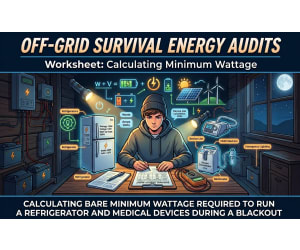
Off-Grid Survival Energy Audits
Math, Addition and Subtraction, Addition, Subtraction, Algebra, Early Math, Geometry, Basic Operations, Place Value, Measurements, Homeschool Curriculum, Homeschool Templates, Grade 8, 9, 10, 11, 12, Teacher Tools, Lesson Plans, Quizzes and Tests, Quizzes, Tests, Assessments, Worksheets & Printables, Workbooks, Worksheets, Word Searches
Transform abstract physics and math concepts into life-saving skills with this comprehensive, real-world STEM project. In "Off-Grid Survival Energy Audits," students are challenged to solve a critical, high-stakes problem: How do you power essential medical devices and refrigeration during a prolonged blackout? This is not just another worksheet packet; it's a 40-page, zero-prep curriculum that answers the age-old question, "When will I ever use this?" Students will step into the role of an energy auditor, applying critical thinking and mathematical precision to navigate realistic survival scenarios. They will learn the physics of power, calculate energy needs for life-sustaining equipment like CPAP machines and insulin refrigerators, and make tough decisions about load-shedding and resource management. This problem-based learning (PBL) resource is perfect for engaging high school students in Physics, Applied Mathematics, STEM, and Career and Technical Education (CTE) courses. It also serves as an exceptional resource for homeschooling co-ops and adult learners interested in emergency preparedness. What's Included in this 40-Page PDF: Part 1: In-Depth Theoretical Guide: A 10-page introduction covering the core physics concepts: Voltage, Amperage, Wattage (Watt's Law), Surge vs. Running Watts, Duty Cycles, Inverter Physics (Pure Sine Wave), and more. Part 2: 10 Progressive Student Worksheets: A complete student workbook with over 75 unique problems. Worksheets cover: Appliance Nameplate Reading Refrigerator Compressor Cycles Medical Device Power Profiles Calculating Surge Wattage Battery Math (Amp-Hours & Voltage) Creating a Daily Energy Budget Factoring Inverter Inefficiency Load Shedding & Triage Scenarios Impact of Temperature Extremes Capstone Project: A Comprehensive 72-Hour Blackout Audit Part 3: Teacher Resources & Visuals: High-contrast, printable instructional diagrams (Flowchart, Triage Matrix). A complete, fully detailed Teacher Answer Key with calculations shown. Equip your students with the confidence and knowledge to apply classroom learning to the real world. This curriculum doesn't just teach physics; it builds resilient, resourceful, and critical thinkers. Keywords: STEM, Physics, Real World Math, Problem-Based Learning, PBL, Emergency Preparedness, Survival, Blackout, Off-Grid, Energy Audit, Electricity, Ohm's Law, Watt's Law, Worksheet, CTE, Homeschool, High School, Critical Thinking, Applied Math, CPAP, Medical Device, Solar Power, Battery Bank.AP, Medical Device, Solar Power, Battery Bank. Why Parents/Schools Love It: Answers "When Will I Use This?": Directly connects abstract physics and math principles (Watt's Law, algebra) to a tangible, high-stakes, real-world scenario, dramatically increasing student engagement. Promotes Critical Thinking: Moves beyond simple calculations to force students to analyze, prioritize, and make strategic decisions (triage, load-shedding) based on their data. Zero-Prep, Comprehensive Curriculum: It is a complete, ready-to-use package. Teachers receive the theory, student worksheets, visual aids, and a full answer key, saving hours of preparation time. Integrates STEM and Real-Life Skills: Perfectly blends Science, Technology, Engineering, and Math into a single, cohesive project that also teaches valuable emergency preparedness skills. Differentiated for Scaffolding: The 10 worksheets are progressive, starting with basic definitions and building to a complex, multi-day audit, allowing teachers to guide students of varying abilities. Target Student Audience : Based on the complexity of the concepts (algebraic calculations, multi-step problem solving, abstract physics principles), target: Primary Target: High School Students (Grades 9-12) in courses like: Physics or Applied Physics STEM / STEAM Electives Career and Technical Education (CTE) focusing on electronics or engineering. Advanced or Honors-level Mathematics (as an application project). Secondary Target: Homeschooling: Particularly for parents and co-ops focusing on practical life skills and advanced science. Adult Education: For individuals and groups interested in emergency preparedness, off-grid living, or the technical aspects of RV/boat power systems. Copyright/Terms of Use: This Book was copyrighted by Syed Hammad Rizvi. This resource is for personal and single classroom use only. You may not alter, redistribute, or sell any part of this resource. In other words, you may not put it on the Internet where it could be publicly found and downloaded. If you want to share this resource with colleagues, please purchase additional licenses from Teachsimple. Thank you for respecting these terms of use. This product is happily brought to you by Syed Hammad Rizvi
Author Creative Book Store
Rating
Tags STEM, STEAM, Physics, Math, Science, Education, HighSchool, EdTech, Learning, CriticalThinking

I WONDER - How Big Is The International Space Station | Animated Video
Space, Earth and Environmental Sciences, Science, Grade 4, 5, 6, 7, 8, 9, 10, Lesson Plans, Teacher Tools
Video Introduction An amazing video designed for the students to learn more about space facts. I WONDER - How Big Is The International Space Station | Animated Video Lesson Do you like reading about space? If yes, what is your favorite topic? What do you know about our solar system? What is the smallest planet in our solar system? What is the biggest planet in our solar system? What is the hottest planet in our solar system? And what is the coldest one? Do you think there are aliens? If yes, what do you think they look like? What do they eat and how they speak to each other? Where do they live? What is a galaxy? And what is a milky way? Have you recently saw a shooting star? If yes, tell us more about it, like when did it happen and where? What is a blackhole? Can a blackhole gets bigger by time? Do you like counting the stars? What do you think a star is made of? I WONDER - How Big Is The International Space Station | Animated Video Lesson The video is perfect for encouraging the researching skills for the students, while learning more about the fantastic space. I WONDER - How Big Is The International Space Station | Animated Video Lesson This friendly designed video is suitable for students at school, homeschooling, and as a group activity. Format Available in MP4 format.
Author Educational Voice
Tags How Big Is The International Space Station, How Big Is The International Space Station Video, International Space Station, International Space Station Facts, International Space Station Facts For Kids, International Space Station Video
I WONDER - Does It Ever Rain In The Desert | Animated Video Lesson
Earth Sciences, Earth and Environmental Sciences, Science, Geography, Social Studies, Grade 4, 5, 6, 7, 8, 9, 10, Lesson Plans, Teacher Tools
Video Introduction An amazing video designed for the students to learn more about famous phenomena in different countries. I WONDER - Does It Ever Rain In The Desert | Animated Video Lesson What do you know about this phenomenon? Where it happens? When it happens? What are the safety measures that we should take to be safe during this phenomenon? Are there any other places in the world that experienced this phenomenon? If yes, tell us more about them. Why do you think it happens? Do you like reading about Geography? What is your favorite country in the whole world? I WONDER - Does It Ever Rain In The Desert | Animated Video Lesson The video is perfect for encouraging the researching skills for the students, while learning more about this fantastic phenomenon. I WONDER - Does It Ever Rain In The Desert | Animated Video Lesson The video is perfect for encouraging the researching skills for the students, while learning more about this fantastic phenomenon. Format Available in a PDF format.
Author Educational Voice
Rating
Tags Does It Ever Rain In The Desert, Does It Ever Rain In The Desert Video, Rain, Rain Facts, Rain Video, Rain Facts For Kids, Rain Video For Kids, Desert, Desert Facts, Desert Video
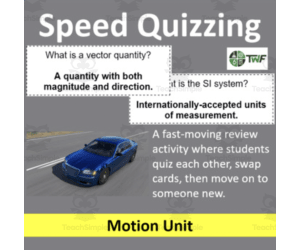
Speed Quizzing – Motion Unit
Science, Physics, Grade 8, 9, 10, Lesson Plans, Teacher Tools
Speed Quizzing – Motion Unit is an engaging activity to review key concepts in a unit on motion. Students are out of their seats and moving around the classroom, discussing questions on topics like one-dimensional motion, two-dimensional motion and vectors, frames of reference, uniform acceleration, and projectile motion. The resource includes 32 high-quality, editable questions that can be used for the activity or as a question bank. Teachers implement the activity by printing and cutting out flashcards, then having students pair up, ask and answer questions, switch cards and partners, and repeat. It's a lively way to prompt conversation, check understanding, remediate skills, and gather formative assessment data. Alternate group structures are provided to ensure students work with new partners each round. With little prep required, this customizable resource sparks student discussion, keeps kids engaged, and helps teachers check comprehension on a motion unit. It's perfect for middle and high school physical science classes.
Author Teach With Fergy
Tags Projectile Motion, Frames Of Reference, Speed Quizzing, Motion Unit, Physical Science Quiz
I WONDER - How Is Our Blood Cleaned | Animated Video Lesson
Human Body, Life Sciences, Science, Biology, STEM, Grade 6, 7, 8, 9, 10, 11, 12, Lesson Plans, Teacher Tools
Video Overview The human body is full of fascinating wonders to learn. This video is created to help the students recognize the anatomy and the job of the human body. I WONDER - How Is Our Blood Cleaned | Animated Video Lesson Every part and organ in our human body is vital so let's see how important they are. Have you ever imagined how we look like if we didn't have a skeleton? Did you know that because we have our amazing muscles we can stand! Do you know how many teeth do we have? Have you ever wondered about the food journey inside our body? Can you name all the glands in our body? Why do we have skin? Our nervous system is really good at sending signals. Can you tell us more about it? Are you really good at Mathematics, painting, or any other thing? You should really thank your brain about it! The famous five senses are really doing a great work? Can you explain how every sense works? I WONDER - How Is Our Blood Cleaned | Animated Video Lesson The video is perfect for encouraging the researching skills for the students, while learning more about our fantastic human body. I WONDER - How Is Our Blood Cleaned | Animated Video Lesson This friendly designed video is suitable for students at school, homeschooling, and as a group activity. Format Available in MP4 format.
Author Educational Voice
Tags How Is Our Blood Cleaned, How Is Our Blood Cleaned Video, Blood, Blood Facts, Blood Facts For Kids, Blood Video, Blood Video For Kids, Circulatory System, Circulatory System Facts, Circulatory System Facts For Kids
The Solar System: Asteroids, Meteors and Comets
Science, Earth and Environmental Sciences, Space, Common Core, Grade 5, 6, 7, 8, Teacher Tools, Lesson Plans
The Solar System: Asteroids, Meteors and Comets Are you ready to take your students on an awe-inspiring journey through the cosmos? Our educational resource, The Solar System: Asteroids, Meteors and Comets may be just what you need! Designed especially for students in grades five to eight with varying learning levels, this lesson plan aims to ignite a passion for Astronomy while staying aligned with Common Core State Standards. This enriching lesson plan delivers its core content across several compelling areas. Focusing on the inner and outer planets of our Solar Systems - it provides an inspiring introduction to celestial bodies like asteroids, meteors and comets. Reporting simplified language blended seamlessly with enriched scientific vocabulary ensures that these complex topics become digestible for young learners. Content & Activities Reading passages tailored specifically around each concept along with comprehension questions that test students' understanding while promoting critical thinking skills. Hands-on activities bolster active learning which can spark new insights into planetary orbits or the lunar cycle while making lessons fun! This product is versatile and ideal for whole-group instruction or small group investigation; it even lends itself powerfully as homework assignments or independent studying tools. Aim is mastery over concepts such as asteroid belts or shooting stars within reach of any classroom! Inclusions: Supporting materials : Colorful mini posters serving as visual aids designed for dress-up bulletin board displays or classroom walls doubling-up as quick-reference points during revisions! A Rubric-filled evaluation scheme accompanies crosswords, word searches tailored from pertinent vocabulary allowing seamless embedding of assessments targeting factual recall and retention. On completing the entire lesson using The Solar System: Asteroids, Meteors and Comets your class would have not only ventured through a space expedition but also explored content written under Bloom's Taxonomy & STEM initiatives culminating in a well-rounded understanding of Astronomy. Teaching Simplified and Learning Amplified!
Author Classroom Complete Press
Tags PDF
I WONDER - What Do The Angles Add Up To In A Triangle
STEM, Geometry, Math, Grade 1, 2, 3, 4, 5, 6, 7, 8, Lesson Plans, Teacher Tools
Video Introduction An amazing video designed for the students to learn more about STEM. I WONDER - What Do The Angles Add Up To In A Triangle | Animated Video Lesson Do you like STEM subjects? what is your favorite one? Have you ever tried to plant a seed? If yes, tell us more about it. Or have you ever tried to invent something? If yes, tell us more about it. And how do you think it will help us? Have you ever seen a microorganism under a microscope? What was it? And how it looked like? Mathematics is a marvelous subject. Let' sharpen our brains and solve some equations. Do you like timetable tricks? What is your favorite one? Do you know how to code? Have you ever created an app or a game before? If yes, how was it like? I WONDER - What Do The Angles Add Up To In A Triangle | Animated Video Lesson The video is perfect for encouraging the researching skills for the students, while learning more about this fantastic topic. I WONDER - What Do The Angles Add Up To In A Triangle | Animated Video Lesson This friendly designed video is suitable for students at school, homeschooling, and as a group activity. Format Available in MP4 format.
Author Educational Voice
Tags What Do The Angles Add Up To In A Triangle, What Do The Angles Add Up To In A Triangle Video, Triangle Angles, Triangle Angles Facts, Triangle Angles Facts For Kids, Triangle Angles Video, Triangle Angles Video For Kids

American Government: Kinds of Governments Gr. 5-8
Social Studies, Government, Grade 5, 6, 7, 8, Teacher Tools, Lesson Plans
The American Government: Kinds of Governments Gr. 5-8 A remarkable teaching resource designed to elucidate the complex system of the American government for grade levels 5 through 8. This resource offers a comprehensive analysis of the legislative, executive, and judicial branches of federal governance, making these concepts easy for young scholars. Fundamental Concept & Roles Explained: An integral part this material is its explanation about the basic principle and diversified roles of a government, enabling students to comprehend why governments are integral across societies. Furthermore, it unveils varying forms such as: Constitutional Monarchy, Dictatorship, Representative Democracy. This teaching tool stands out due to its detailed description regarding the type of government that operates in United States.. It provides clear understanding about the rationale behind creating and maintaining a Constitution promoting awareness among learners surrounding their rights within their governing system. Innovative Exercise: An interactive task asks them to identify main ideas from each constitutional amendment including the Bill of Rights. Creative Learning maneuver : The learning material transcends beyond theoretical knowledge by letting students participate in pragmatic exercises echoing real world governmental operations; like learning the process behind turning a bill into law or taking up presidential responsibilities to resolve contemporary issues. To match standard educational protocols and levels dictated by Blooms Taxonomy, writing tasks are amalgamated with lessons seamlessly. Differentiated tools such as vocabulary enhancing word search and curriculum suitable crossword puzzles are included which stimulate critical thinking. All lessons ends with comprehension quizzes for immediate feedback and understanding of the learnt content through an answer key. Format & Usability: The format of this resource is a simple and portable PDF file. Teachers can use it for creating printed handouts or assign it as digital homework –perfectly suited for group teaching or small cluster activities. Offering flawless integration with Social Studies sub-subjects particularly Government, this resource has versatile usage whether you are conducting public school lessons or supervising home-school education.
Author Classroom Complete Press
Tags PDF

Iraq War (2003-2010): The Fall of Baghdad Gr. 5-8
Social Studies, History, History: USA, Grade 5, 6, 7, 8, Teacher Tools, Lesson Plans
The Iraq War (2003-2010): The Fall of Baghdad Gr. 5-8 This engaging, informative teaching tool is designed specifically for Grade 5 to 8 students. It dives into the nuanced history of Iraq's turmoil and instability from the years of 2003 to 2010, concentrating on the military operation that led to the collapse of dictator Saddam Hussein's regime. Usage Educators can use this resource in various ways such as whole-class discussions or individual assignments. Students can be involved in interactive activities like creating a poster promoting tourism in Iraq, blending creativity with learning about Iraqi culture and geography. Geographical Understanding and Key Themes This teaching tool includes map activities highlighting events leading up to both the Persian Gulf War and subsequently, the war in Iraq. Pertinent themes like world terrorism are also addressed within this plan - emphasizing how fear surrounding weapons of mass destruction escalated these conflicts. Bloom’s Taxonomy Inspired Activities This resource was originally written following Bloom’s Taxonomy - an educational framework that categorizes learning skills. Each activity presents its own unique challenges aimed at stimulating critical-thinking among students while enriching their knowledge base simultaneously. Traditional Tasks & Convenience for Teachers In addition, there are more traditional tasks such as hands-on activities, quizzes and word searches; aiming not just at testing existing knowledge but also making learning irresistible by incorporating elements typically associated with play into it. An included answer key provides convenience by reducing extra prep-work necessary on teacher’s part when grading completed assignments. All told within one downloadable PDF that includes 27 ready-to-print pages full of enriching education resources carefully crafted around reliable historical information about the Iraq War and its profound effects. Fitted not only for public school teachers but also homeschoolers, this resource aims to foster a deep, intellectual understanding in students in an approachable manner.
Author Classroom Complete Press
Tags Iraq War, Baghdad, Reading Passage, Social Studies, History Assessment