



3,911 products added recently
Page 95 - Elementary Lesson Plans
Support your elementary students with lesson plans that cover a broad range of subjects and skills. These resources are designed to promote cognitive, social, and emotional growth. Incorporate them into your teaching to provide a well-rounded education that meets the needs of all your students.

 Show filters


Rainbows Reading Comprehension Passage - Cored Ed Encyclopedia
ELA, Language Development, Reading Comprehension, Reading, Pre-Reading, Science, Earth Sciences, Earth and Environmental Sciences, Writing, Strategies, Grade 2, 3, 4, 5, Worksheets & Printables, Worksheets, Teacher Tools, Centers, Activities, Writing Prompts, Assessments, Quizzes and Tests, Quizzes, Lesson Plans
This rainbows reading comprehension includes: Visualization (on the front cover) Start your lesson by taking a minute to think and share something about the topic. Read the script aloud (slowly), perhaps prepare some music or sound effects. Student close their eyes and let their imaginations wander. Students open their eyes, read the question aloud and give them a few minutes to complete. Ask a few students to share or keep answers until the end to compare with what they learn in the passage. Quick pause—thousands of Cored Education products are included with your TeachSimple membership. Download links and encyclopedia index available here. Pre-Reading Trivia Students will write down one thing they already know about the subject and then read five more facts and discuss. These facts are fun, and the students will enjoy learning about the subject before reading more. Give 1 minute for students to write what they already know (no pressure—best guess is fine). Read the five facts together. After each fact, do ask a student for their opinion, was it surprising? Set a purpose by asking students to highlight/underline one fact they want to learn more about during the reading. Reading Passage The text is a high-interest reading passage with set paragraphs, roughly three to four paragraphs long. It contains a variety of themes about the topic, anywhere from history to technology. The passage is between 250 and 350 words in length. First, ask students to look at the headings and see what they’ll learn about today. What do they know about the topic/heading? First read options: Teacher read-aloud (best for support). Partner reading (paragraph by paragraph). While reading, students underline important details, and vocabulary words they think may come up in the questions section. Mixed Questions The first question page contains four multiple-choice questions, each with a choice of four answers, and three written response questions that require a sentence or two from the student. Students complete the mcqs first independently, then review quickly as a class. For the 3 written responses, try to get students giving the answer with some form of evidence: “I think ___ because the text says ___.” If students get stuck, send them back to check the passage. Vocabulary Questions Practice seven key words from the text in this section across two activities. First section is scrambled words where students will unscramble three words given a clue for each. The second section is a word to meaning matching activity. Before starting, have some students read out words they underlined in the passage. Ask students to say the word and read aloud the sentence(s) around each word. Ask students to do scrambled words and the matching exercise in pairs then go through answers as a class. For the scrambled spelling task, get four pairs to come up to the board and write the words for extra practice with the other student reading out the clue. For the matching task, prompt students to give full sentences: “I matched ___ with ___ because ___.” Creative Writing In this question, the student will be required to write a five to eight sentence paragraph on a question related to the topic. Before starting, ask students write down 3 key ideas they are going to include in their piece. Ask students for ideas to share around the class to help those struggling. Pro writing expectations: 5–8 sentences At least 2 facts or details from the passage At least 2 vocabulary words from the previous page Students read their paragraphs while classmates listen for facts and vocabulary words. Extension Activities This page is optional for fast finishers or to take home. There are several activities, each one requiring a different skill. Do some, do none, do all, completely optional - but you will feel reassured knowing every possibility is planned for. Includes summary writting question. Answer Key There are answers for the multiple-choice questions, written response questions have sample answers, vocabulary answers and if there is a summary question then a sample summary will be provided as well. Lesson Plan Included Customized lesson plan for this lesson is included. Lesson Snapshot Title: Rainbows Genre: Nonfiction (informational text with support pages) Subject: Science (Light & Weather) Primary Topic: How sunlight and raindrops make rainbows Estimated Guided Reading Level (A–Z): R What This Lesson Teaches Best Explains the conditions for seeing a rainbow (Sun behind you; rain or mist in front; rainbow appears opposite the Sun). Builds a clear scientific model of how rainbows form (sunlight enters a raindrop, bends, bounces inside, and bends again as it leaves). Teaches that a rainbow is part of a circle and why it can “disappear” when the Sun is higher (the circle drops below the horizon). Connects science ideas to history of discovery (scholars testing with water-filled glass spheres; Descartes and Newton using a prism to explain white light and colors). Extends learning with aligned practice pages (questions, writing, and activities); vocabulary is mostly aligned, but “Refraction” appears on a vocab page while the passage describes “bending” without using that word. Learning Goals Students will describe where the Sun and rain/mist need to be to see a rainbow. Students will explain the “twisty trip” sunlight takes inside a raindrop using key details from the passage. Students will describe why a rainbow is part of a circle and what happens when the Sun is higher. Students will explain how two bounces inside droplets create a fainter outer bow and flip the color order. Students will identify how people helped solve the rainbow mystery (examples from the Middle Ages, Descartes, and Newton). Key Vocabulary From the Text horizon — where the sky seems to meet the land. raindrop — a tiny drop of water from rain. prism — clear object that spreads white light into colors. scholars — people who study and test ideas carefully. droplets — very small drops of water in the air. FULL CATALOG OF DOWNLOAD LINKS AND ENCYCLOPEDIA INDEX HERE
Author Cored Education
Rating
Tags Vocabulary, Reading Comprehension, Reading Passages, Reading, Creative Writing, Reading Strategies, Writing Prompts, Lesson Plans, Earth Science, Rainbows
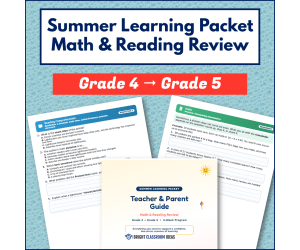
Summer Learning Packet Grade 4 to Grade 5 | Math & Reading Review
ELA, Math, Grade 4, Lesson Plans, Teacher Tools, Worksheets & Printables
Summer Learning Packet Grade 4 to Grade 5 | Math & Reading Review Help students prevent the summer slide and build confidence for fifth grade with this engaging Summer Learning Packet for 4th Grade to 5th Grade ! This comprehensive summer bridge workbook combines reading, vocabulary, grammar, writing, and math review into one easy-to-use resource. Designed to reinforce essential fourth-grade skills while previewing important fifth-grade concepts, this no-prep packet makes summer learning simple, effective, and enjoyable for students, parents, and teachers. What's Included ✔ 90-Page Summer Learning Workbook ✔ Reading Comprehension Activities Fiction and nonfiction passages Theme and central message Character development and traits Point of view Conflict and resolution Main idea and supporting details Author's purpose Text structure Compare and contrast Citing text evidence Making inferences and drawing conclusions ✔ Vocabulary Practice Context clues Greek and Latin roots Prefixes and suffixes Figurative language ✔ Grammar & Language Review Parts of speech Pronouns Verb tenses Subject-verb agreement Capitalization Punctuation Sentence types Run-on sentences Sentence combining ✔ Writing Activities Narrative writing Creative writing Opinion writing Informational writing Research-style writing Paragraph structure Multi-paragraph writing Text-based responses using R.A.C.E. ✔ Math Review Place value to the millions Comparing, ordering, and rounding numbers Multi-digit multiplication Long division Fractions and equivalent fractions Comparing, adding, and subtracting fractions Decimal place value and operations Measurement and conversions Elapsed time Geometry and coordinate grids Perimeter, area, and introductory volume Data analysis and graphing Multi-step word problems ✔ Summer Bonus Activities ✔ Skills Checklist ✔ Progress Tracker ✔ Certificate of Completion ✔ Complete Answer Key Included ✔ Teacher & Parent Guide Included How It Works in the Classroom This 4th Grade Summer Review Packet is designed for flexible use in a variety of learning environments: Summer take-home packets Summer school programs Homeschool instruction Tutoring sessions Intervention support Independent practice End-of-year review Back-to-school refreshers Students complete approximately 2–3 pages per day in about 20 minutes, making it easy to maintain academic skills throughout the summer without overwhelming learners. The included six-week pacing guide helps families stay organized while supporting consistent practice. Standards & Learning Goals Students will review and strengthen key fourth-grade skills while preparing for the increased expectations of fifth grade. Reading & Language Arts Reading comprehension Theme and character analysis Main idea and supporting details Author's purpose Text evidence Vocabulary development Grammar and conventions Narrative, opinion, and informational writing Research and text-based responses Math Place value and number sense Multi-digit multiplication Long division Fraction concepts and operations Decimal place value and comparison Measurement and conversions Geometry and coordinate graphing Area, perimeter, and volume Data analysis Multi-step problem solving Designed to support commonly taught end-of-fourth-grade standards while building readiness for fifth-grade success. Why Teachers Love It ⭐ No-prep summer learning solution ⭐ Comprehensive review of math and reading skills ⭐ Helps prevent summer learning loss ⭐ Includes answer key for easy checking ⭐ Teacher and parent guide included ⭐ Flexible six-week pacing plan ⭐ Encourages independent learning ⭐ Perfect for summer school, tutoring, homeschool, and intervention settings ⭐ Engaging summer-themed activities keep students motivated ⭐ Builds confidence before entering fifth grade If you're looking for a complete Summer Learning Packet for 4th Grade to 5th Grade , this resource provides everything students need to review essential skills, stay academically engaged during summer break, and begin fifth grade with confidence. Download today and give your students a fun, structured, and effective way to keep learning all summer long!
Author Bright Classroom Ideas Marketplace
Rating
Tags Summer, Reading, Ela, Math, Review, Worksheet

I WONDER - What Were Ancient Roman Schools Called | Animated Video
History: Ancient, History, Social Studies, History: Europe, Grade 3, 4, 5, 6, 7, 8, 9, Lesson Plans, Teacher Tools
Video Introduction An amazing video designed for the students to learn more about history. I WONDER - What Were Ancient Roman Schools Called | Animated Video Lesson Do you like history? Which topic do you really enjoy about history? Have you ever read an interesting fact about the Vikings? If yes, can you mention them? What do you like most about the Victorian era? Can you name all the Tudors? Have you ever wondered how people used to live in ancient Japan and ancient China? Do you know any interesting facts about ancient Egyptians and the Pharaohs? Have you ever visited South America? What do you know about Incas and Aztecs? Celtic culture was really one of a kind, can you name any of the places that Celts used to live in? Imagine yourself living during the ancient Roman empire, how your life will look like? Ancient Greece was an amazing place to live in. What do you know about ancient Greek life? I WONDER - What Were Ancient Roman Schools Called | Animated Video Lesson The video is perfect for encouraging the researching skills for the students, while learning more about history. I WONDER - What Were Ancient Roman Schools Called | Animated Video Lesson This friendly designed video is suitable for students at school, homeschooling, and as a group activity. Format Available in MP4 format.
Author Educational Voice
Tags What Were Ancient Roman Schools Called, What Were Ancient Roman Schools Called Video, Ancient Roman Schools, Ancient Roman Schools Facts, Ancient Roman Schools Video, Ancient Roman Schools Video For Kids

Ghosts Mentor Text mini-unit • Poetry of Place: Searching for Setting
ELA, Writing, Grade 4, 5, 6, 7, 8, Lesson Plans, Teacher Tools
The Ghosts Mentor Text mini- unit • Poetry of Place: Searching for Setting in the World Around You Developed with the subject line of Language Arts, specifically targeting Writing skills, it is apt for Grades 4-8. This resource leans into Raina Telgemeier’s Ghosts to unravel the concept of setting in storytelling. Main Features: Graphic Novel Excerpts: Embellished with graphic novel excerpts that fuel participative learning. Multimedia Resources: 'Dia de los Muertos' video which further deepen students' understanding. Tone & Traits Infographics: Infographic on Tone & Traits catering to each learner's unique style. Vocabulary Development Tools: Word Banks aid vocabulary expansion and ensure usage accuracy. Innovative Additions Include : A unique Rule of Story Slideshow that bridges theoretical learning with practical application. This can make classroom sessions lively; be it small group or whole group discussions or even taken as homework instruction prompts. The "Like Life: Writing Inspired by Real Events" section serves as scaffolds guiding your pupils through drafting their stories. This includes: -Hyperlinked student samples that model masterful application. -Approaches celebrated authors have adopted. The entire gamut comes as a PDF containing links to fully editable Google Docs, offering unparalleled freedom to tailor elements per your teaching agenda. From differentiated instruction pathways catering educators globally across public school teachers to homeschoolers alike, this resource makes poetry tangible and enjoyable for students.
Author Room2Ruminations
Tags Ghosts, Mentor Text, Poetry Of Place, Writing Techniques, Setting In Storytelling

I WONDER - Are Some Plants Poisonous | Animated Video Lesson
Nature & Plants, Life Sciences, Science, Grade 5, 6, 7, 8, 9, 10, Lesson Plans, Teacher Tools
Video Introduction An amazing activity designed for the students to learn more about STEM. I WONDER - Are Some Plants Poisonous | Animated Video Lesson Do you like STEM subjects? what is your favorite one? Have you ever tried to plant a seed? If yes, tell us more about it. Or have you ever tried to invent something? If yes, tell us more about it. And how do you think it will help us? Have you ever seen a microorganism under a microscope? What was it? And how it looked like? Mathematics is a marvelous subject. Let' sharpen our brains and solve some equations. Do you like timetable tricks? What is your favorite one? Do you know how to code? Have you ever created an app or a game before? If yes, how was it like? I WONDER - Are Some Plants Poisonous | Animated Video Lesson The video is perfect for encouraging the researching skills for the students, while learning more about this fantastic topic. I WONDER - Are Some Plants Poisonous | Animated Video Lesson This friendly designed video is suitable for students at school, homeschooling, and as a group activity. Format Available in MP4 format.
Author Educational Voice
Tags Are Some Plants Poisonous, Are Some Plants Poisonous Video, Poisonous Plants, Poisonous Plants Facts, Poisonous Plants Facts For Kids, Poisonous Plants Video, Poisonous Plants Video For Kids, Plants

English Starter Pack | Beginner Lesson Plan
ELA, Language Development, ESL, Grade 2, 3, 4, 5, Teacher Tools, Lesson Plans
This is a beginner lesson plan worksheet set for English Starter Pack. Start your English students on their journey to English proficiency with this basic starter pack. The starter pack is an early introduction to topics like greetings and introductions, telling the time, food and cooking, numbers, clothes, parts of the human body, family, countries, nationalities and home furniture and rooms. Students will learn more about these and then complete the exercises to follow, which will assess their comprehension and understanding. Exercises include closed and open activities, matching words with images, writing drills and conversation prompts. This starter pack ESL and TEFL worksheet is a great pre A1 resource to let your students get ahead before they begin the A1 course. Everyone has to start somewhere, right? Start to put the blocks in place right here as you introduce your students to lots of very basic words for vocabulary building. Very little prep is necessary, allowing you more time to focus your energy on your students. This resource can also be accessed through Google Apps. Answer key included. It includes 24 ready to print PDF pages. The different topics can be taught at the same time or they can be divided up to teach in separate classes.
Author TEAM TEFL
Tags About Me, Graphic Organizer, ESL Activity, Cardinal Numbers, Calendars

World War II: Background and Causes
Social Studies, History, History: World, Common Core, Grade 5, 6, 7, 8, Teacher Tools, Lesson Plans
World War II: Background and Causes An educational resource designed to provide engaging classroom experiences for students in grades 5-8. This tool focuses on pivotal aspects of the Second World War with an emphasis on Germany's role, key battles, and crucial causes. Simple and Practical Teaching Resource The strength of this teaching tool lies in its simplicity - free from complex jargon. Its simplified language style makes various social studies concepts related to World War II easily understandable by students thereby enhancing their learning experience. Main Contents Crafted reading passages that navigate through essential themes namely: The invasion of Poland by Germany on September 1st, 1939 Prominent battles like storming of Normandy Bonus Student Activities Included are full-color mini- posters perfect for interactive learning sessions or riveting history discussions. Downloadable PDF Available immediately after purchase without requiring additional software applications Pedagogical Flexibility with Standards Alignment This comprehensive package allows educators to assign work not only based on classroom needs but also individual student's pace. It thoroughly recognizes Common Core State Standards as well as Bloom's Taxonomy benchmarks ensuring effective knowledge impartation at critical stages of learner development journey. User-friendly & Efficient Tool For all Educators: Public school teacher or homeschooler, this resource delivers practicality,and comprehensibility while meeting academic standards.The immersive focus on World War II history ensures a prioritized creative engagement during social studies lessons revolving around significant historical events.
Author Classroom Complete Press
Tags PDF

Climate Change: Reduction: Green Buildings Gr. 5-8
Science, Earth and Environmental Sciences, Environmental Science, Grade 5, 6, 7, 8, Teacher Tools, Lesson Plans
Climate Change: Reduction: Green Buildings Gr. 5-8 An incredible resource that intertwines Science and Environmental Studies to enlighten and engage students about environmental conservation from grade 5 through grade 8. Fostering Sustainable Thinking The "Green Buildings" chapter of the "Climate Change: Reduction" lesson plan concentrates on innovative ways we can decrease consumption levels, reduce our environmental footprint, and adopt cost-efficient methods. Interactive Learning Modules The curriculum encourages student interaction with future concepts – guiding them in making predictions about Earth's temperature given current emission trends. Your dream car creation with an eco-twist! The program lets students imagine vehicles running solely on alternative fuels thus challenging their creativity while enhancing their knowledge of sustainable technology. A Community-Focused Approach Inspiring a community-wide effort toward change, this educational resource highlights the importance of researching regional transportation solutions and compiling them into easy-to-understand brochures. Product Life Cycles: A key discussion point within Climate Change: Reduction: Green Buildings Gr. 5-8 is around product life cycles where companies can lessen emission load substantially. Sustainable Cities: The module makes macro-scale topics relatable for young learners by helping them visualize green cities powered entirely by clean energy! Taking it Global! International efforts aligning with carbon-free objectives & waste management strategies are highlighted. Through structured tasks aligned with Bloom's Taxonomy and STEAM initiatives (Science Technology Engineering Arts Mathematics), students are offered: Creative activities. Vocabulary-building exercises like word searches. Comprehension-enhancing quizzes. A comprehensive answer key. Climate Change: Reduction: Green Buildings Gr. 5-8 shines as an excellent tool that aims to inspire students to acknowledge and contribute towards a cleaner, greener future. This instruction kit is available as an automatically printable 27-page PDF, making it extremely convenient for public school teachers and homeschooling parents.
Author Classroom Complete Press
Tags Science Lesson, Environmental Science, Global Warmining, Climate Change, Reading Passage

How to Write a Book Report: Prewriting Your Book Report - FLASH-PC
ELA, Writing, Common Core, Grade 5, 6, 7, 8, Teacher Tools, Lesson Plans
How to Write a Book Report: Prewriting Your Book Report - FLASH-PC The How to Write a Book Report: Prewriting Your Book Report - FLASH-PC is an invaluable educational tool for both educators and learners in Grade 5 through to Grade 8. It is designed specifically to demystify the process of writing a book report, with an emphasis on prewriting. This digital resource leverages reading passages alongside targeted questions, both before and after reading. These components are expertly curated as they give students ample opportunity to understand the material thoroughly before proceeding. Included Features: Printables: Serve as interactive worksheets enabling students actively engage with their learning while progressively grasping integral aspects of prewriting a book report. Vocabulary Flash Cards:Crafted to cultivate an enhanced understanding of language arts- an underlying requirement when tackling any book report. Graphic Organizers:Aid visual learners by formatively outlining the segments involved in prewriting stages of writing a book report. Interactive Activities: : Employ various applications on PCs thus making it suitable for computer-based learning at home or within traditional classroom environments. The curriculum -based content not only aligns well with Common Core State Standards but it also responds well to Blooms Taxonomy’s cognitive domains hence bedrocking balanced cognitive growth among young learners. Possible Utilizations: Whole-group instruction within public school classrooms, Ssmall group work within homeschool settings, Iindividual assignments designed for remote learning scenarios. Note that due its technologically integrated nature (Software PC), ‘How to Write a Book Report’ requires basic computer literacy not only for deployment but also sustenance throughout its use among target groups (Grade 5-8) making it perfectly suitable digitally competent generation of young learners.
Author Classroom Complete Press
Tags Software (PC)
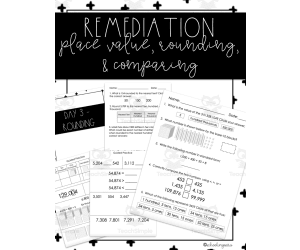
Remediation Plan: Rounding, Place Value, Comparing & Ordering Numbers
Algebra, Math, Addition and Subtraction, Addition, Numbers, Place Value, Grade 2, 3, 4, 5, Teacher Tools, Lesson Plans, Activities
Need to review number sense - place value, rounding, comparing, and ordering numbers - in small groups? Included in this product is a five-day remediation plan (based on the VA SOL 3.1) that reviews the topics over four days, with an exit ticket for the fifth day. Each day comes with a lesson plan, guided practice activities, and then independent practice activities. The final day is an exit ticket, checking for student understanding of the topics after the four days of review. Also included is a teacher slide show to help teach the concepts to your groups - it matches the guided practice. While this product is geared towards the 3rd grade Virginia SOLs, it is usable by any grade level or location teaching place value, rounding, comparing numbers, and ordering numbers. An answer key is provided for the independent practice and the exit ticket. What's Included: Day 1 - Place Value Day 2 - Rounding Day 3 - Rounding - including rounding on a number line Day 4 - Comparing and Ordering Numbers Day 5 - review and exit ticket If you need a math notebook to go along with the place value lesson, check this out: Place Value, Rounding, and Comparing (VA SOL 3.1) Need more low-prep or no-prep math activities? Check these out: No Prep Spiral Math Daily Review and Quizzes Identifying Money Practice Counting Money Practice Area and Perimeter Digital Activity October No-Prep Math Activities Comparing Money Practice 1 Like what you see? Check out my other math notebooks: Identifying and Comparing Fractions (VA SOL 3.2) Solving Word Problems (VA SOL 3.3) Multiplication and Division (VA SOL 3.4) Adding and Subtracting Fractions (VA SOL 3.5) Identifying, Counting, and Comparing Money and Making Change (VA SOL 3.6) Measuring Length and Capacity (VA SOL 3.7) Area and Perimeter (VA SOL 3.8) Telling Time, Equivalent Time, and Elapsed Time (VA SOL 3.9) Measuring Temperature (VA SOL 3.10) Lines, Rays, Angles, Points, and Line Segments (VA SOL 3.11) Identifying, Combining, and Subdividing Polygons (VA SOL 3.12) Congruent and Non-congruent Figures (VA SOL 3.13) Probability (VA SOL 3.14) Bar graphs and Pictographs (VA SOL 3.15) Patterns (VA SOL 3.16) Balancing Equations (VA SOL 3.17)
Author SchoolingSara
Tags VA SOL, SOL, Remediation, 3.1, SOL 3.1, Place Value, Rounding, Comparing, Ordering

Maine State Unit Study (Capital, Bird, Flower, Flag, Animal)
Social Studies, Geography, Grade 2, 3, 4, Lesson Plans, Teacher Tools
Maine State Unit Study: A Comprehensive Educator's Resource The Maine State Unit Study is an all-inclusive resource ideal for educators aiming to explore the geographical features, rich tales of history, and vibrant culture of this unique state. This extensive five-day study plan includes a wide array of topics like the state capital, bird, flower, flag and iconic animal. A Multi-Disciplinary Approach This resource employs an integrated approach incorporating Art (drawing & coloring ), English language arts (reading comprehension exercises) as well as geography that examines the political and physical aspects of Maine including its fauna & flora. Specially designed for ease across different education settings - both traditional classrooms or homeschool environments - it places great emphasis on adaptability catering to learners between second grade through fourth grade. LOW PREP Tool with Diverse Elements A well-compiled blend of videos and interactive notebook pieces showcasing various facets under study - including but not limited to Maine State's symbols embodied by cards in either color or B&W format. Daily worksheets along with interactive tools guiding student discussions aimed at encouraging in-depth research into subjects relating to this distinctive region in America. Includes fulfilling core subject requirements engaging students with geography content similar to social studies also focusing on integrative language art tasks such as reading passages improving grammar skills; additional resources curated painstakingly for exploring scientific aspects tied up with local climate; historical elements triggering insightful essays fostering writing skills congruent with the overall theme centered around the study topic. Note: This tool has been made available in PDF format for seamless integration whether your need is discussion guides; thought-provoking activities enhancing social studies efforts; detailed informative sources supplementing history lessons or just fun education activities in general! Versatility Personified The kit not only simplifies lesson planning but also ensures an engaging experience by leveraging customize-friendly features that are adaptable to varying student age, learning styles and comprehension levels. Your educational journey studying Maine State can take shape through individual research tasks; small group assignments or even class-wide activities. In Summary: Everything needed for a successful unit on the study of Maine state is included in this resource. It positions educators with a complete teaching tool:a balance of subject-specific offerings, from geography through social studies bridging across language arts.
Author Heather Huhman
Tags Maine State, Geography, History, Culture, Symbols

Quarters Reading Comprehension Passage - Cored Ed Encyclopedia
ELA, Language Development, Resources for Teachers, Reading Comprehension, Reading, Pre-Reading, Social Studies, History, Money, Math, Grade 2, 3, 4, 5, Worksheets & Printables, Worksheets, Teacher Tools, Centers, Activities, Writing Prompts, Assessments, Quizzes and Tests, Quizzes, Lesson Plans
This quarters reading comprehension includes: Visualization (on the front cover) Start your lesson by taking a minute to think and share something about the topic. Read the script aloud (slowly), perhaps prepare some music or sound effects. Student close their eyes and let their imaginations wander. Students open their eyes, read the question aloud and give them a few minutes to complete. Ask a few students to share or keep answers until the end to compare with what they learn in the passage. Quick pause—thousands of Cored Education products are included with your TeachSimple membership. Download links and encyclopedia index available here. Pre-Reading Trivia Students will write down one thing they already know about the subject and then read five more facts and discuss. These facts are fun, and the students will enjoy learning about the subject before reading more. Give 1 minute for students to write what they already know (no pressure—best guess is fine). Read the five facts together. After each fact, do ask a student for their opinion, was it surprising? Set a purpose by asking students to highlight/underline one fact they want to learn more about during the reading. Reading Passage The text is a high-interest reading passage with set paragraphs, roughly three to four paragraphs long. It contains a variety of themes about the topic, anywhere from history to technology. The passage is between 250 and 350 words in length. First, ask students to look at the headings and see what they’ll learn about today. What do they know about the topic/heading? First read options: Teacher read-aloud (best for support). Partner reading (paragraph by paragraph). While reading, students underline important details, and vocabulary words they think may come up in the questions section. Mixed Questions The first question page contains four multiple-choice questions, each with a choice of four answers, and three written response questions that require a sentence or two from the student. Students complete the mcqs first independently, then review quickly as a class. For the 3 written responses, try to get students giving the answer with some form of evidence: “I think ___ because the text says ___.” If students get stuck, send them back to check the passage. Vocabulary Questions Practice seven key words from the text in this section across two activities. First section is scrambled words where students will unscramble three words given a clue for each. The second section is a word to meaning matching activity. Before starting, have some students read out words they underlined in the passage. Ask students to say the word and read aloud the sentence(s) around each word. Ask students to do scrambled words and the matching exercise in pairs then go through answers as a class. For the scrambled spelling task, get four pairs to come up to the board and write the words for extra practice with the other student reading out the clue. For the matching task, prompt students to give full sentences: “I matched ___ with ___ because ___.” Creative Writing In this question, the student will be required to write a five to eight sentence paragraph on a question related to the topic. Before starting, ask students write down 3 key ideas they are going to include in their piece. Ask students for ideas to share around the class to help those struggling. Pro writing expectations: 5–8 sentences At least 2 facts or details from the passage At least 2 vocabulary words from the previous page Students read their paragraphs while classmates listen for facts and vocabulary words. Extension Activities This page is optional for fast finishers or to take home. There are several activities, each one requiring a different skill. Do some, do none, do all, completely optional - but you will feel reassured knowing every possibility is planned for. Includes summary writting question. Answer Key There are answers for the multiple-choice questions, written response questions have sample answers, vocabulary answers and if there is a summary question then a sample summary will be provided as well. Lesson Plan Included Customized lesson plan for this lesson is included. Lesson Snapshot Title: Quarters Genre: Nonfiction (informational reading passage) Subject: Social Studies (U.S. history) / Math (money) Primary Topic: How U.S. quarters changed over time Estimated Guided Reading Level (A–Z): S What This Lesson Teaches Best Understanding money value and fractions (a quarter is 25 cents; one fourth of a dollar; “two bits”). How coin materials and features affected trust and prevented cheating (silver, weight, and ridged edges called “reeding”). Timeline thinking using key dates and changes (1796, 1932, 1965, 1999, 2022–2025, 2026). How symbols/designs on coins reflect history and what a country honors (states, national parks, historical places, notable American women, 250th anniversary themes). Reading informational text with headings and main ideas (three titled sections explain different eras/changes). Learning Goals I can explain why a quarter is worth 25 cents and how it relates to a dollar. I can describe what “two bits” means and where the nickname came from. I can explain how “reeding” (the ridged edge) helped stop people from shaving off metal. I can describe one major change quarters went through over time (design or materials) using details from the passage. I can identify the main idea of the section about changing quarter designs. Key Vocabulary From the Text reeding — tiny ridges on a coin’s edge precious — very valuable recognize — know something by its look or feel coating — a covering layer on something honoring — showing respect by featuring someone or something FULL CATALOG OF DOWNLOAD LINKS AND ENCYCLOPEDIA INDEX HERE
Author Cored Education
Rating
Tags Vocabulary, Reading Comprehension, Reading Passages, Reading, Creative Writing, Reading Strategies, Writing Prompts, Lesson Plans, Quarters, Money

I WONDER - How Did The Quetzalcoatlus Eat | Animated Video Lesson
History: Ancient, History, Social Studies, History: World, Animals, Life Sciences, Science, Grade 4, 5, 6, 7, 8, 9, 10, Lesson Plans, Teacher Tools
Video Introduction An amazing video designed for the students to learn more about dinosaurs in different countries. I WONDER - How Did The Quetzalcoatlus Eat | Animated Video Lesson Do you like dinosaurs? what is your favorite one? Do you own a pet? If yes, tell us more about it, like what its name? And what do you like most about it? Do you think that your pet has been evolved from a dinosaur? Can you write down the characteristics of your favourite dinosaur like it's shape, their rivals, where did it use to live and what was their favourite food? What is the largest and the smallest dinosaur that ever found? Why is the T-rex is so famous? Have you ever read any interesting facts about it? Can you name any of the carnivores or herbivores dinosaurs? I WONDER - How Did The Quetzalcoatlus Eat | Animated Video Lesson The video is perfect for encouraging the researching skills for the students, while learning more about dinosaurs. I WONDER - How Did The Quetzalcoatlus Eat | Animated Video Lesson This friendly designed video is suitable for students at school, homeschooling, and as a group activity. Format Available in MP4 format.
Author Educational Voice
Rating
Tags How Did The Quetzalcoatlus Eat, How Did The Quetzalcoatlus Eat Video, Quetzalcoatlus, Quetzalcoatlus Facts, Quetzalcoatlus Video, Quetzalcoatlus Video For Kids, Quetzalcoatlus Facts For Kids

High Frequency Sight Words: Boxed Words - FLASH-MAC
ELA, Language Development, Vocabulary, Grade 1, 2, Teacher Tools, Lesson Plans
High Frequency Sight Words: Boxed Words - FLASH-MAC Dive into a world of enrichment with the High Frequency Sight Words: Boxed Words - FLASH-MAC. Offering an in-depth exploration of Dolch Sight Words, this teaching resource amplifies language arts curriculums for first and second graders. It's uniquely tailored to lay a robust foundation in high frequency vocabulary, seamlessly merging innovative tech and time-tested teaching techniques. Engaging Content to Boost Word Recognition Skills: The heart of this resource is its captivating boxed words exercises. Designed to sharpen recognition skills, these centered tasks are fundamental for fostering reading efficiency in students. By encouraging faster recognition and comprehension of frequently used words, little learners can read more fluently with a deeper understanding. Digital & Printable Exercises: Alongside these interactive activities are printables which offer tangible educational material alongside the digital resources ensuring every learning style is catered to. This yields an all encompassing approach towards vocabulary building within classroom settings as well as when homeschooling. Visual Learning through Presented Flashcards : A notable component of this package is our Dolch sight word flashcards ; tools proven effective for enhancing memory retention and recall abilities using visuals cues. These flashcards help break down complex ideas making learning both fun & easy! Simplification using Graphic Organisers: The package also includes graphic organisers that encapsulate abstract concepts in structured mind-maps visually simplifying each lesson ideal especially for visual-orientated learners. Tailored Interactive Activities: If you're hunting for engaging activities meeting your class's specific needs while maintaining high student involvement, you've hit the jackpot! This High Frequency Sight Words: Boxed Words - FLASH-MAC product file has been developed for convenient use on MAC software. It's easy-to-grasp format is ideal as homework assignments adding reinforcement to lessons learned outside of school hours. Valuable Lesson Plans: The package includes expertly crafted lesson plans, meeting pedagogical research standards assuring that you can easily implement effective teaching methods improving not just vocabulary but offering a richer literary journey for your students.
Author Classroom Complete Press
Tags Software (Mac)

Motion: How to Graph Motion Gr. 5-8
Science, Physics, Grade 5, 6, 7, 8, Teacher Tools, Lesson Plans
Motion: How to Graph Motion Gr. 5-8 A efficient teaching resource aimed towards enhancing the knowledge of students in the 5th to 8th grade on the topic of motion. As a chapter slice from the full lesson plan Motion, this educational tool focuses on simplifying the concept of modeling movement through graphs. Ideal for both public school teachers and homeschoolers seeking effective study materials, this chapter offers comprehensive coverage of linear, accelerating, rotating and oscillating motion. Not only does it impart valuable insights about these aspects but also enlightens students about how they relate to everyday life events and even celestial bodies that form part of our solar system. The Main Features include: Theoretical knowledge with practical exposure. Vivid color mini posters capturing key themes visually. Learners are stimulated into creating mental models for better concept retention. Fosters critical thinking abilities while reinforcing concepts covered. Hands-on activities cultivating critical thinking abilities within learners. Benefits: Language catering specially to struggling readers ensuring an inclusive learning environment accommodating different abilities within a classroom setting.. Crossword puzzles and Word Searches spark curiosity enhancing interest in Physics without overwhelming leaners.. This PDF formatized product directly aligns with State Standards alongside resonating strongly with Blooms Taxonomy and STEM initiatives . It can be flexibly implemented in teaching style ranging from whole-group lessons or smaller focus groups . Further enrich your teaching toolkit as it can also be assigned as homework. This tool simplifies teaching physics effectively while enriching learners fundamental understanding of motion.
Author Classroom Complete Press
Tags PDF

Let's Chat Conversation Cards | "Today I Choose Health"
Special Resources, Social Emotional Learning (SEL), Grade 2, 3, 4, 5, 6, Teacher Tools, Lesson Plans
Let's Chat Conversation Cards for "Today I Choose Health" is a social-emotional learning resource that helps students develop a positive mindset. The cards encourage meaningful conversations where students can understand different perspectives and build stronger connections. This set focuses on choosing health in areas like nutrition, physical activity, and emotional wellness. Teachers can use the cards in small groups or whole-class discussions. The open-ended questions allow students to share their thoughts in a safe, judgement-free zone. Let's Chat is part of the Respectful Ways program by trauma-informed experts. Field tests show the curriculum improves GPAs, attendance rates, and behavior when paired with PBIS frameworks. There are over 50 other Let's Chat decks that address various social-emotional topics. The program also provides training and assessments to meet specific student needs.
Author Respectful Ways
Tags Health, Conversation Cards, Respectful Ways, Spanish, SEL, Social Emotional Learning, Character Education, Let's Chat, Trauma-informed
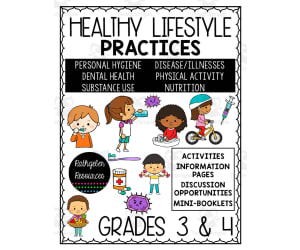
Healthy Lifestyle Practices Unit
P.E. & Health, Health, Grade 3, 4, Lesson Plans, Teacher Tools
This resource is a Healthy Lifestyle Practices Unit. Designed for your Grades 3 & 4 students, this resource is jam-packed with so many good printables to teach students about health, nutrition so much more. Within this unit, students will learn about: - Personal Hygiene - Dental Health - Substance Use - Disease/Illnesses - Physical Activity - Nutrition There are activities, information pages, discussion opportunities and mini-booklets.
Author Rathgeber Resources
Tags Healthy Lifestyle, Dental Health, Physical Activity, Discussion, Comprehension

I WONDER - Were Ancient Greek Boys Educated | Animated Video Lesson
History: Ancient, History, Social Studies, History: Europe, Grade 4, 5, 6, 7, 8, 9, 10, Lesson Plans, Teacher Tools
Video Introduction An amazing video designed for the students to learn more about history. I WONDER - Were Ancient Greek Boys Educated | Animated Video Lesson Do you like history? Which topic do you really enjoy about history? Have you ever read an interesting fact about the Vikings? If yes, can you mention them? What do you like most about the Victorian era? Can you name all the Tudors? Have you ever wondered how people used to live in ancient Japan and ancient China? Do you know any interesting facts about ancient Egyptians and the Pharaohs? Have you ever visited South America? What do you know about Incas and Aztecs? Celtic culture was really one of a kind, can you name any of the places that Celts used to live in? Imagine yourself living during the ancient Roman empire, how your life will look like? Ancient Greece was an amazing place to live in. What do you know about ancient Greek life? I WONDER - Were Ancient Greek Boys Educated | Animated Video Lesson The video is perfect for encouraging the researching skills for the students, while learning more about history. I WONDER - Were Ancient Greek Boys Educated | Animated Video Lesson This friendly designed video is suitable for students at school, homeschooling, and as a group activity. Format Available in MP4 format.
Author Educational Voice
Tags Were Ancient Greek Boys Educated, Were Ancient Greek Boys Educated Video, Ancient Greek Boys, Ancient Greek Boys Video, Ancient Greek Boys Facts, Ancient Greek Boys Video For Kids, Ancient Greek Boys Facts For Kids

I WONDER - When Is Martin Luther King Day | Animated Video Lesson
Biographies, Social Studies, Grade 4, 5, 6, 7, 8, 9, 10, Lesson Plans, Teacher Tools
Video Introduction An amazing video designed for the students to learn more about famous people in different countries. I WONDER - When Is Martin Luther King Day | Animated Video Lesson Do you know this person? How much do you know about him/her? Who is your idol? Why did you choose this person? Tell us more about him/her? Who is your favorite athlete? Or what is your favorite team? Have you recently heard a story about a famous person? Who was this person? Can you tell us more about him/her. Who is your favorite president, king, or queen? Why you chose that person? In your country, who are the most famous people? What did they do? Can you tell us more about them. What is your favorite invention? Who invented it? Who is your favorite artist? What is the most famous thing he/she have done? What is the most enjoyable you have read before? Who wrote it? I WONDER - When Is Martin Luther King Day | Animated Video Lesson The video is perfect for encouraging the researching skills for the students, while learning more about this fantastic place. I WONDER - When Is Martin Luther King Day | Animated Video Lesson This friendly designed video is suitable for students at school, homeschooling, and as a group activity. Format Available in MP4 format.
Author Educational Voice
Rating
Tags When Is Martin Luther King Day, When Is Martin Luther King Day Video, Martin Luther King Day, Martin Luther King Day Video, Martin Luther King Day Facts, Martin Luther King Day Facts For Kids, Martin Luther King Day Video For Kids

A Crush Text: Full Lesson Plan w/ PowerPoints & Graphic Organizers
ELA, Reading, Grade 3, 4, 5, 6, Lesson Plans, Teacher Tools
A Crush Reading Lesson Plan Bundle for Grades 3-6 This comprehensive reading lesson plan bundle for the short story A Crush by Cynthia Rylant provides educators everything they need to teach the text. The resource includes a complete lesson plan, student worksheet, answer key, 15 graphic organizers , and 8 PowerPoint presentations to aid in analyzing the story. Teachers can use the materials for whole-class instruction, small group work, or independent assignments. The lesson supports teaching key English Language Arts standards like theme, plot, characterization, figurative language, and more in an engaging way. With multiple file types offered, the reading bundle offers flexibility for diverse classroom needs.
Author Quality Teaching Products
Tags Peer Evaluation, Short Story, A Crush, Symbolism Chart, Reading Lesson Plan

Measurement: Temperature & Currency - Learn the Skill - FLASH-PC
Math, Measurements, Common Core, Grade 1, 2, Teacher Tools, Lesson Plans
Measurement: Temperature & Currency - Learn the Skill - FLASH-PC Unearth a new realm of practical Mathematics with our innovative software, Measurement: Temperature and Currency - Learn The Skill for PC. Especially tailored for grade 1 and 2 educators committed to integrating life skills into their Math curriculum. The program explores essential components of measurements focusing on aspects like temperature and currency. Using real-world word problems, students can associate complex mathematical principles with daily experiences, thereby enhancing understanding and problem-solving capabilities. Crossing Language Barriers: This inclusive software transcends language barriers seamlessly by incorporating English and Spanish voice overs making it a truly multicultural educational resource. Bridges Theory to Hands-on Experience: An integrated digital math tool allows students to visually understand various outcomes through independent experimentation with changeable inputs while gaining greater insight into measurable nuances. Adherence to Educational Standards: Promotes student-centric learning in line with Common Core State Standards favouring comprehension over memorization techniques. Synchronizes well with STEM (Science, Technology, Engineering, Mathematics) initiatives encouraging tech-integration in education. Meticulously aligns with teaching practices recommended by the NCTM (National Council of Teachers Mathematics). Versatile Applications: Ideal for diverse scenarios including group instructions or homework assignments enables continuity in learning at different paces making it an extensively dynamic resource. In Summary- "Measurement: Temperature & Currency - Learn The Skill", is more than just an educational aid. It's a tool that enhances learner engagement while fostering Math proficiency among Grade 1 & 2 learners. This makes it an indispensable asset in your teaching repository. Experience a radical change in your students' understanding of measurements as complex notions transform into attainable learning objectives.
Author Classroom Complete Press
Tags Software (PC)
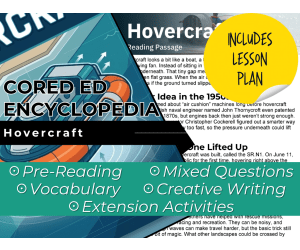
Hovercraft Reading Comprehension Passage - Cored Ed Encyclopedia
ELA, Reading Comprehension, Reading, Pre-Reading, Language Development, History, Social Studies, Science, Physics, Technology, Grade 2, 3, 4, 5, Worksheets & Printables, Worksheets, Teacher Tools, Centers, Activities, Writing Prompts, Assessments, Quizzes and Tests, Quizzes, Lesson Plans
This hovercraft reading comprehension with lesson plan includes: Visualization (on the front cover) Start your lesson by taking a minute to think and share something about the topic. Read the script aloud (slowly), perhaps prepare some music or sound effects. Student close their eyes and let their imaginations wander. Students open their eyes, read the question aloud and give them a few minutes to complete. Ask a few students to share or keep answers until the end to compare with what they learn in the passage. Quick pause—thousands of Cored Education products are included with your TeachSimple membership. Download links and encyclopedia index available here. Pre-Reading Trivia Students will write down one thing they already know about the subject and then read five more facts and discuss. These facts are fun, and the students will enjoy learning about the subject before reading more. Give 1 minute for students to write what they already know (no pressure—best guess is fine). Read the five facts together. After each fact, do ask a student for their opinion, was it surprising? Set a purpose by asking students to highlight/underline one fact they want to learn more about during the reading. Reading Passage The text is a high-interest reading passage with set paragraphs, roughly three to four paragraphs long. It contains a variety of themes about the topic, anywhere from history to technology. The passage is between 250 and 350 words in length. First, ask students to look at the headings and see what they’ll learn about today. What do they know about the topic/heading? First read options: Teacher read-aloud (best for support). Partner reading (paragraph by paragraph). While reading, students underline important details, and vocabulary words they think may come up in the questions section. Mixed Questions The first question page contains four multiple-choice questions, each with a choice of four answers, and three written response questions that require a sentence or two from the student. Students complete the mcqs first independently, then review quickly as a class. For the 3 written responses, try to get students giving the answer with some form of evidence: “I think ___ because the text says ___.” If students get stuck, send them back to check the passage. Vocabulary Questions Practice seven key words from the text in this section across two activities. First section is scrambled words where students will unscramble three words given a clue for each. The second section is a word to meaning matching activity. Before starting, have some students read out words they underlined in the passage. Ask students to say the word and read aloud the sentence(s) around each word. Ask students to do scrambled words and the matching exercise in pairs then go through answers as a class. For the scrambled spelling task, get four pairs to come up to the board and write the words for extra practice with the other student reading out the clue. For the matching task, prompt students to give full sentences: “I matched ___ with ___ because ___.” Creative Writing In this question, the student will be required to write a five to eight sentence paragraph on a question related to the topic. Before starting, ask students write down 3 key ideas they are going to include in their piece. Ask students for ideas to share around the class to help those struggling. Pro writing expectations: 5–8 sentences At least 2 facts or details from the passage At least 2 vocabulary words from the previous page Students read their paragraphs while classmates listen for facts and vocabulary words. Extension Activities This page is optional for fast finishers or to take home. There are several activities, each one requiring a different skill. Do some, do none, do all, completely optional - but you will feel reassured knowing every possibility is planned for. Includes summary writting question and additional facts. Answer Key There are answers for the multiple-choice questions, written response questions have sample answers, vocabulary answers and if there is a summary question then a sample summary will be provided as well. Lesson Plan Included Customized lesson plan for this lesson is included. Lesson Snapshot Title: Hovercraft Genre: Nonfiction (informational text) Subject: Science / Engineering (transportation) Primary Topic: How hovercraft ride on air and where they’re used Estimated Guided Reading Level (A–Z): Q What This Lesson Teaches Best Explains how a hovercraft rides on a “cushion of air trapped underneath,” instead of sitting in water. Describes why the air cushion reduces rubbing so the craft can slide over water, sand, or flat grass. Gives a brief invention history (an 1870s patented idea, then a smarter 1950s improvement to stop air leaking). Shows how design changes improved performance, including the flexible “skirt” for obstacles and choppy water. Connects hovercraft to real-world uses today (ferries, rescue missions, military landings, racing/recreation) and notes challenges like wind and waves. Learning Goals Students will describe how a hovercraft is like a boat, a small airplane, and a moving fan. Students will explain how an air cushion helps a hovercraft slide with very little rubbing. Students will describe how Christopher Cockerell improved hovercraft by reducing air leaking in the 1950s. Students will identify the SR.N1 and tell what happened when it was shown to the public on June 11, 1959. Students will explain how the flexible “skirt” helped hovercraft handle obstacles and choppy water. Students will list at least two places or jobs hovercraft can do today, using text evidence. Key Vocabulary From the Text patented — legally protected an invention idea. pressure — pushing force of trapped air underneath. flexible — able to bend without breaking. obstacles — things in the way that block movement. ferries — boats that carry people across a route. FULL CATALOG OF DOWNLOAD LINKS AND ENCYCLOPEDIA INDEX HERE
Author Cored Education
Rating
Tags Vocabulary, Reading Comprehension, Reading Passages, Lesson Plans, Ela Lesson Plans, Reading Comprehension Lesson Plans, Pre-reading, Science Lesson Plans, Physics, Technology

A Trip to the Zoo
Science, Life Sciences, Animals, Preschool, Grade 1, 2, 3, Teacher Tools, Lesson Plans
A Trip to the Zoo: An Educational Treasure A Trip to the Zoo is an exceptional teaching resource designed specifically to invoke a sense of curiosity in young students from Kindergarten through Grade 3. It transports children into an explorative journey of animals, fostering learning about science and zoology themes. Promoting Reading and Engrossing Stories This resource is packed with carefully curated poems and non-fiction passages. The aim? To not just present facts but weave them into a story that nurtures love for reading among young learners. Beyond Just Reading - Interactive Learning The guide includes classroom activities for reinforcing themes learnt, promoting hands-on interaction with the subject material. It encourages creativity via art projects tied directly to the lessons learned. The unique feature? Classification skills. Students get hands-on experience understanding how classification works by categorizing different animals they encounter on their virtual tour. Fostering Active Discovery and Participation By entwining wildlife facts within poetry and prose narratives, students aren't just passive receivers—they become active discoverers! This approach promotes both meaningful participation & better information retention. Independent Research & Creation We empower our students towards self-motivated learning. They collate observations & findings together creating their own 'zoo book'. A crucial step towards nurturing lifelong learners! In conclusion – 'A Trip To The Zoo' blends seamlessly into any teaching setting (classroom full group settings or during small-group instructional time or even as homework). The best part? This ready-to-use pdf file makes teaching science & zoology subjects effortless while tapping into student's curiosity about wildlife.
Author Classroom Complete Press
Tags PDF

World Electoral Processes: Suffrage: The Voting System, Compulsory Voting, and Voter Turnout Gr. 5-8
Social Studies, Government, Grade 5, 6, 7, 8, Teacher Tools, Lesson Plans
World Electoral Processes: Suffrage: The Voting System, Compulsory Voting, and Voter Turnout Gr. 5-8 This is a comprehensive teaching resource designed to enlighten students about the political functioning of different governments. It dives into the distinctive facets of presidential, parliamentary, and dictatorship regimes. The resource provides a multidimensional approach to learning by: Taking students on a historical journey to understand the inception of electoral processes. Enhancing their understanding of democratic governments. Discussing if they represent a true reflection of people's will or not. About Different Governmental Structures: In the context of governmental structures like presidential and parliamentary systems, it elaborates how laws are made in each scenario. Interactive sessions allow students to take on roles like Members of Parliament thereby enhancing their communication skills. About Dictatorship: A critique about dictatorship traces its evolution from military leaderships onward. Students can reflect upon this information critically comparing modern-day practices with historical ones. Suffrage—the right to vote: It delves into voting rights and systems across nations enlightening on pre-conditions required for citizens. Educational Setting Adaptability Hints: This product can be adapted for both group lessons inside classrooms as well home schooling environments too . Add-on creative tasks like crosswords could help improve information retention while keeping learning fun! . Daily Prep Recapitulation: The product also suits homework assignments allowing pupils grasp concepts faster Check Your Acquired Knowledge: tests comprehension while providing useful feedback indicating if further reviews are needed or not. This teaching instrument strictly adheres with State Standards incorporating Bloom's Taxonomy guidelines making it a balanced learning tool. Pre-Emptive Tool For Educators: No matter if you're a public or homeschool teacher, this adaptable resource is an excellent aid for Social Studies with an even emphasis on Government subtopics. The PDF single-product file caters admirably for the educational requirements of grade 5 to 8 students.
Author Classroom Complete Press
Tags PDF