



3,918 products added recently
Page 5 - Chemistry Lesson Plans
Simplify the complexities of chemistry with lesson plans that engage students through experiments and real-world applications. Covering topics like chemical reactions, atomic structures, and the periodic table, these resources make abstract concepts tangible. Use them to foster enthusiasm and a strong grasp of chemistry fundamentals.

 Show filters

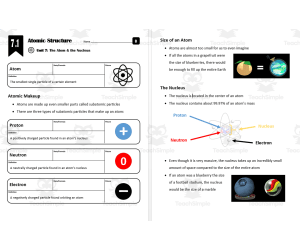
Lesson 7.1 - Atomic Structure
Science, Chemistry, Physics, Common Core, Grade 6, 7, 8, 9, 10, 11, 12, Lesson Plans, Teacher Tools
Lesson 7.1 - Atomic Structure Teaching Resource Serving as an ideal pedagogical tool for students from grades 6 to 12, Lesson 7.1 - Atomic Structure provides multifaceted approach to learning atomic structure, particularly catering to educators specializing in chemistry or physics. Inclusive Materials The lesson includes a myriad of resources that can be adapted for whole class, small group work or homework assignments depending on the teaching demand. One distinctive feature is the 7.1 Atomic Structure Notes. Two versions are available: one with fillable blanks promoting active learning and another completed version ensuring inclusivity. Engaging Opportunities The lesson introduces a cooperative learning activity known as the Subatomic Particle Matching Practice where students engage in peer discussions enabling effective recall. Critical reading skills are developed through materials such as World's Smallest Movie Reading resource which encourages content synthesis and summary writing. Presentation Tools In addition to these materials, there’s Objectives & Starter Questions PowerPoint presenting ready-to-use slides featuring clear objectives alongside interesting starter questions easing lecture preparation. The PowerPoint resource also comes with note-taking guides making presentation easier without compromising quality instruction. Standard Alignment Note that this lesson aligns closely with Indiana State Standards ICP10:2. Note: Please ensure you have compatible software for .docx and .pptx files. For PDFs Adobe Reader or any PDF reader software will suffice. Depending on your preference, adjustments via Microsoft Word/PPT document can be made while uneditable version is available in PDF format. In Conclusion: Lesson 7.1 stands as a comprehensive supplement to learning atomic structure, providing critical materials for both students and teachers. Along with clear definitions and illustrative graphics, it provides engaging tools for inculcating complex scientific concepts making the task of understanding atoms and particles seem effortlessly joyful.
Author Integrated Chemistry and Physics
Tags Atomic Structure, Subatomic Particles, Active Learning, Lesson Materials, Instructional Tools
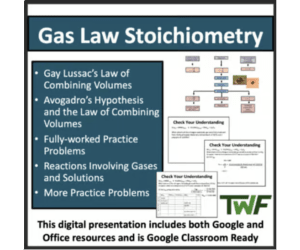
Gas Law Stoichiometry - Senior Chemistry Lesson
Science, Chemistry, Physics, Grade 6, 7, 8, 9, Teacher Tools, Lesson Plans
Gas Law Stoichiometry - Senior Chemistry Lesson Your lesson covers gas law stoichiometry. In order, the lesson teaches about; Gay Lussac’s Law of Combining Volumes, Avogadro’s Hypothesis and the Law of Combining Volumes, Reactions Involving Gases and Solutions and includes fully-worked Practice Problems. Your lesson includes the teacher and student version of the presentation, an auto-graded exit ticket, and a student lesson handout so the students can record the notes on a more condensed medium. This lesson is designed to be your go-to resource, whether you're in a traditional classroom or a virtual one. With both a teacher version and a student version, it seamlessly fits into your lesson plans, making learning engaging and adaptable. Assessment made easy We've included an auto-graded Exit Ticket and a quiz with an answer key because I know you don't have an excess of time. I know you don't, because I don't and I know I'll do whatever I can to reduce my grading time. Whether you use PowerPoint or Google Slides, prefer Word or Google Docs, this lesson has you covered. This lesson comes in both Office and Google formats for your convenience. The student version of the presentation has strategically placed blanks for them to fill in as you're teaching. It keeps them active and engaged, encourages discussion, and leaves more time for those "aha" moments.
Author Teach With Fergy
Tags Earth’s Elliptical Path , Earth’s Motion Around The Sun , The Seasons , Earth’s Tilt , Earth’s Revolution , Equinox , Perihelion , Aphelion

I WONDER - Do Chemical Reaction Affect Energy | Animated Video Lesson
Chemistry, Science, Physics, STEM, Grade 6, 7, 8, 9, 10, 11, 12, Lesson Plans, Teacher Tools
Video Introduction An amazing video designed for the students to learn more about STEM. I WONDER - Do Chemical Reaction Affect Energy | Animated Video Lesson Do you like STEM subjects? what is your favorite one? Have you ever tried to plant a seed? If yes, tell us more about it. Or have you ever tried to invent something? If yes, tell us more about it. And how do you think it will help us? Have you ever seen a microorganism under a microscope? What was it? And how it looked like? Mathematics is a marvelous subject. Let' sharpen our brains and solve some equations. Do you like timetable tricks? What is your favorite one? Do you know how to code? Have you ever created an app or a game before? If yes, how was it like? I WONDER - Do Chemical Reaction Affect Energy | Animated Video Lesson The video is perfect for encouraging the researching skills for the students, while learning more about this fantastic topic. I WONDER - Do Chemical Reaction Affect Energy | Animated Video Lesson This friendly designed video is suitable for students at school, homeschooling, and as a group activity. Format Available in MP4 format.
Author Educational Voice
Tags Do Chemical Reaction Affect Energy, Do Chemical Reaction Affect Energy Video, Chemical Reaction, Chemical Reaction Facts, Chemical Reaction Facts For Kids, Chemical Reaction Video, Energy, Energy Facts
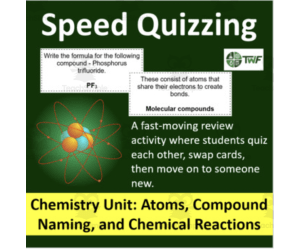
Speed Quizzing – Chemistry Unit – Atoms, Compound Naming, and Chemical Reactions
Science, Chemistry, Grade 10, 11, 12, Lesson Plans, Teacher Tools
Speed Quizzing – Chemistry Unit – Atoms, Compound Naming, and Chemical Reactions This educational resource provides a platform for teachers to conduct engaging and effective reviews for students. It utilizes active learning techniques through movement and interpersonal communication which aids in understanding critical chemistry concepts. Covered Topics Physical and Chemical Changes Periodic Table and Bohr Diagrams Lewis Structures, Ions Chemistry Ionic Compounds specifics Polyatomic Ions & Compounds essentials Molecular Compounds details An overview on Chemical Reactions including Balancing Chemical Equations with detailed coverage of Types of Chemical Reactions like Acid-Base interactions and Neutralization Reaction. The resource requires minimal preparation: simply print the 32 flashcards included in this downloadable editable zip file containing two Microsoft Word documents spanning over four pages. These relevant questions cover the above listed topics ensuring comprehensive yet concise revision. In-class Usage: Distribute one flashcard to each participant then guide them through pairing up via suitable methods. This promotes discussion promoting understanding amongst individuals having multiple opportunities to explain their answers. This teaching tool is ideal for grades 10 through 12 studying Science particularly Chemistry but can be adapted accordingly to suit comprehension levels across various student sets including homeschoolers aiming at mastery-based education. With Speed Quizzing – Chemistry Unit resources not only do you promote collaborative learning during small group activities but also its perfect in large class scenarios during review sessions or homework assignments. The interactive element ensures material retention and nurtures necessary interpersonal skills in and beyond the academic setting.
Author Teach With Fergy
Tags Atoms, Compound Naming, Chemical Reactions, Periodic Table, Balancing Equations

Lesson 2.2 - Speed
Science, Chemistry, Physics, Grade 6, 7, 8, 9, 10, 11, 12, Lesson Plans, Teacher Tools
Lesson 2.2 - Speed This pedagogical resource is designed to aid students in grades six through twelve grasp the concept of speed within the sciences. The teaching materials included revolve around subjects like Chemistry and Physics. This package includes: Instructive worksheets Progressive activities Motivating lesson starters to perfect speed calculations. About the Resource The resource has several integral components including: A detailed notes sheet illustrating the definition and ways of measuring speed. Versions available: An interactive one with blanks for note-taking. A pre-filled version for absentees or those needing extra help. A 'Speed Lab' activity that aids hands-on practice by answering real-time questions. 'Trade-and-Check' sessions replacing traditional question-answer methods with group-oriented problem-solving. An enticing 'Walk to School' activity incorporating Google Maps into hands-on learning while integrating digital resources into individual classroom settings. Additionally, this collection provides PowerPoint versions of instructor notes for clear, sleek presentations. Starter questions enhance student engagement right from lesson commencement. Formats provided are .docx files (editable using Word) & .pptx files (editable on PowerPoint), allowing teachers flexibility in molding materials based on their teaching styles and student requirements. Comprehensive .pdf files ensure undistorted view on any PDF-capable software. Note: This well-balanced mix of traditional print material with digital formats make these resources ideal for whole-class learning, small group instruction or homework tasks—fostering a fun-filled and engaging learning environment all around speed!
Author Integrated Chemistry and Physics
Tags Speed Calculations, Science Instruction, Hands-on Learning, Practical Application, Interactive Teaching

I WONDER - Can Humans Make Radiation | Animated Video Lesson
Chemistry, Science, Physics, Biology, Life Sciences, Grade 6, 7, 8, 9, 10, 11, 12, Lesson Plans, Teacher Tools
Video Introduction An amazing activity designed for the students to learn more about STEM. I WONDER - Can Humans Make Radiation | Animated Video Lesson Do you like STEM subjects? what is your favorite one? Have you ever tried to plant a seed? If yes, tell us more about it. Or have you ever tried to invent something? If yes, tell us more about it. And how do you think it will help us? Have you ever seen a microorganism under a microscope? What was it? And how it looked like? Mathematics is a marvelous subject. Let' sharpen our brains and solve some equations. Do you like timetable tricks? What is your favorite one? Do you know how to code? Have you ever created an app or a game before? If yes, how was it like? I WONDER - Can Humans Make Radiation | Animated Video Lesson The video is perfect for encouraging the researching skills for the students, while learning more about this fantastic topic. I WONDER - Can Humans Make Radiation | Animated Video Lesson This friendly designed video is suitable for students at school, homeschooling, and as a group activity. Format Available in MP4 format.
Author Educational Voice
Tags Can Humans Make Radiation, Can Humans Make Radiation Video, Radiation, Radiation Facts, Radiation Facts For Kids, Radiation Video, Radiation Video For Kids, Humans, Humans Video For Kids

Intermolecular Forces - Senior Chemistry Lesson
Science, Chemistry, Grade 10, 11, 12, Teacher Tools, Lesson Plans
Intermolecular Forces - Senior Chemistry Lesson Your lesson covers the four types of intermolecular forces. In order, the lesson teaches about; Dispersion Forces, Molecular Dipole, Dipole-Dipole Forces, the impact of Intermolecular Forces on Melting and Boiling points, and Hydrogen Bonds Your lesson includes the teacher and student version of the presentation, an auto-graded exit ticket, and a student lesson handout so the students can record the notes on a more condensed medium. This lesson is designed to be your go-to resource, whether you're in a traditional classroom or a virtual one. With both a teacher version and a student version, it seamlessly fits into your lesson plans, making learning engaging and adaptable. Assessment made easy We've included an auto-graded Exit Ticket and a quiz with an answer key because I know you don't have an excess of time. I know you don't, because I don't and I know I'll do whatever I can to reduce my grading time. Whether you use PowerPoint or Google Slides, prefer Word or Google Docs, this lesson has you covered. This lesson comes in both Office and Google formats for your convenience. The student version of the presentation has strategically placed blanks for them to fill in as you're teaching. It keeps them active and engaged, encourages discussion, and leaves more time for those "aha" moments.
Author Teach With Fergy
Tags Chemistry Lesson, Intermolecular Forces, Dispersion Forces, Molecular Dipole, Dipole-dipole Forces, Hydrogen Bonds, Hydrogen Bonding
I WONDER - When Was The Periodic Table Created | Animated Video Lesson
Chemistry, Science, Grade 4, 5, 6, 7, 8, 9, 10, Lesson Plans, Teacher Tools
Video Introduction An amazing activity designed for the students to learn more about STEM. I WONDER - When Was The Periodic Table Created | Animated Video Lesson Do you like STEM subjects? what is your favorite one? Have you ever tried to plant a seed? If yes, tell us more about it. Or have you ever tried to invent something? If yes, tell us more about it. And how do you think it will help us? Have you ever seen a microorganism under a microscope? What was it? And how it looked like? Mathematics is a marvelous subject. Let' sharpen our brains and solve some equations. Do you like timetable tricks? What is your favorite one? Do you know how to code? Have you ever created an app or a game before? If yes, how was it like? I WONDER - When Was The Periodic Table Created | Animated Video Lesson The video is perfect for encouraging the researching skills for the students, while learning more about this fantastic topic. I WONDER - When Was The Periodic Table Created | Animated Video Lesson This friendly designed video is suitable for students at school, homeschooling, and as a group activity. Format Available in MP4 format.
Author Educational Voice
Tags When Was The Periodic Table Created, When Was The Periodic Table Created Video, Periodic Table, Periodic Table Facts, Periodic Table Facts For Kids, Periodic Table Video, Periodic Table Video For Kids

Lesson 5.4 - The Combined Gas Law
Science, Chemistry, Physics, Grade 6, 7, 8, 9, 10, 11, 12, Lesson Plans, Teacher Tools
Lesson 5.4 - The Combined Gas Law includes the following files: 5.4 Combined Gas Law Notes Covers the definitions of pressure and volume and teaches how to use and solve the combined gas law. This notes sheet comes with an (A) version that has blanks for students to fill out as well as a completed (B) version for students who are absent or may require accommodations. 5.4 Combined Gas Law Practice Stations This document includes 6 stations with 2 combined gas law questions each. The pages can be stapled to a manila folder and propped up. The answer page goes under the question page for students to check their answers. Have students use whiteboards to answer each question to add a little fun. 5.4 Objectives & Starter Questions PowerPoint Learning objectives and sample starter questions for the topic. 5.4 PowerPoint Notes Notes in PowerPoint format to make presentation to the class a breeze. The following 2016 Indiana State Standards for Integrated Chemistry & Physics are addressed in this resource: ICP.5.5 Evaluate graphical or pictorial representations that describe the relationship among the volume, temperature, and number of molecules and the pressure exerted by the system to qualitatively and quantitatively describe how changing any of those variables affects the others.
Author Integrated Chemistry and Physics
Tags Integrated Chemistry & Physics, Combined Gas Law, Pressure, Volume

Crash Course Organic Chemistry: Episodes 26-30
Science, Chemistry, Grade 10, 11, 12, Teacher Tools, Lesson Plans
Crash Course Organic Chemistry: Episodes 26-30 - An Educational Resource This study guide is designed for Grade 10, Grade 11, and Grade 12 students studying science, specifically chemistry. Dive into the intriguing world of organic chemistry covering areas such as: Identifying molecules via Proton NMR; An overview of aldehydes and ketones; The exploration of organometallic reagents and carbanions; Understanding aldehyde and ketone reactions; Familiarization with carboxylic acids. Educators can use this guide in various ways such as stimulating group discussions during class hours or as a reference guide for independent learners' group activities outside the classroom. It can also be incorporated into homework assignments for comfortable at-home study sessions. Detailed Episode Guide The resource consists of a comprehensive PDF containing 24 well-prepared pages ready to be printed off at your convenience. Also included within these pages are episode links relating to each topic mentioned which add depth by providing instant access to visual learning content relevant to each subject area. center >-- Interactive Education -- center >, An engaging episode guide designed for student completion is included that allows learners to not only absorb new information but also practice new concepts by putting theories into action—a remarkable approach that enhances comprehension significantly over passive learning methods alone. Evaluation Aid – Answer Keys Included! center > To aid quick understanding evaluation or answer clarification post-study session, answer keys have been conveniently provided within the product—assisting teachers in providing results promptly or swiftly resolving queries when needed. In Conclusion Overall, this study aid offers flexibility to educators, easily adaptable according to classroom needs, and provides core knowledge necessary for mastery in chemistry. It is designed to captivate young minds towards exciting scientific explorations.
Author Karen Maxson
Tags Organic Chemistry, Proton NMR, Aldehydes And Ketones, Organometallic Reagents, Carboxylic Acids

I WONDER - How Can I Make Bubbles | Animated Video Lesson
Chemistry, Science, STEM, Grade 4, 5, 6, 7, 8, 9, 10, Lesson Plans, Teacher Tools
Video Introduction An amazing video designed for the students to learn more about STEM. I WONDER - How Can I Make Bubbles | Animated Video Lesson Do you like STEM subjects? what is your favorite one? Have you ever tried to plant a seed? If yes, tell us more about it. Or have you ever tried to invent something? If yes, tell us more about it. And how do you think it will help us? Have you ever seen a microorganism under a microscope? What was it? And how it looked like? Mathematics is a marvelous subject. Let' sharpen our brains and solve some equations. Do you like timetable tricks? What is your favorite one? Do you know how to code? Have you ever created an app or a game before? If yes, how was it like? I WONDER - How Can I Make Bubbles | Animated Video Lesson The video is perfect for encouraging the researching skills for the students, while learning more about this fantastic topic. I WONDER - How Can I Make Bubbles | Animated Video Lesson This friendly designed video is suitable for students at school, homeschooling, and as a group activity. Format Available in MP4 format.
Author Educational Voice
Tags How Can I Make Bubbles, How Can I Make Bubbles Video, Bubbles, Bubbles Facts, Bubbles Facts For Kids, Chemistry, Bubbles Video, Bubbles Video For Kids, Chemistry Video For Kids, Science
I WONDER - How Can Matter Change | Animated Video Lesson
Science, STEM, Chemistry, Grade 6, 7, 8, 9, 10, 11, 12, Teacher Tools, Lesson Plans
Video Introduction An amazing video designed for the students to learn more about STEM. I WONDER - How Can Matter Change | Animated Video Lesson Do you like STEM subjects? what is your favorite one? Have you ever tried to plant a seed? If yes, tell us more about it. Or have you ever tried to invent something? If yes, tell us more about it. And how do you think it will help us? Have you ever seen a microorganism under a microscope? What was it? And how it looked like? Mathematics is a marvelous subject. Let' sharpen our brains and solve some equations. Do you like timetable tricks? What is your favorite one? Do you know how to code? Have you ever created an app or a game before? If yes, how was it like? I WONDER - How Can Matter Change | Animated Video Lesson The video is perfect for encouraging the researching skills for the students, while learning more about this fantastic topic. I WONDER - How Can Matter Change | Animated Video Lesson This friendly designed video is suitable for students at school, homeschooling, and as a group activity. Format Available in MP4 format.
Author Educational Voice
Tags How Can Matter Change, How Can Matter Change Video, Matter Change, State Of Matters, State Of Matters Facts, State Of Matters Facts For Kids, State Of Matters Video, State Of Matters Video For Kids

Kinetic and Potential Energy - Lesson Bundle
Science, Chemistry, Grade 11, 12, Teacher Tools, Lesson Plans
Kinetic and Potential Energy - Lesson Bundle Kinetic and Potential Energy - Lesson Bundle is an extensive teaching resource designed to impart to students the vital concepts of kinetic and gravitational potential energy. This 12-slide lesson uncovers how these types of energy interact within the principle of conservation of energy. Geared towards Grade 11 and Grade 12 students, it's particularly useful in the subjects of Chemistry and Science. Inclusions in the Bundle A student-friendly material complete with comprehensive teaching aids. A teacher version that provides answers for practice questions posed throughout the lesson. An auto-graded Exit Ticket, an included quiz along with its answer key for evaluating knowledge retention after each module. The unit contains two inserted videos making it appealing for audiovisual learners. Keeping engagement high throughout are three interactive practice questions on topics ranging from kinetic energy to conserving energy application. Versatility & Compatibility Beyond its educational merit, this bundle holds high value due to its adaptability. It can either be used for a whole group or can be customized to smaller groups or individuals during their independent study time at home or school. Various formats including Office formats (PowerPoint presentations & Word documents) as well as Google-compatible formats ( Google Slides & Google Docs) offer flexibility according your preferences regarding instructional style presentation. The Kinetic and Potential Energy - Lesson Bundle is a valuable tool aiming at sharpening science instruction towards modern standards while engaging students through inquiry-based learning methods. As part of a larger series under Work, Energy, Power Units, involving multiple additional lessons, educators are empowered to deliver effective scientific understanding through critical thinking prompts on relevant phenomena impacting our everyday life functions.
Author Teach With Fergy
Tags Kinetic Energy, Potential Energy, Conservation Of Energy, Science Education, Teaching Resource

Lesson 4.2 - Conservation of Energy
Science, Chemistry, Physics, Grade 6, 7, 8, 9, 10, 11, 12, Lesson Plans, Teacher Tools
Lesson 4.2 - Conservation of Energy Take your teaching experience to the next level with our expertly created resource, designed specifically for Integrated Chemistry & Physics education. This extensive digital package provides a multitude of materials that explain the concept of energy conservation and its real-world application. This comprehensive resource includes: Educational notes addressing energy conservation in systems, available in an interactive fill-in-the-blank version (A version) and completed version (B version). A captivating Energy Skate Park Simulation for displaying the transformative process encompassing various forms of energy. Intriguing activities to encourage students' creativity by finding tangible examples of energy conservation within their daily life, backed up by a lab activity focusing on kinetic and potential energies. A structured PowerPoint known as Objectives & Starter Questions to effectively spark class discussions or quizzes. Detailed PowerPoint Notes for presenting material to students smoothly. The aforementioned contents are designed in accordance with 2016 Indiana State Standards ICP.4.2 and ICP.4.3, suiting different learning environments including full-class instruction, small group work, or individual assignments. The files included come in .docx (editable), .pptx (editable PowerPoint), and .pdf (non-editable) formats, compatible with popular software like Microsoft Word & PowerPoint or Adobe Reader. Note: All editable materials can be adjusted to fit your teaching preferences with the right software. Non-editable .pdf files, however, require a PDF viewer like Adobe Reader. It's recommended to check software compatibility before purchase and download. Ideal for Grade 6 to 12 students, this one-stop solution in the realms of Chemistry and Physics education combines comprehensive theoretical input with practical activities. Introduce Lesson 4 - Conservation of Energy in your curriculum today! Reference: The pronouns 'you', 'your' are intended for educators or teachers.
Author Integrated Chemistry and Physics
Tags Energy Conservation, Systems, Interactive Simulation, Lab Activity, Classroom Discussion

I WONDER - What Is An Insulator | Animated Video Lesson
Chemistry, Science, Physics, Grade 4, 5, 6, 7, 8, 9, 10, Lesson Plans, Teacher Tools
Video Introduction An amazing activity designed for the students to learn more about STEM. I WONDER - What Is An Insulator | Animated Video Lesson Do you like STEM subjects? what is your favorite one? Have you ever tried to plant a seed? If yes, tell us more about it. Or have you ever tried to invent something? If yes, tell us more about it. And how do you think it will help us? Have you ever seen a microorganism under a microscope? What was it? And how it looked like? Mathematics is a marvelous subject. Let' sharpen our brains and solve some equations. Do you like timetable tricks? What is your favorite one? Do you know how to code? Have you ever created an app or a game before? If yes, how was it like? I WONDER - What Is An Insulator | Animated Video Lesson The video is perfect for encouraging the researching skills for the students, while learning more about this fantastic topic. I WONDER - What Is An Insulator | Animated Video Lesson This friendly designed video is suitable for students at school, homeschooling, and as a group activity. Format Available in MP4 format.
Author Educational Voice
Tags What Is An Insulator, What Is An Insulator Video, Insulator, Insulators, Insulator Facts, Insulator Facts For Kids, Insulators Video, Insulators Video For Kids, Stem, Stem Facts

I WONDER - Is A Plastic A Polymer | Animated Video Lesson
Chemistry, Science, STEM, Grade 6, 7, 8, 9, 10, 11, 12, Lesson Plans, Teacher Tools
Video Introduction An amazing video designed for the students to learn more about STEM. I WONDER - Is A Plastic A Polymer | Animated Video Lesson Do you like STEM subjects? what is your favorite one? Have you ever tried to plant a seed? If yes, tell us more about it. Or have you ever tried to invent something? If yes, tell us more about it. And how do you think it will help us? Have you ever seen a microorganism under a microscope? What was it? And how it looked like? Mathematics is a marvelous subject. Let' sharpen our brains and solve some equations. Do you like timetable tricks? What is your favorite one? Do you know how to code? Have you ever created an app or a game before? If yes, how was it like? I WONDER - Is A Plastic A Polymer | Animated Video Lesson The video is perfect for encouraging the researching skills for the students, while learning more about this fantastic topic. I WONDER - Is A Plastic A Polymer | Animated Video Lesson This friendly designed video is suitable for students at school, homeschooling, and as a group activity. Format Available in MP4 format.
Author Educational Voice
Tags Is A Plastic A Polymer, Is A Plastic A Polymer Video, Polymer, Polymers Facts, Polymers, Polymer Facts For Kids, Polymers Video, Polymers Video For Kids, Science, Science Video
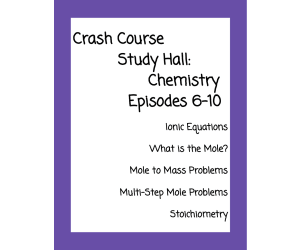
Crash Course Study Hall: Chemistry Episodes 6-10
Science, Chemistry, Grade 9, 10, 11, 12, Teacher Tools, Lesson Plans
Crash Course Study Hall: Chemistry Episodes 6-10 Crash Course Study Hall: Chemistry Episodes 6-10 is a unique teaching resource designed for educators aiming to facilitate an engaging and in-depth understanding of chemistry for students from grades 9 through 12. This comprehensive resource spans across five key topics: Ionic Equations An exploration of the Mole concept Mole to Mass problems Multi-Step Mole problems Stoichiometry. The content within this resource has been expertly organized into 20 ready-to-print pages housed within a single pdf file type— the optimal format for accessible knowledge sharing each lesson plan offers educators the flexibility to utilize during whole group instruction or divided into smaller groups, tailoring it specifically to their instructional needs. Even more adaptably it can serve as supplemental homework and review assignments bolstering the student's grasp on complex concepts. The study guide proves both interactive and catered for real-time comprehension with links directed towards each relevant episode provided within its contents. There's also an episode guide that students can complete independently or collaboratively following each lesson—available in two versions: one with timestamps while second comes without them. Ease of Assessment: To ensure effortless assessment, answer keys are included alongside every comprehensive student worksheet making grading efficient yet easy. In Summary: In summary, Crash Course Study Hall: Chemistry is not just a teaching resource; it’s a treasure trove that allows educators refine their pedagogical methods whilst enriching their students' journey towards mastery in High School level chemistry concepts such as stoichiometry and molecular theory. This neatly ties up with modern educational prerequisites calling upon active involvement from learners coupled with supportive analytical evaluation by teachers.
Author Karen Maxson
Tags Chemistry, Study Guide, Lesson Plans, Stoichiometry, Crash Course

I WONDER - What Is A Solid | Animated Video Lesson
Chemistry, Science, Grade 4, 5, 6, 7, 8, 9, 10, Lesson Plans, Teacher Tools
Video Introduction An amazing activity designed for the students to learn more about STEM. I WONDER - What Is A Solid | Animated Video Lesson Do you like STEM subjects? what is your favorite one? Have you ever tried to plant a seed? If yes, tell us more about it. Or have you ever tried to invent something? If yes, tell us more about it. And how do you think it will help us? Have you ever seen a microorganism under a microscope? What was it? And how it looked like? Mathematics is a marvelous subject. Let' sharpen our brains and solve some equations. Do you like timetable tricks? What is your favorite one? Do you know how to code? Have you ever created an app or a game before? If yes, how was it like? I WONDER - What Is A Solid | Animated Video Lesson The video is perfect for encouraging the researching skills for the students, while learning more about this fantastic topic. I WONDER - What Is A Solid | Animated Video Lesson This friendly designed video is suitable for students at school, homeschooling, and as a group activity. Format Available in MP4 format.
Author Educational Voice
Tags What Is A Solid, What Is A Solid Video, Solid, Solids, Solids Facts, Solids Facts For Kids, Solids Facts Video, State Of Matter, States Of Matter, States Of Matter Facts

I WONDER - Can Metals And Non Metals Form Compounds
Science, Chemistry, STEM, Grade 6, 7, 8, 9, 10, 11, 12, Lesson Plans, Teacher Tools
Video Introduction An amazing video designed for the students to learn more about STEM. I WONDER - Can Metals And Non Metals Form Compounds | Animated Video Lesson Do you like STEM subjects? what is your favorite one? Have you ever tried to plant a seed? If yes, tell us more about it. Or have you ever tried to invent something? If yes, tell us more about it. And how do you think it will help us? Have you ever seen a microorganism under a microscope? What was it? And how it looked like? Mathematics is a marvelous subject. Let' sharpen our brains and solve some equations. Do you like timetable tricks? What is your favorite one? Do you know how to code? Have you ever created an app or a game before? If yes, how was it like? I WONDER - Can Metals And Non Metals Form Compounds | Animated Video Lesson The video is perfect for encouraging the researching skills for the students, while learning more about this fantastic topic. I WONDER - Can Metals And Non Metals Form Compounds | Animated Video Lesson This friendly designed video is suitable for students at school, homeschooling, and as a group activity. Format Available in MP4 format.
Author Educational Voice
Tags Can Metals And Non Metals Form Compounds, Can Metals And Non Metals Form Compounds Video, Metals, Metals Facts, Metals Facts For Kids, Metals Video, Non Metals, Non Metals Facts, Non Metals Facts For Kids
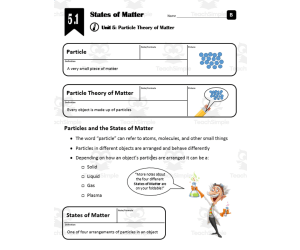
Lesson 5.1 - States of Matter
Science, Chemistry, Physics, Grade 6, 7, 8, 9, 10, 11, 12, Lesson Plans, Teacher Tools
Lesson 5.1 - States of Matter is an all-inclusive learning resource designed to simplify the complex concepts of chemistry and physics for students from grades six through twelve. This tool excellently illustrates the theory that everything is made up of particles, and introduces learners effortlessly into understanding the four different states of matter. The package incorporates a range of resources, including: Notes Foldables Simulations Whiteboard practices Powerpoint presentations. The materials provided are versatile in their application with opportunities to use them in several settings such as full classroom groups, more intimate teaching clusters or even for independent student studies like homework tasks. Note structure: Students will find comprehensive notes which cover the four states of matter in-depth with interactive blanks to practice their assimilation alongside theoretical instructions. A considerate feature includes completed versions for learners who may have been absent or those requiring certain accommodations. Foldables: Engagingly interactive foldables serve not only as note holders but also act as academic creativity stimuli. Leaves detailing each state's specific properties come both blank and prefilled similar to the note structure approach adopted previously ensuring regular revision aids are at hand irrespective of absence or special requirements. Innovative Features: An intriguing computer simulation provides students hands-on experience into exploring particle structures within each state fostered by user friendly URL embedded navigations leading them through modelled scientific data gathering whilst simultaneously answering corresponding queries growing their practical comprehension. Whiteboard practises move away from traditional methods engaging participants visually classifying matter types via pictures showcased on slides reinforcing identification skills real-time in a dynamic setting further enhancing memory retention strategies thereby improving exam performance rates overall. This tool adequately addresses multiple 2016 Indiana State Standards for Integrated Chemistry & Physics such as: Particle representation methods (ICP 5.1) Assumptions leading up to kinetic theory development (ICP 5.2) Explaining how forces change between particles (ICP 5.6) Density effects along with molecular structures contributing towards distinguishing gas properties versus liquid or solid(ICP 6.7) Thus this tool is an investment well worth considering. Your Download: The files come as editable docx or pptx formats in addition to non-editable PDFs, ensuring options to suit varying teaching styles based on preference and available software. In conclusion : Last but not the least, get charged up and ready with a lesson plan for academic success leveraging from Lesson 5.1 - States of Matter!
Author Integrated Chemistry and Physics
Tags States Of Matter, Particle Structures, Interactive Learning, Chemistry And Physics, Practical Comprehension

Lesson 3.3 - Newton's 1st Law of Motion (Inertia)
Science, Chemistry, Physics, Grade 6, 7, 8, 9, 10, 11, 12, Lesson Plans, Teacher Tools
Lesson 3.3 - Newton's 1st Law of Motion includes the following files: 3.3 1st Law of Motion Notes Covers the idea of inertia and gives examples of its presence in everyday life. This notes sheet comes with an (A) version that has blanks for students to fill out as well as a completed (B) version for students who are absent or may require accommodations. 3.3 Inertia Demo Stations Activity This activity is much like a lab , although I don't call it that because it does not follow the scientific process. It is more like a hands-on practice sheet. Students rotate to different stations and perform tasks while answering questions. The tasks are all designed to demonstrate inertia - an object staying at rest or staying in motion. 3.3 Objectives & Starter Questions PowerPoint Learning objectives and sample starter questions for the topic. 3.3 PowerPoint Notes Notes in PowerPoint format to make presentation to the class a breeze. The following 2016 Indiana State Standards for Integrated Chemistry & Physics are addressed in this resource: ICP.3.1 Develop pictorial and graphical representations which show that a single external applied force changes the velocity of an object, and that when no force acts, the velocity of an object remains constant.
Author Integrated Chemistry and Physics
Tags Integrated Chemistry & Physics, Newton's 1st Law, Inertia

I WONDER - Are There Different Types Of Fireworks | Animated Video
STEM, Chemistry, Science, Grade 6, 7, 8, 9, 10, 11, 12, Lesson Plans, Teacher Tools
Video Introduction An amazing video designed for the students to learn more about STEM. I WONDER - Are There Different Types Of Fireworks | Animated Video Lesson Do you like STEM subjects? what is your favorite one? Have you ever tried to plant a seed? If yes, tell us more about it. Or have you ever tried to invent something? If yes, tell us more about it. And how do you think it will help us? Have you ever seen a microorganism under a microscope? What was it? And how it looked like? Mathematics is a marvelous subject. Let' sharpen our brains and solve some equations. Do you like timetable tricks? What is your favorite one? Do you know how to code? Have you ever created an app or a game before? If yes, how was it like? I WONDER - Are There Different Types Of Fireworks | Animated Video Lesson The video is perfect for encouraging the researching skills for the students, while learning more about this fantastic topic. I WONDER - Are There Different Types Of Fireworks | Animated Video Lesson This friendly designed video is suitable for students at school, homeschooling, and as a group activity. Format Available in MP4 format.
Author Educational Voice
Rating
Tags Are There Different Types Of Fireworks, Are There Different Types Of Fireworks Video, Different Types Of Fireworks, Different Types Of Fireworks Facts, Different Types Of Fireworks Video, Different Types Of Fireworks Video For Kids
I WONDER - How Was The Periodic Table Arranged | Animated Video Lesson
Chemistry, Science, Grade 4, 5, 6, 7, 8, 9, 10, Lesson Plans, Teacher Tools
Video Introduction An amazing activity designed for the students to learn more about STEM. I WONDER - How Was The Periodic Table Arranged | Animated Video Lesson Do you like STEM subjects? what is your favorite one? Have you ever tried to plant a seed? If yes, tell us more about it. Or have you ever tried to invent something? If yes, tell us more about it. And how do you think it will help us? Have you ever seen a microorganism under a microscope? What was it? And how it looked like? Mathematics is a marvelous subject. Let' sharpen our brains and solve some equations. Do you like timetable tricks? What is your favorite one? Do you know how to code? Have you ever created an app or a game before? If yes, how was it like? I WONDER - How Was The Periodic Table Arranged | Animated Video Lesson The video is perfect for encouraging the researching skills for the students, while learning more about this fantastic topic. I WONDER - How Was The Periodic Table Arranged | Animated Video Lesson This friendly designed video is suitable for students at school, homeschooling, and as a group activity. Format Available in MP4 format.
Author Educational Voice
Tags How Was The Periodic Table Arranged, How Was The Periodic Table Arranged Video, Periodic Table, Periodic Table Facts, Periodic Table Facts For Kids, Periodic Table Video, Periodic Table Video For Kids
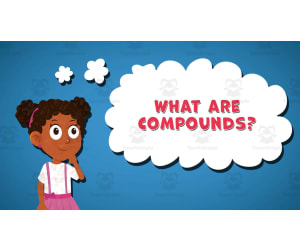
I WONDER - What Are Compounds | Animated Video Lesson
Chemistry, Science, STEM, Grade 6, 7, 8, 9, 10, 11, 12, Lesson Plans, Teacher Tools
Video Introduction An amazing video designed for the students to learn more about STEM. I WONDER - What Are Compounds | Animated Video Lesson Do you like STEM subjects? what is your favorite one? Have you ever tried to plant a seed? If yes, tell us more about it. Or have you ever tried to invent something? If yes, tell us more about it. And how do you think it will help us? Have you ever seen a microorganism under a microscope? What was it? And how it looked like? Mathematics is a marvelous subject. Let' sharpen our brains and solve some equations. Do you like timetable tricks? What is your favorite one? Do you know how to code? Have you ever created an app or a game before? If yes, how was it like? I WONDER - What Are Compounds | Animated Video Lesson The video is perfect for encouraging the researching skills for the students, while learning more about this fantastic topic. I WONDER - What Are Compounds | Animated Video Lesson This friendly designed video is suitable for students at school, homeschooling, and as a group activity. Format Available in MP4 format.
Author Educational Voice
Tags What Are Compounds, What Are Compounds Video, Compounds, Compounds Facts, Compounds Facts For Kids, Compounds Video, Compounds Video For Kids, Compounds Facts Video For Kids