search
user.png
vertical menu

Chemistry Lesson Plans: Gas Law Stoichiometry

Chemistry Lesson Plans: Gas Law Stoichiometry preview
Chemistry Lesson Plans: Gas Law Stoichiometry preview 2
Chemistry Lesson Plans: Gas Law Stoichiometry preview 3
Chemistry Lesson Plans: Gas Law Stoichiometry preview 4

Look Inside · 9 pages · answer key included

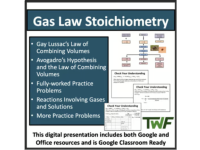
Gas Law Stoichiometry cover listing combining volumes, Avogadro's hypothesis, worked problems and gas-solution reactions
Overview slide to preview the lesson's five topics
Gay Lussac's law of combining volumes: water electrolysis 2H2O to 2H2 + O2 shows gas volumes form small whole-number ratios
Notes slide introducing volume ratios from coefficients
Avogadro's hypothesis: equal gas volumes hold equal moles, shown by converting H2 + Cl2 to 2HCl volumes into mole ratios
Notes linking volume ratios to mole ratios
Mole ratio practice: students find the volume of fluorine needed to make 125 mL of sulphur hexafluoride from S + 3F2 to SF6
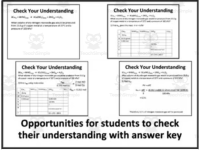
Check-in problem for students to try before the solution
Gas volume at SATP problem: students find the volume of sulphur dioxide made when 14.0 g of sulphur burns in excess oxygen
Multi-step practice problem posed before the worked steps
Sulphur dioxide problem step 1: moles of sulphur found from mass with n = m/M, giving 0.437 mol in an m-M-n table
Step one of the guided solution: mass to moles
Sulphur dioxide problem step 2: a 1:1 mole ratio converts 0.437 mol of sulphur to 0.437 mol of SO2, added to the table
Step two of the guided solution: applying the mole ratio
Photosynthesis gas problem: students find the mL of oxygen made from 0.12 g of carbon dioxide at 15°C and 102 kPa
Extra practice using non-standard temperature and pressure

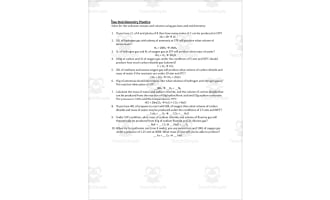
Answer key included

Answer key included
Attributes
Add To Collection
Add to collection Add to collection

About This Product

Gas Law Stoichiometry - Senior Chemistry Lesson

Your lesson covers gas law stoichiometry. In order, the lesson teaches about; Gay Lussac’s Law of Combining Volumes, Avogadro’s Hypothesis and the Law of Combining Volumes, Reactions Involving Gases and Solutions and includes fully-worked Practice Problems.

Your lesson includes the teacher and student version of the presentation, an auto-graded exit ticket, and a student lesson handout so the students can record the notes on a more condensed medium.

This lesson is designed to be your go-to resource, whether you're in a traditional classroom or a virtual one. With both a teacher version and a student version, it seamlessly fits into your lesson plans, making learning engaging and adaptable.

Assessment made easy

We've included an auto-graded Exit Ticket and a quiz with an answer key because I know you don't have an excess of time. I know you don't, because I don't and I know I'll do whatever I can to reduce my grading time.

Whether you use PowerPoint or Google Slides, prefer Word or Google Docs, this lesson has you covered. This lesson comes in both Office and Google formats for your convenience.

The student version of the presentation has strategically placed blanks for them to fill in as you're teaching. It keeps them active and engaged, encourages discussion, and leaves more time for those "aha" moments.

0 Reviews

Explore related searches
you may also like...

Check out these other great products