



3,931 products added recently
Page 128 - Science Lesson Plan Template
Enhance your science instruction with a flexible lesson plan template designed for educators. This tool helps you structure objectives, materials, procedures, and assessments efficiently. Use it to create organized and impactful science lessons that cater to your students' needs.

 Show filters

Mars | Interactive Science Lesson | Micro-Learning Deck
Science, Earth and Environmental Sciences, Space, Grade 6, 7, 8, 9, Teacher Tools, Lesson Plans
This micro-learning deck is the perfect accessory to your Science instruction! This digital slideshow presents Is Mars Really Hot and Red? Within this slideshow, you will receive: -Video Lesson -Reading Passage w/ Audio -Close Reading -Quick Write The informational texts included in this resource alongside the informal assessments will keep your students engaged from beginning to end.
Author Teach Me This
Tags Astronomy, Digital Science, Interactive, Planets, Mars

Producer Consumer Decomposer - Digital Mini Lesson Practice
Science, Life Sciences, Biology, Grade 6, 7, Lesson Plans, Teacher Tools
Introducing the Producer Consumer Decomposer - Digital Mini Lesson Practice This educational tool, primarily designed for 6th and 7th grade students, provides simplified yet comprehensive insights into distinguishing between producers, consumers, and decomposers. Digital Format & Self-Grading Feature The mini-lesson activity is presented via Google Forms, making it an exclusive for digital classrooms. A standout feature is its automatic marking functionality. Each question in the algebra activity is a standalone section, supporting students by isolating individual problems until correctly resolved. Meticulous Design for Inclusive Learning This stepwise teaching methodology pays dividends with English Language Learners (ELLs) or those who require alternative learning strategies due to distinct learning needs. Accompanied by detailed visual prompts, instructions are clearer to follow making the overall instruction delivery more inclusive. In-Class Use: The form primarily serves during classroom sessions as part of group activities or individual practice while covering topics on producers consumers decomposers. Holistic Learning Opportunities: Use it as a revision tool or even assign it as homework to facilitate additional engagement beyond school hours. Easily Customizable: The questions in this mini-lesson can be modified according to your focus areas within biology teaching. Kindly note that this resource doesn't offer any printing options owing to its purely digital format. In Conclusion... The Producer Consumer Decomposer - Digital Mini Lesson Practice serves excellently well in offering efficient ways of captivating students' attention while effectively embedding key academic concepts!
Author Sheltered Language Resources
Tags Biology Education, Producers, Consumers, Decomposers, Digital Learning, Decomposer Producer Consumer, Producer-consumer-decomposer

Speed Quizzing – Space Unit: The Study of the Universe
Science, Earth and Environmental Sciences, Space, Grade 8, 9, 10, Lesson Plans, Teacher Tools
This activity will get your students out of their seats, moving around, and discussing the material. It is fully editable and requires very little preparation. Simply print, cut out the flash cards, and pass them out to students. Note. This resource can also be used as an excellent question bank as it contains 32 high-quality questions that you can use in any way you see fit. This activity contains 32 questions designed to test your students’ knowledge of the unit they are studying. The questions come directly from the lessons and cover the following topics: • Space • Our Solar System • The Life and Death of Stars • Seasons • The Moon • Eclipse • Galaxies, Other Objects, and the Universe • The Immensity of the Universe • How Humans Meet Their Needs in Space Each of the Speed Quizzes listed below can be found in my Speed Quizzes Growing bundle at a discount of at least 65%. Here’s how you implement them: 1. Provide each student with a flash card 2. Pair up students using the stand up/hands up/pair up method 3. Partner A reads the question to Partner B, who answers. Partner A praises if correct or coaches if incorrect. 4. Partners switch roles 5. Students thank each other and switch cards 6. Partners raise their hands to find a new partner 7. Repeat for a specified amount of time Alternate way to ensure each student gets a new partner each time: Divide students into groups A and B. Have every student pair up with someone from the other group (if there is an odd number of students you participate too!) 1) Do Speed Quizzing 2) Then have group A move to the right and group B stay still. 3) Do Speed Quizzing 4) Then have group B move to the left and group A stay still. Every student in group A will meet every student in group B, but students will not meet students in their own group (a clever way to keep apart students who should not be partnered for whatever reason). This activity can be used to: • Prompt meaningful student conversation • Review prior knowledge • Review new terms/problems after a unit • Gather student ideas • Remediate weak skills • Practice new skills Thank you for your interest in my products. If you have any questions, please send me an email - devon@teachwithfergy.com
Author Teach With Fergy
Tags Study Of The Universe, Speed Quizzing, Space Unit, Astrology Assessment, Partner Work
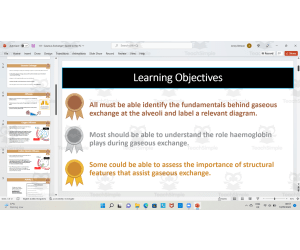
Gaseous Exchange in The Body
Science, Life Sciences, Human Body, Grade 9, 10, Teacher Tools, Lesson Plans
Gaseous Exchange in The Body What is it? Gaseous Exchange in The Body is an educational resource that focuses on the diffusion process, which facilitates gaseous exchange within the human body. This comprehensive package offers a 21-slide PowerPoint presentation lesson, perfect for Grade 9 and Grade 10 science classes. Learning Goals Basic Principles: Every student must grasp the basic principles of gaseous exchange at alveoli and accurately label a corresponding diagram. Hemoglobin's Role: Many are expected to comprehend the central role that haemoglobin plays during this process. Evaluation & Analysis: Lastly, a select number could analyze and evaluate the significance of structural features that aid gaseous exchange. Versatility of Use This innovative teaching tool can be employed for whole group instruction during classroom sessions or utilized for smaller guided study groups focused on detailed discussions or peer tutoring sessions with more individualized learning experiences. Tech-Ready Format The Microsoft PowerPoint format affords seamless integration into any class settings—be it an interactive whiteboard demonstration or remote-learning environment—thus making it adaptable even in diverse learning scenarios such as traditional schooling or homeschooling arrangements. Fostering Critical Thought Gaseous Exchange in The Body isn't just about delivering content; it's also designed with an aim towards fostering critical thought around complex scientific phenomena like these bodily processes. This methodology-based module crosses boundaries offering valuable insights applicable universally across all areas encompassed under general ‘Science’. In conclusion, Gaseasou Exchange In The Body provides a visually appealing yet content-rich experience guaranteed to spark interest and curiosity among young learners keen on deciphering the workings of their own bodies from a biological standpoint.
Author The PE Tutor
Tags Gaseous Exchange, Alveoli, Diffusion Process, Haemoglobin, Structural Features
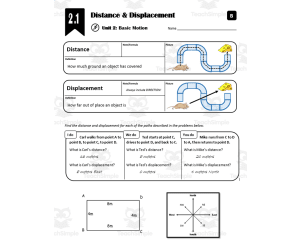
Lesson 2.1 - Distance & Displacement
Science, Chemistry, Physics, Common Core, Grade 6, 7, 8, 9, 10, 11, 12, Lesson Plans, Teacher Tools
Lesson 2.1 - Distance & Displacement: A Comprehensive Teaching Resource This resource is a comprehensive package designed for those tackling the important concepts of distance and displacement in Physical Sciences. A complete set of Notes on Distance and Displacement Two versions available – (A) fill in the blanks for interactive learning, and (B) complete notes as a ready reference or for students with special needs. Custom Worksheets to Practice Skills: Students can practice finding an object's distance or displacement using graphical representations of movements. Inclusive design with a standard (A) version and tailored (B) version to cater to varied learning paces among scholars. Slick PowerPoint Notes: An ideal solution that streamlines lesson delivery regardless of class size, converting scientific explanations into engaging presentations. Included Also Are: "Objectives & Sample Starter Questions" : sets clear goals for understanding the concept at hand while initiating meaningful discussion starts. A resource perfectly aligned with 2016 Indiana State Standards: This resource tailors perfectly into your curriculum requirements—whether it’s public schools or homeschooling settings alike. Diverse File Formats Available: .docx files for adaptability based on individual educator’s preferences plus .pdf files perfect as quick-reference non-editable versions requiring any PDF viewer like Adobe Reader. Ideal For Grades 6-12 : This comprehensive guide allows students between Grade 6 to Grade 12 comprehend how to distinguish between distance and displacement, and determine their values either from graphical or mathematical representation against time. Transform teaching the notion of Distance & Displacement into an enjoyable experience with this comprehensive and concise resource.
Author Integrated Chemistry and Physics
Tags Distance, Displacement, Notes, Worksheets, PowerPoint
Spiders | Interactive Science Lesson | Micro-Learning Deck
Science, Life Sciences, Animals, Grade 6, 7, 8, 9, Teacher Tools, Lesson Plans
This micro-learning deck is the perfect accessory to your Science instruction! This digital slideshow presents Spiders. Within this slideshow, you will receive: -Video Lesson -Reading Passage w/ Audio -Close Reading -Quick Write The informational texts included in this resource alongside the informal assessments will keep your students engaged from beginning to end.
Author Teach Me This
Tags Spiders, Insect Lesson, Interactive, Science, Learning Deck
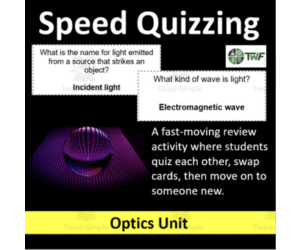
Speed Quizzing – Optics Unit
Science, Physics, Grade 8, 9, 10, Lesson Plans, Teacher Tools
Speed Quizzing - Optics Unit This is a dynamic and editable teaching resource suitable for Grade 8, 9, and 10 students studying Science with an emphasis on Physics. It aims to create a lively learning environment by integrating movement and discussion into the academic framework. About the Product The product mainly entails printing and distributing flashcards among the students It comprises of 32 comprehensive questions, covering various optics-related topics such as: Light, Lasers & Absorption/Transmission, Producing Light, & More unlisted topics. Besides being an engaging classroom exercise; it functions independently as an impressive question bank due to its high-quality question composition. . Detailed Application Process The first step involves dividing your students into groups A and B - these groups would use their flashcards for questioning each other while appreciating or coaching based on responses given. Latterly, roles are switched with partners shuffling after appreciation expressed via thanks noted between them before repeating this process during a predetermined set duration. A variant can be incorporated where group A moves right while group B remains static facilitating different partnerships with swapped positions between rounds for even distribution of partner combinations. . +(ol) The Benefits This resource promotes meaningful student dialogues fostering an interactive environment conducive for knowledge reinforcement especially after freshly concluded units offering room to remediate weak skills along practical applications assisting in solidifying new skills acquisition understanding leading optimally towards higher learning retention rates among pupils efficiently propelling academic success forward. .
Author Teach With Fergy
Tags Optics Unit, Speed Quizzing, Science Education, Physics Activity, Interactive Learning

Kepler's Laws of Planetary Motion - Earth and Space Lesson
Science, Earth and Environmental Sciences, Space, Grade 10, 11, 12, Teacher Tools, Lesson Plans
Kepler's Laws of Planetary Motion - Earth and Space Lesson This delightful teaching resource is specifically designed for science educators instructing students from grades 10 to 12. Kepler's theories about the relationship between planets and their motion serve as the cornerstone of this lesson. The highlights of this lesson include its comprehensive nature, promoting theory-based learning fused with interactive discussions. The course plan unfolds as: A brief history Introduction to Geocentric and Heliocentric models Deep dive into: Kepler’s First Law Kepler’s Second Law Kepler’s Third Law An adaptable structure makes it effective for whole group instruction or smaller groups. Student handouts, education videos, and auto-graded exit tickets round up this robust package. Focusing on accessibility, material compatibility extends to Google applications (Docs & Slides) as well as Microsoft Office applications (Word & PowerPoint), catering conveniently to varying technology preferences among school districts. Sneak peek into student engagement features: This unique presentation keeps students engaged by assigning classroom blanks that prompt them to fill out during discussions—an optimal way towards maintaining active involvement. Following this module on Kepler's Laws of Planetary motion, a further curriculum casts light onto: The Big Bang Theory, Celestial Objects, Astronomical Distances, Electromagnetic Spectrum/ Radiation, Spectroscopy Star Classification, and several fascinating subjects within our Solar System! To sum up, Kepler's Laws of Planetary Motion - Earth and Space Lesson artfully blends technology with traditional teaching methods to create an educational experience that is academically rigorous and highly engaging. It doesn't just teach, but encourages systematic inquiry into our Earth and Space Science.
Author Teach With Fergy
Tags Kepler's Laws, Planetary Motion, Universe, Science Education, Inquiry-based Learning
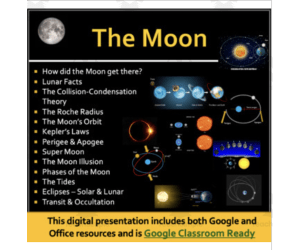
The Moon - Origin, Orbits, and Influences -Senior Earth & Space Lesson
Science, Earth and Environmental Sciences, Space, Grade 10, 11, 12, Teacher Tools, Lesson Plans
The Moon - Origin, Orbits, and Influences - This three-day senior Earth and Space lesson package includes the lesson (student and teacher versions of the presentation), an auto-graded Exit Ticket, EIGHT videos, and a student lesson handout as a document. The presentation is fun and applicable with many opportunities for inquiry-based learning and discussion. The presentation covers a lot of content and is meant to be delivered over a three-day stretch. This lesson includes both Office and Google formats for ALL resources. The presentation is in PowerPoint and Google Slides while all documents contain Word and Google Doc versions. Your resource is perfect for distance learning and integrates seamlessly with Google Classroom as I've included a link that will automatically create a copy of the resources and put them directly into your Google Drive with one click. Download--> Open --> Click --> Assign to your students Having both options allows you to use either without worrying about formatting issues as all the work has already been done for you. It safeguards you in case your department or school decides to go Google 100% and allows you as well as your students to access everything no matter where you are or what kind of equipment is being used. In order, the lesson covers: How did the Moon get there? Lunar Facts The Collision-Condensation Theory The Roche Radius The Moon’s Orbit Kepler’s Laws Perigee & Apogee Super Moon The Moon Illusion Phases of the Moon The Tides Eclipses – Solar & Lunar Transit & Occultation Included in the lesson package is: Google and Office versions of each resource The teacher version of the presentation The student version of the presentation Auto-graded Exit Ticket EIGHT videos embedded into the presentation Student lesson handout The student version of the presentation contains multiple blanks that need to be filled in throughout the lesson. These blanks are conveniently underlined and bolded on the teacher copy. I have found this to be the most effective means of keeping my students engaged and active without having them write everything out. This also leaves more time for discussion and activities. This lesson can also be found within the Earth and Space - Space Unit Bundle which includes: Lesson 1 - The Big Bang Theory Lesson 2 - Celestial Objects Lesson 3 - Astronomical Distances and Measurements Lesson 4 - Electromagnetic Spectrum and Radiation Lesson 5 - Stars - Classification and Spectroscopy Lesson 6 - Earth’s Position In The Celestial Sphere Lesson 7 - Our Solar System - From The Sun to The Oort Cloud Lesson 8 - Kepler’s Laws of Planetary Motion Lesson 9 - The Moon - Origin, Orbits, and Influences Also, please visit my blog Teach With Fergy for my thoughts on teaching, learning, and everything in between.
Author Teach With Fergy
Tags Lunar Facts , The Collision-Condensation Theory, The Roche Radius , The Moon’s Orbit , Kepler’s Laws , Perigee & Apogee , Eclipses – Solar & Lunar

Peacocks | Interactive Science Lesson | Micro-Learning Deck
Science, Life Sciences, Animals, Grade 6, 7, 8, 9, Teacher Tools, Lesson Plans
This micro-learning deck is the perfect accessory to your Science instruction! This digital slideshow presents Peacocks. Within this slideshow, you will receive: -Video Lesson -Reading Passage w/ Audio -Close Reading -Quick Write The informational texts included in this resource alongside the informal assessments will keep your students engaged from beginning to end.
Author Teach Me This
Tags Peacocks, Animal Lesson, Zoology, Vocabulary, Interactive Science

Lesson 9.1 - Static Electricity
Science, Physics, Grade 6, 7, 8, 9, 10, 11, 12, Lesson Plans, Teacher Tools
Lesson 9.1 - Static Electricity An enriching teaching resource for educators focusing on physics for Grade 6 to Grade 12. This unit provides a guide on the topics of electricity and magnetism. Featuring: Components from the Indiana State Standards for Integrated Chemistry & Physics Notes about static electricity, its mechanism and effects when discharging. Lecture resources, interactive simulations, Powerpoint presentations, starter questions and directed tasks. This unit also delves into current electricity with an in-depth explanation of electrical conductors versus insulators while introducing resistance, current and voltage calculation through Ohm’s law. Included in this module; A simulation that lets learners virtually build their circuits. Magnetism! Key topics: Earth’s magnetism effect on compasses are introduced and explored alongside corresponding notes! A segment where students get to research different technologies using magnetism. An interactive approach towards learning! Last but not least, Note-worthy Additions: Binder divider tailored specially for this unit – helping students keep track of their progress better. A comprehensive Unit Test & Recovery Quiz specifically aimed at aiding under-performing students by addressing common problem areas! Fully editable files (.docx or .pptx) alongside its PDF version allows customization ensuring it caters to varying student needs effectively. Finally, center "> An offering rich with resources from lecture notes, interactive simulations to assessments all designed with one goal: Fostering understanding within students about the mystical world of electricity and magnetism! +
Author Integrated Chemistry and Physics
Tags Static Electricity, Current Electricity, Magnetism, Interactive Simulations, Assessment Processes, Electricity Lesson Plans
Finger Placement Practice | Teaching Typing Lesson
Science, Technology, Computer Science, Preschool, Kindergarten, Grade 1, Lesson Plans, Teacher Tools
This resource is a Finger Placement Practice Typing Lesson. You will receive a finger placement worksheet with vibrant colors to keep your little learners engaged. You will also receive instructions for tips on implementing this typing lesson and activity.
Author Lab LLama - Computer Skills Resources
Tags Computer Science, Technology, Typing Lesson, Teaching Typing, Finger Placement, Keyboard Finger Placement, Keyboarding Lesson Plans
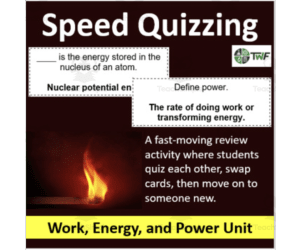
Speed Quizzing – Work, Energy, and Power Unit
Science, Physics, Grade 8, 9, 10, Lesson Plans, Teacher Tools
This activity will get your students out of their seats, moving around, and discussing the material. It is fully editable and requires very little preparation. Simply print, cut out the flash cards, and pass them out to students. Note. This resource can also be used as an excellent question bank as it contains 32 high-quality questions that you can use in any way you see fit. This activity contains 32 questions designed to test your students’ knowledge of the unit they are studying. The questions come directly from the lessons and cover the following topics: • Energy and its Forms • Work and Energy • Kinetic and Gravitational Potential Energy • The Law of Conservation of Energy and Efficiency • Thermal Energy, Temperature and Heat • Power Each of the Speed Quizzes listed below can be found in my Speed Quizzes Growing bundle at a discount of at least 65%. Here’s how you implement them: 1. Provide each student with a flash card 2. Pair up students using the stand up/hands up/pair up method 3. Partner A reads the question to Partner B, who answers. Partner A praises if correct or coaches if incorrect. 4. Partners switch roles 5. Students thank each other and switch cards 6. Partners raise their hands to find a new partner 7. Repeat for a specified amount of time Alternate way to ensure each student gets a new partner each time: Divide students into groups A and B. Have every student pair up with someone from the other group (if there is an odd number of students you participate too!) 1) Do Speed Quizzing 2) Then have group A move to the right and group B stay still. 3) Do Speed Quizzing 4) Then have group B move to the left and group A stay still. Every student in group A will meet every student in group B, but students will not meet students in their own group (a clever way to keep apart students who should not be partnered for whatever reason). This activity can be used to: • Prompt meaningful student conversation • Review prior knowledge • Review new terms/problems after a unit • Gather student ideas • Remediate weak skills • Practice new skills ***************************** For free resources, useful teaching tips, and tools, please visit my blog - TeachScienceWithFergy.com If you have any questions please feel free to send me an email - devon@teachwithfergy.com
Author Teach With Fergy
Tags Law Of Conservation, Forms Of Energy, Science Assessments, Thermal Energy, Speed Quizzing

3D Printing Glossary
Science, Technology, Computer Science, Not Grade Specific, Teacher Tools, Lesson Plans
All the terms and jargon you need for your 3D printing journey!
Author WhyMaker
Tags Computer Science - Technology, For All Subject Areas, 3D Printing Glossary
All About Soil | Earth Science Unit
Science, Earth and Environmental Sciences, Earth Sciences, Grade 1, 2, 3, 4, Lesson Plans, Teacher Tools
All About Soil | Earth Science Unit for Grades 1-4 The All About Soil | Earth Science Unit is a comprehensive teaching resource that extensively covers all aspects of soil in an engaging way. Suited exceptionally for learners in grades 1 through 4, this resource proves invaluable for educators such as public school teachers or homeschoolers, as it makes earth science lessons enjoyable and impactful. This exhaustive earth science unit addresses everything from various types of soil to its importance in sustainable development, leaving no aspect unexplored. Not only does it form a solid foundation on the study of soil but also arouses curiosity among young learners about the planet and its intricate systems. Vibrant posters on topics like 'Soil Provides a Place for Organisms to Live' or 'Soil Filters and Cleans Water' Diverse materials such as vocabulary word strips (e.g., Soil, Clay, Loam) Differentiated reading level articles on topics like composting and recycling elements Craft templates (e.g., Compost Bin printable craft template) Worksheets: 'What is Soil Made Of?' eLearning Compatible Resources: All resources mentioned above can simply be used as interactive slides too enhancing online learning experiences. Videos & Vocabulary: Crafted meticulously with recommended video links fostering visual learning and thematic vocabulary lists that reinforce language skills alongside science study – this teaching toolbox provides much more than knowledge transfer: it cultivates curiosity! All About Soil | Earth Science Unit not just imparts information but kindles innovation within young minds thus shaping future scientists and fostering life-long learning. Note: This product comprises 1 zip file including Google Doc describing what is included, JPEGs explaining some of the individual activities, 53 page PDF with ready to print pages to serve as the ultimate teaching aid. It's perfect for Grades 1-4 under subjects: Science, Sub-subjects: Earth Sciences and includes multiple file types.
Author Simply Schoolgirl
Tags Soil Types, Sustainable Development, Earth Science, Experiential Learning, Interactive Slides
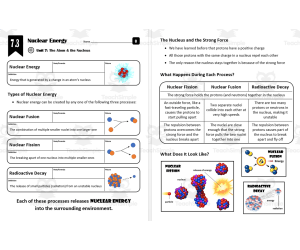
Lesson 7.3 - Nuclear Energy
Science, Chemistry, Physics, Grade 6, 7, 8, 9, 10, 11, 12, Lesson Plans, Teacher Tools
Lesson 7.3 - Nuclear Energy This comprehensive teaching resource aims to enhance student learning of nuclear energy for grades 6 through 12. The guide focuses on various components of nuclear energy, including nuclear fusion, nuclear fission, and radioactive decay. Nuclear Energy Notes: Detailed notes outlining significant differences between the three main types of nuclear energy. These are available in two versions - An interactive format for students to fill in blanks as they learn and a full version which is ideal for absent learners or those needing extra support. Nuclear Energy Simulation: An engaging tool accessed via a provided URL that allows students to study effects of nuclear fission on different nuclei. Nuclear Energy Reading: A segment presenting pro and con arguments from two separate articles at varying lexile levels to cater to different student proficiencies. PowerPoint Notes: Teaching points presented in an easy-to-show format suitable for class time. Objectives & Starter Questions: Prompts designed to get students thinking about core topics before diving into detailed discussions. All the files included can be downloaded as .docx (for Word), .pptx (for PowerPoint) files if revisions are required or .pdf files for quick access without any modifications needed. Lesson 7.3 - Nuclear Energy closely aligns with the Integrated Chemistry & Physics criteria specified by Indiana State Standards making it a perfect educational tool suitable for public educators and homeschooling parents alike..
Author Integrated Chemistry and Physics
Tags Nuclear Fusion, Nuclear Fission, Radioactive Decay, Pros And Cons, Critical Thinking
Mallard Duck Facts | Interactive Science Lesson | Micro-Learning Deck
Science, Life Sciences, Animals, Grade 6, 7, 8, 9, Teacher Tools, Lesson Plans
Mallard Duck Facts | Interactive Lesson for Science This science lesson helps students learn fascinating facts about mallard ducks. The interactive digital slideshow engages learners with a short informational video, reading passage with audio, close reading activity, and a quick write prompt. Educators can utilize the materials in whole group instruction, small group work, independent practice, or as reinforcement. The multiple modes of presenting information followed by assessments keep middle school students focused while building science content knowledge. By covering subjects like animal classification, life cycles, and habitats, this versatile resource enhances zoology and biology curriculum. The materials aim to inspire curiosity and appreciation for the natural world.
Author Teach Me This
Tags Mallard Ducks, Duck Habitat, Science, Digital, Interactive
Stratus Clouds | Interactive Science Lesson | Micro-Learning Deck
Science, Earth and Environmental Sciences, Environmental Science, Grade 7, 8, 9, 10, Teacher Tools, Lesson Plans
This micro-learning deck is the perfect accessory to your Science instruction! This digital slideshow presents Stratus Clouds. Within this slideshow, you will receive: -Video Lesson -Reading Passage w/ Audio -Close Reading -Quick Write The informational texts included in this resource alongside the informal assessments will keep your students engaged from beginning to end.
Author Teach Me This
Tags Stratus Clouds, Interactive, Science, Environment, Reading Passage
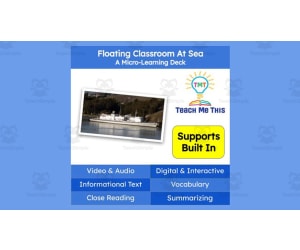
Floating Classroom At Sea | Interactive Science Lesson | Micro-Learning Deck
Science, Earth and Environmental Sciences, Environmental Science, Grade 6, 7, 8, 9, Teacher Tools, Lesson Plans
This micro-learning deck is the perfect accessory to your Science instruction! This digital slideshow presents Floating Classroom At Sea. Within this slideshow, you will receive: -Video Lesson -Reading Passage w/ Audio -Close Reading -Quick Write The informational texts included in this resource alongside the informal assessments will keep your students engaged from beginning to end.
Author Teach Me This
Tags Golden Bear Ship, True False Questions, Classroom At Sea, Engineering, Paramilitary School

Lions | Interactive Science Lesson | Micro-Learning Deck
Science, Life Sciences, Animals, Grade 5, 6, 7, 8, Teacher Tools, Lesson Plans
Lions | Interactive Science Lesson | Micro-Learning Deck This science resource teaches students about the lion, the King of the Jungle. Through an engaging slideshow presentation, students will watch an informative video, read a passage with audio support, analyze the text closely, and complete a quick write activity to demonstrate comprehension. Educators can utilize this resource in a variety of ways - as a whole class lesson to introduce the lion, a small group activity to build background knowledge, or as an independent learning task for students to complete at their own pace. With multiple modalities integrated, this micro-learning deck keeps learners actively engaged from the first slide to the last. Easy to implement and full of essential information, it makes an excellent addition to any middle school science curriculum covering zoology.
Author Teach Me This
Tags Lions Reading Passage, Comprehension, Science Lesson, Zoology, Interactive

Killer Whale (Orca) Unit Study (Endangered Animals Lesson Plan, Activities)
Science, Life Sciences, Animals, Grade 1, 2, 3, Lesson Plans, Teacher Tools
Orca Whales Unit Study Dive into the incredible world of orca whales with this 5-day unit study for grades 1-3. Through engaging videos, worksheets , interactive notebooking pieces, and more, students will learn about the biology and behavior of these remarkable endangered animals. Ideal for whole-class, small group, or independent learning, this comprehensive unit covers reading, writing, science, art, and more. Students will be captivated as they explore orca adaptation, habitat, communication, and conservation. Easily adaptable for all learning styles and needs, this unit brings whales to life while building key skills. Explore the oceans without getting wet with this unforgettable cross-curricular orca adventure!
Author Heather Huhman
Tags Killer Whale, Orca, Endangered Animals, Ocean Animals, Arctic Animals, Science, Zoology, Unit Study

Bees | Interactive Science Lesson | Micro-Learning Deck
Science, Life Sciences, Insects, Grade 5, 6, 7, 8, Teacher Tools, Lesson Plans
Bees - An Engaging Science Lesson This interactive digital lesson helps middle school science teachers cover key concepts about bees. The informational slide deck acts as a micro-lesson that supplements a broader unit on insects. Through a short video, reading passage with audio, close reading activity, and quick write, students learn bee basics like their physiology, hive roles, pollination, and impact on ecosystems. Implement the complete 15-20 minute lesson or use components like the passage and comprehension questions for individual/group work. The multimedia format appeals to visual and auditory learners alike. By blending direct instruction with knowledge checks, this versatile resource boosts student engagement and retention of essential bee knowledge.
Author Teach Me This
Tags Bees Lesson, Insects Lesson, Interactive Science Lesson, Comprehension, Vocabulary
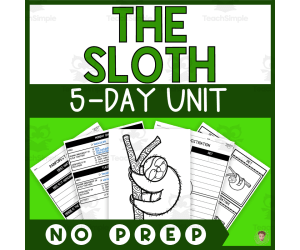
Sloth Unit Study | Rainforest Animals | Lesson Plan, Activities | NO PREP
ELA, Reading, Reading Comprehension, Grammar, Language Development, Spelling, Writing, Science, Life Sciences, Animals, Research, Grade 1, 2, 3, Lesson Plans, Teacher Tools
Need an engaging way to help your students become sloth experts? Look no further than this 5-day NO PREP unit study and research project! Perfect for elementary teachers and homeschoolers alike, this resource covers five aspects—description, diet, habitat, life cycle, and predators—of the sloth through cross-curricular activities. Each day's lesson plan appeals to different types of learners: curated videos (visual and auditory), reading passages (reading), research report pages (writing), interactive notebook and other activities (kinesthetic), and more. A GREAT ADDITION TO YOUR: Sloth or rainforest animals unit study (International Sloth Day is October 20) Writing lessons or centers Science class ...or just for fun! This resource is designed with your ink cartridge in mind. It's no prep, color optional, and "no frills" — everything you need and nothing you don't. Just print and go inspire those budding zoologists with this fun sloth unit! CROSS-CURRICULAR SUBJECTS COVERED: Art (drawing, coloring, arts & crafts) English language arts Grammar Reading Research Science Spelling Writing
Author Heather Huhman
Tags Sloths, Rainforest Animals, Rainforest, Unit Study, Sloth Habitat Project, Sloth Worksheets
Planets Lesson
Science, Technology, Earth and Environmental Sciences, Space, Grade 4, 5, 6, 7, Teacher Tools, Lesson Plans
This is a Planets Lesson that computer students or science students will enjoy. This lesson is ideal for upper elementary and middle school students in 4th – 8th grade. High school students would also learn from this lesson. The objective of the lesson: Students will research the distance of the planets to the Sun and table the data using a spreadsheet program (Google Docs, Excel, etc). The focus or transfer of the lesson is that the planets are far away from the Sun, but, how far away? How close are they to each other? This lesson will comply with Computer Technology Standard #8. The first page will have the instruction and the guided practice. The instruction will teach students what a spreadsheet is and why its useful. Students will learn about the different uses of a spreadsheet. A check for understanding is included. This is a great engagement opportunity for students. In order to respond to the check for understanding, students can do a quick write or a brief turn and talk. The second page will be the printable that students need to complete their guided practice. I hope you enjoy! Take A Look at My Best Sellers: ”Classes Re-Zoomed” eBook “10 Tips to Become a National Board Certified Teacher” eBook 15 Computer Tips eBook Visiting London eBook Spanish: Middle School Parents eBook “Growing Modern Obesity” eBook You can find more resources at my storefront here: https://teachsimple.com/contributor/paul-rallion
Author Paul Rallion
Tags Planets Lesson Plan, Science Lesson Plan, Computer Lesson Plan, Astronomy, Distance Of The Planets, Bar Graph, Spreadsheets, Check For Understanding