



3,885 products added recently
Page 30 - Science Lesson Plan Template
Enhance your science instruction with a flexible lesson plan template designed for educators. This tool helps you structure objectives, materials, procedures, and assessments efficiently. Use it to create organized and impactful science lessons that cater to your students' needs.

 Show filters

I WONDER - Can Vegetables Be Grown In Space | Animated Video Lesson
Nature & Plants, Life Sciences, Science, Biology, Space, Earth and Environmental Sciences, Grade 4, 5, 6, 7, 8, 9, 10, Lesson Plans, Teacher Tools
Video Introduction An amazing video designed for the students to learn more about STEM. I WONDER - Can Vegetables Be Grown In Space | Animated Video Lesson Plants world is really fascinating! Do you know that some flowers eat insects? Some other plants like to grow on walls can you mention any? Do you know what is the difference between fungicide and pesticide? If yes, Can you tell us more about it? What is nuclear energy? Is it safe to use it? Do you think it is a clean energy? Have you ever read about potential energy? If yes, tell us what it is? Do you think that potential energy can be converted into another form of energy? How it happens? I WONDER - Can Vegetables Be Grown In Space | Animated Video Lesson The video is perfect for encouraging the researching skills for the students, while learning more about this fantastic topic. I WONDER - Can Vegetables Be Grown In Space | Animated Video Lesson This friendly designed video is suitable for students at school, homeschooling, and as a group activity. Format Available in MP4 format.
Author Educational Voice
Rating
Tags Can Vegetables Be Grown In Space, Vegetables, Space Vegetables, Grow Vegetables In Space, Vegetables Facts, Vegetables Video, Vegetables Video For Kids, Space Food, Space, Growing Vegetables In Space

Global Warming REDUCTION: Urban Planning - FLASH-PC
Science, Earth and Environmental Sciences, Environmental Science, Common Core, Grade 5, 6, 7, 8, Teacher Tools, Lesson Plans
Global Warming REDUCTION: Urban Planning - FLASH-PC The Global Warming REDUCTION: Urban Planning - FLASH-PC is a comprehensive teaching resource, designed to instill a deep understanding of urban planning and its role in mitigating global warming. It primarily caters to grade 5 through 8 learners. This tool effectively integrates with the Science curriculum and, more specifically, within Environmental Science subtopics. As an educator, you'll appreciate this package's versatility. The content aligns neatly with both Common Core State Standards and Bloom's Taxonomy—two widely recognized standards in the education sphere. The package offers breadth and depth in its coverage of the subject matter. In addition to pre-reading preparation, it also provides post-reading comprehension analysis for rigorous learning on all fronts. This product doesn't stop at offering conventional textual resources: Vocabulary flash cards act as a valuable supplement, giving students an opportunity not just to learn new words but also enrich their scientific lexicon—an essential competency when navigating advanced topics such as global warming reduction. We have included printables that offer tangible understanding of concepts beyond text reading experiences only. Beyond the traditional learning tools: Videos accompany the text for audiovisual representation of contents ensuring unparalleled clarity You'll find interactive activities that... Promote engagement during intense knowledge acquisition sessions Cater equally well towards whole class or small group discussions alike A Portable Solution: PC-Software Based Resource Being PC-software based, this teaching resource offers great portability. You can take your lesson anywhere without loss of quality or effectiveness—making it a great tool for homework assignments. The Final Word In totality: Global Warming Reduction: Urban Planning - FLASH-PC doesn't merely teach—it provides an ecosystem wherein curiosity can thrive amid rich information sources. This transforms a teacher's role from mere instructors into guideposts lighting up labyrinthine academic paths!
Author Classroom Complete Press
Tags Software (PC)

I WONDER - How Long Is The Circulatory System | Animated Video Lesson
Human Body, Life Sciences, Science, Biology, STEM, Grade 4, 5, 6, 7, 8, 9, 10, Lesson Plans, Teacher Tools
Video Overview The human body is full of fascinating wonders to learn. This video is created to help the students recognize the anatomy and the job of the human body. I WONDER - How Long Is The Circulatory System | Animated Video Lesson Every part and organ in our human body is vital so let's see how important they are. Have you ever imagined how we look like if we didn't have a skeleton? Did you know that because we have our amazing muscles we can stand! Do you know how many teeth do we have? Have you ever wondered about the food journey inside our body? Can you name all the glands in our body? Why do we have skin? Our nervous system is really good at sending signals. Can you tell us more about it? Are you really good at Mathematics, painting, or any other thing? You should really thank your brain about it! The famous five senses are really doing a great work? Can you explain how every sense works? I WONDER - How Long Is The Circulatory System | Animated Video Lesson The video is perfect for encouraging the researching skills for the students, while learning more about our fantastic human body. I WONDER - How Long Is The Circulatory System | Animated Video Lesson This friendly designed video is suitable for students at school, homeschooling, and as a group activity. Format Available in MP4 format.
Author Educational Voice
Tags How Long Is The Circulatory System, How Long Is The Circulatory System Video, Circulatory System, Circulatory System Facts, Circulatory System Facts For Kids, Circulatory System Video, Circulatory System Video For Kids

I WONDER - Are There Different Types Of Immunity | Animated Video
Biology, Life Sciences, Science, Human Body, STEM, Grade 4, 5, 6, 7, 8, 9, 10, Lesson Plans, Teacher Tools
Video Overview The human body is full of fascinating wonders to learn. This video is created to help the students recognize the anatomy and the job of the human body. I WONDER - Are There Different Types Of Immunity | Animated Video Lesson Every part and organ in our human body is vital so let's see how important they are. Have you ever imagined how we look like if we didn't have a skeleton? Did you know that because we have our amazing muscles we can stand! Do you know how many teeth do we have? Have you ever wondered about the food journey inside our body? Can you name all the glands in our body? Why do we have skin? Our nervous system is really good at sending signals. Can you tell us more about it? Are you really good at Mathematics, painting, or any other thing? You should really thank your brain about it! The famous five senses are really doing a great work? Can you explain how every sense works? I WONDER - Are There Different Types Of Immunity | Animated Video Lesson The video is perfect for encouraging the researching skills for the students, while learning more about our fantastic human body. I WONDER - Are There Different Types Of Immunity | Animated Video Lesson This friendly designed video is suitable for students at school, homeschooling, and as a group activity. Format Available in MP4 format.
Author Educational Voice
Tags Different Types Of Immunity, Are There Different Types Of Immunity, Are There Different Types Of Immunity Video, Different Types Of Immunity Facts, Different Types Of Immunity Facts For Kids, Different Types Of Immunity Video
I WONDER - How Are Wave Used In Daily Life | Animated Video Lesson
Physics, Science, STEM, Grade 6, 7, 8, 9, 10, 11, 12, Lesson Plans, Teacher Tools
Video Introduction An amazing video designed for the students to learn more about STEM. I WONDER - How Are Wave Used In Daily Life | Animated Video Lesson Do you like STEM subjects? what is your favorite one? Have you ever tried to plant a seed? If yes, tell us more about it. Or have you ever tried to invent something? If yes, tell us more about it. And how do you think it will help us? Have you ever seen a microorganism under a microscope? What was it? And how it looked like? Mathematics is a marvelous subject. Let' sharpen our brains and solve some equations. Do you like timetable tricks? What is your favorite one? Do you know how to code? Have you ever created an app or a game before? If yes, how was it like? I WONDER - How Are Wave Used In Daily Life | Animated Video Lesson The video is perfect for encouraging the researching skills for the students, while learning more about this fantastic topic. I WONDER - How Are Wave Used In Daily Life | Animated Video Lesson This friendly designed video is suitable for students at school, homeschooling, and as a group activity. Format Available in MP4 format.
Author Educational Voice
Tags How Are Wave Used In Daily Life, How Are Wave Used In Daily Life Video, Wave, Wave Facts, Waves, Waves Facts For Kids, Waves Video, Waves Facts Video For Kids, Waves Video For Kids

Evolution of Birds | Animated Birds Video Lesson
Science, Life Sciences, Animals, Not Grade Specific, Lesson Plans, Teacher Tools
The Evolution of Birds | Animated Birds Video Lesson The Evolution of Birds | Animated Birds Video Lesson fuses visual graphics and auditory cues, providing a multifaceted learning experience for various students. The lesson, steeped in science, appeals to young explorers and includes narrative elements illustrating bird-related tales. This resource piques interest in zoology, either as an introduction or as a recap of previously learned topics. Its 13-minute timing gives teachers ample leeway to incorporate it into their syllabus — from whole group teaching to complementing small group discussions. Built on Constructivist Principles Framed around constructivist principles, this animated MP4 file movie presents intricate scientific concepts such as evolution and bird behaviour through lively illustrative components and clear voice-overs - effortlessly digestible for all school levels. This medium efficiently connects different scientific areas encouraging pupils to genuinely engage with the content rather than just note-taking. Tailored for lessons' intro or differentiated homework particularly beneficial for auditory/visual learners who might find text-heavy resources challenging. All-inclusive educational material enriches routine lectures supporting proficient comprehension across diverse learning proficiencies. Promotes inclusive pedagogy ensuring no student is left behind. A Unique Tool For Learning In summary, The Evolution of Birds | Animated Birds Video Lesson stimulates curiosity among pupils while meeting explicit educational standards laid down by the curriculum - promoting profound exploration into bird evolution – reflecting their significance across various global cultures.
Author Educational Voice
Tags Evolution, Birds, Video Lesson
I WONDER - What Can You Build Using Python | Animated Video Lesson
STEM, Computer Science, Technology, Science, Grade 6, 7, 8, 9, 10, 11, 12, Lesson Plans, Teacher Tools
Video Introduction An amazing video designed for the students to learn more about STEM. I WONDER - What Can You Build Using Python | Animated Video Lesson Do you like STEM subjects? what is your favorite one? Have you ever tried to plant a seed? If yes, tell us more about it. Or have you ever tried to invent something? If yes, tell us more about it. And how do you think it will help us? Have you ever seen a microorganism under a microscope? What was it? And how it looked like? Mathematics is a marvelous subject. Let' sharpen our brains and solve some equations. Do you like timetable tricks? What is your favorite one? Do you know how to code? Have you ever created an app or a game before? If yes, how was it like? I WONDER - What Can You Build Using Python | Animated Video Lesson The video is perfect for encouraging the researching skills for the students, while learning more about this fantastic topic. I WONDER - What Can You Build Using Python | Animated Video Lesson This friendly designed video is suitable for students at school, homeschooling, and as a group activity. Format Available in MP4 format.
Author Educational Voice
Tags What Can You Build Using Python, What Can You Build Using Python Video, Python, Python Facts, Python Facts For Kids, Python Video, Python Video For Kids, Coding, Coding Video, Coding Facts
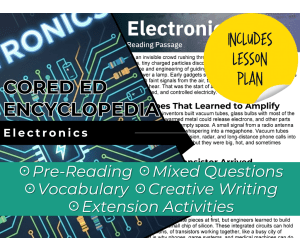
Electronics Reading Comprehension Passage - Cored Ed Encyclopedia
ELA, Reading Comprehension, Reading, Science, Technology, Pre-Reading, Language Development, Physics, Writing, Vocabulary, Grade 2, 3, 4, 5, Worksheets & Printables, Worksheets, Teacher Tools, Centers, Activities, Writing Prompts, Assessments, Quizzes and Tests, Quizzes, Lesson Plans
This electronics reading comprehension with lesson plan includes: Visualization (on the front cover) Start your lesson by taking a minute to think and share something about the topic. Read the script aloud (slowly), perhaps prepare some music or sound effects. Student close their eyes and let their imaginations wander. Students open their eyes, read the question aloud and give them a few minutes to complete. Ask a few students to share or keep answers until the end to compare with what they learn in the passage. Quick pause—thousands of Cored Education products are included with your TeachSimple membership. Download links and encyclopedia index available here. Pre-Reading Trivia Students will write down one thing they already know about the subject and then read five more facts and discuss. These facts are fun, and the students will enjoy learning about the subject before reading more. Give 1 minute for students to write what they already know (no pressure—best guess is fine). Read the five facts together. After each fact, do ask a student for their opinion, was it surprising? Set a purpose by asking students to highlight/underline one fact they want to learn more about during the reading. Reading Passage The text is a high-interest reading passage with set paragraphs, roughly three to four paragraphs long. It contains a variety of themes about the topic, anywhere from history to technology. The passage is between 250 and 350 words in length. First, ask students to look at the headings and see what they’ll learn about today. What do they know about the topic/heading? First read options: Teacher read-aloud (best for support). Partner reading (paragraph by paragraph). While reading, students underline important details, and vocabulary words they think may come up in the questions section. Mixed Questions The first question page contains four multiple-choice questions, each with a choice of four answers, and three written response questions that require a sentence or two from the student. Students complete the mcqs first independently, then review quickly as a class. For the 3 written responses, try to get students giving the answer with some form of evidence: “I think ___ because the text says ___.” If students get stuck, send them back to check the passage. Vocabulary Questions Practice seven key words from the text in this section across two activities. First section is scrambled words where students will unscramble three words given a clue for each. The second section is a word to meaning matching activity. Before starting, have some students read out words they underlined in the passage. Ask students to say the word and read aloud the sentence(s) around each word. Ask students to do scrambled words and the matching exercise in pairs then go through answers as a class. For the scrambled spelling task, get four pairs to come up to the board and write the words for extra practice with the other student reading out the clue. For the matching task, prompt students to give full sentences: “I matched ___ with ___ because ___.” Creative Writing In this question, the student will be required to write a five to eight sentence paragraph on a question related to the topic. Before starting, ask students write down 3 key ideas they are going to include in their piece. Ask students for ideas to share around the class to help those struggling. Pro writing expectations: 5–8 sentences At least 2 facts or details from the passage At least 2 vocabulary words from the previous page Students read their paragraphs while classmates listen for facts and vocabulary words. Extension Activities This page is optional for fast finishers or to take home. There are several activities, each one requiring a different skill. Do some, do none, do all, completely optional - but you will feel reassured knowing every possibility is planned for. Includes summary writting question and additional facts. Answer Key There are answers for the multiple-choice questions, written response questions have sample answers, vocabulary answers and if there is a summary question then a sample summary will be provided as well. Lesson Plan Included Customized lesson plan for this lesson is included. Lesson Snapshot Title: Electronics Genre: Nonfiction (Informational Text) Subject: Science (Technology/Physical Science) / Reading (Informational Text) Primary Topic: How electronics evolved to carry signals Estimated Guided Reading Level (A–Z): Q What This Lesson Teaches Best Defines electrons as tiny charged particles and explains that electronics guides them to carry a message (a “signal”), not just power devices. Traces a clear timeline of inventions : early radio parts → vacuum tubes → transistor (1947) → integrated circuits on silicon chips. Explains how devices can amplify signals (making a small signal stronger), using the vacuum tube and transistor examples. Shows how engineering changes over time led to smaller, more powerful technology , with chips holding millions (even billions) of transistors. Learning Goals Students will describe how electrons moving through wires can carry a message. Students will explain how vacuum tubes helped make radio signals stronger. Students will identify how the transistor differed from vacuum tubes (material used, size, and power use). Students will describe what integrated circuits are and why they allow devices to stay small. Students will summarize how electronics changed from early inventions to modern chips. Key Vocabulary From the Text electrons — tiny charged particles that move through wires. signal — a message carried through a device. vacuum — space with most air removed. transistor — a smaller part that can switch and amplify signals. semiconductor — a material used instead of a vacuum for a transistor. FULL CATALOG OF DOWNLOAD LINKS AND ENCYCLOPEDIA INDEX HERE
Author Cored Education
Rating
Tags Vocabulary, Reading Comprehension, Reading Passages, Lesson Plans, Ela Lesson Plans, Reading Comprehension Lesson Plans, Pre-reading, Science Lesson Plans, Technology, Physics

I WONDER - Why Were Cats Important To Egyptians | Animated Video
History: African, History, Social Studies, History: Ancient, Animals, Life Sciences, Science, Grade 4, 5, 6, 7, 8, 9, 10, Lesson Plans, Teacher Tools
Video Introduction An amazing video designed for the students to learn more about history. I WONDER - Why Were Cats Important To Egyptians | Animated Video Lesson Do you like history? Which topic do you really enjoy about history? Have you ever read an interesting fact about the Vikings? If yes, can you mention them? What do you like most about the Victorian era? Can you name all the Tudors? Have you ever wondered how people used to live in ancient Japan and ancient China? Do you know any interesting facts about ancient Egyptians and the Pharaohs? Have you ever visited South America? What do you know about Incas and Aztecs? Celtic culture was really one of a kind, can you name any of the places that Celts used to live in? Imagine yourself living during the ancient Roman empire, how your life will look like? Ancient Greece was an amazing place to live in. What do you know about ancient Greek life? I WONDER - Why Were Cats Important To Egyptians | Animated Video Lesson The video is perfect for encouraging the researching skills for the students, while learning more about history. I WONDER - Why Were Cats Important To Egyptians | Animated Video Lesson This friendly designed video is suitable for students at school, homeschooling, and as a group activity. Format Available in MP4 format.
Author Educational Voice
Tags Why Were Cats Important To Egyptians, Why Were Cats Important To Egyptians Video, Ancient Egyptians, Ancient Egyptians Facts, Ancient Egyptians Facts For Kids, Ancient Egyptians Video, Ancient Egyptians Video For Kids
I WONDER - Can The Weather Help With Pollination | Animated Video
Nature & Plants, Life Sciences, Science, Insects, Grade 6, 7, 8, 9, 10, 11, 12, Lesson Plans, Teacher Tools
Video Introduction An amazing activity designed for the students to learn more about STEM. I WONDER - Can The Weather Help With Pollination | Animated Video Lesson Do you like STEM subjects? what is your favorite one? Have you ever tried to plant a seed? If yes, tell us more about it. Or have you ever tried to invent something? If yes, tell us more about it. And how do you think it will help us? Have you ever seen a microorganism under a microscope? What was it? And how it looked like? Mathematics is a marvelous subject. Let' sharpen our brains and solve some equations. Do you like timetable tricks? What is your favorite one? Do you know how to code? Have you ever created an app or a game before? If yes, how was it like? I WONDER - Can The Weather Help With Pollination | Animated Video Lesson The video is perfect for encouraging the researching skills for the students, while learning more about this fantastic topic. I WONDER - Can The Weather Help With Pollination | Animated Video Lesson This friendly designed video is suitable for students at school, homeschooling, and as a group activity. Format Available in MP4 format.
Author Educational Voice
Tags Can The Weather Help With Pollination, Can The Weather Help With Pollination Video, Weather, Weather Facts, Weather Facts For Kids, Pollination, Pollination Facts, Pollination Video, Pollination Video For Kids
I WONDER - What Colours Do Bioluminescent Animals Make
STEM, Animals, Life Sciences, Science, Biology, Grade 1, 2, 3, 4, 5, 6, 7, 8, Lesson Plans, Teacher Tools
Video Introduction Animal kingdoms are full of fascinating wonders to learn. This video is designed for the students to learn more about animals in different countries. I WONDER - What Colours Do Bioluminescent Animals Make | Animated Video Lesson Do you like animals? what is your favorite one? Do you own a pet? If yes, tell us more about it, like what its name? And what do you like most about it? What are the animal kingdoms? Can you write down the characteristics of each animal class like mammals, birds, reptiles, amphibian, fish and mollusks. Do you know that some animals can sing, can you name any of them? What is the largest and the smallest mammal in the world? What is the largest and the smallest bird in the world? What is the largest and the smallest fish in the world? I WONDER - What Colours Do Bioluminescent Animals Make | Animated Video Lesson The video is perfect for encouraging the researching skills for the students, while learning more about these fantastic animals. I WONDER - What Colours Do Bioluminescent Animals Make | Animated Video Lesson This friendly designed video is suitable for students at school, homeschooling, and as a group activity. Format Available in MP4 format.
Author Educational Voice
Tags What Colours Do Bioluminescent Animals Make, What Colours Do Bioluminescent Animals Make Video, Bioluminescent Animal, Bioluminescent Animals, Bioluminescent Animals Video, Bioluminescent Animals Facts

Cells: What is a Cell?
Science, Life Sciences, Biology, Common Core, Grade 5, 6, 7, 8, Teacher Tools, Lesson Plans
Cells: What is a Cell? An engaging and accessible resource designed to guide students in grades five through eight on an exploration of the fundamental building blocks of life: cells. This curriculum-aligned learning material allows teachers to deliver a comprehensive biology lesson plan that fits seamlessly into any science curriculum. The teaching resource simplifies complex cell theories with easy-to-understand language and vocabulary. It introduces learners to the essential parts of both plant and animal cells, breaking down their distinct functionalities into visual, understandable mini posters. Key Features: Introduces students to single-celled and multi-cellular organisms Covers human cell reproduction Delves into diffusion and osmosis processes A Versatile Resource for Teachers The ready-to-go reading passages come with student activities that are perfect for various classroom settings—whole-group instruction, small group learning opportunities or even individual work at home. Focusing on Differentiated Instruction: This resource caters specially towards remedial learners without compromising quality or content depth, providing exercises that encourage critical thinking—an essential component of STEM education in today's classrooms. "Cells: What is a Cell?" - More Than Just Informational Text This educational package goes beyond being just an informative PDF; it seeks to engage young minds curious about science while fostering strong foundational knowledge about cellular biology. The contents adhere closely with Common Core State Standards—providing confidence for educators as they impart valuable biological knowledge in diverse settings like public schools and homeschools. With this resource,'Understanding Cells' now becomes 'Teach Simple!'
Author Classroom Complete Press
Tags PDF
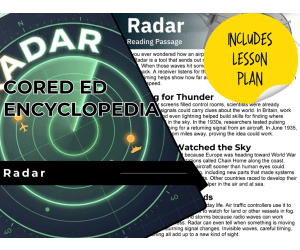
Radar Reading Comprehension Passage - Cored Ed Encyclopedia
ELA, Language Development, Reading Comprehension, Reading, Pre-Reading, Writing, History, Social Studies, Technology, Science, Grade 2, 3, 4, 5, Worksheets & Printables, Worksheets, Teacher Tools, Centers, Activities, Writing Prompts, Assessments, Quizzes and Tests, Quizzes, Lesson Plans
This radar reading comprehension includes: Visualization (on the front cover) Start your lesson by taking a minute to think and share something about the topic. Read the script aloud (slowly), perhaps prepare some music or sound effects. Student close their eyes and let their imaginations wander. Students open their eyes, read the question aloud and give them a few minutes to complete. Ask a few students to share or keep answers until the end to compare with what they learn in the passage. Quick pause—thousands of Cored Education products are included with your TeachSimple membership. Download links and encyclopedia index available here. Pre-Reading Trivia Students will write down one thing they already know about the subject and then read five more facts and discuss. These facts are fun, and the students will enjoy learning about the subject before reading more. Give 1 minute for students to write what they already know (no pressure—best guess is fine). Read the five facts together. After each fact, do ask a student for their opinion, was it surprising? Set a purpose by asking students to highlight/underline one fact they want to learn more about during the reading. Reading Passage The text is a high-interest reading passage with set paragraphs, roughly three to four paragraphs long. It contains a variety of themes about the topic, anywhere from history to technology. The passage is between 250 and 350 words in length. First, ask students to look at the headings and see what they’ll learn about today. What do they know about the topic/heading? First read options: Teacher read-aloud (best for support). Partner reading (paragraph by paragraph). While reading, students underline important details, and vocabulary words they think may come up in the questions section. Mixed Questions The first question page contains four multiple-choice questions, each with a choice of four answers, and three written response questions that require a sentence or two from the student. Students complete the mcqs first independently, then review quickly as a class. For the 3 written responses, try to get students giving the answer with some form of evidence: “I think ___ because the text says ___.” If students get stuck, send them back to check the passage. Vocabulary Questions Practice seven key words from the text in this section across two activities. First section is scrambled words where students will unscramble three words given a clue for each. The second section is a word to meaning matching activity. Before starting, have some students read out words they underlined in the passage. Ask students to say the word and read aloud the sentence(s) around each word. Ask students to do scrambled words and the matching exercise in pairs then go through answers as a class. For the scrambled spelling task, get four pairs to come up to the board and write the words for extra practice with the other student reading out the clue. For the matching task, prompt students to give full sentences: “I matched ___ with ___ because ___.” Creative Writing In this question, the student will be required to write a five to eight sentence paragraph on a question related to the topic. Before starting, ask students write down 3 key ideas they are going to include in their piece. Ask students for ideas to share around the class to help those struggling. Pro writing expectations: 5–8 sentences At least 2 facts or details from the passage At least 2 vocabulary words from the previous page Students read their paragraphs while classmates listen for facts and vocabulary words. Extension Activities This page is optional for fast finishers or to take home. There are several activities, each one requiring a different skill. Do some, do none, do all, completely optional - but you will feel reassured knowing every possibility is planned for. Includes summary writting question. Answer Key There are answers for the multiple-choice questions, written response questions have sample answers, vocabulary answers and if there is a summary question then a sample summary will be provided as well. Lesson Plan Included Customized lesson plan for this lesson is included. Lesson Snapshot Title: Radar Genre: Nonfiction (informational text with support pages) Subject: Science (Physical Science/Technology) Primary Topic: Using radio waves to find objects Estimated Guided Reading Level (A–Z): R What This Lesson Teaches Best Explains how radar works using radio waves, an “echo,” and a receiver that measures return time. Connects timing to distance (how long the trip takes helps show how far away something is). Builds background knowledge about radar’s development before World War II (tests in the 1930s; June 1935 detection; Chain Home stations). Shows real-world uses after the war (air traffic control, ships in fog, weather radar tracking rain and storms). Includes support pages that match the passage content (questions, vocabulary, writing, and extension activities focus on radio waves, echoes, Chain Home, and the 1935 test). Learning Goals Students can describe radar as a tool that sends out radio waves and listens for the waves that bounce back. Students can explain how a receiver uses the echo’s return time to show distance. Students can describe one early step in radar’s development mentioned in the passage (1930s tests or the June 1935 detection). Students can explain why early-warning stations mattered as World War II was getting closer. Students can identify at least two ways radar is used in everyday life after the war (planes, ships, or weather). Key Vocabulary From the Text receiver — device that listens for the returning signal echo — a returning signal that bounces back pulsing — sending waves in repeated bursts detected — found or noticed something was there vessels — boats or ships FULL CATALOG OF DOWNLOAD LINKS AND ENCYCLOPEDIA INDEX HERE
Author Cored Education
Rating
Tags Vocabulary, Reading Comprehension, Reading Passages, Reading, Creative Writing, Reading Strategies, Writing Prompts, Lesson Plans, History, Radar

Climate Change: Reduction: Alternative Fuels Gr. 5-8
Science, Earth and Environmental Sciences, Environmental Science, Grade 5, 6, 7, 8, Teacher Tools, Lesson Plans
Climate Change: Reduction: Alternative Fuels Gr. 5-8 Climate Change: Reduction: Alternative Fuels Gr. 5-8 is a comprehensive teaching resource ideal for educators looking to delve deep into the pressing issue of climate change. This asset focuses particularly on reducing human consumption and outputs, posing both informative insights and actionable solutions to clear up our planet while cutback on operating costs. Special Emphasis on "Alternative Fuels" This unique resource offers special emphasis on "Alternative Fuels". It encourages learners from Grade 5 to 8, irrespective of their stance about Climate Change, to collaboratively reflect upon Earth's future and discuss potential global warming trends. An innovative angle is adopted with activities that prompt students to design an imaginary, efficient car running solely on alternative fuels. This task aims at honing students' creativity while underpinning the importance of sustainable technologies in counteracting climate change. Moreover, this tool further educates about different transportation options available in various regions through engaging research tasks followed by pamphlet creation activity . Such maneuvers inherently instill critical thinking within students whilst making them understand regional discrepancies in fuel consumption practices. It shines light onto product life cycles too; thereby enabling educators teach how industries can reduce emissions during each stage of a product lifecycle. An added advantage happens to be its alignment with Bloom's Taxonomy and STEAM initiatives that aids learners build profound understanding through well-directed exercises. Inclusion of Green City Planning Concepts Climate Change: Reduction: Alternative Fuels also includes elaborate lessons touching upon green city planning concepts which advocate for complete reliance on clean energy sources. The examples illustrate how certain countries are striving carbon dioxide emission-free zones and pivotal zero-waste policies that work towards ecosystem preservation. Hands-On Activities and Self Introspection In addition, it imparts knowledge about green buildings' construction dynamics along with hands-on activities promoting real world intelligence among pupils eventually motivating them comprehend significance behind innovations aimed at sustainable development. This lesson plan also prompts individuals introspect upon ways they can contribute personally towards lowering greenhouse gas emissions ensuring the learning acquired doesn't stay confined merely as school assignments but translates into daily practices. It incorporates a crossword, word search, comprehension quiz and answer key to supplement learning. Final Remarks This resource is crafted to assist educators impart lessons about climate crisis in an engaging yet informative way. Incorporated activities enable students understand the criticality, their potential role and innovative solutions all in one place. To bring ease for educators, it's provided as a downloadable PDF file type facilitating ready-to-teach format. Designed for Grade 5-8 students within the discipline of Science; it will particularly be beneficial for those studying Environmental Science as a sub-subject allowing them comprehend complexities surrounding Climate Change more effectively.</p
Author Classroom Complete Press
Tags PDF
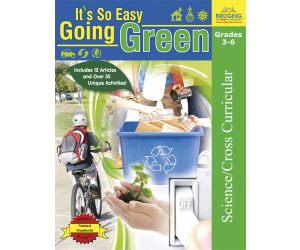
It's So Easy Going Green: An Interactive, Scientific Look at Protecting Our Environment
Science, Earth and Environmental Sciences, Environmental Science, Grade 3, 4, 5, 6, Teacher Tools, Lesson Plans
It's So Easy Going Green: An Interactive, Scientific Look at Protecting Our Environment Teachers from grade three to six will find this comprehensive lesson plan an ideal tool for catalyzing intriguing discussions and activities based on environmental conservation in the classroom. Facts and Insights: Engaging Articles An assortment of twelve research-driven articles throwing light on diverse topics such as the impact of organic products and deciphering global warming. Aimed at instilling a passion for caring for our planet among young learners. Encourages students to ponder their responsibilities towards managing these global issues. Hands-on Activities: Practical Learning This resource is not just limited to theoretical learning; practical understanding comes into play with over thirty-five activities that transform students' perception towards sustainable practices. Here are just a few examples: Building terrariums using easily available resources. Demonstrating reforestation efforts with smaller scale models. Designing solar-powered ovens that harness renewable energy sources. The teaching materials are readily accessible as PDF files and add depth to regular science lessons by emphasizing the interconnected nature of various ecosystems under the category - Environmental Science. Incorporate & Evolve Your Teaching Practices! This resource seamlessly integrates into whole-group instruction sessions, small-group discussions, or independent work students take home— making each interaction with it an enriching experience! Such an approach fosters responsible behaviors among young learners as they evolve to become guardians of our planet. Whether you are homeschooling parent or public school teacher seeking innovative ways to freshen up science instruction while instilling sustainable living principles, "It's So Easy Going Green" has the potential to invigorate your classroom with eager learners who are ready to take a stand for their environment.
Author Classroom Complete Press
Tags PDF

I WONDER - How Many Teeth Should I Have | Animated Video Lesson
Human Body, Life Sciences, Science, Biology, STEM, Grade 1, 2, 3, 4, 5, 6, 7, 8, Lesson Plans, Teacher Tools
Video Overview The human body is full of fascinating wonders to learn. This video is created to help the students recognize the anatomy and the job of the human body. I WONDER - How Many Teeth Should I Have | Animated Video Lesson Every part and organ in our human body is vital so let's see how important they are. Have you ever imagined how we look like if we didn't have a skeleton? Did you know that because we have our amazing muscles we can stand! Do you know how many teeth do we have? Have you ever wondered about the food journey inside our body? Can you name all the glands in our body? Why do we have skin? Our nervous system is really good at sending signals. Can you tell us more about it? Are you really good at Mathematics, painting, or any other thing? You should really thank your brain about it! The famous five senses are really doing a great work? Can you explain how every sense works? I WONDER - How Many Teeth Should I Have | Animated Video Lesson The video is perfect for encouraging the researching skills for the students, while learning more about our fantastic human body. I WONDER - How Many Teeth Should I Have | Animated Video Lesson This friendly designed video is suitable for students at school, homeschooling, and as a group activity. Format Available in MP4 format.
Author Educational Voice
Tags How Many Teeth Should I Have, How Many Teeth Should I Have Video, Teeth, Teeth Facts, Teeth Facts For Kids, Teeth Video, Teeth Video For Kids, Tooth, Tooth Facts, Tooth Facts For Kids
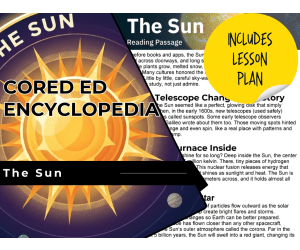
The Sun Reading Comprehension Passage - Cored Ed Encyclopedia
ELA, Language Development, Reading Comprehension, Reading, Pre-Reading, Writing, Science, Earth Sciences, Earth and Environmental Sciences, Space, Grade 2, 3, 4, 5, Worksheets & Printables, Worksheets, Teacher Tools, Centers, Activities, Writing Prompts, Assessments, Quizzes and Tests, Quizzes, Lesson Plans
This Sun reading comprehension includes: Visualization (on the front cover) Start your lesson by taking a minute to think and share something about the topic. Read the script aloud (slowly), perhaps prepare some music or sound effects. Student close their eyes and let their imaginations wander. Students open their eyes, read the question aloud and give them a few minutes to complete. Ask a few students to share or keep answers until the end to compare with what they learn in the passage. Quick pause—thousands of Cored Education products are included with your TeachSimple membership. Download links and encyclopedia index available here. Pre-Reading Trivia Students will write down one thing they already know about the subject and then read five more facts and discuss. These facts are fun, and the students will enjoy learning about the subject before reading more. Give 1 minute for students to write what they already know (no pressure—best guess is fine). Read the five facts together. After each fact, do ask a student for their opinion, was it surprising? Set a purpose by asking students to highlight/underline one fact they want to learn more about during the reading. Reading Passage The text is a high-interest reading passage with set paragraphs, roughly three to four paragraphs long. It contains a variety of themes about the topic, anywhere from history to technology. The passage is between 250 and 350 words in length. First, ask students to look at the headings and see what they’ll learn about today. What do they know about the topic/heading? First read options: Teacher read-aloud (best for support). Partner reading (paragraph by paragraph). While reading, students underline important details, and vocabulary words they think may come up in the questions section. Mixed Questions The first question page contains four multiple-choice questions, each with a choice of four answers, and three written response questions that require a sentence or two from the student. Students complete the mcqs first independently, then review quickly as a class. For the 3 written responses, try to get students giving the answer with some form of evidence: “I think ___ because the text says ___.” If students get stuck, send them back to check the passage. Vocabulary Questions Practice seven key words from the text in this section across two activities. First section is scrambled words where students will unscramble three words given a clue for each. The second section is a word to meaning matching activity. Before starting, have some students read out words they underlined in the passage. Ask students to say the word and read aloud the sentence(s) around each word. Ask students to do scrambled words and the matching exercise in pairs then go through answers as a class. For the scrambled spelling task, get four pairs to come up to the board and write the words for extra practice with the other student reading out the clue. For the matching task, prompt students to give full sentences: “I matched ___ with ___ because ___.” Creative Writing In this question, the student will be required to write a five to eight sentence paragraph on a question related to the topic. Before starting, ask students write down 3 key ideas they are going to include in their piece. Ask students for ideas to share around the class to help those struggling. Pro writing expectations: 5–8 sentences At least 2 facts or details from the passage At least 2 vocabulary words from the previous page Students read their paragraphs while classmates listen for facts and vocabulary words. Extension Activities This page is optional for fast finishers or to take home. There are several activities, each one requiring a different skill. Do some, do none, do all, completely optional - but you will feel reassured knowing every possibility is planned for. Includes summary writting question. Answer Key There are answers for the multiple-choice questions, written response questions have sample answers, vocabulary answers and if there is a summary question then a sample summary will be provided as well. Lesson Plan Included Customized lesson plan for this lesson is included. Lesson Snapshot Title: The Sun Genre: Nonfiction (informational text with support pages) Subject: Science (Space Science) Primary Topic: How the Sun affects Earth and works Estimated Guided Reading Level (A–Z): S What This Lesson Teaches Best How people used the Sun and changing shadows to notice time long before clocks, phones, and apps. How telescopes in the early 1600s revealed sunspots and helped people realize the Sun can change and even spin. How the Sun shines for so long because nuclear fusion joins hydrogen to make helium and releases energy as sunlight and heat. Key facts about the Sun’s size and importance in the solar system (about 1.39 million kilometres across; holds almost all the mass in the solar system). How the Sun can be active (solar wind, flares, storms) and how spacecraft like NASA’s Parker Solar Probe study the Sun’s outer atmosphere, the corona . Learning Goals Describe how changing shadows helped people notice time long ago. Explain what sunspots are and what they helped early observers realize about the Sun. Explain, using details from the text, how nuclear fusion makes energy inside the Sun. Identify what the corona is and why the Parker Solar Probe flew close to the Sun. Describe two ways the Sun is “not always calm,” based on the passage. Key Vocabulary From the Text telescopes — tools used to see faraway objects in the sky. sunspots — dark freckles seen on the Sun. hydrogen — a gas that joins together deep inside the Sun. helium — what hydrogen becomes when it joins together. corona — the Sun’s outer atmosphere. FULL CATALOG OF DOWNLOAD LINKS AND ENCYCLOPEDIA INDEX HERE
Author Cored Education
Rating
Tags Vocabulary, Reading Comprehension, Reading Passages, Lesson Plans, Ela Lesson Plans, Reading Comprehension Lesson Plans, Reading, Pre-reading, The Sun, Earth Science

I WONDER - Why Do Giraffes Have A Black Tongue | Animated Video Lesson
Animals, Life Sciences, Science, Biology, STEM, Grade 1, 2, 3, 4, 5, 6, 7, 8, Lesson Plans, Teacher Tools
Video Introduction Animal kingdoms are full of fascinating wonders to learn. This video is designed for the students to learn more about animals in different countries. I WONDER - Why Do Giraffes Have A Black Tongue | Animated Video Lesson Do you like animals? what is your favorite one? Do you own a pet? If yes, tell us more about it, like what its name? And what do you like most about it? What are the animal kingdoms? Can you write down the characteristics of each animal class like mammals, birds, reptiles, amphibian, fish and mollusks. Do you know that some animals can sing, can you name any of them? What is the largest and the smallest mammal in the world? What is the largest and the smallest bird in the world? What is the largest and the smallest fish in the world? I WONDER - Why Do Giraffes Have A Black Tongue | Animated Video Lesson The video is perfect for encouraging the researching skills for the students, while learning more about these fantastic animals. I WONDER - Why Do Giraffes Have A Black Tongue | Animated Video Lesson This friendly designed video is suitable for students at school, homeschooling, and as a group activity. Format Available in MP4 format.
Author Educational Voice
Tags Why Do Giraffes Have A Black Tongue, Why Do Giraffes Have A Black Tongue Video, Giraffes' Black Tongue, Giraffes Black Tongue, Giraffe Black Tongue, Giraffes' Black Tongue Facts, Giraffes' Black Tongue Facts For Kids
I WONDER - How Do Volcanoes Form | Animated Video Lesson
Geography, Social Studies, Earth Sciences, Earth and Environmental Sciences, Science, Environmental Science, Grade 3, 4, 5, 6, 7, 8, 9, Lesson Plans, Teacher Tools
Video Introduction An amazing video designed for the students to learn more about natural disasters in different countries. I WONDER - How Do Volcanoes Form | Animated Video Lesson What do you know about this natural disaster? Do you know in which part of the world this could happen? Have you ever read about the safety misusers that we could have to protect ourselves from this natural disaster? If yes, can you tell us more about them? Can you name other natural disasters? If yes, tell us more about where they are likely to happen? And how frequently? Do you like reading about Geography? What is your favorite country in the whole world? If you are going on a trip where it will be? Which country? What you are going to see there? Does this country has a famous place to visit? Do you like reading about Geology? If yes, what is your favourite topic? I WONDER - How Do Volcanoes Form | Animated Video Lesson The video is perfect for encouraging the researching skills for the students, while learning more about this fantastic phenomenon. I WONDER - How Do Volcanoes Form | Animated Video Lesson This friendly designed video is suitable for students at school, homeschooling, and as a group activity. Format Available in MP4 format.
Author Educational Voice
Tags How Do Volcanoes Form, How Do Volcanoes Form Video, Volcanoes, Volcanoes Facts, Volcanoes Facts For Kids, Volcanoes Video, Volcanoes Video For Kids, Volcano, Volcano Video, Volcano Facts

I WONDER - What Is The Largest Reptile In The World | Animated Video
STEM, Animals, Life Sciences, Science, Biology, Grade 1, 2, 3, 4, 5, 6, 7, 8, Lesson Plans, Teacher Tools
Video Introduction Animal kingdoms are full of fascinating wonders to learn. This video is designed for the students to learn more about animals in different countries. I WONDER - What Is The Largest Reptile In The World | Animated Video Lesson Do you like animals? what is your favorite one? Do you own a pet? If yes, tell us more about it, like what its name? And what do you like most about it? What are the animal kingdoms? Can you write down the characteristics of each animal class like mammals, birds, reptiles, amphibian, fish and mollusks. Do you know that some animals can sing, can you name any of them? What is the largest and the smallest mammal in the world? What is the largest and the smallest bird in the world? What is the largest and the smallest fish in the world? I WONDER - What Is The Largest Reptile In The World | Animated Video Lesson The video is perfect for encouraging the researching skills for the students, while learning more about these fantastic animals. I WONDER - What Is The Largest Reptile In The World | Animated Video Lesson This friendly designed video is suitable for students at school, homeschooling, and as a group activity. Format Available in MP4 format.
Author Educational Voice
Tags What Is The Largest Reptile In The World, What Is The Largest Reptile In The World Video, The Largest Reptile In The World, The Largest Reptile In The World Facts, The Largest Reptile In The World Facts For Kids

Transportation: Planes, Trains & Automobiles Gr. 1
Science, Technology, Engineering, Grade 1, Teacher Tools, Lesson Plans
Transportation: Planes, Trains & Automobiles Gr. 1 A comprehensive teaching resource designed to introduce grade 1 students to various modes of transportation. This two-week Social Studies/Language Arts unit is equipped with engaging and easy-to-understand informational passages. Scooters Wagons Bicycles Automobiles Trains Busses Boats Rroller Blades, Add a li tag for roller blades here Airplanes, iiffices" Ultra PerioA_POLICED">Planes>/a ""/fonttagctivePogo Sticks/Auaddhasis tbanels fill cateringcuriosity of young learners". P/h4sbilttchers will have the oppord dueOkJR "/marketing site word vocabulary? This educational resource comes bundled with numerous activities such as: "" "Iindibidual word cards for enriching vocabulary competence" game adding play element into learning Crosswords promoting lateral thinking capacities in independent or group-based instructional setups Word searches making learning interactive and fun-filled experience that resonates well with grade 1 mindset /p> /p>The product being a PDF file format does not allow inputting answers directly on device but it can easily be printed out for assignments. /pVery detrinstruchsbration'].'/er planning workload on essenrs Instructionucchlpul Educo parents creating optimal (p)
Author Classroom Complete Press
Tags PDF

I WONDER - Can A Cat Own Money | Animated Video Lesson
Life Sciences, Science, Animals, Grade 3, 4, 5, 6, 7, 8, 9, Lesson Plans, Teacher Tools
Video Introduction Animal kingdoms are full of fascinating wonders to learn. This video is designed for the students to learn more about animals in different countries. I WONDER - Can A Cat Own Money | Animated Video Lesson Pets are really great companions for humans. Have you ever had a pet at your house? If yes, tell us more about it. Do you know how many types of birds do we have on Earth? Can you name some of these types? Can you think of some characteristics that mammals have and why they are different from the other types of animals? Do you think humans are mammals? I WONDER - Can A Cat Own Money | Animated Video Lesson The video is perfect for encouraging the researching skills for the students, while learning more about these fantastic animals. I WONDER - Can A Cat Own Money | Animated Video Lesson This friendly designed video is suitable for students at school, homeschooling, and as a group activity. Format Available in MP4 format.
Author Educational Voice
Rating
Tags Can A Cat Own Money, Cat, Cats, Cat Facts, Cats Facts, Cat Video, Cats Video, Cats Facts For Kids, Cat Facts For Kids, Cats Video For Kids
I WONDER - What Is Nuclear Energy | Animated Video Lesson
Physics, Science, STEM, Grade 6, 7, 8, 9, 10, 11, 12, Lesson Plans, Teacher Tools
Video Introduction An amazing video designed for the students to learn more about STEM. I WONDER - What Is Nuclear Energy | Animated Video Lesson Do you like STEM subjects? what is your favorite one? Have you ever tried to plant a seed? If yes, tell us more about it. Or have you ever tried to invent something? If yes, tell us more about it. And how do you think it will help us? Have you ever seen a microorganism under a microscope? What was it? And how it looked like? Mathematics is a marvelous subject. Let' sharpen our brains and solve some equations. Do you like timetable tricks? What is your favorite one? Do you know how to code? Have you ever created an app or a game before? If yes, how was it like? I WONDER - What Is Nuclear Energy | Animated Video Lesson The video is perfect for encouraging the researching skills for the students, while learning more about this fantastic topic. I WONDER - What Is Nuclear Energy | Animated Video Lesson This friendly designed video is suitable for students at school, homeschooling, and as a group activity. Format Available in MP4 format.
Author Educational Voice
Tags What Is Nuclear Energy, What Is Nuclear Energy Video, Nuclear Energy, Nuclear Energy Facts, Nuclear Energy Facts For Kids, Nuclear Energy Video, Nuclear Energy Video For Kids, Energy, Energy Video
I WONDER - What Did Dinosaurs Eat | Animated Video Lesson
Animals, Life Sciences, Science, Grade 1, 2, 3, 4, 5, 6, 7, 8, Lesson Plans, Teacher Tools
Video Introduction An amazing video designed for the students to learn more about dinosaurs in different countries. I WONDER - What Did Dinosaurs Eat | Animated Video Lesson Do you like dinosaurs? what is your favorite one? Do you own a pet? If yes, tell us more about it, like what its name? And what do you like most about it? Do you think that your pet has been evolved from a dinosaur? Can you write down the characteristics of your favourite dinosaur like it's shape, their rivals, where did it use to live and what was their favourite food? What is the largest and the smallest dinosaur that ever found? Why is the T-rex is so famous? Have you ever read any interesting facts about it? Can you name any of the carnivores or herbivores dinosaurs? I WONDER - What Did Dinosaurs Eat | Animated Video Lesson The video is perfect for encouraging the researching skills for the students, while learning more about dinosaurs. I WONDER - What Did Dinosaurs Eat | Animated Video Lesson This friendly designed video is suitable for students at school, homeschooling, and as a group activity. Format Available in MP4 format.
Author Educational Voice
Rating
Tags What Did Dinosaurs Eat, What Did Dinosaurs Eat Video, Dinosaurs, Dinosaurs Facts, Dinosaur, Dinosaurs Video, Dinosaurs Facts For Kids, Dinosaurs Video For Kids, Dinosaur Video, Dinosaur Facts