



3,878 products added recently
Page 37 - Science Lesson Plan Template
Enhance your science instruction with a flexible lesson plan template designed for educators. This tool helps you structure objectives, materials, procedures, and assessments efficiently. Use it to create organized and impactful science lessons that cater to your students' needs.

 Show filters

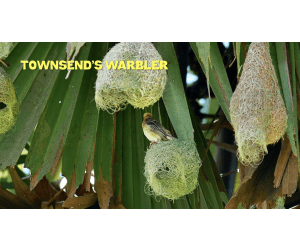
Bird Habitats | Animated Birds Video Lesson
Science, Life Sciences, Animals, Not Grade Specific, Lesson Plans, Teacher Tools
Bird Habitats Animated Birds Video Lesson For educators aiming to make science learning more vibrant and captivating for their students, the Bird Habitats Animated Birds Video Lesson is a valuable resource. Bring the world of ornithology and zoology alive in your classroom. With this animated video , not only will your pupils discover more about different bird habitats, but they will also be engrossed in stories and cultures related to birds. Digital Tool for Versatile Learning This dynamic digital tool offers an easily digestible 10-minute lesson that can successfully introduce or review key concepts. The animation style makes it accessible for students across multiple grade levels since it's not grade specific, simplifying comprehensive science teachings into clear and intriguing lessons that would keep students absorbed. Whole-group viewing:The flexibility of this resource allows you to incorporate it into a whole group session during class time or assigning as individual work. Homeschooling Study Piece:Ideal for homeschoolers looking for self-contained engaging content on bird habitats.- Versatility Meets Instructional Goals In its versatility lies its brilliance: mainstay resource supporting direct classroom instruction while equally phenomenal as independent homework supplement reinforcing science principles outside the classroom walls besides being excellent bring-alive teaching aid demonstrating real-life applications of studies made passionately by those animal-loving pupils keen on nature thus assuring overall better grasp retaining proficiency in subjects like Zoology and Science indefinitely effectively beyond textbook confines traditionally accepted across many educational generations till now substantially easing pedagogic transition towards more digital platforms optimised omnidirectionally consequent upon sudden shift embraced globally owing much due to current global contagion crisis unforeseen compelling teaching fraternity exploring virtual spaces fund improved e-learning resources extensive benefiting ultimately all in particular those inclined towards nurturing lastingly holistic education indispensable today reinforcing mankind survival basic preparedness vis-à-vis global concerns. Revolutionizing Science Education In essence, expect to find in this MP4 file a seamless blend of scientific understanding and worldly wisdom designed to leave an impression on learner's minds, fostering their enthusiasm for the amazing world of science. Trust Bird Habitats Animated Birds Video Lesson as your treasured partner towards reaching pedagogic goals in an age when easy access virtual education resources are the accepted future norm making learning undeniably fun and unforgettable underlining its significance indispensable shaping tomorrow's leaders responsibly.
Author Educational Voice
Tags Bird Habitats, Animated Birds, Science Lesson, Ornithology, Zoology
I WONDER - How Do Humans Affect Climate Change | Animated Video Lesson
Environmental Science, Earth and Environmental Sciences, Science, Earth Sciences, Biology, Life Sciences, Human Body, Grade 4, 5, 6, 7, 8, 9, 10, Lesson Plans, Teacher Tools
Video Introduction An amazing video designed for the students to learn more about STEM. I WONDER - How Do Humans Affect Climate Change | Animated Video Lesson Do you like STEM subjects? what is your favorite one? Have you ever tried to plant a seed? If yes, tell us more about it. Or have you ever tried to invent something? If yes, tell us more about it. And how do you think it will help us? Have you ever seen a microorganism under a microscope? What was it? And how it looked like? Mathematics is a marvelous subject. Let' sharpen our brains and solve some equations. Do you like timetable tricks? What is your favorite one? Do you know how to code? Have you ever created an app or a game before? If yes, how was it like? I WONDER - How Do Humans Affect Climate Change | Animated Video Lesson The video is perfect for encouraging the researching skills for the students, while learning more about this fantastic topic. I WONDER - How Do Humans Affect Climate Change | Animated Video Lesson This friendly designed video is suitable for students at school, homeschooling, and as a group activity. Format Available in MP4 format.
Author Educational Voice
Tags How Do Humans Affect Climate Change, How Do Humans Affect Climate Change Video, Climate Change, Climate Change Facts, Climate Change Facts For Kids, Climate Change Video, Climate Change Video For Kids
Floating Classroom At Sea | Interactive Science Lesson | Micro-Learning Deck
Science, Earth and Environmental Sciences, Environmental Science, Grade 6, 7, 8, 9, Teacher Tools, Lesson Plans
This micro-learning deck is the perfect accessory to your Science instruction! This digital slideshow presents Floating Classroom At Sea. Within this slideshow, you will receive: -Video Lesson -Reading Passage w/ Audio -Close Reading -Quick Write The informational texts included in this resource alongside the informal assessments will keep your students engaged from beginning to end.
Author Teach Me This
Tags Golden Bear Ship, True False Questions, Classroom At Sea, Engineering, Paramilitary School

I WONDER - How Can Recycled Plastic Be Reused | Animated Video Lesson
Environmental Science, Earth and Environmental Sciences, Science, Grade 5, 6, 7, 8, 9, 10, 11, Lesson Plans, Teacher Tools
Video Introduction An amazing video designed for the students to learn more about STEM. I WONDER - How Can Recycled Plastic Be Reused | Animated Video Lesson Do you like STEM subjects? what is your favorite one? Have you ever tried to plant a seed? If yes, tell us more about it. Or have you ever tried to invent something? If yes, tell us more about it. And how do you think it will help us? Have you ever seen a microorganism under a microscope? What was it? And how it looked like? Mathematics is a marvelous subject. Let' sharpen our brains and solve some equations. Do you like timetable tricks? What is your favorite one? Do you know how to code? Have you ever created an app or a game before? If yes, how was it like? I WONDER - How Can Recycled Plastic Be Reused | Animated Video Lesson The video is perfect for encouraging the researching skills for the students, while learning more about this fantastic topic. I WONDER - How Can Recycled Plastic Be Reused | Animated Video Lesson This friendly designed video is suitable for students at school, homeschooling, and as a group activity. Format Available in MP4 format.
Author Educational Voice
Tags How Can Recycled Plastic Be Reused, How Can Recycled Plastic Be Reused Video, Recycled Plastic, Recycled Plastic Facts, Recycled Plastic Facts For Kids, Recycled Plastic Video, Recycled Plastic Video For Kids

Lesson 3.1 - Forces
Science, Chemistry, Physics, Grade 6, 7, 8, 9, 10, 11, 12, Lesson Plans, Teacher Tools
Lesson 3.1 - Forces: A Comprehensive Teaching Resource As a versatile tool for educators, Lesson 3.1 - Forces can serve as a supplement to classroom instruction, an interactive module for remote or homeschool settings, or even as a study aid providing extra practice. It covers various types and categories of forces along with their potential effects on objects. Inclusive Learning Materials Forces Notes: This resource aims at leaving no learners behind, providing details in two variations; version A with blank spaces allowing students to jot down key points themselves and version B which is pre-filled for those who may require them. Forces Practice:Alike notes section, the practice too comes in two versions; format A outlined for general learners and format B formatted towards absentees or learners requiring accommodations. Engaging Content Tools 'Whiteboard Practice':This part presents an interactive PowerPoint embedding images and questions about different force types bringing forth not just home revisions but also whole class activities during class sessions. 'Objectives & Starter Questions:' A conclusive addition to the package includes a PowerPoint which offers clear objectives bundled with starter questions prior to each topic discussion. Educational Standards Compatibility:The resource efficiently meets specific state educational standards like Indiana's ICP 3/2016 standards (Integrated Chemistry & Physics). All files compatible across various platforms are provided in both .docx/.pptx (editable)&.pdf (non-editable). Suitable from Grades 6 through 12,the resource optimally enhances both Chemistry and Physics subject matter.experiences. For educators targeting a comprehensive understanding of forces, Lesson 3.1 - Forces is the perfect tool.
Author Integrated Chemistry and Physics
Tags Forces, Interactive Learning, Study Aid, Hands-on Exercises, Student Engagement
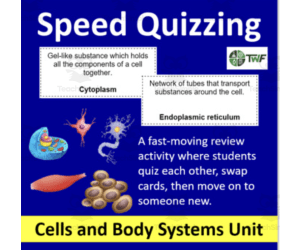
Speed Quizzing – Biology Complete Unit: Cells and Body Systems
Science, Life Sciences, Biology, Grade 8, 9, 10, Lesson Plans, Teacher Tools
This activity will get your students out of their seats, moving around, and discussing the material. It is fully editable and requires very little preparation. Simply print, cut out the flashcards, and pass them out to students. This activity contains 32 questions designed to test your student’s knowledge of the unit they are studying. The questions come directly from the lessons and cover the following topics: · Cell Theory · Cell Structure · The Importance of Cell Division · Mitosis · Cancer: Uncontrolled Cell Division · Specialized Cells · Human Digestive System · Circulatory System · Respiratory System Here’s how you implement them: 1. Provide each student with a flash card 2. Pair up students using the stand up/hands up/pair up method 3. Partner A reads the question to Partner B, who answers. Partner A praises if correct or coaches if incorrect. 4. Partners switch roles 5. Students thank each other and switch cards 6. Partners raise their hands to find a new partner 7. Repeat for a specified amount of time
Author Teach With Fergy
Tags Cells, Body Systems, Science Quiz, Biology Assessment, Quiz

I WONDER - What Is A Gas | Animated Video Lesson
Chemistry, Science, Basic Science, Grade 4, 5, 6, 7, 8, 9, 10, Lesson Plans, Teacher Tools
Video Introduction An amazing activity designed for the students to learn more about STEM. I WONDER - What Is A Gas | Animated Video Lesson Do you like STEM subjects? what is your favorite one? Have you ever tried to plant a seed? If yes, tell us more about it. Or have you ever tried to invent something? If yes, tell us more about it. And how do you think it will help us? Have you ever seen a microorganism under a microscope? What was it? And how it looked like? Mathematics is a marvelous subject. Let' sharpen our brains and solve some equations. Do you like timetable tricks? What is your favorite one? Do you know how to code? Have you ever created an app or a game before? If yes, how was it like? I WONDER - What Is A Gas | Animated Video Lesson The video is perfect for encouraging the researching skills for the students, while learning more about this fantastic topic. I WONDER - What Is A Gas | Animated Video Lesson This friendly designed video is suitable for students at school, homeschooling, and as a group activity. Format Available in MP4 format.
Author Educational Voice
Tags What Is A Gas, What Is A Gas Video, Gas, Gases, Gases Facts, Gases Facts For Kids, Gases Facts For Kids Video, Materials , Stem, Stem Facts

I WONDER - Do Parrots Live In Groups | Animated Video Lesson
STEM, Animals, Life Sciences, Science, Biology, Grade 1, 2, 3, 4, 5, 6, 7, 8, Lesson Plans, Teacher Tools
Video Introduction Animal kingdoms are full of fascinating wonders to learn. This video is designed for the students to learn more about animals in different countries. I WONDER - Do Parrots Live In Groups | Animated Video Lesson Do you like animals? what is your favorite one? Do you own a pet? If yes, tell us more about it, like what its name? And what do you like most about it? What are the animal kingdoms? Can you write down the characteristics of each animal class like mammals, birds, reptiles, amphibian, fish and mollusks. Do you know that some animals can sing, can you name any of them? What is the largest and the smallest mammal in the world? What is the largest and the smallest bird in the world? What is the largest and the smallest fish in the world? I WONDER - Do Parrots Live In Groups | Animated Video Lesson The video is perfect for encouraging the researching skills for the students, while learning more about these fantastic animals. I WONDER - Do Parrots Live In Groups | Animated Video Lesson This friendly designed video is suitable for students at school, homeschooling, and as a group activity. Format Available in MP4 format.
Author Educational Voice
Tags Do Parrots Live In Groups, Do Parrots Live In Groups Video, Parrots, Parrot, Parrots Facts, Parrots Facts For Kids, Parrots Video, Parrots Video For Kids, Parrot Facts, Parrot Video
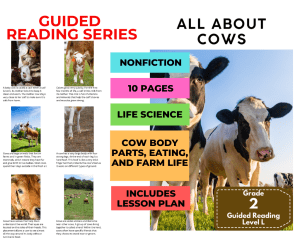
Guided Reading Level L - All About Cows (with Lesson Plan)
ELA, Resources for Teachers, Reading Comprehension, Reading, Science, Language Development, Life Sciences, Animals, Pre-Reading, Vocabulary, Grade 2, 3, 4, Worksheets & Printables, Worksheets, Teacher Tools, Centers, Activities, Literacy Readers, Quizzes, Quizzes and Tests, Assessments, Lesson Plans
This Guided Reading Book - All About Cows (Level L) with lesson plan includes: Guided Reading Color Label (front cover x1) This is a quick way to match the book’s demands to what students can generally handle.. The overall goal is to use the level/color to pick books for several smaller groups. To qualify for a certain level, a student is expected to read a book from that level with about 90–94% accuracy. If a student is consistently accurate and understands, move up a level. If the student is struggling at that level, drop down and add more support. Each student will improve at completely different rates, but it is generally one of the best ways to check progress across the class. DOWNLOAD THE CATALOG TO VIEW ALL GUIDED READING BOOKS AVAILABLE (SORTED LEVELS A-Z) Pre-Reading Question (x1) Teacher asks the prompt aloud, can be while showing the cover or first page. Students share what they already know, or make educated guesses from the cover. Prompt them to use the target vocabulary. Write some of their responses on the board to look back at during the reading. Vocabulary Words (x5) Introduce the five words, best doing it one at a time. Start by saying it, while students repeat and then see if anyone knows what it means before reading further. Read through the meaning and try to briefly connect each word to a picture or gesture so it’s meaningful. Ask students to flip through the book pages and point to where they see each of the vocabulary words. While reading the book pause upon coming across one of the vocab words or read the sentence twice to make sure students understand the word has appeared. Optional: Ask students to raise hands whenever they see/hear one of the new words. Guided Reading Pages (x10) Check the book snapshot (below) for: primary topic - do you need to prep extra reading or intro materials on this? what is taught best - decide on 1-2 bullets to focus on, use the prompt or words provided here for best results. learning goals - what you are checking for students to be able to do after the session, elicit answers using prompts or words provided. key vocabulary (see section above). questions overview - so you know what is coming up and if you need to prep extra materials to assist understanding. Run the lesson You may have already looked at a few of the pages together, but you can show them some of the pictures again first to set meaning. Depending on how much time you have and how familiar your students are with guided reading class, you may want to read the book aloud first with the group first. Students whisper or partner read, while you listen in. If time, do it as a group, one student reading a page each. Use the guided page’s prompts to coach: “Check the picture / does it make sense?” “Point under the words / try the first sound” “Reread the sentence smoothly”. Try to focus more on one student per session (rotating every time), so you can work out if they are ready to move up or need to move down a level. Comprehension Questions (back cover x3) This is your way to check that students didn’t just say the words, but actually understood the text. First, let students answer by pointing to the page/picture and saying a short sentence. After any answer, follow with: “Show me where you found that in the text.” In bigger groups, have partners answer first (10–20 seconds), then call on 2–3 students to share. Differentiation tips: Emerging speakers/struggling readers: oral + pointing On-level: oral in a full sentence Higher: one written sentence or draw + label Book Snapshot Title: All About Cows Genre: Nonfiction (informational) Subject: Life Science + Reading (Informational Text) Primary Topic: Cow body parts, eating, and farm life Estimated Guided Reading Level (A–Z): L What This Book Teaches Best Explains what cows are (large farm animals; mammals that have fur and give birth to live babies). Teaches how cow body parts help them (strong legs, hard hooves that protect feet; eyes placed on the sides for wide view). Describes what cows eat and how they eat plants (herbivores; tongue wraps around grass; plants like grass, hay, clover). Introduces a key digestion process (food goes to a large stomach; cows bring food back up to chew again—“chewing cud”). Builds understanding of cow family and social life (calf care; calves drink milk with vitamins and minerals; cows live in herds and have “friends”). Learning Goals Students will describe what the book says cows are and where they live. Students will explain how a cow’s hoof helps protect its feet while it walks. Students will identify what cows eat and describe how a cow uses its tongue to pull in grass. Students will explain what “chewing cud” means using the book’s description of digestion. Students will describe how calves are cared for and what the text says about calf milk. Students will describe how cows live together in a herd and how they rest. Key Vocabulary From the Text mammals — animals with fur that give birth to live babies. hoof — hard covering that protects a cow’s foot. herbivores — animals that eat only plants. digesting — breaking down food inside the body. herd — a group of cows living together. Discussion Prompts Pre-reading question: What do you already know about cows living on farms? Comprehension questions: How does the book describe a cow’s hoof and what it does? Comprehension questions: What happens to grass after a cow swallows it, and what is “chewing cud”? Comprehension questions: Why can a cow see almost all the way around its body without turning its head? Printing Tips 1. Best Printing Method (Recommended) “Booklet” Printing (Best if Available) If your printer or PDF viewer supports Booklet Printing , use this. Settings to use: Print mode: Booklet Paper size: Letter or A4 (either works) Orientation: Landscape Print on both sides: Yes Flip on: Short edge Scaling: Fit to printable area Booklet subset: First test: Front sides only Then: Back sides only This will automatically: Pair pages correctly Put the cover on the outside Align everything for folding After printing, fold in half and staple along the spine . 2. If “Booklet” Printing Is NOT Available You can still print this correctly with manual duplex printing . Step-by-step: Open the PDF. Choose Print . Set: Orientation: Landscape Pages per sheet: 1 Print on both sides: Yes Flip on: Short edge Print all pages . Because each PDF page already contains two facing book pages, the result will still fold cleanly into a book. Thousands of Cored Education products are included with your TeachSimple membership. Download links and encyclopedia index available here.
Author Cored Education
Rating
Tags Reading Comprehension, Reading Passages, Reading, Guided Reading, Guided Reading Lesson Plan, Guided Reading Activity, Pre-reading, Science Lesson Plans, Life Science, Animals

Pluto, the Maybe Planet: A Cross-Curricular Unit
Science, Earth and Environmental Sciences, Space, Grade 5, 6, Teacher Tools, Lesson Plans
Pluto, the Maybe Planet: A Cross-Curricular Unit Scientists and educators alike will find interest and value in the teaching resource, "Pluto, the Maybe Planet: A Cross-Curricular Unit". This unique study material gives both public school teachers and homeschoolers an insightful approach to teaching astronomy to Grade 5 and Grade 6 students. The unit addresses: Pluto's controversial demotion in 2006, a topic still a matter of contention amongst scientists. The packet includes an engaging nonfiction article on Pluto that presents this controversy stimulatingly. This resource breathes life into astronomy lessons by connecting science with current events and invites students to join in on the debate. Included Resources In addition to the article, it comes with seven pages of ready-to-print content integrated with cross-curricular worksheets. It provides various activity ideas designed for multiple learning settings - from whole group activities for classroom discussions about Pluto's planetary status to individual assignments for deep dives into various aspects of astronomy. The available resources can also be used flexibly according to teaching goals or learners' needs. For instance, teachers might choose some parts as homework assignments while others may facilitate vibrant small group meetings where abstract scientific concepts become more tangible through debate. The versatility ensures usability no matter how diverse or specific your educational objectives might be. Designed not only as a lesson plan but also as an igniter of lively scientific discussion among young learners, "Pluto- The Maybe Planet: A Cross-Curricular Unit" offers multifaceted utility as part of your science curriculum toolkit. This unit requires no additional resources beyond what is provided—just print out the PDF files and apply them right away in your context. Engage your students in thoughtful analysis while reinforcing their knowledge about our intriguing universe using this comprehensive instructional aid on one tiny but huge debatable cosmic object- Pluto!
Author Classroom Complete Press
Tags Planets, Astronomy Lesson, Pluto, Reading Passage, Small Group Work

I WONDER - What Is The Cerebellum | Animated Video Lesson
Human Body, Life Sciences, Science, Biology, STEM, Grade 6, 7, 8, 9, 10, 11, 12, Lesson Plans, Teacher Tools
Video Overview The human body is full of fascinating wonders to learn. This video is created to help the students recognize the anatomy and the job of the human body. I WONDER - What Is The Cerebellum | Animated Video Lesson Every part and organ in our human body is vital so let's see how important they are. Have you ever imagined how we look like if we didn't have a skeleton? Did you know that because we have our amazing muscles we can stand! Do you know how many teeth do we have? Have you ever wondered about the food journey inside our body? Can you name all the glands in our body? Why do we have skin? Our nervous system is really good at sending signals. Can you tell us more about it? Are you really good at Mathematics, painting, or any other thing? You should really thank your brain about it! The famous five senses are really doing a great work? Can you explain how every sense works? I WONDER - What Is The Cerebellum | Animated Video Lesson The video is perfect for encouraging the researching skills for the students, while learning more about our fantastic human body. I WONDER - What Is The Cerebellum | Animated Video Lesson This friendly designed video is suitable for students at school, homeschooling, and as a group activity. Format Available in MP4 format.
Author Educational Voice
Tags What Is The Cerebellum, What Is The Cerebellum Video, Cerebellum, Cerebellum Facts, Cerebellum Facts For Kids, Cerebellum Video, Cerebellum Video For Kids, Brain, Brain Facrs, Brain Facts For Kids

I WONDER - What Is A Food Web | Animated Video Lesson
Environmental Science, Earth and Environmental Sciences, Science, Earth Sciences, Grade 3, 4, 5, 6, 7, 8, 9, Lesson Plans, Teacher Tools
Video Introduction An amazing video designed for the students to learn more about STEM. I WONDER - What Is A Food Web | Animated Video Lesson Do you like STEM subjects? what is your favorite one? Have you ever tried to plant a seed? If yes, tell us more about it. Or have you ever tried to invent something? If yes, tell us more about it. And how do you think it will help us? Have you ever seen a microorganism under a microscope? What was it? And how it looked like? Mathematics is a marvelous subject. Let' sharpen our brains and solve some equations. Do you like timetable tricks? What is your favorite one? Do you know how to code? Have you ever created an app or a game before? If yes, how was it like? I WONDER - What Is A Food Web | Animated Video Lesson The video is perfect for encouraging the researching skills for the students, while learning more about this fantastic topic. I WONDER - What Is A Food Web | Animated Video Lesson This friendly designed video is suitable for students at school, homeschooling, and as a group activity. Format Available in MP4 format.
Author Educational Voice
Tags What Is A Food Web, What Is A Food Web Video, Food Web, Food Web Facts, Food Web Facts For Kids, Food Web Video, Food Web Video For Kids, Science, Science Video, Science Facts For Kids

Simple Machines - Digital Lesson Plan Gr. 5-8 | PC Software
Science, Physics, Grade 3, 4, 5, 6, 7, 8, Teacher Tools, Lesson Plans
Simple Machines - Digital Lesson Plan Gr. 5-8 | PC Software This is an innovative teaching resource designed specifically for educators teaching complex Physics topics. Designed for students in grades 5 to 8, this tool can prove invaluable for both public school teachers and homeschoolers. The Focus of the Software The software simplifies the intricate world of simple machines, explaining fundamental scientific concepts applied daily. Covered topics include six elementary machines - Levers, Inclined Planes, Wedges, Screws, Pulleys, and Wheel & Axles. The content starts with basic principles such as force, work and motion before moving on to complex areas. Dedicated Interactive Learning Environment To foster active learning environments planetary system model consists of over 80 unique screen-pages where lessons are driven by reading passages coupled with pre-and-post comprehension checks. It also features: Test prep modules: A memory match game : Multimedia resources including audio aids and videos: An All-In-ONE Learning Tool For Diverse Scenarios! The inclusivity of multimedia resources supports various learning scenarios including individual study time; group-based projects or even flipped classrooms where students interact with material independently ahead of class discussion or activities. This comprehensive digital resource comes packed in a single zip file containing PC software ensuring a stress-free installation process by instructors. Educational Standards Adherence! All aspects of this product's design have been guided by vigorous State Standards as well as following Bloom's Taxonomy guidelines reinforcing a well-rounded academic approach compatible with curriculums nationwide. Experience the fun of bringing Science to life in your class today with Simple Machines - Digital Lesson Plan Gr. 5-8 | PC Software!
Author Classroom Complete Press
Tags Science Crossword Puzzle, Simple Machines Lesson, Digital Lesson Plan, Physics Lesson, Digital Science

I WONDER - Why Are Bats Important | Animated Video Lesson
STEM, Animals, Life Sciences, Science, Biology, Grade 1, 2, 3, 4, 5, 6, 7, 8, Lesson Plans, Teacher Tools
Video Introduction Animal kingdoms are full of fascinating wonders to learn. This video is designed for the students to learn more about animals in different countries. I WONDER - Why Are Bats Important | Animated Video Lesson Do you like animals? what is your favorite one? Do you own a pet? If yes, tell us more about it, like what its name? And what do you like most about it? What are the animal kingdoms? Can you write down the characteristics of each animal class like mammals, birds, reptiles, amphibian, fish and mollusks. Do you know that some animals can sing, can you name any of them? What is the largest and the smallest mammal in the world? What is the largest and the smallest bird in the world? What is the largest and the smallest fish in the world? I WONDER - Why Are Bats Important | Animated Video Lesson The video is perfect for encouraging the researching skills for the students, while learning more about these fantastic animals. I WONDER - Why Are Bats Important | Animated Video Lesson This friendly designed video is suitable for students at school, homeschooling, and as a group activity. Format Available in MP4 format.
Author Educational Voice
Tags Why Are Bats Important, Why Are Bats Important Video, Bats, Bat, Bats Facts, Bats Facts For Kids, Bats Video, Bats Video For Kids, Bat Facts, Bat Facts For Kids
I WONDER - Are All Stars Yellow | Animated Video Lesson
Space, Earth and Environmental Sciences, Science, Grade 1, 2, 3, 4, 5, 6, 7, 8, Lesson Plans, Teacher Tools
Video Introduction An amazing video designed for the students to learn more about space facts. I WONDER - Are All Stars Yellow | Animated Video Lesson Have you ever thought about travelling to space?! Join us with this amazing video about The Moon Ganymede. Can you name any three facts about The Moon Ganymede? How amazing is space! Let's discover some amazing facts about planets and moons! Do you know that we have two kinds of planets in our solar system? Can you name the planets based upon their core type? I WONDER - Are All Stars Yellow | Animated Video Lesson The video is perfect for encouraging the researching skills for the students, while learning more about the fantastic space. I WONDER - Are All Stars Yellow | Animated Video Lesson This friendly designed video is suitable for students at school, homeschooling, and as a group activity. Format Available in MP4 format.
Author Educational Voice
Rating
Tags Are All Stars Yellow, Stars, Stars Facts, Stars Video, Stars Facts For Kids, Stars Video For Kids, Star Facts, Star Video, Star, Star Facts For Kids

Cells: Cell Reproduction
Science, Life Sciences, Biology, Common Core, Grade 5, 6, 7, 8, Teacher Tools, Lesson Plans
Cells: Cell Reproduction Cells: Cell Reproduction is an educational resource designed for educators. It introduces and explores the concept of cell reproduction for students in grades 5 through 8. The material presents core scientific knowledge related to cells in an engaging and accessible style. Key Learning Areas The structure and function of plant and animal cells Difference between single-celled and multi-cellular organisms An in-depth look at human cell reproduction, diffusion, and osmosis This valuable teaching tool includes detailed reading passages, exciting student activities, colorful mini posters encompassing all topics discussed. Pedagogical Approaches Supported: Whole class instruction : Activity exercises or group discussion stemming from provided reading passages. Small group instruction :To delve deeper into complex concepts with peer-based support fostering interactive scientific dialogue. Homework assignments :To provide individual learners with vital repetition required for conceptual understanding. In addition to traditional classroom environments, this material is ideal for homeschooling parents looking to enrich their children’s science curriculum at home. The provided PDF file type ensures ease of use across digital platforms - project illustrations on a whiteboard or share them directly onto student devices if desired. Educational Standards Alignment & Critical Thinking Skills Enhancement: The comprehensive coverage aligns closely with Common Core State Standards ensuring relevance compliance nationwide. Meanwhile written assignments incorporate Bloom's Taxonomy & S.T.E.M initiatives,fostering critical thinking & encouraging analytical questions promoting further scientific inquiry effectively preparing students for advanced studies in biology down the line. Cells: Cell Reproduction, in essence, instills a foundational understanding of essential biological concepts. Encouraging a love for science amongst students is just one of its many benefits.
Author Classroom Complete Press
Tags PDF
I WONDER - How Do People Eat Vegetables | Animated Video Lesson
Nature & Plants, Life Sciences, Science, Biology, Human Body, Grade 1, 2, 3, 4, 5, 6, 7, 8, Lesson Plans, Teacher Tools
Video Introduction An amazing video designed for the students to learn more about STEM. I WONDER - How Do People Eat Vegetables | Animated Video Lesson Plants world is really fascinating! Do you know that some flowers eat insects? Some other plants like to grow on walls can you mention any? Do you know what is the difference between fungicide and pesticide? If yes, Can you tell us more about it? What is nuclear energy? Is it safe to use it? Do you think it is a clean energy? Have you ever read about potential energy? If yes, tell us what it is? Do you think that potential energy can be converted into another form of energy? How it happens? I WONDER - How Do People Eat Vegetables | Animated Video Lesson The video is perfect for encouraging the researching skills for the students, while learning more about this fantastic topic. I WONDER - How Do People Eat Vegetables | Animated Video Lesson This friendly designed video is suitable for students at school, homeschooling, and as a group activity. Format Available in MP4 format.
Author Educational Voice
Rating
Tags How Do People Eat Vegetables, Eat Vegetables, Eating Vegetables, Eating Vegetables Facts, Eating Vegetables Video, Eating Vegetables Video For Kids, Eating Vegetables Facts For Kids, Ways Of Cooking Vegetables
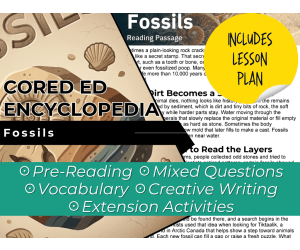
Fossils Reading Comprehension Passage - Cored Ed Encyclopedia
ELA, Reading Comprehension, Reading, Science, Technology, Earth and Environmental Sciences, Life Sciences, Pre-Reading, Language Development, Vocabulary, Grade 2, 3, 4, 5, Worksheets & Printables, Worksheets, Teacher Tools, Centers, Activities, Writing Prompts, Assessments, Quizzes and Tests, Quizzes, Lesson Plans
This fossils reading comprehension with lesson plan includes: Visualization (on the front cover) Start your lesson by taking a minute to think and share something about the topic. Read the script aloud (slowly), perhaps prepare some music or sound effects. Student close their eyes and let their imaginations wander. Students open their eyes, read the question aloud and give them a few minutes to complete. Ask a few students to share or keep answers until the end to compare with what they learn in the passage. Quick pause—thousands of Cored Education products are included with your TeachSimple membership. Download links and encyclopedia index available here. Pre-Reading Trivia Students will write down one thing they already know about the subject and then read five more facts and discuss. These facts are fun, and the students will enjoy learning about the subject before reading more. Give 1 minute for students to write what they already know (no pressure—best guess is fine). Read the five facts together. After each fact, do ask a student for their opinion, was it surprising? Set a purpose by asking students to highlight/underline one fact they want to learn more about during the reading. Reading Passage The text is a high-interest reading passage with set paragraphs, roughly three to four paragraphs long. It contains a variety of themes about the topic, anywhere from history to technology. The passage is between 250 and 350 words in length. First, ask students to look at the headings and see what they’ll learn about today. What do they know about the topic/heading? First read options: Teacher read-aloud (best for support). Partner reading (paragraph by paragraph). While reading, students underline important details, and vocabulary words they think may come up in the questions section. Mixed Questions The first question page contains four multiple-choice questions, each with a choice of four answers, and three written response questions that require a sentence or two from the student. Students complete the mcqs first independently, then review quickly as a class. For the 3 written responses, try to get students giving the answer with some form of evidence: “I think ___ because the text says ___.” If students get stuck, send them back to check the passage. Vocabulary Questions Practice seven key words from the text in this section across two activities. First section is scrambled words where students will unscramble three words given a clue for each. The second section is a word to meaning matching activity. Before starting, have some students read out words they underlined in the passage. Ask students to say the word and read aloud the sentence(s) around each word. Ask students to do scrambled words and the matching exercise in pairs then go through answers as a class. For the scrambled spelling task, get four pairs to come up to the board and write the words for extra practice with the other student reading out the clue. For the matching task, prompt students to give full sentences: “I matched ___ with ___ because ___.” Creative Writing In this question, the student will be required to write a five to eight sentence paragraph on a question related to the topic. Before starting, ask students write down 3 key ideas they are going to include in their piece. Ask students for ideas to share around the class to help those struggling. Pro writing expectations: 5–8 sentences At least 2 facts or details from the passage At least 2 vocabulary words from the previous page Students read their paragraphs while classmates listen for facts and vocabulary words. Extension Activities This page is optional for fast finishers or to take home. There are several activities, each one requiring a different skill. Do some, do none, do all, completely optional - but you will feel reassured knowing every possibility is planned for. Includes summary writting question and additional facts. Answer Key There are answers for the multiple-choice questions, written response questions have sample answers, vocabulary answers and if there is a summary question then a sample summary will be provided as well. Lesson Plan Included Customized lesson plan for this lesson is included. Lesson Snapshot Title: Fossils Genre: Nonfiction (Informational Text) Subject: Science (Earth Science/Life Science) / Reading (Informational Text) Primary Topic: Fossils, how they form, and what they reveal Estimated Guided Reading Level (A–Z): Q What This Lesson Teaches Best Defines a fossil and explains that fossils can be body parts (tooth, bone) or traces (footprint, burrow, fossilized poop) that become clues in the “fossil record.” Explains how fossils form when remains are quickly covered by sediment , and minerals in water replace material or fill empty spaces until remains harden like stone. Teaches mold and cast formation: a body can disappear, leaving a hollow mold that later fills to make a cast. Introduces paleontology and shows how scientists “read” patterns in sedimentary rock layers to learn how life has changed over time. Shows how fossils can guide new discoveries , including using rock layers to search for missing kinds of creatures (Tiktaalik example). Learning Goals Students will identify two kinds of fossils named in the text and give an example of each. Students will explain how sediment and minerals help remains become hard “as stone.” Students will describe how a mold and a cast can form, using the text’s explanation. Students will explain how scientists use patterns in sedimentary rock layers to learn which fossils are older. Students will describe why the fossil record is “not complete,” based on the passage. Students will describe how fossils can help scientists decide where to search for new discoveries. Key Vocabulary From the Text sediment — dirt and tiny bits of rock. minerals — materials in water that can harden remains. mold — a hollow shape left after a body is gone. cast — a filled-in copy of a hollow shape. paleontology — the study of ancient life using fossils. FULL CATALOG OF DOWNLOAD LINKS AND ENCYCLOPEDIA INDEX HERE
Author Cored Education
Rating
Tags Vocabulary, Reading Comprehension, Reading Passages, Lesson Plans, Ela Lesson Plans, Reading Comprehension Lesson Plans, Pre-reading, Science Lesson Plans, Earth Science, Life Science

What's That Smell?: A Unit on Your Senses
Science, Life Sciences, Human Body, Grade 1, 2, Teacher Tools, Lesson Plans
What's That Smell?: A Unit on Your Senses This is an interactive, informative teaching resource designed to stimulate curiosity about the incredible world of human senses. It is crafted specifically for Grade 1 and Grade 2 students. The focus of this lesson plan dwells into the five most foundational ways we perceive our surroundings – namely, sight, touch, sound, taste and smell. About The Lesson The crux of this unit is a comprehensive nonfiction article that elucidates how each sense operates in simple language fit for novice learners. This resource spotlights the utmost importance of our senses as these are our windows to connect with our environment in diverse yet interconnected manners. Moving Beyond Conventional Knowledge Grabbing Approach To assure learning about these essential body functions isn't limiting or mundane; along with furnishing theoretical grounding through its nonfiction article aspect; it incorporates creative exercises and fill-outs. Creative activities: These enjoyable tasks offer a hands-on approach while sticking to emphasizing reinforcement of demonstrated principles. They catch not only auditory learners but also those who absorb best via doing. Educational versatility: A PDF file available at your disposal for customized use; applicable either for whole group instruction sessions during live classes or small break-out group engagements post-lectures. Quite versatile indeed! Homework assignments:The option is there even for assigning chosen sections as insightful home assignments- inducing value-added self-study habits amongst students!
Author Classroom Complete Press
Tags PDF
Reducing Your Community's Carbon Footprint: Reduce, Reuse, Recycle, and Plant Gr. 5-8
Science, Earth and Environmental Sciences, Environmental Science, Grade 5, 6, 7, 8, Teacher Tools, Lesson Plans
Reducing Your Communitys Carbon Footprint: Reduce, Reuse, Recycle and Plant Gr. 5-8 An engaging educational resource, designed primarily for grades 5 to 8 students. It aims to enhance environmental consciousness by offering profound insights into the community's carbon footprint and its effect on global climate change. Evaluation of cause-and-effect incidents: The resource encourages learners to assess the sequence of events that stem from simple routines like commuting to work or substantial implications like reducing island size. Versatile usage: This material is adaptable across different learning environments - ideal not only for whole-group instructions in conventional classrooms but also for small group activities, homework assignments and interactive online sessions. Inspiring transformations: Beyond highlighting the adverse consequences of climate change, this curriculum narrates how Cubans adopted a completely fossil fuel-free farming system within a decade and discusses urban heat island effects caused by urbanization with fact-based analyses. Bloom’s Taxonomy and STEAM initiatives guidelines compliance: This resource marries enlightenment with engagement through crossword puzzles, quizzes which offer self- assessment opportunities with carbon footprint calculators as per Bloom’s Taxonomy guidelines. The curriculum is available as a downloadable PDF format file ensuring easy access and adaptable printing choices whether you wish to use it remotely or in a physical classroom environment. Specially formulated for Environmental Science subject under Science courses, Reducing Your Communitys Carbon Footprint: Reduce, Reuse, Recycle, and Plant Gr. 5-8 offers an intriguing yet pragmatic perspective on environmental conservation promoting sustainable lifestyle habits ensuring us all a healthier future.
Author Classroom Complete Press
Tags PDF
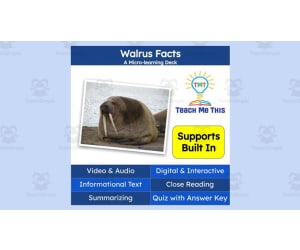
Walrus Facts | Interactive Science Lesson | Micro-Learning Deck
Science, Life Sciences, Animals, Grade 6, 7, 8, 9, Teacher Tools, Lesson Plans
Walrus Facts | Interactive Science Lesson educates students on the biology and behavior of walruses. This digital slideshow can supplement a middle school science curriculum in a variety of settings. Students start by watching an informative video introducing key details about the physical characteristics, habitat, reproduction, and feeding patterns of these marine mammals. Next, students read a passage with audio support to reinforce comprehension of essential walrus facts. The lesson concludes with a close reading activity and a quick write prompt for students to summarize and apply their new knowledge. Implement as a whole class presentation, small group work, or even an independent learning module in both traditional and home classrooms. The mix of informal assessments keeps learners engaged as they expand their understanding of these unique creatures.
Author Teach Me This
Tags Walrus Facts, Interactive, Science, Reading Passage, Vocabulary

Motion: Vibrating Motion - FLASH-PC
Science, Physics, Common Core, Grade 5, 6, 7, 8, Teacher Tools, Lesson Plans
Motion: Vibrating Motion - FLASH-PC An enlightening, curriculum-based teaching resource, designed to elucidate the principles behind vibrating motion. This tool is paramount in the field of Physics for Grade 5 to Grade 8. This comprehensive software delivers engaging content right at your fingertips, starting off with enlightening reading passages that inform learners about the core concepts entailing vibrating motion. It encourages critical thinking by offering interactive questions both before and after each reading section. Different Learning Styles Catered Understanding Physics goes beyond text-based materials. With Motion: Vibrating Motion - FLASH-PC, students can leverage captivating audio and video resources for an immersive learning experience*. Activities: Engaging physical activities that make learning fun and stimulating. Vocabulary Flashcards: Reinforce key terminologies with easy-to-understand definitions for future application or assessments . Printables: Assists teachers as they facilitate instruction, almost like having an additional professional in class! Fulfilling Common Core State Standards Pedagogy And Bloom’s Taxonomy Framework The contents of this product are on pace with Common Core State Standards ensuring credibility. Attention is also given to nurture higher-order thinking skills via Bloom’s Taxonomy lens from introduction till mastery stages. An interactive teaching resource – it's applicable during "whole group lessons", "small group instructions" , or as homework assignments! Unlock a more nuanced understanding of Vibrating Motion for your learners today!
Author Classroom Complete Press
Tags Software (PC)

I WONDER - Is Pluto A Dwarf Planet | Animated Video Lesson
Space, Earth and Environmental Sciences, Science, Grade 6, 7, 8, 9, 10, 11, 12, Lesson Plans, Teacher Tools
Video Introduction An amazing video designed for the students to learn more about space facts. I WONDER - Is Pluto A Dwarf Planet | Animated Video Lesson Do you like reading about space? If yes, what is your favorite topic? What do you know about our solar system? What is the smallest planet in our solar system? What is the biggest planet in our solar system? What is the hottest planet in our solar system? And what is the coldest one? Do you think there are aliens? If yes, what do you think they look like? What do they eat and how they speak to each other? Where do they live? What is a galaxy? And what is a milky way? Have you recently saw a shooting star? If yes, tell us more about it, like when did it happen and where? What is a blackhole? Can a blackhole gets bigger by time? Do you like counting the stars? What do you think a star is made of? I WONDER - Is Pluto A Dwarf Planet | Animated Video Lesson The video is perfect for encouraging the researching skills for the students, while learning more about the fantastic space. I WONDER - Is Pluto A Dwarf Planet | Animated Video Lesson This friendly designed video is suitable for students at school, homeschooling, and as a group activity. Format Available in MP4 format.
Author Educational Voice
Tags Is Pluto A Dwarf Planet, Is Pluto A Dwarf Planet Video, Pluto, Pluto Facts, Pluto Facts For Kids, Pluto Video, Pluto Video For Kids, Dwarf Planet, Dwarf Planet Video, Dwarf Planet Facts

Cheetahs | Interactive Science Lesson | Micro-Learning Deck
Science, Life Sciences, Animals, Grade 5, 6, 7, 8, Teacher Tools, Lesson Plans
Engaging Cheetahs Micro-Learning Science Lesson for Upper Elementary Students This informative digital slideshow lesson helps teach upper elementary students about the world's fastest land mammal - the cheetah. Ideal for grades 5-8 science classes, it can be used in whole group instruction or for individual student learning. The deck immerses students in learning with a short video, reading passage with audio, close reading activity, and quick write assignment. As the captivating content unfolds, young learners will build knowledge on cheetah characteristics like their speed, habitat, hunting techniques, and more through multiple modalities. This stand-alone resource provokes curiosity about animal classification while aligning to science standards. Implement as a supplemental science lesson or homework for engaged inquiry-based learning.
Author Teach Me This
Tags Cheetahs, Fastest Living Animals, Interactive Science Lesson, Comprehension, Vocabulary