



3,890 products added recently
Page 41 - Science Lesson Plan Template
Enhance your science instruction with a flexible lesson plan template designed for educators. This tool helps you structure objectives, materials, procedures, and assessments efficiently. Use it to create organized and impactful science lessons that cater to your students' needs.

 Show filters

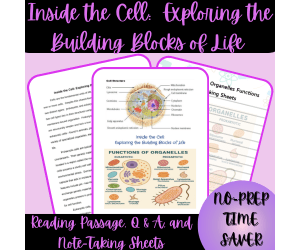
HIgh School Cell Structure & Organelles Functions Reading Passage
ELA, Reading, Writing, Research, Resources for Teachers, Science, Life Sciences, Biology, High School, Homeschool Resources, Teacher Tools, Lesson Plans, Assessments, Quizzes and Tests, Worksheets & Printables, Writing Prompts
This Inside the Cell: Exploring the Building Blocks of Life Reading Passage, Q & A, and Note-Taking Sheets resource is a thoughtfully designed resource created to help students/homeschoolers truly understand the fascinating world of cells. As a homeschool mom guiding my own ninth grader, I know how challenging it can be to find materials that are both engaging and thorough. This Inside the Cell: Exploring the Building Blocks of Life Reading Passage, Q & A, and Note-Taking Sheets resource brings together a detailed reading passage, critical thinking Q & A, and five versatile note-taking sheets to support deep comprehension. Whether you are teaching in a classroom or around the kitchen table, this set will help your learners grasp the essential differences between eukaryotic and prokaryotic cells and the remarkable functions of their organelles. INCLUDED IN THIS RESOURCE: Comprehensive reading passage on cell structure and organelle function 20 higher-order, research-based Q & A prompts Guided answer key for all questions Five note-taking sheets TOPICS COVERED: Differences between prokaryotic and eukaryotic cells Structure and function of major cell organelles Specialized features of plant and animal cells Cellular adaptations and ecological roles This Inside the Cell: Exploring the Building Blocks of Life Reading Passage, Q & A, and Note-Taking Sheets resource is a complete package for teaching and learning about the building blocks of life. It is designed to inspire curiosity, build confidence, and equip students/homeschoolers with the knowledge and skills they need to succeed in biology. As a mom and homeschool educator, I believe this resource will make your science lessons more meaningful and enjoyable for everyone involved. If you and your students/homeschoolers enjoyed this resource, please leave a review. Thank you for your support! Tina - Big Easy Homeschooling Mom
Author Homeschool with Big Easy Homeschooling Mom
Rating
Tags Cell Structure And Function Reading Passage, Eukaryotic And Prokaryotic Cell Comparison, Homeschool Cell Biology Resource, Homeschool Biology, High School Biology, Comprehensive Cell Biology Lesson, Cell Structure And Organelle Teaching Materials, Homeschool Science, High School Science, Eukaryotic And Prokaryotic Cells
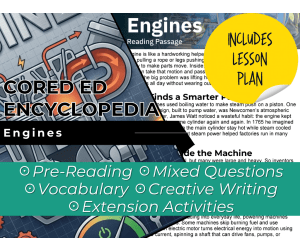
Engines Reading Comprehension Passage - Cored Ed Encyclopedia
ELA, Reading Comprehension, Reading, Science, Technology, Pre-Reading, Language Development, Physics, History, Social Studies, Grade 2, 3, 4, 5, Worksheets & Printables, Worksheets, Teacher Tools, Centers, Activities, Writing Prompts, Assessments, Quizzes and Tests, Quizzes, Lesson Plans
This engines reading comprehension with lesson plan includes: Visualization (on the front cover) Start your lesson by taking a minute to think and share something about the topic. Read the script aloud (slowly), perhaps prepare some music or sound effects. Student close their eyes and let their imaginations wander. Students open their eyes, read the question aloud and give them a few minutes to complete. Ask a few students to share or keep answers until the end to compare with what they learn in the passage. Quick pause—thousands of Cored Education products are included with your TeachSimple membership. Download links and encyclopedia index available here. Pre-Reading Trivia Students will write down one thing they already know about the subject and then read five more facts and discuss. These facts are fun, and the students will enjoy learning about the subject before reading more. Give 1 minute for students to write what they already know (no pressure—best guess is fine). Read the five facts together. After each fact, do ask a student for their opinion, was it surprising? Set a purpose by asking students to highlight/underline one fact they want to learn more about during the reading. Reading Passage The text is a high-interest reading passage with set paragraphs, roughly three to four paragraphs long. It contains a variety of themes about the topic, anywhere from history to technology. The passage is between 250 and 350 words in length. First, ask students to look at the headings and see what they’ll learn about today. What do they know about the topic/heading? First read options: Teacher read-aloud (best for support). Partner reading (paragraph by paragraph). While reading, students underline important details, and vocabulary words they think may come up in the questions section. Mixed Questions The first question page contains four multiple-choice questions, each with a choice of four answers, and three written response questions that require a sentence or two from the student. Students complete the mcqs first independently, then review quickly as a class. For the 3 written responses, try to get students giving the answer with some form of evidence: “I think ___ because the text says ___.” If students get stuck, send them back to check the passage. Vocabulary Questions Practice seven key words from the text in this section across two activities. First section is scrambled words where students will unscramble three words given a clue for each. The second section is a word to meaning matching activity. Before starting, have some students read out words they underlined in the passage. Ask students to say the word and read aloud the sentence(s) around each word. Ask students to do scrambled words and the matching exercise in pairs then go through answers as a class. For the scrambled spelling task, get four pairs to come up to the board and write the words for extra practice with the other student reading out the clue. For the matching task, prompt students to give full sentences: “I matched ___ with ___ because ___.” Creative Writing In this question, the student will be required to write a five to eight sentence paragraph on a question related to the topic. Before starting, ask students write down 3 key ideas they are going to include in their piece. Ask students for ideas to share around the class to help those struggling. Pro writing expectations: 5–8 sentences At least 2 facts or details from the passage At least 2 vocabulary words from the previous page Students read their paragraphs while classmates listen for facts and vocabulary words. Extension Activities This page is optional for fast finishers or to take home. There are several activities, each one requiring a different skill. Do some, do none, do all, completely optional - but you will feel reassured knowing every possibility is planned for. Includes summary writting question and additional facts. Answer Key There are answers for the multiple-choice questions, written response questions have sample answers, vocabulary answers and if there is a summary question then a sample summary will be provided as well. Lesson Plan Included Customized lesson plan for this lesson is included. Lesson Snapshot Title: Engines Genre: Nonfiction (Informational Text) Subject: Science (Physical Science/Technology) / Reading (Informational Text) Primary Topic: How engines turn energy into motion Estimated Guided Reading Level (A–Z): P What This Lesson Teaches Best Explains the core idea that an engine turns energy into motion , using heat, fuel, or electricity to make parts move. Builds understanding of how steam engines work (boiling water makes steam push a piston) and how designs became more efficient (Watt’s separate condenser idea). Describes internal combustion engines and the four-step cycle (take in, squeeze, burn/push, exhaust) that repeats. Connects parts and motion: pistons moving back-and-forth can turn a crankshaft to keep rotation going. Introduces electric motors as another way to change energy into motion using magnetism and current to spin a shaft. Learning Goals Students will explain how an engine changes energy into motion using heat, fuel, or electricity. Students will describe how steam can push a piston in an early steam engine. Students will explain why a separate condenser made a steam engine design more efficient. Students will identify how an internal combustion engine makes motion by burning fuel inside a chamber. Students will list the four repeated steps of a four-stroke engine as stated in the passage. Students will describe how an electric motor uses magnetism and current to spin a shaft. Key Vocabulary From the Text piston — a part pushed by steam or hot gases. condenser — a part that cools steam somewhere else. combustion — burning fuel to make hot gases. crankshaft — a part that keeps turning as pistons move. magnetism — a force used with current to make a shaft spin. FULL CATALOG OF DOWNLOAD LINKS AND ENCYCLOPEDIA INDEX HERE
Author Cored Education
Rating
Tags Vocabulary, Reading Comprehension, Reading Passages, Lesson Plans, Ela Lesson Plans, Reading Comprehension Lesson Plans, Pre-reading, Science Lesson Plans, Technology, Physics
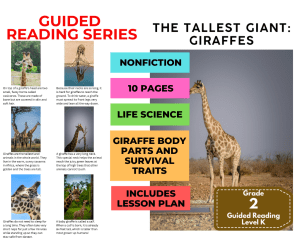
Guided Reading Level K - Tallest Giant Giraffes (with Lesson Plan)
ELA, Resources for Teachers, Reading Comprehension, Reading, Science, Language Development, Life Sciences, Animals, Pre-Reading, Vocabulary, Grade 2, 3, 4, Worksheets & Printables, Worksheets, Teacher Tools, Centers, Activities, Literacy Readers, Quizzes, Quizzes and Tests, Assessments, Lesson Plans
This Guided Reading Book - Tallest Giant Giraffes (Level K) with lesson plan includes: Guided Reading Color Label (front cover x1) This is a quick way to match the book’s demands to what students can generally handle.. The overall goal is to use the level/color to pick books for several smaller groups. To qualify for a certain level, a student is expected to read a book from that level with about 90–94% accuracy. If a student is consistently accurate and understands, move up a level. If the student is struggling at that level, drop down and add more support. Each student will improve at completely different rates, but it is generally one of the best ways to check progress across the class. DOWNLOAD THE CATALOG TO VIEW ALL GUIDED READING BOOKS AVAILABLE (SORTED LEVELS A-Z) Pre-Reading Question (x1) Teacher asks the prompt aloud, can be while showing the cover or first page. Students share what they already know, or make educated guesses from the cover. Prompt them to use the target vocabulary. Write some of their responses on the board to look back at during the reading. Vocabulary Words (x5) Introduce the five words, best doing it one at a time. Start by saying it, while students repeat and then see if anyone knows what it means before reading further. Read through the meaning and try to briefly connect each word to a picture or gesture so it’s meaningful. Ask students to flip through the book pages and point to where they see each of the vocabulary words. While reading the book pause upon coming across one of the vocab words or read the sentence twice to make sure students understand the word has appeared. Optional: Ask students to raise hands whenever they see/hear one of the new words. Guided Reading Pages (x10) Check the book snapshot (below) for: primary topic - do you need to prep extra reading or intro materials on this? what is taught best - decide on 1-2 bullets to focus on, use the prompt or words provided here for best results. learning goals - what you are checking for students to be able to do after the session, elicit answers using prompts or words provided. key vocabulary (see section above). questions overview - so you know what is coming up and if you need to prep extra materials to assist understanding. Run the lesson You may have already looked at a few of the pages together, but you can show them some of the pictures again first to set meaning. Depending on how much time you have and how familiar your students are with guided reading class, you may want to read the book aloud first with the group first. Students whisper or partner read, while you listen in. If time, do it as a group, one student reading a page each. Use the guided page’s prompts to coach: “Check the picture / does it make sense?” “Point under the words / try the first sound” “Reread the sentence smoothly”. Try to focus more on one student per session (rotating every time), so you can work out if they are ready to move up or need to move down a level. Comprehension Questions (back cover x3) This is your way to check that students didn’t just say the words, but actually understood the text. First, let students answer by pointing to the page/picture and saying a short sentence. After any answer, follow with: “Show me where you found that in the text.” In bigger groups, have partners answer first (10–20 seconds), then call on 2–3 students to share. Differentiation tips: Emerging speakers/struggling readers: oral + pointing On-level: oral in a full sentence Higher: one written sentence or draw + label Book Snapshot Title: The Tallest Giant: Giraffes Genre: Nonfiction (informational) Subject: Life Science + Reading (Informational Text) Primary Topic: Giraffe body parts and survival traits Estimated Guided Reading Level (A–Z): K What This Book Teaches Best Giraffes are the tallest land animals and live in the warm, sunny savanna in Africa. A giraffe’s long neck helps it reach “juicy green leaves” on tall trees that other animals cannot touch. Giraffes use a long, strong, dark tongue to wrap around branches and pull off leaves, even with sharp thorns. Each giraffe has a unique pattern of spots; no two have the exact same shapes or colors on their fur. The text highlights survival behaviors and features (drinking stance, short standing naps for safety, fast running, and newborn calf size). Learning Goals Students will describe where giraffes live using details from the text. Students will explain how a giraffe’s long neck helps it get food. Students will describe how a giraffe uses its tongue to pull off leaves, even when there are thorns. Students will explain what is unique about each giraffe’s spots. Students will describe what a giraffe must do to drink water and why it is hard to reach the ground. Students will identify two facts about how giraffes stay safe or move (short naps standing up; running up to thirty-five miles per hour; traveling long distances). Key Vocabulary From the Text savanna — a warm, sunny place with grass and tall trees. juicy — full of liquid; wet and tasty. thorns — sharp points on a plant that can poke you. unique — one of a kind; not the same as others. ossicones — small, fuzzy horns on top of a giraffe’s head. Discussion Prompts Pre-reading question: What body parts might help a giraffe get food and stay safe? Comprehension questions: How does a giraffe’s long neck help it reach food that other animals cannot touch? Comprehension questions: What does the book say a giraffe must do to drink water? Comprehension questions: What is special about each giraffe’s pattern of spots? Printing Tips 1. Best Printing Method (Recommended) “Booklet” Printing (Best if Available) If your printer or PDF viewer supports Booklet Printing , use this. Settings to use: Print mode: Booklet Paper size: Letter or A4 (either works) Orientation: Landscape Print on both sides: Yes Flip on: Short edge Scaling: Fit to printable area Booklet subset: First test: Front sides only Then: Back sides only This will automatically: Pair pages correctly Put the cover on the outside Align everything for folding After printing, fold in half and staple along the spine . 2. If “Booklet” Printing Is NOT Available You can still print this correctly with manual duplex printing . Step-by-step: Open the PDF. Choose Print . Set: Orientation: Landscape Pages per sheet: 1 Print on both sides: Yes Flip on: Short edge Print all pages . Because each PDF page already contains two facing book pages, the result will still fold cleanly into a book. Thousands of Cored Education products are included with your TeachSimple membership. Download links and encyclopedia index available here.
Author Cored Education
Rating
Tags Reading Comprehension, Reading Passages, Reading, Guided Reading, Guided Reading Lesson Plan, Guided Reading Activity, Pre-reading, Science Lesson Plans, Life Science, Animals
I WONDER - What Is Plasma | Animated Video Lesson
Science, STEM, Grade 6, 7, 8, 9, 10, 11, 12, Lesson Plans, Teacher Tools
Video Introduction An amazing video designed for the students to learn more about STEM. I WONDER - What Is Plasma | Animated Video Lesson Do you like STEM subjects? what is your favorite one? Have you ever tried to plant a seed? If yes, tell us more about it. Or have you ever tried to invent something? If yes, tell us more about it. And how do you think it will help us? Have you ever seen a microorganism under a microscope? What was it? And how it looked like? Mathematics is a marvelous subject. Let' sharpen our brains and solve some equations. Do you like timetable tricks? What is your favorite one? Do you know how to code? Have you ever created an app or a game before? If yes, how was it like? I WONDER - What Is Plasma | Animated Video Lesson The video is perfect for encouraging the researching skills for the students, while learning more about this fantastic topic. I WONDER - What Is Plasma | Animated Video Lesson This friendly designed video is suitable for students at school, homeschooling, and as a group activity. Format Available in MP4 format.
Author Educational Voice
Tags What Is Plasma, What Is Plasma Video, Plasma, Plasma Facts, Plasma Facts For Kids, Plasma Facts Video, Plasma Video, Plasma Video For Kids, Science, Science Video
I WONDER - Do All Mammals Have Hair | Animated Video Lesson
STEM, Animals, Life Sciences, Science, Biology, Grade 1, 2, 3, 4, 5, 6, 7, 8, Lesson Plans, Teacher Tools
Video Introduction Animal kingdoms are full of fascinating wonders to learn. This video is designed for the students to learn more about animals in different countries. I WONDER - Do All Mammals Have Hair | Animated Video Lesson Do you like animals? what is your favorite one? Do you own a pet? If yes, tell us more about it, like what its name? And what do you like most about it? What are the animal kingdoms? Can you write down the characteristics of each animal class like mammals, birds, reptiles, amphibian, fish and mollusks. Do you know that some animals can sing, can you name any of them? What is the largest and the smallest mammal in the world? What is the largest and the smallest bird in the world? What is the largest and the smallest fish in the world? I WONDER - Do All Mammals Have Hair | Animated Video Lesson The video is perfect for encouraging the researching skills for the students, while learning more about these fantastic animals. I WONDER - Do All Mammals Have Hair | Animated Video Lesson This friendly designed video is suitable for students at school, homeschooling, and as a group activity. Format Available in MP4 format.
Author Educational Voice
Tags Do All Mammals Have Hair, Do All Mammals Have Hair Video, Mammals Hair, Mammals Hair Facts, Mammals Hair Facts For Kids, Mammals Hair Video, Mammals Hair Video For Kids, Mammals

I WONDER - Where Did The Allosaurus Live | Animated Video Lesson
History: Ancient, History, Social Studies, History: World, Life Sciences, Science, Animals, Grade 4, 5, 6, 7, 8, 9, 10, Lesson Plans, Teacher Tools
Video Introduction An amazing video designed for the students to learn more about dinosaurs in different countries. I WONDER - Where Did The Allosaurus Live | Animated Video Lesson Do you like dinosaurs? what is your favorite one? Do you own a pet? If yes, tell us more about it, like what its name? And what do you like most about it? Do you think that your pet has been evolved from a dinosaur? Can you write down the characteristics of your favourite dinosaur like it's shape, their rivals, where did it use to live and what was their favourite food? What is the largest and the smallest dinosaur that ever found? Why is the T-rex is so famous? Have you ever read any interesting facts about it? Can you name any of the carnivores or herbivores dinosaurs? I WONDER - Where Did The Allosaurus Live | Animated Video Lesson The video is perfect for encouraging the researching skills for the students, while learning more about dinosaurs. I WONDER - Where Did The Allosaurus Live | Animated Video Lesson This friendly designed video is suitable for students at school, homeschooling, and as a group activity. Format Available in MP4 format.
Author Educational Voice
Rating
Tags Where Did The Allosaurus Live, Where Did The Allosaurus Live Video, Allosaurus, Allosaurus Facts, Allosaurus Video, Allosaurus Video For Kids, Allosaurus Facts For Kids, Dinosaur, Dinosaurs
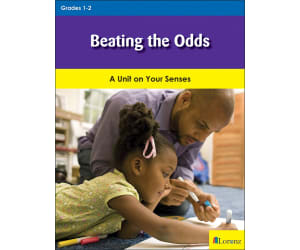
Beating the Odds: A Unit on Your Senses
Science, Life Sciences, Biology, Grade 1, 2, Teacher Tools, Lesson Plans
Beating the Odds: A Unit on Your Senses, is an engaging educational resource meticulously developed for educators seeking to explore the intriguing world of human senses with their maturing learners. Designed precisely to meet the learning requirements of grades 1 and 2, this all-inclusive unit intends to introduce biology as a significant sub-discipline within science. The resource comes as a convenient PDF file encapsulating seven systematically organized pages overflowing with enlightening content, including: A nonfiction article focused on Helen Keller Inspirational story showcasing her victory overcoming immense sensory difficulties. Carefully crafted worksheets providing extensive understanding beyond simple reading or lecture-based lessons. The Beating The Odds: A Unit On Your Senses can be utilized in divergent teaching scenarios such as: Solo-study assignments at home or in remote settings, Small group endeavors during classroom breakout sessions, Full-class instruction via whiteboard presentations or group discussions. This flexibility allows educators various options of incorporating it into their unique teaching strategies based on defined classroom dynamics and specific student needs. Cruising with modern-day academic necessities while honoring traditional values regarding quality and pertinence—"Beating The Odds: A Unit On Your Senses" readies teachers to enlighten young minds for future explorations today.
Author Classroom Complete Press
Tags Science, Senses, Helen Keller, Sign Language, Puzzles

Are Rainbows Real? Slideshow Mini-Lesson
Science, Earth and Environmental Sciences, Environmental Science, Grade 2, 3, 4, Teacher Tools, Lesson Plans
Are Rainbows Real? is an exploratory lesson that your students will love! ************************** Students get a chance to be introduced to terms such as white light and optical illusions as they analyze the question: Are rainbows real? They get the chance to show what they know through short answer questions and a matching activity that reveals a secret picture! ************************** This resource gives you both Color and Black/White options!
Author I Heart STEAM
Tags Rainbows, Optical Illusions, Science Lesson, Mystery Picture, Science Game
I WONDER - What Is Rewilding | Animated Video Lesson
Environmental Science, Earth and Environmental Sciences, Science, Earth Sciences, Geology, Grade 4, 5, 6, 7, 8, 9, 10, Lesson Plans, Teacher Tools
Video Introduction An amazing video designed for the students to learn more about STEM. I WONDER - What Is Rewilding | Animated Video Lesson Do you like STEM subjects? what is your favorite one? Have you ever tried to plant a seed? If yes, tell us more about it. Or have you ever tried to invent something? If yes, tell us more about it. And how do you think it will help us? Have you ever seen a microorganism under a microscope? What was it? And how it looked like? Mathematics is a marvelous subject. Let' sharpen our brains and solve some equations. Do you like timetable tricks? What is your favorite one? Do you know how to code? Have you ever created an app or a game before? If yes, how was it like? I WONDER - What Is Rewilding | Animated Video Lesson The video is perfect for encouraging the researching skills for the students, while learning more about this fantastic topic. I WONDER - What Is Rewilding | Animated Video Lesson This friendly designed video is suitable for students at school, homeschooling, and as a group activity. Format Available in MP4 format.
Author Educational Voice
Tags What Is Rewilding, What Is Rewilding Video, Rewilding, Rewilding Facts, Rewilding Facts For Kids, Rewilding Video, Rewilding Video For Kids, Environment, Environment Video, Environment Video For Kids

I WONDER - Was The Parasaurolophus A Herbivore | Animated Video Lesson
History: Ancient, History, Social Studies, History: World, Animals, Life Sciences, Science, Grade 4, 5, 6, 7, 8, 9, 10, Lesson Plans, Teacher Tools
Video Introduction An amazing video designed for the students to learn more about dinosaurs in different countries. I WONDER - Was The Parasaurolophus A Herbivore | Animated Video Lesson Do you like dinosaurs? what is your favorite one? Do you own a pet? If yes, tell us more about it, like what its name? And what do you like most about it? Do you think that your pet has been evolved from a dinosaur? Can you write down the characteristics of your favourite dinosaur like it's shape, their rivals, where did it use to live and what was their favourite food? What is the largest and the smallest dinosaur that ever found? Why is the T-rex is so famous? Have you ever read any interesting facts about it? Can you name any of the carnivores or herbivores dinosaurs? I WONDER - Was The Parasaurolophus A Herbivore | Animated Video Lesson The video is perfect for encouraging the researching skills for the students, while learning more about dinosaurs. I WONDER - Was The Parasaurolophus A Herbivore | Animated Video Lesson This friendly designed video is suitable for students at school, homeschooling, and as a group activity. Format Available in MP4 format.
Author Educational Voice
Rating
Tags Was The Parasaurolophus A Herbivore, Was The Parasaurolophus A Herbivore Video, Parasaurolophus, Parasaurolophus Video, Parasaurolophus Facts, Parasaurolophus Video For Kids, Parasaurolophus Facts For Kids
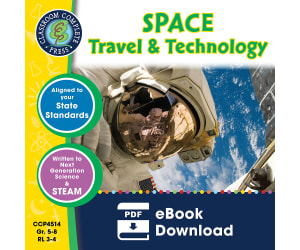
Space Travel & Technology Gr. 5-8
Science, Earth and Environmental Sciences, Space, Grade 5, 6, 7, 8, Teacher Tools, Lesson Plans
Space Travel & Technology Gr. 5-8 An exceptional teaching resource designed for science and astronomy curriculum enhancement aimed at students from Grades 5 through 8. Embark your students on a journey into the cosmos, picturing themselves as astronauts on a mission to the International Space Station (ISS). A comprehensive look at space exploration This hands-on resource provides valuable insights into the various roles in a space shuttle mission. Students get familiarized with powerful instruments like telescopes and their role in studying celestial bodies. Dive headfirst into interstellar missions Gaining invaluable knowledge about how spacecrafts function. Planning a hypothetical mission to Mars; assembling necessary items for the projected 2.5-year journey. Designing an innovative, real-world rover intended for planetary exploration, spurring creativity while fostering problem-solving skills. Lunar Studies and Beyond This educational tool dedicates interesting sections to lunar studies, celebrating humanity's greatest achievements like Apollo 11's moon landing. Moreover, it provides an exciting insight into life aboard the ISS and predictions of how everyday toys would operate in zero gravity! This dynamic teaching aid is adaptable across various classroom activities like group sessions or small cluster projects or even as challenging homework assignments! Tailored according to Next Generation State Standards and Blooms Taxonomy’s educational objectives along with STEAM initiatives ensures top-notch education centered around practical inquiry-based learning experiences. Your classrooms' connection to cosmos – Ignite curiosity, foster problem-solving skills and instill within future scientists a love for space science!! Build your scientific teaching toolkit today! Pedagogical strides beyond traditional textbook curriculum Hands-on experiments that promote experiential learning. Crossword puzzles aiming towards vocabulary building exercises thereby ensuring comprehensive learning and retention. Our PDF format ensures easy implementation and maintenance among educators, irrespective of their technical skills. Add Space Travel & Technology Gr. 5-8 – your key to the cosmos, to your educational resources today!
Author Classroom Complete Press
Tags PDF

I WONDER - What Animals Live In Swamps | Animated Video Lesson
STEM, Animals, Life Sciences, Science, Biology, Grade 1, 2, 3, 4, 5, 6, 7, 8, Lesson Plans, Teacher Tools
Video Introduction Animal kingdoms are full of fascinating wonders to learn. This video is designed for the students to learn more about animals in different countries. I WONDER - What Animals Live In Swamps | Animated Video Lesson Do you like animals? what is your favorite one? Do you own a pet? If yes, tell us more about it, like what its name? And what do you like most about it? What are the animal kingdoms? Can you write down the characteristics of each animal class like mammals, birds, reptiles, amphibian, fish and mollusks. Do you know that some animals can sing, can you name any of them? What is the largest and the smallest mammal in the world? What is the largest and the smallest bird in the world? What is the largest and the smallest fish in the world? I WONDER - What Animals Live In Swamps | Animated Video Lesson The video is perfect for encouraging the researching skills for the students, while learning more about these fantastic animals. I WONDER - What Animals Live In Swamps | Animated Video Lesson This friendly designed video is suitable for students at school, homeschooling, and as a group activity. Format Available in MP4 format.
Author Educational Voice
Tags What Animals Live In Swamps, What Animals Live In Swamps Video, Animals That Live In Swamps, Animals That Live In Swamps Facts, Animals That Live In Swamps Facts For Kids, Animals That Live In Swamps Video

I WONDER - Is The Universe Flat | Animated Video Lesson
Earth and Environmental Sciences, Science, Space, Grade 6, 7, 8, 9, 10, 11, 12, Lesson Plans, Teacher Tools
Video Introduction An amazing video designed for the students to learn more about space facts. I WONDER - Is The Universe Flat | Animated Video Lesson Do you like reading about space? If yes, what is your favorite topic? What do you know about our solar system? What is the smallest planet in our solar system? What is the biggest planet in our solar system? What is the hottest planet in our solar system? And what is the coldest one? Do you think there are aliens? If yes, what do you think they look like? What do they eat and how they speak to each other? Where do they live? What is a galaxy? And what is a milky way? Have you recently saw a shooting star? If yes, tell us more about it, like when did it happen and where? What is a blackhole? Can a blackhole gets bigger by time? Do you like counting the stars? What do you think a star is made of? I WONDER - Is The Universe Flat | Animated Video Lesson The video is perfect for encouraging the researching skills for the students, while learning more about the fantastic space. I WONDER - Is The Universe Flat | Animated Video Lesson This friendly designed video is suitable for students at school, homeschooling, and as a group activity. Format Available in MP4 format.
Author Educational Voice
Tags Is The Universe Flat, Is The Universe Flat Video, The Universe, The Universe Facts, The Universe Facts For Kids, The Universe Video, The Universe Video For Kids, Space, Space Facts, Space Video

I WONDER - Why Are Proteins Important In Our Diet | Animated Video
Human Body, Life Sciences, Science, Biology, STEM, Grade 3, 4, 5, 6, 7, 8, Lesson Plans, Teacher Tools
Video Overview The human body is full of fascinating wonders to learn. This video is created to help the students recognize the anatomy and the job of the human body. I WONDER - Why Are Proteins Important In Our Diet | Animated Video Lesson Every part and organ in our human body is vital so let's see how important they are. Have you ever imagined how we look like if we didn't have a skeleton? Did you know that because we have our amazing muscles we can stand! Do you know how many teeth do we have? Have you ever wondered about the food journey inside our body? Can you name all the glands in our body? Why do we have skin? Our nervous system is really good at sending signals. Can you tell us more about it? Are you really good at Mathematics, painting, or any other thing? You should really thank your brain about it! The famous five senses are really doing a great work? Can you explain how every sense works? I WONDER - Why Are Proteins Important In Our Diet | Animated Video Lesson The video is perfect for encouraging the researching skills for the students, while learning more about our fantastic human body. I WONDER - Why Are Proteins Important In Our Diet | Animated Video Lesson This friendly designed video is suitable for students at school, homeschooling, and as a group activity. Format Available in MP4 format.
Author Educational Voice
Tags Why Are Proteins Important In Our Diet, Why Are Proteins Important In Our Diet Video, Proteins, Protein, Proteins Facts, Proteins Facts For Kids, Proteins Video, Proteins Video For Kids

I WONDER - How Many Times Do We Blink In One Day | Animated Video
Human Body, Life Sciences, Science, Biology, STEM, Grade 1, 2, 3, 4, 5, 6, 7, 8, Lesson Plans, Teacher Tools
Video Overview The human body is full of fascinating wonders to learn. This video is created to help the students recognize the anatomy and the job of the human body. I WONDER - How Many Times Do We Blink In One Day | Animated Video Lesson Every part and organ in our human body is vital so let's see how important they are. Have you ever imagined how we look like if we didn't have a skeleton? Did you know that because we have our amazing muscles we can stand! Do you know how many teeth do we have? Have you ever wondered about the food journey inside our body? Can you name all the glands in our body? Why do we have skin? Our nervous system is really good at sending signals. Can you tell us more about it? Are you really good at Mathematics, painting, or any other thing? You should really thank your brain about it! The famous five senses are really doing a great work? Can you explain how every sense works? I WONDER - How Many Times Do We Blink In One Day | Animated Video Lesson The video is perfect for encouraging the researching skills for the students, while learning more about our fantastic human body. I WONDER - How Many Times Do We Blink In One Day | Animated Video Lesson This friendly designed video is suitable for students at school, homeschooling, and as a group activity. Format Available in MP4 format.
Author Educational Voice
Tags How Many Times Do We Blink In One Day, How Many Times Do We Blink In One Day Video, Blink, Blinking, Blinking Facts, Blinking Facts For Kids, Blinking Video, Blinking Video Facts For Kids
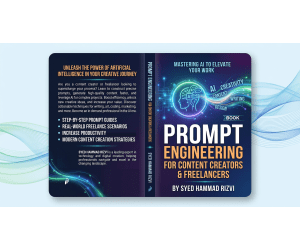
Prompt Engineering for Content Creators & Freelancers Book
Science, Technology, Computer Science, Engineering, Resources for Teachers, Classroom Management, Research, Basic Science, Special Resources, Special Education Needs (SEN), Homeschool Curriculum, Homeschool Templates, Grade 9, 10, 11, 12, Projects, Activities, Experiments, Labs, Teacher Tools, Lesson Plans, Presentations, Assessments, Workbooks, Worksheets & Printables
Utilize AI to its largest extent while becoming a successful content creation business with the Ultimate Guide to Prompt Engineering. This book has been designed specifically for freelancers, digital entrepreneurs, and business service providers aged from twenty-two up through forty. By leveraging AI tools such as ChatGPT, Claude, and Gemini, you will learn how to increase your output by ten times; decrease content creation time by as much as sixty percent; and establish a sustainable, scalable income by creating engaging, informative content that drives traffic to your site. You will learn how to apply the Six-Component Framework for developing flawless prompts, as well as several advanced techniques (attributed to Steve Bidstrup) that allow a creator to express their brand's voice (Chain of Thought and Few-Shot) to produce business-specific content (Twitter/X, YouTube Channel, LinkedIn Page, Instagram Account, Email Newsletter) using case study examples illustrating how content creators such as Sarah and Marcus accomplished their respective businesses by utilizing the techniques contained within this book, while also reducing the total amount of hours worked per week by three. In addition, you will receive a complete thirty-day implementation guide; prompt templates that can be reused; and an ethics guide that will assist in the preservation of your current skill set. If your business model includes selling content services, a newsletter, and managing multiple social channels, then this guide will provide you with an unfair advantage in the modern AI-powered creation economy. You will no longer be required to wrestle with one-size-fits-all AI-generated materials; rather, you will engineer materials that drive commitment, conversion, and cash. Noteworthy Characteristics: The Reliable Six-Component Prompting System To Create Professional Grade AI Results. Site-Specific Prompting Formats and Guidelines for Most Major Platforms such as Twitter, Linked_in, Youtube, Instagram, And Email. Chain Of Thought And Few Shot Methods To Match Your “Real Voice” Exactly. A Full 30 Day Plan For Implementing Once You Have Laid Your Foundations -- To Finally Become Masterful At Using AI. Turnkey Productivity Systems that Will Give You Back 15-20 Hours A Week To Do Core Tasks. Monetization Strategies For Freelancers to Help Scale Their Service Offerings And Prevent From Getting Burned Out. An Ethics System Which Includes A Checklist For Quality Gatekeeping, So You Can Maintain Trust And Credibility As An AI User. Parents/Schools Appreciate It Because: Future-Proofed Career Skills. Students get hands-on experience communicating using AI, an in-demand skill regardless of career path, with a 30-day strategy to turn theoretical knowledge into applicable real-world knowledge through practical experience. Promoting the Ethical Use of AI. This book teaches the ethical and transparent use of AI via its dedicated chapter to ethics and quality gate systems, which enable students to avoid absences and misinformation, eliminate diluted voices, and understand how to leverage AI responsibly. Saving Time for Educators. This book contains pre-prompted library & system tools for educational institutions to utilize as time-savings in lesson plan creation while also modeling how to use AI to create an efficient workflow. Supporting Multidisciplinary & Cross-Curricular Learning. The content relates to English, business, technology, and media classes, representing an adaptable resource to support project-based learning and cross-curricular integration opportunities. Enhancing School Program Engagement and Revenue. It includes a strong emphasis on monetization and scaling of freelance businesses, resulting in veritable economic impact on career-tech programs, providing attractiveness for parents and school districts concerned with job placement readiness. Determine Which Students/Classrooms Are Targeted : This book is written with a professional audience in mind (22-40 yrs old), so your focus should be on post-secondary and professional development settings. Ideal audiences would be: Corporations and Universities Offering Courses in Digital Marketing, Media Creation, Journalism, Communications, Entrepreneurship and Business– Can be Contributed To As Either Textbook Or Suggested Reading For Any Course Of Study Related to Digital Strategy, Applications of AI in Business and/or Online Monetization Of Content. Vocational Training Certificates in Freelance Writing, Social Media Management, Digital Entrepreneurship and AI Literacy. Professional Development Workshops For Freelancers, Marketing Teams, Business Owners Who Want To Improve Their Skill Sets. High School Electives (Grades 11-12) Involved with Media Studies, Tech, Business or Career Readiness –Content Is Constructed Accessible With An Older Teenager Mindset(Preparing For The Digital Workforce). Use This Resource As An Add-On To Your Career Readiness Curriculums Provided By Business/Tech Teachers To High Schools Or As A PD Tool To Educators Who Want To Leverage AI In Their Content Creation. This book is written and published by Syed Hammad Rizvi, with exclusive copyright. This book can only be used individually (by one person) and in a class (by one class), and you cannot make any changes or distribute this book; that is, you cannot put the book on the internet or make it accessible. In order for you to share this book with your coworkers means you need to buy additional licenses to be able to share or give your coworkers. I want to express my sincere thanks to you for adhering to these guidelines of use as I truly appreciate you doing so. This product is made available to you through Syed Hammad Rizvi.
Author Creative Book Store
Rating
Tags PromptEngineering, AIContentCreation, ContentCreator, FreelancerLife, AItools, ChatGPT, ClaudeAI, DigitalProduct, CreatorEconomy, ContentMarketing

I WONDER - What Did The Compsognathus Eat | Animated Video Lesson
History: Ancient, History, Social Studies, History: World, Animals, Life Sciences, Science, Grade 4, 5, 6, 7, 8, 9, 10, Lesson Plans, Teacher Tools
Video Introduction An amazing video designed for the students to learn more about dinosaurs in different countries. I WONDER - What Did The Compsognathus Eat | Animated Video Lesson Do you like dinosaurs? what is your favorite one? Do you own a pet? If yes, tell us more about it, like what its name? And what do you like most about it? Do you think that your pet has been evolved from a dinosaur? Can you write down the characteristics of your favourite dinosaur like it's shape, their rivals, where did it use to live and what was their favourite food? What is the largest and the smallest dinosaur that ever found? Why is the T-rex is so famous? Have you ever read any interesting facts about it? Can you name any of the carnivores or herbivores dinosaurs? I WONDER - What Did The Compsognathus Eat | Animated Video Lesson The video is perfect for encouraging the researching skills for the students, while learning more about dinosaurs. I WONDER - What Did The Compsognathus Eat | Animated Video Lesson This friendly designed video is suitable for students at school, homeschooling, and as a group activity. Format Available in MP4 format.
Author Educational Voice
Rating
Tags What Did The Compsognathus Eat, What Did The Compsognathus Eat Video, Compsognathus, Compsognathus Facts, Compsognathus Video, Compsognathus Facts For Kids, Compsognathus Video For Kids
Cells,Skeletal & Muscular Systems: The Muscular System - Movement - FLASH-PC
Science, Life Sciences, Human Body, Common Core, Grade 5, 6, 7, 8, Teacher Tools, Lesson Plans
Introducing Cells, Skeletal, & Muscular Systems: The Muscular System - Movement - FLASH-PC A comprehensive teaching resource specifically designed to enhance understanding of Muscle Movement across Cells, Skeletal & Muscular Systems. This product caters to students between grades 5 and 8 with a focus on the Science subject and Human Body subtopic. Curriculum -based Content Included is a robust collection of curriculum -based content comprising of: Reading Passages: Each accompanied by 'Before you Read' questions and 'After you Read' queries aiding comprehension and knowledge absorption about Muscle Movement within Cells, Skeletal & Muscular Systems. Interactive Activities:Puzzles and games that allow learners opportunities for practical application of new knowledge in a fun-filled approach. Auxiliary Resources:Vocabulary flash cards for quick reviews, printable exercises for reinforcement or homework assignments meeting myriad needs from whole group lessons to small group sessions. Bloom's Taxonomy compliance: Encouraging higher-order thinking skills by comprehensively addressing tasks ranging from recalling facts through analyzing issues until creating solutions. Common Core State Standards adherence: Guaranteeing quality education aligned with recognized benchmarks. In Summary... This integrative product equips educators with multiple avenues ensuring optimal learner engagement at understanding Muscle Movement from a Cells, Skeletal & Muscular Systems viewpoint thus ideal for both classroom lessons or engaging homework assignments. </P
Author Classroom Complete Press
Tags Software (PC)
I WONDER - Where Did Hamsters Get Their Name | Animated Video Lesson
STEM, Biology, Life Sciences, Science, Animals, Grade 1, 2, 3, 4, 5, 6, 7, 8, Lesson Plans, Teacher Tools
Video Introduction Animal kingdoms are full of fascinating wonders to learn. This video is designed for the students to learn more about animals in different countries. I WONDER - Where Did Hamsters Get Their Name | Animated Video Lesson Do you like animals? what is your favorite one? Do you own a pet? If yes, tell us more about it, like what its name? And what do you like most about it? What are the animal kingdoms? Can you write down the characteristics of each animal class like mammals, birds, reptiles, amphibian, fish and mollusks. Do you know that some animals can sing, can you name any of them? What is the largest and the smallest mammal in the world? What is the largest and the smallest bird in the world? What is the largest and the smallest fish in the world? I WONDER - Where Did Hamsters Get Their Name | Animated Video Lesson The video is perfect for encouraging the researching skills for the students, while learning more about these fantastic animals. I WONDER - Where Did Hamsters Get Their Name | Animated Video Lesson This friendly designed video is suitable for students at school, homeschooling, and as a group activity. Format Available in MP4 format.
Author Educational Voice
Tags Where Did Hamsters Get Their Name, Where Did Hamsters Get Their Name Video, Hamsters, Hamster, Hamsters Facts, Hamsters Facts For Kids, Hamsters Video, Hamsters Video For Kids

Unique Oceans | Animated Ocean Video Lesson
Science, Earth and Environmental Sciences, Earth Sciences, Not Grade Specific, Lesson Plans, Teacher Tools
Unique Oceans | Animated Ocean Video Lesson Transport students into an underwater world with this 14-minute animated video that explores the uniqueness of Earth's oceans. Through captivating visuals and informative narration, learners dive deep to discover how oceans differ in location, plant and animal life, weather, and more. Educators can utilize this engaging science lesson to introduce or review key ocean concepts with individuals, small groups, or the entire class. By sparking curiosity about the planet's watery realms, this video aims to inspire students' appreciation for the diversity and interconnectedness of ocean ecosystems across the globe. With vivid imagery and compelling storytelling, it promises to hold students' attention while building their knowledge about the precious resource oceans provide.
Author Educational Voice
Tags Arctic Oceans, Science Lesson, Earth, Science Video, Polar Bears
I WONDER - What Job Does The Ozone Layer Do | Animated Video Lesson
Earth Sciences, Earth and Environmental Sciences, Science, Environmental Science, Grade 1, 5, 6, 7, 8, 9, 10, Lesson Plans, Teacher Tools
Video Introduction An amazing video designed for the students to learn more about famous places in different countries. I WONDER - What Job Does The Ozone Layer Do | Animated Video Lesson What do you know about this place? Do you know in which part of the world it is? Have you ever visited this place? If yes, can you tell us more about your adventure, and what do you like the most about this place? Do you like reading about Geography? What is your favorite country in the whole world? If you are going on a trip where it will be? Which country? What you are going to see there? Does this country has a famous place to visit? I WONDER - What Job Does The Ozone Layer Do | Animated Video Lesson The activity is perfect for encouraging the researching skills for the students, while learning more about this fantastic place. I WONDER - What Job Does The Ozone Layer Do | Animated Video Lesson This friendly designed video is suitable for students at school, homeschooling, and as a group activity. Format Available in MP4 format.
Author Educational Voice
Tags What Job Does The Ozone Layer Do, What Job Does The Ozone Layer Do Video, The Ozone Layer, The Ozone Layer Facts, The Ozone Layer Facts For Kids, The Ozone Layer Video, The Ozone Layer Video For Kids

I WONDER - What Do Penguins Eat In The Really Cold Weather
STEM, Animals, Life Sciences, Science, Biology, Grade 1, 2, 3, 4, 5, 6, 7, 8, Lesson Plans, Teacher Tools
Video Introduction Animal kingdoms are full of fascinating wonders to learn. This video is designed for the students to learn more about animals in different countries. I WONDER - What Do Penguins Eat In The Really Cold Weather | Animated Video Lesson Do you like animals? what is your favorite one? Do you own a pet? If yes, tell us more about it, like what its name? And what do you like most about it? What are the animal kingdoms? Can you write down the characteristics of each animal class like mammals, birds, reptiles, amphibian, fish and mollusks. Do you know that some animals can sing, can you name any of them? What is the largest and the smallest mammal in the world? What is the largest and the smallest bird in the world? What is the largest and the smallest fish in the world? I WONDER - What Do Penguins Eat In The Really Cold Weather | Animated Video Lesson The video is perfect for encouraging the researching skills for the students, while learning more about these fantastic animals. I WONDER - What Do Penguins Eat In The Really Cold Weather | Animated Video Lesson This friendly designed video is suitable for students at school, homeschooling, and as a group activity. Format Available in MP4 format.
Author Educational Voice
Tags Penguins, Penguin, What Do Penguins Eat In The Really Cold Weather, What Do Penguins Eat In The Really Cold Weather Video, Penguins Food, Penguins Food Facts, Penguins Facts For Kids, Penguins Video

I WONDER - Does My Brain Control My Lungs | Animated Video Lesson
Life Sciences, Science, Human Body, Biology, STEM, Grade 3, 4, 5, 6, 7, 8, 9, Lesson Plans, Teacher Tools
Video Overview The human body is full of fascinating wonders to learn. This video is created to help the students recognize the anatomy and the job of the human body. I WONDER - Does My Brain Control My Lungs | Animated Video Lesson Every part and organ in our human body is vital so let's see how important they are. Have you ever imagined how we look like if we didn't have a skeleton? Did you know that because we have our amazing muscles we can stand! Do you know how many teeth do we have? Have you ever wondered about the food journey inside our body? Can you name all the glands in our body? Why do we have skin? Our nervous system is really good at sending signals. Can you tell us more about it? Are you really good at Mathematics, painting, or any other thing? You should really thank your brain about it! The famous five senses are really doing a great work? Can you explain how every sense works? I WONDER - Does My Brain Control My Lungs | Animated Video Lesson The video is perfect for encouraging the researching skills for the students, while learning more about our fantastic human body. I WONDER - Does My Brain Control My Lungs | Animated Video Lesson This friendly designed video is suitable for students at school, homeschooling, and as a group activity. Format Available in MP4 format.
Author Educational Voice
Tags Does My Brain Control My Lungs, Does My Brain Control My Lungs Video, Lungs, Lung, Lungs Facts, Lungs Facts For Kids, Lungs Video, Lungs Video For Kids, Brain, Brain Facts
I WONDER - What Can We Learn From Studying Solar Winds
Space, Earth and Environmental Sciences, Science, Grade 6, 7, 8, 9, 10, 11, 12, Lesson Plans, Teacher Tools
Video Introduction An amazing video designed for the students to learn more about space facts. I WONDER - What Can We Learn From Studying Solar Winds | Animated Video Lesson Do you like reading about space? If yes, what is your favorite topic? What do you know about our solar system? What is the smallest planet in our solar system? What is the biggest planet in our solar system? What is the hottest planet in our solar system? And what is the coldest one? Do you think there are aliens? If yes, what do you think they look like? What do they eat and how they speak to each other? Where do they live? What is a galaxy? And what is a milky way? Have you recently saw a shooting star? If yes, tell us more about it, like when did it happen and where? What is a blackhole? Can a blackhole gets bigger by time? Do you like counting the stars? What do you think a star is made of? I WONDER - What Can We Learn From Studying Solar Winds | Animated Video Lesson The video is perfect for encouraging the researching skills for the students, while learning more about the fantastic space. I WONDER - What Can We Learn From Studying Solar Winds | Animated Video Lesson This friendly designed video is suitable for students at school, homeschooling, and as a group activity. Format Available in MP4 format.
Author Educational Voice
Tags What Can We Learn From Studying Solar Winds, What Can We Learn From Studying Solar Winds Video, Solar Winds, Solar Wind, Solar Winds Facts, Solar Winds Facts For Kids, Solar Winds Video, Solar Winds Video For Kids