



3,885 products added recently
Page 63 - Science Lesson Plan Template
Enhance your science instruction with a flexible lesson plan template designed for educators. This tool helps you structure objectives, materials, procedures, and assessments efficiently. Use it to create organized and impactful science lessons that cater to your students' needs.

 Show filters

I WONDER - What Is Nuclear Energy | Animated Video Lesson
Physics, Science, STEM, Grade 6, 7, 8, 9, 10, 11, 12, Lesson Plans, Teacher Tools
Video Introduction An amazing video designed for the students to learn more about STEM. I WONDER - What Is Nuclear Energy | Animated Video Lesson Do you like STEM subjects? what is your favorite one? Have you ever tried to plant a seed? If yes, tell us more about it. Or have you ever tried to invent something? If yes, tell us more about it. And how do you think it will help us? Have you ever seen a microorganism under a microscope? What was it? And how it looked like? Mathematics is a marvelous subject. Let' sharpen our brains and solve some equations. Do you like timetable tricks? What is your favorite one? Do you know how to code? Have you ever created an app or a game before? If yes, how was it like? I WONDER - What Is Nuclear Energy | Animated Video Lesson The video is perfect for encouraging the researching skills for the students, while learning more about this fantastic topic. I WONDER - What Is Nuclear Energy | Animated Video Lesson This friendly designed video is suitable for students at school, homeschooling, and as a group activity. Format Available in MP4 format.
Author Educational Voice
Tags What Is Nuclear Energy, What Is Nuclear Energy Video, Nuclear Energy, Nuclear Energy Facts, Nuclear Energy Facts For Kids, Nuclear Energy Video, Nuclear Energy Video For Kids, Energy, Energy Video

I WONDER - How Scientists Figure Out What Dinosaurs Ate
History: Ancient, History, Social Studies, History: World, Animals, Life Sciences, Science, Grade 6, 7, 8, 9, 10, 11, 12, Lesson Plans, Teacher Tools
Video Introduction An amazing video designed for the students to learn more about dinosaurs in different countries. I WONDER - How Scientists Figure Out What Dinosaurs Ate | Animated Video Lesson Do you like dinosaurs? what is your favorite one? Do you own a pet? If yes, tell us more about it, like what its name? And what do you like most about it? Do you think that your pet has been evolved from a dinosaur? Can you write down the characteristics of your favourite dinosaur like it's shape, their rivals, where did it use to live and what was their favourite food? What is the largest and the smallest dinosaur that ever found? Why is the T-rex is so famous? Have you ever read any interesting facts about it? Can you name any of the carnivores or herbivores dinosaurs? I WONDER - How Scientists Figure Out What Dinosaurs Ate | Animated Video Lesson The video is perfect for encouraging the researching skills for the students, while learning more about dinosaurs. I WONDER - How Scientists Figure Out What Dinosaurs Ate | Animated Video Lesson This friendly designed video is suitable for students at school, homeschooling, and as a group activity. Format Available in MP4 format.
Author Educational Voice
Rating
Tags How Scientists Figure Out What Dinosaurs Ate, How Scientists Figure Out What Dinosaurs Ate Video, Dinosaurs, Dinosaurs Facts, Dinosaurs Video, Dinosaurs Video For Kids, Dinosaurs Facts For Kids

I WONDER - Where Did The Quetzalcoatlus Lay Its Eggs | Animated Video
Animals, Life Sciences, Science, History: Ancient, History, Social Studies, History: World, Grade 4, 5, 6, 7, 8, 9, 10, Lesson Plans, Teacher Tools
Video Introduction An amazing video designed for the students to learn more about dinosaurs in different countries. I WONDER - Where Did The Quetzalcoatlus Lay Its Eggs | Animated Video Lesson Do you like dinosaurs? what is your favorite one? Do you own a pet? If yes, tell us more about it, like what its name? And what do you like most about it? Do you think that your pet has been evolved from a dinosaur? Can you write down the characteristics of your favourite dinosaur like it's shape, their rivals, where did it use to live and what was their favourite food? What is the largest and the smallest dinosaur that ever found? Why is the T-rex is so famous? Have you ever read any interesting facts about it? Can you name any of the carnivores or herbivores dinosaurs? I WONDER - Where Did The Quetzalcoatlus Lay Its Eggs | Animated Video Lesson The video is perfect for encouraging the researching skills for the students, while learning more about dinosaurs. I WONDER - Where Did The Quetzalcoatlus Lay Its Eggs | Animated Video Lesson This friendly designed video is suitable for students at school, homeschooling, and as a group activity. Format Available in MP4 format.
Author Educational Voice
Rating
Tags Where Did The Quetzalcoatlus Lay Its Eggs, Where Did The Quetzalcoatlus Lay Its Eggs Video, Quetzalcoatlus, Quetzalcoatlus Facts, Quetzalcoatlus Video, Quetzalcoatlus Video For Kids, Quetzalcoatlus Facts For Kids
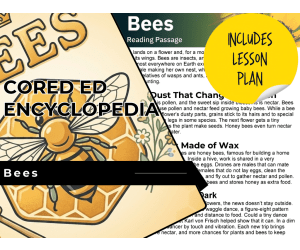
Bees Reading Comprehension Passage - Cored Ed Encyclopedia
ELA, Language Development, Reading Comprehension, Reading, Writing, Pre-Reading, Science, Insects, Life Sciences, Vocabulary, Grade 2, 3, 4, 5, Worksheets & Printables, Worksheets, Teacher Tools, Centers, Activities, Writing Prompts, Assessments, Quizzes and Tests, Quizzes, Lesson Plans
This bees reading comprehension with lesson plan includes: Visualization (on the front cover) Start your lesson by taking a minute to think and share something about the topic. Read the script aloud (slowly), perhaps prepare some music or sound effects. Student close their eyes and let their imaginations wander. Students open their eyes, read the question aloud and give them a few minutes to complete. Ask a few students to share or keep answers until the end to compare with what they learn in the passage. Quick pause—thousands of Cored Education products are included with your TeachSimple membership. Download links and encyclopedia index available here. Pre-Reading Trivia Students will write down one thing they already know about the subject and then read five more facts and discuss. These facts are fun, and the students will enjoy learning about the subject before reading more. Give 1 minute for students to write what they already know (no pressure—best guess is fine). Read the five facts together. After each fact, do ask a student for their opinion, was it surprising? Set a purpose by asking students to highlight/underline one fact they want to learn more about during the reading. Reading Passage The text is a high-interest reading passage with set paragraphs, roughly three to four paragraphs long. It contains a variety of themes about the topic, anywhere from history to technology. The passage is between 250 and 350 words in length. First, ask students to look at the headings and see what they’ll learn about today. What do they know about the topic/heading? First read options: Teacher read-aloud (best for support). Partner reading (paragraph by paragraph). While reading, students underline important details, and vocabulary words they think may come up in the questions section. Mixed Questions The first question page contains four multiple-choice questions, each with a choice of four answers, and three written response questions that require a sentence or two from the student. Students complete the mcqs first independently, then review quickly as a class. For the 3 written responses, try to get students giving the answer with some form of evidence: “I think ___ because the text says ___.” If students get stuck, send them back to check the passage. Vocabulary Questions Practice seven key words from the text in this section across two activities. First section is scrambled words where students will unscramble three words given a clue for each. The second section is a word to meaning matching activity. Before starting, have some students read out words they underlined in the passage. Ask students to say the word and read aloud the sentence(s) around each word. Ask students to do scrambled words and the matching exercise in pairs then go through answers as a class. For the scrambled spelling task, get four pairs to come up to the board and write the words for extra practice with the other student reading out the clue. For the matching task, prompt students to give full sentences: “I matched ___ with ___ because ___.” Creative Writing In this question, the student will be required to write a five to eight sentence paragraph on a question related to the topic. Before starting, ask students write down 3 key ideas they are going to include in their piece. Ask students for ideas to share around the class to help those struggling. Pro writing expectations: 5–8 sentences At least 2 facts or details from the passage At least 2 vocabulary words from the previous page Students read their paragraphs while classmates listen for facts and vocabulary words. Extension Activities This page is optional for fast finishers or to take home. There are several activities, each one requiring a different skill. Do some, do none, do all, completely optional - but you will feel reassured knowing every possibility is planned for. Includes summary writting question and additional facts. Answer Key There are answers for the multiple-choice questions, written response questions have sample answers, vocabulary answers and if there is a summary question then a sample summary will be provided as well. Lesson Plan Included Customized lesson plan for this lesson is included. Lesson Snapshot Title: Bees Genre: Nonfiction (informational passage) Subject: Life Science Primary Topic: Pollination, hive roles, and waggle-dance communication Estimated Guided Reading Level (A–Z): S What This Lesson Teaches Best Bees as insects with many kinds (more than 20,000) living almost everywhere on Earth except **Antarctica. How bees help plants make seeds by moving pollen from flower to flower while gathering nectar and pollen for baby bees. How honey bees live in organized hives with shared jobs (queen, drones, and worker bees doing specific tasks). How honey bees turn nectar into honey and store it for later as extra food. How the waggle dance can share direction and distance to food, supported by the work of Karl von Frisch. Learning Goals Describe where bees live and how many kinds the passage says there are. Explain how pollen gets from one flower to another in the passage. Identify what pollen and nectar do for growing baby bees. Describe how jobs are shared in a honey bee hive, including the queen, drones, and workers. Explain what the waggle dance communicates and how other bees follow it in a dim hive. Describe how honey is made and stored, using details from the passage. Key Vocabulary From the Text pollen — yellow dust that helps plants make seeds. nectar — sweet liquid inside blossoms. colony — a group of bees living together. larvae — baby insects before they become adults. vibration — shaking that can be felt as movement. FULL CATALOG OF DOWNLOAD LINKS AND ENCYCLOPEDIA INDEX HERE
Author Cored Education
Rating
Tags Vocabulary, Reading Comprehension, Reading Passages, Lesson Plans, Ela Lesson Plans, Reading Comprehension Lesson Plans, Pre-reading, Science Lesson Plans, Life Science, Insects

Plants as Food | Animated Plants Video Lesson
Science, Life Sciences, Nature & Plants, Not Grade Specific, Lesson Plans, Teacher Tools
Plants as Food - Animated Video Lesson for Science This 8-minute animated video serves as an engaging introduction or review lesson about plants as food sources. Students will enjoy watching the interactive animations explaining how plants produce fruits, vegetables, grains and more that humans and animals eat. Educators can use this video in various ways - show it to the whole class to introduce a plants or nutrition unit, have students watch it in small groups and complete a worksheet, or assign it as a supplemental video to reinforce the concepts at home. The vivid visuals and clear narration make this an accessible resource for learners of all levels to better understand the vital role plants play in human and ecosystem food chains.
Author Educational Voice
Tags Plants, Food, Botany, Animated Video, Science Video
I WONDER - How Big Are Wind Farms | Animated Video Lesson
Environmental Science, Earth and Environmental Sciences, Science, Earth Sciences, Grade 4, 5, 6, 7, 8, 9, 10, Lesson Plans, Teacher Tools
Video Introduction An amazing video designed for the students to learn more about STEM. I WONDER - How Big Are Wind Farms | Animated Video Lesson Do you like STEM subjects? what is your favorite one? Have you ever tried to plant a seed? If yes, tell us more about it. Or have you ever tried to invent something? If yes, tell us more about it. And how do you think it will help us? Have you ever seen a microorganism under a microscope? What was it? And how it looked like? Mathematics is a marvelous subject. Let' sharpen our brains and solve some equations. Do you like timetable tricks? What is your favorite one? Do you know how to code? Have you ever created an app or a game before? If yes, how was it like? I WONDER - How Big Are Wind Farms | Animated Video Lesson The video is perfect for encouraging the researching skills for the students, while learning more about this fantastic topic. I WONDER - How Big Are Wind Farms | Animated Video Lesson This friendly designed video is suitable for students at school, homeschooling, and as a group activity. Format Available in MP4 format.
Author Educational Voice
Tags How Big Are Wind Farms, How Big Are Wind Farms Video, Wind Farms, Wind Farm, Wind Farms Facts, Wind Farms Facts For Kids, Wind Farms Video, Wind Farms Video For Kids

Beyond the Jack-o'-Lantern Reading Passage and Q & A
ELA, Reading, Writing, Holiday & Seasonal, Resources for Teachers, Science, Life Sciences, Biology, High School, Homeschool Resources, Teacher Tools, Assessments, Lesson Plans, Quizzes and Tests, Worksheets & Printables, Writing Prompts
You know how it is as a homeschool mom - you are constantly on the hunt for something that will actually grab your teenager's attention for more than five minutes! Well, Beyond the Jack-o'-Lantern: The Biology and Culture of Pumpkins totally surprised me. I thought it might be just another fall-themed busy work packet, but wow, was I wrong. INCLUDED IN THIS RESOURCE: A detailed, multi-paragraph reading passage exploring pumpkin biology, history, culture, and nutrition. 20 higher-order thinking questions with an accompanying answer key for guided support. Printable note-taking and graphic organizer sheets to strengthen comprehension and study skills. Teacher-friendly design with easy-to-use formatting for both classroom and homeschool environments. TOPICS COVERED: Plant biology, anatomy, and the growth cycle of pumpkins. Ecological interdependence with pollinators and sustainable agriculture. Historical and cultural significance of pumpkins across societies. Nutritional benefits and interdisciplinary applications in STEAM education. My daughter picked this up thinking she'd breeze through some pumpkin facts, and before I knew it, she was down this rabbit hole learning about plant biology, cultural traditions, and agricultural history. She did not even complain once! (Trust me, that is saying something with a 9th grader.) What I love is that she has no clue she's doing this fancy "cross-curricular" learning - she is just genuinely fascinated. And can I just say how nice it is when a resource does not require me to spend hours figuring out how to teach it? Everything flows so naturally from one topic to the next. The other day she came to me with this question about how pumpkins spread to different continents, and I am thinking, "When did my kid start caring about agricultural migration patterns?" It is these moments that remind me exactly why we chose to homeschool. Taking something as ordinary as a pumpkin sitting on our porch and turning it into this amazing learning adventure - that is the good stuff right there. Sometimes the best lessons come from the most unexpected places! If you and your students/homeschoolers enjoyed this resource, please leave a review. Thank you for your support! Tina - Big Easy Homeschooling Mom
Author Homeschool with Big Easy Homeschooling Mom
Rating
Tags Pumpkin Biology, Pumpkin Culture, Homeschool Science Resource, High School Pumpkin Lesson, History Of Pumpkins, High School ELA Science Unit, Pumpkins In History And Culture, Cultural Traditions Pumpkins, Interdisciplinary Pumpkin Unit, Cross-curricular Pumpkin Unit

All About Skeleton Facts | Human Body Video Lesson
Science, Life Sciences, Human Body, Not Grade Specific, Lesson Plans, Teacher Tools
All About Skeleton Facts | Human Body Video Lesson This educational resource is a perfect blend of curiosity and fascination specially designed for science enthusiasts. It aims to provide an intriguing subject on human skeletal anatomy, making it useful for all educators either in a public school setting or homeschooling. Core Content The main part of this resource is a 4-minute video lesson that intricately explores different aspects about the skeleton. This human body video lesson makes teaching children about skeleton facts easy with its perfect blend of information and engagement. Innovative Teaching Tool This teaching tool promotes visual learning using dynamic graphics that help students visualize complex concepts easily. Ideal for integrating into existing curriculum during class time or as after-class review material at home. The format used is MP4 which ensures compatibility across myriad devices; be it personal computers, tablets, or smartphones. This proves beneficial for teachers keen on utilizing digital platforms for enhanced student learning. Versatility & Focus This resource while not grade-specific is carefully constructed to fit comfortably within Science subjects aimed specifically at introducing students to human anatomy. The primary focus remains strongly tethered towards guiding learners through intriguing details about the Human Body - its sub-subject. In essence, the All About Skeleton Facts | Human Body Video Lesson isn't just another teaching resource - it’s an experience that empowers educators by aiding them clarify one of nature's most intricate structures eagerly waiting to be discovered by eager young minds.
Author Educational Voice
Tags Skeleton Facts, Human Body, Video Lesson, Anatomy, Educational Resource
I WONDER - What Is AI | Animated Video Lesson
STEM, Computer Science, Technology, Science, Grade 2, 3, 4, 5, 6, 7, 8, Lesson Plans, Teacher Tools
Video Introduction An amazing video designed for the students to learn more about STEM. I WONDER - What Is AI | Animated Video Lesson Do you like STEM subjects? what is your favorite one? Have you ever tried to plant a seed? If yes, tell us more about it. Or have you ever tried to invent something? If yes, tell us more about it. And how do you think it will help us? Have you ever seen a microorganism under a microscope? What was it? And how it looked like? Mathematics is a marvelous subject. Let' sharpen our brains and solve some equations. Do you like timetable tricks? What is your favorite one? Do you know how to code? Have you ever created an app or a game before? If yes, how was it like? I WONDER - What Is AI | Animated Video Lesson The video is perfect for encouraging the researching skills for the students, while learning more about this fantastic topic. I WONDER - What Is AI | Animated Video Lesson This friendly designed video is suitable for students at school, homeschooling, and as a group activity. Format Available in MP4 format.
Author Educational Voice
Tags What Is AI, What Is AI Video, Artificial Intelligence , AI Facts, AI Facts For Kids, AI Video, AI Video For Kids, Artificial Intelligence Facts, Artificial Intelligence Video, Artificial Intelligence Video For Kids

Global Warming CAUSES: Greenhouse Gases: Water Vapor - FLASH-PC
Science, Earth and Environmental Sciences, Environmental Science, Common Core, Grade 5, 6, 7, 8, Teacher Tools, Lesson Plans
Global Warming CAUSES: Greenhouse Gases: Water Vapor - FLASH-PC An impactful teaching resource designed to impart a comprehensive understanding of the role water vapor plays in global warming. This mini-chapter covers core content required for grades 5 through 8, rooted firmly in curriculum guidelines. Features: Multifaceted approach to learning: Engages students both visually and audibly with reading passages and video content explaining greenhouse gases' impact on our planet's climate. Practical Questions: 'Before you read' and 'after you read' questions reinforce critical information, enabling effective assessment of students' progression. Diverse Usability: Perfect as a whole-group instructional tool during class time, smaller group discussions, or even individual homework assignments. Vocabulary Flash Cards & Interactive Activities: specifically aimed at augmenting vocabulary related to global warming causes. Hands-on engagement with key concepts about water vapor's role in climate change enriches learning experience. Last but not the least, this resource is user-friendly and designed specifically for PC platforms—the common device used by most educators. Educational Standards Compliance: The approach aligns clearly with Common Core State Standards along with Bloom's Taxonomy learning objectives. In conclusion , Global Warming CAUSES: Greenhouse Gases: Water Vapor - FLASH-PC presents factual environmental science content engagingly while preparing young learners for more advanced scientific studies.
Author Classroom Complete Press
Tags Software (PC)
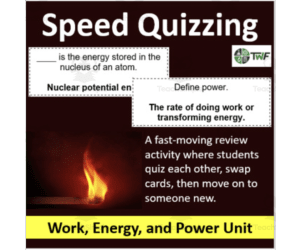
Speed Quizzing – Work, Energy, and Power Unit
Science, Physics, Grade 8, 9, 10, Lesson Plans, Teacher Tools
This activity will get your students out of their seats, moving around, and discussing the material. It is fully editable and requires very little preparation. Simply print, cut out the flash cards, and pass them out to students. Note. This resource can also be used as an excellent question bank as it contains 32 high-quality questions that you can use in any way you see fit. This activity contains 32 questions designed to test your students’ knowledge of the unit they are studying. The questions come directly from the lessons and cover the following topics: • Energy and its Forms • Work and Energy • Kinetic and Gravitational Potential Energy • The Law of Conservation of Energy and Efficiency • Thermal Energy, Temperature and Heat • Power Each of the Speed Quizzes listed below can be found in my Speed Quizzes Growing bundle at a discount of at least 65%. Here’s how you implement them: 1. Provide each student with a flash card 2. Pair up students using the stand up/hands up/pair up method 3. Partner A reads the question to Partner B, who answers. Partner A praises if correct or coaches if incorrect. 4. Partners switch roles 5. Students thank each other and switch cards 6. Partners raise their hands to find a new partner 7. Repeat for a specified amount of time Alternate way to ensure each student gets a new partner each time: Divide students into groups A and B. Have every student pair up with someone from the other group (if there is an odd number of students you participate too!) 1) Do Speed Quizzing 2) Then have group A move to the right and group B stay still. 3) Do Speed Quizzing 4) Then have group B move to the left and group A stay still. Every student in group A will meet every student in group B, but students will not meet students in their own group (a clever way to keep apart students who should not be partnered for whatever reason). This activity can be used to: • Prompt meaningful student conversation • Review prior knowledge • Review new terms/problems after a unit • Gather student ideas • Remediate weak skills • Practice new skills ***************************** For free resources, useful teaching tips, and tools, please visit my blog - TeachScienceWithFergy.com If you have any questions please feel free to send me an email - devon@teachwithfergy.com
Author Teach With Fergy
Tags Law Of Conservation, Forms Of Energy, Science Assessments, Thermal Energy, Speed Quizzing
I WONDER - What Is The Largest Vertebrate In The World
STEM, Animals, Life Sciences, Science, Biology, Grade 1, 2, 3, 4, 5, 6, 7, 8, Lesson Plans, Teacher Tools
Video Introduction Animal kingdoms are full of fascinating wonders to learn. This video is designed for the students to learn more about animals in different countries. I WONDER - What Is The Largest Vertebrate In The World | Animated Video Lesson Do you like animals? what is your favorite one? Do you own a pet? If yes, tell us more about it, like what its name? And what do you like most about it? What are the animal kingdoms? Can you write down the characteristics of each animal class like mammals, birds, reptiles, amphibian, fish and mollusks. Do you know that some animals can sing, can you name any of them? What is the largest and the smallest mammal in the world? What is the largest and the smallest bird in the world? What is the largest and the smallest fish in the world? I WONDER - What Is The Largest Vertebrate In The World | Animated Video Lesson The video is perfect for encouraging the researching skills for the students, while learning more about these fantastic animals. I WONDER - What Is The Largest Vertebrate In The World | Animated Video Lesson This friendly designed video is suitable for students at school, homeschooling, and as a group activity. Format Available in MP4 format.
Author Educational Voice
Tags What Is The Largest Vertebrate In The World, What Is The Largest Vertebrate In The World Video, Largest Vertebrate In The World, Largest Vertebrate In The World Facts, Largest Vertebrate In The World Video, Largest Vertebrate In The World Video For Kids
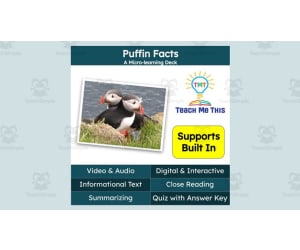
Puffin Facts | Interactive Science Lesson | Micro-Learning Deck
Science, Life Sciences, Animals, Grade 6, 7, 8, 9, Teacher Tools, Lesson Plans
Engage your middle school science students with this informative micro-learning deck on puffin facts. This digital slideshow resource covers key details on the appearance, habitat, diet, and behaviors of the Atlantic puffin. Students will watch an engaging video, read an passage with audio support, analyze the text through close reading questions, and write a quick constructed response. Implement this versatile resource in a variety of ways - as an introductory lesson on seabirds, a homework reinforcement activity, or a center rotation station. The mixed media format appeals to visual, auditory, and kinesthetic learners alike. Assessment options like the close read and quick write make this an impactful addition to any life science curriculum covering marine biology or animal classification.
Author Teach Me This
Tags Interactive, Science, Lesson Plan, Puffins, Animal Habitats

I WONDER - Are Nails Alive | Animated Video Lesson
Human Body, Life Sciences, Science, Biology, STEM, Grade 2, 3, 4, 5, 6, 7, 8, Lesson Plans, Teacher Tools
Video Overview The human body is full of fascinating wonders to learn. This video is created to help the students recognize the anatomy and the job of the human body. I WONDER - Are Nails Alive | Animated Video Lesson Every part and organ in our human body is vital so let's see how important they are. Have you ever imagined how we look like if we didn't have a skeleton? Did you know that because we have our amazing muscles we can stand! Do you know how many teeth do we have? Have you ever wondered about the food journey inside our body? Can you name all the glands in our body? Why do we have skin? Our nervous system is really good at sending signals. Can you tell us more about it? Are you really good at Mathematics, painting, or any other thing? You should really thank your brain about it! The famous five senses are really doing a great work? Can you explain how every sense works? I WONDER - Are Nails Alive | Animated Video Lesson The video is perfect for encouraging the researching skills for the students, while learning more about our fantastic human body. I WONDER - Are Nails Alive | Animated Video Lesson This friendly designed video is suitable for students at school, homeschooling, and as a group activity. Format Available in MP4 format.
Author Educational Voice
Tags Are Nails Alive, Are Nails Alive Video, Nails, Nail, Nails Facts, Nails Facts For Kids, Nails Video, Nails Video For Kids, Fingernails, Fingernailsfacts
I WONDER - How Can You Eat Sustainable Food | Animated Video Lesson
Environmental Science, Earth and Environmental Sciences, Science, Earth Sciences, Grade 6, 7, 8, 9, 10, 11, 12, Lesson Plans, Teacher Tools
Video Introduction An amazing video designed for the students to learn more about STEM. I WONDER - How Can You Eat Sustainable Food | Animated Video Lesson Do you like STEM subjects? what is your favorite one? Have you ever tried to plant a seed? If yes, tell us more about it. Or have you ever tried to invent something? If yes, tell us more about it. And how do you think it will help us? Have you ever seen a microorganism under a microscope? What was it? And how it looked like? Mathematics is a marvelous subject. Let' sharpen our brains and solve some equations. Do you like timetable tricks? What is your favorite one? Do you know how to code? Have you ever created an app or a game before? If yes, how was it like? I WONDER - How Can You Eat Sustainable Food | Animated Video Lesson The video is perfect for encouraging the researching skills for the students, while learning more about this fantastic topic. I WONDER - How Can You Eat Sustainable Food | Animated Video Lesson This friendly designed video is suitable for students at school, homeschooling, and as a group activity. Format Available in MP4 format.
Author Educational Voice
Tags How Can You Eat Sustainable Food, How Can You Eat Sustainable Food Facts, Sustainable Food, Sustainable Food Facts, Sustainable Food Facts For Kids, Sustainable Food Video, Sustainable Food Video For Kids
I WONDER - When Did The Parasaurolophus Live On Earth | Animated Video
History: Ancient, History, Social Studies, History: World, Animals, Life Sciences, Science, Grade 4, 5, 6, 7, 8, 9, 10, Lesson Plans, Teacher Tools
Video Introduction An amazing video designed for the students to learn more about dinosaurs in different countries. I WONDER - When Did The Parasaurolophus Live On Earth | Animated Video Lesson Do you like dinosaurs? what is your favorite one? Do you own a pet? If yes, tell us more about it, like what its name? And what do you like most about it? Do you think that your pet has been evolved from a dinosaur? Can you write down the characteristics of your favourite dinosaur like it's shape, their rivals, where did it use to live and what was their favourite food? What is the largest and the smallest dinosaur that ever found? Why is the T-rex is so famous? Have you ever read any interesting facts about it? Can you name any of the carnivores or herbivores dinosaurs? I WONDER - When Did The Parasaurolophus Live On Earth | Animated Video Lesson The video is perfect for encouraging the researching skills for the students, while learning more about dinosaurs. I WONDER - When Did The Parasaurolophus Live On Earth | Animated Video Lesson This friendly designed video is suitable for students at school, homeschooling, and as a group activity. Format Available in MP4 format.
Author Educational Voice
Rating
Tags When Did The Parasaurolophus Live On Earth, When Did The Parasaurolophus Live On Earth Vide, Parasaurolophus, Parasaurolophus Facts, Parasaurolophus Video, Parasaurolophus Video For Kids, Parasaurolophus Facts For Kids
I WONDER - What Ocean Animals Are Endangered | Animated Video Lesson
STEM, Biology, Life Sciences, Science, Animals, Grade 3, 4, 5, 6, 7, 8, 9, Lesson Plans, Teacher Tools
Video Introduction Animal kingdoms are full of fascinating wonders to learn. This video is designed for the students to learn more about animals in different countries. I WONDER - What Ocean Animals Are Endangered | Animated Video Lesson Do you like animals? what is your favorite one? Do you own a pet? If yes, tell us more about it, like what its name? And what do you like most about it? What are the animal kingdoms? Can you write down the characteristics of each animal class like mammals, birds, reptiles, amphibian, fish and mollusks. Do you know that some animals can sing, can you name any of them? What is the largest and the smallest mammal in the world? What is the largest and the smallest bird in the world? What is the largest and the smallest fish in the world? I WONDER - What Ocean Animals Are Endangered | Animated Video Lesson The video is perfect for encouraging the researching skills for the students, while learning more about these fantastic animals. I WONDER - What Ocean Animals Are Endangered | Animated Video Lesson This friendly designed video is suitable for students at school, homeschooling, and as a group activity. Format Available in MP4 format.
Author Educational Voice
Tags What Ocean Animals Are Endangered, What Ocean Animals Are Endangered Video, Ocean Animals, Ocean Animals Facts, Ocean Animals Video, Ocean Animal, Endangered Animals, Endangered Animals Video
I WONDER - What Animals Live In The Galapagos Islands | Animated Video
Animals, Life Sciences, Science, Geography, Social Studies, Grade 4, 5, 6, 7, 8, 9, Lesson Plans, Teacher Tools
Video Introduction An amazing video designed for the students to learn more about famous places in different countries. I WONDER - What Animals Live In The Galapagos Islands | Animated Video Lesson What do you know about this place? Do you know in which part of the world it is? Have you ever visited this place? If yes, can you tell us more about your adventure, and what do you like the most about this place? Do you like reading about Geography? What is your favorite country in the whole world? If you are going on a trip where it will be? Which country? What you are going to see there? Does this country has a famous place to visit? I WONDER - What Animals Live In The Galapagos Islands | Animated Video Lesson The activity is perfect for encouraging the researching skills for the students, while learning more about this fantastic place. I WONDER - What Animals Live In The Galapagos Islands | Animated Video Lesson This friendly designed video is suitable for students at school, homeschooling, and as a group activity. Format Available in MP4 format.
Author Educational Voice
Tags What Animals Live In The Galapagos Islands, What Animals Live In The Galapagos Islands Video, Animals, Animals Facts, Animals Video, Galapagos Islands, Galapagos Islands Facts, Galapagos Islands Video

Unplugged Coding Task Cards | 30 Debugging WarmUps Grades 3-5 |No Tech
Computer Science, Technology, Science, Winter, Seasons, Holiday & Seasonal, Grade 3, 4, 5, Centers, Activities, Lesson Plans, Teacher Tools, Task Cards, Worksheets & Printables
Find the Bug: Debugging Warm-Ups | Grades 3–5 Computer Science Find the Bug gives Grades 3–5 students engaging, no-tech debugging practice without requiring a specific coding platform. These debugging task cards help students learn to trace, test, explain, and fix broken pseudocode. What’s Included This resource includes six separate PDF files : Teacher Guide – 6 pages Teacher directions and implementation ideas Teacher questioning script Standards alignment Scope and sequence Two-week pacing option Student Reference – 2 pages How to read a bug card Seven-step debugging checklist Read → Trace → Find → Fix → Test debugging cycle Recording Pages – 2 pages Student response sheets Bug type identification Fixed-line recording Debugging progress tracker Bug Cards – 30 pages 30 ready-to-use debugging task cards Six different bug types Three difficulty levels One card per page Answer Key – 10 pages Correct fixes for every card Misconception behind each bug Helpful teacher conferencing notes The six bug types include Sequence, Loop Counting, Loop Conditions, Conditionals, Variables, and Placement . How It Works in the Classroom Use these debugging task cards in flexible ways throughout your computer science instruction. ⭐ Bell-Ringers Project or print one card. Students work independently or with partners. A six-minute work period fits easily into a warm-up routine. One card per day provides approximately six weeks of practice. ⭐ Stations Print and laminate the cards. Add the student response sheet. Students solve cards and record their thinking. Five cards provide a manageable station rotation. ⭐ Sub Plans Provide the cards, checklist, response sheet, and answer key. No student login or device is required. No prior coding platform knowledge is needed. Introduce the cards through discovery. Students encounter concepts by watching code break. Standards & Learning Goals Students practice: Testing and debugging programs or algorithms. Identifying and explaining coding errors. Tracing code step by step. Modifying existing algorithms. Testing boundary cases. Recognizing patterns in repeated reasoning. Explaining why a solution works. The resource aligns with CSTA 1B-AP-10, 1B-AP-11, 1B-AP-12, 1B-AP-15, and 2-AP-17 . It also supports CCSS.MATH.PRACTICE.MP6, MP8, and CCSS.ELA-LITERACY.W.4.2 . Students also build practical debugging habits through the seven-step checklist. These include tracing values, checking starting values, checking stop conditions, reviewing order, checking indentation, and testing edges. Why Teachers Love It ⭐ Misconception-focused answer key The answer key explains the misconception behind each bug. This gives teachers better language for student conferences. ⭐ No devices required Students can practice computational thinking without opening a coding platform. ⭐ Low-prep implementation Print the cards and start using them as warm-ups, stations, or sub plans. ⭐ Built-in differentiation Cards progress across three difficulty levels. ⭐ Focuses on thinking, not guessing Students must find the bug, explain the problem, and write a fix. ⭐ Student reflection is included The debugging tracker helps students see which bug types they solve most successfully. Make debugging practice easier with a ready-to-use computer science resource for Grades 3–5 . Use Find the Bug for warm-ups, stations, targeted reteaching, or substitute plans. Give students repeated opportunities to trace, test, explain, and repair code. Download the resource and give your students a practical way to build stronger debugging habits! 💛
Author Bright Classroom Ideas Marketplace
Rating
Tags Code, Coding, Unplugged, No Tech, Debug, Debugging, Technology, Computer

Lesson 7.2 - The Periodic Table
Science, Chemistry, Physics, Grade 6, 7, 8, 9, 10, 11, 12, Lesson Plans, Teacher Tools
Unit 7: The Atom & the Nucleus - Whole Unit Description This resource provides educators with comprehensive materials for teaching atomic and nuclear concepts. Ideal for middle and high school science teachers handling chemistry and physics topics, these resources encourage fun, student-oriented instruction. Subatomic Particles Lessons The unit begins with lessons on three subatomic particles: proton, neutron, and electron. Included are '7.1 Atomic Structure Notes' which contain details about their properties and location within the atom. A version complete with blanks for in-class participation A filled-out version for reference Interactive Practice Session '7.1 Subatomic Particle Matching Practice' features printable cards with facts about each subatomic particle that students can group accordingly—perfect for group or paired activities. Offline Learning Experience 'World's Smallest Movie Reading' assignment promotes independent exploration outside class hours through an IBM mini-movie created using stop-motion photography of individual atoms. Brief summary writing exercise to improve recall plan attached. PowerPoint Presentations: Filled with Starter Questions The Periodic Table notes touch briefly on history Data from including an exciting scavenger hunt activity Nuclear Energy Lessons & Computer Simulations Sensational computer simulations bring construction of atoms or nuclear fission principles to life while promoting classroom collaboration. Various exercises foster: Critical thinking skills via assorted readings on nuclear energy pros/cons Navigating the various debates surrounding its use Mastery Test The comprehensive test with differing question types ensures understanding of all concepts discussed in this unit: True/False and matching questions Short essay questions A recovery quiz helps boost any underwhelming scores whilst also acting as an additional review process. All materials meet essential Integrated Chemistry & Physics State Standards beyond Indiana’s curricular requirements and are editable in .docx or.pptx formats for easy customization. *You should have a word processor that supports .docx file type and similar presentation software to support the .pptx format for accessing these files.
Author Integrated Chemistry and Physics
Tags Subatomic Particles, Atomic Structure, Periodic Table, Nuclear Energy, Interactive Simulations

Animal Art Journal: Explore the Elements of Art through Animals
Creative Arts, Art, Science, Life Sciences, Animals, Grade 3, 4, 5, 6, 7, Teacher Tools, Lesson Plans
Discover the 7 elements of art through the 7 continents...and some of the amazing animals that live there! 🎨 This Animal Art Journal is a unique way to teach art elements to older kids (3rd-7th grade). The workbook-style adds a level of independent learning and ownership. Kids will love traveling to each continent, drawing animals from each, and journaling about their research. 🗺️ If you need an engaging, print-and-go way to teach the elements of art, THIS IS FOR YOU! 🐅 Use as a framework for your art curriculum, as supplemental worksheets, or as an independent workbook for your kids to draw through! 🎨 WHAT'S INCLUDED - 7 Units teaching the elements of art (line, texture, shape, color, value, space, form) - Exploration of 7 continents through 7 animals from around the world - In-depth explanation and practice of the 7 elements of art - Directed drawing guides of each highlighted animal (+ others!) - Hands-on activities - Journal pages filled with research-driven questions - Imagine it! Pages where kids create their own habitats - Instructions at the top of each worksheet - Example Pages with colored images for EVERY activity 🗺️ HOW TO USE -Full year art curriculum: This journal covers all elements of art with 7 activities per unit. -Supplemental Worksheets: If you're confident in teaching the elements of art but want to give some fun practice worksheets, you need to download this journal! -Independent Workbook: Need something your art students can work on when there's 5 minutes left of class? Print these journals for your students at the beginning of the year and have them ready to go whenever! -Field Trip Buddies: Heading to the zoo? This journal (especially the journal pages!) are perfect to throw onto a clipboard and explore different animals around the world with. 🐅 MY FAVORITE PART I absolutely love all the Imagine It! pages. Each page has an empty jar on it and is found at the end of the unit. Kids "fill" the jar with items that they liked learning to draw from that continent, the animal they learned to sketch, and some skills from the element of art. Check it out in the 3rd thumbnail! 🎨 Happy adventuring! -Abbey Allen ARTventurous Animals
Author ARTventurousanimals
Tags Animal Art Journal, Animal Art, Art Journal, Animal Journal

Carbohydrates and Lipids – 5E Lesson Bundle
Science, Life Sciences, Biology, Grade 7, 8, 9, 10, 11, 12, Teacher Tools, Lesson Plans
This 5E Lesson Bundle will cover everything you need to teach about Carbohydrates and Lipids. This lesson takes approximately 4-6 hours to complete and will be divided across multiple days. Students will consistently be engaged through scavenger hunt activities, learning videos, labs , and more. The teacher has the opportunity to assess their students with a quiz! This 5E Lesson Bundle will cover everything you need to teach about Carbohydrates and Lipids. This lesson takes approximately 4-6 hours to complete and will be divided across multiple days. Students will consistently be engaged through scavenger hunt activities, learning videos, labs , and more. The teacher has the opportunity to assess their students with a quiz! This 5E Lesson Bundle will cover everything you need to teach about Carbohydrates and Lipids. This lesson takes approximately 4-6 hours to complete and will be divided across multiple days. Students will consistently be engaged through scavenger hunt activities, learning videos, labs , and more. The teacher has the opportunity to assess their students with a quiz! This 5E Lesson Bundle will cover everything you need to teach about Carbohydrates and Lipids. This lesson takes approximately 4-6 hours to complete and will be divided across multiple days. Students will consistently be engaged through scavenger hunt activities, learning videos, labs , and more. The teacher has the opportunity to assess their students with a quiz!
Author Teach With Fergy
Tags Biology, Science, Lesson Plan, Lipids, Carbohydrates
I WONDER - Why Is It Important To Recycle Glass | Animated Video
Environmental Science, Earth and Environmental Sciences, Science, Grade 4, 5, 6, 7, 8, 9, 10, Lesson Plans, Teacher Tools
Video Introduction An amazing video designed for the students to learn more about STEM. I WONDER - Why Is It Important To Recycle Glass | Animated Video Lesson Do you like STEM subjects? what is your favorite one? Have you ever tried to plant a seed? If yes, tell us more about it. Or have you ever tried to invent something? If yes, tell us more about it. And how do you think it will help us? Have you ever seen a microorganism under a microscope? What was it? And how it looked like? Mathematics is a marvelous subject. Let' sharpen our brains and solve some equations. Do you like timetable tricks? What is your favorite one? Do you know how to code? Have you ever created an app or a game before? If yes, how was it like? I WONDER - Why Is It Important To Recycle Glass | Animated Video Lesson The video is perfect for encouraging the researching skills for the students, while learning more about this fantastic topic. I WONDER - Why Is It Important To Recycle Glass | Animated Video Lesson This friendly designed video is suitable for students at school, homeschooling, and as a group activity. Format Available in MP4 format.
Author Educational Voice
Tags Why Is It Important To Recycle Glass, Why Is It Important To Recycle Glass Video, Glass Recycling, Glass Recycling Facts, Glass Recycling Facts For Kids, Glass Recycling Video, Glass Recycling Video For Kids

I WONDER - What Job Does The Spine Do | Animated Video Lesson
Human Body, Life Sciences, Science, Biology, STEM, Grade 3, 4, 5, 6, 7, 8, 9, Lesson Plans, Teacher Tools
Video Overview The human body is full of fascinating wonders to learn. This video is created to help the students recognize the anatomy and the job of the human body. I WONDER - What Job Does The Spine Do | Animated Video Lesson Every part and organ in our human body is vital so let's see how important they are. Have you ever imagined how we look like if we didn't have a skeleton? Did you know that because we have our amazing muscles we can stand! Do you know how many teeth do we have? Have you ever wondered about the food journey inside our body? Can you name all the glands in our body? Why do we have skin? Our nervous system is really good at sending signals. Can you tell us more about it? Are you really good at Mathematics, painting, or any other thing? You should really thank your brain about it! The famous five senses are really doing a great work? Can you explain how every sense works? I WONDER - What Job Does The Spine Do | Animated Video Lesson The video is perfect for encouraging the researching skills for the students, while learning more about our fantastic human body. I WONDER - What Job Does The Spine Do | Animated Video Lesson This friendly designed video is suitable for students at school, homeschooling, and as a group activity. Format Available in MP4 format.
Author Educational Voice
Tags What Job Does The Spine Do, What Job Does The Spine Do Video, The Spine, The Spine Facts, The Spine Facts For Kids, The Spine Video, The Spine Video For Kids, Skeletal System, Skeletal System Facts For Kids