



3,906 products added recently
Page 73 - Science Lesson Plan Template
Enhance your science instruction with a flexible lesson plan template designed for educators. This tool helps you structure objectives, materials, procedures, and assessments efficiently. Use it to create organized and impactful science lessons that cater to your students' needs.

 Show filters

I WONDER - What Is Tundra | Animated Video Lesson
Environmental Science, Earth and Environmental Sciences, Science, Grade 6, 7, 8, 9, 10, 11, 12, Lesson Plans, Teacher Tools
Video Introduction An amazing video designed for the students to learn more about STEM. I WONDER - What Is Tundra | Animated Video Lesson Do you like STEM subjects? what is your favorite one? Have you ever tried to plant a seed? If yes, tell us more about it. Or have you ever tried to invent something? If yes, tell us more about it. And how do you think it will help us? Have you ever seen a microorganism under a microscope? What was it? And how it looked like? Mathematics is a marvelous subject. Let' sharpen our brains and solve some equations. Do you like timetable tricks? What is your favorite one? Do you know how to code? Have you ever created an app or a game before? If yes, how was it like? I WONDER - What Is Tundra | Animated Video Lesson The video is perfect for encouraging the researching skills for the students, while learning more about this fantastic topic. I WONDER - What Is Tundra | Animated Video Lesson This friendly designed video is suitable for students at school, homeschooling, and as a group activity. Format Available in MP4 format.
Author Educational Voice
Tags What Is Tundra, What Is Tundra Video, Tundra, Tundra Facts, Tundra Facts For Kids, Tundra Video, Tundra Video For Kids, Educational Video, Educational Video For Kids, Science

I WONDER - How Cacti Survive In The Desert | Animated Video Lesson
Biology, Life Sciences, Science, Nature & Plants, Grade 4, 5, Lesson Plans, Teacher Tools
Video Introduction An amazing activity designed for the students to learn more about STEM. I WONDER - How Cacti Survive In The Desert | Animated Video Lesson Do you like STEM subjects? what is your favorite one? Have you ever tried to plant a seed? If yes, tell us more about it. Or have you ever tried to invent something? If yes, tell us more about it. And how do you think it will help us? Have you ever seen a microorganism under a microscope? What was it? And how it looked like? Mathematics is a marvelous subject. Let' sharpen our brains and solve some equations. Do you like timetable tricks? What is your favorite one? Do you know how to code? Have you ever created an app or a game before? If yes, how was it like? I WONDER - How Cacti Survive In The Desert | Animated Video Lesson The video is perfect for encouraging the researching skills for the students, while learning more about this fantastic topic. I WONDER - How Cacti Survive In The Desert | Animated Video Lesson This friendly designed video is suitable for students at school, homeschooling, and as a group activity. Format Available in MP4 format.
Author Educational Voice
Tags How Cacti Survive In The Desert, How Cacti Survive In The Desert Videos, Cacti, Cacti Facts, Cacti Facts For Kids, Cacti Facts Video, Cactus, Cactus Facts, Desery, Desert Facts

I WONDER - What Are Marshes Used For | Animated Video Lesson
Nature & Plants, Life Sciences, Science, Grade 6, 7, 8, 9, 10, 11, 12, Lesson Plans, Teacher Tools
Video Introduction An amazing activity designed for the students to learn more about STEM. I WONDER - What Are Marshes Used For | Animated Video Lesson Do you like STEM subjects? what is your favorite one? Have you ever tried to plant a seed? If yes, tell us more about it. Or have you ever tried to invent something? If yes, tell us more about it. And how do you think it will help us? Have you ever seen a microorganism under a microscope? What was it? And how it looked like? Mathematics is a marvelous subject. Let' sharpen our brains and solve some equations. Do you like timetable tricks? What is your favorite one? Do you know how to code? Have you ever created an app or a game before? If yes, how was it like? I WONDER - What Are Marshes Used For | Animated Video Lesson The video is perfect for encouraging the researching skills for the students, while learning more about this fantastic topic. I WONDER - What Are Marshes Used For | Animated Video Lesson This friendly designed video is suitable for students at school, homeschooling, and as a group activity. Format Available in MP4 format.
Author Educational Voice
Tags What Are Marshes Used For, What Are Marshes Used For Video, Marshes, Marshes Facts, Marshes Facts For Kids, Marshes Video, Marshes Video For Kids, Science, Science Facts, Science Video For Kids
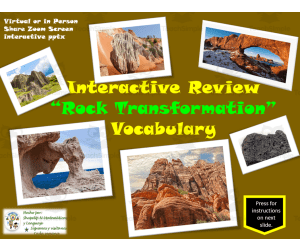
Free Science Rock Transformation Interactive Vocabulary Review
Science, Earth and Environmental Sciences, Basic Science, Earth Sciences, Grade 7, Teacher Tools, Lesson Plans
Free Science Rock Transformation Interactive Vocabulary Review Engage your 7th grade science students with this interactive PowerPoint to learn key vocabulary about rock transformations. Students will review 32 slides that define terms and concepts related to the rock cycle , along with visuals to aid understanding. Our resource can be used for whole-class instruction, small group review, or independent practice. To use: first, introduce the vocab words. Then, have students review and read words aloud. They select a multiple choice answer; correct choices reveal the definition, while incorrect answers are marked with a red X. Press the down arrow to advance slides. Check back for more 7th grade science vocabulary and concept review resources from ShapeUp-N-Matematicas y Lenguaje. We offer engaging activities like human microbiome and metabolism to support learning. Spanish language arts resources also available.
Author ShapeUp-N-Matematicas y Lenguaje
Tags Rock Transformation, Igneous Rock, Magma, Plate, Plate Boundary, Sediment, Sedimentary Rocks, Rocks, Small Or Whole Group, Game

I WONDER - Why Do We Need Acid-base Reactions | Animated Video Lesson
Chemistry, Science, Grade 6, 7, 8, 9, 10, 11, 12, Lesson Plans, Teacher Tools
Video Introduction An amazing video designed for the students to learn more about STEM. I WONDER - Why Do We Need Acid-base Reactions | Animated Video Lesson Do you like STEM subjects? what is your favorite one? Have you ever tried to plant a seed? If yes, tell us more about it. Or have you ever tried to invent something? If yes, tell us more about it. And how do you think it will help us? Have you ever seen a microorganism under a microscope? What was it? And how it looked like? Mathematics is a marvelous subject. Let' sharpen our brains and solve some equations. Do you like timetable tricks? What is your favorite one? Do you know how to code? Have you ever created an app or a game before? If yes, how was it like? I WONDER - Why Do We Need Acid-base Reactions | Animated Video Lesson The video is perfect for encouraging the researching skills for the students, while learning more about this fantastic topic. I WONDER - Why Do We Need Acid-base Reactions | Animated Video Lesson This friendly designed video is suitable for students at school, homeschooling, and as a group activity. Format Available in MP4 format.
Author Educational Voice
Tags Why Do We Need Acid-base Reactions, Why Do We Need Acid-base Reactions Video, Acid-base Reactions, Acid-base Reactions Facts, Acid-base Reactions Facts For Kids, Acid-base Reactions Video, Acid-base Reactions Video For Kids
I WONDER - How Do Heat Waves Impact The Environment | Animated Video
Environmental Science, Earth and Environmental Sciences, Science, Earth Sciences, Grade 6, 7, 8, 9, 10, 11, 12, Lesson Plans, Teacher Tools
Video Introduction An amazing video designed for the students to learn more about STEM. I WONDER - How Do Heat Waves Impact The Environment | Animated Video Lesson Do you like STEM subjects? what is your favorite one? Have you ever tried to plant a seed? If yes, tell us more about it. Or have you ever tried to invent something? If yes, tell us more about it. And how do you think it will help us? Have you ever seen a microorganism under a microscope? What was it? And how it looked like? Mathematics is a marvelous subject. Let' sharpen our brains and solve some equations. Do you like timetable tricks? What is your favorite one? Do you know how to code? Have you ever created an app or a game before? If yes, how was it like? I WONDER - How Do Heat Waves Impact The Environment | Animated Video Lesson The video is perfect for encouraging the researching skills for the students, while learning more about this fantastic topic. I WONDER - How Do Heat Waves Impact The Environment | Animated Video Lesson This friendly designed video is suitable for students at school, homeschooling, and as a group activity. Format Available in MP4 format.
Author Educational Voice
Tags How Do Heat Waves Impact The Environment, How Do Heat Waves Impact The Environment Video, Heat Waves Impact The Environment, Heat Waves Impact The Environment Video, Heat Waves Impact The Environment Facts

Flight Gr. 4-7
Science, Physics, Grade 4, 5, Teacher Tools, Lesson Plans
Flight Gr. 4-7 Teaching Resource Overview The Flight Gr. 4-7 teaching resource provides an engaging and comprehensive guide for students studying flight in a physical science context. Focusing mainly on Grades 4 to 5, this material brings a new dimension to the classroom through its variety of interactive activities and holistic lesson structure. Purpose and Structure of Flight Gr. 4-7 The purpose of Flight Gr. 4-7 is more than simply imparting facts; it seeks to foster comprehension through student participation from start to finish. Every activity is centered around the theme of each lesson, creating a streamline learning experience that builds on prior knowledge. This resource delves into various aspects of flight such as understanding the mechanics of wings, rockets, helicopters. In addition, hands-on experiences where students can construct their own kites and gliders are included. Different Ways to Implement Flight Gr. 4-7 in Classroom Activities This unit can be implemented across whole class discussions or smaller group tasks for independent and group learning experiences respectively. Additionally, it’s also suitable for homework assignments offering flexibility according to each educator's specific needs. Inclusion of Reading Passages & Puzzles Incorporating reading passages that provide valuable context alongside the hands-on activities helps reinforce concepts learned during each experiment or project undertaken by pupils during lessons. Crossword puzzles and word searches are included as complementary materials ensuring mental alertness while engendering fun within education; A readily available answer key makes educators work much easier when grading or providing instruction. Learner-oriented Digital Material This material comes in PDF form which accentuates ease-of-use, perfect for classroom settings or remote learning if required due to its adaptable design pertinent with current educational landscapes. Customizability & Efficiency With optional additional activities included coupled with evaluation metrics embedded within each section, customization (to fit departmental curriculum protocols), adjustments where necessary has never been easier. In summary, Flight Gr. 4-7 is an efficient courseware usable flexibly based on user's preference. Conclusion In summary, Flight Gr. 4-7, is an immersive step-by-step guide aiming toward enhancing both teaching experience and the student's overall academic accomplishment when it comes to grasping the science around flight.
Author Classroom Complete Press
Tags PDF

8th Grade Science Diagnostic Assessment & Review System
Science, Grade 8, Assessments, Teacher Tools, Lesson Plans, Worksheets & Printables
Start the year with a clear picture of student readiness using this 8th grade beginning of year science assessment and targeted skills system. With a 50-question diagnostic worth 114 points , scoring and analysis tools, instructional grouping support, 11 targeted follow-up practice pages , scientific reading passages, CER tasks, and complete explained answer keys, this resource helps teachers move from assessment results to focused instruction. Designed as a complete Assess → Analyze → Group → Review → Reteach system, this Grade 8 science resource emphasizes the reasoning demands students need as they prepare for high school science. Students analyze multi-step problems, real-world scenarios, data tables, experimental setups, scientific models, graphs, reading passages, and Claim-Evidence-Reasoning tasks across Life Science, Physical Science, Earth & Space Science, and Scientific Practices & Reading . What’s Included This 8th grade science assessment and review system includes: ✅ 50-question beginning-of-year science diagnostic ✅ 114 total assessment points ✅ Life Science questions ✅ Physical Science questions ✅ Earth & Space Science questions ✅ Scientific Practices & Reading questions ✅ Multiple-choice questions ✅ Short-answer questions ✅ Diagram and model interpretation ✅ Data tables ✅ Graph reading ✅ Multi-step reasoning tasks ✅ Scientific scenarios ✅ Vocabulary-in-context questions ✅ Claim-Evidence-Reasoning (CER) tasks ✅ 2 short scientific reading passages ✅ Evidence-based reading questions ✅ Pedigree interpretation ✅ Natural selection and adaptation analysis ✅ Finch selection data ✅ Cladogram interpretation ✅ Predator-prey data ✅ Periodic table patterns ✅ Chemical equation reasoning ✅ Conservation of mass data ✅ Velocity-time graph analysis ✅ Wave anatomy ✅ Transverse and longitudinal wave comparison ✅ Electromagnetic spectrum interpretation ✅ Seafloor-spreading model ✅ Spreading-rate calculation ✅ Star life-cycle model ✅ Atmospheric CO₂ graph analysis ✅ Experimental design and reliability ✅ Mean and outlier analysis ✅ Two-series graph interpretation ✅ Answer recording sheet ✅ Quick-reference answer key ✅ Skill-by-skill scoring chart ✅ Strand analysis tool ✅ Secure, Developing, and Needs Support performance bands ✅ Individual Student Performance Profile ✅ Whole-class data tracker ✅ Suggested instructional groups ✅ 11 targeted follow-up science practice pages ✅ “Key Concept” refresher on every follow-up page ✅ “Extension” task for students who are Secure ✅ All-new follow-up practice with no repeated assessment questions ✅ Reading-for-evidence follow-up practice ✅ CER writing follow-up practice ✅ Complete answer keys ✅ Suggested short-answer responses ✅ Suggested reading-response answers ✅ Completed visual and diagram answers ✅ Sample CER responses ✅ Short “why” explanation for every assessment item ✅ Partial-credit guidance Part 1 contains 50 rigorous mixed-format questions worth 114 total points . The Teacher Guide recommends two 45-minute sessions and explains that the diagnostic emphasizes multi-step reasoning, evidence-based conclusions, data tables, experimental setups, model interpretation, and reading scientific text for evidence. Part 2 turns student responses into actionable data with an answer recording sheet, quick-reference key, skill-by-skill scoring chart, strand analysis, performance bands, individual student profiles, a whole-class data tracker, and suggested instructional groups. Part 3 includes 11 ready-to-assign targeted follow-up pages with all-new practice. Every page includes a concise Key Concept refresher and an Extension task, and the set includes dedicated pages for Reading Science for Evidence and CER Writing . Part 4 provides correct answers for all 50 questions, explanations of why answers are correct, suggested responses for short-answer and reading tasks, completed diagrams, sample CER responses, and partial-credit guidance. How It Works in the Classroom Use this 8th grade beginning of year science assessment during the first weeks of school to identify what students retained from prior science learning, how well they reason through multi-step problems, and where instruction should begin. The resource follows a practical five-step system: 🔎 Assess — Students complete the 50-item mixed-format science diagnostic 📊 Analyze — Score by skill and strand to identify patterns and gaps 👥 Group — Form targeted instructional groups based on shared needs 📝 Review — Assign focused follow-up practice by strand or skill 🎯 Reteach — Use complete explanations, worked visuals, and model CER responses to support next steps The Assess → Reteach System chart on page 2 of Part 1 directly connects each stage to the matching component of the four-part resource. The same page summarizes the 50 questions, 114 points, broad format range, four reporting areas, two scientific reading passages, and suggested administration time. Use this resource for: ⭐ Beginning-of-year science assessment ⭐ 8th grade science diagnostic ⭐ Middle school science pre-assessment ⭐ Back-to-school science review ⭐ High school science readiness ⭐ Science readiness check ⭐ Formative assessment ⭐ Small-group planning ⭐ Science intervention ⭐ Targeted reteaching ⭐ Data-driven instruction ⭐ Skill-based grouping ⭐ Independent follow-up practice ⭐ Science stations ⭐ CER practice ⭐ Reading in science ⭐ Text-evidence practice ⭐ Graph and data interpretation ⭐ Multi-step science reasoning The Scoring at a Glance chart on page 2 of Part 2 breaks the assessment into four strand totals: Life Science /31, Physical Science /40, Earth & Space Science /24, and Scientific Practices /19 , for 114 total points . It also defines three performance bands: Secure (80%–100%) , Developing (50%–79%) , and Needs Support (below 50%) . The Student Performance Profile on page 15 of Part 2 gives teachers a one-page strand snapshot with space for strengths, focus areas, assigned Part 3 practice pages, and group placement. The Class Data Tracker on page 16 provides a whole-class view so teachers can scan columns for class-wide gaps and rows for individual grouping needs. Standards & Learning Goals This eighth grade science diagnostic assessment reviews foundational science concepts and advanced scientific reasoning across four major areas: 🌱 Life Science — levels of biological organization, homeostasis, interacting body systems, pedigrees, mutations, natural selection, evolution, adaptations, selection pressure, inheritance, cladograms, common ancestry, predator-prey relationships, biodiversity, ecosystem resilience, and evolution CER reasoning ⚛️ Physical Science — periodic table patterns, atomic number, protons, groups and periods, valence electrons, periodic trends, balancing chemical equations, conservation of mass, open and closed systems, exothermic and endothermic reactions, velocity-time graphs, Newton’s second law, kinetic energy, potential and kinetic energy transformations, wave anatomy, transverse and longitudinal waves, wavelength and frequency, electromagnetic spectrum, and wave-energy transfer 🌎 Earth & Space Science — seafloor spreading, magnetic stripes, evidence for plate tectonics, mantle convection, spreading-rate calculations, star life cycles, gravity and orbits, light-years, tides, atmospheric CO₂ trends, and Earth-and-space CER reasoning 🔬 Scientific Practices & Reading — reliable experimental design, repeated trials, control groups, identifying experimental flaws, graph analysis, comparing data series, calculating means, identifying outliers, reading scientific texts for evidence, connecting evidence to science concepts, drawing evidence-based conclusions, and reading-based CER Students demonstrate understanding through varied science tasks rather than one question type. The diagnostic includes a pedigree , finch beak-depth data , cladogram , natural-selection sequence , predator-prey table , periodic table model , Group 1 reactivity data , open-versus-sealed reaction mass data , velocity-time graph , wave anatomy model , wave-type comparison , electromagnetic spectrum , seafloor-spreading diagram , seafloor age data , Sun-like star life cycle , atmospheric CO₂ graph , bacteria-growth comparison graph , and repeated-trial data analysis. The Skill-by-Skill Scoring Chart on pages 11–13 of Part 2 helps teachers pinpoint specific gaps instead of relying only on one overall score. Skills include homeostasis, pedigrees, mutations, natural selection, selection data, cladograms, adaptation, biodiversity, periodic patterns, valence electrons, balancing equations, conservation of mass, exothermic and endothermic reactions, motion graphs, Newton’s second law, kinetic energy, wave anatomy, wave types, electromagnetic spectrum, seafloor spreading, tectonic evidence, spreading rates, star life cycles, gravity and orbits, experimental reliability, identifying flaws, mean and outlier analysis, reading for evidence, and reading-based CER. A particularly valuable feature is the integration of science literacy . Part 1 includes two short scientific texts with evidence-based questions. Students read “Why Antibiotics Can Stop Working” to connect mutation, survival, reproduction, and antibiotic resistance to natural selection, and “Healing the Ozone Layer” to analyze evidence connected to CFC reduction and ozone recovery. Why Teachers Love It ✨ Move beyond a single test score. Results can be analyzed by strand and individual skill, helping teachers see exactly where students are secure and where review is needed. ✨ Prepare students for high school science reasoning. The Teacher Guide explicitly emphasizes multi-step problems, evidence-based conclusions, data tables, experimental setups, model interpretation, and scientific reading—the kinds of demands students increasingly encounter in advanced science coursework. ✨ Turn assessment data into an instructional plan. The scoring tools connect results to performance bands, student profiles, instructional groups, and targeted follow-up practice instead of leaving teachers with a stack of completed tests. ✨ Measure both science knowledge and reasoning. Students do more than recall vocabulary. They interpret models, calculate rates, compare data, explain mechanisms, evaluate evidence, analyze graphs, and justify conclusions. ✨ Integrate science and reading skills. Two short scientific passages ask students to cite evidence, connect text details to science concepts, interpret measured changes, and construct evidence-based responses. ✨ Use relevant scientific topics for reading practice. Students analyze antibiotic resistance and ozone-layer recovery, connecting real scientific evidence to natural selection, environmental change, and evidence-based reasoning. ✨ Strengthen evolution and natural selection understanding. Students work with finch data, beetle camouflage, selection pressure, adaptation, inheritance, cladograms, mutations, and CER reasoning. ✨ Build readiness for chemistry concepts. Students interpret periodic table patterns, atomic numbers, valence electrons, reactivity trends, balanced equations, conservation of mass, and exothermic versus endothermic reactions. ✨ Strengthen physics reasoning. Students analyze velocity-time graphs, apply F = m × a , reason about kinetic energy, explain potential-to-kinetic energy transformations, interpret wave features, compare transverse and longitudinal waves, and analyze the electromagnetic spectrum. ✨ Connect Earth science models to quantitative reasoning. Students interpret seafloor spreading, use age-and-distance data to calculate a spreading rate, analyze magnetic-stripe evidence, and connect mantle convection to plate movement. ✨ Support data-driven small groups. Part 2 includes suggested instructional groups that help teachers sort students by shared gaps and connect them to matching Part 3 practice. ✨ Differentiate with clear performance bands. Use Secure, Developing, and Needs Support ranges to guide enrichment, targeted practice, or foundational small-group reteaching. ✨ Assign only the review students need. The 11 targeted follow-up pages include: Cells & Genetics Review Evolution & Adaptation Review Ecosystems Review Atoms & Reactions Review Forces, Energy & Motion Review Waves Review Plate Tectonics & Earth Systems Review Space Science Review Experimental Design & Data Review Reading Science for Evidence Review CER Writing Review The Practice Page Menu on page 2 of Part 3 directly matches common student difficulties to specific follow-up pages, making targeted assignment faster. ✨ Refresh key concepts before practice. Every targeted page includes a concise Key Concept section. For example, the Atoms & Reactions page reviews atomic number, groups, periods, conservation of mass, and exothermic versus endothermic reactions before students begin fresh practice. ✨ Extend learning for students who are already secure. Every follow-up page includes an Extension task that pushes students into explanation, application, prediction, argument, or investigation design. ✨ Use fresh follow-up practice instead of repeating the diagnostic. Part 3 explicitly provides all-new practice so students can demonstrate understanding with new examples and situations. ✨ Teach students how to read science for evidence. The dedicated Reading Science for Evidence Review page includes a new passage about a warming mountain lake and changing trout and bass populations. Students identify evidence, explain biological relationships using the text, connect the passage to life science, and generate a testable follow-up question. ✨ Build stronger Claim-Evidence-Reasoning responses. CER appears throughout the diagnostic and receives its own targeted follow-up page. At Grade 8, students are expected to connect specific evidence to a named scientific principle rather than simply restating the data. ✨ Make grading more manageable. Part 4 provides correct answers, short explanations of why, suggested responses for open-ended and reading items, completed diagrams, sample CER responses, and partial-credit guidance. ✨ Use completed diagrams for faster checking. The Completed Diagrams Quick View on page 2 of Part 4 points teachers to fully worked versions of the pedigree, cladogram, natural-selection model, periodic table, wave anatomy, wave types, electromagnetic spectrum, seafloor spreading, and star life cycle. ✨ Score open-ended work more consistently. Part 4 explains that multi-part items can receive point-by-point partial credit and that CER and reading items should be evaluated for a reasonable claim, specific text or data evidence, and reasoning that links them. ✨ Keep the instructional loop connected. Assessment, analysis, grouping, targeted review, science literacy practice, reteaching, and answer support are designed as one coordinated system rather than disconnected activities. Start the year knowing what students understand, how well they reason through complex science tasks, and what they need next with this 8th grade beginning of year science assessment . Download this complete middle school science diagnostic and targeted review system to assess readiness, analyze results by strand and skill, create focused instructional groups, assign specific follow-up practice, strengthen science reading and CER writing, and support reteaching with complete explained answer keys. Perfect for teachers searching for an 8th grade science diagnostic assessment , beginning-of-year science review, middle school science pre-assessment, back-to-school science assessment, eighth grade science review, high school science readiness, Life Science review, Physical Science review, Earth and Space Science review, Scientific Practices assessment, genetics, pedigrees, natural selection, evolution, cladograms, ecosystems, periodic table, chemical reactions, conservation of mass, Newton’s laws, forces and motion, energy transformations, waves, electromagnetic spectrum, plate tectonics, seafloor spreading, star life cycles, experimental design, graph analysis, reading science for evidence, CER practice, science intervention, small-group science planning, data-driven instruction, or targeted science reteaching.
Author Bright Classroom Ideas Marketplace
Rating
Tags Science, Assessment, Worksheet, Back To School, Review

I WONDER - What Is A Lever | Animated Video Lesson
Physics, Science, Grade 6, 7, 8, 9, 10, 11, 12, Lesson Plans, Teacher Tools
Video Introduction An amazing video designed for the students to learn more about STEM. I WONDER - What Is A Lever | Animated Video Lesson Do you like STEM subjects? what is your favorite one? Have you ever tried to plant a seed? If yes, tell us more about it. Or have you ever tried to invent something? If yes, tell us more about it. And how do you think it will help us? Have you ever seen a microorganism under a microscope? What was it? And how it looked like? Mathematics is a marvelous subject. Let' sharpen our brains and solve some equations. Do you like timetable tricks? What is your favorite one? Do you know how to code? Have you ever created an app or a game before? If yes, how was it like? I WONDER - What Is A Lever | Animated Video Lesson The video is perfect for encouraging the researching skills for the students, while learning more about this fantastic topic. I WONDER - What Is A Lever | Animated Video Lesson This friendly designed video is suitable for students at school, homeschooling, and as a group activity. Format Available in MP4 format.
Author Educational Voice
Tags What Is A Lever, What Is A Lever Video, Lever, Lever Facts, Lever Facts For Kids, Lever Facts Video For Kids, Lever Video, Lever Video For Kids, Physics, Physics Facts
I WONDER - What Is An Ecosystem | Animated Video Lesson
Environmental Science, Earth and Environmental Sciences, Science, Grade 3, 4, 5, 6, 7, 8, 9, Lesson Plans, Teacher Tools
Video Introduction An amazing video designed for the students to learn more about STEM. I WONDER - What Is An Ecosystem | Animated Video Lesson Do you like STEM subjects? what is your favorite one? Have you ever tried to plant a seed? If yes, tell us more about it. Or have you ever tried to invent something? If yes, tell us more about it. And how do you think it will help us? Have you ever seen a microorganism under a microscope? What was it? And how it looked like? Mathematics is a marvelous subject. Let' sharpen our brains and solve some equations. Do you like timetable tricks? What is your favorite one? Do you know how to code? Have you ever created an app or a game before? If yes, how was it like? I WONDER - What Is An Ecosystem | Animated Video Lesson The video is perfect for encouraging the researching skills for the students, while learning more about this fantastic topic. I WONDER - What Is An Ecosystem | Animated Video Lesson This friendly designed video is suitable for students at school, homeschooling, and as a group activity. Format Available in MP4 format.
Author Educational Voice
Tags What Is An Ecosystem, What Is An Ecosystem Video, Ecosystem, Ecosystems, Ecosystem Facts, Ecosystem Facts For Kids, Ecosystem Video, Ecosystem Video For Kids, Ecosystems Facts
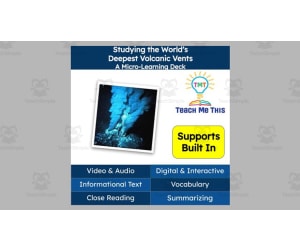
The World's Deepest Volcanic Vents | Interactive Science Lesson | Micro-Learning Deck
Science, Earth and Environmental Sciences, Earth Sciences, Grade 7, 8, 9, 10, Teacher Tools, Lesson Plans
This micro-learning deck is the perfect accessory to your Science instruction! This digital slideshow presents Studying the World's Deepest Volcanic Vents. Within this slideshow, you will receive: -Video Lesson -Reading Passage w/ Audio -Close Reading -Quick Write The informational texts included in this resource alongside the informal assessments will keep your students engaged from beginning to end.
Author Teach Me This
Tags Studying Volcanoes, Volcanic Vents, Science Lesson, Earth Sciences, Vocabulary
All About Water Cycle | Earth Science Unit
Science, Earth and Environmental Sciences, Earth Sciences, Grade 1, 2, 3, 4, Lesson Plans, Teacher Tools
All About Water Cycle | Earth Science Unit The All About Water Cycle | Earth Science Unit is a comprehensive teaching resource designed to bring earth science concepts to life in an engaging and creative way. Primarily targeted at educators teaching Grades 1 through 4, it places a strong emphasis on the sub-topic of Earth Sciences. What does the unit cover? Various aspects of the water cycle and states of water's role within it. A range of material formats, including word strips (e.g., 'Evaporation', 'Vapor', 'Clouds', and 'Precipitation') and visually stimulating posters detailing processes such as Condensation or how Sun assists in this cycle. In addition to visual aids, there are meticulously chosen project suggestions and thought-provoking activities included. These offer students an immersive hands-on experience that fosters deeper understanding of the science behind natural phenomena like Water Cycle. Educational resources accompanying these projects: Informative Articles: ('When Clouds Get Heavy' & 'Collecting Water'), each adjusted for different reading levels. Interactive Worksheets: focusing on label coloring or matching series. Craft-Based Project: a cut-and-glue project. A Review Game: providing setup instructions & printable questions! Teachers utilizing digital platforms like Google Classroom will find JPEGs explaining individual tasks, a handy Google Doc delineating contents, and lesson plan schedules in PDF files. Bonus Features: The unit includes six specialized writing templates revolving around this science topic, catering to early-stage writers up to more advanced ones. This facilitates cross-curricular learning and aids in comprehending the steps involved in the complex yet fascinating water cycle process. To sum up, 'All About Water Cycle | Earth Science Unit' is a treasure trove of resources that offers endless means to inspire lifelong learning while tailoring your teaching approach to cater for individual student needs.
Author Simply Schoolgirl
Tags Water Cycle, Earth Science, Interactive Learning, Hands-on Activities, Visual Aids

I WONDER - Do All Wolf Howls Sound The Same | Animated Video Lesson
Animals, Life Sciences, Science, Grade 4, 5, 6, 7, 8, 9, 10, Lesson Plans, Teacher Tools
Video Introduction Animal kingdoms are full of fascinating wonders to learn. This video is designed for the students to learn more about animals in different countries. I WONDER - Do All Wolf Howls Sound The Same | Animated Video Lesson Do you know what are axolotls? How do they look like and what is special about them? How does the angler fish glow? Do you where does the angler fish live? Can you name any other bioluminescent animal? How does the aye-aye lemur find food? Can you name any other lemurs? and where do they live? Are wolves loyal to their mates? Do all wolf howls sound the same? What is your favourite animal? Where does it live? Can you name any of the animals kingdoms? Do you have a pet animal? If yes, tell us what its name and what kind of animal, bird or fish is it? Format Available in MP4 format.
Author Educational Voice
Rating
Tags Do All Wolf Howls Sound The Same, Wolf Howl, Wolf Howl Facts, Wolf Howl Facts For Kids, Wolf Howl Video, Wolf Howl Video For Kids, Wolf, Wolf Facts, Wolf Video, Wolf Facts For Kids

I WONDER - How Long Does It Take For Food To Get To Our Stomachs
Human Body, Life Sciences, Science, Biology, STEM, Grade 2, 3, 4, 5, 6, 7, 8, Lesson Plans, Teacher Tools
Video Overview The human body is full of fascinating wonders to learn. This video is created to help the students recognize the anatomy and the job of the human body. I WONDER - How Long Does It Take For Food To Get To Our Stomachs | Animated Video Lesson Every part and organ in our human body is vital so let's see how important they are. Have you ever imagined how we look like if we didn't have a skeleton? Did you know that because we have our amazing muscles we can stand! Do you know how many teeth do we have? Have you ever wondered about the food journey inside our body? Can you name all the glands in our body? Why do we have skin? Our nervous system is really good at sending signals. Can you tell us more about it? Are you really good at Mathematics, painting, or any other thing? You should really thank your brain about it! The famous five senses are really doing a great work? Can you explain how every sense works? I WONDER - How Long Does It Take For Food To Get To Our Stomachs | Animated Video Lesson The video is perfect for encouraging the researching skills for the students, while learning more about our fantastic human body. I WONDER - How Long Does It Take For Food To Get To Our Stomachs | Animated Video Lesson This friendly designed video is suitable for students at school, homeschooling, and as a group activity. Format Available in MP4 format.
Author Educational Voice
Tags How Long Does It Take For Food To Get To Our Stomachs, How Long Does It Take For Food To Get To Our Stomachs Video, Stomach, Stomachs, Stomach Facts, Stomach Facts For Kids, Stomach Video
I WONDER - Do All Reindeers Have Antlers | Animated Video Lesson
STEM, Animals, Life Sciences, Science, Biology, Grade 1, 2, 3, 4, 5, 6, 7, 8, Lesson Plans, Teacher Tools
Video Introduction Animal kingdoms are full of fascinating wonders to learn. This video is designed for the students to learn more about animals in different countries. I WONDER - Do All Reindeers Have Antlers | Animated Video Lesson Do you like animals? what is your favorite one? Do you own a pet? If yes, tell us more about it, like what its name? And what do you like most about it? What are the animal kingdoms? Can you write down the characteristics of each animal class like mammals, birds, reptiles, amphibian, fish and mollusks. Do you know that some animals can sing, can you name any of them? What is the largest and the smallest mammal in the world? What is the largest and the smallest bird in the world? What is the largest and the smallest fish in the world? I WONDER - Do All Reindeers Have Antlers | Animated Video Lesson The video is perfect for encouraging the researching skills for the students, while learning more about these fantastic animals. I WONDER - Do All Reindeers Have Antlers | Animated Video Lesson This friendly designed video is suitable for students at school, homeschooling, and as a group activity. Format Available in MP4 format.
Author Educational Voice
Tags Do All Reindeers Have Antlers, Do All Reindeers Have Antlers Video, Reindeers Antlers, Reindeers Antlers Facts, Reindeers Antlers Facts For Kids, Reindeers Antlers Video, Reindeers Antlers Video For Kids
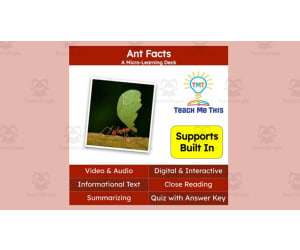
Ants | Interactive Science Lesson | Micro-Learning Deck
Science, Life Sciences, Insects, Grade 4, 5, 6, 7, Teacher Tools, Lesson Plans
Engage your science students with this informative lesson on ants. Through a short video, reading passage with audio support, close reading activity, and quick write prompt, learners will develop an understanding of ant biology and behavior. Implement as a whole class science lesson, center work, or at-home assignment for grades 4-7. The multimedia format appeals to visual, auditory, and kinetic learning styles. Students will learn details of ant anatomy, social structure, and role in seed dispersal and soil health. Assessment opportunities allow teachers to check comprehension on topics like external ant anatomy, ant colonies, jobs within the colony, and symbiosis. This concise yet comprehensive resource can supplement any life sciences curriculum in a blended or remote setting.
Author Teach Me This
Tags Ants Lesson, Summarizing, Interactive Science, Vocabulary, Comprehension

Reducing Your Community's Carbon Footprint: Very Green Houses Gr. 5-8
Science, Earth and Environmental Sciences, Environmental Science, Grade 5, 6, 7, 8, Teacher Tools, Lesson Plans
Reducing Your Community's Carbon Footprint: Very Green Houses Gr. 5-8, is a crucial educational resource designed to inspire students to ponder over the significant impacts of their community's carbon footprint on global climate change. Specifically designed for upper elementary and middle school levels - grades 5 to 8, this resource plays an integral role in the area of environmental science studies. About the Resource This exclusive product is based around a fascinating chapter slice titled "Very Green Houses Gr. 5-8", originating from an extensive lesson plan about reducing a community's carbon footprint. It features deep discussions about global climate change causes and effects, painting an intricate web connecting human activities, communities, and habitats. Understanding Cause and Effect Relationships An efficient teaching tool that assists students in understanding cause-and-effect relationships such as how daily commuting impacts a distant island due to worldwide climatic changes caused by increasing carbon emissions. A detailed insight into suburban living patterns forms an important part of this resource along with its impact on travel footprints within communities. It uniquely highlights Cuba's drastic transformation, showing how it managed to implement fossil fuel-free farming systems in just ten years' time - thus encouraging thoughts concerning sustainable energy consumption alternatives that do not harm our planet. The focus also lies on urban heat islands or densely populated cities that deeply affect local climates. Beyond only emphasizing problems related with climate change, there are suggestions pointing towards proactive solutions like recycling practices where students can brainstorm about future possible lives of recycled items. Inspiring Stories Across Globe: Coverage of stories related to environmentally friendly towns and cities around the globe aiming to inspire and provide instances of viable pathways towards sustainable living. The product also brings in additional resources like graphic organizers, carbon footprint calculator activities, and quizzes thus reinforcing self-learning among students. It gets you an enriching approach to environmental science education adhering securely to Bloom’s Taxonomy and STEAM initiatives. Convenience For Educators: An easily accessible PDF format within a single product file makes it convenient for educators across different settings from traditional public schools teachers to homeschoolers alike! It ultimately prepares the students for fostering a greener future!
Author Classroom Complete Press
Tags PDF

Lesson 4.1 - Potential & Kinetic Energy
Science, Chemistry, Physics, Grade 6, 7, 8, 9, 10, 11, 12, Lesson Plans, Teacher Tools
Lesson 4.1 - Potential & Kinetic Energy is a comprehensive teaching resource meticulously designed to demystify the intricate concepts of potential and kinetic energy for students in grades 6-12. This package, an ideal addition to any science curriculum, encompasses various components aimed toward enriching classroom instruction and boosting student engagement. Potential & Kinetic Energy Notes Included in the kit are the Potential & Kinetic Energy Notes, presenting a succinct overview of these two forms of energy along with their calculation methods. The notes offer two versions: version A with blanks fostering active participation during class, while version B fully completed for absent students or those requiring assistance. Potential & Kinetic Energy Practice Stations To enhance active learning beyond note taking, this package comes with a set of carefully curated Potential & Kinetic Energy Practice Stations. The stations include six sectors each paired with two questions regarding energy calculations—perfect for integration into group activities or independent study schemes based on classroom needs. Answer sheets tucked under corresponding queries aid in immediate feedback and self-assessment processes. Roller Coaster Energy Simulation A noteworthy highlight in this lesson kit is the interactive computer-based activity - Roller Coaster Energy Simulation— facilitating experiential learning scenarios rooted in real-world applications.. Instructions provided on an accompanying page guide students through this digital simulation; thereby allowing them to collect data and answer related questions during their exploration session. PowerPoint Presentation: Lesson 4.1 An inclusive PowerPoint presentation is supplied as part of Lesson 4.1; offering editable notes alongside Objectives & Starter Questions for boosting proactive participation throughout lectures or whole group discussions pivoting on understanding Indiana State Standards pertaining Integrated Chemistry & Physics ICP4.1 ICP4.2. Adaptable across multiple grades from 6 through 12, Lesson 4.1 - Potential & Kinetic Energy delivers versatile utilities oriented toward making complex scientific theories more understandable to all students, irrespective of their learning style or academic needs. It serves as an engaging resource for nurturing curiosity, exploration and robust understanding of energy concepts in your science classroom.
Author Integrated Chemistry and Physics
Tags Potential Energy, Kinetic Energy, Notes, Practice Stations, Simulation
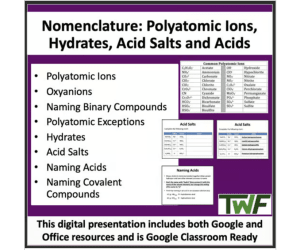
Nomenclature-Polyatomics & Covalent Compounds- Senior Chemistry Lesson
Science, Chemistry, Grade 10, 11, 12, Teacher Tools, Lesson Plans
Nomenclature-Polyatomics & Covalent Compounds - Senior Chemistry Lesson Your lesson covers the nomenclature of polyatomic compounds and covalent compounds. In order, the lesson teaches about; Polyatomic Ions, Oxyanions, Naming Binary Compounds, Polyatomic Exceptions, Hydrates, Acid Salts, Naming Acids, and Naming Covalent Compounds. Your lesson includes the teacher and student version of the presentation, an auto-graded exit ticket, and a student lesson handout so the students can record the notes on a more condensed medium. This lesson is designed to be your go-to resource, whether you're in a traditional classroom or a virtual one. With both a teacher version and a student version, it seamlessly fits into your lesson plans, making learning engaging and adaptable. Assessment made easy We've included an auto-graded Exit Ticket and a quiz with an answer key because I know you don't have an excess of time. I know you don't, because I don't and I know I'll do whatever I can to reduce my grading time. Whether you use PowerPoint or Google Slides, prefer Word or Google Docs, this lesson has you covered. This lesson comes in both Office and Google formats for your convenience. The student version of the presentation has strategically placed blanks for them to fill in as you're teaching. It keeps them active and engaged, encourages discussion, and leaves more time for those "aha" moments.
Author Teach With Fergy
Tags Chemistry Lesson, Valence Electrons, Ionic Bonding, Multivalent Ions, Ions, Nomenclature, Polyatomic Ions, Oxyanions, Hydrates

I WONDER - How Old Can Some Plants Be | Animated Video Lesson
Nature & Plants, Life Sciences, Science, Grade 6, 7, 8, 9, 10, 11, 12, Lesson Plans, Teacher Tools
Video Introduction An amazing video designed for the students to learn more about STEM. I WONDER - How Old Can Some Plants Be | Animated Video Lesson Do you like STEM subjects? what is your favorite one? Have you ever tried to plant a seed? If yes, tell us more about it. Or have you ever tried to invent something? If yes, tell us more about it. And how do you think it will help us? Have you ever seen a microorganism under a microscope? What was it? And how it looked like? Mathematics is a marvelous subject. Let' sharpen our brains and solve some equations. Do you like timetable tricks? What is your favorite one? Do you know how to code? Have you ever created an app or a game before? If yes, how was it like? I WONDER - How Old Can Some Plants Be | Animated Video Lesson The video is perfect for encouraging the researching skills for the students, while learning more about this fantastic topic. I WONDER - How Old Can Some Plants Be | Animated Video Lesson This friendly designed video is suitable for students at school, homeschooling, and as a group activity. Format Available in MP4 format.
Author Educational Voice
Tags How Old Can Some Plants Be, How Old Can Some Plants Be Video, Old Plants, Old Plants Facts, Old Plant, Old Plants Facts For Kids, Old Plants Video, Old Plants Video For Kids, Plants
Conservation: How The Changes In Fresh Water Could Change Our Lives Gr. 5-8
Science, Earth and Environmental Sciences, Environmental Science, Grade 5, 6, 7, 8, Teacher Tools, Lesson Plans
Product Description: Conservation: How The Changes In Fresh Water Could Change Our Lives Gr. 5-8 This teaching resource is a comprehensive instruction aid that explores the critical topic of water conservation, specifically focusing on fresh water resources. It's designed for middle-grade students—from grade 5 to 8—and takes an engaging approach to educate them about the importance of preserving our planet's freshwater supply. Main Features: Global scientific approach: Incorporates reading materials that explain what freshwater is and where it can be found. Climate change focus: Highlights how climate change threatens the purity and availability of fresh water—a resource directly linked to survival. Inclusive learning experiences: Includes interactive activities complementing theoretical knowledge with practical applications, deepening student understanding of fresh water conservation issues. Educational reinforcement tools: Contains comprehension questions and test-taking preparation content ensuring thorough mastery of the subject matter for Grade 5-8 learners In addition, this teaching tool includes color mini posters that not only enhance visual appeal but also function as effective aids for retaining information. This product is adaptable for group discussions or individual study, making it a flexible aide in various learning environments. Educational Standards Alignment & Pedagogical Approach: This lesson plan lines up effortlessly with Your State Standards , integrating Bloom's Taxonomy—an educational theory segmenting levels of intellectual behavior crucial in learning—in its instructional design. About the File Format: The educational material—packaged as a single PDF file—is not just enlightening but also sparks reflection; inspiring students to think deeply about the implications around changes in our fresh water.
Author Classroom Complete Press
Tags PDF

I WONDER - What Is A Gas | Animated Video Lesson
Chemistry, Science, Basic Science, Grade 4, 5, 6, 7, 8, 9, 10, Lesson Plans, Teacher Tools
Video Introduction An amazing activity designed for the students to learn more about STEM. I WONDER - What Is A Gas | Animated Video Lesson Do you like STEM subjects? what is your favorite one? Have you ever tried to plant a seed? If yes, tell us more about it. Or have you ever tried to invent something? If yes, tell us more about it. And how do you think it will help us? Have you ever seen a microorganism under a microscope? What was it? And how it looked like? Mathematics is a marvelous subject. Let' sharpen our brains and solve some equations. Do you like timetable tricks? What is your favorite one? Do you know how to code? Have you ever created an app or a game before? If yes, how was it like? I WONDER - What Is A Gas | Animated Video Lesson The video is perfect for encouraging the researching skills for the students, while learning more about this fantastic topic. I WONDER - What Is A Gas | Animated Video Lesson This friendly designed video is suitable for students at school, homeschooling, and as a group activity. Format Available in MP4 format.
Author Educational Voice
Tags What Is A Gas, What Is A Gas Video, Gas, Gases, Gases Facts, Gases Facts For Kids, Gases Facts For Kids Video, Materials , Stem, Stem Facts
I WONDER - How Smart Are Orangutans | Animated Video Lesson
Animals, Life Sciences, Science, Grade 3, 4, 5, 6, 7, 8, 9, Lesson Plans, Teacher Tools
Video Introduction Animal kingdoms are full of fascinating wonders to learn. This video is designed for the students to learn more about animals in different countries. I WONDER - How Smart Are Orangutans | Animated Video Lesson Pets are really great companions for humans. Have you ever had a pet at your house? If yes, tell us more about it. Do you know how many types of birds do we have on Earth? Can you name some of these types? Can you think of some characteristics that mammals have and why they are different from the other types of animals? Do you think humans are mammals? I WONDER - How Smart Are Orangutans | Animated Video Lesson The video is perfect for encouraging the researching skills for the students, while learning more about these fantastic animals. I WONDER - How Smart Are Orangutans | Animated Video Lesson This friendly designed video is suitable for students at school, homeschooling, and as a group activity. Format Available in MP4 format.
Author Educational Voice
Rating
Tags How Smart Are Orangutans, Orangutans, Orangutans Facts, Orangutans Video, Orangutans Video For Kids, Orangutans Facts For Kids, Orangutan, Orangutan Video, Orangutan Video For Kids
I WONDER - How Are Wave Used In Daily Life | Animated Video Lesson
Physics, Science, STEM, Grade 6, 7, 8, 9, 10, 11, 12, Lesson Plans, Teacher Tools
Video Introduction An amazing video designed for the students to learn more about STEM. I WONDER - How Are Wave Used In Daily Life | Animated Video Lesson Do you like STEM subjects? what is your favorite one? Have you ever tried to plant a seed? If yes, tell us more about it. Or have you ever tried to invent something? If yes, tell us more about it. And how do you think it will help us? Have you ever seen a microorganism under a microscope? What was it? And how it looked like? Mathematics is a marvelous subject. Let' sharpen our brains and solve some equations. Do you like timetable tricks? What is your favorite one? Do you know how to code? Have you ever created an app or a game before? If yes, how was it like? I WONDER - How Are Wave Used In Daily Life | Animated Video Lesson The video is perfect for encouraging the researching skills for the students, while learning more about this fantastic topic. I WONDER - How Are Wave Used In Daily Life | Animated Video Lesson This friendly designed video is suitable for students at school, homeschooling, and as a group activity. Format Available in MP4 format.
Author Educational Voice
Tags How Are Wave Used In Daily Life, How Are Wave Used In Daily Life Video, Wave, Wave Facts, Waves, Waves Facts For Kids, Waves Video, Waves Facts Video For Kids, Waves Video For Kids