



3,908 products added recently
Page 86 - Science Lesson Plan Template
Enhance your science instruction with a flexible lesson plan template designed for educators. This tool helps you structure objectives, materials, procedures, and assessments efficiently. Use it to create organized and impactful science lessons that cater to your students' needs.

 Show filters


I WONDER - What Is A Frost Flower | Animated Video Lesson
Earth Sciences, Earth and Environmental Sciences, Science, Grade 4, 5, 6, 7, 8, 9, 10, Lesson Plans, Teacher Tools
Video Introduction An amazing video designed for the students to learn more about famous phenomena in different countries. I WONDER - What Is A Frost Flower | Animated Video Lesson Weather phenomena can affect our lives, crops and even animals! Can you name any of the weather phenomena that happened in your country? Do you know when hailstorms happen? And what is the most country who has lots of hailstorms happening per year? Do you think the all countries have four seasons? If no, can you name any? Why do some animals sleep at winter? Can you name any of these animals? I WONDER - What Is A Frost Flower | Animated Video Lesson The video is perfect for encouraging the researching skills for the students, while learning more about this fantastic phenomenon. I WONDER - What Is A Frost Flower | Animated Video Lesson The video is perfect for encouraging the researching skills for the students, while learning more about this fantastic phenomenon. Format Available in a PDF format.
Author Educational Voice
Rating
Tags What Is A Frost Flower, Frost Flower, Frost Flower Facts, Frost Flower Video, Frost Flower Video For Kids, Frost Flower Facts For Kids, Severe Weather Phenomena, Severe Weather Phenomena Video

I WONDER - Are There Different Types Of Igneous Rocks | Animated Video
Geography, Social Studies, Earth Sciences, Earth and Environmental Sciences, Science, Grade 4, 5, 6, 7, 8, 9, 10, Lesson Plans, Teacher Tools
Video Introduction An amazing video designed for the students to learn more about famous places in different countries. I WONDER - Are There Different Types Of Igneous Rocks | Animated Video Lesson What do you know about this place? Do you know in which part of the world it is? Have you ever visited this place? If yes, can you tell us more about your adventure, and what do you like the most about this place? Do you like reading about Geography? What is your favorite country in the whole world? If you are going on a trip where it will be? Which country? What you are going to see there? Does this country has a famous place to visit? I WONDER - Are There Different Types Of Igneous Rocks | Animated Video Lesson The activity is perfect for encouraging the researching skills for the students, while learning more about this fantastic place. I WONDER - Are There Different Types Of Igneous Rocks | Animated Video Lesson This friendly designed video is suitable for students at school, homeschooling, and as a group activity. Format Available in MP4 format.
Author Educational Voice
Tags Are There Different Types Of Igneous Rocks, Are There Different Types Of Igneous Rocks Video, Different Types Of Igneous Rocks, Different Types Of Igneous Rocks Facts, Different Types Of Igneous Rocks Video

I WONDER - How Small Are Cells | Animated Video Lesson
Human Body, Life Sciences, Science, Biology, STEM, Grade 4, 5, 6, 7, 8, 9, 10, Lesson Plans, Teacher Tools
Video Overview The human body is full of fascinating wonders to learn. This video is created to help the students recognize the anatomy and the job of the human body. I WONDER - How Small Are Cells | Animated Video Lesson Every part and organ in our human body is vital so let's see how important they are. Have you ever imagined how we look like if we didn't have a skeleton? Did you know that because we have our amazing muscles we can stand! Do you know how many teeth do we have? Have you ever wondered about the food journey inside our body? Can you name all the glands in our body? Why do we have skin? Our nervous system is really good at sending signals. Can you tell us more about it? Are you really good at Mathematics, painting, or any other thing? You should really thank your brain about it! The famous five senses are really doing a great work? Can you explain how every sense works? I WONDER - How Small Are Cells | Animated Video Lesson The video is perfect for encouraging the researching skills for the students, while learning more about our fantastic human body. I WONDER - How Small Are Cells | Animated Video Lesson This friendly designed video is suitable for students at school, homeschooling, and as a group activity. Format Available in MP4 format.
Author Educational Voice
Tags How Small Are Cells, How Small Are Cells Video, Cells, Cells Facts, Cells Facts For Kids, Cells Video, Cells Video For Kids, Cell, Cell Size, Cell Size Facts
Prevention, Recycling & Conservation Gr. 5-8
Science, Earth and Environmental Sciences, Environmental Science, Grade 5, 6, 7, 8, Teacher Tools, Lesson Plans
Prevention, Recycling & Conservation Gr. 5-8: A Key Teaching Resource This teaching tool is designed to deepen students' understanding of sustainable practices and environmental conservation. It expertly brings together theory and practice for Grade 5 to Grade 8 learners depicting a real-life approach to science. An Invitation for Active Participation Intelligence-driven, this material invites students' active participation emphasizing that the battle for Earth's preservation begins with them. Sustainable Learning Experiences In-depth explanations on waste prevention methods and environmental problem-solving. Promotes creativity through innovative recycling management within their community. Harnesses practical knowledge by providing hands-on opportunities like building a classroom compost system. Inclusion of fun activities such as word search and crossword puzzles supporting vocabulary building! A Focus on Water Safety & Independent Research Skills The resource includes critical information about water safety - where it comes from and how it should be conserved. Also encourages developing independent research skills through Internet-based assignments such as creating green business guides or reporting specifically about greenhouse gases. All-Inclusive Teaching Toolkit in PDF Format! The downloadable PDF file comes with: Ready-to-use lesson plans:Fulfilling Bloom's Taxonomy and STEAM objectives aimed at various Environmental Science classes or any course addressing global issues User-friendly evaluation tools:Simplified student assessments like comprehension quizzes coupled with an answer key. The package has everything you need to equip your students with eco-conscious knowledge, outlining the future's biggest battles! Make learning fun while unraveling the complexities of our fragile ecosystems and creating eco-conscious global citizens.
Author Classroom Complete Press
Tags PDF
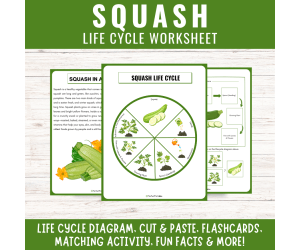
Squash Life Cycle Fall Plant Harvest Science unit study fun facts
Life Sciences, Science, Biology, Nature & Plants, Kindergarten, Preschool, Grade 1, 2, 3, Coloring Pages, Worksheets, Worksheets & Printables, Parts of and Anatomy of, Flashcards, Diagrams, Teacher Tools, Lesson Plans
Make learning about the squash life cycle fun and engaging with this printable plant science activity! Students will explore how a squash plant grows from seed to mature plant while learning about germination, plant growth, flowering, pollination, fruit development, and harvest. I like using this resource during fall science units, autumn classroom activities, harvest lessons, gardening studies, botany units, and seasonal learning. It's a low-prep activity that combines plant science with an engaging fall harvest theme. What You Will Get This printable Squash Life Cycle activity helps students understand the stages of squash plant growth while building science vocabulary and learning interesting facts about this popular fall crop. What's Included in this Resource? • Squash life cycle activity • Seed germination and growth stages • Plant parts and development activities • Flowering and pollination information • Fruit development and harvest stages • Fun facts about squash • Student-friendly science activities • Easy-to-use printable pages This resource is perfect for: • Fall science lessons • Autumn classroom activities • Harvest-themed lessons • Plant life cycle units • Botany and gardening studies • Science centers • Homeschool learning • Early finisher activities Why you will love this? • Easy to print and use • Connects science learning with a seasonal fall theme • Reinforces plant life cycle vocabulary • Encourages observation and scientific thinking • Introduces how crops grow from seed to harvest • Great for seasonal science centers and independent work This Squash Life Cycle activity is a fun way for students to discover how squash plants grow from seed to harvest while exploring plant development, pollination, fruit production, and fascinating fall harvest facts.
Author Perfect_Printables
Rating
Tags Plant Science, Life Cycle, Plant Life Cycle, Plants Diagram, Fall Activities, Squash Life Cycle, Squash, Fall Plants, Fall Science, Autumn Activities
It's So Easy Going Green: An Interactive, Scientific Look at Protecting Our Environment
Science, Earth and Environmental Sciences, Environmental Science, Grade 3, 4, 5, 6, Teacher Tools, Lesson Plans
It's So Easy Going Green: An Interactive, Scientific Look at Protecting Our Environment Teachers from grade three to six will find this comprehensive lesson plan an ideal tool for catalyzing intriguing discussions and activities based on environmental conservation in the classroom. Facts and Insights: Engaging Articles An assortment of twelve research-driven articles throwing light on diverse topics such as the impact of organic products and deciphering global warming. Aimed at instilling a passion for caring for our planet among young learners. Encourages students to ponder their responsibilities towards managing these global issues. Hands-on Activities: Practical Learning This resource is not just limited to theoretical learning; practical understanding comes into play with over thirty-five activities that transform students' perception towards sustainable practices. Here are just a few examples: Building terrariums using easily available resources. Demonstrating reforestation efforts with smaller scale models. Designing solar-powered ovens that harness renewable energy sources. The teaching materials are readily accessible as PDF files and add depth to regular science lessons by emphasizing the interconnected nature of various ecosystems under the category - Environmental Science. Incorporate & Evolve Your Teaching Practices! This resource seamlessly integrates into whole-group instruction sessions, small-group discussions, or independent work students take home— making each interaction with it an enriching experience! Such an approach fosters responsible behaviors among young learners as they evolve to become guardians of our planet. Whether you are homeschooling parent or public school teacher seeking innovative ways to freshen up science instruction while instilling sustainable living principles, "It's So Easy Going Green" has the potential to invigorate your classroom with eager learners who are ready to take a stand for their environment.
Author Classroom Complete Press
Tags PDF

I WONDER - How Is Potential Energy Released | Animated Video Lesson
Physics, Science, Grade 5, 6, 7, 8, 9, 10, 11, Lesson Plans, Teacher Tools
Video Introduction An amazing video designed for the students to learn more about STEM. I WONDER - How Is Potential Energy Released | Animated Video Lesson Plants world is really fascinating! Do you know that some flowers eat insects? Some other plants like to grow on walls can you mention any? Do you know what is the difference between fungicide and pesticide? If yes, Can you tell us more about it? What is nuclear energy? Is it safe to use it? Do you think it is a clean energy? Have you ever read about potential energy? If yes, tell us what it is? Do you think that potential energy can be converted into another form of energy? How it happens? I WONDER - How Is Potential Energy Released | Animated Video Lesson The video is perfect for encouraging the researching skills for the students, while learning more about this fantastic topic. I WONDER - How Is Potential Energy Released | Animated Video Lesson This friendly designed video is suitable for students at school, homeschooling, and as a group activity. Format Available in MP4 format.
Author Educational Voice
Rating
Tags How Is Potential Energy Released, How Is Potential Energy Released Video, Potential Energy, Potential Energy Video, Potential Energy Video For Kids, Potential Energy Facts, Potential Energy Facts For Kids

I WONDER - How Do Giraffes Drink | Animated Video Lesson
Animals, Life Sciences, Science, Biology, STEM, Grade 1, 2, 3, 4, 5, 6, 7, 8, Lesson Plans, Teacher Tools
Video Introduction Animal kingdoms are full of fascinating wonders to learn. This video is designed for the students to learn more about animals in different countries. I WONDER - How Do Giraffes Drink | Animated Video Lesson Do you like animals? what is your favorite one? Do you own a pet? If yes, tell us more about it, like what its name? And what do you like most about it? What are the animal kingdoms? Can you write down the characteristics of each animal class like mammals, birds, reptiles, amphibian, fish and mollusks. Do you know that some animals can sing, can you name any of them? What is the largest and the smallest mammal in the world? What is the largest and the smallest bird in the world? What is the largest and the smallest fish in the world? I WONDER - How Do Giraffes Drink | Animated Video Lesson The video is perfect for encouraging the researching skills for the students, while learning more about these fantastic animals. I WONDER - How Do Giraffes Drink | Animated Video Lesson This friendly designed video is suitable for students at school, homeschooling, and as a group activity. Format Available in MP4 format.
Author Educational Voice
Tags How Do Giraffes Drink, How Do Giraffes Drink Video, Giraffes, Giraffe, Giraffes Facts, Giraffes Facts For Kids, Giraffes Video, Giraffes Video For Kids, Animal, Animals

Acids, Bases, and Neutralization - Lesson Bundle
Science, Chemistry, Grade 6, 7, Teacher Tools, Lesson Plans
Acids, Bases, and Neutralization - Lesson Bundle An invaluable resource for educators seeking to introduce middle school and lower-level high school students to the concepts of acids, bases, and neutralization reactions. This bundle caters specifically to science instructors and fits perfectly within a chemistry curriculum. The lesson bundle combines educational efficiency with digital convenience. Each pack includes a student and teacher version available in PowerPoint and PDF formats. Vibrant colored diagrams simplifying complex subjects. The teacher's copy emphasizing parts that require the students' attention during the lesson. A methodology that keeps students engaged through active participation rather than passive note-taking saving time by removing lengthy writing exercises while providing more opportunities for classroom discussions or group activities. In addition, three embedded videos within the PowerPoint presentation act as valuable supplements supporting comprehension of these science concepts. In terms of practical application, there is also a basic lab activity included where students get hands-on experience testing pH levels of everyday substances – an engaging practice complimenting theoretical learnings. The unique approach includes: A real-world scenario with academic lessons using Acid Spill Case Study as part of its content coverage. A bonus feature enables it to stand out from standard resources - The section on Indicators which simplifies information effectively maintaining interest amongst young learners. }
Author Teach With Fergy
Tags Acids, Bases, Neutralization Reactions, Chemistry Curriculum, Hands-on Learning

How to: 3D Print
Science, Technology, Computer Science, Not Grade Specific, Teacher Tools, Lesson Plans
A step-by-step guide to make 3D printing simple and easy!
Author WhyMaker
Tags Computer Science - Technology, For All Subjects, Quick Guide Poster, 3D Printing Guide

I WONDER - How Long Does It Take A Baby Reindeer To Walk
STEM, Animals, Life Sciences, Science, Biology, Grade 1, 2, 3, 4, 5, 6, 7, 8, Lesson Plans, Teacher Tools
Video Introduction Animal kingdoms are full of fascinating wonders to learn. This video is designed for the students to learn more about animals in different countries. I WONDER - How Long Does It Take A Baby Reindeer To Walk | Animated Video Lesson Do you like animals? what is your favorite one? Do you own a pet? If yes, tell us more about it, like what its name? And what do you like most about it? What are the animal kingdoms? Can you write down the characteristics of each animal class like mammals, birds, reptiles, amphibian, fish and mollusks. Do you know that some animals can sing, can you name any of them? What is the largest and the smallest mammal in the world? What is the largest and the smallest bird in the world? What is the largest and the smallest fish in the world? I WONDER - How Long Does It Take A Baby Reindeer To Walk | Animated Video Lesson The video is perfect for encouraging the researching skills for the students, while learning more about these fantastic animals. I WONDER - How Long Does It Take A Baby Reindeer To Walk | Animated Video Lesson This friendly designed video is suitable for students at school, homeschooling, and as a group activity. Format Available in MP4 format.
Author Educational Voice
Tags How Long Does It Take A Baby Reindeer To Walk, How Long Does It Take A Baby Reindeer To Walk Video, Baby Reindeer, Baby Reindeer Facts, Baby Reindeer Facts For Kids, Baby Reindeer Video, Baby Reindeer Video For Kids

Animal Science Unit | All About Skunks | Learning about Animals
Science, Life Sciences, Animals, Kindergarten, Preschool, Grade 1, 2, Lesson Plans, Teacher Tools
Animal Science Unit: Skunks This is a comprehensive teaching resource with an amazing array of resources enabling educators to formulate an appealing science unit revolving around animal studies, specifically skunks. Primarily targeting Pre-K through 2nd grade. Unit Materials: Real-life skunk photographs: Perfectly supplement lessons on adaptation and anatomy. Non-fiction articles & fictional stories: Help cultivate literacy skills alongside scientific understanding. Arts and crafts materials: Cute cut-outs & masks that encourage creative exploration along with silhouette outlines for studying anatomical details vividly. Diverse worksheets and writing activities: Hog Talent Show! - Mini-book, full-page blank booklets alongside more sophisticated report-templates to cater diverse abilities of documenting observations scientifically resulting invaluable scholastic growth This expansive collection allows teachers to integrate learning with creativity while tailoring sessions according to each student’s learning capacity and is perfect for a variety of settings from whole classroom lessons to small groups or even independent study assignments. This unit contains everything you need to learn to each your students about skunks! Inclusion of Fun Learning Games: A guessing game based on macro-photography coupled with memory exercise facilitating recall process solidifies learned concepts while keeping things interactive. An ideal comprehensive addition to the educator’s toolkit for a memorable science unit focusing on skunks!
Author Simply Schoolgirl
Tags Skunks, Animal Science, Characteristics, Behaviors, Teaching Resource
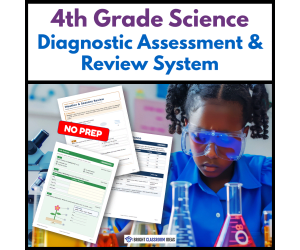
4th Grade Science Diagnostic Assessment & Review System
Science, Grade 4, Assessments, Teacher Tools, Lesson Plans, Worksheets & Printables
Start the year with a clear picture of what students know using this 4th grade beginning of year science assessment and targeted skills system. With a 46-question diagnostic worth 116 points , teacher scoring and analysis tools, instructional grouping support, 13 targeted follow-up practice pages , and complete explained answer keys, this resource helps you move from assessment results to focused instruction without piecing together separate materials. Designed as a complete Assess → Analyze → Group → Review → Reteach system, this Grade 4 science resource checks readiness across Life Science, Earth Science, Physical Science, and Scientific Practices using diagrams, food webs, cycles, models, graphs, data tables, scenarios, and Claim-Evidence-Reasoning tasks. What’s Included This 4th grade science assessment and review system includes: ✅ 46-question beginning-of-year science diagnostic ✅ 116 total assessment points ✅ 4 major science strands ✅ Life Science questions ✅ Earth Science questions ✅ Physical Science questions ✅ Scientific Practices questions ✅ Multiple-choice questions ✅ Short-answer questions ✅ Labeling activities ✅ Matching questions ✅ Diagram interpretation ✅ Data tables ✅ Graph reading ✅ Scientific scenarios ✅ Vocabulary-in-context questions ✅ Claim-Evidence-Reasoning (CER) tasks ✅ 11 labeling and diagram-interpretation items ✅ Food web interpretation ✅ Energy pyramid analysis ✅ Water cycle diagram ✅ Rock cycle diagram ✅ Forces and motion models ✅ Particle models and changes of state ✅ Answer recording sheet ✅ Quick-reference answer key ✅ Skill-by-skill scoring chart ✅ Strand analysis tool ✅ Secure, Developing, and Needs Support performance bands ✅ Individual Student Performance Profile ✅ Whole-class data tracker ✅ Suggested instructional groups ✅ Group planning sheet ✅ 13 targeted follow-up science practice pages ✅ “Remember” reteaching box on every follow-up page ✅ “Apply It” challenge on every follow-up page ✅ Fresh practice with no repeated assessment questions ✅ Complete answer keys ✅ Suggested short-answer responses ✅ Completed visual and diagram answers ✅ Sample CER responses ✅ Short “why” explanation for every assessment item ✅ CER scoring rubric Part 1 contains 46 mixed-format questions worth 116 total points across four science strands. The Teacher Guide suggests using two 35–45 minute sessions and emphasizes that the diagnostic is a planning tool designed to pinpoint where instruction should begin. Part 2 turns student responses into actionable data with answer recording tools, quick scoring, skill-by-skill analysis, strand performance bands, student profiles, a whole-class tracker, and suggested instructional groups. Part 3 includes 13 ready-to-assign targeted follow-up pages , each featuring fresh practice, a short Remember reteach box, and an Apply It challenge for extension. Part 4 provides correct answers for all 46 questions, suggested open-response answers, completed diagrams, sample CER responses, short explanations of why answers are correct, partial-credit guidance, and a CER scoring rubric. How It Works in the Classroom Use this 4th grade beginning of year science assessment during the first weeks of school to identify what students retained from earlier science learning and where instruction should begin. The resource follows a practical five-step system: 🔎 Assess — Students complete the 46-item mixed-format science diagnostic 📊 Analyze — Score by skill and strand to identify patterns and gaps 👥 Group — Sort students into instructional groups based on shared needs 📝 Review — Assign only the targeted follow-up pages students need 🎯 Reteach — Use complete explanations, worked visuals, and sample CER responses to support next steps This workflow is built directly into the four-part resource. The 5-Step System chart on page 2 of Part 1 visually connects each stage to the matching section of the pack, helping teachers move from assessment to action. Use this resource for: ⭐ Beginning-of-year science assessment ⭐ 4th grade science diagnostic ⭐ Back-to-school science review ⭐ Science pre-assessment ⭐ Science readiness check ⭐ Formative assessment ⭐ Small-group planning ⭐ Science intervention ⭐ Targeted reteaching ⭐ Data-driven instruction ⭐ Skill-based grouping ⭐ Independent follow-up practice ⭐ Science centers ⭐ CER practice ⭐ Graph and data interpretation review The Scoring at a Glance chart on page 2 of Part 2 breaks the assessment into four strand totals: Life Science /36, Earth Science /31, Physical Science /29, and Scientific Practices /20 , for 116 total points . It also defines three performance bands: Secure (80%–100%) , Developing (50%–79%) , and Needs Support (below 50%) . The Class Data Tracker on page 15 of Part 2 gives teachers a whole-class view of Life, Earth, Physical, and Scientific Practices percentages, while the Suggested Instructional Groups on page 16 connect students’ lowest strands to matching Part 3 review pages. Standards & Learning Goals This fourth grade science diagnostic assessment reviews foundational concepts and scientific reasoning across four major strands: 🌱 Life Science — animal structures, plant structures, structure and function, ecosystems, food webs, energy flow, adaptations, producers, consumers, decomposers, energy pyramids, and interpreting population data 🌎 Earth Science — water cycle, transpiration, weather and climate, climate data, dual-format graph reading, rock cycle, rock types, mineral properties, weathering, erosion, deposition, fast and slow Earth changes, and evidence-based explanations ⚡ Physical Science — forms of energy, potential and kinetic energy, energy transformations, balanced and unbalanced forces, net force, motion graphs, states of matter, particle models, changes of state, conductors and insulators, mixtures, mass, and force 🔬 Scientific Practices — fair tests, variables and controls, investigation design, data tables, graph interpretation, drawing conclusions, tools and measurement, and Claim-Evidence-Reasoning Students demonstrate understanding through varied science tasks rather than one question type. The assessment includes flower-part labeling, bird-beak structure and function, a food web, an energy pyramid, a five-stage water cycle diagram, climate data, a climate graph, the rock cycle, weathering-erosion-deposition sequencing, a roller-coaster energy model, balanced and unbalanced force diagrams, a distance-time graph, particle models, changes of state, investigation design, plant-growth data, and graph interpretation. The Skill-by-Skill Scoring Chart on pages 10–12 of Part 2 helps teachers pinpoint specific gaps instead of relying only on one total score. Skills include structures and function, food webs, ecosystems, adaptations, water cycle, weather and climate, climate graphs, rock cycle, Earth changes, energy forms, net force, motion graphs, matter and particles, investigation design, data interpretation, graph reading, drawing conclusions, and tools and measurement. Why Teachers Love It ✨ Move beyond a single test score. Results can be analyzed by strand and individual skill, helping teachers see where students are secure and where review is needed. ✨ Turn assessment data into an instructional plan. The scoring tools connect results to performance bands, grouping, and targeted follow-up practice instead of leaving teachers with a stack of completed tests. ✨ Use visual, varied questions to see student thinking. Students work with diagrams, food webs, models, data tables, graphs, labeling, matching, scenarios, vocabulary in context, short responses, and CER tasks. ✨ Assess deeper diagram interpretation. The diagnostic includes 11 labeling or diagram-interpretation items , including food webs, an energy pyramid, water and rock cycles, force models, particle models, and more. ✨ Support data-driven small groups. The Suggested Instructional Groups tool organizes students around shared needs in Life Science, Earth Science, Physical Science, or Scientific Practices. ✨ Differentiate with clear performance bands. Use Secure, Developing, and Needs Support ranges to guide enrichment, targeted practice, or foundational small-group reteaching. ✨ Assign only the review students need. The 13 targeted follow-up pages include: Structures & Function Review Food Webs Review Ecosystems & Energy Review Adaptations Review Water Cycle Review Weather & Climate Review Rocks & the Rock Cycle Review Earth Changes Review Energy & Its Forms Review Forces & Motion Review Properties of Matter Review Scientific Investigation Review Science Data & Graphs Review The Practice Page Menu on page 2 of Part 3 directly matches student difficulties to specific follow-up pages, making targeted assignment faster. ✨ Reteach before students practice. Every targeted page includes a short Remember box that reviews the essential concept before students begin. ✨ Challenge students who are already secure. Every follow-up page includes an Apply It task that extends thinking beyond basic recall. ✨ Build Claim-Evidence-Reasoning skills. Students complete CER tasks connected to adaptations, canyon formation, force and mass, and plant-growth data. Part 4 includes sample CER responses and a scoring rubric. ✨ Make grading more manageable. Part 4 includes correct answers, suggested short-answer responses, completed diagrams, explanations of why answers are correct, and guidance for awarding partial credit on multi-part items. ✨ Support visual science learning. The resource uses colorful diagrams, models, tables, food webs, graphs, particle representations, force arrows, and other visual formats to assess science reasoning in multiple ways. ✨ Use student profiles for individualized planning. The Student Performance Profile on page 14 of Part 2 includes strand snapshots, strengths, focus areas, assigned Part 3 pages, and group placement. ✨ See class-wide patterns quickly. The Class Data Tracker on page 15 lets teachers scan columns for whole-class gaps and rows for student grouping needs. ✨ Keep the instructional loop connected. Assessment, analysis, grouping, targeted review, reteaching, and answer support are designed as one coordinated system rather than disconnected activities. Start the year knowing what students understand and what they need next with this 4th grade beginning of year science assessment . Download this complete diagnostic and targeted review system to assess readiness, analyze results by strand and skill, create focused instructional groups, assign specific follow-up practice, and support reteaching with complete explained answer keys. Perfect for teachers searching for a 4th grade science diagnostic assessment , beginning-of-year science review, back-to-school science assessment, fourth grade science pre-assessment, Life Science review, Earth Science review, Physical Science review, Scientific Practices assessment, food webs, water cycle review, rock cycle review, forces and motion, properties of matter, CER practice, science intervention, small-group science planning, data-driven instruction, or targeted science reteaching.
Author Bright Classroom Ideas Marketplace
Rating
Tags Science, Back To School, Assessment, Worksheet

Motion: How to Recognize Motion - FLASH-PC
Science, Physics, Common Core, Grade 5, 6, 7, 8, Teacher Tools, Lesson Plans
Motion: How to Recognize Motion - FLASH-PC The Motion: How to Recognize Motion - FLASH-PC is a comprehensive teaching resource, meticulously designed for educators focusing on Grade 5 through Grade 8, who aim to deliver a well-rounded understanding of motion physics. Infused with curriculum-based content, this product brings an innovative blend of materials that can foster in-depth knowledge about recognizing and understanding the dynamics of motion. Brimming with educational content such as reading passages along with 'before you read' and 'after you read' questions, it enables students to explore the concept at a comfortable pace. For further assistance in comprehension, this package also includes engaging video and audio activities making it easy for educators to explain complex concepts like inertia or velocity. Incorporated Learning Tools: Vocabulary flash cards: Offers students an efficient way of learning difficult science terms related to motion. User-friendly software for PCs: Increases accessibility in various learning environments such as classrooms or homeschooling sessions. Cohesive with Common Core State Standards: Ensures that students are grasping up-to-date content while aligning their cognitive skills according the principles outlined by Bloom's Taxonomy. This teaching resource exceeds a typical lesson plan by including useful printables that can be utilized within various settings - they can serve as study notes during whole-group instructions or turned into game cards for an interactive small group activity encouraging student participation. The bottom line; The Motion: How to Recognize Motion - FLASH-PC resources offers versatile components which empower educators regardless if they handle small private groups or large public-school grades effectively teaching the principles of motion—an essential pillar in physics—all within their fingertips.
Author Classroom Complete Press
Tags Software (PC)
Global Warming EFFECTS: Climate and the Economy - FLASH-PC
Science, Earth and Environmental Sciences, Environmental Science, Common Core, Grade 5, 6, 7, 8, Teacher Tools, Lesson Plans
Global Warming EFFECTS: Climate and the Economy - FLASH-PC An essential educational tool devised primarily for teachers educating students from Grade 5 to Grade 8. It offers an extensive dive into climate science alongside an analysis of economic impacts caused by global warming, making it a key resource for imparting knowledgeable insights on environmental science topics. Teaching Resource Serving as a concise lesson plan, this teaching aid presents a wealth of instructional content effortlessly adaptable to diverse teaching scenarios. Whether orchestrating group debates, moderating small group discussions or assigning individual homework tasks, this resource caters to all learning styles and environments. Inclusions Reading passages with pre-and-post reading questions Vocabulary flashcards Interactive activities Printable materials Video clips Educational Standards Alignment The content within is aptly aligned with Environmental Science curriculums tailored for middle school (Grade 5-8). Purposefully designed incorporating Bloom's Taxonomy principles while maintaining compatibility with Common Core State Standards demonstrates the high academic standards achieved in crafting this product. In Summary: About Product: This software serves as an encompassing tool allowing teachers to effectively teach intricate issues like global warming effects on our ecology and its interlinkage with economics. Educational Value: Fosters engagement and enrichment while aligning lesson plans with current education standards.
Author Classroom Complete Press
Tags Software (PC)
I WONDER - How Big Was The Apatosaurus | Animated Video Lesson
History: Ancient, History, Social Studies, History: World, Animals, Life Sciences, Science, Grade 3, 4, 5, 6, 7, 8, 9, Lesson Plans, Teacher Tools
Video Introduction An amazing video designed for the students to learn more about dinosaurs in different countries. I WONDER - How Big Was The Apatosaurus | Animated Video Lesson Do you like dinosaurs? what is your favorite one? Do you own a pet? If yes, tell us more about it, like what its name? And what do you like most about it? Do you think that your pet has been evolved from a dinosaur? Can you write down the characteristics of your favourite dinosaur like it's shape, their rivals, where did it use to live and what was their favourite food? What is the largest and the smallest dinosaur that ever found? Why is the T-rex is so famous? Have you ever read any interesting facts about it? Can you name any of the carnivores or herbivores dinosaurs? I WONDER - How Big Was The Apatosaurus | Animated Video Lesson The video is perfect for encouraging the researching skills for the students, while learning more about dinosaurs. I WONDER - How Big Was The Apatosaurus | Animated Video Lesson This friendly designed video is suitable for students at school, homeschooling, and as a group activity. Format Available in MP4 format.
Author Educational Voice
Rating
Tags How Big Was The Apatosaurus, How Big Was The Apatosaurus Video, Apatosaurus, Apatosaurus Facts, Apatosaurus Video, Apatosaurus Video For Kids, Apatosaurus Facts For Kids, Dinosaurs

I WONDER - What Is Fair Food Trade | Animated Video Lesson
Environmental Science, Earth and Environmental Sciences, Science, Earth Sciences, Grade 6, 7, 8, 9, 10, 11, 12, Lesson Plans, Teacher Tools
Video Introduction An amazing video designed for the students to learn more about STEM. I WONDER - What Is Fair Food Trade | Animated Video Lesson Do you like STEM subjects? what is your favorite one? Have you ever tried to plant a seed? If yes, tell us more about it. Or have you ever tried to invent something? If yes, tell us more about it. And how do you think it will help us? Have you ever seen a microorganism under a microscope? What was it? And how it looked like? Mathematics is a marvelous subject. Let' sharpen our brains and solve some equations. Do you like timetable tricks? What is your favorite one? Do you know how to code? Have you ever created an app or a game before? If yes, how was it like? I WONDER - What Is Fair Food Trade | Animated Video Lesson The video is perfect for encouraging the researching skills for the students, while learning more about this fantastic topic. I WONDER - What Is Fair Food Trade | Animated Video Lesson This friendly designed video is suitable for students at school, homeschooling, and as a group activity. Format Available in MP4 format.
Author Educational Voice
Tags What Is Fair Food Trade, What Is Fair Food Trade Video, Fair Food Trade, Fair Food Trade Facts, Fair Food Trade Facts For Kids, Fair Food Trade Video, Fair Food Trade Video For Kids

Motion Gr. 4-7
Science, Physics, Grade 4, 5, Teacher Tools, Lesson Plans
Motion Gr. 4-7 Teaching Resource Motion Gr. 4-7 is a teaching aid created specifically for fourth to seventh graders, helping them master the diversified concepts of motion such as linear, oscillating, reciprocating, and rotational motions. Integrative Learning Approach The design of this product aims to promote understanding through engagement in valuable activities, effectively moving students away from rote learning. The tool fits effortlessly into classroom environments - it can be used in whole group instruction or small group discussions. It also works well as homework assignments for students who prefer individual studying without distractions. Motion Gr. 4-7 comes with student notes that are concise yet highly informative - providing rapid reference points for integrating learning and revising crucial concepts. Besides engaging lessons on principles of motion, this resource also includes various comprehensively designed assessment tools like crosswords and word searches that ensure learning is fun! An answer key is provided to ease the grading process during assessment periods. Aid for Grade 4-7 Science Teachers Educational experts categorize Motion Gr. 4-7 under Physical Science teaching resources since it has been designed carefully to break down complex themes into manageable chunks suitable for grades four through seven—a crucial period when foundational scientific learnings must be strengthened to prepare students for more intricate topics encountered later on.
Author Classroom Complete Press
Tags PDF

I WONDER - What Organs Is The Bladder Connected To | Animated Video
Biology, Life Sciences, Science, Human Body, STEM, Grade 6, 7, 8, 9, 10, 11, 12, Lesson Plans, Teacher Tools
Video Overview The human body is full of fascinating wonders to learn. This video is created to help the students recognize the anatomy and the job of the human body. I WONDER - What Organs Is The Bladder Connected To | Animated Video Lesson Every part and organ in our human body is vital so let's see how important they are. Have you ever imagined how we look like if we didn't have a skeleton? Did you know that because we have our amazing muscles we can stand! Do you know how many teeth do we have? Have you ever wondered about the food journey inside our body? Can you name all the glands in our body? Why do we have skin? Our nervous system is really good at sending signals. Can you tell us more about it? Are you really good at Mathematics, painting, or any other thing? You should really thank your brain about it! The famous five senses are really doing a great work? Can you explain how every sense works? I WONDER - What Organs Is The Bladder Connected To | Animated Video Lesson The video is perfect for encouraging the researching skills for the students, while learning more about our fantastic human body. I WONDER - What Organs Is The Bladder Connected To | Animated Video Lesson This friendly designed video is suitable for students at school, homeschooling, and as a group activity. Format Available in MP4 format.
Author Educational Voice
Tags What Organs Is The Bladder Connected To, What Organs Is The Bladder Connected To Video, Bladder, Bladder Facts, Bladder Facts For Kids, Bladder Video, Bladder Video For Kids, Urinary Bladder
Cells, Skeletal & Muscular Systems: What Are Organs & Organ Systems? Gr. 5-8
Science, Life Sciences, Human Body, Grade 5, 6, 7, 8, Teacher Tools, Lesson Plans
Cells, Skeletal & Muscular Systems: What Are Organs & Organ Systems? Gr. 5-8 A comprehensive teaching resource tailored for students in Grades 5 through 8. This resource dives into the fascinating world of human anatomy, with focus on cells, and the skeletal and muscular systems. Teaching Cell Structure & Function This product delves into cell structure and function with clear lessons targeting all student levels. Special attention is given to specialized cell types - helping students understand that not all cells are created equal. From here, learners can appreciate how different cells come together to form tissues and eventually organs and organ systems. An Overview of Eight Different Organ Systems Circulatory System Respiratory System Nervous System Digestive System Excretory System Reproductive System The organ systems are distinctly detailed within this course material for ease of understanding. In-depth Studies: Muscular & Skeletal Systems In-depth studies then follow on two very integral human body components: the muscular system and skeletal system. Educational Approaches: The manual can be used during classroom interactive sessions (whole-group overview or small group focused study) . The manual can also serve as homework material. Bonus Educational Features: Reading Passages Pre-reading Activities Sequential Lesson Plans Mini Posters Colorful Visually Enhances Learning Evaluation & Assessment : Test Prep Tools Bloom's Taxonomy High-quality Content that Aligns with State Standards covers STEM initiatives.
Author Classroom Complete Press
Tags PDF, The Organs In The Muscular System, Are Organs Muscles

I WONDER - What Are Conductors And Insulators | Animated Video Lesson
Chemistry, Science, Grade 6, 7, 8, 9, 10, 11, 12, Lesson Plans, Teacher Tools
Video Introduction An amazing video designed for the students to learn more about STEM. I WONDER - What Are Conductors And Insulators | Animated Video Lesson Do you like STEM subjects? what is your favorite one? Have you ever tried to plant a seed? If yes, tell us more about it. Or have you ever tried to invent something? If yes, tell us more about it. And how do you think it will help us? Have you ever seen a microorganism under a microscope? What was it? And how it looked like? Mathematics is a marvelous subject. Let' sharpen our brains and solve some equations. Do you like timetable tricks? What is your favorite one? Do you know how to code? Have you ever created an app or a game before? If yes, how was it like? I WONDER - What Are Conductors And Insulators | Animated Video Lesson The video is perfect for encouraging the researching skills for the students, while learning more about this fantastic topic. I WONDER - What Are Conductors And Insulators | Animated Video Lesson This friendly designed video is suitable for students at school, homeschooling, and as a group activity. Format Available in MP4 format.
Author Educational Voice
Tags What Are Conductors And Insulators, What Are Conductors And Insulators Video, Conductors, Conductors Facts, Conductors Facts For Kids, Conductors Video, Insulators, Insulators Facts, Insulators Video

Creatures of the Deep Mini Unit
Science, Life Sciences, Animals, Grade 6, 7, 8, 9, Teacher Tools, Lesson Plans
Creatures of the Deep Mini Unit This is a Creatures of the Deep Mini Unit that will provide students with resources from the beginning to end of a unit. This unit will leave students feeling more knowledgeable about this animal species and equipped to tackle any and all comprehensive activities related to deep sea creatures. This unit is great for middle school students. What You Get: You will receive a zip file that includes: 1. A Zip Folder with Google Classroom Versions 2. Preview Sheets as PDF, PowerPoints, and JPEG files 3. A Zip Folder with Separated Materials for each animal (PDFs) How to Use the Creatures of the Deep Mini Unit: This is a comprehensive unit of study that will have many components to make learning come to life. The first lesson introduces students to the history of deep sea exploration as well as providing some background information on the adaptions that deep sea creatures have made. Reading sheets are provided for eight different deep sea creatures with information on their habitats, feeding, reproduction and interaction with humans. Instructions and sheets are included for students to create their own presentation about deep sea creatures. All materials in the file are also included in a Google Classroom format for teachers to easily upload to their own websites. I hope you enjoy!! Take A Look At My Best Sellers: The History of Piracy The History of Space Exploration – Complete Unit Navajo Code Talkers Mini Unit Women in World War Two – Complete Unit The Forbidden City Mini Unit Natural Disasters – Complete Unit You Can Find More Resources At My Store Front Here: Mr. Gray History
Author Mr Gray History
Tags Creatures Of The Deep, Sea Animals, Sea Animal Reading Passage, Animal Posters, Animal Booklets, Animal Adaptations, Deep-Sea Explorations

I WONDER - Can You Live With One Kidney | Animated Video Lesson
Science, Human Body, Life Sciences, Biology, Grade 3, 4, 5, 6, 7, 8, 9, Lesson Plans, Teacher Tools
Video Overview The human body is full of fascinating wonders to learn. This video is created to help the students recognize the anatomy and the job of the human body. I WONDER - Can You Live With One Kidney | Animated Video Lesson Every part and organ in our human body is vital so let's see how important they are. Have you ever imagined how we look like if we didn't have a skeleton? Did you know that because we have our amazing muscles we can stand! Do you know how many teeth do we have? Have you ever wondered about the food journey inside our body? Can you name all the glands in our body? Why do we have skin? Our nervous system is really good at sending signals. Can you tell us more about it? Are you really good at Mathematics, painting, or any other thing? You should really thank your brain about it! The famous five senses are really doing a great work? Can you explain how every sense works? I WONDER - Can You Live With One Kidney | Animated Video Lesson The video is perfect for encouraging the researching skills for the students, while learning more about our fantastic human body. I WONDER - Can You Live With One Kidney | Animated Video Lesson This friendly designed video is suitable for students at school, homeschooling, and as a group activity. Format Available in MP4 format.
Author Educational Voice
Tags Can You Live With One Kidney, Can You Live With One Kidney Video, Kidney, Kidneys, Kidney Facts, Kidney Facts For Kids, Kidney Video, Kidney Video For Kids, Human Body, Human Body Facts

I WONDER - What Is The Most Reliable Form Of Renewable Energy
Earth and Environmental Sciences, Science, Environmental Science, Grade 4, 5, 6, 7, 8, 9, 10, Lesson Plans, Teacher Tools
Video Introduction An amazing video designed for the students to learn more about STEM. I WONDER - What Is The Most Reliable Form Of Renewable Energy | Animated Video Lesson Do you like STEM subjects? what is your favorite one? Have you ever tried to plant a seed? If yes, tell us more about it. Or have you ever tried to invent something? If yes, tell us more about it. And how do you think it will help us? Have you ever seen a microorganism under a microscope? What was it? And how it looked like? Mathematics is a marvelous subject. Let' sharpen our brains and solve some equations. Do you like timetable tricks? What is your favorite one? Do you know how to code? Have you ever created an app or a game before? If yes, how was it like? I WONDER - What Is The Most Reliable Form Of Renewable Energy | Animated Video Lesson The video is perfect for encouraging the researching skills for the students, while learning more about this fantastic topic. I WONDER - What Is The Most Reliable Form Of Renewable Energy | Animated Video Lesson This friendly designed video is suitable for students at school, homeschooling, and as a group activity. Format Available in MP4 format.
Author Educational Voice
Tags What Is The Most Reliable Form Of Renewable Energy, What Is The Most Reliable Form Of Renewable Energy Video, Renewable Energy, Renewable Energy Facts, Renewable Energy Facts For Kids, Renewable Energy Video