4th Grade Science Diagnostic Assessment & Review System



About This Product
Start the year with a clear picture of what students know using this 4th grade beginning of year science assessment and targeted skills system. With a 46-question diagnostic worth 116 points, teacher scoring and analysis tools, instructional grouping support, 13 targeted follow-up practice pages, and complete explained answer keys, this resource helps you move from assessment results to focused instruction without piecing together separate materials.
Designed as a complete Assess → Analyze → Group → Review → Reteach system, this Grade 4 science resource checks readiness across Life Science, Earth Science, Physical Science, and Scientific Practices using diagrams, food webs, cycles, models, graphs, data tables, scenarios, and Claim-Evidence-Reasoning tasks.
What’s Included
This 4th grade science assessment and review system includes:
✅ 46-question beginning-of-year science diagnostic
✅ 116 total assessment points
✅ 4 major science strands
✅ Life Science questions
✅ Earth Science questions
✅ Physical Science questions
✅ Scientific Practices questions
✅ Multiple-choice questions
✅ Short-answer questions
✅ Labeling activities
✅ Matching questions
✅ Diagram interpretation
✅ Data tables
✅ Graph reading
✅ Scientific scenarios
✅ Vocabulary-in-context questions
✅ Claim-Evidence-Reasoning (CER) tasks
✅ 11 labeling and diagram-interpretation items
✅ Food web interpretation
✅ Energy pyramid analysis
✅ Water cycle diagram
✅ Rock cycle diagram
✅ Forces and motion models
✅ Particle models and changes of state
✅ Answer recording sheet
✅ Quick-reference answer key
✅ Skill-by-skill scoring chart
✅ Strand analysis tool
✅ Secure, Developing, and Needs Support performance bands
✅ Individual Student Performance Profile
✅ Whole-class data tracker
✅ Suggested instructional groups
✅ Group planning sheet
✅ 13 targeted follow-up science practice pages
✅ “Remember” reteaching box on every follow-up page
✅ “Apply It” challenge on every follow-up page
✅ Fresh practice with no repeated assessment questions
✅ Complete answer keys
✅ Suggested short-answer responses
✅ Completed visual and diagram answers
✅ Sample CER responses
✅ Short “why” explanation for every assessment item
✅ CER scoring rubric
Part 1 contains 46 mixed-format questions worth 116 total points across four science strands. The Teacher Guide suggests using two 35–45 minute sessions and emphasizes that the diagnostic is a planning tool designed to pinpoint where instruction should begin.
Part 2 turns student responses into actionable data with answer recording tools, quick scoring, skill-by-skill analysis, strand performance bands, student profiles, a whole-class tracker, and suggested instructional groups.
Part 3 includes 13 ready-to-assign targeted follow-up pages, each featuring fresh practice, a short Remember reteach box, and an Apply It challenge for extension.
Part 4 provides correct answers for all 46 questions, suggested open-response answers, completed diagrams, sample CER responses, short explanations of why answers are correct, partial-credit guidance, and a CER scoring rubric.
How It Works in the Classroom
Use this 4th grade beginning of year science assessment during the first weeks of school to identify what students retained from earlier science learning and where instruction should begin.
The resource follows a practical five-step system:
🔎 Assess — Students complete the 46-item mixed-format science diagnostic
📊 Analyze — Score by skill and strand to identify patterns and gaps
👥 Group — Sort students into instructional groups based on shared needs
📝 Review — Assign only the targeted follow-up pages students need
🎯 Reteach — Use complete explanations, worked visuals, and sample CER responses to support next steps
This workflow is built directly into the four-part resource. The 5-Step System chart on page 2 of Part 1 visually connects each stage to the matching section of the pack, helping teachers move from assessment to action.
Use this resource for:
⭐ Beginning-of-year science assessment
⭐ 4th grade science diagnostic
⭐ Back-to-school science review
⭐ Science pre-assessment
⭐ Science readiness check
⭐ Formative assessment
⭐ Small-group planning
⭐ Science intervention
⭐ Targeted reteaching
⭐ Data-driven instruction
⭐ Skill-based grouping
⭐ Independent follow-up practice
⭐ Science centers
⭐ CER practice
⭐ Graph and data interpretation review
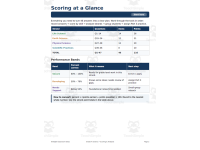
The Scoring at a Glance chart on page 2 of Part 2 breaks the assessment into four strand totals: Life Science /36, Earth Science /31, Physical Science /29, and Scientific Practices /20, for 116 total points. It also defines three performance bands: Secure (80%–100%), Developing (50%–79%), and Needs Support (below 50%).
The Class Data Tracker on page 15 of Part 2 gives teachers a whole-class view of Life, Earth, Physical, and Scientific Practices percentages, while the Suggested Instructional Groups on page 16 connect students’ lowest strands to matching Part 3 review pages.
Standards & Learning Goals
This fourth grade science diagnostic assessment reviews foundational concepts and scientific reasoning across four major strands:
🌱 Life Science — animal structures, plant structures, structure and function, ecosystems, food webs, energy flow, adaptations, producers, consumers, decomposers, energy pyramids, and interpreting population data
🌎 Earth Science — water cycle, transpiration, weather and climate, climate data, dual-format graph reading, rock cycle, rock types, mineral properties, weathering, erosion, deposition, fast and slow Earth changes, and evidence-based explanations
⚡ Physical Science — forms of energy, potential and kinetic energy, energy transformations, balanced and unbalanced forces, net force, motion graphs, states of matter, particle models, changes of state, conductors and insulators, mixtures, mass, and force
🔬 Scientific Practices — fair tests, variables and controls, investigation design, data tables, graph interpretation, drawing conclusions, tools and measurement, and Claim-Evidence-Reasoning
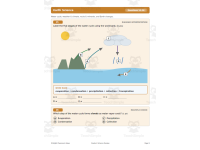
Students demonstrate understanding through varied science tasks rather than one question type. The assessment includes flower-part labeling, bird-beak structure and function, a food web, an energy pyramid, a five-stage water cycle diagram, climate data, a climate graph, the rock cycle, weathering-erosion-deposition sequencing, a roller-coaster energy model, balanced and unbalanced force diagrams, a distance-time graph, particle models, changes of state, investigation design, plant-growth data, and graph interpretation.
The Skill-by-Skill Scoring Chart on pages 10–12 of Part 2 helps teachers pinpoint specific gaps instead of relying only on one total score. Skills include structures and function, food webs, ecosystems, adaptations, water cycle, weather and climate, climate graphs, rock cycle, Earth changes, energy forms, net force, motion graphs, matter and particles, investigation design, data interpretation, graph reading, drawing conclusions, and tools and measurement.
Why Teachers Love It
✨ Move beyond a single test score. Results can be analyzed by strand and individual skill, helping teachers see where students are secure and where review is needed.
✨ Turn assessment data into an instructional plan. The scoring tools connect results to performance bands, grouping, and targeted follow-up practice instead of leaving teachers with a stack of completed tests.
✨ Use visual, varied questions to see student thinking. Students work with diagrams, food webs, models, data tables, graphs, labeling, matching, scenarios, vocabulary in context, short responses, and CER tasks.
✨ Assess deeper diagram interpretation. The diagnostic includes 11 labeling or diagram-interpretation items, including food webs, an energy pyramid, water and rock cycles, force models, particle models, and more.
✨ Support data-driven small groups. The Suggested Instructional Groups tool organizes students around shared needs in Life Science, Earth Science, Physical Science, or Scientific Practices.
✨ Differentiate with clear performance bands. Use Secure, Developing, and Needs Support ranges to guide enrichment, targeted practice, or foundational small-group reteaching.
✨ Assign only the review students need. The 13 targeted follow-up pages include:
Structures & Function Review
Food Webs Review
Ecosystems & Energy Review
Adaptations Review
Water Cycle Review
Weather & Climate Review
Rocks & the Rock Cycle Review
Earth Changes Review
Energy & Its Forms Review
Forces & Motion Review
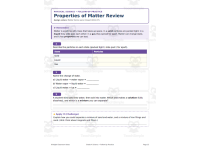
Properties of Matter Review
Scientific Investigation Review
Science Data & Graphs Review
The Practice Page Menu on page 2 of Part 3 directly matches student difficulties to specific follow-up pages, making targeted assignment faster.
✨ Reteach before students practice. Every targeted page includes a short Remember box that reviews the essential concept before students begin.
✨ Challenge students who are already secure. Every follow-up page includes an Apply It task that extends thinking beyond basic recall.
✨ Build Claim-Evidence-Reasoning skills. Students complete CER tasks connected to adaptations, canyon formation, force and mass, and plant-growth data. Part 4 includes sample CER responses and a scoring rubric.
✨ Make grading more manageable. Part 4 includes correct answers, suggested short-answer responses, completed diagrams, explanations of why answers are correct, and guidance for awarding partial credit on multi-part items.
✨ Support visual science learning. The resource uses colorful diagrams, models, tables, food webs, graphs, particle representations, force arrows, and other visual formats to assess science reasoning in multiple ways.
✨ Use student profiles for individualized planning. The Student Performance Profile on page 14 of Part 2 includes strand snapshots, strengths, focus areas, assigned Part 3 pages, and group placement.
✨ See class-wide patterns quickly. The Class Data Tracker on page 15 lets teachers scan columns for whole-class gaps and rows for student grouping needs.
✨ Keep the instructional loop connected. Assessment, analysis, grouping, targeted review, reteaching, and answer support are designed as one coordinated system rather than disconnected activities.
Start the year knowing what students understand and what they need next with this 4th grade beginning of year science assessment. Download this complete diagnostic and targeted review system to assess readiness, analyze results by strand and skill, create focused instructional groups, assign specific follow-up practice, and support reteaching with complete explained answer keys.
Perfect for teachers searching for a 4th grade science diagnostic assessment, beginning-of-year science review, back-to-school science assessment, fourth grade science pre-assessment, Life Science review, Earth Science review, Physical Science review, Scientific Practices assessment, food webs, water cycle review, rock cycle review, forces and motion, properties of matter, CER practice, science intervention, small-group science planning, data-driven instruction, or targeted science reteaching.
Resource Tags
0 Reviews
Check out these other great products