



3,923 products added recently
Page 91 - Science Lesson Plan Template
Enhance your science instruction with a flexible lesson plan template designed for educators. This tool helps you structure objectives, materials, procedures, and assessments efficiently. Use it to create organized and impactful science lessons that cater to your students' needs.

 Show filters


Butterflies: Kindergarten Science Projects
Science, Life Sciences, Biology, Kindergarten, Grade 1, 2, Teacher Tools, Lesson Plans
Here is a Kindergarten Science project to help you teach about butterflies! The Butterflies Kindergarten Science project is ideal for a mini spring topic. Use our Lesson notes to help you plan lessons around science, art and English. I like to help teachers use creatures that are commonly seen by children to explore the natural world, which is the building block of science. By using creatures with which children are familiar, we can cover much of the science curriculum in a way that the children will remember. Science lessons can be transformed as both pupils and teachers become engaged in the project, asking questions to stimulate further enquiry. Teaching notes include: Raising butterflies from eggs: a wonderful thing to do to really help bring science to life for your pupils. Helpful notes about each stage of the butterfly life cycle - help you to feel like an expert; we have done the research for you! Suggested questions to stimulate scientific enquiry. Art activities English Activities Science and English worksheets: By joining subjects together in a science-based project, we teach young children the way they learn - holistically! Four pictures to order the life cycle of a butterfly with matching vocabulary Matching words to pictures activity at 2 levels Anatomy of a butterfly Recording sheets for observations of a butterfly and a caterpillar Reading comprehension exercises 2 poems with comprehension exercises to follow each differentiated; 2 ability levels Decorated writing sheets Display resources: A good display is vital to capture children's interest and make the classroom a vibrant learning environment. Our resources help you to make such a display: Photographs, Labels for each part of the butterfly life cycle, Butterfly life cycle mat, to help children with their writing, or for display. A butterfly life cycle poster (A4) Who is the butterfly's Kindergarten Science project for? Teachers, Home-educators Parents Anyone!!! What is included in the Butterflies Kindergarten Science project? 1 pdf containing the above: 40 pages
Author Lilibette's Resources
Rating
Tags Butterfly Life-cycle, Butterflies, Caterpillars, Spring, Home-education, Kindergarten Science, Insects, Kindergarten Science Projects, Nature, Butterfly Life Cycle

AI Tools for Research – Fact-Checking & Bias Detection Worksheets
Science, Technology, Computer Science, Engineering, Special Resources, Social Emotional Learning (SEL), Social Skills, Life Skills, STEM, Research, Grade 6, 7, 8, 9, 10, 11, 12, Worksheets & Printables, Workbooks, Worksheets, Word Searches, Writing Prompts, Teacher Tools, Lesson Plans, Assessments, Diagrams, Presentations
This 41-page PDF is a fully prepared to print middle school Digital Literacy Curriculum called "Advanced Digital Tools for Research: Fact-Checking and Detecting Bias Worksheets" designed for students in grades 6-8 to be able to use the V.E.R.I.F.Y. Framework (Validate, Extract, Read Lateral, Interrogate Bias, Find Primary Evidence, Yield Conclusion) to critically evaluate content generated by AI, identify hallucinatory or fabricated information, detect algorithmic bias, and utilize lateral reading skills. This resource is ideal for the AI era and includes: - Four theoretical chapters with practical real-world examples (e.g., Titanic, Great Wall of China, Space Race, Paleo-Diet). - Ten hands-on student worksheets (e.g., Anatomy of a Digital Claim, Spotting Plausible Falsities, Lateral Reading Protocol, Unmasking Structural Bias, The Phantom Citation Mystery, Chronological Confusion, etc.). - Three full-color visual frameworks/diagrams (Fact-Checking Workflow, Algorithmic Bias Triad, Source Credibility Spectrum). - A complete answer key with rubrics and high proficiency examples. - A complete Teacher Implementation Guide including pacing (4-6 class periods), differentiation for ELLs/developing readers and gifted students, formative assessment examples, and examples of exit tickets. - A ready-to-teach PDF requiring no preparation that increases research skills, media literacy, and critical thinking through an alignment to both the CCSS, ISTE, and Digital Citizenship Standards, making it appropriate for use in English Language Arts, Social Studies, Science, and Technology classes. Why Schools/Parents Find It To Be Effective: Develops Real World Skills that Kids Need to Survive in an AI World. Kids will learn how to identify when they are being deceived by hallucinations, bias, and fake citations before they copy and paste into their papers or projects. No Preparation or Planning Time Required - Teachers get full theory, worksheets, visuals, answers and pacing guide when using this product. Parents appreciate the independent critical thinking experience provided to their children. Fun Way to Increase Student Engagement - Kids enjoy using the detective-style worksheets (Tree Octopus Hoax, Phantom Biologist, Brooklyn Bridge Hoax, etc.) to develop critical thinking skills through the use of skepticism as a game. Differentiated, Inclusive, and Fully Accessible - Students are able to access the materials because of the built in supports provided for ELL/Developing Readers, and extension challenges for Gifted Students. Ensures Academic Integrity Now and in the Future - Aligns well with the local school districts expanding policies regarding the appropriate use of AI, as well as standards for digital citizenship. Intended Audience of Book (As per complete PDF analysis): This resource is specifically created for students in Grades 6 to 8 (Middle School). There are examples throughout the resource, as can be seen in the seven (7) and eight (8) examples referenced. Answer keys and teacher guides both have "Grade 6 to 8 Student Workbook" clearly labeled on them. Best Fit: ELA, Social Studies/History, Research projects in Science, Digital Literacy/Media Literacy, or Technology courses Excellent for Homeschoolers, Gifted Programs, or Educators Teaching AI Ethics and Responsible Research. Copyright & Terms of Use This Book is copyrighted by Syed Hammad Rizvi. This resource is solely for personal and individual classroom use. You may not modify, redistribute or sell any part of this resource (including putting it online for others to back or download). In order to share this resource with your coworkers please buy more licenses from Teachsimple. Thank you for following these terms of use. -------------------------------------------------------------------* This product was created by Syed Hammad Rizvi to be enjoyed!
Author Creative Book Store
Rating
Tags AIFactChecking, BiasDetection, DigitalLiteracy, MiddleSchoolWorksheets, AIFactCheck, VERIFyFramework, CriticalThinking, MediaLiteracy, AIforTeachers, DigitalLiteracyWorksheets

I WONDER - How Tall Are Giraffes | Animated Video Lesson
STEM, Biology, Life Sciences, Science, Animals, Grade 1, 2, 3, 4, 5, 6, 7, 8, Lesson Plans, Teacher Tools
Video Introduction Animal kingdoms are full of fascinating wonders to learn. This video is designed for the students to learn more about animals in different countries. I WONDER - How Tall Are Giraffes | Animated Video Lesson Do you like animals? what is your favorite one? Do you own a pet? If yes, tell us more about it, like what its name? And what do you like most about it? What are the animal kingdoms? Can you write down the characteristics of each animal class like mammals, birds, reptiles, amphibian, fish and mollusks. Do you know that some animals can sing, can you name any of them? What is the largest and the smallest mammal in the world? What is the largest and the smallest bird in the world? What is the largest and the smallest fish in the world? I WONDER - How Tall Are Giraffes | Animated Video Lesson The video is perfect for encouraging the researching skills for the students, while learning more about these fantastic animals. I WONDER - How Tall Are Giraffes | Animated Video Lesson This friendly designed video is suitable for students at school, homeschooling, and as a group activity. Format Available in MP4 format.
Author Educational Voice
Tags How Tall Are Giraffes, How Tall Are Giraffes Video, Giraffes, Giraffe, Giraffes Facts, Giraffes Facts For Kids, Giraffes Video, Giraffes Video For Kids, Giraffe Facts, Giraffe Video
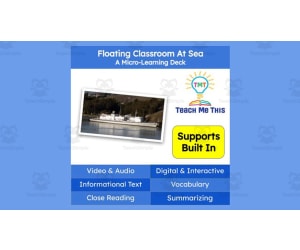
Floating Classroom At Sea | Interactive Science Lesson | Micro-Learning Deck
Science, Earth and Environmental Sciences, Environmental Science, Grade 6, 7, 8, 9, Teacher Tools, Lesson Plans
This micro-learning deck is the perfect accessory to your Science instruction! This digital slideshow presents Floating Classroom At Sea. Within this slideshow, you will receive: -Video Lesson -Reading Passage w/ Audio -Close Reading -Quick Write The informational texts included in this resource alongside the informal assessments will keep your students engaged from beginning to end.
Author Teach Me This
Tags Golden Bear Ship, True False Questions, Classroom At Sea, Engineering, Paramilitary School

I WONDER - How Long Is The Circulatory System | Animated Video Lesson
Human Body, Life Sciences, Science, Biology, STEM, Grade 4, 5, 6, 7, 8, 9, 10, Lesson Plans, Teacher Tools
Video Overview The human body is full of fascinating wonders to learn. This video is created to help the students recognize the anatomy and the job of the human body. I WONDER - How Long Is The Circulatory System | Animated Video Lesson Every part and organ in our human body is vital so let's see how important they are. Have you ever imagined how we look like if we didn't have a skeleton? Did you know that because we have our amazing muscles we can stand! Do you know how many teeth do we have? Have you ever wondered about the food journey inside our body? Can you name all the glands in our body? Why do we have skin? Our nervous system is really good at sending signals. Can you tell us more about it? Are you really good at Mathematics, painting, or any other thing? You should really thank your brain about it! The famous five senses are really doing a great work? Can you explain how every sense works? I WONDER - How Long Is The Circulatory System | Animated Video Lesson The video is perfect for encouraging the researching skills for the students, while learning more about our fantastic human body. I WONDER - How Long Is The Circulatory System | Animated Video Lesson This friendly designed video is suitable for students at school, homeschooling, and as a group activity. Format Available in MP4 format.
Author Educational Voice
Tags How Long Is The Circulatory System, How Long Is The Circulatory System Video, Circulatory System, Circulatory System Facts, Circulatory System Facts For Kids, Circulatory System Video, Circulatory System Video For Kids
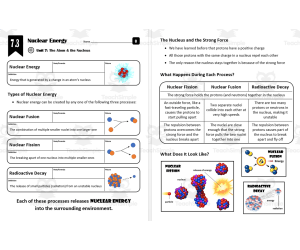
Lesson 7.3 - Nuclear Energy
Science, Chemistry, Physics, Grade 6, 7, 8, 9, 10, 11, 12, Lesson Plans, Teacher Tools
Lesson 7.3 - Nuclear Energy This comprehensive teaching resource aims to enhance student learning of nuclear energy for grades 6 through 12. The guide focuses on various components of nuclear energy, including nuclear fusion, nuclear fission, and radioactive decay. Nuclear Energy Notes: Detailed notes outlining significant differences between the three main types of nuclear energy. These are available in two versions - An interactive format for students to fill in blanks as they learn and a full version which is ideal for absent learners or those needing extra support. Nuclear Energy Simulation: An engaging tool accessed via a provided URL that allows students to study effects of nuclear fission on different nuclei. Nuclear Energy Reading: A segment presenting pro and con arguments from two separate articles at varying lexile levels to cater to different student proficiencies. PowerPoint Notes: Teaching points presented in an easy-to-show format suitable for class time. Objectives & Starter Questions: Prompts designed to get students thinking about core topics before diving into detailed discussions. All the files included can be downloaded as .docx (for Word), .pptx (for PowerPoint) files if revisions are required or .pdf files for quick access without any modifications needed. Lesson 7.3 - Nuclear Energy closely aligns with the Integrated Chemistry & Physics criteria specified by Indiana State Standards making it a perfect educational tool suitable for public educators and homeschooling parents alike..
Author Integrated Chemistry and Physics
Tags Nuclear Fusion, Nuclear Fission, Radioactive Decay, Pros And Cons, Critical Thinking
I WONDER - What is The Smallest Vertebrate In The World
STEM, Animals, Life Sciences, Science, Biology, Grade 1, 2, 3, 4, 5, 6, 7, 8, Lesson Plans, Teacher Tools
Video Introduction Animal kingdoms are full of fascinating wonders to learn. This video is designed for the students to learn more about animals in different countries. I WONDER - What is The Smallest Vertebrate In The World | Animated Video Lesson Do you like animals? what is your favorite one? Do you own a pet? If yes, tell us more about it, like what its name? And what do you like most about it? What are the animal kingdoms? Can you write down the characteristics of each animal class like mammals, birds, reptiles, amphibian, fish and mollusks. Do you know that some animals can sing, can you name any of them? What is the largest and the smallest mammal in the world? What is the largest and the smallest bird in the world? What is the largest and the smallest fish in the world? I WONDER - What is The Smallest Vertebrate In The World | Animated Video Lesson The video is perfect for encouraging the researching skills for the students, while learning more about these fantastic animals. I WONDER - What is The Smallest Vertebrate In The World | Animated Video Lesson This friendly designed video is suitable for students at school, homeschooling, and as a group activity. Format Available in MP4 format.
Author Educational Voice
Tags What Is The Smallest Vertebrate In The World, What Is The Smallest Vertebrate In The World Video, Smallest Vertebrate In The World, Smallest Vertebrate In The World Facts, Smallest Vertebrate In The World Video

Properties of Matter: Physical Changes of Matter Gr. 5-8
Science, Physics, Grade 5, 6, 7, 8, Teacher Tools, Lesson Plans
Properties of Matter: Physical Changes of Matter Gr. 5-8 An instructional resource perfect for teachers and homeschoolers educating students from grades 5 to grade 8 about the complex concepts of matter in physical science. This comprehensive guide aids educators in teaching what matter is and what it's not, with activities focused on understanding the distinctions between a mixture and a solution. Includes an engaging array of hands-on activities designed to facilitate comprehension about various physical and chemical alterations of matter. Simplifies otherwise complex scientific concepts through accessible language usage. Provides meticulously curated information paired with easy-to-implement instruction, crafted specifically for learners requiring extra support or those who do well with step-by-step guidance due to its focus on foundational skills reinforcement. A notable feature: The array of experiments that keep learners engaged during instruction. Alongside these interactive elements are reading passages that help boost literary comprehension whilst highlighting applicable science principles simultaneously. An effective tool in preparing students for exams, thanks to its informative mini posters which serve as condensed revision materials and integrated answer key designed specifically for checking pupil’s mastery over topics discussed. How Can You Use It? You can use this resource: In whole group settings enhancing collaborative learning experiences In one-on-one class settings allowing each student self-paced study time based on their respective needs. We’ve made sure that our resources align perfectly with state standards, written considering Bloom's Taxonomy guidelines coupled with STEM initiatives provisions - rest assured that your learnings align strictly with educational strategies that underline successful teaching practice. You can download this indispensable guide as a PDF, making delivery of content handy and efficient for educators catering to youngsters eager to unravel the wonders of matter and its physical changes.
Author Classroom Complete Press
Tags PDF

I WONDER - What Is A Meteor | Animated Video Lesson
Space, Earth and Environmental Sciences, Science, Grade 4, 5, 6, 7, 8, 9, 10, Lesson Plans, Teacher Tools
Video Introduction An amazing video designed for the students to learn more about space facts. I WONDER - What Is A Meteor | Animated Video Lesson Do you like reading about space? If yes, what is your favorite topic? What do you know about our solar system? What is the smallest planet in our solar system? What is the biggest planet in our solar system? What is the hottest planet in our solar system? And what is the coldest one? Do you think there are aliens? If yes, what do you think they look like? What do they eat and how they speak to each other? Where do they live? What is a galaxy? And what is a milky way? Have you recently saw a shooting star? If yes, tell us more about it, like when did it happen and where? What is a blackhole? Can a blackhole gets bigger by time? Do you like counting the stars? What do you think a star is made of? I WONDER - What Is A Meteor | Animated Video Lesson The video is perfect for encouraging the researching skills for the students, while learning more about the fantastic space. I WONDER - What Is A Meteor | Animated Video Lesson This friendly designed video is suitable for students at school, homeschooling, and as a group activity. Format Available in MP4 format.
Author Educational Voice
Tags What Is A Meteor , What Is A Meteor Video, Meteor, Meteor Facts, Meteor Facts For Kids, Meteor Video, Meteors, Meteors Video For Kids, Space, Space Video

I WONDER - What Is Refraction | Animated Video
Physics, Science, STEM, Grade 6, 7, 8, 9, 10, 11, 12, Lesson Plans, Teacher Tools
Video Introduction An amazing video designed for the students to learn more about STEM. I WONDER - What Is Refraction | Animated Video Lesson Do you like STEM subjects? what is your favorite one? Have you ever tried to plant a seed? If yes, tell us more about it. Or have you ever tried to invent something? If yes, tell us more about it. And how do you think it will help us? Have you ever seen a microorganism under a microscope? What was it? And how it looked like? Mathematics is a marvelous subject. Let' sharpen our brains and solve some equations. Do you like timetable tricks? What is your favorite one? Do you know how to code? Have you ever created an app or a game before? If yes, how was it like? I WONDER - What Is Refraction | Animated Video Lesson The video is perfect for encouraging the researching skills for the students, while learning more about this fantastic topic. I WONDER - What Is Refraction | Animated Video Lesson This friendly designed video is suitable for students at school, homeschooling, and as a group activity. Format Available in MP4 format.
Author Educational Voice
Tags What Is Refraction, What Is Refraction Video, Refraction, Refraction Facts, Refraction Facts For Kids, Refraction Video, Refraction Video For Kids, Refraction Facts Video For Kids, Science Video

I WONDER - Will Solar Power Ever Run Out | Animated Video Lesson
Environmental Science, Earth and Environmental Sciences, Science, Grade 4, 5, 6, 7, 8, 9, 10, Lesson Plans, Teacher Tools
Video Introduction An amazing video designed for the students to learn more about STEM. I WONDER - Will Solar Power Ever Run Out | Animated Video Lesson Do you like STEM subjects? what is your favorite one? Have you ever tried to plant a seed? If yes, tell us more about it. Or have you ever tried to invent something? If yes, tell us more about it. And how do you think it will help us? Have you ever seen a microorganism under a microscope? What was it? And how it looked like? Mathematics is a marvelous subject. Let' sharpen our brains and solve some equations. Do you like timetable tricks? What is your favorite one? Do you know how to code? Have you ever created an app or a game before? If yes, how was it like? I WONDER - Will Solar Power Ever Run Out | Animated Video Lesson The video is perfect for encouraging the researching skills for the students, while learning more about this fantastic topic. I WONDER - Will Solar Power Ever Run Out | Animated Video Lesson This friendly designed video is suitable for students at school, homeschooling, and as a group activity. Format Available in MP4 format.
Author Educational Voice
Tags Will Solar Power Ever Run Out, Will Solar Power Ever Run Out Video, Solar Power, Solar Power Facts, Solar Power Facts For Kids, Solar Power Video, Solar Power Video For Kids, Energy Facts, Energy Facts For Kids
I WONDER - How Many Blood Vessels Are In Brain | Animated Video
Biology, Life Sciences, Science, Human Body, Grade 3, 4, 5, 6, 7, 8, 9, Lesson Plans, Teacher Tools
Video Overview The human body is full of fascinating wonders to learn. This video is created to help the students recognize the anatomy and the job of the human body. I WONDER - How Many Blood Vessels Are In Brain | Animated Video Lesson Every part and organ in our human body is vital so let's see how important they are. Have you ever imagined how we look like if we didn't have a skeleton? Did you know that because we have our amazing muscles we can stand! Do you know how many teeth do we have? Have you ever wondered about the food journey inside our body? Can you name all the glands in our body? Why do we have skin? Our nervous system is really good at sending signals. Can you tell us more about it? Are you really good at Mathematics, painting, or any other thing? You should really thank your brain about it! The famous five senses are really doing a great work? Can you explain how every sense works? I WONDER - How Many Blood Vessels Are In Brain | Animated Video Lesson The video is perfect for encouraging the researching skills for the students, while learning more about our fantastic human body. I WONDER - How Many Blood Vessels Are In Brain | Animated Video Lesson This friendly designed video is suitable for students at school, homeschooling, and as a group activity. Format Available in MP4 format.
Author Educational Voice
Rating
Tags How Many Blood Vessels Are In Brain, Blood Vessels, Blood Vessels Facts, Blood Vessels Video, Blood Vessels Facts For Kids, Blood Vessels Video For Kids, Brain, Brain Facts, Brain Video

Reflection Explained - Fully Resourced lesson for Middle School
Science, Physics, Grade 5, 6, 7, 8, 9, Lesson Plans, Teacher Tools
Reflection Explained - Fully Resourced Lesson for Middle School Reflection Explained is a versatile teaching resource prepared for middle school, focusing extensively on the concept of reflection in plane mirrors. The content is meticulously tailored to be suitable for students from Grade 5 to Grade 9. Coverage of Concepts The lesson delves into light-transmitting materials including transparent, translucent, and opaque classifications. The resource provides immense clarity on labeling incident rays, reflected rays, angles of incidence & reflection, and their corresponding norms. Fostering Practical Understanding An interactive virtual experiment spectacularly demonstrates how equal values for the angle of incidence equate to the angle of reflection (i = r). This can enable students either derive conclusions or assist them in conducting real-time experiments. Inclusion Of Ray Diagrams And Image Formations: The resources explore how eyes perceive an image in plane mirrors as well as periscopes. Meticulously detailed explanations that emphasize upright positions or lateral inversions through mirror reflections contribute to a comprehensive understanding of these physics principles. Honing Student Engagement And Literacy Skills: Fascinating activities like flip-it games alluringly intertwined within help reinforce tough phenomona visually!The inclusion of anticipation guides make learning stimulate learners generate curiosity throughout lessons emphasizing what's been ingested so far thus advancing literacy skills! Apt Supportive Material: Synchronous Worksheets: A set off our worksheets align perfectly with PowerPoint presentations ensuring seamless teaching-learning flow. Factual Sheets: Convenient reference sheets that can serve as study references after class hours are also included within the package. Although home-based, these additional resources harmonize well pupil insight contrasting improvement and strengths through calibrated self- assessments - confidence amplifiers of a different kind! A Well-Laid Plan For Educators: The clear one-page lesson plan delineated provides potential paths for content delivery based on individualized mastery levels and time management. This boosts control over classroom dynamics and customization. Importantly: The resource promotes peer evaluation prompts ideally fostering a collaborative learning environment supporting critical thinking enhancement by molding foundational science principles vibrantly sustaining that vital interactive classroom dynamic! To-A-Neat'T: The virtual wrap-up exit ticket quiz features prominently at end-helping teachers gauge harder to comprehend grasp levels briskly before progressing offer subsequent lessons ensuring no doubts creep years later.
Author Elf off the Shelf Resources
Tags Reflection, Plane Mirrors, Light Transmission, Image Formation, Peer Evaluation
I WONDER - How Hot Is Lightning | Animated Video Lesson
Earth Sciences, Earth and Environmental Sciences, Science, Grade 3, 4, 5, 6, 7, 8, 9, Lesson Plans, Teacher Tools
Video Introduction An amazing video designed for the students to learn more about famous phenomena in different countries. I WONDER - How Hot Is Lightning | Animated Video Lesson What do you know about this phenomenon? Where it happens? When it happens? What are the safety measures that we should take to be safe during this phenomenon? Are there any other places in the world that experienced this phenomenon? If yes, tell us more about them. Why do you think it happens? Do you like reading about Geography? What is your favorite country in the whole world? I WONDER - How Hot Is Lightning | Animated Video Lesson The video is perfect for encouraging the researching skills for the students, while learning more about this fantastic phenomenon. I WONDER - How Hot Is Lightning | Animated Video Lesson The video is perfect for encouraging the researching skills for the students, while learning more about this fantastic phenomenon. Format Available in a PDF format.
Author Educational Voice
Rating
Tags How Hot Is Lightning, How Hot Is Lightning Video, Lightning, Lightning Facts, Lightning Video, Lightning Video For Kids, Lightning Facts For Kids, Weather, Weather Facts, Weather Video

I WONDER - Is Chemical Energy Harmful To The Environment
Chemistry, Science, STEM, Grade 6, 7, 8, 9, 10, 11, 12, Lesson Plans, Teacher Tools
Video Introduction An amazing video designed for the students to learn more about STEM. I WONDER - Is Chemical Energy Harmful To The Environment | Animated Video Lesson Do you like STEM subjects? what is your favorite one? Have you ever tried to plant a seed? If yes, tell us more about it. Or have you ever tried to invent something? If yes, tell us more about it. And how do you think it will help us? Have you ever seen a microorganism under a microscope? What was it? And how it looked like? Mathematics is a marvelous subject. Let' sharpen our brains and solve some equations. Do you like timetable tricks? What is your favorite one? Do you know how to code? Have you ever created an app or a game before? If yes, how was it like? I WONDER - Is Chemical Energy Harmful To The Environment | Animated Video Lesson The video is perfect for encouraging the researching skills for the students, while learning more about this fantastic topic. I WONDER - Is Chemical Energy Harmful To The Environment | Animated Video Lesson This friendly designed video is suitable for students at school, homeschooling, and as a group activity. Format Available in MP4 format.
Author Educational Voice
Tags Is Chemical Energy Harmful To The Environment, Is Chemical Energy Harmful To The Environment Video, Chemical Energy, Chemical Energy Facts, Chemical Energy Facts For Kids, Chemical Energy Video For Kids
I WONDER - What Is Tidal Energy | Animated Video Lesson
Earth Sciences, Earth and Environmental Sciences, Science, Environmental Science, Grade 3, 4, 5, 6, 7, 8, 9, Lesson Plans, Teacher Tools
Video Introduction An amazing video designed for the students to learn more about STEM. I WONDER - What Is Tidal Energy | Animated Video Lesson Do you like STEM subjects? what is your favorite one? Have you ever tried to plant a seed? If yes, tell us more about it. Or have you ever tried to invent something? If yes, tell us more about it. And how do you think it will help us? Have you ever seen a microorganism under a microscope? What was it? And how it looked like? Mathematics is a marvelous subject. Let' sharpen our brains and solve some equations. Do you like timetable tricks? What is your favorite one? Do you know how to code? Have you ever created an app or a game before? If yes, how was it like? I WONDER - What Is Tidal Energy | Animated Video Lesson The video is perfect for encouraging the researching skills for the students, while learning more about this fantastic topic. I WONDER - What Is Tidal Energy | Animated Video Lesson This friendly designed video is suitable for students at school, homeschooling, and as a group activity. Format Available in MP4 format.
Author Educational Voice
Tags What Is Tidal Energy, What Is Tidal Energy Video, Tidal Energy, Tidal Energy Facts, Tidal Energy Facts For Kids, Tidal Energy Video, Tidal Energy Video For Kids, Energy, Energy Video, Energy Video For Kids
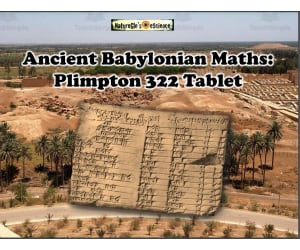
Math: Mesopotamia Thematic Unit
Social Studies, Science, Earth and Environmental Sciences, Math, Geometry, History, History: Ancient, Grade 9, 10, 11, 12, Lesson Plans, Teacher Tools
Math: Mesopotamia Thematic Unit is a great resource for students to explore early Babylonian mathematics!
Author NatureGlo's eScience
Tags Math Thematic Unit, Mesopotamia, Ancient History, Pythagorean Triplets
I WONDER - Are There Different Types Of Wind | Animated Video Lesson
Earth Sciences, Earth and Environmental Sciences, Science, Grade 4, 5, 6, 7, 8, 9, 10, Lesson Plans, Teacher Tools
Video Introduction An amazing video designed for the students to learn more about famous phenomena in different countries. I WONDER - Are There Different Types Of Wind | Animated Video Lesson What do you know about this phenomenon? Where it happens? When it happens? What are the safety measures that we should take to be safe during this phenomenon? Are there any other places in the world that experienced this phenomenon? If yes, tell us more about them. Why do you think it happens? Do you like reading about Geography? What is your favorite country in the whole world? I WONDER - Are There Different Types Of Wind | Animated Video Lesson The video is perfect for encouraging the researching skills for the students, while learning more about this fantastic phenomenon. I WONDER - Are There Different Types Of Wind | Animated Video Lesson The video is perfect for encouraging the researching skills for the students, while learning more about this fantastic phenomenon. Format Available in a PDF format.
Author Educational Voice
Rating
Tags Are There Different Types Of Wind, Are There Different Types Of Wind Video, Different Types Of Wind, Different Types Of Wind Video, Different Types Of Wind Facts, Different Types Of Wind Video For Kids
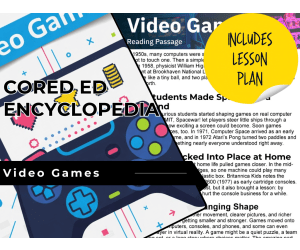
Video Games Reading Comprehension Passage - Cored Ed Encyclopedia
ELA, Language Development, Reading Comprehension, Reading, Pre-Reading, Science, Technology, Engineering, History, Social Studies, Grade 2, 3, 4, 5, Worksheets & Printables, Worksheets, Teacher Tools, Centers, Activities, Writing Prompts, Assessments, Quizzes and Tests, Quizzes, Lesson Plans
This video games reading comprehension with lesson plan includes: Visualization (on the front cover) Start your lesson by taking a minute to think and share something about the topic. Read the script aloud (slowly), perhaps prepare some music or sound effects. Student close their eyes and let their imaginations wander. Students open their eyes, read the question aloud and give them a few minutes to complete. Ask a few students to share or keep answers until the end to compare with what they learn in the passage. Quick pause—thousands of Cored Education products are included with your TeachSimple membership. Download links and encyclopedia index available here. Pre-Reading Trivia Students will write down one thing they already know about the subject and then read five more facts and discuss. These facts are fun, and the students will enjoy learning about the subject before reading more. Give 1 minute for students to write what they already know (no pressure—best guess is fine). Read the five facts together. After each fact, do ask a student for their opinion, was it surprising? Set a purpose by asking students to highlight/underline one fact they want to learn more about during the reading. Reading Passage The text is a high-interest reading passage with set paragraphs, roughly three to four paragraphs long. It contains a variety of themes about the topic, anywhere from history to technology. The passage is between 250 and 350 words in length. First, ask students to look at the headings and see what they’ll learn about today. What do they know about the topic/heading? First read options: Teacher read-aloud (best for support). Partner reading (paragraph by paragraph). While reading, students underline important details, and vocabulary words they think may come up in the questions section. Mixed Questions The first question page contains four multiple-choice questions, each with a choice of four answers, and three written response questions that require a sentence or two from the student. Students complete the mcqs first independently, then review quickly as a class. For the 3 written responses, try to get students giving the answer with some form of evidence: “I think ___ because the text says ___.” If students get stuck, send them back to check the passage. Vocabulary Questions Practice seven key words from the text in this section across two activities. First section is scrambled words where students will unscramble three words given a clue for each. The second section is a word to meaning matching activity. Before starting, have some students read out words they underlined in the passage. Ask students to say the word and read aloud the sentence(s) around each word. Ask students to do scrambled words and the matching exercise in pairs then go through answers as a class. For the scrambled spelling task, get four pairs to come up to the board and write the words for extra practice with the other student reading out the clue. For the matching task, prompt students to give full sentences: “I matched ___ with ___ because ___.” Creative Writing In this question, the student will be required to write a five to eight sentence paragraph on a question related to the topic. Before starting, ask students write down 3 key ideas they are going to include in their piece. Ask students for ideas to share around the class to help those struggling. Pro writing expectations: 5–8 sentences At least 2 facts or details from the passage At least 2 vocabulary words from the previous page Students read their paragraphs while classmates listen for facts and vocabulary words. Extension Activities This page is optional for fast finishers or to take home. There are several activities, each one requiring a different skill. Do some, do none, do all, completely optional - but you will feel reassured knowing every possibility is planned for. Includes summary writting question. Answer Key There are answers for the multiple-choice questions, written response questions have sample answers, vocabulary answers and if there is a summary question then a sample summary will be provided as well. Lesson Plan Included Customized lesson plan for this lesson is included. Lesson Snapshot Title: Video Games Genre: Nonfiction (Informational text) Subject: Science & Technology / Media Literacy Primary Topic: How video games changed from dots to VR Estimated Guided Reading Level (A–Z): P Story text location: Reading Passage on page 3. Support pages included: Visualization prompt (p.1), Pre-Reading Trivia (p.2), Mixed Questions (p.4), Vocabulary (p.5), Creative Writing (p.6), Extension Activities (p.7), Answers (p.8). Support-page QA check: The questions, vocabulary tasks, and answer key match the passage’s details (dates, examples, and key terms). What This Lesson Teaches Best Early video games grew from science tools and big computers: Describes room-sized computers and a “game screen” idea using an oscilloscope. Timeline of key early games and places: Connects Tennis for Two (1958), Spacewar! at MIT (1962), Computer Space (1971), and Atari’s Pong (1972). How cartridges changed home gaming: Explains that swapping cartridges let one system play many different games, and names early cartridge consoles (Fairchild system, Atari 2600). Technology improvements changed how games look, sound, and where they are played: Notes smoother movement, clearer pictures, richer sound, and games moving to handheld screens, computers, consoles, and phones. Games became many types of experiences: Lists examples like puzzles, team sports, building sets, long stories with choices, and virtual reality. Learning Goals Students will describe how Tennis for Two worked and what device showed the moving dot. Students will identify major milestones in early video game history by placing key examples in order. Students will explain how cartridges helped video games spread at home. Students will summarize how video games changed as computers became smaller and stronger. Students will give examples of different kinds of games mentioned in the passage. Key Vocabulary From the Text oscilloscope — a screen tool that can show moving signals. physicist — a scientist who studies matter and energy. arcades — public places where people play games. cartridges — plastic game boxes you swap into a system. virtual — computer-made, not physically real. FULL CATALOG OF DOWNLOAD LINKS AND ENCYCLOPEDIA INDEX HERE
Author Cored Education
Rating
Tags Vocabulary, Reading Comprehension, Reading Passages, Lesson Plans, Ela Lesson Plans, Reading Comprehension Lesson Plans, Pre-reading, Science Lesson Plans, Technology, History Lesson Plans
I WONDER - What Is A DNA Code | Animated Video Lesson
Human Body, Life Sciences, Science, Biology, STEM, Grade 6, 7, 8, 9, 10, 11, 12, Lesson Plans, Teacher Tools
Video Overview The human body is full of fascinating wonders to learn. This video is created to help the students recognize the anatomy and the job of the human body. I WONDER - What Is A DNA Code | Animated Video Lesson Every part and organ in our human body is vital so let's see how important they are. Have you ever imagined how we look like if we didn't have a skeleton? Did you know that because we have our amazing muscles we can stand! Do you know how many teeth do we have? Have you ever wondered about the food journey inside our body? Can you name all the glands in our body? Why do we have skin? Our nervous system is really good at sending signals. Can you tell us more about it? Are you really good at Mathematics, painting, or any other thing? You should really thank your brain about it! The famous five senses are really doing a great work? Can you explain how every sense works? I WONDER - What Is A DNA Code | Animated Video Lesson The video is perfect for encouraging the researching skills for the students, while learning more about our fantastic human body. I WONDER - What Is A DNA Code | Animated Video Lesson This friendly designed video is suitable for students at school, homeschooling, and as a group activity. Format Available in MP4 format.
Author Educational Voice
Tags What Is A DNA Code, What Is A DNA Code Video, DNA Code, DNA Code Facts, DNA Code Facts For Kids, DNA Code Video, DNA Code Video For Kids, DNA, DNA Facts, DNA Facts For Kids

Lesson Plan on The Weather - Grades 1-4
Earth and Environmental Sciences, Science, Earth Sciences, Environmental Science, Grade 1, 2, 3, 4, Activities, Lesson Plans, Teacher Tools, Worksheets & Printables
This fun 90-minute lesson is perfect for Grades 1–4. It helps students learn all about the weather in a simple and engaging way. The lesson starts with a quick observation activity where students look outside and describe what they see. Then, they watch a short, colorful video called Weather | Science for Kids . It explains what weather is, the different elements, and why it matters. After the video, students answer questions, sort weather cards, and work in pairs. The lesson includes a printable worksheet full of matching, drawing, and word games. Students also make their own weather wheels and act as mini meteorologists in class. Everything is hands-on and easy to follow. The lesson builds vocabulary, boosts speaking, and teaches science—all at once. It’s ideal for classroom or remote learning. Best of all, the activities are ready to print and use right away. If you want a weather lesson that’s fun, interactive, and packed with learning, this is it!
Author Bright Classroom Ideas Marketplace
Rating
Tags Weather, Lesson, Plan, Environment, Earth
I WONDER - What Is Special About A Gecko | Animated Video Lesson
STEM, Animals, Life Sciences, Science, Biology, Grade 1, 2, 3, 4, 5, 6, 7, 8, Lesson Plans, Teacher Tools
Video Introduction Animal kingdoms are full of fascinating wonders to learn. This video is designed for the students to learn more about animals in different countries. I WONDER - What Is Special About A Gecko | Animated Video Lesson Do you like animals? what is your favorite one? Do you own a pet? If yes, tell us more about it, like what its name? And what do you like most about it? What are the animal kingdoms? Can you write down the characteristics of each animal class like mammals, birds, reptiles, amphibian, fish and mollusks. Do you know that some animals can sing, can you name any of them? What is the largest and the smallest mammal in the world? What is the largest and the smallest bird in the world? What is the largest and the smallest fish in the world? I WONDER - What Is Special About A Gecko | Animated Video Lesson The video is perfect for encouraging the researching skills for the students, while learning more about these fantastic animals. I WONDER - What Is Special About A Gecko | Animated Video Lesson This friendly designed video is suitable for students at school, homeschooling, and as a group activity. Format Available in MP4 format.
Author Educational Voice
Tags What Is Special About A Gecko, What Is Special About A Gecko Video, Gecko, Gecko Facts, Gecko Facts For Kids, Gecko Video, Gecko Video For Kids, Animal, Animals, Animals Facts

Space: The Final Frontier Gr. 4-6
Science, Earth and Environmental Sciences, Space, Grade 4, 5, Teacher Tools, Lesson Plans
Space: The Final Frontier Gr. 4-6 Space: The Final Frontier Gr. 4-6 is a comprehensive teaching resource, designed to inspire and educate students about the universe beyond our planet. Suited for learners in grades 4 through 6, this offering explores the captivating world of space and fosters an understanding of complex topics such as galaxies, planets, solar systems, and gravity. The subjects tackled in this resource come under Science - Astronomy, specifically making it an enriching addition to your curriculum. The structure begins with lecture-style content melded with engaging assignments and activities oriented towards building up a solid foundation of knowledge about key space-related concepts. A Balanced Approach To Learning! This unit doesn't stick to just theory! It dives into fun-filled activities centered on aspects like: Space exploration techniques. The logarithms behind how rockets work. Making parachutes. Egg splat competitions! Brimming With Activities! The unit is equipped with a vast reproducible student Activity Handbook filled with relevant assignments guaranteed to bring out the inner astronaut in your students while sparking their interest in Earth Science. Crossword puzzles for vocabulary building are included too, A variety of reading passages on topical themes, Last but not least word searches intended at reinforcing memory recall functions among learners, Included Exam & Answer Keys The package also contains an exam that covers everything covered during the unit study along while providing teachers convenient access to answer keys helping maintain objectivity during assessments while saving precious time! Flexibility & Format Whether you're implementing this plan across a whole class or adapting it for smaller groups, or even individual study-time outside school hours, flexibility is at its core. The resource is available as a PDF download, which means integrating Space: The Final Frontier Gr. 4-6 into your science repertoire has never been easier! This robust yet hassle-free platform introduces practicality into lesson planning – serving as an exciting yet comprehensive launchpad propelling each student on their unique journey of discovery into the boundless realms of space.
Author Classroom Complete Press
Tags PDF
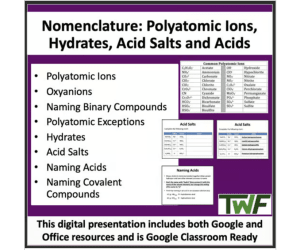
Nomenclature-Polyatomics & Covalent Compounds- Senior Chemistry Lesson
Science, Chemistry, Grade 10, 11, 12, Teacher Tools, Lesson Plans
Nomenclature-Polyatomics & Covalent Compounds - Senior Chemistry Lesson Your lesson covers the nomenclature of polyatomic compounds and covalent compounds. In order, the lesson teaches about; Polyatomic Ions, Oxyanions, Naming Binary Compounds, Polyatomic Exceptions, Hydrates, Acid Salts, Naming Acids, and Naming Covalent Compounds. Your lesson includes the teacher and student version of the presentation, an auto-graded exit ticket, and a student lesson handout so the students can record the notes on a more condensed medium. This lesson is designed to be your go-to resource, whether you're in a traditional classroom or a virtual one. With both a teacher version and a student version, it seamlessly fits into your lesson plans, making learning engaging and adaptable. Assessment made easy We've included an auto-graded Exit Ticket and a quiz with an answer key because I know you don't have an excess of time. I know you don't, because I don't and I know I'll do whatever I can to reduce my grading time. Whether you use PowerPoint or Google Slides, prefer Word or Google Docs, this lesson has you covered. This lesson comes in both Office and Google formats for your convenience. The student version of the presentation has strategically placed blanks for them to fill in as you're teaching. It keeps them active and engaged, encourages discussion, and leaves more time for those "aha" moments.
Author Teach With Fergy
Tags Chemistry Lesson, Valence Electrons, Ionic Bonding, Multivalent Ions, Ions, Nomenclature, Polyatomic Ions, Oxyanions, Hydrates