



3,923 products added recently
Page 94 - Science Lesson Plan Template
Enhance your science instruction with a flexible lesson plan template designed for educators. This tool helps you structure objectives, materials, procedures, and assessments efficiently. Use it to create organized and impactful science lessons that cater to your students' needs.

 Show filters

I WONDER - Are There Any Advantages During Monsoon Season
Social Studies, Geography, Earth Sciences, Earth and Environmental Sciences, Science, Environmental Science, Grade 4, 5, 6, 7, 8, 9, 10, Lesson Plans, Teacher Tools
Video Introduction An amazing video designed for the students to learn more about natural disasters in different countries. I WONDER - Are There Any Advantages During Monsoon Season | Animated Video Lesson What do you know about this natural disaster? Do you know in which part of the world this could happen? Have you ever read about the safety misusers that we could have to protect ourselves from this natural disaster? If yes, can you tell us more about them? Can you name other natural disasters? If yes, tell us more about where they are likely to happen? And how frequently? Do you like reading about Geography? What is your favorite country in the whole world? If you are going on a trip where it will be? Which country? What you are going to see there? Does this country has a famous place to visit? Do you like reading about Geology? If yes, what is your favourite topic? I WONDER - Are There Any Advantages During Monsoon Season | Animated Video Lesson The video is perfect for encouraging the researching skills for the students, while learning more about this fantastic phenomenon. I WONDER - Are There Any Advantages During Monsoon Season | Animated Video Lesson This friendly designed video is suitable for students at school, homeschooling, and as a group activity. Format Available in MP4 format.
Author Educational Voice
Tags Are There Any Advantages During Monsoon Season, Are There Any Advantages During Monsoon Season Video, Monsoon Season, Monsoon Season Facts, Monsoon Season Facts For Kids, Monsoon Season Video
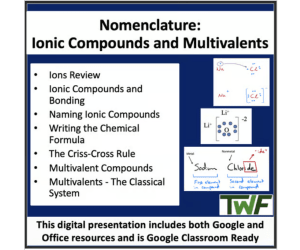
Nomenclature -Ionic Compounds & Multivalents - Senior Chemistry Lesson
Science, Chemistry, Grade 10, 11, 12, Teacher Tools, Lesson Plans
Nomenclature - Ionic Compounds & Multivalents - Senior Chemistry Lesson Your lesson covers naming ionic compounds and multivalents. In order, the lesson teaches about; Ions, Ionic Compounds and Bonding, Naming Ionic Compounds, Writing the Chemical Formula, The Criss-Cross Rule, Multivalent Compounds, and Multivalents - The Classical System. Your lesson includes the teacher and student version of the presentation, an auto-graded exit ticket, and a student lesson handout so the students can record the notes on a more condensed medium. This lesson is designed to be your go-to resource, whether you're in a traditional classroom or a virtual one. With both a teacher version and a student version, it seamlessly fits into your lesson plans, making learning engaging and adaptable. Assessment made easy We've included an auto-graded Exit Ticket and a quiz with an answer key because I know you don't have an excess of time. I know you don't, because I don't and I know I'll do whatever I can to reduce my grading time. Whether you use PowerPoint or Google Slides, prefer Word or Google Docs, this lesson has you covered. This lesson comes in both Office and Google formats for your convenience. The student version of the presentation has strategically placed blanks for them to fill in as you're teaching. It keeps them active and engaged, encourages discussion, and leaves more time for those "aha" moments.
Author Teach With Fergy
Tags Chemistry Lesson, Lewis Structures, Valence Electrons, Octet Rule, Ionic Bonding, Multivalent Ions, Ions, Naming Ionic Compounds, Bonding

What is Coding? | Animated Coding Video Lesson
Science, Technology, Computer Science, Grade 9, 10, 11, 12, Lesson Plans, Teacher Tools
What is Coding? | Animated Coding Video Lesson This 3-minute animated video serves as an engaging introduction to computer coding concepts for secondary school students. By watching the interactive visuals in this lesson, learners of all abilities can better understand the foundations of coding in a fun and memorable way. Educators may show this informative video to entire classes or small groups to spur discussions about programming languages and real-world applications. Whether used to introduce coding and computer science principles or to review core ideas, this lively animated lesson aims to get students excited about the creative potential of writing code. With vivid images and clear narration pitched at a grade 7-8 level, the video breaks down coding basics like algorithms, debugging, loops, conditionals, variables, and functions.
Author Educational Voice
Tags Coding Lesson, Computer Science, Computer Coding, Technology, Google
I WONDER - What Is The Future Of Pesticides | Animated Video Lesson
Animals, Life Sciences, Science, Insects, Nature & Plants, Grade 4, 5, 6, 7, 8, 9, 10, Lesson Plans, Teacher Tools
Video Introduction An amazing video designed for the students to learn more about STEM. I WONDER - What Is The Future Of Pesticides | Animated Video Lesson Plants world is really fascinating! Do you know that some flowers eat insects? Some other plants like to grow on walls can you mention any? Do you know what is the difference between fungicide and pesticide? If yes, Can you tell us more about it? What is nuclear energy? Is it safe to use it? Do you think it is a clean energy? Have you ever read about potential energy? If yes, tell us what it is? Do you think that potential energy can be converted into another form of energy? How it happens? I WONDER - What Is The Future Of Pesticides | Animated Video Lesson The video is perfect for encouraging the researching skills for the students, while learning more about this fantastic topic. I WONDER - What Is The Future Of Pesticides | Animated Video Lesson This friendly designed video is suitable for students at school, homeschooling, and as a group activity. Format Available in MP4 format.
Author Educational Voice
Rating
Tags What Is The Future Of Pesticides, The Future Of Pesticides, The Future Of Pesticides Facts, The Future Of Pesticides Video, The Future Of Pesticides Video For Kids, The Future Of Pesticides Facts For Kids, Pesticides

I WONDER - What Are The Different Types Of Joints | Animated Video
Human Body, Life Sciences, Science, Biology, STEM, Grade 5, 6, 7, 8, 9, 10, 11, Lesson Plans, Teacher Tools
Video Overview The human body is full of fascinating wonders to learn. This video is created to help the students recognize the anatomy and the job of the human body. I WONDER - What Are The Different Types Of Joints | Animated Video Lesson Every part and organ in our human body is vital so let's see how important they are. Have you ever imagined how we look like if we didn't have a skeleton? Did you know that because we have our amazing muscles we can stand! Do you know how many teeth do we have? Have you ever wondered about the food journey inside our body? Can you name all the glands in our body? Why do we have skin? Our nervous system is really good at sending signals. Can you tell us more about it? Are you really good at Mathematics, painting, or any other thing? You should really thank your brain about it! The famous five senses are really doing a great work? Can you explain how every sense works? I WONDER - What Are The Different Types Of Joints | Animated Video Lesson The video is perfect for encouraging the researching skills for the students, while learning more about our fantastic human body. I WONDER - What Are The Different Types Of Joints | Animated Video Lesson This friendly designed video is suitable for students at school, homeschooling, and as a group activity. Format Available in MP4 format.
Author Educational Voice
Tags What Are The Different Types Of Joints, What Are The Different Types Of Joints Video, Different Types Of Joints, Different Types Of Joints Facts, Different Types Of Joints Facts For Kids, Different Types Of Joints Video

I WONDER - How Did The Ankylosaurus Use Its Tail | Animated Video
History: Ancient, History, Social Studies, History: World, Human Body, Life Sciences, Science, Grade 4, 5, 6, 7, 8, 9, 10, Lesson Plans, Teacher Tools
Video Introduction An amazing video designed for the students to learn more about dinosaurs in different countries. I WONDER - How Did The Ankylosaurus Use Its Tail | Animated Video Lesson Do you like dinosaurs? what is your favorite one? Do you own a pet? If yes, tell us more about it, like what its name? And what do you like most about it? Do you think that your pet has been evolved from a dinosaur? Can you write down the characteristics of your favourite dinosaur like it's shape, their rivals, where did it use to live and what was their favourite food? What is the largest and the smallest dinosaur that ever found? Why is the T-rex is so famous? Have you ever read any interesting facts about it? Can you name any of the carnivores or herbivores dinosaurs? I WONDER - How Did The Ankylosaurus Use Its Tail | Animated Video Lesson The video is perfect for encouraging the researching skills for the students, while learning more about dinosaurs. I WONDER - How Did The Ankylosaurus Use Its Tail | Animated Video Lesson This friendly designed video is suitable for students at school, homeschooling, and as a group activity. Format Available in MP4 format.
Author Educational Voice
Rating
Tags How Did The Ankylosaurus Use Its Tail, How Did The Ankylosaurus Use Its Tail Video, Ankylosaurus, Ankylosaurus Facts, Ankylosaurus Video, Ankylosaurus Facts For Kids, Ankylosaurus Video For Kids
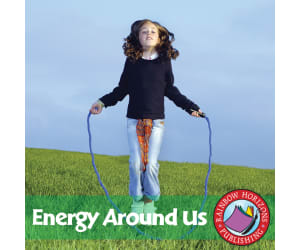
Energy Around Us Gr. 4-7
Science, Physics, Grade 4, 5, Teacher Tools, Lesson Plans
Energy Around Us Gr. 4-7: A Comprehensive Teaching Resource The 'Energy Around Us Gr. 4-7' product is a comprehensive teaching resource for educators aiming to immerse students into the complex facets of energy. Whether public school teachers or homeschoolers, it offers engaging tie-in activities while introducing various forms of energy and exploring energy transformation. Centricity on Physical Science This unit is primarily focused on Physical Science, unveiling critical information through a series of student notes that emerge as lessons progress. The Science Challenge Format Promotes cooperative learning. Fosters problem-solving related to each lesson's theme. Serves as an active learning platform crucial for understanding complex scientific concepts like energy transformation. Beyond Interactive Sessions: Including exercises such as crosswords and word searches to reinforce knowledge in an enjoyable way, it ensures interactive sessions aren't limited only to student note discussions. Utilization across different teaching setups without disruption along with its applicability from grade 4 up-to grade 7 frameworks makes this resource a practical tool for teachers. A holistic approach: Educational reading passages, energy-themed activities, xpath management solutions- All these features bring together a balance between complexity and comprehensibility making 'Energy Around Us Gr. 4-7' the perfect choice in understanding physical science topics associated with energy attributions. Encased within easy access PDF files without having issues around software compatibility this resource effectively fuses fun with learning whilst understanding the omnipresent nature of energy!
Author Classroom Complete Press
Tags PDF

I WONDER - What Are The Different Blood Types | Animated Video Lesson
Human Body, Life Sciences, Science, Biology, STEM, Grade 6, 7, 8, 9, 10, 11, 12, Lesson Plans, Teacher Tools
Video Overview The human body is full of fascinating wonders to learn. This video is created to help the students recognize the anatomy and the job of the human body. I WONDER - What Are The Different Blood Types | Animated Video Lesson Every part and organ in our human body is vital so let's see how important they are. Have you ever imagined how we look like if we didn't have a skeleton? Did you know that because we have our amazing muscles we can stand! Do you know how many teeth do we have? Have you ever wondered about the food journey inside our body? Can you name all the glands in our body? Why do we have skin? Our nervous system is really good at sending signals. Can you tell us more about it? Are you really good at Mathematics, painting, or any other thing? You should really thank your brain about it! The famous five senses are really doing a great work? Can you explain how every sense works? I WONDER - What Are The Different Blood Types | Animated Video Lesson The video is perfect for encouraging the researching skills for the students, while learning more about our fantastic human body. I WONDER - What Are The Different Blood Types | Animated Video Lesson This friendly designed video is suitable for students at school, homeschooling, and as a group activity. Format Available in MP4 format.
Author Educational Voice
Tags What Are The Different Blood Types, What Are The Different Blood Types Video, Different Blood Types, Different Blood Types Facts, Different Blood Types Facts For Kids, Different Blood Types Video, Different Blood Types Video For Kids
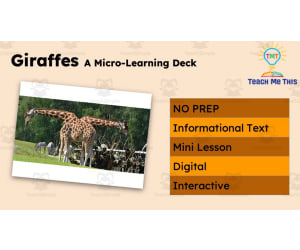
Giraffes | Reading Comprehension Deck | Interactive Lesson
Science, Life Sciences, Animals, Grade 4, 5, 6, Teacher Tools, Lesson Plans
Giraffes | Reading Comprehension Lesson Plan for Upper Elementary Students This interactive reading comprehension lesson plan teaches upper elementary students about giraffes. Through an engaging video, reading passage with audio, close reading activity, and quick write assessment , students will learn facts about giraffes' appearance, habitat, diet, and behavior. Teachers can implement this resource in multiple ways - as a whole class lesson, small group activity, independent work, or homework assignment. The mixture of informal assessments and informational text will keep students engaged from start to finish while improving their reading comprehension and content knowledge. This digital slideshow lesson plan can easily supplement any elementary science or social studies curriculum in need of a boost on animal classification or habitats.
Author Teach Me This
Tags Giraffes, Reading, Comprehension, Zoology, Interactive Lesson
Global Warming REDUCTION: The Masdar Initiative - FLASH-PC
Science, Earth and Environmental Sciences, Environmental Science, Common Core, Grade 5, 6, 7, 8, Teacher Tools, Lesson Plans
The Global Warming REDUCTION: The Masdar Initiative - FLASH-PC This is an exceptional education tool for primarily Grades 5 through 8 teachers and homeschoolers. Centered on environmental science, it enhances learner's understanding of the Masdar Initiative for Global Warming Reduction. Key Features: A unique blend of technology and content including software compatible with PCs enables interactive activities to bring learning to life. Offers a graduated learning experience based on Bloom's Taxonomy from knowledge recollection through synthesis and evaluation. Includes reading passages specifically designed to educate on the Masdar initiative, paired with 'before you read' and 'after you read' comprehension questions. Vocabulary flash cards included to aid mastery over crucial terminologies. Multimedia Benefits: Tool includes video and audio facilities enhancing visual understanding while catering to a variety of learning styles within your student group at large. Flexible Uses Include: Whole group instruction , An individual homework assignment, Small focus groups, or The resource can be tailored around your specific pedagogical requirements maintaining engagement amongst students along varied levels of proficiency ensuring every learner benefits effectively from each session. Adhering closely to Common Core State Standards, using this tool assures alignment with recognized academic benchmarks equipping learners adequately towards mastering grade-level expectations successfully. In conclusion,"Delve deeper into the realm of environmental science and evoke in your students a sense of responsibility towards reducing global warming."</p
Author Classroom Complete Press
Tags Software (PC)

High School Amphibians Reading Passage Bundle
ELA, Reading, Reading Comprehension, Science, Life Sciences, Animals, Biology, Resources for Teachers, High School, Homeschool Resources, Teacher Tools, Assessments, Worksheets & Printables, Writing Prompts, Quizzes and Tests, Rubrics, Lesson Plans
As a homeschool mom of a high schooler and a passionate resource creator, I know firsthand how challenging it can be to find engaging, rigorous science materials that truly captivate older learners. That exact struggle inspired me to design this comprehensive, High School Amphibians Reading Passage Bundle resource focused entirely on the fascinating biology of amphibians. Whether you are guiding your teenager through independent study or building a robust weekly science unit, this High School Amphibians Reading Passage Bundle resource transforms complex ecological concepts into clear, digestible learning milestones. Furthermore, my goal was to save you countless hours of planning by bundling an information-rich reading passage, extensive critical thinking prompts, note-taking sheets, academic vocabulary tools, and a complete assessment framework into one cohesive bundle. INCLUDED IN THIS RESOURCE: Comprehensive text covering amphibian biology and evolution. Analytical questions with paragraph-format answer keys. Forty terms with parts of speech, definitions, and quizzes. Detailed grading structures, scales, and complex rubrics. TOPICS COVERED: Gas exchange via permeable skin barriers. Thyroxine-driven developmental transformations. Predator-prey dynamics in global food webs. Chytrid fungi and anthropogenic extinction threats. Investing in this carefully curated High School Amphibians Reading Passage Bundle will elevate your high school science curriculum while bringing excitement back into your daily homeschool routine. By combining rigorous academic content with practical, time-saving printables and transparent rubrics, you can foster a genuine appreciation for evolutionary biology without the stress of heavy lesson planning. Truly, this resource bridges the gap between high-level scientific inquiry and accessible home education, ensuring both you and your teenager achieve academic success. Grab your copy today and watch your high schooler transform into a confident, scientifically literate steward of the natural world. If you and your students/homeschoolers enjoyed this resource, please leave a review. Thank you for your support! Tina - Big Easy Homeschooling Mom
Author Homeschool with Big Easy Homeschooling Mom
Rating
Tags Biology Lesson

Reducing Your Community's Carbon Footprint Gr. 5-8
Science, Earth and Environmental Sciences, Environmental Science, Grade 5, 6, 7, 8, Teacher Tools, Lesson Plans
Reducing Your Community's Carbon Footprint Gr. 5-8 A comprehensive teaching resource designed to inspire and engage students in grades 5 through 8 to contribute actively towards environmental preservation. About the Resource: This resource encourages learners to investigate and understand the concept of carbon footprints and their effects on global climates and habitats. Besides theoretical knowledge, it invites them to examine subjects like urbanization, Cuba's eco-friendly agricultural model, and the urban heat island phenomenon - key components for understanding our impact on the environment. The tool promotes creativity by urging students to formulate unique ways of repurposing waste in their local communities. Global Green Communities: This educational guide also aims to increase awareness about existing green communities worldwide, inspiring students not just understand these practices but consider how they can be incorporated into their own communities. Supplemental Materials: To boost engagement comprehension this web-based tutorial presents a wealth of added resources which include graphic organizers a carbon footprint calculator educational games such as word searches crossword puzzles. Note: In both public school education or homeschooling context this versatile lesson plan can adapt across different learning environments allowing assignment whole-class instruction smaller group activities occasional independent study homework elements. Pedagogical Approach: The distinctiveness this digital guide lies its alignment with both Bloom Taxonomy hierarchical model used classifying learning objectives STEAM Science Tech Engineering Art Math principles. This substantiates academic robustness while encouraging interdisciplinary exploration particularly relating science aspects that are interwoven with technology engineering art math contexts foundational knowledge credits it adheres to. Conclusion: Instilling constructive environmental practices amongst young learners necessitates useful effective resources like Reducing Your Community's Carbon Footprint Gr. A perfect addition to educators' teaching portfolios offering value beyond a conventional classroom dissemination extending the reach wider community level.
Author Classroom Complete Press
Tags PDF

Atoms and the Periodic Table Middle School Chemistry - Lesson Bundle
Science, Chemistry, Grade 6, 7, 8, Teacher Tools, Lesson Plans
An introduction to Atoms and the Periodic Table. This introductory lesson is geared towards middle school students and lower-level achieving high school students. The PowerPoint contains diagrams, five embedded videos, examples, discussion lead-ins, and explanations that will keep your students interested throughout. Your lesson bundle includes a teacher and student version in both PowerPoint and PDF formats and a basic lab activity that will have your students testing the pH of common substances. In order, the lesson covers: - How atoms are studied - The size of an atom - Current Atomic Model - Atomic structure and notation - Protons - Neutrons - Electrons - Atomic Number - Mass Number - Atomic Symbols - History of the periodic table - Element squares The student version of the PowerPoint contains multiple blanks that need to be filled in throughout the lesson. These blanks are conveniently underlined and bolded on the teacher copy. I have found this to be the most effective means of keeping my students engaged and active without having them write everything out. This also leaves more time for discussion and activities. This file is in .zip format. All that means is you download the lesson package as one file (.zip) and then double-click it to extract it. No additional software is needed, your PC or Mac will do all the work. Please view the Preview File to obtain a sense of my style, see how my PowerPoint lesson is structured and evaluate my work. If you are not 100% happy with what you purchase, I will refund your entire purchase price via PayPal. To access the video(s), begin the slideshow and click the image of the video player. A new window will open up taking you directly to the video. Also, please visit my blog Teach With Fergy for my thoughts on teaching, learning and everything in between.
Author Teach With Fergy
Tags Atoms, Periodic Table, Middle School Chemistry, Lesson Bundle, Student Outline, Periodic Table Video For Middle School, Middle School Chemistry Com, Periodic Table Projects Middle School
Climate Change: Effects: Extreme Weather Gr. 5-8
Science, Earth and Environmental Sciences, Environmental Science, Grade 5, 6, 7, 8, Teacher Tools, Lesson Plans
Climate Change: Effects: Extreme Weather Gr. 5-8 is a comprehensive and insightful resource that aids educators in explaining the impacts of climate change on the environment and human life. Focusing on 'Extreme Weather', this teaching material provides an opportunity for students to understand beginner-level environmental science. The unique learning tool integrates Bloom's Taxonomy and STEAM initiatives, inspecting how climate has shaped human societal evolution over time, including significant historical periods such as Earth's various ice ages. Students are encouraged to see how early humans were directly affected by climatic shifts. Theoretical Knowledge with Practical Applications This resource blends theoretical knowledge with practical applications, suitable for whole group or small group instruction, or engaging homework assignments. It includes: Hands-on activities:: such as creating a melting ice sheet model for visual comprehension about its impact on sea level rise. Projection models:: showing rising sea levels in action, enabling learners to grasp this global issue tangibly. Potential Health Hazards and Economical Impacts Potential health hazards linked with climate change such as mosquito-borne diseases and heat strokes among other varied risks posed by pollution are explored. In addition, it addresses the economical impact - how drastic shifts in climate have detrimental effects on agricultural sectors' economies. Synthesis Exercise & Supplements An activity requiring learners to conduct research into one ecosystem's potential struggles against ongoing changes caused by shifting climates gives them an opportunity to synthesize knowledge gained so far. This is further complemented by supplements like crosswords and word search activities. Comprehension Quizzes Each lesson segment is concluded with comprehension quizzes designed to cement the learners' newly-acquired understanding. An answer key is provided for quick reference. Conclusion In a contemporary world where climate change is ever so perceptible, Climate Change: Effects: Extreme Weather Gr. 5-8, serves as a vital teaching aid for educators aiming to equip their students from Grade 5 to Grade 8 with informed perspectives about environmental science and the issue of climate change.
Author Classroom Complete Press
Tags PDF
I WONDER - How Big Is The White Rhinoceros | Animated Video Lesson
STEM, Animals, Life Sciences, Science, Biology, Grade 1, 2, 3, 4, 5, 6, 7, 8, Lesson Plans, Teacher Tools
Video Introduction Animal kingdoms are full of fascinating wonders to learn. This video is designed for the students to learn more about animals in different countries. I WONDER - How Big Is The White Rhinoceros | Animated Video Lesson Do you like animals? what is your favorite one? Do you own a pet? If yes, tell us more about it, like what its name? And what do you like most about it? What are the animal kingdoms? Can you write down the characteristics of each animal class like mammals, birds, reptiles, amphibian, fish and mollusks. Do you know that some animals can sing, can you name any of them? What is the largest and the smallest mammal in the world? What is the largest and the smallest bird in the world? What is the largest and the smallest fish in the world? I WONDER - How Big Is The White Rhinoceros | Animated Video Lesson The video is perfect for encouraging the researching skills for the students, while learning more about these fantastic animals. I WONDER - How Big Is The White Rhinoceros | Animated Video Lesson This friendly designed video is suitable for students at school, homeschooling, and as a group activity. Format Available in MP4 format.
Author Educational Voice
Tags How Big Is The White Rhinoceros, How Big Is The White Rhinoceros Video, White Rhinoceros, White Rhinoceros Facts, White Rhinocerosfacts For Kids, White Rhinoceros Video, White Rhinocerosvideo For Kids

I WONDER - What Is Humidity | Animated Video Lesson
Earth and Environmental Sciences, Science, Environmental Science, Earth Sciences, Grade 4, 5, 6, 7, 8, 9, 10, Lesson Plans, Teacher Tools
Video Introduction An amazing activity designed for the students to learn more about STEM. I WONDER - What Is Humidity | Animated Video Lesson Do you like STEM subjects? what is your favorite one? Have you ever tried to plant a seed? If yes, tell us more about it. Or have you ever tried to invent something? If yes, tell us more about it. And how do you think it will help us? Have you ever seen a microorganism under a microscope? What was it? And how it looked like? Mathematics is a marvelous subject. Let' sharpen our brains and solve some equations. Do you like timetable tricks? What is your favorite one? Do you know how to code? Have you ever created an app or a game before? If yes, how was it like? I WONDER - What Is Humidity | Animated Video Lesson The video is perfect for encouraging the researching skills for the students, while learning more about this fantastic topic. I WONDER - What Is Humidity | Animated Video Lesson This friendly designed video is suitable for students at school, homeschooling, and as a group activity. Format Available in MP4 format.
Author Educational Voice
Tags What Is Humidity, What Is Humidity Video, Humidity, Humidity Facts, Humidity Facts For Kids, Humidity Facts Video, Weather, Climate, Weather Facts, Weather Facts For Kids

I WONDER - Is Nuclear Energy Safe | Animated Video Lesson
Environmental Science, Earth and Environmental Sciences, Science, Earth Sciences, Grade 6, 7, 8, 9, 10, 11, 12, Lesson Plans, Teacher Tools
Video Introduction An amazing video designed for the students to learn more about STEM. I WONDER - Is Nuclear Energy Safe | Animated Video Lesson Do you like STEM subjects? what is your favorite one? Have you ever tried to plant a seed? If yes, tell us more about it. Or have you ever tried to invent something? If yes, tell us more about it. And how do you think it will help us? Have you ever seen a microorganism under a microscope? What was it? And how it looked like? Mathematics is a marvelous subject. Let' sharpen our brains and solve some equations. Do you like timetable tricks? What is your favorite one? Do you know how to code? Have you ever created an app or a game before? If yes, how was it like? I WONDER - Is Nuclear Energy Safe | Animated Video Lesson The video is perfect for encouraging the researching skills for the students, while learning more about this fantastic topic. I WONDER - Is Nuclear Energy Safe | Animated Video Lesson This friendly designed video is suitable for students at school, homeschooling, and as a group activity. Format Available in MP4 format.
Author Educational Voice
Tags Is Nuclear Energy Safe, Is Nuclear Energy Safe Video, Nuclear Energy, Nuclear Energy Facts, Nuclear Energy Facts For Kids, Nuclear Energy Video, Nuclear Energy Video For Kids, Energy

Global Warming CAUSES: Greenhouse Gases: Water Vapor - FLASH-MAC
Science, Earth and Environmental Sciences, Environmental Science, Common Core, Grade 5, 6, 7, 8, Teacher Tools, Lesson Plans
Global Warming CAUSES: Greenhouse Gases: Water Vapor - FLASH-MAC FLASH-MAC is an interactive, multimedia comprehension-based teaching resource developed for grades 5 to 8. It's uniquely designed for environmental science instruction with a focus on the complex topic of global warming. The Focus: Greenhouse Gases, primarily Water Vapor The product breaks down the primary causes of global warming- greenhouse gases, and specifically water vapor. The content is presented in an engaging way that makes it easy for young learners to understand these complex concepts. Packaged Offering: Structured lesson plans: Loaded with curriculum -oriented content and enriched reading passages. Educational aids:'Before you read' and 'after you read' questions integrated within the package foster critical thinking abilities. Tangible learning aids:Vocabulary flashcards that double up as excellent supplements while studying environmental science nuances. Diverse Teaching Approaches The platform allows resources to be implemented in various ways depending on classroom specifics – whole-group instructions, small group discussions, or even homework assignments. Multimedia Learning Elements Integrated In addition to reading materials,this unique offering includes video and audio components - promoting better cognitive retention among students through varied stimuli. Also included are interactive activities for practical applications of acquired knowledge. Digital Classroom Compatible Product! The product also includes software specifically designed for Mac users ensuring ease of implementation within digital classrooms. Incorporating Educational Standards! Every aspect adheres to Common Core State Standards (CCSS) and is aligned with Bloom's Taxonomy principles – a balanced fusion of standard requirements and higher-order thinking skills. Regardless if you’re a public school teacher or homeschooler, this resource can help teach one of the most pressing topics in environmental science- the causes of global warming — with concrete focus on greenhouse gases and water vapor.
Author Classroom Complete Press
Tags Software (Mac)

X-Rays Reading Comprehension Passage - Cored Ed Encyclopedia
ELA, Language Development, Reading Comprehension, Reading, Science, Technology, Physics, History, Social Studies, Pre-Reading, Grade 2, 3, 4, 5, Worksheets & Printables, Worksheets, Teacher Tools, Centers, Activities, Writing Prompts, Assessments, Quizzes and Tests, Quizzes, Lesson Plans
This x-rays reading comprehension with lesson plan includes: Visualization (on the front cover) Start your lesson by taking a minute to think and share something about the topic. Read the script aloud (slowly), perhaps prepare some music or sound effects. Student close their eyes and let their imaginations wander. Students open their eyes, read the question aloud and give them a few minutes to complete. Ask a few students to share or keep answers until the end to compare with what they learn in the passage. Quick pause—thousands of Cored Education products are included with your TeachSimple membership. Download links and encyclopedia index available here. Pre-Reading Trivia Students will write down one thing they already know about the subject and then read five more facts and discuss. These facts are fun, and the students will enjoy learning about the subject before reading more. Give 1 minute for students to write what they already know (no pressure—best guess is fine). Read the five facts together. After each fact, do ask a student for their opinion, was it surprising? Set a purpose by asking students to highlight/underline one fact they want to learn more about during the reading. Reading Passage The text is a high-interest reading passage with set paragraphs, roughly three to four paragraphs long. It contains a variety of themes about the topic, anywhere from history to technology. The passage is between 250 and 350 words in length. First, ask students to look at the headings and see what they’ll learn about today. What do they know about the topic/heading? First read options: Teacher read-aloud (best for support). Partner reading (paragraph by paragraph). While reading, students underline important details, and vocabulary words they think may come up in the questions section. Mixed Questions The first question page contains four multiple-choice questions, each with a choice of four answers, and three written response questions that require a sentence or two from the student. Students complete the mcqs first independently, then review quickly as a class. For the 3 written responses, try to get students giving the answer with some form of evidence: “I think ___ because the text says ___.” If students get stuck, send them back to check the passage. Vocabulary Questions Practice seven key words from the text in this section across two activities. First section is scrambled words where students will unscramble three words given a clue for each. The second section is a word to meaning matching activity. Before starting, have some students read out words they underlined in the passage. Ask students to say the word and read aloud the sentence(s) around each word. Ask students to do scrambled words and the matching exercise in pairs then go through answers as a class. For the scrambled spelling task, get four pairs to come up to the board and write the words for extra practice with the other student reading out the clue. For the matching task, prompt students to give full sentences: “I matched ___ with ___ because ___.” Creative Writing In this question, the student will be required to write a five to eight sentence paragraph on a question related to the topic. Before starting, ask students write down 3 key ideas they are going to include in their piece. Ask students for ideas to share around the class to help those struggling. Pro writing expectations: 5–8 sentences At least 2 facts or details from the passage At least 2 vocabulary words from the previous page Students read their paragraphs while classmates listen for facts and vocabulary words. Extension Activities This page is optional for fast finishers or to take home. There are several activities, each one requiring a different skill. Do some, do none, do all, completely optional - but you will feel reassured knowing every possibility is planned for. Includes summary writting question. Answer Key There are answers for the multiple-choice questions, written response questions have sample answers, vocabulary answers and if there is a summary question then a sample summary will be provided as well. Lesson Plan Included Customized lesson plan for this lesson is included. Lesson Snapshot Title: X-Rays Genre: Nonfiction (informational text) Subject: Science (energy, technology, space science) / Informational Reading Primary Topic: Discovering X-rays and how they’re used Estimated Guided Reading Level (A–Z): R Support pages present: Pre-reading trivia; mixed questions; vocabulary page; creative writing; extension activities; answer key What This Lesson Teaches Best How Wilhelm Conrad Röntgen noticed a surprising glow in a dark lab and named the mystery ray “X.” Why X-ray pictures look like “shadow pictures,” with bone and metal stopping rays more than skin and soft tissue. How X-rays help doctors and dentists see inside the body without surgery, and how CT scans use many X-rays from different angles. That X-ray doses are kept as low as possible because X-rays can damage cells. How X-rays are used beyond hospitals, including security scanners and space telescopes on satellites that collect X-rays from hot places near black holes. Learning Goals Students will describe what happened in the lab that made the discovery of X-rays possible. Students will explain why bone and soft tissues show up differently on an X-ray picture. Students will identify how X-rays help doctors or dentists look inside the body without cutting. Students will describe what the text says about safety and why doses are kept low. Students will give an example of an X-ray use outside a doctor’s office found in the passage. Key Vocabulary From the Text invisible — not able to be seen. mystery — something not understood yet. detector — a tool that records the X-rays. tissues — soft parts inside the body. wavelength — the size/length of a wave. FULL CATALOG OF DOWNLOAD LINKS AND ENCYCLOPEDIA INDEX HERE
Author Cored Education
Rating
Tags Vocabulary, Reading Comprehension, Reading Passages, Lesson Plans, Ela Lesson Plans, Reading Comprehension Lesson Plans, Pre-reading, Science Lesson Plans, History Lesson Plans, Physics

Cells,Skeletal & Muscular Systems: The Skeletal System - Joints and Cartilage - FLASH-PC
Science, Life Sciences, Human Body, Common Core, Grade 5, 6, 7, 8, Teacher Tools, Lesson Plans
Cells, Skeletal & Muscular Systems: The Skeletal System - Joints and Cartilage - FLASH-PC A meticulously crafted learning experience that delves into the captivating realms of cells, skeletal structures, and muscular systems. This educational package focuses primarily on joints and cartilage. Key Features: Curriculum -Requisites: Designed to meet educational guidelines with reading passages that engage young minds. 'Before You Read' & 'After You Read' Questions: Aids in the assimilation of key concepts. Vocabulary Flashcards: Helps strengthen concept absorption. Printables: Making the education circle complete for both educators and students. The product also includes graphic organizers to help comprehend intricate content and interactive activities promoting hands-on learning approach. All features are designed in compliance with Common Core State Standards ensuring your lesson aspects adhere resolutely to necessary educational guidelines. User-Friendly Product File Features Intricately designed keeping ease-of-use in mind Caters to various levels under Bloom's Taxonomy accrediting its range covering different capabilities across your student cohort. Aid your teaching toolkit with our unique digital resources today suitable for Grade 5-8 science classes focusing on human anatomy sub-topics!
Author Classroom Complete Press
Tags Software (PC)

Ecosystems: Photosynthesis
Science, Earth and Environmental Sciences, Environmental Science, Common Core, Grade 5, 6, 7, 8, Teacher Tools, Lesson Plans
Ecosystems: Photosynthesis An incredibly useful resource for educators focused on making the understanding of ecosystems more accessible for students in grades 5-8. The resources delve into the details of biotic and abiotic ecosystems with crisp language and striking examples targeted at younger learners. Main Topics: Photosynthesis: A core chapter that explains the contrast between producers, consumers, and decomposers. Populations & Ecosystem Changes: Engaging content addressing changes in populations and their ecosystems, stimulating critical thinking while reinforcing subject matter understanding. The resource perfectly blends theory with practical application. It offers exciting activities crafted specially for middle-grade science classrooms ensuring an immersive learning experience through hands-on student participation. Connectivity within natural systems Evidence about how the water cycles interact with all nature's systems—from humans to microorganisms—is given through vibrant color mini posters included as visual aids. These can be employed either during full-class dialogues or one-on-one study sessions to facilitate comprehension of complex scientific ideas. Understanding Food Chains & Webs In an effortlessly comprehensible manner, light is shed on key environmental science concepts—food chains and food webs. This module serves a variety of schoolroom applications such as homework assignments or resources during collective group chats where students work collaboratively on reinforcing ecosystem principles. About this resource: A total of 26 ready-to-print pages combined into a single PDF file makes lesson planning hassle-free allowing efficient time utilization by teachers. Compatible With Common Core State Standards ensuring its applicability across various educational curriculums worldwide aiding tutors navigate today's educational requirements effortlessly. To sum it up: This constructive PDF lesson plan keeps your students occupied while consolidating vital scientific principles essential to Environmental Science. It makes gaining a thorough understanding of ecosystems, especially photosynthesis, simpler for learners.
Author Classroom Complete Press
Tags Ecosystems, Science Lesson, Plant Life Cycle, Photosynthesis, Environment Lesson

I WONDER - How Cacti Survive In The Desert | Animated Video Lesson
Biology, Life Sciences, Science, Nature & Plants, Grade 4, 5, Lesson Plans, Teacher Tools
Video Introduction An amazing activity designed for the students to learn more about STEM. I WONDER - How Cacti Survive In The Desert | Animated Video Lesson Do you like STEM subjects? what is your favorite one? Have you ever tried to plant a seed? If yes, tell us more about it. Or have you ever tried to invent something? If yes, tell us more about it. And how do you think it will help us? Have you ever seen a microorganism under a microscope? What was it? And how it looked like? Mathematics is a marvelous subject. Let' sharpen our brains and solve some equations. Do you like timetable tricks? What is your favorite one? Do you know how to code? Have you ever created an app or a game before? If yes, how was it like? I WONDER - How Cacti Survive In The Desert | Animated Video Lesson The video is perfect for encouraging the researching skills for the students, while learning more about this fantastic topic. I WONDER - How Cacti Survive In The Desert | Animated Video Lesson This friendly designed video is suitable for students at school, homeschooling, and as a group activity. Format Available in MP4 format.
Author Educational Voice
Tags How Cacti Survive In The Desert, How Cacti Survive In The Desert Videos, Cacti, Cacti Facts, Cacti Facts For Kids, Cacti Facts Video, Cactus, Cactus Facts, Desery, Desert Facts
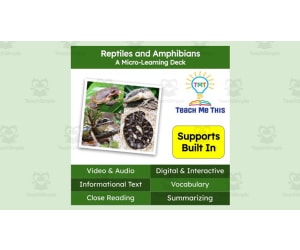
Reptiles and Amphibians | Interactive Science Lesson | Micro-Learning Deck
Science, Life Sciences, Animals, Grade 6, 7, 8, 9, Teacher Tools, Lesson Plans
This micro-learning deck is the perfect accessory to your Science instruction! This digital slideshow presents Reptiles and Amphibians. Within this slideshow, you will receive: -Video Lesson -Reading Passage w/ Audio -Close Reading -Quick Write The informational texts included in this resource alongside the informal assessments will keep your students engaged from beginning to end.
Author Teach Me This
Tags Reptiles, Amphibians, Interactive, Science, Digital Lesson
I WONDER - Where Did The Microraptor Hunt | Animated Video Lesson
History: Ancient, History, Social Studies, History: World, Animals, Life Sciences, Science, Grade 4, 5, 6, 7, 8, 9, 10, Lesson Plans, Teacher Tools
Video Introduction An amazing video designed for the students to learn more about dinosaurs in different countries. I WONDER - Where Did The Microraptor Hunt | Animated Video Lesson Do you like dinosaurs? what is your favorite one? Do you own a pet? If yes, tell us more about it, like what its name? And what do you like most about it? Do you think that your pet has been evolved from a dinosaur? Can you write down the characteristics of your favourite dinosaur like it's shape, their rivals, where did it use to live and what was their favourite food? What is the largest and the smallest dinosaur that ever found? Why is the T-rex is so famous? Have you ever read any interesting facts about it? Can you name any of the carnivores or herbivores dinosaurs? I WONDER - Where Did The Microraptor Hunt | Animated Video Lesson The video is perfect for encouraging the researching skills for the students, while learning more about dinosaurs. I WONDER - Where Did The Microraptor Hunt | Animated Video Lesson This friendly designed video is suitable for students at school, homeschooling, and as a group activity. Format Available in MP4 format.
Author Educational Voice
Rating
Tags Where Did The Microraptor Hunt, Where Did The Microraptor Hunt Video, Microraptor, Microraptor Facts, Microraptor Video, Microraptor Video For Kids, Microraptor Facts For Kids, Dinosaur